



Abstract
This study investigated the mediator effect of satisfaction with family life in the relationship between social ignore and social media addiction among adolescents. The research was conducted on 456 high school students studying in the 2019 academic year. Ages of the students vary between 14 and 16 years old. Social Media Addiction Scale, Social Ostracism Scale, and Satisfaction with Family Life Scale were used to collect data. SPSS 25 software package and PROCESS software package developed by Hayes as an add-on to SPSS were used in the data analysis. It was found that social ignore predicted social media addiction positive significantly and satisfaction with family life negatively. It was observed that satisfaction with family life predicted social media addiction negative significantly. It was also found that satisfaction with family life mediated the relationship between social ignore and social media addiction.
Introduction
Adolescence is a stormy (challenging, exciting, and anxious) period for most individuals (Plotnik, 2009). This period during which emotional, cognitive, and physiological changes are experienced at a fast pace may pose various risks for the individual. One can argue that some of these risks include risks about dysfunctional use of technology which may be caused by adolescent’s different searches as their social needs are not met in the real world and they cannot receive the very emotional and social support they need from their family. Use of social media as a technological tool has become increasingly popular all around the world. According to the 2020 data, 4 billion people use social media networks around the world, and there is an increase of about 2 million per month (We are Social, 2020). The dramatic increase in social media use particularly among children and adolescents (O’Keeffe & Clarke-Pearson, 2011) assumingly paves the way for the emergence of social media addiction as a type of behavioral addiction that adversely affects adolescents in particular. Indeed, a relationship is observed in the literature between intensive use of social media networks and social media addiction (Al Kord, 2016; Yüksel et al., 2020).
Behavioral addictions are defined as a type of addiction which is not associated with substance abuse but share some common aspects with substance addiction (American Psychiatric Association, 2013). While this definition covers the social media addiction, there is no definition of social media addiction on which there is consensus in the literature (Van den Eijnden et al., 2016).
For most people, social networks are a space where they express who they are. However, it can be an addictive space for some. There is a fine line between both uses (Griffiths & Kuss, 2017). No consensus on the definition of social media addiction can affect future studies in the field negatively. Despite the lack of a clear definition, concrete consequences of social media addiction are observable. Social media addiction continues to have an impact on the lives of humans through signs such as constant occupation of mind with social media, using social media to get rid of negative emotions, increased usage, withdrawal symptoms once social media use is inhibited, negligence of responsibilities due to social media use or impaired functionality in other important domains of life due to social media use, and loss of control in social media use (Andreassen et al., 2017). Accordingly, social media addiction can be defined as a psychological problem that develops through psychological processes and lead to problems in individual’s life such as occupation, mood regulation, repetition, and conflict in the business, academic, private, and social life (Tutgun-Ünal, 2015)
In the literature, social media addiction is observed to be negatively correlated with satisfaction with family life (Savcı et al., 2020), social connection (Savcı & Aysan, 2017), social support and psychological resilience (Bilgin & Taş, 2018), self-esteem (Hawi & Samaha, 2017; Kırçaburun, 2016), satisfaction with life (Şahin, 2017; Yüksel et al., 2020), and positively correlated with depression and daily internet use (Kırçaburun, 2016), social media envy, social media burnout, and anxiety for use of social media (Liu & Ma, 2020), and loneliness (Yüksel et al., 2020). It is also seen that social media use is predicted by family relations and loneliness (Doğan & Karakuş, 2016) and negative feedbacks to social media profiles of adolescents has a negative effect on their self-esteem (Valkenburg et al., 2006).
It is important to determine frequency and intensity of social media addiction which is and seemingly will be a current problem (Van den Eijnden et al., 2016) and negative consequences of social networks and other disorders accompanying the social media addiction (Kuss & Griffiths, 2011). It is also of importance to identify the variables that affect and are affected by social media addiction to mitigate or eliminate its negative effects on children and adolescents. Hence, the relationship between social ignore, which is thought to trigger social media addiction, and satisfaction with family life, which is thought to reduce social media addiction, was examined in this study.
Social Ignore and Social Media Addiction
Discussed as individual’s status within the peer group (Kaya, 2005), social acceptance is one of the factors determining the emotional response level of the adolescent (Yavuzer, 2002). While the social acceptance of the adolescent is important for giving healthy emotional responses, social ostracism can lead to exhibiting emotional and behavioral responses. Because people depend on the group life for their lives, continuity of their well-being, their comfort, and many other positive things, and therefore, they strive to be accepted to a group (Baumeister et al., 2005). Addressed as a type of cyberbullying when employed by children and adolescents, social exclusion (Stanley & Arora, 1998) seems to involve the situation where individual is not in a social network (Williams et al., 2005) and consequent concern for deprivation of social gains (Molden et al., 2009).
Social ostracism is discussed as two subtypes: Exclusion and Ignore (Williams & Nida, 2011). Although both of aspects are not necessarily associated with each other (Williams et al., 2005), that is, both can be observed separately, it can be argued that both have negative effects on the individual. One of these effects is the desire to belong to a group, that the excluded individual becomes incapable of distinguishing the good from the bad, and that he/she becomes orientated toward extremist groups, sects, or belief groups with these feelings (Williams, 2007). Such orientation, as in the real world, can also be toward the virtual communities where they can feel belonged (Güzel, 2006).
Social ignore, described as a dimension of social exclusion in the literature, is one of the situations where humans have trouble when they experience it (Williams & Nida, 2011). People are quite sensitive to being ignored (Williams et al., 2000). They can seek to contact with others for getting rid of the pain caused by being ignored (Molden et al., 2009). Creating social connections and tendency to maintain those connections are considered as a basic need (Baumeister & Leary, 1995). According to Adler, social emotion as a natural inclination guides individual toward society, and it is very important to interact with society. Interaction with society is also an indicator of mental health (Eker, 2012). As a passive form of exclusion, social ignore is regarded as one of the barriers to this natural inclination.
Social media used for purposes such as socialization, information acquisition, entertainment, and communication (Uzun et al., 2016) can be a center of attraction especially for individuals with social problems. Whereas there are positive aspects of using social networks, the rewarding nature of the social networking sites leads individuals to check social networks constantly and to be overly intertwined with social media in an obsessive way, which can lead to psychological problems (Oberst et al., 2017). However, it is observed that individuals who make social connections in real life have lower levels of social media addiction (Savcı & Aysan, 2017). The studies on social ostracism found it to be in a negative relationship with satisfaction with school and school affection, in a positive relationship with romantic loneliness, familial loneliness, and social loneliness (Büyükcebeci & Deniz, 2017) with internet addiction (Poon, 2018; Taş & Öztosun, 2018) and with cyberbullying-cyber victimization (Gür, 2019). Social ostracism also found in a negative relationship with psychological resilience and a positive relationship with depression (Niu et al., 2016). Given the variables associated both with social exclusion and social media addiction, one can argue that both variables are also importantly interrelated. Lowering the social ignore levels among adolescents can also reduce the levels of social media addiction.
Satisfaction With Family Life as a Mediator Variable
Satisfaction with family life can be defined as individual’s level of satisfaction with the parent-child relationship or the relationship with siblings within the family (Carver & Jones, 1992). Satisfaction with family life is a product of verbal and physical interaction maintained by the individual with other members of the family. Once those interactions are reinforced, the individual is satisfied with the family; once they are punished, it is the contrary (Barraca et al., 2000).
One of the environments in which the adolescent may dispose of or reduce the negative impact of social ostracism is his/her family social environment. Family is an environment where the child has their first social experiences (Dönmezer, 1999) and also an important setting where their social needs will be met in days to come. Satisfaction with family life, which is considered the emotional atmosphere in the family, affects the individual’s feelings, thoughts, and behaviors toward the social environment (Çalışkan et al., 2017). Positive impacts of the social environment can be reinforced and its negative impacts can be compensated in the family environment. While the adolescents accepted in the family achieve emotional satisfaction, those who are excluded from the family may feel the need to fulfill the emotional satisfaction they cannot receive in different environments. One of these environments is the virtual world involving serious risks for the adolescents.
It is observed that adolescents seek the support, which they could not receive from their families, in the online world that allows them to socialize (Luciana, 2010). The orientation toward the online world allows for the fulfillment of unmet emotional needs and can bring about several problems such as social media addiction. As found in the literature, the negative correlation between satisfaction with life and social media addiction (Cavga, 2019) is important for pointing out the effect of satisfaction with life on social media addiction.
It is observed in the literature that satisfaction with family life is negatively correlated with anxiety, depression, somatization, negative self, and hostility (Çalışkan et al., 2017) and positively correlated with psychological resilience (Cavga, 2019) and empathic skills (Özgenel, Taş, et al., 2019). A similar study on adults (Bayram et al., 2010) concluded a negative correlation between satisfaction with life and social exclusion. However, studies related to family relations, family climate and family characteristics were reviewed as well since satisfaction with family life is considered the emotional atmosphere within the family. Accordingly, it was found that self-esteem of adolescents who were valued (heard, taken into consideration in the decision process, of whom problems were shared, to whom time was spared) in the family was significantly higher (Erbil et al., 2006). Studies found that the adolescents who perceived family relations to be negative had significantly higher levels of bullying and victimization than those who perceived family relationships to be positive (Cenkseven Onder & Yurtal, 2008) and that the adolescents who perceived their family environments to be healthy had significantly higher adaptation levels than those who did not perceive their family environments to be healthy (Kalyencioğlu & Kutlu, 2010). Karacaoğlu (2019) found that the children who had supportive family attitudes had significantly lower levels of computer gaming addiction than those who had obstructive family attitudes. Lai and McBride-Chang (2001) explored a positive relationship between negative family climate and suicidal thoughts. Based on the research in the literature, one can argue that a healthy or unhealthy family environment is quite effective in behaviors of children and adolescents.
This study focuses on the relationship between social ignore, which is a subtype of social ostracism, and social media addiction and satisfaction with family life among adolescents. No studies investigating the relationship among satisfaction with family life and social exclusion and social media addiction were observed in the literature. It is seen that satisfaction with family life is negatively correlated to depression, anxiety, hostility, negative self, and somatization (Çalışkan et al., 2017). Given the dramatic increase of social media addiction among adolescents and pubescent individuals (O’Keeffe & Clarke-Pearson, 2011), how social acceptance of the adolescents is determinative of his/her emotions and behaviors during this period (Yavuzer, 2002) and of the effect of his/her family environment on his/her development and examining the relationship among these three concepts becomes exteremely important. The fact that no studies related to these concepts were found in the literature makes the study meaningful. Accordingly, a mediation model was developed on the assumption that social ignore, which is a subtype of social exclusion, has an effect on social media addiction and part of this effect is achieved through satisfaction with family life. The developed model is presented below (in Figure 1)

The model suggested for the mediator role of satisfaction with family life in the relationship between social ignore and social media addiction among adolescents.
Acccording to the proposed model, “a” respresents the effect of social ignoring on family life satisfaction; “b” shows the effect of the family satisfaction on social media addiction; “c” denotes the direct effect of social ignoring on social media addiction; “c′” indicates the effect of the independent variable on the dependent variable after the mediating variable enters the model.
Method
Research Model
This study investigating the mediator effect of satisfaction with family life in the relationship between social ignore and social media addiction among adolescents utilized the relational survey model. The relationships between the variables in the research were analyzed with the mediation test. Mediation tests require a full or partial existence of another variable in the relationship between the two variables (Şimşek, 2007). Mediation tests are handled in two ways, namely mediation and partial mediation. In the mediation model, the relationship between the independent variable and the dependent variable disappears or weakens when the mediating variable enters the model, whereas in the partial mediation model, when the mediating variable enters the model, the relationship between the independent variable and the dependent variable maintains its significance, but a significant decrease is observed in this relationship (Yilmaz & Dalbudak, 2018).
Participants
The research group was composed of 456 high school students studying in the 2018 to 2019 academic year. About 246 (53.9%) of the participants are female, 210 (46.1%) of them are male. The participants’ age vary between 14 and 18 years old, and their average age is 15.54. In the research, the data were collected according to the convenience sampling method. The convenience sampling method refers to the collection of data from an easily accessible and applicable sample to eliminate the limitations that arise due to external variables that affect research, such as labor, time, and money (Büyüköztürk et al., 2010).
Instruments
Social ostracism scale
The scale was developed by Gilman et al. (2013) and adapted to the Turkish culture by Mercan (2016). The 11-item scale is composed of two subtypes: Ignore and Exclusion. Since there is no total score in the scale, each subtype can be used independently. The KMO value of the scale is 0.87, the Bartlett’s Test of Sphericity value is χ2 = 1,797 (p < .000). The factor loadings of the scale vary between 0.59 and 0.83. It is seen that Ignore explains 39.19% of the total variance of the scale. The Cronbach’s Alpha internal consistency coefficient of the scale is .82 for Ignore and .83 for Exclusion. Item-total correlations vary between .75 and .83. It appears that scale’s fit indices are within the acceptable limits (χ2 = 117.32, df = 43, (χ2/df = 2.73), RMSA = 0.061, GFI = 0.96, CFI = 0.96, NNFI = 0.95, SRMR = 0.044). The reliability analysis value (Cronbach’s Alpha) of the scale for this study is .81. This value indicates that the scale is a highly reliable instrument (Kayış, 2014).
Satisfaction with family life scale
It is a 23-item Likert scale developed by Çalışkan et al. (2017). KMO value of the scale is 0.938 and Bartlett’s Test of Sphericity value is χ2 = 6,134.525 (p < .01). The factor loadings of the scale vary between 0.53 and 0.79. The scale items explain 47% of the variance of satisfaction with family life. The Cronbach’s Alpha internal consistency coefficient of the scale is .95. Item-total correlations vary between .37 and .73. The reliability analysis value (Cronbach’s Alpha) of the scale for this study is .95. This value indicates that the scale is a highly reliable instrument (Kayış, 2014).
Social media addiction scale
The Social Media Addiction Scale was developed by Özgenel, Canpolat, et al. (2019). The scale consists of nine items and one factor. KMO value of the scale is .958 and Bartlett’s Test of Sphericity value is χ2 = 8,345.031 (p < .000). The factor loadings of the scale items vary between 0.690 and 0.790. It appears that the scale items explain 56.78% of the total variance of the scale. The Cronbach’s Alpha internal consistency coefficient of the scale is .90. Item-total correlations vary between .702 and .790. The fit indices of the scale appear to be within the acceptable limits (χ2/df = 2.694; GFI = 0.92; AGFI = 0.87; CFI = 0.95; RMR = 0.06; SRMR = 0.04). The reliability analysis value (Cronbach’s Alpha) of the scale for this study is .87. This value indicates that the scale is a highly reliable instrument (Kayış, 2014).
Collection and Analysis of the Data
The data were collected from the students personally and on a voluntary basis. They were informed that the collected data would be utilized for scientific purposes and kept confidential. Since the research group consisted of adolescents, parental consent was also obtained. Ethics committee approval was obtained for the research. The SPSS software package and PROCESS, which runs as an add-on to SPSS, were used in the data analysis. The effect of mediator variable was measured with PROCESS model 4 which is a macro added to the SPSS software by Hayes (2012). Using the non-parametric Bootstrapping method, this add-on performs the analysis on a sample of 5,000 individuals with a 95% confidence interval with the resampling method. The effect of the independent variable on the dependent variable was calculated with the scores of direct effect, indirect effect, and total effect. The effectiveness of the mediator variable is measured with the bootstrap confidence interval. The lower-upper limits of the confidence interval (BootLLCI-BootULCI) being below or above 0 and absence of the number “0” between the two values indicate the mediator effect of the variable. In addition, reducing the TYPE II error is the strength of the Bootstrapping method (Preacher & Hayes, 2008).
Results
First, descriptive statistics of the variables and the relationships among the variables are presented in the research. The findings achieved from the data are shown in Table 1.
Statistical Data and Correlation Values of Variables.

p < .01.
According to Table 1, the kurtosis and skewness values of the variables ranged between 0.219 and 1.37. The study found a positive significant relationship between social ignore and social media addiction (r = .260, p < .01), a negative significant relationship between social media addiction and satisfaction with family life (r = −.279, p < .01) and a negative significant relationship between social ignore and satisfaction with family life (r = .277, p < .01).
The relationships between the variables indicate that one of the basic conditions of the mediation model was met. Before proceeding to the mediation analysis, it was tested whether the variables met the assumptions of multiple regression. Accordingly, the scatter plot was checked for the linearity assumption, and the linearity assumption was found to be met. Variance Increase Factors (VIF) and tolerance values were investigated for the problem of multicollinearity. It was found that VIF values were below 10 (1.083), tolerance values were higher than 0.10 (0.924), and there was no problem of multicollinearity (Çokluk et al., 2012). The suggested model was tested following these results.
The mediation model for the mediator effect of satisfaction with family life in the relationship between social ignore and social media addiction among adolescents is given below (in Figure 2).
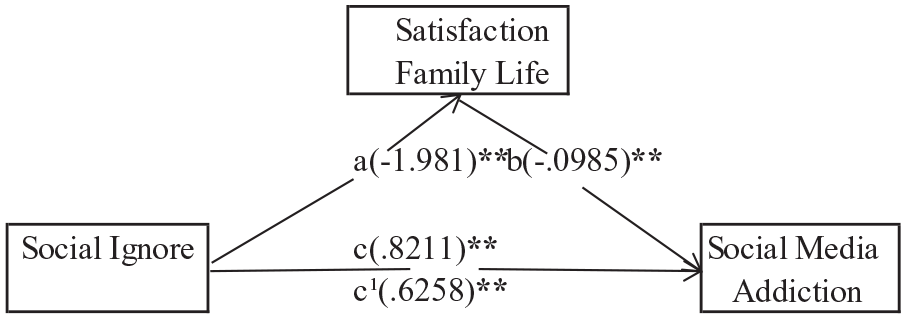
The model suggested for the mediator role of satisfaction with family life in the relationship between social ignore and social media addiction among adolescents.
Figure 2 shows the paths a, b, c, and c1 of the mediator effect of satisfaction with family life in the relationship between social ignore and social media addiction and standardized regression coefficients of these paths. Three conditions are proposed for the mediation model test. Accordingly, the independent variable needs to predict the dependent variable and the mediator variable, and the mediator variable needs to predict the dependent variable. When the mediator variable is included in the analysis with the independent variable, the effect of the independent variable on the dependent variable needs to drop to zero or decrease significantly. After the mediator variable is included in the analysis, the effect of the independent variable dropping to zero (0) indicates to the full mediation of that variable whereas a significant decrease in the effect refers to the partial mediation (Baron & Kenny, 1986). Accordingly, it was found in the model that social ignore negatively predicted satisfaction with family life (a = −0.1.981**; 95% CI [2.616, −1.346]); satisfaction with family life negatively predicted social media addiction (b = −0.0985**; 95% CI [−0.1384, −0.0587]); and social ignore positive significantly predicted social media addiction (c = 0.8211**; 95% CI [0.5400, 1.102]). When the mediator variable was included in the analysis along with social ignore, a regression coefficient of (c1 = 0.6258**; 95% CI [0.3404, 9,113]) was found between social ignore and social media addiction. With the inclusion of satisfaction with family life in the mediating model, a significant decrease was observed (c = 0.8211’den c1 = 0.6258).
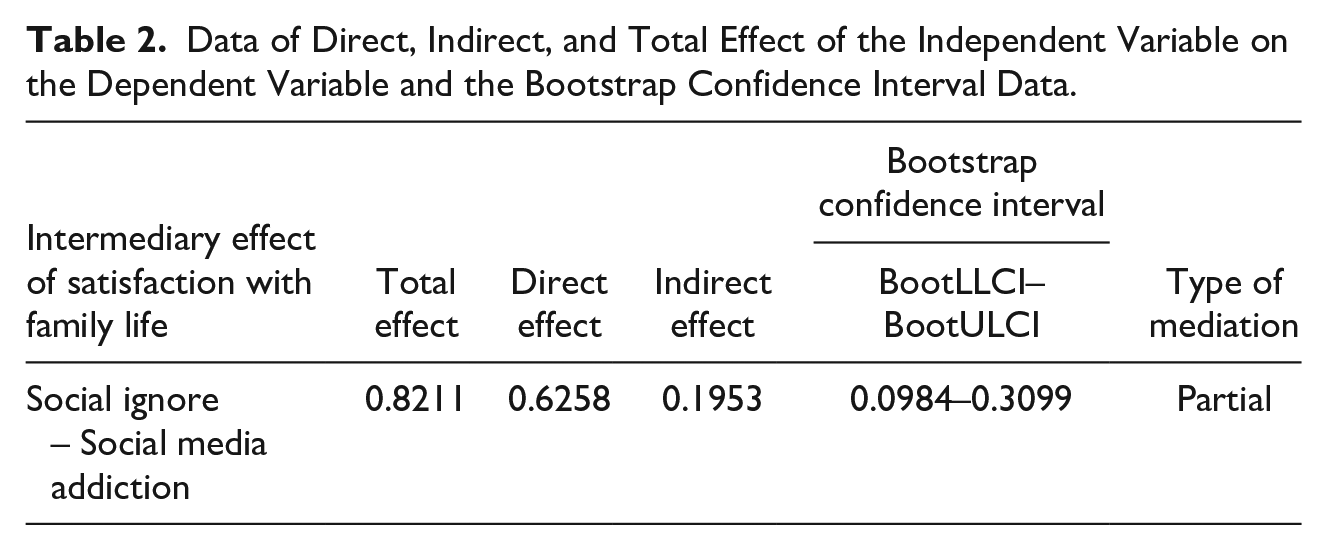
The data of direct effect, indirect effect and total effect, and the bootstrap confidence interval were checked to test whether the decrease which occurred after the inclusion of the mediator variable in the model was due to the effect of the mediator variable.
Table 2 shows the total indirect and direct effect values of social ignore on social media addiction among adolescents. Accordingly, the total, direct, and indirect effects of social ignore on social media addiction are .8211 (p < .000), .6258 (p < .000), and .1953, respectively. The bootstrap confidence interval is above 0 [0.0984, 0.3099], and there is no “0” between both values. This result showed that satisfaction with family life mediated the relationship between social ignore and social media addiction.
Data of Direct, Indirect, and Total Effect of the Independent Variable on the Dependent Variable and the Bootstrap Confidence Interval Data.
Discussion and Conclusion
Although social media addiction seriously threatens adolescents, there are limited studies on social media addiction among adolescents and related concepts. This study investigated the mediator effect of satisfaction with family life in the relationship between social ignore and social media addiction among adolescents. It was found that the relationship between social ignore and social media addiction was partially mediated by satisfaction with family life.
According to the research, social ignore, which is a subtype of social ostracism, positively predicted social media addiction. When the studies examining social ignoring and other technological problems (internet addiction, cyberbullying, etc.) are examined; the studies investigating the relationship between social ostracism and internet addiction (Poon, 2018; Taş & Öztosun, 2018) and the study investigating the relationship between social ignoring and cyberbullying and cyber victimization (Gür, 2019) support this finding. Trying to be included in a group is one objective of human’s efforts because people depend on the group life for their lives, continuity of their well-being, their comfort, and many other positive things (Baumeister et al., 2005). It is observed that individual who is ignored despite such efforts go through hurtful feelings (Molden et al., 2009). Social exclusion has a negative impact on adolescents’ positive moods such as being good, happy, at ease, and friendly (Sebastian et al., 2010). Social exclusion also seems to negatively affect the sense of belonging, self-esteem, and meaningful existence. It is seen that individuals resort to social media (Facebook) as a strategy of coping with negative effects of social exclusion (Schneider et al., 2017). Grohol’s (2012) pathological internet usage model may contribute to understanding why individuals who experience social exclusion turn to social media. Grohol (2012) states that almost all internet activities (mail, forum, chat, online game, etc.) have a social interaction dimension. According to him, every interaction of individuals on the internet is aimed at meeting their social needs. The individual who turns to the internet for these needs is almost fascinated by the applications and activities she/he encounters for the first time. Being stuck in the fascination stage, which is the first stage in the internet usage model, causes pathological internet use. According to the model, the other stages are seeing the facts and balancing, that is, normalization. Accordingly, adolescents who cannot meet their social needs in real life because they are excluded may turn to social media and spend a lot of time on social media networks. The fact that spending excessive time on social media is positively associated with social media addiction (Yüksel et al., 2020) may lead to the development of social media addiction in adolescents who are a risky group for social media addiction. Another theory to explain Internet addiction behavior was proposed by Caplan (2003). According to the social skills deficiency model proposed by Caplan (2003) regarding the causes of internet addiction, preferring online social communication is associated with psycho-social problems such as loneliness, depression and anxiety, and lack of social skills. Caplan (2005) stated that there are six social skills, which he claims may cause internet addiction. These are emotional expressiveness, emotional sensitivity, emotional control, social expressiveness, social sensitivity, and social control. But he especially underlined the social control dimension. Social control refers to the success of the individual in presenting herself/himself, role ability, and impression management skills in face-to-face interpersonal communication. According to him, individuals having problems especially in the dimension of social control prefer online social interaction more. It can be said that individuals who are ignored in real-life experience deprivation in other dimensions of social skills and especially in the dimension of social control. In conclusion, both models help explain the use of social media by socially excluded individuals at the level of addiction. Considering this finding in the light of research in the literature, one can argue that individuals who cannot build social relations or are excluded and ignored by others in the real life resort to virtual communities to satisfy such needs of theirs.
It was observed in the research that satisfaction with family life predicted social media addiction negative significantly. In the literature, Savcı et al. (2020) achieved a similar result. Similarly, the study performed by Cavga (2019) concluded a negative correlation between satisfaction with family life and social media addiction. However, the study showing a positive relationship between gaming addiction, which is another technological addiction, and poor family relations (Da Charlie et al., 2011), the study showing a positive relationship between computer gaming addiction among children and obstructive family relations (Karacaoğlu, 2019), the study showing a negative relationship between social media addiction and satisfaction with life (Şahin, 2017), and the study showing a negative relationship between Internet usage frequency and quality family relations (Mesch, 2003) are in line with this finding of the research. Satisfaction with family life is defined as individual’s level of satisfaction with the parent-child relationship or the relationship with siblings within the family (Carver & Jones, 1992). The concept of family life satisfaction seems to be closely related to family systems theories. According to family system theorists, everyone in the family is interconnected. A change in one part of the system will affect other parts as well. For this reason, to know the individual, it is necessary to focus on the system he/she is in and the relations between the members of the system (Murdock, 2012). The quality of the relationships may be effective in determining the direction of the relationship between the family satisfaction of the adolescent and the social media addiction behavior. In this context, when the structural family system theory, which evaluates family relations and the effects of these relations in terms of subsystems, is examined, it is seen that the theory focuses on three basic subsystems in family relations, namely spouse, parent, and sibling subsystems. The spouse subsystem performs some tasks with its complementarity and adaptability skills to ensure the functionality of the family. Spouses can support the good aspects of each other as well as activate their negative aspects. The parent subsystem is concerned with functions such as the care, upbringing, and socialization of the child. The sibling subsystem is the first social environment in which the child will test his/her friendships. In this subsystem, children learn to either support, exclude, or scapegoat each other (Minuchin, 1974). Accordingly, the deterioration of the functionality of even one of the subsystems in the family system will adversely affect the entire family system. As children and adolescents, an important component of the family system, cannot complete their development, they will be the subsystems most affected by this negativity. Adolescents who cannot find the satisfaction they seek in family relationships may try to achieve this satisfaction in social networks. In contrast, a functional family system can be protective against the development of social media addiction and other negative behaviors.
Another structural family systems theory concept related to the family life satisfaction of the adolescent is the concept of intimacy. The concept of intimacy, one of the basic concepts of the theory, is defined as the emotional bond between family members. A low level of this emotion leads to disjointed relationships, and a high one leads to conjoined relationships (Minuchin, 1974). As a matter of fact, feeling lonely in family relationships being a significant predictor of social network usage (Doğan & Karakuş, 2015) and the negative relationship between social media addiction and social support (Bilgin & Taş, 2018) may indicate that the adolescent has disjointed relationships in the family context. In other words, the fact that adolescents who cannot get the social support they seek in real life turn to the online world (Luciana, 2010) may be a sign that there is a problem in the family system. Because, as stated by Minuchin (1974), an individual’s behavior (e.g., addictive behavior) is determined by her interactions with her/his environment. In the light of the research finding and the literature, one can suggest that individuals who are not from a healthy family environment and could not get emotional satisfaction from their family are at risk of being social media addicts.
The research concluded that satisfaction with family life negative significantly predicted social ignore. In the literature, the study by Madey and Williams (1999) similarly found a negative correlation between satisfaction with life and social exclusion. Eker et al. (2001) found a negative correlation between family support and negative social relations. Çalışkan et al. (2017) observed satisfaction with family life to be negatively correlated with psychological signs such as depression, anxiety, negative self, somatization, and hostility. Regarding other studies on the effects of family environment, family support is observed to be negatively correlated with tendency to violence (Haskan Avcı & Yıldırım, 2014) and hopelessness and loneliness (Eker et al., 2001). Furthermore, adolescents who have been sexually abused are observed to receive less support from their family (Bal et al., 2003). On the other hand, it is seen that family support is positively correlated with stress coping (Demirtaş, 2007). In a healthy family, individuals can minimize the effects of negative experiences outside and acquire the functional coping methods. One can argue based on the literature and the research finding that family environment, where adolescents socialize for the first time, and a positive climate within family play an effective role in coping with such painful emotions.
Finally, satisfaction with family life was found to have a partial mediating role between social ignore and social media addiction. Similarly, Savcı et al. (2020) found satisfaction with family life to play a mediating role in the relationship between social connection and problematic social media use. The negative correlation between satisfaction with family life and social network addiction (Cavga, 2019; Savcı et al., 2020), significant prediction of social media use by family relationships (Doğan & Karakuş, 2016), and the negative correlation between supportive attitudes of family and Internet addiction (Karacaoğlu, 2019) indicate that family environment is an important shelter against technological addictions. Therefore, it is important that adolescents excluded and ignored in the social life are not excluded in the family life and are supported emotionally and valued by the family. The adolescent who is excluded and ignored in the social life can compensate the effects of negative emotions stemming from the social environment in the warm, welcoming, and satisfying environment of the family. How adolescent’s negative emotions are compensated can provide a protective function against the social media that attracts adolescents with properties such as limitlessness, perception of different time and space, and the opportunity of presenting oneself as they wish (Cezik & Alanka, 2016).
Consequently, this study showed that satisfaction with family life partially mediated the relationship between social ignore and social media addiction.
Limitations and Recommendations
At the end of the research, the limitations of the research were drawn attention and some recommendations were made for experts, educators, and researchers. The research has some limitations. The first one is related to the generalization of the results obtained from the study. The data of the study were collected from adolescents attending a school type with above-average academic achievement. This type of school makes up the majority of schools in the country. However, in the country where the research was conducted, there are vocational high schools where students with academic success below the average attend and there are also types of schools where students with academic success far above the average attend. Considering the negative relationship between academic achievement and social media use (Kumcağız et al., 2019), it can be said that the result obtained from this study cannot be generalized to adolescents in other school types. This limitation can be overcome by conducting research in other school types. The second limitation is related to data collection tools. Self-report scales were used in the study. Such studies may include some biases such as understanding the scale items, social acceptance, and responding according to the current mood. Researchers can reduce these biases by using different tools (e.g., interviews) and research methods (e.g., longitudinal). Another limitation of the study is that social media addiction was examined in general. There are scales (e.g., Facebook addiction scale, Instagram addiction scale) developed for many social media applications. Since each social media application may have some unique features, the variables of family life satisfaction and social ignore can be examined more specifically with these scales. In addition, the concepts can be investigated in other samples such as children, university students and adults and compared with the results of the study.
It could be useful that clinicians working on social media addiction carry out their studies in consideration of satisfaction with family life and social ignore. Educators and psychological counselors working with adolescents in schools can include the effects of family and social relations when implementing the psycho-educational programs of coping with social media addiction. It could be conveyed to the families by educators, social workers, and psychological counselors, where the support of the families and the family environment is important in order not to adversely affect adolescents who have problems with the environment of friends or who are not involved in the environment of friends. While social media addiction is a serious risk especially for adolescents, there is limited research on social media addiction. Research can contribute to a better understanding of the phenomenon of social media addiction by investigating its relationship with different concepts.
Footnotes
Declaration of Conflicting Interests
The author declared no potential conflicts of interest with respect to the research, authorship, and/or publication of this article.
Funding
The author received no financial support for the research, authorship, and/or publication of this article.
