



Abstract
Many Black young adults engage in their communities through critical action, or activism, as they transition into adulthood. However, knowledge about predictors of critical action remain sparse. The present longitudinal study addresses this gap by exploring links between critical action, ethnic-racial identity, and racial discrimination among 143 Black youth who were surveyed as adolescents (Mage = 15; 66% female) and again as young adults (Mage = 20). Using hierarchical logistic regression, we found that young adult experiences of racial discrimination were related to increased odds of critical action, accounting for adolescent racial discrimination, gender, caregiver education, and postsecondary enrollment. We also found that criminalizing discriminatory experiences (e.g., being stopped by the police) during young adulthood were related to increased odds of critical action. Our findings document changes in racial discrimination and ethnic-racial identity during the transition to adulthood and suggest that some marginalized youth may transform adverse experiences into critical action.
Keywords
Becoming an Activist: Critical Action During the Transition to Adulthood
Research has extensively highlighted environmental hazards in the developmental contexts of many Black youth—including neighborhood disinvestment, gun violence, and racial discrimination (Assari et al., 2017; James et al., 2021; Schwartz et al., 2022). Although research demonstrates that these environmental hazards are linked to poor developmental outcomes, it is critically important to acknowledge that trajectories for Black youth development do not exclusively involve misfortune (Rapa et al., 2018; Ungar, 2013). Many Black adolescents and young adults positively adapt to their environment and engage in prosocial behaviors despite racialized adversity (Lozada et al., 2017; White-Johnson, 2012). Furthermore, developmental contexts often provide Black youth with an array of socialization experiences (e.g., parental racial socialization and afterschool programs) that may bolster ethnic-racial identity development and prompt later critical action (Anyiwo et al., 2023; Smith & Hope, 2020).
Critical action refers to participation in a broad scope of activist efforts such as protests, volunteering for racial solidarity groups (e.g., NAACP), or consciousness-raising conversations with family and friends (Bañales et al., 2021). Black young adults have a long history of critical action as evidenced by Martin Luther King Jr. launching his career during the Montgomery Bus Boycott at age 26 (Carson, 2005). The tradition of critical action among Black young adults continues today. In 2013, the #BlackLivesMatter (BLM) movement launched in response to the acquittal of George Zimmerman for the murder of an unarmed Black teenager, Trayvon Martin. BLM energized youth activism and sparked a wide range of critical action from social media campaigns to street demonstrations (Rickford, 2016).
Recent empirical work suggests that critical action among young adults is linked to greater racial discrimination and a stronger sense of ethnic-racial identity (Hope et al., 2019a; Pinedo et al., 2021). The current longitudinal investigation of racial discrimination and ethnic-racial identity as predictors of critical action extends this work by assessing whether various types of racial discrimination experienced during adolescence and young adulthood differentially relate to critical action (e.g., discrimination that is overt such as being followed in a store versus discrimination that is covert such as microaggressions that make one feel unintelligent). Additionally, existing studies have primarily investigated youth’s likelihood of engaging in critical action in the future, whereas the present study focuses on youth’s reports of prior critical action. The current study’s contributions also include its focus on understudied issues and on populations that are not well-represented in extant literature.
Brief Overview of Critical Action
Critical action has been the focus of an increasing number of academic investigations in recent years. This work is often informed by Freire’s (1970) theoretical perspective on critical consciousness which is conceptualized as a process that involves three components: (1) an analysis of historic and contemporary inequity (i.e., critical reflection), (2) the perception that one has the capacity to make social change (i.e., critical motivation), and (3) participation in efforts confronting systemic oppression (i.e., critical action; Freire, 1970; Heberle et al., 2020). Scholars theorize that relationships between these components are reciprocal—such that each component of critical consciousness facilitates development in the others (Diemer et al., 2021). For example, a young adult attending meetings to organize a protest (i.e., critical action) is likely to simultaneously gain a keener analysis of social conditions (i.e., critical reflection) that necessitated the call to protest.
Critical consciousness is widely considered a developmental asset (Watts et al., 2011). Empirical work finds that, of the three components, critical reflection and critical action are related to greater academic achievement among racially marginalized youth (Seider et al., 2020). Research has also found that critical action may foster adolescent career expectancies, and lead to higher-status occupational attainment in adulthood among Black youth from low-income households (Rapa et al., 2018). However, research assessing hypothesized links between critical consciousness and developmental outcomes (e.g., academic achievement and future orientation) overwhelmingly addresses the cognitive components of critical consciousness (i.e., critical reflection, critical motivation) to the detriment of the behavioral component (i.e., critical action; Diemer et al., 2021). Much additional research is needed to understand the correlates of the behavioral component of critical consciousness as a counterweight to the overwhelming emphasis in the research literature on the cognitive components of critical consciousness.
Another limitation of the literature addressed in the current investigation is that much of the research on critical action has been conducted with adolescents. Due to realities that are beyond a teenager’s control (e.g., parental permission), the type of critical action available to adolescents is often constrained. During the transition to adulthood, young people may experience newfound autonomy and have more opportunities to engage in critical action (McLoyd et al., 2015). Research is needed to understand what motivates Black young adults to engage in critical action and the extent to which critical action is a positive adaptation to racial injustice (Hope et al., 2019b).
Exploring Critical Action as a Positive Adaptation to Racial Discrimination
Racial discrimination refers to events that individuals perceive they experienced due to their marginalized ethnic-racial identity (e.g., being stopped by the police because they are Black). Black youth transitioning into adulthood face the added pressures of interpersonal and institutionalized racism while navigating life-stage tasks such as securing employment and further education (Hope et al., 2015). Research on racial discrimination has largely explored its adverse effects on physiological stress responses, psychological distress, and academic outcomes among Black youth (Clark et al., 1999; Hurd et al., 2014; Neblett et al., 2006). Despite the harmful effects of racial discrimination experiences, many marginalized youth manage to adapt and even thrive (Witherspoon et al., 2023). Though links between racial discrimination and critical action have been understudied, recent scholarship suggests that racial discrimination may also lead to adaptive coping responses such as critical reflection on social inequity and critical action to disrupt such inequities (Anyiwo et al., 2018; Hope et al., 2023).
The small empirical literature base investigating racial discrimination and critical action among young adults has primarily focused on college students. One study of Black college students found that higher frequencies of racial discrimination predicted more frequent prosocial attitudes (i.e., positive attitudes about helping the Black community) and more frequent prosocial behaviors (i.e., participation in community efforts to help the Black community; White-Johnson, 2012). In another study of Black college students, greater racial discrimination predicted more civic engagement (e.g., attendance at community meetings; Riley et al., 2021).
Evidence also suggests that individuals respond differently to various types of discrimination. For instance, one study found that Black adults were most likely to adopt problem-solving coping strategies (e.g., direct action) in response to institutional discrimination, but spiritual-centered coping strategies (e.g., prayer) in response to interpersonal discrimination (Joseph & Kuo, 2009). These studies lay a foundation for investigations of critical action in relation to different dimensions of discriminatory experiences.
The present study assesses racial discrimination and critical action during young adulthood while accounting for adolescent experiences of racial discrimination. Aligning with the view that critical action is an adaptive coping response to racial discrimination within marginalized communities (Ginwright, 2010), we hypothesized that more experiences of racial discrimination would be associated with increased odds of critical action. We also assessed whether different categories or dimensions of racial discrimination experienced during adolescence and young adulthood (i.e., Invisible/Outsider, Criminal, Harassed, and Unintelligent) are differentially linked to critical action. We did not make predictions about the relationships between these dimensions of racial discrimination and critical action because this aspect of the study was exploratory.
Ethnic-Racial Identity as Catalyst for Critical Action
Ethnic-racial identity is a multidimensional construct referring to the process by which individuals construct identities as a member of a racial group and the feelings one has about their racial group (Umaña-Taylor et al., 2014). Questions that characterize ethnic-racial identity development include asking oneself, “Who am I?”, “Who can I be?”, and “What does it mean to be a member of my racial group?” (Tatum, 2004). The current study conceptualizes ethnic-racial identity in accord with Sellers et al.’s (1997) Multidimensional Inventory of Black Identity. Two dimensions are investigated: Centrality, which refers to the overall importance individuals ascribe to race in their identity; and Regard which is composed of Private Regard, which refers to an individual’s personal evaluation of their ethnic-racial group; and Public Regard, which refers to how an individual perceives out-group members evaluate their ethnic-racial group. Prior research suggests that a strong psychological connection to one’s ethnic-racial group is associated with improved academic achievement and psychological functioning (Sellers et al., 2006; Wong et al., 2003).
There has been little empirical work that addresses connections between ethnic-racial identity and critical action. In their review of literature on ethnic-racial identity and critical consciousness, Mathews et al. (2020) postulate that youth with a strong sense of ethnic-racial identity would be more likely to engage in critical action. Evidence that Black young adults with greater centrality and private regard are more likely to engage in activities benefiting the Black community lends support to this assertion (White-Johnson, 2012). An advantage of the present study is its assessment of ethnic-racial identity during adolescence and during young adulthood, making it possible to assess the concurrent and longitudinal relationship between ethnic-racial identity and critical action during the transition to adulthood. We hypothesized that individuals with a stronger sense of racial centrality and private regard would be more likely to engage in critical action, given that ethnic-racial identity is generally viewed as promotive of positive psychosocial outcomes (Diemer & Rapa, 2016; Sellers et al., 2006). The research on whether public regard has positive or negative implications for psychosocial outcomes is mixed (Mathews et al., 2020). However, one recent empirical study by Hope et al. (2019a) found that lower public regard was associated with high-risk activism (i.e., activism that is perceived as likely to result in physical harm or arrest). In line with findings from Hope et al. (2019a), we hypothesized that individuals with lower public regard would be more likely to engage in critical action given their greater perceptions that others hold negative attitudes toward Black people.
Developmental Significance
There has been a surge of scholarly and public interest in the transition to adulthood given that recent cohorts of youth are delaying traditional markers of adulthood (e.g., marriage, family, and career; Settersten & Ray, 2010). Psychological literature on this period often reflects Arnett’s (2000) conceptualization of emerging adulthood (approximately spanning ages 18–29 years) which characterizes this period as a distinct developmental stage wherein individuals delay traditional adult-status roles to instead embark on self-focused identity exploration. This highly cited work sparked investigations on the five features of emerging adulthood: identity exploration, instability, self-focus, feeling in-between, and optimism about possibilities (Arnett et al., 2014).
Theoretical work on emerging adulthood has been criticized for its limited generalizability to emerging adults from marginalized backgrounds (Côté & Bynner, 2008). The transition to adulthood is complex and racial marginalization compounds challenges faced during this transition. Compared to White young adults, Black young adults are more likely to take on adult roles, support their families, worry about finances, and are less likely to attend college (Kendig et al., 2014). Many Black young adults also focus on empowering disinvested communities through critical action (Mathews et al., 2022). Thus, there is ongoing debate about whether the conceptualization of emerging adulthood adequately addresses developmental experiences of marginalized youth (Hendry & Kloep, 2010). However, there has been far too little research on race and the five features of the emerging adulthood theory to adequately address these criticisms (Syed & Mitchell, 2013). Given the ongoing debate about the generalizability of the emerging adult theory to Black youth, we use the term, “young adults”, to broadly refer to youth experiencing the transition from adolescence to adulthood.
Method
Participants
We collected data from 143 self-identified Black young adults (66% female) who ranged in age from 18 to 24 years (Mage = 20). After the transition from high school, 56% enrolled in a 4-year institution, 20% enrolled in a 2-year community college, and 15% did not enroll in any postsecondary institution. All of these young adults were surveyed as adolescents (Mage = 15) in a longitudinal school-based study of parental, school, peer, and neighborhood influences on Black youth’s social, academic, and psychological functioning. The longitudinal study consisted of four waves of four cohorts of participants, all of whom attended schools in three school districts in a Midwestern metropolitan area chosen to ensure racial, ethnic, and socioeconomic diversity. The current study uses adolescent data on ethnic-racial identity and racial discrimination collected during the final wave of the original study.
Procedure
In May 2018 (4 years after the final wave of the original study), we began the follow-up study to investigate the psychosocial development of Black youth during the transition to adulthood. Data were collected through April 2020—and therefore our findings reflect Black young adult critical action after the rise of the Black Lives Matter movement. For the remainder of this paper, Wave 1 refers to data collected during adolescence and Wave 2 refers to data collected during young adulthood. Recruitment for the follow-up study involved multiple strategies. We began with a roster of contact information (i.e., e-mail address, telephone number, and/or mailing address) for youth and their parents collected during Wave 1. We first emailed youth and parents pertinent information about the follow-up study. The message explained that we were interested in the experiences of the youth after they transitioned from high school, and that participation in the study was voluntary and would involve completing a 45-minute online survey for which the young adult would be sent a $30 gift card. If the young adult was interested in participating in the study we would, in turn, email a confidential link to the consent form and the survey. The e-mail message also indicated that the consent form and survey could be sent and returned via US mail if this was a preferred option.
Next, we called and left voicemail messages for the young adults and parents who we had not successfully contacted by email. Then, we sent letters via US mail to those who did not respond to our email or who we were unable to reach by telephone. We also used Facebook to identify eligible young adults who had not yet participated in the survey. We concluded data collection in April 2020. Of the 1,010 adolescents surveyed in Wave 1, we secured updated contact information that enabled us to invite 554 young adults to the online follow-up survey. A total of 143 young adults completed the survey giving us a final response rate of 26%.
We anticipated that attrition would be higher than typical for longitudinal studies for several reasons: (1) The design of the original study did not call for a follow-up at the conclusion of the initial investigation, hence, tracing strategies and updates to contact information ceased after this time point. We began our follow-up recruitment efforts 4 years after the original study ended. The passage of time increased the likelihood that some, if not all, of the contact information was no longer current (e.g., we often had access to the student’s school-issued email address, rather than their personal email address, but the former are typically deactivated after the student graduates); (2) Young adults, the age group that our study targets, tend to have relatively high levels of residential mobility due to transitions in education, employment, and living arrangements (Arnett, 2000); and (3) Blacks and individuals from low-income backgrounds experience heightened residential mobility due to instability related to racialized and financial marginalization (A. Clark, 2018).
Measures
Critical Action
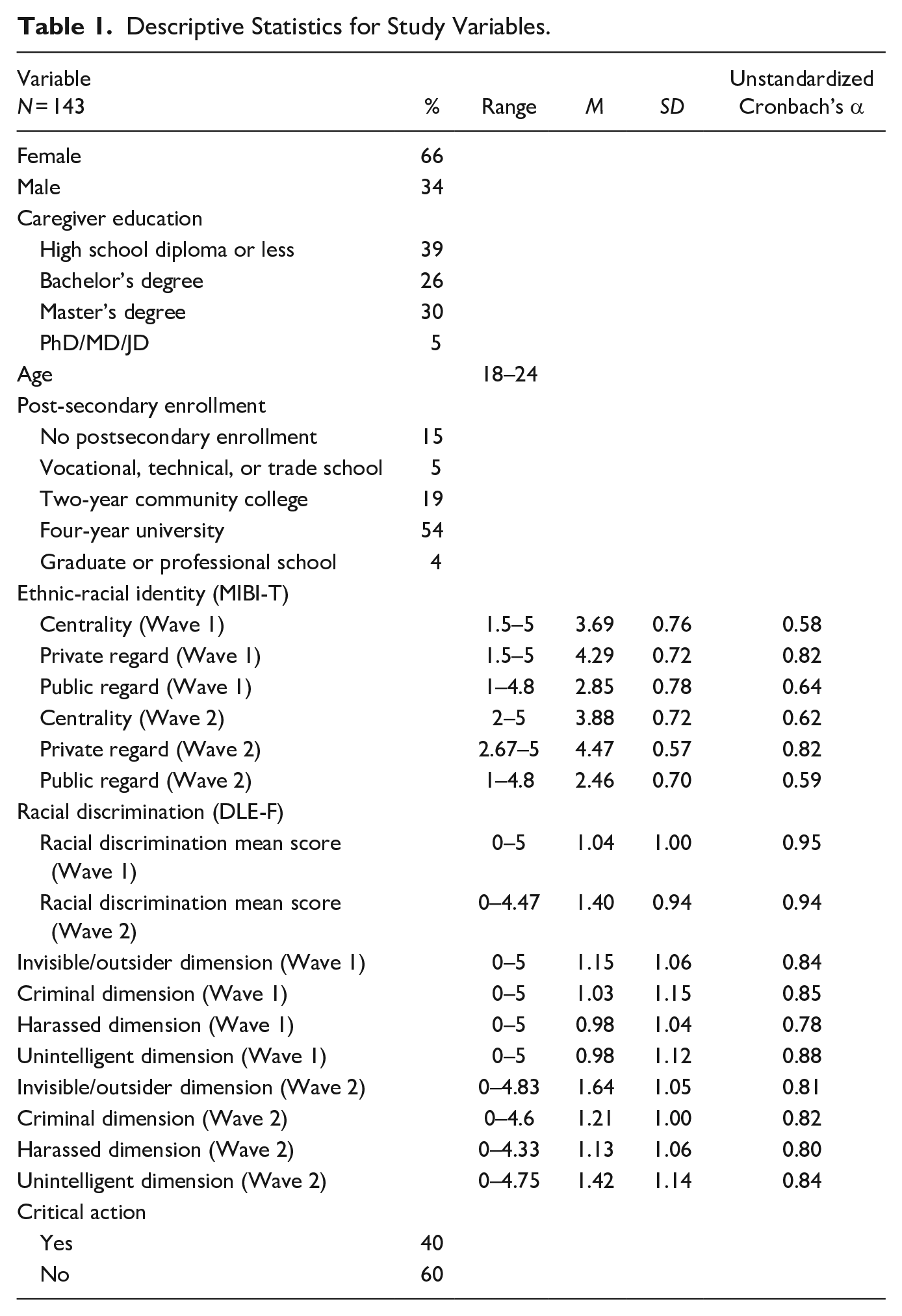
Respondents reported whether they participated in each of the following types of activities or behaviors since high school: (1) demonstrated in a march against social inequality or a march to promote social justice, (2) recruited others to attend a march, (3) volunteered with a neighborhood improvement group or social action group, (4) volunteered with a solidarity or ethnic support group (e.g., NAACP), (5) volunteered with a political club or organization. Forty percent (n = 50) of respondents reported engaging in one or more critical action activities; 60% (n = 74) reported no involvement in critical action. We dichotomized the critical action measure (1 = Critical action, 0 = No critical action). Descriptive statistics on the dichotomous critical action variable are reported in Table 1.
Descriptive Statistics for Study Variables.
Racial Discrimination
A modified Daily Life Experiences-Frequency (DLE-F) scale was used to assess racial discrimination experiences (Harrell et al., 1997). Existing work has documented concurrent and criterion validity for the DLE-F scale (Harrell et al., 1997). Using a 6-point Likert scale ranging from 0 (never) to 5 (once a week or more), participants indicated how often during the past year they experienced each incident “because they are Black.” Example items included “Being observed or followed while in public places,” and “Being insulted, called a name.” Given recent attention to racial disparities in school discipline and policing (George, 2015), we added the following two items: “Being disciplined unfairly (in Wave 1 and 2)” and “Being stopped or detained by the police for questioning about your activities (Wave 2).”
Due to our limited sample size and potentially low communalities, we did not use factor analytic strategies to identify racial discrimination dimensions (Costello & Osborne, 2005; Flora et al., 2017). Instead, we used dimensions identified in a reliability study conducted by Evans (2011) with an expert panel to conceptually group the DLE-F items into four dimensions of interpersonal racial discrimination: (1) Invisible/Outsider, experiences where individuals felt they were ignored or overlooked, (2) Criminal, incidents where individuals felt they were being accused or treated as a criminal, (3) Harassed, experiences in which others created hostile situations, and (4) Unintelligent, experiences in which individuals feel they are expected to be intellectually inferior. Item responses were averaged so that higher mean scores correspond to higher frequencies of racial discrimination experiences. Unstandardized Cronbach’s alphas for each racial discrimination dimension are reported in Table 1.
Ethnic-Racial Identity
The centrality, private regard, and public regard subscales of the Multidimensional Inventory of Black Identity-Teen Version (MIBI-T) were used to assess ethnic-racial identity (Sellers et al., 1997). Psychometric investigations have established convergent and concurrent validity for the MIBI-T scale (Casey-Cannon et al., 2011; Scottham et al., 2008). Centrality refers to the overall importance individuals ascribe to race in their identity (e.g., “I feel close to other Black people”). Private Regard refers to an individual’s personal evaluation of their racial group (e.g., “I feel good about what the Black community has accomplished”). Public Regard refers to an individual’s perception of how out-group members evaluate their racial group (e.g., “Some people don’t expect me to do well in life because I’m Black”). Respondents reported the extent to which they agree with each item on a five-point Likert scale ranging from 1 (really disagree) to 5 (really agree). The current study assesses ethnic-racial identity during adolescence (Wave 1) as well as during young adulthood (Wave 2). Item responses within each developmental period were averaged so that higher mean scores correspond to higher associations with the measured aspect of ethnic-racial identity. Unstandardized Cronbach’s alphas for each subscale are reported in Table 1.
Covariates
We included caregiver education, gender, postsecondary enrollment, and age as covariates given established links between sociodemographic variables and various forms of community engagement (Gaby, 2017). Participants reported on their caregiver’s educational history in Wave 2. The highest level of caregiver education attained was used as the indicator of social class. Gender was self-reported by participants in Wave 2 (0 = female, 1 = male). Participants also reported whether they enrolled in postsecondary education after leaving high school during Wave 2. Postsecondary enrollment was coded as 0 (No postsecondary enrollment), 1 (vocation, technical, or trade School), 2 (2-year community college), 3 (4-year college), and 4 (graduate or professional school). Participants also reported their age during Wave 2. Demographic descriptive data are reported in Table 1.
Data Analysis
We established that the data satisfied logistic regression assumptions on outliers, multicollinearity, and linearity between continuous predictors and their logits using SPSS version 26 (Wuensch, 2014). Next, we conducted a hierarchical logistic regression to examine whether racial discrimination and ethnic-racial identity during the transition to adulthood (Wave 2) predicted critical action over and above racial discrimination and ethnic-racial identity during adolescence (Wave 1). Variables were sequentially entered in three steps: covariates (Step 1); racial discrimination and ethnic-racial identity during adolescence (Step 2); and racial discrimination and ethnic-racial identity during the transition to adulthood (Step 3). We ran a separate hierarchical logistic regression to explore the relationship between dimensions of racial discrimination (i.e., Invisible/Outsider, Criminal, Harassed, Unintelligent) and critical action, entering variables sequentially in three steps in parallel fashion to the prior regression.
Results
Preliminary Analyses
Several notable changes occurred as youth transitioned from adolescence to young adulthood. Youth reported significantly more experiences of racial discrimination (t(120) = 3.91, p < .001), greater centrality (t(120) = 2, p < .05), and higher private regard (t(121) = 2.35, p < .05) during young adulthood than during adolescence. In contrast, youth reported lower public regard during young adulthood than during adolescence (t(123) = 4.58, p < .001). These pattern of changes in ethnic-racial identity across development mirror findings reported in prior research (Willis & Neblett, 2020).
Racial Discrimination and Ethnic-Racial identity as Predictors of Critical Action
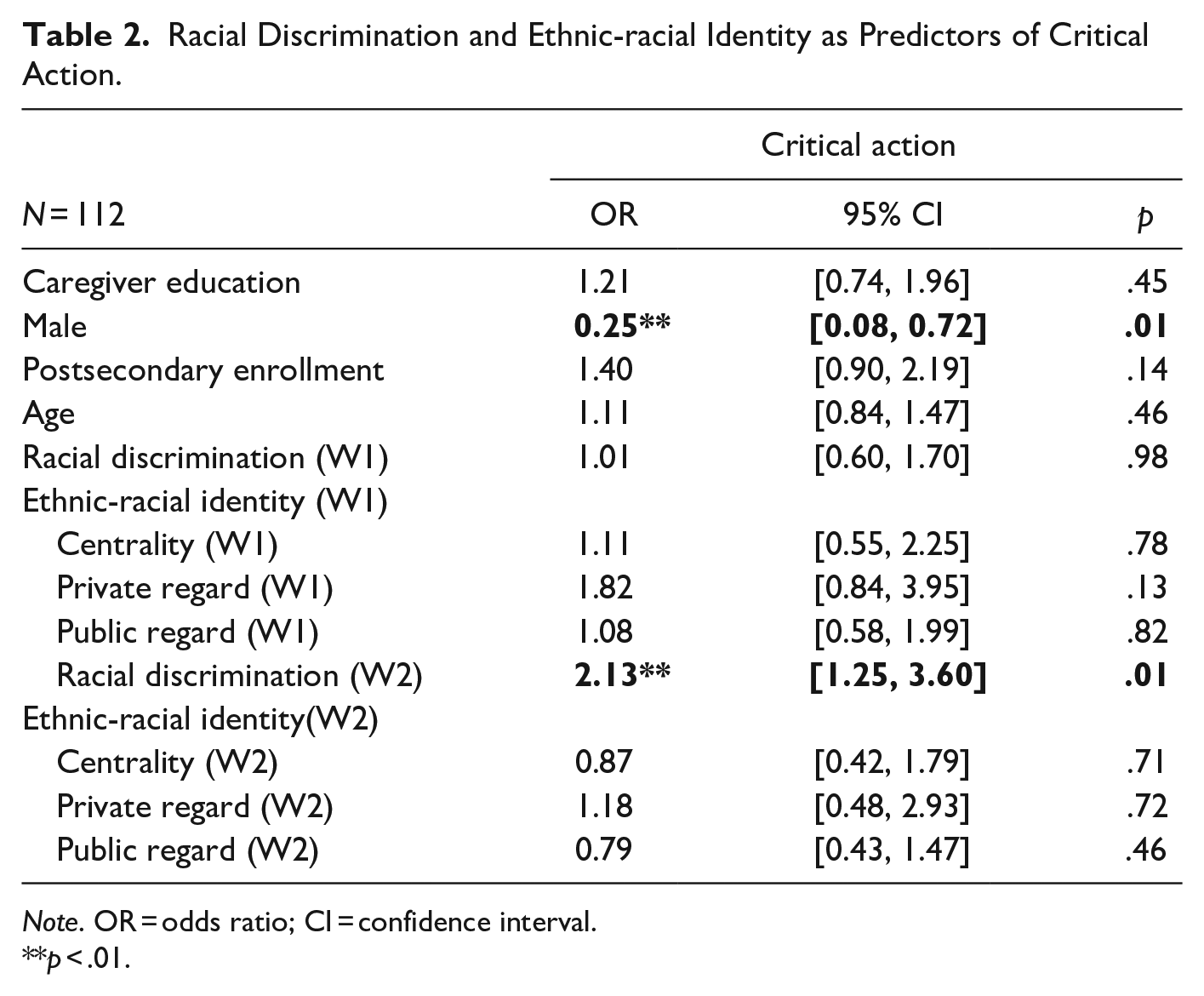
Consistent with our hypothesis, the hierarchical logistic regression indicated that racial discrimination during young adulthood was significantly associated with increased odds of participating in critical action, accounting for racial discrimination during adolescence (see Table 2). Each unit increase in racial discrimination was associated with 2.13 higher odds of critical action (95% CI [1.25, 3.60], p < .05). Contrary to our hypothesis, none of the subscales of ethnic-racial identity during adolescence or young adulthood were significantly related to the odds of critical action.
Racial Discrimination and Ethnic-racial Identity as Predictors of Critical Action.
Note. OR = odds ratio; CI = confidence interval.
**p < .01.
Of the demographic variables, gender was significantly related to critical action. Participants who identified as male were associated with 0.25 lower odds of participating in critical action compared to participants who identified as female (95% CI [0.08, 0.72], p < .01). Caregiver education, postsecondary education, and age were unrelated to critical action.
Dimensions of Racial Discrimination and Critical Action
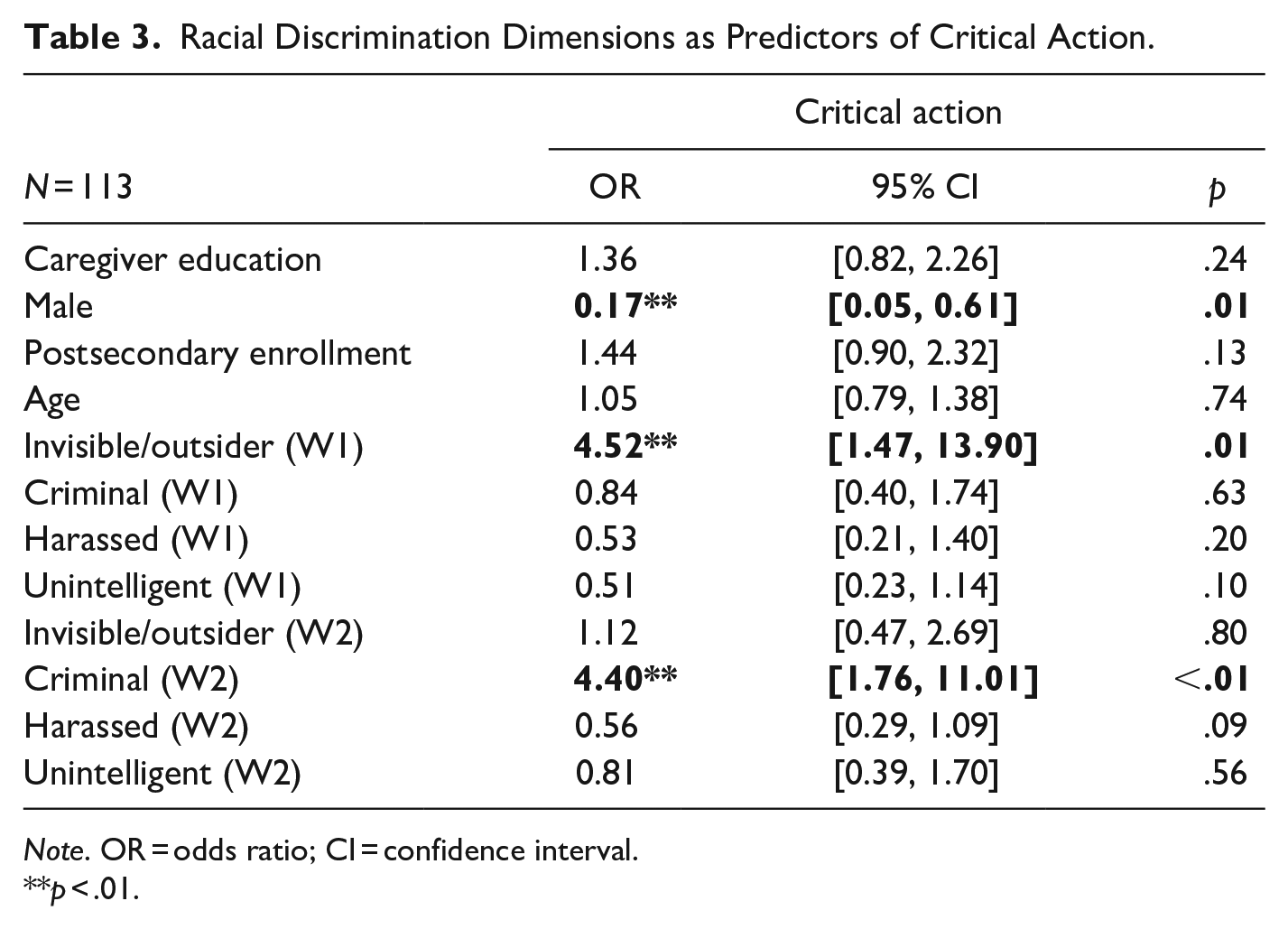
Both racial discrimination that made one feel invisible (e.g., being ignored or not given service) during adolescence (OR = 4.52, 95% CI [1.03, 18.88], p < .01) and racial discrimination that made one feel criminalized (e.g., being stopped by the police) during young adulthood were positively related to higher odds of critical action (OR = 4.40, 95% CI [1.32, 14.7], p < .01; see Table 3). None of the other dimensions of racial discrimination experienced during adolescence or young adulthood were significantly associated with odds for critical action.
Racial Discrimination Dimensions as Predictors of Critical Action.
Note. OR = odds ratio; CI = confidence interval.
p < .01.
Post-hoc analyses exploring gender differences in the dimensions of racial discrimination revealed that men (M = 1.52, SD = 1.12) were significantly more likely to report criminalizing experiences than women as young adults (M = 1.07, SD = 0.92), t(125) = −2.33, p < .05). There were no significant gender differences in any of the other racial discrimination dimensions.
Discussion
In line with existing literature on Black youth’s sociopolitical development (Hope et al., 2019a; Riley et al., 2021), we find that greater racial discrimination was associated with increased odds of critical action. Our study extends existing work with preliminary evidence that various dimensions of racial discrimination differentially relate to critical action. We found that both racial discrimination that made one feel ignored and overlooked during adolescence and racial discrimination that made one feel criminalized during young adulthood were positively related to higher odds of critical action. Contrary to our prediction, ethnic-racial identity was unrelated to critical action. The current study broadens existing knowledge about an understudied population of Black young adults and highlights that perceived racial marginalization may prompt some Black youth to take critical action.
Critical Action During the Transition to Adulthood
Forty percent of respondents engaged in some form of critical action after high school. Although civic participation research has found that Black young adults report the highest rates of community service compared to other racial groups, community service generally declines among all racial groups as youth transition from adolescence to young adulthood (Wray-Lake et al., 2017). Declines in community service during young adulthood may be attributed to balancing role responsibilities of work, education, romantic partnerships, parenthood, and living independently. Despite prior evidence of an overall decline in civic participation during this developmental transition (Wray-Lake et al., 2020), we find that a sizable portion Black young adults surveyed in our study did in fact engage in critical action.
As noted earlier, it is beyond the scope of this study to ascertain the generalizability of the highly cited emerging adulthood theory to marginalized Black young adults. However, our results prompt questions about how sociopolitical development intersects with Arnett et al.’s (2014) five features of emerging adulthood (i.e., identity exploration, instability, self-focus, feeling in-between, and optimism about possibilities). For instance, how does community activism relate to certain features of emerging adulthood such as identity exploration and optimism about possibilities? To what extent would expanding Arnett’s model to include community activism enhance its relevance to marginalized youth? Additional empirical and theoretical research is necessary to broaden scientific knowledge about developmental transitions into adulthood.
Changes in Racial Discrimination Frequency and Ethnic-Racial identity During the Transition to Adulthood
Youth reported greater racial discrimination during young adulthood than during adolescence. This increase may be prompted by transitions into higher education and employment as well as a growing capacity to identify racial discrimination with age (McLoyd et al., 2015). We also found several changes in ethnic-racial identity as youth move from adolescence into young adulthood, including an increase in centrality and private regard and a decrease in public regard. These results suggest that although Black youth may develop a more positive ethnic-racial identity over time, they may also become increasingly aware that others view Black people negatively.
Racial Discrimination and Critical Action
Although prior literature reports links between racial discrimination and negative psychosocial outcomes, our results illustrate that racial discrimination is not exclusively disempowering and may serve as an impetus for positive critical action. Our findings align with existing evidence on Black sociopolitical development which finds that racial discrimination is associated with concurrent critical action (Hope et al., 2019b; Pinedo et al., 2021, Szymanski & Lewis, 2015)—and extends prior work by providing preliminary evidence that the type of racial discrimination experienced matters when considering critical action.
Notably, we find that the aggregate measure of racial discrimination experienced during young adulthood was related to concurrent critical action. However, the aggregate measure of racial discrimination experienced during adolescence was not related to later critical action. Our exploration of racial discrimination dimensions found that the criminal dimension of racial discrimination was related to critical action concurrently, but not longitudinally. The opposite was true for the invisible/outsider dimension of racial discrimination, which was related to critical action longitudinally, but not concurrently. Future research is needed to assess replicability of the dimensions of racial discrimination found in the present study, as well as the longitudinal relation between these dimensions and critical action.
The current study’s finding that criminalizing racial discrimination was related to increased odds for critical action speaks to a longstanding history of collective action against incessant, brutal policing of Black Americans (Hinton, 2021). These results mirror important contemporary events such as the surge in Black Lives Matter demonstrations protesting police killings of unarmed Black Americans. It is important to note that in addition to protesting police brutality, these demonstrations also call for societal efforts to redress the mental, physiological, and financial harm Black communities have disproportionately experienced due to structural racism (Bor et al., 2018; H. Lee et al., 2014; Miller, 2013; Ray et al., 2017).
Ethnic-Racial identity and Critical Action
We were surprised that we found no relationship between ethnic-racial identity and critical action. Existing work conducted by Hope et al. (2019a, 2019b) has found that ethnic-racial identity was related to low-risk activism (e.g., wearing a t-shirt or button), but not related to high-risk activism (e.g., activist efforts that are risky such as blocking access to a building with your body for a cause). Our null finding may be due to the fact that our measure of critical action included activities that could be classified as high-risk activism. Recent theoretical work also suggests that ethnic-racial identity may be more strongly linked with critical reflection (i.e., the cognitive component of critical consciousness) than with critical action (Mathews, 2023). Consequently, our finding that ethnic-racial identity was not linked to critical action may suggest that the behavioral component of critical consciousness (e.g., critical action) has a different set of antecedents than the cognitive component of critical consciousness (e.g., critical reflection). Much additional research is necessary to explore links between ethnic-racial identity and the various dimensions of critical consciousness.
Limitations and Directions for Future Research
Though attrition is a well-known challenge for longitudinal research, our small sample size limits generalizability and increases the likelihood of a Type II error (e.g., failure to detect true relationships) due to inadequate power (Gustavson et al., 2012). Another limitation of the current study is that our measure of critical action misses a broad range of critical action experiences including church involvement and lower-risk activism such as social media posting. In addition, our measure did not explicitly ask participants whether they were engaging in activism in service of Black communities. Future work may consider using validated measures such as the youth anti-racism action scale (Aldana et al., 2019) or the short critical consciousness scale (Diemer et al., 2022) which measure frequencies of critical action.
Another limitation is the low reliabilities of the MIBI-Teen scale—a concern also reported in prior research (Seaton et al., 2009). Future work should improve existing measures of ethnic-racial identity to increase their internal reliability because these low reliabilities reduce analytical power. Future work may also consider alternative measures of ethnic-racial identity such as the Multigroup Ethnic Identity Measure (MEIM; Ponterotto et al., 2003).
Additionally, our study falls short of examining the breadth of racial discrimination. We used the Daily Life Experiences Frequency (DLE-F) racial discrimination scale which is recommended as a general measure of racial discrimination (Lee et al., 2021). However, this measure does not capture a wide range of experiences such as racial discrimination in healthcare (e.g., reported pain being dismissed) or in the workplace (e.g., being denied promotion). The scale also misses many racial discrimination experiences unique to other marginalized identities including women, transgendered and non-binary individuals. Future work should adopt an intersectional theoretical lens to better illuminate how interlocking forms of oppression contribute to different types of racial discrimination experiences across various marginalized backgrounds (Azmitia, et al., 2023; Crenshaw, 1990; Lewis & Neville, 2015).
Moreover, our measure of racial discrimination exclusively focuses on individual discrimination experiences. Yet, young adults attribute systemic forms of racism as the worst experiences contributing to their mental health burden (Volpe et al., 2020). Systemic and institutionalized racism maintain persistent inequalities in key developmental outcomes such as health and education. Expanding existing measures of racial discrimination to examine institutional forms of racism is also sorely needed.
Conclusion
Our study highlights important developmental changes such that Black youth reported greater racial discrimination and stronger ethnic-racial identity as young adults than they reported as adolescents. Our results also highlight how some Black young adults respond to adverse racial discrimination experiences with critical action. These results have a broad range of implications for organizations including colleges, non-profits, and employers that aim to support the development of youth transitioning into adulthood. Given the salience of criminalizing discriminatory experiences among Black young adults, organizations may consider creating efforts that address concerns related to the carceral system (e.g., campus policing; Dizon, 2023). This study contributes to current scholarship on critical consciousness and positive youth development and bolsters emerging research investigating links between racism and critical consciousness during the transition to adulthood.
Footnotes
Data Availability Statement
The datasets generated and analyzed in the current study are available from the corresponding authors upon reasonable request.
Declaration of Conflicting Interests
The author(s) declared no potential conflicts of interest with respect to the research, authorship, and/or publication of this article.
Funding
The author(s) disclosed receipt of the following financial support for the research, authorship, and/or publication of this article: Data collection for Wave 1 of the study was supported by a National Science Foundation grant (AWARD #0820309).
