




Abstract
Prior research tends to treat left-behind children as homogeneous, overlooking variations in their family structures. Grounded in the Resilience and Youth Development Module, this study explores caregiver support among four distinct groups of left-behind children: children left behind by one (LBC-One) or two migrant parents (LBC-Two), children from divorced families left behind by the custodial parent (LBC-Divorced), and bereaved children left behind by their single living parent (LBC-Bereaved). Second, it examines the correlation between children’s resilience and caregiver support and, therefore, determines the mediating role of caregiver support in the relationship between family structure and resilience of rural left-behind children. Structural equation modeling analyses on a sample of 2,300 students (Mage = 13.93 ± 0.94 years) recruited from 4 junior schools reveal that LBC-One received significantly more caregiver support than the other three groups. In addition, caregiver support mediates the resilience disparities between left-behind children from different family structures.
Keywords
Introduction
The phenomenon of left-behind children in rural China has become a pressing social issue as many rural workers move to urban areas for better opportunities and leave their kids at home. Rural left-behind children are defined as rural children who are under 17 years old and left behind by one or both migrant parents (Zhuang & Wu, 2024). The latest statistics from the 2020 national census indicated that the number of rural left-behind children amounted to 41.8 million, representing around 40% of the nation’s rural child population (National Bureau of Statistics of China, United Nations Children’s Fund, & United Nations Population Fund, 2023). This massive demographic reality is a consequence of China’s rigid household registration (hukou) system and the unprecedented rural-to-urban migration it has shaped. The hukou system ties social benefits like public education and healthcare to an individual’s registered birthplace, making it difficult for migrant workers to enroll their children in public schools or access public healthcare in the cities where they work (Wen et al., 2022). Besides the institutional exclusion, the low economic resources and financial precarity of rural households also obstruct migrant parents from registering their children in urban private schools, which are either expensive or have low teaching quality (Liang et al., 2019; Wan, 2024). Thus, despite the slight increase in the number of rural children moving with their parents to the cities, single-person or parent-only migration remained prevalent in China, with rural children being left behind in the villages for public education and stable care (Lyu et al., 2024).
Often cared for by grandparents or relatives, these children face significant challenges in their development and well-being (Murphy & Zhang, 2023). Although scholars argued from an economic perspective that remittances from migrant parents sent back to their rural households are beneficial for rural children’s educational and physical development (Démurger & Wang, 2016; Qiu et al., 2024), the absence of parental care appeared to be able to negate these benefits, threatening left-behind children’s psychological wellbeing, schooling, and social development (Chen et al., 2017; B. Y. Hu et al., 2020). After all, aside from parental absence and insufficient parental involvement, rural left-behind children are also confronted with multifarious and intersected challenges, such as local caregivers’ incapability to provide appropriate educational involvement, insufficient support from rural schools, and low family socioeconomic status (X. Li et al., 2024; Rozelle & Hell, 2020). A bulk of empirical studies have consistently suggested that left-behind children demonstrate poorer educational achievement and higher levels of mental health issues than their non-left-behind peers (Chang et al., 2017; Hong, 2021; Wen et al., 2022; Zhou et al., 2014). They report low levels of happiness (Dai & Chu, 2018), life satisfaction (Sun et al., 2015), and educational aspiration (Wen et al., 2022), along with high levels of anxiety (X. Zhao et al., 2014), depression (Ding et al., 2019), and suicide attempts (Chang et al., 2017).
Yet, despite the increasing number of studies on this population, two research gaps remain in the literature. First, existing studies often treat children left behind by one parent as homogeneous (Su et al., 2012), neglecting the variations within this population. Considering rural left-behind children as those left behind by at least one migrant parent, differences exist regarding the other parent, who might be a non-migrant living with the child, a rural-to-urban migrant worker, a divorced parent who was not given custody and left the family, or, in other circumstances, an incarcerated, deceased, or otherwise absent parent. Among them, only the first group lives with one parent, while the other groups of left-behind children are in the custody of non-parental caregivers, who are likely to be their grandparents or relatives from either father’s or mother’s side (Lin et al., 2023). The received caregiver support they receive might be incomparable with the support received by peers living with one parent. Second, while existing studies are inclined to adopt a deficit-based approach, focusing on the negative impacts of parental absence on rural left-behind children (Murphy, 2022;C. Zhao & Chen, 2022), it is of significant importance to shift the research focus to children’s resilience in bouncing back from the adversities, as well as the protective mechanisms behind it. From a strength-based approach, such an investigation is crucial as it might unravel the factors and pathways that contribute to the positive development of rural left-behind children of various family structures and therefore, provide fresh insight for rural families, schools, and policymakers in their parenting practice, curriculum design, and intervention implementation dedicated to fostering the resilience of these children (Duan et al., 2023).
The current study aims to address these research gaps. It first explores caregiver support among left-behind children with varying family structures. Rural left-behind children are categorized into four groups. While children left behind by one parent and living with another parent (LBC-One) are the only group cared for by one parent, the other three groups live with non-parental caregivers. They are children left behind by two migrant parents (LBC-Two), children from a divorced family and left behind by the custodial parent (LBC-Divorced), and bereaved children left behind by their single living parent (LBC-Bereaved). Table 1 presents the detailed definitions and descriptions of the four groups. It is important to note that these four categories are not intended to represent an exhaustive typology of left-behind children; rather, they are empirically derived from the data used for this study and reflect relatively common family structures documented in the literature. Other complex family circumstances, such as parental incarceration, exist and warrant further investigation in future research. Second, this study examines the correlation between left-behind children’s resilience and caregiver support, consisting of care, communication, and meaningful participation from caregivers. Taken together, this study attempts to determine the mediating role of caregiver support in the relationship between family structure and resilience of rural left-behind children. As far as it is concerned, this study is the first endeavor to explore the variations among rural left-behind children and investigate their resilience through caregiver support. It is crucial as it provides a nuanced understanding of the diverse experiences of rural left-behind children, highlighting how different family structures impact their resilience. By examining the mediating role of caregiver support, the research offers valuable insights that might inform interventions aimed at enhancing the well-being of these vulnerable children.
Descriptions of the Four Groups.

Youth Resilience in the Resilience and Youth Development Module
Resilience in youth is widely perceived as the capacity to adapt and overcome both psychological and environmental adversities (Martin & Marsh, 2009). While earlier scholars deem it an inborn personal disposition (Fraser, 1997), the conceptualization of resilience in recent scholarly discourses is centered on the interactions between risk and protective factors in fostering individuals’ positive adaptation and growth (Buchanan, 2014; Ellis et al., 2017). On top of this, a more recent multisystemic perspective has underscored the significance of external systems in providing protective effects on individuals. It highlights that the resilience of an individual system is backed up by its external micro-, meso-, and macro-systems (Rutter, 2023; Ungar, 2021; Ungar & Theron, 2020; Wu & Ou, 2021). In addition to individuals’ internal protective factors, the dynamic interplay among individuals’ self-system and multiple external systems contributes to individuals’ overall resilience and enables them to triumph over adversities. The study of resilience, therefore, is likely to be framed on the examination of the interactions among the developing self, adversities, and available support from multiple external systems (Ungar, 2021).
In this vein, the Resilience and Youth Development Module (RYDM) is of significant theoretical relevance to the study of resilience as it charts the pathways of influence from multiple external systems to the resilience and positive development of youths at risk (Hanson & Kim, 2007). The module was developed by WestEd’s Resilience Assessment Expert Panel and validated by the California Healthy Kids Survey, a large-scale longitudinal survey in California (Furlong et al., 2014). It delineates the indirect effect of external support from school, home, community, and peer systems on children’s social and educational development by tackling their developmental needs (e.g., belonging, mastery, meaning, and safety) and improving their resilience. Drawing upon an ecological system perspective, three dimensions of environmental factors were accentuated in the module, consisting of meaningful participation, caring relationships, and high expectations (Benard, 1991, 2004). The module suggests that children’s meaningful participation and caring relationship with their school, family, peers, and community systems address their developmental needs in youth and adolescence and contribute to their resilience assets, such as empathy, problem-solving ability, self-efficacy, self-awareness, and aspirations. These internal resilience assets further positively predict youths’ health, social, and academic outcomes.
The module has been widely applied in international studies to elucidate the associations among family support, resilience, and positive development across diverse at-risk child groups (Berinšterová et al., 2019;Ijadi-Maghsoodi et al., 2022;Kuperminc et al., 2019;Porter et al., 2024;Singh, 2013;Zhuang, 2026). For instance, Porter et al. (2024) employed a mixed-method approach to examine the multisystemic resilience among Black youths in the United States. While quantitative results suggested that youths with more communication with parents were less likely to endorse depressive symptoms, interviews with both parents and children revealed that support from caregivers would not only facilitate problem-solving but also deliver youths the sense of being cared for, which further contributes to their resilience in the face of mental health challenges. These patterns extend to the Chinese rural context, where research on left-behind children has consistently identified strong family connections and caregiver support as significant predictors of resilience (C. Li et al., 2018;B. Wang et al., 2022;Xiao et al., 2019). In a large-scale study of over one thousand middle and high school left-behind children in Eastern China, B. Wang et al. (2022) found that frequent parent–child communication was associated with heightened resilience. Similarly, C. Li et al. (2018) offered a comprehensive model linking community, school, and family social support to resilience, revealing that family and school social capital mediate the relationship between community support and resilience. In line with the empirical evidence gathered from these studies and the theoretical assumption of RYDM, we hypothesized that caregiver support would be positively associated with left-behind children’s resilience (H1). The conceptual model is presented in Figure 1.
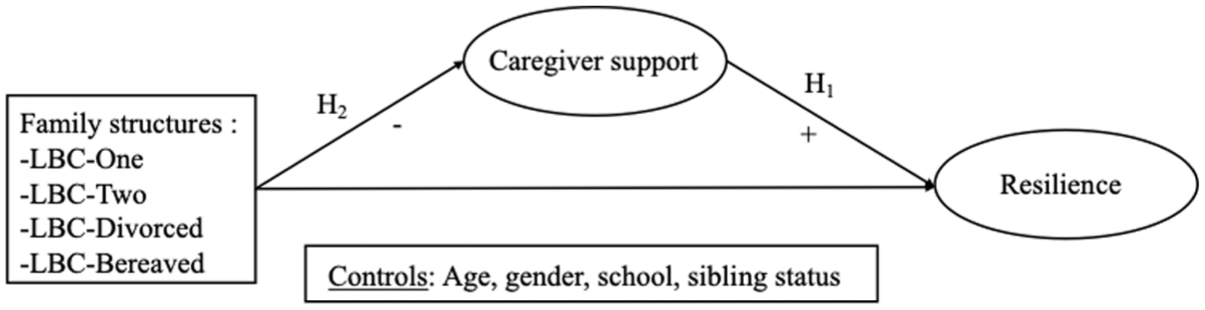
Conceptual model about the mediating effect of caregiver support on the association between family structures and resilience.
In addition, despite many scholarly efforts that have been made to explore the protective factors of left-behind children’s resilience from their family system, many of them are centered on the support and care from parents. However, variations exist in the rural left-behind child population regarding their family structure. Children are not always in the custody of their parents but of non-parental caregivers. In China, among the 41 million rural left-behind children, around half of them are left behind by two migrant parents and are in the custody of non-parental caregivers (Lyu et al., 2024). In addition, not all of those left behind by one parent live with another parent. A certain proportion of them are physically separated from their other parent and reside with non-parental caregivers for reasons such as parent divorces or bereavement. As for these left-behind children, their local caregivers might play a more important role in their resilience than their migrant parents because they are the most proximal to the children (M. Li et al., 2021; Y. Wang et al., 2023). In this study, it is also hypothesized that children left behind by one parent and residing with another parent (LBC-One) receive more caregiver support compared with their counterparts who are either children left behind by two migrant parents (LBC-Two), children from divorced families and left behind by the custodial parent (LBC-Divorced), or bereaved children left behind by their single living parent (LBC-Bereaved) (H2).
From the perspective of attachment theory, children are biologically predisposed to form a profound, enduring emotional bond with a primary attachment figure who provides consistent, sensitive, and responsive care (Bowlby, 1978). While the theory does not merely emphasize the presence of a parent, it underlines that the quality and security of the attachment bond shape children’s developmental trajectories (Ryan et al., 2007; Weaver & de Waal, 2002). Quality and secure attachment—characterized by a caregiver’s consistent responsiveness—fosters an internal working model of the self as worthy of love and of others as reliable, forming the bedrock of psychological security and resilience (Agu, 2018; Ainsworth et al., 2015). In contrast, insecure or ambivalent attachments, which may arise from inconsistent or insensitive caregiving, might confer elevated psychological risk even when a parent is physically present (Cassidy & Berlin, 1994; Kerns & Brumariu, 2013). This distinction is particularly salient in the context of left-behind children. While the migrant parent remains a psychologically significant figure, the consistency and sensitivity of care provided by the co-resident caregiver—whether a non-migrant parent for LBC-One or a grandparent for the other three groups—may be more proximately related to the left-behind children’s daily sense of security (Chen, 2016).
Along the same line, parents are likely to provide more support to the child compared with other caregivers due to a confluence of factors rooted in the depth, consistency, and nature of the parent-child bond. First, the biological and emotional connection often fosters a long-term and unconditional commitment that is less susceptible to circumstantial changes (Draper & Harpending, 2017). This creates a stable foundation of trust and attachment, allowing the child to perceive support from parents as more reliable and authentic. Second, parents typically possess profoundly specialized knowledge of their child’s unique temperament, needs, and nonverbal cues, developed through sustained and intimate interaction from infancy (Soenens et al., 2017). This deep, contextual understanding enables parents to provide support that is not only timely but also tailored to the child’s specific emotional and developmental landscape (Oppenheim & Koren-Karie, 2014). In contrast, non-parental caregivers, regardless of their dedication, often operate with a more limited knowledge base and may face structural barriers—such as their own psychological distress, ambiguous roles, or a lack of legal and social authority—that might impede their capability to respond as intuitively or authoritatively (Beal & Greiner, 2015;Vandivere et al., 2012).
As for rural left-behind children, first, rural parents are likely to have relatively higher educational attainment than other caregivers, such as grandparents, and are more capable of providing appropriate and sufficient support to their children in underprivileged rural families (Gao et al., 2019; Jingzhong & Lu, 2011). Accounting for nearly 90% of non-parental caregivers of rural left-behind children (Hannum et al., 2018), rural grandparents are usually illiterate and have little educational experience. It is difficult for rural grandparents who have not experienced much schooling to comprehend the emotional and learning status of their grandchildren (Murphy, 2020). Therefore, grandparents are less capable and confident in offering proper support to their children in need compared to parents. In effect, in previous interviews, many grandparents testified that they are not familiar with the educational and psychosocial problems encountered by their rural grandchildren and consider themselves as the primary daily caregivers whose main duty is to respond to their grandchildren’s physical needs, such as food provision and safety (Jingxiong et al., 2007;Jingzhong & Lu, 2011). Except for the physical support, their participation in their grandchildren’s schooling and growth is limited.
By the same token, the second line of reasoning lies in the intergenerational gap existing between grandparents and left-behind kids from “skipped generation families” as Rachel Murphy (2020) portrayed. Grandparents are at least 40 years older than their grandchildren. Time has changed, and their traditional caregiving philosophy and practice might not be suitable for the current generation. In Murphy’s interviews, while rural left-behind children complained about their grandparents’ authoritarian parenting style, along with the incomprehension of their inner thoughts and school problems, grandparents expressed anxieties about their caregiving quality and were frustrated about their inability to engage in deep conversations with their grandchildren. The gap that exists between the two generations might not only hinder the interactions between the two but also lead to the caregiver support deficiency of the rural left-behind children. For these reasons, it is hypothesized that left-behind children living with one parent perceive more caregiver support than the one received by LBC-Two, LBC-Divorced, and LBC-Bereaved, who are fully left behind and accompanied by non-parental caregivers (H2). Considering H1 and H2 together, this study aims to determine the mediating effect of caregiver support on the association between rural left-behind children’s family structure and their resilience.
Methodology
Data and Participants
To test our conceptual model and the two hypotheses, we conducted a study in a county in central China, which has always been one of the poorest and largest migrant-sending counties of the region since the founding of the People’s Republic of China in 1949. According to its 2019 County Chronicle, the county has 41 junior high schools, 35 of which are located in the township surrounding the city. The study was conducted after obtaining ethical approval from the Institutional Review Board of the university with which the first author was affiliated. Students enrolled in these schools are either from the towns or rural villages near the town. We applied a single-stage cluster sampling method. Four junior high schools were randomly selected from the 35 schools. They are from three towns, which are each about one hour away by car from the city center. While School D has a relatively larger student size than the other three schools, all four schools have similar academic performance in terms of their students’ grade achievement and public high school enrollment rate. All students from the four selected schools were invited to complete a questionnaire in March 2024. Informed consent was first obtained from the school principals and then the student participants at the beginning of the survey questionnaire, including the basic information of the study, statement of voluntariness, confidentiality and data usage, and consent affirmation. In addition, the researcher introduced the study and emphasized that participation was voluntary before distributing the questionnaire. The paper-and-pencil survey was conducted in the students’ classroom. In most cases, the teachers were present during the introduction of the study but were invited to leave before the students started working on the questionnaire. In other instances, teachers were absent for the entire session. The survey took place during the students’ self-study sessions. A total of 2,300 surveyed students were selected for the analysis, as they were either left behind by two migrant parents or left behind by one parent and with the other parent being dead or being excluded from the household due to divorce.
Table 2 details the demographic features of the sample. There were slightly more male participants (56.02%) in the sample. Over 90% of them were 13 to 15 years old when surveyed. In terms of family structure, the majority of the students were left behind by two parents (LBC-Two; 72.48%), while 17.87% of them were left behind by one parent and residing with another parent (LBC-One). 8.17% of the participants were from divorced families and were left behind by their custodial parents who migrated to the cities (LBC-Divorced). Bereaved children with one parent dead and left behind by their living parent (LBC-Bereaved) have the smallest proportion (1.48%).
Participant Demographics.

Note. LBC-One= Children left behind by one parent and residing with another parent; LBC-Two= Children left behind by two parents; LBC-Divorced= Children from the divorced family and left behind by the custodial parent who migrates to cities; LBC-Bereaved= Bereaved children left behind by the living parent who migrates to cities.
Measures
Resilience
Students’ resilience was measured using eight items extracted from the Child and Youth Resilience Measure (CYRM-12) developed by Liebenberg et al. (2013). The initial CYRM-28 was developed based on youth samples across 11 countries (Ungar & Liebenberg, 2011). Researchers employed qualitative methods to identify universal concepts of resilience and the resources that enable individuals to thrive despite challenges. This process led to the development of 58 items across four resilience categories: individual, relationships, community, and culture. Quantitative analyses of pilot study data, including exploratory factor analysis and expert consensus, refined the measure to 28 items across three categories: individual traits, relationship to caregiver(s), and contextual factors that facilitate a sense of belonging. The 12-item scale is a brief version of CYRM-28. A study based on data from two samples of youth from Atlantic Canada has verified its reliability and validity (Liebenberg et al., 2013). The Chinese version of CYRM-12 was developed by Mu and Hu (2016), and it demonstrated satisfactory psychometric properties in the Mainland Chinese context. The Chinese version of CYRM-12 was utilized to measure left-behind students’ resilience in this study. While the CYRM-12 captures individual, relational, and contextual dimensions of resilience, the present study focused specifically on the caregiver subscale to align the analysis with our research question regarding family structure. Therefore, we selected items pertaining to perceived family support. A family resilience score was calculated by summing these items, with higher scores indicating greater perceived family-level support. The scale shows good reliability in this study, with Cronbach’s alpha equal to 0.757.
Caregiver Support
Above all, caregivers are those who reside with the child and provide them with primary daily care. They are parent caregivers for LBC-One and non-parental caregivers for LBC-Two, LBC-Bereaved, and LBC-Divorced. Consistent with the RYDM, we assessed three aspects of caregiver support—communication, care, and participation—which collectively capture children’s perceptions of caring relationships and meaningful participation with their caregiver. This multidimensional latent approach to measuring caregiver support has been employed in previous international studies (e.g., Aditaputri et al., 2024; Cheraghian et al., 2023). First, caregiver communication was measured with 5 items. Participants were asked to rate on a five-point scale the frequency of their caregivers communicating with them regarding things that happened at school, their relationships with friends and teachers, their school learning, mutual acquaintances, and things that they were upset about within the past month. Similar scales have been utilized in previous studies to measure parent-child communication between Chinese rural parents and children (e.g., Su et al., 2012;Zhuang et al., 2024). The scale shows acceptable reliability in this study (α = .756). Each item had a rating scale of 1 to 5, representing “never,” “once per month,” “once per week,” “once every other day,” and “once per day,” respectively. The cumulative scores for caregiver communication were between 5 and 25. A higher score indicates a higher frequency of communication between rural children and their migrating or residing parents. Second, caregiver care was measured with six questions. Participants were asked to rate on a four-point scale the frequency of their caregivers discussing with them their school performance, attending school-parent meetings, visiting their classrooms, attending school events, checking their homework, and limiting their time watching TV. Each item had a rating scale of 1 to 4, denoting “never” (coded as 1), “seldom” (coded as 2), “sometimes” (coded as 3), and “often” (coded as 4), respectively. The cumulative scores for caregiver communication were between 6 and 24. A higher score indicates a higher level of parental care.
Third, students’ meaningful participation with caregivers was measured by their frequency of engaging in different activities with their parent or non-parental caregivers. Participants were asked to rate on a five-point scale the frequency of shopping, doing exercises, watching TV, dining together, and visiting relatives and friends with their caregivers in the past month. This five-item scale shows acceptable reliability in this study (α = .721). Each item had a rating scale of 1 to 4 referring to “never” (coded as 1), “seldom” (coded as 2), “sometimes” (coded as 3), and “often” (coded as 4), respectively. The accumulative scores for caregiver communication were between 6 and 24. A higher score indicates a higher level of parental care.
Analytic Approach
To test the mediating effect of caregiver support on the association between family structure and resilience, structural equation modeling (SEM) was conducted using Stata 17. In the constructed mediation models, students’ resilience was entered as the outcome variable, while their family structure served as the predicting variable, which was set as a dummy variable. Caregiver support was set as a latent variable, measured by caregiver communication, caregiver care, and caregiver participation. In the tested mediation model, LBC-One was set as the reference group. To reduce item-specific noise and measurement error, resilience was modeled as a latent variable predicted by the mean scores of three randomly generated parcels. Students’ age, gender, school, and sibling status were controlled for both caregiver support and resilience in all models. Further, to test the indirect effect, a 95% bias-corrected bootstrap confidence interval (BCCI) based on 5,000 bootstrap samples was computed. The measurement and structural models were considered to fit the data if the chi-square p-value was below 0.05, the root mean square error of approximation (RMSEA) estimate was less than 0.05, the standardized root mean square residual (SRMR) was below 0.05, and the comparative fit index (CFI) was above 0.9.
Results
Descriptive Statistics
Table 3 presents the mean comparisons across four groups of left-behind students within different family structures. Results of ANOVA tests revealed that there were statistically significant differences among the four groups regarding their resilience (F[3, 2244] = 5.00, p = .002) and three aspects of caregiver support: caregiver communication (F(3, 2234) = 10.60, p < .001), caregiver participation (F[3, 2206] = 5.46, p < .001), and caregiver care (F[3, 2225] = 7.10, p < .001). In addition, Table 4 details the bivariate correlations among resilience and the three aspects of caregiver support. Resilience is positively correlated with the three aspects of caregiver support.
Mean Comparisons of Three aspects of Caregiver Support and Resilience Across Four Groups.

Note. LBC-One= Children left behind by one parent and residing with another parent; LBC-Two= Children left behind by two parents; LBC-Divorced= Children from the divorced family and left behind by the custodial parent who migrates to cities; LBC-Bereaved= Bereaved children left behind by the living parent who migrates to cities; C-Communication= Caregiver communication; C-Participation= Caregiver participation; C-Care= Caregiver care.
Bivariate Correlations Among Variables.

Note. C-Communication= Caregiver communication; C-Participation= Caregiver participation; C-Care= Caregiver care.
p-Value < .001.
Mediation Model Results
To examine our hypotheses, structural equation modeling was used to test whether the difference in resilience among left-behind students from different family structures would be mediated by their caregiver support. First of all, the model showed a good fit to the data, with χ2 (36) = 199.69, p < .001, CFI = .940, TLI = .905, SRMR = 0.025, RMSEA = 0.047, 90% CI for RMSEA [0.041, 0.054]. As shown in Figure 2, LBC-Two (β = −.064, p = .034), LBC-Divorced (β = −.160, p < .001), and LBC-Bereaved (β = −.084, p = .001) reported statistically significantly lower levels of support from their caregivers than LBC-One, supporting Hypothesis 2.

Results of mediation model.
In addition, the correlation between caregiver support and resilience is positive and statistically significant (β = .641, p < .001) after controlling for students’ age, gender, enrolled school, and sibling status, supporting Hypothesis 1. The bootstrapping results indicated that the mediating effect of caregiver support was significant, with b = −0.128, BCCI [−0.251, −0.008] for LBC-Two, b = −0.511, BCCI [−0.713, −0.328] for LBC-Divorced, and b = −0.611, BCCI [-0.982, −0.276] for LBC-Bereaved. This suggests that LBC-Two, LBC-Divorced, and LBC-Bereaved are likely to receive less support from their caregivers, which further contributes to their lower level of resilience compared with LBC-One. Lastly, the direct effects of LBC-Two, LBC-Divorced, and LBC-Bereaved on resilience were nonsignificant, which suggests that caregiver support might account for all of the observed differences in resilience between LBC-One in parental care and the other three groups in non-parental care. All the path coefficients in the mediation model are presented in Table 5.
Results of Path Analysis in the Mediation Model.

Note. LBC-Two= Children left behind by two parents; LBC-Divorced= Children from the divorced family and left behind by the custodial parent who migrates to cities; LBC-Bereaved= Bereaved children left behind by the living parent who migrates to cities.
Discussions and Implications
Although a growing number of studies are dedicated to exploring the support from the family system on rural left-behind children’s resilience, these studies are inclined to place particular emphasis on parental support and involvement, with the role of caregivers being neglected. In addition, given that the left-behind child population is heterogeneous regarding their family structure, little is known about the variation among left-behind children from different family structures in their received caregiver support. Drawing upon insight from the Resilience and Youth Development Module, the current study explored the relationship between caregiver support and resilience among left-behind children from different family structures. Results revealed that left-behind children living with one parent receive significantly higher caregiver care and communication from their caregivers compared with the other three groups living with non-parental caregivers. We further found a positive correlation between left-behind children’s caregiver support and resilience and thus identified the mediating effect of caregiver support on the association between family structure and resilience. The difference between children left behind by one parent and the other three groups in their resilience level might be fully mediated by their different caregiver support.
Foremost and before discussion, it is worth highlighting that the current study serves as a preliminary investigation rather than a definitive or exhaustive typology of left-behind children. The four family structures examined herein—LBC-One, LBC-Two, LBC-Divorced, and LBC-Bereaved—were derived from the available data and informed by our literature review. They represent empirically identifiable and relatively common subgroups among rural left-behind children. However, these categories are not intended to capture the full spectrum of family complexity that left-behind children experience. Other meaningful family circumstances, such as parental incarceration combined with migration, could not be examined in the present study due to data limitations. Therefore, we suggest that the present findings should be interpreted as reflecting differences and associations within the four identified family structures, rather than generalizable conclusions about all possible forms of left-behind children.
First, this study found that children left behind by one parent and living with another parent reported receiving more caregiver support compared with peers who are cared for by non-parental caregivers. Likewise, we also found that children left behind by two parents demonstrated significantly higher levels of caregiver support compared with those from divorced families and from single-parent families. This difference might be attributed to the difference in quantity and quality of caregiver support between parent and non-parental caregivers. Parent caregivers might be more capable and confident in providing support to their children because they are likely to have more educational experience and hold less generational gap with the child compared with non-parental caregivers (Gao et al., 2019; Jingzhong & Lu, 2011). These advantages grant them not only a better comprehension of their children’s changing developmental needs, as underlined in the Resilience and Youth Development Module, but also knowledge and skills in providing appropriate support to their children to address their developmental needs by nurturing a caring relationship with, showing their positive expectation for, and engaging in meaningful interactions and activities with their children. Conversely, non-parental caregivers who have little educational experience and a relatively great generational gap with the left-behind children tend to find it difficult to understand their children and find it challenging to offer proper support (Murphy, 2020).
To a certain extent, this finding resonates with the persistent debate that parent caregivers are more capable of childbearing and play a more important role in a child’s development than non-parental caregivers (Beal & Greiner, 2015; Lamb, 1996). International studies have consistently suggested that children living with non-parental caregivers demonstrated poorer levels of physical, psychological, and developmental outcomes (Taussig & Clyman, 2011;Vandivere et al., 2012). Parents typically have a stronger emotional connection with their children, which fosters security and trust. With a strong sense of trust and connectedness, it is easy for parent caregivers to deliver their care to and engage in meaningful activities with their children.
In addition, this study also observed a positive correlation between caregiver support and resilience. Children are in tremendous transitions in physical strength, thinking and reasoning abilities, emotional functioning, and social relationships (Graber et al., 2018; Lerner & Foch, 2021), which would lead to remarkable changes in their developmental needs and negatively impact their social and psychological wellbeing along with educational development (Benard, 2004; Blum et al., 2014). Resilience is crucial for children to address their multifarious developmental needs evolving with environmental changes. Caregiver support plays a vital role in fostering children’s resilience because it not only provides them with external resources to tackle their developmental needs, as RYDM suggests, but more importantly, it delivers to at-risk children warmth and care from the family system, which might indirectly contribute to their capability of coping with developmental challenges (Hanson & Kim, 2007; S. Hu, 2019). Rural left-behind children in China are likely to receive insufficient developmental support from their multiple external systems due in part to their parental migration, rural school resource scarcity, and caregivers’ low awareness of involvement (Cui et al., 2021; Xie et al., 2019). In addition, the deficient educational investment from parents and caregivers is compounded and limited by the economic precarity of rural households, creating a cycle of disadvantage that permeates the daily lives and development of rural left-behind children (Lu, 2012). As a result, the individual developmental uncertainty, coupled with insufficient external support, poses a considerable challenge to the rural left-behind children’s ability to cope with their developmental needs and challenges (Davidson & Adams, 2013; Liu et al., 2018). Nonetheless, studies point out that care and support from caregivers would deliver underprivileged children familial warmth that further functions as a significant compensatory factor for their multiple adaptive challenges and contributes to their resilience (Davidson & Adams, 2013; Simpkins et al., 2014).
To conclude, the analysis revealed that caregiver support might fully mediate the relationship between family structure and resilience among left-behind children. This finding suggests that the lower levels of resilience observed among LBC-Two, LBC-Divorced, and LBC-Bereaved, compared to those with LBC-One, might be explained by the disparities in the caregiver support they receive. In other words, it might not be the structural fact of being left behind per se that directly diminishes a child’s resilience, but rather the significant reduction in perceived support from their caregiver that often accompanies these complex family situations. This underscores the central role of the caregiver-child dynamic; when support is perceived as adequate, the negative impact of family structure on resilience appears to be nullified.
The implications of this study extend to both practice and policy, emphasizing the necessity of a comprehensive approach to support rural left-behind children as well as their caregivers. By recognizing that caregiver support significantly contributes to resilience, stakeholders—including local and central educators, rural schools, and interest organizations—should develop targeted programs that enhance caregiver capabilities, particularly in communication and educational involvement. Two important points warrant discussion in this regard. On the one hand, our findings suggest that parent caregivers play a more effective role in fostering left-behind children’s resilience. It is important for migrant parent(s) who leave their children in the custody of non-parental caregivers to stay with their children to engage in meaningful events and build a caring relationship with them. However, we acknowledge that such a decision necessitates a broad consideration of family economic benefit and is thus hard to achieve. In this light, given that concrete and physical parental support is challenging to arrange due to parent-child separation, an alternative and feasible way for migrant parents to support their children and deliver their care to them is through online communications. Through frequent and regular parent-child communication, migrant parents are able to convey their care to their children, which might further contribute to their resilience, as RYDM suggests (Hanson & Kim, 2007; F. Wang et al., 2019).
On the other hand, tailor-made training and resources should be made available to non-parental caregivers, whose capability of rendering support to left-behind children might be constrained by their low educational attainment and intergenerational gap with the children. Such interventions are not common among Chinese rural left-behind children. Not many intervention programs have been implemented targeting grandparents or non-parental caregivers, and they were dedicated to promoting grandparents’ nutrition and hygiene practices (Rozelle & Hell, 2020). Our findings further indicated that more attention should be given to grandparent interventions concerning left-behind children’s resilience to cultivate grandparents’ skills and confidence in engaging in deep and quality communications with left-behind children and showing their care.
Lastly, given the relatively limited non-parental caregiver support to rural left-behind children, policies at a local and regional community level should be implemented to establish a community support network that connects left-behind families with resources and services to strengthen caregiver engagement (C. Zhao et al., 2017). Such an initiative should be led by the local authorities and operated by schools or interested educational organizations. Fundamental services of the community support network include creating support groups for multiple left-behind families, mentorship programs led by schoolteachers, and educational workshops for left-behind children, as well as for rural non-parental caregivers focused on the communication between the two in fostering children’s resilience. Special care should be given to children who are left behind by both parents or those who are from one-parent families and left behind by their custodial parent (e.g., LBC-Bereaved & LBC-Divorced), as they receive relatively less support from their non-parental caregivers.
Limitations
Despite its interesting findings and meaningful implications, this study has several limitations. First, one significant limitation of this study is the absence of longitudinal data, which restricts our ability to draw definitive causal inferences on the relationships between family structure and caregiver support, as well as the relationship between caregiver support and resilience. For instance, while we observed a strong association between higher caregiver support and greater resilience, it is plausible that a child’s inherent resilience positively influences the level of support a caregiver provides, a dynamic that longitudinal data could help untangle. Therefore, the interpretation of research findings could only be based on associations among the variables rather than causal pathways. Future research employing longitudinal designs is necessary to delineate the directionality and potential reciprocity of these relationships.
Second, the application of the RYDM provides the theoretical basis on which our research questions and hypotheses are rooted. Yet, on top of the positive effect of meaningful participation and caring relationships on youths’ internal resilience, the module further suggested that such a correlation is mediated by the youths’ developmental needs. That is, external support from the family, school, community, and peer systems enhances individuals’ resilience by addressing their developmental needs, such as safety, belongingness, and respect (Hanson & Kim, 2007). These factors were not considered, and the mediating mechanism was not examined in this study among the rural left-behind child population. By the same token, this study only examined the effect of caregiver support on left-behind children’s resilience, while factors from left-behind children’s community, school, and peer systems were neglected (Zhuang et al., 2025). Although the finding underscores the potent role of caregiver support as it fully mediates the resilience disparities between left-behind children from different family structures, this statistical full mediation should not be interpreted as the absence of other pathways. It is plausible that a direct effect of family structure exists but operates through factors from unmeasured external systems, such as school, peers, and community. Therefore, future work should explore these systems to determine their potential compensatory roles in fostering rural left-behind children’s resilience.
Lastly, as noted in the Introduction and Discussion, the four-category classification of left-behind children—LBC-One, LBC-Two, LBC-Divorced, and LBC-Bereaved—does not represent an exhaustive typology of all possible family structures. Other complex family circumstances, such as parental incarceration, were not examined due to data constraints in the current study. Consequently, the findings are not able to capture the full range of heterogeneity among left-behind children, and the observed patterns of caregiver support and resilience may differ in family configurations not represented here. Future research with more comprehensive family data is needed to extend and validate the present classification framework across left-behind groups with diverse family structures.
Footnotes
Acknowledgements
The authors would like to thank the support from the four project schools and the participation of the students.

Ethical Considerations
Ethical approval for this study was obtained from the Institutional Review Board at The Hong Kong Polytechnic University [Ref. HSEARS20240103004]
Consent to Participate
Informed consent was obtained from all subjects involved in the study.
Funding
The authors received no financial support for the research, authorship, and/or publication of this article.
Declaration of Conflicting Interests
The authors declared no potential conflicts of interest with respect to the research, authorship, and/or publication of this article.
Data Availability Statement
The data that support the findings of this study are available from the corresponding author, upon reasonable request.