




Abstract
Past research has posited that effective leadership is an essential ingredient in reaching international agreements and overcoming the collective action problems associated with responding to climate change. Despite its fundamental importance for leadership relationships, the demand side of the leadership equation has been comparatively neglected in the literature. In this study, we answer several related questions that are vital for understanding the leadership dynamics that impact the United Nations Framework Convention on Climate Change (UNFCCC) negotiations. Are there any leaders in the field of climate change and, if so, who are they? How do followers select climate leaders? What factors are important to them? Using unique survey data collected at four consecutive United Nations (UN) climate summits, Conference of Parties (COP) 14–17, this article investigates which actors are actually recognized as playing a leadership role in the UNFCCC negotiations and probes how followers select leadership candidates in this issue area. The survey findings reveal a fragmented leadership landscape, with no one clear-cut leader, and spotlight that if an actor seeks to be recognized as a leader, it is crucial to be perceived as being devoted to promoting the common good.
Keywords
Scholarship on international cooperation and negotiations has posited that leadership is a crucial determinant in overcoming the obstacles associated with reaching international agreements and establishing international institutions. 1 Leadership can make a difference by establishing a ‘relationship of influence in which one actor guides or directs the behavior of others toward a certain goal’. 2 When confronting complex global problems, such as the climate change challenge, in which the stakes are high and solutions can be blocked by collective action problems, leadership is essential. Leadership can make a decisive difference by providing a model others may want to emulate, removing uncertainty about whether the leader is actually devoted to meaningful action, or creating incentives that may persuade others to follow.
To date, leadership theory has focused almost entirely on the leaders thereby failing to provide a systematic understanding of the role and importance of followership. The main aim of this article is to contribute to the leadership scholarship by focusing on the demand side of the leadership equation. We attempt to do so by addressing two comparatively neglected elements of leadership: who is recognized as a leader and what factors determine leadership recognition. By testing six rival hypotheses concerning what motivates potential followers to support particular leaders, we seek to fill existing theoretical gaps in the leadership literature.
Scholars have found that resource capabilities, legitimacy, and credibility are imperative for effective leadership. 3 However, the very existence of a leader ‘implies followers who move in the same direction’, 4 and the latter of these components deserves more attention than it has received thus far in leadership research. Leadership is indeed ‘a relationship between leaders and followers’, and consequently both parties to this relationship are indispensable. 5 In fact, ‘[w]ithout followers who act on leadership directives, the title of leadership is hollow’. 6
Followers are vital because they ‘empower leaders’. 7 If followers are required for a leader to be successful, it is axiomatic that the effectiveness of leadership efforts will be seriously undermined if an actor who aspires to be a leader fails to be recognized as such. Low levels of recognition for a particular leadership candidate, in turn, increase the likelihood that potential followers will not be willing to let their behavior be guided in the direction suggested by the would-be leader.
In this article, we address two issues that are crucial for understanding the role of leadership in international climate change negotiations. Based on unique survey data collected at four consecutive Conference of Parties (COP) summits – in Poznań 2008, Copenhagen 2009, Cancún 2010, and Durban 2011 – we seek first to document whether there are in fact any actors recognized as leaders in the field of climate change. Who among the leadership candidates are recognized as leaders, and to what extent? Second, and more importantly, we aim to shed light on the factors that influence whether or not a leadership candidate is recognized as a leader. If it is indeed true that ‘there are no leaders without followers’, 8 then it is a crucial task to better understand how followers decide which actors to recognize as leaders. With our second objective, we thus aim to make a much needed contribution to the leadership scholarship by examining a number of rival hypotheses regarding what determines leadership selection and recognition. Providing a better understanding of the factors that motivate followers to support particular leaders also allows us to provide insights into which leadership attributes are the most consequential.
In proceeding, we first discuss previous research and the insights provided by the leadership scholarship. Second, we discuss the concept of leadership and examine the various leadership modes. Third, we elaborate the article’s analytical concerns and present our analytical framework. Next, we examine which actors are recognized as climate change leaders and look at how leadership perceptions have evolved from COP-14 to COP-17. In the penultimate section, we seek to chart what motivates potential followers to support different actors as leaders. We conclude by summarizing the main results and discussing what our findings imply for leadership scholarship and the role of leadership in the international climate change negotiations.
The study of leadership: what do we know?
When looking at previous research on leadership, it becomes evident that the bulk of past scholarship has focused on the supply side of leadership and the strategies and actions of the leaders. The main thrust of the research on the supply side of leadership has been directed toward increasing our knowledge on how the various modes of leadership have been deployed in various issue areas. These contributions have confirmed some of the results from the pioneering work done by scholars such as Oran Young and Arild Underdal by showing that leaders actually do combine different leadership modes rather than simply relying on one form of leadership to guide the behavior of others. 9
By focusing on which actors are recognized as leaders by United Nations Framework Convention on Climate Change (UNFCCC) negotiation participants, and why, this study seeks to make an important contribution to a research filed which hitherto has been focused nearly exclusively on the supply side of leadership and the words and deeds of would-be leaders. 10 To fully understand the role played by leadership in international climate change negotiations, it is, of course, valuable to have a firm understanding of what aspiring leaders actually say and do in their efforts to affect the behavior of other actors. However, it is not enough to simply focus on the goals, strategies, and leadership modes of self-declared leadership contenders. It is also imperative to investigate which actors are actually recognized and accepted as leaders. A mismatch between the supply and demand of leadership may mean that potential followers will be less willing to let their behavior be guided by specific leadership gambits or undermine leadership efforts to forge joint solutions to common problems. Therefore, in order to acquire a more complete picture of leadership, we must zero in on follower perceptions and the factors associated with leadership recognition.
Traditionally, studies on the supply of leadership have dominated this research field, but there are now a number of valuable studies that focus on the demand side of leadership and the follower side of the leader–follower relationship. Gupta and van der Grijp were among the first to examine followers’ perceptions on leadership within the climate change regime. 11 More recently, Elgström and Kilian have compared the European Union’s (EU) role perception of itself as a leader with the views held by potential followers of the performance of the EU in different regime settings such as trade, forestry, endangered species, and climate change. 12
In evaluating the EU’s quest for a leadership role in various issue areas, these studies showed that EU interviewees and respondents from states outside the EU have different views on the EU’s status as a leader. The latter tended to be more critical of the leadership provided by the EU. For example, Elgström found that within the World Trade Organization (WTO), EU respondents portrayed EU leadership as indisputable, while interviewees from non-EU states had a more mixed impression of the EU’s leadership role. 13 Also, in a recent study informed by responses from more than 200 climate change negotiation participants, it was shown that there is a strong geographical component to leadership recognition. 14 Competing leadership contenders – in this case, China, the EU, the G-77, and the US – ‘were more widely recognized as leaders in their “home constituencies” than among respondents in general’. 15
It is clear that previous research on leadership has improved our knowledge on a number of crucial issues. The research efforts focused on the supply side of leadership have, for example, increased our understanding of the motivations actors have for seeking leadership positions, 16 how leaders combine different leadership modes to guide the behavior of others, 17 and the prerequisites for leadership efforts to bear fruit. 18
More recently, the leadership literature has also provided some insights into which actors are actually recognized as leaders in international negotiations. 19 A remaining gap in the literature, we argue, is the lack of a theoretically grounded understanding of leadership recognition, that is, we simply need to learn more about what ‘drives followers to follow’. 20 This is the lacuna which the current article seeks to address by formulating and testing six rival hypotheses on what motivates potential followers to recognize an actor as a leader.
Leadership and its modes
What is meant by leadership is fairly well established in this subfield and is well captured by Underdal’s definition of leadership as an ‘asymmetrical relationship of influence in which one actor guides or directs the behavior of others toward a certain goal’. 21 Other well-known definitions of leadership include Young’s view of leadership as ‘the actions of individuals who endeavor to solve or circumvent the collective action problems that plague efforts of parties seeking to reap joint gains’, 22 or Nye’s definition of leadership as ‘the power to orient and mobilize others for a purpose’, 23 where a leader is seen as someone ‘who guides or is in charge of others’. 24
Scholars have identified a number of different forms or modes of leadership through which an aspiring leader can seek to guide or direct the behavior of others 25 and examined these in the context of specific issue areas such as climate change, 26 trade, forestry, and endangered species of animals and plants. 27 From these efforts, there are a number of different, partly overlapping, classifications of the different modes of leadership to be found in the literature. Furthermore, the terminology sometimes differs between scholars who are essentially talking about the same or very similar modes of leadership. All of this has resulted in a certain amount of confusion surrounding the various modes of leadership. However, once one examines the various leadership modes on offer, it becomes manifest that there is actually much common ground to be found between the different contributions. So, although the terminology varies, we believe that it is possible to distinguish between four main modes of leadership: structural, directional, idea-based, and instrumental.
Structural leadership refers to the deployment of power-resources for the purpose of creating new incentives and changing the costs and benefits associated with different avenues for action in a particular issue area. 28 This type of leadership flows from an actor’s aggregate power and can be pursued through coercion or constructive inducements. By utilizing resource-based incentives, the leader tries to change the pay-offs associated with different outcomes in an issue area to promote a preferred solution to a collective problem.
Directional leadership, 29 or unilateral leadership, 30 rests on taking unilateral action and is accomplished by the demonstration effects of leading by example. 31 By making the first move, it is possible to demonstrate the feasibility, value, and superiority of particular policy solutions. Exemplative leadership demonstrates a commitment to act and also removes uncertainty about whether the leader is actually devoted to the undertaking rather than just engaging in ‘cheap talk’. 32
Idea-based leadership (also referred to as intellectual), is concerned with problem naming and framing and the promotion of specific policy solutions to collective problems. 33 This type of leadership is characterized by agenda setting efforts and includes discovering and proposing joint solutions to collective problems. There are two dimensions connected to ideational leadership: one involves efforts to change perceptions regarding the problem at hand, ‘consciousness-raising’, 34 while the other consists of making new proposals and suggesting innovative solutions.
Finally, there is instrumental leadership, 35 sometimes referred to as entrepreneurial, 36 or problem-solving leadership. 37 This mode of leadership is closely related to idea-based leadership as it partly has to do with devising proposals to achieve common goals. The emphasis for an instrumental leader, however, has less to do with agenda setting or presenting new ideas intended to alter the fundamental preferences of the actors. Instead, an instrumental leader rather relies on ‘negotiating skill’ and seeks to ‘put together deals that would otherwise elude participants’. 38
Examining leadership recognition
The data used in this study stem from surveys conducted at the four consecutive UNFCCC COP meetings, 2008–2011. The data set consists of a total of 1861 completed surveys. Having secured the UNFCCC secretariat’s endorsement to conduct our study, surveys were distributed in person at the conference venue during the first week and during the high-level segment of week 2 at each COP. Given the operating environment, random sampling was not a viable option, and we opted instead to use quota sampling to select respondents. The survey was primarily focused on collecting a strategic sample of the two largest and most important categories of COP participants: on the one hand, members of party delegations, such as negotiators and representatives of government agencies, and, on the other, non-governmental organization (NGO) representatives and researchers. Members of the two smallest participant categories, media and representatives of UN and other intergovernmental organizations, were not our primary focus but respondents from these groups of participants are also included in the data set. Roughly 45 percent of the respondents in the final sample were delegates (negotiators or government representatives), whereas some 55 percent were observers (NGO representatives, UN/International Government Organization (IGO) representatives, researchers, or media), which corresponds well with the composition of the frame population where the percentage of delegates in the four COPs surveyed has varied between 43 and 45. The overall response rate has been around 65 percent.
In order to answer the first question posed by this article – who among the leadership candidates are recognized as leaders, and to what extent? – we used a fairly straightforward approach: we simply asked participants at the COP meetings which actors they saw as leaders in the field of climate change. Rather than providing respondents with a fixed number of response alternatives, we used an open-ended question to tap into their views on which actors they recognized as playing a leading role in the climate negotiations: ‘Which countries, party groupings and/or organizations have, in your view, a leading role in climate negotiations?’ Respondents could answer this by putting down none, one, two, or as many leaders as they found to be present in the climate change negotiations. 39
Attempting to answer the second question, regarding the factors that influence leadership recognition, takes us into uncharted territory. We utilized past studies of leadership to formulate six competing hypotheses on what motivates followers to support particular leaders. The first four hypotheses are taken from the scholarship on leadership forms, as discussed in the previous section, which identified four main modes of leadership: structural, directional, idea-based, and instrumental. Previous leadership studies have used these modes of leadership ‘to focus on the behavior of the leader alone’, 40 but we believe that they can also be employed to shed light on what drives prospective followers to recognize an actor as a leader.
The first hypothesis is that an actor’s aggregate power and its capacity to deploy power-resources will be an important factor for being recognized as leader by potential followers. To be a leader, one must have the capacity to act and actually make a difference. It would, therefore, seem reasonable to assume that an actor equipped with extensive material power capabilities will be well positioned to attract followers. In order to tap into the significance of structural leadership in this context, we asked respondents to indicate to what extent a leader’s ‘ability to provide resources and inducements to address a problem’ was important for their decision to support a particular leader.
In a similar fashion, we examined the significance of directional leadership. By making the first move, a would-be leader removes any uncertainty prospective followers may have regarding the leader’s devotion to action rather than just engaging in cheap talk. By taking the first step, the leader proves his or her dedication to a proposed solution and ideally demonstrates that the solution works and is worthy of emulation, which in turn may persuade others to follow. 41 The second hypothesis was tested by asking respondents to what extent ‘the leader’s ability to demonstrate a credible domestic climate change policy’ was an important factor for choosing to support a particular leader.
The third hypothesis is concerned with idea-based leadership and rests on the assumption that prospective followers will value an actor’s ability to bring new knowledge to bear on a particular issue, make novel proposals, and suggest innovative solutions to a collective problem. To test this assumption, we asked respondents to indicate to what extent they agreed with the proposition that ‘the leader’s ability to provide new ideas and solutions for dealing with the climate change problem’ was a major factor in choosing to support a particular leader.
The fourth hypothesis derived from the scholarship on leadership modes assumes that an actor’s ability to engage in instrumental leadership is important for leadership recognition. In other words, the extent to which an actor possesses negotiating skills that may facilitate the reaching of agreements ‘that would otherwise elude participants’. 42 The fourth hypothesis was tested by asking respondents to what extent ‘the leader’s ability to act as a broker to bridge problems in the negotiations’ came into play as a central consideration in choosing to recognize an actor as leader.
In addition to features linked to an actor’s ability to act as a structural, directional, idea-based, or instrumental leader, we tested two additional hypotheses. Leadership theory often includes the pursuit of the common good or a collective goal as a defining characteristic of leadership. 43 For example, according to Malnes a ‘leader is supposed to look beyond his or her own interests and concerns, to the interests of a wider group…’. 44 Our fifth hypothesis was thus designed to test to what extent the leader’s pursuit of a common good is an integral consideration when followers decide whether or not to back a specific leadership candidate. This hypothesis was tested by asking respondents to what degree ‘the leader’s overall commitment to solving the climate change problem’ was an important factor.
Finally, we need to acknowledge that self-interest very well may come into play as a factor determining whether or not prospective followers decide to support a particular leader. The sixth hypothesis concerning what drives followers to recognize an actor as a leader was tested by asking respondents to what extent ‘the leader’s promotion of their country’s interests’ was important for their decision to support a specific leader.
In order to explore what motivates followers to support different actors as leaders, respondents were asked to what extent they agreed – with the aid of a Likert scale ranging from 1 (disagreement) to 7 (agreement) – with the six rival hypotheses concerning which factors are important for choosing to support a particular leader. 45 This gives us the opportunity to provide theoretically grounded evidence to the question regarding what factors motivate prospective followers to recognize an actor as a leader as well as shed light on which leadership strategies matter most. To what extent will an actor’s perceived ability to engage in structural, directional, ideational, or instrumental leadership affect the likelihood of it being recognized as leader? And to what extent will the leader’s commitment to the common good as well as to what extent self-interest come into play when followers decide who to follow?
While we believe our survey results provide valuable evidence and insights concerning leadership recognition and selection, we recognize that there are some limitations to the methodology used in this study. For example, there is always a risk that respondents are not entirely forthcoming when answering survey questions and give what they think is an acceptable answer rather than what they actually believe. Also, our sample, while representative for the participants at the COP conferences and though it includes many influential players, does not include some important actors involved in calling the final shots in the negotiations, such as environmental ministers or heads of states. It may be that this very top echelon of elite actors has somewhat different views on what the key attributes for an aspiring leader are.
Nonetheless, although these caveats, many of which are inherent to survey approaches, need to be acknowledged, these concerns should not be exaggerated either. Moreover, the way the survey was designed and the population of the sample mitigates, to some extent, the concerns aired above. First, the respondents were guaranteed anonymity, which reduces any incentive to answer strategically. Second, there is no strong prevailing norm or widespread consensus which would tell or signal to the respondents what the ‘appropriate’ answer or ranking among the various alternatives ideally should be. Third, the respondents surveyed represent a select and elite group and the many delegates included in the sample are well placed to understand the motives for their negotiating instructions and the policy choices of their delegations.
Having laid out our objectives and analytical concerns, in the following sections, we present and analyze our findings. We start by looking at leadership recognition in the field of climate change and then turn our attention to the factors that motivate leadership selection and support.
Are there any climate change leaders?
A number of actors, including the EU and the US, have in recent years declared their intention to act as leaders within the UNFCCC regime. The EU in particular has invested much time and effort to brand itself as a climate change leader. The EU’s ambition has for some time now been nothing short of leading global action against climate change. 46 This aspiration was recently reaffirmed by EU Commission President Barrosso, who, in his state of the Union 2012 address, argued that the world needs an EU ‘that leads the fight against climate change’. 47
In recent years, the US under President Obama has likewise pledged leadership in addressing the climate change challenge. In the run-up to the COP-15 summit, for example, the US administration expressed a willingness to work together with the international community in devising strategies to do so. 48 The special envoy for climate change, Todd Stern, has also claimed that the US actually has been providing leadership in order to keep the UNFCCC negotiations moving forward. 49
Emerging global powers like China, India, and Brazil are also looking to increase their influence on the global scene, even to the point of seeking leadership positions in various policy fields. 50 It is one thing, however, to declare yourself a leader and quite another to actually be recognized as such by potential followers. In our search for leadership recognition in the field of climate change, we will focus on the under researched demand side of the leadership relationship and the perceptions of the followers.
Historically, leadership on climate change has primarily been exercised by the US and the EU. In the last 30 years, both have attempted to exercise leadership on this issue. However, as noted above, in recent years, the landscape of international environmental cooperation has changed, with new actors and coalitions now vying for leading roles. 51 One important and already highly influential new leadership contender is the BASIC (Brazil, South Africa, India, and China) coalition. The BASIC group made a real impact at COP 15 and played a major role in shaping the Copenhagen Accord. The addition of these new would-be leaders means that the supply side of the leadership landscape is more fragmented than ever. 52 The key question then is whether and to what extent any of these leadership candidates are actually recognized as leaders by potential followers, or whether we simply have a number of self-proclaimed leaders with no real support?
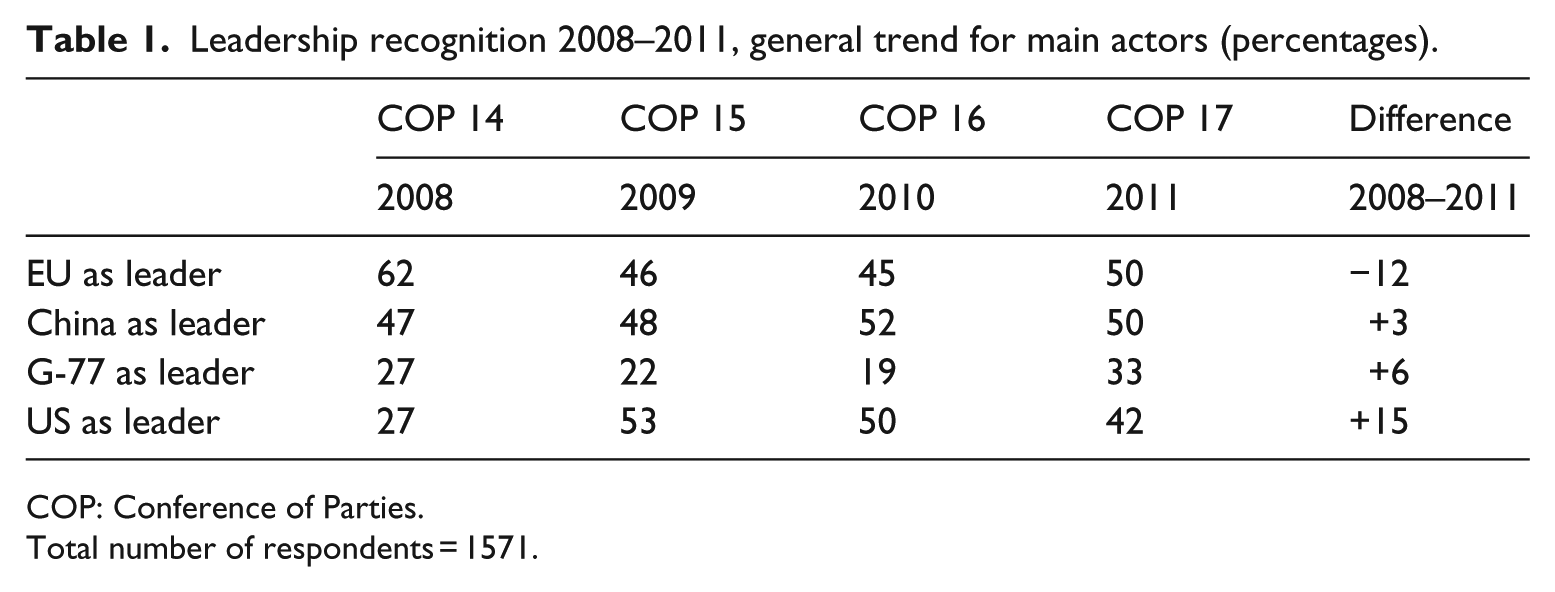
What, then, do the data tell us about leadership recognition in the field of climate change? According to our results, China, the EU, the G-77, and the US were the actors most frequently mentioned as playing a leading role in the field of climate change. Other party groupings (e.g. the BASIC countries and the Alliance of Small Island States) as well as individual countries like India and Brazil were also recognized as leaders by roughly 10 percent of the respondents, but no other actor came close to the same levels of recognition as the four actors included in Table 1.
Leadership recognition 2008–2011, general trend for main actors (percentages).
COP: Conference of Parties.
Total number of respondents = 1571.
The first conclusion to be drawn from Table 1 is that there is no single, undisputed leader on climate change. Putting the focus on the three most recent climate summits in Copenhagen, Cancún, and Durban, what we see is a situation best described as a ‘fragmented leadership landscape’ with three leadership candidates – the EU, the US, and China – being recognized as leaders by roughly half of the respondents. 53 If we look back at how the situation has changed since COP 14 in Poznań, we can register some fairly dramatic changes in leadership recognition. The recognition of the EU declined from a height of 62 percent at COP 14 to 46 and 45 percent at the COP 15 and 16 meetings. In Durban, however, the EU made a bit of a comeback with 50 percent of participants recognizing the EU as a leader. The opposite trend is noticeable for the US with figures increasing from 27 to 53 percent and 50 percent for COP 15 and 16. The numbers dipped to 42 percent in Durban. China’s recognition as a leading actor, on the other hand, has been relatively stable, and in Durban, China equaled the EU for the number 1 position with 50 percent of the respondents reporting that they see China as a leading actor in the climate change negotiations. The recognition of G-77 as leader has declined from COP 14 to 16 with only 19 percent of Cancún respondents naming this party grouping as a climate change leader. The perception of the G-77 as a leading actor increased to 33 percent at COP 17 in Durban.
The EU which has made it its mission to brand itself as the leader on climate change was indeed the actor most commonly recognized as leader in Poznań but lost the number 1 position, and in Copenhagen and Cancún, where slightly less than half of the respondents reported that they saw the EU as a leader in the field of climate change. The big decline in leadership recognition for the EU, from 62 to 46 percent, however, occurred between Poznań and Copenhagen. Since Copenhagen and Cancún, it would seem that the recognition for the EU is on the rise again. At COP-17 in Durban, the EU, along with China, was the most recognized leadership contender, and the EU was instrumental in setting the agenda for the Durban Platform which established a negotiating mandate to reach a new deal by 2015. In many ways, after the marginalization and disappointment in Copenhagen, the EU has quietly made a comeback into a major role of influence again.
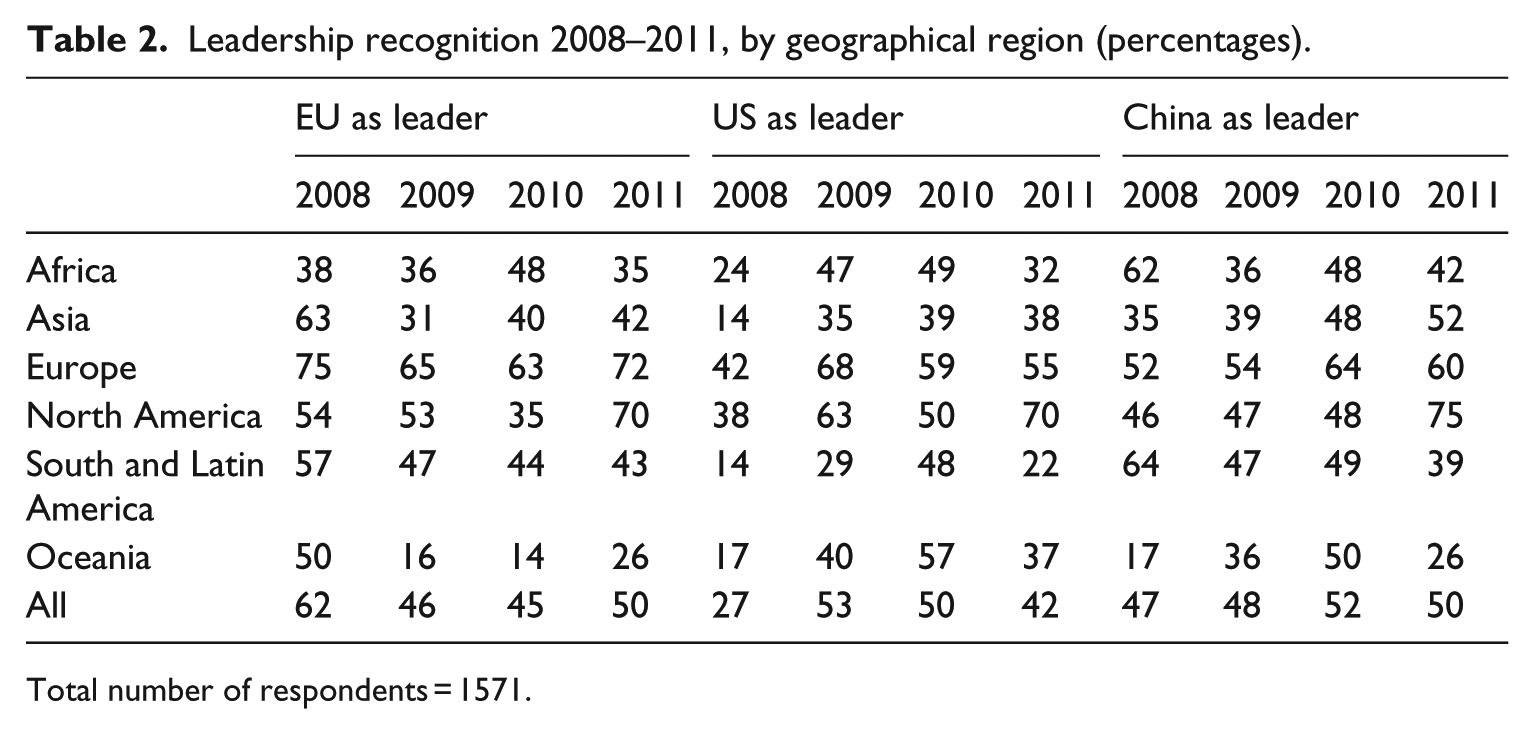
Previous research indicates that leadership recognition may indeed vary among groups of respondents according to geographical belonging. 54 Do we find this here as well? Do actors aspiring to leadership positions primarily enjoy support from members of its home constituency, or are leadership contenders also acknowledged as such outside their regional area? When we break down the data by the respondents’ geographical belonging, we do find some interesting differences as reported in Table 2.
Leadership recognition 2008–2011, by geographical region (percentages).
Total number of respondents = 1571.
As Table 2 shows geographical belonging appears to matter a great deal for which actors prospective climate change followers recognize as leaders. If we focus on leadership recognition at COP 17 in Durban, we see, for example, that a clear majority of respondents from Europe (72%) see the EU as leading actor, whereas only a third of all respondents from Africa (35%) and a quarter of all respondents from Oceania (26%) see the EU as leader. In a similar vein, we find that the US is recognized as a climate change leader by a large proportion of respondents from North America (70%) but struggles mightily to find support from respondents in South and Latin America (22%) or Africa (32%).
In summary, the data tell us that the world currently lacks a single undisputed leader in the field of climate change. In 2008, it may, from a leadership recognition perspective, have been justified to claim that the EU was wearing the climate change leadership mantle. However, since then, things have changed, and we now have a leadership landscape with three leadership candidates that are recognized as leaders by roughly 40–50 percent of the population of prospective followers, an indication that these would-be climate change leaders are struggling to gain widespread recognition as leaders. The data also reveal that the main leadership contenders on climate change struggle to be recognized as leaders across the board and that they in general are less likely to be seen as leaders outside their borders. This raises a crucial question, one that leadership theory to date has no answer to: what factors matter to followers when determining which actors to support as leaders?
Exploring the determinants of leadership recognition
Having documented which actors are recognized as climate change leaders, it is time to turn our attention to the determining factors associated with leadership recognition. Attempting to shed light on this topic takes us into unexplored theoretical and empirical territory. While there has been some research done recently on the demand side of leadership, 55 there is still a black hole in leadership theory when it comes to shedding light on how followers select which actors to recognize as leaders.
As discussed above, we utilized previous leadership research to construct six competing hypotheses on what determines leadership recognition. In order to better understand followers’ reasons for choosing to support specific leaders, we then asked COP participants – using a Likert scale from 1 (disagree strongly) to 7 (agree strongly) – to indicate how important they believed six different leadership characteristics to be.
In the table above we report the main results from our survey probing the importance of six factors associated with leadership recognition. Table 3 clearly shows that overall commitment to solving the climate change problem is the most important reported factor that motivates the support of a particular leader. Put differently, an actor aspiring to gather widespread support as leader needs to work for, or at least be perceived as working for, the common good. The mean for this factor for the period 2009–2011 was 6.15 on the Likert scale used, where 7 indicates the respondents agree strongly that this is an important factor for their choice to support an actor as a leader.
Importance of factors for leadership recognition 2009–2011.

SD: standard deviation.
Total number of respondents = 1579. The 95% confidence interval is 0.11–0.21.
At the other end of the spectrum, as Table 3 once again shows, our respondents reported that self-interest was by far the least important factor when deciding to recognize an actor as leader. The mean for the self-interest factor for the period 2009–2011 was 4.37, indicating that a minority of respondents judged the promotion of their country’s interests to be a key determinant for their choice to support a particular actor as leader – only little more than a third of the respondents gave this factor a 6 or a 7 on the scale used to tap into their views of leadership recognition. It is noteworthy that the standard deviation for the self-interest factor is significantly higher than for the other five determinants of leadership recognition, thus indicating that respondents’ views of the significance of this factor are highly divergent.
As for the four leadership modes, our results suggest that respondents judge an actor’s ability to provide ideational (mean = 5.62), directional (mean = 5.57), and instrumental (mean = 5.56) leadership to be roughly of equal importance as there are no statistically significant differences between the results for these factors. Accordingly, each of these traits seem to matter for an actor’s opportunity to gain recognition as leader and no one can be placed above the others.
What is clear from our examination is that the ability to engage in structural leadership by providing ‘resources and inducements to address the problem’ was rated as less important (mean = 5.29) by our respondents than the other leadership modes. This may seem somewhat surprising as structural leadership and the ability of an actor to deploy power-resources that create new incentives and changes the costs and benefits associated with different avenues for action is the mode of leadership that has ‘attracted the most attention’ in the academic literature. 56 What our results show is that respondents actually, at least in this issue area, have a diversified understanding of leadership and deem all four modes of leadership as important. By no means do they equate leadership simply to the possession and/or effective deployment of material resources. In fact, structural leadership was rated as the least important factor of the four modes of leadership.
The results seem to confirm the claims of past research that providing good ideas, setting a good example which others may follow, or solving problems in the negotiations, while important leadership tools, are, in isolation, unlikely to be sufficient in guaranteeing a positive outcome or widespread leadership recognition. Relying solely on structural leadership, in addition to the fact that it is difficult for any one actor to muster sufficient power-resources to make this a viable strategy, will be, in light of our results, especially questionable as a strategy for securing widespread leadership support. Overall then, our results suggest that an actor aspiring to widespread leadership recognition needs the ability to successfully deploy different leadership modes. This conclusion points in the same direction as classical contributions in the leadership field which argue that if the efforts of a leader are to be successful, it will often take the ‘contributions of different forms of leadership’. 57
When we compare our results from 2009, 2010, and 2011, we see that our respondents’ perceptions concerning the importance of the different factors remained fairly stable. For all years, as reported by Table 3, the ranking order between the different factors remained nearly the same. Commitment to the common good was clearly deemed the most important factor for all 3 years, whereas self-interest was seen as the least vital factor when selecting which leader to support. Structural leadership was consistently ranked as the second least important factor, with only minor changes in ranking order, for the most part not statistically significant, recorded for the remaining factors.
If we instead zero in on absolute changes in mean scores for the different factors, we do find some noteworthy changes over time. While still rated as the least important factor, the mean score for self-interest increased from 4.19 in 2009 to 4.52 in 2010. Conversely, the significance of structural leadership went down from 5.50 in 2009 to 5.14 in 2010. It is not far-fetched to assume that these changes may have something to do with the process and outcome of the COP 15 in Copenhagen. It is clear that the main leadership contenders had conflicting visions of what should be achieved at COP-15, and none of them provided leadership that inspired overwhelming support. In fact, not only did the main leaders fail to work effectively toward a common goal, they actually worked toward achieving conflicting goals. 58 In Copenhagen, there was clearly frustration with the most powerful states for their inability to provide the positive leadership needed to reach a comprehensive climate deal, 59 which may have affected respondents’ views concerning the importance of structural leadership. Moreover, the fact that many representatives of the countries most likely to suffer severe consequences from climate change felt let down by the major power players in Copenhagen may, on the other hand, have led these parties to intensify their views on the importance of self-interest when deciding whether or not to back a particular leadership candidate.
What about the importance of geographical belonging for understanding the determinants of leadership recognition? As we saw in Table 2, the data showed clear differences in leadership recognition depending on geographical belonging. Do we find substantial differences between prospective followers from different regions, also when it comes to which factors they report as important when deciding to recognize a particular actor as a leader? If so, this would indeed complicate the possibility, in multilateral negotiation settings, of gaining recognition as leader across the board rather than only by a small subset of prospective followers .
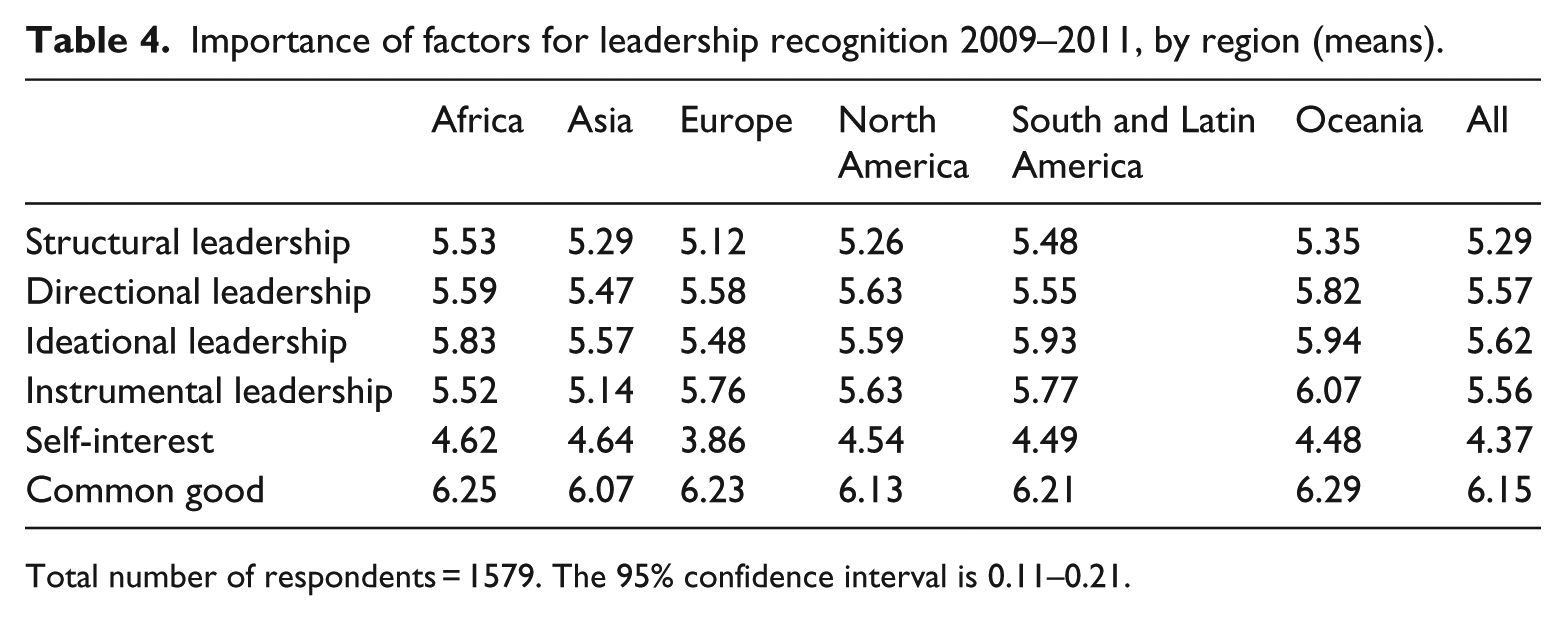
When comparing the answers of respondents from different regions, it is striking that the ranking order when it comes to assessing the relative importance of the different factors that determine leadership recognition is very similar between the groups (see Table 4). Respondents from all regions accordingly see promotion of the common good as the most important factor and self-interest as the least important factor for deciding to recognize an actor as a leader. Furthermore, structural leadership is regarded the second least important factor by respondents from most regions. Respondents from Africa and Asia are the exceptions, ranking structural leadership as the third least and instrumental leadership as the second least important of the factors; these differences are not, however, statistically significant. Also, in four of the six regions, the respondents see ideational leadership as more important than directional leadership. European and North American respondents take the opposite view and find directional leadership to be more important than ideational leadership but only marginally so, and these differences are also not statistically significant.
Importance of factors for leadership recognition 2009–2011, by region (means).
Total number of respondents = 1579. The 95% confidence interval is 0.11–0.21.
While there are only small differences when it comes to how respondents from different regions rank the different determinants of leadership recognition, we actually do find some important differences as we compare the mean scores between regions. The most striking difference is found in connection to respondents views on the importance of self-interest. The COP participants from Europe attach much less weight to this factor (mean = 3.86) than respondents from the other regions (means ranging from 4.48 to 4.64).
Looking at instrumental leadership, we find that respondents from Oceania attach more (mean = 6.07) and respondents from Asia less importance (mean = 5.14) to this factor than respondents from other regions (means ranging from 5.52 to 5.77). As for the importance of ideational leadership, it is interesting to note that respondents from Africa, South and Latin America, and Oceania all attach more importance to this factor (means = 5.83–5.94) than do COP participants from Asia, Europe, and North America (means = 5.48–5.59).
For the remaining factors, we find only small differences in mean scores between respondents from different regions. The only noteworthy exception being that prospective followers from Oceania are more inclined (mean = 5.84) than the other respondents (means ranging from 5.47 to 5.63) to see an actor’s ability to provide directional leadership as important for recognizing that actor as a leader.
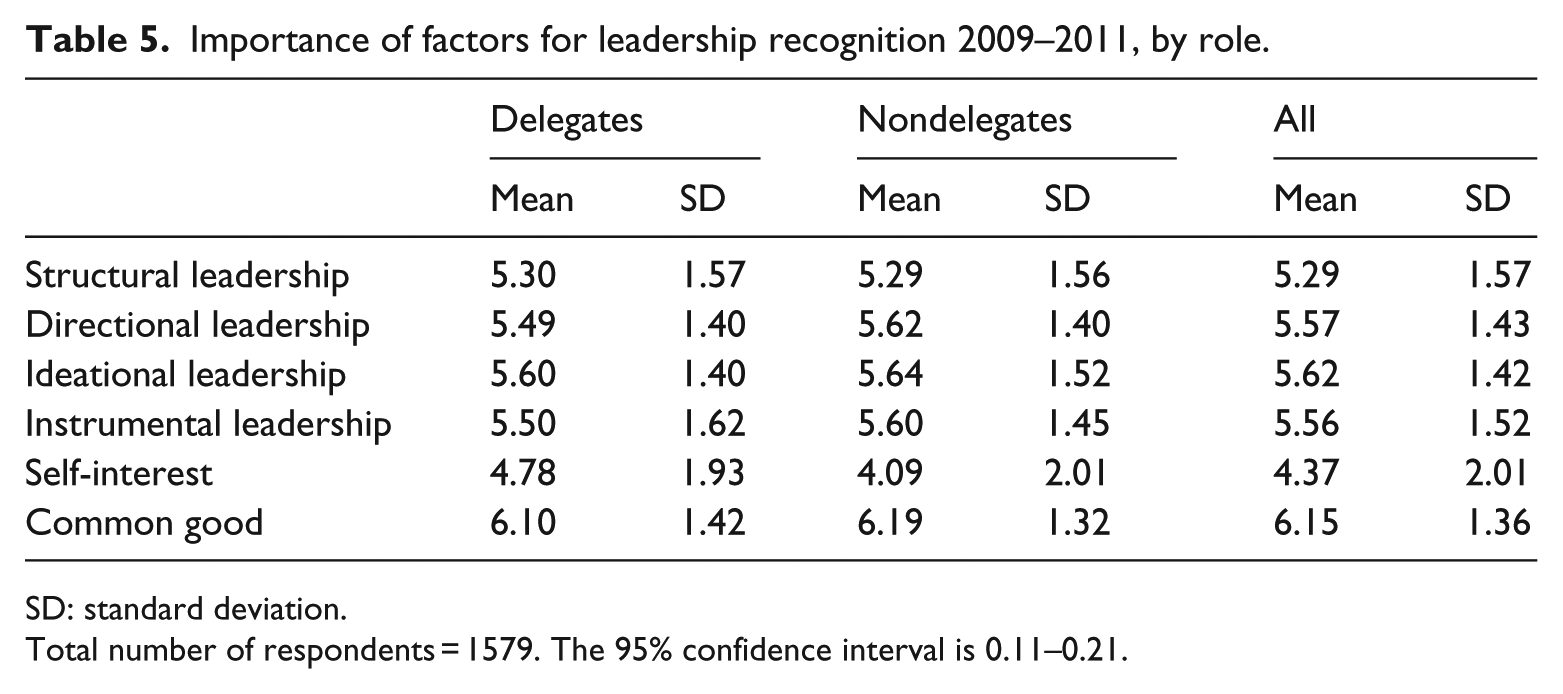
The fact that respondents’ views on the relative importance of the determinants of leadership recognition are quite similar indicates that it is possible to make meaningful comparisons between prospective followers from different geographical regions. Our results accordingly indicate that COP participants have comparable perceptions of what it means to be a leader, even if they make different judgments regarding which actors are actually deemed to be leaders. When we break down the data by role, only marginal differences present themselves as we compare delegates and nondelegates.
As Table 5 reveals, we find familiar patterns when we compare how delegates and nondelegates have ranked the importance of the six factors that are important when deciding which leadership candidate to support: both groups see the common good as the most important factor, while self-interest and structural leadership are regarded as least important.
Importance of factors for leadership recognition 2009–2011, by role.
SD: standard deviation.
Total number of respondents = 1579. The 95% confidence interval is 0.11–0.21.
When comparing the mean scores, the only significant difference has to do with the importance attached to self-interest. Delegates tend, quite naturally as they are state representatives, to attach more importance (mean = 4.78) than nondelegates (mean = 4.09) to the promotion of their country’s interests when deciding to back a particular leader. For all other factors, we find no statistically significant differences between delegate and nondelegate views on which factors are important for their decision to back an actor aspiring to assume the position as a leader.
Conclusion
This article set out to contribute to the leadership scholarship by focusing on followership and the neglected demand side of the leadership equation. More specifically, we asked two questions: which actors are acknowledged as climate change leaders and what factors determine leadership recognition?
Based on the results from our survey, we can conclude that we are currently facing what has in previous research been described as a ‘fragmented leadership landscape’ within the field of climate change. 60 Between COP-14 in Poznán in 2008 and COP-15 in Copenhagen in 2009, we witnessed a dramatic change in leadership recognition, with the US almost doubling its support (the Obama effect and the return to an active US climate diplomacy after the inaction of the Bush administration), whereas recognition of the EU dropped significantly. This new situation, with roughly an equal size of recognition for the EU, the US, and China, was confirmed by the data from COP-16 in Cancún in 2010. At COP-17 in Durban in 2011, US support dipped somewhat, the EU rose a bit, once again surpassing the US, and China held steady. The overall picture, however, is clear: The EU, the US, and China are indeed the Big Three when it comes to who is seen as climate change leaders. However, all three of the main leadership contenders are at the moment struggling to gain recognition as leaders by even a majority of respondents, and therefore, the legitimacy and effectiveness of their leadership bids can rightfully be called into question.
The main purpose of this article was to fill an existing void in the leadership literature by examining which factors matter most when deciding to support a particular leader. The demand side of the leadership equation is undertheorized, and to date, the leadership scholarship has had precious little to offer when it comes to shedding light on the determinants of leadership selection and recognition. In our search for a theoretically grounded understanding of leadership recognition, we formulated and tested six rival hypotheses on what motivates potential followers to recognize an actor as a leader.
Our survey results, which were remarkably stable and consistent between groups and across all years, provided us with a number of intriguing findings regarding which factors inspire prospective followers to support particular leaders. When comparing respondents from different geographical regions, occupying different roles at the COP meetings, we found only minor differences, and the lack of variation between different groups of respondents is striking. For example, the ranking order when it comes to assessing the importance of the different factors that determine leadership support is almost identical between respondents from different geographical regions. This indicates that it is indeed possible to make meaningful comparisons between different groups of respondents when it comes to who they recognize as climate change leaders. It does not, in other words, appear to be the case that different actors attach substantially different meanings to leadership. In short, our results indicate that COP participants have very similar understandings of what it means to be a leader, even if they have different views on how various actors perform as leadership candidates.
One of the motivations for this study was the absence of a theoretical consensus or any empirical evidence from past research that convincingly specified which factors weighed the most in determining leadership recognition. Our findings, from one issue area, provide insights into which modes of leadership are the most influential and to what extent potential followers report being motivated by self-interest versus the common good when selecting a leadership candidate to support. What then does the data tell us?
According to the logic of mainstream international relations thinking, with its emphasis on power and interests, one might have expected to find more support in our results for structural leadership and self-interest as being the major determinants of leadership recognition. Yet, according to our results, this was not the case. In fact, self-interest was the least important determinant of leadership recognition (mean = 4.37) and structural leadership, despite being identified as being of great consequence by past scholarship, 61 was the second least important factor (mean = 5.29). Given the significance accorded to structural leadership in the literature, this can be seen as a surprising result. This also indicates that potential followers do not simply anoint powerful actors as leaders, and the ability to deploy resources and offer inducements are insufficient if an actor aspires to widespread leadership recognition.
Among the remaining leadership modes, directional, ideational, and instrumental leadership were all rated as being of roughly equal importance. Given that the ability to demonstrate a credible domestic climate change policy at home and act as good role model is often highlighted as a key asset for actors seeking to take the lead inside the climate change regime and that the EU has made this a key component of its leadership strategy, the advocates of leading by example might be surprised that directional leadership, while valued, was not seen as any more important than ideational or instrumental leadership.
The number one conclusion to be drawn from our data is that the evidence strongly suggests that it is imperative for any actor seeking recognition as a leader to be perceived as being devoted to promoting the common good. The mean for this factor was 6.15 on the 7-point scale. Regardless of role or geographical origin, all groups of respondents ranked this as the most important factor when choosing to support an actor as a leader. No other factor comes even close to being as essential for leadership support. Leadership theory might be divided when it comes to deciding whether or not the pursuit of the common good should be seen as a defining characteristic of leadership, 62 but followers are unequivocal that this is the crucial factor for determining which leadership candidate to back.
What are the implications of this study for future research? What we have offered here is surely not the last word on what determines leadership recognition. However, we do believe that we have taken valuable steps toward further theorizing about the demand side of the leadership equation, thereby increasing our understanding regarding what factors are important for leadership recognition. This study has thus engaged in tentative theory development by offering a systematic examination of the determinants of leadership recognition, albeit in a single issue area. In order to better understand what drives followers to follow 63 and to what extent the insights from one sphere, such as climate change, apply to others, comparative research is needed on multiple cases across a variety of issue areas such as trade, security, human rights, and other transnational environmental challenges.
Finally, we should take a moment to ponder the implications that our research results have concerning the climate change negotiations. Our findings help shed light on how the fragmented leadership landscape that we currently see should be understood. The fact that all three leadership candidates are struggling to achieve widespread recognition signifies that the EU, the US, and China all have more work to do if they want to convince prospective followers that they are genuinely dedicated to solving the climate change problem.
The performance of the three would-be leaders in Copenhagen dramatically illustrates this state of affairs. The COP-15 conference proved to be a contentious event that failed to produce a new legal agreement to replace, enhance, or extend the Kyoto Protocol and instead resulted in an ambiguous interim political deal that did not even win universal approval at the end of the conference, with the COP only consenting to ‘take note’ of it. 64 This outcome was largely due to the fissures among China, the EU, and the US. 65 Each actor espoused different negotiation visions, which they were unable to transcend to reach ambitious shared goals for the good of the planet. As a result, it appears that at the moment, none of the Big Three passes what could be seen as the litmus test of leadership recognition, namely, to be perceived by a majority of potential followers as acting in pursuit of the common good.
The less than impressive levels of leadership recognition, therefore, suggest that none of the main leadership contenders currently enjoy the credibility that is necessary to be an effective leader. 66 The fact that the main contenders trying to exercise international climate change leadership are struggling to gain widespread support is likely to hamper the effectiveness of the climate change regime, particularly with regard to reaching agreement on new measures to close the ambition gap and reduce greenhouse gas (GHG) emissions to levels that the scientific consensus says are needed to avoid the most dangerous climate damages.
Our research clearly shows that there are no short cuts available for actors aspiring to be leaders. The only way to strengthen international climate change leadership is for the main leadership contenders to convince others that they are truly committed to tackling the climate change problem and are working on behalf of the common good. This work needs to start at home with meaningful domestic action, but it will also require the Big Three to constructively cooperate together and with others at the global level. The improved working relationships between China, the EU, and the US visible at COP-16 and COP-17 could represent the first steps toward more effective international climate change leadership. Implementing the various elements agreed to in the Copenhagen Accord and the Cancún Agreements while simultaneously using the Durban Platform to negotiate a new agreement with ‘legal force … applicable to all Parties’ by 2015 will require leaders and followers. This provides an opportunity for China, the EU, and the US to come together to mobilize the support that will be necessary in order to build on the incremental progress achieved in recent negotiations and create a new post-2020 climate regime.
Footnotes
Acknowledgements
Funding
This research was made possible by the generous financial support of the Swedish Research Council (Project No. 421-2011-1862), the Swedish Foundation for Strategic Environmental Research’s (Mistra) Climate Policy Research Program (Clipore), and the Swedish Civil Contingencies Agency via the Centre for Natural Disaster Science ( ).
).