



Abstract
According to policymakers, US national values shape US foreign aid policy. However, these national values clash with material interests when policymakers are faced with the decision of whether or not to grant US military aid to countries that do not adhere to US national values but do serve US security and economic interests. To what extent are US national values resilient to clashes with these material interests? This paper hypothesizes that national values are resilient to clashes with interests to the extent to which these values are a salient feature of US national identity. The findings indicate that more prominent values (democracy) are almost impervious to countervailing interests while more tangential values (enterprise and human rights) exhibit different effects on US military aid allocation depending on the security and economic importance of the recipient state.
Introduction
The United States has long justified its foreign policy on the basis of its national identity, or as former President Obama would say, ‘Who we are’. 1 This tendency is visible, even in a ‘hard power’ tool such as US military assistance. The US has recently cut off, reduced, or delayed military aid to Thailand, Mexico, and the Philippines for their undermining of democracy or abuses of their citizenry – practices in conflict with US national identity. 2
Despite these examples, other instances of US military assistance seem to contradict the values embedded in US national identity. Many times, these instances seem to be motivated by security and economic concerns based on geopolitical rivalries with Russia and China, as well as parochial issues like terrorism. For example, the US has allocated large amounts of military aid to Uzbekistan, a country that, according to the US State Department’s own reports, is a ‘nightmarish world of rampant corruption, organized crime, forced labor in the cotton fields and torture’. 3 While Uzbekistan is an affront to US values, it is an asset to US interests. The country provides a transit point for US troops and supplies and was a central location in the Bush Administration’s rendition program. There are also economic reasons for supporting Uzbekistan, as the US seeks to create a ‘New Silk Road’ through helping establish regional trade ties and acting as an economic counterweight to Russia. 4
Similarly, security and economic incentives exist to give large amounts of military aid to the Philippines. The Philippines has been in democratic decline for years and is one of the worst human rights abusers in the Indo-Pacific region. 5 Yet, despite delaying a small portion of economic aid in 2016, the Philippines is the largest recipient of US military assistance in the Indo-Pacific, receiving over $1 billion in assistance from 2015 to 2021. 6 The US commitment to supporting the Philippines with massive amounts of military aid is no doubt due to its perceived national security and economic importance as tensions with China increase.
While much of US military assistance is granted in accordance with values rooted in US national identity, showering these repressive and non-democratic governments with aid powerfully illustrates national identity’s limits and the reasons for them. With respect to the US-Uzbek relationship, Secretary of State John Kerry noted, ‘the challenge for the United States is to strike a balance between its short-term, war-fighting needs and long-term interests in promoting a stable, prosperous, and democratic Central Asia’. 7 Given the increasing intensity of geopolitical conflicts with China and Russia, situations in which ‘short term’ needs conflict with US values may continue to be more common and visible in the coming decades.
Both US national values and US interests have generally been included into models of US economic and military aid allocation. This literature has found evidence for the influence of both. However, with few exceptions, these models treat values and interests as independent determinants. This additive model ignores the fact that interests and values often clash (as is evident in the case of Uzbekistan and the Philippines), requiring policymakers to choose. How do policymakers negotiate tradeoffs between interests and values when allocating military aid? Are some of these values more resilient to conflicts with material interests than others?
In contrast to the previous literature, I analyze the interaction between US interests and US values in US military assistance and demonstrate that the influence of US values on US military aid allocation is eroded when recipient states are of national security or economic importance to the US. However, I also theorize that the nature of US national identity is what determines the degree to which US national interests outweigh certain US values. US values that have a stronger attachment to US national identity are less tempered by interests than those values that have a weaker attachment to US national identity. I test the degree to which distinct US national values are overshadowed by US interest using a dataset of US military aid allocation. The results demonstrate that while US values are overlooked when they compete with US interests in military aid allocation, the most central US value, democracy, is more resilient to countervailing material interests.
US interests and US values
US foreign aid is a tool of US foreign policy meant to achieve strategic goals. 8 This is especially true of military aid, which is deployed to bolster friendly states against their internal and external adversaries. The State Department calls US military assistance ‘an instrument of U.S. national security and foreign policy – a program with a substantial return on investment’. 9 However, the US justifies its policies on the basis of its national identity in addition to strategic concerns. Promoting democratic institutions, improving governance, and promoting human rights have all been used at various times to justify US foreign military assistance programs and policies. These identity-based foreign policy goals are values, defined as political ends pursued for reasons that are not instrumental to US national security or well-being, but because they are viewed as inherently good. Such values can overlap with interests. For example, democracies are thought to be more stable for foreign investment – an economic benefit to capital rich countries like the US. 10 However, the two conflict at times. For example, a democratic country may seek to nationalize industry, such as Chile did in the early 1970s under Allende. 11 In cases like these, democracy ceases to be instrumental and therefore the value of democracy and interests of US economic well-being or national security conflict.
Why would US policymakers take US values into account while implementing a tool ultimately geared toward strategic interests? Policymakers consider US values when allocating military aid because the US has a national identity that socializes policymakers to genuinely care about such values. State identity is a ‘property’ of the state that ‘generates motivation and behavioral dispositions’. 12 Insofar as the state is identified with the nation, state identity is synonymous with national identity. National identity inculcates those that share it with its prescribed characteristics that they must maintain through performance. 13 Therefore, US policymakers wish to incorporate the values associated with US identity into foreign policy, including the allocation of US military aid, because it is consistent with their self-image and assists in maintaining their national identity.
While some may consider adherence to national identity to be purely rhetorical for propagandistic purposes, the strive to maintain US national identity can be seen in declassified US national security documents not meant for the public eye. 14 Reports from the National Security Council exalt the ‘spiritual, moral, and material posture of the United States’ that ‘rests upon established principles’ and state that the basic objective of US policy is to preserve ‘fundamental values’. 15 Policymakers do not seem to be utilizing values for purely instrumental reasons, but actually seem to be true believers in US national identity and its values.
If policymakers are ‘true believers’ in US values, they would be reluctant to support states that violate them with military aid. In international relations, states obviously cannot completely shun others that do not align with their national values. Such behavior would bring all diplomacy, trade, and multilateral action to a stand-still. However, it is one thing to negotiate diplomatically with a country you have moral disagreements with – it is quite another to support that state with military aid, the very means with which they could continue to engage in the kind of behavior that the donor abhors. Furthermore, in the US context the adherence to values has taken on a proselytizing form. The US has ‘been defined in terms of both adherence to a set of liberal, universal political ideals and a perceived obligation to spread those norms internationally’. 16 Historians and social critics have often pointed out that the very notion of the US as ‘exceptional’, is tied to the belief that it can spread its values across the earth. 17 As such, the population of the US remains what historian Anthony Smith calls ‘missionary peoples’ who seek to ‘transform the world’. 18 Implementations of US values promotion often oscillate between those who wish to be exemplars and those who wish to be actively intervening for the cause of US values. 19 Regardless, no version of US exceptionalism would view assisting those who violate US values as consistent with the moralizing mission the US has set out for itself.
US national identity socializes US policymakers to appropriate it and to reinforce it through their foreign policy decisions, including the allocation of military aid. However, material interests moderate this impulse. If the US does not secure its national security and its economic prosperity, it threatens the ontological safety and wellbeing of the state and therefore, the safety and welfare of its citizens. US policymakers believe that they must occasionally tolerate ‘evils in the pursuit of good’, since ‘good’ can only be achieved if the US creates ‘an environment conducive to it’. 20 Cognitive biases may also induce policymakers to prioritize US material interests over values. When foreign policy decision-making concerns survival, individuals tend to favor political decisions more aligned with realpolitik and dismiss ethical concerns or misgivings. 21 Additionally, populations are also biased toward states and regimes that are known to be conducive to their own wellbeing. For example, when individuals become aware of an atrocity committed by their allies (or themselves), they are much more likely to believe that this act is an aberration from the norm. 22 Thus, states that contribute to the nation’s wellbeing are given the benefit of the doubt, even when their perceived immoralities come to light. Essentially, while US values will play a role in military aid allocation, how large of a role they play should depend on whether they conflict with US interests.
Conversely, ensuring that military aid will reach US security and economic partners in-spite of their incongruence with US values has its own costs. Readily granting military aid to countries that violate values produces a contradiction between how policymakers view the US and the reality of US actions. Such actions violate the US national identity that policymakers have been socialized to adhere to and could result in an undermining of national identity that policymakers would like to avoid if possible. US national identity is also not uniform and contains values of varying importance to the identity. Thus, the ‘magnitude’ of the contradiction created from violating values will correlate positively with the importance of the value being violated, meaning that policymakers will be more reluctant to violate some values and less reluctant to violate others. In sum, policymakers will violate values in favor of interests when necessary, but their propensity to do so should decrease the more integral the value in question is to sustaining and maintaining US national identity. 23
US values and US military aid
If policymakers are more likely to allow interests to overshadow more tangential US values, the question then becomes which values are most integral and which values are more tangential to US national identity? The literature on US national identity provides a number of values that can be compared for analysis. Studies of American ideology, culture, and identity strongly reinforce the idea that ‘democracy’ or ‘freedom’ is a prevalent US value. 24 Democracy and ‘self-determination’ were ideas that were present at the founding of the US but continue to be endorsed by the entirety of the mainstream political spectrum. 25
Enterprising progress is another value that makes itself prominent in discussions of US national identity. Williams identifies a number of ‘enterprise’ associated values including ‘activity and work. . .achievement and success. . .science and secular rationality’ and ‘progress’. 26 Kohls notes that change, control of time, competition and enterprise, future orientation, action, and efficiency are all hallmarks of American culture. 27 Some, such as Cingranelli, have characterized this value as simply the belief in capitalism, but other scholars note that the idea of enterprise is not limited to the economic system. Americans value ‘newness’ and ‘innovation’ and support ideas they believe are conducive to these goals. Americans often viewed themselves at the cutting edge of the frontier in terms of both the expansion of the state and the expansion of knowledge and technology.
Human rights is a newer addition to US national identity. Its meaning was contested, was not readily apparent until the 1970s, and continued to be contested even then. 28 Initially, human rights were only in the purview of a ‘group of progressive American internationalists’ but became more integrated into broader American thought due to the work of activists in the 1960s and 1970s. 29 Eventually human rights gained such prominence that they are now regularly advocated for by US government institutions and US policymakers. 30
Analyzing US history is one way by which to ascertain US national identity and the values that make-up its importance, as historical experiences are widely recognized as shaping the identity of the nation. 31 In order to do so, I conduct an analysis of the US National Archives and Records Administrations’ (NARA) ‘100 Milestone’ Documents. 32 According to NARA, these documents, spanning from the founding of the country to 1965, have influenced the character of the nation. As such, the documents are a good data source from which to identify the major values associated with US national identity.
I read each document and the commentary NARA provides to identify values explicitly mentioned in the text or values that are prevalent in the surrounding context concerning the document at the time it was produced. I then code the documents dichotomously by value, where a ‘1’ indicates that the document exudes a certain US value and a ‘0’ indicates that it does not. 33 The results demonstrate that ‘democracy’ is the most important US national value, registering in over 30% of the documents considered. The value of ‘enterprise’ is a relatively close second. The value of ‘human rights’ is the third most important US value. 34
Democracy remains an influential value in foreign policymaking in the contemporary period. Many administrations have explicitly justified their foreign policy in terms of promoting democracy. 35 Critics of different administrations have also framed their criticism in terms of what actions might be more conducive to democracy promotion. USAID explicitly includes democracy promotion as one of their goals in conducting their aid programs and Congress has passed regulations on foreign aid with these goals in mind. 36
Previous analyses of US foreign aid have consistently demonstrated that a recipient’s status as a democracy positively influences the probability and amount of aid the state receives. 37 The US is distinctive in this regard. Alesina and Dollar find that among all industrialized donors, the US is the donor that is most responsive to democracy and democratization. 38 According to Meernik et al., this responsiveness to democracy occurs both during the Cold War and after, as in ‘both time periods, the U.S. government appears to be more likely to provide aid and increased amounts of assistance to more-democratic states’. 39 Furthermore, democracy is a strong determinant of other bilateral US foreign policy tools, such as arms exports, both before and after the Cold War. 40
These results do not mean that democracy is unmovable. The positive effect of democracy on US economic aid allocation seems to have increased in the post-Cold War era. 41 There are other studies showing that the effect of democracy diminished among some subsets of US economic aid (democracy aid in particular) during the War on Terror. 42 These results demonstrate that the effect of democracy varies in different temporal environments with different overall strategic concerns. However, there remains a dearth of literature (beyond case studies) on how the effect of democracy on aid varies by specific US security and economic interests within a potential recipient state. 43
Because of its strong and lasting attachment to US identity, violating democracy through the allocation of military aid to a non-democracy produces an enormous contradiction between US actions and US national identity. Policymakers would have trouble rationalizing these contradictions and will therefore opt to avoid them. Democracy should therefore be the value that is most resilient to clashes with interests when US policymakers allocate military aid. There are cases in which the US does allocate aid to non-democracies. 44 However, these cases are ones in which the regime supported with military aid was determined to be absolutely vital to US interests. The democratic nature of a state should therefore have a positive effect on that state’s military aid allocation and the effect of democracy should only weakly decline with increases in US security or economic interests. The positive effect of democracy on US military aid should remain for all states with the exception of those that are exceptionally important for US security or economic purposes.
H1: Democracy will have a positive effect on US military aid when US national security interests are low, which will decline as US national security interests increase.
H2: Democracy will have a positive effect on US military aid when US economic interests are low, which will decline as US economic interests increase.
In addition to democracy, the United States is well known for its enterprising and progressive outlook. Enterprise is a central component of 20 of NARA’s documents. Early US history is characterized by an embrace of commercial and industrial progress such as the Patent for the Cotton Gin (1974) and Jefferson’s ‘Message to Congress Regarding the Lewis and Clark Expedition’ (1803). Central to the American attitude at the time is an emphasis on America’s ‘newness’ as opposed to ‘old’ Europe. Previous literature does not identify ‘enterprise’ as a US value per say but does investigate the effect of variables such as development and absence of capitalism. Unsurprisingly, Cold-War era analyses find that socialist or communist states receive less aid than capitalist ones. 45 Later literature finds development to be a significant factor in the post-Cold-War era, with some analyses finding it to be a larger determinant than democracy. 46 However, it is important to note that while they are perhaps sub-components, capitalism and development are not synonymous with enterprise, which indicates a kind of social progress in addition to commercial progress. Nevertheless, the existence of capitalism in a state may serve as an imperfect proxy for US policymakers to gauge how enterprising a state is.
The fact that military aid would be more readily supplied to states that exhibit principles of enterprise and progress would be relatively unsurprising given that the US has explicitly done so before with the goal of strengthening and supporting these states against the potential internal and external socialist and communist adversaries. This continued after the end of the Cold War with the ‘Assistance for the Independent States of the Former Soviet Union Act’ of 1992, which granted security aid to post-Soviet states transitioning to free markets. 47 At times the US has allocated large amounts of military aid to socialist states, such as Yugoslavia, or (more commonly) to economically clientelistic states, such as Zaire. As such, it seems that the US concern with this value diminishes when interests demand it. This is to be expected, given that the value is less attached to US national identity than democracy and will therefore be more easily outweighed by countervailing economic and security interests.
H3: Enterprise will have a positive effect on US military aid when US national security interests are low, which will decline as US national security interests increase.
H4: Enterprise will have a positive effect on US military aid when US economic interests are low, which will decline as US economic interests increase.
In contrast to democracy and enterprise, the value of human rights is less well established in US national identity. In the contemporary period, human rights is perhaps the most widely discussed US value. However, the value is often discussed in the context of failures on the part of US policymakers to uphold human rights when implementing US foreign policy. Human rights only came into the purview of Americans in the 1940s when they were enshrined in the Universal Declaration on Human Rights (1948). Even as the term gained prominence in activist circles, its meaning ranged from social welfare to decolonization. Eventually human rights took on a primarily liberal definition, embraced by the Carter Administration. 48
The literature on US foreign aid and human rights is a complicated and contradictory one. Early studies generally showed little effect or even a negative effect of human rights on economic and military aid allocation. Essentially, states that abused human rights either received more aid or faced no consequences for their behavior. Some early studies were able to demonstrate a positive effect, however this was only the case if they controlled for ‘outliers’, which made up a significant part of the sample. 49
However, the number of congressional staff interested in human rights grew during the 1970s. 50 Throughout the decade, the concept was formally incorporated into US federal law with the Foreign Assistance Act and its amendments. 51 This may have impacted US behavior. Several studies using more robust estimation methods have since shown human rights violations to negatively affect both US economic and military foreign assistance. For example, Poe et al. finds that US economic and military aid to Latin America is partially determined by human rights. 52 However, there are several cases where US interests are significant (Colombia and El Salvador) that must be controlled for in order to produce the effect, indicating some conditionality on US security concerns. In studies of the determinants of US aid globally, the effects range from moderate to small. 53
Despite indications that the effect of human rights on foreign aid are conditional on US interests, few studies have explicitly modeled this conditionality. Nielsen finds that the effect of human rights on donor aid is conditional on political and security ties. 54 Sandlin finds that the effect of human rights on US economic aid specifically is conditional on measures of national security importance. 55 However, neither of these papers focus on US military aid.
Consistent with previous literature, it is expected that human rights violations should have a negative effect on US military aid when the recipient is of no strategic value to the US. However, this relationship should change when the recipient state is of strategic or economic value. Policymakers should more easily discard human rights concerns because human rights have a more minor attachment to US national identity. Furthermore, whenever countries violate human rights, it usually signals that they are facing potential internal dissent or turmoil and are attempting to pacify it. Thus, human rights violations committed by an economically or strategically important state should signal to US policymakers that a friendly regime is in need of assistance. Threats to the friendly regime also represent a threat to US economic or strategic interests. As such, policymakers will wish to assist the regime. One way to accomplish this task is by giving the regime more military assistance. One of the primary historical examples of this phenomenon is US policy with respect to Latin America during the 1980s. The US showered countries like El Salvador and Guatemala with military assistance. These regimes were US-friendly, faced domestic backlash, and had horrendous human rights records. Even under the more human rights-oriented Carter Administration, countries such as El Salvador continued to receive military assistance on the basis of US security concerns just as their human rights records reached their most abysmal. 56 Carter’s policy of hesitant military assistance to these client states would later be taken up by the Reagan Administration ‘with alacrity’. 57
Human rights violations should have a negative effect on US military aid when recipients contribute little to US economic prowess or security but should have a positive effect on US military aid when the recipient state contributes to US economic or strategic interests. Nielsen and Sandlin find this relationship with respect to economic aid. 58 It is reasonable to expect this relationship to also apply to US military aid.
H5: Human rights violations will have a negative effect on US military aid when US national security interests are low and a positive effect on US military aid when US national security interests are high.
H6: Human rights violations will have a negative effect on US military aid when US economic interests are low and a positive effect on US military aid when US economic interests are high.
Data and methods
To test this theory I use a cross-sectional time-series data set of US bilateral military aid allocations spanning from 1976 to 2015. 59 The dependent variable, US Military Aid, is the natural log of the total amount of military aid in constant dollars allocated to the recipient in the given year. The data is taken from USAID’s Overseas Loans and Grants ‘Greenbook’. 60
The first two hypotheses concern how policymakers consider recipient democracy when allocating US military aid. To measure how democratic the recipient state is, I include the variable Democracy, operationalized as revised combined Polity IV scores. 61 Americans generally think of democracy in a liberal-democratic framework. Polity IV utilizes a similar standard when making quantitative judgments, ranking each country from least democratic (–10) to most democratic (10). 62
Hypothesis 3 and Hypothesis 4 address the value of enterprise. While enterprise is a broader concept than free markets, the presence or absence of free markets and secure property rights is perhaps the easiest means by which policymakers could classify a country as being enterprising or not. Policymakers will likely perceive countries that have clientelistic or socialist economies as being ‘backward’ and deficient for not embracing the process of creative destruction. I measure Enterprise using an index of investment risk, used by financial institutions to rate the favorability of a country’s investment climate. While used primarily for international investors, it is essentially a measure of domestic property rights within the state. The index measures the degree to which a country’s investment climate is at risk of expropriation, profit repatriation, and payment delays. The index, obtained from the International Country Risk Guide ranges from ‘0’ to ‘12’, where 12 indicates the most favorable investment climate. 63 The measure exhibits a lower correlation with GDP per capita compared with other potential measures for Enterprise. 64
I measure the level of human rights violations in the recipient state by including the variable Human Rights Violations, measured by the ‘Political Terror Scale’ (PTS). 65 The PTS is an ordinal variable measuring the level of citizen’s physical integrity within the state based on the amount of torture, imprisonment, and extrajudicial killing perpetrated by the state. It has been re-coded from a ‘1–5’ scale to a ‘0–4’ scale to more easily interpret the constituent terms of the interactions. A score of ‘0’ indicates that human rights violations are rare. A score of ‘4’ indicates that violations are common and severe. 66 There are two sets of PTS scales. One scale is coded from US State Department reports while the other is coded from Amnesty International country reports. 67 I unify these scales into a single measure by averaging the terror scores between them.
Half of the hypotheses concern the degree to which US values are overwhelmed by the US national security importance of the recipient state. I measure the national security worth of the recipient state by the amount of US Troops present in the recipient state. 68 Troops are a measure of the geopolitical importance of the recipient state. The US deploys troops to areas of strategic importance. Furthermore, once a significant amount of troops are present in a country, the US has an interest in ensuring that the government allowing them to reside there remains appeased and defended. The allocation of US military aid has the potential of accomplishing both of these goals.
In order to test the hypothesis that economic interests will moderate the effect of US values on US military aid allocation I include the variable Trade, which measures the extent of the economic relationship between the US and the recipient state. Trade is operationalized as the sum of the nature log of US exports to and imports from the recipient state in a given year (coded from COW dyadic trade data). 69 Trade relations create economic interdependence by ensuring that both countries are reliant on each other’s economies. The US has an interest in ensuring the protection of its trade partners. The more the US trades with the recipient state, the greater the economic interest the US has in ensuring the security of the state from internal and external threats.
I include a number of control variables. The recipient’s real GDP Per Capita is included in the model to measure the recipient state’s need for US military assistance. I also control for the need for US military aid by including the variable Military Expenditure, which measures the state’s military spending as a percentage of GDP for the given year. 70 Sometimes, Troops and US Military Aid will substitute for one another when the purpose of those troops is military assistance under an existing agreement. The North American Treaty Organization (NATO) is the prime example of such a situation and is the most prominent US-multilateral military alliance. Therefore, I control for NATO membership using a dichotomous variable that takes the value of ‘1’ if the recipient state is a full member of the alliance. I control for the presence of Interstate Conflict and Intrastate Conflict with measures from Systemic Peace’s ‘Major Episodes of Political Violence’ dataset. 71 The variable Population, measured as the natural log of the state’s population as specified by the World Bank is included in the model.
In order to test the hypotheses, I estimate seven tobit regressions, one base model and six interactive models. The tobit model is used due to the fact that aid allocations are left censored and cannot go below zero. The tobit model estimates the effect of the independent variables on a latent dependent variable. The latent dependent variable is calculated as the sum of the probability of receiving aid, weighted by the expected value of aid, and the amount of aid received, weighted by the expected probability of receiving aid. The tobit model will therefore not return estimates that are below zero without arbitrarily truncating the model. 72 To control for unobserved heterogeneity, a random effects version of the tobit model is used. Each of the interactive regressions interacts a US value (Democracy, Enterprise, Human Rights Violations) with a US interest (Troops or Trade). Each of these interactions allows for an examination of how the effect of the US value on US Military Aid varies or doesn’t vary with the quantity of each US interest.
Results
‘Table 1’ shows the tobit coefficients of the interactions and their constituent terms for each of the six models. 73 Generally, the interaction terms are significant, meaning that the effect of values is significantly altered by the presence of interests. This alone demonstrates that the effect of US values on US military aid depends on the economic and security significance of the recipient state. However, the coefficients of the interaction terms also reveal that Democracy, Enterprise, and Human Rights are not equally altered by Troops and Trade.
Tobit model interactions and constituent terms.

Standard errors are in the parentheses below the coefficients.
p < 0.05. **p < 0.01.
In ‘Model 1’ the constituent term for Democracy is positive and significant, meaning that when Troops are not present, Democracy has a positive effect on US Military Aid. The interaction of Democracy and Troops is statistically significant and in the negative direction.
Therefore, the positive effect of Democracy on US Military Aid declines with an increase in Troops. This result is in line with the expectation of H1. The coefficient of the interaction between Democracy and Trade in ‘Model 2’ is also significant and in the negative direction. As such, the effect of the potential recipient’s democracy on US military aid is altered by both the amount of US troops and the amount trade the US has with the state.
‘Figures 1 and 2’ graph the respective interactions and provide a more complete picture of how the effect of Democracy on US Military Aid varies with Troops and Trade. The decline in ‘Figure 1’ demonstrates that when numbers of Troops are low, Democracy has a strong positive effect on US Military Aid. As Troops increases the positive effect of Democracy declines, eventually becoming insignificant. However, the level of Troops must reach roughly the 90th percentile in order for the effect to diminish to insignificance. Therefore, for the vast majority of states, being a democracy will result in more US military aid. For states with a very high number of Troops, democracy will eventually have a negative effect on US military aid allocation. While this was not anticipated by the hypotheses it does not contradict them. ‘Figure 2’ shows that the positive effect of Democracy also declines slightly with an increase in Trade. The effect of Democracy remains positive and significant over the range of values for Trade until Trade reaches past the 99th percentile. The effect of Democracy never becomes significant and negative, even at the highest levels of trade.
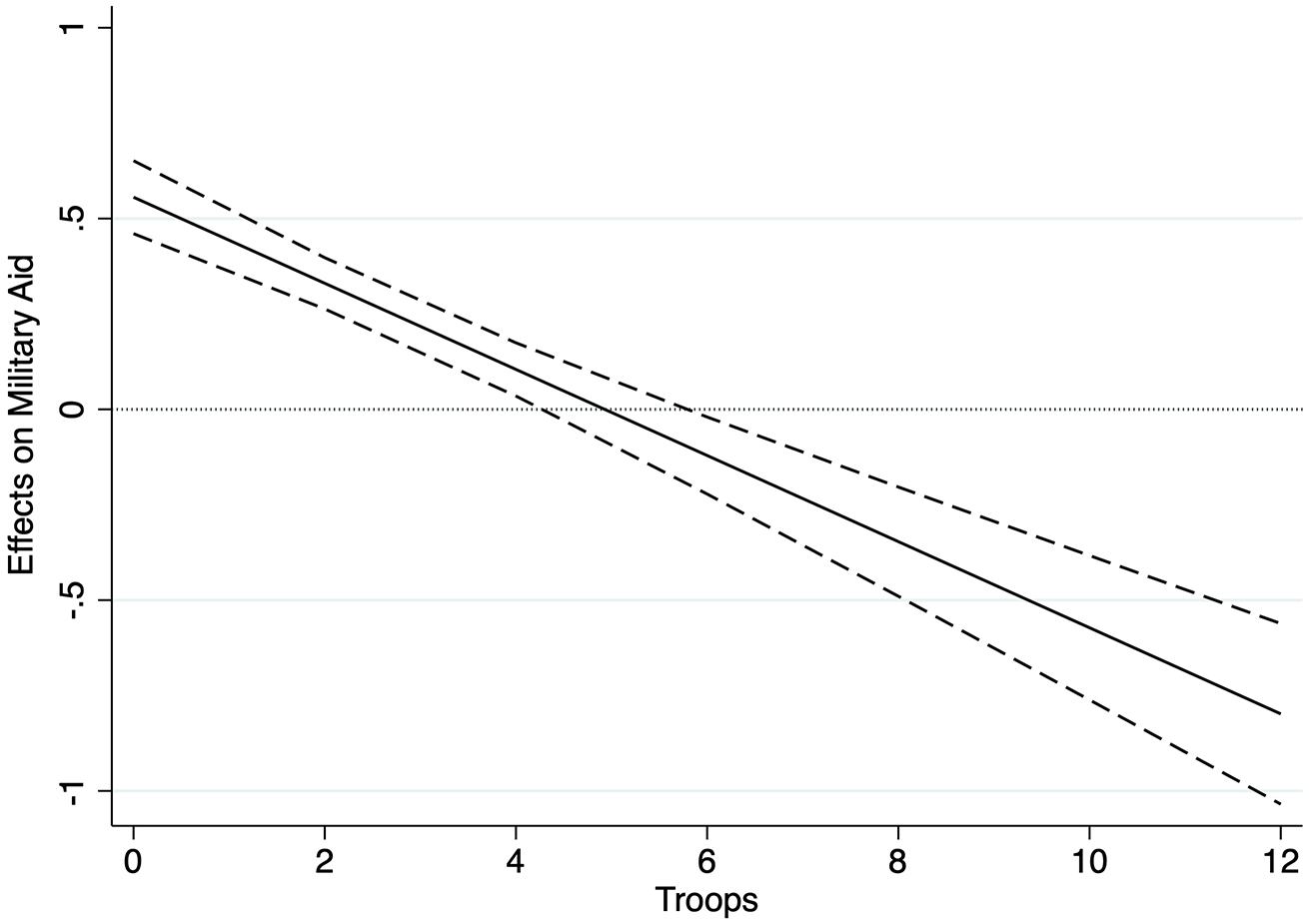
Effect of Democracy on US Military Aid Over Troops.
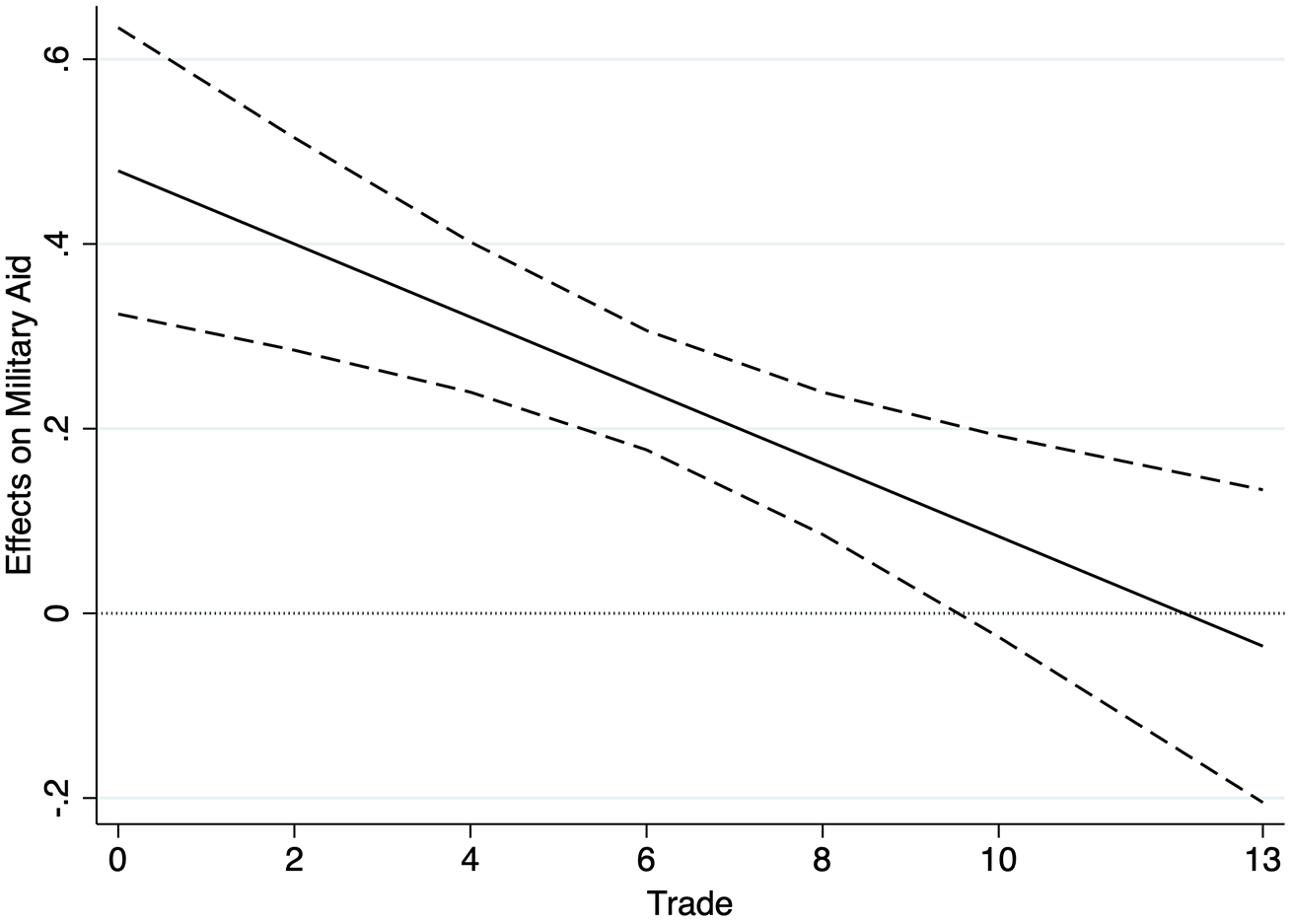
Effect of Democracy on US Military Aid Over Trade.
The results show that strategically and economically unimportant countries receive more US military aid when they are democracies. This result reveals the importance of democracy as a value: it motivates the allocation of US military aid even in the absence of economic and national security considerations. The presence of democracy in countries that don’t matter very much still grants them access to US military assistance. Furthermore, the effect of democracy declines but remains positive for the overwhelming majority of states regardless of their level of Troops or Trade. Thus, non-democratic countries can expect to receive less US military aid unless they are enormously important to US national security or are extremely strong US economic partners, providing support for both H1 and H2.
As expected, the results for Enterprise show the value to be both less significant and more affected by US interests. The interactions in ‘Model 3’ and ‘Model 4’ are both negative but only the interaction with Troops is significant. The constituent term for Enterprise is positive in both models, indicating that recipient countries that are more enterprising are rewarded with more US military aid so long as they are hosting few Troops and have a low volume of Trade with the US. ‘Figures 3 and 4’ show that the positive effect of Enterprise declines quickly with increases in Troops. Unlike Democracy, the effect of Enterprise becomes insignificant almost immediately after passing the median of number of Troops. With respect to Trade, the effect of Enterprise declines but not significantly so. The coefficient also remains insignificant at lower levels of Trade as well. Therefore, we find no support for H4. The results do support H3 however, which predicts that the value of enterprise would be affected security interests in US aid allocation. Furthermore, the effect of Enterprise actually becomes negative and significant when Troops are high (upwards of the 90th percentile). States that display the value of enterprise will receive more US military aid when they are not US economic or security assets and will receive less US aid when they are very strong US economic and security associates. As such, enterprise is both a less important determinant than democracy and more affected by countervailing interests.
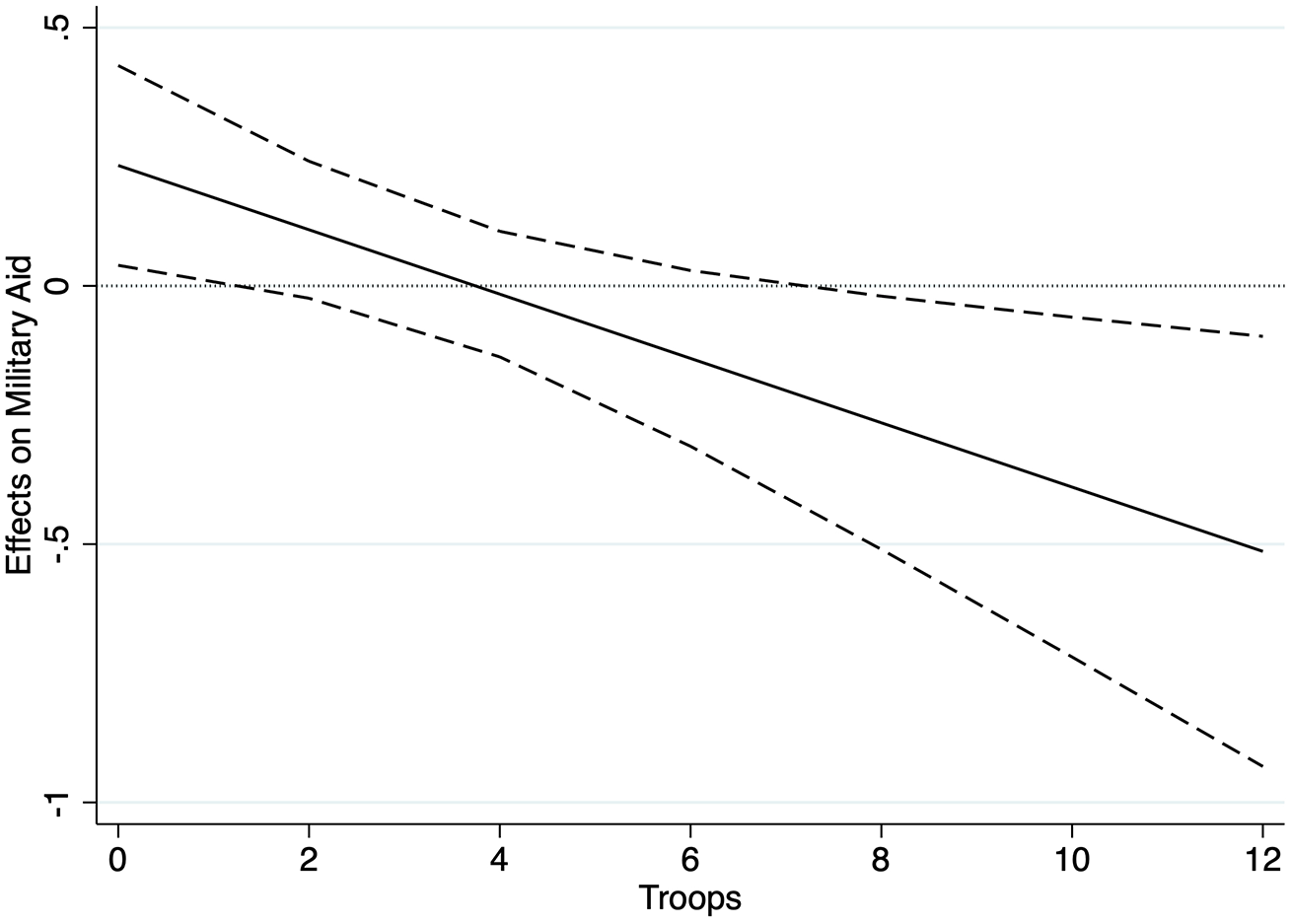
Effect of Enterprise on US Military Aid Over Troops.

Effect of Enterprise on US Military Aid Over Trade.
Human rights are the most conditioned of US values. The constituent term for Human Rights Violations is negative in both ‘Model 5’ and ‘Model 6’, meaning that human rights violators are given less US Military Aid when Troops and Trade are low. The result supports H5 and H6. The positive and significant interaction terms in both models signal that the negative effect of Human Rights Violations declines in significance with an increase in Troops and Trade, which again supports the predictions of H5 and H6. As shown by ‘Figures 5 and 6’, this change is fairly drastic. The effect of Human Rights Violations is insignificant when Troops reaches around the 80th percentile. Notably, Human Rights Violations does not become insignificant until well past the 90th percentile of Trade, meaning that Human Rights Violations are conditioned more by Troops than they are by Trade. As predicted by both H5 and H6, Human Rights Violations have a positive and significant effect on US Military Aid when values of Troops and Trade are sufficiently high. Recipient states of even moderate importance to US national security are granted more US military aid when they violate human rights. Human rights violators who are very important to the US economy are also granted more military aid.

Effect of Human Rights Violations on US Military Aid Over Troops.
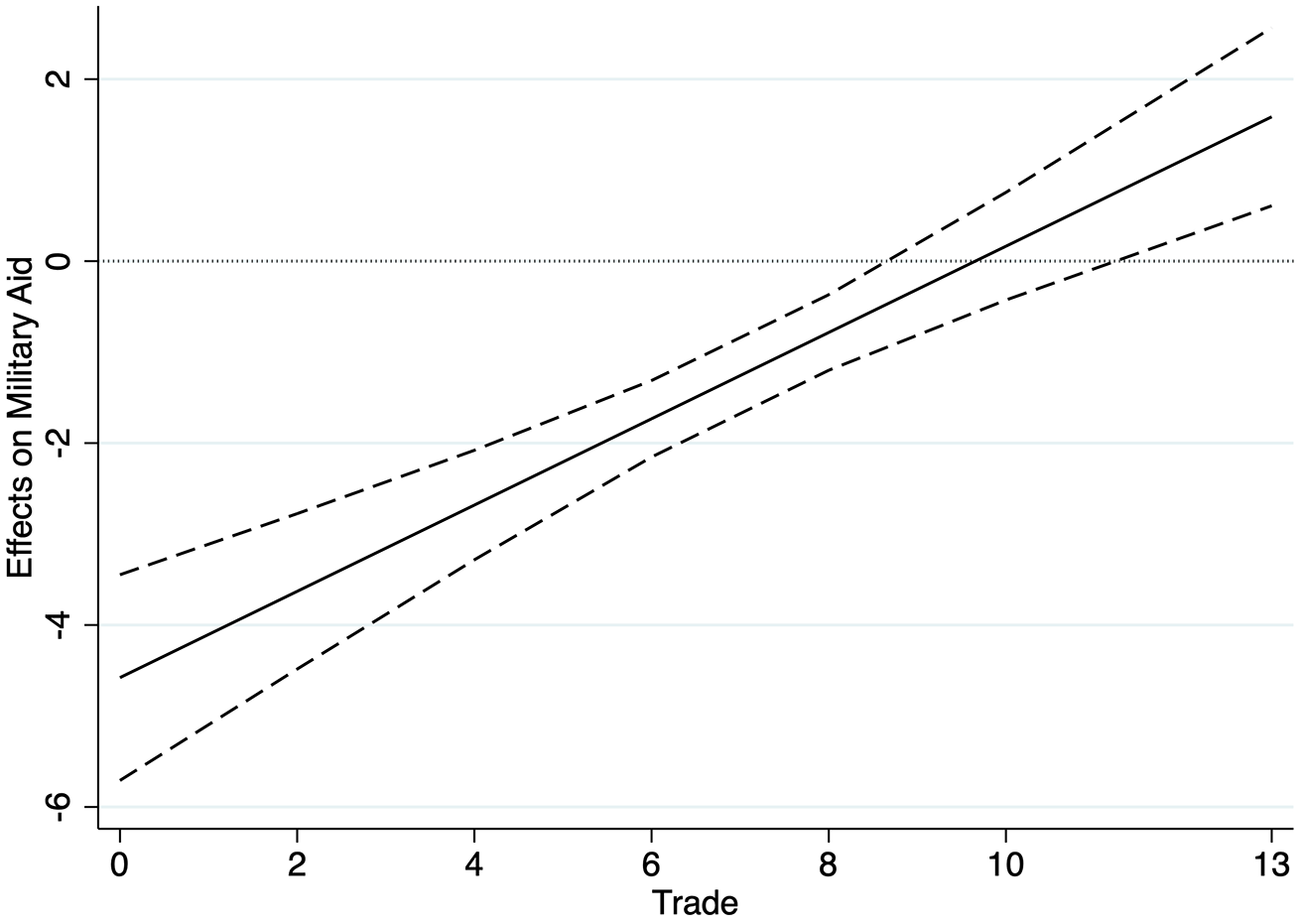
Effect of Human Rights Violations on US Military Aid Over Trade.
The effects of all three values on US military aid are modified by US security and economic interests. However, there are differences in how each value is modified. The vast majority of states receive more US military aid if they are democracies. This only changes in cases where US security or economic interests are overwhelming. With respect to national security, democracy may even play a negative role for the security partners of the utmost importance. Most states that exhibit the value of enterprise also receive more US military aid. However, a state’s loyalty to enterprise ceases to matter once states are of average US national security importance. In cases of high US security importance, states that are enterprising can be expected to receive less US military aid. Enterprise is not significantly conditioned by economic interests, and its overall effect on US military aid is much weaker than the effect of Democracy. Human rights exhibit a similar pattern. States of even moderate importance will be rewarded with more US military aid when they violate human rights. Nevertheless, human rights seem to be fairly resilient to conflicts with US economic interests. Only the most important economic partners are rewarded for violating human rights. The findings confirm past literature showing the effect of these US values on US military aid but make a new contribution by demonstrating that all values are altered by the presence of countervailing interests. Additionally, these findings contribute to the literature by showing that not all US values are equal. Democracy is a much stronger value than enterprise or human rights and is more resilient to the countervailing interests that present themselves in US military aid allocation.
Robustness checks
It is possible that troops and military aid are substitutes for each other. States with characteristics that motivate US troop deployments may get less military aid because they are already receiving a different form of US military assistance. As such, alliance structures may be another indicator of national security importance that could be used in the analysis and is not vulnerable to the critique that it is a substitute for military aid. Therefore, as a robustness check I use the number of Defense Cooperation Agreements as a proxy for US national security interest and interact this variable with Democracy, Enterprise, and Human Rights Violations in three separate models. 74 Defense Cooperation Agreements (DCA’s) are defined as ‘formal bilateral agreements that establish institutional frameworks for routine defense cooperation’. 75 DCA’s are military alliances but differ from traditional alliances or other defense-related agreements in that they have largely symmetric obligations, establish long-term cooperation at the outset with a great likelihood of renewal, and have specific components intended to strengthen the signatories’ overall defense capabilities. Given that DCA’s seek to improve capabilities of the parties to the agreement, they are clearly only made with states that are instrumental to US national security. Furthermore, the greater the number of agreements, the greater the degree of cooperation.
Interacting Defense Cooperation Agreements with variables for US values presents a pattern very similar to the one presented using Troops. 76 The interaction between Defense Cooperation Agreements and Enterprise is negative and statistically significant while the constituent term for Enterprise is positive and significant. This result indicates that the initial positive effect of Enterprise declines as the number of Defense Cooperation Agreements increases. Like the interaction using Troops, the variable Enterprise eventually becomes negative and significant at higher levels of Defense Cooperation Agreements. The interaction between Human Rights Violations and Defense Cooperation Agreements is almost identical to the interaction between Human Rights Violations and Troops. Human Rights Violations has a negative and significant effect on aid when states have one or two Defense Cooperation Agreements. When a state has five or six Defense Cooperation Agreements, the effect of Human Rights Violations is positive, meaning that states receive more aid when they violate human rights. As such, the results support Hypotheses 3 and 5.
Where the results differ from the model using Troops is in the interaction between Democracy and Defense Cooperation Agreements. The interaction is positive and significant, meaning that the effect of Democracy increases with an increase in Defense Cooperation Agreements. Nevertheless, the effect of Democracy remains positive and significant across the range of Defense Cooperation Agreements, meaning that similar to the results using Troops, Democracy is resilient to clashes with interests. Whereas strong national security partners are rewarded with more military aid when they support enterprise and protecting human rights, these same national security partners are punished with less aid if they are non-democracies. The results therefore validate democracy as the paramount US value.
Furthermore, ‘national security’ could be a narrow frame with which to view the political interests of the United States on the world stage. The US has a number of goals with respect to global finance, international law, climate change, and political stability where national security is the principal concern but is indirectly related to the specific issue at hand. At times military aid might be a worthy policy tool with which to address some of these issues (such as political stability or even climate change). I therefore use a broader measure of US ‘national security’ interests that may capture when national security overlaps with other concerns: voting at the United Nations. I use the Ideal Points index as the measure of the potential recipient state’s US national security importance. The variable Ideal Points is an estimate of state preferences based on voting at the United Nations General Assembly. The results of the models using the Ideal Points index present the same story as the original estimation. 77 The interactions between Ideal Points and Democracy, Enterprise, Human Rights Violations are all statistically significant and in the same direction as the interactions using the troops measure. As such, using a broader measure of political interests rather than a measure that specifically captures the security dimension yields the same result.
Another potential issue with the results concerns the value of enterprise. Although the investment risk index used has a much lower correlation with economic development than alternative measures, it may still be capturing an aspect of development that is not captured by GDP Per Capita. Furthermore, the value of enterprise as described earlier is a ‘progressive’ orientation not limited to the economic sphere but also extends to the social sphere. By operationalizing the value through an economic measure, this social dimension may be unaccounted for. I therefore also conduct tobit regressions using women’s political empowerment as the measure of Enterprise to capture the social aspects of the value. 78 Once again, the variable Enterprise is conditioned by Troops and Trade in the same way as it is in the initial tests. The positive effect of Enterprise on US military aid declines significantly with increases in Troops, much faster than Democracy. However, Enterprise as measured by women’s empowerment is not significantly conditioned by economic interests, just as it wasn’t when it was measured by investment risk.
Using the Political Terror Scale (PTS) as the sole measure of Human Rights Violations may also be concerning. The scale has well-known biases that are often the result of its source material. 79 Furthermore, any human rights index, such as PTS is subject to changes in reporting, accountability, and monitoring. As such, I conduct a robustness check using Fariss’ latent human rights measurement, which takes changes in human rights standards and reporting into account. 80 When it comes to Troops, the results using the Fariss measure are nearly identical to the ones using PTS. The effect of Human Rights Violations becomes insignificant just around the 75% percentile and then becomes negative and significant at higher values of Troops. With respect the Trade the story is similar in that the effect of Human Rights Violations declines considerably with increases in Trade but less than anticipated by H6. Unlike with PTS the coefficient never becomes negative and statistically significant. The result confirms both that human rights are less conditioned by interests than democracy and also that human rights are more resilient to clashes with economic interests than hypothesized.
Several studies have shown POLITY IV scores to be subject to measurement error. Therefore, as a robustness check, the model is also estimated with a dichotomous democracy variable from Cheibub et al., where a ‘1’ indicates the presence of democracy. The results are remarkably similar those using Polity IV. The dichotomous variable is conditioned by national security interests in the way H1 hypothesizes. The effect of the dichotomous variable decreases with increases in Troops, but just like the POLITY, the measure does not become negative and significant until Troops passes the 90th percentile. Likewise, the variable is conditioned less by Trade. The dichotomous version of the variable never becomes negative and significant, even at the highest levels of trade. As such, the results are robust to multiple measures of democracy.
Conclusion and discussion
Although US values play a role in aid allocation, the influence of these values on US military aid wanes when potential recipient states are important economic and security partners. The influence of material interests is so strong that at times countries that protect human rights, are enterprising countries, and even those that are democracies get less aid when they are strong national security partners. The results with respect to human rights and democracy have a straightforward explanation: when countries are of high strategic importance to the US, the US will grant them greater amounts of military aid to ensure they continue to repress political activity that could upset the US-recipient relationship. The result with respect to enterprise is harder to explain. Why would the US punish enterprising countries with less aid when they are strategic partners? One potential explanation is that progress, whether economic or social, results in more actors being able to influence the state. For example, economic liberalization creates newly empowered constituencies that could place political pressure on a recipient government. Thus, when the US has already captured influence through beneficial security ties, the potential influence of other actors represents uncertainty and a potential threat to the existing security order. The US will give non-enterprising countries more US military aid when these countries are important assets because the US is surer the relationship is free from other influences.
The other important result to note here is that the hypotheses for which the data produced little evidence were those concerning economic interests. The effect of democracy and enterprise never becomes negative, even at the highest values of trade. Human rights violations only had a positive effect at very high levels of trade between the US and the recipient and this was not robust to different measures of human rights. Evidently, economic interests override values in the same way as concerns about security but not to the same degree. National security remains a higher priority than economic ties.
Realists and liberals will likely consider these results as being consistent with the view that US values are instrumental to achieving foreign policy goals. Democracy, enterprise, and human rights are disregarded when they come into conflict with more tangible and pressing one: national security. However, this view is not entirely consistent with the other major finding of this paper. Despite the fact that material interests direct how US national values are incorporated into US military aid policy, US national identity still determines how resilient these values are to countervailing interests. Democracy, the value most integral to US national identity, is much less affected by conflicts with material interests and is generally a more significant determinant. Enterprise and human rights, values that are less central to US national identity, are both less significant and more easily overridden by interests when the two clash. The difference in how these values are treated corresponds to democracy being the most prominent part value within US national identity. The results therefore vindicate aspects of constructivist theory in that the national identity of the US predicts US behavior. Those who believe US values are instrumental would have to explain how democracy serves US interests more than enterprise. They would also have to explain how democracy serves US interests more than protecting human rights. This seems like a difficult case to make. Although US policymakers likely see democracy, enterprise, and human rights as promoting US interests, it is doubtful that any one of these values is more instrumental to serving US interests than the other. In other words, the fact that these values could be instrumental does not explain their hierarchy. In contrast, US national identity is a compelling explanation for the differing prioritization of these values.
Supplemental Material
sj-docx-1-ire-10.1177_00471178221140087 – Supplemental material for The limits of US national identity: interests and values in US military aid
Supplemental material, sj-docx-1-ire-10.1177_00471178221140087 for The limits of US national identity: interests and values in US military aid by Evan W Sandlin in International Relations
Footnotes
Funding
The author received no financial support for the research, authorship, and/or publication of this article.

Supplemental material
Supplemental material for this article is available online.
Notes
Author biography
Supplementary Material
Please find the following supplemental material available below.
For Open Access articles published under a Creative Commons License, all supplemental material carries the same license as the article it is associated with.
For non-Open Access articles published, all supplemental material carries a non-exclusive license, and permission requests for re-use of supplemental material or any part of supplemental material shall be sent directly to the copyright owner as specified in the copyright notice associated with the article.
