




Abstract
A decade ago, Amitav Acharya outlined his ‘new agenda’ for International Relations (IR) scholars: ‘Global International Relations’. This article seeks to modestly move forward two aspects of the Global IR agenda. First, we foreground a region largely missing from the Global IR literature: the Pacific Islands. That the Pacific has been ‘geo-politically marginal’ has consequences for the Global IR, and broader Political Science and IR scholarship, which has missed out on analysing and learning lessons from a rich and diverse region. Second, the Global IR scholarship has focused on important questions about ontology and epistemology, but with less consideration of methodology. That means that the question of how to move ‘beyond critique’ and do the practical work of studying Global IR remains largely unanswered. In the second part of our article we outline considerations arising from greater Global IR, and broader Political Science and IR, scholarly attention to the Pacific and then provide a grounded perspective of the practicalities of doing research there.
Introduction
In his 2014 Presidential Address to the International Studies Association Amitav Acharya outlined his ‘new agenda’ for ‘Global International Relations’. Acharya argued that, as a discipline, International Relations (IR) ‘does not reflect the voices, experiences, knowledge claims, and contributions of the vast majority of the societies and states in the world’. 1 He and others have identified the reasons ‘why there is no non-Western IR theory’ and proposed that a Global IR approach can generate ‘greater inclusiveness and diversity in our discipline. 2 The Global IR approach therefore argues that IR theories should ‘rethink their assumptions and broaden the scope of their investigations’, 3 to derive IR concepts and theories from both Western and non-Western societies, organised into ‘regional worlds’. 4 The aim is to achieve ‘pluralistic universalism’, which will allow ‘us to view the world of IR as a large, overarching canopy with multiple foundations’. 5 Most significantly, writing with Barry Buzan, Acharya’s formulation of Global IR ‘does not reject the mainstream theories . . . But challenges their parochialism and urges them to accept the ideas, experiences and insights from the non-Western world’. 6 Acharya and Buzan argue that scholars should avoid cultural exceptionalism, parochialism and ‘ethnocentricities’ 7 by generalising ‘from the local context on its own terms to offer new concepts and approaches that have analytical value beyond the region’, 8 so that IR theory gives ‘due recognition to the places, roles, and contributions of non-Western peoples and societies’. 9
This article seeks to modestly move forward two aspects of the Global IR agenda. First, we foreground a region largely missing from the Global IR literature: the Pacific Islands. 10 The Global IR literature usually identifies the ‘non-West’ as ‘Asia, Africa, Latin America, and the Middle East’. 11 This definition is echoed in the scholarship about the relationship between IR and Area Studies. 12 This is despite the Pacific long being interesting to metropolitan powers for its strategic location relative to the United States, Northeast and Southeast Asia, Australia and New Zealand, as well its abundant natural resources, including fisheries, minerals and timber. Over the last decade, interest in the region has spiked in the context of rising concern about the reverberations of strategic competition between China and the United States and its allies and partners. 13 Pacific countries have also demonstrated international leadership on issues such as climate change and maritime security, including advocating for a United Nations Loss and Damage Fund and shaping United Nations Convention on the Law of the Sea state practice by issuing the 2021 Declaration on Preserving Maritime Zones in the Face of Climate-Related Sea-Level Rise. 14 In addition, Pacific countries have used strategic narratives to counter geostrategic framings of their region; most recently their ‘Blue Pacific’ narrative has shaped the policies of the United States, Australia, Japan and New Zealand, among others. 15
Yet while metropolitan governments are increasingly focused on the Pacific and have been joined by influential think tanks 16 and the media, 17 as we demonstrate in the first part of our article, the region is relatively absent from the Global IR, and broader Political Science and IR, scholarship. That the Pacific has been ‘geo-politically marginal’ 18 has consequences for that scholarship, which has missed out on analysing and learning lessons from a rich and diverse region. The Pacific consists of 24 states and territories. The more than 14 million people of the region speak over 1000 languages and engage in an array of cultural, spiritual, social, economic and political practices, including innovative sociopolitical models that draw on both local and introduced methods of governance and justice. 19
Second, the Global IR scholarship has focused on important questions about ontology and epistemology, but with less consideration of methodology. That means that the question of how to move ‘beyond critique’ and do the practical work of studying Global IR remains largely unanswered. 20 In the second part of our article we outline considerations arising from greater Global IR, and broader Political Science and IR, scholarly attention to the Pacific and then provide a grounded perspective of the practicalities of doing research there.
To bring non-Western perspectives into IR theory Acharya calls for a dialogue across ‘the distinction between West and non-West’. 21 We agree with Yong-Soo Eun that this dialogue must be ‘understood and practised as a reciprocal exchange of perspectives for mutual learning’ and ‘involve the improvement of the existing knowledge that both sides in the dialogue have produced’, that is, the aim should be to achieve ‘complementary reciprocity . . . across theoretical, empirical, and meta-theoretical levels’. 22 This means, as Teresia Teaiwa long argued, that the Pacific must be ‘brought to the table as an equal partner in any conversation about the nature of humanity or society’. 23 Therefore, while acknowledging the risks inherent in such exchanges, particularly structural inequalities and coloniality, we are persuaded by Eun’s ‘instrumentalist’ call for non-Western scholars to ‘initiate dialogue’ to ‘attempt to find and expand points of contact with our [/their] western counterparts’. 24
This article represents our effort at such a dialogue, guided by an ethos of ‘epistemological compassion’, 25 in which we have attempted mutual learning. It is the product of almost 4 years of collaboration between the authors, who are from Australia, and Samoa and Tokelau, respectively. We were educated at universities in Australia, New Zealand and the United Kingdom, and work at an Australian university. We have necessarily brought our respective positionalities, including our citizenship, class, race, educational background, language and religion, to our collaboration, which have both material and symbolic consequences. 26 And while, like other Global IR scholars, we share an ‘emancipatory agenda’, 27 our collaboration has unavoidably been influenced by power dynamics stemming from our age, gender, professional status and, for the Australian, settler-colonial identity.
However, we have been guided by the Samoan principle of soalaupule (collaborate with humility), which means that we have assumed that we both share authority to reach consensus as equals in our deliberations. 28 Mindful of Laumua Tunufa’i’s warning about the risk of ‘ascribing new meanings’ to Pacific concepts, our approach has deliberately remained within the spirit of soalaupule as understood and practiced within the Samoan context. 29 Soalaupule is a collaborative decision-making mechanism in Samoa; soa means ‘two or more people’, lau means ‘you or yours’, and pule means ‘authority or power’ in the Samoan language. 30 The ‘blending of our different perspectives’ was underpinned by ethical values such as respect, active listening, reflexivity and reciprocity. 31 We applied this Samoan concept as a method(ology) when writing this article to acknowledge each other’s agency as we ‘weighed up our different ideas, understandings and experiences’, and to ensure our ideas and outcomes were collectively owned and shared. 32 In doing so, we went beyond talanoa (conversation); it was not a ‘falsifying and disempowering exercise’. 33 Finally, while our arguments are our responsibility, they have been informed and enriched by decades of intergenerational lived experiences, conversation and collaboration with colleagues and communities across the Pacific, and we are thankful for the knowledge that they have gifted to us.
Our collaboration has been guided by an example of how soalapule can be used in practice to facilitate dialogue between Western and non-Western theories contained in a 2023 article. 34 That article followed Vilsoni Herenikos’ call for ‘Pacific Islanders to infuse western scholarship with their own ways of being and doing’. 35 It represented a conversation between four authors, across and between their different nationalities and lived experiences, guided by the principes of soalapule. That conversation generated an example of how understandings of the geographies and politics of Pacific peoples can be brought into conversation with dominant western Political Geography concepts to re-imagine how Pacific geopolitics are analysed and understood. It followed Linda Tuhiwai Smith’s observation that ‘[d]ecolonization . . . does not mean and has not meant a total rejection of all theory or research or Western knowledge. Rather, it is about centring our [Indigenous peoples’] concerns and world views and then coming to know and understand theory and research from our [Indigenous peoples’] own perspectives and for our own purposes’. 36 The authors collectively proposed how the non-sequential, mutually reinforcing ‘intersecting sociospatial conceptualisations of ta (based on the Tongan word taimi [tai-me], time), va (vava, space), and la (which we drew from the Tongan word lahi, meaning big or wide-ranging)’ can be brought into conversation with the intersecting Political Geography concepts of time, space, and scale.
What constitutes the ‘Political Science and International Relations’ scholarship?
For scholars working at an Australian university, at first blush the question of what constitutes the Political Science and IR scholarship seems obvious: the literature published by scholarly journals or book publishers mostly based in North America or Europe (although the scholarship comes from an increasingly broad range of countries). We describe this scholarship as ‘dominant’ to capture the fact that, at least in western universities, it is taken as common sense that what constitutes legitimate scholarship will be published in these outlets, and accordingly follow the conventions and speak to the theoretical and methodological debates that characterise them. We acknowledge that, especially in non-western contexts, this is a narrow understanding; thinkers and scholars have been creating work about politics and international relations for millennia. 37 We also acknowledge that this description means that we are, we feel unavoidably, replicating the ‘continuing hierarchical divide that privileges IR theorising over empirical research on and from places outside the Western core’. 38
But we began our search for the Pacific in the dominant Political Science and IR scholarship for the pragmatic reason that it is dominant in the metropolitan countries interested in the Pacific region, and indeed in many Pacific tertiary institutions. We started by looking at the university curricula in the major metropolitan states interested in the Pacific: Australia, New Zealand and the United States. 39 Our research assistant visited the websites of all universities known (or identified as likely) to teach courses related to the Pacific, and after working through their course catalogues and descriptions, compiled the data in Table 1.
Undergraduate university courses that cover the Pacific Islands region in 2024.
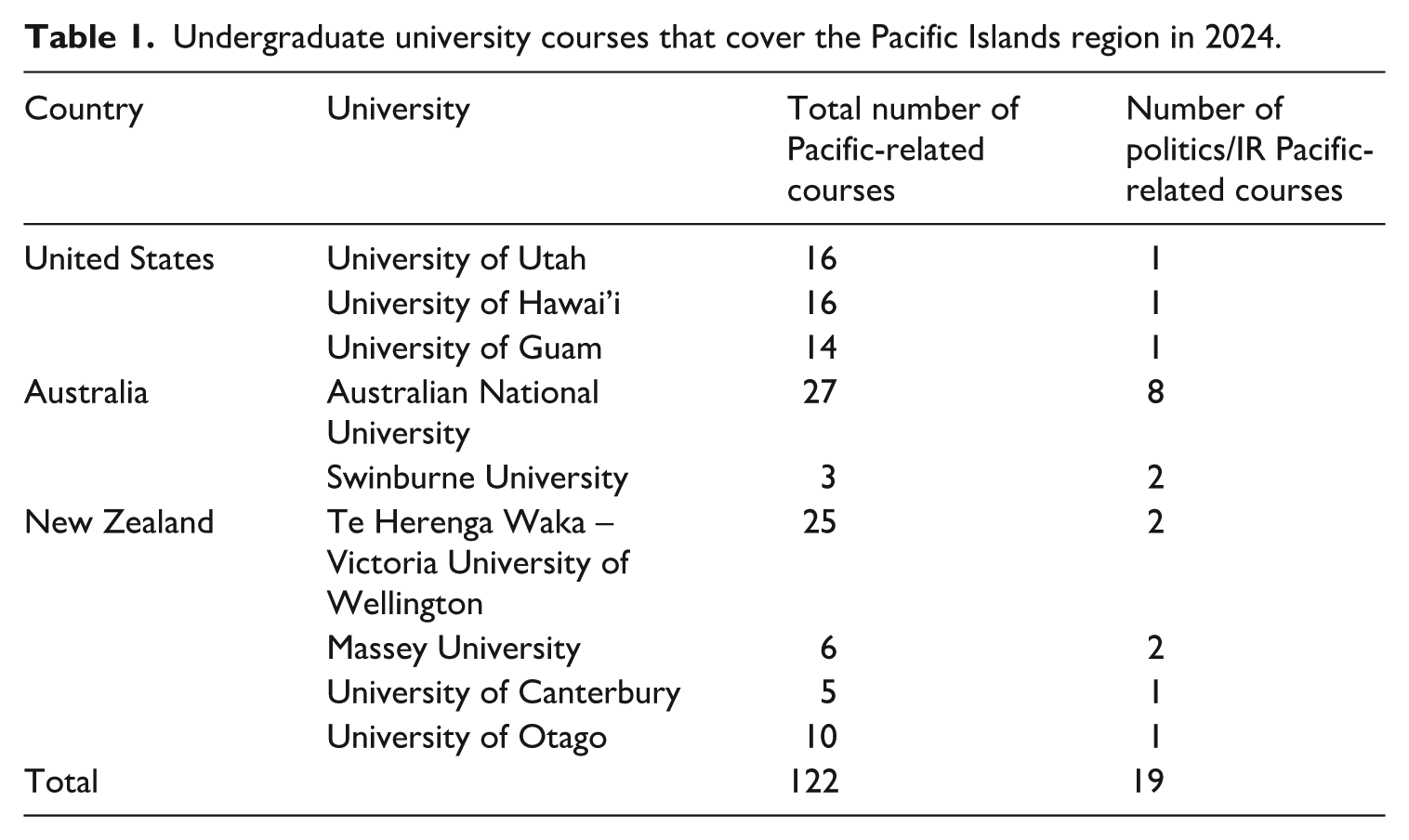
As Table 1 illustrates, very few universities teach undergraduate courses specifically about the Pacific, even those that have some Pacific research capability. Of the universities that do, less than one sixth of those courses relates to politics or international relations (the rest primarily relate to culture, history, development and agriculture). We acknowledge that this data is potentially incomplete, as our research assistant worked off university websites, and the Pacific may be discussed in other courses without being specifically identified in the course descriptions. Information relating to the number of students enrolled in these courses would also provide a valuable indication of student interest, but was unfortunately not publicly available. Even accounting for the courses that we may have missed, the data in Table 1 highlights that very few students graduate from their degrees having studied anything about the Pacific, especially about the politics and international relations of the region. This likely disincentivises them researching the region if they go on to complete further study in Political Science or IR.
We then directed our search for the Pacific to scholarly books and journals. Because regionalism is an important aspect of Pacific IR, we looked for the region in major handbooks on this topic. We found that the prestigious Oxford Handbook of Comparative Regionalism, does not devote any of its 27 chapters to the Pacific Islands region. 40 Nor does the Routledge Handbook of Regionalism and Federalism or the Elgar Handbook on Global Governance and Regionalism. However, in 2023 Fijian scholar William Waqavakatoga did publish a chapter about the region in the Oxford Research Encyclopedia of International Relations. 41 In their canonical work, Regions and Powers: The Structure of International Security, Barry Buzan and Ole Wæver do discuss the Pacific. But they dismiss it as an ‘unstructured region’, where states ‘have such low capability that their power does not project much, if at all, beyond their own boundaries’. 42 As a result, they conclude that Pacific countries have only developed ‘some loose regional forums’. 43 This conclusion sits in contrast to the longstanding work of, for example, Albert Wendt, Epeli Hau’ofa, Gordon Nanau, Greg Fry, Sandra Tarte and Stephanie Lawson on Pacific regionalism, 44 Transform Aqorau on Pacific regional fisheries management 45 or Sala George Carter on Pacific climate diplomacy. 46
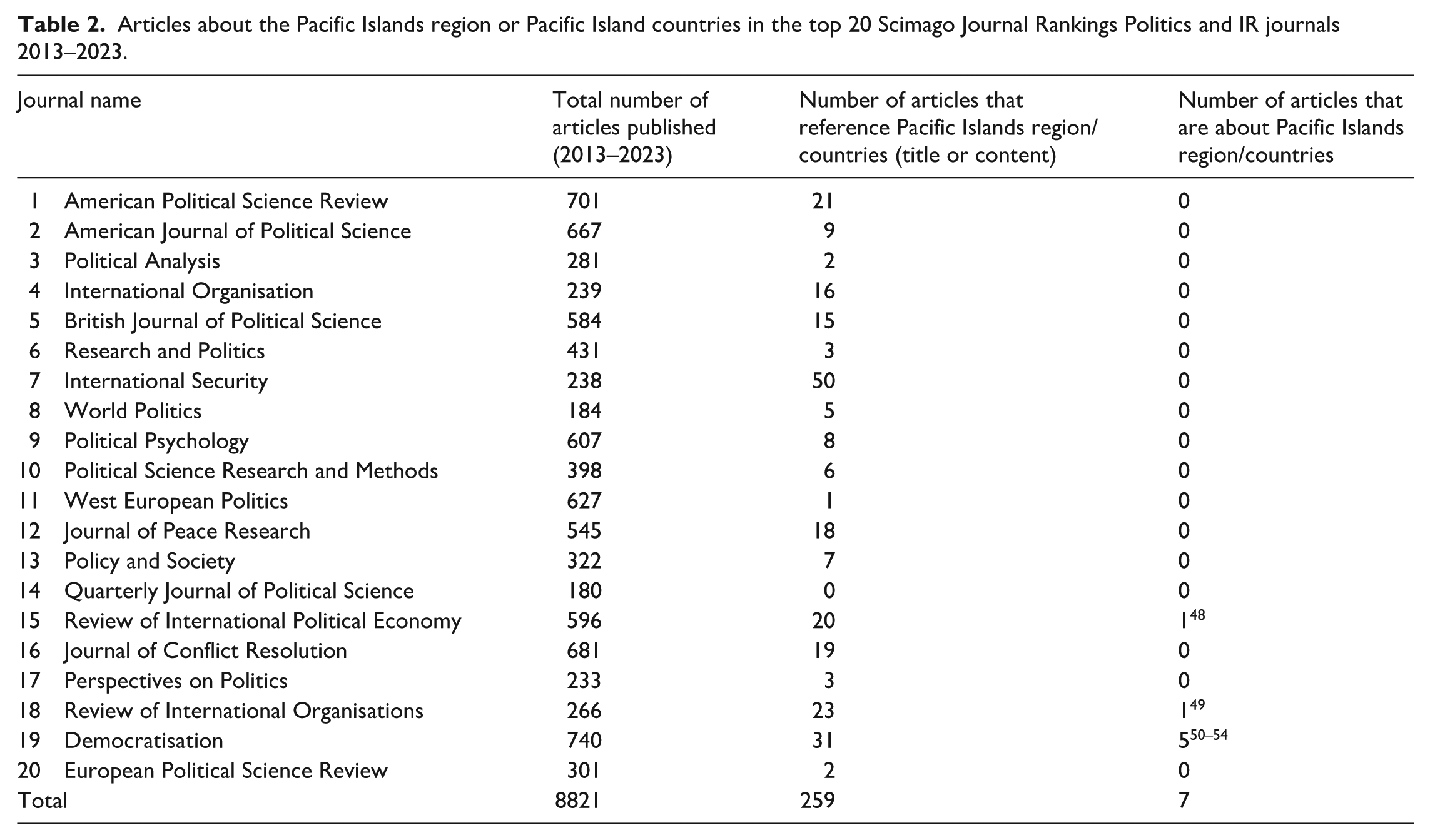
As Table 2 illustrates, in the last ten years almost no articles about the Pacific, or Pacific countries, were published in the top 20 Political Science and IR journals, as identified by the Scimago Journal Rankings. Our research assistant read the titles and abstracts of every article published in these journals from 2013 to 2023 and identified those that referenced the Pacific region or a specific Pacific country. Rather than relying on an automated review tool, to ensure the probity of our analysis he then read those articles to identify which were specifically about the region or Pacific countries. By necessity, given the volume of articles reviewed, we asked our research assistant to focus only on the top 20 journals on the Scimago Journal Ranking. As it is impossible to get data on what articles are submitted to these journals, we do not know what work journal editors, and later, reviewers, rejected. In the 20 journals analysed, of the 8821 articles published, only seven were specifically about the Pacific region or a Pacific country, and none of these seven was by a scholar from the Pacific. However, beyond the ‘top 20’ journals we analysed, a handful of articles about the Pacific have appeared in journals ranked Q1 on the Scimago Journal Rankings, such as the International Affairs, Third World Quarterly, Political Geography and the Australian Journal of International Affairs. The Pacific has also appeared in Q1 journals in the context of the developing literature on small states, as the five articles in Democratization illustrate. 47
Articles about the Pacific Islands region or Pacific Island countries in the top 20 Scimago Journal Rankings Politics and IR journals 2013–2023.
We used the Scimago Journal Ranking because it is often treated as the most important indicator of the prestige of scholarly journals. While critiques of quantitative rankings are well-known, 55 we used Scimago because, imperfect as it is, it has consequences. For example, in Australia, many universities calculate academic workloads based on publications, with only publications in Q1 journals on the Scimago Journal Rankings counting towards workload allocations. The Australian Research Council, the country’s most prestigious competitive research grant funder, asks academics to identify their ten ‘best’ publications on their grant applications and to justify their choices with reference to journal rankings and citations. The rankings of researchers’ publications can also influence the outcome of job applications and academic promotion, with ‘impact’, as determined by metrics such as rankings, often key assessment criteria. 56
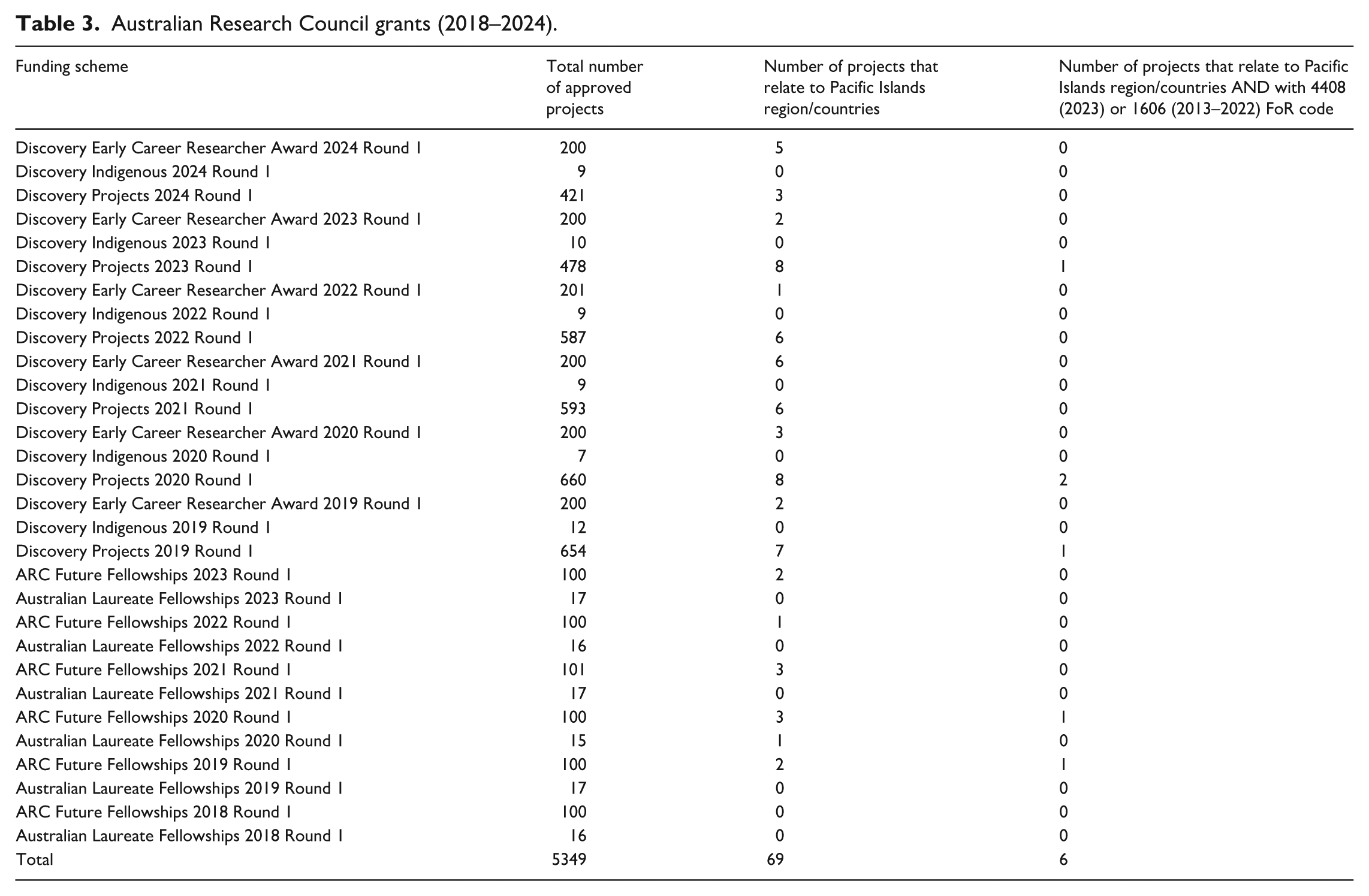
Since research is costly, particularly in the Pacific where travel across large distances can be expensive, we then looked for the Pacific in the grants made by the major funding bodies in the two metropolitan countries most interested in the region: Australia and New Zealand. As Table 3 illustrates, out of 5349 projects funded by the Australian Research Council under its Discovery schemes between 2018 and 2024 (the years for which data was available online), only 69 related to the Pacific region or Pacific countries, and of them, only 6 related to the politics or international relations of the region (which our research assistant identified by the FoR (field of research) code for Political Science that includes IR as a sub-code).
Australian Research Council grants (2018–2024).
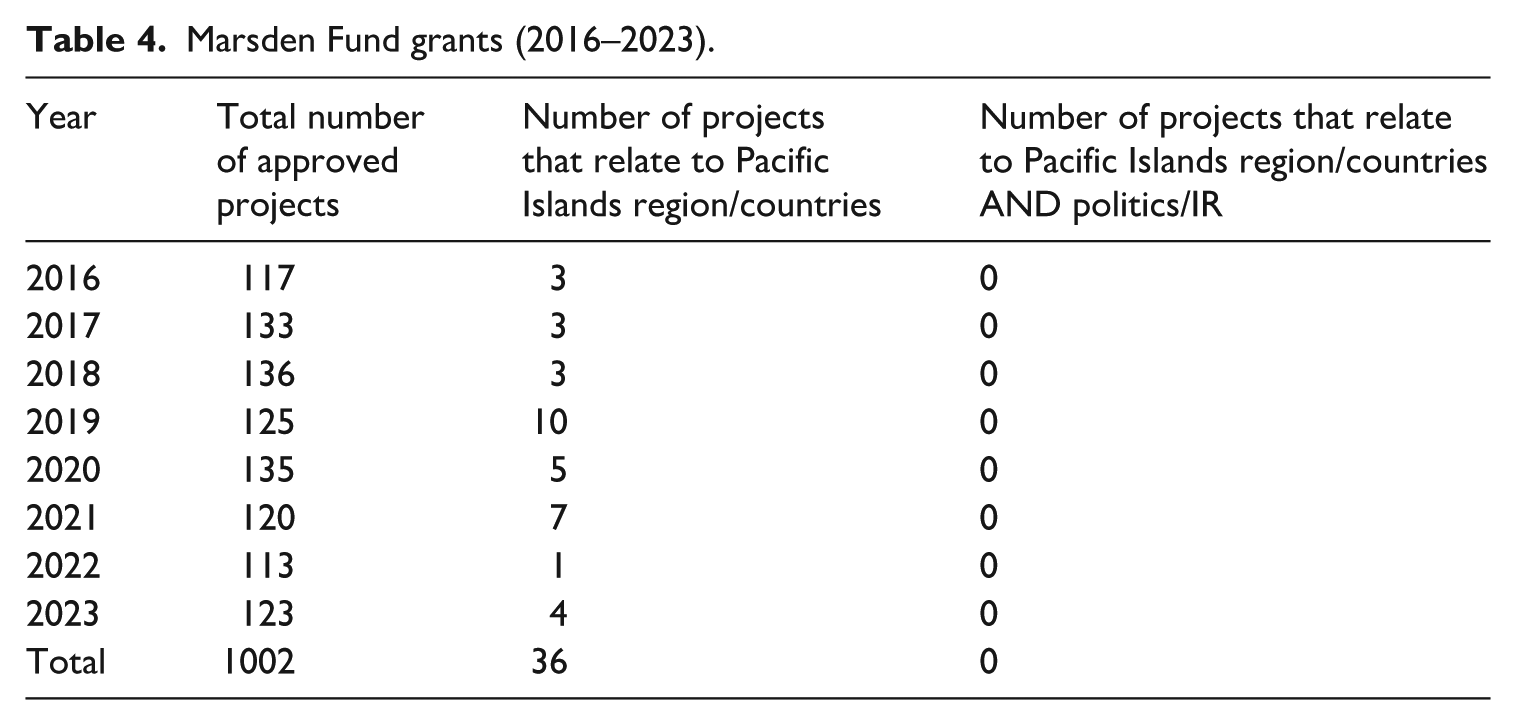
This dynamic is repeated in New Zealand with respect to its major competitive grant scheme, the Marsden Fund. And funding cuts announced by the Luxon government in 2024 in the humanities and social sciences disciplines may have implications on future research. 57 As shown in Table 4, of the 1002 projects funded between 2016 and 2023, only 36 related to the Pacific region. While New Zealand provides proportionally higher funding for Pacific research than Australia, none of the funded projects related to politics or IR (based on our research assistant’s review of the project descriptions).
Marsden Fund grants (2016–2023).
It is not possible to access data about unsuccessful grants, so we cannot assess how many projects on the politics and/or international relations of the Pacific region have been proposed.
In Australia and New Zealand most research on the Pacific is funded by foreign affairs and defence departments. For example, in Australia, the most significant funding scheme is the Pacific Research Program, to which the government has committed almost A$50 million over 10 years from 2017. 58 The program is conducted by a consortium from the Australian National University (ANU) and the Lowy Institute. While the Australian National University first established a Research School of Pacific Studies in 1946 (now the College of Asia and the Pacific), and continues to undertake research on Pacific history, languages and cultures, the bulk of research about the politics and international relations of the region is now conducted under the Pacific Research Program. The stated aim of that program is to contribute ‘to sound policy-making and program design by the Government of Australia and its partner governments and organisations’. 59 The call for proposals specified that ‘the relationship between DFAT [Department of Foreign Affairs and Trade] and the research institution will be characterised by open, honest dialogue to ensure that the program’s research remains relevant to the needs of policy-makers and program designers in Australia, the Pacific region and from around the world’. 60 When the program was extended in 2022 it was with the overall goal ‘to deepen Australia-Pacific research & education partnerships that support evidence-based policy-making for the Pacific’. 61 That the program is not a blue-sky basic research funding scheme is not necessarily a bad thing, as research-informed policymaking is important, particularly in the Pacific, where poorly designed policies have undermined development for decades. 62 But the program’s focus on informing policymaking influences what the funded researchers study, with priority topics identified based on their relevance to government. Yet research that is driven by donor-identified policy priorities can exclude appreciation of Pacific philosophies and ways of knowing, undermining their practical outcomes. 63 The focus on policy outcomes also potentially influences how critical these researchers can be, given that some of their job security relies on continued funding. 64 And it may influence what and where the researchers publish, given the government’s preference for policy briefs rather than ranked publications.
But the net result is the same: very few academic studies of the politics and/or international relations of the Pacific region are funded by the major competitive funding bodies in the two metropolitan countries most interested in the region, Australia and New Zealand. In sum, if we are guided by the dominant measures of scholarly prestige and impact, the Pacific region, and the countries within it, are almost entirely absent from university curricula, the most prestigious politics and IR scholarship, and receive little competitive grant funding in Australia and New Zealand.
This finding prompted us to look beyond the dominant Political Science and IR scholarship. A noted, the Pacific is absent from the Global IR scholarship, but we found considerable scholarship about politics and/or international relations in the Pacific Islands region primarily published by USP Press, ANU Press and the University of Hawai’i Press, the institutional homes to the greatest number of Pacific-related teaching courses. This reflects that these institutions have the greatest number of faculty teaching and researching the region. The University of the South Pacific (USP) is the main regional university, with campuses in 12 Pacific countries. The ANU has a government mandate and dedicated funding to research and teach about the region. Beyond these universities, key Pacific scholars, such as Steven Ratuva at the University of Canterbury and Damon Salesa at Auckland University of Technology have published a series of books about the politics and/or international relations of the region.
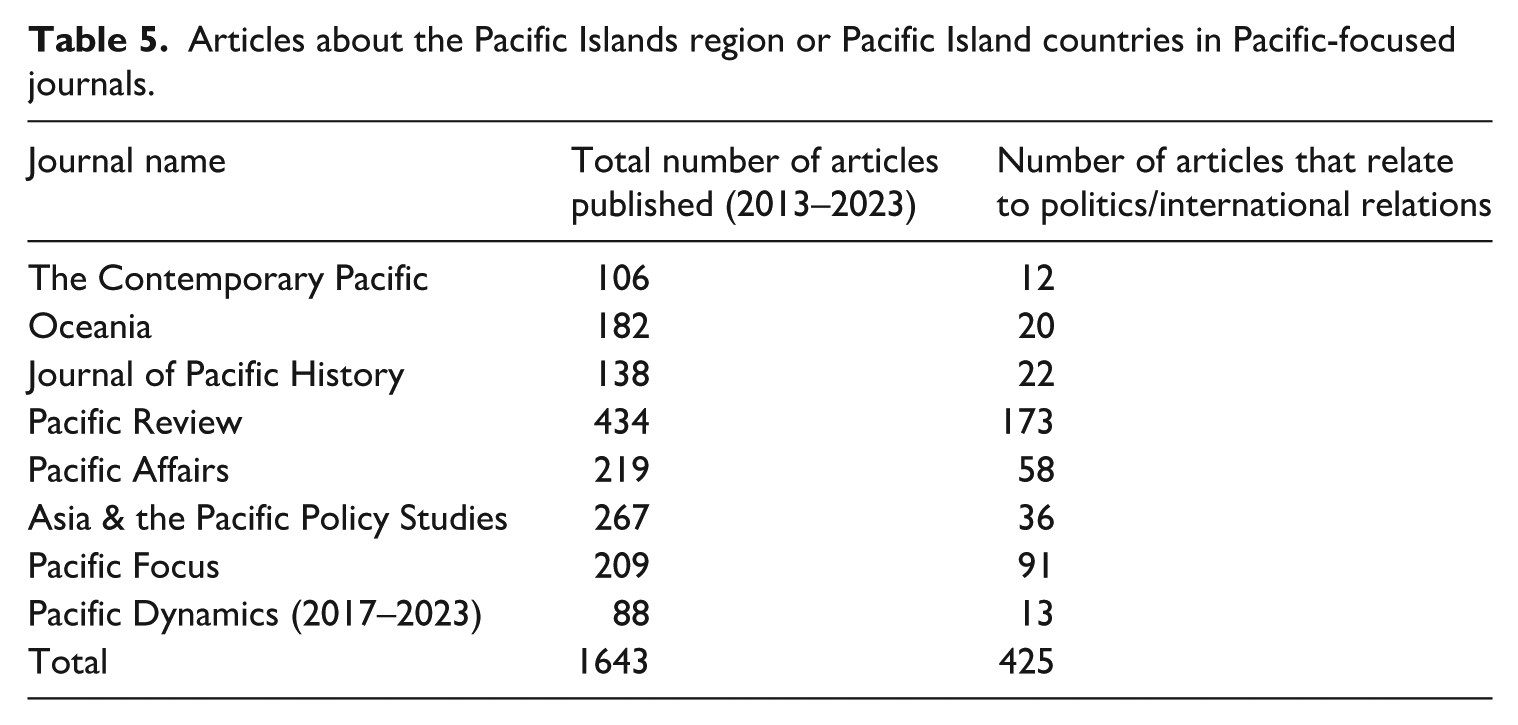
We then continued our search for the Pacific region in the major Social Science journals that focus more specifically on the Pacific. As Table 5 illustrates, there is much greater representation of work on the politics and/or international relations of the region or countries within it in these journals. Of the 1643 articles these journals published between 2013 and 2023, 425 related to the politics and/or international relations of the Pacific region and the countries within it. We do not wish to denigrate the prestige of any of the Pacific-focused Social Science journals, many of which are classified as Q1 on the Scimago Journal Ranking and in which we have ourselves published. Instead, we argue that this data illustrates the tendency of people doing this work to congregate in Pacific-focused journals, rather than in those that speak to the wider discipline. This likely reflects that these journals are perceived to be – and probably are – more welcoming to different research methodologies and to articles that primarily make empirical, rather than theoretical, advancements. 65 This reflects the broader dynamics of the division between Political Science and IR scholars, who ‘aspire to be social scientists’ who master a discipline, and Area Studies scholars who adopt interdisciplinary approaches and emphasise field research and ‘life-long devotion to studying a nation or region’. 66
Articles about the Pacific Islands region or Pacific Island countries in Pacific-focused journals.
Several of the Pacific-focused journals we have identified were created as part of the Pacific Studies research agenda, spearheaded by Pacific scholars such as Teresia Teaiwa at USP and then at Te Herenga Waka – Victoria University of Wellington, and Brij Lal at USP, the University of Hawaii and finally the ANU. Indeed, Lal was the founding editor of The Contemporary Pacific, which played a vital role in establishing the agenda of Pacific Studies as inter-disciplinary, drawing on political, economic, social, cultural, literary and ecological approaches, and guided by a commitment to emancipation, decolonisation, anti-racism, Indigenous rights and agency and sovereignty (in many forms). 67
Considerations arising from greater Global IR, and broader Political Science and IR, scholarly attention to the Pacific Islands region
While we argue for greater Global IR, and broader Political Science and IR, scholarly attention to the Pacific, we acknowledge that this comes with risks. As Teresia Teaiwa once asked, when considering how Feminist Security Studies (FSS) had overlooked the region, ‘Should we lament the lack of a coherent body of Pacific Island FSS or count ourselves fortunate to have avoided such a biased view of what is worth knowing?’ 68 Teaiwa ultimately concluded, and we agree, that the Pacific should and ‘can continue to engage with any version of FSS on our own terms’. 69
We acknowledge that critics are concerned that, by distinguishing between the ‘Western’ and ‘non-Western’ worlds, the Global IR approach is ‘likely to reproduce essentialized understandings by bifurcating the world and pairing one side of the duality with particular geographic locations and particular ethno-cultural traditions’. 70 Influenced by Derrida, these critiques argue that ‘such essentialized identities and fixed binaries are constitutive of a coloniality of power that marginalises “different” voice is located on one side of the duality’. 71 Critics are particularly concerned that Acharya’s emphasis on analysing ‘regional worlds’ implies an ‘individualist ontology by which parts exist in separation from other parts, and where difference becomes a matter of logical contradiction and hierarchy’. 72 Indeed, by identifying regions as referents for analysis, Acharya’s ‘geo-epistemological labelling’ is said to ‘run the risk of reification’ as it ‘ask[s] us to imagine places as having essentially bounded, or internalist, developmental histories, which result in particular ethno-cultural ways of thinking, knowing, and valuing’. 73 Critics argue that this ‘misses the co-constitutive, transboundary relations through which theories and approaches to world politics actually develop historically’ and ‘retains a set of largely Eurocentric geographic categories with imperial origins’, particularly the ‘identification of world regions’. 74
We nevertheless frame our discussion around a binary of ‘metropolitan’ and ‘Pacific’ researchers as a shorthand to capture that ‘things are different’ in the Pacific. 75 We use metropolitan to describe scholars working in countries such as Australia, New Zealand, the United States and the United Kingdom, and who use the theoretical and empirical frameworks and methodologies evident in the dominant Political Science and IR scholarship. In contrast, we take Pacific researchers to be scholars originally from the Pacific and either based in the Pacific region or in metropolitan countries, and who are mainly guided by Pacific ontologies, epistemologies and cosmologies. We acknowledge that this binary is false and does not fully capture the relational complexity of individual researchers’ intersectional identities. The Pacific region is also highly diverse, even within Pacific countries, so while a Pacific researcher might be an ‘insider’ in their home or ancestral locale, they may be considered an ‘outsider’ even in another village or province, let alone another Pacific country. However, we are wary that efforts to avoid essentialism and cultural relativity – while admirable – run the risk of obscuring important and (potentially) productive differences.
We therefore remain confident about the relevance of the Global IR approach to the Pacific Islands region. As our use of the label ‘Pacific Islands region’ implies, people from the Pacific – and especially prominent Pacific intellectuals – have long experienced a sense of regional identity that makes us comfortable with this geo-epistemological labelling. Connections and relationships across the ‘sea of islands’ 76 are longstanding, and as far back as 1883, when improvements in technology made intra-regional travel more accessible, Hawaiian King Kalakaua adopted the principle of ‘pan-Pacific activism’ to protest European imperialism, including by appointing a network of diplomats across the region. 77 Indeed, Pacific leaders have long used the regional referent, most recently through the concept of the ‘Blue Pacific Continent’, as a powerful way to crystallise regional solidarity, stress their strategic autonomy, and empower Pacific agency. 78 We see a risk that flattening out differences between world regions to emphasise ‘transboundary relations’ could disempower and subsume Pacific perspectives within larger discourses that provide little space to recognise their particularities.
Critics of Acharya’s Global IR agenda are also concerned that his concept of pluralistic universalism assumes that it is possible to bridge gaps between dominant IR theories and ‘concepts and theories derived from the non-Western or Global South’. 79 Felix Anderl and Anthonia Witt have criticised this effort at seeking progress through ‘inclusion rather than confrontation’, as ‘circumvent[ing] an open debate about what actually counts as good IR knowledge while establishing global applicability as an unquestioned benchmark for defining the value of knowledge’. 80 For Eun, by seeking to preserve and develop existing IR theories, Global IR fails to grapple with the continued ‘dominance of positivism’ and runs the risk that ‘the same hierarchic structure of knowledge production will be reproduced where understanding of how the world works is, once again, universalized’. 81 By ‘merely seeking to “bring them in”’ through including non-Western perspectives in IR theory, critics therefore warn that Global IR ‘strategies are liable to produce no more than cosmetic change rather than a profound transformation’, 82 particularly if they reproduce ‘potentially essentialist understandings of representation’ and overlooks the structural factors that influence the generation of theory and scholarship in different parts of the world. 83
We acknowledge that many metropolitan Political Science and IR scholars’ understandings of their disciplines remains ‘trapped in colonial pedagogical mentality, where it is universities, scholars and publishing outlets in the West that dominate and set the agenda’, which does not ‘truly reflect the global society we live in today’. 84 Many scholars writing about the Pacific therefore decide not to try to ‘fit’ their scholarship into spaces which are bounded by disciplinary approaches that represent entrenched western colonial structures of generating, recognising and valuing knowledge, and assume that scholarship needs to ‘embrace a positivist and scientist epistemology and very often a quantitative and statistical methodology’. 85 Such approaches are often incompatible, or even hostile, to Pacific ways of knowing and being, which as we describe below, frequently use ‘unscientific’ methodologies such as storytelling. And when research has drawn on storytelling, it was often as a tool of colonisation – ‘stories were ‘taken’ and ‘made’ and ‘used’ to define, destroy and deter the valuing of Indigenous knowledge, people and practices’. 86
In addition, seeking to publish work guided by Pacific political or international relations understandings in dominant Political Science and IR journals, and – to satisfy editors and reviewers – applying disciplinary theories and concepts to them, might involve ontological, epistemic, and/or cosmological violence. 87 Pacific understandings do not necessarily neatly translate into western ones, which raises the risk that ‘ascribing new meanings’ to Pacific concepts in a Political Science or IR context would be a ‘falsifying and disempowering exercise’ 88 as the ‘disciplinary methodologies and subjectivities’ of dominant Political Science and IR thought are ‘embedded in the colonial contexts from which the discipline[s] emerged’. 89 For example, most dominant Political Science and IR is guided by individualist and ‘scientific’ ontologies which does not map easily onto the more relational and cosmological ontologies of many Pacific peoples. This raises ethical questions, including whether metropolitan researchers can ever really ‘know’ Pacific knowledge, since they ‘learn, or at least translate, that knowledge’ based on different ontological frameworks. 90
There are also questions about the impact of the translation of Pacific knowledges into the dominant academic language, English, and the consequences for the scholarship generated from it. Indeed, ‘language is the medium for the construction of intersubjective meanings and social reality, yet seldom do Western scholars and practitioners speak the language of populations’ in the Pacific. 91 Therefore, metropolitan researchers need to be ‘conscious that the language in which knowledge is recorded or communicated will influence their interpretation’, as different languages ‘possess markedly different conceptual resources’. 92 Moreover, since much Pacific knowledge is oral, performative (such as through ceremony or dance) or representational, metropolitan researchers need to attempt to understand these practices. They also need to understand the power of silence in the Pacific region; 93 often what goes unsaid is most meaningful, and generally the most respected leader is the quietest in any group conversation. Some of these silences ‘are not disrupted’ in exchanges between Pacific and metropolitan scholars, particularly when ‘a select number of Islanders [are drawn] into elite Western circles of status . . . while keeping most Islanders at arm’s length’ and therefore ‘without seriously disrupting’ the dominance of the metropolitan scholars. 94 This reminds us that there is often a distinction between ‘public and hidden transcripts’ of local knowledge. 95 This highlights how Pacific knowledge as understood by metropolitan researchers is ‘by definition generated in an unequal, tension-ridden, and contingent event of social interaction’. 96
We are also conscious that the continuing influence of colonisation on relationships between Australia, New Zealand, the United States, France and Pacific countries, within the region, and within Pacific countries themselves, influences the power dynamics of research. We recognise that coloniality continues to influence the dynamics of ‘development, globalization and local realities’ in Pacific countries, including ongoing practices of ‘domination and control’. 97 This has implications both for the power relations between metropolitan researchers and Pacific researchers and participants and for the politics of the knowledge production. 98 While few Pacific countries are still formally colonised, the economic, political, social, religious, cultural, educational and other implications of colonisation continue to shape how both states, and the groups and individuals within them, live. The United States, France, New Zealand and Chile have colonies in the region, and although it is no longer a colonial power, Australia was described as engaging in a form of ‘neo-colonialism’ when it led the Regional Assistance Mission to Solomon Islands from 2003 to 2017. 99 Australia, the United States, New Zealand and France also continue to be the largest aid donors, highlighting how the ‘economic, political, and social relations enacted during the conquest and colonial period operated under a system of power largely present in contemporary relations between people and states’. 100
Nevertheless, we are persuaded by Acharya and Buzan’s argument that the Global IR project is ‘likely to fail if it does not draw in the broadest group of scholars, including those in the Western mainstream’. 101 Indeed, while Western ‘analytical and theoretical categories’ evident in dominant Political Science and IR scholarship are ‘inadequate’, they are ‘indispensable’, as they are ‘so deeply inscribed within the institutionalised practises of international law and society’. 102 They also play a ‘constitutive’ role, ‘which has shaped the thought patterns of policy analysts and academics, thereby creating a self-fulfilling dynamic. Completely discarding established narratives would thus be unwarranted, as they partially explain how the system works’. 103 We also agree that it is important to ‘avoid a narrowly “critical” or “Southern” view’ 104 and therefore that the goal of Global IR should be to see the ‘more general application and relevance’ of concepts and conceptual frameworks developed ‘out of varied regions and contexts’ to ‘avoid ghettoising the contributions of the “non-west”’. 105
Indeed, while the Pacific region is distinctive, we agree with Teresia Teaiwa that we must not ‘give in to the tempting rhetoric of Pacific exceptionalism’, as the ‘greatest crime would be to ghettoize ourselves’. 106 We therefore agree with the Global IR agenda that there is much to be gained by crossing disciplinary and regional boundaries to engage in collaborative conversations, 107 as ‘it is better to have attempted an inappropriate analogy and a false homology than to have ignored all possible points of comparison’. 108 While acknowledging the reality of disciplinary oppression symptomatic of the existence of wider colonial structures, we are confident that we can continue to recognise the particularities inherent to the Pacific while also teaching and learning lessons, building solidarities and ultimately decolonising the dominant disciplines by engaging across difference with a wider range of empirical examples and ways of knowing. Instead of drawing boundaries between disciplines, we need to, paraphrasing Konai Helu Thaman, look for the relationships between dominant Political Science and IR ideas and ‘locally recognised concepts of knowledge and wisdom’. 109 As Konai Helu Thaman has argued, we need to ask: ‘how are globally available, academically generated ideas able to articulate with the needs of Oceanic peoples and communities such that they can foster a better way of living at this time, let alone in the future?’ 110
How can a Global IR approach be implemented with respect to the Pacific?
Therefore, we see merit in pursuing and developing a Global IR approach with respect to the Pacific. In this section we outline the practicalities of how this can be implemented.
As a first step, metropolitan researchers must be mindful of ongoing coloniality and therefore the need to know themselves, and to listen and to learn from their Pacific partners and participants to co-develop and apply a decolonial approach. This involves acknowledging that colonialism was/is experienced differently in different places and by different people. 111 The Pacific decolonial literature is influenced, for example, by the differing colonial experiences of the CHamoru people of Guåhan, the Tangata whenua of Aotearoa, the First Nations people of Australia and the Kanaka ‘Oiwi people of Hawaii. 112 Therefore, a unitary ‘decolonial’ approach is inappropriate, and rephrasing Adichie, there is no single story of the Pacific’s colonial past. 113 There is a need for space to disrupt what Jacoba Matapo refers to the ‘hegemonic ideals’ which have been universally accepted as the ‘norm’. 114
A decolonial approach also requires researchers to be conscious of the politics of knowledge production 115 and to constantly challenge its implied ontological and epistemological universality. As Walter Mignolo describes, coloniality engages in a ‘geopolitics of knowledge’ 116 which assumes the ‘epistemic privilege of the First World [emphasis in original]’. 117 This creates ‘the impression that knowledge-making has no geo-political location’. 118 But decolonial scholarship reminds us that knowledge is always ‘political, always connected to people, power, and place’. 119 This means that decolonial research ‘requires rethinking/retheorising from alterity and multiplicity in knowledge production . . .. We need more and different perspectives and to more deeply consider privilege over knowledge and where it “sits”’. 120 This requires metropolitan researchers to ‘seek to delink from the epistemological assumptions of neutral and detached observations and address patterns of dominance in knowledge production’. 121 Instead, they need to try to ‘look at the world from angles and points of view critical of hegemonic perspectives’. 122 As we argue below, one way to do this is by drawing on Pacific research methodologies. We do not propose this to ‘negate western ways of knowing, or specify thinking from a “fixed geopolitical place”’, but instead to generate ‘a rethinking of space and time that is multiple and varied’. 123
Indeed, the metrics we described relating to grants and publications emphasise highly quantified interpretations of power. But power dynamics in research collaborations can be multidimensional. While metropolitan researchers with government funding have financial ‘capital’, 124 Pacific researchers and participants have cultural and social capital through their networks, relationships, language skills, knowledge and trust, which are critical to producing accurate and meaningful research. Moreover, discussions of power in research settings tend to assume that the researcher always sits in a position of power as the creator and owner of knowledge. While there are historical merits to this argument, it is underappreciated that participants can exercise agency in creating and shaping knowledge. This is illustrated by ‘Margaret Mead syndrome’, 125 which describes how famed anthropologist Margaret Mead’s 1928 book, Coming of Age in Samoa, 126 was effectively debunked in 1983 by Derek Freeman. Freeman revealed that Mead ‘was comprehensively hoaxed by her Samoan informants, and then, in her turn by convincing . . . others of the “genuineness” of her account of Samoa, she unwittingly misinformed and misled the entire anthropological establishment’. 127 This example highlights the agency of Mead’s informants, who concluded that she had not done sufficient work to build trust with them and to use locally appropriate research methods. It also illustrates the fluidity of power dynamics when undertaking research in Pacific communities where power does not necessarily rest with the researcher.
An important lesson we have drawn from Mead’s mistakes is to acknowledge our positionality. As we stated at the outset, one of us is of Tokelau and Samoa heritage, and was mainly nurtured in Samoa, but has since gained extensive international development experience across the region. The other is Australian and has, for the last decade, received funding from the Australian government for her research about the Pacific. Neither of us is a rational, objective researcher; we each bring our own ‘beliefs, attitudes, values, experiences, emotions, traits, style, memory, national, and self-conceptions’, which have been shaped by our differing societal contexts, which have in turn been shaped by ‘culture, history, geography, economics, political institutions, ideology, demographics’. 128 This reflects work by Bourdieu on the relationship between ‘disciplinary habitus’ and ‘trajectory’, or individual researcher’s social and educational histories. 129 For example, our national identities have inevitably shaped our political beliefs, our perceptions of other countries and peoples, and our understandings of how our own countries act. 130 We therefore acknowledge our own limitations, and do not take for granted our collective experiences, understandings and our respective heritages. Mindful of not misrepresenting, misusing, and misappropriating indigenous knowledge, 131 we have been diligent in our analytical process by examining multiple sources of information.
Researchers are all, in different contexts, ‘outsiders’ or ‘insiders’, and sometimes both. And we acknowledge that there is often uncritical acceptance of the ‘impression that insiders are implicitly methodologically advantageous in the research process’, with differing shades of ‘outsiderness’ and ‘insiderness’. 132 Indeed, for researchers from Pacific countries ‘what constitutes the “field” and “home”’ can be a dilemma 133 and Pacific researchers are not necessarily ‘insiders’ in their communities. 134 This highlights the importance of all researchers acknowledging our positionality as a first step to encouraging continual reflexivity about, 135 and critical examination of, ourselves, our processes, ‘power relations and politics in the research process, and researcher accountability in data collection and interpretation’. 136 This should involve researchers constantly checking-in with our assumptions, asking whether we are making judgements or/pre-supposing parties’ intentions based on our own biases. We remember Youlande Bouka’s warning: ‘the reality is that much of what we know is generated collaboratively’, but ‘even the best intentions do not prevent exploitative practices from generating a great deal of harm’. 137
The importance of acknowledging our collaborations highlights why metropolitan researchers should invest in open, honest, and transparent conversations with Pacific research partners and participants. Pacific philosophies and principles can provide guidance. As mentioned, our collaboration has been guided by the Samoan principle of soalaupule. Within this collaborative principle, people are empowered to contribute by acknowledging their own and other people’s rightful authority to engage in the decision-making process. The ideas and outcomes are collectively shared and owned. An important part of soalaupule, and of relationship-building in the Pacific more generally, is listening to each other and to research participants. This listening must be active and respectful so that we ‘develop story relationships in a responsible manner, treat story knowledge with reverence, and strengthen storied impact through reciprocity’. 138 Stories are important in the Pacific and elsewhere, as they are ‘part of articulating our world, understanding our knowledge systems, naming our experiences, guiding our relationships, and most importantly, identifying ourselves’. 139
Our emphasis on building relationships has been reflected in our efforts to build consensus and understanding between us. The ‘Talatalaga Research Methodology’ that Leituala Kuiniselani Toelupe Tago has developed resonates with our approach. 140 We hope that, if we can genuinely trust and engage respectfully with each other, these values can be duplicated when we collaborate out with Pacific researchers and participants. For this reason, we recommend that researchers first engage in socialisation with their Pacific research partners and participants, which involves devoting time and space to building trust and to reflecting on collaboration in the broadest sense. In the Pacific context, this is about relational values. This is known as va (relational space) in Samoa or Tokelau and vava in Tonga, and is an understanding of space that it is interested in the ‘quality of the relationship’ between people or social groups. 141 This means that va captures the ‘secular and spiritual dimensions of relationships and relational order, that facilitates both personal and collective well-being’. 142
It also means that va can result in ‘valelei (good space) or vakovi (bad space)’. 143 In Samoan this ‘valuing’, ‘nurturing’ and ‘looking after’ of ‘collective and collaborative’ relationships ‘to achieve optimal outcomes for all stakeholders’ is known as teu le va. 144 Similarly, in Tonga, relations are based on tauhi vaha’a, ‘nurturing and/or protecting the spaces between two or more persons or among groups who are related to one another in some way’, 145 as well as ‘mamahi’i mea (loyalty), faka’apa’apa (respect) and loto’to (humility)’. 146
Nurturing and maintaining valelei requires cyclical mechanisms of consultation guided by soalaupule to attain ‘balance and harmony in all human interconnections and relationships’. 147 This involves ‘keeping in touch and paying visits, described in Tongan as eva, to build trust and grow lasting relationships’. 148 Maintaining the ‘va, particularly valelei, is also done through upholding values, beliefs, code of conduct, rules and laws, policies, or agreements (whether Polynesian or western, depending on context)’ 149 and is ‘intricately connected to the performance of social duties’. 150 There is no short cut to building and nurturing relationships. Researchers must invest time in meeting to develop common understandings, to build relationships and to nurture the va.
If researchers are guided by soalaupule, they should attempt to co-create and co-own the knowledge generated by research. Pacific scholars have raised concerns that ‘non-Pacific academics . . . have added to the silencing of Pacific people in academia, through extracting our voices and presenting them to the outside world, as if us as Pacific people are not capable of presenting our own narratives’. 151 In an African context, Bouka has argued that ‘the failure to acknowledge the intellectual property of non-Western scholars during collaborative research is not only unethical, but it also constitutes a violent act’. 152 Structural violence occurs by not recognising the contribution of local collaborators to research and is especially serious in situations where information and data were collected on the ‘pain and suffering of others’. 153 We are therefore mindful of Linda Tuhiwai Smith’s observation that it ‘appals us that the West can desire, extract and claim ownership of our ways of knowing, imagery, the things we create and produce, and then simultaneously reject the people who created and developed those ideas’. 154 To avoid this, in our research projects we have collaborated with our Pacific partners to co-develop a Cultural Protocol, Data Collection Plan and Communication Plan that emphasise, among other things, that our priority is to provide a platform for the voices of our Pacific participants and that our project publications will name our Pacific partners as lead authors to recognise their contributions. 155
Indeed, for research to be meaningful to Pacific communities, it needs to privilege local knowledge, voices and contexts. 156 An important way to do this is for metropolitan scholars to co-author with Pacific research partners. This can help to avoid the practice of metropolitan researchers claiming credit for the work, or diminishing the contribution, of Pacific researchers by engaging in ‘helicopter research’. 157 This often occurs because metropolitan researchers use their greater access to funding to engage in ‘outsourcing the empirical parts of development research projects to local academics’, who are not given equal credit as authors after the metropolitan researchers have applied the ‘right’ theoretical lenses to the data collected. 158 This means that researchers should try to engage in ‘writing “with” rather than writing “about”’. 159 This does not involve patronisingly trying to ‘to give voice to others, to empower others, to emancipate others, to refer to others as subjugated voices’, 160 or worse, scholars adding Pacific scholars names to their work to enhance its perceived legitimacy, but without taking their views seriously. Instead, it should see researchers ‘listen to and to participate with those “othered” as constructors have meanings of their own experiences and agents of knowledge’. 161 Metropolitan researchers should therefore acknowledge the agency and subjectivity of Pacific research partners, which is critical to the collection of data, production of knowledge, and its translation for public audiences. 162
When writing with, rather than about, Pacific countries and people, researchers should seek guidance from Pacific research methodologies. This reflects the decolonial critique that western-centric research methodologies are based on the false assumption that they are ‘culture free and that researchers occupy some kind of moral high ground from which they can observe their subjects and make judgements about them’. 163
Much of the formal literature relating to Pacific research methodologies is Polynesian and focused on the education and health sectors. There are questions about whether it is applicable to other parts of the Pacific region. But through our conversations with our Pacific colleagues and research partners, we have come to understand that all Pacific methodologies are underpinned by relationships and values. What is crucial is valuing and validating Pacific knowledge systems. Lessons can be learnt from Michael Lujan Bevacqua’s work on cultural politics and the impact of colonialism on the CHamoru people, Upolu Luma Vaai’s relational renaissance, Cresantia Frances Koya-Vakauta’s ‘Rethinking Research as Relational Space in the Pacific’, Melani Anae’s ‘Teu le Va’, Unaisi Nabobo Baba’s Fiji-based methodologies and Kabini Sanga’s tok stori methodology. These approaches highlight that, when ‘Pacific people talk about the self, therefore, they are not referring to an individual self that operates as a discrete unit, but are most likely to be speaking of relationships, connections and inter-connections’. 164 This suggests that it makes sense to use Pacific research methods, such as tok-stori and talanoa, to collect data in the region. Also, the search for knowledge in the Pacific context cannot be demanded nor requested. It is a gift that is shared through meaningful relationships. 165
Tok-stori (tok-storis) are a ‘flexible and informal conversation’ 166 that reflect a Melanesian Pacific relational mode of communication 167 and ‘Melanesian form of dialogical engagement’. 168 Tok-stori therefore ‘offers a platform for dialogue in which listening and speaking are expected to be balanced, and through which the expertise of all is valued’. 169 Tok-stori has parallels with the Tongan, Samoan, Fijian and Tokelauan concept of talanoa, with tala meaning story or talk, and noa meaning balance or equilibrium between relationships. 170 To talanoa therefore means to engage in ‘a conversation, a talk, an exchange of ideas or thinking, whether formal or informal’ that is ‘subjective, mostly oral and collaborative, and is resistant to rigid, institutional, hegemonic control’. 171 But metropolitan researchers should draw on Pacific research methodologies sensitively and with the intent of achieving genuine engagement. As Laumua Tunufa’i has observed, ‘Talanoa is ubiquitous and seems trendy among postgraduate students, academics and researchers’, but often involves metropolitan researchers ‘conducting focused group discussions or individual interviews’ and then just calling them talanoa. 172 We have been conscious of this challenge in our research and on one of our projects we spent 3 years collaborating with researchers in the Pacific to develop trusting relationships, understanding, and respectful engagement between us. Our Pacific colleagues, in turn, led and conducted data collection, using locally appropriate versions of relational storytelling methods similar to tok-stori in participants’ own environments, such as in their homes, under trees, their offices or their gardens. Our research participants, in turn, shared their knowledge and gifted their stories to our research partners and to us. 173
Metropolitan researchers also need to be sensitive to the local context. In parts of the region affected by conflict, such as Solomon Islands, questions could cause psychological harm and traumatisation. 174 If research is funded by metropolitan governments, Pacific research partners or participants may face social, political or other sanctions if they are perceived to be collaborating too closely with that government. While metropolitan researchers return home at the end of their fieldwork, Pacific partners and participants must live with, and manage, the aftermath of the research.
Metropolitan researchers should also acknowledge that their research is often an imposition. Participation can be time consuming, and there can be structural barriers, particularly if the research involves norms and processes that are unfamiliar or inappropriate. There is also the reality that in much of the Pacific region people reside in rural areas and rely on labour-intensive practices such as subsistence agriculture, fishing and farming. If the expectations placed on them by research, particularly the time required, are too onerous, this could see participation resemble a form of ‘tyranny’. 175 Indeed, most citizens of metropolitan countries engage in little to no substantive participation in research projects, yet many citizens of Solomon Islands have been asked to participate in research multiple times, reflecting the quantum of research conducted about Regional Assistance Mission to Solomon Islands. 176
Conclusion
By looking for the Pacific in the dominant Political Science and IR literature we have demonstrated how little attention the region receives, even in the Global IR scholarship. We have therefore sought both to bring the region to the attention of scholars guided by a Global IR approach and working in the dominant Political Science and IR disciplines, and to think through the practicalities and risks of metropolitan scholars engaging in research in and about the region. In this way, we hope to move the Global IR agenda forward by identifying some ways that these risks can be – at least partially – mitigated. We also hope that our article prompts scholars to question why they do not engage with the Pacific, and it would be revealing to interview North American and European scholars about their knowledge of the Pacific and their reasons for not studying the region. From our conversations on the sidelines of international conferences, our sense is that many North American and European scholars feel that they lack avenues into the region. We have found that scholars from and in the Pacific can be generous with their time and their networks, especially if they are met with reciprocal and ethical generosity. An academic development workshop we co-convened with Solomon Islands National University in Honiara in July 2025 received overwhelming interest, and the Pacific participants’ enthusiasm for engaging in broader disciplinary debates was infectious.
However, we do acknowledge that, even within our longstanding collaborative relationship, we have found that conversations between our differing ways of knowing and being – acknowledging our positionality and how it is implicated in, for example, ongoing coloniality – can be deeply uncomfortable. We also recognise that it is difficult to move outside our ontological frameworks and epistemic assumptions and to accept our ignorance and fallibility, particularly when western academia rewards purported expertise and defensibility. But as Konai Helu Thaman and others have argued, these conversations are important: there needs to be a decolonisation of western Political Science and IR scholarship that ‘involves accepting indigenous and alternative ways of seeing the world. For [metropolitan] academics, it means accepting Pacific perspectives, ways of knowing, and wisdom, and encouraging efforts by staff and students to reclaim indigenous knowledge as well as philosophies of teaching and learning that encompass the multiple experiences of Oceanic peoples’. 177
Footnotes
Acknowledgements
The authors thank Corey O’Dwyer for his research assistance gathering the data about teaching, publishing and grants cited in this article. They also thank Derek Futaiasi for his advice on the discussion of tok-stori in an early draft of this article, Rev. Prof. Upolu Luma Vaai for sharing his thoughts during his visit to the University of Adelaide in March 2024, and Priestley Habru, William Waqavakatoga, Henrietta McNeill, Henry Ivarature, Jennifer Wate and her team in Solomon Islands, and Linda Kenni and her team in Vanuatu for their knowledge sharing. Parts of this article were presented by Joanne Wallis in her keynote speech at the New Zealand Political Studies Association conference in February 2024 and she thanks the organisers for the invitation and participants for their feedback. Finally, they thank the reviewers for their highly engaged and thoughtful feedback.
Funding
The authors disclosed receipt of the following financial support for the research, authorship, and/or publication of this article: Both authors receive funding from the Australian Department of Defence and the South Australian Government, but this article was written independently of those funding sources and does not relate to the projects funded by them. Joanne Wallis’s research for this article was funded by ARC Discovery Project DP200101994.
