




Abstract
We examined how legalization of Sunday alcohol sales relates to attitudes towards Sunday sales, and how both attitudes and alcohol consumption patterns relate to Sunday alcohol purchasing. A total of 1,384 adults of legal drinking age completed a survey one year post-legalization of Sunday sales. A majority of respondents (51%) were supportive of Sunday sales legalization both before and after legalization. People were more likely to support Sunday sales legalization if they reported binge drinking (PR: 2.19; CI: 1.51 3.18). Following Sunday sales legalization, 59% of participants reported purchasing alcohol in Minnesota on Sunday. Binge drinking (PR: 1.39; CI: 1.27, 1.52) or supporting Sunday sales legalization (PR: 1.85; CI: 1.56, 2.17) were associated with higher likelihood of purchasing alcohol on Sunday. Legalizing Sunday sales may have increased access to alcohol for people with more unhealthy drinking behaviors.
Background
A large body of alcohol research has shown a positive relationship between alcohol availability and consumption. Policies that increase the availability of alcohol (e.g., reducing taxes on alcohol, reducing minimum legal drinking ages) are associated with greater alcohol consumption, including binge and heavy drinking (Mäkelä & Österberg, 2009; Wagenaar et al., 2010). One type of policy that reduces availability of alcohol are bans on the sale of alcohol at off-premise outlets (e.g., liquor stores) on Sundays. This policy has received attention recently due to several states repealing these bans (e.g., Minnesota, Tennessee) while other states are considering repealing their Sunday sale bans (MacPherson, 2018; Tribune & Samuels, 2019). As of January 1, 2019 there were 11 states that retained bans on their Sunday liquor sales at off-premise outlets (Bans on Off-Premises Sunday Sales, n.d.).
In general, research shows that legalization of Sunday alcohol sales (i.e., repealing a Sunday sales ban) is associated with higher overall and excessive consumption of alcohol (Middleton et al., 2010; Yörük, 2014). In addition, sales of spirits and other alcoholic beverages have increased in some states following legalization of Sunday alcohol sale (Stehr, 2007). Together these studies suggest that legalization of Sunday alcohol sales may be associated with changes in purchasing behavior and increased alcohol consumption. Additional studies are needed to understand what factors might influence Sunday alcohol purchasing behavior and in turn increased consumption.
One overlooked factor that may be related to Sunday alcohol purchasing behavior is public opinion or attitudes toward legalization of Sunday alcohol sales. For example, individuals who purchase alcohol on Sunday following legalization of Sunday alcohol sales may have more favorable attitudes toward the policy and consume more alcohol than individuals with less favorable attitudes. This hypothesis has not been tested. Public opinion and public policy are strongly related. For example, public opinion or attitudes toward a policy may influence legalization of Sunday alcohol sales; but the reverse may also be true (i.e., legalization of Sunday alcohol sales may influence attitudes toward the policy). Understanding how public policy affects attitudes toward the policy is important in understanding why some policies are sustained over time while other polices are abandoned. When measuring the impact that public opinion has on policy, several studies have found that public opinion is a proximate cause of policy change (Burstein, 2003; Page & Shapiro, 1983; Wlezien, 2011). Policies can also influence and change attitudes. A body of literature on the expressive theory of law (i.e., laws that express social values) describes how policies can influence attitudes and behavior by what they express as normative (Aksoy et al., 2018; McAdams, 2015; Nadler, 2017). Studies have examined public opinion of alcohol control policies and found that public support for less alcohol restrictions can influence the adoption of less restrictive alcohol control policies, and vice versa (Lipperman-Kreda et al., 2010; Nyborg, 2003; Nyborg & Rege, 2003; Saglie, 1996; Toomey & Wagenaar, 1999).
To address gaps in the research, we examined whether: (1) legalization of Sunday alcohol sales in Minnesota was associated with support for the policy following adoption, and (2) Sunday alcohol purchasing was associated with more supportive attitudes toward the policy. On July 2, 2017 the state of Minnesota repealed its ban on Sunday liquor sales at off-premise outlets (i.e., liquor stores). This policy change provided another avenue for Minnesotans to purchase alcoholic beverages on Sundays, in addition to previously existing avenues including beer, wine and/or spirits at on-premise outlets (e.g., bars and restaurants with liquor licenses), beer with 3.2% maximum alcohol content at grocery stores and other small stores (e.g., gas stations), and growlers (large jugs of draft beer) at breweries (for off-premise consumption) (Sec. 340A.504 MN Statutes, n.d.). No other studies have yet examined the legalization of Sunday alcohol sales in Minnesota, and evaluation of attitudes towards legislation has been limited to polls conducted by news outlets.
We hypothesize that 1) current attitudes towards Sunday sales (post-legalization) will be more favorable compared to retrospective recalled attitudes (prior to legalization); and 2) alcohol purchasing on Sunday will be higher among people who are supportive of Sunday sales legalization and those who consume alcohol (including those who binge drink).
Methods
Design
We used a cross-sectional study design to examine self-reported alcohol purchasing on Sundays and attitudes towards the legalization of Sunday sales of alcohol as well as alcohol consumption behaviors. We conducted this study one year after Sunday alcohol sales were legalized in Minnesota. All study procedures were approved by the University of Minnesota Institutional Review Board.
Sample
We recruited participants from the 2018 Minnesota State Fair, a large and popular annual event in August and September in St. Paul, Minnesota that drew 2,046,533 visitors from across the state (Attendance, 2016). Study participants were recruited at a research facility within the fairgrounds, the Driven to Discover (D2D) building, owned by the University of Minnesota. In 2018 over 21,000 fairgoers participated in at least one of the 46 on-site studies in the D2D building. Previous studies have made use of this venue for study recruitment with great success, recruiting large sample sizes with representation across several different demographics (Helwig et al., 2017; Sanstead et al., 2018). We recruited participants over four shifts during both the morning and afternoon hours. Individuals who expressed interest in the study were deemed eligible if they: (1) could legally drink alcohol (i.e., age 21 years or older) and (2) were a resident of the state of Minnesota for at least three years prior to participation in the study. If these criteria were met, study staff read a consent statement to the individual or the individual read the consent statement on their own. A total of 1,384 individuals participated in our study.
Participants sat in a sectioned-off study booth to complete a brief survey on a tablet computer. The survey included 17 questions regarding alcohol purchasing behaviors, attitudes towards Sunday sales of alcohol, alcohol consumption and basic demographics. The survey took approximately five minutes to complete. We inquired about current and past (prior to Sunday sales legalization) attitudes and behaviors. To aid in recall of past behaviors and attitudes, we used the Timeline Followback (TLFB) method (Linda C. Sobell & Sobell, 1992) by including the date of the Sunday sales policy change and key events proximal to this date. The TLFB has been used primarily to aid in recall of past alcohol consumption (Linda Carter Sobell et al., 2003). Trained data collection staff members were present to assist participants with technology issues if needed. Participants were compensated with the opportunity to win a University of Minnesota backpack or tote bag; 17% of participants received this compensation. In addition, participants were provided a copy of the consent form upon request.
Measures
We also measured whether or not participants had traveled outside of Minnesota on Sundays for the purpose of purchasing alcohol. To measure travel prior to Sunday alcohol sales being legalized in Minnesota, we asked: “Before the law was changed, did you ever travel to another state on a Sunday specifically for the purposes of purchasing alcohol?” (yes/no). To measure travel after Sunday sales had been legalized, we asked: “In the last year, did you travel to another state on a Sunday specifically for the purposes of purchasing alcohol?” (yes/no). The latter was asked to determine if there were participants living close enough to the Minnesota border that off-premise outlets in neighboring states could be nearer than outlets within Minnesota.
Analysis
We calculated descriptive statistics for all variables. Associations between recalled past attitudes and current attitudes towards Sunday alcohol sales legalization was assessed using a chi-square test of independence between the two three-level variables (supports/supported legalization, does/did not care, does/did not support legalization). We fit a multinomial logistic model to examine the associations between participant characteristics (alcohol consumption and demographics) and current attitudes about Sunday alcohol sales legalization (as the outcome). We also examined the association between Sunday alcohol purchasing (outcome) and participant characteristics (alcohol consumption and demographics) by fitting a modified multivariable Poisson regression model, with robust standard errors due to the high prevalence of Sunday purchasing (59%). Previous validation studies have shown that Poisson models modified with robust standard errors are able to approximate risk ratios (prevalence ratios, in the case of cross-sectional studies) for dichotomous outcome variables (Barros & Hirakata, 2003; Lumley et al., n.d.). We used the Huber/White/Sandwich linearized estimator so that models no longer assume the mean and variance are equal when calculating standard errors. Abstainers from alcohol (accounting for 2% of the sample) were included in these models. Education, race, gender, and religious service attendance were included in all models based on a-priori hypotheses for their associations with Sunday sales attitudes and purchasing. For the modified Poisson models, we then added our three-level variable of current attitudes regarding legalization of Sunday sales as another independent variable to determine whether attitudes and purchasing were related. Analyses were done using Stata version 15.1.
Results
Sample characteristics
Sample characteristics are shown in Table 1. The majority of participants were female (57%), white (89%), and college-educated (70%). Frequency of attending religious services was mixed, from never attending (17%) to attending weekly or more (29%). In terms of regional representation, our participants resided in 252 of the state's 961 ZIP codes (26%; data not in table). Nearly all participants had consumed alcohol at some time in their lives (98%). Compared to the state as a whole, our sample had a larger percentage of individuals who identify as white, are college educated and consume alcohol. Participants consumed alcohol a median of 5 days in the past 30-day period, at a median of 1 drink per day. Most participants (64%) did not report binge drinking in the past 30-day period.
Sample characteristics (n = 1,384).
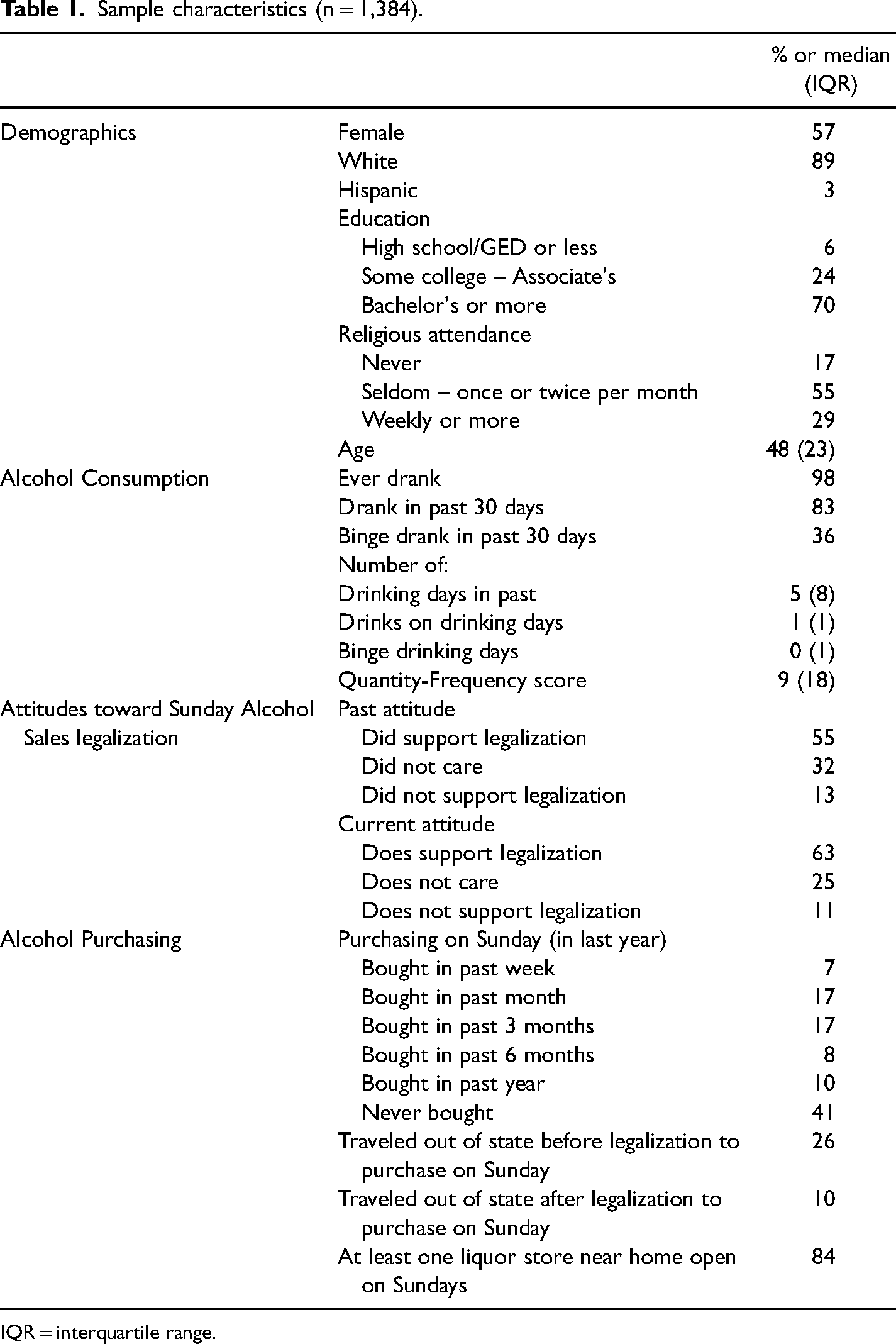
IQR = interquartile range.
While 55% of participants recalled that they supported legalization of Sunday sales prior to the policy change, 63% reported support for Sunday sales post-legalization. In the year after Sunday sales were legalized in Minnesota, 59% of survey participants had purchased alcohol from a liquor store on Sunday.
Attitudes regarding Sunday sales legalization
Table 2 shows associations between participants’ current attitudes and their recollection of attitudes prior to legalization. Nearly all of the participants who favored Sunday alcohol sales prior to legalization remained supportive (93%) while the majority of participants who opposed Sunday alcohol sales remained unsupportive (78%). Among those who did not care about Sunday sales before legalization, 60% continued to not care post legalization. Among the participants whose attitudes did change, 196 (15%) reported more favorable attitudes towards Sunday sales and 64 (4%) were less supportive of Sunday sales after the policy change. Most people who adopted a more favorable attitude towards Sunday sales legalization reported that they did not care about legalization of Sunday sales (n = 158) prior to the change in the law.
Attitudes towards Sunday sales legalization: current vs. past, n (row %).

This measure is based on recollection of past attitudes regarding Sunday sales legalization.
Table 3 includes the associations between participant characteristics and current attitudes toward Sunday sales from the multinomial logistic model. Participants who were more likely to support Sunday sales legalization (compared those that did not care) were more educated (PR: 2.41; CI: 1.35, 4.32), more likely to report binge drinking in the past 30 days (PR: 2.19; CI: 1.51, 3.18), and have a higher quantity-frequency alcohol consumption score (PR: 1.01; CI: 1.00, 1.02). Participants who were more likely to oppose Sunday sales legalization (compared to those that did not care) were more likely to be older (for every one year of age; PR: 1.03; CI: 1.01, 1.04) and attend religious services weekly or more frequently (PR: 2.71; CI: 1.09, 6.72). Estimates for Black participants were unstable due to sparse data and were thus excluded from Table 3.
Associations between participant characteristics and current attitudes towards Sunday sales legalization.

Quantity-frequency.
Alcohol purchasing, attitudes and alcohol consumption
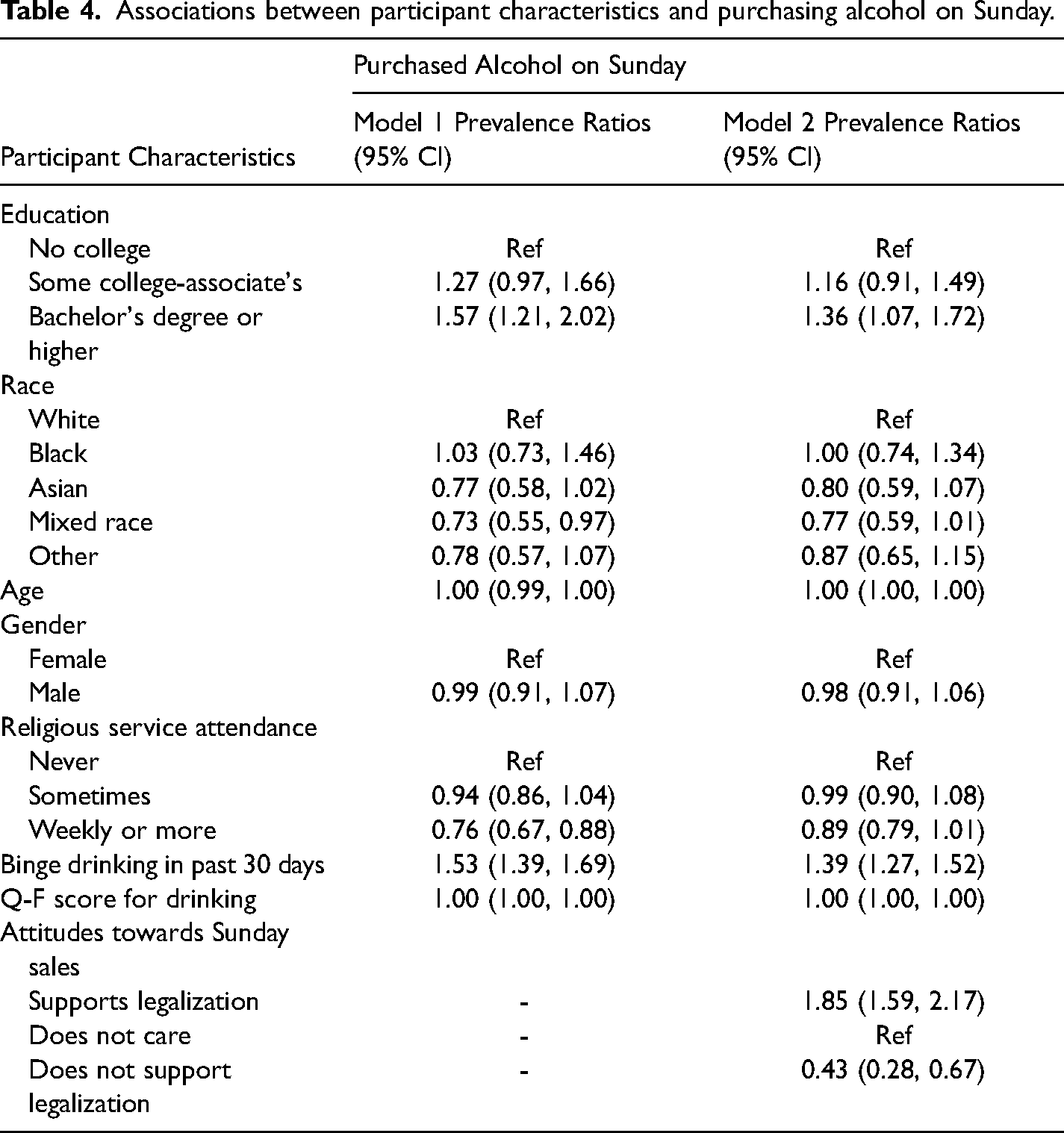
Table 4 shows the relationships between participant characteristics and Sunday alcohol purchasing from the modified Poisson regression models, which were similar to those seen in associations between participant characteristics and current attitudes toward Sunday sales legalization. In Model 1 (attitudes not included), participants who had greater likelihood of having purchased alcohol on a Sunday post-legalization were more likely to be have a Bachelor's degree or higher level of education (compared to no college; PR: 1.57 [CI: 1.21, 2.02]) and to report binge drinking in the past thirty days (PR: 1.53; CI: 1.39, 1.69). They were less likely to purchase on Sundays if they identified as mixed race (compared to white; PR: 0.73 [CI: 0.55, 0.97]) or attended religious services weekly or more (vs. never; PR: 0.76 [CI: 0.67, 0.88]). There were no differences in the likelihood of purchasing on a Sunday with regards to age, gender, or quantity-frequency score for drinking. We were not able to assess whether living near a liquor store was associated with purchasing because only 2% of participants reported that they did not live near a liquor store that sold alcohol on Sundays. When current attitudes about Sunday sales was added to the model (Model 2), directionality of these associations remained unchanged and magnitude did not change appreciably except religious service attendance became non-significant. Participants with greater likelihood of having purchased alcohol on a Sunday had more favorable attitudes towards legalization of Sunday sales (PR: 1.85; CI: 1.59, 2.17).
Associations between participant characteristics and purchasing alcohol on Sunday.
Discussion
We hypothesized that (1) current attitudes towards Sunday sales (post-legalization) would be more favorable compared to retrospective recalled attitudes (prior to legalization); and (2) alcohol purchasing on Sunday would be higher among people who were more supportive of Sunday sales legalization and those who consume alcohol (including those who binge drink). Our hypotheses were supported. While most participants’ attitudes towards Sunday sales remained stable pre- and post-legalization, 15% were more supportive of Sunday sales after its legalization compared to their recollected attitudes about the policy prior to legalization. This finding is consistent with previous studies showing how attitudes often become more favorable toward a policy after it has been adopted (Saglie, 1996). The majority of those who had more favorable attitudes after legalization recalled not caring about Sunday sales prior to legalization. One reason for this may be that people who are undecided about a policy can be swayed more easily to support it after the policy has been implemented, compared to others who already have strong negative attitudes and oppose the policy. However, change in attitudes may be driven primarily by the increase in availability of alcohol and opportunities to purchase rather than perceived legitimacy of the policy itself.
We also found that those who were in support of legalization of Sunday sales were more likely to purchase on Sunday and consume greater amounts of alcohol on average (more frequent drinking, greater quantities of drinking). One reason for this may be that people who drink alcohol in greater quantities and more frequently may be more likely to take the opportunity of liquor stores being open on Sundays to purchase alcohol than moderate or light drinkers. In addition, people who drink alcohol in greater quantities and more frequently may need to re-stock their supply of alcoholic beverages more often, and thus use the extra day of sales to sustain their level of consumption. Impulsivity may also play a role in who takes advantage of Sunday alcohol sales. Given the link between impulsive traits (urgency, sensation seeking) and excessive alcohol consumption (Amlung et al., 2013; Gray & MacKillop, 2014; Smith et al., 2010), people who tend to drink more alcohol could be more likely to decide spur-of-the-moment to purchase alcohol on Sunday.
Religious service attendance predicted Sunday alcohol purchasing only when attitudes were excluded from the model. Prior research has shown that personal attitudes about alcohol consumption are a strong mediator between religious belief and alcohol use (Chawla et al., 2007). Attitudes about alcohol consumption are likely correlated with attitudes regarding alcohol policies (e.g., people who approve of alcohol consumption are more likely to support Sunday sales), and thus may also mediate the relationship between religious service attendance and Sunday alcohol purchasing.
Our results show that a majority of participants purchased alcohol from a liquor store on Sunday, but we did not measure whether purchasing increased following Sunday sales legalization. Data from the Minnesota State Auditor's Office and the Minnesota Department of Revenue have shown slight increases in alcohol tax revenue in 2017 (the year Sunday sales were legalized), but these increases may be the result of a trend and not Sunday sales legalization (Otto, 2018). Few peer-reviewed studies have examined the link between Sunday sales legalization and alcohol purchasing. Stehr analyzed data from 1990 to 2004 and found increases in liquor sales between 0.88% and 16.15% as a result of states legalizing Sunday sales (Stehr, 2007). As described earlier, other literature on Sunday sales has shown increases in consumption of alcohol after Sunday sales were legalized.
Limitations
Our study has several limitations. First, data were collected cross-sectionally, thus we cannot infer causality or demonstrate directionality (e.g., Sunday alcohol purchasing leads to increase consumption or the reverse). A longitudinal study to investigate the relationship between purchasing after Sunday sales legalization and individual drinking behaviors is needed to test this hypothesis.
Second, we used a convenience sample of participants recruited at a state fair setting on weekends. Our sample had a higher median age, higher levels of educational attainment, a greater proportion of people who identify as white, and a higher prevalence of binge drinking than the general population of Minnesota (Minnesota Department of Health, n.d.), which may hamper our ability to generalize these results. In our sample, 89% white, 1% Black, and 4% Asian while the population of Minnesota in 2018 was 84% white, 7% Black, and 5% Asian (Minnesota State Demographic Center, n.d.). In addition, 36% of participants reported binge drinking in the past 30 days, which is higher than the reported prevalence of binge drinking (21.3%) among Minnesotans in 2016 (Minnesota Department of Health, n.d.). These differences are not surprising when considering that our sample is self-selected; people with higher educational attainment are more likely to participate in surveys (Bakker et al., 2017), and drinkers may be more interested in a study on Sunday alcohol sales. At the same time, our data were collected in a novel setting that draws from a variety of regions in Minnesota (26% of zip codes). Recruiting participants in a fair setting proved to be an effective way of gathering a large amount of data quickly, at a low cost, and with a small number of staff. Over approximately 25 h, our study successfully recruited and collected data from 1,384 individuals. Future studies may find this approach to sampling an effective means of gathering a quick snapshot of a public health issue with a large sample size.
Third, we were unable to measure attitudes in real-time prior to legalization of Sunday sales and had to rely on participant recollection. This type of measurement is prone to recall bias, as some people may misremember their attitudes from one year ago; however, we did include key dates and events to aid in this recollection through the TLFB method (Linda C. Sobell & Sobell, 1992). Use of TLFB for recall of policy attitudes is a novel method for measuring past policy attitudes, and should be considered for similar studies involving alcohol control policies.
Finally, we did not measure amount of alcohol purchased on Sundays. Data from the Minnesota State Auditor's Office and the Minnesota Department of Revenue have shown slight increases in alcohol tax revenue in 2017 (the year Sunday sales were legalized), but these increases cannot be directly attributed to Sunday sales legalization (Otto, 2018). Future research should include longitudinal studies where participants’ purchasing is tracked. While several studies have examined how legalization of Sunday sales is related to increases in alcohol consumption, few have assessed the policy change's impact on purchasing. Given purchasing functions as a likely mediator between increased access on Sundays and consumption, understanding whether purchasing is impacted by Sunday sales can help determine whether increases in consumption are due to the alcohol purchased from off-premise outlets on Sunday, specifically.
Conclusion
This study examined the association between legalization of Sunday alcohol sales, alcohol purchasing and consumption, and attitudes towards Sunday sales. The results demonstrate that there is a positive relationship between alcohol purchasing and attitudes towards alcohol control policies; people were more likely to have bought alcoholic beverages on Sunday if they were more supportive of legalized Sunday alcohol sales. These results also suggest that Sunday sales legalization may increase availability of alcohol for people who drink more frequently and in greater quantities but more research is needed in this area. Insights from this study may inform future research into how legalization of Sunday sales has affected purchasing and consumption among heavy and binge drinkers, or how these policy changes affect attitudes towards other alcohol control policies. This study is important when considering the broader implications of alcohol policy changes. Given that policies can influence attitudes, policy changes that increase access to alcohol and ease restrictions may increase support for liberalizing the alcohol policy environment. This, in turn, can have consequences for alcohol-related public health problems.
Footnotes
Acknowledgements
The content is solely the responsibility of the authors and does not necessarily represent the official views of the National Institutes of Health.
Declaration of conflicting interests
The authors declared no potential conflicts of interest with respect to the research, authorship, and/or publication of this article.
Funding
The authors disclosed receipt of the following financial support for the research, authorship, and/or publication of this article: This work was supported by the National Cancer Institute, (grant number T32CA163184).
