



Abstract
Mainly, this paper is written to address an engineering educator pool that has limited firsthand knowledge of the industry work scope. Specifically, members that gain necessary academic credential and gain a faculty job without having professional industry work exposures. Transition of knowledge gained in the undergraduate engineering experimental laboratories into engineering graduate's job in the industry is examined here. The concept was examined by performing a survey of some random B.S. in Mechanical Engineering program graduates. The survey mainly summarizes and charts a) the applicability of the laboratory courses taken during the completion of the Mechanical Engineering program to their job function and b) the ranking of the relevant contents of the laboratory courses for their current job function. The review of the knowledge gained in the undergraduate engineering laboratories with the feedback from some of the B.S.M.E. graduates working in the industry, points to a specific direction; “design support”.
Introduction
According to ABET (Accreditation Board of Engineering and Technology, 2021) general Criterion 3 (Student Outcomes) there are 7 requirements for the student outcomes in an engineering program. Out of the 7 criterion requirements in Criterion 3, three (3) requirements are aimed at development of the engineering graduate to be able to function as a fully hands-on productive member in the workforce after obtaining a job.
The three (3) Sections (2), (6) and (7), indicate that, “The [engineering] program must have documented student outcomes that prepare graduates to attain the program educational objectives. [Student shall have]:
2. an ability to apply engineering design to produce solutions that meet specified needs with consideration of public health, safety, and welfare, as well as global, cultural, social, environmental, and economic factors. 6. an ability to develop and conduct appropriate experimentation, analyze and interpret data, and use engineering judgment to draw conclusions 7. an ability to acquire and apply new knowledge as needed, using appropriate learning strategies.
In order to meet these requirements, participation of the engineering students in experimental laboratory courses is essential to success. Specifically, taking a Mechanical Engineering program for example; laboratory course work associated with courses in Materials, Machine Design, Measurements, Fluids, Thermal/Heat Transfer, Controls and Capstone Design are required. In each of these laboratories the student is exposed to a series of experiments that prepares the students to design and conduct experiments that allow them to analyze and interpret data as expected. It nourishes their ability to design systems, components and processes that meet criterion (c) above. Additionally, laboratory experiments allow the engineering graduate to gain the ability to practice engineering by developing necessary personal techniques, skills and insight in utilization of the engineering tools (Cioc et al., 2017). This also allows students to develop communications skills, good writing skills, excellent oral communication skills, listening well; be compassionate and empathetic, excellent problem-solving and analytical skills and finally be creative and innovative (College of Engineering, Career Development & Experimental Learning center, UMASS AMHERST (2016–2017)). These academic preparations are evaluated and graded for each student to adequately prepare the graduate for the future industry work.
Making sure that the laboratory experimentations are essential in our program, allow us to explore how this translates into success after graduation while transitioning to the workforce. Starting with a Materials laboratory the student gains access to techniques in gathering data, analyzing data and interpreting data to characterize a material. When working in the industry, it is not uncommon that prior to using a material (either metallic or composite) that it is required by the regulations (FAA, Advisory Circular, AC No. 25.613-1, MATERIAL STRENGTH PROPERTIES AND MATERIAL DESIGN VALUES, U.S. Department of Transportation, FAA (2003)) and standardization procedures to have a set of mechanical properties defined before utilizing the material in a design concept. Prediction of the behavior of the materials used in design has to be made only by characterization of the mechanical properties of the material in use. The failure of the design is only predictable or determined by knowing the strength values of the material in use. Thus, exact procedures learned and practiced in the materials laboratory course during the program are necessary in order to achieve the data required for the design. Hence, the instrumentation procedures for determining loads and deflections to the use of the software for data acquisition, in the industry is exactly as is mimicked in the materials laboratory course (ASTM A370-20 Standard Test Methods and Definitions for Mechanical Testing of Steel Products (2020)).
Likewise, in a machine design laboratory course, analytical work done and learned throughout the course for component design are also exactly as what is essential in component design in the industry. Frequently, tools such as Finite Element Software packages that simulated deflection and stress levels in components are utilized. Understanding and setting constraints that are proper for the component in design are only natural essentials. Reports generated in the laboratory course for documenting the design are necessary and required as well in the industry settings too. Formatting the presentation of the reports and the findings are also necessary by regulations and engineering practice rules (i.e., assumptions, analysis, sizing, margins of safety, etc.).
Furthermore, concepts learned in a measurements laboratory course, where instrumentation concepts for data collection and of data noise elimination and grounding methods are explored, are all applicable and useful in the industry work as well. Oftentimes in the industry for testing and qualification of systems and devices that produce signals and gather information via sensors, thereby making it a necessity to be able to understand the basic measurement and instrumentation concepts at the experimental levels. It is essential to learn how sensors, gauges, actuators and data acquisition systems are utilized in gathering engineering data for a variety of applications.
Fluid flow laboratory courses, where the students learn and experiment how to measure flow and characterize pressure built-ups, are exactly what is needed in industrial fluid and hydraulic system designs as well. The understanding of the magnitude and power of fluids and hydraulic systems are essential and necessary for safe design of systems. Without the firsthand knowledge of the flow patterns and associated powers from fluid systems designs the theoretical conceptualization may not be safe and adequate for operation in the industry.
Without the experimental learning knowledge gained by designing an actual heat exchanger (ASME, Criteria for Shell-and-Tube Heat Exchangers According to Part UHX of ASME Section VIII-Division 1, PTB-7 (2014)) in a laboratory setting or analyzing it and comparing the experimental design to the analysis, it is practically useless to design a heating/thermal system. Without knowing the thermal cycles in an experimental setting, understanding a design or starting a design is impossible.
Knowing how to formalize a control system and having to see the feedback of the control system in an actual physical setting becomes very valuable in the design of the engineering control system of any kind. Seeing the mathematical gains and control functions in a system is essential in understanding and optimizing a functional design.
Understanding, organizing and summarizing the multidisciplinary concepts of any design in a capstone design course are necessary in contributing into an industry design team group later as the graduate enters the workforce. How to be economical, feasible, safe, environmentally friendly, ethical, designing for quality, manufacturable and sustainable are all skills and techniques that are developed in such capstone design laboratory courses (Meah et al., 2020; Omar, 2014).
Adequacy of the Gained Experimental Knowledge
The question arises whether the knowledge gained in the undergraduate engineering program through the experimental laboratory course work is enough to have the graduate start working on most industrial designs right after being hired (Martin et al., 2005; Ramadi et al., 2016; Stiwne & Jungert, 2010). The answer is complex: yes and no due to the fact that without this undergraduate exposure to experimental concepts the necessary skills never will be built-in an individual graduate of the engineering program. If the skills are not developed for each individual student at their respective engineering program, any subsequent training at the industry level would have a questionable outcome for success or at best case scenario result in risky project outcomes. The risk is due to the fact that without the skill developments at the undergraduate program and exposure to experiment techniques, the training becomes very time consuming, costly and technically immature (i.e., un-standardized). Also as set by ABET rules and guidelines, the concepts need to be taught by advanced degreed engineers that most often have specialization in that field backed by research work and advanced academic knowledge in that field.
It is observed that the standardization of the experimental knowledge of the procedures for experimentation and design development by the accredited program, makes the process and the procedures perfect with a guaranteed success rate for students (Accreditation Board of Engineering and Technology (2021)). The evaluation and grading system in place during the completion of the laboratory course works, are the means that assure the engineer's mistakes are outlined and necessary actions are taken in progressing toward a successful skill development for design at early stages of the program. This concept was examined a bit further, by performing a survey of random B.S. in Mechanical Engineering program graduates who already work in the industry. The survey was specifically geared toward the already working graduates since they are the ones that have been exposed to various job functions and are able to express opinions regarding the course work importance on execution of these various job functions in the industry.
Results of the Feedback from B.S. in Mechanical Engineering Program Graduates
A brief survey of a number of graduates with B.S. in Mechanical Engineering was conducted. The survey was collected from 9 random mechanical engineering graduates from the U.S. The survey was conducted without bias as participants are not from any specific university or state within the U.S.. The survey explored the knowledge gained from the experimental laboratory courses that the graduate had taken during their educational program in relation to their current job function in the industry. The survey mainly summarizes and charts a) the applicability of the laboratory courses taken during the completion of the Mechanical Engineering program to their job function and b) the ranking of the relevant contents of the laboratory courses for their current job function.
Figure 1 following is showing, via the sampling done by this survey, the relevancy of the broad typical ME undergraduate laboratories to the participants current job functions. It appears the leading laboratories in the ME program that made the most impact and are relevant to many job functions of the participants are Materials, Machine Design and Measurements Laboratories. Interestingly, the percentage of the relevancy are quite close to each other in these three (3) laboratories. The relevancy is about 25% of the participants’ responses each equally. The reason for the bias shown toward these three (3) laboratories may be discovered later as in this survey the relevancy of the content of laboratories are examined with respect to the participants job functions.

Laboratories relevant to the graduate's current job functions.
Figures 2–8, illustrates the knowledge and skills content importance of each specific laboratory with respect to the participants current job functions. The specific contents can be examined by visiting the requirements set by ABET (Accreditation Board of Engineering and Technology (2021)) for each laboratory course by the reader. However, it is important to understand the content relevancy of the participants to their respective job functions in general without the job title investigation. The job title of each participant was determined during the survey, but since there is variance in the job functions of every job title from one company to another, it is only sufficient to examine the participants own responses to their job functions as determined by the participants themselves. For reporting purposes, the job titles of the survey participants are Design Engineer, Design Manager, Technologies, Manufacturing Engineer, Structural Engineer, Project Engineer, Master Designer, Metallurgist and Retired. In Figures 2–8, score of 1 is the score which is for least content relevance and score of 10 is the score which is for most content relevance to the participants’ current job function.
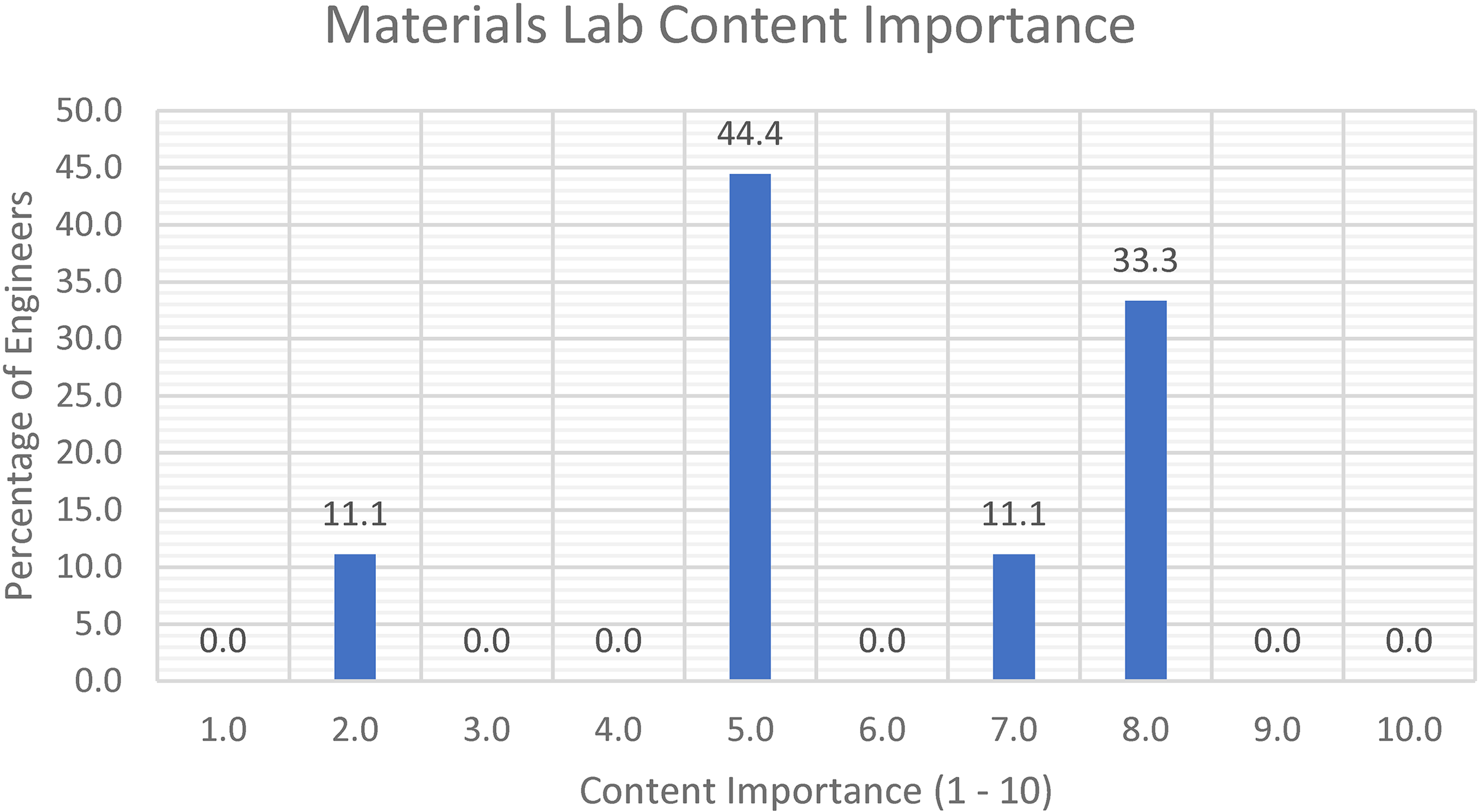
Materials lab content importance to the graduate's current job functions.
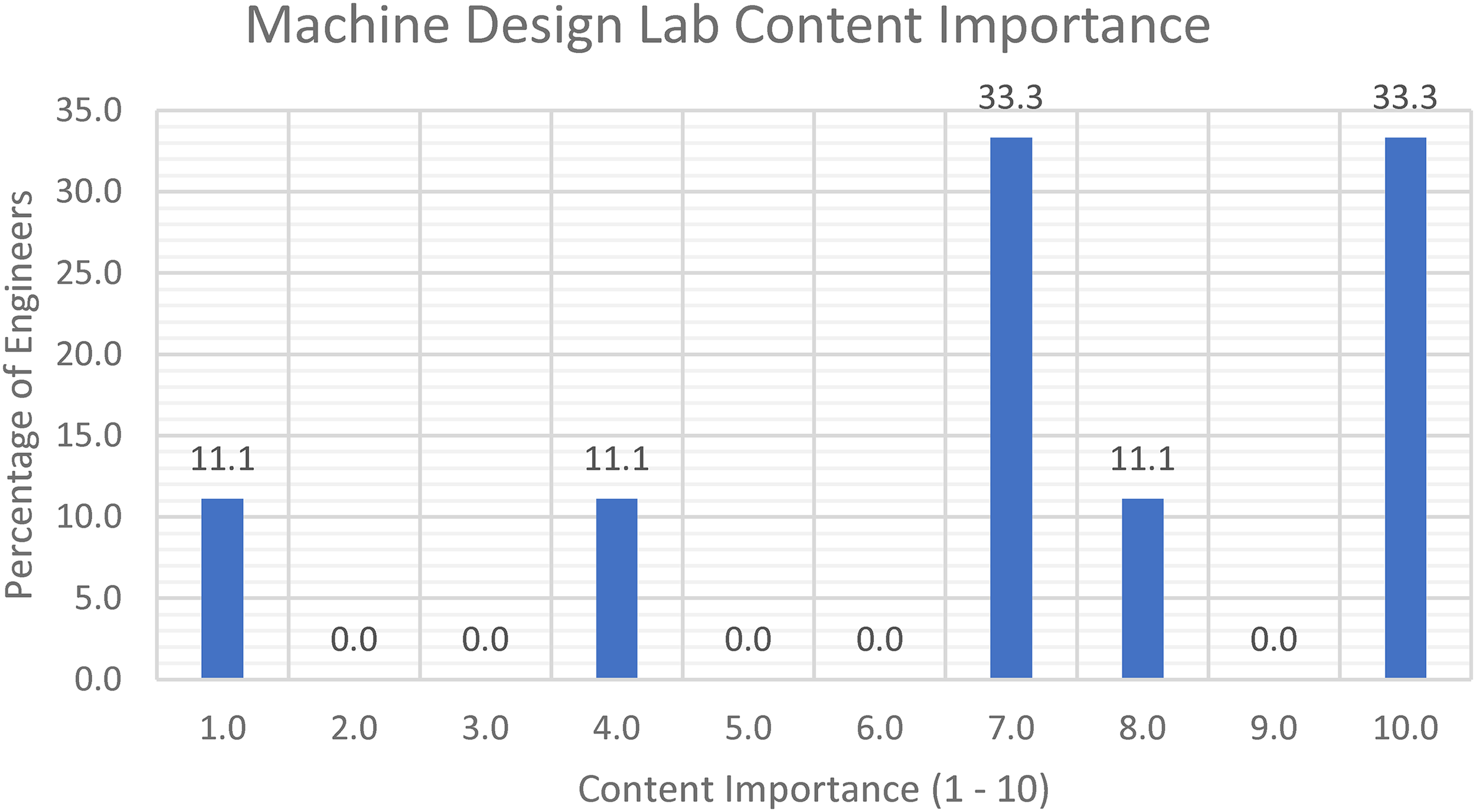
Machine design lab content importance to the graduate's current job functions.
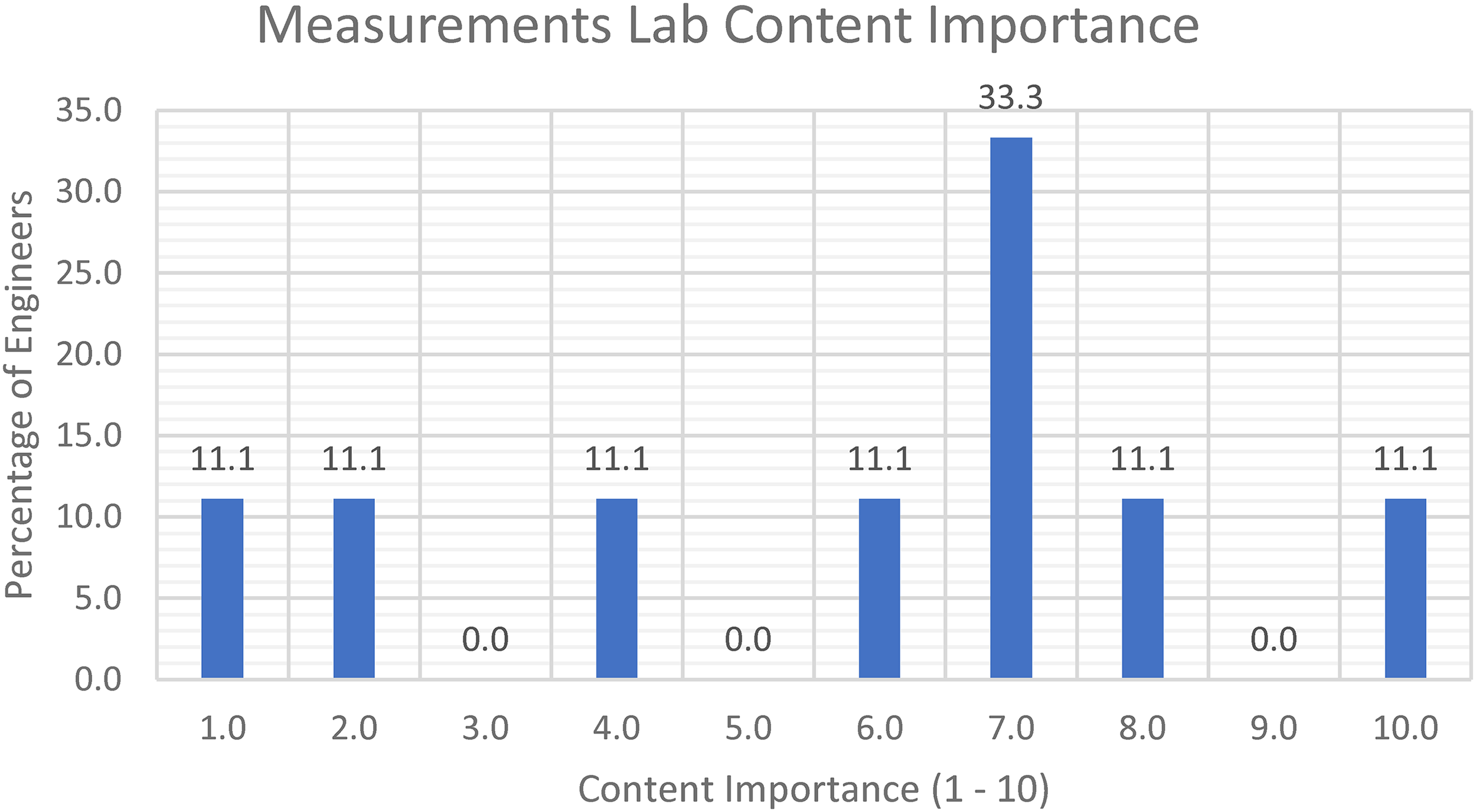
Measurements lab content importance to the graduate's current job functions.
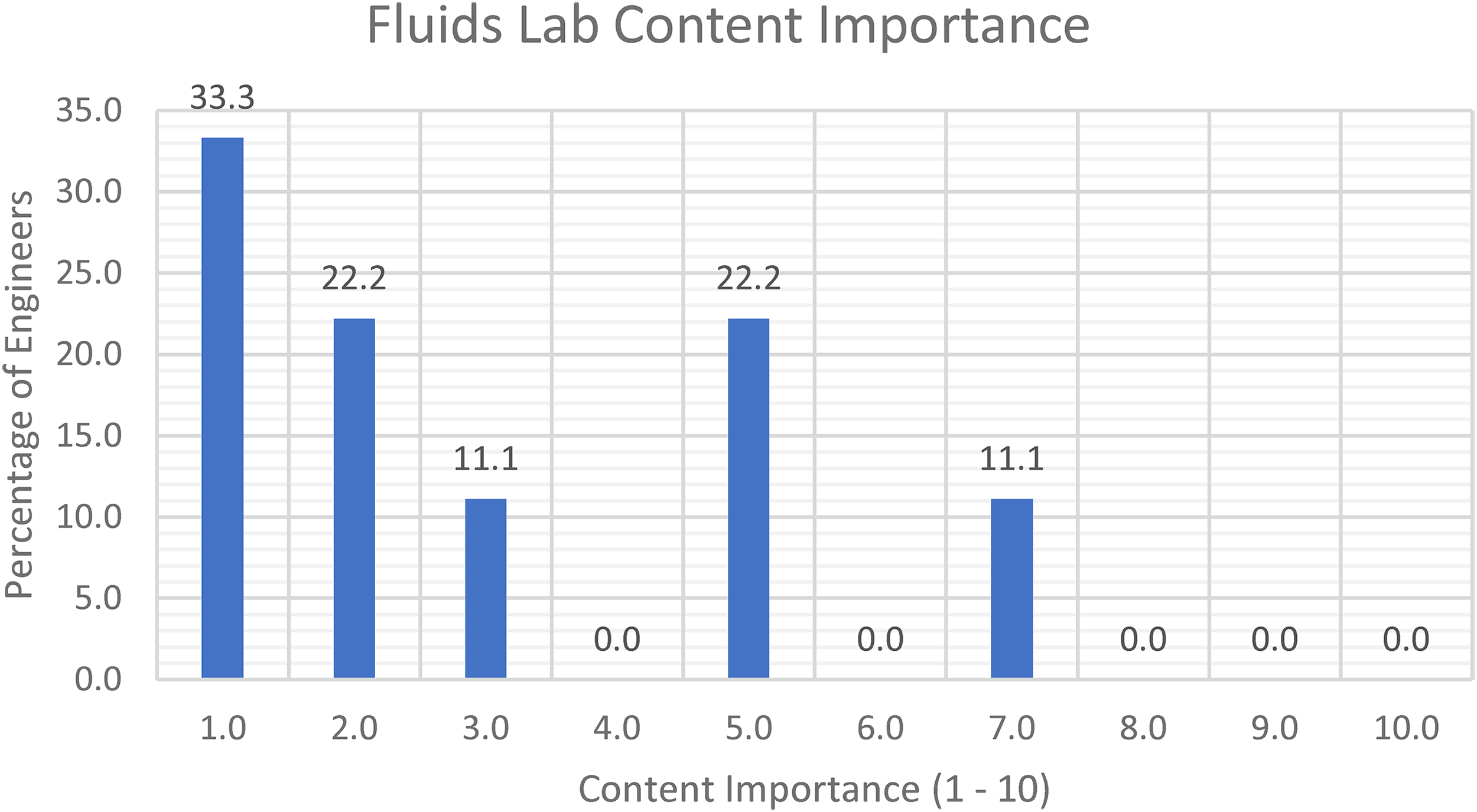
Fluids lab content importance to the graduate's current job functions.
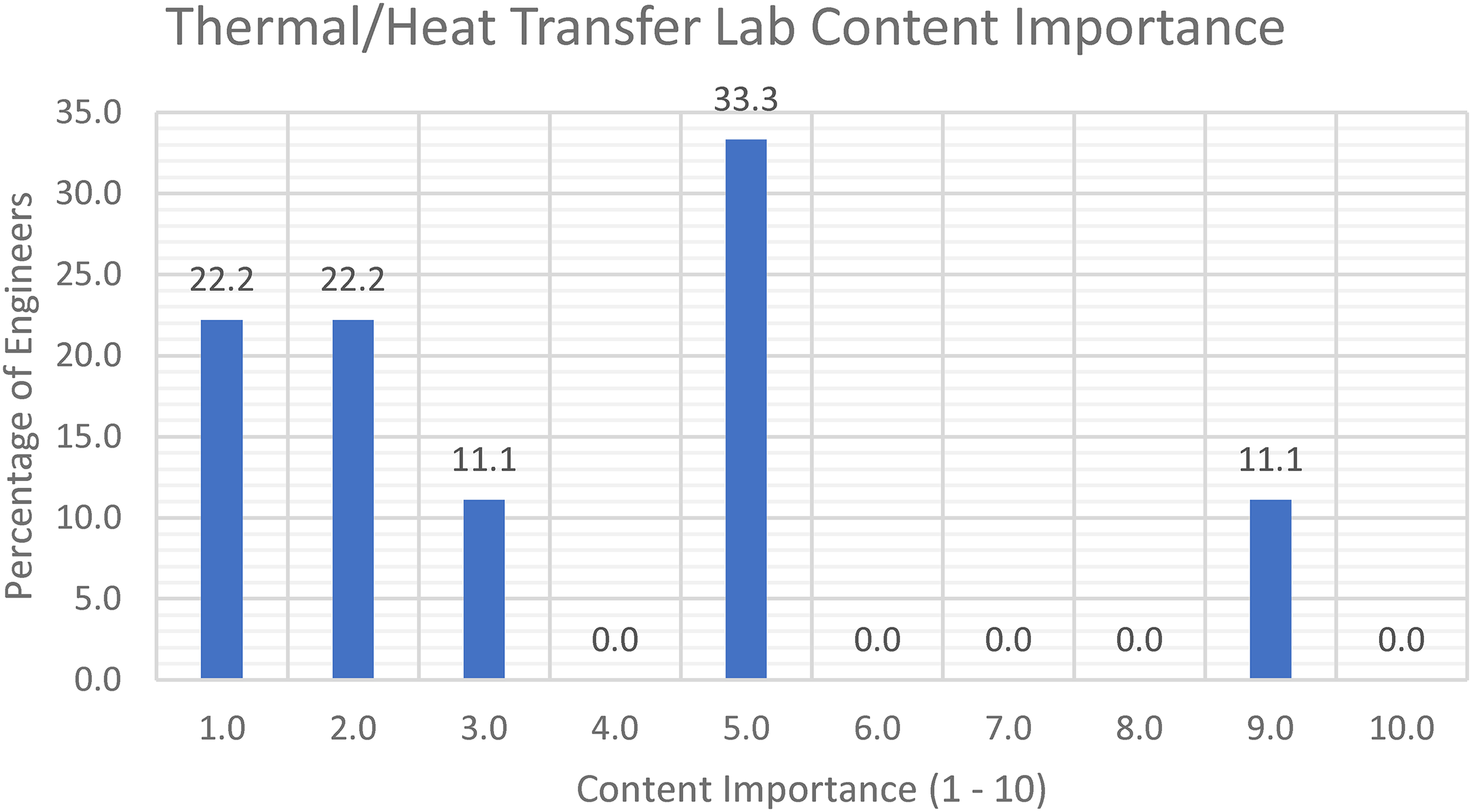
Thermo/heat transfer lab content importance to the graduate's current job.
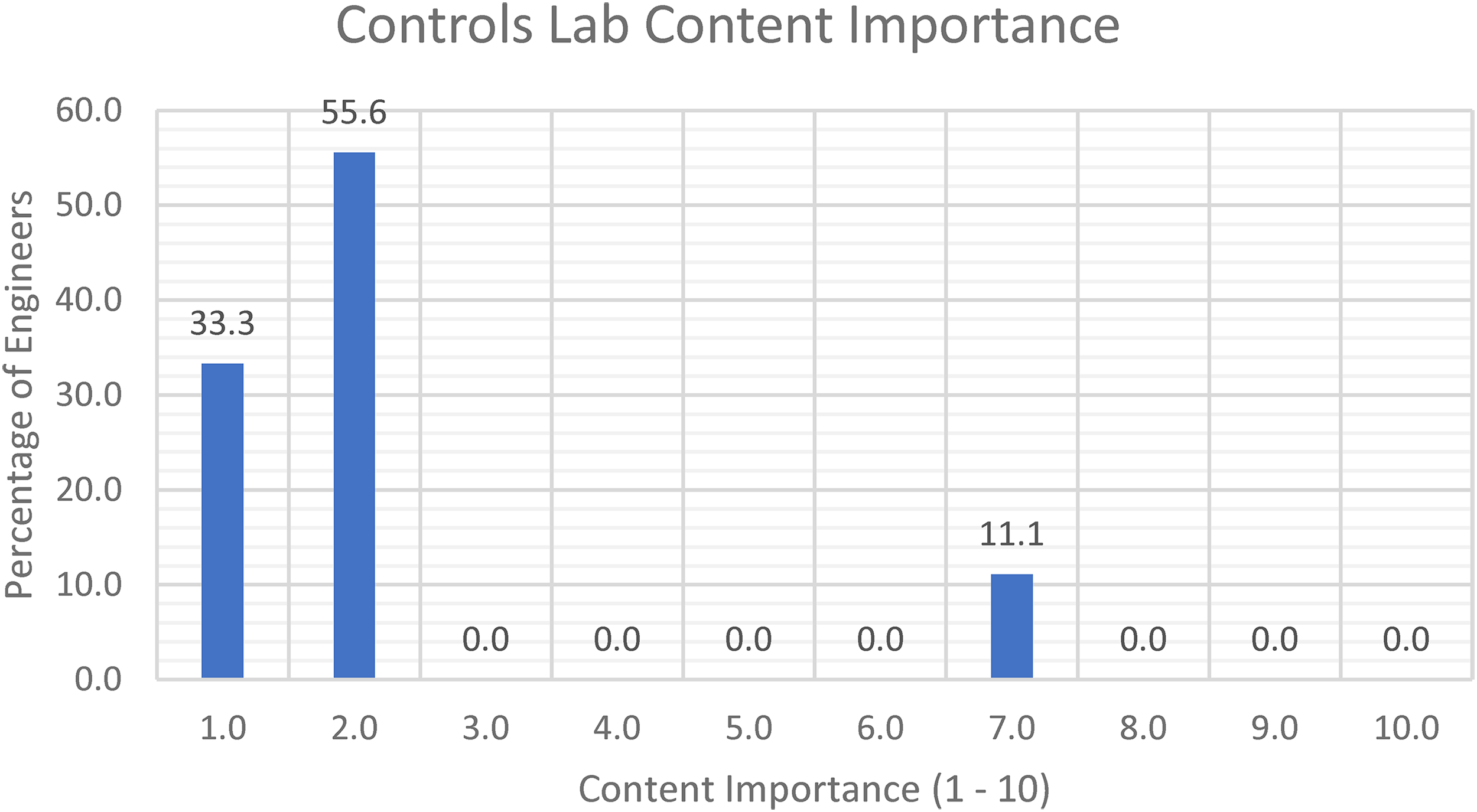
Controls lab content importance to the graduate's current job functions.

Capstone design lab content importance to the graduate's current job functions.
Discussions and Summary
While most studies that have been conducted in the school-to-work transition in engineering, have focused on the job readiness of graduates (Martin et al., 2005; Ramadi et al., 2016) a review of the knowledge gained has never been a subject of study. A review of the knowledge gained in the undergraduate engineering laboratories with the feedback from some of the B.S.M.E. graduates working in the industry, points to a specific direction; “design support”. These engineers vastly used the knowledge gained in engineering laboratories as skill tools for design support. By large, meaning that the engineers’ knowledge gained contributed to the engineering support services for accomplishing a design or a development effort. For example, without the knowledge of what is the difference between the engineering stress-strain curve and the true stress-strain curve an engineering analyst cannot carry out non-linear analysis on a component under loading. This knowledge was acquired in an engineering materials laboratory testing environment that was developed during hands-on testing.
Likewise, without the knowledge gained in a heat and energy transfer laboratory, one may not be able to visualize the heat reduction factors associated with a heat exchanger design and may not be able to determine efficiency of an energy system under design. Also, without the fluid flow experimentation knowledge, one may not be able to adjust and account for real flow reductions and pressure drops/rises in a hydraulic system design or development.
Without the knowledge gained during a measurement laboratory course work, one may not be able to perform proper load application and measurements for structural substantiation of a design that needs to meet regulations/requirements, among other things. In other words, without any skill set knowledge gained from the undergraduate engineering laboratories, an engineer may not be able to show proof of concept for a design by theoretical means only which could be very unsafe and risky. In conclusion, it appears that the transition of knowledge and the skill sets gained in the undergraduate engineering laboratories, in general, are extremely relevant to the engineers’ job functions, as many engineers ultimately support a design and development process. Specifically, for ME's that were participants of the survey in this study; Materials, Machine Design and Measurement laboratories, demonstrated a relatively high importance to many participants’ job functions and the bias is coming from the content importance of these three (3) specific laboratories.
It is essential to also indicate that at every engineering college and subsequently at every engineering department with a differing curriculum, there is an outside academic advisory committee that meets with the department and faculty to discuss the discipline's curriculum every year. This committee consists of members who work in the industry and have first hand knowledge of the mainstream engineering job functions required for a successful engineer. The committee discusses the details of the curriculum deficiencies and what needs to be emphasized in each department in order to make the graduate a more knowledgeable and efficient engineer in the workplace. This is a well established mechanism in guiding curriculum development efforts by the faculty in each department. Many colleges place a high level of importance on this process which helps to prepare the curriculum for students to ultimately succeed in the workplace after graduation.
Footnotes
Declaration of Conflicting Interests
The author(s) declared no potential conflicts of interest with respect to the research, authorship, and/or publication of this article.
Funding
The author(s) received no financial support for the research, authorship, and/or publication of this article
