



Abstract
This article examines contemporary essay films that concern refugee im/mobilities across the Mediterranean Sea. In the last few decades, the Mediterranean has been transformed into a fatal space for those attempting to cross the sea without documents. The dominant Eurocentric perspective reductively views these refugee and migrant crossings as violations of European borders. Such limited frameworks feed into the category of ‘crisis’, which demands immediate intervention and top-down governmental solutions, such as the militarization of borders. In this article, I explore essay films that counter and disrupt the ‘crisis’ framework and the sense of urgency and tragedy it evokes: Havarie (2016), a slow-form documentary by Philip Scheffner, and The Leopard (2007), a dance film by Isaac Julien. Drawing on recent theories of multi-directional memory, I investigate the ways in which these films establish mnemonic connections across diverse experiences of displacement, including those produced by European colonialism, transatlantic slavery and postcolonial conflict.
Capsized boats and clandestine immigrants washing up on European shores: these are the dramatic images that put Europe’s southern border in the news again and again. The media seem to say that these images communicate the essence of the border in its most compressed and climactic form . . . There can be no violent icon to which the event of crossing is reducible, only the plurality of passages, their diverse embodiments, their motivations and articulations. (Biemann, 2008)
Havarie (2016), an essay film by Berlin-based filmmaker Philip Scheffner, opens with maritime coordinates − 37°28.6′N 0°3.8′E – displayed against a black screen to the faint sound of ticking. It then cuts to an idyllic shot of seascape merging with clear blue sky on the horizon. The shot is fixed and looks at once depthless and like an impressionist painting of a sea view. At the centre of the frame is an inflatable dinghy carrying silhouetted human figures, filmed from afar by a slightly shaky camera (see Figure 1). The coordinates mark the position of the boat, slowly drifting on calm waters off the Spanish coast. Scheffner’s source material for the film is an unedited YouTube video of an actual encounter between a rubber boat carrying Algerian refugees trying to reach Spain and a massive cruise ship named Adventures of the Seas. As we watch the boat slowly shifting positions within the frame, we hear the original radio communication between the cruise ship and the Spanish maritime team organizing the rescue and the apprehension of the refugees – the screechy soundtrack anchoring the hazy image in a specific time and place.

Still from Havarie (2016) © Philip Scheffner.
This iconic shot of a small boat stranded on the vast open sea belongs to a constellation of mass-media images that instantly conjure up the so-called refugee crisis that has dominated European headlines, especially since the summer of 2015, when thousands of people from the Middle East and Africa risked their lives to cross the Mediterranean in a desperate effort to reach Europe – and thousands died in the attempt. Yet Havarie offers a different take on this iconic imagery: the film stretches the three-minute YouTube clip to 93 minutes, thus forcing the viewer to look at nothing but this scene. The image remains virtually unchanged for the duration of the film, except for the dramatic moment when the camera pans away from the sea and reveals that the videographer is one of dozens of passengers on the cruise ship watching and recording the stranded refugee boat.
In the last few decades, the Mediterranean has been transformed into a fatal space for those attempting to cross the sea without documents. From the Eurocentric perspective, the image of anonymous refugees on a boat signifies illegality – a ‘crisis’, disruption or a threat that needs to be contained, curtailed or dispersed. Such dominant perspectives characterize refugee crossings as violations of European borders, reducing the people seeking refuge to ‘unwanted’ bodies – figures often marked with criminality or victimhood. Despite being seemingly antithetical, both characterizations (criminal and victim) adopt a restrictive lens, with the former attributing excessive agency to refugees and migrants whereas the latter allows no agency. Their individuality and diverse experiences find no place in this picture; they are ‘illegals’ or voiceless ‘victims’ divested of socio-historical context.
This reductive take on the refugee experience is widespread in political, media and humanitarian discourses, which often portray refugees as a depersonalized, faceless mass 1 – forms of representation and framing defined by anthropologist Liisa Malkki as ‘dehistoricizing universalism’. Malkki contends that these practices ‘depoliticize the refugee category’ and create ‘a context in which it is difficult for people in the refugee category to be approached as historical actors’ (1996: 378). Such images of vast numbers of refugees on the move, disembarking from boats, being rescued at sea, being detained in camps, or washing up on European shores, form a significant facet of ‘border spectacle’ (De Genova, 2002; 2013). This spectacle not only validates the necessity of exclusion but also ‘produces (illegalized) migration as a category and literally and figuratively renders it visible’ (Casas-Cortes et al., 2015: 67). This in turn feeds into the state-centred categories of ‘emergency’ or ‘crisis’ that demand immediate intervention and top-down governmental solutions, such as the militarization of borders or deterrence policies (Giordano, 2016). The resulting ‘improvisatory modes of action may elide preestablished norms, models, protocols, and institutions’ (Smith, 2017: 887); they also operate through historical amnesia, disavowing various socio-political and historical processes that pave the way for refugee and migrant mobilities. 2
Multi-directional or palimpsestic memory and the essay film offer thought-provoking avenues for the analysis of traditional views of and responses to refugees. The term multi-directional memory, coined by Michael Rothberg, articulates the productive tensions that emerge when ‘different histories of extreme violence confront each other in the public sphere’ (2011: 523). Rothberg argues that memory ‘works productively through negotiation, cross-referencing, and borrowing’ and that ‘collective memories of seemingly distinct histories are not easily separable from each other, but emerge dialogically’ (2014: 176). Moreover, the model of multi-directional memory ‘posits collective memory as partially disengaged from exclusive versions of cultural identity’, thus challenging discriminatory identity politics (Rothberg, 2009: 11). Building on Rothberg’s non-essentialist and dynamic model, Max Silverman describes such entangled and hybrid memory work as ‘palimpsestic’, noting that the concept of palimpsest ‘captures more completely the superimposition and productive interaction of different inscriptions and the spatialization of time’ (2013: 4). Silverman further asserts that palimpsestic memory has the potential to offer ‘a dynamic and open space composed of interconnecting traces of different voices, sites, and times’ (2013: 8), holding out the prospect of new solidarities across the lines of race and nation.
Thinking of (refugee) crisis and (palimpsestic) memory together creates a rich terrain for discussion: while the notion of crisis signals urgency and demands clarity and delimiting a specific problem in the present moment to find quick solutions, memory defies categorization – it is elusive, evocative and performative, blurring the boundaries between real and imaginary. Indeed, the very etymology of crisis, from the ancient Greek term krisis (from krinein/krinô), which means ‘to separate, to choose, cut, to decide, to judge’, underscores judgement, distinction and separation (Roitman, 2013: 15). More to the point, while the contemporary use of the term crisis often reduces complexities to easily recognizable categories, ignoring the subtleties and wider implications of situations, memory entails a dialogic relationship between forgetting and remembering that is multi-layered and non-linear, constantly folding past, present and future into each other. While the crisis framework often provides an excuse for authoritarian emergency measures that neglect rights and responsibilities, critical memory work has the potential to foster reflection and accountability. In that sense, putting these concepts in dialogue can provide new ways of thinking about refugee mobilities. A focus on palimpsestic memories in the Euro-Mediterranean context might denature the ‘refugee crisis’ by opening up a space for introspection and relationality, and by thinking through the longue durée of migration and mobility, as well as the persistent legacies of European colonialism and transatlantic slavery, and the ensuing global inequality and neo-colonial practices. Indeed, as the New Keywords Collective argues, ‘European wealth, power, and prestige have long been deeply implicated in the imperial domination of the same countries and regions of the Global South’ from which contemporary migrant and refugee movements emanate (2016: 23).
With its focus on self-reflexivity, anachronism and indeterminism, the genre of essay film lends itself easily to transcultural memory work. The essay form’s ‘dialogic, fluid nature – that is, its ability to mediate or communicate among different domains in an open-ended critical engagement’ – invites a multi-faceted exploration of a subject and the questioning of assumptions (Papazian and Eades, 2016: 2). As Nora Alter suggests, the essay film, which has been recognized as a distinct form of filmmaking since the 1960s, ‘is seen as the ideal genre by filmmakers who want to advance historical knowledge but recognize that this can only be done in a tenuous way’ (2007: 52). The essay films Havarie (2016), by Scheffner in collaboration with novelist Merle Kröger, and The Leopard (2007), by London-based artist Isaac Julien, employ the essay mode effectively to create a dialogic intersection of multiple spatio-temporalities. The essay mode in both films emerges as the interweaving of various audio-visual fragments – albeit in aesthetically different ways – to account for the complexity of intersecting histories and memories of displacement across the Mediterranean.
The relentlessly static visual space of Havarie opens up to different worlds through a polyphonic soundscape that reveals diverse experiences and memories, as well as asymmetrical power relations that lie beneath the surface of the Mediterranean. Layering voice, music and ambient noise with a radically slowed-down image, the film renders the present tense of the ‘crisis’ permeable. Like Havarie, Julien’s poetic dance film The Leopard connects refugee im/mobilities to different historical and contemporary trajectories of displacement. Made in collaboration with choreographer Russell Maliphant, Julien’s opulent and sensual film intersperses surrealist, dream-like choreography with documentary-style images to portray clandestine sea passages from North Africa to Europe, linking refugee arrivals on the Italian island of Lampedusa to transatlantic slavery and the socio-cultural transformations that took place during the formation of modern Italy. Throwing into relief several spatio-temporalities, both films subvert the absence of temporal depth that usually characterizes the refugee experience in hegemonic discourses and allow for an interrogation of the dehumanizing power of the clichéd images and the historical amnesia that characterize the ‘crisis’ framework and the ‘border spectacle’.
Havarie: Turbulent stillness, polyphonic soundscape
They say some spirits are roaming around in the wilderness. I heard these people from Libya going to Italy. They died of hypothermia. But I don’t know. Maybe their spirit is still roaming around (Filipino crew member on a container ship, in Havarie).
Over the last decade, Philip Scheffner has made several self-reflexive, essayistic documentaries on politically charged topics, often in collaboration with marginalized communities in Europe. 3 In his experimental documentaries, Scheffner creates ‘complex visual and aural spaces, weaves together different stories, and sets out on intense searches for clues whose points of intersection remain pointedly open’ (Heidenreich, 2013). Adopting a similar multi-faceted, research-oriented approach for Havarie, Scheffner traced the Algerian refugees on the boat whose ghostly images we see in the film, and between June 2014 and February 2015 he taped interviews – in Ireland, Spain, France and Algeria, on the cruise ship Adventures of the Seas, and on a container ship – with those who encountered or might have encountered the refugee boat, as well as those who could have been there in their stead. However, with the escalation of Europe’s ‘refugee crisis’ in 2015 and the ensuing proliferation of sensationalist media images of refugees cramped on unseaworthy vessels, Scheffner decided to discard all the documentary material he had shot, including the footage of the interviews, the ships and the Mediterranean setting. Keeping the original soundtrack, he instead used ‘found footage’ for Havarie’s visual track – a low-resolution video of the chance encounter of a cruise liner and a refugee boat – recorded by Terry Diamond, an Irish passenger on the cruise ship. Havarie, which means damage, emergency, accident or shipwreck in German, reveals the exact time and space of the ‘accident’: it was 2:56 p.m. on 14 September 2012, when the captain of Adventures of the Seas reported to the Spanish Maritime Rescue Centre the spotting of a dinghy adrift with 13 people on board off the coast of Cartagena, and was instructed to keep ‘visual contact’ with it until the rescue team arrived. The wait lasted approximately 90 minutes, which is also the length of Havarie.
At normal speed, the boat in the video appears to move up and down, tilt, or go off-screen as Diamond shakes the camera or repositions himself. Scheffner step-printed Diamond’s unedited 3.36-minute video to extend the length of the film until it ran one single frame per second (1 fps) in extreme slow motion. Thus, the visual space of the film is condensed to a single sequence, with each changing frame marking a second. Despite such a radical reworking of found footage, Havarie preserves the representational elements of the original imagery – a stranded refugee boat. The visual image and the perspective, that of the ‘tourist gaze’ (Urry, 2002), remains the same throughout the film. Yet the pixelated video and reflections on the water produce spectral images: the boat appears to double, occasionally approaching or receding from the vantage point of the cruise ship, or even disappearing from the camera’s field of vision altogether. The visual minimalism of the film, with its focus on a single scene for its entire length, evokes the aesthetics of ‘slow cinema’, a distinct strand of art cinema that ‘downplays event in favor of mood, evocativeness, and an intensified sense of temporality’ (Romney, 2010: 43). Slowness in this context suggests an experimentation with ‘extended structures of temporality, with strategies of hesitation, delay, and deceleration, in an effort to make us pause and experience a passing present in all its heterogeneity and difference’ (Koepnick, 2014: 3). Similarly, Havarie makes the viewer acutely aware of a passing present, in which one feels an enhanced awareness of the acts of looking and perception.
The slowing-down of the image and the start-and-stop transitions create a dramatic visual effect, drawing attention to the material surface of the screen, through which the pixelated digital image becomes almost hypnotic. This allows the viewer to see each frame for a longer period, further emphasizing its material reality as a photographic image. When Diamond performs a double-pan (left, right, then left again past the boat), turning the camera’s gaze to reveal the vantage point of the cruise ship and the tourists staring at the refugee boat, the dramatic camera move distorts the image to the point of abstraction, with the refracted sunlight bursting in colour and a vertical ray of light sharply separating the ship from the boat (see Figure 2). This is a gesture that further implicates viewers in a voyeuristic act, inviting them to reflect not only on what they see but also on their own involvement in the ‘refugee crisis’. The film thus casts the viewer in a deeply unsettling role – watching a ‘tragedy’ slowly unfold from a safe position, undeniably locked into the perspective of those on the cruise ship.
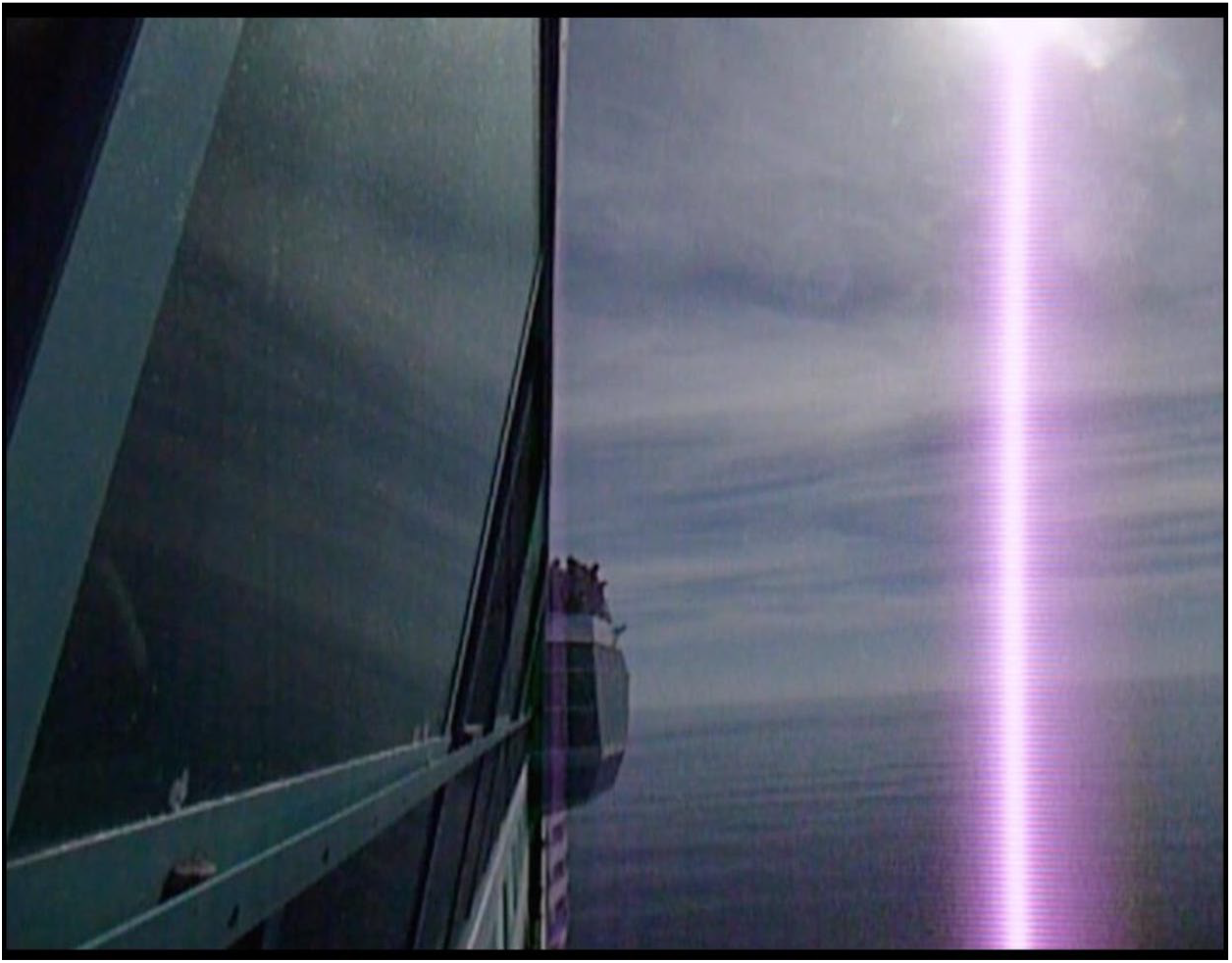
Still from Havarie (2016) © Philip Scheffner.
The formal experimentation (the focus on the durational) enhances the political argument of the film, underscoring the unpredictability and ‘chronic waiting’ (Jeffrey, 2010) inherent in the refugee condition. The image in Havarie raises a paradox that Craig Martin defines as ‘turbulent stillness’: ‘a purposefully paradoxical nomenclature that is intended to illustrate how stillness in undocumented migration is riven with uncertainty and instability’ (2011: 194). Havarie poignantly visualizes ‘turbulent stillness’ through an aesthetics of slowness. The serenity of the slowed-down footage of a boat engulfed by the sea defies such metaphors as ‘floods’, ‘waves’ and ‘swarms’ frequently used by mainstream political discourse to describe refugee mobilities. Yet the unchanging blue visual field also masks the deadly potential of crossing the Mediterranean on an unseaworthy vessel. Once linked to clandestine migration, the stillness of the image defies cosmopolitan notions of escape, tranquillity and rest; instead, it elicits a sense of precariousness and uncertainty – conditions that mark the experiences of refugees and undocumented migrants in detention camps, on dinghies, or stowed away in containers or trucks. 4 In fact, while the film disavows the state-imposed notion of ‘crisis’, its form embodies another version: a distinct sense of temporality experienced by people under circumstances of instability. As Rebecca Bryant argues, the ‘time of crisis’ produces an uncanny present that becomes ‘anxiously visceral’ to the people experiencing it ‘as a moment caught between past and future’ (2016: 20). For Bryant, ‘what makes the present uncannily present in moments of crisis is the inability to anticipate the future’ (2016: 21). Havarie’s visual aesthetics embody the excruciatingly long ‘uncanny present’ that hinders an imagination of the future – a form of imagination denied to thousands of displaced people living in protracted situations. In that sense, the film integrates formal experimentation and attention to the aesthetic surface with a critical take on the refugee condition, deconstructing the dominant apprehension of that condition promulgated by racialized, sensational media images.
Nonetheless, Havarie’s aesthetic experimentation with the clichéd image of a stranded boat runs the risk of reproducing mainstream discourses which characterize refugees as an anonymous group of ‘invaders’ or ‘victims’. The 13 refugees on the boat appear as silent, ghostly figures with no solidity, and their small gestures (such as waving) gain monumentality as a result of the extreme slow motion – a cinematic effect that further highlights the objectifying gaze of the camera and registers the people on the boat as nameless shadows. 5 The spectrality of the figures exposes their invisibility as human beings as well as their precariousness in the vast open sea. Additionally, for those on the boat, the frozen moment of each frame also indicates a moment of danger, a potential death in the sea, which is heightened when the boat leaves the frame or becomes a speck in the distance. However, the spectacle of the ‘refugee crisis’ and the moment of capture/rescue suggested by the image are pluralized and historicized by a multi-voiced soundscape that animates the various spatio-temporal connections, fractures and asymmetrical power relations that shape the Euro-Mediterranean borderscapes. Foregrounding its limited point of view from the cruise ship, Havarie examines the ever-changing region as a site of geopolitical conflict and uprooting, implicated within still-unfolding histories of colonialism and domination.
In Havarie the soundtrack registers the different vectors of im/mobility across the Mediterranean – we hear the stories of several people who are implicated in and affected by the increasing fortification of the European borders, including survivors of similar crossings, legal migrants, ship captains and un/documented crew members. They discuss the sea; vexed maritime transnationalism on cruise and container ships; the plight of refugees and the displaced; unemployment, poverty and separation; the desire for a better life in Europe; and memories of violence, smuggling, home, loss and longing. The film eschews an authoritative, expository voiceover or text that explains what we see or hear. Instead, the context and meaning slowly emerge from fragmented, interwoven narrative threads – carefully choreographed story fragments and living and non-living sounds ‘accentuate the particularity and locatedness of those we encounter and the conflicts they live in and with’ (Wolf, 2016). The non-linear soundscape slowly reveals the interior struggles of its characters, which rise from specific material and political realities, including French-Algerian colonial and postcolonial history, the civil war (or the ‘black decade’) in Algeria, the IRA–British conflict, and the collapse of the Soviet Union and the ensuing conflicts in the region, such as that between Ukraine and Russia.
Havarie’s voices speak in Arabic, French, Russian, Filipino or variously accented forms of English, and they share the auditory space with many other sounds, such as ambient noises, radio feedback, a ringing phone, a ticking clock, running water, passing cars, footsteps, sirens and street sounds. The ambient elements embed the voices in specific environments, such as a kitchen, a café or a beach. The actual radio traffic between the Adventures of the Seas and the Spanish rescue team forms a connective thread, overlapping with other soundscapes and repeatedly pulling the viewer back into the slowly unfolding scene at sea (and to the present time of the image). We encounter each protagonist through fragments of their narratives or intimate conversations with loved ones, and the image of the refugee boat gains different meanings through these perspectives: for example, we hear the love story of an Algerian couple Rhim and Abdallah Benhamou, separated by the Mediterranean, and learn about Abdallah’s perilous trips on a dinghy and Rhim’s struggle with scoliosis, which had remained untreated due to the rejection of dozens of visa applications to France, where she could have received treatment. We hear stories from a container ship captained by Ukrainian Leonid Savin, his Russian-Ukrainian crew and Filipino sailors, including Savin’s tale of Algerian refugees found stowed away on his ship, which sailed regularly between Algeria and Spain, and the Filipino sailors’ song about a lost son, which reminds one of them of the spirits of those who died in the Mediterranean. We hear the same Filipino pop song played live by a band on the Adventures of the Seas, where Captain Guillaume Coutu and his wife Emma live and work; we hear their reflection on cruising from port to port, experiencing life as though frozen in time. Coutu recounts the chance encounter with the dinghy and its passengers whose faces he cannot remember. Irish tourist Terry Diamond remembers his childhood friend, shot dead by the British army during the Troubles, the 30-year struggle over the status of Northern Ireland that claimed thousands of lives – a traumatic memory triggered during Diamond’s observation of the refugee dinghy from the upper deck of the cruise ship.
Evoking the legacies of French colonialism, the story of Rhim and Abdallah reveals the ongoing condition of precariousness that marks Algerian lives both in their homeland and in Europe, as well as the ‘historical amnesia’ in France regarding migrants and refugees coming from its ex-colonies.
6
Abdallah narrates his attempts to clandestinely cross the Mediterranean, and describes his desire to be reunited with his wife: ‘I met her at a market in Paris. We then got to know each other . . . Although I was deported, we stayed in touch. I fell in love with her. I wish to share my life with her.’ The intimacy in their voices as they speak by phone in Arabic masks their violent separation. Their stories also register the trauma of the ‘black decade’ in Algeria – the brutal civil war in the 1990s between the government and Islamist insurgency that resulted in the deaths of hundreds of thousands of people.
7
Their voices convey the ways in which the pervasive violence and resulting trauma of the civil war persistently leap forward into the present, with a generation of unemployed and disillusioned Algerian youths trying to reach Europe for a better life. Abdallah’s conversations with other Algerian young men who call themselves harragas (from the Arabic, meaning ‘those who burn’) further shed light on the hazardous passage across the sea:
8
Isn’t the beach beautiful? An entire people set off from here. Another 75 kilometres and you’re in Spain . . . Do you think people died because the sea swallowed them up? They were rammed by ships . . . I’ve experienced an airplane trying to kill us. It flew so low above us – to kill us!
Havarie’s unyielding slowness and fixed frame confine the fluid space of the Mediterranean, which is portrayed in the film as an obstacle and a site of death. Since the early 1990s, the illegalization of migration has transformed the Mediterranean into an extremely dangerous, even lethal, border zone. In this new borderland, which is also a zone of surveillance, barrier and control, migrants and refugees are rendered ‘illegal’ before they even set foot on European land, hence the harragas ‘burning’ their lives the moment they decide to undertake the crossing. Yet in Havarie the sensationalized depiction of ‘illegal’ migrants and refugees serves as a catalyst for polyphonic storytelling and entangled memories. Breaking the hegemony of the visual in the global mediascape, the film integrates investigative research, documentary form, poetics and a multi-layered sound design to create a multi-faceted portrait of the refugee condition.
Havarie’s complexly imbricated auditory space redefines the Euro-Mediterranean region as a palimpsest of emergent and residual formations marked by unevenness and non-synchronicity. The interplay of various sonic textures in the film demands an affective labour from the viewer through its capacity to unsettle, implicate or move them. The imaginative thickening of the ‘present’ in the film (the present moment of the accident/encounter) creates a complex mnemonic itinerary, extending into the recent past to draw lines between seemingly disparate events and individuals. The intersections between different geotemporal traces ‘constitute a sort of composite structure, like a palimpsest, so that one layer of traces can be seen through, and is transformed by, another’ (Silverman, 2013: 3). The dynamic space composed of interconnecting traces of different voices, sites and times thus reframes refugee im/mobilities as part of a postcolonial cultural space of the Mediterranean formed by longer histories of cross-cultural encounter and communication, as well as colonization, violence and exclusion (Chambers, 2009). In doing so, Havarie disentangles the clichéd image of a refugee boat from ‘crisis’ and ‘border spectacle’, countering the popular representation of refugee stories as individualized tragedies that erase the violent borders underpinning them.
The Leopard (2007): Spectral crossings, allusive montage
In the face of contemporary migration, there are frankly far too few willing to listen to those phantoms that constitute the historical chains that extend from Africa five hundred years ago to the coasts of southern Italy today and which link together the hidden, but essential, narratives of migration in the making of modernity. (Chambers, 2008: 12)
A fixed camera placed inside a dark, cave-like space frames a metal gate opening onto a rocky coast and calm blue waters. We hear the voice of the Malian singer Oumou Sangaré along with the sound of waves breaking gently on the shore. We glimpse the bright sky and shimmering waters through the bars of the half-open gate – a sharp contrast with the dark interior. A black woman wearing a white dress, played by actress Vanessa Myrie, enters the shot from the right-hand corner, walking through the passageway in slow motion until she stands at the threshold. She looks out at the horizon with her back to the viewer. The camera presents her in a stylized tableau, her body forming an elegant silhouette against the sky (see Figure 3). Cut to a close-up shot of the gate, this time locked with a chain; the shore on the other side becomes visible. The music and the sound of waves continue as we return to the previous shot, and then move to a close-up of Myrie’s face in profile as she gazes off-screen. Next we see a montage of close-ups: rippling water, boats and fishermen preparing their nets. Unsettling electronic sounds and unintelligible radio chatter replace the singing; we hear fragments of news reports in English and Italian: ‘Thirteen migrants have died from the journey . . . Lampedusa . . .’
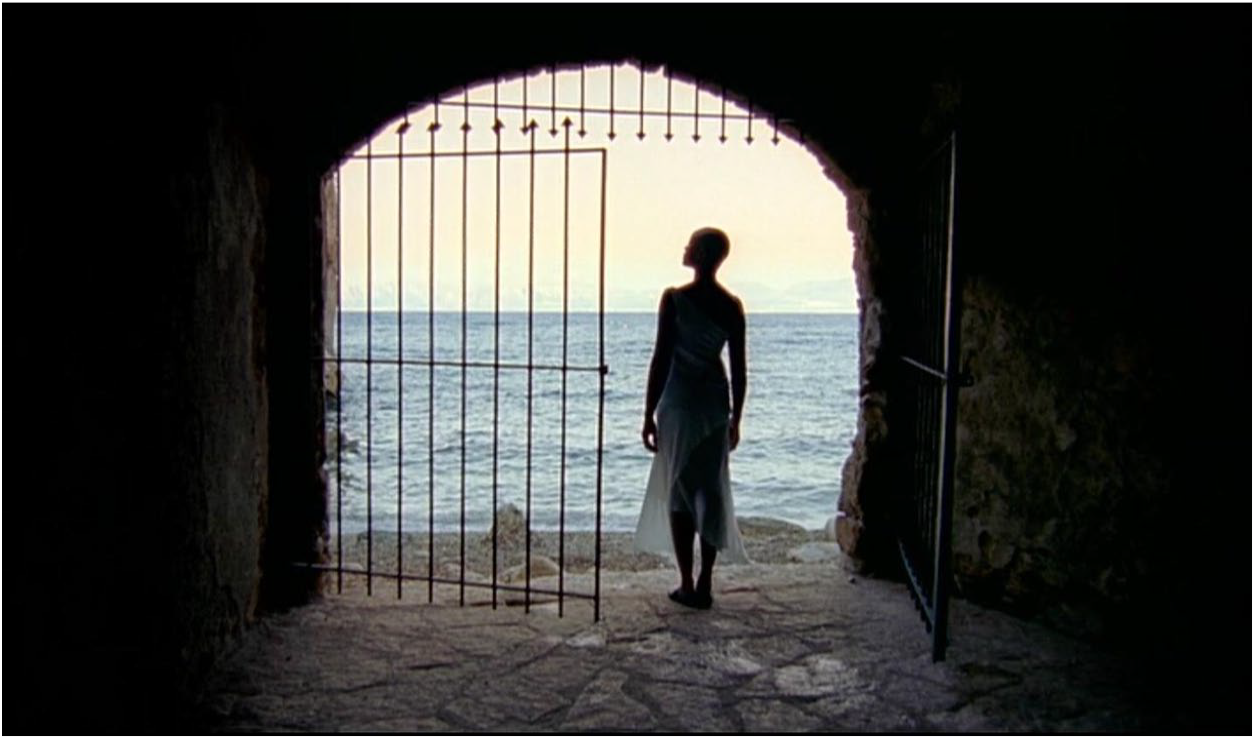
Still from The Leopard (2007) © Isaac Julien.
So opens Isaac Julien’s 18-minute essay film The Leopard, the single-screen edition of his multi-screen installation Western Union: Small Boats. 9 Myrie’s character appears throughout the film, traversing or posed in contemplation before the sea, coastal hills or lavish interior spaces, providing an analogue to the viewer’s own position watching the film. In The Leopard, lush, carefully composed images of spectacular natural landscapes and palatial spaces immerse viewers in a luminous world – spaces that are paradoxically interspersed with perilous refugee movements. This dark undercurrent is present from the opening scene, which poignantly evokes memories of the Atlantic Middle Passage and the fortresses on African shores that held those destined for slavery in America; the gate is reminiscent of ‘the door of no return’ through which Africans passed to board slave vessels. Indeed, Julien’s film joins a recent trend in contemporary Afro-Italian literature in which the transatlantic slave trade and the ‘cultural memory of oceanic crossing’ provide a space to expose the harsh conditions under which migrants and refugees travel (or stay put) to reach Europe (Lombardi-Diop, 2008: 162–3). The Leopard is rife with similar tensions – between past and present, freedom and incarceration, movement and stillness, and presence and absence.
Shot in 2007 in Palermo and Lampedusa, the Sicilian island on Europe’s southernmost border, The Leopard focuses on contemporary clandestine refugee crossings from North Africa to southern Europe. Since the late 1990s, the tourist island of Lampedusa has become one of the main destinations for migrants and refugees – largely from the Middle East and Africa – who have disembarked there and elsewhere along the Sicilian coast in the hope of living in Europe. Attention to the region has been heightened in the last decade as a result of the increasing number of refugee deaths at sea. The integration of the EU and the establishment of a common external border, meanwhile, have intensified controls along both the maritime and terrestrial borders of southern European countries. In this context, Lampedusa has become a space of strict border controls aimed at restricting ‘unwanted’ migrations that ‘threaten’ Italian (and European) sovereignty (Bayraktar, 2016: 120–49; Pugliese, 2009). Moreover, the recent arrival of migrants and refugees in Italy constitutes ‘a haunting reminder of the repression of the Italian colonial past’, exposing ‘what had been relegated to cultural amnesia’ (Sarnelli, 2015: 154). Indeed, the increasing visibility of Lampedusa ‘as a memory site for migration from Africa’ underscores that ‘all EU citizens are “implicated subjects”’ when it comes to the policing of deadly European borderlands (Rigney, 2014: 350).
Taking contemporary refugee crossings as its main focus, The Leopard pays homage to Italian filmmaker Luchino Visconti’s masterpiece, Il Gattopardo (The Leopard, 1963). Set in the 1860s, Visconti’s film deals with the decline of the aristocracy and the rise of bourgeois society, chronicling the changing class relations in Sicily after the unification of Italy. 10 Julien’s film draws parallels between the Sicilian bourgeoisie replacing the aristocracy and the contemporary migrants and refugees coming from the global south as ‘unwelcome’ guests – a gesture that highlights the inherent instability and fluidity of the social conditions in the region. The Leopard thus establishes, through lush visual imagery, cinematic intertextual references, and the use of specific locations and architecture, mnemonic connections between seemingly disparate histories, including those of Italian unification (or Risorgimento) and transatlantic slavery, as well as of multi-faceted and enduring migrations to and from Sicily. Unlike Scheffner’s Havarie, in which the visual track consists of a single iconic image that opens up to include diverse memories through a complex soundscape, The Leopard employs visual cinematic techniques, such as alterations in the depth of focus, sweeping camera movements, multiple camera angles, associative and allusive montage, and sublime imagery, to juxtapose divergent spaces, temporalities and bodies. Moreover, Julien’s poetic film integrates dance and choreography with moving images and avoids narration. Engaging a non-linear, dream-like, surrealist image–sound interaction, the film eschews documentary realism for the impressionistic, fragmentary and poetic.
The complex aesthetic and narrative strategies of The Leopard refute the narrative of ‘crisis’ commonly framing recent refugee crossings from North Africa to Italy. ‘Crisis’ suggests eventfulness (Roitman, 2013: 3) – a specific problem that needs to be solved. And the urgency that the ‘refugee crisis’ suggests has justified the use of more expansive sovereign strategies in Europe, including the mass detention and deportation of undocumented migrants (New Keywords Collective, 2016: 20). In such state-centric frameworks, notions of both crisis and refugee appear largely rooted in and defined by the immediacy of the present. The temporality of crisis is strictly limited to the present (when the problem occurs) and the immediate future (when the crisis is to be solved with effective state-imposed interventions and regulations). In dominant discourses, the refugee, as a politico-legal category of exception, emerges as a stateless figure, a non-person, trapped in the present. ‘Stripped of both a personalized history and a meaningful future by legal structures that can only recognize them in relation to statelessness’, refugees appear to exist in ‘an exceptional state of permanent temporariness’, asserts Georgina Ramsay (2017: 518). 11 The categories of emergency and crisis thus further reinforce the refugee as an exception, defined by a suspended temporality – a protracted present with limited access to past and future.
Indeed, suspension seems to be the key word in understanding refugeehood: individuals are suspended between life and death, here and there, person and non-person, past and future. Furthermore, the sensationalist rhetoric of mainstream media and politics simultaneously serves to dehumanize refugees. The Leopard challenges such frameworks by embedding refugee crossings within a complex historical and contemporary palimpsest of migration, displacement and violence. It confronts the reduction of refugee experiences to the times and spaces of the present tense by extending its field of vision beyond the immediate present of emergency, putting traces of past trauma into contact with present ones to reveal not only their interconnectedness but also their continuing legacy.
Formally exploratory, The Leopard places image and sound in a complex relationship to illuminate the mnemonic density of the Mediterranean. It is characterized by an aestheticizing gaze that delights in intricate surfaces and picturesque scenery. Mixing elements such as dance and documentary, it embraces a non-linear form, loosely structured around the movements of the Myrie figure, who, as a spectral presence, ‘witnesses’ refugee passages and deaths in various locations (Greene, 2012: 259). Her presence ‘punctuates the work like a Greek chorus’ – she observes, reveals, reflects and salvages remnants of lives lost at sea during fatal crossings (González, 2011: 117). The film’s sequences emphasize unclear relationships between cuts, carefully layering or juxtaposing images that are linked through associative or allusive montage, bringing seemingly divided geographies and temporalities into proximity.
Documentary-style scenes in the film include well-known iconographic images of contemporary migration. We see long and close-up shots of boats stacked on the shore with tattered sails; brightly coloured but decayed wooden boats abandoned by the coastguard after migrant interceptions. Their large number suggests the multitudes of people who have attempted to make this journey, and the Arabic names painted on them conjure up a sense of being out of place. The camera lingers on the traces of objects the travellers have left behind, such as small pieces of clothing and life jackets – objects that represent the ghostly presence of those who have risked their lives on the crossing. We also see starved and dehydrated refugees drifting in a small wooden boat under the blazing sun (Julien staged these scenes with actual refugees now living in Palermo). In another scene, we see bodies wrapped in aluminium foil, lying on a beach in close proximity to tourists enjoying their vacations. Yet the film is most effective in the lyrical, dream-like scenes that dissociate the figure of the refugee from permanent temporariness and the stereotypes of victimhood and suffering.
The Leopard, which first emerged as a collaboration between Julien and British choreographer Russell Maliphant, presents an expansion of the language and aesthetics of film to explore the experience of forced displacement. Establishing a connection with the historical avant-garde, this essay film recalls avant-garde dance films such as Maya Deren’s Meshes of the Afternoon (1943), which attempted to evade the trappings of narrative film and create a poetic visual language based on discontinuity and fragmentation through surreal cuts, shifts in location, repetition of images, and bodies moving across and connecting distant or incommensurate spaces. Julien juxtaposes and superimposes diverse, even contradictory images that are simultaneously joined and separated by a complex montage. In her discussion of lyrical essay film, Laura Rascaroli defines lyricism as ‘counter-narrative for its propensity to fragmentariness, incompleteness, and lacuna and for it being a force that produces meanings associated not to story or rational discourse, but to affect’ (2017: 144–5). The lyricism of The Leopard emerges in the evocative choreography performed by professional dancers in imaginative sequences that sharply contrast with documentary-style scenes based on iconographic images of migration. Engaging the viewer through affect and aesthetic pleasure, lyrical scenes featuring sensual choreography and ambiguous imagery enact a palimpsestic interlacing of seemingly disparate histories of displacement and violence. In its lyrical associative qualities, the film evades didacticism and instead seeks to instil in the audience an affective and perhaps more critical understanding of the precarious mobilities in a trans-historical frame, taking into account colonial historical links and legacies.
The dream-like sequences in the film induce the spectral and the sublime in visualizing the multi-layered constellations of migration at the intersection of Europe and Africa, the Middle East and the Atlantic world. The dazzling white rocks of the Scala dei Turchi, or the Turkish Steps, jutting out into the Mediterranean near Agrigento, Sicily, is the first site where Julien’s poetic interpretation of refugee crossings takes place. In this otherworldly landscape – a spectacular, desolate place devoid of anything but white chalk rock by the blue sea – we see a long shot of Myrie, wearing a black dress, gracefully walking down the cliff. Then the camera focuses on a reverberating reflection of five bodies on the water, echoing the undulations of stone, an image that underscores their spectral presence. Cut to a long, static shot of five dancers walking in harmony across the rocks as Myrie, positioned in the foreground, lifts a red piece of clothing from the sea – the remnant of a shipwreck (see Figure 4). Following a montage of documentary-style shots of exhausted refugees on a drifting boat interspersed with shots of an African village, the film cuts to the polished tiled floor of an ornate interior space. The camera slowly tilts up to show a brightly lit palace, decorated with velvet divans and crystal chandeliers, the entire space shimmering in gold, complete with painted ceilings and exotic flora and fauna depicted on the tiles of the lavish floor. We are in the splendour of the Gallery of Mirrors in the Palazzo Valguarnera-Gangi – the eighteenth-century baroque palace in Palermo, Sicily, where the final ballroom sequence of Visconti’s Il Gattopardo (1963) was filmed – a scene that showcases the tensions between the aristocracy and the rising bourgeoisie during Italian unification.
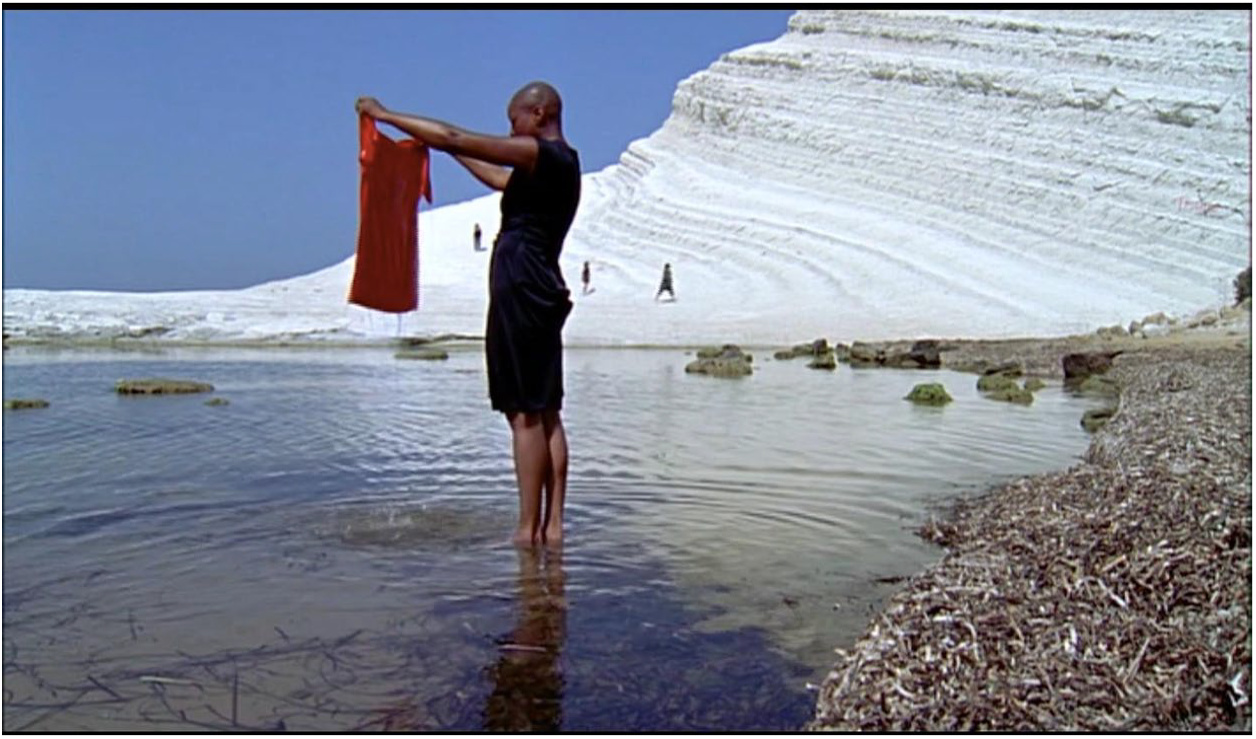
Still from The Leopard (2007) © Isaac Julien.
In Julien’s film, the sumptuous ballroom of the Palazzo Valguarnera-Gangi serves simultaneously as a symbol of European wealth, excess and power (produced by centuries of colonial domination and exclusion) and as a symbol of refusal for non-European migrants and refugees. We see a blonde white woman wearing pink walking across the ballroom toward the camera, looking directly at the viewer with an increasingly stiffening smile on her face, the clicks of her heels echoing across the empty space. Representing the epitome of aristocratic entitlement, she is Carine Vanni Mantegna di Gangi, the current descendant of Prince Pietro and Princess Marianna Valguarnera, who lived in the palace in the eighteenth century. Cutting away from the princess, the camera slowly glides through and lingers on the rich, intricate surfaces of the ballroom: we see paintings of angels on the ceiling, oil paintings of aristocratic figures decorating the walls, and details of crystal chandeliers. No surface is untouched by golden excess. Myrie, wearing her white dress, walks elegantly through the ballroom waving a red fan. The shots of her strolling through the space are intercut with and superimposed on the shots of the excessive ornamentation of the baroque architecture. Unlike the princess’s, Myrie’s footsteps make no sound, underscoring her spectral quality as she traverses incongruous spaces and times. In contrast to the static shots of documentary-style sequences, the sequence in the Palazzo Valguarnera-Gangi presents a visual journey, with the camera continually moving, tracking and panning, resulting in a dream-like atmosphere. The soundscape in this sequence is complex, with a female announcing the princess’s arrival in Italian, her words echoing against enigmatic electronic tones, a bell ringing, and a wooden ship creaking, sounds with no clear connections to the imagery, and which are out of place in the grandeur of the palace.
In a disorientating cut that takes us back to the white cliffs, we see two dancers entering the static frame, walking away from the camera on a ledge at the Turkish Steps (see Figure 5). The soundscape continues uninterrupted through a discontinuous visual space. The scene becomes further unsettling as one of these dancers carries the other – arms dangling limply and showing no signs of life – across his shoulder. The racial dynamics of the scene are complicated: the dancer doing the carrying (Alexander Varona) is dark-skinned, while the limp one (Riccardo Meneghini) is white. There is a cut back to the Myrie figure exiting the ballroom of the Palazzo Valguarnera-Gangi as the two dancers (this time facing the camera) enter, Varona carrying a passive Meneghini on his shoulders through the Gallery of Mirrors, the camera lingering on the lifeless torso of the latter dancer (see Figure 6). Transposed into the ballroom, they sway together, intimately tangled, underscoring the ‘corporeality’ and ‘materiality’ of their bodies, which are at once ‘alive and dead’ (Gonzales, 2011: 122).
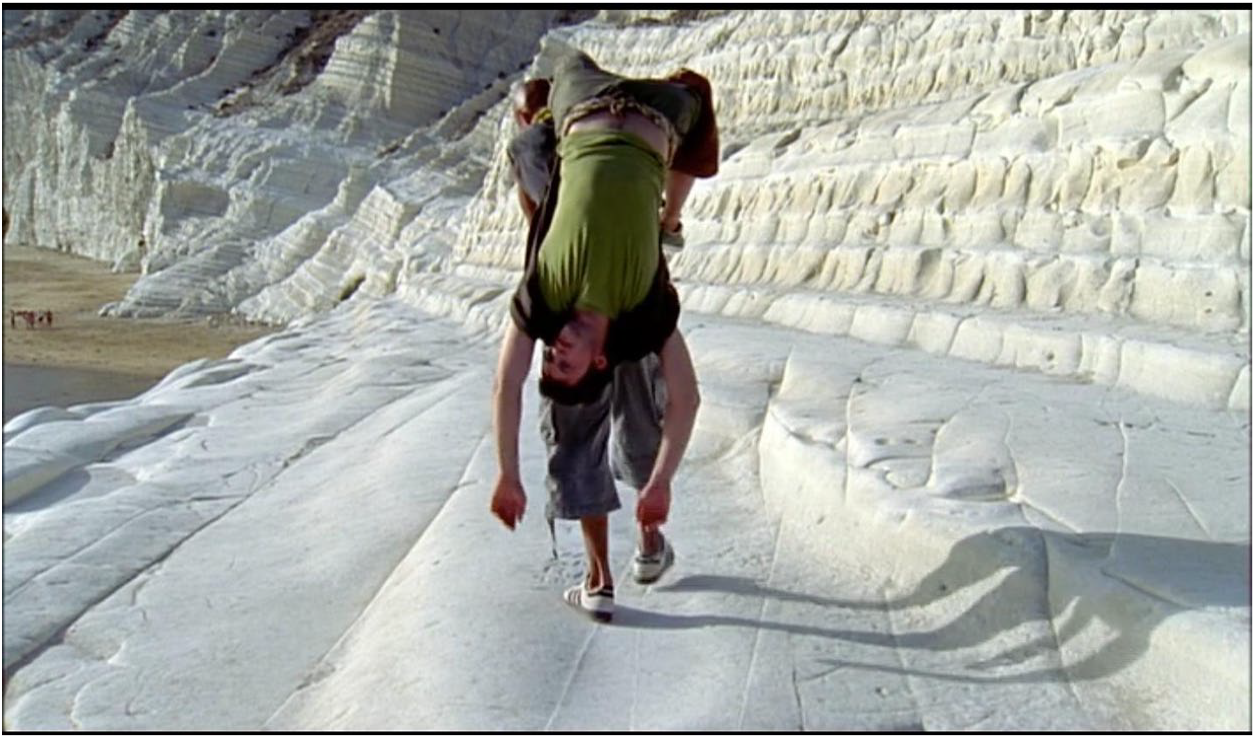
Still from The Leopard (2007) © Isaac Julien.

Still from The Leopard (2007) © Isaac Julien.
Cut to Varona twisting, curving and rolling against the smooth surface of the tiled floor to the sounds of splashing water. The shots of Varona sliding and slithering across the floor are intercut with shots of him re-enacting the moment of drowning, struggling underwater, twisting and turning forcefully as if being devoured by the sea (see Figures 7 and 8). He is trapped in the water, flailing hopelessly beneath the waves, a gesture that offers a glimpse of the extreme violence of Mediterranean deaths. In this evocative and highly disturbing sequence, the Palazzo Valguarnera-Gangi floor, a symbol of European colonial heritage, is transformed into a sea of death. The sequence ends with the camera focusing on a painted leopard on the tiled floor of the ballroom with eyes that look human, pointing to the designation of non-Western ‘others’ as less than human in the European colonial fantasy.
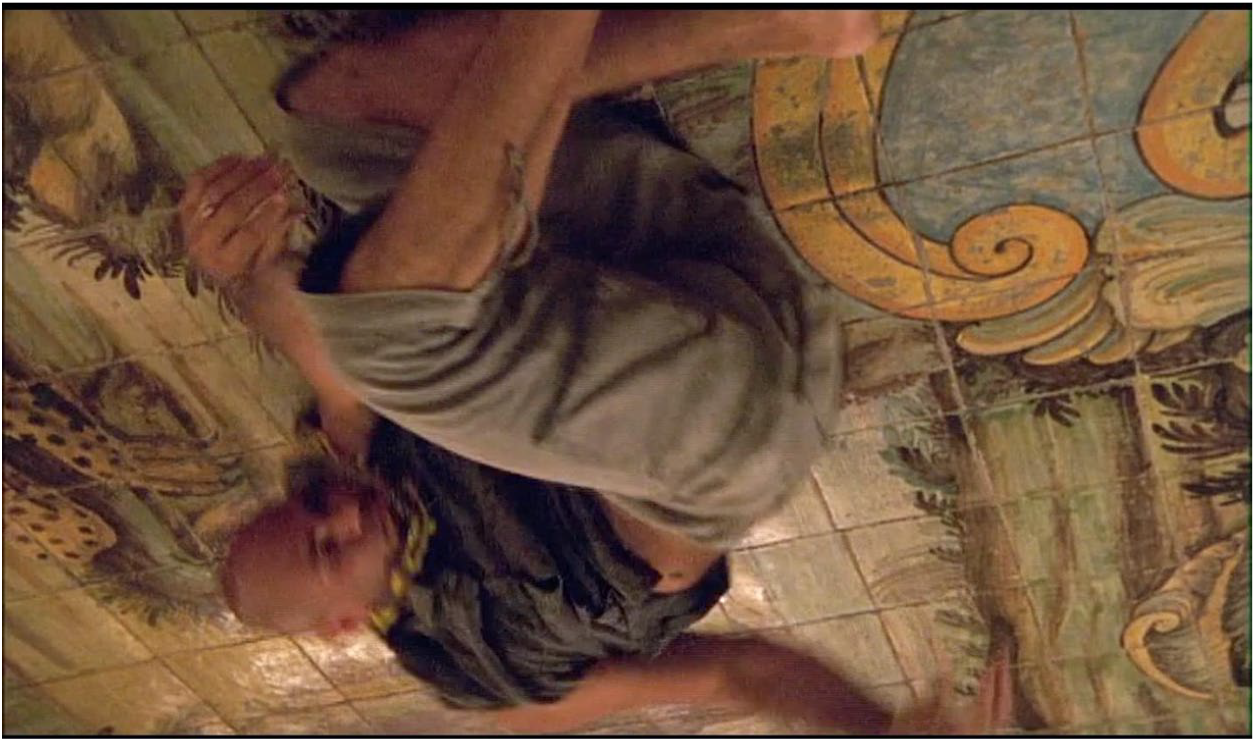
Still from The Leopard (2007) © Isaac Julien.

Still from The Leopard (2007) © Isaac Julien.
In the sequences with Myrie and the dancers, Julien facilitates a heightened level of intimacy between the camera gaze, the body and the environment. Dance performances disrupt fixed meanings and construct relations between bodies and spaces in open-ended and allusive ways. As Erin Brannigan (2011) argues, we access such intimacy more readily in dance films than in other types of films. She suggests that when we witness a dancing body on film, we see it ‘accessing corporeal knowledge and forms of expression that elude thought’, producing an amplified kinaesthetic experience for the viewer (2011: 188). Enhancing this effect, Julien choreographs his camera ‘as one would a dance, with sweeping motions that echo the sensuous moves of the performers’ (Cruz, 2000: vii). In The Leopard, allusive montage creates a fragmented, incoherent, dream-like audio-visual space that allows the viewer to engage with refugee crossings outside of the dominant framework, navigating ambiguities and tensions through affect and visual pleasure. Indeed, by foregrounding detail in an aestheticized and poignant manner, The Leopard offers affective connections with the states of precariousness, uncertainty, hope, despair, pain and death that mark refugee crossings.
Moreover, the surrealist scenes at the Turkish Steps and the Palazzo Valguarnera-Gangi avow the spectral, reimagining these spaces as sites of ‘postcolonial haunting’ (Bhabha, 1997) that communicate a fractured temporality – sites where spectral figures of slavery and colonialism come back to haunt the present and demand recognition. The ballroom of the Palazzo Valguarnera-Gangi specifically becomes the setting for a sequence of irruptions with diverse memories, fantasies and bodies appearing spontaneously, rupturing the luxurious surfaces of the ballroom. The dancers and Myrie function as spectres crossing borders in a manner that collapses time and space. In The Leopard, the historical images awakened by aristocratic locations like the Palazzo Valguarnera-Gangi and the passageway to the slave ship do not refer to a distant past – the very form of the film reveals the present as always haunted by a chain of past atrocities still awaiting redress. And the camera choreography implicates the viewer as both a witness and an accomplice to the violence of European border zones.
By establishing mnemonic connections across diverse experiences of forced or voluntary displacement – including those produced by European colonialism, decolonization, civil war and transatlantic slavery – both Havarie and The Leopard take part in a broad contemporary aesthetic and social awareness in which performances of palimpsestic and multi-directional memory play a key role. Refusing the fetishization of human suffering in dominant discourses around refugee crossings, these essay films transform the Euro-Mediterranean arena into a multi-layered space of memory and diversified mobility shaped by increasing constraints, immobilities and inequalities. They offer a politicized aesthetic in which the present (in this case, the present moment of ‘crisis’ and ‘border spectacle’) swells and thickens – as though contaminated by multiple elsewheres and temporalities. Refugeehood in these works untangles from the ‘crisis/tragedy’ framework, intertwining instead with other historical and contemporary experiences of migration and revealing the multiple spectres of coloniality that still haunt Europe.
Footnotes
Acknowledgements
I would like to thank Philip Scheffner and Merle Kröger for permission to reproduce the images from their film Havarie; and Isaac Julien for permission to reproduce the images from his film The Leopard. I would also like to thank NWO (Netherlands Organisation for Scientific Research), The Chair of European Literature and Culture at the University of Groningen, and NIAS (the Netherlands Institute for Advanced Study in the Humanities and Social Sciences), for support in the preparation of this article.
Notes
Author biography
 ), examines cinematic and artistic representations of migration and mobility in Europe since the 1990s. She recently curated the exhibition No Place Else: Dystopian Sci-Fi Imagination, which explored concepts including the dystopian city, the post-human, AI, ecological crises and retro-futurism.