



Abstract
In the field of business and technical communication, scholars have called for research on dealing with cultural conflict for a long time. But the limited study on dealing with cultural conflicts, along with the current political context in the United States, calls for efforts to systematically address diversity issues and cultural conflict in our research and teaching practices. One obstacle to advance effective communication strategies on cultural conflict in business and technical communication is the lack of communication with other disciplines. Through an interdisciplinary perspective, the current article introduces the concept of cultural conflict, examines strategy models to address cultural conflict in different fields, and provides an example on how to identify a strategy model to resolve cultural conflict in business and technical communication practices. This article concludes by emphasizing that there is not a best model that can be applied to handle cultural conflict in all circumstances and calling for research on exploring and identifying effective strategy models to resolve cultural conflict in business and technical communication practices.
Keywords
The substantially increasing interactions among culturally diverse groups at multicultural workplaces have brought about amazing opportunities for organizations. But at the same time, challenges and problems also arise from the daily interactions among different cultural group members. Cultural conflict is a natural occurring during each multicultural process; enhancing shared goals and principles while respecting individual cultural differences is the challenge every multicultural workplace faces. Scholars in business and technical communication have long recognized the contemporary need to integrate intercultural communication into research and pedagogy. As a result, developing cross-cultural competence is integrated in business and technical communication texts. However, no significant scholarship in the field has been devoted to dealing with the daunting task of developing communication strategies to address diversity issues and resolve cultural conflict. In business and technical communication textbooks, most of the current approaches to developing intercultural competence are limited to bullet point guidelines on how to keep an open or global mind-set, be culturally sensitive, or make fewer assumptions. But simply instructing students to maintain an open mind or to be aware of cultural differences is not enough. There is a void of research on ways to develop communication strategies to resolve cultural conflict and create inclusive work environment in organizations.
In the field of business and technical communication, scholars have called for research on dealing with cultural conflict for a long time (St. Amant, 2002; Varner & Beamer, 2011). But the limited study on dealing with cultural conflict, along with the current political context in the United States, calls for efforts to systematically address diversity issues and cultural confliction in our research and teaching practices. One obstacle to advance effective communication strategies on cultural conflict in business and technical communication is the lack of communication with other fields. Through an interdisciplinary perspective, the current article introduces the concept of cultural conflict, examines strategy models to address cultural conflict in different fields, and provides an example on how to identify a strategy model to resolve cultural conflict in business and technical communication practices. This article concludes by emphasizing that there is not a best model that can be applied to handle cultural conflict in all circumstances and calling for research on exploring and identifying effective strategy models to resolve cultural conflict in business and technical communication practices.
Understand Cultural Conflict
The management of cultural conflict in organizations is complex and has drawn research from different fields. Ting-Toomey and Oetzel (2013) defined cultural conflict as the implicit or explicit emotional struggle between persons of different cultural communities over perceived or actual incompatibility of cultural ideologies and values, situational norms, goals, face orientations, scare resources, styles/processes, and/or outcomes in a face-to-face (or mediated) context within a sociohistorical embedded system. (p. 635)
The social identity theory posited that the belonging of an individual to a specific group provides a source for the individual’s social identity, with which individuals cultivate a sense of belonging or fitting in the group. The theory maintains that people normally make “us versus them” comparisons and create distinctions between in-groups and out-groups (Tajfel, 1978, 2010). Based on this theory, individuals tend to look for cultural similarities to form in-groups and identify cultural differences to exclude out-groups. In-group members tend to mistrust and discriminate against out-group members by making negative stereotypical evaluations and developing a bias in favor of one’s own group (Ashforth & Mael, 1989; McCann & Giles, 2006; Sabharwal, 2014). The social identity theory explains why the preference for interacting with members of one’s own culture group, especially in an informal context, to be prevalent in organizations, and this preference is true for minority group members as well as majority group members (Cox, 1994).
Along the same line, the social comparison theory assumes that people tend to compare their own opinions and abilities with those they think are similar to gain accurate self-evaluations. Constantly seeing oneself from the viewpoint of others creates the sense of inclusion or exclusion on the interactions with each other (Festinger, 1954; Sabharwal, 2014), which is another factor that explains cultural conflict in organizations. The last theory, similarity attraction theory, maintains that people tend to be attracted to others who are similar to themselves in attitudes, values, and beliefs because similar others are more likely to possess opinions and worldviews that help to validate one’s own (Baskett, 1973). The similarity attraction theory explains why in an organizational setting, people seek to belong to a group based on similar cultural backgrounds in which they feel they are accepted and secure. People regard interactions with similar others as a source of social reinforcement. But the “similar to me” phenomenon also creates a bias against members of other cultural groups and contributes to separation and even conflict. The abovementioned three theories explain why people create social categories, why they form in-groups and out-groups, and how the classifying may affect workplace relationships and cause cultural conflict.
Besides the abovementioned three theories, another typical theoretical approach to understanding cultural conflict is Geert Hofstede’s (1984) cultural dimension theory, which describes how a culture affects values, behaviors, and communication styles of its members. The cultural dimension theory associates cultural conflicts at diverse workplaces with dimensions of cultural variability and provides a framework to understand why cultural differences exist and how conflicts can develop from cultural variations. For example, according to the theory, people from an individualism culture embrace a direct communication style and are often frustrated by members of collectivist cultures, who prefer an indirect communication style. In recent years, dimensions such as power distance and individualism collectivism dimensions are the most commonly studied (Stohl et al., 2013). The cultural dimension theory is commonly found in business and technical communication textbooks, and it provides a foundation to understand cultural conflict arising from multicultural workplaces.
Along with seeking theoretical frameworks to explore the mechanisms of cultural conflict in organizations, scholars also examine triggers of cultural conflict and categorize conflict as either task related or social related, with the latter sometimes being referred to as relationship or emotional conflict (Blake & Mouton, 1982a, 1982b; Jehn, 1997). Arising from negative affect and dislike, emotional conflict limits group cohesion and efficiency and is associated with relationship issues manifested as friction, frustration, and personality clashes within culturally heterogeneous groups (Ayoko & Hartel, 2006; Berscheid, 1983; Ross, 1989). Stohl and coworkers also maintained that along with the “classic” nation-state cultural dimensions, there are multilevel mechanisms that contribute to cultural conflict, including microlevel cultural variables such as unique rites, rituals, communicative practices, and other diverse preferences (Stohl et al., 2013). Such microlevel variables can magnify cultural differences, exacerbate conflicts, and lead to distinct perceptions of justice for procedures or policies in organizations.
Models to Address Cultural Conflict and Diversity Management
As Nishii (2013) maintained, conflicts can be regarded as an important source of interpersonal insight, and they serve as opportunities for individuals to deepen their understanding of cultural differences. To minimize cultural conflict and maximize benefits of diversity, comprehensive organizational development should be implemented. It is generally agreed that there are five key areas that an organization needs to initiate: leadership with strong commitment and effective communication strategies; research and measurement for comprehensive organizational assessment and benchmarking; education programs to facilitate awareness and in-house expertise; changes in culture and management systems such as recruitment, performance appraisal, promotion, compensation, and benefits; and follow-up for evaluation, accountability, and continuous improvement (Cox, 1994). Besides these general five area models to guide organizational change, several models or frameworks from different disciplines have been identified to guide research and organizational practices in order to address the many types of cultural conflict arising from diverse workplaces, which are briefly introduced in the following section.
To describe how organizations resolve cultural differences and conflict, Cox and Finley-Nickelson (1991) identified four modes, or types, of acculturation processes in organizations that span from assimilation, separation to deculturation and pluralism. Assimilation’s goal is to eliminate cultural differences, and it is a one-way adaptation with the entering members being forced to reject or repress their cultural norms and values. Separation refers to a situation in which minimal cultural exchange happens when entering members are unwilling or unable to adapt to an organization’s culture and are separated from others. Deculturation occurs when minority group members who have severed ties with their original group but failed to be accepted in the dominant culture. Pluralism refers to a two-way learning and adaption process in which both the organization and entering members from various cultural backgrounds change to some degree to reflect the cultural norms and values of the other(s) (Cox & Finley-Nickelson, 1991). An organization’s acculturation mode demonstrates ways to mediate cultural conflict between entering members and the dominant group, and it determines whether organizations can successfully close the distance between cultural groups in organizations (Cox, 1994).
In recent years, to address cultural tensions in diverse workplaces, Brett, Behfar, and Kern (2006) identified four effective intervention strategies: (a) adaptation—acknowledging cultural gaps openly and members make adjustments to accommodate each other. Adaptation works when members involved are willing to acknowledge cultural differences and assume responsibility for finding ways to work with or around the challenges they face; (b) structural intervention—switching teams to eliminate conflict. Structural intervention is a reassignment designed to remove a source of conflict when members are affected by emotional tensions; (c) managerial intervention—setting norms, rules, or policies early or bringing in a higher level manager. Managerial intervention can be effective when the conflict has produced a high level of emotion and the team has reached a stalemate; and (d) exit—removing a team member when other options failed. Exit is the last resort when a team member cannot adapt to the challenging situation and is unable to contribute to the team project, although it is not a frequent strategy for managing cultural conflict (Brett et al., 2006).
In the field of intercultural communication, Ting-Toomey and coworkers (2000) investigated patterned responses to cultural conflict in a variety of situations and have yielded seven conflict management styles: integrating, compromising, dominating, avoiding, neglecting, emotional expression, and third party help. These cultural conflict management styles reflect the five specific styles of handling interpersonal conflict identified by Rahim and Bonoma (1979): integrating, obliging, dominating, avoiding, and compromising. To develop an awareness of different ways of responding to conflicts, Hammer (2009) put forward an intercultural conflict style model, which presents the four-quadrant model of intercultural conflict style differences: discussion, engagement, accommodation, and dynamic. Both discussion and engagement styles adopt direct strategies in communicating about disagreements, although unlike the discussion style, the engagement style demonstrates an emotionally expressive demeanor. The accommodation and dynamic styles use indirect strategies for solving problems with either an emotionally restrained approach (accommodation) or emotionally expressive approach (dynamic). The model has been effectively integrated in the mediation process when cross-cultural disputes arise and have been proven to be beneficial in conflict resolution, decision-making, and improved relations across cultures (Hammer, 2009).
Managing cultural conflict is about how we perceive and deal with cultural differences. To understand the process of how people deal with cultural differences, Bennett (1998) captured the developmental model of intercultural sensitivity (DMIS), which describes an evolution process in attitudes and behavior toward cultural difference. Bennett maintained that how people perceive cultural differences constitutes the development of our intercultural sensitivity—the ability to discriminate and experience cultural differences. The process of developing intercultural sensitivity can be divided into two stages: ethnocentric stage (denial, defense, and minimization) and ethnorelative stage (acceptance, adaptation, and integration). At the denial stage, people are unable to perceive cultural differences at all or maintain cultural stereotypes toward others. People are at the defense state if they can see cultural differences but tend to denigrate others with negative stereotypes while attaching positive stereotypes to themselves. While people at the minimization stage recognize and accept superficial cultural differences, they believe that deep down all people are the same and tend to use their own cultural perspectives to interpret cultural behaviors. At the ethnorelative stage, people recognize, accept, and explore cultural differences; adapt their behavior to any cultural context; and are capable of engaging in contextual evaluation (Bennett, 1998).
In recent years, business management literature has shifted from diversity management to inclusion. Managing cultural conflict also implies searching for ways to integrate diverse individuals in organizations to create inclusive climate, so that a group member feels that he or she feels valued and included. In business management literature, scholars use Brewer’s optimal distinctiveness theory to present a framework of inclusion to promote perceptions of employee inclusion and reduce cultural clashes and minimize conflict (Shore et al., 2011). On the basis of Brewer’s (1991) position that tensions and conflict are associated with people’s seeking to balance the needs for both belongingness and uniqueness, Shore and colleagues proposed an inclusion framework that suggests uniqueness and belongingness work together to create feelings of inclusion. Specifically, the inclusion framework describes perceptions of inclusion ranging from exclusion, differentiation, assimilation, and inclusion, and how they are related to the sense of belongingness and uniqueness. According to Shore et al., low value of uniqueness contributes to exclusion and assimilation, and high value in uniqueness promotes differentiation and inclusion. Similarly, low belongingness leads to exclusion and differentiation, while high belongingness is desirable for assimilation and inclusion. The inclusion framework introduces an exclusion–inclusion continuum that helps to guide inclusion practices in organizations and help individuals to avoid rejection by work groups (Shore et al., 2011).
In the field of intercultural business communication, scholars posited that managing conflict is culture specific, and results-oriented cultures and relationships-oriented cultures are very different in how they manage conflicts (Varner & Beamer, 2011). Specifically, Varner and Beamer (2011) presented five modes of managing conflict: competing, collaborating, compromising, avoiding, and accommodating; individuals and organizations can choose a specific mode depending on the goals, circumstances, priorities, and cultures involved. Competing and collaboration are encouraged in individualist cultures to resolve conflict. Avoiding conflict and accommodating the other party’s goals are more commonly found in collectivist cultures. Compromising involves giving up something voluntarily from both conflicting parties, and cultural attitudes toward compromise vary (Varner & Beamer, 2011). Different modes of managing conflict correspond to varied conflict communication styles. For example, dominating communication style is related to the competing mode of conflict management, and bargaining communication style matches the compromising mode (Varner & Beamer, 2011). When conflict exists across cultures, Varner and Beamer (2011) recommended five strategies to resolve conflict: listen carefully, express agreement, identify common goals, explain your position, and identify resolutions that accommodate cultural priorities.
Identify the Strategy Model to Resolve Cultural Conflict in Business and Technical Communication Practices
Conflicts in culturally diverse workgroups are inevitable because cultural clashes happen when people tend to exclude others based on how culturally different they perceive others from themselves. To minimize the diversity-related intergroup conflict, various approaches and models have been put forward as aforementioned, and the above brief body of literature has generated many meaningful and informative theories and guidelines for minimizing cultural conflict in organizations. But there are few practices provided in literature on how the models can be used in real-life situations to reduce conflict in culturally heterogeneous workgroups. To address this problem, business and technical communication scholars can take the chance to develop scholarship on new ways to use existing models to resolve cultural conflict in communication practices.
But it is important to note that there is not a best model that can be used to assess strategies for handling cultural conflict in all circumstances. As Varner and Beamer (2011) noted, an organization’s specific goals, priorities, culture, and circumstances decide which model or mode to use when dealing with cultural conflict (Varner & Beamer, 2011). Rahim (2002) also maintained that there are various conflict management styles that can be used to deal with conflict, and organizational members would require training and on-the-job experience to select the right style of handling conflict, so that various conflict situations can be appropriately dealt with. Scholars agree that the nature of the conflict decides which strategy can be implemented and successful managers adopt different strategies to resolve conflict. For example, communication differences can be minimized with adaption, emotional issues can be alleviated by structural intervention, adaptation is more likely to have long-term as well as short-term benefits, and integrating or problem solving style can be used to manage conflict to enhance learning and effectiveness (Brett et al., 2006; Rahim, 2002; Stohl et al., 2013). Although avoidance is rarely an effective long-term solution dealing with cultural conflict, it can be an appropriate interim strategy for dealing with conflict by allowing one party to learn more about the other side before declaring a stance (Parker, 2002). In the following section, I provide a detailed example on how one of the aforementioned models was adopted to assess communication strategies in my business communication teaching practices.
People tend to associate cultural conflict with distinct ways of processing information, different communication styles, varied attitudes toward authority, or different norms of decision-making. But quite often, even daily routines such as reheating meals in an organizational setting can generate frustrations and create barriers to a team’s ultimate success. One cultural conflict commonly found at multicultural workplaces stems from employees’ different reactions to cultural food smells at workplaces. People are usually conservative with the food they eat. When new international employees from another culture reheat their fish meals in the microwave oven on a daily basis, local American employees complain and request fish to be banned from the kitchen. But at the same time, the new employees point out that the smell of popcorn or beef sandwich is equally disgusting to them (adapted from Locker and Kienzler, 2013). The cultural differences related to different perspectives on food smell at the workplace had caused emotional upset, and stressed interpersonal relationships that powerfully affect employees’ day-to-day interactions with each other. Failure to effectively and timely manage disagreements and reduce conflicts will contribute to an escalating situation and impede the growth of the organization. In the earlier situation, one of Brett and colleagues’ four effective intervention strategies—managerial intervention—is a good fit, which involves setting norms, rules, or policies early when the conflict has produced a high level of emotion and the two groups involved have conflicting interests with one another. The task-facing management on this management dilemma is to set up a policy on microwave use in the office to minimize the affective (or emotional) conflict. Following this strategy, in my business communication teaching practices, I introduced the dilemma to students and assigned them to draft a policy memo on microwave use to all employees to address the cultural confliction on behalf of the management team.
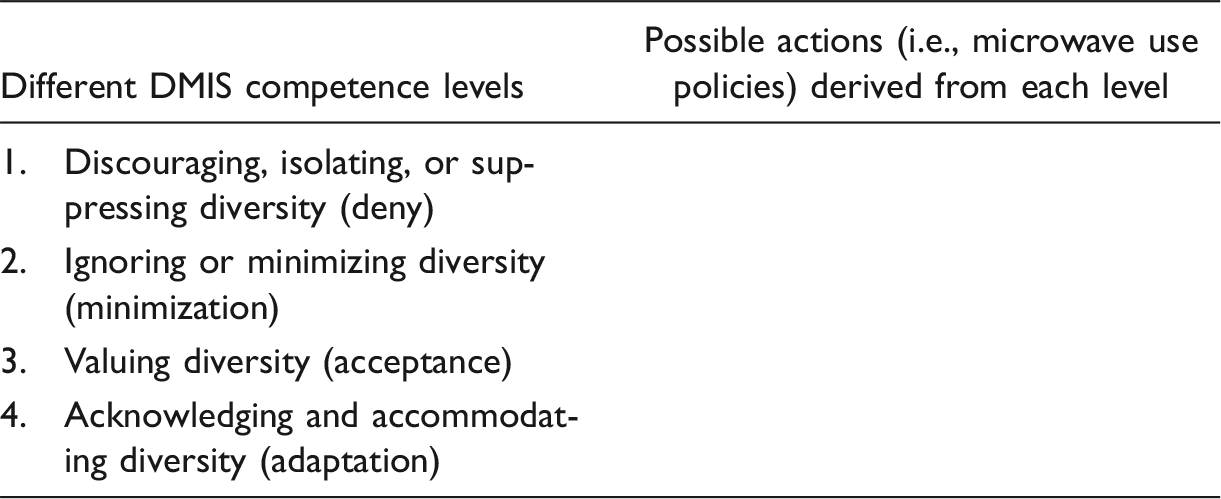
The abovementioned exercise is designed to provide students a chance to practice employing the conflict model to solve real-world cultural conflict problems. In this circumstance, the salient conflict is a cultural one that has negative impact on relationships among the two groups of employees. The new employees feel being personally attacked and defensive when they are noticed about other employees’ complaints about the unpleasant odor of their lunch. These complaints cause dissatisfaction among the new employees who feel uncomfortable working among the hostile coworkers. On the other side of the issue, local employees feel that the working environment is not productive and they are distracted by the fish odor. Since this conflict originates from cultural differences on food choices among employees, I borrowed Bennett’s (1998) DMIS to help students choose the right communication strategies to manage this cultural conflict. The DMIS model presents a continuum on how people’s attitudes and behavior toward cultural differences are developed in an evolution process and has been incorporated into business communication teaching practices (Wang, 2013). This continuum is an effective tool to assess the ethnocentric and ethnorelative tendency of the policy. To test the effectiveness of the conflict management model, I requested students to draft a policy memo before and after the DMIS model (pre- and posttest) was introduced in class.
Worksheet Based on the DMIS Model.
Note. DMIS = developmental model of intercultural sensitivity.
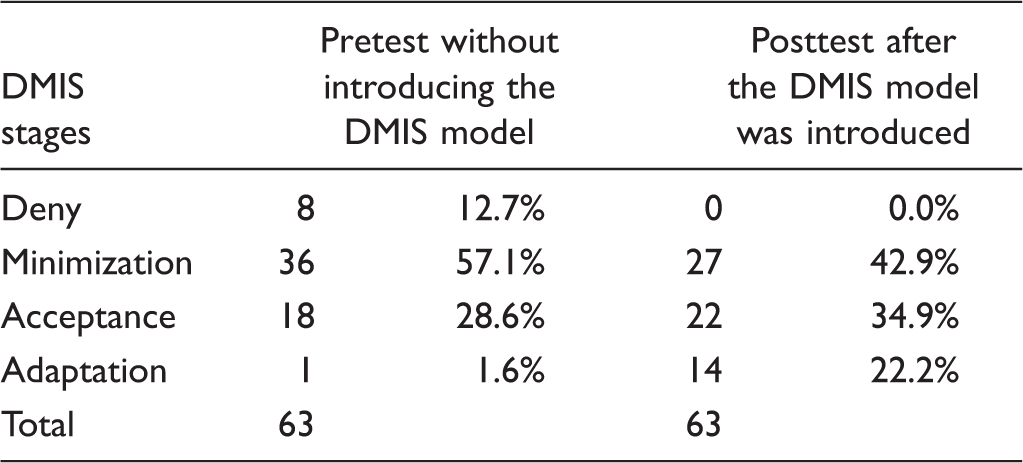
A Comparison of Students’ Actions to Resolve the Cultural Conflict.
Note. DMIS = developmental model of intercultural sensitivity.
As Table 2 shows, there is an increase of more than 20% of students who chose adaptation actions in the posttest. The strategy is based on the understanding that although the organization has hired employees from other cultural backgrounds, the cultural distance between the entering group and dominant group is huge, demonstrated in the employees’ reactions to new employees’ diet choice. Such an organization is diverse in terms of phenotype as Cox phrased it, but genuine cultural diversity is quite limited, and the organization needs to address cultural integration in order to create an inclusive organization that fosters and values cultural differences and reduces intergroup conflict (Cox, 1994). In other words, an effective conflict management strategy to deal with this conflict is to enhance a macrolevel organizational learning and effectiveness and use the conflict as opportunities for individuals to deepen their understanding of cultural differences. As Rahim (2002) noted, organizational learning and effectiveness is a criterion that successful conflict management should satisfy. In the posttest memos that demonstrate adaption strategies, these students do not stop at introducing some easy-to-do methods to reduce food odor in the office; instead, they incorporate cultural events and programs aimed at leveraging differences, promoting cross-cultural socializing, and increasing culture awareness. For example, students proposed events such as organizing multicultural potluck events to encourage employees to bring cultural food to share; initiating sports programs or employee clubs so that employees can interact with each other and learn about different cultures, races, religions, and socioeconomic backgrounds; or designing surveys and other instruments to practice regular, effective, and open communication to empower employees, so that their feedback, concerns, and opinions can be heard and valued. These adaptation actions serve as effective conflict management interventions because they provide opportunities for employees to gain cultural awareness and prepare them to effectively deal with possible situations in the future.
Although there is a significant increase in adaptation strategies, both the pre and posttests show a tendency for minimization—some students tend to minimize or avoid the conflict by removing the microwave or asking employees to eat outside, which makes it impossible for members to improve rapport and gain cultural awareness. Removing the microwave focuses only on the conflict itself while ignoring the problems that cause the conflict—the noninclusive climate at the workplace and the lack of intercultural competence among employees. In this case, leaders’ effective management strategies should promote members’ openness to diversity and include actions for cultural groups to get to know each other and overcome members’ disposition to be attracted to only similar others in order to achieve higher cohesion and integration. Along with establishing norms of using the microwave, the organization needs to take actions to promote cultural learning (rather than hostility) among employees, so that collective cultural competence can be improved and an inclusive climate can be established. On the other hand, if the company chooses to ban the heating of fish lunch, the organization is seeking to assimilate the new employees into the dominant cultural group while ignoring the new employees’ cultural diet preferences that are different from the traditional norm. Following the preferences of the majority would inadvertently create barriers to full participation by organization members who are from a different cultural background; thus exclusive communicative behaviors such as banning fish or separating new employees from others during lunch time fall into the category of the denial stage.
The aforementioned example shows how theoretical models to deal with cultural differences and conflict can be utilized in business communication teaching practices to facilitate students’ learning. The process of using conflict management models to assess communication strategies can also be used in real workplace settings, where leaders can rely on it to assess conflict-reducing strategies before taking actions. But it should be emphasized that there is not a best model that can be used to assess strategies for handling cultural conflict in all circumstances. Depending on the nature of the conflict and other specific situations, there are other models that can be used to evaluate conflict resolving strategies. In the earlier scenario, Shore and colleagues’ (2011) inclusion framework describing perceptions of inclusion ranging from exclusion, differentiation, assimilation, and inclusion is another tool that can be used to assess a strategy’s tendency along the exclusion–inclusion continuum.
Conclusion
When rules, policies, and practices are needed to deal with cultural conflict, there is a tendency for the dominant group in organizations to reflect their own cultural biases and value systems. An exercise like the one described earlier provides chances for leaders to examine and assess their own perceptions before making decisions to handle the conflict. As Rahim (2002) pointed out, there is no clear set of guidelines on how conflict should be dealt with. Our research and teaching practices can benefit from investigating how theoretical findings can be utilized at workplaces to resolve cultural conflict in communication practices. Researchers are encouraged to explore various models and identify effective ones for teaching communication strategies to resolve cultural conflict. The process of linking cultural learning to communication strategies promotes active learning and helps learners grasp practical skills to assess and implement communication strategies among diverse workplace audiences. The conflict management models introduced and the application examples described in this article show us how research in other fields can benefit the field of intercultural business and technical communication. Borrowing research findings in other fields and applying them to the teaching practices in business and technical communication fills the research void in our field while serving the needs of the globalized social and economic contexts. It also provides scholars a way to acknowledge the pragmatic implications and the impact of the field of business and technical communication.
Footnotes
Declaration of Conflicting Interests
The author(s) declared no potential conflicts of interest with respect to the research, authorship, and/or publication of this article.
Funding
The author(s) disclosed receipt of the following financial support for the research, authorship, and/or publication of this article: This research was funded by University of Minnesota, Duluth, 10.13039/100009742. Chancellor’s faculty small grants program.