



Abstract
Documenting and characterizing interactions between student interns and their mentors in the workplace offers perspective on student learning and enculturation that can help us introduce these ways of learning to students in the technical communication classroom, even before the internship. Three student intern conversations in the internship setting are the focus of this close discourse analysis, framed by 6-month-long case studies and Vygotsky’s learning theory. Results indicate that many similarities exist between classroom feedback and mentor feedback in the internship, but that differences in student agency may make negotiation important in the technical communication classroom.
Keywords
Introduction
Internships are a place between school and work that offer real-world experiences that build on classroom practices. In this internship setting, through mentor feedback, students can become enculturated into the activities of the workplace, and mentors provide important contextual information to understanding work tasks (Kramer-Simpson, 2016; Tovey, 2001). Enculturation can be difficult as students may encounter different ways of learning in the workplace (Henze, 2006) which makes it even more important for researchers to examine how student interns learn in situ—at moments of interaction with their mentors. These interactions offer an important glimpse into the ways that students are brought to understand professional strategies for problem solving and should be a part of our discussions on internships and student learning.
Much work in technical communication research has focused on cases of internships (Bourelle, 2014; Henze, 2006), yet little is known about how mentoring takes place during internships, specifically in the interactions between student interns and their mentors (Kramer-Simpson, 2016). Much work in response to student writing can inform the characterization of interactions in the workplace (Kim, 2015; Prior, 1995), particularly on issues of active negotiation and student agency that play such a critical role in learning to problem solve (Vygotsky, 1978). By blending the literature from composition and second language writing with internship research in technical communication, I find language to describe ways that the interactions between interns and mentors may impact learning, and ways that the workplace interactions differ from the technical communication classroom. Further, I offer suggestions and implications for classroom feedback in light of the findings in the workplace. Adopting some of these techniques may allow students to more successfully move from school to work.
This study uses three conversations between interns and their mentors in the context of 6-month-long case studies to demonstrate how negotiation and agency played a role in student uptake of strategies taught by the mentors. In two cases, the students demonstrated learning through this scaffolding, but in one case, the student misunderstood the feedback. The impact of this disconnect was the termination of the internship. Thus, with employment at stake, it is important to understand interactions between students and mentors that lead to learning. Findings from a close discourse analysis indicate that mentor repetition of feedback, task agenda setting, and student confidence may all factor into enculturating students into this world of work.
Review of Literature and Theory
Drawing on Vygotsky’s theory of learning and development offers a way to look at core elements of the feedback. It describes the action and problem solving that takes place during these interactions. My emphasis here is on a model that focuses on student uptake of concepts with the goal of independent practice. This is very different from a more static model of characterizing feedback by type of comment, teacher intention, or simple fixing on the part of the student. I wanted a theory that would help me explain how students take on the approaches of their mentors and adapt these to other contexts. I later use this theory to highlight aspects of the research on internships and mentor feedback, comparing that body of work to an even larger body of research on classroom feedback and interaction. Merging the literature from internships with literature on response to student writing helps us understand elements of feedback that may be particularly important to student learning in both contexts.
Framing Learning Through Vygotsky
Although Vygotsky (1978) discusses child development, his theory has been applied to internship contexts as well (Kramer-Simpson, 2016; Sides & Mrvica, 2007). Vygotsky emphasizes that it is not sufficient to look at learners’ actual development. Instead, he suggests looking at the learners’ potential development; “the distance between the actual developmental level as determined by independent problem solving and the level of potential development as determine through problem solving under adult guidance or in collaboration with more capable peers” (p. 86). This is the zone of proximal development, or ZPD. Through negotiating solutions to problems with a mentor, students are able to extend their understanding. Feedback as a dialogue is the means by which students negotiate problem-solving strategies. Vygotsky argues that examining the problem-solving processes allows researchers to see “processes that are in a current state of formation” (p. 87) and gives us a better understanding of how learning occurs through action and interaction.
Wilson and Devereux (2014) also emphasize that through the act of problem solving and negotiation, learning occurs. For this reason, work that unpacks this problem-solving process may greatly add to our findings about what support helps students learn to grapple with and solve problems using expert guidance.
The goal of working with a more experienced mentor is that students will learn these problem-solving processes and eventually be able to work independently. As Vygotsky (1978) summarizes, “what a child can do with assistance today she will be able to do by herself tomorrow” (p. 87). Vygotsky emphasizes that it is not enough for students to imitate the behaviors of the more experienced teacher, mentor, or peer, (or simply “fix” a paper) but that they must “grow into the intellectual life of those around them” (p. 88). This is a process of enculturation and immersion. Students must not only understand the problem-solving strategies of the experts, but they must also internalize them and be able to adapt them to new situations. Students must make these strategies their own and agency is a critical part of this process.
Wilson and Devereux (2014) argue that students need both autonomy and active engagement in order for learning to occur (pp. A91–A93). This builds on Vygotsky’s social theory by showing that students need some room to own the concepts they are supported in learning. Wilson and Devereux (2014) emphasize that dialogic feedback is one means of providing contingent scaffolding, or “on-the-spot” individualized interactions with students (pp. A94–A95.) Feedback, then, is a means of supporting student development, but there need to be opportunities for students to negotiate that feedback in order for them to learn.
The internship setting provides many casual and formal opportunities for this negotiation and “on-the-spot” interaction. For this reason, examining conversations between interns and mentors in-action proves a rich research forum for exploring feedback, scaffolding, and learning among students.
Internship Literature in Technical Communication
Internships, as a transitional space between school and work, offer unique opportunities for students to learn, become enculturated, and practice new skills as professionals-in-training. The workplace offers valuable experiences that are not available in the classroom (Bourelle, 2012; Tovey, 2001). Internships offer a bridge between school and workplace that has been explored by researchers in both education (Dias, Freedman, Medway, & Pare, 1999; Freedman & Adam, 1996) as well as in technical communication (Bloch, 2011; Katz, 2015; Munger, 2006). The transition between school and work is often rocky, and much mentoring support is needed to help students acculturate into a new organization or workplace (Kohn, 2015; Kramer-Simpson, 2016; Munger, 2006; Tovey, 2001). In fact, Munger (2006) recommends not approving internships where the industry supervisor does not have the ability to give “adequate guidance or feedback” (p. 331). Tovey explains that for writing in particular, it is essential to know the organization culture and expectations, and a mentor is essential in bridging this knowledge gap. Feedback is important in internships, and much of the internship research in technical communication emphasizes that industry supervisors need to give it. However, little research has examined closely how this mentoring takes place in-action, during regular meetings. This study aims to use discourse analysis to closely examine three interactions between student interns and their mentors and compare this to other feedback interactions well documented in classroom writing situations (e.g., see Taylor, 2011). By merging what we know about mentoring in internships with what we know about feedback interactions scaffolding writing development, I shed light on several essential elements of problem solving and skill development that may benefit both internship supervisors as well as classroom teachers.
Dialogic feedback in internships
Frequent discursive interactions for feedback between interns and their industry mentors are identified in the technical communication literature as important, though rarely is this discussed in detail. Workplace learning is very collaborative (Freedman & Adam, 1996), and students must identify ways to interact socially with their mentors to ask questions and build self-efficacy (Kohn, 2015; Sides & Mrvica, 2007). Learning to write in the workplace or learning to design or edit documents is a slow process that is hopefully facilitated by a mentor. Bloch (2011) reports students feeling abandoned when not supported by regular meetings with mentors (p. 316). Sides and Mrvica (2007) in several places throughout their book on internships stress the social nature of the internship and emphasize that there must be regular times for feedback in the exchanges between intern and mentor (p. 81). Munger (2006), too, emphasizes that feedback needs to be timely in the internship (p. 334). Feedback is a part of the responsibilities of the industry mentor and is a very interactive and dialogic process. Although this feedback can be time consuming (Jennings, 2012; Munger, 2006), industry professionals appreciate this chance to teach students current skills that will benefit students as they enter technical communication as new professionals (Jennings, 2012). However, instruction of these skills is only possible through frequent feedback and discussion surrounding the problem-solving strategies employed in the workplace. More research needs to closely examine these exchanges to understand how this teaching takes place.
Student agency in internship literature
Interaction between student and mentor is not enough to ensure learning in the workplace. Instead students must be actively engaged in the problem solving so that they can learn to independently apply these skills in the future. Feedback is critical for “developing independently in the future” (Bourelle, 2012, p. 186). Students who ask questions and feel they have a designated time where their needs can be met more actively engage with the process. Both Bourelle (2014) and Bloch (2011) discuss examples where the high level of interaction between student and mentor led to initiative by the student and more self-efficacy. The “scaffolded stages” of feedback that Kohn (2015) describes lead to a student who is self-confident in what he or she brings to the organization. Essentially, it is not sufficient to provide answers to questions; we must help the students become members of the organization (Tovey, 2001) through the activities of writing, revising, and responding to feedback. We want, as Vygotsky has indicated, to help students demonstrate agency and initiative in these internship contexts so that in the future they can practice these skills themselves.
Academics rarely get more than a glimpse of interactions in the workplace. This may be due to the distance St. Amant (2003) has identified between internship coordinators and industry mentors. Or, as Bourelle (2014) has suggested academics may worry about interfering with the internship mentors. This limited research on internships encouraged me to look to the classroom characterization of feedback to see how learning occurs in this context.
Literature on Feedback Interactions in the Classroom
Much of the research on feedback and response to student writing comes from composition and second language writing literature. Similar to the internship literature in technical communication, response literature also reveals themes of dialogue and student agency.
Dialogic response
Authentic interaction has long been a component of feedback emphasized in the literature on response to student writing and feedback, both in first and second language writing contexts. Sommers (1982) and Straub (1997) discuss the negative impact of generic comments. It is not enough that the student fixes the comments the teacher makes; that leads to a teacher or mentor-driven text that is often garbled (Sperling & Freedman, 1987). Instead, research on response to student writing shows that the student and teacher must exchange information in an active, social relationship. Students must understand why the comment is made (Taylor, 2011), and teachers must communicate rationale for the comments (Ferris, Liu, Sinha, & Senna, 2013). This demands a dialogic exchange between mentor and mentee or student and teacher. As Tovey (2001) has mentioned, feedback is a process by which social enculturation occurs. In fact, the relationship with the teacher or mentor can impact the way the feedback is received (Lee & Schallert, 2008). This social or affective factor only solidifies the importance of understanding the dialogue between mentors and interns in the workplace context and comparing that to classroom exchanges.
A challenge identified by the literature on response to student writing is that though teachers may strive for a dialogue through commentary and feedback, students may not always interpret these comments as a conversation (Christiansen & Bloch, 2016). Yet another challenge documented is that learners may adopt mentor feedback wholesale, as in Prior’s (1995) tracing of feedback in a graduate learning context. To see what challenges exist for mentor feedback in an internship setting, more data are needed to characterize how these interactions take place.
Student agency in classroom settings
Feedback is useless unless there is some uptake from the student learner. For this reason, Sandra Murphy (2000) has encouraged researchers to focus on the student in studies of feedback. Student agency has “not always been fully explored” in research on feedback (Hyland & Hyland, 2006). More work is needed to examine how feedback interactions unfold to understand how the student takes an active role in the problem-solving process (Vygotsky, 1978). Some literature in feedback has focused on the danger of appropriation (Brannon & Knoblauch, 1982; Tardy, 2006), or the mentor taking over the student text. Many contextual factors of the students themselves may impact students’ ability to demonstrate agency in revision (Conrad & Goldstein, 1999; Goldstein, 2006; Yeh, 2016). In particular, Yeh (2016) noted that despite the one-on-one context of conferences in an English as a Foreign Language (EFL) setting, students often were confused about what questions to ask and did not always prefer to establish their agency in the conference. Newkirk (1995) has found that sometimes his first language students were not ready to ask clarifying questions about feedback in conferences, and that they took a very passive role in the response process. Lee (2008) found that students in an EFL context also tended to be passive about working with teacher feedback. Sperling and Freedman (1987) in an first language context found that students, who focus on pleasing the teacher, may end up confusing feedback and revisions. Kim (2015) found that in her close examination of writing center conferences, the writers who could make their goals understood had more successful conferences. It seems essential to the feedback dialogue that students make their voices heard. More work needs to identify the role that student agency plays in feedback interactions.
In this study, I characterize interactions between student interns and their mentors, focusing on issues of dialogic interaction and student agency, as identified by the literature. I compare internship interactions to those of the technical communication classroom in order to show ways to ease the transition for students from school to work.
Methods
This qualitative case study and discourse analysis of meetings between mentors and interns focused on student learning and the impact of feedback from mentors. The qualitative approach places an emphasis on the evidence of the data, as it is important with qualitative research that “all conclusions and statements be traceable back to directly observed data within the study” (Hughes & Hayhoe, 2008, p. 82). Rich description provided from multiple data sources over the course of several months helped me to see not only the initial uptake of students but also the impact of this learning. This study focused on synthesizing the data gathered in response to two central research questions:
What kinds of dialogic feedback actions do student interns and mentors demonstrate in face-to-face meetings? What factors impact student learning when examining particular case-study participants’ interactions?
Participants
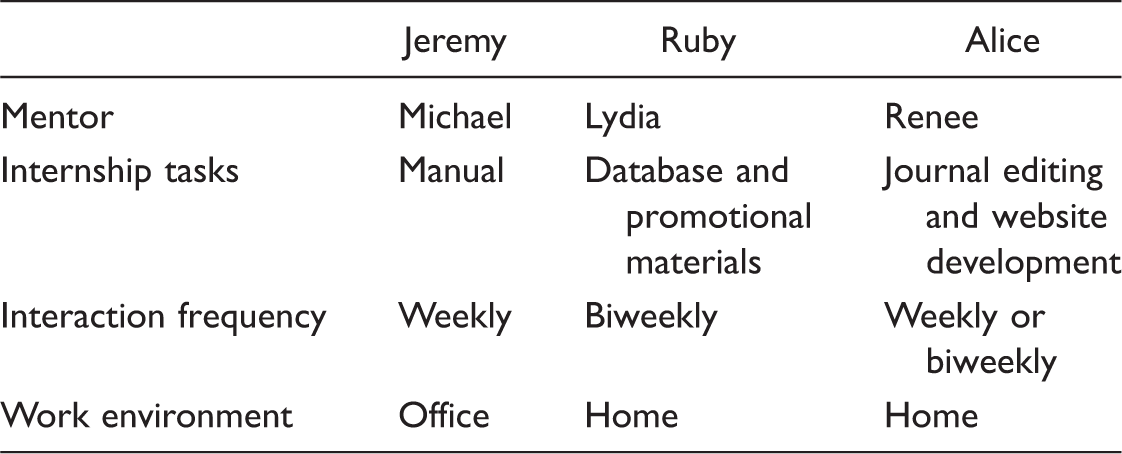
Participant Internship Information.
Data Collection
The primary source of data for this discussion is one digitally recorded meeting between each intern and the mentor toward the beginning of the internship. I chose the beginning because there would be more opportunities for student learning and guidance from mentors than later in the internship. The weekly or biweekly meetings were scheduled to last between 30 minutes and 1 hour, though Alice and Renee’s conversation was particularly short and only lasted 10 minutes this particular time. Ruby and Lydia’s conversation lasted 40 minutes, and Michael and Jeremy’s conversation lasted 40 minutes.
As a part of the larger case study providing the context for these discussions, I conducted four 30-minute one-on-one interviews with interns every 1 to 2 months. Interviews were semistructured and followed guiding questions. I was able to ask clarifying questions about my observations or their writing tasks. Tracking students’ progress over the course of 6 months allowed me to see many of the outcomes of the weekly discussions in the student interns’ independent practice. Also, I interviewed mentors for 30 minutes twice: Once toward the beginning of the internship and once after the internship had finished. These one-on-one interviews allowed me to unpack what mentors intended from their feedback.
Data Analysis
Observed conversations were digitally audiorecorded to ease participant comfort and maintain confidentiality. I also took notes during the conversations to provide context. I identified codes of student and mentor action in these conversations. Coding by action allowed me to contextualize turns in larger segments, from different points in the conversations. I began with smaller codes and abstracted to larger categories (Hughes & Hayhoe, 2008). I combined suggesting and rationale because in most cases, the suggestions were followed by a rationale as to why that consideration was important.
Results
Types of Response Actions in Mentor-Intern Pairs.
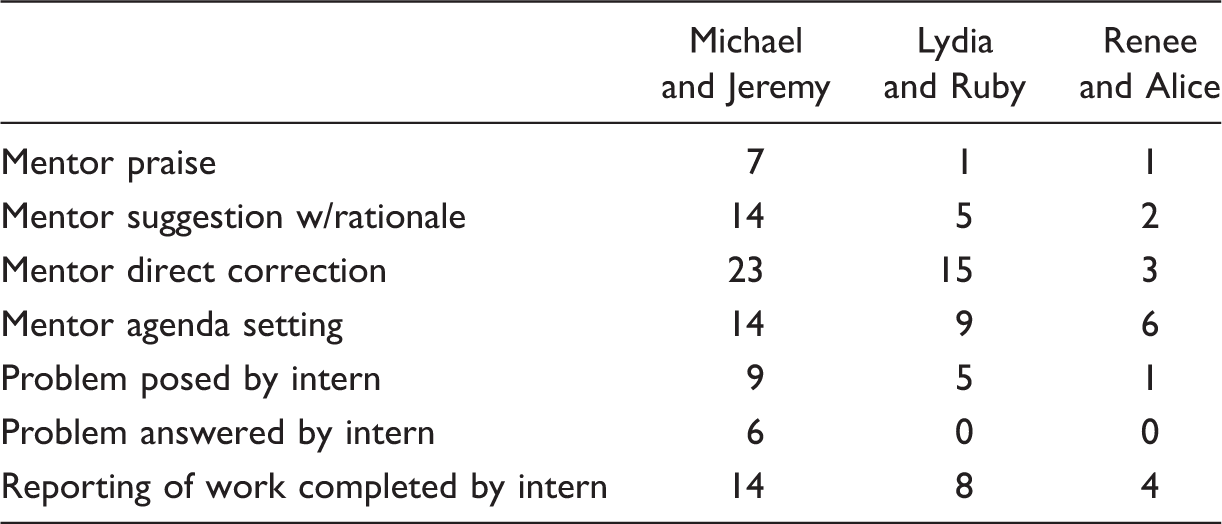
Another category from Table 2 similar to technical communication classrooms is the suggestion and rationale category. In most cases, the rationale why the suggestion was given was provided to students. It seems that like writing teachers, these mentors wanted students to know not only what action to take but also why it was necessary (Taylor, 2011).
Categories that are more characteristic of the workplace and the internship specifically are the categories of agenda setting and reporting work. Although Lee (2008) documents agenda setting in writing conferences, that skill is particularly crucial in an internship setting where time for interacting with interns may be limited (Jennings, 2012). In fact, it often seemed from observation a way of directing and focusing the conversation between internship mentor and student intern. In a technical communication classroom, conversations often are led by the teacher, rather than the student accounting for work completed. The exception may be in client-based projects. The complex juggling that comes with workplace experience and internships may require more structure to the conversations to field the tasks.
A category that is particularly important to scaffolding and best shows the dialogic interaction between mentor and student is the problem-posing category. This category was determined by the student initiating an issue that he or she could not immediately solve in the work. In Jeremy’s case, he talked himself through answers to the problems in six out of the nine cases. These exchanges took up the bulk of the transcripts and seemed the most important in interviews after the observed discussions. These problems posed by interns served as points of learning for the students as they progressed through their internships.
In the next sections of the results, I focus on particular problem exchanges between the interns and their mentors. I examine how the problems were negotiated by mentors and interns. I also examine how interns gradually took ownership of the concepts (or not). Finally, I tie these interactions to Vygotsky’s theory of learning and ZPD to show the gradual move toward professionals that these students made in their internships.
Repetition and Negotiation: A Problem With the Raw Data Folder
Jeremy worked for a research institution composed of scientists and engineers. His supervisor was an electrical engineer. Jeremy had taken some engineering classes, but his major interest was writing and design. The research organization was interested in providing a manual for a complex piece of equipment that helped them process data for scientists and they were excited to have a technical communication intern. Michael, Jeremy’s mentor, knew a lot about the mechanisms of the hardware, firmware, and software that Jeremy was describing. Michael and Jeremy met once a week, usually on Wednesdays, to discuss work that had been accomplished on the manual and Jeremy’s questions. This was time devoted to Jeremy’s needs, and Michael provided expertise on both the information and where to find more of it. Michael connected Jeremy with other online resources of similar machinery (through a site called CASPER) and then presented Jeremy with a 1.3 gig folder of raw data previous engineers had assembled about the mechanism. One of the challenges Jeremy faced throughout the internship was knowing when the information was available through one of the digital resources, and when the information needed to come from Michael. In the conversation I focus on below, Michael gave Jeremy tips for how to read the raw data folder. Through repetition and negotiation, the concept of finding information through diagrams in the raw data folder is a strategy that is communicated and then serves Jeremy well throughout the project.
Jeremy posed the problem by stating in the conversation, “I've got no usable documentation between CASPER that really has any meat that we don't cover.” What he meant is that there is no extra information on the CASPER website that has information that Jeremy needed for the manual. He mentioned that he has “no usable documentation” to write about the attenuator control, a part of the larger piece of equipment that he is describing.
Michael was not surprised because he explains in subsequent turns that the part was not described in CASPER because it is “very custom” to this organization. Instead, Michael suggested that Jeremy look in the raw data folder of 1.3 gigs which was created by engineers at their organization. Michael specified to look under the folder for that part.
Jeremy did not immediately accept Michael’s suggestion. Jeremy responded that he already looked in the raw folder and commented “That’s where I pulled this one” or that’s where he got the existing information that makes up the attenuator section.
Michael invited Jeremy to open the folder in the raw data file and scroll to the bottom to a table that presents the information. However, Jeremy was still confused. He was looking for a paragraph that describes the part, and Michael showed him a table. Michael repeated that the information Jeremy needed was in the table: “Those are what describe how you control the attenuator, and then the next little section down here [are] some of the switches.” Michael repeated information a total of six times to try to get Jeremy to uptake the concept. Jeremy finally responded with okay and seemed to understand that information could take the form of tables as well as paragraphs.
Jeremy filled in this part of the manual and performed the revision with expert scaffolding (Vygotsky, 1978; Wilson & Devereux, 2014). Michael’s persistence despite Jeremy’s frequent dismissal of the feedback demonstrates scaffolding and a willingness to work until the information and strategy reached Jeremy’s ZPD. Uptake is determined when Jeremy finally replied okay very quietly and then took notes. Michael confirmed this understanding with additional explanation about why this piece of information was crucial to the overall document that Jeremy was creating. This follow-up cements the technique of research and provides Jeremy with specific information about the organization that he would not have had otherwise. Repetition by Michael was potentially necessary because Jeremy did not see the finer details of what the raw data document provided. However, once Jeremy acknowledges the finer tuned aspects of this description with the word okay and makes notes to himself, he is growing intellectually into the culture of the organization that Michael provides (Vygotsky, 1978). Jeremy is later able to find other aspects of the system in the raw data folder. Jeremy’s okay is a very important step helps Jeremy take ownership of the knowledge in a way that he can implement and adapt it to a variety of different situations. Later in his internship, Jeremy demonstrates that he often can research and find information in the 1.3 gig folder of raw data, and that he can include custom features of the system into the manual using information from diagrams and tables.
As is common in the technical communication classroom, Jeremy first does not quite understand what the teacher or mentor is asking. However, there is more negotiation and interaction between the mentor and intern than usually seen in a technical communication classroom setting. It is this negotiation and repetition that helps Jeremy voice his opinions, learn a new approach to research, and then practice this skill independently on future parts of the manual. Jeremy is very active in this exchange, which helps him pose alternate explanations such as he “already looked.” Jeremy felt confident in voicing his thoughts and opinions. An important element to help students transition is giving opportunities for such back-and-forth in the classroom.
Repetition and Student Agency: Claiming the Solution to the Problem
Ruby also demonstrated the problem-posing strategy several times in the conversation I observed between this intern and her mentor. Ruby took an internship working with another campus department on a research initiative for the whole university. This special project was meant to showcase research from the institution over the last 125 years; this was no small task and required coordination across campus. Ruby’s mentor Lydia was very busy and was happy to have a technical communication intern to potentially rewrite academic-ese and design some promotional materials for the university. The largest portion of Ruby’s time was focused on creating a database of the peer-reviewed research published by academics from the university. Ruby worked with another student intern who programmed the database, and both student interns worked mostly from home. However, Lydia made sure to have biweekly meetings, lasting between 30 minutes and an hour and a half, to update everyone on the team. Ruby often came to these meetings with a list of questions. Ruby frequently e-mailed other questions that needed more immediate answers. Despite less face-to-face time than Jeremy and Michael’s meetings, the meeting that I observed offered great opportunities for discussion and negotiation. Like Jeremy’s case, the problem that I discuss later with Ruby features repeated feedback from Lydia. Also, Ruby is very active in the process of this conversation, posing the problem, and even posing some solutions and giving rationales that echo her mentor’s approaches. Like Prior’s (1995) findings, Ruby internalizes her mentor’s feedback and employs the strategy discussed here of prioritizing to tasks later in the internship.
Ruby posed the problem in a comment during the conversation regarding the academic replies to e-mail queries about research done at the university. Ruby related that most of the replies from faculty were “author bios.” Then she asked Lydia “which by the way, do we want to do author bios or not?” Ruby asked whether the author bios provided by faculty fit into the research database. Her use of “by the way” to introduce this problem made me think it was an impromptu part of the conversation, not part of the list she carried for her tasks. To address problems that emerge through the negotiation and interaction, it is very important to have time for mentors and interns to discuss the work (Sides & Mrvica, 2007).
Ruby was unsure of what to do with this unexpected information and so poses a problem that she then problem solves for several minutes with her mentor. Lydia checked whether she included author bios in the scope of the project as described to the other student intern. Before giving feedback, Lydia double checks the priorities of the project. Lydia asserts that these were not a priority for the database.
Lydia scaffolded Ruby’s learning by also suggesting that there may be a future use for this material and she encourages Ruby to “hold them in reserve” so that if another department would like to incorporate this information, they could at a later date. She reminded Ruby, and the rest of the team, that they may not finish this project completely in the first year. Lydia referred to priorities to clarify. She repeated this concept and later called the author bios “not a high priority.” After another exchange, she mentioned that “the bios we had made really low priority” (though not complete junk) and after Ruby affirmed with yeah, Lydia commented that “And so it wasn’t a high priority to get bios in. It was a high priority to focus on the research.” Lydia focused on teaching Ruby how to prioritize. Repetition is a key part of getting Ruby to uptake the information.
Ruby needed the context that Lydia provided to understand the nuance of how and when to use information in this project. Lydia confirmed that the author bios were a low priority. Ruby even added her own opinion in a frustrated tone, seemingly trying to understand why they received author bios: “Yeah, I mean if anything, they highlight yeah, here is the research this author has done, but they don’t give the actual research summaries of just the research.” Ruby focused on the priority of “just the research.”
Ruby, like Prior’s (1995) student, accepts the rationale provided by the teacher or mentor. Ruby also needed additional context to understand the nuance of the rhetorical situation. However, Ruby took the initiative to pose and even solve the problem. She was assertive enough to pause the conversation and direct it to this additional concern that she was grappling with. Lydia provided the larger context of another department potentially wanting the author bios so that Ruby understood how they could be useful. However, Lydia also brought this into Ruby’s zone of proximal development by discussing the priorities of the project and fitting this as a lower order concern for Ruby’s task. Lydia gave Ruby a system of prioritizing that she can use to order the tasks of the internship and problem solve. Ruby at the end of this interaction determined that prioritizing did not mean ignoring information, but rather focusing on the most important parts first. Ruby has grown intellectually into the community and identifies the community’s priorities in her own words particularly after she has gotten clarification from Lydia (Vygotsky, 1978, p. 88).
Ruby commented later in the internship that it was stressful not to know the priorities of the work, but that as she came to know the priorities of the tasks in the internship, the job became more manageable. This demonstrates Ruby’s employment of her mentor’s problem-solving strategy generalized to other contexts, and she confidently conducted other tasks in the internship such as making an infographic and brochure for the program. More than is typical in the technical communication classroom, Ruby took control of the problem solving in this instance.
Partial Understanding Leads to Problems With Task Completion
Alice worked for a department on campus creating a website and editing an academic journal. Her mentor was often unsure of Alice’s skill set, and this became a challenge later in the internship. Alice and her mentor Renee often met for 30 minutes, though the interaction I observed and recorded lasted only 10 minutes. Alice worked primarily from home and frequently submitted work to Renee for approval. In the interaction and problem posing below, I show how Alice’s partial understanding led to problems with uptake which then shortened the potential length of her internship.
Renee gave Alice two articles to review and edit. Renee gave Alice an article that Renee found problematic. When Renee asked if Alice read that article, Alice responded with yeah but brings up the problem that she was confused by the article. She tried to remember specific examples and commented “there were some parts of it, like, where the article says” but she could not initially remember examples and so finished the turn by saying “I just didn’t understand some parts.”
Renee encouraged Alice to think more about this problem. Renee wanted confirmation of her own reading of the article, and so prompted Alice to recall particular examples. At this point, Renee may have had more control of the conversation. Alice initially responded no, then remembered the “externalities game.” Renee then asked Alice what the next step should be, in theory handing the control of the conversation back to Alice. Alice suggested marginal comments or questions.
The information breakdown occurred after this point, when Renee clarified that there were other times in editing where in-line suggestions were better. Then Renee ended with “if the meaning is not immediately clear, not even after you read it twice, then in that case, it’s a good idea to pass the question along [to the author].” Renee suggested conditions where Alice’s ideas work but also suggested in-line editing, but it was not a repeated suggestion.
Alice missed the in-line editing statement. Alice wrote very few in-line edits in the documents (which I saw held mostly marginal comments). Renee was unable to communicate to Alice the conditions for her problem solving, though Alice offered her own solution in asking the authors to clarify parts that were unclear in the research article. Alice did not understand the full nuance of the direction from Renee, or the problem-solving technique, and particularly when to apply textual editing and when to apply commenting or questions to authors.
The result of this interaction was that Alice stopped editing articles. It became too costly for Renee to keep Alice on as an employee and may have been a factor leading to the end of her internship once the 160 hours were completed. Another student was hired for editing. Much of the process of problem solving described earlier was led by Renee. She observed in our final interview that she could have expected more from Alice, but was not sure of her skill set. From other observations, Alice always seemed to focus on what the mentor wanted, not what was important to the task. This case illustrates both a lack of uptake and a lack of agency necessary to the learning process. Even with contingent scaffolding specific to the situation (Wilson & Devereux, 2014), if the student assimilates the concept or does not assert enough agency, the scaffolding may not lead to learning.
Discussion
To prepare students to move from school to work, it may be helpful to encourage students to identify problems in their writing and why those are issues (Taylor, 2011). These students, through agenda setting and negotiated interaction during face-to-face conversations were encouraged to identify problems, and work through those issues with their mentors. The agenda setting acted to break apart large tasks into manageable chunks and helped prioritize which tasks out of the multiple job assignments were most important. Second, students need to negotiate the solutions with the more experienced mentor or teacher in order to move from potential to actual independent practice (Vygotsky, 1978). These students all posed problems that they could not solve on their own and were prompted to pose problems by the agenda setting activities of the internship feedback structure. They needed the support of the mentors to understand what problem-solving strategies would be most appropriate in these specific situations, and mentors were able to provide expert contextual information on worksites that the students would otherwise not have known.
From closely examining these conversations, it is apparent that students need to take ownership of the concepts discussed in these mentoring conversations, or the core nuances of the problem-solving strategies may be missed as in the case of Renee and Alice. To ensure that students have ample opportunities to grasp these complex nuances, the close conversation analysis demonstrated that mentors repeated their points with slightly different elements of context to frame the problem-solving strategy at least three times each during the short conversations. The technical communication classroom, as I discussed with Michael in our second interview, is good at teaching the problem-solving strategies but students need more guidance about when to use these strategies. It is the complex environment of the workplace and membership status of the mentors in that workplace that yields the contextual scaffolding of when to use problem-solving strategies in the workplace (Wilson & Devereux, 2014), but these factors are only revealed when mentors repeat and reframe the points of learning. Teachers may consider repeating feedback to students as a chance to give more context to learners so that they can take ownership of when to use problem-solving strategies in their work.
In two of the cases described earlier, the students learned when to use the problem-solving strategy. Michael pointed out that for custom pieces of the equipment, Jeremy should look in the 1.3 gig raw data folder. In subsequent interviews, Jeremy reported combing through the raw data folder, and even looking more closely at the graphics provided there. Jeremy learned that for unique equipment, he should look to the source data from the organization and look within the data provided by graphics. Lydia pointed out that Ruby should save author bios just in case another department wanted them, but put those at a lower priority than her other tasks. Ruby did not delete the author bios, but she did not spend much time reading them. Further, Ruby adapted this strategy across her work, as she learned to prioritize tasks. This made her feel less overwhelmed by her work as she mentioned in the fourth interview. Ruby and Jeremy asserted their own claims and offered suggestions during this interaction which cemented their learning.
Alice demonstrated less agency and confidence in her own work; she was most often focused on pleasing Renee. Alice did demonstrate learning in other contexts, as with the web descriptions for the website. However, in the problem posing she did in the conversation I observed here, she misses the essential understanding of when and under what conditions to use the commenting strategy and her internship with the academic journal was terminated after 160 hours. As this issue of student agency is raised in both response literature (Brannon & Knoblauch, 1982; Newkirk, 1995; Straub, 1997) and in internship literature (see Sapp & Zhang’s [2009] practitioner rating of initiative in the workplace), this serves as a call to help students focus more on the task and less on what the instructor wants lest we also experience the confusion created by a good student revising (Sperling & Freedman, 1987)—by students who try to revise solely to please instructors or mentors.
A wonderful finding from this close analysis is just how much time and attention mentors give to student interns in the workplace. Although all three mentors claimed not to have given a lot of time to interns, and all three were frustrated by competing demands of their regular jobs, all three made time for face-to-face interactions with interns. Jennings (2012) reports that one of the main reasons practitioners do not engage with students is a lack of time. However, my experience is that once committed, the mentors spend quite a bit of time with student interns.
Finally, the internship provides a task-oriented context with complex audiences that make features of feedback such as agenda setting and reporting updates of work completed essential parts of the feedback conversation. Even the problem posing of the interns suggests an agenda setting and an identification of issues in the workplace that gives them a more active role than typically seen in the classroom. Ruby in particular took on the strategy of prioritizing work as a way to balance the many tasks of the internship and brought it up in both the second and fourth interviews over the course of 6 months. This beyond-sentence-level feedback is crucial to developing new members of our field who may be able to independently work as technical communicators in the future.
Limitations and Conclusions
We get so frustrated as teachers when we have to repeat a comment, however, this may be an important and often overlooked part of feedback, scaffolding, and learning. Although such repetition may be easier in conversations like these internship settings, one-on-one conferences also offer much dialogic interaction in the technical communication classroom. More research needs to explore student uptake of feedback, particularly identifying how often a concept is presented before it is internalized. If, as Vygotsky (1978) suggests, we want students to “grow into the intellectual life of those around them” (p. 88), we may need to be more persistent in our feedback and reframing of the writing problems and their potential solutions.
Through the 6-month case studies of these participants in internships, I was able to see not only the point of interaction in negotiating feedback but also the after effects as students applied problem-solving strategies throughout the internship. Future studies may need to employ such longitudinal methods in order to assess the impact of feedback beyond the initial point of interaction.
Finding ways to encourage technical communicators to identify issues and problems in their work may assist teachers in two ways. First, teachers may be able to see where the ZPD is for students as characterized by the issues the students identify. This may be critical in establishing a common frame of reference for discussions of how to revise the work (and avoid issues like those experienced by Renee and Alice). Second, by encouraging the students to take an active role in identifying problems, teachers can encourage more active negotiation of advanced problem-solving solutions with students.
This study is limited in scope, as it only focuses on three cases and three conversations between student interns and their mentors. Interviewing students from different institutions about their experiences interacting with their mentors would help expand the scope of this study. Also, more analysis and documentation of interactions between mentors and interns in the workplace would enhance our knowledge of how this important mentoring takes place.
Footnotes
Declaration of Conflicting Interests
The author(s) declared no potential conflicts of interest with respect to the research, authorship, and/or publication of this article.
Funding
The author(s) received no financial support for the research, authorship, and/or publication of this article.