



Abstract
Pedagogical and programmatic research remains important in technical and professional communication. For such approaches to be effective, meaningful, and successful, they must represent effective scholarship that can be used within and address the needs of the greater field. The authors performed a metasynthesis of pedagogical and programmatic scholarship published in five central technical and professional communication journals between 2011 and 2015 (n = 82). The authors report the results of this research and what it means for the field to approach pedagogical and programmatic scholarship in the future.
Technical and professional communication (TPC) scholars are increasingly producing scholarship that seeks to enhance research in the field. Within this context, scholars have discussed the
research relationship between practitioners and the academic field (e.g., Blakeslee & Spilka, 2004; St.Amant & Melonçon, 2016b); methods of empirical research (e.g., Boettger & Lam, 2013; Melonçon & St.Amant, 2019); need to look critically at the field from differing perspectives (e.g., Albers, 2017; Blakeslee, 2009; Carliner, Coppola, Grady, & Hayhoe, 2011; Selber, 2004); ways in which members of the field are trained to do research (e.g., Albers, 2017; Campbell, 2000; Cook & Rickly, 2017); and call for new research methodologies or approaches (e.g., Frost, 2016; Melonçon & Scott, 2018; Petersen & Walton, 2018).
Further, a number of TPC special journal issues focus on different aspects of research in the field (e.g., Albers, 2016; McNely, Spinuzzi, & Teston, 2015), and some scholars (Rude, 2009, 2015; St.Amant & Melonçon, 2016a) have used research as a way to define the field. Despite such important reflective activities on research, TPC scholars have spent notably less time examining pedagogical research, and building meaningfully on the impressive corpus of work in this area will require critical examinations of its various strengths and weaknesses.
We seek to add to the growing literature on research methods in TPC through a field-wide metasynthesis of pedagogical research. The first step to gaining insights into the field’s current research practices is to identify what those practices are; therefore, we looked at published research in TPC journals between 2011 and 2015. We categorize TPC pedagogical and programmatic research into four areas:
empirical classroom-based; programmatic; exposition; and teacher reflection.
We, then, use this taxonomy to examine and discuss how TPC can be strategic in developing impactful pedagogical research moving forward. Such knowledge is essential to providing a common foundation for the field to further discuss, debate, and examine this topic, particularly in regard to critical praxis wherein teaching can guide research and research can shape teaching.
Why Research Pedagogical Topics?
Much of the research published in the early days of the field was pedagogical and programmatic in nature because the field was centered on teaching and programmatic work (see Adams, 1993; Connors, 1982; Kynell, 2000). As the field grew and matured, the need to publish more and different types of research became a priority for faculty as they faced increased research obligations for tenure and promotion. Even with this emphasis, TPC scholars continue to publish research that is pedagogically focused as teaching well remains a major priority for many TPC faculty members. When we say, “pedagogically focused research,” we mean that the design of the research study was driven by a question, problem, or desire to improve or to understand one or more of the following:
Classroom teaching approaches at the course level; Classroom teaching and student learning practice at the course level; and Programmatic approaches related to courses, curricula or TPC program administration.
Alongside service, many in academia have learned to view research and teaching as part of the metaphoric “three-legged stool” of their work. The better we can understand the connections between research and teaching—the two generally most valued aspects of this model—the better we can plan how the field might move forward in a way that optimizes the relationship between these two areas. Such understanding is key in addressing the need for faculty to continually reassess and rebalance such factors in response to changing political, social, and economic climates. It is this need that motivates the macrolevel objective for this project. That is, we wish to offer guidance for those who would like to take up or extend their own pedagogically focused research such that it will have maximum impact and it will enrich praxis.
Moreover, in a more local context, pedagogical scholarship can affect both program development and teaching and learning processes at the course level. Ideally, pedagogical research and programmatic research overlap in iterative and reciprocal ways that lead to continuous reflection and improvement in how we teach and how we administer programs. The programmatic and course-level dimensions of scholarship, thus, form the microlevel basis of our research objective.
Choosing a Metasynthesis Approach
As a field with a large and growing body of scholarship, TPC is sufficiently established that we can reasonably reflect on the field’s research practices. There are numerous methodological approaches for conducting this sort of “research on research.” For example, the integrative literature review has gained traction within TPC (e.g., Clark, 2016; Lauren & Schreiber, 2018; Melonçon & Warner, 2017), as such reviews provide deep insights into specific topic areas and make calls to advance research in that topic area. While useful at the topic level, the integrative literature review would not effectively address our research objective of understanding field-level research since such research spans multiple topics. Thus, we needed a different approach.
For that approach, we turned to the metasynthesis. A metasynthesis involves a comprehensive approach to reviewing and analyzing published scholarship during a specific point in time. As Walsh and Downe (2005) explained, “Meta-synthesis attempts to integrate results from a number of different but interrelated qualitative studies. The technique has an interpretive, rather than aggregating, intent, in contrast to meta-analysis of quantitative studies” (p. 204). As such, it can reveal the overall perspective of a field on a topic or concept at a key moment in its history and development. For this reason, a metasynthesis of qualitative literature is used frequently in allied health sciences and medicine as the qualitative equivalent to a systematic review (which is based on reviewing quantitative studies such as randomized control trials). In a metasynthesis review, researchers restrict their bodies of literature in an attempt to aggregate information and discover patterns in research that help to characterize not only the kinds of research taking place but also areas left unstudied or understudied. Using a metasynthesis approach, likewise, allows us to examine a body of (inter)related literature bound by a broad research category rather than examining a specific orientation toward research (such as methods, cf., Boettger & Lam, 2013; Melonçon & St.Amant, 2019).
We are also using metasynthesis broadly to encompass a field-wide view of approaches and practices and to move outward beyond a specific topic (e.g., service learning). Accordingly, we assume the role of methodologists because research should “move on to consider . . . the ‘how do I know?’ question” (Charney, 2014, p. 106) as related to TPC’s pedagogical research. This field-based metasynthesis approach to pedagogical research allowed us to consider both specific questions about the research itself and broader questions about what pedagogical research reveals about the state of scholarship in TPC. In the next section, we outline how we gathered and coded data.
Process and Practice for Data Collection
To gather a representative data set on this topic, we examined a 5-year sample of publications (2011–2015) in five major journals in TPC:
IEEE Transactions on Professional Communication (IEEE)
Journal of Business and Technical Communication (JBTC)
Journal of Technical Writing and Communication (JTWC)
Technical Communication (TC)
Technical Communication Quarterly (TCQ)
We selected these journals based on past research practices involving surveying published scholarship in the field (see, e.g., Boettger & Lam, 2013; Lowry, Humpherys, Malwitz, & Nix, 2007; Melonçon & St.Amant, 2019; Smith, 2000) and the journals’ longevity and recognition within TPC. For example, JTWC is the oldest academic journal in the field (founded in 1971), while TC is the oldest continuously published journal in the field (founded in 1954 as Technical Writing Review, later to become Technical Communication in 1967). We openly acknowledge that TPC-related pedagogical and programmatic scholarship is published in places outside of the journals selected. While other journals have emerged and provide important research outlets (e.g., Programmatic Perspectives), their relative newness (i.e., most have existed for less than 10 years, some for fewer than 5 years) limits their ability to represent a historically established venue with a standardized and continuous publication schedule and that is widely recognized by members of the field. By selecting these five journals, we provide logical parameters and an appropriate scope that parallel prior work of this nature and that fit with our study’s objectives: to better understand pedagogical and programmatic research practices in TPC. Based on these factors, we believe that the journals selected for this project give us a broad view of pedagogical research in TPC. That said, future studies might use our approach to mine newer publications to test our findings against these other publications.
We selected a 5-year sample as that time frame encompasses sufficient data for patterns to emerge and to provide a sense of rigor to the method and findings. To engage in this kind of research, one needs time because it takes time to compile, code, and analyze the data. Until tools are created that can automate the processes of data extraction, cleaning, and coding, much of this type of work still must be done manually. Moreover, there are no shortcuts to reading the scholarship to make decisions about how to code and analyze it. Thus, to do this type of research well means there will be a delay between the period selected for study and the time to publication.
After reading each of the articles published in the five identified journals during the stipulated time frame, the authors identified a series of basic research questions to guide the next step of the process. The overarching research question we wanted to consider was as follows:
What types of research are scholars doing in relation to pedagogy, including programs, in TPC?
This question was foundational as we used it from the beginning of this project. It also led us to more specific questions that guided our approach to coding and, subsequently, to analyzing the data: RQ1: Where is pedagogical research being published, and how many articles are being published? RQ2: Can we categorize the types of research being done to study pedagogical research? RQ2a: What are the types of empirical research being done on these issues? What methods are being used to examine them? RQ3: How can we improve our pedagogical research based on this metasynthesis analysis?
Each of the authors read all of the abstracts of the larger data set (n = 404) to initially give each article a summative word/phrase that captured the salient category of the research. After coding articles based on the abstracts, each of the authors read each article. We then discussed whether an article would stay in this data set based upon the topic of the entry and the approach used to examine that topic. Once we had agreed on the data set (n = 82) and with our focused research questions, we conducted the more in-depth analysis using our coding schema (described in more detail in the text to follow).
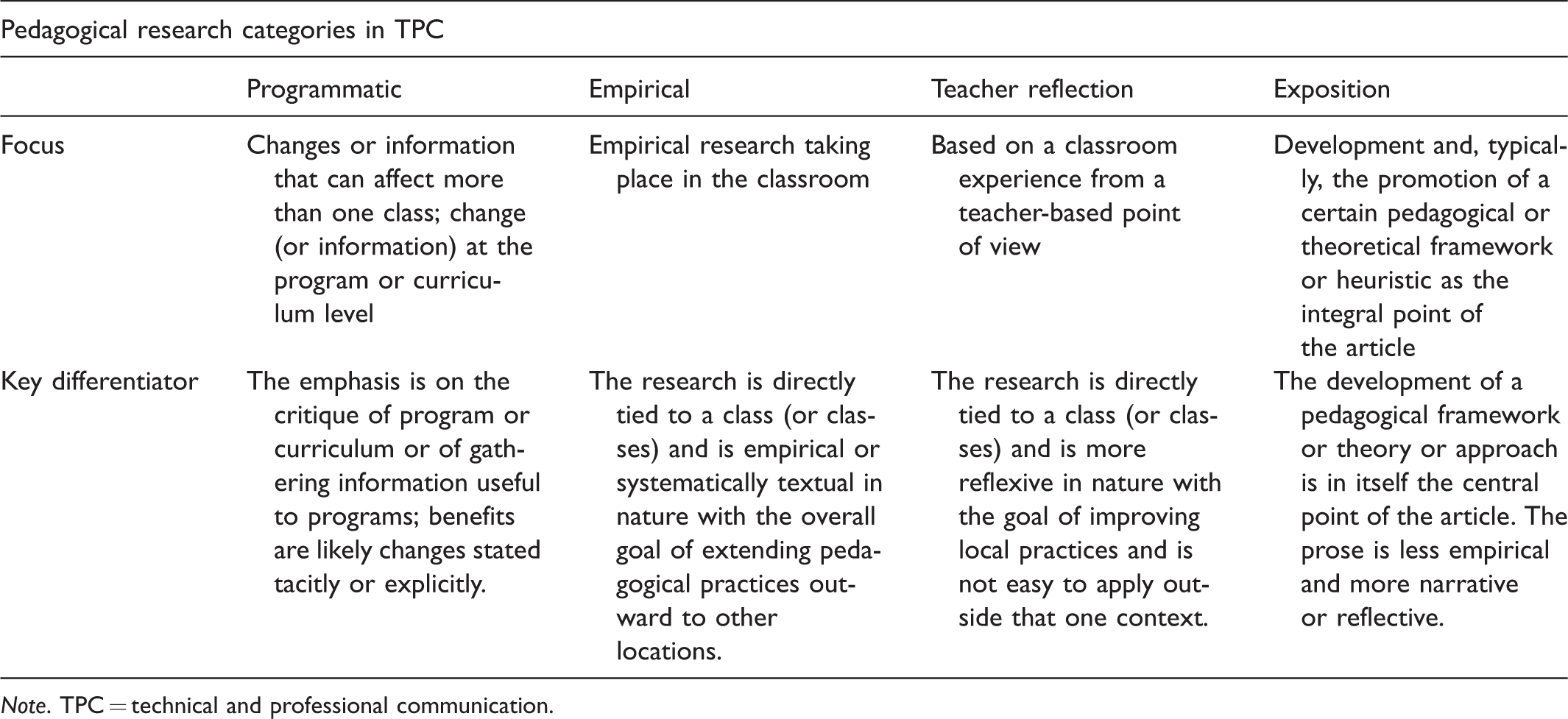
We coded articles in three ways. One was to identify the type of pedagogical research (explained in more detail later and in Table 1). A second was to identify the topic(s) of research (not included in this analysis). If the pedagogical piece was empirical, the third approach was used to determine what type of research method was used (thus building on work done by Carliner et al., 2011, and Melonçon & St.Amant, 2019). We did not use a set list or predetermined codes when engaging in these activities. Rather, we let the articles guide how we coded them in an open coding scheme. Our coding scheme for categorizing the research can be replicated in the future or—at the very least—refined for a consistent, reflexive look at pedagogical and programmatic research in TPC from 2011 to 2015. In the next sections of this entry, we confine our analysis and discussion to only these 82 articles (see online Appendix A for titles).
Types of Pedagogical Research in TPC.
Note. TPC = technical and professional communication.
RQ1: Where Is Pedagogical Research Being Published, and How Many Articles Are Being Published?
In this section, we provide an overview of the field’s pedagogical and programmatic research based upon the previous research questions. These data points provide TPC researchers with a starting point for understanding how researchers in the field have approached pedagogical and programmatic issues.
Figure 1 provides a visual overview of the number of articles published and the journals in which they are published between 2011 and 2015.
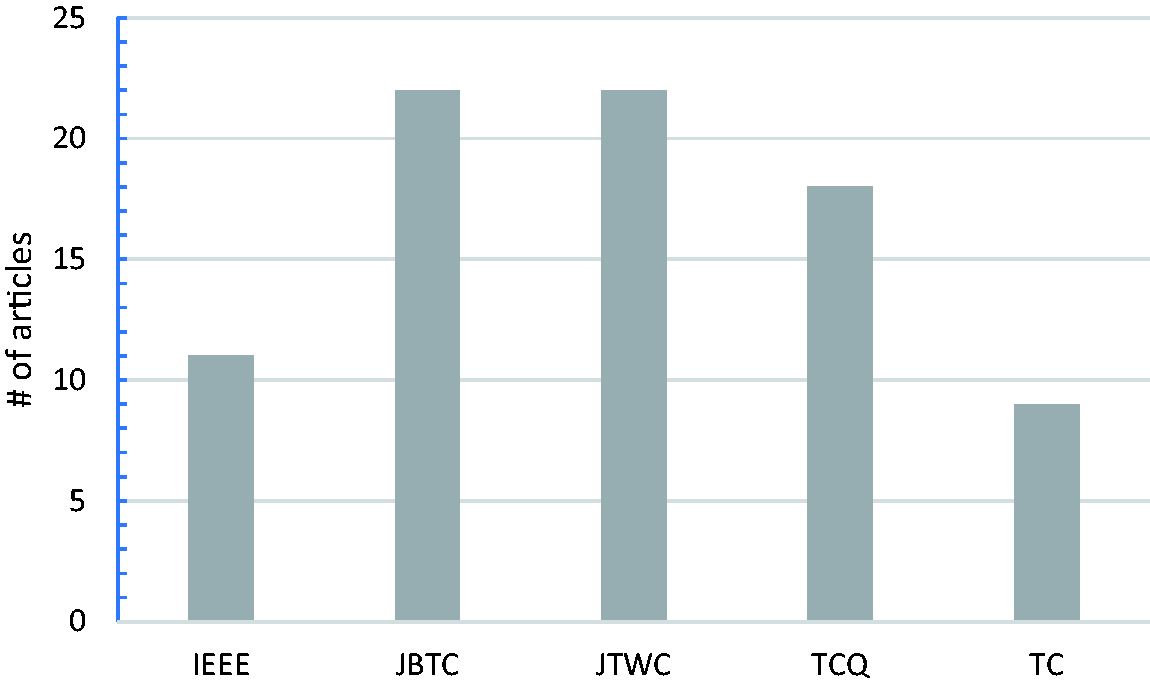
Number of articles published in each journal during the study period, 2011-2015.
Based on our review, JBTC and JTWC published the highest number of pedagogical articles (22 each), while IEEE published the lowest number (11).
Figure 2 shows the change in number of pedagogical articles published over the 5-year span.
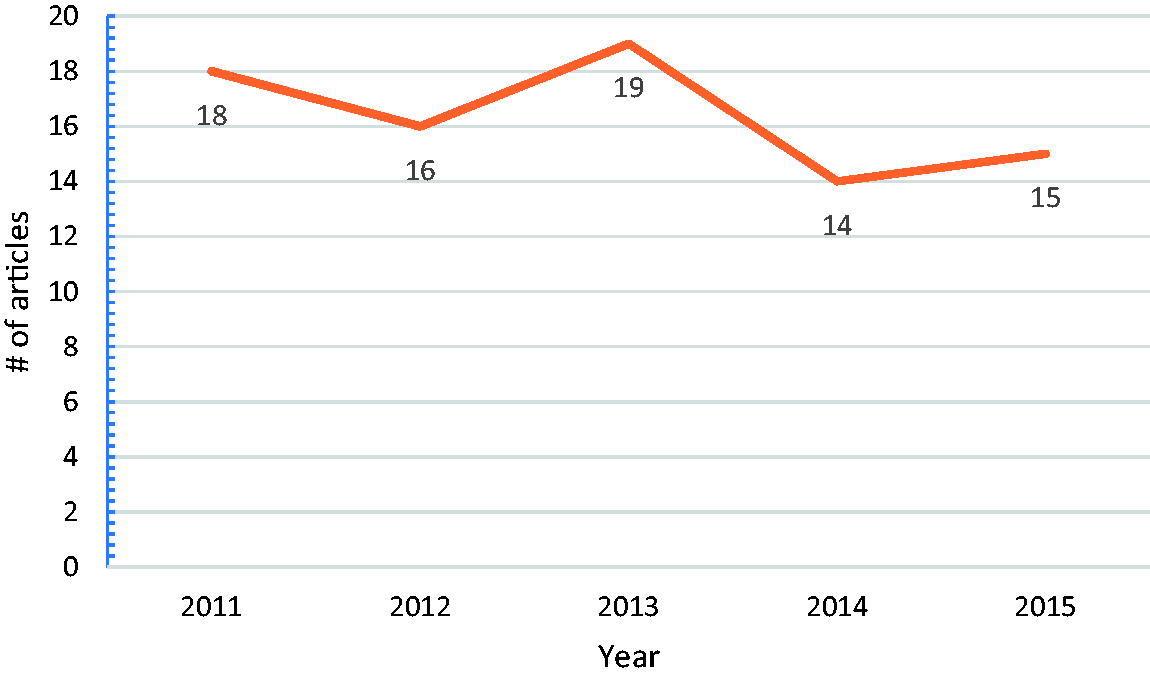
Number of pedagogical articles published per year across the five journals.
As Figure 2 notes, pedagogical articles do show some relative consistency in the numbers published within the time frame studied. This finding is not surprising since so much of the work of faculty involves thinking about or focusing on teaching, curricular development, and programmatic concerns. What’s more, the largest number of TPC programs are at teaching institutions where research about teaching helps balance publishing requirements with teaching obligations by merging them into a more effective and manageable whole.
RQ2: Can We Categorize the Types of Research Being Done to Study Pedagogical Research?
Early in the research process, it became clear we needed to categorize different pedagogical research. While the articles in our data set all related to classroom practice or programs, the approaches to researching the topic were different. As we read and discussed the research we reviewed, we could place it within a taxonomy with four categories:
empirical classroom-based; programmatic; exposition; and teacher reflection.
Being able to categorize the research from a field level was the only type of traditional metasynthesis that we could achieve. In presenting this research here, we provide TPC with a taxonomy to use when doing future examinations of pedagogical and programmatic research. Each category provides a brief definition of its primary purpose and a key differentiator that helps to clarify how the categories are distinct from each other (see Table 1).
Categorizing the scholarship allowed us to see the research differently and begin to understand the theoretical or methodological orientations of the field. Figure 3 illustrates the frequency of category type per journal. It also helped us identify TPC’s epistemological orientations to creating new pedagogical and programmatic knowledge. Charting pedagogical meaning-making practices in the field, we hope to inspire TPC scholar-practitioners to engage in conversations about how we have conducted research and how we might use enhanced versions of such approaches moving forward. Next, we provide additional explanation and examples of these categories.
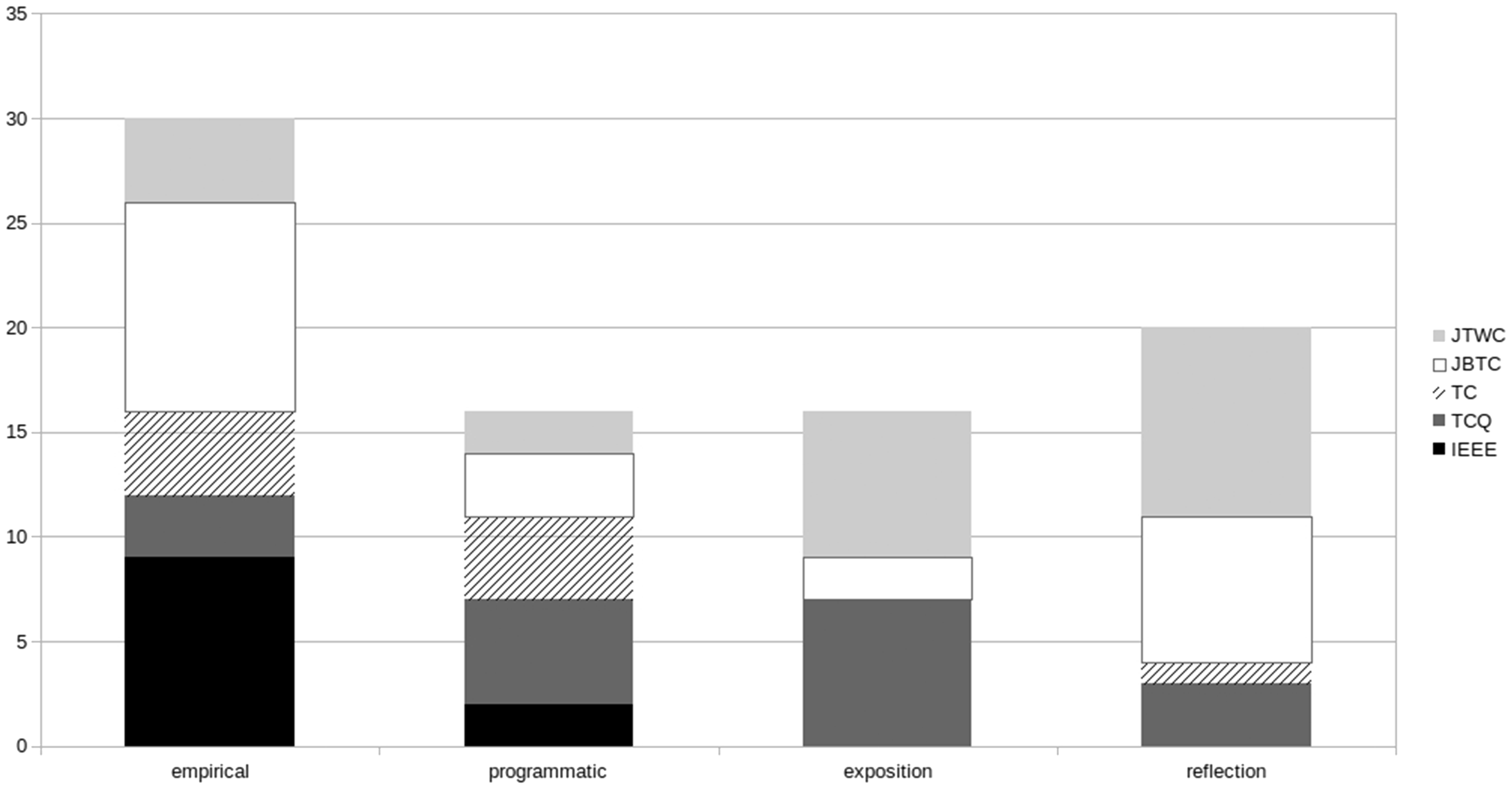
Number of article categories represented in each of the five studied journals.
Empirical Classroom-Based
Empirical classroom-based research focuses extensively on what is taking place in the classroom. Such research may be conducted through surveys, interviews, textual analysis, teacher research, or other methods, but the site of research where data are collected is the classroom or an academic learning space. This category is well represented in the study corpus, with 35% (n = 31) of the articles fitting into this classification.
One of the articles that exemplifies classroom-based research is Wang’s (2013) study examining whether teaching practices can lead to improved intercultural competencies among students. Wang’s work represents empirically based classroom research because the study design and implications reflect the type of work that offers a clear contribution to pedagogical literature in TPC. The work can be duplicated and built upon. In addition, Wang’s study:
Tested the effectiveness of a predetermined model; Used and justified a varied set of instruments; Presented her data collection practices clearly and used study instruments (such as pretest and posttest surveys) consistently; Offered solid conclusions that were supported by a robust data set (more than 40 pretest and posttest surveys based on established instruments, with additional analyses of student exercises and reflections); and Explained the pedagogical model in such a way that it can be easily used by TPC instructors.
Thus, all aspects of data collection, analysis, and interpretation for Wang’s study are connected to the classroom context.
Several of the classroom-based pieces reviewed for this project similarly reported dynamics in which the primary researcher was also the instructor of a course that served as a basis for research. This approach is not a methodological problem per se. In fact, it can offer a firsthand perspective on classroom activities—one more difficult to achieve in situations where the researcher was less familiar with the pedagogical situation.
The issue with such research, however, is the innate difficulty of extrapolating broader findings from this model, particularly when only one class is studied or the sample provides an incomplete picture of the larger population of interest. Bokor (2011), for example, used the classroom-based approach to examine technical translation practices and concepts of a generalized English that privileges aspects of the Western experience. Arguing for a World Englishes approach to teaching international technical communication, Bokor conducted surveys of 30 students in a technical writing course that he taught and interviewed some of them as well. He then used the data collected from these limited samples to assert broader curricular implications. While this project could constitute an effective pilot study, the limited data collected from one small and specific group leads to questions about how generalizable the research findings are beyond the particular class studied. Therefore, Bokor’s important work would be more impactful if the essay were framed in a way that highlighted the generalizability associated with research involving relatively small sample sizes and that called for broader follow-up study.
The same situation is the case for work that presents a practice, approach, or method for providing instruction (e.g., Tatzl, Hassler, Messnarz, & Flühr, 2012) model for collaborative cross-disciplinary technical writing instruction. While such approaches might work well in one class, without testing them in other classes—be it a similar kind of class or a completely different one—there is no way to determine how effective that approach is beyond the specific class in which it was studied. Again, such research focused on studying the dynamics of a single class could constitute an effective pilot study. Yet, without further research to test ideas and trends, generalizing findings beyond that specific context affects the portability and applicability of the important work these scholar-practitioners do when they measure the successes and failures of specific teaching models in their classes. We suggest that calling these studies “pilot” studies and offering their contributions in the form of methodological suggestions for follow-up studies would strengthen their impact. Such an approach could greatly contribute to the field by providing a body of research-based material from which larger scale research endeavors could be developed.
Methods
To increase analytical precision, and to help ensure we understood the research designs more fully, we added four areas of analysis specific to the classroom-based research category. These areas were as follows:
Whether a control group was included; Whether research was performed across sections of the same course; Whether the researcher was also the teacher of the class studied; and What kinds of texts were generated by students and then used as objects of analysis in the research.
These areas commonly applied to many (though not all) of the classroom-based research articles we reviewed. These areas are important not only because of their frequent use in the category but also because of the ways in which they potentially affected results. For example, if research was performed across different sections of the same course, each of the sections was likely to have a different instructor (e.g., Kim, Mohan, & Ramesh, 2014); having a different instructor implies differences (however nuanced) in pedagogy that could have a marked effect on results. In many studies, the researcher who wrote the article was also the classroom teacher (e.g., Albers & Marsella, 2011), presenting a whole different set of circumstances to think about. The ways in which student performance and perception were measured also varied among the studies. Some studies used surveys (e.g., Kumi, Conway, Limayem, & Goyal, 2013); others incorporated interviews (e.g., Yu, 2012, which also incorporated surveys and a written response); still others incorporated materials that were more unique within the corpus (e.g., Mehlenbacher, Autry, & Kelly, 2015, which used a feature specification or report as well as a written memo). In effect, there was no consistent method used to conduct research in such contexts, and the replicability of the work (and testing findings) does not always seem possible.
One of the areas we evaluated was whether a classroom-based study incorporated a control group as part of its design. The use of a control group normally implies that a study includes an experimental or quasi-experimental design. In the former, participants are assigned at random to a control or experimental group. In the latter, randomization of those assignments may be reduced because of the researcher’s need to control group assignment manually, the fact that true randomization may not be possible, or some other factor. In this corpus, six of the articles (20% of the classroom-based research category) incorporated a control group of some kind.
In sum,
37% (n = 11) featured studies performed across sections of the same class; 50% (n = 15) saw the researcher also as the teacher of at least one of the classes (in 3 of the articles, it could not be determined whether this was the case or not); and 30% (n = 9) featured research conducted within the same class.
Of the materials used as a basis of data analysis, some of the most common included
surveys: 53% (n = 16); interviews: 30% (n = 9); and writing artifacts of various kinds: 50% (n = 15)
Less common yet noted materials included reflections (20%, n = 6), tests (7%, n = 2), and videos (7%, n = 2). Again, such factors represent the wide and varied range of approaches used to engage in this kind of research.
Examining the research study designs of classroom-based research is important in establishing a foundational understanding of how TPC researchers are actually conducting research. Without this sort of baseline knowledge, the field cannot work toward innovating methodologically. Moreover, it cannot accurately test findings or collect the data needed to know if a process or approach has been effectively implemented or has been successful.
Programmatic
The second category of research identified was programmatic. Here, we follow Schreiber and Melonçon (2018), who define programmatic perspective as the critical review of programs involving careful deliberation on the nature of programs to better understand how and why they exist and work. Effectively engaging in such activities involves understanding that TPC programs are both locally situated and shaped by field-wide trends in academia and industry. (n.p.).
Programmatic research can be empirical or textually based. An example of empirical research using interviews can be found in Taylor’s (2011) study of how students interpret instructor feedback. As an example of a textually based study, we consider Ford and Newmark’s (2011), which involves considerations of how to incorporate an emphasis on research through their examination of students’ work on an undergraduate writing journal.
Programmatic research is also typically data-driven in some way. For example, Melonçon and Henschel’s (2013) study of undergraduate degree programs used textually based, data-driven research to enable the field to see trends in undergraduate degree programs over time. Such research also helps to illustrate the difference between the other types of research under discussion. In this case, the information and resultant conclusions are useful at both the programmatic and classroom level.
Exposition
In exposition research, the development and, typically, promotion of a certain pedagogical or theoretical framework is the integral point of the article. This framework is typically developed on other frameworks, and classroom-based research may or may not be used to bolster the theoretical arguments. An example of an exposition piece is Yu’s (2012) article that advances a definition of intercultural competence for TPC and evaluates nine methods of assessing intercultural competence. The focus of Yu’s article is definitional development and the discussion of relevant assessment methods. Another example is Saidy, Hannah, and Sura’s (2011) theoretical discussion of archival research methods and how such methods can be used in the TPC classroom.
In some cases, scholars will bring examples of their own or others’ teaching to bear in an exposition piece as a way of exemplifying the efficacy of the frameworks they discuss. Bourelle (2014), for example, discussed her own experience teaching an online technical communication course using a “Service eLearning” model to examine challenges and best practices for implementing a service-learning model in online TPC courses. In so doing, she incorporated student reflections as part of assessing the results. In this case, the discussion of the pedagogy and the analysis of student reflections were used as part of developing and promoting the pedagogical framework around which the article centers.
For exposition scholarship, as the examples show, the overall aim is to offer a conceptual or theoretical framework to pedagogical practice that should lend itself to testing of the concept or theory through empirical, classroom-based research. However, clear pathways to doing such important classroom-based research are not always present; therefore, we call for researchers to be more deliberate in setting up detailed frameworks for those who would like to test the concept or theory at hand.
Teacher Reflection
The teacher reflection became a key pedagogical research category that emerged during the authors’ research. It was, in fact, one that required a great deal of refinement as the study developed. The term teacher reflection came to denote an article based on a classroom experience from a teacher-based point of view. The research is directly tied to a class (or classes) and is more reflexive in nature. The goal of this type of research is to improve local practices. Such a focus means the nature of the research is to apply findings to one specific classroom environment (the author’s). This means the related findings are not easily applied outside that localized context, and the aim might be to inspire similar, local instructor metacognition such that new, individual insights are possible. The typical article in this category has three components:
a teaching case; a reflective component by the teacher; and an implicational component providing recommendations for future application/research.
A teaching case, like a case study, is the review of a self-contained, bounded unit of interaction that exists within certain set parameters (e.g., a point in time with a distinct start and end point) and location/setting (e.g., a classroom). What sets it apart from a “tutorial” or a “pedagogical piece” is that tutorials and pedagogical pieces focus on an assignment or activity that is part of a preset process controlled by the instructor. A teaching case involves a study of the events that took place in a class context over a given period of time (e.g., a semester/term). It is not a controlled activity, but a review of the events after the fact that took place in a given location at a particular point in time.
As such, a teaching case cannot by definition be empirical and is simply an extended example that is not necessarily research. This argument applies because the author/researcher is not preestablishing parameters and conditions to test a fixed relationship. Such testing, moreover, must focus controlling the variables individuals use to perform in a process—one they would not have undertaken unless prompted by the researcher to do so (as opposed to observing and recording original behaviors that naturally emerge within the context of a class). This is not to lessen the importance of reflective writing, of course. Instead, we highlight the importance of framing such pieces as thoughtful contemplations meant to inspire teacher metacognition within their classrooms and programs but should, therefore, not be used to promote specific approaches without a research study.
Wolfe’s (2015) article discussing the importance of rhetorical decision-making in data visualization is an example of teacher reflection. In this article, Wolfe applies Perelman and Olbrechts-Tyteca’s idea of “interpretative level” to the choices students make in creating data visualizations and writing about visualizations in informal and formal assignments. Cárdenas’s (2012) article, in comparison, presents a teaching case of students working with a community health department to effectively inform citizens of the operations of an important Texas law. In so doing, she examines intercultural communication practices and how individuals make appropriate rhetorical choices to reach their audience. In both articles, the teaching case, the teacher reflection, and the implicational component are present, despite variations in the ways the discussions of each are structured. In addition, the context of practice in each article is localized (a good example is the South Texas area where Cárdenas’s students were working and the law applied). These factors mean while the models can be adapted to other settings, the cases themselves are often difficult to replicate outside the settings where they were first used. The value they clearly do have, though, is in offering metacognitive models that instructors might use as inspiration in their own reflective critical praxis. If these essays’ contributions were described in such a way, the impact could be recontextualized.
RQ3: How Can We Improve Our Pedagogical Research Based on the Results of This Metasynthesis Analysis?
The overarching goal of a metasynthesis is to find trends and subsequently draw new conclusions about the subject under examination. We were able to create a categorization heuristic for pedagogical and programmatic research that was enabled specifically by the field-wide metasynthesis approach. The data gathering and analysis phases of the metasynthesis enabled us to participate in a reflexive research practice, which is a term coined by Alvesson and Sköldberg (2009).
1
While their work is focused on empirical research, we feel that this terminology and approach is central to all research. Alvesson and Sköldberg define reflexive research as research that includes careful interpretation and reflection. “Interpretation comes to the forefront of research work. This calls for the utmost awareness of the theoretical assumptions, the importance of language, and pre-understanding, all of which constitute major determinants of the interpretation” (p. 9). Alvesson and Sköldberg want to openly acknowledge that all data are problematic and open to a variety of ways of seeing it, perceiving it, and interpreting it. To work through the messiness of research and different interpretations, Alvesson and Sköldberg offer reflection as a way through: “Reflection can . . . be defined as the interpretation of interpretation and the launching of a critical self-exploration of one’s own interpretations of empirical material (including its construction)” (p. 9). Thus, following Alvesson and Sköldberg, we argue, reflexive research practice should be an integral part of the definition of “sustainable research” (Melonçon & St.Amant, 2019). In examining empirical research, Melonçon and St.Amant (2019) argued for a sustainable approach to research practices that included such activities as
stating research question(s) or problem(s) clearly and directly connecting explicitly to previous research and research questions rather than the standard of focusing on the “gaps” discussing data collected and how it addresses the primary research question(s) explicating methods and define terms locating methods in the framework of research study design explaining results in terms of data collected noting directions for future testing of the research. (p. 22)
It then becomes paramount for researchers to have a mechanism to provide an ongoing check and balance to the interpretation of data. In discussing reflection, Alvesson and Sköldberg (2009) are adamant that researchers openly acknowledge the messiness and subjectivity of research. Reflection as part of the interpretation process during and, as we are advocating, after the research process can provide key insights into ways to improve the design, methods, and practices of research and to make the contributions of each study clearer. Doing so would create sustainable research by helping researchers identify the kinds of information to consider and report to help others attempt to replicate/test or build upon/apply their work. “Reflexive” in this sense is taking the time to
look back and consider alternative approaches; question what went wrong or right; define the strengths and weaknesses of different aspects of the research; and clarify what the intended takeaway is for audiences.
Reflexive research is more involved than simply reflecting on the research process. Reflexive research practices ask the individual to consider the efficacy of the research question that guided a project. What we found after reading this set of articles is that TPC research does not have a clear, consistent framework for conducting pedagogical and programmatic research. More important, there is little consensus or commonality in terms of the ultimate goals of conducting this type of research. The overarching point is that TPC’s attempts to understand or to improve our pedagogical and programmatic practices could be greatly enhanced by more critical attention to such matters as replicability, limitations, strengths and weaknesses, and implications. If TPC pedagogical researchers were to build more deliberate, consistent attention to these matters in their work, the impact of their research could be stronger.
Based on the data set of research articles we reviewed, what areas should TPC consider to provoke such reflection and to enhance the good work the field is already doing? We would say they are
improve research study design; make training researchers a priority; and focus on sustainable research.
These are issues worth the field’s attention in the form of discussions, considerations, and debates via multiple channels (e.g., at conferences, through social media, and in our publications). Doing so is essential to move toward the research needed to advance scholarship—and related pedagogical and programmatic practices—in TPC as a field.
Improve Research Study Design
Research study design, of course, is a comprehensive plan that provides the rationale and justification for methodology, methods, and practices with an intense and transparent focus on ethics. It does so by aligning the research process by focusing on answering an overall research question. The idea is to first identify the question one wishes to answer via a research project and then determining what kind(s) of data one needs to collect to answer it. Once one knows the kind of data needed, the person can select the method(s) best suited to collecting such data and identify the contexts in which these methods can be used to collect the data. In this way, study design serves as a guide or map for the research project. What is key is that the study design must remain flexible enough to change when situations arise during the research project (Melonçon, 2018, p. 213). Starting at the point of a question and then systematically thinking through the design of the research study could potentially create stronger research studies.
In essence, it is worth considering that teacher research is but one model for pedagogical research. A different model, one that can potentially lead to generalizable results, is the use of control/test studies with outside researchers instead of teachers looking at their own classes. This alternate type of experimental research is research others can test in the classroom contexts of their own institutions, and it is replicable research that allows members of the field to truly engage with and act upon existing research findings. The field stands to benefit from expanding how TPC does research to include more approaches that can be replicated, tested, and expanded upon or applied.
Take Care When Drawing Research Conclusions
An important part of research study design is writing up the research. In the process of the metasynthesis, we realized two important aspects that we wish to caution researchers about. First, pedagogical researchers should be careful of overstating conclusions based on data from a single study, sample, or research design. Within TPC scholarship, this issue occurs when the researcher overpromise what results imply for other classroom settings based on a single case or small sample size (see, e.g., Lauer & Sanchez, 2011) or for programs based on a single case study (see, e.g., Cárdenas, 2012). While single cases can be useful to provide insights in local situations, and more importantly to guide the field in what questions to ask next or to inspire similar metacognition in readers, researchers need to take care in making claims where data do not support relevance of findings beyond a specific context. Rather than make the case for the applicability of the findings for other settings, why not highlight the need for other practitioners to engage in similar metacognition? If the goal is to, instead, advance a particular approach, a different approach to research design would likely be more appropriate and advantageous.
Second, TPC researchers must, of course, avoid drawing conclusions about workplace practices based on classroom research as these two contexts are, out of necessity, highly dissimilar. We wish to note that empirical classroom-based research can be valuable to understanding the dynamics of certain instructional contexts. TPC researchers, however, must be careful about making larger (i.e., extending beyond the classroom) arguments that flow from the analysis of data, or even from the premise itself. Manion and Selfe (2012), for example, used the results of case studies involving different courses to draw connections between industry practice and the use of wikis and student-involved assessment practices. They did raise valid points (e.g., stressing that the workplace context can help students develop discipline-appropriate writing and design skills). However, claims of the transferability of skills observed in these classroom-based cases to the workplace are uncertain without more detailed follow-up with a large number of participants operating in a workplace setting. While we do not discount the value of this work for pedagogical purposes, these kinds of limitations should be carefully foregrounded in the scholarship.
Make Training Researchers a Priority
Closely related to this point is that graduate programs in TPC should consider encouraging early-career researchers to challenge taken-for-granted assumptions and to create stronger and more sustainable research a greater priority. There is the concern that too many pedagogical practices and programmatic models are based on lore or limited case studies of singular sites. While there can be successes and strengths in such models, more focused study would only strengthen what is working well in such spaces. Another goal should be for TPC to push toward “self-advocacy research” 2 designed to advocate for ourselves as a vital field, as essential administrators, as critical researchers, and as praxis-committed teachers. We could move toward these goals by planning studies that will generate widely credible (i.e., testable) data that can be used to support TPC programs or pedagogy.
Importantly, well-designed self-advocacy research can be central to
challenging lore-based practices others (e.g., institutional administrators) think we should continue or adopt; and examining assessment structures or pedagogies not inclusive to all students (e.g., those with disabilities or different backgrounds).
3
The key to achieving these objectives is generating research results that can be tested—through replication—to assess their validity. For these reasons, members of the field need to rely on these methods to successfully advocate for effective teaching and administrative practices in our programs. That said, some TPC scholar-practitioners might feel underprepared to take on such work.
To address such factors, researcher training in TPC needs to include more detail and more in-depth coverage of the common methods used in high-quality, interdisciplinary pedagogical and programmatic research. Such coverage is essential to matching the research questions being asked to the available methods for addressing them. Surveys, for example, are a prevalent method used to research classroom contexts. The ease with which one can use surveys to collect and collate data, however, can lead to surveys being used in cases where they are not the best method for collecting the data needed to address a particular research question or context. By expanding our familiarity with different research methods, we can, thus, make better choices related to what methods to use when researching certain situations. Having better data, of course, will allow TPC researchers to showcase their considerable analytic and writing skills in ways that could benefit them, their students, and their institutions.
Further, the review of pedagogical and programmatic research reported here indicates the field needs to reconsider how it trains researchers—a finding consistent with Melonçon and St.Amant’s (2019) work on empirical research in the field. Much of the classroom-based research (see, e.g., Lauer, 2015; Newmark & Ford, 2012), for example, actually inverts the research process. In such cases, the researcher often must create a study that conforms to what the specific class examined is and does (i.e., create a study to fit the context) rather than creating experiments or empirical research situations designed to study a question and design an experiment/situation focused on answering that question. Said another way, much of the classroom-based research in our sample saw researchers conforming studies to the classroom context rather than the classroom conforming to the context of the research question(s). Such situations are problematic because they are difficult—if not impossible—to replicate such that testing and the extraction of generalizable findings are possible. Researchers can avoid this problem with more specific and careful attention to research study design. With more deliberate study designs, TPC pedagogical researchers will have better data from which to generate new knowledge.
Focus on Sustainable Pedagogical Research
Every field needs to take time to reflect on current practices, and a metasynthesis examination such as this is useful for providing insights into areas of strength and areas for improvement. Following recent calls (Melonçon, 2018; Melonçon & St.Amant, 2019; Schreiber, Carrion, & Lauer, 2018) for improving research, we offer three areas where we believe TPC can create more sustainable pedagogical research:
enhance classroom studies; perform multi-institutional research; and consider doing transfer research.
Enhance Classroom Studies
Our metasynthesis revealed that during the time frame we examined, only seven studies were designed to include some form of control group. Individuals can realize immediate impacts in empirical classroom-based research by using control group and experimental studies. While some may push back against the term control groups, it is difficult to make generalizable claims about improved learning or effective teaching without a baseline against which to compare results. As such, study design that includes control groups will bring more rigor and validity to pedagogical research findings. This sort of research can assist TPC program administrators and faculty with making cases about teaching writing to stakeholders outside of our home departments (e.g., service courses or writing across the curriculum situations).
In the majority of other cases published in this time frame, pedagogical or programmatic researchers attempted to design thoughtful studies. For example, Friess’ (2015) study of heuristic evaluations was used across sections. Lam’s (2013) divided students in the same class into two distinct groups, which is a form of a control. However, the small size of the sample study limits the application of the results. TPC could, thus, benefit from more research conducted across sections of the same course within the same term or, better yet, longitudinally, using the same course over multiple terms. By moving outside of singular classrooms through experimental and control group studies, TPC can build better research that could improve the field’s pedagogical approaches. As field-wide impacts cannot hope to occur with single classroom studies, the field needs to challenge its research practices to generate classroom-based research that is sustainable (i.e., that can stand up to scrutiny) and (re)usable (i.e., that can be implemented in other contexts).
Perform Multi-Institutional Research
In the early days of the field, any classroom-based research was welcomed. This was because TPC did not have any research to rely on for our pedagogical practices or to help make local arguments about curricula. For these reasons, TPC often borrowed from related fields such as composition in following their research study design. TPC, however, is no longer a brand new field. Rather, with more than 50 years of published studies, it is now time to challenge current research practices. It is, perhaps, time to insist upon much more pedagogical research that goes beyond a singular case study. Case studies occurred across all of these heuristics of pedagogy research, yet these types of studies are difficult to port to other locations. This call to action is not meant to diminish the good writing and thinking that goes into case studies in the field; instead, we wish to highlight the importance of enhancing such work with other kinds of broader study.
One way to enhance case study approaches would be to engage in projects including multiple institutions. This research is difficult, complex, and cumbersome, but it is especially needed as multi-institutional research and field-wide research offer TPC the most potential for affecting day-to-day practices (see, e.g., Veltsos & Patriarca, 2017). If TPC were to move to more multi-institutional research studies, our pedagogical questions and answers could offer insights that go beyond local cases. Without these rigorous studies, TPC could lose credibility. That is, if case studies were appropriate in the early days of the field because the field lacked other methods, those studies provided the foundation for a robust field of inquiry that is now ready to take on the challenges of multi-institutional study. If we do not begin to do this work, we risk appearing stuck in the past.
Consider Doing Transfer Research
One of the primary premises of TPC programs is that we are preparing students for future professional lives both as engaged citizens and as professionals. In fact, it is an area in which both academics and members of industry are increasingly interested (see Bridgeford & St.Amant, 2015; St.Amant & Melonçon, 2016b). Unfortunately, we have limited research that helps to prove that TPC is doing the very good work that we all know, anecdotally, it is doing. As the need to convince other stakeholders of the value of our work increases in our programs and in the academy in general, strong data to support our worth are necessary.
One area where we could focus our pedagogical and programmatic research is in transfer studies (Brent, 2011), which are studies that focus on understanding how students transfer knowledge from one context to another. Accordingly, TPC scholars could set up well-designed research studies meant to examine how well students are transferring knowledge from TPC courses (e.g., the service course) back to their own majors (e.g., Ford, 2004) or to examine how well students are transferring the knowledge from our courses to the workplace upon graduation (e.g., Schieber, 2016).
Conclusion
We have examined the pedagogical and programmatic research published in five TPC journals between 2011 and 2015. We found such research during this time period accounts for 21% of all published studies. The JTWC and the JBTC published the most studies in this area, and 31% of the studies use an empirical approach to research.
By using a metasynthesis approach, we developed a taxonomy that categorizes this research into four types: classroom-based, author exposition, teacher, and programmatic perspectives. This taxonomy provides TPC scholars with the opportunity to effectively replicate and consistently study and analyze pedagogical research in the future. In addition, the metasynthesis approach we used pointed to the necessity of a reflexive approach to examining research practices. Such approaches, in turn, lead to a series of observations on how to improve pedagogical research that included designing research studies to improve findings; focus on training researchers; take care when offering results; and focus on sustainable research, the latter of which included specific suggestions on how to perform more sustainable research. Each of these areas came to light based on the metasynthesis review of research in the field. More important, they led us to a research orientation focused on the future (i.e., what can be: here is what we need to do next to test or apply the results) instead of the past (i.e., here is what we found).
The reflective and reflexive work of a field-wide metasynthesis is important to provide the field with an critical benchmark for the field’s pedagogical and programmatic research in a way that we have not done to date and to encourage vital reflective work about research practices and processes. After all, to plan for and move into the future, one needs to start thinking of that future now. This future-looking focus is essential to using research to correct a problem, understand an issue, or apply a best practice grounded in research on a given area (such as teaching a course). Through reflective and reflexive work, TPC can move toward this future-looking orientation.
The metasynthesis and related reflexive questioning as described here can form a baseline from which we can build and challenge our own practices. In terms of how to realize such ideas, TPC researchers should
question approaches to study design to ensure the validity and reliability of the method and practice and how they relate to the research question under examination; engage in more open discussions of instructional practices and pedagogical research processes—including discussions of how such work needs to be contextualized in terms of tenure and promotion practices and external program reviews; expand research documentation practices to provide more complete discussions of the research study design used and what it entailed; rethink manuscript submission and peer-review processes to place more emphasis on explicating methods/study design and address issues of sustainability; and engage in more research focused on testing prior research results on a topic before moving on to other investigations of a topic.
At this point in its history, TPC is producing more research than ever before. Pedagogical research can potentially produce more direct results by influencing practice and guiding the next generation of practitioners (and scholars). Thus, it is important that we thoughtfully consider ways of improving research so that it is more influential to our practices. Engaging in forward-focused actions might lead to more effective pedagogical and programmatic research in TPC.
Supplemental Material
Supplemental material for A Field-Wide Metasynthesis of Pedagogical Research in Technical and Professional Communication
Supplemental Material for A Field-Wide Metasynthesis of Pedagogical Research in Technical and Professional Communication by Lisa Melonçon, Jeremy Rosselot-Merritt and Kirk St.Amant in Journal of Technical Writing and Communication
Footnotes
Declaration of Conflicting Interests
The author(s) declared no potential conflicts of interest with respect to the research, authorship, and/or publication of this article.
Funding
The author(s) received no financial support for the research, authorship, and/or publication of this article.
Notes
Supplemental Material
Supplemental material for this article is available online.
Author Biographies
References
Supplementary Material
Please find the following supplemental material available below.
For Open Access articles published under a Creative Commons License, all supplemental material carries the same license as the article it is associated with.
For non-Open Access articles published, all supplemental material carries a non-exclusive license, and permission requests for re-use of supplemental material or any part of supplemental material shall be sent directly to the copyright owner as specified in the copyright notice associated with the article.
