



Abstract
Social justice is a framework that has been at the forefront of technical communication in recent years. While social justice is often applied in participatory studies, it can also feature in studies using quantitative methods. In this study, I use corpus-based critical discourse analysis to investigate the portrayal of migrants in the World Migration Reports, the flagship publication of the International Organization for Migration. I emphasize context to bring in the social justice framework in this analysis. This study finds that the World Migration Reports represent migrants within various topoi, with a particular focus on the topos of advantage and that of danger/threat.
Introduction
Social justice has featured heavily in the technical and professional communication (TPC) literature in recent years. It has been applied to various types of projects and linked to key TPC areas such as design (Rose, 2016), intercultural communication (ICC; Agboka, 2012, 2013, 2014), and pedagogy (Jones, 2017). But what is social justice? Jones and Walton (2018) define social justice in TPC as “[investigating] how communication, broadly defined, can amplify the agency of oppressed people—those who are materially, socially, politically, and/or economically under-resourced” (p. 242). Social justice research is linked to the idea of oppression which disrespects the intrinsic worth of a person (Walton, 2016). Young (2009) notes five faces of oppression, namely, exploitation, marginalization, powerlessness, cultural imperialism, and violence. Therefore, social justice aims at amplifying the agency of people who are under threat of exploitation, marginalization, powerlessness, cultural imperialism, and violence. Or to use Walton’s notion of intrinsic worth, social justice aims at amplifying the agency of people whose very humanity is under threat.
Technical communication scholars have focused on several marginalized communities, including homeless bus riders in Seattle and issues of design (Rose, 2016), African American homebuyers and issues of plain language (Jones & Williams, 2017), marginalized communities abroad (Agboka, 2013), and migrants (Gonzales, 2018). Focusing on migration, researchers have examined documents created by migrants or those portraying migrants (Evia & Patriarca, 2012; Whitney, 2013) and migrants’ linguistic repertoires (Gonzales, 2018; Tovares & Kamwangamalu, 2017). While TPC scholars have made some foray into focusing on migrant communities, especially with language uses, no TPC study to date has focused on international documents and policies governing migrants. In this study, I use a social justice lens to focus on immigration documents created at the international level. In particular, I use a corpus-based approach to critical discourse analysis (CDA) to examine World Migration Reports (WMRs).
WMRs are the flagship reports published every couple of years by the International Organization for Migration (IOM), the leading intergovernmental organization in the field of migration. These reports address important issues about migration that would interest key actors, such as policy makers, migration researchers, and organizations and government agencies serving or working with migrants. They frame the international discourse around migration as they are published by the leading intergovernmental migration organization (i.e., the IOM). Because of their reach to key actors who directly or indirectly affect the lives of migrants, these reports are key documents for the international community of migrants.
In using a social justice approach to analyze these WMRs, I hope to illustrate how social justice can be applied to research involving large corpora. In particular, I show how a social justice lens can be used with a corpus-based approach to CDA by focusing on context. I argue that context can be a central factor in social justice-oriented quantitative research. Context here involves both the context of the texts’ creation and the context within which word analysis occurs (i.e., collocation and concordance). Examining contexts allows us to see how marginalized communities are featured in given corpora, in terms of positionality, power, and ability to act.
Thus, I examine WMRs through a corpus-based approach to CDA to shed light on how the IOM discusses migrants. This study addresses the central question: how are migrants being portrayed in WMRs? In combining corpus analysis with a focus on the context of texts’ creation and distribution, I hope to show the following: (a) how migrants are portrayed in the flagship publications of the IOM and (b) how social justice principles can be applied in CDA with corpora.
Literature Review
In this section, I offer a brief overview of the literature that guide this study. I start by discussing social justice in TPC, tracing the ways TPC scholars have been engaging with social justice. I then discuss how social justice principles can be applied to a corpus-based approach to CDA before discussing how a corpus-based approach to CDA has been used in the literature, including in TPC. Finally, I offer an overview of how TPC has studied migration. These topics will provide context for the discussion of how migrants are being portrayed in WMRs.
Social Justice in TPC
Social justice is intricately linked with human rights (Ding & Savage, 2013; Merry, 2006; Walton, 2016). Ding and Savage (2013) note the dangers of static definitions of social justice, which can lead to the same kind of exploitation associated with static models of intercultural communication. The definitions of social justice in TPC highlight the complexity of the concept (Leydens, 2012). This complexity of social justice is seen with the articles published in the TPC literature on social justice. Each of these approaches the topic in different ways, applying it with different populations and combining it with different TPC topics.
However, some common elements of social justice repeatedly appear in the literature. In TPC, social justice usually involves the following key principles:
Placing vulnerable or marginalized populations in a central position (Acharya, 2019; Agboka, 2012; Rose, 2016) Observing social inequities and proposing/taking action to address them (Jones & Walton, 2018) Examining and minimizing issues of power differentials (Ding & Savage, 2013; Frost, 2013, Walton, 2013)
Using only one of these principles does not necessarily make a study social justice-oriented. In fact, most widely cited studies on social justice (such as Agboka, 2012, 2013; Jones et al., 2016; Rose, 2016; Walton, 2016) make it a point to consider human rights at the point of designing the study rather than a tack-on. Drawing on Canagarajah (2006), Agboka (2014) notes the ways that researchers using a social justice approach might not necessarily use different methods, but that their approaches to these methods are different and this difference matters (p. 319). I should note that this movement toward social justice in TPC has roots in other disciplines that have long been working with marginalized communities and issues of power, including Latinx studies, feminist studies, and border studies among others. Agboka (2014), for instance, draws on decolonial methodologies to frame his work on participatory localization. Social justice in TPC asks us to reconsider not only who we are studying but also how we are studying what we study and how we position ourselves in that study.
A fundamental social justice principle that researchers use aims at minimizing power differentials between researchers and participants. The goal is for participants to have agency within the process of research (Rose, 2016) without overburdening them to fit the researcher’s agenda. However, Agboka (2014) cautions against the concept of “giving voice” to participants. He notes that “the act of giving voice puts the giver of voice in a position of authority and casts the recipient perpetually as a subject, and therefore an object of colonialism” (p. 303). A better approach would be to establish a collaboration between researcher and participant, whereby participants have a say in how the research is being conducted and how their data are being used. In practice, both approaches might seem the same. But the key here is the attitude with which a researcher approaches their project and their willingness to reflect on their roles as researcher and collaborator, their methods, assumptions, and positionality (Agboka, 2014, p. 442). This reflection operates on three levels: self-reflexivity (which involves “thinking, doing and facilitating change” with our rationality, intuition, and creativity), interpersonal-reflexivity (which aims at improving “our conversations and interconnectedness with others”), and collective reflexivity (which shows the “need for deepening social and political analysis that contributes to strategies for social change”; Chiu, 2006, pp. 199–200). Therefore, I would argue that a researcher interested in social justice would reflect on their own practices and rationality, their collaborations with participants and communities, as well as the potential impact of their work to enact meaningful social change. Such reflection would be a constant process throughout the research project.
Social Justice in Corpus-Based Approach to CDA
In qualitative approaches, a social justice approach often involves actively collaborating with participants to guide the research process and data collection and use. For example, following Agboka’s (2014) call to ensure that participants are involved with the research process, Rose (2016) asked her participants where they would like the research to take place (p. 434). This collaboration between researcher and participants becomes more complicated with quantitative-focused approaches because of the distance already present between researcher and participants. Even approaches like CDA, that are often classified under qualitative methodologies (Given, 2008; Weninger, 2012), include a certain distance between researcher and participants. In quantitative approaches close to CDA, like a corpus-based approach (see Baker, 2012; Gabrielatos & Baker, 2008; Hardt-Mautner, 1995), the distance becomes important. While a corpus-based approach CDA focuses on context, direct collaboration between researcher and participant is difficult because this approach focuses on large corpora of texts. As quantitative researchers can no longer tailor the data collection part to minimize researcher-participant distance (and be more socially responsible), researchers need to find other ways to enact a social justice approach. Context has been offered as a key component of social justice in cross-cultural, cross-disciplinary, and cross-organizational environments (Walton & Jones, 2013). I argue that context can also be a central factor in social justice-oriented quantitative research. As Canagarajah (2017) argues, context is inseparable from texts, especially in migration studies. A social justice-oriented quantitative study would aim at explicitly examining all facets of context. Context not only involves spatiotemporal elements, but it is also dynamic, agentative, diverse, and operates at multiple levels (Canagarajah, 2017). In this study, context is integral to the text of the WMRs. Context here involves both the context of the texts’ creation and the context within which word analysis occurs (i.e., collocation and concordance). Examining contexts allows us to see how marginalized communities are featured in given corpora, in terms of positionality, power, and ability to act.
Corpus-Based Approach to CDA
KhosraviNik (2010) draws on Van Dijk (2001) to offer something of a definition of CDA. He writes: “CDA maintains that discourse is not only a container and carrier of ideologies but is also a social action on its own. CDA is socially and politically committed” (p. 478). Therefore, CDA offers a mechanism through which discourse can be analyzed for its social and political implications. Huckin (2002a) notes that critical discourse analysts must explicitly discuss how texts influence the formation of beliefs and values (p. 26). According to Van Dijk (2001) and Jäger (2001), CDA is an approach that focuses on three key points: context, power relations, and ideology. Context includes past and present events; power relations include such questions as who has access to resources and whose ideas are being represented as well as issues of power structures that control access and representation; ideology involves the ways that discourse both reflects a version of reality and shapes that version of reality.
CDA has been used to focus on marginalized communities and examine various issues in TPC. Huckin et al. (2012) note that CDA aligns well with rhetoric and composition which often focuses on “the power of spoken and written discourse, in particular the ways in which language can be used to persuade audiences about important public issues” (p. 109). They argue that CDA shares a focus on the historical, material, and political with writing studies. Focusing on homelessness, Huckin (2002b) investigates the silences, particularly manipulative silence, present in newspaper articles on homelessness. Jones and Williams (2017) also use CDA to examine the implementation of plain language in mortgage documents, particularly for African American homebuyers. Therefore, CDA has potential to work well alongside writing studies, especially in work involving marginalized communities and social justice.
CDA does not have any fixed method for data collection and analysis (see Jäger, 2001; Meyer, 2001; Wodak, 2001). CDA pioneers and practitioners often offer possible methods or analytical guidelines while generally emphasizing the multiplicity of methods possible. Therefore, a corpus-based approach is only one possible method among many others that has been used with CDA.
A corpus-based approach offers an important advantage: It helps address some of the criticism CDA faces (see Baker, 2012; Gabrielatos & Baker, 2008; Hardt-Mautner, 1995; Mautner, 2009). CDA studies often face the criticism that they use arbitrary selection of texts and that the number of texts are too small to allow helpful patterns to emerge (Gabrielatos & Baker, 2008). Combining corpus linguistics to CDA can address these limitations by using a greater number of texts that might more reliably allow patterns to emerge (Gabrielatos & Baker, 2008).
A corpus-based approach to CDA has been particularly helpful in studies focused on migrants (Baker & McEnery, 2005; Fotopoulos & Kaimaklioti, 2016; Gabrielatos & Baker, 2008). For example, Baker and McEnery (2005) studied the negative discourse around refugees and asylum seekers in British newspapers and texts from the Office of the United Nations High Commissioner for Refugees website, which were published in 2003. Similarly, Gabrielatos and Baker (2008) studied the discursive construction of refugees and asylum seekers in British newspapers, published from 1996 to 2005.
While corpus analysis has long been used by linguists, it is an emerging approach in TPC. Brown and Aull (2017), for example, use corpus methods to study student writers transitioning into U.S. postsecondary writing. Drawing from rhetoric and discourse studies and using corpus analysis, Cramer (2008) examines the nominal uses of “public” to describe a group of people, focusing on definiteness, nonassignability, and anthropomorphism. Writing within the body of work on ICC, Hua et al. (2017) use corpus linguistics along with “situated meaning” approach to study how intercultural communication and the notion of culture are framed in on-line promotional discourse of higher education intercultural communication courses. They write: “A central assumption [of situated meaning] is that words do not have meaning outside of the communicative practices invoke and it is through the analyzing an item in particular contexts of use that underlying meanings and ideologies can be inferred” (Gee, 2005 as cited in Hua et al., 2017, p. 285). This understanding of “situated meaning” aligns with the strong emphasis on context found in CDA approaches. Therefore, CDA and corpus analysis have potential within TPC.
CDA is particularly useful for this study because of its focus on context and power relations, especially in relation to marginalized communities (including migrants). Given CDA’s focus on the political as well as social, this approach is also particularly salient for the study of IOM’s flagship publications (the WMRs), which often guide international discourses and policies on migration. Finally, a corpus-based approach allows us to study the entire body of IOM’s WMRs, which number about 3,000 pages, to find emerging patterns surrounding the portrayal of migrants. Therefore, a corpus-based approach to CDA is ideal to address our central question of how migrants are portrayed within the IOM’s WMRs.
Migration and Technical Communication
Migration has been a constant in human history. People migrate due to various push/pull factors, including conflicts/wars, climate change, environmental disasters, and economic and social opportunities (Reed et al., 2016, pp. 609–610). Migration in all cases can be circular (e.g., seasonal agricultural workers), short term (e.g., international students), and long term (e.g., permanent residents). Canagarajah (2017) notes that capitalism has appeared to provide more scope for migration, but “it comes with its own boundaries to channel the flows in specific ways, giving access to certain people to certain spaces” (p. 4). Migration thus tends to reproduce and emphasize existing inequalities (Canagarajah, 2017; Faist, 2016). Drawing from Brubaker (2014) and Shachar (2009), Faist (2016) notes that traits such as education, language acquisition and citizenship status tend to influence these inequalities (p. 330). Migrants thus face particular inequalities intrinsically linked to their situation as migrants (i.e., in terms of education, language acquisition, citizenship status).
Given the growing number of people migrating worldwide and in the United States, it is imperative to turn our TPC research lens to migrants and their needs. Migration studies is an interdisciplinary field of study, encompassing linguists, sociologists, economists, geographers, historians, and many others. Each field has focused on key aspects of migration within their disciplinary expertise. While having made some foray into migration studies, TPC is still somewhat lagging behind on studies focused explicitly on migrants, especially the documents and policies surrounding them, despite being strategically positioned to study communication contexts in migration. Later, I discuss the ways that writing studies and communication (in which I am including applied linguistics and the broader writing studies area) have engaged with migration.
There are three broad areas in the nexus of migration and communication, namely, in language, translation, and information and communication technologies (ICTs). These three areas often encompass different spaces (e.g., workplaces, classrooms, cities, borders) and different groups (e.g., workers, patients, city-dwellers, slaves and their descendants, indentured laborers, and their descendants) and aim at different purposes (e.g., personal communication with family, policies governing migrant bodies, news articles for the general public).
Studies focused on language often include discussions of metrolingualism and translingualism (Canagarajah, 2018; Dryer, 2016; Gonzales, 2015; Heugh, 2017; Horner et al., 2011; Hurst, 2017; Lu & Horner, 2016; Sharma, 2018; Verzella & Tommaso, 2014). While discussing translingualism, some studies do not explicitly refer to migrants. Yet, their findings are eminently applicable to migrants. Language-focused studies include discussions of migrants’ linguistic repertoires and identities (Tovares & Kamwangamalu, 2017) and issues of language maintenance and new language formation in the case of pidgins and creoles (Mesthrie, 2017). While focusing on classrooms and communities, language-focused studies also sometimes feature policy. For example, Whitney (2013) analyzes the portrayal of migrants in The 2010 Citizens Clean Elections Voter Education Guide, a document made available to the Arizona public prior to the 2010 state general elections.
Studies focused on translation often feature health-care contexts and global workplaces and technologies (Bloom-Pojar, 2018; Gonzales, 2018; Gonzales & Zantjer, 2015; Maylath et al., 2015; Pigozzi, 2018; St. Amant, 2019; Sun, 2006).These works often put translation in conversation with intercultural communication and social justice. For instance, Gonzales (2018) draws on social justice, translation, and disability studies to discuss designing accessible digital research for audiences from broad linguistic backgrounds.
Studies focused on ICTs mostly focus on migrants’ use of social media before, during, and after their migration. Migrants often use social media for interpersonal communication through their personal network (Charmarkeh, 2013; Dekker et al., 2018; Fiedler, 2019). However, ICTs present dangers to migrants, including false information, surveillance by state actors, and nonprofit organizations (Borkert et al., 2018; Dekker et al., 2018; Gillespie et al., 2016). Migrants have also used social media, such as Facebook, to position themselves legally, socioculturally, and politically (Witteborn, 2015). ICTs-focused studies include work on the representations of migrants on social media. For instance, Perreault and Paul (2018) analyze the visual portrayal of Syrian refugees in “Humans of New York,” a Facebook group.
While the studies discussed earlier have begun examining the role of language and communication tools in migration, much work still needs to be done, specifically within TPC scholarship. This topic is also particularly kairotic in the sense that migration has been at the heart of several national and international discussions. It is the right time to devote more time as technical communicators to this important and varied group of people.
Methods
To understand the portrayal of migrants in WMRs, I first collected all nine WMRs published from 2000 to 2019 on the IOM’s website. They are available in five languages (Chinese, English, French, Portuguese, Russian, and Spanish). I downloaded the English versions of the reports.
Because a social justice approach emphasizes the context within which social justice work is being conducted (Walton & Jones, 2013), I have turned to three areas for context: (a) the circumstances around the creation of these WMRs, their authors, and expected audiences; (b) the contexts around the key words occurring alongside key terms (i.e., collcoates); and (c) contexts of the Migrant Voices sections in WMRs (2013) and (2015). For the contexts of the WMRs’ composition, I turn to information published on the IOM’s website as well as the WMRs’ metadata.
For the key word analysis, I used Antconc (https://www.laurenceanthony.net/software/antconc/), a freeware corpus analysis program created by Laurence Anthony. Anthony is an applied linguist whose work focuses on corpus linguistics, educational technology, natural language processing, and genre analysis. He has created several freely available tools for use in corpus linguistics, which he published on his website.
Antconc includes tools for finding concordance as well as for textual analysis. It also allows for such functions as finding clusters and collocates. One advantage of using Antconc is that it can rapidly process a large number of .txt files. For instance, in this study, there were nine files overall, with each file averaging 327 pages (see Table 1).
Number of pages per report and average.

For the corpus analysis, I identified collocates of the following terms: *migrat*, *migrant*, asylum seeker, expat*, displaced pe*, refugee*, *alien*, foreigner*, settler*, colonist*, citizen*, national*, native*, andemigrant*. I chose these terms as they are synonyms commonly used with “migrants” according to thesaurus.com, merriam-webster.com, and Google search dictionary (which is based from Oxford Dictionaries). The asterisk (*) in the search terms earlier indicates that the program will look for all variations of these terms. Laurence Anthony (the creator of Antconc) describes the asterisk as a wild card. For example, *migrat* will render results for migration, immigration, emigration, migrate, immigrate, and emigrate, as well as all conjugated verb forms of the key part “migrat.” Collocates of these search terms provide the context within which these terms occur by showing alongside which terms they occur.
To find patterns of words occurring together, I used the clusters tool in Antconc. This feature allows us to find how often groups of words occur together. Combining the clusters results with the concordance tool allows us to find the context around top collocates occurring with the search terms.
Finally, I examine the stories featured in sections labeled “Migrant Voices” in two of the reports (2013 and 2015). These sections address specific areas of a particular individual’s migratory experience and feature direct quotes from the featured migrants.
Results and Discussion
In this section, I discuss the results of the analysis. I first examine the IOM and the WMRs, focusing on the contexts surrounding their creation. I then discuss the results of the corpus analysis. Finally, I examine the “Migrant Voices” sections in WMR (2013) and (2015).
About the IOM
The IOM, established in 1957, is the leading intergovernmental organization in the field of migration. It was first created as an operational logistics agency after World War II to address the displacement of people in Europe. Over the years, its functions and size grew, making it the main international organization involved in migration. The IOM works with both governments and civil society. The organization’s operating budget is about $1.5 billion (IOM, 2020a). Although not a UN agency, the IOM is closely related to the UN.
As the main international migration agency, the IOM’s goal is to: help ensure the orderly and humane management of migration, to promote international cooperation on migration issues, to assist in the search for practical solutions to migration problems and to provide humanitarian assistance to migrants in need, including refugees and internally displaced people. (“About IOM” page [IOM, 2019a])
They go on to identify their areas of operation as: migration and development, facilitating migration, regulating migration, forced migration, promoting international migration law, policy debate and guidance, protecting migrants’ rights, migration health and the gender dimension of migration.
The IOM includes 173 member states and 8 observer-status states. They have a substantial global physical presence, numerating offices in more than a hundred countries. They have over 10,000 staff members operating in these offices. These staff members come from all over the world, including nonmember countries (IOM, 2020b). In recent years, the IOM has sought to improve its gender balance, especially among its upper level professional staff (P-5) although there is still much work to be done in that area (IOM’s Annual Report 2018, IOM, 2019e).
The IOM states that it serves both governments and migrants (“About IOM” page, 2019). On their mission page, they add to their list of goals that they work to “uphold the human dignity and well-being of migrants” (“Mission” page [IOM, 2019d). Despite this stated goal, the IOM has helped governments to the detriment of migrants. Human Rights Watch (2019), for example, notes in late 2019 that the IOM has been facilitating the transportation of asylum seekers forced to wait in Mexico due to the U.S. State Department’s “voluntary return” program back to their country of origin. Human Rights Watch notes that the IOM did so without notifying U.S. immigration judges, which “most likely [resulted] in negative judgments against asylum seekers for not appearing in court, possibly resulting in a ban of up to 10 years on entering the US again, when they could have withdrawn their cases without penalty.” In this case, the IOM appears to be serving governments more so than migrants.
Therefore, while the IOM frames its mission within the language of “human dignity” which relates well to the language of social justice, we must ask ourselves whose dignity they are preserving, whose rights and interests they are protecting. In the context of this study, these questions mean that we need to ask ourselves whether their framing of migrants indeed aligns with preserving human dignity.
IOM’s WMRs
The Migration Policy Research Division, which is part of the Department of International Cooperation and Partnerships, is responsible for conducting and managing applied research on migration topics (“Migration Research” page [IOM, 2019c]). This Division is also responsible for publishing its findings in various publications, including the WMRs.
The WMRs are the flagship publications of the IOM. The first WMR was published in 2000. Since then, the IOM has published a WMR every 2 years or so, namely, in 2000, 2003, 2005, 2008, 2010, 2011, 2013, 2015, and 2018. There are nine total WMRs. The latest WMR is scheduled to be published in 2020. The first WMR was published to respond to “a specific need expressed by the IOM membership for up-to-date information and documentation on international migration” (“About IOM Publications” [IOM, 2019b]).
Authorship
The WMRs are highly collaborative documents, with large teams of authors and editors. Each chapter in the WMRs usually has its own team of main contributors and research assistants. The editors often form part of the main contributors for each chapter.
For example, WMR (2018) has a large team of over 20 contributors, editors, reviewers among others. This collaboration involves individuals coming from various institutions, including the IOM and various academic institutions. For example, the two editors, Dr. Marie McAuliffe and Martin Ruhs, are from different organizations. Dr. Marie McAuliffe is the head of the Migration Policy Research Division, while Martin Ruhs is Chair in Migration Studies and Deputy Director of the Migration Policy Centre at the European University Institute in Florence. He is also an associate professor of political economy at the University of Oxford.
While the WMRs are the flagship publications of the IOM, each of the publications, except for WMR (2003), contains a variant of the following statement: The opinions expressed in this report are those of the author and do not necessarily reflect the views of IOM. The designations employed and the presentation of material throughout the report do not imply the expression of any opinion whatsoever on the part of IOM concerning the legal status of any country, territory, city or area, or of its authorities, or concerning its frontiers or boundaries. (WMR, 2018, p. ii)
This statement is first featured on the second page of the report and then repeated on page ii. This disclaimer might be positioned twice near the start of the WMRs to circumvent any potential legal issue or as an administrative expedient intended to direct contentious issues to the authors of the report. Yet, it gives a sense that the statements and findings of the WMRs are the sole responsibility of the authors, and not the IOM. In short, it shows that the IOM does not stand behind the WMRs, which is problematic as these reports are meant to serve as the IOM’s flagship publications. In writing this disclaimer in such a strategic place on the document (i.e., first on the very first page after the cover and then repeated on p. ii), the IOM takes away the authoritativeness of the document and places its ethos solely on the reputation of the authors.
The statement also contradicts what the IOM Director General, William Lacy Swing, states a few pages into WMR (2018). He notes: In this era of heightened interest and growing activity affecting migration and migrants, we hope this 2018 edition of the World Migration Report, IOM’s flagship publication, is a close companion and a useful reference. We hope it helps you to make better sense of this challenging and dynamic topic as you endeavour to carry out actions and interventions that serve to improve the situation of migrants and the societies in which we all live. (WMR, 2018, p. xi)
In his message for the WMR (2018), he notes that WMRs are the flagship publications of the IOM and highlights his hope that its users would lean on it to get a better sense of migration. Thus, he, as Director General of the IOM, seems to stand behind WMR (2018) despite the earlier warning message. Overall, these contradicting sentiments do not help toward trust-building with readers.
Audiences
The stated audiences for these WMRs are researchers, policy makers, and governments. In short, these reports are intended for people and entities who either study migration topics or set migration topics. These reports are not targeted toward migrants. This is particularly interesting given that the IOM’s stated goal is to serve both governments and migrants. The content of the reports mirror the needs of this audience as the focus is on migration trends as well migration topics/issues at the national or international level. That is, they do not include information that a migrant could use to facilitate their migration. Unfortunately, most of the major IOM publications on their bookstore are similarly targeted toward researchers and policy makers. I should note that the WMRs are freely available on the IOM website, which makes them more accessible to all researchers, policy makers and governments.
Now that I have offered an overview of the context around the documents’ creation, I turn to the results from the corpus-based CDA.
Corpus-Based CDA Results
To identify the different categories of arguments informing the portrayal of migrants, I will draw on Reisigl & Wodak (2001), who identified various topoi around anti-foreigner discourses. These include topos of advantage/usefulness, topos of danger/threat, topos of definition/name interpretation, topos of burdening/weighting down, topos of law/right, topos of culture, topos of abuse, and topos of authority. I will trace the presence or absence of these topoi in the collocates around the search terms described earlier.
Frequencies
First, I will turn to the frequency of each proposed search term. Table 2 shows the frequency with which the search terms occur within all the documents.
Frequency of search terms.

The search term colonist* and any of its variations did not occur within any of the WMRs. Surprisingly, all the other variants around migration, such as refugees, foreigners, and citizens, occurred within the documents. This draws our attention to the multiplicity of terms regularly used by migration experts. It is thus important to distinguish between each term when discussing migrants. For example, the term migrant* (10,765) occurs much more frequently than the term emigrant* (259). The authors of the WMRs, then, seem more concerned with immigration than emigration, therefore with countries receiving migrants rather than those losing migrants. Similarly, terms like alien*, while featuring heavily in media accounts of migrants, occur rarely within the reports (only 48 times). This shows that the authors of the WMRs and the IOM itself tend to use terms that have fewer negative connotations.
The question remains though: why does the IOM use the term *alien*?
Alien* and Its Implications
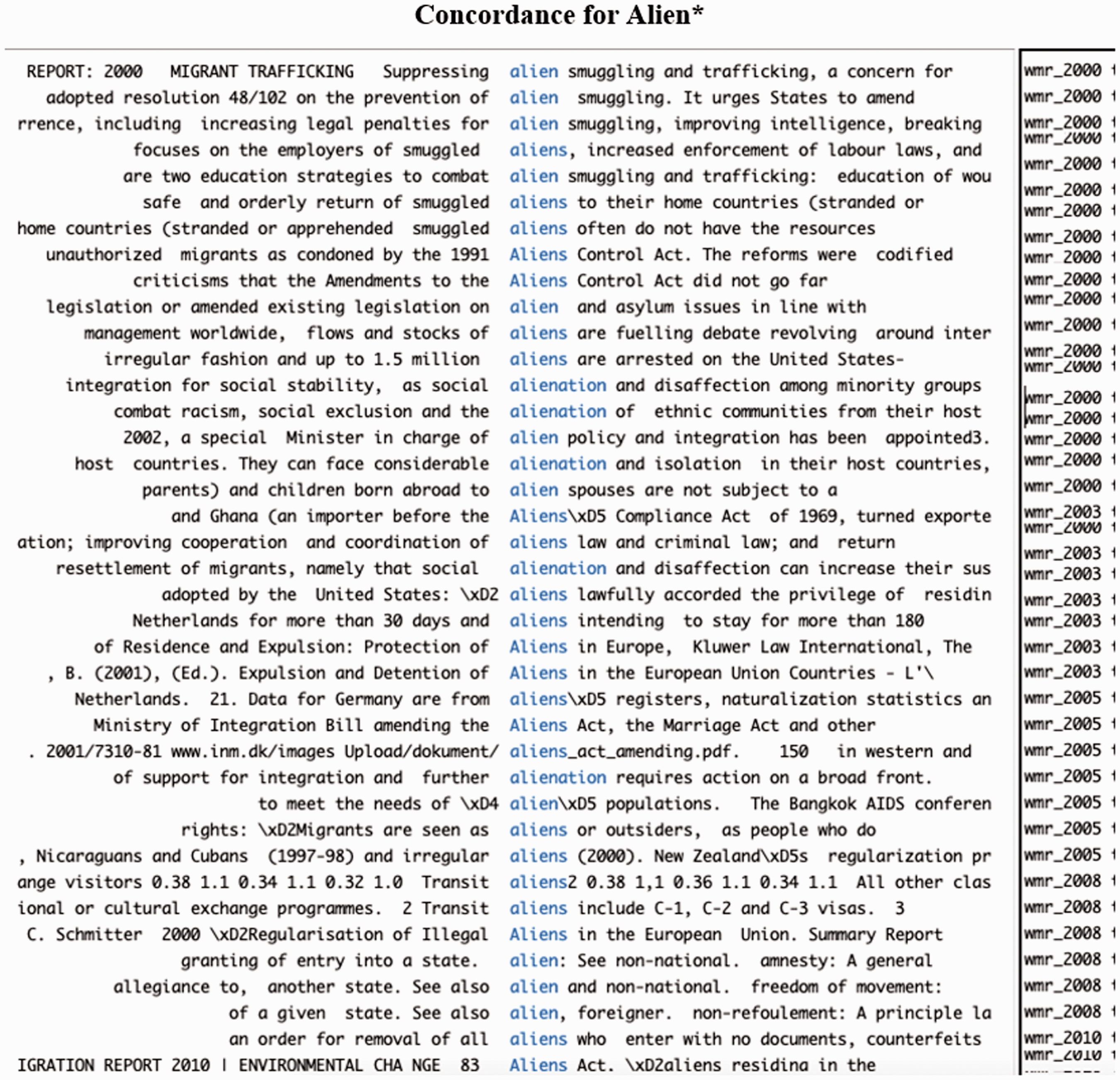
The IOM uses the term alien* 48 times—a negligible number considering the large number of words in all WMRs. Yet, its presence in these official documents is troubling. Figure 1 shows the concordances around this term.
Concordance results for the term alien*. Concordance for alien*.
Figure 1 shows that the term “alien” is often used alongside issues of smuggling. The greater context within which each instance of “alien” occurs in the original files shows that the IOM uses the term “alien smuggling” synonymously with “migrant smuggling.” This smuggling involves both voluntary smuggling and forced smuggling. The first involves people contacting smugglers, who will provide such things as fake documents, for their migration needs. The latter involves people smuggled against their will or people who may have been recruited under false reasons (such as recruiting women for work abroad and then forcing them into prostitution). Within WMR (2003), the term “alien” occurs most often when the authors are discussing the United States. For example, the authors mention 9/11 and then use the word “alien” rather than “migrant” (p. 25). Similarly, they discuss “aliens” being arrested along the U.S.–Mexico border rather than “migrants” (p. 60). In all cases, “alien(s)” are often used in legal contexts, such as when referring to certain laws or agreements (e.g., Aliens Act, aliens law, etc.), and they are also used with a somewhat negative frame. The migrant is not presented as a person with agency; rather, framing the migrant as “alien” allows them to be seen as subjects (of laws, smuggling, etc.).
Alongside “alien(s),” variations of the term alienation also occur within this search. Alienation carries both negative and neutral connotations. In some instances, alienation is used with the idea of migrants needing integration (e.g., WMR, 2005), thus highlighting that migrants are not part of the host community and that the migrants are to blame for not being integrated yet. In others, alienation is used as migrants facing isolation from their host communities (e.g., WMR, 2003), thus implying that the host communities are not open to migrants. Therefore, alien* gives at best neutral connotations and at worst, negative impressions of the migrant. Equally, it gives at best neutral connotations and at worst, negative impressions of the host community.
Collocates by T-Score
Collocates provide insight into the context around which key terms occur as they note the words that occur most frequently alongside these key terms. The words are ranked by using a statistical measure: the T-score. Harper Collins Dictionary defines the T-score as “a measure not of the strength of association but the confidence with which we can assert that there is an association.” Table 3 shows the collocates occurring with each key term as well as the order in which these collocates occur.
List of Collocates per Search Term (Sorted by T-Score).
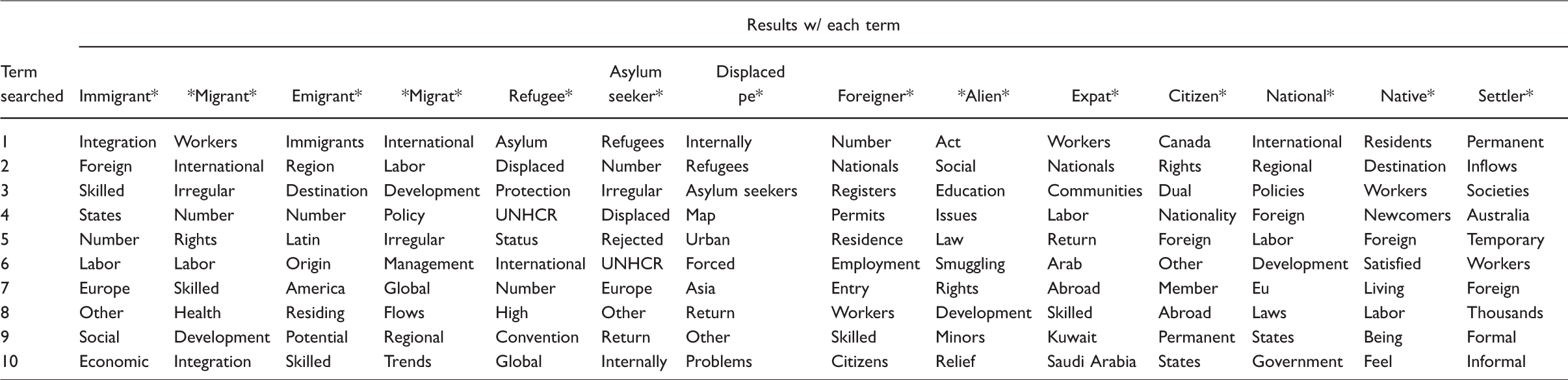
As the term colonist* does not occur in the WMRs, the column for this term has been removed from Table 3.
The first striking element in Table 3 is the top collocate “integration” occurring with the search term immigrant*. This collocate suggests that the idea of integration is a key factor of immigration in the WMRs. Extending the list of collocates rankings beyond Table 3 shows that integration also occurs alongside asylum seeker*, alien*, citizen*, and national*. However, the collocate “integration” remains absent around terms such as expat* or emigrant* or foreigner*. Expatriates are often used for migrants who are often either wealthier or higher skilled (otherwise the literature often references migrants working in a foreign country as labor workers). It seems that the IOM, or its member countries, is not concerned with the integration of expats as much as they are with the integration of other migrants who are less highly regarded. This would suggest that migrants who are perceived as being in a different category as other migrants, such as expats, are not associated with the topos of danger/threat to the community, that is, they are not in need of integration. There are some exceptions to this, as I will later describe (especially with Arab expats in Gulf Cooperation Council [GCC] countries). While expats are generally regarded in a less negative light than other migrants, I should note that they are not immune to exploitation (as I will show during the discussion of the collocate “workers”). Overall, these differences in terms associated with particular migrant groups is a surprising take-away from the IOM WMRs given IOM’s goal of promoting the rights of all migrants. One would not expect such discrimination among categories of migrants.
Another category of particularly interesting collocates in Table 3 relates to the notion of labor. These include “labour,” “skilled,” “economic,” “workers,” and “employment.” All these terms related to labor reflect the importance the IOM places on the question of migrants as economic workers, contributing to countries’ economies. Finally, the mention of specific countries’ names in Table 3 is particularly intriguing. The countries/continents mentioned include the United States/America, Europe, Asia, Kuwait, Saudi Arabia, Canada, and Australia. While the WMRs mention various other countries throughout, the countries mentioned earlier are those that occur the most frequently with our search terms. Note that while the United States/America and Europe occur repeatedly across search terms in Table 3, Asia occurs only under displace pe*, Kuwait and Saudi Arabia occur only under expat*, Canada occurs only under citizen*, and Australia occurs only under settler*. This suggests that particular migrant types are typically associated with certain countries. For example, expatriates are typically associated with the Gulf states such as Kuwait and Saudi Arabia.
Now I turn to the collocates that occur alongside various search terms. Table 4 shows a list of collocates occurring under multiple search terms. Table 4 omits any collocates that appear under only one search term. These collocates were omitted because they do not apply to multiple categories of migrants, and therefore, they are less relevant in describing the overall portrayal of migrants. They are also less helpful in allowing for comparison among migrant groups. I should note that although the collocates in Table 4 occur under various search terms, they do not occur in the same order under each term (see Table 3).
Collocates occurring under multiple search terms.

Based on Table 4, I will examine in more detail the top six collocates that occur most frequently across search terms. These include foreign, number, labor, other, skilled, workers. Table 4 shows under which search terms these collocates occur.
Concordances for Collocates
In this section, I discuss the top collocates from Table 4 and their concordances.
Concordance for Collocate “Foreign”
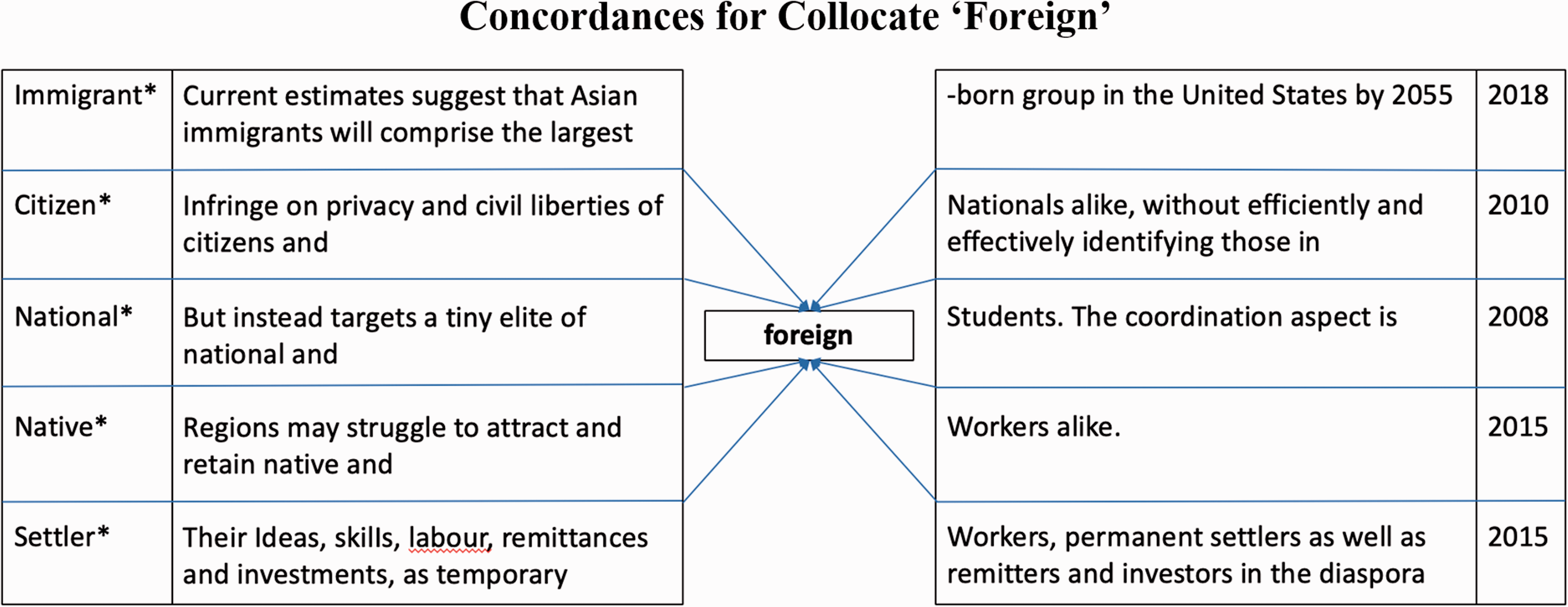
The collocate “foreign” occurs with the search terms immigrant*, citizen*, national*, native*, and settler*. The collocate “foreign” features mostly in the topos of advantage, but it also sometimes features in the topoi of burdening, danger/threat, and law/right. Figure 2 shows that foreign is often associated with workers and students. The concordances for each search term and “foreign” reveal that foreign is often set as a comparison point between those already in the country (nonmigrants) and migrants. Sometimes, this comparison is framed within the topos of burdening as with the term immigrant*. The concordance positions Asian immigrants as a growing group of foreigners in the United States.
Concordances for top collocate “foreign.”
At other times, the WMRs draw parallels between citizens and foreign nationals. The concordance with citizen* highlights states’ use of tracking systems (such as registration requirements, checks of identity documents, etc.) as “[infringing] on privacy and civil liberties of citizens and foreign nationals alike” (WMR, 2010, p. 36). The report describes these tracking systems as “particularly problematic when they appear to involve racial, ethnic or religious profiling” (WMR, 2010, p. 36). While the tracking systems are designed to track immigrants, it can inadvertently also impact the civil liberties of minorities (who are citizens) who are profiled during these checks. This case positions states who use tracking systems within the topoi of abuse and danger/threat even while suggesting that they are operating within the topos of law/right as the IOM does not control how states manage their immigrant populations. This positioning also puts immigrants in the topos of danger/threat as WMR (2010) acknowledges that those systems are used (ineffectively) to “[identify immigrants] in the country or engaged in employment without proper authorization” (p. 36).
The concordance around national* and “foreign” also highlights the parallels between foreign students and national ones in exchange programs. This example is intriguing in that it positions both types of students as “elite.” Even while pointing out the privilege of these students who engage in these exchange programs, the authors of the report still point out that “foreign students are expected to return to their country of origin and are not infrequently barred from remaining in their host country for more or less extended periods after completing their studies” (WMR, 2008, pp. 114–115). Therefore, while these “elite” foreign students are welcome for short periods of time, they are not to burden host countries for extended periods. This case shows that foreign students are seen within the topos of advantage while those who overstay their welcome are seen within the topos of burdening if not danger/threat.
The context around the search term native* is the following: Skilled migrants, business investors and foreign students tend to be attracted to vibrant metropolises, financial hubs or high-tech clusters, while other regions may struggle to attract and retain
In this case, WMR (2015) clearly positions immigrants within the topos of advantage. They are needed to attend to the “needs of the communities.” This need for immigrant labor is a significant and constant thread throughout the WMRs. The last concordance discussed (with settler*) also relates to another dimension of labor: remittances and investments. The economic dimension of immigration is a topic that has been at the forefront of topics of interest to the IOM and its member states.
Concordance for Collocate “Number”
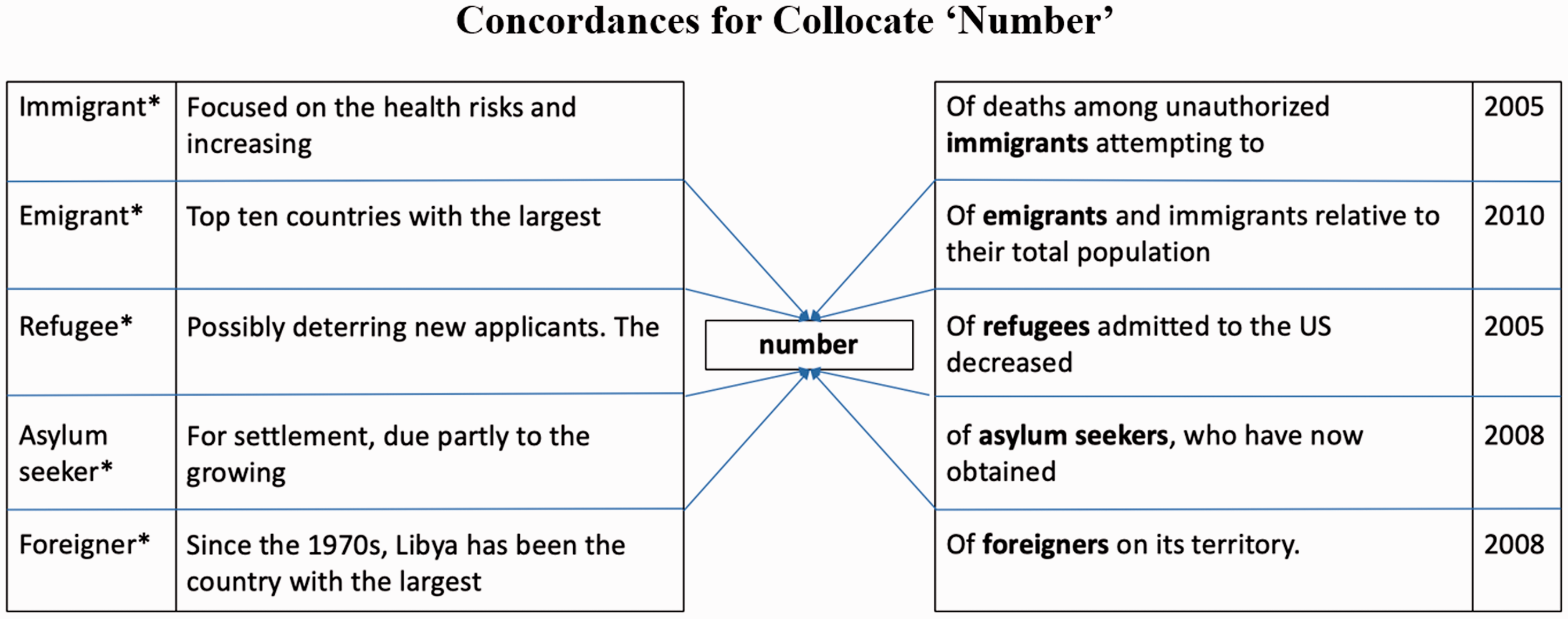
Figure 3 shows the concordances for collocate “number.” This collocate occurs with immigrant*, emigrant*, refugee*, asylum seeker*, and foreigner*. The collocate “number” is often portrayed within the topoi of danger/threat and law. This collocate aims at quantifying migrant populations. The WMRs sometimes couple the collocate “number” with the words “increasing,” “growing,” “largest,” and “decreased” (for the number of refugees admitted to the United States). The context around the outlier with “decreased” is the following:
Concordances for top collocate “number.”
Refugee applicants and their identification documents are now subject to additional background checks as well. These actions have been criticized for unduly hindering the timely protection of those seeking refuge and possibly deterring new applicants. The number of refugees admitted to the US decreased from 68,426 in 2001 to 28,455 in 2003. (WMR, 2005, p. 87)
In this case, this decrease in the number of refugees, while criticized, is portrayed within the topos of law with changes in the law influencing the number of refugees admitted. In other instances, the context around this collocate is located within the topos of danger/threat. For example, here’s the context for the collocate “number” with asylum seekers: In the U.K., for example, immigration figures recorded an increase in numbers of husbands, wives and fiancé(e)s (of citizens and non-citizens) accepted for settlement, due partly to the growing number of asylum seekers, who have now obtained indefinite leave to remain (permanent residence), as well as the clearance of backlogs in 1999, leading to larger numbers qualifying for family reunification and family formation. (WMR, 2008, p. 155)
In most cases, however, the collocate “number” can be associated with the topos of danger/threat as it refers to countries with the biggest populations of emigrants and immigrants (WMR, 2005, p. 96; WMR, 2010, p. 155) and foreigners (WMR, 2008, p. 89).
The next top collocate is “labour” which occurs with immigrant*, migrat*, expat*, national*, and native*. “Labor” is one among many collocates that also address the economic impact of migrants. The other collocates include “workers,” “economic” and “employment.” All these terms link migration with the work-force. I will address “labour” now and turn to “workers” later on.
Concordance for Collocate “Labour”
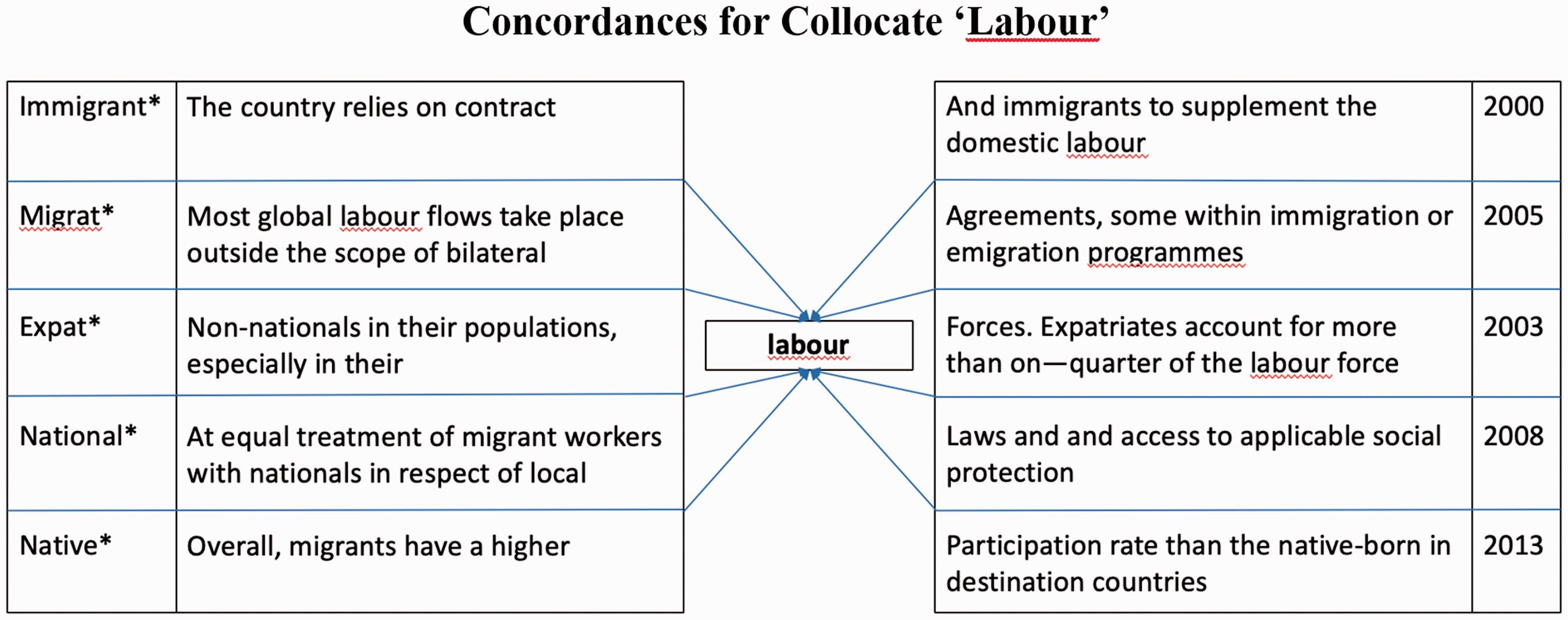
Figure 4 shows the concordances for the collocate “labour.” The collocate “labour” is positioned variously within the topoi of advantage, law, and threat. As discussed earlier, discussion of the economic dimension of immigration has been a constant throughout the WMRs. “Labour” is not often associated with refugee* and asylum seeker* given that these migrants are not often linked with economic migrants, even though researchers have argued that such distinct delimitations among migrants is problematic as someone can be fleeing persecution and also be seeking economic opportunities (see Long, 2015). Labor features heavily in the reports, with labor migrants/migration being an important focus across the years. This collocate occurs mostly within the topos of advantage, with immigrant labor being seen as a positive for destination countries. For instance, WMR (2000) mentions that Gabon “relies on contract labour and immigrants to supplement the domestic labour force” (p. 143). Sometimes this collocate occurs within both the topos of advantage (with emigration programs) and law (irregular and clandestine migration flows), such as in WMR (2005) which mentions:
Concordances for top collocate “labour.”
Most global labour flows take place outside the scope of bilateral labour agreements, some within immigration or emigration programmes set up unilaterally by receiving countries, others through regional agreements. Many labour migration flows are irregular and clandestine in nature. (WMR, 2005, p. 248)
Immigrant labor is seen as a positive as destination countries set up these immigration or emigration programs. Yet, the question of labor is situated within the domain of the law; it is either favored by destination countries which set up legal routes for economic immigrants or it operates outside the law with irregular and clandestine labor migration flows.
However, sometimes the collocates feature a sense of quantification as with the collocate “number.” This occurs in WMR (2003): “A unique feature of GCC States is the extremely high percentage of non-nationals in their populations, especially in their labour forces. Expatriates account for more than one-quarter of the labour force in all GCC States, reaching over three-quarters in some” (p. 205). This case is somewhat unusual as it positions quantification alongside expats. It also positions some expats within the topos of danger/threat while excluding other expats from this qualification. While immigrant labor is needed, a big percentage of certain expats (Arab expats in the case of GCC countries as described in WMR, 2003) in the population seems like a threat. WMR (2003) describes GCC countries limiting the size of the Arab nonnational population in an effort to limit “importing radical social and political ideas, including a pan-Arab ideology, which implicitly favoured the abolition of the conservative Gulf monarchies, and the creation of one “Arab” nation with a freely circulating labour force” (p. 206). To counter this threat, GCC countries have turned to Asian immigrants who are meant to “mainly … work, not to live there permanently or to bring their families” (p. 206). Here, while Arab expats are unwelcome in large numbers, other expats, especially Asian expats are welcome. Therefore, some expats are positioned within the topos of threat/danger, while others are positioned solely within the topos of advantage.
There is also a threat to economic immigrants rather than only a threat to the native population of destination countries. WMR (2008), for example, discusses the “equal treatment of migrant workers with nationals in respect of local labour laws and access to applicable social protection” (p. 34). Migrant workers are often in danger of being taken advantage of by employers in destination countries, especially migrant workers who have taken an irregular route to working in the destination countries. Hence, the collocate “labour” is positioned variously within the topoi of advantage, law, and threat.
Concordance for Collocate “Skilled”
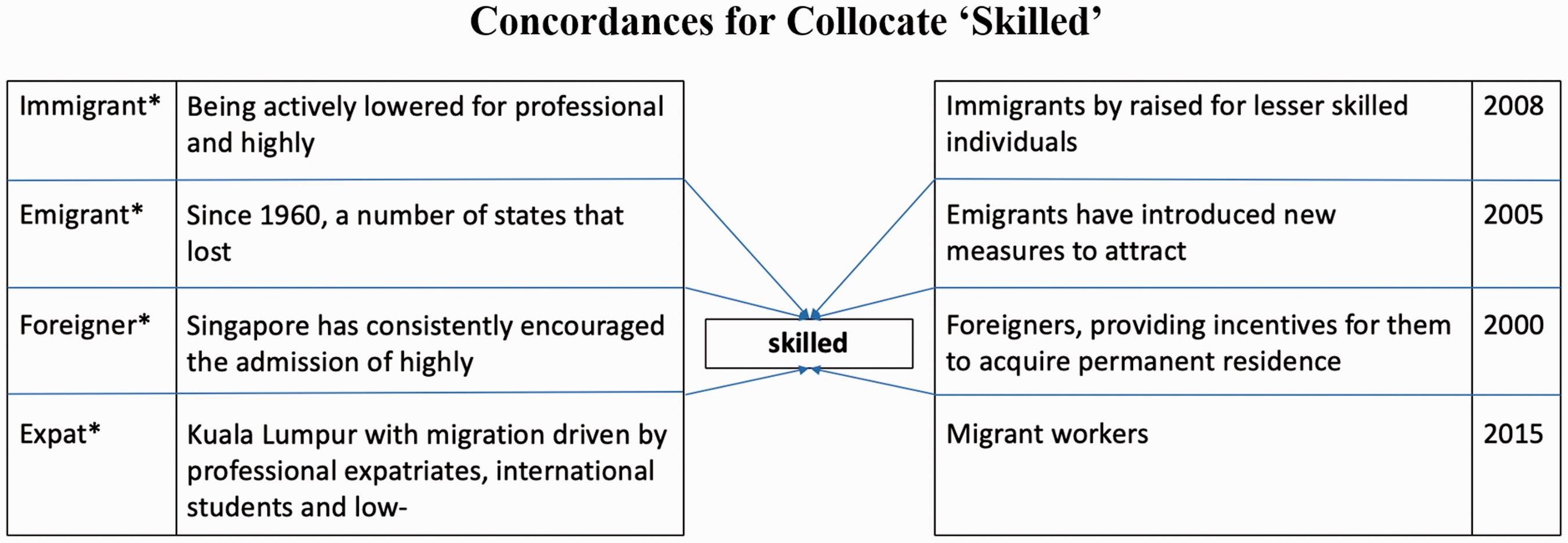
Figure 5 shows the concordances around the collocate “skilled,” which occurs alongside the search terms immigrant*, emigrant*, foreigner*, and expat*. Throughout the WMRs, immigrants are portrayed as either high skilled or low skilled. Highly skilled immigrants are often associated with the topos of advantage for destination countries. Conversely, lower skilled immigrants are often associated with the topos of burdening for destination countries. For origin countries, highly skilled emigrants are often associated with the topos of burdening as origin countries lose a portion of their highly skilled labor force with their emigration. As it is advantageous for destination countries to attract highly skilled immigrants, WMR (2008) points out that “border barriers in many rich countries are being actively lowered for professional and highly skilled immigrants but raised for lesser skilled individuals” (p. 64). WMR (2000) gives the particular example of Singapore, France, and Switzerland who encourage the immigration of highly skilled foreigners while discouraging that of low skilled workers (p. 83; p. 193).
Concordances for top collocate “skilled.”
Similarly, origin countries are also doing their best to retain their highly skilled labor force. WMR (2005) notes that origin countries, such as Colombia, Ghana, India, Iran, Malaysia, Pakistan, Sri Lanka, and the Philippines, have introduced programs that “offer such benefits as funded travel, reinsertion assistance, medical insurance and professional equipment to aid effective reintegration” (p. 290). However, the report also notes that these programs have received mixed results so far, focusing on the example of such programs in Malaysia. Highly skilled emigrants can then be positioned within the topos of burdening for origin countries as they are needed for the countries. In leaving their origin countries, these migrants place a burden on the origin countries who would rather their highly skilled workers not migrate. The last concordance in Figure 5 addresses the cultural dimension of economic migration. WMR (2015) notes that: Much urban growth is taking place in low- and middle-income countries, particularly in Asia and Africa. Key urban centres in Asia include Singapore and Kuala Lumpur with migration driven by professional expatriates, international students and low-skilled migrant workers. Relatively homogeneous societies, previously unused to such diversity, are having to deal with it for the first time. (p. 52)
This quote highlights a certain shift from earlier WMRs. While in the early 2000s, the focus was on rich countries drawing highly skilled immigrants to their borders, in 2015, the focus now includes low- and middle-income countries as destination countries for highly skilled migrants. The second change refers to the kinds of migrants that low- and middle-income countries, which include students and low-skilled workers. The third change hints at how countries’ immigration policies might change over time. While in the early 2000s, Singapore aimed at attracting only highly skilled immigrants, in 2015, it also welcomed students and low-skilled migrants. While WMR (2015) notes that all these migrants (professional expatriates, students, and low-skilled migrants) are helping boost the economy of these destination countries, it also mentions the cultural and linguistic dimensions that immigration brings along. While not explicitly saying so, the report hints at how these dimensions can be problematic for destination countries. This focus on diversity echoes the concept of integration that was the top collocate with search term immigrant* in Table 2. Economic migrants are thus placed within the topos of advantage while also being in the topoi of burdening and culture.
Concordance for Collocate “Workers”
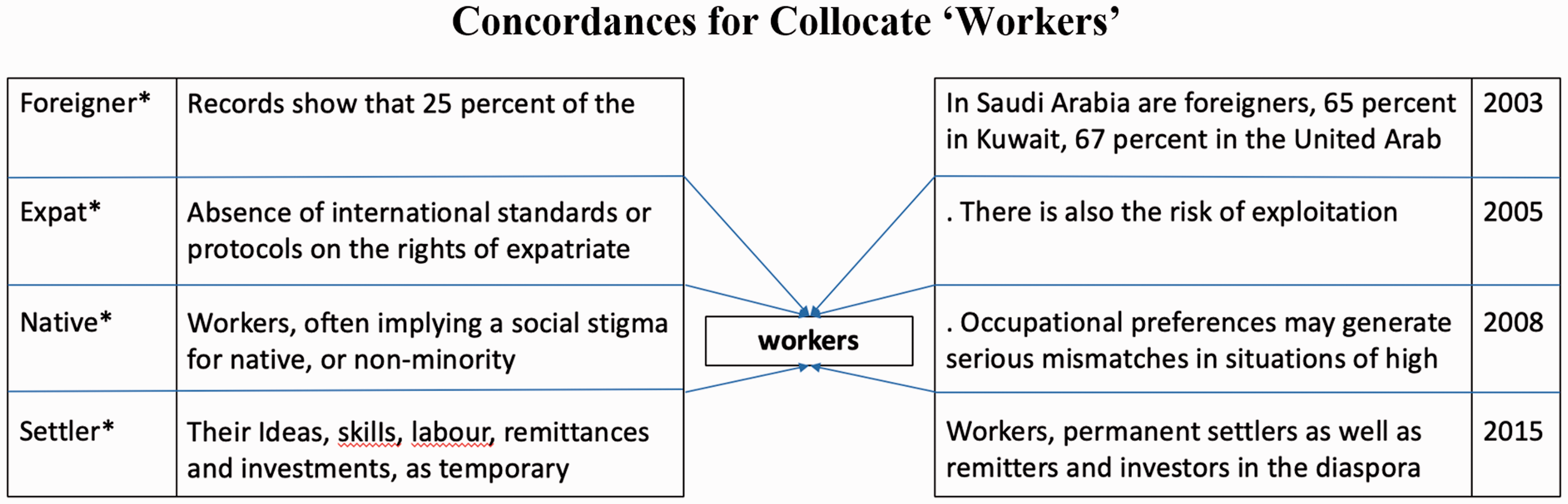
Figure 6 shows the concordances around the collocate “workers” which occurs alongside foreigner*, expat*, native*, and settler*. This collocate continues the trend with the focus on the economic dimension of migration. The collocate “workers” is often positioned within the topos of advantage, to both destination and origin countries but is also sometimes positioned within the topos of danger/threat. The first concordance references again the high number of immigrants in some destination countries. WMR (2003) notes that:
Concordances for top collocate “workers.”
the Middle East has been a highly attractive destination for labour migrants. Records show that 25 per cent of the workers in Saudi Arabia are foreigners, 65 per cent in Kuwait, 67 per cent in the United Arab Emirates and as much as 70 per cent in Qatar. Most of these migrants come from South Asia (Bangladesh, Sri Lanka), South-East Asia (Philippines, Thailand) or Africa (Egypt, Sudan). They were attracted by the oil boom and their occupations range from building and construction, maintenance, to repairs and domestic work. (WMR, 2003, p. 34)
While Middle Eastern countries might attract foreign labor, they are also strict about the rights of migrants. For example, further along, the WMR (2003) notes no pathways for migrants in the Gulf states, like the United Arab Emirates, to obtain citizenship even if they have spent decades working there (WMR, 2003, p. 206). These migrants are often positioned within the topos of advantage as they are needed by the destination countries to sustain their economic growth. However, despite the advantages they bring to destination countries, they are still treated as second-hand people as they can never enjoy the privileges of citizens. The second concordance around the search term expat* illustrates “the absence of international standards or protocols on the rights of expatriate workers” (WMR, 2005, p. 240) and the risk for exploitation of these workers. This positions migrant workers as vulnerable and in need of protection. They are thus situated within the topos of abuse. WMR (2003) also notes the gender disparity in the composition of the migrant labor force in Gulf states (p. 205). This disparity has been documented in other reports besides the WMRs, such as in reports published by the Migration Policy Institute. One of them mentions the disproportionate male migrant labor force in Gulf countries as well as the lack of protection for women migrants (Malit & Al Youha, 2013). This lack of protection again positions migrant workers within the topos of abuse. At the same time, this large male migrant labor force can also be perceived as a threat to citizens (perhaps especially to female citizens), thereby placing these migrant workers within the topos of danger/threat.
The third concordance is particularly interesting because it highlights a major disadvantage in restricting immigration: natives’ reluctance to do certain jobs. WMR (2008) notes that: One of the most significant factors generating labour market mismatches is the unwillingness of resident workers to do certain low-skilled, low-status and low-paid work … . Many professions have now become associated with immigrant or ethnic minority workers, often implying a social stigma for native, or non-minority workers. (p. 297)
In this case, immigrant workers become a necessity because no one else is willing to perform these jobs. Therefore, immigrant workers who are willing to work in those positions are seen within the topos of advantage for destination countries. Countries often put in place programs for seasonal or circular migrants who come for a period of time to perform certain types of work, such as harvesting produce, before returning to their origin countries. Of course, even as these workers are needed as citizens are unwilling to work those jobs, these migrants are sometimes still negatively perceived as taking the jobs away from citizens (as seen in certain media outlets in the United States).
The final concordance of settler* and collocate “workers” is similar to the concordance of settler* and collocate “foreign” above. Again, the focus is on the economic aspect of migration with remittances and investments (WMR, 2015, p. 142). This positions workers within the topos of advantage, to both destination and origin countries.
Concordances and Topoi
To conclude this section, a few topoi feature most prominently in the WMRs. These include advantage, danger/threat, burdening, law/right, abuse, and culture. WMRs most often position migrants as being an advantage to destination countries (and sometimes even for origin countries). However, to a lesser extent, they also position migrants within the topos of danger/threat. This portrayal reflects the dichotomies of the perception of migration by states as needed and yet with the potential to be threatening. While the WMRs are documenting and reproducing member states’ perceptions and treatment of migrants, it is troubling that the IOM does not seek to address these problematic perceptions and treatments.
While the WMRs shed light on the inequities (and discrimination) that migrants face, they do not offer concrete recommendations to address these inequities. WMRs typically state some recommendations at the end of each chapter related to the chapter’s focus. These recommendations often include the need for more data (i.e., the need to fill in data gaps), which can be helpful for researchers and to guide policy work. Some of the recommendations might also have a more direct impact on migrants’ lives. For example, WMR (2015) notes the need for the development and implementation of inclusive policies for migrants: Inclusive policies are key to making migrants more resilient, and more resilient migrants help reduce risk for both communities of origin and of destination …Proactive and inclusive urban planning at the local level and effective national mobility management policies are therefore essential not only to prevent the potential vulnerabilities linked with movement into cities, but also to leverage the potential of building the resilience and increasing the well-being of migrants. (WMR, 2015, p. 104)
While statements such as this quote push for action to redress inequities migrants face, they remain vague, leaving the interpretation of such recommendations at the discretion of member states. Therefore, while WMRs examine the situations migrants experience, they do not adequately discuss concrete actions states need to take to address inequities migrants face.
Migrants’ participation is another key element missing from these reports from a social justice perspective. The reports focus on migrants and presumably rely on data that migrants have shared with researchers (along with states’ data on migration). However, the language used throughout does not reflect migrants’ participation in the creation of these reports. Therefore, the power differentials between researchers (i.e., WMRs’ author-teams) and migrant participants are neither examined nor minimized. The only hint of migrants’ participation is the Migrant Voices sections in WMRs (2013) and (2015).
In the next section, I turn to Migrant Voices sections in WMRs (2013) and (2015). These sections offer insight into migrants’ participation in the WMRs and offer another source of context for analyzing these reports.
Migrant Voices Sections
WMRs from 2013 and 2015 include a particularly interesting feature: Migrant Voices sections. Unfortunately, WMR (2018) does not continue this trend. These Migrant Voices sections address specific areas of a particular individual’s migratory experience. WMR (2013) and WMR (2015) contain nine and eight Migrant Voices sections, respectively. These sections stand out because they tell the stories of individual migrants and often include their pictures as well. These migrants represent a wide variety of migrant types, including refugees, economic migrants, people migrating internally or internationally, South–South migrants, North–North migrants, South–North migrants, and North–South migrants. They provide insight into the lives of migrants, bringing a human dimension to the trends and concepts that the WMRs discuss elsewhere. Reading about migrant labor and remittances is no longer solely an economic issue, advantageous to both origin and destination countries; it becomes an important part of somebody’s life that they send money to the families they left behind.
For WMR (2013), five Migrant Voices sections contain no additional authorial information. One section is adapted from a presentation by the featured migrant at the International Dialogue on Migration in Geneva. Three sections are adapted from stories featured in other IOM documents, including IOM Gender, Migration News (2012), and Migrant Stories from Southern Africa (through IOM Pretoria).
For WMR (2015), all eight Migrant Voices sections contain no authorial information. However, one section is written in the first person, which indicates that the featured migrant has probably written their section. WMR (2015) gives the following statement concerning the Migrant Voices sections: “special thanks go to all field offices for their tremendous effort in gathering the Migrants’ Voices and relevant data, and to colleagues in IOM Headquarters for their assistance in data collection and analysis” (p. ix). Later in the report, they state that “IOM Regional Offices provided relevant background information as well as interview cases with urban migrants in order to add the critical migrant voices to the present report” (p. 28). These statements indicate that IOM staff conducted interviews with migrants and provided context for these sections. However, the reports do not indicate the circumstances surrounding the collection of this information and whether participating migrants had control over how their stories would be shared. This lack of understanding and control over the procedure for data collection is a major drawback for social justice researchers who are using already-collected data/reports/narratives. This lack of information reinforces the distance existing between researchers and participants in quantitative studies, especially those involving corpora. As social justice researchers, we must acknowledge this distance and strive to lean on social justice principles while handling such data. In cases like these, I argue that we need to go back to studying context to better understand the data we are using and minimize abuse of such data.
To understand context for the Migrant Voices sections, we need to examine first, the context surrounding these sections, and second, the ways that these sections contribute to the context surrounding the WMRs. While the sections are not usually written in the first person, they always contain quotes from the featured migrants. This represents an effort on the part of the authors of these sections to include verbatim the voices of the migrants. The sections also often include the migrants’ pictures. Unfortunately, as readers of the WMRs, we do not have much more information about the contexts for these sections. As special features of the WMRs, these Migrant Voices sections also provide contextual information to the WMRs. They humanize the question of migration by putting a face and a story to the broad category of migrants. They remind readers that the migration trends and policies they are reading have real consequences on people’s lives. I argue that ultimately, these sections function as powerful rhetorical moments, building ethos and pathos in the WMRs.
I focus on two sections here: One follows Adamu, who moved from Walewale (Ghana) to Accra (Ghana) is featured in WMR (2013), and the other follows Alfredo, who moved from Mexico to the United States and is featured in WMR (2015). In the section dedicated to Adamu, the author starts by offering a colorful portrait of Accra’s market before describing her work as one of the Kayayei (which means female head porters). Adamu’s journey from her small village in northern Ghana is described as well as her current living conditions. Despite living in a small room with 11 other girls without water, toilets, and electricity (they can access public facilities offering these), Adamu helps to financially support her family in Walewale. She also saves money for a 3-month bead course. Adamu recently set up a group called “Together We Stand” which aims at improving the living conditions of Kayayei, who are particularly vulnerable to sexual predators given their precarious living conditions. Adamu’s dreams include eventually setting up a trade in bead work. In her own words, in 5 years, she hopes to accomplish the following: “I plan to have a trade, and continue to work in Accra” (p. 129). Adamu’s story is inspiring because she remains a hopeful and hard-working woman and migrant despite the difficulties she faces. It illustrates how migrants can overcome great obstacles to achieve their dreams, despite a lack of help from states or nongovernmental organizations.
The second story I discuss is Alfredo’s. Alfredo moved from Mexico to the United States 26 years ago. He originally intended to work for 2 years in the United States before returning home, but he ended up staying in the United States. The narrative describes his journey at work through the various promotions he obtained over time as well as his financial success. As Alfredo has work authorization, he was not exploited at work. He notes: “An American might earn USD 8, but someone without papers earns half that” (p. 117). Alfredo speaks very positively of his supportive and friendly neighborhood and community. He is also positive about the police and health care in the United States. Alfredo represents a happy immigrant. The story quotes him as saying: “Here, if you work hard and persevere, in a short time, you can have a dignified way of life, a good house; I have three cars, a job …In Mexico, people work hard to eat; the poor get poorer and the rich get richer” (p. 117). Despite problems with inequality and racism for Latinos in the United States, Alfredo is hopeful about the future. Alfredo’s story is another inspiring story. Like Adamu, he works hard to achieve his dreams despite the obstacles he faces.
These stories reflect some of the issues that the WMRs are discussing, such as sexual violence against female migrants, the economic dimension of migration with remittances and migrant labor contributing to destination countries’ economies, laws about immigration (e.g., with work authorization for certain migrants), and the cultural dimension of immigration. These stories shed light on the lived realities of migration, where many vulnerable individuals face inequities in their daily lives. These inequities are especially prominent when migrant status intersects with race, gender, and sexual orientation discrimination in the stories.
While presenting the difficulties that migrants face, these sections also illustrate the agency migrants display in actively shaping their lives despite these obstacles. These stories also present the resilience of migrants, by demonstrating their determination to pursue their dreams even in the most difficult of circumstances. These stories humanize migration topics and remind the readers of the WMRs that, in discussing migration and migrants, we are ultimately talking about people and laws and policies that have a significant impact on people’s lives.
Conclusion
In this article, I address the question of how migrants are portrayed within the IOM’s WMRs. In so doing, I also use social justice principles to research with a quantitative-bent. While it is impossible to remove the distance that exists between participants and researchers in many quantitative studies, focusing on context can be a productive way of aligning quantitative-based studies, such as corpus analyses, with a social justice approach. Focusing on context involves examining the context around the creation of texts and the context within which word analysis, such as collocation and concordance, occurs. Examining contexts can shed light on how marginalized communities are featured in given corpora, in terms of positionality, power, and ability to act.
In this study, I used a corpus-based approach to CDA to study WMRs. Focusing on context, I showed that migrants are often portrayed within the topoi of advantage, danger/threat, burdening, law/right, abuse, and culture. While the author teams of the WMRs attempt to use neutral language throughout, they nevertheless often position migrants within either positive or negative topoi while reflecting how states think of certain migration topics. On the one hand, they show that immigration provides an advantage to destination countries while on the other, they also show the negative perceptions and reactions that states have toward certain migrants. I recognize that these reports need to accurately reflect the realities of migration. Thus, they should include the negative views that states have of certain migrants, such as low-skilled migrants. However, they should also be careful about reproducing those negative views and thus continuing a negative trend. Governments are unlikely to materially improve policies for migrants worldwide and in their respective countries if the leading intergovernmental migration organization continually reproduces harmful discourses on migrants. If migrants’ human dignity is to be preserved, national and international migration discourses need to change, including in the WMRs. Finally, as WMRs document migration, it is also crucial for the IOM to involve migrants’ participation throughout the creation of these reports, and not merely in the data collection stage.
TPC scholars can help in changing these harmful discourses. I call for more TPC research to examine the documents that agencies tasked with working with migrants and migration topics publish. Such an examination can help us review the ways that researchers write about vulnerable populations, such as migrants. Social justice researchers have been pushing for more social justice-oriented research approaches. We need to continue working toward implementing a social justice framework in all kinds of methodologies, including ones that call for quantitative methods. Finally, as technical communicators, we need to work with immigrant communities more so that we can learn how to better serve them.
Footnotes
Declaration of Conflicting Interests
The author(s) declared no potential conflicts of interest with respect to the research, authorship, and/or publication of this article.
Funding
The author(s) received no financial support for the research, authorship, and/or publication of this article.
