




Abstract
In increasingly online higher education environments, instructors must develop positive and community-oriented learning environments, equivalent to, if different from, face-to-face learning experiences. Connectivism and communities of inquiry are complementary theories that facilitate the design and development of online learning and enable online learners to connect with peers. This article discusses two pedagogical interventions that encourage connectivism and foster communities of inquiry in online technical communication programs: (a) a face-to-face orientation workshop at the beginning of an online program and (b) a peer-review activity in a research methods graduate course. The article explains the development, deployment, and evaluation of the activities.
For learners, online programs offer flexible access to educational opportunities. Many learners who might not otherwise undertake full-time, on-campus study choose online programs—for example, individuals in employment, or those who cannot travel due to cost, distance, a caring responsibility, or for myriad other reasons. For higher education institutions, too, online programs have important potential benefits: they can increase an institution’s capacity to reach new and nontraditional learners and therefore to grow enrollments and broaden access. Online programs may also offer increased flexibility to teaching faculty. Because of their value to learners, institutions, and instructors, fully or partially online programs and courses have escalated in number. A recent report (Seaman et al., 2018) indicated increased enrollments in distance education programs in the United States for the 14th consecutive year, despite an overall downward trend in higher education enrollments.
To support higher numbers of online learners, some essential resources need to be in place. Some such resources must be provided at the level of the institution, for example, ensuring that online learners can enroll and can later access institutional services: essential services like IT and student records as well as pastoral support such as careers and counseling advice. Such resources help learners to feel connected to the institution and to one another. In their absence, the online experience can be, at best, lesser than the on-campus experience, and at worst, lonely and isolated, leading to reduced motivation and higher attrition rates. Indeed, according to Boton and Gregory (2015), the increased number of online students worldwide has led to a parallel attrition problem. Therefore, a goal of institutions and online program directors is to improve persistence rates among learners.
In addition to institutional supports, instructors in online programs can develop strategies and techniques that increase learners’ feelings of connectedness and community. Rovai (2003) argues that, although the decision to leave an academic program is complex and is linked to dynamics internal to the learner as well as externalities, several academic factors affect learners pursuing online programs. These include academic and social integration, interpersonal relationships, a sense of connection to the institution, and access to academic advice. For example, face-to-face socialization at the beginning of a distance education program is particularly helpful (Kember et al., 1992, 1994), and making an orientation program mandatory may improve learners’ experiences of online programs (Bawa, 2016).
This article explores peer engagement activities at program and course levels in two Technical and Professional Communication (TPC) programs at one institution: one of the programs is delivered entirely online and the other in a hybrid online/campus mode. The activities described in this article incorporate principles of connectivism and are designed to foster the development of a Community of Inquiry (CoI). The article begins with an overview of previous research about connectivism and communities of inquiry, the importance of interaction in online programs, and recent relevant studies in TPC and related disciplines. It then describes two examples of peer engagement activities, in terms of their development, deployment, and evaluation.
Literature Review
Within instructional design, three learning theories were prominent in the 20th century: behaviorism, cognitivism, and constructionism. Behaviorism is concerned with how a stimulus provokes a response in a learning environment; cognitivism focuses on the processes of learning; and constructivism sees learners as continuously, often collaboratively, constructing knowledge (see Slattery & Cleary, 2016 for a longer explanation of these theories and their applications to learning environments). In the past three decades, more research has begun to explore how engagement in communities and networks impacts on learning.
Connectivism
According to Siemens (2005), traditional learning theories have limited capacity to explain and inform how learning happens in the digital age, because they do not “address learning that occurs outside of people (i.e., learning that is stored and manipulated by technology). They also fail to describe how learning happens within organizations” (para. 10). Siemens (2005) proposed connectivism as an alternative. Ravenscroft (2011) suggests that connectivism is “usually understood as contrasting with traditional behaviourist, cognitivist, and constructivist approaches” (p. 139). Nevertheless, it is not a replacement for other learning theories, but rather a method of explaining the new ways that learning can be orchestrated online.
Connectivism is less concerned with fixed knowledge than with enabling learners to identify, access, and leverage information sources, including people. According to Siemens (2005), a core principle of connectivism is that “the connections that enable us to learn more are more important than our current state of knowing” (para. 20). Siemens explains that 21st-century learners will likely work in fields tangential, or even unrelated, to their studies and in fields where informal and lifelong learning are essential priorities because information is dynamic. Furthermore, Siemens argues that some types of information processing, which were promoted in cognitivist learning environments, can now be “off-loaded to, or supported by, technology” (para. 22).
Siemens (2005, para. 22) outlined these principles of connectivism:
Learning and knowledge rests in diversity of opinions. Learning is a process of connecting specialized nodes or information sources. Learning may reside in non-human appliances. Capacity to know more is more critical than what is currently known. Nurturing and maintaining connections is needed to facilitate continual learning. Ability to see connections between fields, ideas, and concepts is a core skill. Currency (accurate, up-to-date knowledge) is the intent of all connectivist learning activities. Decision-making is itself a learning process. Choosing what to learn and the meaning of incoming information is seen through the lens of a shifting reality. While there is a right answer now, it may be wrong tomorrow due to alterations in the information climate affecting the decision.
These principles illustrate how connectivism gives prominence to the capacity of the learner to find information dynamically rather than seeking to acquire fixed knowledge; furthermore, the learner’s ability to make decisions and prioritize is highlighted. Connectivism enables instructors both to theorize about contemporary learning situations and to plan connected learning environments and activities. Later in this article, I explain how these principles map to an academic socialization activity in an online program (see Example 1).
Goldie (2016) explains that connectivism depends on distributed knowledge that is not uniquely located but based within “networks of connections formed from experience and interactions between individuals, societies, organizations and the technologies that link them” (p. 1065). Siemens and Conole (2011) reflect on the implications of technology developments for learning and find connectivism to be an appropriate lens through which to explore and challenge these developments. Likewise, Kop and Hill (2008) see connnectivism as an “intuitive and powerful” (p. 7) explanation of web-based learning. Therefore, its principles are appropriate for the development of peer engagement activities in both online and face-to-face environments.
CoI Framework
Although connectivism helps to explain the convergence of learning and technology, critiques of this theory emphasize its lack of empirical foundation. Bell (2011) considers connectivism to be “perceived as relevant by its practitioners but as lacking in rigour by its critics” (p. 98). Ravenscroft (2011) argues that “[e]mbracing” connectivism means that we need to consider new design metaphors for future learning that place the person, their social behaviour, and their community at the centre of the design process and the resulting networked technologies” (p. 155). Likewise, Downes’s (2008) explanation of connectivism foregrounds the importance of community. He argues that “through the interaction of different sets of perspectives . . . a community can arrive at new knowledge” (p. 3). This theory, therefore, sees shared learning spaces and experiences, and a learning community, as central to learning.
The CoI framework, first proposed by Garrison et al. (2000) also emphasizes social and participatory learning. This framework proposes that in order for deep learning to occur in online networks, three types of overlapping “presence” must be enabled: teaching, social, and cognitive presence. Teaching presence can encompass the many activities and interactions organized by the teacher to support learning. The instructor must develop “multiple ways of creating meaningful communication between students and with their instructor” (Dixson, 2010, p. 8). Social presence refers to the means that exist to create a sociable and human-centered learning environment and is “defined as the amount of connectedness a student feels to the other students and faculty in a class” (Gazza & Hunker, 2014, p. 1127). Cognitive presence refers to how learners work together to understand new content, build domain knowledge, and develop competence. Garrison et al. (2000) define it as “the extent to which the participants in any particular configuration of a community of inquiry are able to construct meaning through sustained communication” (p. 89).
The CoI framework has proven to be a popular and robust means of describing and analyzing online learning design and has amassed theoretical and empirical support. It is, thus, a relevant tool for developing and analyzing, especially online, learning environments. For example, recent studies have explored how learning analytics suggest successful learning strategies in CoIs (Kovanović et al., 2015) and evaluated instruments to test metacognition in a CoI (Garrison & Akyol, 2015).
Two instruments are widely used to analyze online communities of inquiry: transcript coding and the CoI survey (Arbaugh et al., 2008). A recent systematic literature review (Stenbom, 2018) identified 103 journal articles published between 2008 and 2017 about the CoI survey. Although the CoI survey is designed to be taken by learners, it can also serve as a practical tool for designing online courses that incorporate each of the presences. It includes a series of statements within the three main framework categories, that respondents rate on a Likert scale. Within the teaching presence category, the survey includes statements about design and organization, facilitation, and direct instruction. Within the cognitive presence category, it includes statements about triggering learning, exploration, integration, and resolution. Within the social presence category, it includes statements about affective expression, open communication, and group cohesion. Later in this article, I explain how this survey instrument has contributed to the development of a peer review activity on a graduate technical communication research course (see Example 2).
The Importance of Interaction in Online Programs
Crucially, both connectivism and the CoI framework rely on and promote the principle that interaction is central to the online educational experience. Garrison and Cleveland-Innes (2005) argue that interactive learning communities are essential in higher education. They conclude that in order for deep learning to occur, however, interactions must involve “purposeful and systematic discourse” (p. 135). Croxton (2014) argues that interactivity is directly linked to a learner’s decision to persist with an online program. As well as interacting with the instructor, learners benefit from peer interaction, but this interaction does not come naturally in an online environment and may have to be instigated and managed by an instructor.
Successful peer interaction involves “students learning from and with each other in both formal and informal ways” (Boud et al., 2001, p. 4). Indeed, peer activities can effectively model the role of the instructor if they are orchestrated effectively and if instructions are sufficiently detailed. A study by Nicol et al. (2019) found that peer review of eportfolios encouraged deep reflection and “provides strong evidence that reviewing and receiving reviews are at least complementary to, and might even afford advantages over, the learning benefits a coach might provide” (p. 9). In a study of successful massive open online courses (MOOCs), Hew (2016, p. 320) ranked “peer interaction” among the top five factors influencing a course’s popularity. His article describes assignments that include a social dimension, such as online discussions of a problem, and a shared forum to review and discuss assignments. Hew found that “peer interactions could encourage knowledge sharing and construction among participants” (p. 332), and discussion forums were the most widely used tool for peer engagement.
Related Research in TPC and Online Writing Instruction
As increasing numbers of TPC programs are offered online, more research has begun to examine how teaching and learning can be supported on such programs (see, for example, Cleary et al., 2018; Hewett & Bourelle, 2017; Melonçon, 2007, 2017). Research into online writing instruction (OWI) contexts acknowledges the importance of community. Principle 11 of the Conference on College Composition and Communication’s (CCCC) position statement on OWI links online communities with student success. Recent OWI scholarship has also explored the CoI framework. In their exploration of “purposeful pedagogy”, Harris et al. (2019) discuss the importance of instructor presence and “connectedness.” Hilliard and Stewart (2019) surveyed learners on partially online writing courses, using a modified CoI survey. They found that learners were more aware of teaching presence than either social or cognitive presence and that learners on “high blend” courses (50% or more online) were more aware of the three presences than learners on “medium blend” (30% online) courses. They concluded that this finding challenges the view that face-to-face learning environments are more interactive. Watts (2017) used the CoI survey to conduct a pilot evaluation of learner perceptions of one online graduate seminar in a technical communication program. She concluded that “team-based active learning” (p. 509) helps to foster teaching, social and cognitive presence. She also recommended adopting the CoI survey as a program-wide evaluation tool.
Although there is limited research on connectivism in TPC programs, Moses and Duin (2015) described how connectivist principles informed the development of intercultural personal learning networks on a technical communication course.
The next section describes activities I have developed that seek to foster engagement in technical communication programs. In addition to orchestrating connectivism at a program level, at course level I use peer engagement to leverage information sharing and foster communities of inquiry.
Peer Engagement Examples
The University of Limerick has run programs in technical communication for more than two decades. Since 2001, a Graduate Certificate in Technical Writing has been offered online, and since 2015, the MA in Technical Communication and E-Learning has been available in an online, as well as an on-campus, delivery mode.
This institution has only recently begun to establish university-level and university-led structures to manage, support, and deliver online programs. Therefore, the program team has designed and evolved our programs and the online delivery strategies with limited university direction or input. This situation is both an advantage and a disadvantage. An important advantage is the scope and flexibility that was afforded to teaching faculty to develop materials and techniques based on our expertise in instructional design and content development. Disadvantages include the inevitable time and resource constraints.
As MA Program Director, I have been interested in fostering a connectivist learning mindset at the level of the program and enabling a CoI to develop among learners undertaking individual courses and assignments. The purpose of this connected engagement is to help learners to build networks and to use those networks as an explicit and implicit learning strategy. Networking is an essential skill, regardless of whether learning takes place primarily online or on-campus.
The next sections describe two examples of activities I have developed, one at program level that fosters connectivism and one at course level that explicitly sets out to develop communities of inquiry. In the examples, I present the context and explain how I have used research into best practices to develop the activities and to revise and improve them over time to ensure that the program and course remain sustainable. The stages in creating a learner-centered peer activity include:
Development: the instructor plans strategies and outlines success criteria. Deployment: the instructor and learners work together to initiate and follow through on the peer activity. Evaluation: the instructor and learners evaluate the activities and plan improvements.
The two examples that follow use these stages as an organizing principle. This iterative process should empower learners both by involving them in the activity and by enabling them to provide feedback to peers and to the instructor. Through providing summative feedback on their experiences, they have a stake in the development of the activity for future learners.
Example 1: Fostering Connectivism Through an Academic Socialization Workshop
The MA in Technical Communication and E-Learning has an intake of approximately 30 new students annually. It runs part-time (over two years) and full-time (students complete the program over 1 year). This program has been offered in an on-campus delivery mode since 2010. I was Program Director from 2011 to 2019.
Development
In 2014, I applied to the university program review committee for approval to run the program in an online mode. During this application phase, I spent a year planning strategies for online delivery. I consulted the program board and the program’s external examiner and reviewed the literature on designing successful online programs. That consultation process led me to conclude that, for both online and on-campus students, an intensive face-to-face socialization workshop was essential preparation for learners. Bawa (2016) argues that “rigorous orientation programs can help online learners become better prepared for their academic journeys online” (p. 9). Martinez et al. (2019) surveyed learners about their experiences of online writing courses. They found that online learners preferred an orientation program that included information about the course and the technology, and about learning online.
Deployment
To alleviate some of the issues highlighted in the literature and to increase learners’ connectedness and sense of community, at the beginning of the program, students are required to come to campus for two days. All students must attend, regardless of whether they intend to take the program in a primarily online or a primarily on-campus delivery mode. One day of this orientation is organized by the university and involves enrollment, a library tour, presentations by service providers within the university (such as student counseling and student registry), and a campus tour. This university orientation day ensures that learners have completed the basic administrative tasks that can often be overlooked in an online program. It also reminds learners that they are part of the larger university community and, therefore, that they are entitled to access its supports, even where they are learning online and will not attend campus regularly.
In addition, I developed an on-campus program orientation workshop for the group. This workshop is usually run over a half day, on the day before or after the university orientation. During the workshop, I introduce the program, and colleagues provide overviews of their courses. The Faculty Librarian also explains and demonstrates online library resources. Most of the workshop focuses on preparing learners for online collaboration. They log in to their university email accounts to ensure they can access messages, because instructors and university services will communicate through the learners’ university email addresses, not their personal ones. I also introduce the university virtual learning environment (VLE). Prior to the workshop, I create a site within the VLE for program-level communication. The site includes program resources, links to university services, and communication tools (i.e., announcements, discussion forums, and a chat room). During the workshop, while they are on-campus and supported by instructors, learners test the discussion forum and chat room of the VLE. This activity enables them to familiarize themselves with the features of the communication tools in a low-stakes activity. Technology has a strong impact on the development of a CoI, particularly for online teaching and learning. While some technologies may be beyond the control of the instructor or learners (e.g., the selection of a VLE is usually an institutional decision), it may be possible to use open source or freely available tools to help foster a community. Wenger et al. (2009) explain how “technology stewarding adopts a community’s perspective to help a community choose, configure, and use technologies to best suit its needs” (p. 24).
The workshop also, crucially, provides scope for learners to ask questions and to provide feedback. After the workshop, the whole group has lunch together.
Following the on-campus workshop, the VLE program site remains available and I encourage learners to use it to share resources and communicate via the forums and chat room. I inform them that I will not be active on this site and that it is a peer communication, not an instructor-led, forum.
Evaluation
I have not conducted a formal, systematic evaluation of this activity, but I have reflected on feedback I receive each year about the value of this workshop. This feedback is delivered through student comments and messages directly after the workshop and later through program evaluation instruments administered at university level. This feedback indicates the importance of the workshop in building a sense of community and cohesion within each cohort. Many learners mention the collaborations and friendships that began at the workshop and continued throughout the program, and most refer to the essential information they assembled regarding how to interact and access materials online.
Analysis of the feedback suggests that the on-campus program orientation has several benefits for learners:
It ensures that they recognize their peers and interact with them in person and online before beginning to study together. It gives them an opportunity to begin to make friends and develop deeper connections with peers. It gives them an opportunity for face-to-face interaction with instructors. It enables them to test the VLE in a supported environment. It provides space for asking questions. It sets up a positive introduction to the program.
I also analyzed data from the VLE site developed for the workshop, and which learners can access throughout their tenure on the program. The 2018–2019 site registered over 2,000 unique visits. The most active tool was forums, with almost 100 messages and over 1,500 views. The peer forums included class notices, advice, and shared resources.
This site supports the development of connectivist learning that corresponds to several principles outlined by Siemens (2005):
Through interacting online and in person, learners begin to explore connections between fields of study. They recognize that they are diverse co-creators of knowledge. They come to see the VLE as one of many sources of information. They begin a process, that continues over the course of the program, of acknowledging the dynamic nature of knowledge. In fields such as technical communication and e-learning, where change is constant, this process is essential.
For instructors, the face-to-face program orientation also has benefits. We value meeting learners. Furthermore, through intensively explaining and answering questions about our courses, approaches, and expectations, we reduce the number of individual email queries we receive.
While the literature suggests that attrition rates are likely to be higher in online programs, this has not been the experience in this program. Based on anecdotal feedback, I hypothesize that the program orientation reduces attrition by:
Demonstrating the university supports available to learners. Giving learners the tools to build a learning community that will increase their resilience and help them to persist with their studies. Introducing learners to the university’s physical environment and therefore implicitly increasing their sense of connection. Managing learner expectations: throughout the session, learners ask questions, and the responses and discussion help them to develop a clearer understanding of our expectations, timeframes, and materials. They also learn how to access and use the VLE, and the many resources, documents, and websites with which they need to become familiar, embarking on a new program at a new institution.
This example has described a broad, program-level peer engagement activity that exploits principles of connectivism. Although the activity is designed specifically to foster connectivism, it also supports the later development of a CoI. The connections and strategies that learners develop through this activity help them to interact better in learning communities as they progress through the program. The next section describes a more granular and targeted peer engagement activity that demonstrates how a CoI develops.
Example 2: Developing a CoI Through a Peer Review Activity
I coordinate and teach a course about research in technical communication taken by both Graduate Certificate and MA students. The assignment in this course is multifaceted and involves writing a research proposal, conducting a research project, and writing a report about the findings. When I first taught this course, an adjunct professor spent a week intensively discussing individual research proposals to help learners to revise and refine their projects. The objective of this interaction was to help ensure that each learner’s research project was viable. On retirement of the adjunct professor from the role, I undertook to advise each learner in a similar way. As numbers increased, however, it became impossible for me to provide the level of detail needed within the timeframe of a week, and I designed a peer activity approach instead. Peer engagement may take many forms, but one of the most common is some kind of formative assessment to facilitate learning. Gielen et al. argue (2010) that “during formative peer assessment, judgements often include qualitative comments in addition to (or instead of) marks. These comments are labeled ‘peer feedback’” (p. 304). Gielen et al. identify criteria that make this feedback more effective, including detail and frequency; focus on performance improvement rather than personality; timeliness; and appropriateness to both the learner’s context and the assignment purpose. In addition, in order for feedback to be effective, the recipient must engage with and act on the feedback.
Development
In 2015, I introduced a peer-review activity that runs over one week each Fall semester. Learners are organized into groups of four or five. Each group has its own discussion forum, and learners work in peer groups to offer feedback on one another’s research proposals.
I used the CoI survey to design the guidelines for the activity. Following are the relevant CoI survey statements (in italics) together with an explanation of how I have adapted them.
The instructor provided clear instructions on how to participate in course learning activities.
This survey statement is relevant because, when designing any kind of activity that requires learners to engage with one another in specific ways to be successful, instructors must explain and clarify what they expect in terms of engagement: frequency, type, timeframe, and any other relevant criteria.
The instructor clearly communicated important due dates/timeframes for learning activities.
Learners need to know the timeframe of the peer activity and any milestone deadlines.
The instructor helped to keep course participants engaged and participating in productive dialogue.
Even though the activity is peer-to-peer, I read all discussion entries and follow the discussion asynchronously, and learners are aware of my commitment at this level.
The instructor helped keep the course participants on task in a way that helped me to learn.
I may need to intervene if the discussion is losing focus or is not purposeful. I make it clear to learners at the beginning of the activity that I will not be active, but that I will intervene if necessary.
Instructor actions reinforced the development of a sense of community among course participants.
Although I am not directly involved in any group’s discussions, I use language that promotes a sense of community within the peer groups.
Getting to know other course participants gave me a sense of belonging in the course.
This peer activity gives learners a shared purpose and a unique opportunity to engage. Because the course includes a mix of on-campus and online learners, I ensure that each peer group reflects that mix. This strategy should promote a stronger sense of belonging, particularly among online learners.
I was able to form distinct impressions of some course participants.
Working together on a purposeful activity can improve learners’ networks. I encourage learners to use socioemotional communication at the start of the activity as a means for learners to get to know one another and to develop empathy.
Online or web-based communication is an excellent medium for social interaction.
In a successful peer activity, learners have a sense that they have achieved collaboration in ways that would not otherwise have been possible.
I felt comfortable conversing through the online medium.
I felt comfortable participating in the course discussions.
I felt comfortable interacting with other course participants.
I felt comfortable disagreeing with other course participants while still maintaining a sense of trust.
All of these statements refer to the need for learners to work on social presence and to develop empathy and trust. I encourage them to contact me if they feel uncomfortable engaging in any aspect of this activity.
I felt that my point of view was acknowledged by other course participants.
I provide instructions about how to interact and respond to one another to ensure that no group member either dominates or withdraws.
Online discussions help me to develop a sense of collaboration.
Online discussions were valuable in helping me appreciate different perspectives.
Both these statements indicate how, ultimately, successful interactions lead to stronger understanding of collaboration. Learners recognize the value of the activity and have a better human understanding as a result.
This activity also exploits principles of connectivism, by enabling learners to recognize diverse opinions, to acknowledge one another as information sources, to acknowledge the peer group as a node that facilitates learning, and to see connections within and across peers’ proposals.
Deployment
Table 1 presents the guidelines I provide about the process and demonstrates how learners are expected to interact during the week-long activity.
Peer Review Guidelines.

Hew (2016) explored peer review in a MOOC. While most participants in that study appreciated the peer review component, critiques included “superficial reviews from peers, and misunderstanding about the submitted work, which resulted in poor reviews” (p. 335). In the peer review assignment I have developed, learners have an opportunity to respond to the peer feedback, resulting in few instances of the problems Hew described.
Li and Grion (2019) reported on a survey of learners who had participated in a peer assessment activity. Respondents “perceived more learning benefits from giving feedback rather than receiving feedback” (p. 1). The authors suggest that this finding may be attributable to the higher level of engagement needed to give feedback, compared to the relatively passive activity of receiving feedback. This finding would suggest that, as in the example described here, all learners should be engaged in giving, as well as receiving, feedback in any peer activity.
I also provide guidelines regarding how to communicate through the forum, reminding learners that it is a lean communication medium and that they must aim to be as clear and detailed as possible. The communication guidelines include the following:
When you post comments about another learner’s proposal, be sure to frame these in positive language. For example, rather than saying, “this research proposal is unworkable,” instead ask for more information on parts that you do not understand. Be sure to acknowledge comments other learners make about your proposal. If you do not understand a comment about your proposal, follow-up with the individual who made the comment. Use the forum to open a conversation about your ideas. Try not to take critiques of your proposal personally. Appreciate the time that your classmates have taken to read your work. Their comments will help to make your proposal, and ultimately your research project, stronger.
Potential problems with peer feedback may include its quality. Gielen et al. (2010) noted that because peers are not subject-matter experts, peer feedback may not be accurate. To overcome this potential problem, peers in this activity do not grade one another, and learners have an opportunity to respond to the feedback they receive. At the end of the week’s activity, I post general comments in each group’s forum, about the quality of discussion and peer engagement.
Evaluation
Table 2 indicates the engagement with this activity in the Fall semesters of 2016 and 2017, based on an ex post facto analysis of VLE data. It shows for each semester the numbers of peer groups, the total numbers of learners involved, and the numbers of messages (average number, along with number for the least active and most active peer groups).
Engagement With the Peer Review Activity.
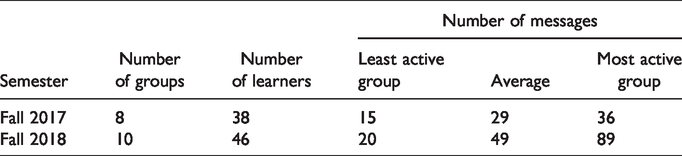
In 2018, the higher number of learners per peer group, and two groups with very high numbers of posts, increased the average number of messages. Nevertheless, the data indicate that in almost all groups, learners posted more messages than required, and some groups continued to use the forum to discuss their projects with their peers for the remainder of the semester. Feedback about this activity is relayed through
University-administered evaluations of the module and program. Individual emails sent to me by learners. Comments on discussion forums.
I have not conducted a systematic evaluation of this activity to date, but analysis of exemplary qualitative feedback from learners shows that the activity is essential both as a cognitive support for learning and as a mechanism for developing and strengthening a learning community. The feedback about the peer review activity is usually highly positive. Learners reflect on the many positive features of peer interaction that are also highlighted in the literature: engagement, collaboration, connectedness, knowledge construction, and motivation.
While learner feedback about the peer review activity is positive, Graduate Certificate students have found the overall course requirements time consuming and challenging. As well as collaborating on proposals for this activity, they have to conduct and write up individual research assignments. Since these learners are, in the majority of cases, already in the workplace, their needs are more vocational, and many have expressed a preference for shorter term assignments with a more explicit vocational focus. Following consultation at program level, the Certificate program has been amended and will not include this course from 2020 onwards. I expect this change to have a positive impact for future iterations of the module because all learners will be taking the same program and will be equally motivated to undertake research.
Conclusions and Future Research Directions
The two activities described in this article exploit features of connectivism and communities of inquiry to promote deep learning within learning communities. The activities also establish a network for learners and help them to develop networking skills for the future.
The program orientation workshop foregrounds connectivism as a theory and strategy. Learners begin to use networked technologies to communicate during the face-to-face workshop. This session also facilitates the formation of a CoI by enabling academic socialization to begin. Therefore, this workshop helps to prepare learners for online learning and for their future careers. Furthermore, the community and connections that learners develop may manage their expectations and increase their resilience, possibly leading to higher persistence rates. This tentative conclusion needs to be explored through further research.
Although the online learning environment is different from the face-to-face classroom, it need not be a lesser experience for learners. Indeed, many of the affordances of technology enable a CoI to thrive. The peer activity described in the second example in this article demonstrates how such a community can become a learning tool as well as a rewarding, rich, and engaging activity. Using the CoI survey to design the activity has helped me to ensure that teaching, social, and cognitive presence are emphasized. This strategy appears to have had a strong impact on learner satisfaction and engagement.
It is essential to monitor the impact of all pedagogical interventions at both a program and course level. Gathering feedback about interventions enables instructors to update activities and provides a solid basis for curricular improvements. It also involves learners in curriculum design. While I have gathered informal feedback from learners, and this article describes my reflections on that feedback, an essential next phase is to collect more formal and systematic data, and to conduct more comprehensive analyses, about the learning experience. Data could include VLE statistics, CoI survey data, and targeted quantitative and qualitative information from learners. The theories discussed in this article, of connectivism and communities of inquiry, have several interactions and overlaps, which could also be the subject of a future study.
Technical communication and e-learning are fields where new developments and models are continuously emerging, and where the skills of decision-making, networking, and prioritizing may be more valuable than fixed knowledge that is likely to change rapidly. Therefore, learners in these disciplines need to be able to make and use connections, identify information sources, and leverage the information search, processing, and analytic features of technology. As online teaching becomes more common in TPC, online programs have the potential to influence the development of connected and collaborative future professionals.
Footnotes
Declaration of Conflicting Interests
The author(s) declared no potential conflicts of interest with respect to the research, authorship, and/or publication of this article.
Funding
The author(s) received no financial support for the research, authorship, and/or publication of this article.
