




Abstract
This article presents a reexamination of intercultural components in prominent, recent technical professional communication textbooks. This examination reveals the need for the technical professional communication field to establish a dynamic definition of culture as well as presents a possible definition, presents areas where textbooks have addressed previous scholars’ concerns as well as areas that could still use improvement and may require instructors to add supplemental instruction, and presents considerations for instructors when incorporating intercultural component elements into their courses.
There is a prevalent body of research regarding intercultural communication (IC) within the technical professional communication (TPC) field. Much of this research, outside of better understanding cultures and IC, deals with teaching IC. Since the 1990s, a great deal of literature has focused on integrating this subject within TPC classrooms. Several researchers have referred to both the broader field of TPC and workplace settings as reasons to incorporate IC education in classrooms to address business and workplace needs, better communicate with others, and develop soft skills (Cárdenas, 2012; Constantinides et al., 2009 Matsuda and Matsuda, 2011; Matveeva, 2007, 2008).
Addressing pragmatic, business and workplace needs is one of the most prominent reasons scholars provide for including IC in TPC curriculum. Scholars suggest that teaching and developing students' IC skills will better prepare them to communicate and interact in the workplace, leading to more job opportunities (Tippens, 1993; Weiss, 1993). While these additional opportunities could include working with other teams, departments, or organizations, some scholars posit these opportunities could refer to working with people worldwide, especially since many organizations wish to enter new markets and stay competitive in a globalized world (Weiss, 1993).
While pragmatically preparing students for the interactions they may encounter in the workplace is an essential role for TPC courses, there are other reasons to teach IC in TPC courses. Teaching IC can also help students communicate with others in all situations, not just in the workplace, more effectively. Miles (1997) argues that we need to sensitize students to cultures beyond those they already know to help them communicate with others. In other words, sensitizing students to different cultures can lead students to better understand and respect these cultures. This respect and knowledge can lead to better communication that lessens the chance of stereotyping or “Othering” behavior.
Explained briefly, Othering is the view of believing someone is different to you, usually while viewing yourself as “‘normal’ ‘civilized’ or ‘superior’” (Holliday et al., 2017, p. 24). This Othering behavior can be intentional or unintentional. Holliday et al. (2017) argue that anyone can “fall into the trap of Othering” when we “reduce people to less than what they are” (p. 24). This behavior usually stems from stereotyping and prejudices and is closely related to “Easy” answers. Easy answers refer to stereotypical thoughts/actions which fail to acknowledge the complexities of humans. People can often resort to Easy answers when they encounter an IC communicative situation. Developing foundational awareness and sensitivity to other cultures can help prevent these behaviors and help one recognize and avoid instances of Othering or Easy answers. Scholars, such as Schulz (2008), suggest identifying one's behavioral shortfalls (like Othering) can be a beneficial step to learning and improving oneself and communicating interculturally.
This study suggests that by examining the TPC field in a broader sense, we can see connections between culture and IC and the turn to more social justice work our field is making (Miller, 2020). Explained more deeply, this study suggests that many social justice projects center around better understanding culture, IC, and cultural rhetorics. This study also takes the position that cultural rhetorics and IC studies are neighboring fields (Bratta & Powell, 2016). By incorporating IC topics into TPC classrooms, there are opportunities for transdisciplinary work with other fields and departments, which can lead to social justice projects between various writing and communication and other areas (Chen & Bergholm, 2020; Enríquez-Loya & Léon, 2020; Gonzales et al., 2020; Poe & Inoue, 2016). There has been a push for more transdisciplinary work in writing studies, as seen by journals such as College English’s 2020 special, including several TPC and other writing study collaborations.
In summary, by incorporating IC lessons into a TPC classroom, instructors can heighten students’ awareness of culture, help students recognize and question Othering behaviors and Easy answers, help students communicate more efficiently and respectfully, and potentially be better prepared to take part in transdisciplinary work, social justice projects, or other activities that involve working with other groups.
While understanding various reasons to teach IC is helpful, it is also helpful to know how the TPC field has evolved in its understanding of culture. Explained further, the TPC field has called for a more nuanced way of looking at culture and IC past national cultures and static understandings to more dynamic understandings of cultures such as disciplinary and organizational cultures (Constantinides et al., 2009). This nuanced view applies to classrooms as well. Instructors who feel comfortable with IC may have no problem incorporating a variety of resources, activities, and dynamic understandings of culture into their classrooms (Barker & Matveeva, 2006). However, instructors who feel less comfortable with IC may stick with provided resources. These resources may be ones they already use in their courses (like textbooks) or ones other instructors have shared with them. However, even with these resources, many instructors have shared additional challenges in teaching IC, including a lack of time, lack of adequate IC training, and the lack of resources relevant to IC (Barker & Matveeva, 2006).
This method of studying textbooks’ and their depictions of IC started in the 1990s, and various follow-up studies have since been conducted (Matsuda & Matsuda, 2011; Matveeva, 2007; Miles, 1997; Thrush, 1993). While each researcher focused on slightly different IC material aspects, Matveeva (2007) was the first to coin the term intercultural components to describe IC materials and examples listed within textbooks. While many of these studies provide a wealth of knowledge, to my knowledge, there has been no follow-up research examining IC components in textbooks for almost a decade. However, in the past decade, the TPC field has continued to deepen our understanding of IC and the need to include it in our curriculum (Cárdenas, 2012; Ding & Savage, 2013; Gonzales & Baca, 2017). By studying textbooks, as a field, we can better understand textbooks' (un)intentional views about specific issues, such as culture (Miles, 1997) and whether texts are meeting the current demands of the TPC field and offering more dynamic understandings of culture.
Melonçon and St.Amant (2018) argued that it is essential to develop deeper and more sustainable research practices. One way to achieve this goal is by creating and using preestablished definitions (even working definitions) and promoting more sustainable research methods. This study intends to build upon previous scholars’ work in multiple ways. First, this article will share some key definitions surrounding IC (such as culture and intercultural) and share the working definition for ICC by Han Yu. Yu (2012) suggests that having more definitions for complex topics can help individuals better grasp and conceptualize them.
Second, this article will report and discuss findings from a quasi-replication, rich content analysis study of the intercultural components in current TPC textbooks. Gubala et al. (2020) define quasi-replication studies as one that examines a similar or the same set of questions as an original study while also including “significant changes in the methods or practice of research” (p. 257). One of the benefits of quasi-replication studies is the ability to intentionally build upon previous research with different populations and provide future research to assist workplace and instructor practices (Gubala et al., 2020). This study will focus on both similar research questions and similar methods that previous scholars have used with slight deviations for both.
Third, this article will offer some suggestions and takeaways based on the content analysis findings for both instructors and the TPC field. The three main takeaways from this study include:
There is a need for the TPC field to establish a dynamic definition of culture. This study presents definitions for culture and intercultural and builds upon Yu's (2012) definition for intercultural competency to practice deeper and more sustainable IC research practices (Melonçon & St.Amant, 2018). This study presents an updated review of common intercultural components used in some service TPC textbooks. Based on the textbook analysis findings, this study presents considerations for TPC instructors.
Working Towards a Working Definition
As noted in the previous sections, incorporating culture and IC into TPC curriculum and classrooms is a worthy use of time and space. It is also evident from scholars that culture, intercultural communication, and intercultural competency are complicated terms to define, which can make this topic difficult to teach. The term culture has hundreds of definitions. Atkinson (2004) states that during the mid-1950s, there were over 160 different definitions of culture, and he illustrates how this number of definitions continues to grow each year. The vast number of definitions for this foundational term demonstrate the complexity of this term and the challenge of defining terms built upon it, such as intercultural communication and intercultural competence.
However, even though culture is a complex and nuanced topic, it does not mean that we should not attempt to define it as a field. Instead, it is essential to have a strong, albeit working, definition of culture before introducing this and other topics related to it in the classroom. These working definitions exist to create more consistency within our field, assist with more in-depth research through replication and quasi-replication studies, and help students understand this highly complex topic while still allowing flexibility (Yu, 2012). By examining TPC and neighboring fields' conversations regarding culture, this article hopes to provide working definitions for culture, intercultural communication, and intercultural competency.
While culture has hundreds of definitions, there are commonalities between them that focus on shared beliefs, values, and thinking. These commonalities stem from Kluckhohn’s original 1954 definition. Kluckhohn (1954) defined culture as “patterned ways of thinking, feeling and reacting” (p. 89). This definition gave several scholars a solid foundation for understanding culture and allowed scholars to adapt this definition based on their research.
However, many scholars have argued against the “reacting” portion of Kluckhohn’s (1954) definition. Scholars such as Collier (2015), Holliday (2013), and Zamel (1997) suggest that understanding a culture cannot lead to “clairvoyant tendencies” of knowing how one person in a culture may act or react. In other words, the emphasis of knowing how one would react can be problematic because this understanding removes the agency from an individual in the culture and suggests that culture itself is the actor or has agency over an individual. Explained further, instead of viewing people as individuals within a culture who can make their own decisions and act in unique ways, this lens suggests that all people within a culture react in the same manner. These same scholars who argue against the reacting portion of the definition emphasize that a definition should recognize that individuals have the agency to make decisions similar, counter, or unrelated actions to the perceived belief about their culture (Collier, 2015; Holliday, 2013; Zamel, 1997).
This article suggests that those who do not critically interrogate definitions of culture would be more likely to fall prey to Easy answers or reductionist thoughts. In this sense, reductionist thoughts refer to reducing a person down to presumed ideas about their culture. For example, an instructor might tell his students, “if you use concise, blunt text with your Russian client, they will appreciate this writing more and continue to work with you.” In this example, the instructor is suggesting that by doing “x” (using concise, blunt writing), a specific reader will do “y” (react with appreciation and continue working with someone). This line of thinking is reductionistic because it groups all people in one nation as wanting the same thing. Holliday (2017) warns that reductionist or essentialist comments ([x] culture always believes [y]) can be problematic because, again, the agency is focused on the culture rather than on an individual. This mindset removes the possibility that individuals or groups within this same culture might respond in other ways (for various reasons). In other words, these ideas present a false view that everyone in the culture does or wants something. While some common ideas about culture might be useful starting points to understand the similarities and differences between cultures, these ideas still need to be critically examined (Weiss, 1993). While this concept may sound like common sense, sometimes the critical examination portion is easy to forget when exploring culture and IC topics.
As mentioned previously, since Kluckhohn’s foundational definition, many other definitions have been created. It is not the intention of this study to discredit previous scholars' work and their use of those definitions. Rather, this study wishes to present four common critiques regarding many definitions of culture, offer two categorizations of many definitions of culture (Big and Small), and present a working definition to interrogate all definitions of culture. The four common critiques related to many definitions of culture are ones that lead to Easy answers, Othering, Essentialism/Reductivism, and a Eurocentric, Western-only, or ethnocentric lens.
Critique 1: Definitions That Lead to Easy Answers
As previously defined, Easy answers refer to the stereotypical thoughts and actions based in part when one fails to acknowledge the complexities of humans (Holliday et al., 2017). In other words, Easy answers lead individuals to believe the most basic understanding of an interaction, event, or experience; many of these Easy answers are based on stereotypes and prejudices. Weiss (1993) argues that stereotypical behavior occurs when we fail to “align our images of other people with actuality” (p. 203). Weiss suggests that when one hears information about another culture, one should critically evaluate whether that statement reflects a whole population in a culture or a blanket statement/stereotype. This project suggests that the term Easy answer is the umbrella term for many other issues that can occur, such as Othering, essentialism, reductivism, and issues that arise when using a Eurocentric, Western-only, or ethnocentric lens.
Critique 2: Definitions That Lead to Othering
Othering is under the umbrella of an Easy answer. Othering assumes and accepts stereotypes (Easy answers) and then views oneself as superior to the other culture based on the Easy answer understanding (Holliday et al., 2017). This term can be related to dominant cultures, but these terms are still different. While dominant culture refers to the idea of a prominent culture in an area, and a person from a dominant culture may view subcultures in an Othering light, one can still fall into an Othering mindset without being a part of a dominant culture. Explained further, if one is not part of the dominant culture, they can still believe their culture is superior or “normal” as compared to the dominant (or another) culture.
Critique 3: Definitions That Lead to Essentialism and Reductivism
Essentialism and reductivism are other types of Easy answers. Holliday et al. (2017) define essentialism as believing a “universal essence, homogeneity and unity in a particular culture” and reductivism as “reducing cultural behavior down to a simple causal factor” (Holliday et al., 2017, p. 1). In other words, one could have an essentialist attitude that all people in that culture does “x” or “y,” or one could reduce a culture down to specific characteristics or behaviors.
Referring to the previous example, an essentialist thought might be, “All Russians are blunt.” Essentialism is a more extreme form of stereotyping. When using formulaic frameworks or methods of teaching IC, such as Low-/High-Context, Dimensions of Culture, and the Information-Acquisition frameworks, one can easily fall into essentialistic, Easy answers. Further, frameworks like these that focus on essentialist or reductionist attitudes lead to “implicit Othering” (Holliday, 2013, p. 68). Because cultures have “heterogeneous histories, divergent interests, and antagonistic interpretations …” (Holliday, 2013, p. 55), these frameworks can run into various issues. Witte (2011) further suggests that essentialist views of culture are problematic because they are
Reductive; “Static and consequently cannot grasp processes of cultural innovations; …[Tend to harmonize] (up to the point of ignoring) the inner tensions and contradictions within cultures; … Neglect the agency of subjects by emphasising the normative force of traditional patterns of knowledge; Operate with a strict opposition of ‘culture' and society,' thus tending to ignore the manifold and complex interrelationships between the two inseparable categories; Tend to promote determinism and reductionism which can lead to a regression from cultural ethnic (and at worst biological-racial) reasonings; and Tend to lack empirical correctives and thus cannot eliminate the danger of developing stabilizing stereotypes of ‘Other’.” (p. 62)
Critique 4: Definitions That Focus on a Eurocentric, Western-Only, or Ethnocentric Lens
This article also suggests that Eurocentric, Western-Only, and Ethnocentric lenses are all Easy answers. Each of these three terms relates to how one positions culture and these terms relate to how one views a particular area or culture as the correct or standard culture.
For example, Eurocentrism positions that the primary culture is European. A Eurocentrism lens typically positions European culture as the standard (or dominant) culture. In addition, a Eurocentrism lens view and may treat different cultures as Other. Slightly different is a Western culture lens. Instead of focusing solely on European culture, a Western culture lens focuses on a more general idea of the values and cultures held in the “West.” Like Eurocentrism, people use a Western culture view and value “The West” as the standard (or dominant) culture. Lastly, ethnocentrism bridges the ideas of Eurocentrism and Western culture. Ethnocentrism views one's culture (whether it is a Western culture, a national culture, or another culture) as the standard or dominant culture and views and treats all other cultures as Others. In other words, Western culture and Eurocentrism are both forms of ethnocentrism. The problem with these views of cultures is that they fail to recognize and understand other cultures' perspectives adequately. By failing to understand these other cultures, many who subscribe to these three terms of culture may use Easy answers when describing or trying to understand another culture. For example, some scholars have critiqued Hall and Hofstede's work because of the Western, ethnocentric, and Eurocentric perceptions of non-Western cultures (Kumaravadivelu, 2008).
One of the most common critiques regarding cultural components in TPC textbooks is how authors may present culture in a Eurocentric, Western, or ethnocentric fashion. In other words, many times, authors will position the United States as the dominant, national culture where the Western (or particularly the United States') values are standard and normal (Matveeva, 2007). These textbooks will then position interactions with other cultures or nationalities as a hurdle to overcome because their values, practices, or ideas are different from the perceived values, practices, or ideas of their dominant, national marketplace. A further critique is that textbooks in the past have suggested that all technical writing is done by individuals in the dominant culture (i.e., United States) and fail to recognize that other cultures also have technical writers (Matveeva, 2007; Miles, 1997). These examples of textbooks using the United States as the dominant culture illustrate the textbooks authors' adherence to Western culture and ethnocentrism ideas because they position the United States' values as the standard or correct values and place other nationalities as Others. Further, textbooks have negatively presented culture and IC that it makes it seem like one must “deal” with an individual from another culture. These previous examples illustrate how textbooks have used Easy answers, whether (un)intentionally or not, by failing to look outside the dominant culture and providing a more nuanced view of culture.
Moving Away From Easy Answers and Big Culture
After presenting critiques of definitions of culture, this article also suggests that many, not all, definitions of culture can be categorized as using Big or Small lenses. Further, this study posits that many of these Easy answers and problems found in the mentioned frameworks stem from a static, territorialized definition of culture, known as Big culture. Bennett (2009) suggests that Big culture views the objective context of culture, which includes “the set of institutional, political, and historical circumstances that have emerged from and are maintained by a group of interacting people” (S2), and explains that many times educational goals and curriculum design focus on objective aspects of culture. However, many times these objective contexts are not all that objective. Bennett (2009) suggests moving to a more subjective, holistic, and nuanced view of culture to better serve personal and professional communication, which echoes other scholars' sentiments (Holliday, 1999; Weiss, 1993).
While I agree with Holliday's (1999) claim that Big culture is not necessarily an incorrect way to teach culture, I also echo Holliday's worries that it is very easy to slip into Easy answers when using this lens. These Easy answers are problematic and typically occur when one does not properly interrogate Big culture, which one could do through accompanying activities that include critical discussion and reflections. This article suggests that many Easy answers stem from this static definition of culture and lack of critically examining claims. If one were to teach Big culture critically and intentionally, one could use this lens as a productive first step to introducing the idea of culture and increasing one’s intercultural sensitivity and knowledge of a Big culture (Bennett, 2009). Big culture definitions, as well as any type of definition of culture, could be supplemented using thick description. Thick description involves two elements:
“Deriving meaning from a broad view of social phenomena which pieces together different, interconnected perspectives” and “Exploration, in which sense is made from an ongoing emergence of social phenomena, which may not immediately seem to connect, and which may indeed be unexpected” (Holliday et al., 2017, p. 10).
In other words, thick description is a tool that helps foster critical reflection by questioning what one knows about culture and imploring that one be open to other possible perspectives or answers. This tool is very similar to Bennett's argument of looking for the more subjective nature of culture. However, this tool also allows individuals to confront their own biases and develop their ability to be more open to various cultures, which can help develop one's ICC skills.
Moving Towards Working Definitions of Culture, IC, and ICC
In addition to using thick description, this study suggests that using a dynamic, de-territorialized working definition of culture can be beneficial to challenge Easy answers and lead to more sustainable research practices. By starting with this type of working definition, students can more easily understand culture in a de-territorialized way, which can be beneficial in limiting overgeneralizations, stereotypes, and reductionist issues (Holliday, 1999). Further, a de-territorialized concept of culture that includes more subtleties, such as social cultures, can be more beneficial for students to examine their own cultures more easily (Bhabha, 1994). This study argues that regardless of the definition or framework one uses, thick description should be used in conjunction to help interrogate one's own biases and understandings and challenge Easy answers.
As mentioned previously, common (or working) definitions allow researchers to build upon one another's work more efficiently, which leads to sustainable research practices (Melonçon & St.Amant, 2018). These definitions can also create consistency within the TPC field for researchers, practitioners, and instructors that limit conceptual confusion (Yu, 2012), allowing for a more in-depth exploration of the topic or exploration into neighboring topics and fields.
This study would like to offer the following working, dynamic, and de-territorialized definition of Small culture, which builds upon Holliday’s (1999, p. 248) definition: Culture is usually recognizable by common behaviors and understandings and serves as a way for members within and outside of that group to communicate better. These behaviors and understandings are made up of commonly practiced processes, happenings, or activities. However, these behaviors and understandings are continually evolving, based on events, situations, and group members' individual contributions. Further, culture is not necessarily tied to a specific area or region but instead could relate to social, organizational, or other cultures.
This Small culture working definition is beneficial because it focuses on the subtleties of a particular group of people, such as beliefs, behaviors, and worldviews (DeCapua, 2018; Holliday, 1999; Yu, 2012; Yuen, 2011). What is also unique and helpful about this definition is that each member of culture will bring their individual experiences to the group, as Holliday (1999) noted. Individuals can challenge the understanding or add to a culture’s complexity. Ultimately, this understanding that members can individually shape a culture can help remove the idea of culture in an essentialist or static view. Further, this working definition has more to do with the activities taking place within a group rather than the nature of the group itself or how someone in a culture may react in any given situation. Since this definition focuses on a group of people who have similar beliefs, behaviors, and worldviews, this definition could also be used to examine and develop skills to become more competent within organizational cultures one might interact with life.
Intercultural Communication and Intercultural Communication Competency
However, culture is not the only complex term that needs to be explored. Culture is often taught in the TPC classroom to explore IC topics further and develop students' ICC. However, intercultural, intercultural communication (IC), and intercultural communication competency (ICC) can be challenging to define for various reasons. DeVoss et al. (2002) discuss how individuals can use intercultural as an umbrella term for intercultural, intracultural, and international communication, which can cause confusion. This study agrees with their assessment that IC is communication among two different cultures, intracultural communication refers to communication within a culture, and international communication refers to communication between multiple nations, which can also be referred to as cross-cultural communication.
As mentioned previously, this study hopes to build from working definitions that have been presented in the field. Sadri and Flammia (2011) more specifically define IC as “interactions among members of diverse cultures” (p. 9). It should be noted that while Sadri and Falmmia’s (2011) work focuses on national or Big culture, they both agree that culture can be more nuanced than merely geographic cultures.
This project suggests that IC viewed through a lens of Small cultures recognizes that people have commonalities through other shared cultures. Due to this common ground, individuals may be less inclined to focus on only perceived differences and the notion that differences among cultures are the only aspects of communication. The project does not imply that various cultures do not have differences; however, the Small culture lens emphasizes that the differences are not necessarily the most important aspect.
In other words, one person might share another small culture with one they are speaking to, but the current communicative context focuses on two distinct cultures. Let us take the following example: Two TPC undergraduate students at the same college discuss what they have planned for the upcoming winter break. One student shares some of their religious background and shares the activities they have planned within their temple while the other student shares they are nonreligious and shares the activities they have planned. While both are students share that one type of small culture (TPC undergrads at the same institution) and possibly share several other cultures, the current type of communication is focused on two different cultures (a specific religion and nonreligious). By using a Small culture definition, we recognize that these individuals might have cultures in common, there may be intersectionality of cultures that influence individuals, and we are also pushing past the idea that differences among the two cultures are the most important aspect of communication. As mentioned previously, this view of intercultural communication does not deny or ignore differences; however, it does push against the idea that the differences are the sole aspect to attend to regarding IC. This lens also focuses on activities rather than reactions. Additionally, using the dynamic base definition of cultures for IC, and using thick description, issues regarding Othering, essentialism, Western culture, ethnocentrism, Eurocentrism, and Easy answers are limited because the base understanding of culture does not focus on entirely national culture.
With IC defined, the last term to define is intercultural communication competency. Again, this study wishes to start with working definitions that have already been established in the field. Yu (2012) provides a strong, working definition of intercultural competency as “the ability to communicate appropriately and effectively in international and cross-cultural technical communication situations based on one’s sensitivity, awareness, and skills” (p. 171) and mentions that this research pertains to national (or Big) culture. However, paired with the previously established definitions, this definition could be slightly modified as “the ability to communicate appropriately and effectively in various intercultural technical communication situations based on one's sensitivity, awareness, and skills.” This definition could encompass more IC situations one might encounter. With this definition, we could examine the ICC levels of the two students in the previous example. As mentioned previously, ICC can be beneficial for one's personal and professional growth and is often included in TPC curriculum as well as the broader TPC field (Ding & Savage, 2013; Gonzales & Baca, 2017).
In the TPC curriculum, instructors and researchers have presented various ways to develop students’ ICC. There are tools, such as the DMIS, which help establish students' baseline ICC. These tools focus on students’ IC sensitivity, activities, behaviors, and how open and flexible they are to new cultures. Regardless of the tool being used, after establishing students' current ICC level, there are various ways to develop ICC skills. As mentioned previously, TPC programs and instructors have incorporated activities, discussions, portfolios, client/community-partner projects, and social justice work into their curriculum (Cárdenas, 2012; Enríquez-Loya & Léon, 2020; Gonzales & Baca, 2017; Matveeva, 2008; Yu, 2012) as well as social justice projects.
Regardless of the activity, many instructors may use texts and textbooks to help develop students' ICC when starting with curriculum development. Textbooks can be the primary source to learn about IC, especially if an instructor is new to or feels uncomfortable teaching the topic themselves (Barker & Matveeva, 2006). Instructors may lean on textbooks to describe or define culture. They may use the books' activities to help develop students' ICC, or they may use the textbook as the foundation to build larger IC projects such as client-/community-based projects, portfolios, and other activities. Since textbooks can be one of the tools (or the primary tool) for programs and instructors culture, IC, and ICC, it is important to understand how textbooks present these topics and if they are meeting the curriculum needs of assisting students in developing their ICC skills.
More specifically, this study was guided by three research questions.
Methods
As shared previously, this study was a quasi-replication study that built from previous scholars’ work regarding IC components in textbooks. Many of these scholars had slightly different goals for their research. While Miles' studied textbooks published in 1995 and how they described IC and nonnative English technical communicators, Matveeva's focused on textbooks published within a 13-year timeframe (1993–2006) to examine changes texts made over time, and Matsuda and Matsuda studied textbooks published within a 2-year timeframe (2005–2007) to study, among other topics, how textbooks represent global and IC issues.
In addition, each of these scholars selected their textbooks in different manners. Miles chose all texts published roughly around 1995. Matveeva chose textbooks that were available in their English department during the periods of study. Matsuda and Matsuda examined publisher websites and narrowed their selection with additional parameters.
One of this study's research goals was to examine if changes had occurred to reflect the TPC fields changing understanding of culture in the past decade. To select texts, I chose to study textbooks published recently (between 2015 and 2018). I allowed for this three-year time span to allow for more books since most textbooks are not updated yearly. Like Matsuda and Matsuda’s (2011) method, I then reviewed publisher webpages to find textbooks published during this period. Like their study, I focused on textbooks used for the service TPC course. In other words, this textbook could be used as a general textbook for an introductory TPC course that may have a variety of majors (not only TPC majors) in it. While Matsuda and Matsuda provided additional parameters for their textbook selection, I did not because I wanted to get a general sampling of these texts. From this list of textbooks, I then narrowed the list to the textbooks being used by instructors who were teaching introductory, service TPC courses at both institutions where I taught. At the time I examined the list of textbooks being used, five textbooks were being used: Johnson-Sheehan, R. (2017). Technical communication strategies for today (3rd ed.). Pearson. Lannon, J. M., & Gurak, L. J. (2017). Technical communication (14th ed.). Pearson. Markel, M. (2015). Technical communication (11th ed.). Bedford/St. Martin’s. Markel, M. (2017). Practical strategies for technical communication (2nd ed.). Bedford/St. Martin’s. Tebeaux, E., & Dragga, S. (2018). The essentials of technical communication (4th ed). Oxford University Press.
To be clear, this study used a type of convenience sampling to select textbooks (Saumure & Given, 2008). While convenience studies can be beneficial for case studies (Cohen et al., 2018), this study recognizes that a broader survey of introductory, service TPC instructors would provide a more accurate view of the current texts being used and provide generalizable themes which could prove a beneficial follow-up study.
Textbook Analysis
To answer the three research questions, I conducted a rich content analysis of each textbook. Content analysis is beneficial for analyzing the text itself, meaning in the context, and because it allows for reanalysis and reapplication (Cohen et al., 2018, p. 674). Studies that can be reanalyzed allow for more sustainability and credibility in the TPC field. This study was broken into two phases of analysis.
Phase 1
Similar to Matveeva’s (2007) initial strategy, I started my content analysis by logging every instance of the word culture and descriptions similar to culture (IC, ICC, global communication, among others) in the textbook. To capture these instances, I analyzed textbooks using a line-by-line method. It should also be noted that even though the lens of the Small culture was presented in the previous section as a nuanced definition for culture, I did not look for only terms that were related to these ideas of culture, nor did I frame my analysis around whether textbooks used this lens. I made the intentional decision to study all aspects of the textbook including callouts, activities, and exercises presented in textbooks. By examining all aspects, specifically activities and exercises, which can be geared explicitly to help a reader build their IC competency, one can better understand if these textbooks support the field's current needs and serve as a helpful pedagogical tool to develop students ICC.
Content analysis allows one to share the relative frequency and importance of topics (Anderson & Arsenault, 1998, pp. 101–102). For comparison sake, similar to Matveeva’s (2007) study, I also counted the frequency of terms, codes, number of pages dedicated to culture. While this step was done for comparison's sake and to illustrate the relative frequency of instances, I suggest that frequency alone does not present the full picture of how topics are incorporated into textbooks. To capture a fuller picture, I also used Matsuda and Matsuda’s (2011) method of examining how these topics were distributed through chapters, sections, boxes, icons, segments, and other miscellaneous ways they may be presented. In addition, when logging, I recorded more contextual information regarding each instance and assigned initial codes to each instance.
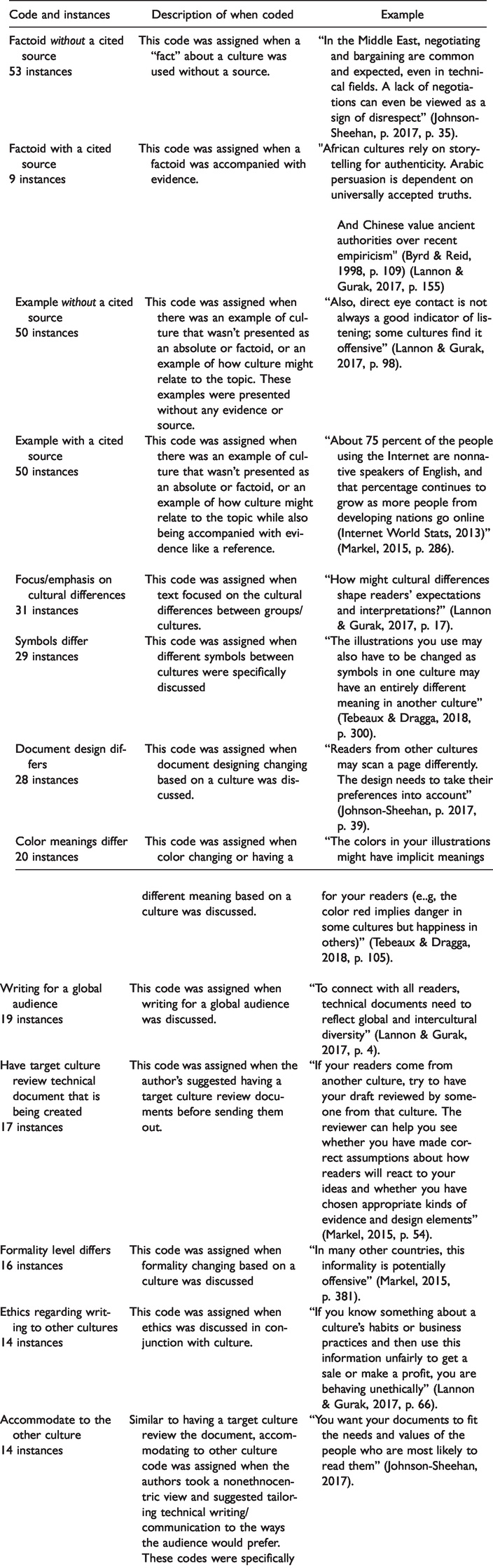
After going through the initial data multiple times, I noted patterns and inconsistencies and assigned initial open codes based on these unique aspects of the data. These codes were mostly based on similar words, meanings, and concepts of the actual instance (such as an example or factoid). A further explanation of factoids and examples may be necessary. For this study, a “factoid” was coded as content in a textbook that stated “y” culture does “z.” In other words, I defined and coded “factoids” as instances when the book stated that a culture does, behaves in, or believes a certain way. If the textbook provided a study or a source to add credibility to the statement, the code was labeled as “factoid with a cited source”; however, the vast majority of factoids were not accompanied by research or evidence. Slightly different were “examples.” I defined and coded “examples” as instances when a book would suggest that someone or a general culture might do “x,” or the textbook would provide an example of how writing might have to shift depending on cultures with an example about tone or formality. It should be noted a factoid and example are different in that factoids were stated as absolutes, whereas examples were stated as suggestions or possibilities and typically were less concrete.
In summary, for this initial stage, I used a line-by-line analysis as the unit of analysis. Within each line, I logged every instance of a term related to culture within a textbook. For each instance, I recorded the content of the instance (chapter location; a snapshot quote of content being discussed; summary of broader context; how the instance was presented—i.e., callout, paragraph, activity; and other notes); any other information that would be beneficial to understand that instance (such as if a definition was presented). Finally, in Phase 1, I assigned open codes to all the instances based on patterns, interesting findings, or other unique aspects while still using the word or meaning presented in the textbook. This initial phase was helpful for me to answer my first research question.
Phase 2
While the first Phase 1 was beneficial for seeing the frequency of open codes, I still wanted to better understand how culture was presented in textbooks. To better understand these open codes, I used recursive, intermediate coding to better identify commonalities and analyze open code connections. This intermediate coding focused more on interpretive or descriptive codes that also considered the context surrounding the instance (Cohen et al., 2018). These descriptive codes better explained the context surrounding the instance; I was then able to develop more conceptual categories for the instances. This second phase allowed me to answer my remaining research questions.
Findings
During my initial logging in Phase 1, I logged how these instances were presented throughout the chapters (as shown in Table 1). These instances were most commonly presented as a single bullet point mentioning something regarding IC, an end-of-the-chapter activity with an IC component or an end-of-the-chapter activity that focused entirely on IC, a sentence or phrase regarding IC in a section otherwise not related explicitly to IC, and an entire section dedicated to IC information.
Presentation of IC Instances in Textbooks.

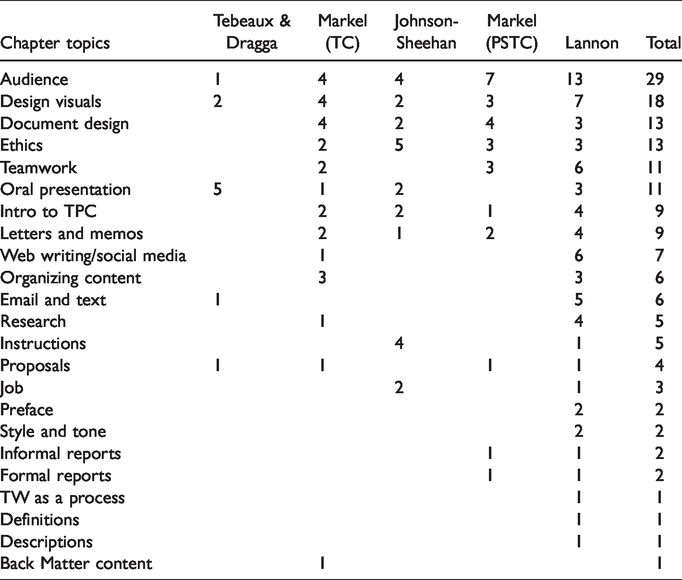
To better understand how culture was presented in textbooks, this phase analyzed how these instances were distributed through chapters. While not every chapter had the same chapter names nor chapter topics, I used generalizations to describe these chapters instead.
As seen in Table 2, the chapters that discussed IC topics the most were ones dedicated to audience analysis and considerations, designing visuals, designing pages/content, ethics, teamwork, and oral presentations. It should also be noted that IC topics were less prevalent in the chapters regarding the professional writing genres themselves, such as instructions, proposals, reports, definitions, and descriptions.
Distribution of IC Components Within Chapter Topics.
Phase 2
As stated previously, while open coding was beneficial to answer my first research question, intermediate coding was beneficial to answer my remaining research questions. During this intermediate level of coding, the content and context surrounding how culture was discussed in textbooks were clearer. Typically, the cultural content was presented as a point of awareness for readers, a suggestion for readers, or sharing a factoid/example. Due to the overwhelming number of factoids presented, I also analyzed which ones used evidence to support those claims. The following is a list of these codes.
Factoid without a cited source Factoid with a cited source Example without a cited source Example with a cited source Note of cultural differences Note that symbols differ between cultures Note that document design differs between cultures Note that color meanings differ between cultures Note regarding writing for a global audience Note that the formality level differs between cultures Note that ethics regarding writing to other cultures Note that tone differs between cultures Note that evidence preferences differ between cultures Suggestion to have target culture review technical document that is being created Suggestion to accommodate to the other culture
Further, Table 3 provides the frequency of the most common codes. In addition, since previous scholars did not necessarily show how they coded instances, in Table 3, I also present how I assigned codes and provide an example of each as an intentional move to provide an opening for more replication studies.
Description and Examples of Codes Assigned.
While these intermediate codes helped better understand how culture was presented in textbooks, this level of intermediate coding did not fully answer whether textbooks provide dynamic descriptions of culture. By analyzing more of the context and how these codes were connected, I developed 15 conceptual categories. While some of these conceptual categories are similar to the first level of intermediate coding, these conceptual categories had more to do with how the textbooks viewed culture and how dynamic they view culture.
Providing reasons or the need to study culture Providing resources to learn more about culture and IC Using examples or factoids Presenting other types of cultures (outside of nation) Tying culture to audience awareness Using a variety of terms (outside of IC) to describe communicating with other cultures Tying how culture related to goals of the textbook Defining culture Providing frameworks used to describe culture Focusing on cultural differences Explaining agency as it relates to culture Explaining ethics as it relates to culture Providing guidelines/best practices for communicating with other cultures Explaining how genres change with cultures Using negative language when discussing the process of communicating with other cultures Providing characteristics of culture
Discussion
From this analysis, I was able to answer my three initial questions.
RQ1: How Are IC components Presented, and Where Are They Presented in TPC Textbooks?
In the textbooks studied, culture was mostly used as an end-of-chapter activity, bullet point, sentence, or entire section. The bullet points and sentences were mostly used as caveats or examples of how culture is related to the current topic. Many bullet point topics shared how audience awareness and design (both for visuals and document design) related to culture. These instances were typically examples or factoids to make students more aware of the topics being presented. Many of these examples and factoids are related to national culture. In summary, the end-of-chapter activities, bullet points, lone sentences, and bullet points presented IC components in a static fashion.
However, promisingly, textbooks did have several sections and paragraphs dedicated to a more in-depth exploration of culture. Markel’s textbooks had several sections where students were supposed to reflect on various cultures such as organizational, community, and others and the ones they belong to while applying that information to the TPC topic. This reflection and activity focus more on attitude than memorizing or understanding social norms. Recognizing differences is one of the lowest ICC levels based on the DMIS model (Bennett, 2009; Wang & Zhu, 2011). Explained further, developing students' intercultural sensitivity through attitudinal changes is thought to better develop ICC skills (Hammer et al., 2003).
Lastly, I examined and found that most of the IC components were included in the chapters that discussed the softer, underpinning technical communication skills rather than chapters focused on TPC genres. Every textbook included IC components in their audience analysis chapter, which makes logical sense. However, instructors may consider revising previous chapters or adding more IC information to supplement these chapters and topics when discussing TPC genres.
RQ2: What Is the Context Surrounding IC Components in TPC Textbooks?
Examining the context surrounding IC components in textbooks was beneficial to better understand embedded assumptions textbooks were making and compare some of the findings to previous' scholars' work. Regarding Miles’ (1997), Matveeva’s (2007), and Matsuda and Matsuda’s (2011) study, there are several critiques they have presented regarding IC components in textbooks.
Textbook activities present surface-level information or that rely on english as a second language (ESL)/international students to teach culture, Textbooks use a negative tone to discuss intercultural communication, Textbooks present negative portrayals of nonnative English speakers and lack portraying nonnative English speakers as TW, Textbooks may use guidelines/tips as rhetorical strategies to increase students’ ICC, but textbooks should make that position more transparent and not based them on factoids/stereotypes, Textbooks use Othering, and Textbooks use factoids/stereotypes.
When examining the context surrounding many instances of IC components, many of these critiques are still valid. For example, many exercises still relied on asking international students to teach culture by speaking about their personal experiences. While learning about another's experiences and learning about national cultures can be beneficial, placing this pressure on international students as well as having one person speak on behalf of an entire nation or culture can be problematic for a variety of reasons including being a reductionistic method (Holliday, 1999; Witte, 2011). In addition, many of these activities were very superficial. They suggested students imagine a fake, national culture scenario and apply TPC to that scenario or presented factoids in the exercise and asked students to apply it to the TPC topic. However, I still posit that exercises can still be beneficial tools to teach students about culture, primarily when students reflect on their own cultures (Matveeva, 2007), how they relate to TPC and IC, and if they were to apply thick description activities to exercises. For example, if we take the following factoid presented earlier, “Russians prefer blunt, concise communication,” an instructor could develop that activity to focus more on the more in-depth understanding of this question and have students focus on their own preferences and attitudinal thoughts about communicating in such a way.
Explained further, the instructor could start with this factoid and have students discuss factoids' problematic nature. To make it more impactful, the instructor could have students reflect on factoids they may hear about students. The instructor could then introduce thick descriptions to discuss other reasons, social phenomena, and interconnected perspectives that negate the factoid (Holliday et al., 2017). The discussion can lead more to how one can learn about what an organization or culture wants in their project by talking with members from the culture and having them review the project, which is a suggestion both of Markel's textbooks provide. Finally, suppose there are differences in communication preferences. In that case, the class could discuss their thoughts, openness, and comfortability of communicating in such a fashion—again, leading back to the focus on the attitudinal side of being open to cultures, being open to changing one's own original perceptions, and respectfully working with other cultures and possible differences and similarities (Hammer et al., 2003).
Previous scholars have critiqued textbooks for their negative portrayal of IC because textbooks used terms such as “hurdles” to overcome challenges, primarily when related to individuals of other national cultures (Matveeva, 2007; Miles, 1997). However, some of the books, specifically the Markel textbooks, focused on opportunities with IC. This may indicate an attitudinal shift in textbooks. However, there also seems to be a more ethnocentric view of who TPC communications are, as many of the textbooks lacked any evidence that international/ESL students (as well as other nations) can have technical/professional communicators—outside of one Markel textbook discussed which had a multilingual writer’s guide in addition to the typical reference guide at the end of textbooks.
Specifically, this study wants to call out the use of factoids in these textbooks. Most of the factoids did not include any evidence to support the claims made, the ones that did use evidence used evidence typically from 20 years (or more) years ago. For example, Lannon and Gurak use several factoid examples without evidence or evidence from the 1990s or earlier, which focuses on stereotypes of culture. One example is illustrated when they cite Byrd and Reid's (1998) study “African cultures rely on storytelling for authenticity. Arabic persuasion is dependent on universally accepted truths. And Chinese value ancient authorities over recent empiricism)” (p. 154). The present study found these factoids being used predominantly in all textbooks. This study suggests that factoids are problematic because textbooks do not explicitly state that these examples are meant to be rhetorical strategies to illustrate a possible cultural norm. If these examples/factoids are presented as absolutes, these instances can be detrimental because they can lead to Easy answers such as reductionistic thoughts and Othering. Further problematic is that many of these factoids and examples did not come with any evidence to support them. Whereas examples in other chapters regarding audience analysis, oral communication, and other topics had very recent citations (within the past 5 to 10 years), examples and factoids lacked evidence or were accompanied with evidence that was decades old. Since the understanding of culture has changed dramatically over the past decades, these factoids are even more problematic.
It should be noted that when textbooks used more current evidence to support claims, these instances typically showed more nuances of culture and combatted stereotypes. For example, in Markel's Practical Strategies for Technical Communication, he mentions, If a US student casually asks a Japanese student about her major and the courses she is taking, the Japanese student might find the question too personal—yet she might consider it perfectly appropriate to talk about her family and her religious beliefs (Lustig & Koester, 2012). Therefore, you should remain open to encounters with people from other cultures without jumping to conclusions about what their actions might or might not mean. (p. 50)
This example does not rely on categorizing the entire nation of Japan a certain way, and it also has students reflect on how individuals in a national culture might differ compared to one's preconceived ideas (thus not relying on stereotypes) while still being positive and open to interactions with other cultures. This study does not suggest that an instructor should work to find new factoids each year, but instead, they can challenge factoids through thick description and focus on activities that involve more exploration rather than an acknowledgment of differences and similarities to better develop students' ICC (Wang & Zhu, 2011).
Activities that focus on exploring cultures (including one's own) can help prevent Othering. Miles (1997) specifically warned against presenting differences and Othering cultures in TPC textbooks. The present study found that most IC instances that focused on cultural differences were presented positively regarding advocating or being sensitive to a specific audience's needs. More interestingly, Markel's Technical Communication textbook specifically called out the similarities between groups. In a section about gender, he makes that argument that “The differences in behavior between two men or between two women are likely to be greater than the difference between men and women in general” (p. 77). If one were to view this statement in the sense of genders as cultures, it could be implied that Markel is making the stance that there are more similarities than differences among groups, and groups themselves are diverse. While this idea of similarities was mentioned a few times elsewhere, most of the textbooks focused on cultural differences. While these differences were presented, the dominant culture was presented as typically the United States, there did not appear to ethnocentric views in the textbooks.
Textbooks have also made some interesting, positive rhetorical moves that suggest a change from a static to a dynamic understanding of culture. Some textbooks, such as Markel's and Johnson-Sheehan's, call out the dangers of stereotyping. For example, Johnson-Sheehan's textbook suggests, You should also be careful not to rely on simplistic cultural or ethnic stereotypes when you are working with people from other cultures. It is wrong to assume that all people of a particular culture or ethnic group think alike and behave in a specific way. Negative stereotypes can be especially misleading and destructive, especially when prejudice assumptions are used to define a whole culture or ethnic group. (p. 30)
These small notes in textbooks may help students be more critical of the factoids, examples, or tips they are reading and help prevent stereotypical assumptions. In addition, some texts suggested the need to acknowledge one's own culture while still accepting others' cultures, which previous scholars (Matveeva, 2007) had suggested, which also point to more attitudinal suggestions for increasing students' ICC (Hammer et al., 2003). Finally, textbooks are also presenting more Small cultures, such as institutional cultures, which can provide a beneficial, dynamic understanding of culture. Even more interestingly, some texts (Markel’s) mentioned the idea of a third, hybrid space when communicating with cultures, which can lead to more critical explorations and activities related to IC.
RQ3: Do Textbooks Provide Dynamic Understandings of Culture for Programs/Instructors to Develop Students’ ICC?
As mentioned previously, most critiques of culture definitions revolve around definitions that can lead to Easy answers or that can be tied to a static understanding of culture. Many, but not all, textbooks mentioned and/or discussed dynamic understandings of cultures outside of solely national cultures, but importantly to note, textbooks never defined culture. Four of the five books mentioned and/or discussed other cultures such as corporate/organizational culture, gender culture, government culture, community culture, neighborhood culture, and media culture as these cultures relate to TPC. For example, Johnson-Sheehan's textbook states, “Learn the culture of the community. Listen to and learn before your post. Most communities have a distinct culture, which influences how and when people post, link, and reply” (p. 380) or from Tebeaux and Dragga’s textbook “… Do research on the organization, its problems, its corporate culture, the perspectives and attitudes stemming from its corporate culture… ” (p. 226). While these other types of culture might not have been explored as deeply as national culture, this usage of other cultures may indicate that many textbooks have started to lightly include a more dynamic view of culture to meet the needs of the TPC field and market.
However, textbooks lacked defining culture. Many offered both national culture and de-territorialized descriptions of culture, and many described culture as having:
Its own set of assumptions, Unique characteristics, Changes over time, Unique values, Unique expectations, and Customs that should be respected.
Since there were no definitions provided, descriptions of culture change within most of the textbooks. These changes happened within the same chapter in some instances or in later chapters. These descriptions changed based on the example provided. In other words, a description of culture being tied to nations might be presented in one chapter; however, in a following chapter, a corporate culture might be presented with an entirely new understanding of culture.
While it would be beneficial for textbooks to define culture to better help readers conceptualize complex terms (Yu, 2012), textbook authors have a lot to consider when crafting these texts. Since many textbooks do not have a definition of culture and descriptions of culture can change based frequently, it is paramount that instructors establish a definition for their students and have students explore that definition as it relates to the textbook, other materials discussed in class, and themselves. By providing a working definition, students can more easily understand and more deeply investigate this topic and apply it to neighboring topics and fields.
Implications
This study hoped to accomplish three goals. This study hoped to provide an updated review of IC components in textbooks, since textbooks can be a main source of disseminating IC information. Secondly, this study hoped to provide some suggestions to instructors, especially those who may feel new teaching IC topics or who have limited time and/or resources.
Since instructors choose textbooks for a multitude of reasons, instead of analyzing an entire textbook to find out how the textbook categorizes culture (whether in the Big or Small category), instructors can focus on a few chapters. For example, an instructor can skim the chapters focused on underpinning TPC skills, like the chapters focused on audience analysis. All textbooks discussed IC in these chapters. These chapters and their activities could provide instructors with a good understanding of what supplemental material they want to incorporate, such as thick description, their own exercises, or a working definition that is revisited throughout units. This study recognizes instructors choose textbooks for a multitude of reasons. If an instructor is already using a textbook and still wants to incorporate IC into their classroom, this study again suggests examining the previously mentioned chapters. If an instructor notices several factoids, this study suggests using time in class to discuss factoids and the Easy answer dangers associated with using factoids without critical reflection. In addition, since the textbooks rarely discussed IC in topic focused on genres, such as proposals or reports, these might be useful sections to introduce more examples and areas where students can investigate their own Small cultures and how they relate to various genres and preferences. Since attitudinal development is key for ICC, this study suggests that instructors supplement textbooks with activities, projects, and exercises to focus on students’ attitudes of IC to better assist their ICC abilities (Hammer et al., 2003).
Lastly, this study hoped to provide a working definition for culture for instructors, TPC programs, and the field to consider. As presented previously, a working definition of culture can assist with the following goals.
Instructors can have a working definition to build from, which may help with their comfortability in teaching IC, which they can use with the resources they already have (Barker & Matveeva, 2006). Using a definition for a complex term can help students better understand the topic, which in turn allows for deeper exploration of that and surrounding topics (Yu, 2012). This deeper understanding and cross-exploration can be used in transdisciplinary work or social justice projects. Both are current, meaningful moves in our field (Gonzales et al., 2020; Miller, 2020; Walton et al., 2019). Working definitions allow for consistency and more sustainable research (Melonçon & St.Amant, 2018).
Footnotes
Declaration of Conflicting Interests
The author(s) declared no potential conflicts of interest with respect to the research, authorship, and/or publication of this article.
Funding
The author(s) received no financial support for the research, authorship, and/or publication of this article.
