



Abstract
Community-based action as a positive impact of tourism development is examined and connected to a community’s capacity to protect itself from outside threats by negotiating the quality of tourism development. Five communities in Jeju Island, South Korea, are studied through interviews with community members and analysis of a regional newspaper archive. Tourism development is depicted as an interaction between outside developers and local residents that ultimately builds a sustainable dialogue for growth of tourism. In five communities, the partnerships established between local community residents and outside tourism developers began with initial resistance from residents and led to the following sequence of behavior: town meetings, formal organization of residents, petitioning, public demonstration, and legal action. By examining collective action narratives in the five study communities, a framework for sustainable rural tourism development is built to understand relationships between tourism impacts and community identity.
Introduction
Tourism development not only changes the physical landscape of a destination but also results in changes to the social life of the community (Kang et al. 2008). When tourism development intensifies beyond a community’s capacity, the social life of a community undergoes tremendous change and upheaval (Perdue, Long, and Kang 1995).
Social impacts often stem from abrupt transformation of community identity and resident solidarity, which directly influence quality of life (Perdue, Long, and Kang 1995). Rosenow and Pulsipher (1979) provided some early insight to understanding the lost sense of a community’s identity and change to traditional culture that accompanies a fast-paced tourism development. Huang and Stewart (1996) indicated that intrusion of a touristic culture on a rural destination, even if done in an incremental fashion, still changes relationships among community members and, for some segments of residents, strengthens their sense of solidarity. Many residents want to protect their community from negative impacts and often work to redirect tourism development to minimize such impacts (Gursoy, Chi, and Dyer 2010).
A general concern is that tourism encourages nonresidents (or outsiders) to a community who bring unwanted changes because of their cultural, economic, and political power to influence residents (Andereck and Vogt 2000). When local decision-making processes become overwhelmed by outside forces, residents’ sense of community is vulnerable to change in ways beyond the control of local people and threatens the quality of life (Snepenger, O’Connell, and Snepenger 2001).
Community-Based Action as Necessary for Tourism Development
An impressive body of research has been directed at understanding community perceptions of impacts of tourism (Sheldon and Abenoja 2001). These efforts have collectively identified a broad array of resident perceptions and attitudes toward the impact of tourism. Several implications for affected communities have come to light, including impacts regarding increased traffic congestion, construction projects, crime, mixed effects on quality of life, and changes in community identity, to name a few (Deccio and Baloglu 2002; Zhou and Ap 2009). Although our understanding of community perceptions and attitudes toward tourism development has grown tremendously, there is limited understanding of residents’ behaviors in relation to tourism impacts (McGehee and Andereck 2004). According to Lai and Nepal (2006), a growing area of interest complements resident attitude research by examining ways in which tourism development affects community behavior (i.e., collective action).
Many studies have suggested roles for community-based collective action. Rural sociologists, especially those who explore interrelations between social capital and community behavior, have a history of understanding causes and consequences of community action (Adger 2003; Besser 2009; Glover 2004; Son and Lin 2008). A recurrent finding is that collective action empowers a group of residents to address problems from local perspectives (D’Silva and Pai 2003; Mitchell and Reid 2001). The target of collective action is often directed at eliminating an external threat or reducing the negative impacts on a community’s way of life. When community-based action is effective at negotiation, a community is usually left stronger and more capable of addressing future development threats and opportunities (Pretty and Ward 2001). Collective action could enhance the sustainability of tourism development because of processes that empower a community to negotiate a fit between tourism and community’s sense of itself (McMillan and Chavis 1986). Effective collective action is not about eliminating tourism but about implementing tourism development in ways that fit with a community’s sense of itself.
An important line of research has been directed at understanding resident behavior in relation to tourism impacts (Butler 1980; Dogan 1989). Referred to as coping strategies, such research investigates ways in which residents deal with tourists and tourism development. Ap and Crompton (1993) have identified a continuum of behavioral strategies from embracing tourism to withdrawing from one’s community due to the inability to handle direct contact with tourists. This line of research has provided useful information about individual attitude and behavior; however, it has not yet assessed collective behavior of groups of residents. An important stream of tourism research highlights the significance of social capital for sustainable rural development. This body of research has identified strong ties and trusting relationships among residents as contributing factors to initiate and maintain community support for tourism (Jóhannesson, Skaptadóttir, and Benediktsson 2003). Specifically, Jones (2005) found that strong ties and trusting relationships facilitate collective action that supports proposed tourism development. In contrast, this study explores community-based efforts to change the nature of tourism development in ways that increase positive impacts and decrease negative impacts.
Goodwin and Jasper (2009) defined community-based action as the activities residents pursue to address issues of community identity and solidarity. That is, the community works together—or at least negotiates as fragmented groups—through collaboration of residents and their organizations. Collective action implies collaboration with other community members, and participating in acts of solidarity, which are distinct from residents acting alone or individually coping behavior.
Community-based impacts of tourism development—including various kinds of collective action—are important to understand, and indicate the extent to which residents are willing partners in sustaining tourism (Vincent and Thompson 2002). Because successful tourism development depends on positive encounters between tourists and hosts, the long-term success of tourism is dependent on locals and their support for tourism (Gursoy, Chi, and Dyer 2010). Cooke (1982) and Allen et al. (1988) were some of the first to suggest that both resident attitudes and behaviors are critical to understand the long-term success of tourism.
This study explores ways in which collective action leads to minimizing negative tourism impacts and maximizing positive impacts. Understanding local reactions to tourism development and factors that influence collective behavior are crucial for sustainable tourism (Pérez and Nadal 2005). Collective action holds promise to enhance a community’s capacity to negotiate the quality of tourism development and protect themselves from undesirable change.
Although residents may initially resist externally based tourism development initiatives, the subsequent feedback and interaction between developers and community organizations could provide an appreciative dialogue necessary for collaborative implementation of tourism. External tourism development initiatives could be from a variety of forces, including federal designation of a place as being nationally significant, a corporate-based proposal for hotel development, or a regional initiative to build a larger waste-water treatment plant or other infrastructure to cater to a growing tourism industry.
Within this study, local reactions to tourism development are framed as having the potential to build enduring relationships between a community and the tourism industry. Relationships are built across a series of interactions and may require an appropriate time span to be perceived as relationship-building. Even if initial local reactions are negative and lead to a collective sense of anger and resentment with tourism initiatives, when channeled into collective action, they may lead to positive consequences for the community and ultimately for the long-term viability of tourism. The research characterizes community-based interaction with external tourism developers and identifies a model for collective action that leads to a strengthened community through enhanced solidarity, empowerment, and ultimately sustainable rural tourism development. No doubt tourism developers could be residents of a local community, and the catalyst for change would be internal rather than external. However tourism developers external to a local community were the catalyst for change for the communities studied herein. Methodologically, evidence for (or against) collective action to tourism initiatives is relevant to the research question. The empirical portion identifies local narratives depicting collective behavior of residents who organize themselves to work with outsiders linked to the tourism industry.
Method
Study Site: Five Communities on Jeju Island, South Korea
This study was conducted on Jeju Island, a popular tourism destination at the southernmost tip of the Korean peninsula (see Figure 1). Jeju Island has a history of isolation from the mainland of South Korea and has been well preserved not only in its unique traditional culture, but also its beautiful natural landscape. Tourism development on Jeju Island was initiated by the South Korean government in the 1970s and has evolved gradually since that time. The total tourism-related gross domestic product (GDP) for transportation, restaurants, and hotels of Jeju Island was 1,022,000 million Won (more than US$1 billion), which accounted for 13% of the total GDP of Jeju Island (Jeju Special Self-Governing Province 2007). The tourism industry of Jeju Island is proportionately larger compared with that of Seoul, with tourism accounting for 7% of its economy and 6% for the entire country of South Korea.
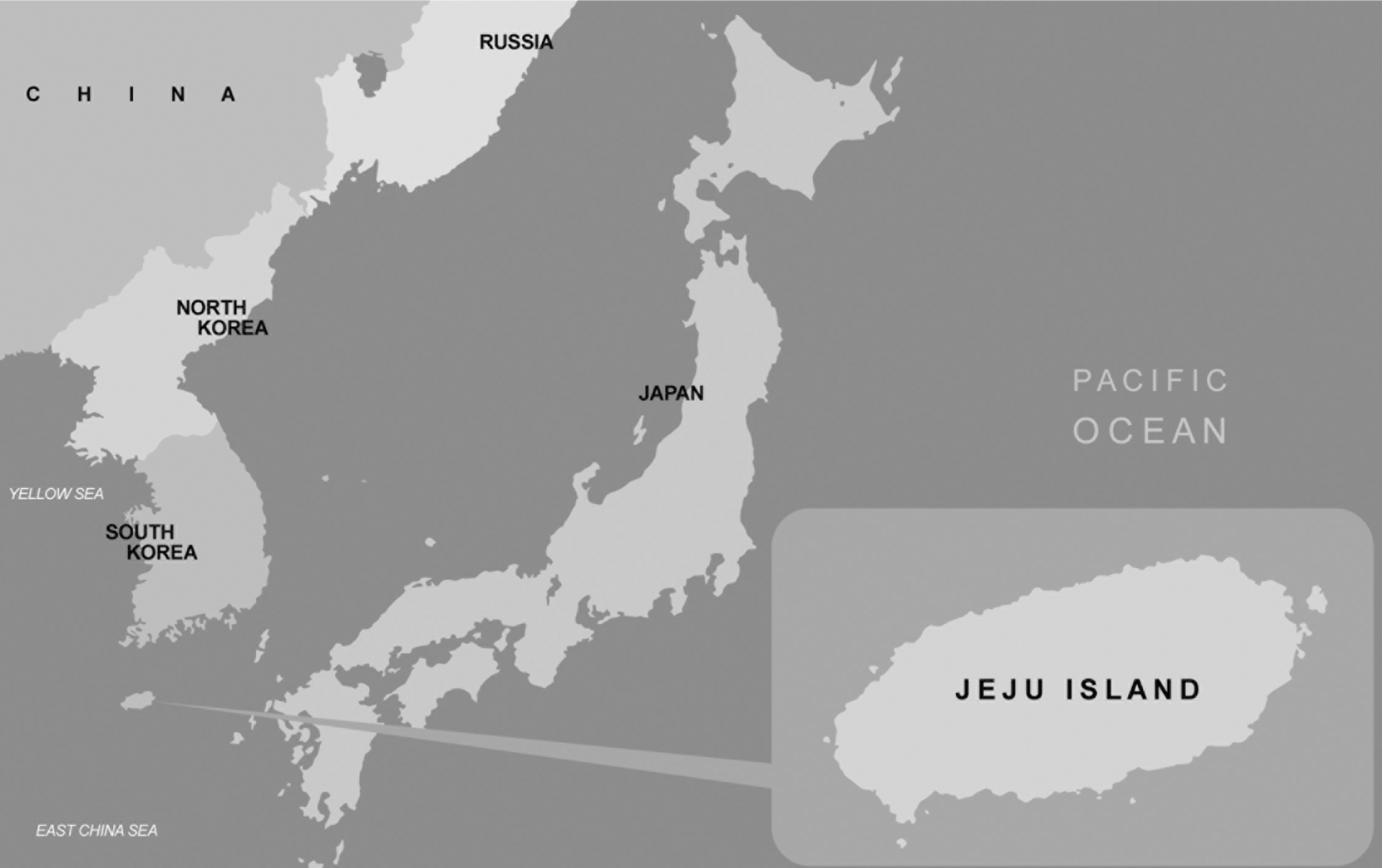
Location of Jeju Island
Five communities on Jeju Island were included in the research. The communities each have a unique history with tourism development. The community of Sungsan with almost 2,000 residents is well known for Sungsan Sunrise Peak—a scenic volcanic mountain. Its value has been internationally recognized by its designation as a United Nations World Natural Heritage site in 2007 (World Natural Heritage Jeju 2007) because of its dramatic coastal landscape and traditional village life. The community of Yere (population 800) has a history of community-based organizing to conduct festivals and other community-inspired tourism activities. As a regional capital city for more than 500 years, Sungeup (population 850) was designated as a traditional folk village by the government of South Korea in 1984. Mosulpo is famous not only for beautiful scenery but also for its numerous historic battlefield monuments. Mosulpo—850 residents—has a history of collective action to address various social issues, including tourism development. Jungmoon—5,000 residents—has a recent history of enclave tourism development assisted by the central government.
Procedures
To examine each community’s collective action, the first author became immersed in the development narratives of each community by engaging informants in conversations that recalled the tourism development processes of their community. Creswell (2003) indicated that the use of qualitative method allows researchers to understand the social and community-based framing experienced by informants. A qualitative approach was adopted for this study to gain an in-depth understanding of community-based collective efforts from the view of each community’s leaders.
Two research methods were conducted simultaneously during April and June 2008. Archival research of local newspapers spanning 30 years and semistructured interviews with community leaders assessed the history of social issues and collective behavior related to tourism development in each community. The methods complement one another and provided diverse angles to see each community’s history of tourism development. The newspaper articles were used to both facilitate memory recollection during the interviews and explore convergence of the two methods through cross-checking (Patton 2002). The application of the two methods enhanced the credibility of any given finding by assessing its consistency across different data collection methods.
For the newspaper analysis, three local daily newspapers of Jeju Island were reviewed by the first author, and the Jeju Daily was selected for sampling, being the longest running daily newspaper on the island and most widely circulated. Jeju Island tourism was first initiated in 1978, and given that the Jeju Daily has been in publication since 1945, it was the most appropriate newspaper to examine for development issues across the five communities of study. Newspaper archives were examined at two public libraries, the Jeju Library and the Jeju National University Library; hard copies were used from 1978 to 2003, after which digital archives were reviewed.
The review was restricted to the one or two pages of the “local community” section of the weekday editions of the Jeju Daily which includes local information and announcements of events. Any article directed at tourism development was copied for further reference and later analyzed for content related to collective action. To identify articles for copying, terms relevant to tourism were the first criterion for selection; the second criterion was an indication of the name of one of the five study communities (Nickerson 1995). Each weekday edition was reviewed during the 30-year time period, totaling more than 6,000 newspapers. An assistant was trained to support the review of the first author.
Interviews were conducted concomitantly with the review of newspaper archives. The interviews were arranged at places where interviewees could comfortably meet. Although each interview was scheduled to last one hour, most were two to three hours in length because of the informants’ detailed viewpoints and keen interests in the topics discussed. Questions asked them to recall the history of tourism development in their community, the sequence of events, social- and community-based impacts, and their responses to the development. Interviews with 20 informants were audio-recorded using standard human subjects protocol and review.
Interviews were initiated with an introduction and use of a name card. Because the first author completed his undergraduate study on Jeju Island, opening the interview with the first author’s college history was effective in building rapport. In addition, the first author’s use of Jeju dialect reduced barriers to conversation and facilitated trust building. Several informants commented with gratitude for use of Jeju dialect. Furthermore, a colleague of the first author who is a lifelong resident of Jeju Island helped with the arrangements of the initial set of interviews (Fontana and Frey 2000). As part of the relationships built between the first author and the informants, gifts were given to each interviewee as an expression of appreciation.
The interview approach was developed based on procedures identified in standard texts on interview techniques (Babbie 2004). After introductions, the purpose of this research was explained and informants were asked to recollect the initial development of tourism in their community. The initial questions that asked them to recall the start of tourism were intended to invite informants to express their own thoughts about tourism, to foster a conversational rapport, and to gradually move toward the central questions of the study. The author was sensitive to being a supportive listener and encouraging a “balanced rapport” to evoke an honest, wide-ranging, and detailed discussion regarding collective action and tourism development (Fontana and Frey 2000).
For some interviewees, the questions about local tourism development taxed their memories and they had difficulty recollecting. So at times, information from the Jeju Daily was used to stimulate their memory on tourism-related issues. The interviewer asked informants questions to clarify what a writing was about or to elaborate on an announcement of an historical event. At times, the first author wanted to understand the extent of shared opinion among community members (Babbie 2004), and would ask such questions as “Do other community members also think this way?” or “Then, how did other community members feel at that time?”
After key questions, the first author provided a brief summary of their responses to be sure they were understood. After each summary, interviewees were asked, “Did I correctly describe what was said? Is there anything that we should have talked about but did not?” Fitzpatrick, Sanders, and Worthen (2004) indicated that this kind of preliminary analysis during the interview enhances trustworthiness of the findings. Such iterative processes nuanced meaning and built a “thick description” to ensure credibility of the stories told (Hudley, Haight, and Miller 2003).
Informants
Informants of each community were identified on a referral basis, also known as a snowball sampling technique (Patton 2002). A referral basis was the most effective strategy to access a small number of residents who would be aware of the history of community development from a firsthand perspective. Elected leaders of each community served as the initial point of contact. From there, other informants were identified who were a mixture of elected community leaders, business owners, and residents who consider themselves stakeholders in the future of their community. At the completion of each interview, the initial leaders were asked to suggest names of people who fit the following two criteria: (1) community residents who know the community well and care about the future growth of the community, regardless of their position on growth and development, and (2) residents who have been involved with group efforts to address tourism development (e.g., community forums, workshops, public organizations). There were four informants identified in each of the five communities, 20 informants in all. Most informants were born and raised in their community, less than 65 years of age (with range of age from 40 to 80 years), male, and were either an elected community leader during the past 30 years or considered themselves a stakeholder in the future of the community.
Analysis
To explore community-based action, interview transcription was conducted by the first author after each interview as the first step of data analysis. Because the interview was fresh in the mind of the first author (who was also the transcriber), the detailed language and interpretation of each interviewee was captured in the transcription (Gibbs 2008). The transcripts were translated by the first author and then cross-checked by the third author, who is also bilingual in Korean and English. Both interview transcripts and news articles were reviewed for each community and general themes identified and cross-checked (Patton 2002). The cross-check among the three authors contributes to both minimize misinterpretations that may happen in the process of coding and to bring out biases of researchers to encourage a critical reflexivity in the analysis. The cross-checking ultimately contributes to enhance the trustworthiness of findings (Gibbs 2008).
As an iterative process between news articles and transcripts, stories were analyzed to identify facts and thematic narratives of five communities. As part of the process, the research questions were used to direct the questions being asked of the data. For example, the impact of collective action was an important research question. An informant stated that “relationships among community members became stronger through working together” and that it led to a theme of collective action to enhance community solidarity. Another informant in the same community reported that “collective action helps residents realize we all depend on each other.” This statement was interpreted under the same general theme and was seen as a pattern to support strengthened solidarity through collective action (Patton 2002).
Various thematic categories were used to synthesize similar ideas and concepts. After initial categorization of the data, new thematic categories were added in cases where important data did not fit into these categories or a single category blurred two or more ideas relevant to connecting collective action to tourism (Rubin and Rubin 1995). The findings from the newspaper archives were used to check the sequence of events from the interviews and, where possible, the effects of any specific collective action.
Findings and Discussion
Phases of Collective Action
In all five communities, the partnerships currently established between local community residents and outside organizations advocating tourism all began with initial resistance from residents. The resistance was a general pattern exhibiting the following sequence of behavior: public hearings and town meetings, formal organization of residents, petitioning, public demonstration, and where these failed, a strategy for legal action. In two cases, community residents failed in their quest to modify initial tourism development decisions, and in three cases community members were successful at establishing an effective dialogue with outside forces advocating tourism through use of town meetings and public petitions.
The initial point of collective action instilled a sense of personal investment within community residents (Ostrom 2000). In all five communities, outside tourism developers proposed some kind of tourism development that was framed as a threat by the community and led to information sharing among residents. Information was shared through existing informal and formal social networks (Freeman 1973). However, information sharing was not a sufficient condition for galvanizing collective action. Sharing information of the threat of proposed tourism was a result of village meetings held by community leaders. In each community, the purpose of the meeting was to discuss the proposed tourism development and identify impacts that would threaten some desirable aspect of community life.
Information from the initial meetings was shared among the townspeople. Residents began to speculate on threats of the proposed development to their way of life. Rather than focusing on opportunities, the fear of negative impacts became the central point (Freudenburg and Gramling 1994) and was partially fueled by the lack of familiarity and trust with developers from outside the community. For example, the developer JDC (Jeju Free International City Development Center) held public hearings several times for Yere residents and explained their plans for a resort complex, including the location of facilities and contribution to the residents’ lives. However, the townspeople remained wary of whether JDC would keep their promises, and a resistance movement grew from this fear and uncertainty.
A key distinction that separated friendly development processes from conflict-ridden ones was the use of town meetings to share values related to a community’s sense of itself and create public value for a community’s identity. The development processes started with town meetings that encouraged residents to learn from each other about their community-based values. Such dialogue processes led townspeople to “discover” (or create) a collective identity through shared conversations among members that subsequently formed a basis for trusting relationships and community-based action (Hardy, Lawrence, and Grant 2005). Initiating development conversations with residents about their sense of community identity was effective at bringing tourism developers into a sustained conversation about community priorities, which in turn made it easier for community residents to accept tourism development proposals. This was revealed by an informant who is an elected official in Sungsan:
At that time, we had emergency community meetings in order to see how others thought, and through these meetings, we usually reflected on the opinions of community members. We could not solve the problem alone. Working alone is very weak. The solution is only possible when we work together. . . . [After sharing opinions among community members] we discovered our reasons to fight with the developer.
Another key point about these initial meetings was their creation of feelings of solidarity. When townspeople shared opinions about their community, many positive emotions emerged in appreciating their town. Such dialogue created closer relationships among community members as they learned about their collective concerns and searched for effective ways to cope with their perceived threats. Ostrom (2000) indicated that residents become involved in community dialogue processes in order to attain a sense of safety from outside threats. This “coming together” through community dialogue creates a sense of belonging based on beliefs or expectations that one is a member of a community and willing to sacrifice for it. This solidarity is about a common identification, which was reflected by informants by a statement such as “It is my group.”
Public hearings, town meetings, and petitioning are associated with formation of formal organizations to affect tourism development decisions (Beard and Dasgupta 2006). Particularly for meetings linked to the future of their community, residents often created formal organizations to represent their viewpoints within public hearings and strategize in the petitioning process on behalf of the community. Within these groups, there were a diversity of roles for residents to play. An informant from Yere indicated that his group would work late at night while other residents would bring coffee and snacks to serve them, and still others would clean up from the meeting. The organizations were formed as a strategy to represent themselves, as indicated by an informant who owns and manages a gift shop in Yere:
Community members were divided into two groups, and they made their own organizations to create two sets of voices. One group was the landowners’ council and the other was the residents’ countermeasure council. The landowners’ group worked toward individual compensation for land sales. The other group welcomed the development of the new resort because of overall community benefits.
The interview described the emergence of community-based organizations to represent opinions in the negotiations surrounding this resort development.
Community-based efforts were usually enhanced by petitioning the local and central governments. The formal organizations would make an official statement reflecting the community’s interests. These petitions not only informed about their present condition and overall position on tourism but also asked for help from various government agencies. This effort was described by an informant working as an interpreter for tourists at Sunrise Peak in Sungsan:
In order to prevent construction of the Lila Hotel inside Sunrise Peak, we had town meetings . . . and reached agreement to submit a petition to the local government. . . . Since we strongly believed our opinion was justified, we asked for help from the local government.
For local residents, petitioning the local and central governments occurred only after public meetings and served to solidify the sense of a collective identity among them from sharing their beliefs and justification for their actions.
When petitioning was not effective, a couple of communities took the next step of public demonstrations in order to make their voices heard. As part of tourism development in Sungsan, residents’ coping strategy included demonstrations against the construction of the Lila Hotel. Meetings, hearings, and petitioning were not effective, and the community realized the need for another way to make their voices heard. As stated by an informant who is an elected official in Sungsan,
We tried many ways to make our demands heard regarding the construction of Lila Hotel, but most of our methods were not effective. So we decided to stage demonstrations to resolve the problem. We stopped working our regular jobs, and spent our whole time demonstrating. The women [seaweed] divers and members of the young men’s association went to the construction site of the hotel everyday and demonstrated against hotel construction.
As other examples of collective action in Sungsan and Mosulpo, the newspaper indicated that about 100 residents demonstrated in the rain to protest the construction of a gas station inside the Sungsan harbor watershed. They protested not only to prevent the environmental destruction of the sea but also to preserve the natural scenery of Sunrise Peak as a tourist attraction and the protection of spawning grounds for the fishery industry (Lee 2000). The Mosulpo community also organized demonstrations to advocate against the operation of an excursion ship in this area since they believed the operation of this ship would ruin their fisheries.
Yere residents also were intending to demonstrate as a show of force against a plan to build a resort in their community:
We almost demonstrated against the resort development because the developer had been ignoring our opinion and was not willing to hear our voice. So we made a plan to demonstrate to prevent construction by wearing white headbands and using our farming equipment [to stall traffic and reflect solidarity]. However, a day before our planned demonstration, the developer accepted our proposal. (an informant who owns and manages a gift shop in Yere)
In all cases where the communities strategized to demonstrate, the resistance movement was not antitourism but opposed to a specific kind of tourism development that was deemed inappropriate for their community.
There was just one community whose initial steps of community-based action were ineffective and led to legal action. By asking assistance from the judicial branch of government, Sungsan residents thought they could strengthen their cause and motivate others to help them (see also Goodwin and Jasper 2009). Sungsan applied for an injunction against the construction of the Lila Hotel as its last effort of resistance. This method proved to be effective, as explained by an elected official in Sungsan:
Since the developer wanted to use the path already used by the women [seaweed] divers, we applied for an injunction against the construction of Lila Hotel. To pay for this legal action, the women divers were willing to donate a portion of their income from their work. . . . After the legal action, other parties inside and outside Jeju started to provide us with sympathy. There were two distinguished Koreans who stepped in to arbitrate for us, including the . . . president of the married woman’s group in Jeju. People helping us at this level of notoriety were influential in reaching an agreement between residents and the outside developer.
Other evidence of willingness to use legal action was presented by an informant who owns and manages a grocery store in Yere:
We considered using legal action, but we did not because we thought we could prevent development by ourselves before using legal action. We’d seen demonstrations in other communities that were successful at stopping threats from the outside without depending on legal action.
This informant indicated an intention of using legal action as a last resort for resolving their problem.
Collective Action to Enhance Community Solidarity
A second set of findings provided insight into the effectiveness of collective action on building community solidarity. Huang and Stewart (1996) indicated two ways in which solidarity develops: (1) because residents share a similar cultural background and lifestyle they are naturally inclined to identify with one another, and (2) personal ties are formed and solidarity strengthened by working with one another on tasks to reach a common goal. Both of these forces were apparent in the communities of Jeju Island. Not only did residents share the same cultural experience and community-based memories but also worked together to address a perceived threat from tourism developers. Strong ties among community members contributed to their ability to successfully negotiate with tourism developers.
Many rural sociologists have indicated that when people feel threatened, they show solidarity and create a sense of community identity to cope (Paxton 2002). An outcome of collective action is a strengthened community identity and enhanced solidarity (Besser 2009). In the communities of this study, interaction between community members through collective action affirmed their bonds and gave focus to their sense of collective identity. However there was some variation across the communities. A focused community identity did not come naturally—it was the result of several public meetings and hearings. Prior to the first set of meetings, each community was fragmented into historic subgroups based on specific interests connected with kinship, employment, and neighborhood. However, three of the communities were able to overcome their initial fragmentation because the dialogue brought out a community identity broad enough to encompass its many groups. These three communities constructed collective fronts to address the negative impacts of the original proposals for tourism development. In turn, solidarity strengthened from developing a shared sense of identity and initial success in negotiations with tourism development.
Informants from Sungsan provided support for the effectiveness of collective action in strengthening solidarity of residents. As stated by one informant who was working as an interpreter at Sunrise Peak:
Women who were engaged in fishery jobs are involved 100% in collective action opposing the construction of a hotel, and the overall opinion was to work together because the issue was so strongly related to our survival. . . . At that time, most of our community’s income was dependent upon gathering brown seaweed. For this reason, women divers played a crucial role.
Even though the issue was strongly related to the conditions of the women seaweed divers, most residents tried to work together because they saw this issue as closely related to preserving their shared social values, that is, a village at the base of a protective mountain whose heritage was tied to farming the sea. In the initial public meetings, they shared stories that appreciated Sunrise Peak, the bounty of the sea, and the culture of women who dive for brown seaweed.
Evidence of building solidarity through collective action was apparent in several communities. As noted by an informant who is an elected official in Sungsan:
We needed to apply for an injunction to oppose hotel construction. However, we did not have enough money for that. Thus, a couple of residents, including me, decided to loan money to the group as security. We borrowed seven hundred dollars at that time, and we could apply for an injunction to prevent development. We did this for our community.
Although residents were not affluent, they were still willing to donate a portion of their money for efforts that increased their success in negotiating with outside developers. It was effective at designing a proposal based on compatibility and coexistence of the women divers, the fishes that spawn in the watershed, and the resort development.
Other evidence that supported solidarity through collective action came from informants in Yere, as described by an informant who owns and manages a gift shop:
At first, others members who opposed the construction of the resort because they wanted to increase their individual benefits kept blaming us (who supported the development of the facility) because they thought they would not get compensated enough due to our support for development. Thus, they did not participate in the meetings, and we had lots of conflicts with them. However, they started to change their minds after observing that we changed the direction of the development to reflect what we collectively wanted. They started to notice our strength and the effectiveness of working together.
Resort development in Yere created factions among the community. Most residents supported resort construction, while some residents who demanded more compensation for selling their land to the developers strongly opposed its construction. However, the positive changes that occurred as a result of the supporters’ collective action detailed above made some members of the opponent group realize the effectiveness of collective action, causing them to view the other group’s collective action in a more positive light. This made them see things from the other community members’ perspective, which in turn strengthened relationships between community segments.
The community of Mosulpo also was fragmented prior to initiating tourism development. A group that viewed tourism as a tool for community development invited other groups to a town meeting to speak and listen to one another. At this meeting, the collective values of community members were shared and the groups realized other community members’ point of view. As depicted in the local newspaper Jeju Daily,
In the process of acquiring the land needed for development, some community members tried to persuade landowners to sell the land to developers. Negotiations continued long into the night. Because of these efforts, 98% of the land needed for development could be successfully negotiated (Cho 1999).
The newspaper article reflects the willingness of the Mosulpo community to see the effectiveness of interaction to reach an agreement and strengthen solidarity.
Collective action and increased solidarity fueled each other. The success of each negotiation provided feedback that strengthened functional relationships of community organizations and enhanced solidarity. These relationships were similar to those identified in studies of social capital and characterized by trust, common vision, and collective action (Pretty and Ward 2001). Moreover, these functioning relationships were subsequently used by community organizations to pursue positive changes within tourism development as judged by community residents. For example, there was a growth in community-based festivals organized by residents as a result of both collective action and community solidarity. The efforts of Yere residents provide evidence for this positive sequence of events. As stated succinctly by an informant who is an elected official in Yere,
Until now [before any collective action opposing construction] we had asked outsiders for just enough compensation to mitigate [direct negative] impacts. We did not consider the kinds of benefits the development would bring to our community. However, our thoughts about the development have totally changed. . . . We came together with one voice to change the direction of the development to reflect our desires, such as asking “Could you change the path of the road toward our community?” Now, we welcome the development in our community. . . . We have restored our traditions and created diverse attractions and participatory programs, which had been buried and unknown to anyone until now.
The opposition of Yere residents to construction from outside developers was fueled by a focus on the negative impacts that tourism brings. Their action was instrumental in having them become self-aware of their collective strengths, and its positive effect on their community. The residents’ confidence and strengthened ties encouraged them to participate in meetings where they developed a unified voice to express concerns. They revised their efforts and rather than opposing tourism, became proactive to develop sites and programs to attract tourists.
A positive sequence of events was also apparent in the Mosulpo community, whose local festival was initially put on by the local people for the local people. However, as tourists gradually discovered the festival, positive feedback shifted their perspective in favor of certain kinds of tourism development. As stated in the Jeju Daily newspaper:
When considering the outcome of this festival, it could be considered successful in that it demonstrated the possibility for a community to hold a local festival that featured the special products of the region. . . . The most dominant characteristic of the Yellowtail Fish Festival . . . was the harmonization of the community members with tourists. . . . It was conducted on the basis of participation of community members, and this contributed not only to the harmony among community members but also let the community build confidence in future development (Kim 2001).
This article depicts the contribution of collective action to enhance community solidarity and empowerment. The enhancement of social capital as a result of hosting a festival and the confidence gained by residents from tourists enjoying their festival led the community to explore other tourism developments.
Collective Action Enhances Community Identity
A third finding is linked to latent community values that were revitalized because of coping with outside threats. The use of constructive public dialogue in three communities led to civic discovery (Whittier 1999), in which community-based narratives that had been held by individuals were publicly shared and legitimized in public meetings and hearings. In three communities whose solidarity strengthened, they re-created themselves and established a new sense of community. According to Puddifoot (1995), a critical element of community identity was its “collectiveness,” which emphasizes a sharing of individual senses of community to help shape a collective community identity. That is, community identity is larger than any one resident’s sense of community, but exists as shared knowledge among residents regarding their sense of “we.”
As part of the successful public meetings and hearings in the initial phases, residents shared their community narratives and emotional attachments to their community. Such a dialogue brought the community’s heritage and values to the surface and revitalized a coherent narrative that provided residents with a sense of their collective selves. The effectiveness of the dialogue at public meetings and hearings to revitalize a community’s collective identity has been recognized by several scholars who study social impacts of community (Hardy, Lawrence, and Grant 2005; Holland, Fox, and Daro 2008). Miller (1992) indicated that community identity is created through careful communication among residents that share personal histories and appreciation for a locale. Goodwin and Jasper (2009) also emphasized the importance of cultural messages that help frame a collective identity. Social ties among residents facilitate sharing values and emotions that shape a collective identity and strong sense of belonging.
Collective action related to tourism, as shown in the five communities of this study, led to the public creation of community identity. Community members worked together to negotiate tourism development, which in turn led them to construct and discover their community identity. A collective action of the Yere community resisted development of a sewage disposal plant and created a collective value that appreciated the coastal seawater as clean and pure. As stated by a Yere informant who owns and manages a gift shop,
If we had just let the developers proceed how they wanted, and if we had welcomed the development, they might not have changed their plan and the negative impacts could have been serious. However, our residents created the Yere Environmental Watchdog Group by ourselves and supervised the development to ensure that it was conducted in a way that preserved our natural environment and to minimize negative impacts on sea water.
Before the proposal to construct a sewage disposal plant in Yere, the community was not collectively conscious of its value of keeping the sea clean and beautiful. It was merely the sea, absent of any collective or public significance. However after several town meetings and public hearings, the significance of the sea—particularly its clean and beautiful waters—were “discovered” as being an important part of the community’s sense of itself. It was deemed a precious sea that should be protected and kept clean and beautiful; this new sense of identity was reflected in other actions to negotiate tourism development.
The discovery of a community’s identity was also a feature of Mosulpo’s Yellowtail Fish Festival. Community members used this festival as a tool not only to promote their special products to visitors but also to educate and be recognized about their identity. Through the festival, community members who were not previously engaged in tourism became more involved in tourism activity by selling and promoting special products of their region. In this interaction process, community members shared their identity with other residents who eventually embraced it as their own. This interaction among residents and tourists that expanded community identity to a broader portion of a community was described in a conversation with an informant who is working for the preservation of the traditional culture of Mosulpo:
We used to have a hard time selling the primary products of our region. But this was resolved through the [Yellowtail Fish] Festival. Guess what the primary products have been? Our garlic is the best special product; the next is the sweet potato; and potatoes, beef, and pork come after them. The weather during the festival is usually very cold, so visitors want something warm. We let the visitors taste our warm sweet potatoes and baked pork for free during the festival; they will enjoy them and warm up. Moreover, they become more likely to know and demand these products when they return home.
The interview indicates how residents of Mosulpo resolved the problems that their primary industries faced by integrating their products with tourism. It also clearly shows revitalization of the old value through the collective action of the community. Before the festival, products such as garlic, sweet potatoes, potatoes, beef, and pork were considered to be quite common in that they were produced in multiple areas of Jeju Island. However, they have been newly valued as the products that represent this region and led to a shared pride among community members because of their integration with the festival. In other words, Mosulpo has been branded as being the place for garlic, sweet potatoes, potatoes, beef, and pork, and the same tastes cannot be experienced in the other communities of Jeju Island.
Conceptual Model Integrating Community Collective Action
These findings lead to a conceptual framework (see Figure 2) centered on tourism development as a catalyst to empower a community through collective action, enhance community identity, and ultimately to negotiate with outside forces related to sustainable rural tourism. Through public action, community members realized their individual investment in their community life. Such realization led them to pursue positive change without having to depend on extra-local government or outside industry. These efforts were asserted through community-based meetings, organization, petitions, demonstration, and in one case the threat of legal action. Because their various collective behaviors were effective at representing themselves and engaging tourism developers, their solidarity with each other strengthened, and sense of community identity came into focus. An important contribution of this study is its sensitivity to processual issues of community behavior as a social impact of tourism.
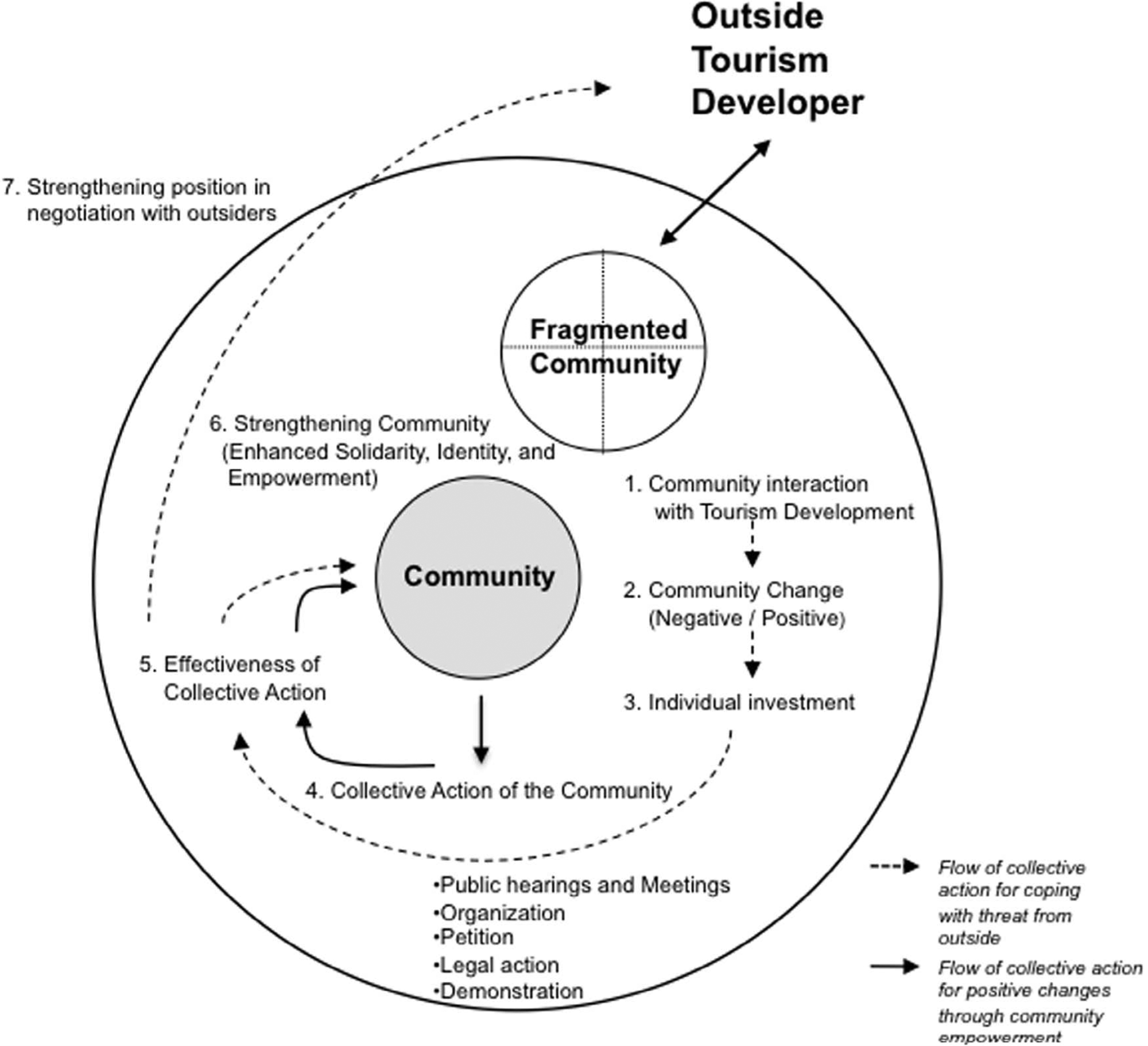
Conceptual framework for community-based action to influence tourism
This conceptual framework reflects the pattern of collective action, its relationship to solidarity, and its effects on community identity. A model inferred from these findings indicates that community members, often in a state of fragmentation, have the capacity for solidarity through community-based action to address outside threats. As a first step of a development process, residents interact with tourism developers and anticipate change for themselves—some negative, some positive. They invest themselves to protect the positive aspects of their community and minimize the anticipated negative impacts of development. Subsequently, they share their sense of community with other residents in ways that appreciate their community culture and conditions.
Solidarity is related to a strong sense of community identity that facilitates the creation of symbols of community, and invites boundaries that distinguish “we” from touristic “others.” This study supports findings of McMillan and Chavis (1986) that through various kinds of community-based actions, residents better understand their collective uniqueness and are more effective at charting their future. In addition, such constructive public dialogue led to civic discovery (Reich 1988), in which community-based narratives that had been held by individuals were publicly shared and legitimized at planning forums. In three communities where solidarity strengthened, the community members re-created themselves and established a new sense of community.
Proposals for tourism development met initial resistance from community residents and organizations. The inception of each resistance movement consisted of town meetings and public petitions. However from there, the patterns of collective action diverged. In two cases, community residents initially failed in their quest to modify tourism development. The communities reacted with renewed energy in order to ensure that their voices would be heard. Thus, the failure of using town meetings and public petitions incited stronger means of political action, such as public demonstrations and court injunctions on tourism development (see step 4 of Figure 2). In addition, within two other communities, collective action not only strengthened community solidarity but also revitalized latent community values, which ultimately became widely shared by community members.
Previous studies support these findings. According to Goodwin and Jasper (2009), community-based action includes efforts that a community pursues to resolve local problems. In addition, Gold (1985) indicated that collective action, which is based on the interaction of each individual with the overall community, is crucial to the creation of community identity and the formation of strong ties among community members. Moreover, Huang and Stewart (1996) indicated that as members of the community invest themselves in the community and share their emotions and ideas, their identification and attachment to the community will be strengthened.
As limitations, sampling was tied to four interviewees within each of five communities. All interviewees were male and considered leaders within their community. Their comments were cross-checked with (and sometimes stimulated by) newspaper archives; however, the ability for their narratives to represent those of the entire community has its limitations. In addition, there were differences in social and political power between the informants of this study and other residents. A person’s social status provides a vantage point to understand a community, and there were vantage points from lower status residents that were not included in this study, such as women, younger adults, and those who did not participate in collective action. To this end, the research design invited informants to identify residents who might disagree with them and queried about the extent of shared agreement within the community. Responses to such questions remain perceptions of the informants and should not be generalized as representative of the entire community. An additional limitation is related to the Korean cultural contexts of the communities studied. Korean culture is known for its collective orientation compared to the individualism of Western societies like the United States or Canada. The collective action identified in this study may be particular to this cultural context, and specific to ways in which individual action is motivated within Korean community life (Goodwin and Jasper 2009).
Conclusion
The purpose of this study was to explore community-based action as a meaningful impact of rural tourism development. Community-based action was connected with a capacity to protect one’s community from outside threats and foster development that aligns with its sense of community. The conceptual framework extends previous research that addressed resident attitudes toward tourism. By examining collective action as the unit of analysis and including public dialogue as essential for community-based empowerment narratives, the implications led to a framework to understand relationships between outside tourism developers, community residents, and their collective behavior. This study contributes to understanding ways in which pubic dialogue connects with collective action and results in effecting change not only in the direction of tourism development but the social construction of a felt sense of community.
As a practical implication for community planners, the start of the dialogue about tourism development should not be “What do we like about tourism?” but rather “What do we like about our community?” To be proactive, residents should address this question about themselves before discussing any specific development proposal. Their dialogue about appreciating their community has the potential to bring them together as residents and prepare them to initiate conversations with outside developers. As practical implications for tourism developers, community-based action is not something to be feared and can be channeled to enhance tourism development. In each of the communities, tourism development was gradual and provided time for reaction and development of alternatives. Public hearings allowed the conversations about community identity to be shared among residents and developers. The tenor of these initial public hearings was critical to bringing fragmented groups together and functioned to invest residents in their community’s future. Stated differently, the initial dialogues were crucial in fostering community-based ownership in tourism development. Although developers may have felt-needs to expedite their processes, building community-based coalitions that further define a community’s identity with tourism is a step toward long-term sustainability.
As research implications, this study creates a context of community-based action and social impacts of tourism in rural South Korea distinct from much of the English-language literature on tourism impacts. The sustainability of rural tourism development in Korea depends on community-based action with outside forces connected to the tourism industry. When the collective action includes public forums that allow residents to share knowledge about a community’s sense of itself—or community identity—the prospects for sustainable tourism development narratives are enhanced. In addition, the study findings demonstrated that social impacts occur in the planning phase of development (Freudenburg and Gramling 1994). In other words, social impacts of tourism were felt before anything physically changed on the landscape. Not a shovel-full of soil was moved nor a concrete brick laid, yet social impacts of tourism development were realized and ironically galvanized the community to negotiate a more sustainable form of tourism for itself.
Unlike cross-sectional designs that provide a one-point-in-time perspective of relationships between residents and tourism development, the methods of this study captured narratives of the dynamic relationship between residents and tourism development. Some research contexts may depict tourism development proposals as not flexible, not willing to reduce negative impacts, and impose a predetermined development on a community. Most likely during the early years of tourism in these five communities, a cross-sectional study would have depicted these communities struggling to resist tourism and suggested that tourism was not appropriate for them. However, due to persistent collective action, the findings portray the implementation of tourism as having flexibility and given to negotiation. This is not to say it came easy for the communities of this study, but to say tourism impacts brought communities together and empowered them to act in their collective interests. A contribution of the methodology was its focus on community narratives for action as a strategy to examine social impacts and its ability to provide insight to community-based behavioral processes of tourism development.
The findings suggest that community-based action is more than just a social impact; rather it plays critical roles for successful long-term tourism development. Conflicts between outside tourism developers and residents could be overcome through planning processes that allow communities to create a set of public values for their community. Rather than something to fear as detrimental to tourism, community-based action and initial resistance to tourism development holds promise for a community that cares about its future and will invest in specific kinds of tourism development. Vice versa, rather than something to fear as detrimental to community, tourism development may leave residents with an increased sense of solidarity and influence over their future.
Footnotes
The author(s) declared no potential conflicts of interest with respect to the research, authorship, and/or publication of this article.
The author(s) received no financial support for the research, authorship, and/or publication of this article.