



Abstract
Via two experiments, the authors meld research in travel destination image (TDI) and country-of-origin image (COI) to investigate whether consumers’ perceptions of a country’s products influence their perceptions of the country as a travel destination. In the first experiment, the authors show that reverse COI effects may occur, where participants use product beliefs to imbue destination beliefs. More positive product beliefs lead to more favorable perceptions of and greater intentions to tour the destination. The second experiment follows on to show that destination familiarity may moderate the product beliefs–destination beliefs relationship established in the first study. As familiarity increases, participants rely less on product beliefs to evaluate the destination. A key implication for exporters, tourism policy makers, and tourism businesses is that foreign products not only are competing with each other for domestic customers but also are competing through their products for a share of the outbound tourism market.
Keywords
Tourism research has had a long focus on travel destination image (TDI) as an important aspect of tourism marketing and strategy, while marketing research has extensively tapped country-of-origin image (COI) to understand consumer behavior and guide export marketing. Traditionally, these two research streams have developed independently, but some recent studies have begun exploring a potential relationship between the two concepts, TDI and COI (Mossberg and Kleppe 2005; Zhou, Murray, and Zhang 2002).
However, these studies typically conceptualize COI as the image of a product’s country of origin and aim to determine potential buyers’ reactions to signals from countries where they are not resident. Using the term product-country image to mean the same as COI, Elliot, Papadopoulos, and Kim’s (2010) recent review concluded comprehensively that the studies fell short of establishing a relationship between TDI and COI. The authors particularly highlighted that none have tested whether consumers’ beliefs of a country’s products, rather than of the country, relate to their travel behavior. Although Elliot, Papadopoulos, and Kim did show that favorable product beliefs increased receptiveness to tour a country, they did not investigate the relationship between product beliefs and beliefs about the destination. We therefore ask, do consumers’ beliefs about a country’s products influence their perceptions of the country as a travel destination?
This question is particularly pertinent to the tourism industry. Given the globalization of trade, consumers are likely to have experience with and be familiar with foreign products in their country but know little of or have not visited the product’s origin country. For example, U.S. consumers may be familiar with Korean brands (e.g., Samsung) but know little of Korea. Likewise, avid Havana cigar smokers may possess scant knowledge of Cuba. Tourism businesses, as well as national tourism bodies, would benefit from understanding how images of a country’s products may influence perceptions of the country as travel destination. The knowledge would help guide synergistic collaborations with product or brand owners to promote tourism to the country.
If consumers’ perceptions of a travel destination stem from their beliefs about the country’s products, then we are essentially seeing a reverse of country-of-origin effects; traditional COI research links country image to product beliefs (Srinivisan and Jain 2003; Verlegh and Steenkamp 1999). Drawing on COI research, it would also mean that as familiarity with a destination increases, the relationship between product beliefs and destination beliefs should weaken. Our second question is thus, would people who are familiar with a travel destination rely less on product beliefs to evaluate the destination?
To address the above two questions, we present two experiments exploring COI and TDI as a means to understand how product perceptions may be useful in tourism marketing. In the first experimental study, we investigate whether priming participants with favorable (unfavorable) information about a country’s product would lead them to evaluate the country as a travel destination more (less) positively. The second study, a quasi-experiment, builds on the first study to determine whether familiarity with a travel destination weakens the relationship between product beliefs and destination beliefs.
For each study, we provide a relevant literature review, then the method and findings. We then discuss the findings together with conclusions and directions for future research. To be clear, we use the term destination throughout this study (e.g., destination image, destination beliefs) when referring to a country specifically as a travel destination.
Study 1—Effects of Product Beliefs on Destination Image
Country-of-Origin Image
The effects of COI on product evaluations and preferences are well known (see reviews by Srinivisan and Jain 2003; Verlegh and Steenkamp 1999). Especially when consumers lack knowledge about a product or are unable to detect a product’s true characteristics, they often use a perceived image of a product’s country of origin to form stereotypical beliefs about the product (Boatwright, Kalra, and Wei 2008; Han 1989; Laroche et al. 2005). This image halo may also extend from beliefs about a product that consumers are knowledgeable about (e.g., “Volkswagens are technologically superior German cars”) to unfamiliar ones from the same country of origin (e.g., “Since Opel is German made, it must also possess superior technology”). In this sense, COI works like other intangible cues such as price, where higher prices may signal better quality (e.g., Monroe 1973). Consequently, consumers favor products from countries with positive images to those with negative images. Similarly, negative images can be formidable barriers to marketers, even if the perceptions are misguided or erroneous (Chattalas, Kramer, and Takada 2008; Johansson, Ronkainen, and Czinkota 1994).
In an experiment on COI, Liu and Johnson (2005) showed that deliberately exposing experimental participants to a product’s origin country led them to form country-specific beliefs about the product. Even though the participants had sufficient information to evaluate the product objectively, they still relied on COI to guide their evaluation. Similarly, Leclerc, Schmitt, and Dubé (1994) showed that French-sounding brand names improved the evaluation of hedonic products such as perfume but lowered the evaluation of utilitarian ones such as computers. This perception that France was better at manufacturing hedonic than utilitarian products persisted even after consumers had actually experienced the products. Halo effects are thus powerful and well known in marketing.
While early research in COI (e.g., Bilkey and Nes 1982; Han 1989) focused primarily on the origin country of a product (e.g., “Sony is a Japanese product”), some studies have broadened the concept to cover derivations such as country of manufacture or country of design (Ahmed and d’Astous 2008; Amonini, Keogh, and Sweeney 1998). Insch and McBride (2004), for instance, decomposed the concept into country of design, country of assembly, and country of parts and found that each dimension had different effects on overall product quality perceptions.
While we acknowledge that COI may compose different underlying dimensions, for this study we follow the path of recent studies by adopting the original overarching definition of COI without breaking it down to individual dimensions (Chattalas, Kramer, and Takada 2008; Pappu and Quester 2010; Roth and Diamantopoulos 2009). That is, we are interested in how the overall perceptions of a product (Chilean copper artifacts) may influence perceptions of a destination (Chile). Nonetheless, we defer to future research to investigate whether dimensional derivatives (e.g., Chilean copper artifacts but designed in the United States) have a different influence on destination perceptions.
Reversed Effects of COI
As reviewed above, COI research primarily concerns consumers using a country’s image to imbue beliefs about the country’s products. Pervasive trade globalization means that consumers are often exposed to foreign products available in their domestic markets. For example, CNET recently reported online that Samsung is the market-share leader (about 18%) for LCD televisions in the United States (Whitney 2010). By contrast, the Office of Travel and Tourism Industries reported that only 2% of outbound U.S. tourists went to Korea in 2009 (http://www.tinet.ita.doc.gov/outreachpages/download_data_table/2009_Outbound_Profile.pdf). This suggests that consumers are likely to be more knowledgeable about certain foreign country’s products than with the country itself, particularly as a travel destination.
While COI research focuses primarily on the halo effects of overall country image on product evaluations, no studies have examined the reverse relationship of whether product perceptions can influence the evaluations of a country as a travel destination. Nadeau et al. (2008) attempted to link COI to TDI, but they based their conceptualization of COI on broad image factors, such as its political situation and citizens, rather than on the country’s products. We argue that when consumers are familiar with a country’s products but not with the country, a reverse halo effect may occur whereby consumers use their beliefs of a country’s products to form perceptions of the country as a travel destination. We set forth the arguments for our contention below.
Early research suggests that the effectiveness of halos stems from people having “a fundamental inability to resist the affective influence of global evaluation on evaluation of specific attributes” (Nisbett and Wilson 1977, p. 255). The halo effect may be triggered by the mere presence of a related mental stimulus, especially when consumers are unaware that the stimulus may bias their perceptions (Bargh 2002; Fitzsimons et al. 2002). Within this study’s context, we argue that consumers may unconsciously use product image, a related mental concept, as a halo to color their perceptions of the product’s origin country as a travel destination.
Support for our contention comes from Nisbett and Wilson (1977), who provide evidence that people may nonconsciously judge an object via an overall impression of the object. Their experiment had participants rate a college teacher’s attributes (appearance, mannerism, and accent) after viewing a video of the teacher. One video showed the teacher as likeable and approachable, while the other portrayed him as cold and aloof, although the rated attributes were identical in both videos. Not only did the two groups of participants rate the identical attributes differently, they reported that their attribute ratings led to their overall evaluation of the teacher; they wrongly believed that their overall impression of the teacher resulted from their objective attribute ratings. The authors concluded that the participants were unaware of a halo operating on their judgments, and had they known the outcome might be different. In other words, such “altered judgments require the absence of awareness [of the global evaluation driving the judgments]” (p. 256, emphasis original).
Indeed, this phenomenon of a nonconscious halo was already apparent in early psychology experiments, which found that repeated exposures to an object could influence the attitude toward the object (Zajonc 1968), especially when conscious processing was minimal or even absent (Bornstein and D’Agostino 1992). Likewise, Fitzsimons et al. (2002) surmise that consumers often retain salient visual cues without their conscious knowledge or intention, and the cues subsequently influence their purchase decisions.
Nonconscious halo effects work similarly to the spillover effect articulated by some researchers. For example, Balachander and Ghose (2003) propose that marketing efforts on a brand may spill over to influence other product categories under the same brand as well as the overall brand image. Kleppe, Iversen, and Stensaker (2002) posit that some strong brands (e.g., Levi’s or Mercedes-Benz) may be imbued with such strong national identities that they can influence perceptions of the country as well as other unrelated brands from the country. Kleppe, Iversen, and Stensaker concluded that certain advertising dimensions about a country’s products, such as their quality, might unintentionally boost the country’s image.
The synergy between a country’s products and the country as a travel destination is also seen in the “Space for Minds” initiative launched by Sweden, where tourism bodies and private industry come together on a common country-brand platform (Kleppe and Mossberg 2006). If product and country images overlap, then “one obvious consequence would be that image programmes for nations and promotion programmes for products from a country should be coordinated” (Mossberg and Kleppe 2005, p. 501). That is, since stereotyped destination and product images can help simplify people’s judgments of destinations and products, products could be used as unique features to differentiate countries. Summing up the above studies, we therefore hypothesize,
Hypothesis 1 (H1): Consumers with more (less) positive product beliefs possess more (less) favorable beliefs of the country as a travel destination.
Method
Pretesting the experimental primes
We carried out an experiment to test H1. Prior to the actual experiment, we tested the effectiveness of the experimental primes—articles about Chilean copper artifacts—using 19 students recruited from an undergraduate tutorial class. Students are suited as participants in such experiments as their high intellectual ability but limited life experience allow for effective priming manipulations, without their life experiences biasing or coloring the experimental outcomes (Kuhn, Cheney, and Weinstock 2000).
The students were randomly assigned to one of two groups. One group read an article describing how Chilean copper artifacts were world renowned for their quality and fine craftsmanship and Chile was well poised to take advantage of the country’s massive copper deposits. The second group read an article lamenting the low quality and poor craftsmanship of Chilean copper artifacts, despite the abundance of copper deposits in the country. The articles were identical except for information regarding the quality of the copper craftsmanship. Pictorial cues of well made and poorly made copper artifacts helped contrast the difference between the two articles. We selected Chile and Chilean products because we reasoned that the students were unlikely to have visited Chile (a postexperiment questionnaire confirmed that none had visited or lived in Chile previously). In both articles, the information about Chilean copper artifacts was fictitious. Both groups were told that the experiment was to test their ability to recall from memory information in the article and were given 10 minutes to read the article.
Upon reading the article, the students answered five questions, three of which ostensibly tested their memory recall (e.g., what was the population of Chile), one of which asked if they had visited or lived in Chile previously, and one of which tapped their overall image of Chilean copper artifacts on a 7-point scale anchored on bad and good. The results showed that those who read the good-artifact article rated their perceived image of Chilean copper artifacts higher (average rating = 5.737) compared with those who read the bad-artifact article (average rating = 3.111). The rating difference between the two groups was significant based on t-test results indicated (t-value = 6.702, df = 34, p < .001). This supported the effectiveness of the experimental primes in manipulating participants’ perceptions of Chilean copper artifacts.
Experimental procedures
An email invited students enrolled in marketing programs in an Australian university to participate in an experimental study. Of the 141 students who participated in the study, 4 cases were deleted as the students indicated that they had visited or lived in Chile previously and 2 cases were deleted for missing data. The final sample of 135 contained 54 males and 81 females, with ages ranging from 19 to 43 (M = 23 years).
Participants were randomly assigned to one of two groups and were told that the purpose of the experiment was to test their memory recall ability. Similar to the pretest, one group read the good-artifact article and the other group read the bad-artifact article. After 10 minutes, the participants were told to put the article away and answer a questionnaire. To mask the purpose of the study, five questions asked the participations to recall information in the article (e.g., “name another South American country mentioned in the article”). To measure product beliefs, an item asked participants of their overall image of Chilean copper artifacts. Similar to some studies (e.g., Nadeau et al. 2008; Um and Crompton 1990), we measured destination belief via a single question that tapped participants’ overall impression of Chile as a travel destination. Finally, three questions measured participants’ intentions to tour Chile, intentions to buy Chilean copper artifacts, and willingness to recommend the products to others. All questions used 7-point Likert-type scales anchored on strongly disagree and strongly agree. To minimize common method bias, the items were ordered randomly (Podsakoff et al. 2003).
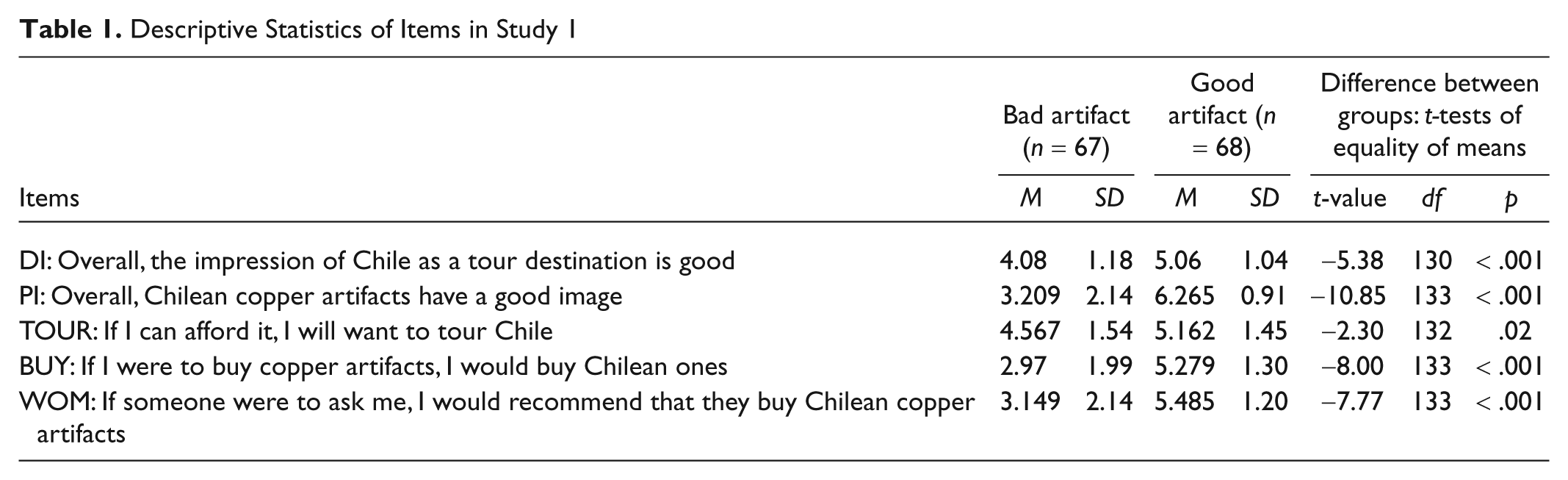
As a postmanipulation check, participants were asked if they knew or could guess the actual purpose of the experiment after they had completed the questionnaire. None correctly identified the real purpose, and they were debriefed before given a token payment for participation. Table 1 contains the descriptive statistics of the items in the questionnaire, excluding the five questions to ostensibly mask the study’s purpose.
Descriptive Statistics of Items in Study 1
Results
We conducted t-tests of equality of means to determine the differences between the two experimental groups (see last column in Table 1). As expected, participants primed with the good-artifact article possessed more favorable perceptions of Chilean copper artifacts than those exposed to the bad-artifact article. They were also more likely to buy Chilean copper artifacts and more willing to recommend the copper artifacts to others. This supported the effectiveness of the experiment’s primes.
The t-test results also indicated that good-artifact group rated their overall impression of Chile as travel destination significantly higher than the bad-artifact group. This finding supported H1, which proffers that product beliefs relate positively to destination beliefs. The good-artifact group also possessed greater intentions to visit Chile. Spearman’s tests showed positive and significant correlations between destination perceptions and visit intentions for both the good-artifact (ρ = .505, p < .001) and the bad-artifact (ρ = .312, p = .01) groups.
Having established the relationship between product beliefs and destination beliefs, we now examine another concept—familiarity—often reported in COI studies. COI research suggests that when consumers are familiar with a country’s product, they rely less on country image as a halo to guide product evaluations (Chattalas, Kramer, and Takada 2008; Johansson, Douglas, and Nonaka 1985). In the next study, we used a quasi-experimental approach to investigate whether familiarity with a travel destination weakens the influence of product image on destination beliefs. That is, as destination familiarity increases, would consumers rely less on product perceptions to evaluate a destination?
Study 2—The Moderating Influence of Destination Familiarity
Familiarity with products may interfere with the workings of COI (Chattalas, Kramer, and Takada 2008; Johansson, Douglas, and Nonaka 1985). When consumers are unfamiliar with a product, they may use the COI to imbue stereotypical beliefs about the product. In contrast, people who are familiar with a product through actual use or when product information becomes available may rely less on COIs to form their product beliefs (Erickson, Johansson, and Chao 1984; Johansson, Douglas, and Nonaka 1985). The more they are knowledgeable about a product, the more they shape their product perceptions from the information (Chattalas, Kramer, and Takada 2008; Johansson, Douglas, and Nonaka 1985).
The moderating influence of product familiarity makes sense in that the halo effect is useful for product evaluations only to the extent that consumers possess little knowledge of the products. For example, Liu and Johnson (2005; also see Knight and Calantone 2000) suggest that when consumers can easily assess their belief structure from memory, they rely more on cognitive information than an overall image to judge products. Otherwise, consumers automatically activate stereotypical images from their long-term memory for evaluation.
Extending the findings of COI research on product familiarity, we argue similarly that destination familiarity would weaken the influence of product image on destination beliefs. That is, consumers who are familiar with a destination would rely less on product image as a halo to imbue beliefs about the destination. Instead, they are more likely to rely on their knowledge of the destination to form their destination beliefs. This has implications for travel promotion and advertising.
For example, in a study of U.S. travelers’ perceptions of Turkey, destination familiarity was conceptualized as a composite of informational and experiential familiarity (Baloglu 2001). The results indicated that familiarity was a significant determinant of destination image. Also, higher degrees of familiarity were associated with more positive images of Turkey. The author proposed using familiarity as an index for destination image. After showing that a country’s image, such as its history and political situation, might relate to potential travelers’ image of the country as a travel destination, Nadeau et al. (2008) similarly suggest that future studies should consider destination familiarity’s influence in the strength of the relationship. Of course, these assume positive familiarity or experience, not negative ones. Our hypothesis focuses on the moderating effect of familiarity between product image and destination image, hence,
Hypothesis 2 (H2): Familiarity with a country negatively moderates the relationship between product beliefs and destination beliefs. That is, product beliefs influence destination beliefs more (less) when destination familiarity is low (high).
Method
To test H2, we carried out a quasi-experiment using the context of Australia as the travel destination and Australian wine as the product. As we explain later, we carried out surveys in two locations, China and Australia, to operationalize the concept of destination familiarity. Both surveys used identical questionnaires written in simplified Chinese. We first developed the questionnaires in English. Following common back-translation procedures (Craig and Douglas 2005), a Chinese postgraduate student translated the questionnaires into Chinese, followed by a translation back to English to check for consistency and accuracy. Other than minor semantic changes, no problems were found with the questionnaires.
For the Australian survey, a Sydney travel agent helped administer the questionnaire to Chinese tourists about two weeks after they had arrived. The surveys took place during lull periods on board tour buses to ensure that the tourists were less distracted. At the time of the surveys, the tourists had not visited vineyards as part of their tour itinerary. As a goodwill gesture, tourists received token souvenirs.
To minimize response bias, data collection took place over four weeks, in thirteen different buses, and with tourists from different regions in China (Bickart 1993). A total of 49 cases were discarded for outlying or missing data or for invalid responses (e.g., respondents answering all 1s or 7s to 7-point scale questions). A further 13 cases were deleted because these respondents had visited Australia multiple times prior to the current visit (mean visits = 3.5); these cases might skew the results. The final sample (n = 235) constituted consumers who were familiar with Australia as a tour destination. Acceding to the participating travel agent’s request, we did not collect personal data.
The second survey took place over two weeks at three major shopping precincts in the Chinese city of Guangzhou. Surveying in multiple locations and at different times should help minimize potential response bias (Bickart 1993). In each location, between six and eight interviewers stationed at shopping center exits approached people as they entered or left the centers. Whether or not wine was bought was not a criterion to selecting potential respondents, and the respondents were given token gifts for participation. To be able to contrast this data set to the one from Chinese tourists in Sydney, 12 cases were deleted for those who had been to Australia at least once and 7 cases were deleted for missing or invalid data. The final sample (n = 234) constituted those who were unfamiliar with Australia as a tour destination. Therefore, similar to some studies (Milman and Pizam 1995; Stepchenkova and Morrison 2008), we operationalized destination familiarity not as a self-reported rating but as an actual behavior of having toured a country.
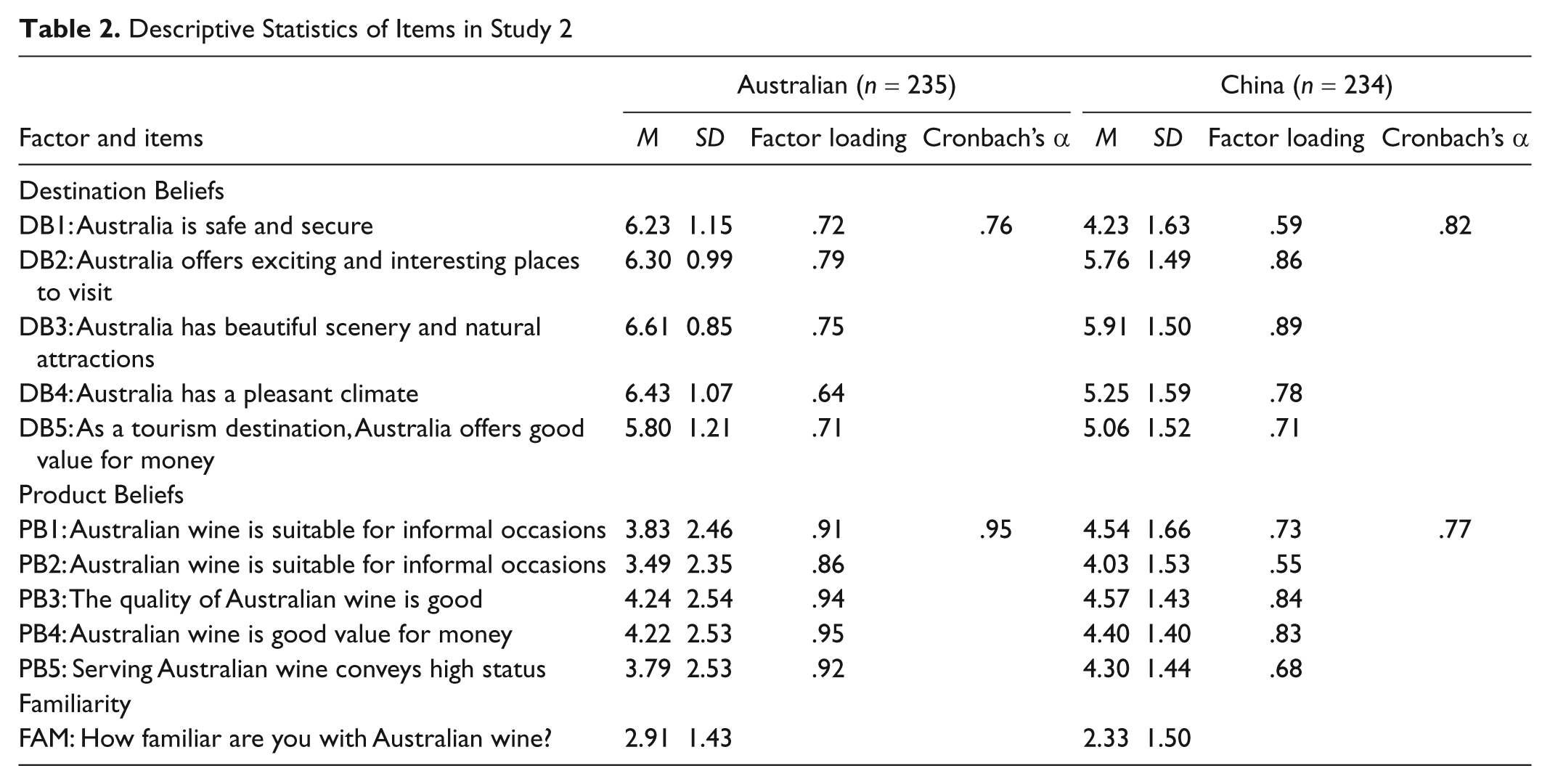
Both surveys used the same questionnaire. We operationalized product beliefs as a latent construct of five items measuring the quality, status, and value of Australian wine. Drawing on Gallarza, Saura, and Garcia’s (2002) review of travel destination studies, destination beliefs were a five-item factor of beliefs about Australia as a travel destination. To control for potential interactions from participants’ familiarity with Australian wine, a single item measured the extent that respondents were familiar with Australian wine. Table 2 lists these items and their descriptive statistics.
Descriptive Statistics of Items in Study 2
Results
We used structural equation modeling with maximum likelihood estimation (www.spss.com/Amos) to specify the model in Figure 1.
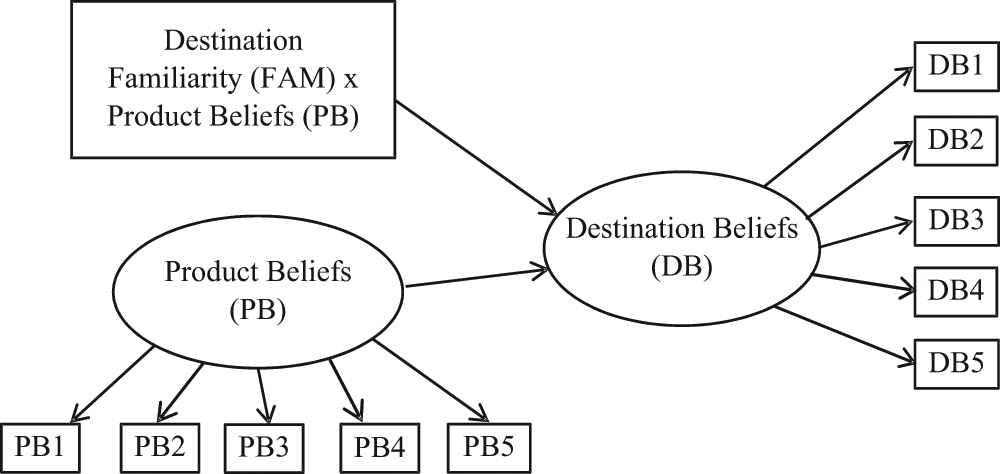
Conceptual model of this study
Prior to fitting the structural model, we analyzed the data for construct reliability and validity. Correlation coefficients among all items ranged from .007 to .661, well below the .9 collinearity threshold (Hair et al. 2006). As the study was exploratory, reliability was also adequate with all factors across the two surveys having Cronbach’s alphas of more than .7 (Peter 1979).
We tested construct validity following Fornell and Larcker’s (1981) formula. With the Australian sample, variance extracted estimates for the product beliefs (.524) and destination beliefs (.698) exceeded the two factors’ squared correlations (.096). With the China sample, variance extracted estimates for the product beliefs (.448) and destination beliefs (.595) exceeded the two factors’ squared correlations (.101). These results supported construct validity among the factors in both samples.
Table 3 shows that fitting the structural model with the two samples produced adequate structural model fits (Hair et al. 2006). With both samples, product beliefs were significantly and positively related to with destination beliefs. These results further supported Study 1, which showed that product beliefs positively influenced destination beliefs. Furthermore, product beliefs determined destination beliefs more when destination familiarity was low (the China sample) than when familiarity was high (the Australian sample).
Path Coefficients of Structural Equation Modeling

To test for the potential effects of product familiarity, we ran the structural model by adding an interaction term of (product familiarity × product beliefs) to the models. To ensure that potential multicollinearity between the interaction term and predictors did not distort the results, we followed Aiken and West’s (1991) deviation-from-means method to compute the interaction term. The path coefficients between the interaction term and destination beliefs were not significant with either sample, suggesting that the reported relationship between product beliefs and destination beliefs did not depend on and were not affected by respondents’ familiarity with Australian wine. Collectively, these results support H2.
We further compared the ratings of the individual destination beliefs between the two groups. Results of t-tests indicated that destination image and beliefs were consistently and significantly higher for the Australian sample. These findings concur with those of Baloglu (2001) and Elliot, Papadopoulos, and Kim (2010), who found that travelers who were familiar with a destination tended to rate the destination favorably.
Discussion
Research in TDI and research in COI have developed independently, although both concepts concern how perceived images of a country may influence consumer behavior to tour the country or buy the country’s products. Our study adds to the recent research stream that attempts to meld the two concepts and uncover potential relationships between them. Our study is the first we know of to directly relate different product beliefs to global judgments of the focal country as a travel destination without any travel-related information supplied.
While COI research links country image to product beliefs, we demonstrate in Study 1 that a reverse COI effect may also occur whereby consumers use their perception of a country’s product to imbue their perceptions of the country as a travel destination. Indeed, the influence of product beliefs on destination beliefs may extend beyond tangible goods. For example, perceptions of sporting events can change the perceptions toward the country hosting the event; people who were favorably exposed to the Seoul Olympics in 1988 developed more positive perceptions of South Korea (Jaffe and Nebenzahl 1993). It does appear that a halo may have a wider effect than currently acknowledged or understood in this context.
In their study of the effectiveness of various information sources for promoting TDI, Govers, Go, and Kumar (2007) found that perceptions of a travel destination stemmed more from vicarious sources, such as movies containing scenes of the destination or personalities associated with the destination, than from overt advertising and promotion. The results of this study lend support to Govers, Go, and Kumar’s findings in that product beliefs may be another vicarious source capable of influencing TDIs.
We also draw on the theory of associative memory network (Bower 1981; Teichert and Schöntag 2010) to explain the reverse COI effects. Grounded in cognitive psychology, the theory describes how human memory is organized as a network of nodes and links. A node represents a concept (e.g., TDI and COI), and concepts that are cognitively related to each other are represented as linked nodes. Memory retrieval occurs when a focal node traverses a link to activate another related node. Within this study’s context, COI effects can be explained as a country-belief node (“Germany is a high-technology country”) associating with a product-belief node (“German cars possess superior technology”). However, as the theory further posits, a link between two nodes may be bidirectional. This means that people may possibly retrieve a country-belief node from a product-belief node, thereby establishing a reverse COI effect.
Study 2’s findings corroborate findings from other studies (e.g., Han 1989; Liu and Johnson 2005), which show that consumers who are familiar with an object tend to rely more on cognitive information than on general images of the object for evaluation. Extending COI research, we show that the moderating influence of familiarity with a product works in very much the same way as familiarity with a travel destination in moderating the halo effects of images. Respondents in China with no direct knowledge of Australia formed their beliefs, as suggested by Govers, Go, and Kumar (2007), probably from a range of vicarious sources. Their perceptions of Australian wine are positively linked to their evaluations of Australia as a travel destination. Similarly, it is unsurprising that those visiting Australia are more likely to derive their TDI and beliefs from their visit to Australia than from their perceptions of Australian wine.
Even though the relationship between product beliefs and destination beliefs is weaker with the high-familiarity sample (Australia) than with the low-familiarity (China) sample, the relationship is nonetheless positive and significant with both samples. This supports Study 1 and further stresses the importance of coordinating product marketing with tourism marketing efforts.
As trade globalization makes foreign products readily available in a country, this study’s findings should interest exporters, tourism policy makers, and tourism businesses. Not only are the foreign products competing with each other for domestic customers, but also the foreign countries are competing through these products for a share of the outbound tourism market. Favorable or unfavorable perceptions with a particular product may bias evaluations of the country as a travel destination.
The positive relationship between product beliefs and destination beliefs also means that exporters can use their home country image to help differentiate their products from those of foreign competitors. This requires exporters to work closely with tourism policy makers, who are responsible for promoting a country. For example, government-sponsored national branding (tourism) campaigns in a foreign country may aid exporters wishing to do business in the country. An example of this cooperation is the Space for Minds initiative launched by Sweden, where tourism bodies and private industry came together on a common country-brand platform (Kleppe and Mossberg 2006).
However, the synergies to be gained by exporters and tourism businesses are likely to depend on the congruence between the destination image and the product category (e.g., see Chao, Samiee, and Yip 2003). For example, it may be easier to pair wine with tourism than to pair computers with tourism. Hence, tourism businesses may find it more effective to jointly promote with tourism-related or hedonic products (e.g., wine and fashion) than with utilitarian ones such as computers and automobiles.
Conclusion
Thorndike (1920) first highlighted the phenomenon of a halo when he noticed that army superiors were unable to analyze different aspects of officers under their command. Instead, the superiors possessed marked tendencies to think of the person as generally good or inferior and suffused specific ratings of the individuals with this general feeling. Kotler and Gertner (2002) reason that an image halo is a mental knowledge structure that has wide-reaching influence across areas including exports and tourism, and people often use these images as shortcuts for decision making. However, they did not test this assertion.
Both country-of-origin research and destination-image research have long traditions and have consistently shown how umbrella image constructs lead to beliefs about specific products or places. In this study, we are essentially melding two research streams—country-of-origin research and travel destination research—to test our contention that the literature on product and tourism images can be blended to better understand the cross-effects of a nation’s various images. We believe this study’s findings should provide some direction to the growing popularity of tourism marketing, country branding, and export promotion undertaken around the world.
As with any exploratory study, there are future research issues to resolve. While country and destination images overlap, perceptions of a country in general, such as its geography and history, are different from perceptions of a country as a travel destination (Stepchenkova and Morrison 2008). Future research should extend this study by investigating which product images influence a country’s general image and which are linked more strongly to tourism.
COI effects are stronger when the country and product match rather than mismatch (Chao, Samiee, and Yip 2003; Insch and McBride 2004). In this study, we used wine as the contextual product, and wine may be related to Australia as a travel destination in that Australia is a key global wine producer. Future research should replicate this study by using products (e.g., computers) that are most likely to be unrelated to a destination (e.g., Australia). Better yet, research should investigate the potential intertwining relationships among product image, destination image, and country image, especially across different types of hedonic and utilitarian products.
We noted in the literature review that a COI might be composed of different underlying dimensions (e.g., country of manufacture, country of design). Similar to other researchers, we treat COI as an overall or gestalt view of a country. Future research should investigate whether dimensional derivatives (e.g., Chilean copper artifacts but designed in the United States) have a different influence on destination image and beliefs.
Footnotes
Declaration of Conflicting Interests
The author(s) declared no potential conflicts of interest with respect to the research, authorship, and/or publication of this article.
Funding
The author(s) received no financial support for the research, authorship, and/or publication of this article.