



Abstract
The purpose of this study was to explore the factors that drive festival visitor loyalty to host destinations. Our analysis focused on the role of place attachment as a mediator of the relationship between visitors’ positive evaluation of their festival experience and their loyalty to the host destination. Using structural equation modeling, we found that satisfied visitors at a festival develop a moderate level of emotional attachment to the festival host destination and ultimately become loyal to that destination. Not all dimensions of place attachment and festival satisfaction, however, were statistically significant, nor were they of equal valence in their prediction of the destination loyalty dimensions. Based on these findings, both theoretical and practical implications of this investigation are discussed.
With fierce competition among destinations, attracting and sustaining a flow of visitors is of great importance for destination marketing organizations (DMOs). To ensure a steady stream of visitors, DMOs seek to create a myriad of new products such as festivals and events (Pike 2008). Festivals and events, particularly in rural destinations with few commercial tourism attractions, bring into play their unique surroundings and cultural traditions to draw people who might not otherwise visit and then to encourage them to return. In addition to their appeal as tourist attractions (Getz 1991), visitor spending at these festivals provides economic stimulus to small communities where there is little tourism infrastructure and few other industry alternatives. These festivals and events also offer participatory opportunities that can nurture and sustain a strong sense of place (Reid 2007).
Past research has suggested that customers are attracted and retained when their needs are met, and they tend to express their satisfaction to others (Kotler, Bowen, and Makens 2010). Given that satisfying experiences of tourists influence their future travel, the maintenance of positive visit experiences stemming from consistent quality at festivals is a destination marketer’s top priority (Pike 2008). Thus, it is important to understand the extent to which visitor satisfaction at a festival contributes to the development of emotional attachment and loyalty to its hosting destination. Stated differently, will satisfied festival visitors visit the host city even when the festival is not being held?
In an attempt to answer this question, we incorporated the concept of place attachment, rooted in geography and environmental psychology, to assess visitors’ attitude toward festival host communities within a developmental model of destination loyalty. Not only is place attachment defined in terms of people’s emotional ties to a spatial setting but also refers to the social ties that bind individuals to specific locales along with their place-related actions (Low and Altman 1992). It has recently been suggested that place attachment shares conceptual similarity with psychological commitment, which is an integral component of attitudinal loyalty (Iwasaki and Havitz 1998; Kyle et al. 2004; Park 1996) and is positively related to behavioral intentions (Lee, Graefe, and Burns 2007) and revisitation (Kyle et al. 2004). Being attitudinal in structure, it is considered an antecedent of behavior (Ajzen 1991; Jorgensen and Stedman 2001).
Leisure researchers have shown that place attachment has utility for both resource management and understanding recreationists’ behavior (e.g., Kyle et al. 2004; Kyle, Graefe, and Manning 2005; Kyle, Mowen, and Tarrant 2004; Moore and Graefe 1994; Warzecha and Lime 2001). Recently, Yüksel, Yüksel, and Bilim (2010) demonstrated the utility of place attachment for understanding the satisfaction–loyalty relationship within a holiday destination context. They reported positive associations between place attachment, satisfaction and loyalty. Questions remain, however, concerning the associations among these constructs. WhileYüksel, Yüksel, and Bilim’s work provided an important step toward resolving these issues, some concern remains about the external validity of their findings owing to the use of a convenience sample. Thus, in an effort to further our understanding of the constructs’ relationships, the purpose of this study was to explore factors that drive festival visitor loyalty to host destinations. Our analysis focused on the role of place attachment as a mediator of the relationship between visitors’ evaluation of their festival experience and their loyalty to the host destination. In this study, “place” and “destination” are used synonymously.
Literature Review
Our conceptual model (see Figure 1) was derived from human attachment theory in the disciplines of environmental psychology and geography and published empirical evidence focusing on humans’ relationships with physical environments and the meanings they attribute to these settings (Morgan 2010). Combined, this literature suggests that place attachment is an attitudinal construct providing insight on the manner in which individuals view the physical landscape (Jorgensen and Stedman 2001; Kyle et al. 2004). It often emerges from positive evaluations of spatial attitudes (i.e., place satisfaction) and has behavioral outcomes (i.e., behavioral loyalty; Kyle et al. 2004; Lee, Graefe, and Burns 2007). In the context of the model presented in Figure 1, we suggest that behavioral loyalty within the context of cultural festivals is the product of a developmental process where visitors’ satisfaction with the festival drives their emotional and symbolic attachment to the festival setting which, in turn, underlies their behavioral loyalty to the festival hosting communities.

A hypothesized conceptual model
In this review, we provide a conceptual overview of festival satisfaction, place attachment, and destination loyalty. We then discuss their hypothesized relationships based on theory and existing empirical evidence and conclude with the research questions that guided our analysis.
Festival Satisfaction
Satisfaction was defined by Oliver (1997: 13) as “a judgment that a product, or service feature, or the product or service itself, provides a pleasurable level of consumption–related fulfillment.” In general, satisfaction has been used to evaluate past experience, the performance of products and services, and perceptions of the physical environment such as a neighborhood and tourist destinations (Ringel and Finkelstein 1991; Ross and Iso-Ahola 1991). Research has shown that satisfaction has been closely linked to destination choice, consumption of tourism products and services, and decisions to return (Bigné, Andreu, and Gnoth 2005; Kozak and Rimmington 2000).
In the tourism and leisure literatures, the expectancy- disconfirmation approach (Oliver 1980) has been the dominant paradigm used to investigate visitors’ satisfaction in a diverse range of contexts, including wildlife refuges (Tian-Cole, Crompton, and Willson 2002), travel agency services (Millán and Esteban 2004), shopping experiences (Yüksel and Yüksel 2007), and holiday destinations (Tribe and Snaith 1998). This approach uses four elements to evaluate customers’ service experiences: pre-purchase expectations, perceived performance, disconfirmation, and satisfaction. Consumers’ level of satisfaction is determined through a cognitive comparison between the expectations that customers develop prior to a purchase and their postpurchase product evaluation. Postpurchase product evaluations can be placed along a continuum with a midpoint of “confirmation” where the performance or experience outcome is said to have met the consumer’s pre-purchase expectations. Anchoring the continuum are poles that emerge from “disconfirmation” where the product or service’s performance has been either superior or inferior relative to the customer’s expectation. For superior performance, “positive disconfirmation” occurs, resulting in satisfaction. Alternately, “negative disconfirmation” is equivalent to a customer’s dissatisfaction where actual performance falls short of expectations.
Another common approach for evaluating satisfaction uses only perceived actual performance (Tse and Wilton 1988). Owing to concerns over the precision of expectation measures, this assessment disregards customers’ expectations that have been shaped by external factors such as past experience, comparisons to alternatives, and recommendations from others (Cronin and Taylor 1992). Research has shown that the performance-only approach can be an effective method for assessing satisfaction when the consumer has little knowledge of the experience (Yoon and Uysal 2005). In the context of tourism products, this is often the case. For example, Lee and Beeler (2007) provided empirical evidence that the performance-only measure was a stronger predictor of behavioral intentions within a festival setting than was an alternate model that employed a disconfirmation measure. Researchers have also examined visitors’ evaluations of different physical attributes and the performance of service quality indicators within the context of a number of tourism destinations (e.g., Kozak 2001; Qu and Ping 1999; Yu and Goulden 2006). These studies have identified key attributes of both tangible products and intangible services. They have also effectively measured customers’ satisfaction with these products and services by evaluating the perceived performance of those attributes.
The performance-only approach has also been applied to measure tourists’ overall satisfaction with destinations (e.g., Kozak 2001; Qu and Ping 1999; Severt et al. 2007; Yu and Goulden 2006). In this regard, satisfaction has been defined as “a summation state of the psychological outcomes they [visitors] have experienced over time” (Tian-Cole, Crompton, and Willson 2002: 4). Thus, satisfaction can be considered a collective evaluation of individual experiences. Research has also provided evidence indicating that overall visitor satisfaction is an accurate measure of the quality of an experience at parks and wilderness areas (e.g., Stewart and Cole 2001; Tian-Cole, Crompton, and Willson 2002).
Place Attachment
The construct of place attachment has been adapted in various disciplines to study human thought and behavior in relation to the physical environment. For instance, geographers and environmental psychologists have explored humans’ attachment to their homes, communities, and societies. The word attachment emphasizes affect and the word place focuses on the environmental settings to which people are emotionally and culturally attached (Low and Altman 1992). Generally speaking, people are “attached” to places if they share an emotional tie and if they associate place-related meaning from social interactions occurring within the place (Milligan 1998).
While emotion is central to understanding human connections to place, place attachment in the leisure literature has been conceptualized as a multidimensional construct consisting of place identity and place dependence (Moore and Graefe 1994; Warzecha and Lime 2001; Williams and Roggenbuck 1989; Williams and Vaske 2003). Place identity refers to “the dimensions of the self that define the individual’s personal identity in relation to the physical environment” (Proshansky 1978: 155). Place dependence is associated with the opportunities a setting affords for fulfillment of specific goals or activity needs and is used to assess how the current setting compares with other available settings that may have the same attributes (Williams et al. 1992). For example, golfers may become attached to a golf course because of its attributes or characteristics that allow them to enjoy playing golf (Petrick, Backman, and Bixler 1999). These two place attachment dimensions have been found to be reliable across various samples and outdoor recreation contexts. It has also been demonstrated that (1) the way each dimension influences other outcomes (i.e., recreationists/tourist’s attitudes, preferences, and behavior) is not uniform and (2) each dimension’s associations with other outcomes vary across activity contexts, setting types, and individual characteristics (e.g., Kyle et al. 2004; Kyle, Graefe, and Manning 2005; Kyle, Mowen, and Tarrant 2004).
Another dimension of place attachment thought to be important for understanding human-place bonds focuses on the social ties that bind individual to the landscape (Hidalgo and Hernández 2001; Kyle, Mowen, and Tarrant 2004; Mesch and Manor 1998). Researchers have shown that attachment is often associated with the meanings tied to the relationships shared with significant others (i.e., family and close friends) and place experiences in that occur in the presence of others. It is particularly true of festival settings that provide a context for social relationships and shared experiences (Kyle and Chick 2007). Mesch and Manor (1998) found a significant positive impact of residents’ social investments within their neighborhood on their emotional attachment to the neighborhood. Hidalgo and Hernández (2001) also observed that social attachments among their respondents were stronger than attachments to houses, neighborhoods, and cities.
Destination Loyalty
According to Lovelock (2011: 151), customer loyalty was defined as consumer’s “willingness to continue patronizing a business over a long term, purchasing and using its goods and services on a repeated and preferably exclusive basis, and voluntarily recommending the firm’s products to friends and associates.” In other words, it represents irrational behavior as a result of “a deeply held commitment to repatronize a preferred product/service consistently” (Oliver 1997: 392).
While there is consensus that customer loyalty is multidimensional, debate over which dimensions are most salient continues. A traditional two-dimensional loyalty framework has been dominant in the literature featuring a behavioral and attitudinal dimension. Behavioral loyalty is synonymous with repeat purchase behavior, underlying how people make repeat purchases rather than why they buy. The common measures of behavioral loyalty include (1) the proportion of one brand purchase to the total purchase of the same product category; (2) the duration of use, representing the history of use or participation; (3) the amount of time devoted to purchase or use per day, week, month, or year; (4) the number of purchases, uses, or extent of participation (Iwasaki and Havitz 1998); (5) the purchase sequence of the same brand in one product category (Iwasaki and Havitz 1998; Pritchard, Howard, and Havitz 1992); and (6) the relative purchase frequency (Ostrowsk, O’Brien, and Gordon 1993). Behavioral measures have more commonly been used because of easier implementation from readily available data on customers’ repeat purchase history compared with other loyalty measures (Oppermann 2000). The behavior-only approach, however, has been questioned and may not be an adequate assessment of repeat visitation for tourism destinations because many consumers undertake their holiday only on an annual basis (Michels and Bowen 2005). Another issue associated with behavioral loyalty measures in tourism contexts is the determination of an appropriate time frame during which customers may or may not return to a destination (Oppermann 2000).
Attitudinal loyalty has been proposed as a complement to the use of behavioral indicators of loyalty because of the shortcomings of using behavioral indicators alone (Dick and Basu 1994). Attitudinal indicators provide insight on why people patronize a product or service. They focus on understanding consumers’ preference, liking, and positive attitudes that are relatively stable over time. Attitudinal loyalty has also been used synonymously with psychological commitment (Iwasaki and Havitz 1998; Park 1996). Some have also proposed that an understanding of the strength of consumers’ commitment provides insight on the distinction between truly loyal customers and those whose brand or place choice is more strongly influenced by situational factors such as the scarcity of alternatives, availability of other options, and involuntary choice (Pritchard, Havitz, and Howard 1999). Accordingly, commitment involves some degree of affective attachment and is viewed as “a process through which individual’s interests become attached to carrying out of socially organized patterns of behavior which express the needs of the individuals” (Buchanan 1985: 405). It can also play a mediating role in the relationship between satisfaction and loyalty (Bloemer and Odekerken-Schroder 2002; Pritchard, Havitz, and Howard 1999). That is, positive evaluations of products and services foster commitment to a brand (i.e., resistance to change), which ultimately leads to consumer patronage (Pritchard, Havitz, and Howard 1999).
Oliver (1997, 1999) proposed that the additional dimensions of cognitive and conative loyalty develop in sequence. Consumers first become cognitively loyal based on a belief that one brand is preferable because its attributes are superior to those of the alternatives (cognitive loyalty). Next, consumers form an emotional attachment to the brand through cumulative satisfaction after having used it (attitudinal loyalty). Once such attachment has been developed, the customers most likely remain committed to only that brand regardless of situational factors and competitors’ marketing promotions. They then express an intention to repurchase the same brand (conative loyalty). Finally, these factors ultimately lead to eventual patronage (behavioral loyalty). Studies testing Oliver’s hierarchical process of loyalty development have produced mixed findings. In studies of customer loyalty to hotels (Back 2001) and cruise ships (Li 2006), cognitive loyalty is subsumed by attitudinal loyalty which has had a direct effect on behavioral loyalty. Alternately, Lee, Graefe, and Burns (2007) have found that visitors who have been satisfied with their visit become loyal through the attitudinal-conative-behavioral processes.
Festival Satisfaction and Place Attachment
Although both satisfaction and place attachment have an extensive history of application for addressing a diverse range of managerial issues, little empirical work has examined the relationship with one another. Notably, only a handful of studies have dealt with the satisfaction−place attachment association, and their findings have varied. Some researchers have found no relationship between place attachment and satisfaction. For example, Mesch and Manor (1998) reported that an individual can be satisfied with where he or she lives without being particularly attached to that place. In Lee and Allen’s (1999) study, satisfaction with coastal tourism destinations in South Carolina was not found to be directly related to visitors’ attachment to those destinations. Instead, place attachment was found to be more effectively predicted by variables such as destination attractiveness and the importance of experiences as a family tradition.
Alternately, environmental psychologists have demonstrated that satisfaction with home/neighborhood environments is closely related to the strength of an individual’s value or identification with a particular setting (Handal, Barling, and Morrissy 1981; Ringel and Finkelstein 1991; Stedman 2002). In a similar vein, attachment to a particular place is predicted by overall level of satisfaction with the setting (Petrick, Backman, and Bixler 1999). Halpenny (2006) reported that satisfaction with a national park’s natural, social, and activity-conducive environments has a positive effect on overall place attachment. Last, in a study of the relationship between service quality and visitors’ attachment to a Greek ski resort, Alexandris, Kouthouris, and Meligdis (2006) observed that “personal interaction quality” was a stronger predictor of place identity than was “physical environmental quality,” whereas the effect of “physical environmental quality” on place dependence was stronger than that of “personal interaction quality.”
Given the evidence provided in these studies, we posit that visitors’ positive evaluations of festival experience will positively influence all three dimensions of attachment to the festival hosting community: place identity, place dependence, and social bonding (see Figure 1).
Festival Satisfaction and Destination Loyalty
Although many studies have explored the relationships between satisfaction and loyalty, findings have been mixed. The association between the two constructs is subject to industry type, product category, and customer characteristics (Yang and Peterson 2004). In a car sales context, Bloemer and Odekerken-Schroder (2002) observed that customer satisfaction with the car was a major determinant of brand loyalty, whereas satisfaction with sales service and after-sales service had a direct effect on loyalty to the specific car dealer. Alternately, in the context of international tourism, Oppermann (1999) suggested that there may be no direct effect of satisfaction on destination loyalty. Compared to the repurchase of consumer products, repeat visits to tourist destinations are relatively rare because of considerable travel time, cost constraints, and the variety of available alternative destinations (Michels and Bowen 2005). Therefore, many tourists may be unable to revisit a foreign destination even if they are highly satisfied with their experience.
In contrast, other work has demonstrated a direct effect of satisfaction on conative loyalty (i.e., behavioral intentions and word-of-mouth recommendation) in both domestic and international tourist destination contexts. Satisfaction is believed to influence future patronage behavior by minimizing efforts to consider alternatives (Russell-Bennett, McColl-Kennedy, and Coote 2007). For instance, studies have shown that interregional tourists or convention attendees who are highly satisfied with their experience are more likely to report an intention to revisit and actively recommend the destination to others than those who are less satisfied (Chi and Qu 2008; Severt et al. 2007; Tian-Cole, Crompton, and Willson 2002). Yoon and Uysal (2005) also reported that international tourists satisfied with their holiday experience in Northern Cyprus were more likely to indicate an intention to revisit and share stories of their experience with others compared to less satisfied visitors.
Thus, it is posited that visitors’ overall satisfaction with festival experience is likely to (a) increase their intention to visit that festival host destination again, (b) express positive word-of-mouth evaluations, and (c) indicate a preference for the destination (see Figure 1).
Place Attachment and Destination Loyalty
In examining the relationship between place attachment and loyalty, Kyle and colleagues (2004) noted that place attachment is conceptually similar to psychological commitment. They argued that commonality is evidenced in the dimensions underlying each construct. For example, the identification dimension in commitment, referred to as “position involvement” by Pritchard, Havitz, and Howard (1999), conceptually corresponds with the place identity dimension of place attachment. Both dimensions are associated with a cognitive process that associates self-images with a particular brand or place. The place dependence dimension of place attachment is also conceptually consistent with the informational dimension of commitment proposed by Pritchard, Havitz, and Howard (1999). This dimension indicates individuals’ effort to maintain a relationship with the product or setting to maximize psychological benefit and reduce economical costs when faced with the complex decision-making process to fulfill their needs. Likewise, place dependence concerns individuals’ continuation of a relationship with a place where its attributes support their enjoyment of a particular activity. Using this framework, Kyle and colleagues provided empirical evidence illustrating the effect of psychological commitment on visitors’ behavioral loyalty to a natural recreation area.
Lee, Graefe, and Burns (2007) also suggested that place attachment can be operationalized to measure visitors’ attitudinal loyalty to a national forest within the United States. They found that overall satisfaction with a visit experience had both a direct and an indirect effect on conative loyalty mediated by attitudinal loyalty (i.e., place attachment). Similarly, Yüksel, Yüksel, and Bilim (2010) demonstrated that place attachment is an antecedent to destination loyalty and satisfactory holiday experiences. They found that the three dimensions of place attachment (i.e., place dependence, affective attachment, and place identity) influenced cognitive and affective loyalty directly and indirectly through overall satisfaction, which led to conative loyalty. As noted earlier, however, there remain several concerns over their study findings: (a) the use of a nonprobability sampling framework (i.e., a convenience sample of tourists who stayed only at selected commercial hotels), which weakens generalizability; (b) concerns over construct validity (i.e., discriminant validity) relating to the dimensions of place attachment and loyalty stemming from strong correlations among these dimensions; (c) conceptual issues surrounding the distinction between place attachment and attitudinal loyalty; and (d) their hypothesized temporal structure that situated place attachment as an antecedent of satisfaction. Recent evidence suggests that place attachment is the product of satisfactory place experiences that positively influence conative loyalty (Halpenny 2006; Lee, Graefe, and Burns 2007) as opposed to influencing satisfaction.
Accordingly, we posit that visitors’ symbolic, functional, and social attachments to festival host towns develop from satisfactory festival experiences. This satisfaction with the experience also drives their loyalty to that destination (see Figure 1).
Research Design and Methods
Study Sites
We chose three community-based agricultural festivals in Texas as study sites. The three-day Poteet Strawberry Festival, about 20 miles south of San Antonio, is one of the oldest and largest agricultural festivals held in Texas each year and attracts nearly 100,000 visitors each year. The three-day annual Pasadena Strawberry Festival is located in Pasadena, Texas, and welcomes about 55,000 attendees from the Houston area. These two strawberry festivals provide visitors with food and entertainment at designated sites. The Texas Reds Steak & Grape Festival, which drew approximately 6,000 to 8,000 visitors in its first year in 2007, is an annual, two-day celebration of Texas’s beef and wine industries. The festival allows visitors to enjoy food and wine and to take part in various activities themed around wine and steak cook-offs.
Sampling and Data Collection Procedures
We collected data in two phases: an on-site and a follow-up survey. The on-site survey was conducted from April through June 2008 at the three study sites. On-site surveys were administered to obtain visitors’ trip characteristics, sociodemographic information, and contact information for the subsequent survey. To minimize response bias and ensure the representativeness of the sample population, at about 10- to 15-minute intervals, trained interviewers handed out self-administered questionnaires to visitors in randomly selected groups who had spent some time at venues at each site. About one in every three festival visitors who were asked to take part in the survey declined to participate, citing lack of interest, preoccupation with festival activities, or the need to attend to accompanying visitors. A total of 743 individuals at the three festivals completed the onsite survey questionnaire. After eliminating visitors whose contact information was missing and invalid, 579 potential respondents were identified for the next phase of data collection.
The second phase involved a follow-up survey procedure using a mixed-mode approach. Based on respondents’ preference for receiving the follow-up survey, individuals were sent a self-administered survey questionnaire via either postal mail or e-mail/Internet. This mixed-mode approach has been identified as an effective method to increase the response rates (Converse et al. 2008). A three-wave survey questionnaire and a postcard reminder were distributed over a six-week period (Dillman 2007). A total of 228 questionnaires were returned in six weeks (39.4% response rate); 12 questionnaires that did not match responses in the previous stage were excluded from further analyses. Of these, 89 were from visitors to the Poteet Strawberry Festival, 58 were from visitors to the Pasadena Strawberry Festival, and 69 were from visitors to the Texas Reds Steak & Grape Festival.
To examine nonresponse bias, we compared sociodemographic and trip characteristics using chi-square and independent-sample t-tests between respondents who completed both surveys and those who participated in the onsite survey but did not respond to the later survey. We found no significant differences between the two groups for gender, attendance patterns, and purpose of trips. Although statistically significant differences in the mean age scores were observed between respondents (M = 40.55, SD = 0.98) and nonrespondents, M = 37.19, SD = 0.60, t (729) = −2.97, p < 0.05, the magnitude of the difference was small (Cohen’s d = 0.22) (Cohen 1988).
Survey Measures
To assess respondents’ attachment to festival host communities, 18 items were adapted from Kyle, Mowen, and Tarrant’s (2004) place attachment scale (see Table 1). In their study of the relationship between visitors’ motivation and attachment to a large urban park, they adapted items from Williams and Roggenbuck’s (1989) place attachment measures that conceptualize the place identity and place dependence dimensions. They further added a social bonding dimension based on past research findings suggesting that meaningful social interactions in specific settings are also an important dimension of individuals’ attachment to those settings (Hidalgo and Hernández 2001; Kyle, Graefe, and Manning 2005; Mesch and Manor 1998). It is particularly true that a festival setting provides a context for social relationships and shared experiences. All place attachment items were measured on a 7-point scale, with anchors of “strongly disagree” (1) and “strongly agree” (7).
Confirmatory Factor Analysis and Item Descriptives for Place Attachment, Festival Satisfaction, and Destination Loyalty c
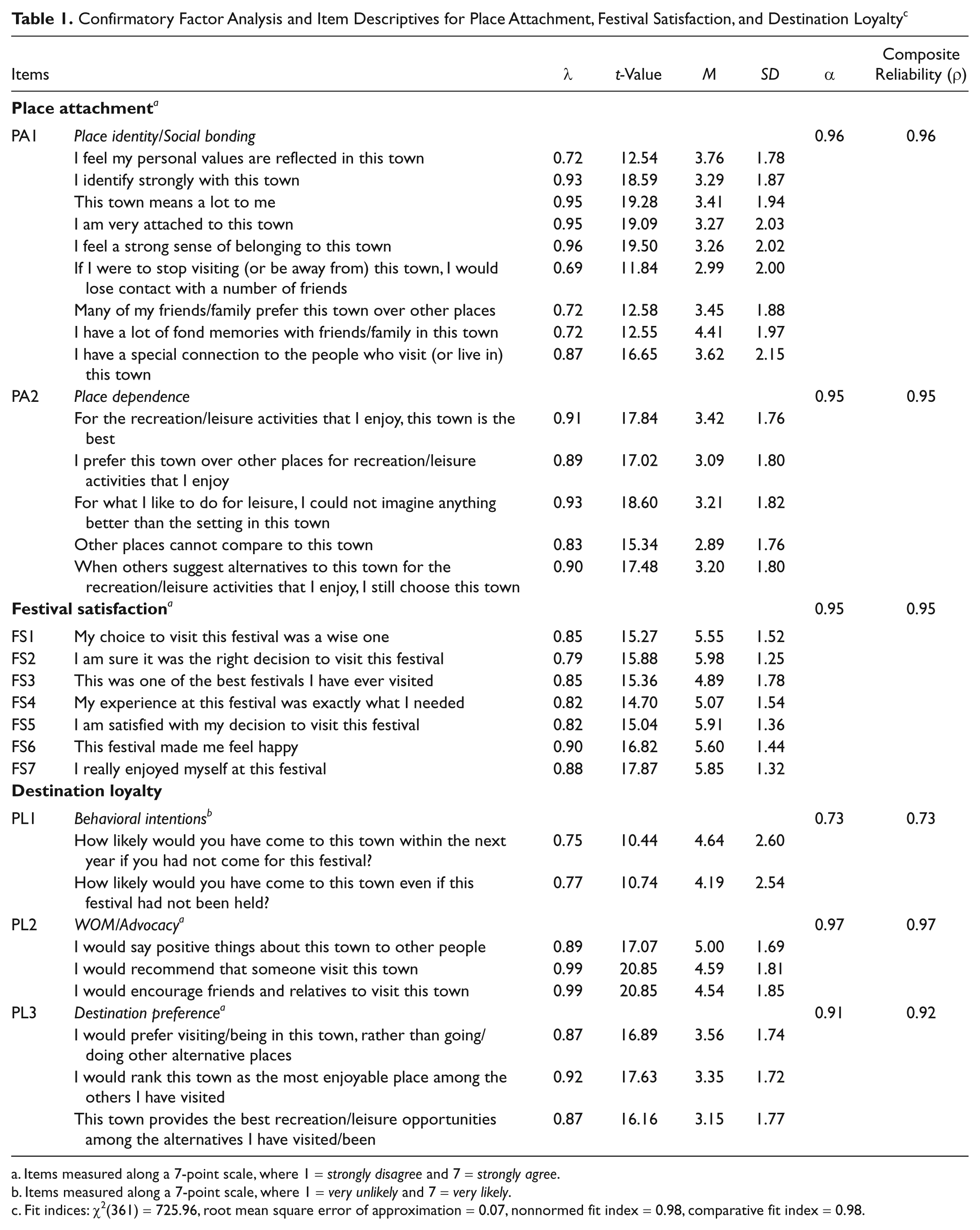
Items measured along a 7-point scale, where 1 = strongly disagree and 7 = strongly agree.
Items measured along a 7-point scale, where 1 = very unlikely and 7 = very likely.
Fit indices: χ2(361) = 725.96, root mean square error of approximation = 0.07, nonnormed fit index = 0.98, comparative fit index = 0.98.
Satisfaction with the festivals was measured using 11 items adapted from Oliver’s (1980, 1997) evaluative set of cumulative satisfaction measures. Respondents were asked to rate their level of agreement using a 7-point Likert-type scale where 1 is “strongly disagree” and 7 is “strongly agree.”
Loyalty to the festival hosting destinations was measured using Jones and Taylor’s (2007) service loyalty scale derived from the interpersonal psychology literature. They tested the validity of an eight-dimensional model in the context of customer-based generic services (e.g., health care, financial services, and repair services). A total of 10 items in the dimensions of behavioral intentions, word of mouth (WOM), and strength of preference were adapted to fit the festival visitors’ experience. Additionally, two items that assessed the behavioral intentions of place revisitation were adapted from Crompton, Lee, and Shuster’s (2001) scale. The first two dimensions were measured along a 7-point scale, where 1 is “least likely” and 7 is “most likely,” while the last dimension was measured along a 7-point scale, where 1 is “strongly disagree” and 7 is “strongly agree.”
Data Analysis Procedures
A structural equation modeling (SEM) technique with maximum likelihood (ML) estimation was used to examine the determinants of loyalty to the festival hosting destinations in LISREL (8.7 version). SEM allows researchers to simultaneously test hypothesized relationships among an entire system of variables (Byrne 1998). After screening and preparing data to detect any irregularity and check normality, we adapted a two-step approach: (1) examination of a measurement model to validate the factorial structure of the hypothesized model using confirmatory factor analysis (CFA), and (2) test for a structural model to examine the causal relationships among the latent variables (Anderson and Gerbing 1988).
We assessed model fit based on root mean square error of approximation (RMSEA; Steiger and Lind 1980), the nonnormed fit indices (NNFIs; Bentler and Bonett 1980), and comparative fit index (CFI; Bentler 1990). It has been suggested that an RMSEA value less than 0.08 with the upper limit of 0.10 represents a reasonable model (MacCallum, Browne, and Sugawara 1996) and NNFI and CFI values greater than 0.95 indicate a good fit (Hu and Bentler 1998). In addition to the goodness-of-fit indices, we evaluated the signs and sizes of parameter estimates along with standard errors.
Results
Characteristics of Respondents
The respondents at the three festivals were predominantly female (68.3%), which was more evident at the two strawberry festivals. The average age of respondents at the three festivals was 41 years. Approximately half of all respondents in each of the surveys indicated that they had graduated from college and/or earned an advanced degree. There was no statistically significant difference in household income among the respondents across the three study sites. The proportion of visitors from outside of the city/town limit of the festival was significantly higher at the two strawberry festivals (more than 90%) than at the Texas Reds Steak & Grape Festival (43.8%). The strawberry festivals had more repeat visitors (61.1% to Poteet and 49.2% to Pasadena) whereas the wine and steak festival had more first-time visitors (84.5%). This disparity is likely due to the comparatively short history of the Texas Reds Steak & Grape Festival, which had been held for only three years at the time of data collection.
Testing the Measurement Model
We prepared and screened the raw data to (1) detect irregularities (e.g., outliers), (2) address issues of missing data, and (3) meet underlying assumptions of multivariate normality (Kline 2005). For missing data, we replaced missing values using the robust multiple imputation method in PRELIS 2 (Jöreskog and Sörbom 1999). Although none of the individual scores were considered extreme, it was evident that several indicators were moderately skewed and/or had mild kurtosis. Consequently, we performed normal score transformations (Jöreskog and Sörbom 1999).
As an important preliminary step in the analysis of full latent variable models, the validity of the measurement model was tested using CFA in LISREL. This procedure determines the extent to which all items properly represent their respective latent construct (Byrne 1998). The goodness-of-fit indices of the initially hypothesized model indicated a reasonable fit to the data: χ2(674) = 1181.88, RMSEA = 0.09, NNFI = 0.96, CFI = 0.97.
An inspection of the modification indices for factor loadings, however, isolated the presence of the cross-loading and low reliability of four items in Place Attachment, four items in Festival Satisfaction, and two items in Destination Loyalty. These items were deleted and the model was respecified. In addition, of the initially hypothesized three dimensions of Place Attachment, social bonding (r = 0.97) was substantially correlated with place identity. According to Kline (2005), the high factor correlation suggests that the two factors are not distinct and reflect a single construct. Thus, items from these two factors were specified to load on a single factor we called place identity/social bonding. This new dimension was composed of indicators measuring visitors’ symbolic meanings ascribed to the festival community along with the social ties that bound them to the host towns. Thus, these data indicate that respondents’ identification with place was inextricably linked to the social nature of their fair experience.
Table 1 displays only items with statistically significant parameter estimates. The estimation of the respecified model resulted in an acceptable overall model fit: χ2(361) = 725.96, RMSEA = 0.07, NNFI = 0.98, CFI = 0.98. An assessment of the internal validity of the items in each factor revealed satisfactory reliability, with coefficients ranging between 0.73 and 0.97. Similarly, the estimates of composite reliability (ρ values ranged between 0.73 and 0.96) were all above the recommended threshold of 0.70 (Nunnally and Bernstein 1994).
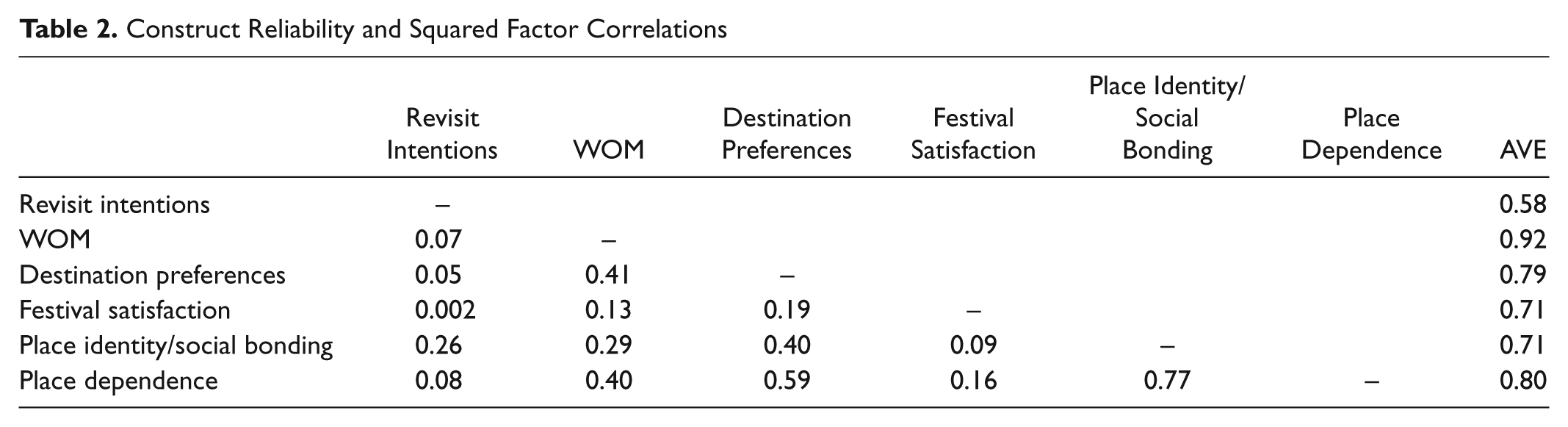
We further assessed the construct validity (i.e., convergent and discriminant validity) of the variables tested in our path model (Figure 1). Convergent validity is supported by evidence that different indicators of theoretically overlapping constructs are strongly correlated (Byrne 1998). Alternatively, discriminant validity is indicated by evidence that theoretically distinctive indicators in a construct are dissimilar (i.e., not highly interrelated). For convergent validity, all factor loadings were strong and statistically significant as shown in Table 1. All constructs’ average variances explained (AVEs), which measures the amount of variance captured by the construct among the individual indicators compared to the variance due to measurement error (Fornell and Larcker 1981) were greater than 0.50 (see Table 2). Thus, our findings provide evidence of convergent validity among constructs. In terms of discriminant validity, a construct AVE can be compared with the shared variance of another latent construct (Fornell and Larcker 1981). That is, when the former is greater than the latter, there is empirical support of discriminant validity. As indicated in Table 2, all squared correlations between the latent constructs were below each of the construct AVEs, thereby providing empirical evidence in support for discriminant validity among the constructs.
Construct Reliability and Squared Factor Correlations
Testing the Structural Model
Following the establishment of a valid measurement model, we then examined the implied causal relationships between the respective dimensions of the three constructs: festival satisfaction, place attachment, and destination loyalty. The goodness-of-fit indices for the hypothesized model indicated a reasonable fit to the sample data: χ2(365) = 1031.02, RMSEA = 0.08, NNFI = 0.97, CFI = 0.97. Examination of the structural parameter estimates for the model indicated that four parameters in the Beta matrix were not statistically significant (i.e., festival satisfaction → revisit intentions, festival satisfaction → WOM, place identity/social bonding → WOM, and place identity/social bonding → destination preference).
For parsimony, we respecified the model with these insignificant paths deleted. The χ2 difference between the hypothesized and reestimated models was not statistically significant (p < 0.05). The respecified final structural model was also considered to be an adequate fit, resulting in an overall χ2(369) = 1034.84 with a RMSEA value of 0.08, an NNFI value of 0.97, and a CFI value of 0.97. Table 3 provides a summary of the significant path coefficients with their standardized estimates.
Structural Model Analysis
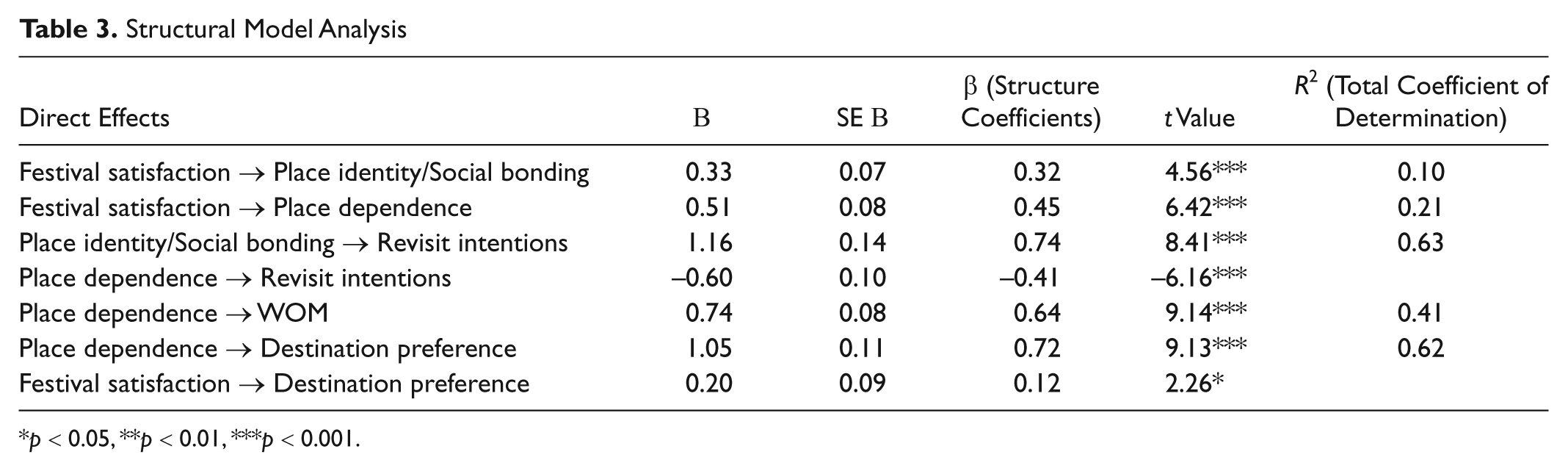
p < 0.05, **p < 0.01, ***p < 0.001.
As illustrated in Table 3 and Figure 2, Festival Satisfaction significantly predicted both dimensions in Place Attachment: place identity/social bonding (β = 0.32, t = 4.56, p < 0.001) and place dependence (β = 0.45, t = 6.42, p < 0.001). Festival Satisfaction accounted for a modest proportion of the variance in place identity/social bonding at 10% but was a stronger predictor of place dependence, accounting for 21% of the variance. As expected, a satisfactory festival experience contributed to the development of visitors’ dependence on the setting for achieving desired experiences and, to a lesser extent, a sense of belonging to the host destination.
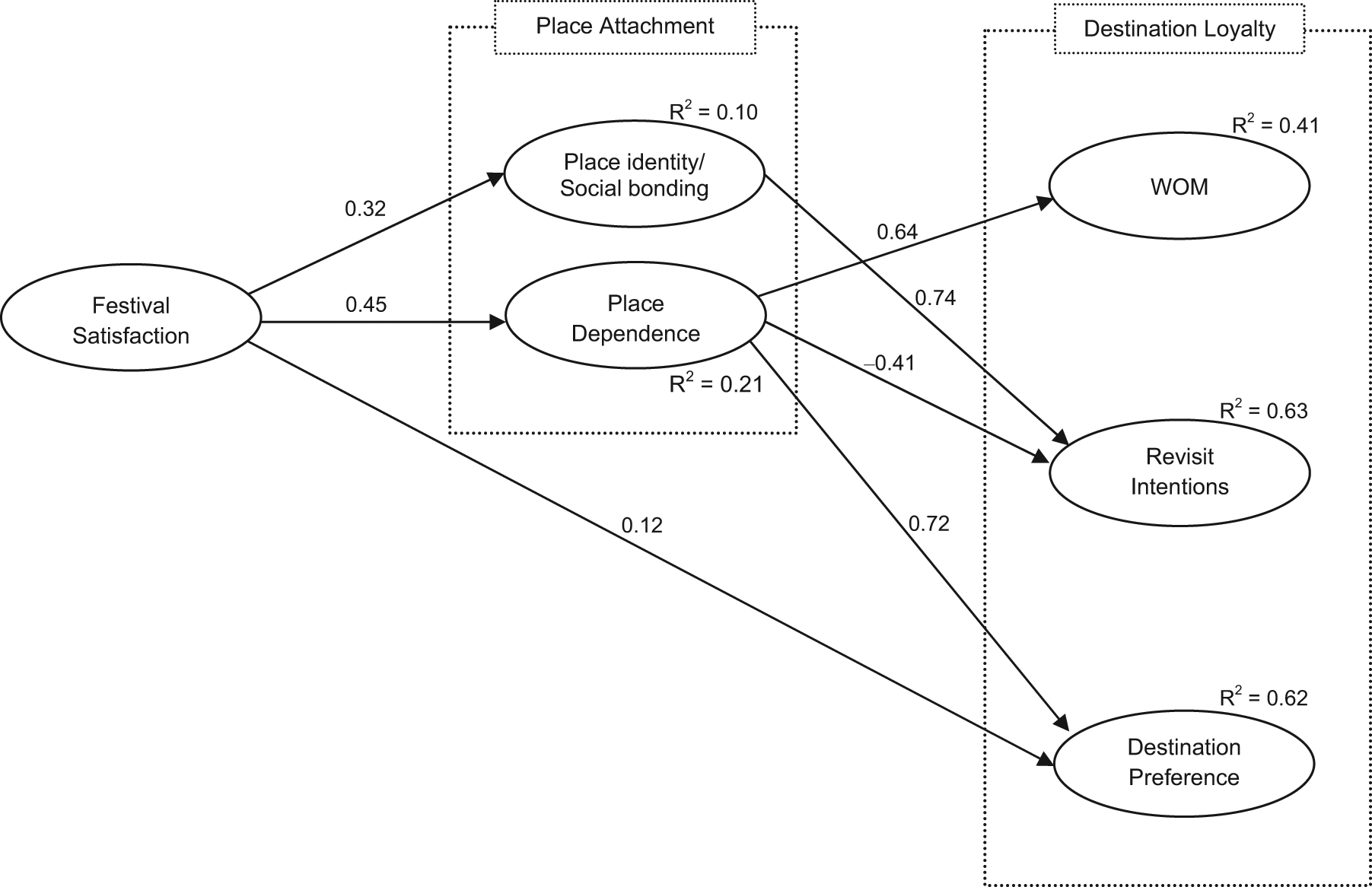
A final structural model with standardized regression coefficients
We also observed that not all dimensions of Place Attachment were significant predictors of the three dimensions of Destination Loyalty. Place identity/social bonding had a positive effect on revisit intentions (β = 0.74, t = 8.41, p < 0.001), whereas place dependence was a negative predictor of revisit intentions (β = −0.41, t = −6.16, p < 0.001). All together, these determinants explained more than half of the variance (63%). Place dependence also had a strong positive effect on both WOM (β = 0.64, t = 9.14, p < 0.001; R2 = 0.41) and destination preference (β = 0.72, t = 9.13, p < 0.001). To a lesser extent, destination preference was also predicted by Festival Satisfaction (β = 0.12, t = 2.26, p < 0.05). Both of these antecedents accounted for 62% of the destination preference variance.
We further analyzed the indirect effects in order to examine if Place Attachment was a significant mediator of the relationship between Festival Satisfaction and Destination Loyalty. Implied in our hypothesized model is a process whereby festival visitors’ satisfaction with their festival experience influences their attachment to the hosting town. This attachment then shapes their subsequent attitudes and behavior related to the hosting town. Our analyses of the indirect effects test the presence of these causal processes. It was empirically demonstrated that Festival Satisfaction had a positive indirect effect on revisit intentions through place identity/social bonding (indirect effect = 0.38, t = 4.10, p < 0.001), while the indirect relationship of Festival Satisfaction and revisit intentions via place dependence was negative (indirect effect = −0.31, t = −4.37, p < 0. 001). In addition, the indirect effects of Festival Satisfaction on WOM (indirect effect = 0.38, t = 5.25, p < 0.001) and destination preference (indirect effect = 0.54, t = 5.30, p < 0.001) via place dependence were statistically significant and positive. In terms of the total effects that estimated the sum of all direct and indirect effects of one variable on another, we found that Festival Satisfaction did not have a significant total effect on revisit intentions. Festival Satisfaction, however, did have a strong positive total effect on destination preference (total effect = 0.73, t = 6.17, p < 0.001).
Conclusion and Discussion
Drawing from theory on human attachment (Morgan 2010) and past empirical evidence, we examined the extent to which satisfactory visitor festival experiences contributed to the development of loyalty to festival host destinations. Overall, our findings support the contention that place attachment plays a mediating role in the relationship between festival satisfaction and destination loyalty. That is, satisfied visitors at a festival develop an emotional attachment to the festival host destination and ultimately become loyal to that destination. Not all dimensions of place attachment and festival satisfaction, however, were statistically significant, nor were they of equal valence in their prediction of the destination loyalty dimensions.
Specifically, festival satisfaction had a direct positive effect on both dimensions of place attachment: place identity/social bonding and place dependence. Festival satisfaction was a stronger predictor of place dependence than was place identity/social bonding. That is, a positive evaluation of the overall festival experience contributed both to developing self-identification with the host and a sense of belonging that was rooted in experience shared with others. To a greater extent, satisfied visitors also became attached to the community owing to the attributes and features that supported their experience-related needs. In this context, satisfaction rests on the attributes that comprise and define the setting and their congruence with individuals’ place-based needs. This result corresponds to Stedman’s (2002) claim that satisfactory experience within a given setting, supported by place-based attributes, drives people’s attachment to that setting. This is also consistent with the findings from the leisure and social psychology literature, suggesting that satisfaction with natural and social environments (e.g., national parks, golf courses, and neighborhood) directly influences the value that an individual ascribes to that particular place (Halpenny 2006; Petrick, Backman, and Bixler 1999; Ringel and Finkelstein 1991).
Our results also illustrate that the dimensions of place attachment did not significantly predict all dimensions of destination loyalty. Of the two place attachment dimensions, place identity/social bonding was found to have a strong positive effect only on revisit intentions. Alternately, place dependence was a strong positive predictor of both word-of-mouth recommendation and destination preference, but was also a negative predictor of revisit intentions. In other words, a visitor who experiences meaningful social interaction within a particular place is highly likely to revisit that destination. Individuals who consider a place to be important owing to its ability to facilitate desired outcomes are also more inclined to spread positive word-of-mouth to others and display a strong preference over alternative destinations. Ironically, however, they are less inclined to return to that destination. This negative association was contrary to what has been previously reported in the literature and what we anticipated. The finding suggests that a setting’s specific attributes to meet the needs of an individual does not guarantee their return. It is likely that the cultivation of place dependence is a necessary but insufficient element underlying visitors’ intention to return. More compelling are the social and emotional ties that bind visitors to the hosting venue. For festival organizers, manipulating setting attributes that enhance shared experiences is more critical to promote the return of visitors. More research is needed to better understand why place dependence may be inversely related to intentions to revisit in festival contexts.
Festival satisfaction was found to positively influence destination preference, but not other dimensions of destination loyalty. It is noted that visitors had a stronger preference for the communities due to the spatial attributes that meet their needs rather than their satisfying experience at the festival. This result is in contrast to findings of past research, suggesting that satisfaction with a specific setting is a significant predictor of revisit intention and positive word of mouth (e.g., a wildlife refuge in the work of Tian-Cole, Crompton, and Willson (2002). In general, the literature is devoid of empirical work that has simultaneously tested the causal relationship between visitor loyalty to a destination and satisfaction with a particular attraction within that destination. This relationship should be investigated further in future studies.
For the conceptualization of place attachment, we observed that place identification and social bonding were indistinguishable. The finding illustrates that in this festival context, the experience of place reflects compound processes involving social interaction, emotional bonding, and an identification with the town. While past work has illustrated that multidimensional conceptualizations provide better insight on the foundation of people’s attachment to place, it also has the potential to falsely demarcate processes that are intimately tied. These data illustrate that distinguishing emotional/identity-based elements of attachment from social/experiential factors is not reflective of our respondents’ attachment to the host cities. We do not recommend a departure from multidimensional conceptualizations of place attachment. We do, however, suggest that researchers be open to the potential for merger among place dimensions. This would allow for contextual consideration as opposed to the steadfast imposition of a predetermined factorial structure where it may potentially not apply.
Our results also illustrate the key mediating role of place attachment on the relationship between visitor loyalty to a destination and their overall postvisit appraisal of a particular attraction within the destination. On the whole, our findings highlight the conceptual alignment with the Oliver’s (1997) hierarchical loyalty development process. That is, individuals with a belief that their festival visit is worthwhile as a result of satisfactory experience at the festival (i.e., cognitive loyalty) are more likely to develop an emotional attachment (i.e., attitudinal loyalty) and behavioral intention related to the festival host communities (i.e., conative loyalty). Arguably, there may be a recursive relationship between festival satisfaction and place attachment based on the idea that strongly held attitudes lead to selective attention and dissonance reduction (see attitude theory; Sherif, Sherif, and Nebergall 1965). Therefore, further investigation on this relationship is necessary. Our final model illustrates that while satisfaction had a direct and positive effect on destination preference, its effect on other elements of loyalty were mediated by the dimensions of place attachment. The inclusion of place attachment in the satisfaction-loyalty model provides greater insight on how the maintenance of satisfactory experiences at tourism attractions shapes destination loyalty outcomes.
On the basis of these study results, we suggest that destination marketers focus their efforts more strongly on managing positive visitor experiences at festivals. Broadly, this can be done by maintaining destination attributes (i.e., tourism attractions), such as implementation of destination quality management programs through a joint venture between the DMO and festival organizers within the destination (Pike 2008). In particular, marketers could pay more attention to factors that enhance visitors’ emotional ties not only to the festival but also to the spatial context in which the festival is experienced. Previous place literature has shown that, in addition to the provision of quality services, drivers of place attachment emanate from the physical (e.g., ambience, place character, and destination attractiveness) and social character (e.g., customer mix and service personnel) extant in the setting (Kyle and Chick 2007; Milligan 1998). These elements enhance visitors’ emotional attachment and ultimately attract and retain more visitors to the host community (Alexandris, Kouthouris, and Meligdis 2006; Lee, Graefe, and Burns 2007).
There are several limitations related to our methods that warrant noting. Despite our effort to increase the sample size using our multiple-method approach, we acknowledge that our response rate was relatively low. This potentially undermines the external validity of our findings. Another concern is the assessment of the key variables 4 to 6 months after a festival visit. Given that both satisfaction (Stewart and Hull 1992) and loyalty (DuWors and Haines 1990) are time-dependent and dynamic variables, visitor real-time experiences could be quite different from their post hoc evaluations. Hence, it might be necessary to measure these constructs and test their relationships over the course of festival experiences in future research. It would be also interesting to examine if there is any difference in the causal relationship between the constructs for on-site festival experience and postvisit appraisal through multiple-group analyses. Last, additional analysis in future studies could be performed to examine how all the considered determinants of festival visitor loyalty in this study interact with other variables, such as visitor history associated with the festival (Moore and Graefe 1994), perceived values (Yang and Peterson 2004), place motivations (Kyle, Mowen, and Tarrant 2004), and festival involvement (Kyle et al. 2004).
Footnotes
Declaration of Conflicting Interests
The author(s) declared no potential conflicts of interest with respect to the research, authorship, and/or publication of this article.
Funding
The author(s) received no financial support for the research, authorship, and/or publication of this article.