




Abstract
Tourism destinations are increasingly concerned about global climate change and considering to become involved in the adoption of mitigation policies that reduce global emissions. On the other hand, behavioral sciences have shown that consumers’ choices may be significantly influenced by the way that they are framed. In this article, we test the impact of alternative ways to frame the pricing of climate change policies on the values and preferences of tourists. The evidence comes from three different experiments on a proposal to mitigate climate change through a carbon offset program using both an opt-out pricing frame and in an opt-in pricing frame. The results show that the opt-out frame led to a larger probability of accepting to pay the price for a carbon offset policy proposal. The main implication is that destinations’ climate change policies should take into account the designs of the frame in which policies are posed.
Introduction
Tourism destinations are increasingly concerned with the impacts of climate change, since they can cause notable changes in their environmental attributes (Berrittella et al. 2005; Buzinde et al. 2010; Buzinde et al. 2010). It has been suggested by many scholars that climate change can be capable of affecting tourist destinations through the potential impact on tourist demand (Leon and Araña 2012; De Freitas 2005; Hamilton 2004; Lise and Tol 2002; Maddison 2001; Scott and Konopek 2007). Tourists are expected to behave in response to the changes in attributes by modifying their travel plans according to their preferences. Facing these problems, some authors have argued that tourist destinations should anticipate them, by enforcing the adoption of appropriate policies that could lead to the amelioration of the impacts of climate change and contribute to its contention on a global scale (Higham and Cohen 2011; Perry 2005, 2006; Scott and McBoyle 2007; Leon and Araña 2012). These scholars also suggest that climate change policies can enhance the destinations’ image by inducing a favorable preference from tourists.
However, an important issue in the design of climate change policies in tourism is concerned with the way tourists potentially could respond and behave facing these policies (Becken 2002, 2004, 2007; Becken and Hay 2007; Dickinson, Robbins, and Lumsdon 2010; Gössling 2002, 2009; Gössling et al. 2006; Gössling et al. 2007; O’Brien 2009; Gössling and Schumacher 2010). Recent advances in behavioral sciences have shown that individuals in society can behave differently depending on the frame of the options of choice in the consumption process (Thaler and Sustain 2008). That is, individuals can be nudged to choose the default or no action option, which is the alternative that involves less costs of decision (Biswas 2009; Camerer et al. 2003; Johnson and Goldstein 2003; Johnson, Steffel and Goldstein 2005; Levin and Gaeth 1988). For instance, when tourists are asked to pay for an environmental proposal in addition to the price of their tourist package, the results may be different if the additional cost was already included in the price of the package than if it was not (Goldstein, Cialdini, and Griskevicious 2008).
A theoretical explanation for this “endowment effect” is the loss aversion theory, originally proposed by Kahneman, Knetsch, and Thaler (1990). The main idea comes from the evidence that individuals strongly prefer avoiding losses to acquiring gains. Following this idea, many authors have proposed to separate out consumer behaviors when facing price discounts (i.e., “losses”) and price premiums (i.e., “gains”). Some interesting and recent applications in the hospitality industry are Mostert, Petzer, and De Meyer (2012), Araña and Leon (2008), Kwon and Jang (2011), and Nusair et al (2010), among others.
On the other hand, there is evidence that tourists might answer to environmental policy proposals in different ways and that these proposals tend to influence actual tourist behavior according to their environmental preferences for tourist destinations (Baddeley 2004; Budeanu 2007; Dolnicar and Leisch 2008; Fairweather, Maslin, and Simmons 2005; Higham and Cohen 2011; Manaktola and Jauhari 2007). Also, some recent works have demonstrated an important difference between awareness and behavior in tourism (e.g., Hares, Dickinson, and Wilkes 2010; Barr et al. 2010; McKercher et al. 2010; Barr, Gilg, and Shaw 2011). Thus, in the design of tourism policies regarding prices and options, tourists can be induced to choose the option that might lead to higher benefits for themselves and for the destination.
There is an open debate in the tourism literature regarding the consequences of climate change mitigation policies on destinations’ sustainability. This idea is nicely summarized in two recent works by Weaver (2011) and Scott (2011). Weaver argues that “in an era of chronic economic uncertainty all combine to increase the likelihood of unsuccessful climate change policies and strategies.” Moreover, Weaver states that “adaptation is a rational business response to climate change that is not directly related to environmental and sociocultural sustainability, and that mitigation measures should be supported to the extent that they yield practical and tangible short- and medium-term benefits and address local sustainability issues such as air quality and biodiversity protection.” In a reply to Weaver’s work, Scott (2011) argues that “addressing climate change is considered a prerequisite to sustainable development and therefore germane to advancing sustainable tourism research. Tourism is currently considered among the economic sectors least prepared for the risks and opportunities posed by climate change and is only now developing the capacity to advance knowledge necessary to inform business, communities and government about the issues and potential ways forward.”
The purpose of this article is to compare the potential results in tourists’ behavior of alternative ways of framing climate change policies in tourism. To this aim we design a set of experiments involving hypothetical and real market scenarios. In all the experiments, tourists are asked to choose between two alternatives of climate change policies: a default or no action option and an alternative option that involves the rejection of the default option. The hypothesis to be investigated is to what extent the default option makes a difference in tourists’ acceptance of climate change policy proposals.
For instance, in a real market experiment, tourists registering for a conference in a destination can be asked to accept the price for a carbon-offsetting program included in the price of the conference, that is, the default option. In the alternative frame, the default option would not include the supplement for the carbon-offsetting program and tourists are asked to accept the payment of a supplement for this policy proposal. Thus, in the former frame the policy proposal is included in the default option, whereas in the latter case it is not included. The outline of the paper is as follows. The next presents the design and methods of the experiments. The third section discusses the findings and implications while the fourth section concludes.
Methods
Three experiments were conducted for studying the impact of the default option on the choices tourists could make about climate change policies in tourism. Two experiments are conducted in a hypothetical market setting, that is, by using a constructed market approach based on a questionnaire commonly known as contingent valuation (Mitchell and Carson 1989). This is a method that has been extensively used for the valuation of environmental goods and has been successfully applied to value environmental policies and attributes in tourism (Alexandros and Jaffry 2005; Asafu-Adjaye and Tapsuwan 2008; Huybers and Bennet 2000; Lindberg, Dallaert, and Rassing 1999; Lindberg, Johnson, and Berrens 1997; Leon et al. 2003; Maddison and Foster 2003). It consists of asking subjects about their willingness to pay for a policy proposal about an environmental or nonmarket good. The method allows researchers to measure marginal additional willingness to pay on a change in an attribute characteristics. The good should be precisely defined and the questionnaire should provide the appropriate incentives for a truthful revelation of consumer preferences (Bateman and Willis 1999; Carson, Flores, and Meade 2001).
The other experiment was conducted using a field experiment approach. Field experiments have become a powerful setting for hypothesis testing in economics and social sciences (Cardenas and Carpenter 2008; List 2006). In this setting, individuals are observed to decide between choice alternatives in a market context and their actual behavior is recorded. The advantage is that subjects are not aware that they are being observed, and therefore their behavior is not conditioned by the fact of being participants in a social experiment.
Hypothetical Experiment 1
The hypothetical experiments were designed following contingent valuation methods that involve the construction of a market in a questionnaire in which tourists are posed with policy proposals on climate change in tourism destinations. The questionnaire contained three sections. In the first section, the subject was presented with information about the problem of the climate change and its potential impacts on tourism destinations. The second section presented the nonmarket experiment for the policy proposal and the third section asked some questions on the socioeconomic characteristics of the individual.
Two focus groups with tourists of different nationalities who were visiting the Canary Islands allowed us to improve the wordings and the understanding of the scenarios and the other questions in the survey instrument. The focus groups allowed us to learn about tourists’ knowledge of climate change policies and check for the appropriate effect of the communication devices. The informational material about the climate change issues and its potential impacts on tourist destinations were tested in the focus groups. The potential answers of tourists to the policy questions were also checked in order to enhance participation and understanding of the experiment. Questionnaires were translated by professional editors who were native speakers of each language and then back-translated by different professional editors in order to improve the wording and avoid translation biases due to the multicultural nature of the sampled population. In addition, two pretest samples of 100 individuals and 20 in-depth interviews with potential respondents allowed us to prove that the questionnaire was understood as expected by the researchers.
Tourists were presented with several options of choice regarding their next vacation at their most preferred tourist destination. Prior to the policy choice, tourists were informed about the content of the policy proposal. This was defined as an extra tax or a supplement for financing policies that would equilibrate the increase in the amount of CO2 that will follow from the vacation or the holidays of the tourist, that is, a carbon offset policy. In order to avoid problems resulting from the generation of adverse competitive advantages due to changes in the relative prices of the destinations, tourists were told that all destinations will adopt the same policy; that is, that the tax would have to be paid in whatever destination they eventually choose for their holidays. This statement was also directed to enhance the incentive compatibility properties of the hypothetical experiment, since no tourist could avoid the payment if the policy was implemented.
Two alternative framings were presented in different subsamples. In the first treatment or opt-in alternative, the potential tourist was asked if she would accept to pay an extra tax for the vacation in order to pay for the purpose of climate change mitigation at the tourist destination. The frame of the policy proposal reads as follows:
Tourist destinations are considering the implementation of a tax on tourists with the aim to finance policies intended to counterbalance the effects that tourism has on climate change. These policies will be directed towards the reduction of global emissions of CO2 such as actions like reforestation or the implementation of green technologies, and would compensate for the emissions that your holidays will produce on the global environment. If implemented, this tax will be adopted by all tourist destinations in the European Union, and later around the world. In your next holidays would you accept to pay the extra amount of X $ for this policy?
In the opt-out alternative, we asked tourists to assume that the price of their next holidays would already include a supplement for the contribution to the reduction of global carbon emissions of CO2, and were asked if they would reject this supplement to be included in the price of their next vacation. The frame of the policy proposal was as follows:
Tourist destinations are considering collecting a supplement from tourists with the aim to finance policies intended to counterbalance the effects that tourism has on climate change. These policies will be directed towards the reduction of global emissions of CO2 such as actions like reforestation or the implementation of green technologies, and would compensate for the emissions that your holidays will produce on the global environment. If implemented, this tax will be adopted by all tourist destinations in the European Union, and later around the world. In your next holidays, would you reject to pay the extra amount of X $ for this policy?
The survey work was conducted in the first semester of 2009 using online procedures. The survey was administered and controlled by a professional firm specializing on Web surveys, and it also supervised the quality of data collection. Tourists were recruited from the general population after screening for those who had traveled in the past year to an overseas destination for tourism or vacation purposes and intended to make the same or similar travel within the next year. The survey was conducted in ten countries of the European Union: United Kingdom, Germany, Italy, Spain, Denmark, Sweden, Norway, Finland, and Ireland. A total of 854 interviews were completed following quotas of market shares of international tourism for this set of countries. The response rate was 60% of all those contacted for application of the questionnaire. The sample was split into two treatments, 420 interviews for the opt-in scenario and 434 for the opt-out scenario.
Hypothetical Experiment 2
A second hypothetical experiment was conducted with another sample of subjects in the same countries as the previous experiment but the participants were screened in international conferences in the year before the interview. The survey was also conducted online and with the same technical procedures described above for the previous experiment. The question frames and the payment vehicles were exactly the same in the opt-in and opt-out treatments. The policy proposal for the opt-in treatment read as follows:
Assume that in your next conference abroad, the organizers plan to include the possibility of paying an extra amount in addition to the conference fee with the aim to finance policies intended to counterbalance the effects that tourism has on climate change. These policies will be directed towards the reduction of global emissions of CO2 such as actions of reforestation or the implementation of green technologies, and would compensate for the emissions that your travel to the conference will produce on the global environment. Would you accept to pay the extra amount of X $ in addition to your conference fee?
For the opt-out treatment, the wording was as follows:
Assume that in your next conference abroad, the organizers plan to include as part of the conference fee a supplement with the aim to finance policies intended to counterbalance the effects that tourism has on climate change. These policies will be directed towards the reduction of global emissions of CO2 such as actions of reforestation or the implementation of green technologies, and would compensate for the emissions that your travel to the conference will produce on the global environment. Would you reject to pay the extra mount of X $ as part of your conference fee?
This experiment was conducted in the second semester of 2009. The final number of observations was 754, with 367 observation for the opt-in treatment and 387 observations for the opt-out treatment. As in the previous experiment, the sample was stratified according to the travel market of the countries considered in the experiment.
Field Experiment
The field experiment was very similar to the hypothetical experiments but was conducted in a real market for tourists registering for conferences in Gran Canaria. The field works were conducted from September 2009 to February 2010. The field works were preceded by two focus groups that allowed us to improve the wording of the opt-in and opt-out treatments and enhance the understanding of the potential subjects to both situations. In addition, pretest work with 50 tourists in the Canary Islands allowed us to prove that the policy options were clearly understood by the potential participants in the market experiment.
Individuals registering at the Convention Center were given the option to pay an extra amount of money beyond the conference registration fees with the aim of contributing to a general policy of carbon offsetting that would compensate for the increase in global emissions due to their travel to Gran Canaria. Similarly to the hypothetical experiments, two alternative framings were used in order to test for the impact of the default option on tourists’ choices. The treatments differed only in the way that the policy proposal was framed to the potential tourists: (1) Opt-in alternative: the extra price of the carbon offsetting policy was not included in the conference price; (2) Opt-out alternative: the extra price of the carbon offsetting policy was included in the conference price.
The payment was justified on the basis of the emissions that follow as a result of the travel decision of the tourist. Thus, in the section of the payment process, the conference participant was provided with the following information on the carbon-offset program of the Conference Bureau:
Your decision to travel to Gran Canaria for this Conference involves an increase in the amount of global emissions of greenhouse gases such as CO2 that can have an effect on the global climate in the medium and larger terms. In order to compensate for these emissions you can contribute to some programs that reduce the amount of global emissions, such as forest plantations or the adoption of greener technologies. As part of the socially responsible policy of this Bureau we offer all our clients the opportunity to contribute to carbon offset programs with the aim of controlling and reducing global emissions of greenhouse gases.
The framing of the payment vehicle was defined in two alternative treatments:
Opt-in treatment: In this treatment, the subject was asked to pay an extra amount above the fee for the conference, with the aim of contributing to carbon offsetting policies. The wording of the framing was:
Please tick in this box if you would like to include the additional amount of X $ to your conference fee with the aim of contributing to carbon offset programs.
Opt-out treatment: In this treatment, the subject was told that the fee for the conference included a fee for carbon offsetting programs and was asked to accept or refuse this payment. The wording was as follows:
The conference fee includes an amount of X $ that will be dedicated to carbon offsetting programs. Please tick in this box if you do not agree with this payment and want it to be deducted from the conference fee.
The two treatments were randomly assigned to potential tourists registering for conferences from all over the world. A final sample of 852 individuals was randomly included in the study, with 422 for the opt-in treatment and 430 for the opt-out treatment.
Bid Price Design
In all the experiments, each individual in the sample was offered one price for the contribution to the tourism climate change policy that she or he was asked to accept or refuse in each of the treatments for the default options. A vector of four prices was considered that was determined by using information from the open-ended responses to the willingness-to-pay (WTP) questions in the pretest work, using Cooper’s (1993) optimization methods based on the minimization of the mean square error, that is, the sum of variance and bias of the expected value of WTP. Some distribution is assumed for WTP in the optimization procedure: for an asymmetric distribution (e.g., lognormal or loglogistic), the outcome of the optimization process leads to prices that are not evenly spaced. In practice, each individual randomly receives one of these optimal prices. In our experiments, the vectors were (30, 60, 100 and 150 US$) for hypothetical experiment 1 and (10, 20, 40 and 60 US$) for hypothetical experiment 2 and the field experiment.
Modeling
The data from the experiments can be modeled by using the binary response models developed by Hanemann (1984) and Cameron (1988). The idea is that the probability accepting the price for the climate change policy proposal is assumed to decline as the price increases. This allows the researcher to estimate the mean willingness to pay (WTP) for the policy proposal across the sample of respondents.
Following Cameron (1988), assume WTP is a function of two components, a deterministic parameter μ and an unobservable random variable ε with zero mean and σ standard error. Thus, WTP = µ + σε, where μ and σ are the location and scale parameters (i.e., mean and standard deviation, respectively) of WTP. The location parameter can be expressed as a linear predictor associated with a k x 1 regression parameter vector β and a covariate vector x, that is, µ = X′β.
The individual would answer “yes” to the price offered for the climate change policy proposal if WTP is higher than the price asked, and would answer “no” in the opposite case. The probability of a “yes” response is given by

where B stands for the price offered to the individual in each of the experimental settings and Fε is the cumulative distribution function of WTP.
The likelihood function across all sample observations is

where y = 0, 1 is an indicator variable of whether the subject answers negatively and positively, respectively, that is, whether WTP is lower or higher than bid price B. Parameters β and σ can be estimated by maximum likelihood methods applied to equation (2) (e.g., Hanemann 1984; Cameron and James 1987; Araña and León 2005).
Results
The three experiments presented in this article were designed with the aim of studying the sensitivity of tourists’ behavior to the framing of an environmental policy against climate change. All the experiments were conducted with similar methodological procedures but differ only in the type of tourist services implied (i.e., either average destination tourists or conference tourists) and the nature of the experiment (i.e., either hypothetical or real). Tables 1 to 3 present sample means of sociodemographic characteristics for each experiment and for each subsample. Although there might be differences among responses by type of tourist and the nature of the experiment implemented, since the chi-squared tests presented in Tables 1 to 3 conclude that socioeconomic characteristics of the individuals in the subsamples for the different treatments in the experiments were not significantly different, any potential divergences in the results between the opt-in and opt-out can be attributed to the effect of the frame of the default option.
Sociodemographic Characteristics by Subsample in Experiment 1 a
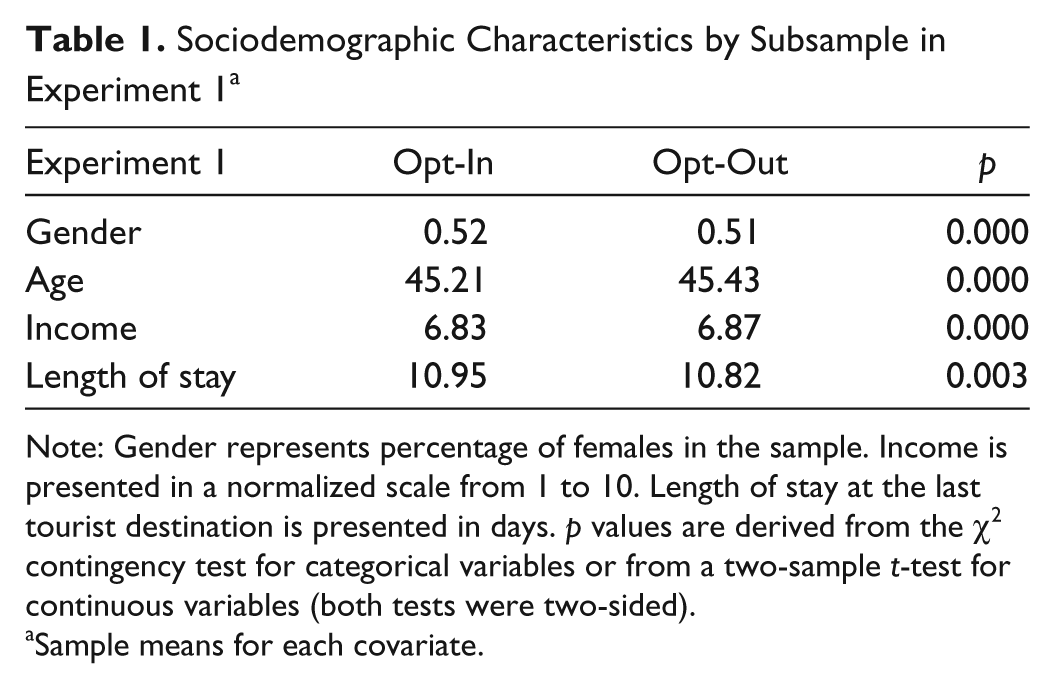
Note: Gender represents percentage of females in the sample. Income is presented in a normalized scale from 1 to 10. Length of stay at the last tourist destination is presented in days. p values are derived from the χ2 contingency test for categorical variables or from a two-sample t-test for continuous variables (both tests were two-sided).
Sample means for each covariate.
Sociodemographic Characteristics by Subsample in Experiment 2 a
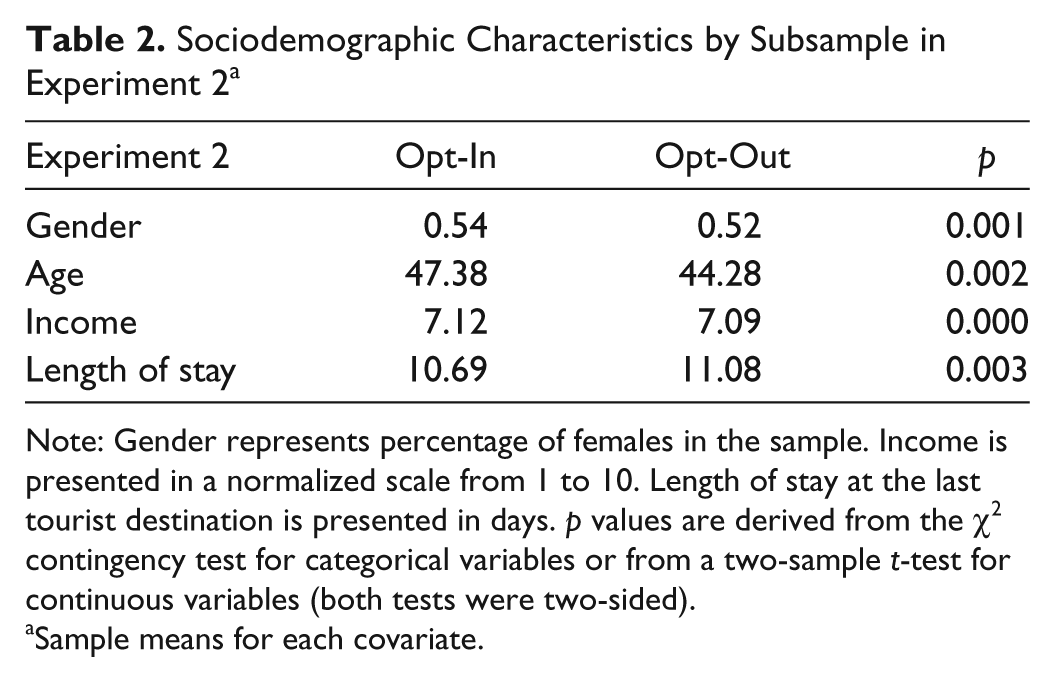
Note: Gender represents percentage of females in the sample. Income is presented in a normalized scale from 1 to 10. Length of stay at the last tourist destination is presented in days. p values are derived from the χ2 contingency test for categorical variables or from a two-sample t-test for continuous variables (both tests were two-sided).
Sample means for each covariate.
Sociodemographic Characteristics by Subsample in Experiment 3 a
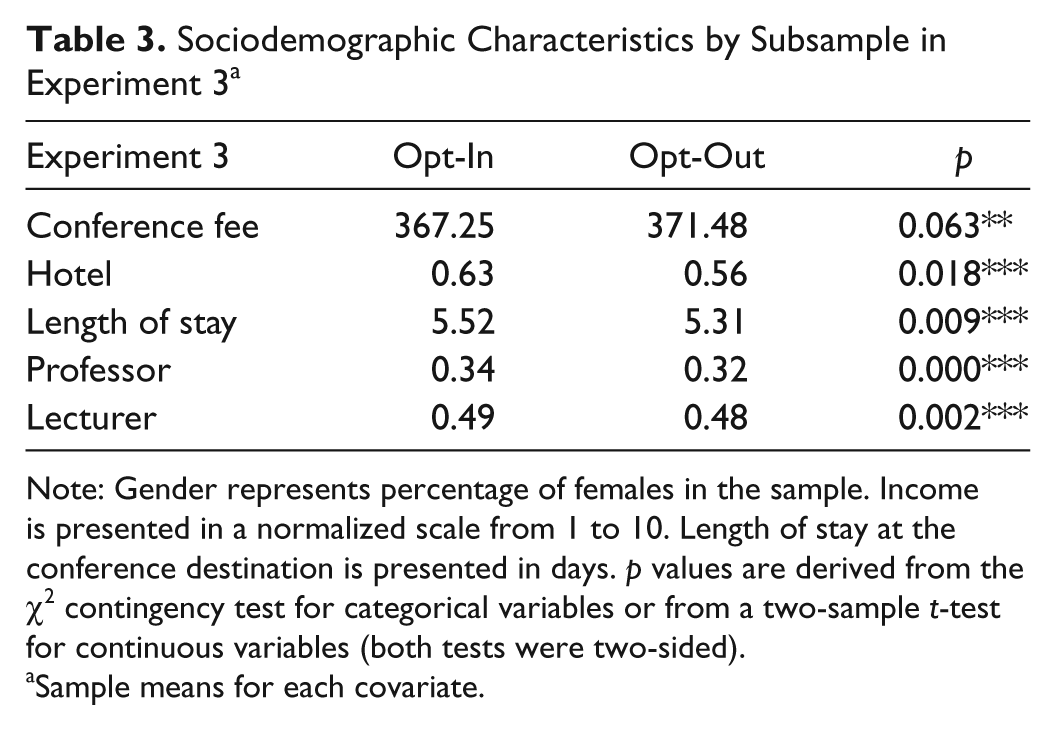
Note: Gender represents percentage of females in the sample. Income is presented in a normalized scale from 1 to 10. Length of stay at the conference destination is presented in days. p values are derived from the χ2 contingency test for categorical variables or from a two-sample t-test for continuous variables (both tests were two-sided).
Sample means for each covariate.
The responses of tourists to the prices offered in each of the experiments are presented in Figures 1 to 3 for hypothetical experiments 1 and 2 and the field experiments, respectively. For the opt-in treatments, the proportions of positive responses to the proposed bid prices are declining as the price increases, proving that subjects answered to prices as expected. That is, the higher the price the lower would be the probability for the subject to be willing to pay for the policy proposal against climate change. For the opt-out treatments, the proportions of negative responses also decline as prices increases; that is, the higher the price, the smaller the likelihood of a negative answer rejecting to pay the stipulated amount. For all experiments, the proportion of no answers in the opt-out responses is always above the proportion of yes answers in the opt-in responses. This means that subjects are more likely to pay each of the bid prices offered when the climate change policy in tourism is framed as an opt-out alternative than when it is framed as an opt-in alternative. In other words, the default situation seems to have an impact on the acceptance of the tourist policy on climate change by tourists.

Proportion of yes (no) responses for opt-in (opt-out) in hypothetical experiment 1

Proportion of yes (no) responses for opt-in (opt-out) in hypothetical experiment 2

Proportion of yes (no) responses for opt-in (opt-out) in the field experiment
The differences between the yes and no responses to the opt-in and opt-out treatments seem to be similar for the three experiments. For instance, for the lowest price of $10 as a supplement to the conference fee in hypothetical experiment 2 (Figure 2), 61% of respondents answered yes in the opt-in treatment while 83.5% answered no in the opt-out treatment. This means that a larger proportion of respondents were willing to accept the extra payment in the opt-out treatment than in the opt-in treatment. This difference is quite similar for the real market experiment (Figure 3), where 57% answered yes to the same price in the opt-in treatment while 83% answer no in the opt-out treatment. For higher prices, the differences in the yes and no responses between both treatments are significant but become smaller, as revealed by the converging lines of both treatments in Figures 1 to 3.
A χ2 contingency test showed that the differences between both treatments in the yes and no responses to respectively accepting or rejecting to pay for the climate change policy for each of the experiments were statistically significant at the 99% level. This was proved for the responses to each of the prices and for the responses to all the prices. Thus, in all cases, the opt-in treatment leads to a lesser willingness to contribute to the policy of climate change in tourism than the opt-out treatment. The implication is that the inclusion of the price to be paid for the policy of climate change in tourism in the price for the tourist package, or in the conference price, leads to greater participation of tourists in the proposed policies. However, the differences between both frames for the default option are reduced as the price to be paid for the climate change policy in tourism becomes larger.
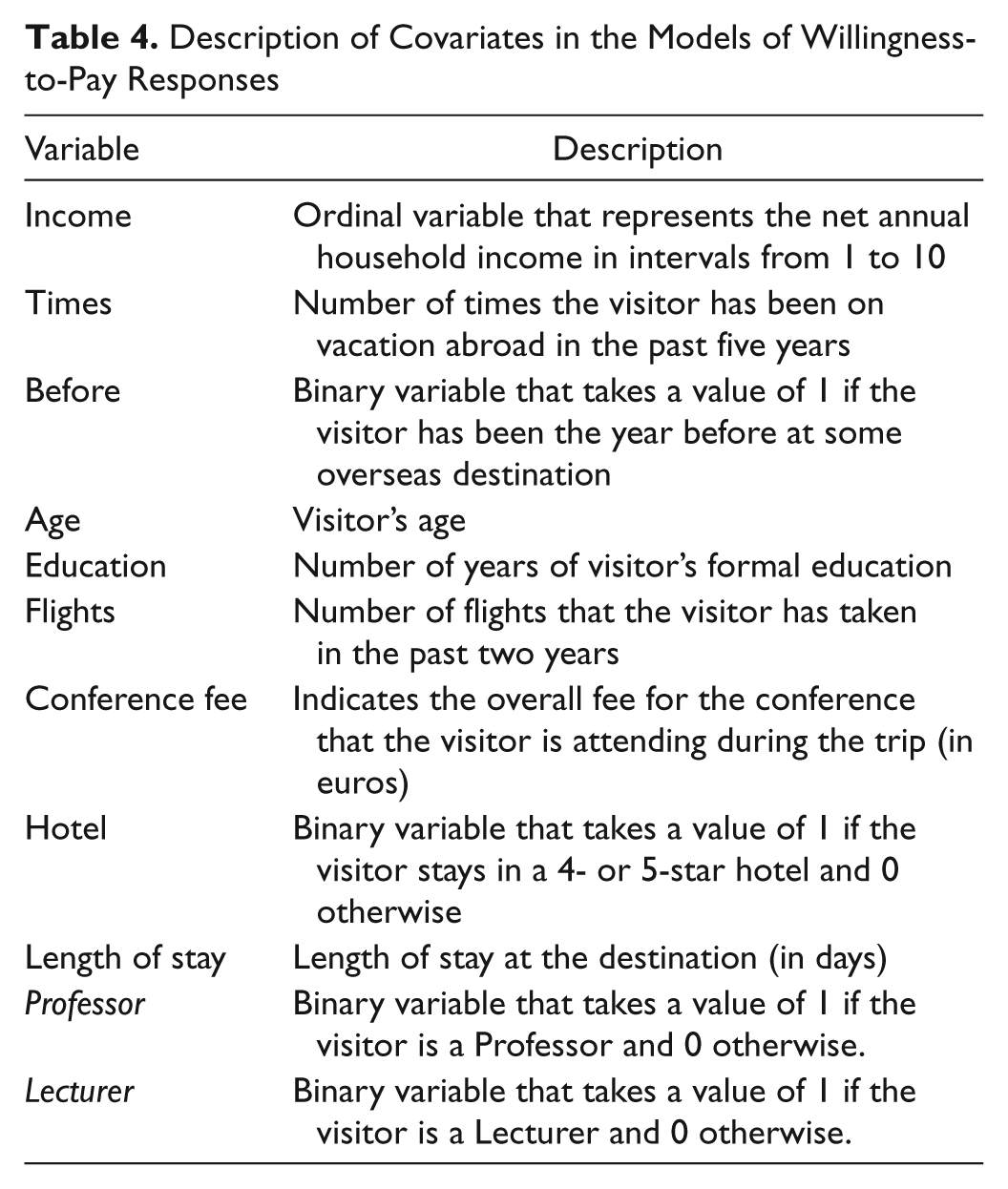
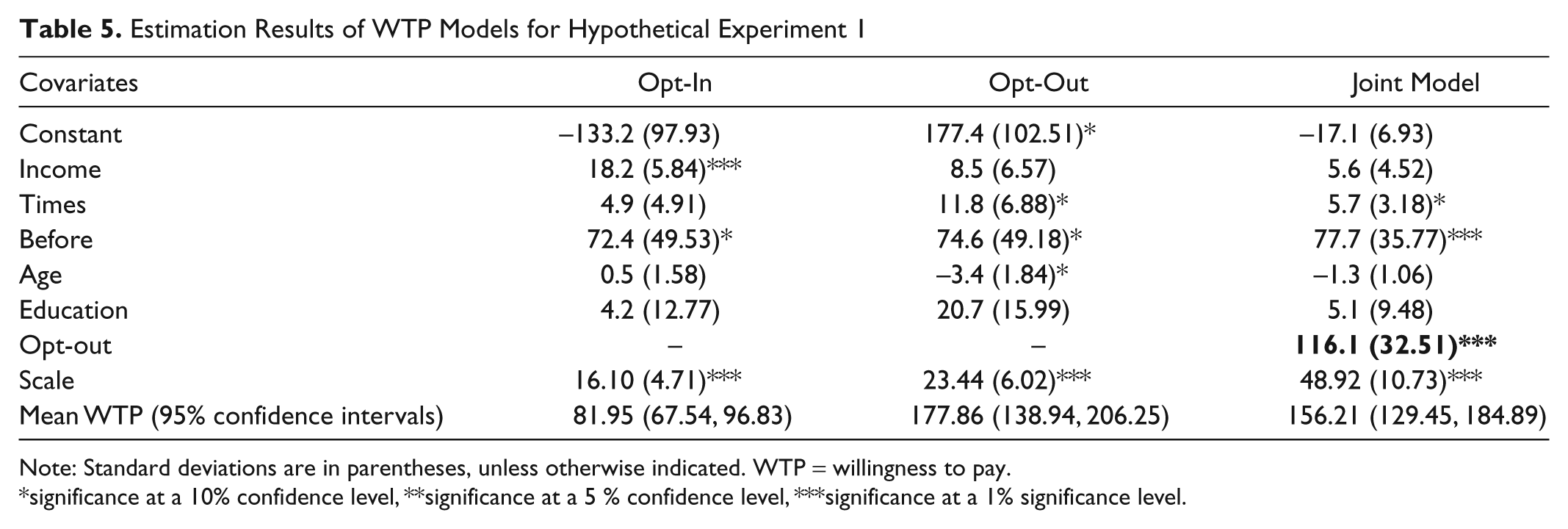
Tables 5 to 7 present the results of the estimated valuation functions for the three experiments respectively, both for the opt-in and opt-out treatments. Table 4 describes the covariates that became significant in explaining the probability of accepting the price offered in the regressions. The models have been estimated by maximum likelihood using Cameron’s (1988) parameterization, that is, willingness to pay (WTP) as a function of socioeconomic variables. For hypothetical experiment 1 (Table 5) on the climate change policy for the tourist destination, WTP rises significantly with income for the opt-in treatment. However, this variable is not significant for the opt-out treatment. WTP in both treatments also rises with the fact that the tourist had been the year before at the some overseas tourist destination. The number times that the subject had been on vacation abroad in the last five years previous to the interview had also a positive impact on WTP but only for the opt-out treatment.
Description of Covariates in the Models of Willingness-to-Pay Responses
Estimation Results of WTP Models for Hypothetical Experiment 1
Note: Standard deviations are in parentheses, unless otherwise indicated. WTP = willingness to pay.
significance at a 10% confidence level, **significance at a 5 % confidence level, ***significance at a 1% significance level.
The age of the tourists had a negative impact on WTP, but this relationship was statistically significant only for the opt-out treatment. The joint model also incorporates a dummy variable for the opt-out treatment that allows us to test for potential differences between both default options, that is, the framing effect. This dummy variable has a positive value and is significant at the 99% level, indicating that the WTP responses are much larger in the opt-out treatment than in the opt-in treatment. Mean WTP in for the latter is 81.95 $ and for the former 177.86 $. The differences between both values are significant since confidence intervals do not overlap.
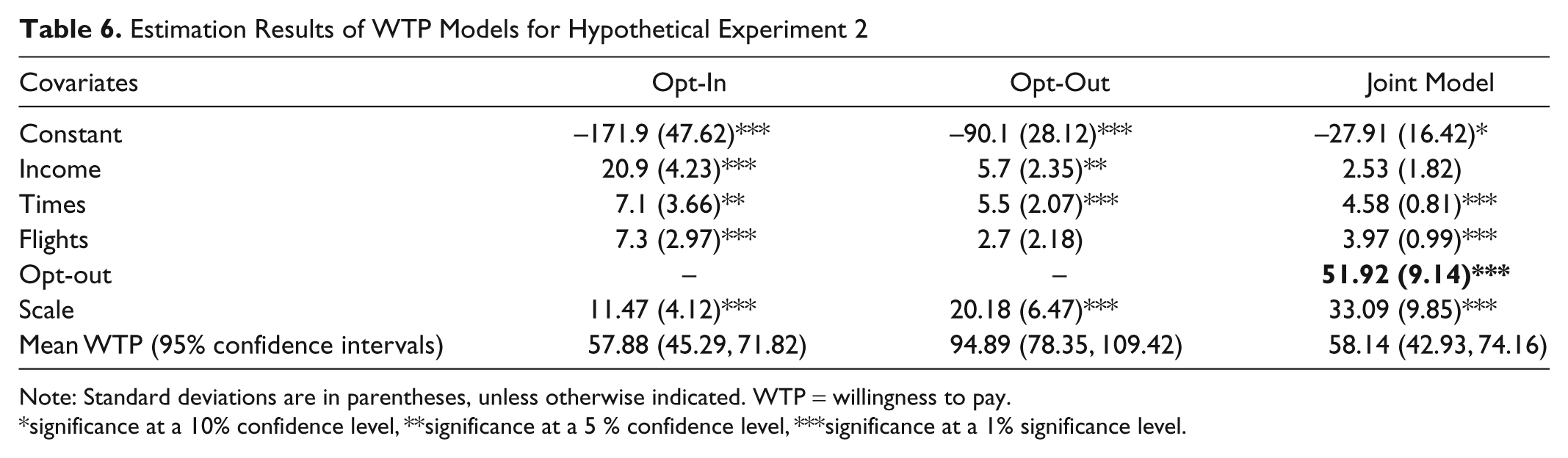
For hypothetical experiment 2 (Table 6) about the conference registration, WTP significantly increases with income, education, and with the number of flights that the conference tourist had taken in the past two years. These relationships are statistically significant for the opt-in treatment. However, for the opt-out treatment we find out that the number of conference flights in the past two years is not significant. The pooled model that joins both data sets shows that the dummy variable for the opt-out treatment is positive and significant at the 99% level, indicating that there the responses to the opt-out frame of a carbon offset supplement included in the conference fee received larger support in yes responses than the opt-out frame in which the climate change policy supplement was not included. The mean values of WTP are $57.88 for the opt-in treatment and $94.89 for the opt-out treatment. This difference is significant because the confidence intervals do not overlap.
Estimation Results of WTP Models for Hypothetical Experiment 2
Note: Standard deviations are in parentheses, unless otherwise indicated. WTP = willingness to pay.
significance at a 10% confidence level, **significance at a 5 % confidence level, ***significance at a 1% significance level.
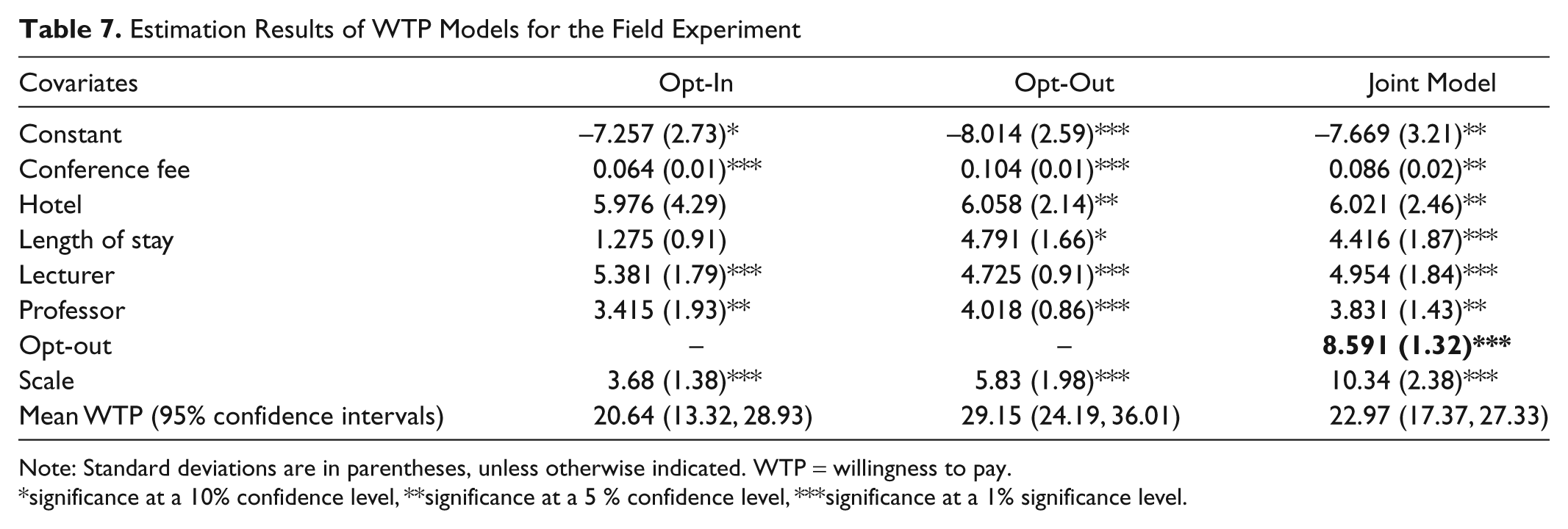
For the field experiment on the conference tourists, Table 7 presents the results of the estimated WTP models. It can be seen that WTP significantly rises with the conference fee in both treatments, which can be interpreted as an anchoring effect since those conferences with higher fees induce a larger willingness to participate in the proposal for a climate change policy in tourism. In addition, the WTP for the opt-out treatment significantly increases with the category of the hotel that the conference tourists chose in their registration, as well as with the length of stay at the destination. The fact of being a professor or a lecturer also increases the amount that tourists are willing to pay for the climate change policy in tourism over other conference attendants.
Estimation Results of WTP Models for the Field Experiment
Note: Standard deviations are in parentheses, unless otherwise indicated. WTP = willingness to pay.
significance at a 10% confidence level, **significance at a 5 % confidence level, ***significance at a 1% significance level.
The differences between the opt-in and opt-out treatments in the field experiment are captured by the dummy variable for the latter treatment in the joint model that pools both data sets. This variable is significant at the 99% level, indicating that the framing of a default option based on the supplement for the climate change policy included in the conference fee raises more support among tourists than the default option based on the need to make a monetary increment to the conference fee. The mean values for the opt-in treatment is $20.64 for the opt-in and $29.15 for the opt-out treatment. These differences are significant at the 90% level even though there is some overlap in the confidence intervals.
The comparison of the results of hypothetical experiment 1 and the field experiment suggests that subjects in the hypothetical contexts, both for the opt-in and opt-out treatments, tend to provide higher values than in the real context. This has been referred to in marketing studies as the hypothetical bias, the fact that people usually show different behavior in a hypothetical context than in a real market situation (e.g., Little and Berrens 2004; List and Gallet 2001; Murphy et al. 2005). Nevertheless, the exact comparison between both contexts is not possible because the incentives tourists are offered are not exactly the same in each situation. On the other hand, List (2006) found out that laboratory and hypothetical experiments are more prone to pro-social behavior than real market experiments, and that in the latter type of experiments subjects are more guided by motives of self-interest rather than by social preferences related to fairness, trust, and reciprocity, which tend to predominate in the former type of experiments. Whereas the hypothetical context could be interpreted as the implementation of an enforced tourist policy, and therefore no tourist could deviate from it, in the field experiment tourists could in practice perceive it as a voluntary contribution and therefore deviate from a payment behavior. In addition, other tourists could interpret the hypothetical context as a nonconsequential situation that would not have any implications for the actual payment that they would have to make in their next conference abroad.
Conclusions
Climate change is an increasingly important problem for tourist destinations, since it will affect in different ways the characteristics of the tourism products that provide a unique experience and satisfaction. Thus, tourist destinations should adopt appropriate policies that contribute to counteract the potential effects of climate change both at the global and local levels. The design of these policies requires an evaluative assessment of tourists’ potential behavior in order to maximize their potential benefits on the climate and minimize the potential impacts on tourism demand.
In this article, we have considered the role of the framing options in which climate change policies can be designed in tourism. To this aim, we have conducted two hypothetical experiments and one field experiment with tourists that have allowed us to obtain information on the sensitivity of tourists’ decisions to the ways in which climate change policies can be framed. Although tourists might have precise preferences toward climate change policies, our results have shown that the frame of these policies could make a significant difference in tourists’ answers to them.
That is, when tourists are presented with a framing option in which the payment for a climate change policy is included in the price of the tourist product or services, they have a larger intention to accept the payment than when this is framed as a situation in which tourists are asked an additional contribution for the policy. This result has been consistent across the type of tourist services that include the climate change payment (a destination tax or a conference fee) and the type of context in which tourist behavior was assessed (hypothetical and real).
Thus, tourist destinations and tourist services in general could have an opportunity for gaining acceptance of climate change policies if they consider the framing effects of the default option, or the situation in which the default situation includes environmental preservation. This result has implications for the marketing of climate change and environmental policies in tourism, and for other policies regarding new services and products in the tourism industry. Further research should provide more evidence on how the design of default options in managing tourist products and services can enhance the performance of tourist organizations and institutions.
Footnotes
Acknowledgements
The authors thank the four anonymous reviewers and an associate editor of the journal for their useful comments, which significantly improved the piece. Only the authors are responsible for the opinions expressed and potential errors in the content.
Declaration of Conflicting Interests
The author(s) declared no potential conflicts of interest with respect to the research, authorship, and/or publication of this article.
Funding
The author(s) disclosed receipt of the following financial support for the research, authorship, and/or publication of this article: The authors gratefully acknowledge financial support by the Spanish Ministry of Science and Technology (Projects ECO2009-12629, ECO2008-06148, and ECO2011-30365) and by the Agencia Canaria de Investigacion (Projects SolSubC 200801000381 and PI2007/040).