




Abstract
This exploratory study examines the destination risk perceptions and risk rationalizations of tourists who, despite governmental travel advisories, cross the border into a region previously and repeatedly targeted by terror attacks. Data were collected from Israeli tourists at the Israeli–Egyptian border in Eilat on their way to the Sinai Desert. A statistical analysis of 489 questionnaires indicated that “terrorism and security” issues constituted only one dimension of tourists’ perceived risk among several others. The tourists used numerous means of rationalization to justify their seemingly irrational behavior, such as blaming the media for overexposure of terror risks. Finally, the respondents’ risk perceptions were found to be correlated with their political orientation regarding the Israeli-Arab conflict. Further investigations in other areas of conflict, as well as among tourists of different cultures, are recommended.
Introduction
The scientific literature on tourists’ responses to terror-related risks is primarily based on quantitative data not collected in actual situations of terror risk. Specifically, numerous studies rely mainly on official statistics of tourist visitation patterns (Bar-On 1996; Brady and Widdows 1988; Mansfeld 1996; Enders and Sandler 1991), simulations of hypothetical terrorist threats (Cook 1990), and attitude surveys (Sönmez and Graefe 1998b; Roehl and Fesenmaire 1992). While such research provides important knowledge, it rarely included studies examining tourists’ reactions to terror-related risks in real-time situations in which they were actually threatened by terror events. Nonetheless, a small number of qualitative studies focused on risk-taking tourists choosing destinations threatened by terror (Hartz 1989; Uriely, Maoz, and Reichel 2007). These studies rely on interviews and ethnographic data to provide insight into the cognitive and affective processes experienced by tourists when threatened by terror. However, to our knowledge, the present research is the first quantitative study of tourists arriving in destinations threatened by terror in spite of official travel alerts. Such an investigation provides insight about tourists’ reactions to terror as well as enriches the literature on tourist behavior, tourist destination risk perceptions, and the process of risk-taking rationalization.
The current article examines risk perceptions and rationalizations of tourists crossing an international border to a destination under a severe travel advisory. Moreover, this article adds a quantitative dimension to the aforementioned ethnographic study on risk-taking behavior of Israeli tourists in Sinai (Uriely, Maoz, and Reichel 2007). While the earlier study was based on observations and in-depth interviews conducted mainly at tourist resorts within Sinai, the current study relies on 489 questionnaires administered to Israeli tourists waiting to cross from Eilat, Israel, to the Egyptian Sinai. The statistical analysis identifies the dimensions of the respondents’ perceived risks, political viewpoints, and their rationalization processes geared toward reducing the risk perceptions associated with Sinai.
Literature Review
Consumer behavior literature has dealt with the theory of perceived risk for more than five decades. The tenets of this concept are that consumers perceive risk when purchasing products or services and they usually look for means to alleviate such risk (Fuchs and Reichel 2010). The concept of perceived risk continues to receive attention from both practitioners and academics, and has been applied to a wide range of areas, including intercultural comparisons, banking, and apparel catalogue shopping (Mitchell 1999). Yet no universally agreed on theoretical or operational marketing definition of “risk,” be it conceptual or mathematical, exists. However, most studies adhere to Mowen and Minor’s (1998) approach relating to perceived risk as “a consumer’s perception of the overall negativity of a course of action based on an assessment of the possible negative outcomes and the likelihood that those outcomes will occur” (p. 176). Alternatively, since consumers experience difficulty reporting about their likelihood assessments, research on consumer risk can be conceptualized as consumer “worries”(Larsen, Brun, and Øgaard 2009).
A subset of the service industry, tourism is characterized with the service-specific characteristics of intangibility, inseparability, variability, and perishability (Grönroos 1990, 2007; Lovelock and Wirtz 2007; Zeithaml, Bitner, and Gremler 2006). Moreover, the tourism “product” is prone to specific risk factors such as bad weather, unfriendly locals, strikes, unfit local food, terror, personal crime, political unrest, disease and natural disasters, as well as dishonest and inconsiderate treatment. These risk factors have been widely studied and found to raise the tourist’s level of perceived destination risk (Larsen, Brun, and Øgaard 2009; Pizam and Mansfeld 1996; Roehl and Fesenmaier 1992; Sönmez 1998; Sönmez and Graefe 1998a; Tsaur, Tzeng, and Wang 1997; Witt and Moutinho 1995; Yüksel and Yuksel 2007).
Roehl and Fesenmaier (1992) pioneered the stream of research on the concept of risk perception in tourism. Utilizing factor analysis, they identified three basic dimensions of perceived risk: physical-equipment risk, vacation risk, and destination risk. Additional studies portrayed tourist risk as a multidimensional concept. For example, Mitchell and Vassos (1997) identified a list of 43 perceived risk factors of a holiday package, which ranged from serious occurrences such as natural disasters to trivial matters such as a tour representative not joining in activities. Tsaur, Tzeng, and Wang (1997) studied types of risk that were associated with travel-related diseases, crime, natural disasters, accidents, hygiene, danger stemming from different means of transportation, culture/language barriers, and uncertainty with destination-specific regulations and laws. Referring to international travel, Sönmez and Graefe (1998a, 1998b) measured risk perception of various tourist destinations in terms of financial, functional/equipment, physical, psychological, social, satisfaction, time, health, political instability, and terrorism dimensions. Similar patterns were reported by Kozak, Crotts, and Law (2007) and Reisinger and Mavondo (2005, 2006). Fuchs and Reichel (2004, 2006) investigated destination risk perception among foreign tourists visiting Israel. They identified six destination risk perception factors: “human induced risk,” “financial,” “service quality,” “social-psychological,” "natural disasters and car accidents,” and "food safety problems and weather.” Boksberger, Bieger, and Laesser (2007) examined risk in commercial air travel. Again, issues such as political risk, including terrorism and political instability, financial risks, psychological risks, environmental risks, and health risks clearly demonstrate the multifaceted and multidimensional nature of tourism risk perception. Perceived risk has also been studied within distinct market segments, including tourists of specific nationalities (Fuchs and Reichel 2004; Reisinger and Mavondo (2006), youths on vacation (Carr 2001; Hunter-Jones, Jeffs, and Smith 2007), and backpackers (Larsen, Ogaard, and Brun 2011; Reichel, Fuchs, and Uriely 2007, 2009).
The aforementioned literature depicts tourists as rational and risk-averse consumers. Accordingly, terrorist threats at a particular destination should logically increase tourists’ perceived risk of the destination and, consequently, impact on tourists’ arrival to the destination (Blake and Sinclair 2003; Roehl and Fesenmaier 1992; Sönmez and Graefe 1998a, 1998b). However, the literature on tourist reactions to terror-related risks also includes several studies documenting tourists who voluntarily visit destinations despite potential threats (Hurley 1988; Noy and Kohn 2010; Tremblay 1989; Uriely, Maoz, and Reichel 2007; Wall 1996). In this context, Tremblay (1989) suggested that familiarity with the local political situation might mitigate fears of terror commonly associated with a specific destination. Similarly, Wall (1996) speculated that visitors to Northern Ireland were less threatened by terrorist threats because they understood its underlying reasons. In line with this perspective, a qualitative field study conducted in the Sinai after several terror attacks revealed two types of rationalizations among Israeli tourists: (1) inward-oriented rationalizations that reduce the perceived risk of the destination by stressing that their tourism-related practices are less risky and are indeed even safer than their everyday life activities at their home environment; (2) outward-oriented rationalizations that reduce the perceived risk of the destination by emphasizing the general threats of terror outside the visited destination, in essence threats associated with the globalization of terror (Uriely, Maoz, and Reichel 2007).
The purpose of this study is to reveal the risk perceptions of Israeli tourists who are about to cross the border into an officially declared “dangerous region” (see Noy and Kohn 2010). Although there is some evidence on such individuals’ decisions from an ethnographic perspective, this article attempts to examine the risk perceptions of a “dangerous” destination using a large sample that increases the likelihood of being representative of the population that decided to disregard governmental travel alerts related to Sinai. Moreover, the article attempts to focus in particular on the critical factor of terror risk and examine its components, as well as the rationalizations of tourists for their travel choice. In addition, the analysis addresses the linkage between political viewpoints and terror-related risk behavior: will respondents who consider themselves as “right wing” (“hawks”) demonstrate different rationalization patterns than those who identify themselves as “left wing” (“doves”)? While some of the above issues were addressed to some extent in an earlier ethnographic study conducted in Sinai (Uriely, Maoz, and Reichel 2007, 2009), this topic clearly benefits from a quantitative inquiry.
Method
This study used a questionnaire to examine the perceptions, rationalizations, political attitudes, and characteristics of tourists who choose a destination threatened by terror. The questionnaire is based on Fuchs and Reichel’s (2006) measure of destination risk perception. Since the target population is Israeli, the Hebrew version of the questionnaire was used. However, it had been rephrased and adapted to the specific destination issues of Sinai. Also, elements derived from in-depth interviews as well as participant observations conducted in Sinai were added to the questionnaire. For example, topics relating to the nature of host–guest contact, such as varying attitudes toward Egyptian migrant workers versus local Bedouins, the presumed ensuing sense of security, and concerns about causing distress to friends and relatives (see Uriely, Maoz, and Reichel 2007). Additional in-depth interviews performed in order to test the clarity of the questionnaire revealed the potential significant impact of prevailing Israeli political orientations (right-wing, center, and left-wing).
Of particular interest are the set of justifications or rationalizations for tourist risk-taking behavior that were compiled based on the aforementioned ethnographic study. Among such rationalizations were statements such as “The identity of the owners of the place I stay at is important for my safety (Egyptians, Bedouin, or Sudanese)” and “I believe that the chances of a terror attack reoccurring at the same place are low.” In total, the questionnaire consisted of 72 items, including information about the respondents’ expected vacation form in Sinai (8 questions) and 30 attitudinal statements reflecting destination risk perceptions and risk reduction strategies, as well as rationalization or justification for the destination choice. In addition, the questionnaire included travel information search patterns (7 questions), 12 inquired attitudes toward hosts and service providers (Bedouins), a question about the respondent’s political orientation as well as several questions about past experience in Sinai, and sociodemographic data. Attitudinal statements were measured on a 7-point Likert-type scale. Political orientation was measured on a 7-point scale, varying from 1 (“extreme right”) to 7 (“extreme left”). It should be noted that this terminology reflects the prevailing Israeli domestic meaning as demonstrated in almost weekly surveys, referring to political orientation in terms of attitudes toward foreign policy rather than macroeconomic perspectives. As noted earlier, the current analysis focuses on three main issues: destination risk perceptions, justifications and rationalizations, and political orientation. The entire questionnaire was pretested for clarity on 14 individuals who frequented Sinai.
Most of the data collection occurred in April 2004 (a week before and during the Passover holiday), five months subsequent to the perpetration of major terrorist attacks on several tourist destinations in Sinai. As of the year 2004, Sinai has been a popular Egyptian peninsula of desert natural beauty, attracting both Israelis and international tourists alike. The attraction of Israeli tourists to Sinai is explained in terms of the virgin and serene beaches, the easy access from the south of Israel, as well as the relatively modest accommodation prices, especially in comparison to the prevailing hotel rates in Israel. The tourists are usually scattered along the eastern coastline of the Red Sea, in resorts such as Taba, Dahab, and Sharm-el-Sheikh—all were sites of terror attacks. Since there are almost no cultural sites or man-made attractions in Sinai, the main motive for vacations are rest and relaxation along the sandy beaches of the Red Sea. The presence of tourists in Sinai on the one hand highly supported employment in Egypt, but on the other hand also attracted the activities of terror groups whose main objective was to harm Egyptian economy and “free” Egypt from Western tourists, especially Israelis. Consequently, the Israel National Security Council of the Office of the Prime Minister (http://www.nsc.gov.il/NSCWeb/Templates/FourLastAlerts.aspx) issued travel advisories for Sinai (an Egyptian territory). (See also Noy and Kohn 2010.) Despite the situation described above, Israeli citizens were flocking to the checkpoint to cross the border into Sinai. This situation facilitated a smooth data collection process. After acquiring Israel Border Police Authority permission to conduct the study on premises, the participants were approached while in situ, in line to cross the border. The questionnaires were self-administered, while one of the authors and three assistants were at hand to respond to participants’ questions. The response rate was more than 90%, as the idle tourists seemed happy with a possible distraction on their “never-ending” line. The assistants were three specially trained graduate students. The approximate time for a questionnaire completion was half an hour. Of the 489 respondents, 252 (51.5 %) were male and 235 (48.1%) female (two did not mark their gender). The average age was 29. The youngest interviewee was 18 and the oldest 67.
Results
The statistical analysis included the following six steps:
Identifying the various attributes constituting perceived risks associated with visiting Sinai, under travel alert.
Revealing the underlying dimensions of perceived risk associated with Sinai, focusing on terror and security issues.
Exploring how tourists rationalize their visit, in spite of the travel warning and the destination’s history of terror.
Revealing the underlying dimensions of risk rationalizations.
Examining the possible impacts of political standpoints on terror and security risk perception.
Examining the possible impacts of political standpoints on rationalizing the choice of a destination under travel advisory.
Sinai’s Perceived Risk Dimensions
Table 1 presents the descriptive statistics of Sinai risk perception. As seen in Table 1, the highest-ranked risk relates to friends and family worries about the visitor’s safety (M = 4.73). This risk is followed by the fear that the Egyptian proceedings will not suffice in case of a terror attack (evacuation, treatment, etc.) (M = 4.71). The two least meaningful risks are “my conduct might be seen in a negative manner by the locals” (M = 2.31) and “the language barrier might impede on the visit” (M = 2.30).
Sinai Risk Perceptions—Descriptive Statistics
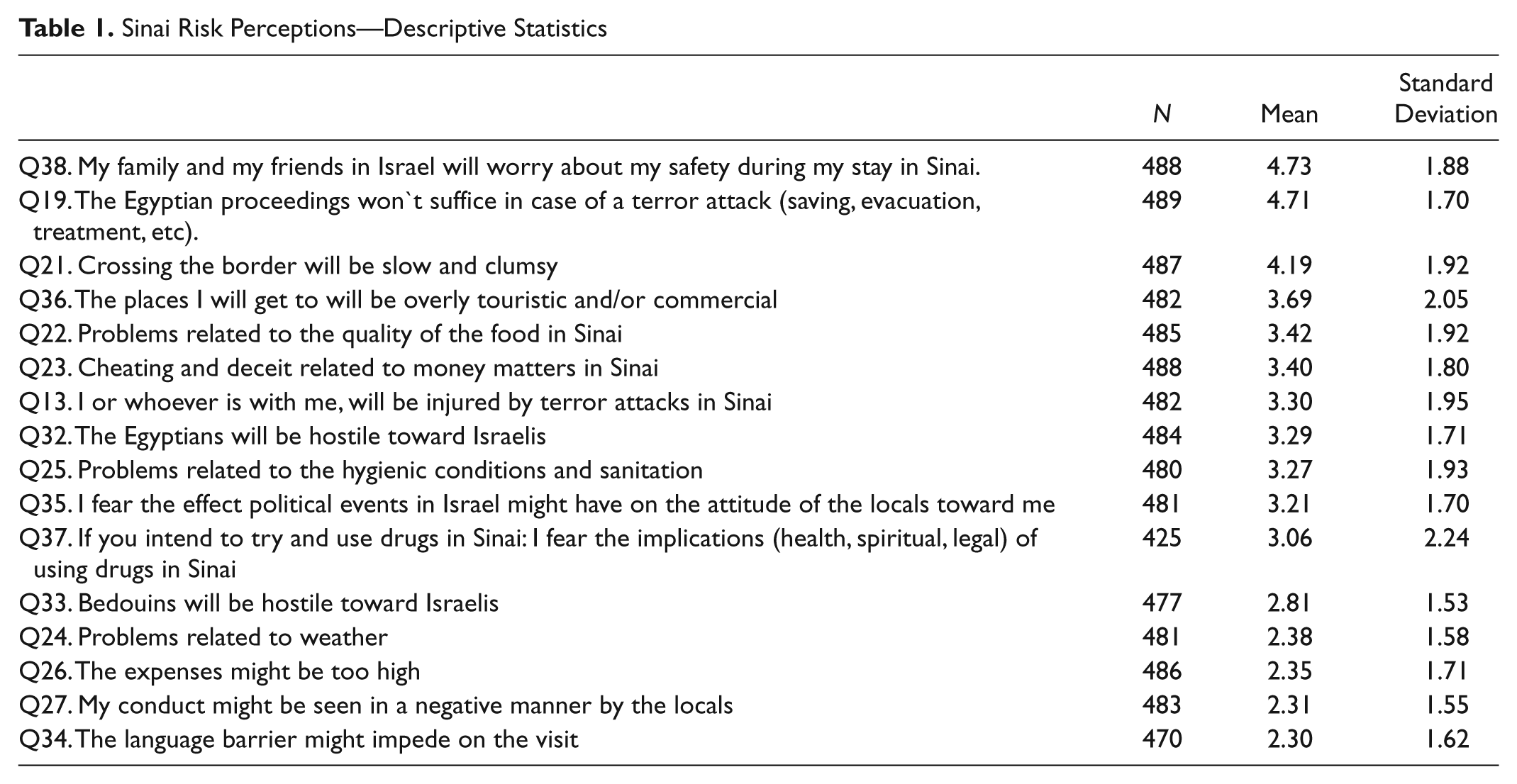
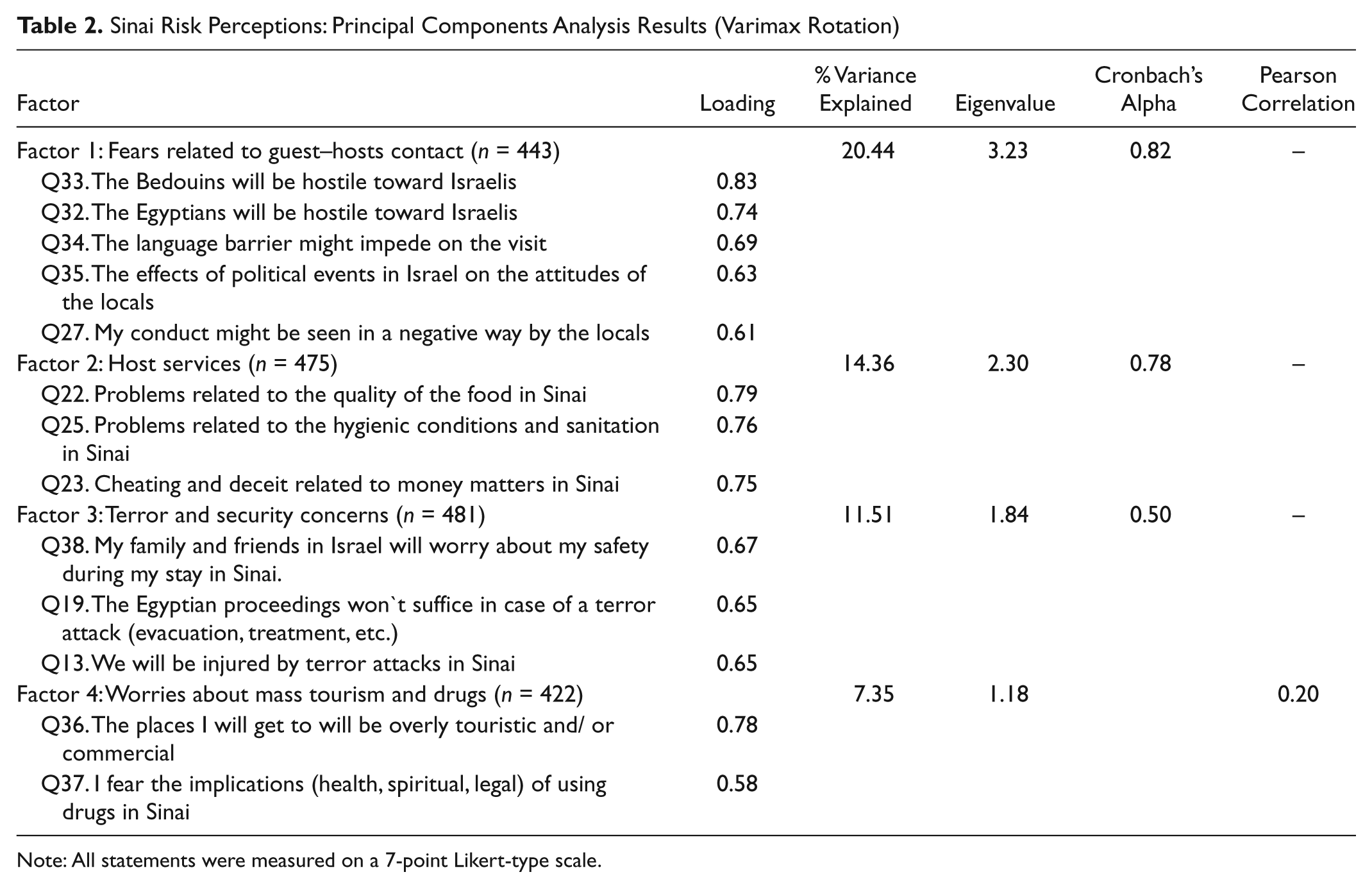
To test the underlying dimensions of perceived risks associated with Sinai, a factor analysis on 16 particular risk measures was utilized, employing the method of principal component with varimax rotation. The treatment of the missing values was performed according to the Listwise Option. A summary of the factor analysis results is presented in Table 2. The cut-off point for variable inclusion in a particular factor was above 0.5 loading. Accordingly, 13 of the 16 risk perception variables were grouped into four factors (see Table 2). Three risk measures were not included in the factors because of low loadings or simultaneous high loadings on two factors: Q21, “I fear that crossing the border will be slow and inept”; Q24, “I am concerned about problems related to the weather in Sinai”; and Q26, “I am worried about unexpected high expenses in Sinai.”
Sinai Risk Perceptions: Principal Components Analysis Results (Varimax Rotation)
Note: All statements were measured on a 7-point Likert-type scale.
The first factor is titled “Fears related to guest–hosts contact.” This factor accounts for 20.44% of the variance of the analysis. This factor’s Cronbach’s alpha is .82. The second factor, titled “Host Services,” accounts for 14.36% of the variance, yielding a Cronbach’s alpha of .78. The third factor, “Terror and security concerns,” accounts for 11.51% of the variance, with a Cronbach’s alpha of .50. The fourth factor, “Worries about mass tourism and drugs,” accounts for 7.35% of the variance. The Pearson correlation between the factor’s two variables was .20 (significant at the level of .00). The four factors together account for 53.66% of the variance.
Dimensions of Risk-Taking Rationalization and Behavior Justification
As noted earlier, the tourists about to cross the border related to several rationalizations (based on Uriely, Maoz, and Reichel 2007) for their seemingly irrational behavior. Table 3 presents the descriptive statistics of these rationalizations.
Visitor Rationalizations—Descriptive Statistics

The two most agreed on rationalizations were “The risk of being injured in a terror attack in Sinai during holidays is higher than during regular days” (M = 4.71) and “The Israeli media give the Israeli public a wrong and overly negative impression regarding the level of risk in Sinai” (M = 4.54). The least-ranked rationalizations were “The risk of being injured in a terror attack in Sinai in a place located far from the Israeli border is higher than in a place close to the border” (M = 3.11) and “Sinai is less dangerous than the area I live in” (M = 3.47).
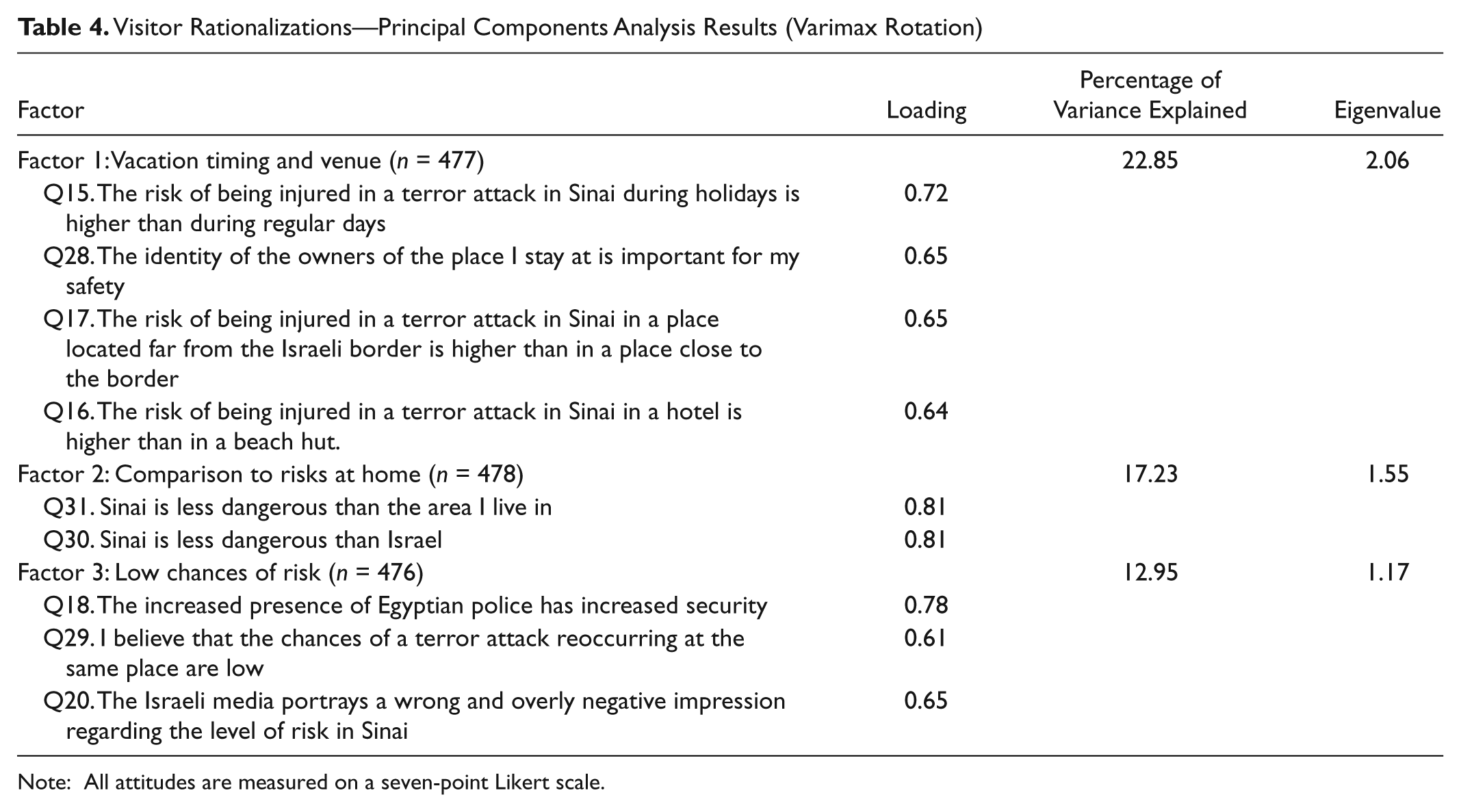
To test the underlying dimensions of the rationalization process involved in taking a trip to a risky destination, factor analysis on nine particular rationalization statements was used, employing the method of principal component with varimax rotation. The treatment of the missing values was carried out according to the Listwise option. A summary of factor analysis results are presented in Table 4. The cutting point for variable inclusion in a particular factor was a loading higher than .5. Accordingly, the nine rationalizations were grouped into three factors.
Visitor Rationalizations—Principal Components Analysis Results (Varimax Rotation)
Note: All attitudes are measured on a seven-point Likert scale.
Factor 1, “Vacation timing and venue” accounts for 22.85% of the variance, Cronbach’s alpha = .59; factor 2, “Comparison to risks at home,” accounts for 17.23% of the variance. The Pearson correlation between the two factor items is .46 (p < .01).
Factor 3, “Low chances of risk,” accounts for 12.95% of the variance, with a relatively low Cronbach’s alpha of .39. The above three factors account for 53.03% of the variance of the rationalization processes.
Political Standpoint and Terror and Security Issues
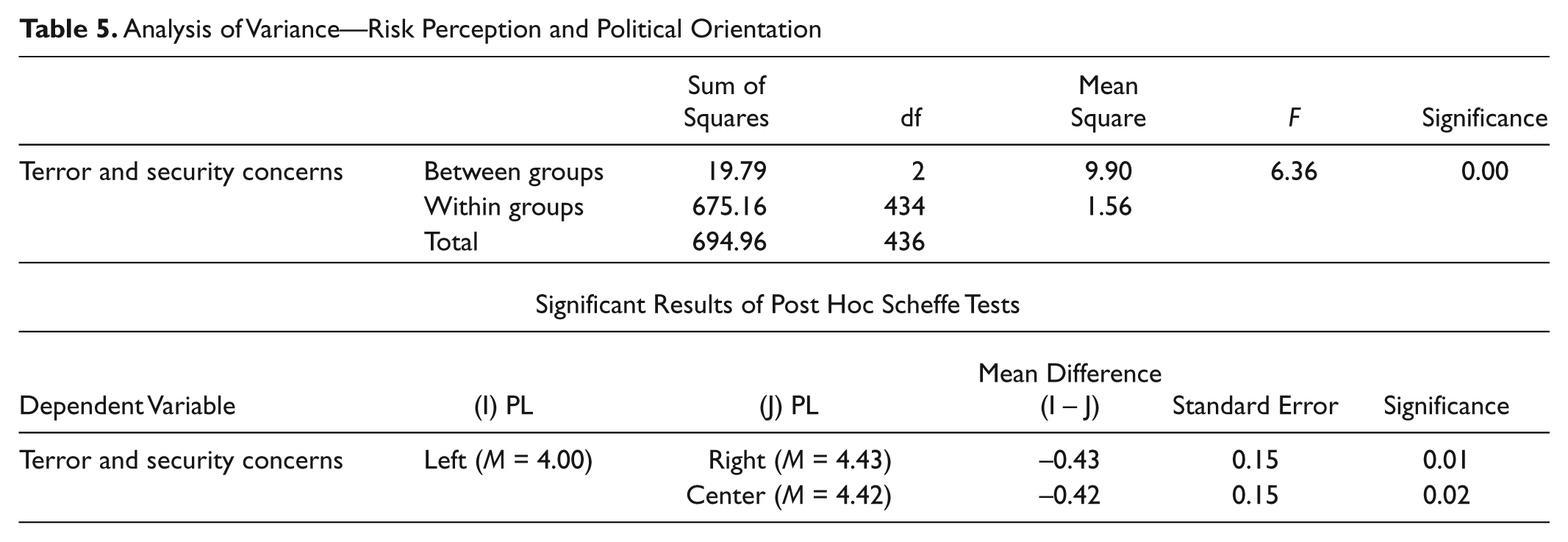
To examine possible differences in the perception of terror and security risk between respondents of different political standpoints, ANOVA tests were used. Table 5 presents the ANOVA test between the factor scores of “terror and security risk issues” and political standpoints. As noted earlier, the “Terror and security issues” factor consists of the following statements: (1) “My family and my friends in Israel will worry about my safety during my stay in Sinai”; (2) “The Egyptian proceedings won’t suffice in case of a terror attack (saving, evacuation, treatment, etc.)”; (3) “We will be injured by terror attacks in Sinai.”
Analysis of Variance—Risk Perception and Political Orientation
The political orientation of the interviewees was measured on a 7-point scale. However, given the low response to the extreme two categories, all responses were converted into three categories: right-wing political orientation, center political orientation, and left-wing political orientation. It should be noted, however, that these political standpoints are devoid of the economic approach to the distribution of wealth, and more akin to the American constructs of hawks versus doves, especially in relation to the Arab–Israeli dispute. Of the 489 respondents, 111 (22.7%) reported right political standpoint, 106 (21.7%) reported center political standpoint, and 226 (46.2%) reported left political standpoint. It is interesting to note that those who identify themselves as right-wing oriented amounted to almost 23% of the sample.
As noted earlier, one of the purposes of this study is to focus on terror-related issues that are an integral part of Sinai destination risk perception. In our case, the focal point is the dimension portrayed mainly by factor 3, “Terror and security concerns,” and its relationships to political orientation. As depicted in Table 5, there are statistically significant results of the post hoc Scheffe tests of political orientation and terror risk perception. Specifically, the results shown in Table 5 indicate that tourists with left-wing political opinions are less concerned about terror and security issues in comparison to tourists with center and right-wing political opinions.
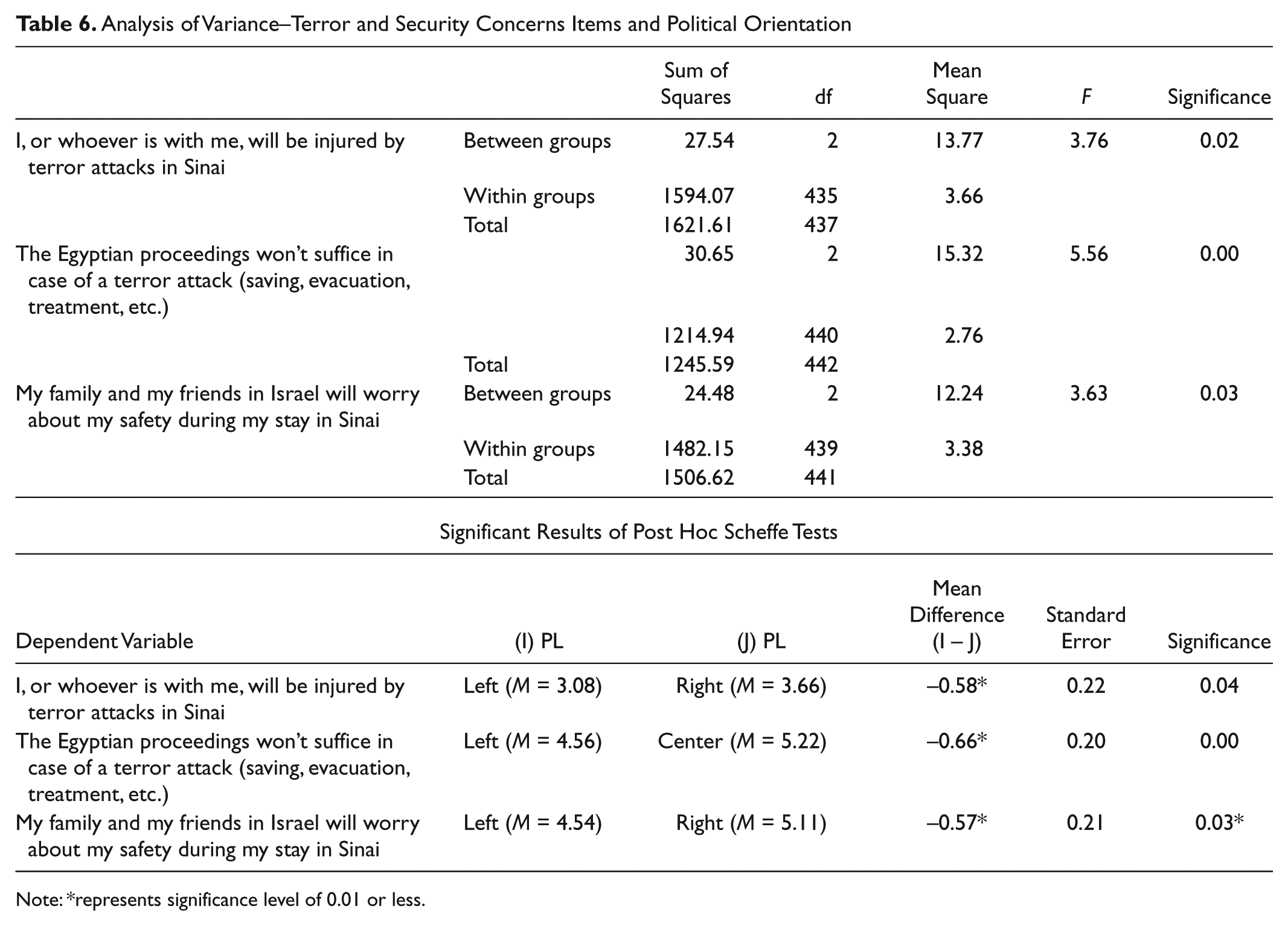
It should be noted, however, that factor 3 carries a relatively low Cronbach’s alpha (see Table 2). This could indicate a lack of sufficient “compatibility” among its three components. However, from a contents perspective, these three statements are highly correlated. Hence, in order not to lose valuable information on the various items of the risk of terror, each item is analyzed independently, as presented in Table 6.
Analysis of Variance–Terror and Security Concerns Items and Political Orientation
Note: *represents significance level of 0.01 or less.
As depicted in Table 6, tourists of left-wing orientation tend to fear less of terror risk issues than their right wing and center counterparts. Specifically, “I or whoever is with me will be injured by terror attacks in Sinai”—tourists of right-wing orientation are more fearful than their left counterparts. On the second item, “The Egyptian proceedings won’t suffice in case of a terror attack (saving, evacuation, treatment, etc.),” tourists of central political orientation are more worried than the left-wing-oriented colleagues. On the third issue, “My family and my friends in Israel will worry about my safety during my stay in Sinai,” tourists of right-wing orientation are worried more than the left-wing segment.
Finally, as for the three additional risk factors, ANOVA tests indicated similar patterns: doves or left-wing-oriented tourists are less concerned with the risk issues of “fears related to guest–host contacts” and “host services.” However, ANOVA on factor 4, “Worries about mass tourism and drugs,” yielded no statistically significant differences between the three segments.
Conclusions
This large-scale quantitative study reexamined the risk rationalizations of Israeli tourists in Sinai that were revealed in a previous qualitative analysis of in-depth interviews (Hartz 1989; Uriely, Maoz, and Reichel 2007). The current 489-respondent study reaffirms the insights gained from the qualitative small-scale study that took place in Sinai, within several resorts. In addition, the current study explored the destination risk perceptions and the political orientation of tourists about to cross the border into Sinai, immediately following the government’s issuance of a travel advisory. Sinai has been the site of previous terror attacks and, thus, a travel advisory seems to be highly relevant. A statistical analysis of 489 fully completed questionnaires yielded the following main findings:
“Terror and security issues” construct only one dimension of the tourists’ perceived risk and are complemented by worries related to “guest–host contact,” “host behavior toward tourists” and “worries about mass tourism and drugs.” The “terror and security” dimension of the destination of Sinai’s perceived risk consists of the fear of a terror-related injury, skepticism regarding the Egyptians’ ability to evacuate tourists in case of a terror attack, and concerns about the worries of family members left at home. The last two variables were the highest ranked of all risk features.
The tourists waiting to cross into Sinai used numerous rationalizations in order to reduce their terror-related perceived risk. In this regard, the analysis revealed three rationalization dimensions: “the vacation’s specific timing and venue,” “comparison to risks at home,” and “low chances of risk.”
The respondents’ risk perceptions were found to be related to their political standpoint regarding the Israeli–Arab conflict. Specifically, tourists with left-leaning political opinions were less concerned about terror and security issues than their center- and right-leaning counterparts. The above observation is in contrast to the prevailing Israeli assumptions or stereotypes that those with right-wing, hawkish political opinions would be more hesitant to vising Arab areas. While no specific percentages were presented in the exploratory hypothesis about the link between political orientation and the risk of terror, it can be cautiously argued that contrary to prevailing expectations (e.g., implied also by Noy and Kohn, 2010), travelers to Sinai are not overwhelmingly left–wing-oriented, with less than half (46.2%) identifying themselves as left wing. According to Arian’s (1995, 1997, 2003) accounts, the percentage of people of right-wing orientation is close to 40%. Yet, as noted earlier, the public image of most travelers to Sinai is of having a left-wing orientation, “peaceniks.” Consequently, it was very interesting to find in this first study of its kind that the travelers are not overwhelmingly left-wing-oriented.
In addition to the risk factor of “terror and security,” ANOVA tests conducted on fears related to guest–host contact and host services yielded a similar pattern. In other words, those who define themselves as doves politically (left wing, in Israeli discourse) are consistently less worried about travel risks in Sinai. While there is almost no literature that deals directly with individuals’ political orientation and travel risk perception, one may refer to several possible explanations to variations in risk perceptions presented by Wildavsky and Dake (1990): “people worry most about the risks that seem most directly to threaten their wellbeing at the moment.” Similarly, “selective attention to risk, and preferences among different types of risk taking (or avoiding), correspond to cultural biases—that is, to worldviews or ideologues entailing deeply held values and beliefs defending different patterns of social relations” (pp. 166-67). Clearly, this approach can at least partially explain the exploratory results of political orientation and destination or travel risk perceptions. More explicitly, the issue of political orientation and tourism risk perception revealed in the present study seems to be only the tip of the iceberg in terms of both current global circumstances and emerging research agenda. Researchers like Isaac (2010a, 2010b) have investigated tourism as associated with political standpoints and turmoil, especially in the Middle East. Moreover, numerous political organizations, following the footsteps of the Greenpeace movement, often travel as tourists to destinations in dispute to express their opinion, usually toward a favorite side versus the less favored one. Their tendency to travel to risky destinations raises furthermore the issue of political orientation and destination risk perception.
The findings of this exploratory study shed light on two specific issues that were not addressed in previous research on terror-related risk perceptions: risk takers’ concerns about the worries of at-home relatives and the role of political opinions. The former seems to reflect the Israeli culture of high concern for those who travel to risky destination risk or under travel alert (Klar, Zakay, and Sharvit 2002; Noy and Kohn 2010). While the results presented here may reflect a particular case study, these issues need to be further examined in other areas of conflict as well as among tourists of different cultures and nationalities.
While a plethora of studies exist dealing with destination risk perceptions, and the willingness or lack of willingness to travel under certain perceptions of risk (e.g., Larsen, Brun, and Øgaard 2009; Pizam and Mansfeld 1996; Roehl and Fesenmaier 1992; Sönmez 1998; Sönmez and Graefe 1998a; Tsaur, Tzeng, and Wang 1997; Witt and Mountinho 1995; Yüksel and Yuksel 2007), the current paper adds insight into the rationalization and risk reduction process used by tourists about to enter a “risky” destination. Indeed, the literature search did not yield any other study that examined in situ destination risk perceptions, travel decision rationalizations, and the possible role of political orientation on travel issues. Clearly, these elements constitute a meaningful contribution to the emerging literature on travel and risk.
Similar to previous studies, destination risk perception is indeed a multidimensional concept (e.g., Fuchs and Reichel 2006; Reisinger and Mavondo 2005; Carr 2001; Hunter-Jones, Jeffs, and Smith 2007; Reichel, Fuchs, and Uriely 2007, 2009; Larsen, Ogaard, and Brun 2011). In today’s turbulent world, it seems that one can hardly ignore the significance of terror threats or fears related to travel. As noted earlier, most previous studies examined statistical data indicating reduced tourist demand after an act of terror (Mansfeld 1999). However, the current research focused on tourist perceptions and behavior, thus contributing to our knowledge about the cognitive processes of explanations and rationalizations used by tourists undertaking risky behaviors. In addition, this quantitative analysis yielded interesting findings related to the Israeli context. As a nation noted for its citizens’ active political involvement, the findings depicted here reveal a relationship between one’s political orientation and various risk perceptions. Finally, the high consistency between the ethnographic results concerning vacationers in the Sinai (Uriely, Maoz, and Reichel 2007) and the current large-scale quantitative study adds credence to the rationalization processes that are associated with risky behavior. These results echo on the emerging research of political views as a determinant of tourist behavior, in terms of heritage, destination choice, and risk perception. Nonetheless, future studies should attempt to document those whose motivation for a vacation was not high enough for crossing the fear of risks threshold. In other worlds, while there is an emerging body of literature on risk perceptions of tourists arriving at various “risky” destinations, a knowledge gap exists about characteristics of destination “risk averse” tourists. Clearly, such studies would have both theoretical and applied value.
Footnotes
Declaration of Conflicting Interests
The authors declared no potential conflicts of interest with respect to the research, authorship, and/or publication of this article.
Funding
The authors received no financial support for the research, authorship, and/or publication of this article.