



Abstract
Underpinning generational cohort analysis is the notion that the formative experiences of each cohort influence its members’ lifelong beliefs, values, and behavior. However, previous studies have failed to verify this notion. This study is the first to do so, showing that memories of the formative years influence a generational cohort’s present-day travel decision making. Focus groups and an online survey of Australian Baby Boomer, Generation X, and Generation Y consumers provided data for the development and testing of the model presented here. Structural equation modeling shows the proposed model is robust, substantiating the importance of formative referents influencing salient referents, value perceptions, and attitude and intention to travel. This study provides a theoretical foundation for future research on this topic, highlighting the importance of considering a travel segment’s generational perspective when designing a marketing strategy.
The widespread adoption of generational cohort analysis to understand the behavior of tourists (e.g., Pennington-Gray, Kerstetter and Warnick, 2002; You and O’Leary 2000), and more generally all consumers (e.g., Noble, Haytko and Phillips 2008; O’Cass and Choy 2008), suggests it is a meritorious segmentation method. References to generational cohorts increasingly appear in both the tourism academic literature (e.g., Cleaver and Muller 2002; Prideaux 2007) and the mainstream business press (Coupland 1996, Furlong 2007; Mackay 1997). Several tourism marketing authorities around the world, including those in the United States (Loda, Coleman, and Backman 2010), United Kingdom (Pritchard and Morgan 1996), and Australia (Tourism Australia 2007), have adopted generational cohort analysis to understand and target particular traveler segments.
Most of this discussion focuses on the post–World War II generations known as the Baby Boomers (born 1946 to 1964), Generation X (born 1965 to 1976), and Generation Y (born 1977 to 1994). Members of these cohorts are presently aged 19 to 67 years and represent the largest proportion of worldwide adult consumers. Approximately 81.5 million Baby Boomers and 112.8 million Generation X and Y consumers reside in the United States, and combined, these cohorts represent 63% of the U.S. population (United States Census Bureau 2010). Similarly, Baby Boomers (5.5 million) and members of Generations X and Y (5.5 million) represent 55% of the Australian population (ABS 2006). Given their current age and size, these cohorts exert a worldwide impact on travel consumption.
Cleaver and Muller (2002) argue that the Baby Boomer cohort is only a four-nation phenomenon, affecting the populations of Canada, Australia, New Zealand, and the U.S. (CANZUS countries). However, Baby Boomer research has been conducted outside of these four nations, in both western and eastern countries (Niemelä-Nyrhinen 2007; Hung, Gu and Lim 2007). Likewise, the concepts of Generation X and Generation Y have been widely applied to studies across the world (e.g., Knight and Kim 2007). The universal application of these labels suggests that the concept of Baby Boomer, Generation X, and Generation Y cohorts is now globally pervasive.
Despite this interest and widespread application, few empirical studies validate generational travel, and more generally consumer, decision making. Although some empirical research examines generational cohorts, most assertions about these cohorts are descriptive and are typically unsubstantiated, based merely on anecdotal evidence (e.g., Morton 2002; Schewe, Meredith, and Noble 2000). Characterization of generational consumer decision making in the popular business press relies primarily on overly simplistic views and generalizations founded on unverified advice (Davis, Pawlowski, and Houston 2007). Furthermore, researchers have been unable to fully validate generational differences or conclusively link generational memories of the past with present-day beliefs, values, and behavior of cohort members (Noble and Schewe 2003).
The lack of theory development has hindered progression of generational cohort analysis. Although a qualitative exploratory study of Generation Y consumers proposed a model of Generation Y purchase motivations (Noble et al. 2008), this model has limited application to explain Baby Boomer and Generation X consumer behavior. Given the level of academic and practitioner interest in generational cohort analysis as well as the limited theory development and empirical research, investigation of generational influences on travel decision making is clearly warranted.
This study focuses on advancing the comprehension of generational travel behavior by proposing and testing a theoretical model of generational travel decision making. The findings extend understanding of generational cohort analysis and its applications to travel decision-making theory. This study aims to build a solid theoretical foundation for future tourism research regarding generational cohorts and to present a model applicable to other consumer contexts.
The article begins by describing the theoretical basis of generational cohort analysis and the implications of this analysis for generational changes in demand for travel. Next is an explanation of the conceptual model and hypotheses, followed by a discussion of the methodology that includes descriptions of a qualitative focus group study and a subsequent quantitative survey. After presentation of the results of the study, the article concludes with a statement of the study’s limitations and suggestions for future research.
Literature Review
Generational shifts in the demographic profile of society are exerting a major influence on tourism behavior (Cooper and Hall 2008; Nedelea 2008). The World Tourism Organization (WTO) predicts that worldwide visitor arrivals will exceed one billion by 2012 (WTO 2012), driven by increases in population and life expectancy, migration, and changing family structures. In addition, expansion of the middle class in emerging economies, most notably China and India, has fueled tourism growth. With these changes come effects on the nature of travel consumption as well as opportunities and challenges for the tourism industry (WTO 2010). In particular, as demand for tourism has increased and new tourist destinations have emerged, competition in the tourism sector has intensified (Crouch 2011; Getz and Brown 2006).
Most discussion of competition in the tourism literature focuses on how tourist destinations and experiences can distinguish themselves to attract more visitors (Getz 2008; Gomezelj and Mihalic 2008; Zhang, Gu, Gu, and Zhang 2011). Several studies explore the determinants of destination choice (Lin and Cai 2012; Lin, Morais, Kerstetter, and Hou 2007), highlighting the multidimensionality (Choi, Lehto, Morrison, and Jung 2012) and consumer psychology (Boksberger, Dolnicar, Laesser and Randle 2011; Nicolou 2012) of travel decision making However, tourism industry players are increasingly realizing that competition for consumers’ discretionary time and money extends beyond other tourism offerings. For example, a consumer’s need for excitement could be satisfied by traveling, but it could be equally satisfied by reading a thrilling novel (Gnoth 1997). Technological advances in home-based virtual entertainment also present a threat to tourism consumption (d’Hauteserre 2000). Australia’s national tourism organization expanded tourism’s zone of competition by suggesting that tangible goods, such as a new home entertainment system and home furnishings and renovations, are the main competitors to domestic holidays in Australia (Tourism Australia 2007). Clearly the tourism industry needs to broaden its conceptualization of competitive analysis and find ways to motivate consumers to prioritize travel as an important part of their lives, thereby creating a drive to travel rather than purchase other products and services.
Economic and social transformations following the end of World War II democratized tourism in Western countries, making domestic and international holidays more accessible to all levels of society and not just an activity for the wealthy elite. During the 1980s and 1990s, this trend was replicated in other non-Western countries (Weaver and Lawton 2006). As a result of these social and environmental changes, the size of the consumer market seeking tourism experiences has increased. However, at the same time, consumers are becoming savvier and their preferences more diverse, as they seek more individualized experiences than in the past. From the 1950s onwards, diversity or heterogeneity among consumers became the rule rather than the exception (Smith 1956) and, as a result, tourist product offerings have become more varied and commoditized (White 2005).
In keeping with these changes, marketing activities increasingly speak to the distinct consumer psychology of a particular target market (Schiffman et al. 2008). Thus, tourist destinations are progressively moving away from mass marketing and are instead pursuing more sophisticated approaches to segmenting tourist markets. As a result, a generational perspective on travel and other purchase decisions is preferable to other segmentation variables such as demographic characteristics of age and life stage, which have traditionally been used to identify market segments. More recently, generational cohort segmentation has become popular because it examines historical and environmental influences on consumer psychology (Benckendorff, Moscardo, and Pendergaust 2010).
When applied to tourism, generational cohort analysis considers travel behavior from a dynamic rather than a static perspective, arguing that each cohort will be distinctly different from past and future cohorts (Noble and Schewe 2008). Generational cohort analysis is based on the notion that people born during a specific period of time have “come of age” during a particular historical era (Mannhiem 1952), which influences the cohort member’s lifelong beliefs, values, attitudes, and behavior (Rentz and Reyolds 1991; Rogler 2002). The time between adolescence and adulthood can be particularly important. Psychoanalytic theorists Sigmund Freud and Erik Erikson describe this time as a defining period for psychological development, as it is during this time that individuals form the identity that remains with them throughout life (Berger 2008). Drawing on this premise, generational cohort theorists argue that shared formative referents of “growing up” and “coming of age” together create the unique perspective of each cohort. We therefore propose that formative referents act as a primary influence or input into generational travel decision making.
Conceptual Model and Hypotheses
The model for this study rests on the conceptual underpinnings of generational cohort analysis. The model is also grounded in established theories of travel decision making. These theories describe travel choice as a multistage sequential process, involving complex decision heuristics to satisfy multiple travel needs (Choi et al. 2012). Accordingly, the model draws on value-expectancy theory to explain how consumers form value associations with travel experiences (Andereck, McGehee, Lee, and Clemmons, 2012) and how these associations influence their attitude and intention to purchase travel. The conceptual model (presented in Figure 1) has 10 observable and three latent constructs. The observable constructs include formative referents, mass media referents, interpersonal referents, normative referents, emotional value, novelty value, value for money, quality, attitude, and intention. The latent constructs include informational referents, hedonic value, and functional value. The following sections describe the theoretical rationale for this model and present the study’s hypotheses.

Theoretical model and hypotheses.
Hypotheses
This study seeks to integrate the conceptual underpinnings of generational cohort analysis, which relies on formative referents, with value-expectancy theory (Fishbein and Ajzen 1975). Value-expectancy theory forms the basis of well-accepted behavioral theories, most notably the theory of reasoned action and theory of planned behavior. In turn, these theories form the basis of several tourism decision-making studies (Han, Hsu, and Sheu 2009; Lin and Cai 2012; Sparks and Pan 2009). It is evident that the outcomes consumers anticipate to receive from a travel experience motivates them to travel (Hsu, Cai and Li 2010). According to value-expectancy theory, these beliefs are based on the information available to them. Hence, consumers are rational thinkers that accept “information from others as evidence of reality” (Bearden, Netemeyer, and Teel 1989, p. 474). Evaluation of this information guides individuals’ travel expectations, particularly in the early stages of decision making, for instance, when consumers are choosing a travel destination (Choi et al. 2012). Examples of informational referents are mass media and interpersonal “word-of-mouth” communication (Schiffman et al. 2008). Normative referents, based on how others will perceive the travel decision, also guide travel beliefs (Bearden et al. 1989). Drawing together these notions of informational and normative referents with the conceptual underpinnings of generational theory, we argue that the formative referents manifest in present-day travel decision making positively influence how each cohort approaches the travel decision-making process. Thus:
Hypothesis 1: Formative referents have a positive influence on informational referents.
Hypothesis 2: Formative referents have a positive influence on normative referents.
Drawing on the original conceptualization of value expectancy (Fishbein and Ajzen 1975), this study proposes that anticipatory knowledge, shaped by informational and normative referents, creates beliefs about the outcomes a travel experience will deliver. Consumers form these expectations by evaluating trade-offs between what they “get from” and what they “give to” a travel experience (Sweeney and Soutar 2001), and tend to choose the option that has the most favorably perceived value based on these cost–benefit evaluations (Gallarza and Saura 2006). Thus, the greater the value consumers attach to the purchase of travel, the more motivated they are to consume it (Zeithaml 1988). Consumer value perceptions are typically conceptualized as a dichotomy of hedonic and functional value considerations (Sweeney and Soutar 2001; Voss, Spangenberg, and Grohmann 2003). Accordingly, the decision to travel is motivated not only by hedonic or affective drivers but also by functional or cognitive evaluations (Choi et al. 2012; Gnoth 1997; Lin et al. 2007).
Consumers expect a travel experience to arouse affective feelings of pleasure or excitement. Thus, an experience that delivers this emotional value (Hosany, 2012) will be thought of favorably, and consumers will have a positive attitude toward it. Travel also has a novelty value, arousing curiosity, altering the routine, and satisfying a desire for new and different experiences (Assaker, Esposito, and O’Connor 2010; Lee and Crompton 1992). Combined with emotional value, novelty value forms part of hedonic value assessments. Therefore, it is hypothesized that:
Hypothesis 3: Informational referents have a positive influence on perceived hedonic value.
Hypothesis 4: Normative referents have a positive influence on perceived hedonic value.
Travel decisions are also influenced by cognitive evaluations (Gnoth 1997). The most notable functional value perceptions are the perceived monetary cost of the travel experience relative to what is received—that is, its value for money—and the perceived performance or quality of the experience (Sweeney and Soutar 2001). Thus, tourists make price comparisons, based on expected quality, to avert loss (Nicolau 2012) and maximize benefits (Nicolau & Sellers 2012). On the basis of this conceptualization of perceived value, we propose the following hypotheses:
Hypothesis 5: Informational referents have a positive influence on perceived functional value.
Hypothesis 6: Normative referents have a positive influence on perceived functional value.
The decision-making literature advises that consumer attitude is a function of summated beliefs or perceptions about an object (Fishbein 1963). A favorable or unfavorable attitude toward travel is thus based on perceptions of hedonic and functional values associated with the travel experience. Thus:
Hypothesis7: Perceived hedonic value has a positive influence on consumer attitude toward travel.
Hypothesis 8: Perceived functional value has a positive influence on consumer attitude toward travel.
In turn, a positive attitude determines a consumer’s intention to purchase, and behavioral intention is the best proximal measure of actual behavior (Ajzen and Fishbein 1980). Thus, we propose:
Hypothesis 9: Consumer attitude has a positive effect on consumer intention to travel.
Method
This study adopted a mixed methods approach, in which a qualitative phase was followed by a quantitative phase of data collection and analysis. The qualitative phase aimed to verify the constructs in the model, explore emerging themes, and aid scale development. The quantitative phase aimed to measure the constructs and test the relationship between constructs in the model.
Focus Groups (n = 49)
Seven focus group sessions with members of the Baby Boomer, Generation X, and Generation Y cohorts were conducted, including two sessions with each cohort and one mixed cohort session. Each session lasted approximately two hours and was digitally recorded and later transcribed (Knodel 1993). The session transcripts were then thematically analyzed (Marshall and Rossman 1999).
The first part of the session focused on exploring the salient referents on generational travel decision making to unpack the constructs in the model and identify emerging themes. Consistent with the attitudinal literature and conceptual model for this study, most participants felt that emotional value, novelty value, value for money, and quality influenced their attitude toward travel. These value perceptions were guided primarily by information from the mass media and interpersonal referents. These findings are consistent with the existing literature on attitude formation and the conceptual model for this study. Normative influence—that is, the influence of how others perceived a travel decision—was not overly evident in the focus group sessions. However, this construct was retained in the model given the existence of literature indicating the importance of this construct, particularly on Generation Y consumption (Morton 2002; Taylor and Cosenza 2002).
To stimulate discussion on formative referents, focus group participants were given a list of major historical events and social and technological changes that occurred during the formative years of each generation. Working from this list, participants reminisced with each other about their shared memories of growing up during a particular historical era, reflecting on episodic memories of the major historical events that occurred during their formative years. For instance, Baby Boomer participants recalled the assassination of the U.S. president John Kennedy, Generation X participants recalled the collapse of the Berlin Wall and the death of Princess Diana, and Generation Y participants recalled the New York terrorism attacks of September 11, 2001. However, these events had little influence on their long-term or present-day travel attitude. As an illustration of the temporary influence of macro events, below a Generation Y focus group participant discusses the terrorist attacks on New York on September 11, 2001 as well as the London tube bombings and how they affected her attitude and behavior when visiting these destinations after these events:
It’s strange because I’ve been to New York since the September 11 crashes, I’ve been on the tube since the tube bombings, and nothing ever affected me. . . . I wasn’t in that city when it happened so I’m a little bit separated and disengaged from it, not that I’m saying it’s fairytale at all, but it doesn’t feel real because I wasn’t there when it happened, and when I’ve gone there there’s no issue around it, so there’s no connection there, so it has no real affect on me.
This quote not only shows how these events did not influence long-term travel attitude or behavior, but also suggests a disassociation between the past and present from a consumer viewpoint.
In contrast, focus group participants could easily articulate the personal relevance of major social changes and compared past travel behavior to present-day travel behavior. For example, a Baby Boomer focus group participant reflects on the change in travel behavior from the formative years to the present:
When I was a kid it was very much Christmas time, just school holidays, Christmas January, and everyone went away for three weeks or whatever. Now it’s just an ongoing non-stop people travelling and going for short breaks, [and] longer trips. Flying, which a lot of people didn’t used to be able to do. I think probably the biggest change in travel is the accessibility of airline travel to everybody.
Similarly, a Generation Y member reflects on the differences between her travel attitude as a young adult today compared with her parents’ attitude when they were a similar age:
My mum is a Baby Boomer and her first ever overseas trip was in her forties and she wouldn’t have even gone overseas if her husband at the time hadn’t pushed and pushed and pushed and pushed. And my dad, my biological dad, he only just—it would have late fifties or early sixties—the first time he went overseas.
As these quotes illustrate, each generational cohort had a different experience of travel, society, and lifestyle during its formative years. These memories of the formative years influence cohort members’ current beliefs, values, and attitude toward travel today. In particular, the focus groups revealed how family travel behavior during the formative years influenced the attitude toward travel today. For example, a Generation Y focus group participant states:
I think if when I was growing up, if we had gone overseas I think definitely that would have encouraged me more [to travel] even after uni. . . . I really think that if I’d been overseas and experienced that I think I would have definitely done more overseas travel.
In contrast, another Generation Y focus group participant had different travel experiences growing up, stating:
When I was younger we went to South-east Asia and I’ve been to Europe a few times and that gave me the confidence—I travelled a lot by myself going overseas and the U.S.
Memories of travel and everyday life during the formative years are particularly salient because they had an impact on individuals personally, in contrast to the major historical events that were experienced mostly through media images. The analysis revealed that generational formative referents were based on personal experiences with friends and family and on comparing economic, education, and employment opportunities during the formative years with present-day conditions. Thus, individuals translated macro-level historical and environmental influences into meanings that had personal relevance, such as the influence of their mother working had on their family life, and, in turn, their family’s travel behavior. Previous research has given limited consideration to how these macro referents translate at the micro or personal level. The focus group analysis suggests eight key formative referents: (1) friends; (2) family; (3) religious affiliations; (4) socioeconomic circumstances; (5) education opportunities; (6) employment opportunities; (7) the economy; and (8) society’s value.
In summary, the focus group analysis shows that each generational cohort has shared memories of growing up during a particular historical era, and these formative referents shape how each cohort approaches travel decision making. The results suggest that informational referents, based on mass media and interpersonal information, influence consumer beliefs about perceived value associated with a travel experience. While the influence of normative referents on value perceptions is not evident in the focus group analysis, prior attitudinal research proposes this influence (Bearden et al. 1989; Taylor and Consenza 2002), and therefore this construct was retained in the model. Consistent with the literature (Sparks and Pan 2009; Lam and Hsu 2006), the focus group analysis shows that perceived value influences attitude toward travel.
Quantitative Model Measurement and Testing
The next stage in the model development process involved quantitative measurement of the observable constructs and testing of the proposed hypotheses. Accordingly, an online survey for Australian Baby Boomer, Generation X, and Generation Y consumers was undertaken. An online method of distribution was appropriate for this study as it facilitated a national geographic dispersal of the survey (Aaker, Kumar, and Day. 2007). In addition, technology-based interaction enabled recruitment of younger participants, who may be difficult to contact via postal mail or fixed-line telephone surveys (Australian Government 2008). Further, the online survey provided anonymity, increasing the likelihood that participants would admit socially undesirable behavior (Aaker et al. 2007). The following sections describe the survey instrument, pilot study, sampling for the full study, and data analysis methods.
Survey Instrument
The survey instrument was organized according to the 10 observed constructs: formative referents, mass media referents, interpersonal referents, normative referents, emotional value, novelty value, value for money, quality, attitude, and intention. Appendix A presents the items used to measure each construct in the survey. Respondents were asked their level of agreement for each item based on a seven-point Likert-type scale ranging from 1 (strongly disagree) to 7 (strongly agree). Demographic questions were also included. To ensure a common understanding of key terms, respondents were told that the term holiday refers to “overnight travel away from home for the purpose of recreation and leisure” and that “mass media” refers to “print (magazine, newspapers, billboards), broadcast (radio and television), and electronic media (the Internet).” All items were adapted from existing scales and informed by the focus group analysis as well as the context of the study. The development of these items and resulting scales is described below.
Formative referents
The question to measure formative referents was adapted from a previous cross-generational study (Noble and Schewe 2003) and reworded to ask, “Thinking about when you were growing up (i.e., aged 14-20 years), how important are the factors below to your attitude towards holidays in Australia today?” Owing to the absence of measures for this construct, an eight-item scale was generated from the focus group analysis to measure formative influences on travel decision making, according to the approach proposed by Churchill (1979). Analysis of the focus group transcripts revealed three key micro and five key macro formative influences on present-day travel decision making. The three micro or personal-level influences included friends, family, and religious affiliations. For example, respondents were asked, “My family’s values when I was growing up influence my attitude toward domestic holidays today.” The five macro or societal-level influences included socioeconomic circumstances, education opportunities, employment opportunities, the economy, and society’s values. For example, “The economy when I was growing up influence my attitude toward domestic holidays today.”
Mass media, interpersonal, and normative referents
The influence of mass media and interpersonal referents was measured with four items each, and eight items were used to measure normative referents. All 16 of these items were adapted from scales developed by Bearden et al. (1989).
Emotional value and value for money
Items measuring perceived emotional value and value for money were adapted from the PERVAL perceived value scale (Sweeney and Soutar 2001). To reflect the travel behavior under investigation and the literature on generational cohorts (Noble and Schewe 2003; Cleaver and Muller 2002; Patterson and Pegg 2009), two items in the PERVAL scale were replaced by two items specifically referring to excitement and sense of accomplishment. For example, Noble and Schewe (2003) highlight the importance of these two emotional values, particularly for Generation Y members. Other studies propose that Baby Boomers seek stimulating and self-fulfilling experiences (e.g., Cleaver and Muller 2002; Patterson and Pegg 2009). Items measuring value for money remained consistent with Sweeney and Soutar’s (2001) wording for all items, except on one occasion where the word product was substituted for experience.
Novelty value
The five items assessing novelty value were based on the tourist novelty-seeking scale (Assaker et al. 2010), with rewording and simplification to reflect general rather than destination-specific travel attitudes.
Quality
This study adopts all four items used by William and Soutar (2009) to measure perceived quality. This scale was derived from original PERVAL measures of quality, but tested in a tourism context, and therefore deemed more appropriate for this study than the original scale.
Attitude and intention
Attitude and intention were each measured with three items based on scales used in previous tourism studies (Sparks and Pan 2009; Williams and Soutar 2009).
Pilot Study (n = 50)
A pilot study was undertaken to refine the wording of questions and items and identify deficiencies in the survey (Creswell 1994). For each item, the central tendency and dispersion were checked and exploratory factor analysis was performed to ensure that the items used to measure each construct were unidimensional and reliable measures of that construct based on acceptable ranges (Hair, Anderson, Tatham, and Black 1995).
Full Study (n = 360)
The full study relied on a national online survey of Australians born between 1946 and 1994, a period that includes the Baby Boomer, Generation X, and Generation Y cohorts. To reduce the likelihood of different formative and present-day referents, potential respondents were invited to participate in the survey only if they were born in and currently living in Australia. The survey was distributed to 14,300 email accounts by a market listing company.
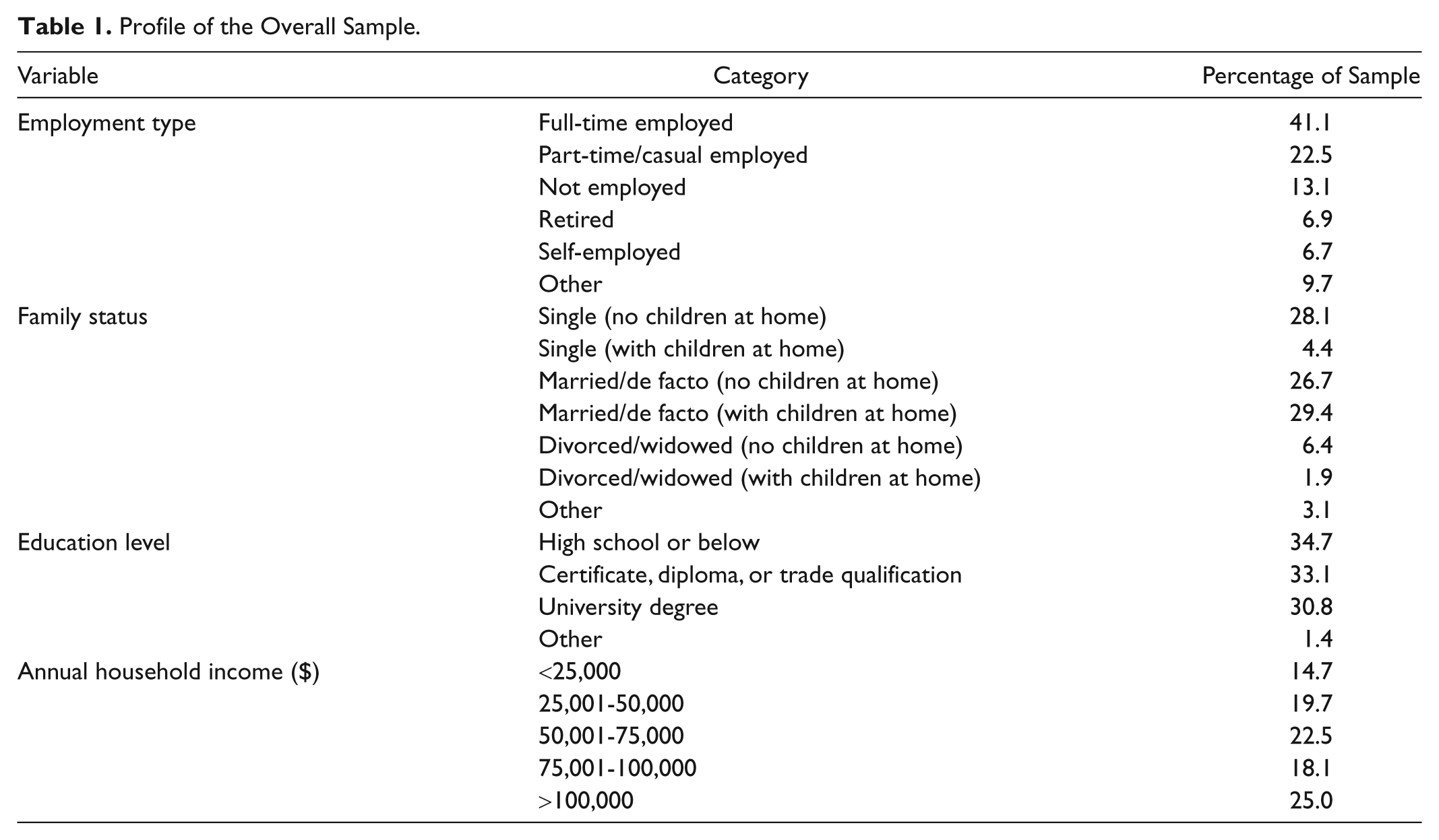
Age and gender quotas were imposed on the sample to ensure participation by the entire age range of each cohort and that male/female genders were equally represented. Minimum sample size requirements were imposed on each cohort to ensure sufficient data for the subsequent analysis. Cases with missing data appeared random and thus were removed from analysis (Tabachnick and Fidell 2007). In addition, 95 individuals indicated they were not born in and currently living in Australia and, accordingly, these cases were also removed from the analysis. The resultant data set comprised 632 responses. To achieve equal representation of the three generational cohorts, 120 respondents were randomly selected from each generational cohort. Thus, the final data set used for the analysis comprised 360 responses. This procedure ensured that the findings were not biased toward responses from any one cohort. Table 1 presents the demographic features of the overall sample, showing that the sample is not dominated by one employment type, family status, education level, or household income.
Profile of the Overall Sample.
Results
The following sections present the full study results, including the sample profile, factor analysis, and hypothesis testing. Descriptive statistics and the correlations of items and reliability of the scales were tested using the Statistical Package for Social Science (SPSS). The hypotheses were tested via structural equation modeling (SEM). The following sections report the results of the factor and SEM analyses.
Factor Analysis
The data (n = 360) were examined for normality (by inspecting skewness and kurtosis), linearity (by inspecting scattering plots), and the presence of outliers, and visually inspected using histogram graphs. No outliers were detected in any of the variables, and the standard deviations were within an acceptable range of less than three deviations. Most of the statistics were within acceptable ranges (e.g., skewness and kurtosis ± 2.00) and normally distributed. Three variables (or items) relating to emotional value reported kurtosis statistics of 2.02, suggesting slightly beyond normal distribution for this construct. This issue of nonnormality is addressed in the discussion of the partial least squares (PLS) analysis. Thus, the data were suitable for factor analysis.
As Table 2 shows, the factor analysis (n = 360) revealed that the items in the questionnaire were valid and reliable measures of each construct. Factor loadings ranged from .74 to .98 and the variance explained ranged from .69 to .85, indicating that the items were valid measures on the constructs, consistent with Hair et al.’s (1995) recommendations. The scales were also reliable composite measures of the constructs, reporting Cronbach’s alpha levels between .88 and .96, consistent with Malhotra’s (2010) recommendations.
Factor Analysis Results of Key Constructs.

Hypotheses Results
The hypotheses were tested via a PLS approach to SEM. Structural regression modeling software, SmartPLS version 2.0 (Ringle, Wende, and Will 2005) was used for this analysis. This software was selected because PLS analysis has the ability to handle larger, more complex models with multiple latent variables and indicators. PLS analysis also accommodates nonnormally distributed data, which often occurs in behavioral studies (Chin, 1998). PLS analysis is, therefore, appropriate for this study, given the multiple relationships and manifestation variables employed in the theoretical model and the nonnormal distribution of the emotional value construct in the model.
Tables 3 and 4 report the PLS analysis results, indicating the path coefficients (PC), critical ratios (CR), and average variance accounted for (AVA) for outer and inner models, respectively. Table 4 also shows the R-squared (R2) for each construct. Figure 2 presents the SEM results, indicating the path coefficients and the significant (and not significant) relationships in the models. Path coefficients are deemed significant when the t value is greater than 1.96. Significant relationships are represented by a solid line and nonsignificant relationships by a broken line.
Component Loadings for Outer Model.

Note: PC = path coefficient; CR = critical ratio; AVA = average variance accounted for.
Bootstrap estimate divided by bootstrap standard error.
Exceeds minimum acceptable level of 1.96.
Partial Least Squares Results for Inner Model.

Note: PC = path coefficient; CR = critical ratio; AVA = average variance accounted for.
Bootstrap estimate divided by bootstrap standard error.
Exceeds minimum acceptable level of 1.96.
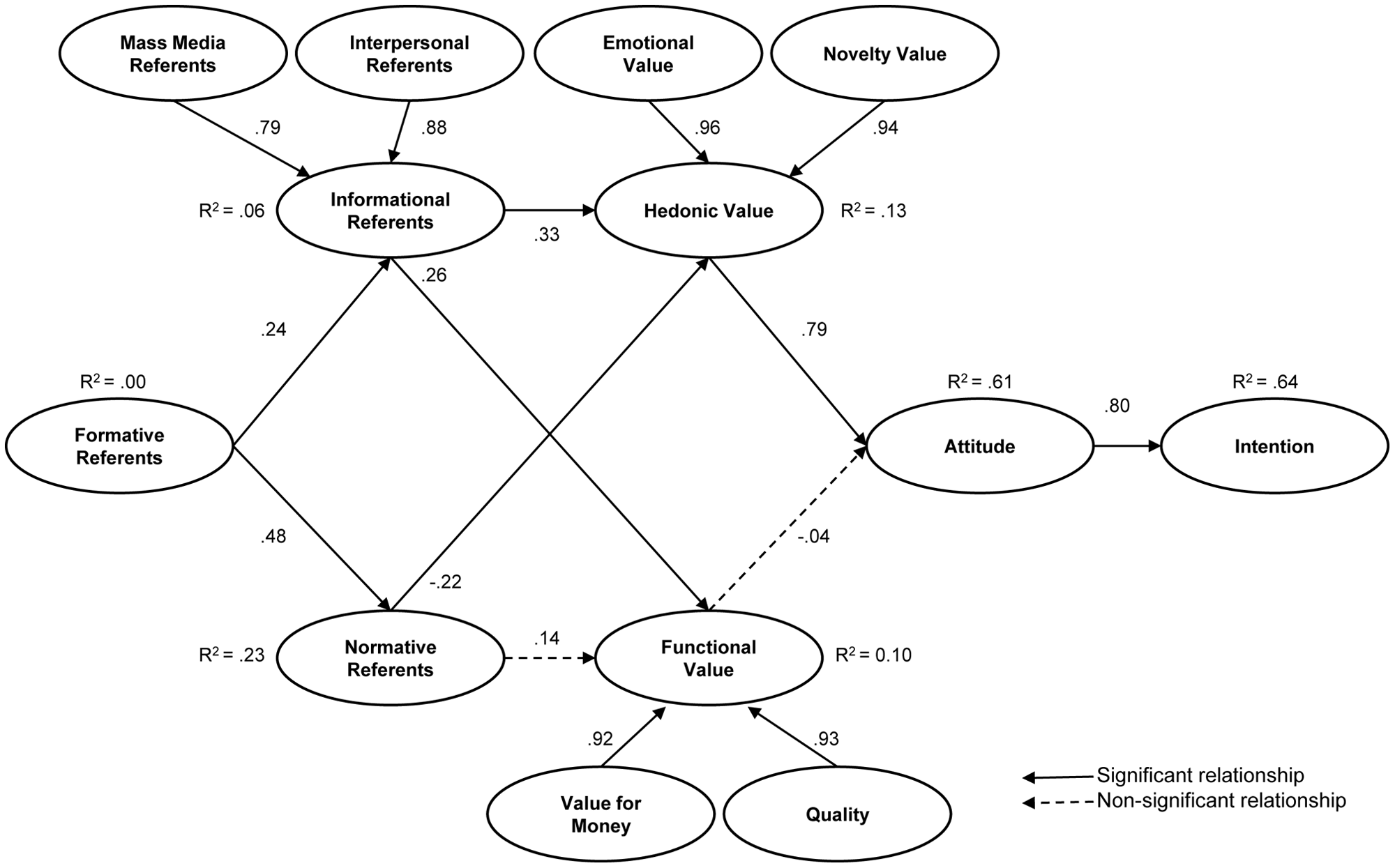
PLS results of model analysis.
The model shows that the outer model is supported, with positive path coefficients and critical ratios greater than 1.96 on all relationships in the outer model. Significant positive relationships are reported from mass media and information referents to informational referents, respectively. Likewise, analysis shows that emotional and novelty value operationalize hedonic value and value for money and price operationalize functional value.
Most relationships in the inner model are also supported. The relationships relating to hypothesis 1 (formative referents to informational referents), hypothesis 2 (formative referents to normative referents), hypothesis 3 (informational referents to hedonic value), hypothesis 5 (informational referents to functional value), hypothesis 7 (hedonic value to attitude), and hypothesis 9 (attitude to intention) report significant (critical ratios greater than 1.96) and positive relationships between these constructs. The results show a negative path coefficient between normative referents and hedonic value. Therefore, although the relationship is significant, hypothesis 4 is not supported because of this negative relationship. The relationship relating to hypothesis 6 (normative referents to functional value) reports a critical ratio of 1.12, and therefore is not significant in the model. Likewise, the relationship between functional referents and attitude reports a critical ratio of .58. Thus, hypothesis 8 is not supported.
The model was also examined for goodness of fit via the goodness of fit (GoF) index (Tenenhas, Vinzi, Chatelin, and Lauro 2005). The GoF index for the model is .52, which indicates communality or a quality measurement model. In summary, the model is a good fit and has predictive relevance for hypotheses 1 to 9. The model is robust with most hypotheses supported (i.e., hypotheses 1, 2, 3, 5, 7, 9, and 10), except for the relationships between normative referents and hedonic and functional value (hypotheses 4 and 6, respectively) and functional value and attitude (hypothesis 8).
Discussion
The profound interest in the generational cohorts and the limited theory development on this topic formed the basis for this study, which is the first to validate a theoretical model of generational travel decision making. The results of this investigation significantly advance the understanding of generational cohort behavior and its application to travel decision making, and the model makes a major contribution by verifying that formative referents—memories of experiences while growing up—influence present-day travel decision making. Although the logic that each generation’s unique memories influence present-day behavior seems plausible, this connection has been difficult to establish prior to this study.
As suspected in previous generational studies, but confirmed here, focus group participants reported a disassociation between memories of past macro historical events, such as major wars and terrorist attacks, and present-day travel decisions. Such a finding is attributed to the fact that none of the focus group participants was directly affected by, or personally involved in, the major events they remembered. Instead, their recollections were based on the mass media images of these events. While they felt shock at the devastation of major world events and sympathy for those who suffered from being involved in them, the bombardment of these messages reduced their overall impact and participants’ personal connectivity to these events. Memories of macro historical events are episodic memories, linked to a particular time and place, and affect only short-term travel decisions rather than the lifelong consumer attitude and intentions toward travel.
The findings of this study may also reflect the absence of cataclysmic historical events since the end of World War II. Hence, the historical events experienced by members of the Baby Boomer, Generation X, and Generation Y cohorts have not had the same profound impact on society as the historical events experienced by earlier generations, who experienced events such as World Wars I and II and the Great Depression. This study suggests that macro events experienced during the formative years of the Baby Boomer, Generation X, and Generation Y cohorts—such as regional conflicts and wars, terrorist attacks, and deaths of prominent individuals—did not have a pervasive impact on society as a whole and, as a consequence, do not shape the lifelong mindset of members of these cohorts.
In contrast, focus group participants could easily articulate the personal relevance of major social changes that affected their current beliefs and attitudes. This generational perspective was formed by comparing life and society of the formative years to their present-day life and society, and participants spoke at length about societal shifts that resulted in changing social expectations and norms. These memories tended to be more semantic—that is, they were unsure of how they knew about them—rather than episodic. These memories are particularly salient because they affect an individual personally.
The focus group analysis made clear that some formative referents related to society as a whole. For each cohort, society’s values, employment, education opportunities, and economic condition during the formative years are particularly salient memories of the past. Likewise, influences of a person’s family and life during the formative years are also important. These shared memories of the past structure the formative referents for each generational cohort. This finding supports the foundational premise of the literature on generational cohorts: the formative years play an important role in shaping lifelong beliefs, attitudes, and behavior.
However, this study extends this literature by identifying that societal and personal influences are the key formative referents in shaping the generational mindset, dismissing previous notions that macro events during the formative years have a profound and long-term influence on the generational mindset. Although this premise has been previously suspected among generational cohort researchers (Noble and Schewe 2003; Schuman and Scott 1989), this study presents the first empirical evidence validating the role formative referents play in both travel and more general consumer decision making.
As Figure 2 shows, the model validates the premise that salient memories of the past, or formative referents, guide the cohort member’s contemporary preferences on which informational and normative social cues shape their value beliefs (relating to hypotheses 1 and 2). Salient social cues relating to travel decision making are informational referents from the mass media and interpersonal conversations as well as consumers’ perceptions of how others will view the purchase choice or normative referents. Informational referents inform consumers’ perceptions of the hedonic value of travel, as well as the functional value associated with a travel experience (relating to hypotheses 3 and 4). Consistent with the literature of attitude formation (Assker et al. 2010; Grimm 2005), hedonic value expectations about the travel experience in turn influence a consumer’s purchase attitude and intention (relating to hypotheses 7 and 9).
The results also show that seeking the approval of others also has a significant, although negative, relationship to hedonic value perceptions. Furthermore, functional value perceptions are made independently of normative referents. This finding suggests that consumers do not make value decisions to meet the expectations of others, nor are they motivated by social approval seeking. These findings do not negate the importance of social value in consumer decision making, but do suggest that consumers today pursue unique products or experiences that differentiate them from other consumers. Thus, normative influences continue to remain an important component of attitude formation, although the nature of this influence may have changed since subjective norms were originally proposed in attitudinal models such as the theory of reasoned action (Ajzen and Fishbein 1980).
The evolution in consumer normative beliefs is reflected in contemporary literature. For example, the consumer’s pursuit of differentness may have a counterconformity motivation, fueled by the need to enhance the self-perception of uniqueness (Tian, Bearden, and Hunter 2001; Pike 2008). Consumers have often criticized staged tourist experiences that appear too commercial, contrived, and artificial (Weaver and Lawton 2006). The findings of this study suggest that consumers desire unique experiences that offer social value (Sweeney and Soutar 2001) and enhance their self-concept. One means of achieving this end is creating individualized, customized experiences through a process of cocreation (Binkhorst and Dekker 2009). For instance, tourism products could be unbundled to allow consumers to rebundle to create their own tailored experience. The findings from this study support a shift toward a more dynamic process of cocreation that empowers consumers to create their own stories and narratives about their travel experiences to share with others.
The results also contradict research suggesting that functionality influences consumer attitude to travel. This study reports a nonsignificant relationship between functional value and attitude (hypothesis 8), a finding that implies that functional aspects of travel have limited influence in motivating consumers to travel. The strong motivational power of hedonic value may also explain this result, reducing the influence of functional value on travel decision making.
The theoretical model of generational travel decision making validated in this study extends previous attitudinal theories, such as the theory of planned behavior. In contrast to previous models that have focused solely on the decision making of individuals, the introduction of formative referents to a travel decision-making model means that group (i.e., generational cohort) as well as individual dynamics are incorporated into the attitude formation process. The unique formative experience of each cohort creates the basis of a “generation gap” that distinguishes generational cohorts from each other. As a result, each generational cohort is a unique consumer group with distinct attitudinal beliefs that are collectively shared by the cohort’s members. Therefore, while the model developed in this investigation focuses on the decision making of individuals, it also accounts for the influence of group dynamics that exist as a result of individuals being part of a cohort.
This study represents the first comprehensive study of generational travel decision making, and the results confirm the validity of this approach to understanding travel consumer groups. This study makes a major contribution to the theoretical understanding of generational cohorts, identifying key constructs that underpin generational travel decision making and their relationships with each other. A significant contribution is the presentation of the first theoretical model of generational travel decision making.
Limitations and Future Research
While this study identified key constructs that underlie generational travel decision making, it has some limitations that suggest directions for future research. Future research on this topic could unpack the constructs examined here, perhaps by using other research methodologies such as more participatory narrative-based approaches, including storytelling and biographic studies (Nimrod 2008; Sedgley, Pritchard, and Morgan 2011). Cross-cultural studies are also important to advance understanding of generational cohorts, particularly to establish whether these generations, with their associated travel decision-making processes, are a global, western, CANZUS, or country-specific phenomenon. Longitudinal studies of generational travel behavior, as undertaken by Pennington-Gray et al. (2003), may also provide some further insights into the changing preferences and behavior of each cohort.
The next important step in advancing understanding of generational travel decision making is to test the robustness of the model across generational cohorts, comparing the cohort models with each other to investigate the similarities and differences between the cohorts. Furthermore, cross-generational comparison of the conceptualization of the key constructs in the model would be useful. For instance, exploring each cohort’s views on value for money, similar to the experimental approach adopted by Nicolau and Selllers (2012), could yield important insights. Given the popularity of generational cohort analysis and the dynamic and rapidly changing environment in which the tourism industry operates, further investigation of a generational approach to understanding travel consumption is warranted.
Footnotes
Appendix
Survey Items
| Formative referents | |
|---|---|
| FR1 | My friends when I was growing up influence my attitude towards holidays in Australia today. |
| FR2 | My family’s values when I was growing up influence my attitude towards holidays in Australia today. |
| FR3 | My family’s financial circumstances when I was growing up influence my attitude towards holidays in Australia today. |
| FR4 | My religious affiliation when I was growing up influence my attitude towards holidays in Australia today. |
| FR5 | Education opportunities in society when I was growing up influence my attitude towards holidays in Australia today. |
| FR6 | Employment opportunities in society when I was growing up influence my attitude towards holidays in Australia today. |
| FR7 | The economy when I was growing up influence my attitude towards holidays in Australia today. |
| FR8 | Society’s values when I was growing up influence my attitude towards holidays in Australia today. |
| Mass media referents | |
| MR1 | To make sure that I buy the right holiday, I often observe stories about holidays in the mass media. |
| MR2 | If I have little experience with a destination, before purchasing a holiday there I often look in the mass media for information about it. |
| MR3 | To help choose the best holiday alternative available, I often consult the mass media. |
| MR4 | Before booking a holiday, I frequently gather information from the mass media. |
| Interpersonal referents | |
| IR1 | To make sure that I buy the right holiday, I often observe what other people are doing on holidays. |
| IR2 | If I have little experience with a destination, before purchasing a holiday there I often ask other people about it. |
| IR3 | To help choose the best holiday alternative available, I often consult with other people. |
| IR4 | Before booking a holiday, I frequently gather information from other people. |
| Normative referents | |
| NR1 | I rarely purchase a holiday until I am sure others will approve of it. |
| NR2 | It is important that others like the holiday I choose. |
| NR3 | I generally choose a holiday that I think others will approve of. |
| NR4 | The holidays I take are what others expect me to choose. |
| NR5 | I like to go on holidays that make a good impression on others. |
| NR6 | I achieve a sense of belonging by purchasing the same holidays that others purchase. |
| NR7 | If I want to be like someone, I often try to go on the same type of holidays as them. |
| NR8 | I often identify with other people by going on the same holidays as them. |
| Perceived emotional value | |
| EV1 | Taking a holiday in Australia is enjoyable. |
| EV2 | Taking a holiday in Australia is exciting. |
| EV3 | Taking a holiday in Australia makes me feel good. |
| EV4 | Taking a holiday in Australia gives me pleasure. |
| EV5 | Taking a holiday in Australia gives me a sense of accomplishment. |
| Perceived novelty value | |
| NV1 | Taking a holiday in Australia is something different. |
| NV2 | Taking a holiday in Australia is unique. |
| NV2 | Taking a holiday in Australia increases my knowledge. |
| NV4 | Taking a holiday in Australia offers variety. |
| NV5 | Taking a holiday in Australia is something I can talk about when I get home. |
| Perceived value for money | |
| PV1 | Holidays in Australia are reasonably priced. |
| PV2 | Holidays in Australia offer value for money. |
| PV3 | Holidays in Australia are a good experience for the price. |
| PV4 | Holidays in Australia are economical. |
| Perceived quality | |
| QV1 | Holidays in Australia offer consistent quality. |
| QV2 | Holidays in Australia are well done. |
| QV3 | Holidays in Australia offer an acceptable standard of quality. |
| QV4 | Holidays in Australia are well organized. |
| Attitude | |
| AT1 | Holidays in Australia are good. |
| AT2 | I like holidays in Australia. |
| AT3 | I have a favorable attitude towards holidays in Australia. |
| Intention | |
| IN1 | I would recommend a holiday in Australia to others. |
| IN2 | I intend to go on a holiday in Australia in the near future. |
| IN3 | I am likely to go on a holiday in Australia in the next 12 months. |

Acknowledgements
The authors would like to acknowledge Professor David Weaver for his advice on earlier versions of this manuscript.
Declaration of Conflicting Interests
The author(s) declared no potential conflicts of interest with respect to the research, authorship, and/or publication of this article.
Funding
The authors would like to thank the Queensland Government Smart Funds Program, Tourism Austraila, Gold Coast Tourism and Griffith University’s Centre for Tourism, Sport and Service Research for their financial support for the research and publication of this article.