




Abstract
Empirical evidence about the educational outcomes of travel is scattered across many fields of study. This paper reviews the literature on the educational benefits of travel, beginning with the literature on study abroad. Learning outcomes have been found from the travel portion of the study experience, and some research has found that out-of-class experiences were the most impactful portion of study abroad. Personal growth, increase in life skills, and knowledge also result from independent international travel, as well as “objectiveless” travel. A few studies have focused on adults and seniors, but the research primarily has focused on young adults and college students. After a review of the literature, numerous suggestions for future study are provided, including a focus on the educational outcomes of domestic travel, youth travel, and determining which travel experiences result in the most learning benefits.
Introduction
It has been proposed that all travel is educational because it broadens the mind as people learn from and interpret experiences (Casella 1997; LaTorre 2011; Steves 2009). Even though learning new things and personal enrichment have both been found to be motivators and desired benefits of travel (Shoemaker 1994), the learning effects of travel and tourism have been under-researched (Falk et al. 2012; van ’t Klooster et al. 2008). This paper will thus investigate the literature on the educative outcomes and benefits of travel. First, learning and educational tourism will be defined. Then a link between study abroad and tourism will be established, before discussing the current literature on the educative effects of study abroad. While educational travel provides a formal framework through which learning can occur, there are other realms in which people learn through travel, including youth group travel, youth exchange, and independent travel, which will also be discussed. This review concludes with limitations of the literature and suggestions for future research into the educational and learning benefits of travel. Overall, the paper attempts to answer the question, “How is travel educational?”
Methods
Research methods are shown in Figure 1. Primary literature was obtained by searching fourteen online databases, but the three primary databases searched were Academic Search Complete (EBSCO), Hospitality and Tourism Complete (EBSCO), and Readers’ Guide. A panel of graduate students produced a list of possible keywords, which were modified to reflect findings and ensure relevance to the research. Keywords such as “education + travel” and “educational travel” proved too broad for the search, so they were narrowed down with additional keywords. The search was expanded to other relevant literature. For example, a portion of the study abroad literature was deemed relevant to this topic. For this study, the keyword travel was paired with informal education, education, experiential learning, and youth. Other key words were international education (paired with college, university, and benefit), educational travel, study abroad benefit, study abroad outcome, foreign study benefit, educational benefit of travel, and learning benefit of travel. Only sources in English were included.
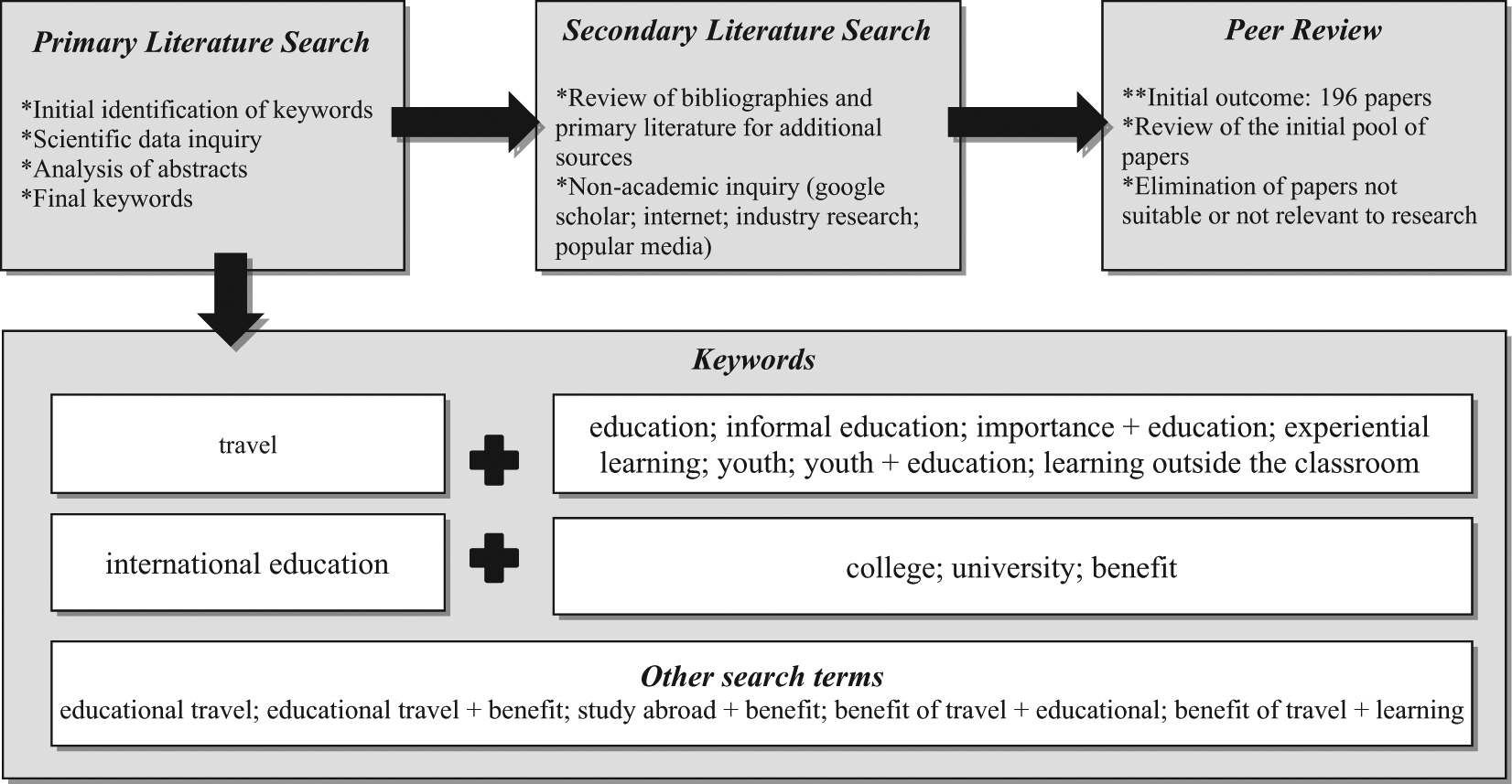
Methodology for article search.
For each of the academic resources found, the bibliographies were reviewed for additional relevant articles. Books and published bibliographies in topics relevant to the educative benefits of travel were also located. A secondary literature search was carried out utilizing nonacademic databases to obtain additional publications that may have been overlooked or omitted by academic databases. Google and Google Scholar were searched to locate other resources, including white papers and presentations related to the topic. Publicly available published resources were searched from industry associations, including Student Youth Travel Association (SYTA) and Association of International Educators (NAFSA).
The articles and publications obtained were checked for initial relevance by a team of two graduate students in tourism. The primary and secondary literature searches initially yielded 196 journal articles, papers, presentations, dissertations, and a few nonacademic resources. Further review of the resources was conducted by two professors in the field, and each of these was determined to contain empirical, theoretical, and/or practical information. A majority of articles and resources related to the benefits of study abroad and the benefits of international educational opportunities, but they were curated to find only those focusing on outcomes, especially as it related to the travel component of study abroad. Overall, while the literature has been expanding over the last several years, there is still a dearth of in-depth academic research about the educative benefits of travel undertaken outside of a formal college or university program. A summary of key academic articles with findings concerning learning as a result of travel can be found in Table 1.
Notable Studies Showing Learning Benefits of Travel Experiences.

Note: For studies of study abroad participants, it may be difficult to isolate learning outcomes from travel with learning outcomes of academic experiences or a combination of the two.
Review of Literature
Learning Concepts
Over time, views of learning have evolved, and today many believe that learning is labor, not leisure (Werry 2008). Despite a focus on learning via formal education systems, learning has been discussed as a lifelong process that is often informal (Mitchell 1998). Because of the difficulties in defining learning, the terms education, learning, knowledge, and educative outcomes are used interchangeably in this article. The principles of experiential learning and transformative learning may provide a viable connection between travel and education.
Experiential learning provides one model to explain how people learn by traveling. Dewey (1938), a pioneer in the idea of learning through experience, proposed that knowledge and skills that a person learns in one situation can help them to understand and react to subsequent experiences. Boydell (1976) defined experiential learning as “meaningful discovery” (p. 19), occurring when learners uncover knowledge on their own, through perceptual experiences and insight, usually as the result of a personal experience.
Kolb (1984) expanded this research with his theory of experiential learning, which combines experience, perception, cognition, and behavior to create learning (see Figure 2). Kolb’s model may provide a framework for understanding and evaluating travel learning. A key aspect of Kolb’s model is reflection, a necessity for experiential learning. The concrete experience of travel and discovery provides an avenue where the traveler can reflect on the experience, thus creating learning (Mouton 2002). While experiential learning research has focused on the formal education arena, the requirements for experiential learning could all occur through travel.
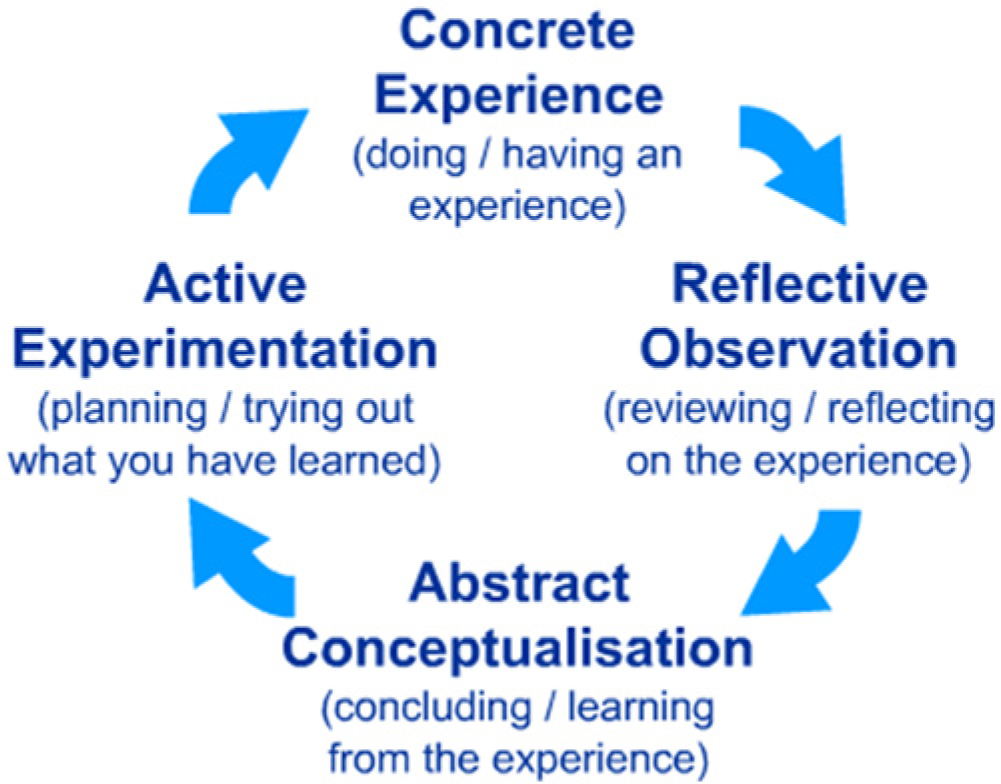
Davies and Lowe (n.d.) based on Kolb’s (1984) experiential learning model.
The value of experiential learning has been found to be positive for both visitor and hosts in a study of tourism students visiting The Gambia (Novelli and Burns 2010). Additionally, a cruise field trip was found to yield experiential learning benefits, as hospitality and tourism students understood cruise ship operations through observation, insight, and reflection (Weeden, Woolley, and Lester 2011). However, Kolb’s model has not yet been thoroughly analyzed as a way of understanding travel learning.
Outdoor touristic and adventure activities have also led to learning experiences (Koseoglu and Doering 2011; Stringer and McAvoy 1992). This experiential knowledge can transcend the traditional construct that school is a necessity for learning (Falk et al. 2012). Within experiential learning, content knowledge can lead to personal growth, which can lead to an openness and to more learning (Meyer-Lee and Evans 2007). Experiential learning can also occur from touristic events (Broomhall et al. 2010) and through field trips, seminars, and immersion experiences like internships, volunteering, and teaching (Peterson et al. 2007).
Travel is also a potential source of transformative learning (Morgan 2010), and all travel can be potentially transformative to the traveler and the host (Fordham 2006). Morgan (2010) proposed that a traveler changes during travel, from ordinary resident to traveler to “transformed home comer” (p. 252). In an educational context, Brown (2009) found the changing viewpoints in the traveling student to be akin to transformative learning. During a travel study trip to the South Pacific, Werry (2008) noticed that many of her students’ most transformative experiences occurred outside of the classroom. Rowan-Kenyon and Niehaus (2011) interviewed students who studied abroad in Prague, revealing that transformative learning had occurred, as several students had been positively influenced by their experiences abroad.
Besides being an outcome of traveling, education can also inspire travel. Crompton (1979) and Shoemaker (1994) identified education and learning as motivators to travel. Yet, learning and education are implicit in other motivations of travel. No matter the initial reason for undertaking a travel experience, learning can still occur (Falk et al. 2012). While motivations are worth considering, pairing motivations of travel with educative outcomes is beyond the scope of this article.
History of Education and Travel
Education and travel have been intertwined for centuries. Ritchie (2003) traced the origin of travel for educational purposes to the Grand Tour of the 17th to 19th centuries, during which young upper-class British men would venture across continental Europe as a form of education. However, the linkage of learning and travel began centuries earlier. Before discussing the educative benefits of the Grand Tour in detail, Brodsky-Porges (1981) quoted ancient Chinese and Western philosophers who mentioned the benefit of learning from travel. From the colonial period through the 19th century, young Americans went abroad to learn languages and learn through contact with other cultures (Sell 1983; Vande Berg 2007). By analyzing 19th-century travel diaries, Casella (1997) determined that travelers were actually seeking knowledge. Today, educational tourism maintains some similar elements of the Grand Tour by creating a formalized travel product in which education is supposed to occur.
Educational tourism is a segment of the travel market, which Ritchie (2003) divided into two different types: university, college, and school tourism, in which tourist experiences are secondary to formal learning (“education first”); and edu-tourism, defined as general travel for education (“tourism first”), which would include many youth study tours. Study abroad, a segment of educational tourism in which college students receive credit for international study, is one of the few avenues through which educative outcomes have been comprehensively studied. It is believed that investigating the learning benefits of study abroad is a good starting point for uncovering the learning benefits of travel (Falk et al. 2012). Within this article, the discussion of travel’s learning benefits begins with a review of relevant study abroad literature.
Learning through Study Abroad
Study abroad has been studied extensively, both qualitatively and quantitatively, particularly in the educational field. Since 1990, there has been a dramatic increase in research into study abroad, and several bibliographies attest to the quantity and variety of research (e.g. Comp, n.d.; Forum on Education Abroad 2012; Wilson and Richards 2003). Collegiate study abroad has been found to be “one of the most important experiences students can have during their undergraduate years” (Paige et al. 2009, p. S41).
Study abroad and tourism are interrelated in several ways. The most obvious parallel between study abroad and tourism is that travel is a central component of each, and neither study abroad nor tourism can exist without travel. Because study abroad is an impossibility without travel, many of the benefits of study abroad may be influenced by (or even be a direct result of) travel and touristic activities. As the student has a predetermined date of returning home, study abroad can be considered a tourist experience (Freestone and Geldens 2008). Many activities are common between tourists and educational travelers, such as shopping (Smith and Jenner 1997) and sightseeing, which was determined by Carr and Axelsen (2005) to be an important component of students’ activities while studying abroad.
Touristic motivations to study abroad
Although those taking part in educational travel can be defined as tourists, tourism is not typically their primary motivation (Ritchie 2003; Roppolo 1996). However, many study abroad motivators are similar to touristic motivations. Some of the main motivational factors for study abroad include: a search for new experiences (Juvan and Lesjak 2011; Sanchez, Fornerino, and Zhang 2006; Taylor and Rivera 2011); a good opportunity to travel (Sanchez, Fornerino, and Zhang 2006; Van Hoof 2006); to live in or learn about another culture (Chieffo 2007; Lamet and Lamet 1982; van Hoof 2006); the desire to be somewhere different (Juvan and Lesjak 2011); and exposure to a different culture/language (Doyle et al. 2010). Additionally, the same push–pull motivational factors that entice tourists to visit destinations (Beeton 2006) have been shown to motivate students to study abroad (Eder, Smith, and Pitts 2010; Mazzarol and Soutar 2002).
The study abroad experience includes many activities (see Figure 3). The benefits and outcomes to study abroad have been researched, but it is often unclear if these are due to travel, interaction with other cultures, classroom study, or a combination. Wanner (2009) lamented the “difficulty of attributing the desired (vague) effects to a single (precise) cause” (p. 88). Because many students take advantage of touristic experiences while abroad, it may be difficult to determine to what extent learning occurs as a result of either the travel or the study portions of their experiences. Following this logic, Abrams (1979) stated that study abroad is better defined as learning through experience abroad.
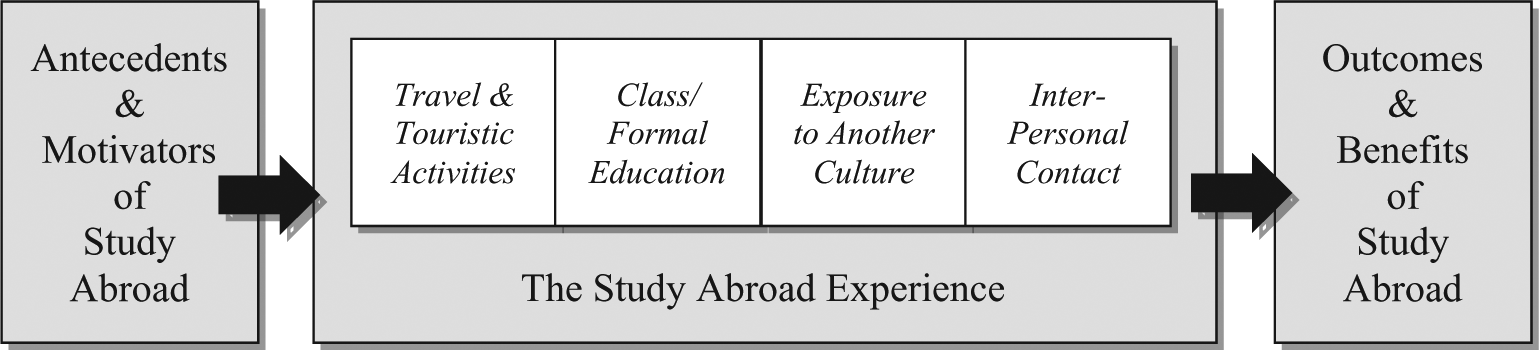
Study abroad: A process model.
The extant literature on study abroad includes antecedents to study abroad, the study abroad period, as well as outcomes. While this article focuses on knowledge/learning outcomes of study abroad, it is worth mentioning that much of the study abroad literature focuses on the supply-side aspects of study abroad, such as how destinations can attract student tours, student destination choice, and obstacles to study abroad (e.g. Doyle et al. 2010; Eder, Smith, and Pitts 2010; Ritchie 2003; Roppolo 1996), in addition to design of study abroad programs. While these may be of use to tourism organizations, they do not relate to learning outcomes of travel.
Benefits of study abroad
Study abroad makes an impact. In a retrospective survey of more than 6,000 study abroad alumni, Paige et al. (2009) asked which collegiate experiences had a strong impact and found that a higher percentage mentioned study abroad than any other collegiate experience (including friendships and coursework). Much of the study abroad research has focused on cross-cultural benefits and internal change as a result of study abroad. Researchers have shown that study abroad can result in a variety of outcomes, including change of perspective or worldview (Dwyer 2004), independence (Bachner and Zeutschel 2009), self-confidence (Bachner and Zeutschel 2009; Chieffo 2007), intercultural development (Ingraham and Peterson 2004; Rexeisen et al. 2008), global engagement (Paige et al. 2009), and dispelling of stereotypes (Freestone and Geldens 2008) among participants. Intercultural (or cultural or cross-cultural) competence, a major focus of study abroad benefits research, has been defined in many ways (see Deardorff 2009), but should include elements of cognitive/knowledge, affective/attitudes, and behavior/skills (Meyer-Lee and Evans 2007). Language learning, another outcome of study abroad, is beyond the scope of this review.
Intellectual and cognitive knowledge growth has also been found to be a benefit of study abroad. Chieffo (2007) reported that 85% of students learned new information about political/social issues, the people, geography, history and culture of another country in short-term study abroad. Miller-Perrin and Thompson (2010) found that achievement scores increased over time for study abroad students, while they decreased in a nontraveling student control group. Similarly, Sutton and Rubin (2004) compared about 250 students who studied abroad with those who did not, and discovered significant differences in knowledge, including functional knowledge and knowledge of global interdependence, cultural relativism, and world geography. In a study of more than 1,100 students, Ingraham and Peterson (2004) reported that students perceived slightly increased academic performance as a result of study abroad. Other increases in knowledge resulting from study abroad that have been found include learning about the unknown (Novelli and Burns 2010), another culture/cultural sophistication (Chieffo 2007), and global understanding (Kitsantas 2004). These researchers also attributed the knowledge gains to the entire experience of study abroad.
Impact of short-term study abroad
The benefits of short-term study abroad (one semester or less) may be a better parallel to benefits of travel because the shorter time frame more closely equates to a tourist experience. Short-term study abroad is the fastest-growing segment of study abroad, accounting for nearly 60% of American study abroad students (more than 161,000 in 2009–2010) (Chow and Bhandari 2011). Chieffo and Griffiths (2004) compared 827 students on a short-term travel study program with more than 1,500 students who did not travel and found a significant difference in 80% of survey items. Students who traveled showed an increase in functional knowledge, intercultural awareness, and personal growth. However, some questions (e.g., knowing the U.S. dollar conversion rate) seemed to favor the experimental group.
Outside-of-class learning has been identified as a result of travel study. Both Janes (2008) and Sjoberg and Shabalina (2010) found outside-of-class learning occurred during travel study to Britain and Russia, respectively. Harrison (2006) recorded learning in students who had taken a four-week business travel study trip during a 10-year period, whereas Peppas (2005) recorded gains (including educational outcomes and increased cultural awareness) resulting from a two-week business travel study course.
Overall, academic, career, and personal growth have been identified as benefits of short-term study abroad, but some believe longer study is better. In a study of four decades of youth exchange students, Bachner and Zeutschel (2009) found more benefits of longer-term programs. Following a longitudinal study of more than 3,700 study abroad alumni of the Institute for International Education of Students (IES) spanning 50 years, Dwyer (2004) reported that longer study led to more significant benefits. However, Dwyer’s (2004) research showed that a large percentage of short-term participants acquired similar educational benefits, including a lasting impact on worldview (92% of short-term participants vs. 97% full-year), increased self-confidence (97% vs. 98%), and understanding of own cultural values (95% vs. 99%).
Ingraham and Peterson (2004) similarly found that a longer sojourn resulted in higher personal growth, intercultural awareness, and academic performance, yet they noted that short-term programs were also beneficial and “provide notable value” (p. 90). In a longitudinal study, the American Institute for Foreign Study (AIFS 1988) discovered that more than 70% of summer and year-long study abroad students reported gains in maturity, knowledge of a specific culture, and adaptability/flexibility; however, a higher percentage of year-abroad students reported these gains. Similarly, increased knowledge of a specific culture was reported by 79% of summer abroad students, compared with 92% of year abroad students. While there is evidence that longer study abroad may carry more educative benefits, many studies have shown that learning is also gained by short-term study abroad.
Long-term educative outcomes of study abroad
Although there are challenges in measuring the cumulative nature of learning (Falk et al. 2012), longitudinal studies have shown long-term impacts related to study abroad. In a retrospective study of 330 students who traveled abroad in the 1960s, Abrams (1979) found the experience had an important influence on subsequent behaviors, including strengthening academic interests. Of these students, 53% said it was one of the most important experiences of their lives, and an additional 26% said it was a great experience. A lasting effect has also been found for the search for knowledge. After studying abroad, more than half of a 95-student sample said they were more apt to study simply to learn rather than for grades (Hadis 2005), and Dwyer (2004) found that study abroad created an interest in learning about other languages or cultures.
Learning through Travel
Many studies have shown educative outcomes due to the travel component of study abroad, while others have found that experiences as a traveler led to learning. In a qualitative study of 35 American students studying in Ireland, Langley, and Breese (2005) found that students learned the most about culture independently through “serendipitous” travel, as “participant observers, interacting sojourners, and travelers” (p. 317). In a study of 184 students studying abroad more than a 10-year period, Lamet and Lamet (1982) reported that only one student listed in-class experience as the most valuable part of the education abroad. Instead, the out-of-class experience was most impactful to 62% of respondents, while the remainder valued both. Gmelch (1997) analyzed the journals of students studying overseas, finding that students learned more through travel than in academic experiences. These journals expressed learning, even if it was not commonly thought of as knowledge.
Laubscher’s (1994) study of study abroad students focused on out-of-class learning experiences, and he found that travel enhanced students’ learning while abroad. Both travel with a learning objective and objectiveless travel generated educational benefits including personal development, new perspectives, and many generic skills, such as autonomy, independence, and self-confidence, which may be best gained through independent travel (Laubscher 1994). Paul and Mukhopadhyay (2003) studied two international executive MBA programs, finding that cognitive, affective, and overall learning occurred as a result of the travel component of an international experience. The level of learning was not dependent on the destination. In a reflection of three-week study trips to Italy, Coryell (2011) referred to the foreign city as a classroom, indicating it was important the students were given free time in order to learn from the “sights, sounds, smells, physical sensations, cultural practices, and foreign peoples and languages” (p. 10).
Learning through independent travel
Independent travel has been explored more recently. Inkson and Myers (2003) interviewed 50 New Zealanders who had spent at least six months overseas, and revealed that a majority mentioned gaining interpersonal, communication, self-confidence, and cross-cultural skills. These benefits echo those of study abroad and suggest that a formal learning component is not a necessity to glean the educative benefits of travel. After interviewing three South African students who had taken a “gap year” (a year off between schooling), Coetzee and Bester (2009) determined that travel during the gap year had resulted in personal growth and increased life skills. Kuh (1995) interviewed 149 college students across several institutions about outside-of-the-classroom learning. Twenty-two percent of respondents mentioned travel as influential to their learning and personal development. Although there were few outcomes attributed to travel, Kuh (1995) stated that travel was “often a developmentally powerful experience” (p. 141).
This stream of research seems to indicate that learning through travel (even among students) is not the exclusive benefit of a formal study abroad program. However, there are limited examples of empirical studies of travel benefits outside of a student environment. In a study of web-based travelogues, Pearce and Foster (2007) discovered that travelers reported learning of “generic skills” such as problem-solving and interpersonal/social skills. In addition, they gained more general knowledge (e.g., historic and geographic knowledge) and social and cultural awareness. They also surveyed 386 backpackers and reported that travel contributed to individual skill development. More than 60% of respondents reported gains in 20 different “generic skills,” including being open minded, decision making, general knowledge, adaptability, tolerance, and interpersonal understanding. In a related study, Scarinci and Pearce (2012) found that international travel helped to develop generic skills like problem solving, time management, and communication. They concluded that the more a person travels internationally, the more the benefits of travel are perceived, as 14 of 20 skills showed significant differences based on the number of trips taken. However, the subjects included a high concentration (31%) of international students, and the results were arguably not generalizable beyond the population of a single small college.
Richards and Wilson (2003) conducted a study about independent student and youth travel for the International Student Travel Confederation (ISTC) with 2,300 international respondents. They found that exploring other cultures and increasing knowledge were two of the top three motivations for travel. The benefits gained by the respondents echoed their motivations, as more than 70% of respondents said they gained appreciation of other cultures, more interest in learning about other cultures, increased tolerance of differences, and more self-knowledge. Family holiday travel also can result in experiential learning. Minnaert (2012) interviewed low-income individuals who had taken recent trips and found learning of “soft skills” like independence, confidence, and self-esteem. The benefits of independent travel were thus similar to those of formal educational travel.
Adult learning through travel
Adult learning through travel has been the subject of limited study. Mouton (2002) conducted a qualitative study of experiential learning of adult festival goers and Elderhostel participants. Self-directed learning, combined with reflection and experience, led to greater meaning and transformation. This is similar to Casella’s (1997) view of the educated traveler “construct[ing] a pedagogy of travel” through traveling, viewing, recording, interpreting and sharing their experiences” (p. 187). Alexander, Bakir, and Wickens (2010) surveyed 172 individuals in a “typical” English neighborhood. Vacation experiences were found to have affected just more than half of the respondents (53%). While only a small percentage acknowledged change in confidence, knowledge, or skills, those who did showed similar learning outcomes as the student samples: functional knowledge, increased interest in learning, and changes in stereotypes. In this study, shorter trips (1–7 days) were shown to have a higher impact than other lengths, and experiences where tourists interacted with locals were also more impactful.
The benefits of travel for seniors have also been studied. In a study on intellectual decline of 112 women older than age 65, Sands (1981) found that vacations were inversely related to decline in intellectual functioning, suggesting that vacations also have a cognitive effect beyond learning benefits. Roberson (2002) conducted semistructured interviews with eight seniors, finding that each of them had learned something new, interesting, or surprising from travel. The knowledge gain, including geography, culture, and self-knowledge, occurred in both domestic and foreign settings. Jarrett (2009) completed a similar study, interviewing nine independent senior women who had traveled internationally, and the stated benefits of travel included personal growth, tolerance, and lifelong learning in general.
Children’s learning through travel
Benefits of youth travel have also been identified, including family travel, student and youth group travel, and youth educational exchanges. Family travel has been perceived to have benefits by parents, who often believe that travel is educational for their children. Byrnes (2001) proposed that children’s learning through travel can result in broadening a child’s world view and learning generic life skills (e.g., problem solving, patience, and flexibility), math, map reading, and values of other cultures. Byrnes (2001) used the term travel learning for the education provided to children who travel during the academic year and provided suggestions for parents who are providing travel learning experiences to their children, but she presented no empirical research. Crompton (1979), in studying motivations for vacation destination selection, found that parents considered vacations as learning experiences. “The positive influence of pleasure vacations on children’s education” (Crompton 1979, p. 420) was a major (and often primary) consideration in destination selection.
Travel was stated as an “essential” part of children’s educational experiences by 86% of respondents (n = 425) to a Student and Youth Travel Association (SYTA) (2008) study. The act of traveling was thought to be important to many different subjects. Sixty percent reported a positive impact of travel on their academic experiences, while less than 1% reported a negative impact. Respondents also indicated that more than half of parents perceived a positive change in academic performance after a travel experience, although the sample was not random. A Holecek, Nicholls, and Collison (2008) study on student and youth group travel showed that many (even in noncurricular youth groups) take advantage of educational experiences on their trips, including sightseeing (35.1%), guided tours (27.9%), historic site visits (24%), state/national park visits (20.6%), lectures (17.6%), and history or science museum visits (19.8%).
While the educational outcomes of youth travel are not always clear (and some trips, such as travel with sports teams, may not have learning as a goal), there appears to be a correlation between youth travel and academic achievement. In a study of student and youth travelers, 66% of students who traveled had a B+ or above average, while 82% had at least a B average (Holecek, Nicholls, and Collison 2008). In an unpublished study, Explorica (2011) surveyed 600 adult Americans (300 who had traveled outside of the U.S. between ages 12 and 19 and 300 who had not, revealing that those who had traveled outside of the U.S. were almost twice as likely to attain a college degree or postgraduate work (67% vs. 34%), be employed full-time 61% vs. 40%), and report a higher household income ($72,300 vs. $52,200). While these findings are potentially impactful, the Explorica (2011) study was not peer-reviewed nor available in full, which puts into question the validity and relevance of these data. Additionally, it is possible that these differences could be due to attributes other than travel (e.g., those of a higher socioeconomic level may have had more travel and educational opportunities).
Learning through youth educational exchange
Youth educational exchange and homestay programs can result in learning outcomes. Bachner and Zeutschel (2009) studied long-term effects of student youth exchange and found that about 90% of respondents said they gained abilities or traits that were useful. Stitsworth (1989) compared a control group of 112 American students with 154 American students who spent a month homestay in Japan. The overseas travelers showed more flexibility, more independence, and became less conventional. In a similar study of Japanese students on a homestay in the United States (426 travelers, 265 control group), Stitsworth (1994) found that exchange participants showed greater personal growth and became more sociable, extroverted, responsible, spontaneous, self-confident, individualistic, informal, competitive, and independent. This provides evidence that travel can potentially lead to personal change, even when removed from a school curriculum. The United States Department of State (USDOS) (2009) introduced a Youth Exchange and Study (YES) program in which teenagers from primarily Muslim countries spent a year in the United States. In a longitudinal study of 1,755 participants, more than 95% demonstrated increased understanding of U.S. politics and government, the economy, the people, and the American culture (USDOS 2009). Students also showed large gains in generic skills (e.g., solving problems, managing money, and flexibility) and leadership skills.
Other experiential learning environments
A final area of research that may relate to the educative benefits of travel is experiential learning, such as field-based education, ecotourism, and leisure. For decades, researchers have shown that student field trips result in direct knowledge (Atyeo 1939), longer retention of knowledge (Atyeo 1939), and encouraging different student interests than classroom settings (Clark 1943). Many field trips occur in touristic environments. Leisure research may also apply to learning through travel. Roggenbuck, Loomis, and Dagostino (1990) summarized the demonstrated learning benefits of leisure, including skill learning, factual knowledge, concepts, and attitudes. Field trips and visits to national parks, museums, and visitors centers were all included as learning environments. While this article does not explore the research on field trips and excursions, this is a related subject that may inform the research on travel learning.
Limitations
This study of the proposed educational benefits of travel has been guided by study abroad literature, which, albeit vast, suffers from several limitations. It appears clear, after hundreds of published studies over the decades, that study abroad leads to knowledge and personal development. However, as Figure 3 indicates, there are many factors in study abroad that may lead to the observed benefits. There is no conclusive evidence that the benefits attributed to study abroad are the result of (or require) an academic component. Although some studies point to learning benefits directly from the travel component, there has been little effort to segregate the experiences of study abroad to determine how travel impacts learning. A study could not be located that compared traveling students and traveling nonstudents simultaneously. Even within the academic component, much of the research has focused on cross-cultural competence and personal change, instead of academic or learning outcomes of study abroad.
Regardless of the study sample, it is difficult to measure the effect of any one experience on cognitive gain and educational achievement (Wanner 2009). Some studies have relied on self-reports of perceived learning (e.g. Chieffo and Griffiths 2004) as opposed to specific content (Sutton and Rubin 2004). Sutton, Miller, and Rubin (2007) proposed that asking students how much they learned does not actually measure change. Many measurements have been designed to measure change (see Paige and Stallman 2007), but most of these gauge global awareness, cross-cultural competence, or similar attitudinal measures instead of actual or perceived learning. There is the potential to develop a broader measurement for learning outcomes in noneducational settings.
The extant literature on travel learning benefits has a focus, almost exclusively, on international travel (in particular, study abroad), which makes it difficult to generalize the results to all travel. However, benefits of travel away from the home may be realized in domestic settings also. Wanner (2009) stated that “we do not know whether the international dimension is important” (p. 88), and Hull, Lemke, and Houang (1977) found no superiority for international off-campus programs when compared to domestic off-campus programs. Recently, some study abroad offices have begun to encompass domestic travel (Sobania and Braskamp 2009), so the next generation of study abroad literature should include a focus on domestic study off campus to determine if similar learning outcomes occur. While domestic travel may not be hypothesized to have the same impact on cross-cultural competence, other forms of learning may result.
Overall, the primary investigations have been on long-term study abroad and of long-term international travel. Some have bemoaned the lack of research about the benefits of short-term study trips (Chieffo 2007; Roppolo 1996) and longitudinal studies (Franklin 2010), but this article cites several examples. Additionally, most of the studies do not have a comparison group (Carlson and Widaman 1988), and, even if they do, it is difficult to find an equivalent control group to study abroad students. Control groups are often nontraveling students who remain on campus (e.g. Chieffo and Griffiths 2004; Miller-Perrin and Thompson 2010; Sutton and Rubin 2004). However, some experiments (e.g. Chieffo and Griffiths 2004) seemed geared to support their hypothesis of educational gains through international education. Additionally, learning has a value that is not dependent on grades and there are limitations to measuring GPA and academic achievement (Hadis 2005).
Recommendations for Future Research
Based on the entirety of the extant research and its inherent limitations, it can be concluded that further study is needed to determine in which ways travel is educational. Because most of the research conducted thus far is related to international travel, more research is necessary to show the educative benefits of domestic travel. The educational outcomes of short-term travel and vacations are also under-researched. Exactly how do factors like distance traveled and amount of travel time affect learning?
Longitudinal studies have measured the impact of study abroad and youth exchange over time, but a similar study was not located addressing the benefits of youth travel over time. It could be determined, using both quantitative and qualitative research, if adults perceive that they had learning benefits of travel as children (see AIFS 1988; Dwyer 2004). These benefits could also be measured for impact against other life experiences (e.g., sports, youth groups, and teachers) following Paige et al. (2009). The effects of travel on academic performance, educational goals, and college admissions also lack formal study.
In order to study impact of domestic travel and short-term travel, a study could investigate youth student travel, comparing a control group of nontraveling students with a group of students traveling on a class trip. A near term study could determine factual knowledge and attitude change, while a longitudinal follow-up study could test retention of knowledge for the classroom learners compared to the experiential learners to show the impact of travel. Additionally, this research should examine what nonacademic educative portions of the experience are retained by the traveling group. While it would technically be a study of educational travel benefits, this study could also demonstrate any educative benefits of domestic travel and short-term travel.
Following up on the study abroad research, another step could be to assess which of these benefits occur in a situation in which no schooling is involved. Can nonacademic travelers gain the same benefits as study abroad students? Are the cited benefits a result of touristic activities and the act of travel itself, or are they unique to educational travel? Separating the “travel” component from “study abroad” is difficult, but this would be an important step in travel and tourism research. This type of study would help to separate the benefits of travel from the benefits of educational travel, as well as enrich the tourism literature.
In addition, Scarinci and Pearce’s (2012) survey of students related to the perceived effects of international travel could be duplicated in different settings to allow for more generalizability of the results stating that international travel leads to generic skills learning. This could also be conducted among younger students and adults, as well as for domestic travel. Pearce and Foster (2007) indicated that travelers may also impact the society into which people return, so this could also warrant future research.
Correlational research could expand on the findings of Holecek, Nicholls, and Collison (2008) and Explorica (2011), linking GPA and academic success to youth travel. Following study abroad research, it could be determined how that travel influenced their education, educational goals, and lifelong learning. In addition, a self-selected sample has stated that parents perceived that their children learn through travel (SYTA 2008). Scientific inquiry could determine if this result would stand across additional demographics, to find to what extent parents feel that their children learn from additional travel. Together, these studies can help to determine linkages between travel and educational attainment and educative outcomes.
Conclusion
Throughout time, travel has been considered to be educational. Travelers have undertaken journeys in order to learn, and people still refer anecdotally to the educational benefits of travel. Yet there is belief among many that education happens primarily in the classroom, even though learning can occur in many contexts, including travel. Study abroad, defined as educational travel overseas, is one travel experience where learning is expected to, and has been found to, occur. The many benefits of study abroad can be summarized into three categories: knowledge/skills, development, and life choices (Sutton, Miller, and Rubin 2007). While some state that these benefits require a formal study abroad program (Vande Berg 2007), many have found that learning is not limited to educational travel. Both serendipitous and independent travel have resulted in personal growth, life skills development, general knowledge, and social and cultural awareness. However, researchers have primarily investigated international and long-term travel, especially among students and young adults.
The literature shows that travelers gather knowledge as they “understand, learn, discover, explore, and make sense of other places” (Casella 1997, p. 52). Yet how they learn and how much they learn, the “educative benefits of travel” have not been the basis of much scientific inquiry. This article provides a launching point for research linking travel to learning, so that future research may more precisely show how “travel is educational.”
Footnotes
Declaration of Conflicting Interests
The author(s) declared no potential conflicts of interest with respect to the research, authorship, and/or publication of this article.
Funding
The author(s) disclosed receipt of the following financial support for the research, authorship, and/or publication of this article: US Travel Association; $38,799.