



Abstract
This study challenges the way the research community has approached issues and implemented concepts in the field of destination management. In contrast to previous contributions that deliver a particular framework, this study aims to literally deframe the construct of the destination. To this end, we propose an alternative and dynamic viewpoint for researchers and practitioners that might have evolved decades ago, if the research community had not tried to constrain or reduce the phenomenon of the destination to a comprehensive and inherently static system. We identify the main problems of destination management and attempt to explain the reason for the many failures and shortcomings in practice. Building on an alternative concept, we present its applicability to the case of the currently ongoing reform of the destination management organizations (DMOs) in Switzerland. The study has a conceptual character, although its practical relevance has been proved over the past two years.
Introduction and Aim of the Paper
After more than 30 years of destination management and research in the field, it appears as though we have reached a point where only incremental knowledge gains are possible. Nonetheless, we think that a number of basic foundations of destination management and planning, particularly when translated into practice, may be questionable. With due respect for the previous contributions in this field, we propose a new perspective on how to interpret what we all already think we know and think we agree upon.
The concepts and ideas for this contribution are not really new. They build on rather old but basic concepts of the tourist and the destination discussed decades ago by scholars in tourism research (Gunn 1972; Leiper 1979; Miossec 1977; Pearce 1979). Further approaches have detailed the issues with the aim of understanding and planning the destination as a crystallization point of supply and demand in space (Bieger 1996; Dredge 1999; Gunn 2002; Leiper 1990; Lue, Crompton, and Fesenmaier 1993; Mitchell and Murphy 1991; Pearce 1995). We believe that they have been unfortunately used (if at all) for the development of comprehensive and rather constrained models for research and management. As a consequence, translating the concepts and notions of the complex phenomenon of the destination into practical implications for destination management and planning today raises nearly insoluble contradictions at almost every point. This is particularly true in matters relating to the role of the destination management organization (DMO) as a focal organization.
In contrast to previous contributions in this field that provide a particular framework for the destination, the aim of this study is, to literally deframe the construct of the destination. To realize this, we propose an alternative viewpoint for researchers and practitioners to the one that might have evolved decades ago if we had not tried to constrain or reduce the phenomenon of the destination to a comprehensive and inherently static system.
Following a conceptual part that summarizes the main problems of destination management in an attempt to explain the reason for many failures and shortcomings in practice, we propose a less comprehensive and more relaxed concept of the destination from different viewpoints. Building on this concept, we present its practicability for the case of the currently ongoing reform of the DMOs of the third generation in Switzerland. The paper has a conceptual character, although its practical relevance has been proved in the last two years.
Inherent Problems of Destination Management
The Problem of Shifting Markets
The problems of effective destination management start as early as the origin of the destination itself: the visitor. Considering that the destination is a construct driven by the tourist (Murphy, Pritchard, and Smith 2000), managing the tourists and, more generally, the markets in the destination’s area implies coping with shifting markets. As a matter of fact, in the mid- and long term, destinations change their business models as their markets change. Switzerland is a good example of this. It is a traditional tourist country, which has experienced four main development phases in its tourism industry, all driven by shifting markets (Müller, Kramer, and Krippendorf 1995). The first phase (“development”) spanned the second half of the 19th century, when the European nobility discovered alpine leisure activities combined with recreation and recovery tourism. In these years, there was no considerable organization or coordination of tourist activities until at the end of the 19th century a series of associations as well as numerous tourist offices were founded (second phase of “organization”). The third phase of “consolidation” was induced by World War I and lasted until the 1950s. This period caused a dramatic crisis in the Swiss tourist industry, because of social unrest and economic breakdown in its main markets. Phase four witnessed a rebound nurtured mainly by increasing leisure time and incomes of the Swiss and Western European population, with an accentuated growth in demand and supply between the mid-1960s and the 1990s. The latter two development phases gave rise to many new tourist destinations, particularly in alpine and pre-alpine areas. Since the 1990s, Swiss tourism has experienced increasing international competition as well as a continuous shift in market structures. The dependence on the domestic and German markets made the country vulnerable not only to the tourist industry’s general trends (i.e., increasing mobility, increasing international competition; Bieger and Laesser 2002), but also to market maturity, characterized by more flexibility, access to long-haul destinations with regard to budgets and time, and an ageing society that sought more valuable experiences than just skiing (Laesser and Bieger 2008). It is primarily market-based challenges that are compelling alpine destinations in Switzerland to innovate and reinvent themselves. Climate change with its increasing weather risks, particularly uncertainty of snow in the main winter season, is just an additional aggravating symptom that is increasing the urgency of change.
The Problem of Transient Supply Networks
Visitor segments in tourist destinations vary according to their length of stay, mobility levels, origin of the tourist (Debbage 1991) as well as travel motives and activities (Bieger and Laesser 2002). In fact, tourism distributes markets to products, and not vice versa (Gunn 1988). Visitors choose destinations based on attractions and activities that in return induce them to move in a particular area (Leiper 1990; Richards 2002). In addition, a series of conceptual papers have described typologies of spatial and tourist flow patterns (Lew and McKercher 2002; Lue, Crompton, and Fesenmaier 1993; Lundgren 1982; Oppermann 1995). While visited places and attractions vary greatly, travel is indeed structured (Hyde and Laesser 2009; Zach, Gretzel, and Fesenmaier 2008), such that we may speak of a demand-activated network of suppliers. Hence, “any given destination can be as diverse or as limited as the market itself” (Dredge 1999, p. 781). Actually, “planners [ . . . ] are sometimes accused of narrowly focusing upon inappropriate geographical boundaries [while] markets and destinations are interdependent and must be considered as part of any destination planning exercise” (Dredge 1999, pp. 781-82). Depending on visitor segments, the range of the destination must vary (Bieger 1996). The challenge is to cope with the fact that the destination’s supply systems change rather quickly because of visitors’ activities and needs while in addition new suppliers join and exit as their markets and new business opportunities change.
The Problem of Fickle Actors
Depending on their dominant business logic, actors view the destination from a rather ego-centric or group-centric point of view. In fact, a study carried out with a series of prominent actors in various destinations has shown that individuals agree on the challenges of the destination (often general issues), while they clearly show different perceptions of the competitive advantages and the competitors of the destination. These dimensions are usually business-related and therefore pertain to the individual or group-related perceptions of the destination (Beritelli 2011).
Consequently, financing projects and tasks, fostering initiatives, and obviously assigning functions to focal organizations such as DMOs becomes a challenge involving inherent conflicts between stakeholder groups and, even more so, between decision makers and organizations operating under different business logics (Marzano and Scott 2009; Ryan 2002; Wang and Krakover 2008) and in a turbulent environment (Jamal and Stronza 2009).
The Problem of Inapproachable Competitiveness and Sustainability
An important research stream in destination management focuses on competitiveness and sustainability, with the aim of explaining and increasing a destination’s long-term success by treating the object of research in a holistic framework (Dwyer and Kim 2003; Enright and Newton 2004; Ritchie and Crouch 2003). However, empirical studies around destination competitiveness have shown that underneath the destination’s comprehensive competitiveness, variations in the main business may occur (d’Hauteserre 2000; Hudson, Ritchie, and Timur 2004), different motivations and activities affect the competitive position (Faulkner, Oppermann, and Fredline 1999), and tourism enterprises affect overall destination competitiveness (Crouch and Ritchie 1995). Behind the comprehensive approach of the models, Ritchie and Crouch point out that “before different parties can agree or come to a consensus on what needs to be done, they must first agree on the entity for which the strategy is developed” (Ritchie and Crouch 2003, p. 71). Hence, overall destination competitiveness and sustainability may be the aggregate of subsystemic competitiveness and sustainability.
Additionally, destinations evolve, and underneath the destination’s evolution we must distinguish which wheels of the engine move at which speed. Butler’s tourist area life cycle model is an important conceptual contribution that highlights the fundamental fact that destinations change as their markets and products evolve (Butler 1980). Unfortunately, his conceptual approach, arguing from the whole destination’s point of view, has in the past induced a view of the destination as a rather rounded, stable construct. In contrast, we may explain (Miossec 1977) and analyze (Beritelli 1997; Choy 1992; Haywood 1998) the destination’s area as a sum of product–market life cycles, each of them in a different life cycle stage. To be more precise, a destination can be seen as a demand-caused, interlinked supply network with the aim of producing of a tourist good, where supply-sided organizations and actors, responding to the market developments, move at different speeds of innovation and renewal, like different clocks (Fine 1999). Often, it is the clock speed of the most important and influential actors and enterprises (in terms of producing a tourist experience) that determines a destination’s evolution as a whole. But we must consider that there is a multiplicity of partly interlocked systems, each running its own race. Hence, a comprehensive view of destination competitiveness or destination sustainability must be characterized as the synergetic sum of the competitiveness or sustainability of different businesses in a given territory called destination.
Deframing the Destination’s Territory
It can be deduced from the above-mentioned problems that destination management implies the execution of various tasks in a territory that hosts multiple demand flows in different places (including places outside of the territory) and in different periods of time. The response on the supply side is somewhat in reaction to the situation and is often unorganized. The actors and organizations involved regard the destination from their own viewpoint, driven either by the business purpose or by the rules of public governance, or both. Focal organizations, such as DMOs, consequently struggle to act effectively and efficiently in this variable context with heterogeneous interests.
By visualizing the problems with a simple illustration, we distinguish three reference frameworks with corresponding logics: (1) the territorial logic, (2) the business logic, and (3) the experiential logic (Figure 1). First, the territorial logic serves for all actors (including visitors) as an objective reference framework. They all use mental and physical maps to find an orientation in space, based on a common spatial knowledge (Golledge and Stimson 1997). However, while the local population and particularly the public institutions understand the territorial logic as the dominant framework for their concerns and actions, tourist businesses extend their scope to a wider virtual network of operators of the tourist industry, within and outside a particular region. Finally, the tourist perceives his travel experience in an even more blurred range of areas in which concrete services, attractions, activities, and encounters join with abstract landscapes and cultural contexts. Planning and managing a destination implies the effective coordination of these three rarely matching logics. Public institutions often fail to effectively participate in the business logic; private businesses fail to effectively translate their needs in the territorial logic of the public sector or to adapt to the requirements of the experiential logic of the tourist. Between the three logics, DMOs must find a way to facilitate processes and increase the competitiveness of the variously defined territory, with the hope of ensuring sustainable development. It is in this trap of multiple frameworks that destination management and DMOs regularly fail to achieve long-term plans and sustainable strategies.

Three logics and the destination management failure cycle.
While the task seems impossible, particularly for DMOs (Gretzel et al. 2006), we must consider that institutions and organizations consist of actors who have the capability of understanding multiple logics. The territorial and business logic are formal constructs driven by the perspective of the organizations and the institutions. Yet, actors may have multiple roles (e.g., a hotel director in a municipal council) and may change their viewpoint, depending on the context they are confronted with. Hence, the good news is that the destination is a subjective mental construct and that by shifting their perspective the actors can vary their interpretation and adapt their roles and actions.
Destination Management in a Heterogeneous Context
As a consequence of the above-mentioned problems, the framework for destination management may be revised considering the various logics affecting the context. Actually, we propose to go beyond a purely descriptive distinction of perspectives (Saraniemi and Kylänen 2011) and to build on an integrated yet viable approach for researchers and for practitioners. The cornerstones of the concept require a destination to cope with
multiple and dynamic markets with corresponding multiple and dynamic supply networks activated in different times of the year for different periods of time,
multiple and variable roles for actors and the institutions they represent, and, consequently,
multiple and variable spaces.
These assumptions seem trivial. However, the implications and the final consequences may cause dramatic changes in how destinations are analyzed, managed, and developed. Figure 2 vividly illustrates the heterogeneous context of the destination. A destination’s space is the playground of different supply networks activated by visitor flows at different times of the year (week) and with different durations. While some services and attractions may be specific to only one supply network, some are so important and polyvalent that they serve multiple networks (Tremblay 1998). These are represented by the dotted lines in the figure.
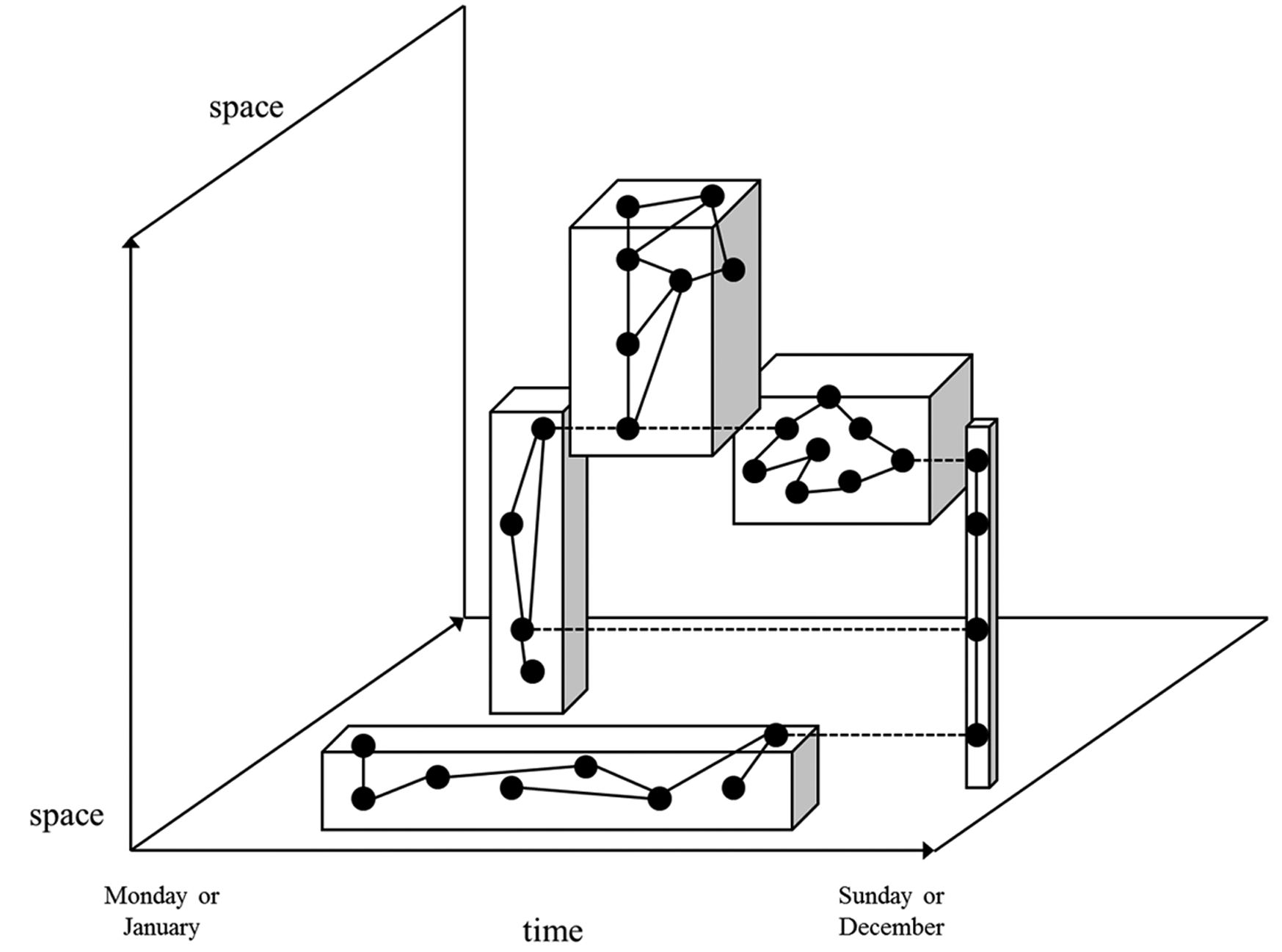
The variability and the possible connection of businesses in a destination.
Hence, instead of combining the various products and services in a destination’s territory into an amalgam and thus into a comprehensive view of managing and marketing the destination (Buhalis 2000), we propose to work straightforwardly with the decomposed state and derive from this the consequences for planning and development.
Empirical Case—The Current DMO Reform in Switzerland
We have chosen to discuss our proposed approach with the help of DMOs, because today DMOs are inextricably linked to a destination’s success (Bornhorst, Ritchie, and Sheehan 2010) and because these organizations often unify the hopes and concerns of all the stakeholders in the destination (Getz, Anderson, and Sheehan 1998; Gretzel et al. 2006). The empirical case of the current DMO reform in Switzerland presents a major initiative in progress that validates the concept explained above. The case of Switzerland is of particular interest, despite the limited size of the country’s territory, because
the industrialization of the sector took place in second half of the 19th century and therefore presents not only destinations in a growth stage but also destinations in mature and even declining stages of development;
there is today a diverse portfolio of tourism regions and products, some with a considerable amount of international or intercontinental visitors, and some with a strong dependence on the domestic demand;
there are a variety of markets, with a sometimes simultaneous occurrence of short-haul vacation, day tourism, international visitors, and business travel in the same regions;
Swiss DMOs are institutions with a long tradition but have been confronted in the past decades with changes in markets and products, making the question of adaptability of paramount importance; and
the strongly federal structures with fiscal sovereignty and autonomy not only at the cantonal but also at the municipal level allow a multitude of different cases that reflect regional and local peculiarities.
With these historical and general conditions, the DMO landscape in Switzerland clearly differs from the more uniform configuration and profile of tourist organizations in many other countries. With regard to DMO tasks, organizational and financial structures and governance models, Switzerland may be seen today as a lab in which many experiments are taking place even at the municipal scale; some fail while some produce interesting results with instructive lessons learned.
History and the Most Recent Reforms of DMOs
DMOs in Switzerland have a long tradition. The first one was founded in St. Moritz in 1864. Its original scope was to fulfill tasks that could neither be financed by single enterprises nor were typically in the domain of the municipalities, that is, running an information desk, embellishing the streets in the town, and maintaining the hiking trails. In contrast to DMOs in many other European countries, Swiss DMOs were founded as associations, with member fees the original source of financing. With the industrialization of the tourist industry after the world wars and the growth in domestic demand, DMOs continually added new tasks, often financed through overnight taxes and municipal subsidies (Bieger 1996). However, as competition grew fierce in the 1980s and Swiss travelers chose alternative destinations, many DMOs needed to restructure.
The first major reform was launched in the mid-1990s and focused on optimal task sharing among local, cantonal, and federal organizations as well as on the need to achieve economies of scale through mergers (Bieger 1998; Bieger and Laesser 1998). Since federal structures meant that the implementation could only work based on a bottom–up approach, the changes took longer than expected. Hence, between 1999 and 2006, the governments of the major tourist cantons (Graubünden, Valais, Bern, and Ticino) launched a reform with a rather top–down approach, just as had happened in neighboring Tyrol in Austria some years earlier. The objective of the reform was again to increase economies of scale through mergers as well as to distinguish traditional territorial tasks (e.g., information desk, public tourist infrastructure) from product tasks (e.g., service bundling and sales) (Beritelli, Bieger, and Laesser 2009).
These reforms produced larger organizations with more stable resources but did not really shake the institutions’ concept of themselves. Still, many DMOs do essentially the same things independent of the destination they serve: they run information desks, have a promotion and a public relations department, and employ key account or sales managers. They usually try to successfully work in so many geographical markets that they simply run from one fair to the next. In short, many DMOs still limit themselves by spending their often publicly collected money either for public services locally and for general “aesthetic” marketing (i.e., brand management, reputation management, public relations, destination portals, and social media marketing for the whole destination) that in the past appeared adequate to the majority of tourist enterprises as well as the local institutions and the population. Yet, in times of increasing competition and reduced public spending, the debate on DMOs’ justification to exist is sharper than ever, even in countries like Switzerland.
DMOs of the Third Generation
Variable geometry and the DMO
Built on the conclusions of the conceptual section, two basic ideas have guided us in developing the model for reframing the context of strategic decision making for DMOs: (1) the role of attractions and activities in space from the viewpoint of the visitor and (2) the overlapping of the visitor-chosen spaces in the so-called variable geometry. First, referring to our conceptual proposition in paragraph 3, empirical research shows that “tourist flows are not random, but patterned by the geographical and national background of tourists” (Bowden 2003, p. 257) and that tourism flows are not only spatially but also temporally differentiated (Wu and Carson 2008). More recent studies have shown that these areas are often clearly identifiable, to the degree that they can be localized with single points on maps or drawn as spaces of stopovers and movements (Espelt and Benito 2006; Leask 2010; Shoval and Raveh 2004; Van der Ark and Richards 2006). The most advanced techniques, for example with GPS tracking through mobile phones, allow even the micro-analyses of traveler movements in destinations with regard to their motives and sociodemographic profiles (Shoval and Isaacson 2007). These studies have also shown that when we analyze visitor attraction perimeters with corresponding activities, we look at significant demand flows, often indicating strategically relevant business areas for the whole destination, and that “if well planned, these areas can co-exist and even create a synergy where the attraction of the region is more than the sum of its constituent[s]” (Dredge 1999, p. 786).
Second, the idea of variable geometry originates from the aviation industry and describes the modification of aircraft wing angles during the flight, so that the aircraft shape (i.e., its geometry) adapts ideally to speed and altitude conditions. Yet, more recently, variable geometry in politics and business refers to the capability of governments or public and private organizations to adapt to different development conditions and dynamics (Hooghe and Marks 2003; Hyman 2001; Jones and MacLeod 2004). Perhaps the most prominent exponent of this concept is Castells with his idea of the space of flows (Castells 1989). According to Castells, The connection between production and reproduction . . . requires an adequate linkage to the place-based system of formation and development of labor. This linkage must be explicitly recognized by each locality, so that locally-based labor will be able to provide the skills required in the production system at the precise point of its connection in the network of productive exchanges. Labor—and indeed, individual citizens—must develop an awareness of the precise role of their place-based activities in the functional space of flows. (Castells 1989, p. 351)
By “flows,” Castells understands “purposeful, repetitive, programmable sequences of exchange and interaction between physically disjointed positions held by social actors in the economic, political, and symbolic structures of society” (Castells, Francke, and Ham 2006, p. 8). Consequently, the economy creates a “variable geometry of production and consumption, labor and capital management and information” (Castells 1989, p. 348), just as it does for strategically relevant attractions and activities in tourist destinations.
Building on the above-mentioned considerations, we can draw a series of principles to identify the business-related role of DMOs or, in other words, their added value in the economic system of the tourist destination:
Destination areas comprise one or more spaces to which relevant numbers of visitors travel and where they spend their time and money.
Visited attractions, executed activities, and lived experiences by those tourists are identifiable as approximate business areas, each one consisting of specific traveler segments with similar motivations and similar activities.
The business areas are localizable (e.g., on maps), delimited in time, and are of strategic importance for the destination. In this connection, we use the term strategic business areas (SBA), referring to the fact that business portfolios require a differentiated strategy for each single business (Hedley 1977).
Behind these SBAs, there is a system of enterprises and organizations (private and public) that implicitly or explicitly collaborate and create value for the visitors.
Consequently, DMOs can create additional value for the destination if (1) they recognize which SBAs are relevant for the present and the future and (2) they can support or foster the SBAs in need or in development. They can do that by (3) selectively building specifically financed competencies for the current strategic need of the concerned SBA and by (4) adapting their competencies to the changing needs of the SBAs.
We think that these principles are valid for every tourist environment, in every country or region of the world, because they are independent of the development phases of the businesses and the natural, social, or political environments. As a matter of fact, the approach builds on the visitors and how the supply systems and the DMOs can respond to their needs.
Methodology and case overview
In a white paper, published in its final version in 2011 (Bieger, Laesser, and Beritelli 2011), we proposed to reorganize the Swiss DMOs on the basis of the idea that these organizations only provide added value for the system if they can fulfill tasks along current and future productive processes and if these tasks are financed by the direct beneficiaries, either through collective or single financial sources. The reorganization process follows an approach that virtually reinvents the DMO from scratch. Figure 3 pits a traditional logic of the DMO against the new, process-oriented logic.
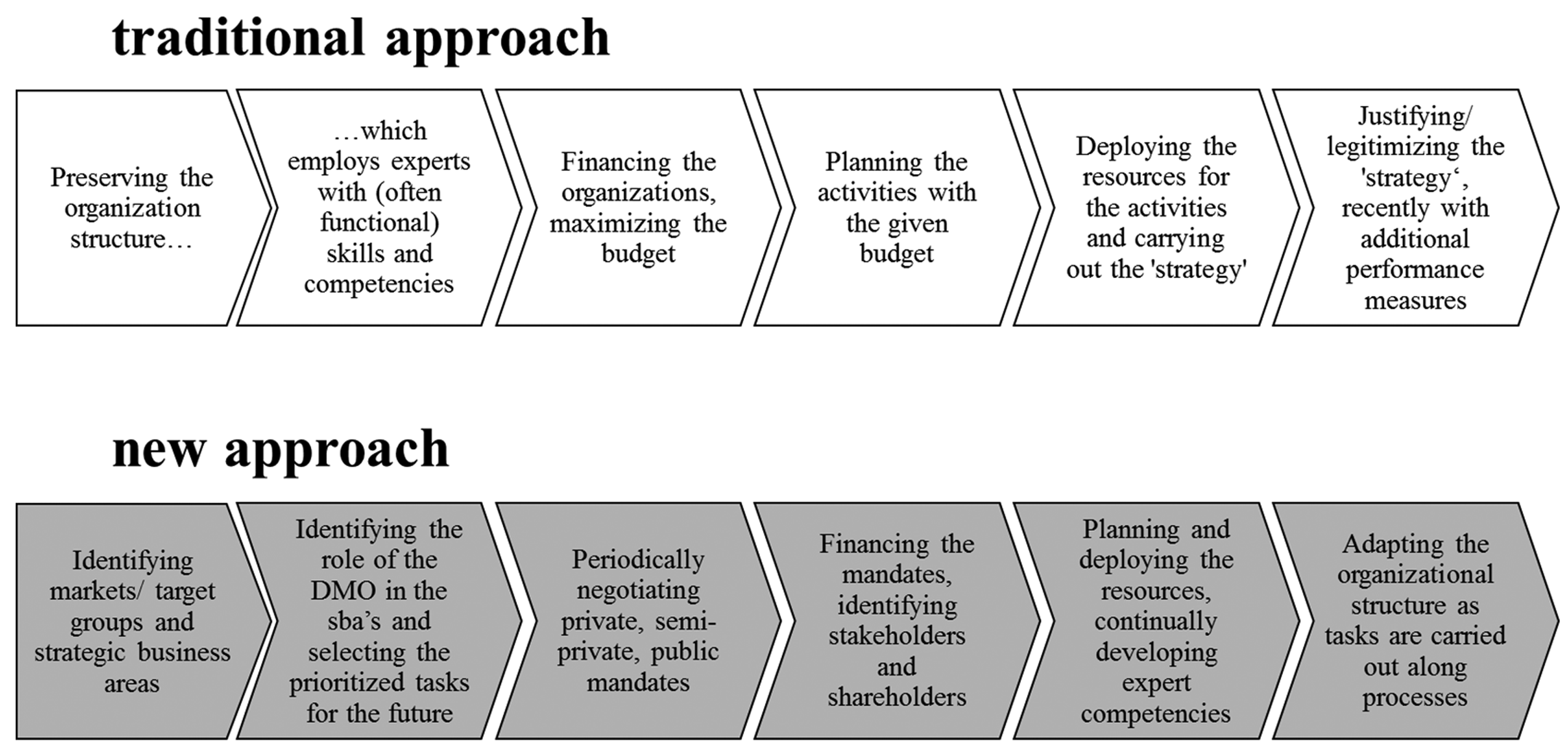
New versus traditional approach of understanding the DMO.
To achieve the new logic, it is necessary to shift four basic beliefs
from one territorial area to multiple strategic business areas;
from the DMO as an institution (one big pot) to the DMO as a synergetic combination of tasks, commissioned by the private and public sectors (stacking bricks that can be added or removed); and consequently,
from common ownership (the DMO belongs to everybody and serves everybody) to effective transactions and relationships (the DMO can only fulfill selected tasks, with a clear goal); and
from statistical opportunism to negotiated accountability.
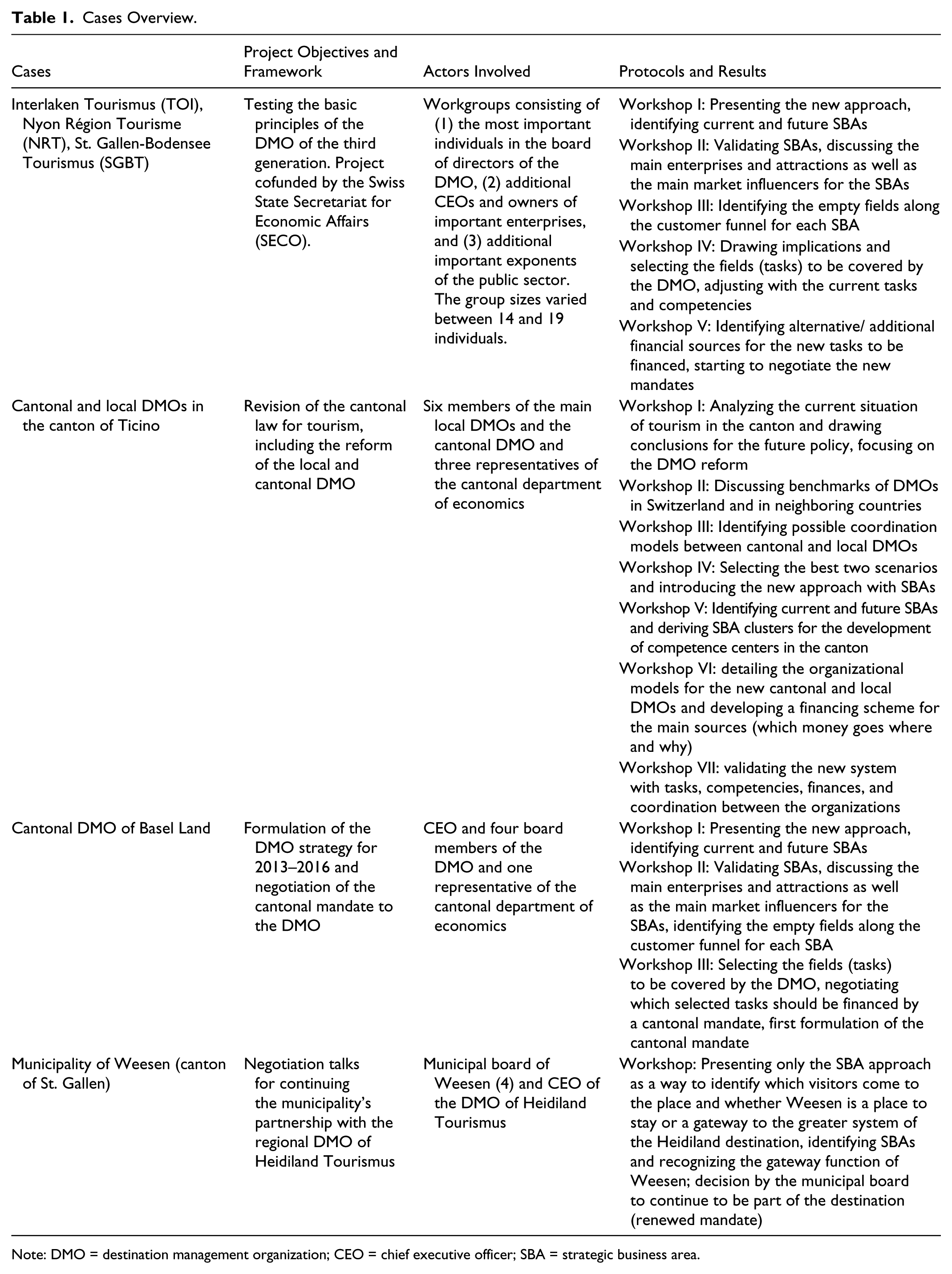
Table 1 summarizes the main aspects of four selected projects in which the principles have been applied. The work in progress follows an action-learning approach (McGill and Beaty 1992) and is therefore oriented toward a facilitation-based change of mindset of the various policy makers and decision makers in the destinations.
Cases Overview.
Note: DMO = destination management organization; CEO = chief executive officer; SBA = strategic business area.
From the geographic area to multiple strategic business areas
One of the most critical but powerful steps in the process was the identification of and the final overlapping of the SBAs on the map. In order to identify the current and future strategic business areas, the participants were asked the following questions: (1) Who? (Which tourists, what origin, how can we best describe them, what are their needs?) (2) What? (What do they do, and when; how do they spend their time and money?) (3) Where? (Where do they stay, from where do they come, and where do they go?).
The approach has its limitations. First, even if the participants were the most knowledgeable individuals of their communities, they could not know everything about the current and future SBAs. Second, the identified areas on the maps were rather fuzzy; that is, the real perimeters of stopovers and movements may look different. In addition, they may change, as activities and attractions could be added or disappear, or just because not all visitors do all the same things and follow exactly the same paths. Hence, the process was led under bounded rationality (Simon 1991). Nonetheless, consensus was always reached on the question of whether a current or future business area was of strategic importance and of which main activities and attractions it comprised.
Overlapping the SBAs on the map and discussing the pictures with the participants produced striking results. Figure 4 shows the overlapping SBAs for the destination St. Gallen-Bodensee (SGBT) in contrast to the traditional, territorial perspective. For the case of SGBT, the extension of the geographical scope of the DMO goes far beyond the previous destination boundaries and requires the organization to offer its services to tourist enterprises that are currently being supported by other DMOs.

Traditional territorial space versus variable geometry for the case of St. Gallen-Bodensee Tourismus.
The discussion of the variable geometry on the maps has facilitated strategic decisions in two ways. First, the participants easily recognized which places are nontourist places. This enabled them to be more selective and to depart from previous discussions on how to involve every single enterprise and organization in the wider area. For the representatives of the public sector, the pictures enabled them to increase the focus of their discussions. For tourism entrepreneurs, the discussions were more relaxed, because they recognized that they do not have to be involved in every business area and therefore they do not have to be part of every initiative. Second, previous mental territorial frames have been broken up. For all the cases, the participants considered it obvious to cooperate or even merge with neighboring DMOs, including actors who never thought to do so in the past. Indeed, the approach of variable geometry suggests cooperating with the neighbors only with regard to some specific SBAs. This allows a more relaxed access to the single issues, without questioning the existence of the DMO in the first place and without threatening the sense of local identity.
A special case of the above can be seen in gateways, which are defined as “entrances or arrival zones to the destination region and are located along inter-regional circulation routes. They may be sharply focused at a particular point along a route or involve a gradual transition from one destination to another” (Dredge 1999, p. 786). The concept of gateway matches the issue for the case of Weesen, where the municipal council, after three years of a mandate to the DMO of Heidiland Tourismus, needed to critically question the involvement in the destination, because, as so often, locals want to know if public money (in this case the municipal overnight tax) is being spent in the best way. Figure 5 shows the overlapping SBAs for Weesen, a small territory completely covered by the white areas. Note that east and northeast of the municipality, visitors enter Heidiland by railway or freeway access and that the destination continues along the lake of Walensee as well as South and North of Weesen.
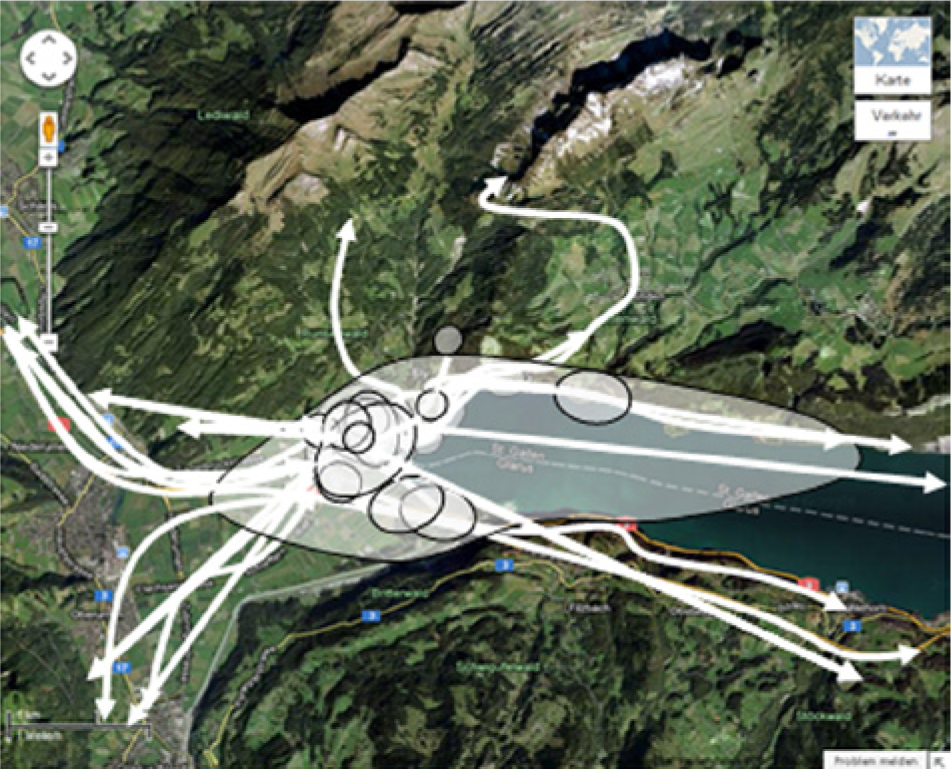
Weesen as gateway to the destination Heidiland.
From the pot to the bricks and from common ownership to effective transactions and relationships
Serving all SBAs is for a DMO not only impossible but also ineffective (even if there were enough resources). The real added value of the organization is, in line with its original scope, its fulfilling critical tasks that are provided by neither the public nor the private sector. In order to identify which tasks have already been fulfilled by others and which of the empty fields are of critical importance, we chose a simple viable approach using the scheme of the customer funnel (Lewis 1908), which was later enriched with the AIDA formula (attention–interest–desire–action) (Townsend 1924). The funnel steps included, in different degrees of integration, market analysis, supply analysis, product development, product commercialization, awareness, interest, desire, distribution, sales, and overall system functions (e.g., brand management, quality management). It was less important to exactly fill in all the fields with the correct answers than it was to provoke a differentiated discourse and to collectively agree upon which tasks were already fulfilled by other organizations (and consequently were redundantly fulfilled by the DMO in the past) and in return which tasks the DMO should better fulfill in the future.
Figure 6 presents an overview of a project with Baselland Tourismus (Basel area). Because of resource limitations, the DMO could not serve all 20 SBAs completely or even all of them for selected steps along the customer funnel (e.g., promotion or sales). In fact, every SBA has its own life cycle (Miossec 1977) and the life cycle stage implies a different role for the DMO. The table highlights in light gray the empty fields in need of action and in dark gray the prioritized fields (tasks) to be covered (fulfilled) by the DMO for the strategy period of 2013–2016.
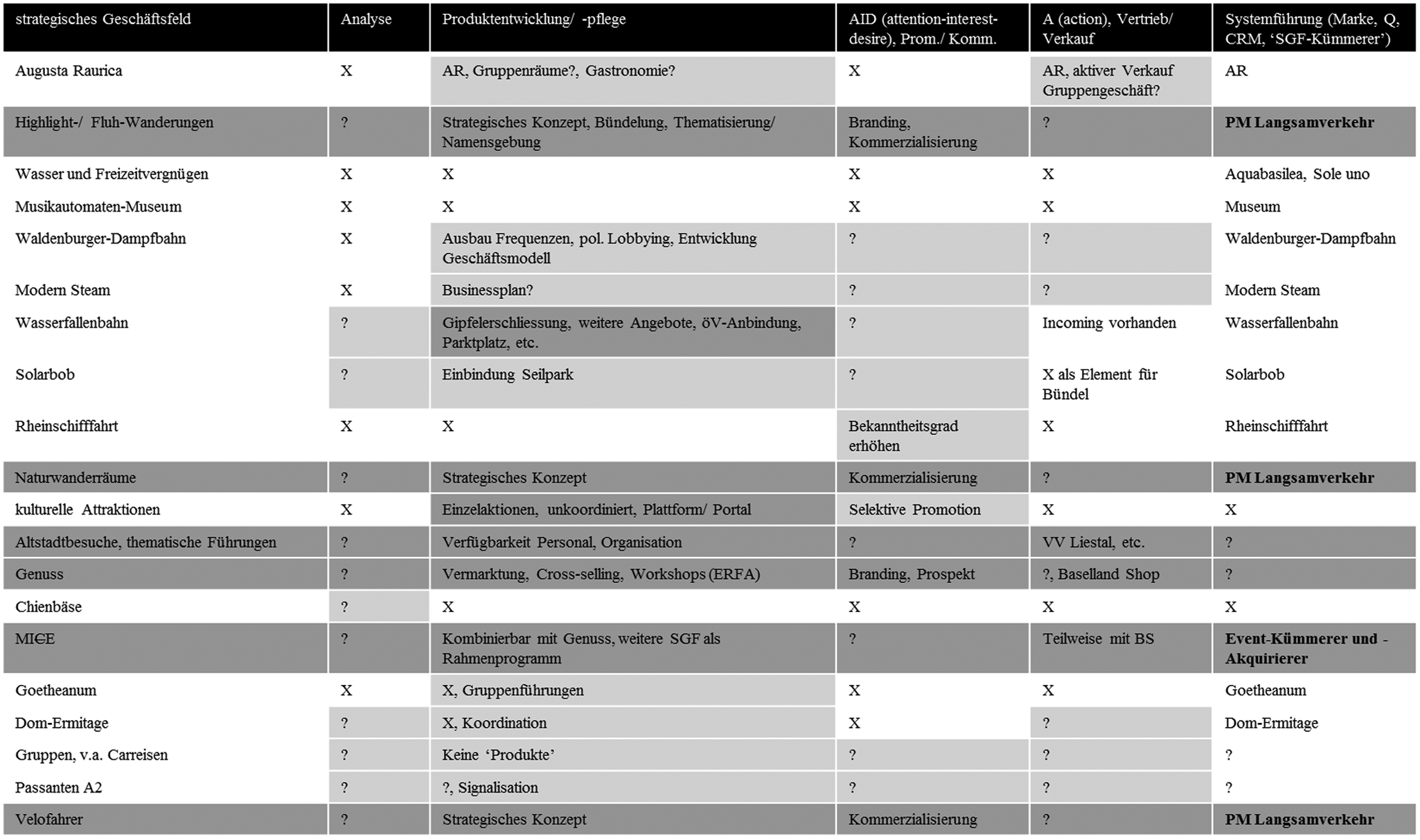
Selected tasks for the DMO of Baselland with the help of the customer funnel.
Obviously, beyond the mandates that could be derived for the prioritized tasks, a DMO (1) provides basic services such as basic information to the visitors, (2) has to be organized with back-office functions (accounting, information and communication technology [ICT], etc.), and (3) must be linked to the local and regional organizations and institutions, ensuring the lobbying and strategic planning function (Getz, Anderson, and Sheehan 1998; Presenza, Sheehan, and Ritchie 2005). Hence, for the case of Baselland Tourismus, in addition to the SBA-related tasks, researchers identified a basic information task package financed through the overnight taxes and two transversal projects, namely, (1) the development of a booking engine for small hotels and holiday homes and (2) the support for classification of those accommodation businesses, financed through the cantonal mandate.
With this approach, the DMOs could focus on tasks with the highest leverage effect for the whole region, financed by the actors and institutions that either profit in general (more publicly collected funds) or in particular (more privately financed mandates). As a consequence, the DMO’s role shifts away from an institution that must be preserved for the sake of the identity of the local population or for balancing the organizational power in the community to a synergetic combination of tasks, well endowed with respective financial resources and professional competencies. The more flexible these competencies are, the better they respond to the dynamic changes in the competitive environment of today and the higher is their value for the public institutions, particularly for the private enterprises in the destination. For example, the pilot projects have also triggered a collective mandate for a product manager for adventure travels as a new position in the DMO, financed by the local association of adventure hotels and tour operators in Interlaken. Similarly, in Nyon, the wine growers association decided to reallocate its promotional budget to the DMO, with a fully financed new product manager dedicated to culinary experiences and travels.
From statistical opportunism to negotiated accountability
As DMOs are financed through public or private funds, commercial activities, or collective mechanisms such as overnight taxes, they must be held accountable for the money they spend (Perdue and Pitegoff 1990). Since the 1990s, DMO effectiveness and the corresponding performance measurements have been conceptualized and operationalized in practice and have been the object of research. Some approaches have focused on input dimensions and have proposed defining a minimal budget size for specific tasks (Beritelli, Bieger, and Laesser 2009). As DMOs often focus on marketing tasks, measuring marketing effectiveness has been one of the key issues for demonstrating the organization’s effectiveness (Faulkner 1997; Pike 2012; Woodside 1990; Zhou 1997). More recently, promotion as well as digital sales and distribution through destination websites have become a further area for scrutinizing a DMO’s performance (Park and Gretzel 2007; Schegg et al., 2002). Yet, if the current state-of-the-art of destination marketing and communication was founded on a comprehensive, homogenized destination construct and if local, regional, and national destination websites combined all SBAs under one umbrella or on one platform, we must challenge the usefulness of many key performance indicators such as the number of addresses of potential visitors or key accounts gained at travel fairs, or the number of visits on the destination webpage, or even the total bookings generated on the destination website (just to name a few). In fact, those metrics all tend to evaluate dimensions that are (1) not directly and solely attributable to the DMO’s activities and/or (2) aggregated in a way that the reason for an increase or decrease of effectiveness must be further analyzed.
Let us expand on this by means of an example and assume there is an increase in visitors coming from a neighboring country coming into a destination, because of a favorable exchange rate and the simultaneous increase in accommodation capacities from a new resort built in that destination. If at that moment the DMO significantly shifts the marketing and promotion budgets for that market, it will be hard to prove the additional and therefore direct effect the organization has had in developing this given market for the destination. In addition, as a consequence, it will be hard to convince business partners to join in for the next round of cooperation, particularly because from their viewpoint, for some reason, the business seems to run well.
The situation described above virtually allows the DMO to make an arbitrary and opportunistic (1) choice of different measures, (2) allocation of the budget to different initiatives, (3) selection of key performance indicators, and (4) explanation of figures, and in so doing, eventually decreasing the trust and perceived usefulness of the organization among the numerous stakeholder groups. Just like the number of arrivals or overnights in a certain destination, the more recent and sophisticated sets of key performance indicators look at aggregated output dimensions at the end of the productive process, concealing the DMO’s contribution (Pike, 2012). The above-mentioned symptoms are well known in business research and relate to (1) the lack of objectivity in measuring marketing success, (2) the missing empirical connection between planning and performance, (3) the retrofit problem of reports, and (4) the inverse relation between self-assessment and performance, which overemphasizes the role of the benchmark in the class (Ambler and Kokkinaki 1997). Of course, DMOs are not immune to this trouble (Woodside and Sakai 2009).
In order to avoid the trap of measuring everything but the accountable, we propose to distinguish the effectiveness measurement of the DMO according to the activities accomplished and the knowledge gained for a specific SBA. In the end, every business will select metrics that reflect the primary interests of the accountable actors (Ambler, Kokkinaki, and Puntoni 2004). In implementing the DMOs of the third generation, we return to several basic questions: What is the reason for financing a particular task of the DMO? What do the funding partners specifically expect the DMO to do? How can we qualitatively and/or quantitatively measure the effectiveness of those tasks? The questions sound trivial but they rest on practical common sense and build on two fundamental assumptions:
Every DMO has to negotiate specific performance measurements for each task, because of different SBAs, different tasks along the consumer funnel, different funding mechanisms, and a different negotiating and bargaining process with the partners.
DMOs are not comparable to one another because they reflect the sum of all the distinct tasks and develop their own unique organization with unique capabilities and competencies.
As a consequence, DMOs should not be benchmarked against each other, with the aim of identifying the best in class, neither with the help of quantitative metrics (e.g., budget size, marketing spending per arrival/overnight) nor through qualitative dimensions (e.g., running a convention bureau, running a destination portal, developing its own brand). In fact, at best, benchmarking becomes a learning process for change (Xiang et al. 2007). For example, Baselland Tourismus has negotiated with the canton, which substantially finances the strategic business area of slow mobility, to perform the following four objectives:
development and promotion of four to six new itineraries for hiking, biking, and further nonmotorized vehicles with the integration of partner enterprises (e.g., equipment suppliers, rentals, hotels, restaurants);
corresponding communication and (where needed) sales portals per itinerary;
qualitative and quantitative control of product awareness in the region and in the bordering areas of Germany and France with the help of media analysis;
conducting a biannual survey of visitors along the itineraries, analyzing strengths and weaknesses and deriving improvement measures.
It is easy to assess the degree of fulfillment for each task. Performance measurement is straightforward and is directly based on the activities of the DMO, with little or no interference from other external factors or organizations. The surveys measure the proximate market success of the developed products and allow the DMO to adjust its target by objectively improving its effectiveness. In so doing, the DMO and the mandating partner have the opportunity to revise assumptions, objectives, and actions. This allows the evolution from an initially purely transaction-oriented approach to a mid- to long-term cooperative relationship.
A New Paradigm for Destination Management and DMOs
We think that the approaches described in the empirical cases already exist as fragmented initiatives in many places and regions. However, the systematic and consequent implementation requires a radical change in mindset. Hence, we conclude with a confrontation between what we see as a rather traditional approach of looking at the destination and the DMO and what may be a new paradigm.
Table 2 compares two perhaps extreme, and all the more contrasting perspectives. The traditional view implies a single and rather territorially confinable area usually with one destination image and one destination brand. This leads practitioners and researchers to analyze and plan the destination as one comprehensive construct. Furthermore, even acknowledging the existence of different markets and organizations and actors, the object of discussion and research is the whole destination in which all the elements and events are lumped together. We propose accepting the variety and multiplicity of SBAs and focusing on each single one, acknowledging that there may be different destination images because of different markets and, therefore, possibly different or differentiated brands. Essentially, through the new paradigm, we gain a practical, commonsense explanation of the claim that destination image is a multidimensional, segment-related, and dynamic construct (Gallarza, Saura, and García 2002). Thus, the level of discussion is not one territory but a productive flow of visitors, with its own competitive position, development phase, and specific organizations, institutions, and actors playing a duly active role. Strictly accepting the multiplicity of businesses in the destination forces the actors to uncouple the DMO from the destination. Indeed, the DMO simply cannot support all the steps along the consumer funnel for all the SBAs. Hence, the tasks must be more focused, serving institutions and partners willing to cooperate with the DMO. Finally, the new tasks eventually require a different, more direct funding mechanism, which allows a differentiated financial management with an effective activity-based costing. In the midterm, the DMO is capable of building new competencies because of well-endowed mandates that allow the employment of specialists. In the long term, the organization gradually changes, because of added, revised, or removed mandates, shifting along with the development of the SBAs it serves. Finally, the DMO enjoys higher acceptance, particularly among the mandating partners, an acceptance that is measurable not with aggregated output metrics of a certain territory or region but through the achievement and periodic revision of the negotiated tasks.
Traditional View and New Paradigm of Destination and the DMO.
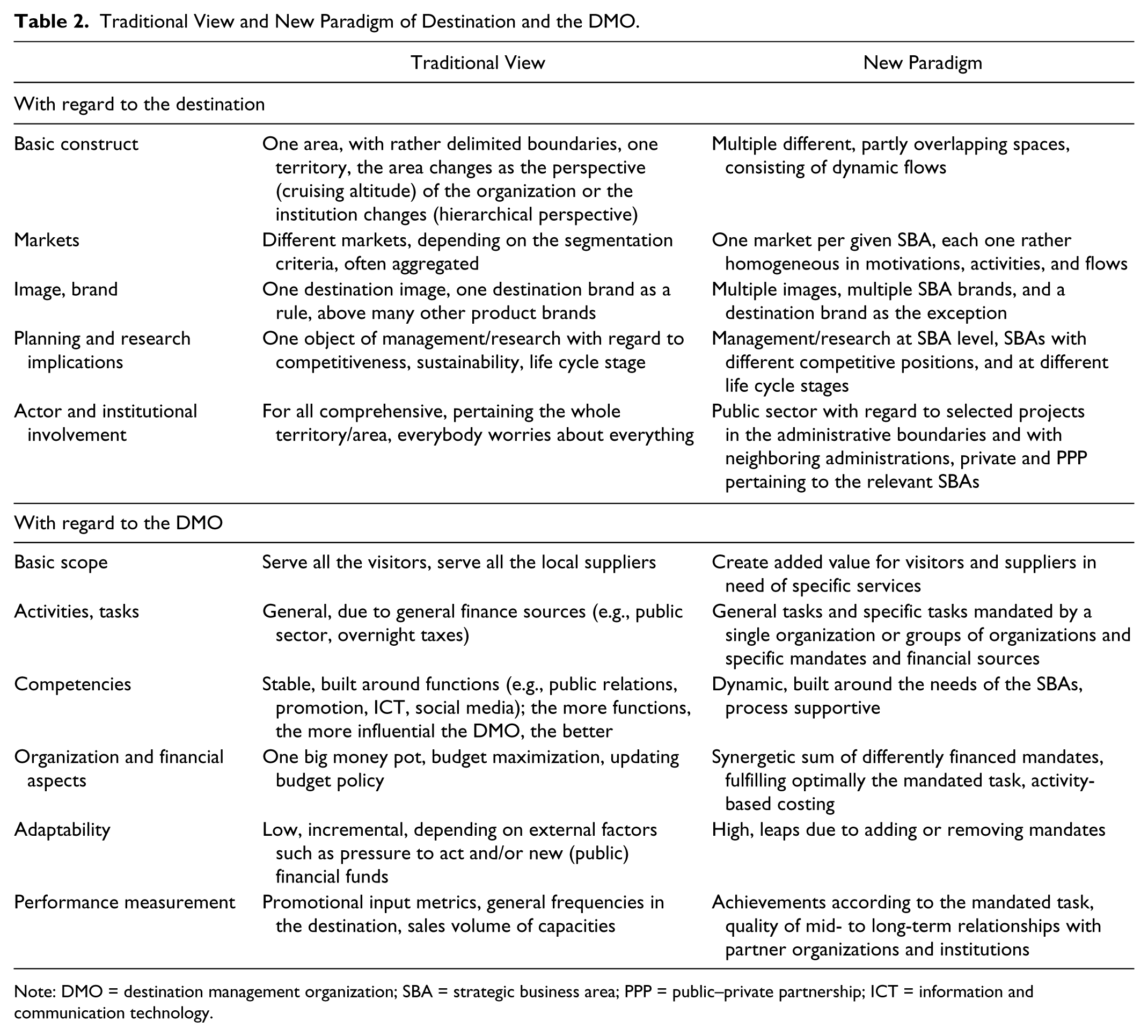
Note: DMO = destination management organization; SBA = strategic business area; PPP = public–private partnership; ICT = information and communication technology.
Coda
This study may be unsettling in two ways. On the one hand, the findings propose returning to basic concepts and ideas that were thoroughly discussed more than 30 years ago. Hence, it may sound like old wine in new caskets. But instead of creating a new, better, or improved concept, we have translated the basic features of those old foundations into a new viable approach for practice and for research. We think that without trying to turn back the clock, this contribution should remind us of how we could have alternatively done research and management around the idea of the tourist destination in the past decades and how they could be done in the future.
On the other hand, this study challenges a substantial body of literature on destination management, both concepts and models as well as empirical studies. It also challenges the work of many DMOs around the world. Indeed, in research and practice, the current understanding of the tourist destination is, at least implicitly, based on a single-construct framework. We deliberately deframe the tourist destination from its conventional boundaries. Yet, we intend to preserve the concept of the destination, because it is one of the main themes that still challenge us in the tourist industry. On both counts, we hope to have provoked the reader, as we think that particularly in the area of destination management we need new food for thought with greater target surface. Thus, we are very receptive to feedback and debate from the community.
Footnotes
Declaration of Conflicting Interests
The author(s) declared no potential conflicts of interest with respect to the research, authorship, and/or publication of this article.
Funding
The author(s) received no financial support for the research, authorship, and/or publication of this article.