



Abstract
This article aims at providing a theoretical framework for the practice of experience design in tourism drawing from a comprehensive review of literature from different disciplines relevant to tourism as a design context. Three fundamentals in tourism experience design are suggested: human-centeredness, iterative designing process, and a holistic experience concept as an outcome of designing. These call for four approaches to experience design in tourism: naturalistic inquiries and empathic design to target experience narratives, participatory design involving tourists at every stage of designing, integrative design research that include explorative, generative, and evaluative research as essential parts of designing, and the orientation of concepts and theories from multiple disciplines as applied to tourism contexts. Finally, tourism experience concept is elaborated into meta-concept, representing the value propositions of tourism destinations, and operational concept that allows for the orchestration of design elements within tourism destinations to allow for and facilitate desired experiences.
Introduction
Recent tourism literature places increasing emphasis on quality tourism experiences and sees experience as the essence of tourism. Likewise, tourism businesses pay more attention to the creation and management of quality experiences for tourists by placing tourism experience at the core of their products and services. From marketing and management perspectives, it is understood that a key to survive and excel in the increasingly competitive tourism market is to offer unique, differentiated products and services that lead to memorable experiences that add value for visitors. Indeed, the notable concepts of experience economy (Pine and Gilmore 1998) and entertainment economy (Wolf 1999) stress the importance of delivering meaning and value in consumer experiences, which requires tourism businesses to connect to tourists in a personal way to not only ensure customer satisfaction, but to create a deeper emotional attachment that results in customer loyalty. As tourism is often considered the biggest producer of experiences (Binkhorst and den Dekker 2009), there is a desire among tourism researchers and businesses to treat tourism as an experience production system (Sundbo and Hagedorn-Rasmussen 2008), wherein values and meanings can be designed and evoked through various contextual elements within tourism-related services and experiences (Diller, Shedroff, and Rhea 2008). This informs a consumer-focus approach to designing and delivering tourism experiences, often labeled as empathic design (Leonard and Rayport 1997; McDonagh 2006). Consequently, scholars have attempted to introduce the term experience design in tourism to guide research and business processes that place tourism experience at its core (Fynes and Lally 2008).
Experience design is gaining momentum in business literature, specifically in services research. There are three different ways how the term design has been approached in recent business literature: design as a unique proposition characterizing products and services, design as a state of mind (i.e., design thinking), and design as a process that governs the creation of new products and services (i.e., designing). First, because of the emergence of design consciousness among suppliers and consumers, design is often defined as value-added factors (e.g., aesthetics) to enhance the value proposition of certain products and services in order to form business identity and enhance the effectiveness of marketing communication (e.g., design hotels; Heide, Lærdal, and Grønhaug 2007; Strannegård and Strannegård 2012). According to Love (2002), design consciousness is a result of several factors: consumption is viewed as a heightened aesthetic experience rather than as material sustenance, the look and feel aspects of design is considered a compelling marketing element, and design has been considered a critical element in the strategic toolkit to maintain competitive advantage in the marketplace. The integration of aesthetic elements into products and services provides unique selling propositions and, in turn, increases brand value. Therefore, well-designed products are considered vital to the brand experience.
Second, the term design thinking implies that design is positioned as a pervasive practice within an organization where human-centered innovation can be attained through an integration of consumers, designers, and business managers in a collaborative environment. Design thinking refers to applying designers’ sensibility and methods to problem solving, which makes it a methodology for innovation and enablement (Lockwood 2010). In service design literature, design thinking is seen as an effective way to explore and define unarticulated problems associated with service delivery and to provide solutions to these problems in innovative ways. Third, business literature defines experience design as the development of experience-centric services (Zomerdijk and Voss 2010), where services are designed in such ways that service providers can connect to customers in a personal and memorable way through the creation and management of moments of engagements (i.e., service touch points). Most studies in this category suggest that the focus of experience design is to create new experience concepts through a careful construction of the service contexts to intensify engagement and emotional connections with customers. This implies experience design as a form of designing, whereby design is situated at the core of business processes and strategies to orchestrate all contextual elements, tangible and intangible, of service experience (Pullman and Gross 2004). Most of these studies focus on how service design tools can be applied to approach various situations within which services can be improved. Hence, the main argument of these studies lies in the applicability of design as tools and methods to ease the activities in the design process.
Design methods have been applied in different areas of services, especially those considered as experience-centric services such as entertainment (Martinson, Schwarz, and Vaughan 2002), health care (Bate and Robert 2006, 2007), hotel and restaurant (Lambert and Watson 1984), and public services (Karwan and Markland 2006). In tourism and hospitality, recent studies highlight the application of service design approach to tourism experience and utilize tools typically applied in service design research to explore and evaluate tourism experiences (e.g., Stickdorn and Zehrer 2009; Trischler and Zehrer 2012). For example, Stickdorn and Frischhut (2012) compiled various applied research utilizing mobile ethnography as a tool to capture and understand experiences in the tourism service design context. Lee, Tussyadiah, and Zach (2010) employ user diaries to capture and evaluate visitor experiences with a newly launched tourism attraction as a foundation to design better tour experiences in the destination based on consumer-driven innovation strategy. Trischler and Zehrer (2012) apply service design tools such as user personas and service scenarios to stage relevant experiences for different visitors in theme parks. The emphasis of these studies is on the use of design tools to explore, observe, and understand visitor experiences, identify and solve problems arising from these experiences, and design for better experiences.
Another stream of research integrating experience design in services and tourism focuses on user experience with technology-assisted services. These studies are informed by a user experience design (UXD) approach in computer and information systems research referring to user-centered design for a given computing system, which may include user interfaces, graphics, physical interactions, etc. Typically, UXD involves traditional methods within human–computer interaction (HCI) research to evaluate experiences with computing technology as perceived by the users. In business literature, principles of UXD are applied to the designing of e-service platform (e.g., Liu, Shen, and Liao 2003). In tourism, based on patterns identified from a rich set of data collected from visitors using experience-based survey and ethnography, Tussyadiah, Fesenmaier, and Yoo (2008) suggest a framework to design tourists’ interactions while experiencing tourism destinations, which include mobile-mediated interactions between tourists and others in the same physical space (people, artifacts, etc.), mobile-mediated interactions between tourists and social networks elsewhere, and interactions between tourists and mobile technology itself (i.e., HCI) through the use of different travel-related applications (this will be presented as a case study in this article).
Even though different terminologies are used to explain these approaches to designing services (i.e., service design, user experience design, customer experience design, etc.) and the outcomes of experience designing process in services are varied, it is apparent that the focus of experience design research is to create quality experience for consumers, which implies the need for service providers to work closely with consumers to better understand their experience and to validate different service scenarios created through an iterative process. This highlights the importance of consumer engagement and participation in the designing of experiences. Furthermore, these studies are multidisciplinary in nature. Even though efforts were made to create a guideline to universally applied design principles and methods (e.g., Lidwell, Holden, and Butler 2003 ; Martin and Hannington 2012), experience design practice typically integrates various concepts, methods, and theories relevant to the contexts of the study. Consequently, considering the relevance of experience design in the context of tourism, it is important to provide a clear definition of and framework to experience design research as it applies to tourism domains to guide a critical orientation of theories to explain this new approach in tourism. In order to enrich and ensure rigor in tourism experience design (TED) research, this study presents a comprehensive analysis of design research theories and practices towards a unified cross-disciplinary body of theory for TED research. Experience design is elaborated from the theoretical standpoint to define design, designing, and design research in tourism and from the practical point of view to explain the notion of experience designing as practically relevant research approach to tackle issues and problems with visitors’ experiences in order to enhance the experiential profiles of tourism destinations.
Design, Designing, and Design Research
The word design is common enough to attract interest among scholars and practitioners, but it has been considered full of incongruities and lacks boundaries that give it clarity and definition (Heskett 2005). Indeed, design occurs in many different contexts and different domains of practice, which creates ambiguities regarding its meaning (Cruikshank 2010). Scholars agree that there is lack of agreement regarding terminologies and core concepts of design (Ralph and Wand 2009), which contributes to the lack of unified body of theory in design research (Love 2002). The term design is used rather loosely. Sometimes it is used as a noun, as a verb, as an adjective, and as an adverb; each of these refers to a different concept (Love 2002). Heskett (2005) illustrates the use of the word design in an English sentence: “Design is to design a design to produce a design.” The first design refers to design as a general concept, the second to an activity, the third to a plan or an intention, and the fourth to a finished outcome or a product. It is noteworthy that design as a plan is distinct from design as an outcome (e.g., an artifact, a system). To some extent, it can be understood that the product of designing (i.e., a plan) is devised in the absent of artifacts, while the product of a plan typically manifest in artifacts (tangible or intangible). The following define design as a plan: “Design”—a noun referring to a specification or plan for making a particular artefact or for undertaking a particular activity. A distinction is drawn here between a design and an artifact—a design is the basis for, and precursor to, the making of an artefact. (Love 2002, pp. 356-57) [Design is] a specification of an object, manifested by some agent, intended to accomplish goals, in a particular environment, using a set of primitive components, satisfying a set of requirements, subject to some constraints. (Ralph and Wand 2009)
To provide a clear distinction between the noun form and the verb form of design, scholars use the term designing to refer to the intentional human activities that result in a design. “‘Designing’ [is a] human activity leading to the production of a design” (Love 2002, p. 357). Ralph and Wand (2009) propose a conceptual model of designing (i.e., design as a verb) as an activity enacted by an agent that results in specification of objects based on the agent’s initial intentions, the type of object to design, and the intended environment. Along the way, the goals, the primitives (i.e., the set of elements from which the design object may be composed), the requirements (i.e., a structural or behavioral property that a design object must possess) and the constraints (i.e., a structural or behavioral restriction on the design object) will emerge or change, implying that the process of designing might evolve as more information is acquired (Ralph and Wand 2009). Further, it is also suggested that designing must involve the production of a design, in that the activities of collecting and analyzing information prior to the creation of a design are distinct from designing (Love 2002).
Scholars also suggest the different categories explaining the object of designing. Alexander (1964) argues that the ultimate object of designing is forms (material objects), while Simon (1969) asserts that design involves actions aimed at changing existing situations into preferred ones. Love (2002) suggests nine areas where design theory can be applied: human, object, concept, and interactions between and among any of these three (e.g., interaction between human and human, interaction between human and object, and so forth). Further, Ralph and Wand (2009) identify six classes of object in designing: physical artifacts (e.g., hotels, resorts), processes (e.g., business workflows), symbolic systems (e.g., programming language), symbolic scripts (e.g., essays, software), laws, rules, and policies (e.g., building code), and human activity systems (e.g., universities, hospitals, artistic productions). In early tourism literature, design and designing has been attributed to the area of tourism planning and development, specifically addressing design specification in the development of facilities and infrastructure to accommodate tourist activities. For example, Mills (1983) and Gunn (2002) provide design criteria for building arrangements in resort development to induce desired forms of relationships among visitors (i.e., groupings of buildings to stimulate more social interactions and vice-versa) for optimum experiences. Gunn (2002) suggests the term design in tourism site planning (e.g., attractions and facilities planning) mainly to increase the aesthetic appeal of tourism destinations and to enhance the affordances of these facilities to sustain the intended tourism activities. While these design references are given to physical artifacts as the object of designing, the intended outcomes of designing are associated with human behavior (e.g., patterns of interactions) resulting from the use of these artifacts. More recently, tourism scholars also pay attention to design as an “applied art” in the development of tourism facilities such as design hotels (Heide, Lærdal, and Grønhaug 2007; Strannegård and Strannegård 2012) and the functionalities of tourism information channels, such as brochure design, destination website design, etc. (e.g., Getz and Sailor 1993; Kim and Fesenmaier 2008; Morrison, Taylor, and Douglas 2004).
The next important concept is design research and how it is situated in different disciplines, as it is associated with design practice. Initially, design research emerged as an approach to study of and into the process of designing. Indeed, many articulate design research as the study of design and the process of knowledge production that occurs through the act of designing (e.g., Biggs 2002; Laurel 2003; Fallman 2007; Koskinen et al. 2011). However, Faste and Faste (2012) argue that design research conducted by academics and that by design practitioners are drastically different. Therefore, they offer two different points of view to understand design research: design research as “a type of research” and research as a part of designing, even though they later argue that the second point of view is the right way to define design research. From the first point of view, design research is framed as varieties of practice-based or applied research, as they are realized through the practice of designing. Further, while traditional research outside the realms of design typically employs deductive or inductive reasoning, designing require a third kind of logic called abductive reasoning. Abductive reasoning is defined as a form of logical inference that goes from data description to a hypothesis that accounts for the reliable data and seeks to explain relevant evidence, an inference to best explanation or best guess (Poole 2000; Thagard and Shelley 1997). Hence, design research values the creation and generation of new knowledge (Faste and Faste 2012; Kimbell 2012). Second, design research is conducted as a part of designing process, where data and information generated from research activities are used to guide the designing process. Faste and Faste (2012) identify three areas of design research as a part of designing: (1) empirical design research to explore and define users’ needs, (2) research as part of iterative prototyping of forms and experiences to determine their usefulness and usability, and (3) research applying theoretical or critical design approaches as interventions into cultural discourse and practice. In other words, design research can be seen as activities that are distinct but inseparable from designing.
In the context of tourism and hospitality services, the approach to design, designing, and design research is articulated in service design and experience design approaches. The term service design was brought for in the literature on services marketing and management as innovative consumer-centered approach to service development (Edvardsson et al. 2000; Zeithaml, Parasuraman, and Berry 1990) and it gained momentum when the design discipline started to have an interest in it. Today, service design has emerged as a cross-disciplinary research interest situated in management, operations, design, engineering, and the social sciences. Stickdorn and Schneider (2010) argue that service design is an emerging and evolving approach such that giving it a single definition may constrain its further development. However, to provide a cohesive understanding of service design, the following definitions can be consulted: Service design is designing for service as conceiving of, iteratively planning and constructing a service system or architecture to deliver resources that choreograph an experience that others design. (Evenson and Dubberly 2010) Service design aims at designing services that are useful, usable and desirable from the user perspective, and efficient, effective and different from the provider perspective. It is a strategic approach that helps providers to develop a clear strategic positioning for their service offerings. Services are systems that involve many different influential factors, so service design takes a holistic approach in order to get an understanding of the system and the different actors within the system. (Mager and Sung 2011)
Generally, designing services is a matter of looking into services from the outside-in perspective starting from the customers (Holmlid and Evenson 2008). Further, designing services involves designers co-creating problems and solutions in an exploratory, iterative process and approaching issues at hand. As an outcome of designing, Shostack (1982, 1984) suggests a visual representation of service design called service blueprints, which represent customers’ encounters with service personnel and line of visibility throughout a service experience. Likewise, others also suggest points of interactions between customers and service evidence (Bitner, Boons, and Tetreault 1990) or touch points, “moment of truth” (Normann 1991), and service clues (Carbone and Haeckel 1994; Berry, Wall, and Carbone 2006) as important elements in service design. Lastly, the development of service concept in service designing is suggested (Goldstein et al. 2002), which is understood as a mental picture of service (i.e., service in the mind) held by customers, service personnel, and designers (Clark, Johnston, and Shulver 2000). It is suggested that service concept mediates between customer needs and the strategic intent of service providers (Goldstein et al. 2002).
A direct application of service design in tourism can be problematic because of the nature of tourism experience that is not fully comparable to services. Tourism involves a wide array of services from airlines to accommodation to entertainment, but it also involves exploration of places that enables tourists to interact with objects (e.g., sceneries), people (e.g., locals), and other resources in tourism destinations that cannot be categorized as services. As a result, design elements such as service touch points and customer journey as stand-alone design elements may be too simplistic to apply in tourism. Hence, experience design can be a better-fitting approach to designing tourism experiences. Experience design is broadly defined as a practice of designing products, services, processes, events, and environments with a focus on the quality of the user experiences; a deliberate, careful creation of a total experience for customers (Shedroff 2001). Similar to service design, designing for experiences means creating and staging the prerequisites that enable consumers to have desired experiences. However, a great emphasis is on the human-centric approach to designing and, thus, the use of disciplines in psychology, ethnography and cultural sciences, linguistics and information sciences, and other social sciences to explain human behavior and experience as a basis of designing. Another notable approach to experience design in services is termed experience-based designing (EBD) (Cain 1998). EBD has been widely applied in public services, particularly in health care services to develop patient-care systems (Bate and Robert 2006). It is argued that EBD applies a fundamentally ethical approach to designing because of the emphasis on understanding users’ experience as their reactions to and interpretation or perception of any interactions with services and using this understanding to the designing and redesigning of services in order to enhance user experiences. EBD acknowledges that experiences can be influenced by a multitude of complex factors, which, to a greater extent, reflect the ways human beings react to the world around them (Bate and Robert 2007). In other words, EBD places importance in the intrinsic humanness of service users. A comprehensive review on theoretical foundation for TED will be presented in the following section and, subsequently, a foundation for designing and design research for TED will be provided.
Theoretical Underpinnings for Tourism Experience Design
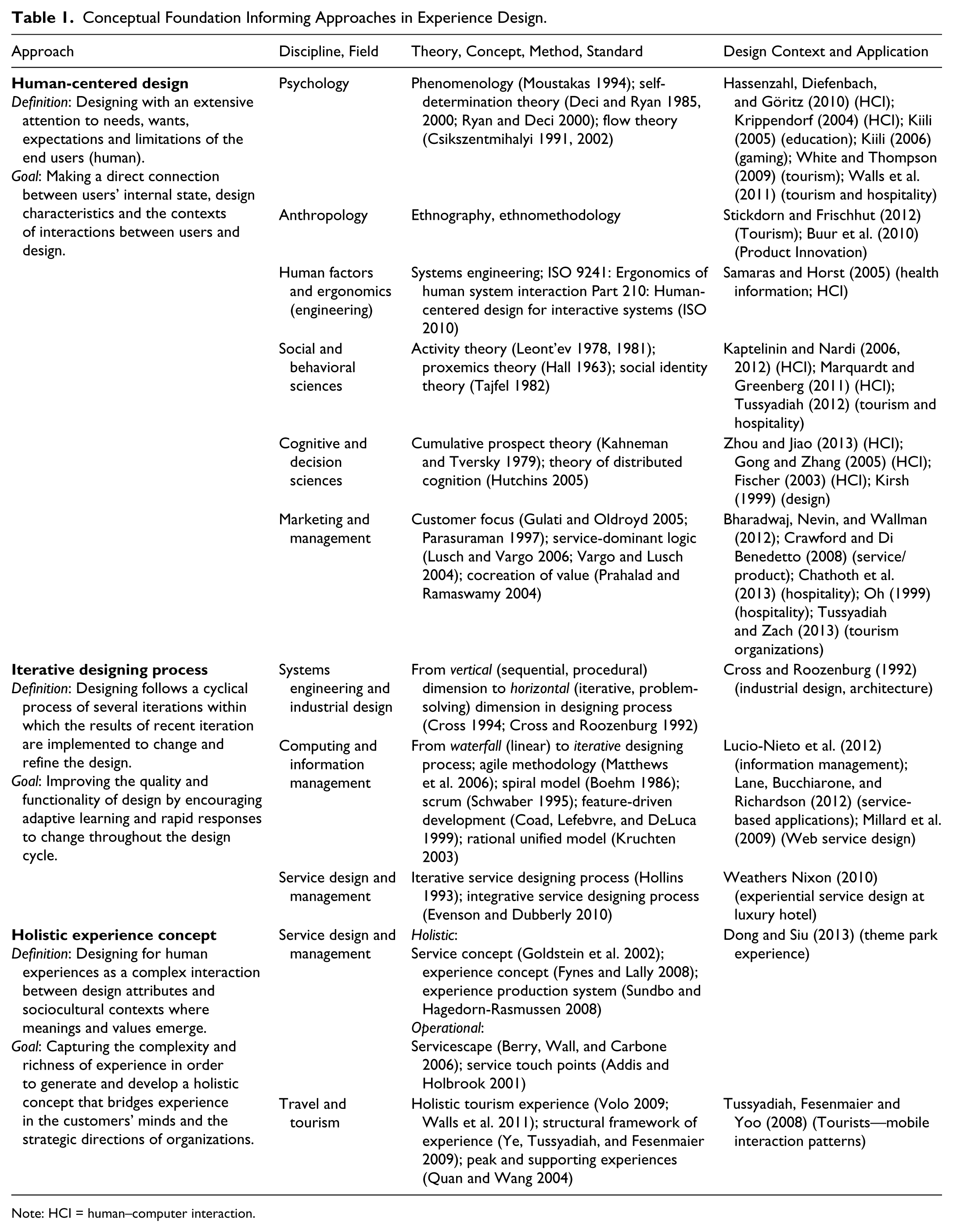
A comprehensive review of literature in different disciplines as they apply to experience design point toward these three fundamental approaches: the human-centered approach to designing, the designing as iterative processes, and the holistic experience concept as an outcome of designing. The theories and concepts in literature emphasizing these three approaches to designing experiences are summarized in Table 1.
Conceptual Foundation Informing Approaches in Experience Design.
Note: HCI = human–computer interaction.
First, as an emerging approach, experience design is associated with a great emphasis on understanding the experiences of end users. The terms human-centered design (HCD), user-centered design (UCD), and empathic design are often used to emphasize the designing process in which the needs, wants, expectations, and limitations of the end users are given an extensive attention at every stage of designing. HCD is based on the idea that designers do not design things/objects (i.e., products, services, environments, etc.) but the users’ experience with these. In other words, a direct connection should be made between a user’s internal state with the characteristics of the design and the context within which the interaction between users and designed products/services/systems occurs (Hassenzahl and Tractinsky 2006). In the context of tourism, it is argued that designing for tourism experience is not a matter of creating a tour package or staging a theme park, it is designing the experiences tourists will have with the tour and at the park, which typically include experiences associated with the senses, cognition, emotions, affect, and other values and situated in different tourism contexts. Hence, it is important for designers to empathize with the end users, to identify with their thoughts and feelings, their motivations, emotional and mental models, values, priorities, preferences, and inner conflicts (Fulton Suri 2003), to be able to gain intimate insights and understanding into their experiences (Thomas and McDonagh 2013).
Human-centered approach in product design typically bases its theoretical underpinnings from psychology, anthropology, and social and behavioral sciences to understand users’ needs, behavior, and activities resulting from their use of and interactions with the products. User-centered approach in the context of computing technology draws from theories in human factors and ergonomics (HF&E) within engineering as well as cognitive psychology literature, even though theories from anthropology and social sciences are increasingly integrated into HCI studies. Marketing and management literature places a great emphasis on “customer focus,” suggesting that companies that understand the entire spectrum of customer experience and then design and deliver their products and services against it will generate customer satisfaction and loyalty.
Experience design research in different contexts uses phenomenology to capture human experiences (Moustakas 1994), based on the idea that experience is a complex concept, an “in-relation-to” a phenomenon, and is defined by the qualities of directedness, embodiment, and worldliness, which is evoked by the state of “being-in-the-world” (Langdridge 2006). Experience design literature emphasizing on HCD draws on psychology literature to explain the intrinsic needs and motivations of individuals to interact with, use, and experience the designed objects and/or systems. Self-determination theory (Deci and Ryan 1985, 2000; Ryan and Deci 2000) is utilized as a ground to explain and integrate users’ intrinsic motivation to design systems that can stimulate and transform users’ behavior and experience (designing for systems to induce learning, to promote physical exploration of the surroundings, etc.). Literature on HCD also draws on flow theory (Csikszentmihalyi 1991, 2002) to assess optimal experiences based on an understanding of a balance interaction between users’ skills and challenges offered within the designed systems to induce engagement. In the context of tourism, self-determination theory has been applied to understand tourists’ motivation and behavior in terms of tourism consumptions (White and Thompson 2009), drawn from earlier literature on pull–push motives for tourists (e.g., Crompton 1979; Dann 1977, 1981). Furthermore, flow theory has been widely cited to explain tourism experiences (e.g., Tussyadiah and Fesenmaier 2009; Walls et al. 2011). More recently, Pearce and Packer (2013) suggest new links from psychology and tourism, which address the mental processes and embodied actions of tourists on the move associated with motivation and decision, satisfaction and memory. This signifies future application of theories within psychology as a basis for TED.
Literature on HCD is dominated by the integration of qualitative research methods from anthropology (i.e., a study on human behavior with its emphasis on in-depth investigation of context) in order to ground the designing in the needs of users, their environments, and their cultures. Ethnography is increasingly utilized to study users in their natural environments and use-contexts to gain rich descriptions of their experience. Lately, video ethnography (i.e., video recording of users’ activities in their natural settings), a type of visual ethnography (Pink 2006), typically involves observation and video interpretation, and mobile ethnography (i.e., letting users record their behavior using their mobile phones), a type of autoethnography (Ellis, Adams, and Bochner 2011 ), have been gaining popularity in applied ethnography for design research due to advancement in digital technologies. A few of these ethnographic studies are specifically conducted as part of design research for TED (Stickdorn and Frischhut 2012).
Other theories in social and behavioral sciences that have been used in the HCD literature include activity theory (Leont’ev 1978, 1981), proxemics theory (Hall 1963), and social identity theory (Tajfel 1982), among others. Activity theory (AT) is a descriptive meta-theory or framework to explain the structure, development, and context of human activities (Kaptelinin, Nardi, and Macaulay 1999). AT is based on two foundational concepts: (1) unity of consciousness and activity (i.e., the human mind can only be understood in the context of people’s interaction with the world) and (2) social nature of the human mind (i.e., human activity is situated in and shaped by social and cultural context) (Kaptelinin and Nardi 2006, 2012). In design research, the application of AT lies in the framework of activity system, which consists of five basic concepts (Kaptelinin, Nardi, and Macaulay 1999; Kaptelinin and Nardi 2012): object-orientedness (i.e., human activity is always directed toward an object), activity hierarchy (i.e., an activity can be deconstructed into actions and lower-level operations), internalization and externalization (i.e., internal, mental activities and external activities transform and influence each other), mediation (i.e., human activities are mediated by rules, artifacts, etc.), and historicity and development (i.e., activities change and develop over time). It is argued that the design of an activity system should consider all five concepts. AT, specifically the concept of subject–object interaction, has been widely applied in HCI research (Kaptelinin and Nardi 2012), including activity-based computing design, interaction design, and designing for computer-mediated experiences. In the context of travel and tourism, Chang (2009) utilizes it as a foundation to explain tourists’ use of WebGIS for recreation and tourism information search.
Hall (1963) coins the term proxemics to explain interpersonal spatial relationships between individuals. It explains people’s use of space around them and how it influences interaction and communication with others. It is argued that people often use nonverbal communication, such as body language and orientation, to indicate privacy. Proxemics theory has been applied to the designing of human–human interactions in the context of architecture and urban design (i.e., building arrangements), interior design (e.g., Thompson 2012), and environments supporting technology-mediated interaction (e.g., Ballendat, Marquardt, and Greenberg 2010 ; Marquardt and Greenberg 2011). In tourism research, Tussyadiah (2012) refers to proxemics theory to explain tourists’ territorial behavior mediated by location-based social network applications on smartphones (such as Foursquare and Facebook places) to secure access to resources attached to particular establishments (such as deals and promotions) at tourism destinations. The use of social identity theory (Tajfel 1982; Tajfel and Turner 1986) as a foundation of designing has been found in HCI and social network research. It suggests that membership in a group creates a psychological state that confers social identity (Tajfel 1982). The theory also suggests self-categorization, a process that emphasizes similarities between individuals affiliated with the same group and differences to those in different groups (Turner 1982). In service design and user experience research, the theory provides a foundation to explain experience as a social act and services as a sociotechnical system in which multiple users can be involved and interact with multiple resources while experiencing services. Social identity influences people’s experience and behavior as it addresses issues such as conformity, normative behavior, stereotype and prejudice, leadership, etc., which are relevant to the designing of complex systems.
Another stream of theories supporting HCD in designing for experiences comes from the cognitive and decision sciences, such as utility theory and prospect theory (Kahneman and Tversky 1979). Integrating the aspects of users’ cognition and emotion in designing, Zhou and Jiao (2013) apply cumulative prospect theory under two affective conditions to represent users’ cognitive tendency and affective influence as a basis to provide an interconnected mix of design elements that generate pleasurable experience for users. Another notable theory is distributed cognition (DCog) (Hutchins 1994; Norman 1993), which emphasizes that cognition is embodied, enculturated, situated in local interactions, and distributed or stretched across humans and artifacts (Nersessian 2006). In contrast to traditional cognitive science that views artifacts as scaffolds to cognition, DCog sees cognition as “an emergent property of interactions between an individual and the environment through perception and action rather than a property bounded inside an individual” (Liu, Nersessian, and Stasko 2007, n.p.). DCog has been applied as a descriptive and explanatory framework to investigate how artifacts, tools, and sociotechnical environments can be designed and evaluated to empower users (Fischer 2003; Kirsh 1999).
In engineering literature, HF&E studies the design of artifacts and systems that fit the human body and its cognitive abilities and focuses on optimizing users’ well-being and system performance. It is argued that human factors should be integrated earlier in the design process, namely, at the conceptual phase of designing, and continued at every stage of systems designing (i.e., preliminary, detailed, and final; Feigh et al. 2011), which is often referred to as human-centered systems engineering. The infusion of human factors into systems design typically evolves into development of design specifications that generate design standards and guidelines. In the context of HCI, for example, the International Organization for Standardization (ISO) has issued ISO 9241, a standard in ergonomics of human system interaction, with Part 210 specifying on human-centered design for interactive systems (ISO 2010).
From marketing and management perspectives, human-centeredness is rooted in the importance of customer focus as a basis for meaningful differentiation in organizations’ offerings to achieve competitive advantage (Gulati and Oldroyd 2005; Parasuraman 1997). Consumer-focused organizations are often characterized as those able to translate consumer input into innovative products and services (Rust, Moorman, and Bhalla 2010). One of the methodologies suggested in business literature is voice of customer (VOC) to understand customer needs that may reveal innovative ideas for product or service development (Bharadwaj, Nevin, and Wallman 2012; Crawford and Di Benedetto 2008). Further, the concept of service-dominant (S-D) logic (Lusch and Vargo 2006; Vargo and Lusch 2004) asserts that value is no longer embedded in tangible offerings, but is cocreated with customers through meaningful interaction experiences with services (i.e., cocreation experiences) (Prahalad and Ramaswamy 2004). Therefore, service design focuses on engineering service encounters to optimize the value of user experience and his/her memories after the completion of the service use based on the fundamental behavioral science principles underlying human interactions (Cook et al. 2002). S-D logic and the concept of cocreation experiences have been integrated in tourism and hospitality research (e.g., Chathoth et al. 2013; Tussyadiah and Zach 2013), suggesting its relevance for further consideration in TED research.
Second, the conceptual framework for experience design concerns with the designing process, including the position of design research in designing. From the early 1960s, a consensus model was developed in the field of engineering design to provide a stricter theoretical background and a more systematic approach to engineering design and development projects (Maffin 1998). The consensus model describes the designing process as a sequence of activities consisting of four phases: clarification of the task, conceptual design, embodiment design, and detail design, leading up to immediate results, which include performance specification, function structure, principal solutions, concept, preliminary layout, definitive layout, and documentation (Cross 1994; Cross and Roozenburg1992). It is further suggested that the model uses a systems engineering approach where the designing project is structured in two dimensions: the vertical dimension corresponds to the origination phases in the life cycle of the product (feasibility study, preliminary design, detail design, etc.) and the horizontal dimension corresponds to the problem-solving process that occurs in the different phases in the vertical dimension (analyzing and defining problems, synthesizing solutions, etc.) (Cross 1994). However, Cross and Roozenburg (1992) assert that many practitioners tend to overlook the horizontal dimension of the designing, which is associated with design research, and pay more attention to the vertical one (i.e., emphasizing the stages of activities that have to take place). Further, Cross and Roozenburg (1992) compare the engineering design model to that of architecture and industrial design, highlighting that while early design models in architecture are similar to engineering design models, distinctions started to emerge in 1970s. Particularly, designers have recognized that (1) design problems are typically ill defined (i.e., often referred to as wicked problems), (2) presuppositions are important as the origins of solution concepts, and (3) designers and other participants need to refine their understanding of problems and solutions in parallel (i.e., a conjecture–analysis cycle). Hence, the attention of the architecture and industrial designers has shifted from the vertical (i.e., sequential, procedural) dimension to the horizontal (i.e., iterative, problem-solving) dimension, implying that the systems engineering model is more prescriptive while the industrial design model is more descriptive (Cross and Roozenburg 1992).
Similarly, in the area of HCI, an emphasis has been made to move from a linear process (i.e., also termed as waterfall design process) to an iterative process in designing. In the waterfall process, the requirements for the design are specified at the beginning to guide a sequential process where the completion of one phase starts the next. The criticism over the waterfall process focuses on the high risk associated with the time needed to complete the designing process before testing the final design prototypes with potential users and the difficulties in knowing exactly what the design requirements and limitations are before the designing process is completed. Consequently, a cyclical process that includes several iterations of prototyping, testing, analyzing, and refining the designed products or systems is suggested as a better methodology. It is argued that capturing and confronting the unpredictable nature of user needs early in the designing process can lead to a better understanding of possible issues with user experiences before a concept is further developed. Agile methodology (Matthews et al. 2006) is also widely applied in software design by combining iterative and incremental approaches that promote adaptive learning and encourage rapid and flexible responses to change through collaboration and interactions with users throughout the development cycle. Recently, Céret et al. (2013) propose taxonomy of design methods process model and suggest that many process models claim to be iterative. These include the spiral model (Boehm 1986), scrum (Schwaber 1995), feature-driven development (Coad, Lefebvre, and DeLuca 1999), rational unified model (Kruchten 2003), and many more. These iterative designing processes have been applied in computing and information technology fields to design for information management services (Lucio-Nieto et al. 2012), service-based applications (Lane, Bucchiarone, and Richardson 2012), and other web services (Millard et al. 2009). Finally, it is suggested in these studies that design research is integrated in the entirety of designing process as information gathering (i.e., typically through observation and user testing) and analysis processes are situated in all iterations of the designing stages.
In service design, designing for services is also understood as a cyclical process that includes an integrative design research. Hollins (1993) argues that the designing process in services must be subjected to continuous improvement and that the designing of a service involves iterations of different stages from service design specifications based on market requirements to detail design and implementation. Evenson and Dubberly (2010) suggest five stages in an integrative service designing: observe (i.e., immersion in the context and/or community), reflect (i.e., creating the model of what the service system may be like), make (i.e., designing the service system), socialize (i.e., creating the network for uptake), and implement (i.e., bringing the system to life). Each of the stages in service designing is associated with different design research approaches, each contributing to the others (Evenson and Dubberly 2010). An exploratory research process to understand user needs will inform the early stages of designing and provide a foundation for the next step in design research. The following research process is generative, typically to verify and frame the identified needs and generate assumptions on how to respond to these needs. Later in the process, a generative research process captures users’ reactions to the design (e.g., an experience concept) to further confirm the likelihood that the detail design meets user requirements. Finally, an evaluative research process is conducted at the later stage of designing to validate if the service experience actually met the needs and expectations brought forth in earlier research processes. As designing methods in different disciplines come into similar conclusion to suggest iterative designing as a superior approach, it is imperative to adopt an iterative process to designing in TED.
In early design research, reductionism and atomistic strategies are often applied to analyze users’ satisfaction with design, which is typically based on the utilitarian values of the designed objects. The studies of usability and technology acceptance fall into this category. The reductionist approach is criticized mainly because it tends to reduce the complexity and richness of experience to a set of manipulative and measurable variables (Wright and Blythe 2007). Hence, it cannot fully explain complex abstract concepts such as emotion and affect inherent in user experiences. Furthermore, the reductionist approach typically captures atomistic momentary experiences but ignores the development of user experiences over time. Therefore, it is suggested that designing needs to consider a holistic experience approach. Experience should be understood as a complex interaction between design attributes and contextual details where meanings and values will emerge in given contexts (Suri 2002), which implies designing within and for a complex sociocultural context.
There has been a considerable amount of research to capture and define tourism experience in a holistic way (e.g., Otto and Ritchie 1996; Volo 2009; Walls et al. 2011). Volo (2009) emphasizes the complex nature of tourism experiences and that contextual details allow for variation in tourism experiences; the same tourism activity can generate different experiences to people in the same market segment. Some conceptualizations of experience explain the experience structure and then dissect it into different interrelated components. In the context of experiential marketing, Schmitt (1999) proposes five different aspects of experience: sensation, cognition, affect, individual’s actions extended over time, and relational experience. Holbrook and Hirschman (1982) suggest an experiential view of consumption, taking into consideration hedonic, symbolic, and aesthetic nature of consumer experiences. Based on analysis of tourists’ narratives, Ye, Tussyadiah, and Fesenmaier (2010) suggest a structure of tourism experience consisting of sensory and other bodily experience, perceptual and cognitive experience, social experience, and emotional experience, with the latter situated at the center of the experience structure. Later, Tussyadiah and Zach (2012) show that these elements cannot be seen as separate concepts, but together they make a coherent whole of tourism experience. Walls et al. (2011) conceptualize a framework to explain the components of consumer experience in tourism and hospitality, which consist of ordinary, extraordinary, cognitive, and emotive experiences. Furthermore, they suggest factors on the periphery of customer experience, which include perceived physical experience elements, perceived human interaction elements, individual characteristics, and situational factors.
The need to capture holistic tourism experience also leads to theoretical foundation in conceptualizing tourism experience as an outcome of designing (i.e., experience concept is design as a plan). Sundbo and Hagedorn-Rasmussen (2008) suggest the term experience production system referring to the ways experiences are produced and delivered in a variety of industries, including tourism, entertainment, and technology. They assert that while the earlier understandings of experience production are heavier on frontstaging (i.e., associated with creative, artistic prop for experiences), it is backstaging (i.e., associated with business strategies to gain competitive advantage) that is gaining more and more emphasis in experience design today. The experience production system generates and develops an experience concept, which bridges the imagined experiences in the minds of customers and the strategic directions of the organizations. An experience concept is a framework consisting of core services and experiences as well as peripheral services and experiences, which include not only the production side but also the marketing side of experiences (Sundbo and Hagedorn-Rasmussen 2008). This corresponds to the conceptualization of tourism experience as consisting of peak experiences and supporting experiences; both can be interchangeable, as suggested in other literature (McCabe 2002; Mossberg 2007; Quan and Wang 2004; Walls et al. 2011).
Other tourism researchers have also attempted to clarify the experience concept for the application of service design and experience design practices in tourism (e.g., Fynes and Lally 2008; Murray, Foley, and Lynch 2010). They do so by articulating the holistic nature of the concept and at the same time breaking it down into operational deliverables for designers and tourism organizations. Based on the idea that experiences are the progression of economic offerings from services (Pine and Gilmore 1998), Fynes and Lally (2008) attempt to articulate an experience concept by expanding the framework of a service concept to include additional elements that specifically characterize experiences. They suggest that a service concept captures the desired customer experience through an integration of service benefits, people, physical, process, and perception. To transform a service concept into an experience concept, an incorporation of experience-specific elements into the system is deemed necessary. Drawing on literature regarding active participation as a precursor of experience (Pine and Gilmore 1998) and an emotional connection resulting from meaningful and memorable experiences (Pullman and Gross 2004), two elements are added into the concept: participation activities and emotional theming (Fynes and Lally 2008). Further, the experience concept is translated into requirements for memorable experiences through sensorial stimulation (Schmitt 1999), facilitation for engagement and participation (Pine and Gilmore 1998), and creation and management of points of interactions with the customers (e.g., service touch points) (Addis and Holbrook 2001; LaSalle and Britton 2003). Hence, the outcome of designing in TED is a comprehensive tourism experience concept that can be dissected into different components that capture the nature of tourists’ experiences and at the same time the operationalization of tourism experiences as a business offering.
Designing and Design Research for Tourism Experiences
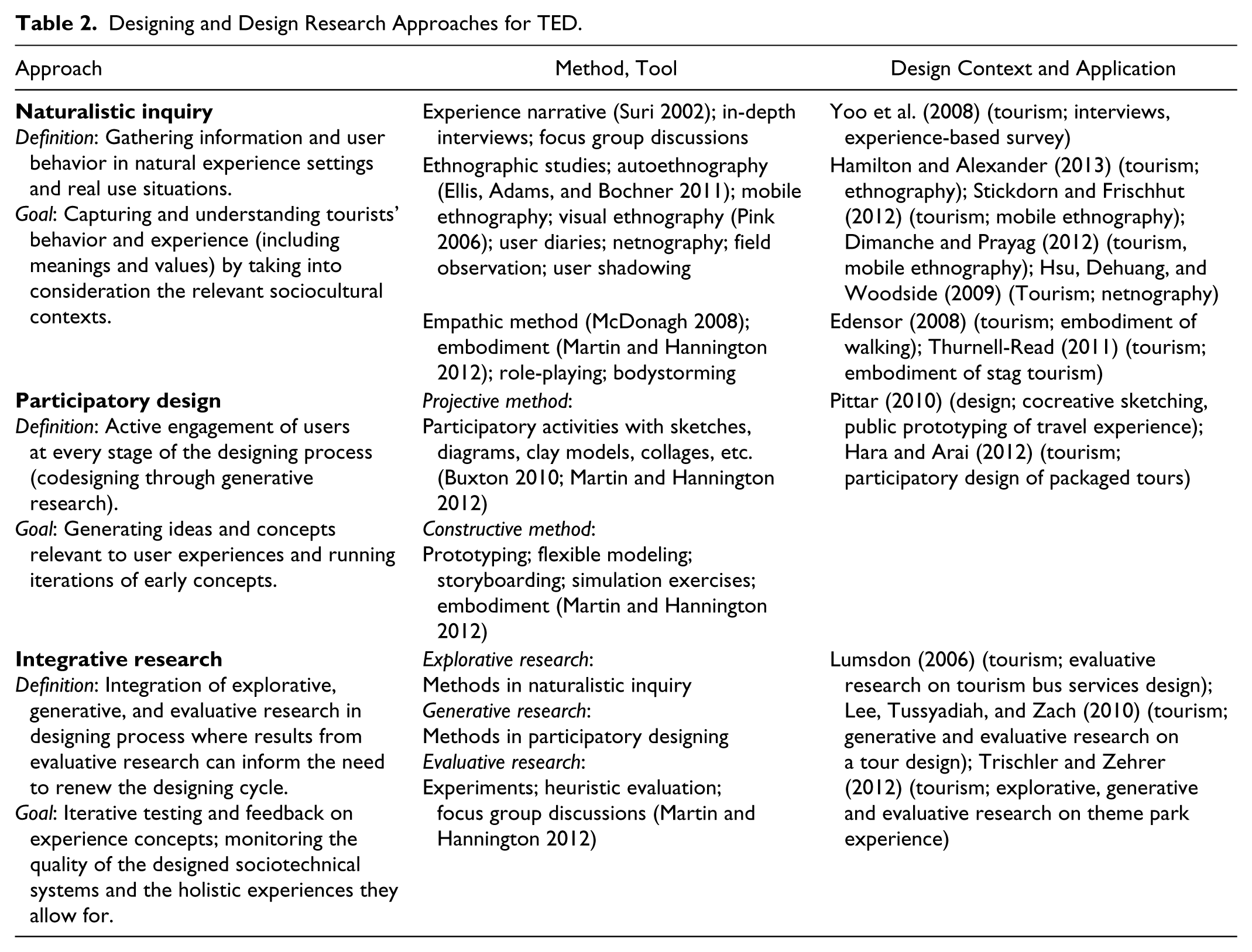
The three approaches discussed in the previous section (i.e., human-centeredness, iterative process, and holistic experience concept that can be translated into meaningful operational design components) frame the fundamentals (Figure 1) that inform the designing and design research process (Figure 2) as well as tools and methods for TED (Table 2). At the intersection of HCD and holistic experience concept, designing for experiences calls for the conceptualization of experience that is based on an exploration of human experiences through naturalistic inquiry, by gathering information and observing user behavior in natural experience settings and real use situations (i.e., tourists at tourism destinations), while taking into consideration the relevant sociocultural contexts. HCD and iterative designing process require participatory design (i.e., codesigning), where every stage of designing includes an active engagement of end users (i.e., tourists) together with designers and other stakeholders (i.e., management, employees, locals, etc.). At the intersection of iterative designing process and holistic experience concept lays the integrative design research where explorative, generative, and evaluative research processes are essential parts of the entire experience concept development process. Finally, at the core is the integration of theories and concepts from multiple disciplines that are relevant to the tourism experience contexts.
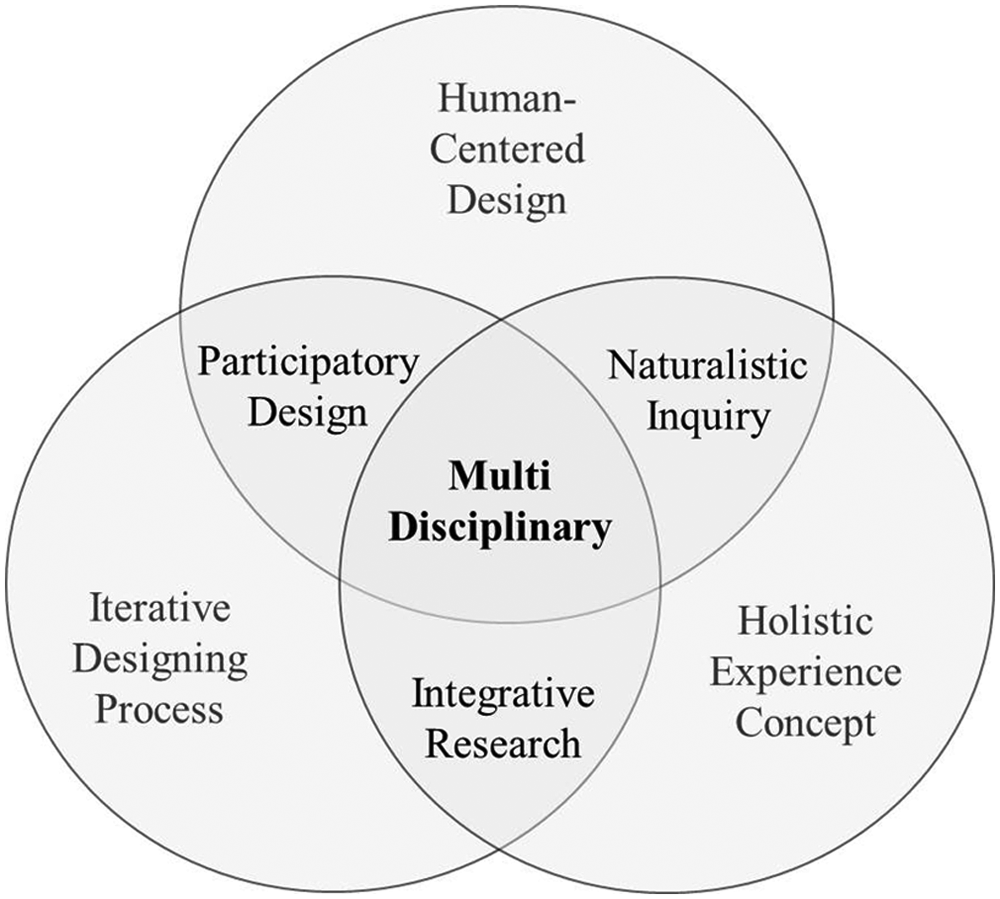
The fundamentals for tourism experience design.
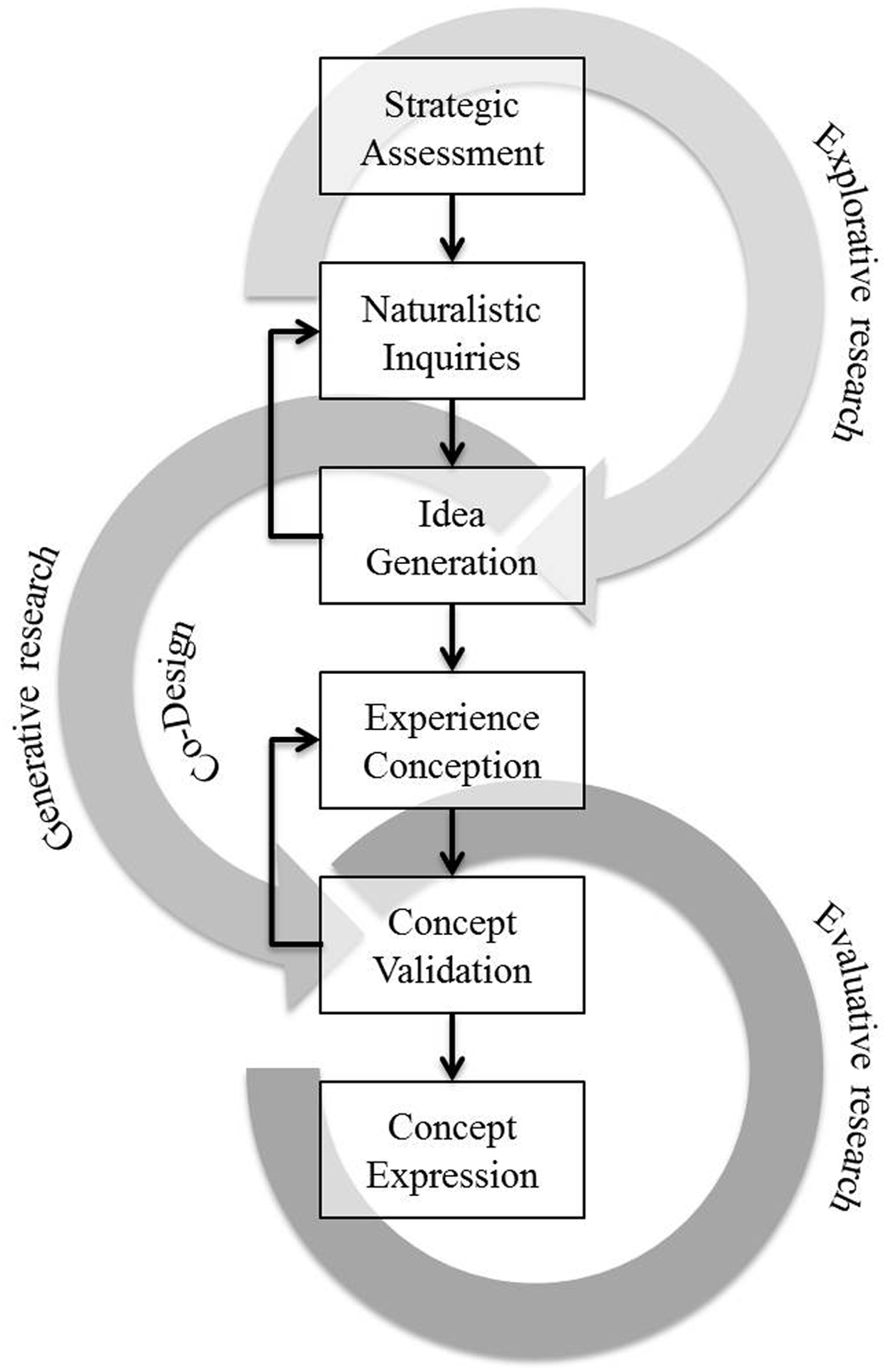
Designing and design research for tourism experience.
Designing and Design Research Approaches for TED.
In an attempt to capture and understand tourists’ experiences as a basis of designing, it is imperative to gather and analyze information from the tourists’ perspective. Forlizzi and Ford (2000) assert that designed objects/systems with their features and affordances offer a narrative of use and storytelling that represents the users’ subjective side of experience. Hence, Suri (2002) proposes experience narrative as a method to capture meaning and values from user experiences with designed objects and systems. Indeed, human beings use narratives as a device to communicate and make sense of their experiences (Sarbin 1986). Through narratives, users make sense of their experience by attaching meanings and personal relevance to situations (Forlizzi and Ford 2000). The importance of narratives to capture tourism experiences has been emphasized in tourism literature. Based on tourists’ stories captured in an experience-based survey, Yoo et al. (2008) suggest narratives as an identity-shaping device. Through narratives, tourists construct and reconstruct their identity. Narratives mediate the relationship between tourists’ actions and their identity in two different ways: reflexive narrative (i.e., tourists monitor their own actions and try to maintain their coherent self-image) and reflective narrative (i.e., tourists’ identity is shaped by reflection and recollection of past events). They argue that narratives are social acts, as personal narratives are constructed in social space. Also, the temporal dimension of experience suggests that experience may evolve over time. Further, through interpretation of tourists’ narratives, a deeper understanding of tourists’ interactions with artifacts, people, and contexts can be achieved and, thus, can provide a comprehensive and holistic interpretation of experiences.
Different methods can be utilized to capture tourists’ narratives about their experience, such as phenomenology and ethnographic studies. The call for naturalistic inquiry in design research brings forward several immersive design research tools that involve interactions between researchers and tourists, such as participant observation, user shadowing, in-depth interviews and focus group discussions, ethnographic studies, and field experiments. Autoethnography and experience-based survey tools that encourage and empower tourists to capture and record their narratives while simultaneously experiencing tourism destinations in the forms of user diaries, photos, videos, and records made by applications on smartphones (e.g., narratives of space–time experiences) can also be effective to understand tourists’ experiences, especially when combined with other tools to verify the reflection and interpretation of experiences (e.g., Stickdorn and Frischhut 2012; Hamilton and Alexander 2013). Additionally, capturing experiences from secondary data, such as through netnography (i.e., ethnographic studies conducted on the internet) and data mining of experiences stored for other purposes (blog posts, stories on social media, etc.) (e.g., Hsu, Dehuang, and Woodside 2009), can be useful to gain insights in exploratory design research.
Another important factor in understanding experiences from users’ perspective is to develop empathy among designers and researchers to increase awareness and extend imagination and sensitivity into users’ world (Fulton Suri 2003; McDonagh 2008). To that end, empathic design methods suggest researchers to step into users’ life in an attempt to conceive and reflect on user experiences in naturalistic settings beyond their own personal experiences and knowledge. In TED, this involves design researchers to step into the tourists’ world by practicing “being a tourist” and experiencing tourism firsthand. One of the empathic research methods is embodiment, in which design researchers utilize their own bodies as a research tool to conceive tourism experiences. The underlying premise of this method is that the knowledge of the bodies is embedded in meanings, which, in turn, guide researchers’ experiences with the environments (Madison 2005). Tourism has seen the practice of embodied experiences as a part of research, such as embodied practice with walking experience (e.g., Edensor 2008) and engagement in stag tourism (Thurnell-Read 2011). Another method for empathic design is role-playing, drawn from theater studies, where design researchers play the role of tourists, typically accompanied with simulations of likely situations relevant to designing following experience scenarios and/or service scripts. An example of role-playing and embodiment to generate ideas is bodystorming, which is a type of brainstorming that is situated in physical experiences (Martin and Hannington 2012). It is suggested that such empathic design research tools are especially useful in generative research to suggest ideas and possible solutions to different issues identified in early exploratory research (McDonagh 2008).
Generative research in designing typically involves participatory design activities to generate ideas and concepts and run iterations of early concepts. Participatory design activities in generative research “engage users in creative opportunities to express their feelings, needs, dreams and desires, resulting in rich information for concept development” (Martin and Hannington 2012, p. 94) combined with discussions and reflections on themes and ideas emerged from the exercises. Generative research is categorized into projective and constructive methods. As an early phase of generative research, projective methods focus on expressive exercises to facilitate users in articulating their thoughts, feelings, and desires that are usually hard to communicate verbally (Martin and Hannington 2012), such as how people feel about certain experiences at the emotional level (Evenson and Dubberly 2010). Participatory design activities in projective generative research include allowing participants to communicate ideas using sketches, collages, diagrams, clay models, etc. (Buxton 2010; Martin and Hannington 2012). Constructive methods, on the other hand, focus on testing experience concepts at the later stage of development, which involve some concrete parameters (Martin and Hannington 2012). Activities include prototyping and flexible modeling (i.e., allowing participants to configure a system from a set of predetermined elements), storyboarding, simulation exercises, etc. Studies of Pittar (2010) and Hara and Arai (2012) provide examples of how generative research methods can be applied to design tourism and travel experiences, using tools such as cocreative sketching and public prototyping. One of the complexities in generative research for designing in general is the fact that concepts are designed in the absence of tangible products and, in many cases, in the absence of market (i.e., when designing for new, radical innovation that creates new market). In other words, participants and designers work together to conceptualize products and services from their abstract features, requirements and limitations, making imagination a key in participatory designing. Moreover, this complexity is enhanced in the tourism context because both the tourism experience concept (i.e., design as a plan) and real tourism experiences (i.e., design as a product) are highly characterized with abstract values for tourists at the personal and social level (emotion, identity formation, etc.). Therefore, while the practice of explorative research, and to some extent evaluative research, is prevalent in tourism studies, finding relevant design methods to conduct generative research for tourism experiences is likely the key challenge in TED.
Lastly, evaluative design research is directed toward iterative testing and feedback on experience concepts, which also involves participatory designing with users. Methods such as experiments, heuristic evaluation, and focus group discussions are typically applied at the designing stages where concepts are evaluated, refined, and produced. After an implementation and launch of design, evaluative research is targeted to monitor the quality of the designed systems and the experiences they allow for. Evaluative design research can be characterized by an ongoing review of the design and, whenever new problems and opportunities arise, it can inform the need for explorative design research to renew the designing cycle. Lee, Tussyadiah, and Zach (2010), for example, utilize user diaries to capture tourists’ experiences with a newly launched Quilt Gardens Tour to evaluate the experience affordance of the tour and simultaneously engage tourists in generating ideas and prototyping detailed design elements of the tour (e.g., quilt patterns, plants selection, and supporting facilities) for the following year. Trischler and Zehrer (2012) utilize the multistep qualitative approach that include explorative, generative, and evaluative research framework from service design to design theme park experiences. The framework for designing and design research in TED is illustrated in Fig. 2.
Tourism Experience Concept
Integrating the concepts from backstaging–frontstaging processes (Sundbo and Hagedorn-Rasmussen 2008), core–periphery tourism experiences (Quan and Wang 2004; Walls et al. 2011), and whole–components of tourism experiences (Fynes and Lally 2008), a tourism experience concept is elaborated as an outcome of designing in TED. The formulation of an integrative concept of tourism experience includes two transformative steps. First, it starts with a meta-concept of tourism experience that include the strategic, meaning-evoking tourism experience propositions transformed into the core and peripheral experiences, supported by the storytelling of these experiences (i.e., the meanings and values of these experiences as they are situated in the society at large). Second, it requires the facilitation of these core and peripheral experiences to happen through a careful application of design principles in the creation and management of experience-facilitating systems and environments. The first transformation corresponds to backstaging, which focuses mainly on attaching meanings to tourism experiences based on strategic destination positioning in order to strengthen the brands and images of tourism destinations. This will be referred to as the meta-concept of tourism experience. The second step corresponds to frontstaging, which focuses on orchestrating various design elements within tourism destinations (e.g., experiencescapes, touchpoints, functional and emotional clues, and thematic elements) to allow for meaningful tourism experiences to take place. This will be referred to as the operational concept of tourism experience. In terms of designing, the meta-concept of tourism experience is likely the result of explorative and projective generative research, while the operational concept is likely supported by the constructive generative research.
The meta-concept of tourism experience should incorporate destinations’ strategic positions based on a comprehensive understanding of how, where, and when tourists want or need to connect to a deeper tourism experience (see Figure 3). A meta-concept should encompass value propositions targeted toward tourists’ needs and expectations. Meaning-generating experiences are carefully framed to induce tourists’ perceived values and benefits that are relevant to their desires. For example, Diller, Shedroff, and Rhea (2008) suggest different meaning-generating appeals that are globally appreciated in different design and consumption contexts, such as community, creation, harmony, redemption, and validation, among others. Cities attempting to brand themselves as creative tourism destinations, for example, may conceptualize a meta-concept of experience that would allow tourists to achieve the sense of creation and validation through the staging of core and peripheral experiences that provide functional and emotional values for tourists seeking to contribute a lasting impact in a certain domain and validate their being through participating in tourism activities that induce creativity. The core experiences can be designed in the form of bundles of attractions, activities, and interactions that facilitate tourists to learn and acquire skills in their respective domains of creativity and the staging of programs and events to support the dissemination of tourists’ creative outcomes (exhibition, demonstration, etc.). Peripheral experience should be designed to support the achievement of these core experiences. In addition to those activities, programs and events, the meta-concept should also include the storytelling of these experiences to support the values and meanings generated from these experiences not only at the individual level (i.e., tourists’ satisfaction resulted from individual interpretation of experiences) but also at the society level (i.e., interpretation of experiences that is guided by norms, shared values, etc.), where creative tourism experiences can be seen as a way for tourists to give a lasting contribution to the society and gain appreciation from others.
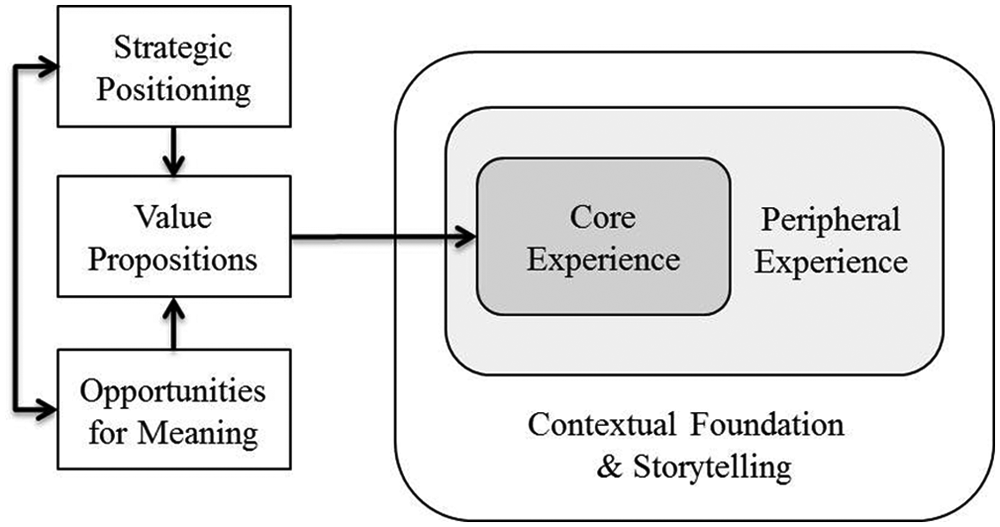
A meta-concept of tourism experience.
The operational concept of tourism experience should contain the expressions of the meta-concept, covering the entire journey of the tourists from anticipatory to recollection (i.e., conceptualization of a tourist journey comparable to “customer journey” in service design). More importantly, it should encompass the orchestration of design elements necessary for the facilitation of the designed core and peripheral experiences as well as the storytelling aspects of these experiences. Particularly, the operational concept of tourism experience should pay attention to interactivity, which include interactions between tourists and the physical elements of the destinations (i.e., interactions with objects and concepts associated with destinations), interactions with the social elements of the destinations (i.e., interactions with other tourists, locals, tourism employees, and other social networks associated with destinations) and interactions with the mélange of media associated with the destinations (i.e., interactions with mass media, marketing materials, etc.) (Figure 4). In this sense, the emphasis on interactivity as one of the design elements for tourism experience signifies the importance of participation activities as an important aspect in tourism experience concept (Fynes and Lally 2008; Pine and Gilmore 1998). Design for interactivity also informs the development of tourism touch points, which include the hard, tangible elements (attractions, infrastructure, facilities, etc.) and the soft, intangible elements (knowledge and information, programs, service quality, etc.) of tourism destinations supporting touristic activities (e.g., sightseeing) and idiosyncratic everyday activities (e.g., dining) of tourists.
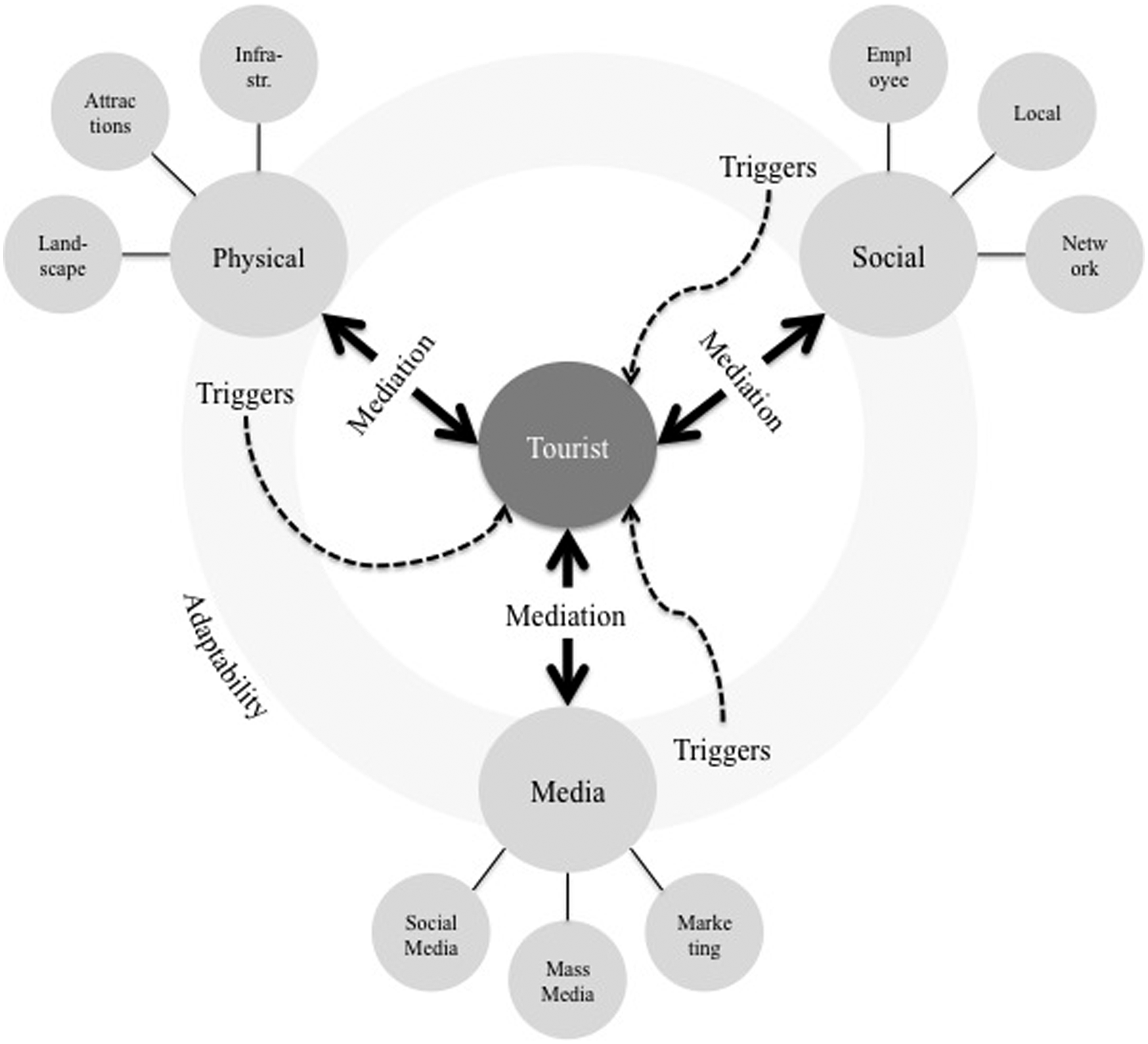
Interactivity and Triggers for Tourism Experience Design.
The arrays of tourism touch points are different from those of services, since tourists interact with different tangible and intangible elements of tourism destinations across space and over time, some of which will be categorized as service encounters, use of public facilities, or informal social interactions, all of which contribute to the tourism experiences. The orchestration of these elements to ensure seamless tourism experiences requires control for interactivity, which brings forth the concept of mediation in tourism experiences (i.e., an active attempt to mediate experiences of tourists; Jennings and Weiler 2006; Tussyadiah and Fesenmaier 2009). It is argued that designed experiences can be stimulated by controlling how tourists interact with the physical, social, and media elements of the destinations. Controlling interactivity through mediation means opening and or limiting access to experiences by facilitating high-impact interactions (i.e., where tourists modify and change the environments) with one element and low-impact interactions (i.e., limited interactions without altering the environments) with the other. Mediators that help control interactivity can be personal (e.g., tour guides) or nonpersonal (e.g., guidebook, signs, and streetscape). In most cases, mediators are the on-stage contacts with which tourists have direct interactions throughout their journey, which marks the line of visibility in tourism experience concept. Another important requirement to design interactivity is the adaptability of the tourism system to accommodate interchangeability of core and peripheral experiences to serve different tourism purposes.
In addition to interactivity, the operational concept of tourism experience should also pay attention to the creation of triggers (i.e., prompts, cues; Carbone and Haeckel 1994; Diller, Shedroff, and Rhea 2008; Pine and Gilmore1998) to target tourists’ behavior for desired experiences. Triggers can be external (i.e., from the environments, which can be designed) or internal (i.e., resulting from tourists’ habits or routines, which can be observed and conditioned). In his behavior model to explain designing for persuasion, Fogg (2009) suggests three things that should present to change people’s behavior: motivation, ability, and triggers. He asserts that there are two paths to design people’s ability to perform desired behavior: giving them more skills (i.e., train them) to perform complicated tasks or making the tasks simple. He further suggests three types of triggers to target users’ motivation and ability, which are labeled as facilitator (i.e., low ability, high motivation), signal (i.e., high ability, low motivation), and spark (i.e., high ability, high motivation). Depending on the users’ contexts, these triggers should result in a series of desired behavior and experiences, ideally starting from facilitating the completion of simple tasks and then leading to more complicated tasks (Fogg 2009; Fogg and Hreha 2010). For the tourism experience concept, triggers should be designed to persuade tourists to perform specific behaviors by indicating the relevance of the target behaviors to their motivation, perceived ability, and situational contexts. The forms of triggers can be languages and texts (e.g., signs and instructions), symbols (e.g., themes), and sensation and emotion (e.g., atmospherics targeting pleasure and/or arousal).
Using the example of creative tourism experiences outlined in the meta-concept, the operational concept of this tourism experience should include scenarios and “blueprints” of tourists’ participation in different activities along the creative processes (e.g., sightseeing to seek for inspirations, workshops, and boot camps to acquire skills and produce things, exhibition to disseminate outcomes, etc.), interactions with different elements of tourism destination over time, which include direct interactions with objects (e.g., art scenes, cultural artefacts), people (e.g., networks of creative communities), and media (e.g., brand-based destination reputation) as well as indirect (i.e., mediated) interactions while participating in these activities, as well as the emotional and cognitive states (i.e., sensation, feelings and reasoning processes) resulting from these interactions and participation activities. From the destination point of view, this will result in an array of visible and nonvisible destination components to facilitate and condition tourists’ interaction and participation as well as stimulate sensation and emotion. These components will then be supported by a set of triggers, embedded in the physical (e.g., signs, layout, themes, assistive technology), social (e.g., participatory programs, collaboration), and media (e.g., coproduction of content) environments in the destinations.
Case Study: Designing for Mobile-Mediated Tourism Experiences
To illustrate the application of TED, a case study of mobile-mediated urban tourism experiences (MMT) in Philadelphia, Pennsylvania (Yoo et al. 2008; Tussyadiah, Fesenmaier, and Yoo 2008; Saari, Yoo, and Tussyadiah 2008), is consulted. The goals of MMT design research were to capture the experiences of tourists who are equipped with mobile phones and using their phones to assist them while consuming urban destinations and, based on these experiences, conceptualize experience scenarios to enhance quality tourism experiences in urban destinations through the development of relevant assistive mobile technologies. MMT is a multidisciplinary research with its theoretical foundation from phenomenology, tourism, management information systems, and communication literature. It applies the multimethod approach of naturalistic inquiries integrating explorative, generative, and evaluative research that includes the following:
Pretrip interview and questionnaire to capture travel motivation to better understand contexts, initial subjective affective and emotional states, and mobile technology self-efficacy to ensure the use of mobile phones for different trip-related purposes
Time interval experience-based survey utilizing mobile phones to capture spatiotemporal movements (i.e., based on GPS tracks and time stamps of voice recording), tourists’ narratives through regular reporting of experiences (i.e., recorded storytelling based on guide questions), dynamics of emotions (i.e., regular reporting of emotion and mood states), and photo and video-elicitation (i.e., geo-tagged images as parts of tourists’ narratives)
Participant observation and mobile ethnographic study to capture patterns of experiences and tourists’ interactions with objects and social networks while experiencing destinations as well as the patterns of mobile phone use
Posttrip interview and questionnaire to capture tourists’ evaluation of destinations (i.e., attractions, experiences), reflection on the overall experience, and to generate ideas for the design of MMT;
Follow-up email interview to gather tourists’ interpretation of photos and videos captured and confirm findings from previous stages
Design workshop to present and gain feedback on design scenarios and concepts.
These efforts generated rich data from 49 participants’ subjective interpretation of their experiences (i.e., narratives, emotion, meanings, values) as well as mobile usage log and GPS tracks in an attempt to capture holistic tourism experiences. Based on the characteristics of tourists and the narrative analysis of their stories, personas were identified and their respective journeys were mapped using geo-visualization techniques. Using phenomenology and experiential computing framework as theoretical foundations, Yoo et al. (2008) summarize three tourist personas from this study: the sojourner, the social being, and the anthropologist. The sojourner consumes places with a determination to complete planned tasks (i.e., goal-oriented); his/her experiences are typically driven by the desire to cross off a list of must-visit places or must-do activities. The social being enjoys tourism activities and experiences as ways to develop and maintain social connections with others; his/her experiences are driven mainly by positive or negative social interactions (i.e., tourist places are considered as stages). The anthropologist positions himself/herself as opposed to the “others” at tourism destinations; the key determinants are the characteristics of people and objects encountered during experiences (i.e., tourist places are considered as both stages and performances). The journey maps of these personas reflect the tourist mobility that is individual (i.e., tourists skillfully monitor their own actions to construct a coherent self-identity) and social (i.e., tourists interact with others in constructing their narratives) at the same time (Yoo et al. 2008). Posttrip and follow-up interviews generates design ideas as participants were asked to recall their most and least interesting places in order to identify various design problems and the potential solutions for these problems.
This study also reveals the roles of mood and emotions in forming moment-by-moment experiences of tourists in time and space while using mobile phones, which are associated with physical movements across space, temporal tensions, changes in physical activities, multitasking, interactions with others, and negotiation of personal and group space (Saari, Yoo, and Tussyadiah 2008). It is understood that the content of moment-by-moment experiences of tourists when encountering perceptual stimuli are filled with transient attentional and emotional states, moods, cognition and information processing, persuasion, and other subjective experiences. Hence, respondents’ moment-by-moment emotional and cognitive states were captured through time interval experiential-based survey as well as pre- and posttrip questionnaire. They were analyzed using the positive activation (PA, ranging from high-arousal positive valence such as “joy” to low-arousal negative valence such as “depressed”) and negative activation (NA, ranging from high-arousal negative valence such as “angry” to low-arousal positive valence such as “relaxed”) dimensions within the valence-arousal network of emotions. Correlations between moment-by-moment emotional states and posttrip reflections were identified; posttrip high positive valence (e.g., happiness) is correlated with positive activation during the trip. Additionally, tourists also reveal high perceived values of using advance mobile media during the trip, which inform the possibility to expand the design space to leverage new emotional experiences assisted by mobile media.
From observers’ notes and images taken during mobile ethnography and recorded narratives of the tourists, patterns of behavior emerge as results of mobile phone use for interactions with near environments at destinations such as negotiating decisions, user stories, sound- and location-based user reviews, among others (Tussyadiah, Fesenmaier, and Yoo 2008). Following pattern language theory (Alexander, Ishikawa, and Silverstein 1977), which is originally conceptualized in architecture and urban design fields, but is increasingly applied in HCI, these patterns were identified with their respective contexts of the design problems, forces that need resolution, problems arising from the forces, and known solutions for the problems that are proven in practice. Hence, these patterns inform the detailed design elements structuring the concept of mobile-mediated tourism experiences. As an outcome of designing, a concept of tourists–mobile interactions in tourism spaces was developed (Tussyadiah, Fesenmaier, and Yoo 2008), which provides a foundation for tourists’ journey that includes tourists’ encounters with sites (i.e., places, objects, people), negotiation of consumption decisions, as well as preservation and sharing of experiences.
Summary
As experience design is getting more attention in tourism literature because of relevance of design methods in the production of tourism products and services that are experiential in nature. Therefore, there is a need to provide a comprehensive body of theory to frame the practice of experience design in tourism. Based on a comprehensive review of literature from different disciplines, first the definitions of design, designing, and design research are discussed to provide a clearer framework and limitation of experience design practice. Design is defined as a plan, an outcome of designing, which is elaborated in the context of tourism as tourism experience concept. Designing is understood as a series of activities to produce a design. Design research is a series of inquiries involving the gathering and analysis of information to support the designing process. Design research is distinct from designing, but is situated as an integral part of designing.
Further, there are three theoretical foundations that frame the practice of experience design in tourism: (1) human-centeredness, (2) iterative designing process, and (3) holistic experience concept. Designing for tourism experiences requires a comprehensive understanding of experiences from the perspectives of tourists, not only their experiences as consumers (i.e., in tourism contexts situations) but more so as human beings (i.e., in various sociocultural contexts of their life). Designing and design research in many different disciplines draw from theories in psychology, anthropology, social and behavioral sciences, cognitive and decision sciences, marketing and management, etc. These theories assist designer in understanding and making sense of why and how users experience the designed objects and sociotechnical systems around them by capturing their needs, motivations, desires, and expectations. As design research is considered an integral part of designing, it is suggested that designing should follow an iterative process where research activities are integrated at different stages of designing to refine and validate early concepts. Theories also suggest the creation of a holistic experience concept as an outcome of designing. Tourism experience concept should be comprehensive, but at the same time can be dissected into components that allow for designers and practitioners to operationalize the concept.
These three foundations inform the approaches and methodologies used in designing and design research in TED. First, there is an emphasis on naturalistic inquiries to capture holistic experiences from tourists. It is argued that designed systems offer experience narratives for their users and, similarly, users utilize narratives to make sense of their experiences with these systems. Hence, capturing tourists’ narratives, particularly when it is done simultaneously as they experience tourism destinations, will provide designers with a holistic view to tourism experiences. Methods such as field research, participant observation, and ethnographic studies are considered useful. Second, there is also an emphasis on participatory designing whereby tourists are invited to codesign with designers and other stakeholders to ensure that the iterations are consistent with the human-centeredness concept of designing. Third, it is suggested that the designing process should integrate design research, consisting of explorative, generative, and evaluative research. Explorative research is typically useful at the beginning stage of designing to understand tourists’ experiences. Generative research supports the generation of ideas based on the insights from explorative research and participatory design methods involving tourists and/or empathic design methods. Evaluative research is conducted at the final stage of designing to confirm that the experience concept meets tourists’ needs and requirements. Fourth, design research for tourism experiences should be multidisciplinary in nature, since tourism experiences are associated with a variety of activities involving interactions with services, public sectors, technologies, and cultural contexts. Theoretical underpinnings from different disciplines should be consulted to guide designing and design research in TED.
Finally, as an outcome of designing, tourism experience concept to cover a meta-concept (i.e., strategic value propositions) and an operational concept (i.e., orchestration of design elements) of tourism experience. The meta-concept of tourism experience consists of core experiences, peripheral experiences, and the basis for storytelling of these experiences. These are created based on opportunities for meaning generation as identified in exploratory design research. An operational tourism experience concept consists of the entire tourist journey from pretrip to posttrip experiences. Two important design elements that make the concept operational are interactivity and triggers. It is argued that interactions shape tourists’ experience. Managing tourists’ interactions with the different elements of the destinations, thus, can be a powerful tool to provide tourists with desired experiences. The key to managing interactivity is control (i.e., mediation/brokerage by opening or limiting access to interactions) and adaptability of the systems to allow for different levels of interactivity depending on the contexts within which tourism activities are performed. The operational concept of tourism experience also deals with orchestrating the different elements of tourism destinations, which include physical, social, and media, and providing triggers that signal and motivate tourists to perform targeted behavior and, hence, consume desired experiences.
This article provides a comprehensive review of theories and concepts that frame the foundation for experience design in tourism. It is not the intention of this paper to provide a complete list of design methods and tools applicable in TED or to offer a standard guideline on how to conduct design research and designing in tourism. Rather, the contribution of this article is in the clarification of the definition of TED and the critical orientation of theories and concepts from multiple disciplines as they are relevant to tourism. Also, based on integrative nature of design research to support the iterations in designing process, new designing tools and design research methods emerging from different disciplines not typically applied in tourism contexts should be encouraged.
Footnotes
Acknowledgements
The author would like to thank Daniel Fesenmaier for his valuable comments and suggestions.
Declaration of Conflicting Interests
The author declared the following potential conflicts of interest with respect to the research, authorship, and/or publication of this article: The research project cited as case study was conducted in collaboration with Youngjin Yoo, Daniel Fesenmaier, Timo Saari, and Ingvar Tjostheim.
Funding
The author disclosed receipt of the following financial support for the research, authorship, and/or publication of this article: The research project cited as case study was funded by Samsung Electronics, Inc.