



Abstract
Travel behavior is becoming inherently dynamic and socially connected because of the increasing use of mobile technologies; as such, the concept of context is becoming increasingly important in travel and tourism and particularly within today’s technology-supported mobile environment. This article builds upon existing literature describing recent developments in context-aware system design with the aim of defining the notion of context as it relates to the mobile technological environment for tourism. As part of this effort, a conceptual framework is proposed to describe the structure and fundamental properties of context, and several implications are discussed for tourism research and the design of mobile systems.
Introduction
Recent research has shown that information technology (IT), especially the Internet, has substantially transformed travel behavior (Gretzel, Fesenmaier, and O’Leary 2006; Werthner and Klein 1999; Xiang et al., forthcoming). However, the impact of IT is considered even more significant when travelers are equipped with mobile technologies (Fesenmaier and Xiang 2014; Gretzel 2010; Wang, Park, and Fesenmaier 2012). Consider the following scenario:
You are planning a trip to visit Shanghai, China, known for its exquisite Chinese cuisine, for a personal vacation. Prior to leaving, you use search engine Google on your desktop computer at home to look for a famous local restaurants in Shanghai. You acquire advice from a variety of sources such as Yelp, your Facebook friends, and the local destination marketing website. Two weeks later, you arrive in Shanghai and, while you are in the hotel lobby waiting to check in, you pull out your smartphone and start searching in Google. Your previous queries about this restaurant have been stored in Google but, at this moment, Google recognizes your current location and instantly updates keywords suggestions. You also open the mobile app Yelp and, by just one tap, you are connected with the restaurant through the hyperlink of the phone number in the app. While you are on your way to the restaurant, your family members have studied the customer reviews of that restaurant and are offering their opinions. And, some of your Facebook friends have already posted a number of messages on your Timeline with suggestions for what to order at that restaurant. . . .
Adapted from a recent article in New York Times (Miller 2012), this scenario illustrates today’s mobile environment within which travelers search for information and make decisions in different settings. In this scenario, travel is supported by a variety of IT tools across different platforms at different times and locations. Importantly, the way travelers use these IT tools may change with the transition from one context to another. That is, contextual cues such as searching for a specific type of product in travel planning, arriving at a specific location, and the approaching of dinner time, give rise to the needs for different information and communication services, which in turn, provide opportunities for tourism businesses to engage with their potential customers. Therefore, how tourism businesses leverage traveler-defined information becomes an increasingly important question (Stienmetz and Fesenmaier 2013; Tussyadiah 2012a; Zach and Gretzel 2012).
The notion of context has been studied primarily as a problem in human–computer interaction (HCI) wherein computer systems are designed to be context-aware, that is, they are able to sense and respond to aspects of the settings in which computers are used (Baldauf, Dustdar, and Rosenberg 2007; Dourish 2004). However, existing definitions of context and context modeling have largely been ad hoc, operation-based, without taking into consideration the complexity and experiential nature of the tourism product as well as characteristics of on-the-go travelers. This article builds upon existing literature on travelers’ situational needs (e.g., Gretzel, Hwang, and Fesenmaier 2012) and the recent research on context-aware design in travel (e.g., Lamsfus, Alzua-Sorzabal et al. 2012; Lamsfus, Martín, et al. 2012) with the aim to provide a deeper understanding of the notion of context as it relates to the mobile technological environment in travel and tourism. The next section critically reviews the literature discussing context as a HCI problem in mobile computing. Then, a conceptual framework is proposed with the aim to operationalize context in terms of travel behavior. Finally, the implications for tourism marketing and research on mobile tourism as well as directions for future research are discussed.
Context in Mobile Computing and Travel
Context plays an important role in HCI because it provides implicit cues about the objects of interest such as people, places, events, things, information, and media (Mehra 2012). With foundations in ubiquitous computing (Weiser 1999), context-aware computing (Dey, Abowd, and Salber 2001), pervasive computing (Ark and Selker 1999), and embodied interaction (Dourish 2001), context becomes a central concept whereby systems are able to sense and respond to aspects of the situation in which computers are used without specific human intervention. Dourish (2004) suggests that there are basically two views of context. On the one hand, the positivist approach seeks to reduce social phenomena to essence or simplified models that capture underlying patterns with the goal to represent the problem. For example, one popular definition states that context is “any information that can be used to characterize the situation of entities” and it is “typically the location, identity and state of people, groups, and computational and physical objects” (Dey, Abowd, and Salber 2001). Context, therefore, is seen as a form of information; it is representational and stable; and importantly, context and activity are separable. Thus, the positivist approach aims to capture, represent, or model context. On the other hand, the phenomenological approach considers social phenomena as emergent properties of interactions, not pre-given or absolute but negotiated, contested and subject to continual processes of interpretation and reinterpretation. Context is seen as interactional; it is something that describes a setting or situation, and something that people do. It is an outcome rather than a premise, and therefore context and content (or activity) cannot be separated because each arises from and is sustained by the other (Dourish 2004).
As one might expect, the literature on context-awareness related to HCI largely takes the positivist perspective in that most of the work has used an operational approach with the main objective to define and model context based upon certain computing parameters (indeed, the second perspective is largely intractable from an objective perspective). In particular, the research carried out during the 1990s focused on developing applications that managed the information describing context primarily to assist users in their interactions with mobile devices (Want et al. 1992; Schilit, Adams, and Want 1994; Dey and Abowd 2000). For example, researchers sought to design systems that would enable a cell phone to always vibrate and never beep in a concert if the system can know the location of the cell phone and the concert schedule (Moran and Dourish 2009). Thus, by carefully embedding computing into the context of our activities and surroundings, computer programs can make inferences about users’ needs and wants with minimal requirements on human effort (Moran and Dourish 2009).
Numerous typologies of context, usually assuming context has a hierarchical structure, have been developed to facilitate mobile tourism guide development (see Tan et al. 2009). For example, Feng, Apers, and Jonker (2004) grouped different contexts into two major categories, that is, user-centric and environmental. User-centric contexts refer to any factors related the technology user including behavior, physiological, and emotional states. Environmental contexts encompass the physical, social, and computational environments. From a different perspective, Hinze and Buchanan (2005) identified contextual information into three major categories, that is, network context, device context, and application context, with the user context subsumed under the application context to capture the use and human factors of a system. Tan et al. (2009) provided a comprehensive taxonomy of contextual information for mobile tourism applications and proposed a conceptual framework called “TILES,” which stands for Temporal (time and date), Identity (e.g., personal interests, preferred language, duration of trip, and other personal preferences), Location (current physical position and nearby attractions), Environment (e.g., weather and traffic), and Social (traveling companion) as the main categories of contextual information to represent a traveler’s information needs on the go.
Early examples of mobile tourist guides were working prototypes with the aim to identify unexplored problems related to design aspects such as user interfaces and location-based services (Grün et al. 2008). However, access to tourism information was one of the obstacles to develop mobile tourism information systems since tourism services are dependent on tourism destinations (Buhalis 2003). Indeed, the first generation of mobile tourist guides were constrained by the information offered by suppliers, that is, they were focused on the supply side instead of what the tourist needs within a specific context (Anegg et al. 2002). The most well-known examples of advanced tourism mobile guides include Berlin Tainment (Wohltorf, Cissee, and Rieger 2005), etPlanner (Höpken et al. 2006), Lamsfus, Martín, et al. 2012, and liveCities (Martín, Lamsfus, and Alzua-Sorzabal 2011). Apart from these prototypes, there are many location-based information apps running on today’s smartphones that provide general information about nearby restaurants, hotels, and points of interest (POIs) (Wang and Xiang 2012). Therefore, context, especially location of the user, plays an important role in these systems as an input variable.
Today, the miniaturization of computing devices, the ubiquitous connectivity to the Internet, as well as the integration of various sensors on smartphones seem to have mitigated the problems first found in the early development of tourism mobile guides (e.g., lack of data and issues related to usability). Mobile technology has been touted to possess the capabilities to transform many aspects of our use of information and communications (Katz 2006; Peters 2006). The current challenge for contextual computing centers on personalization and recommendation for tourism information consumption along with other aspects related to social interaction and mobile commerce. As a complex application domain, context-awareness computing entails a profound understanding of tourist movements as well as the personal and environmental factors linked to the decisions tourists make about where, how and when to do things (Xia, Zeephongsekul, and Packer 2011). While recent research has increasingly paid attention to the new conditions of travel created by the cutting-edge mobile technologies (e.g., Gretzel 2011; Wang, Park, and Fesenmaier 2012; Wang and Xiang 2012), the notion of context has largely been ad hoc, and as such, has not been well defined and articulated (Tan et al. 2009).
Indeed, most approaches to context modeling have been designed to solve very specific problems in very specific situations without taking into consideration the complex and experiential nature of tourism (Lamsfus et al. 2012). Furthermore, the traditional HCI perspective considers only a handful of entities such as physical condition, available transportation, weather, task, travel speed, familiarity with the place, the structure of the place, and the travel terrain (Zipf 2002). However, today’s mobile technology enables the capture and representation of a much wider range of contextual information during the process of travel. Therefore, it is argued that the notion of context should be used as a starting point to understand how today’s mobile technological conditions influence travelers’ behavioral patterns in order to identify and develop effective mechanisms to assist on-the-go travelers.
Defining Context for Mobile Tourism
Tourism represents an important field of application for mobile information systems (Gretzel 2011). In fact, mobile tourist guides have evolved from the very first prototypes to today’s more sophisticated smartphone apps commercially available in Apple’s iTune Store or Android’s Market. The notion of context is not new in the study of tourism because the tourist experience always takes place in time and space and through the interaction with the social/physical environments (Ryan 2002; Urry 1995; Uriely 2005; Williams and Stewart 1998). Indeed, the need to define context sprouts from the recognition that context is critically important for us to understand the on-the-go tourists supported by today’s cutting-edge mobile technologies. It is a useful concept because it “conditions” and thus sets the basis for understanding travel behavior. As such, the goal to define context is twofold: (1) to offer a richer and more adequate understanding of context in the mobile tourism setting than the existing definitions in HCI and related fields, which usually have a narrow, ad hoc focus, and (2) based on this understanding, to develop a foundation to understand the new possibilities to support on-the-go tourists’ needs.
A General Framework of Context and Travel Behavior
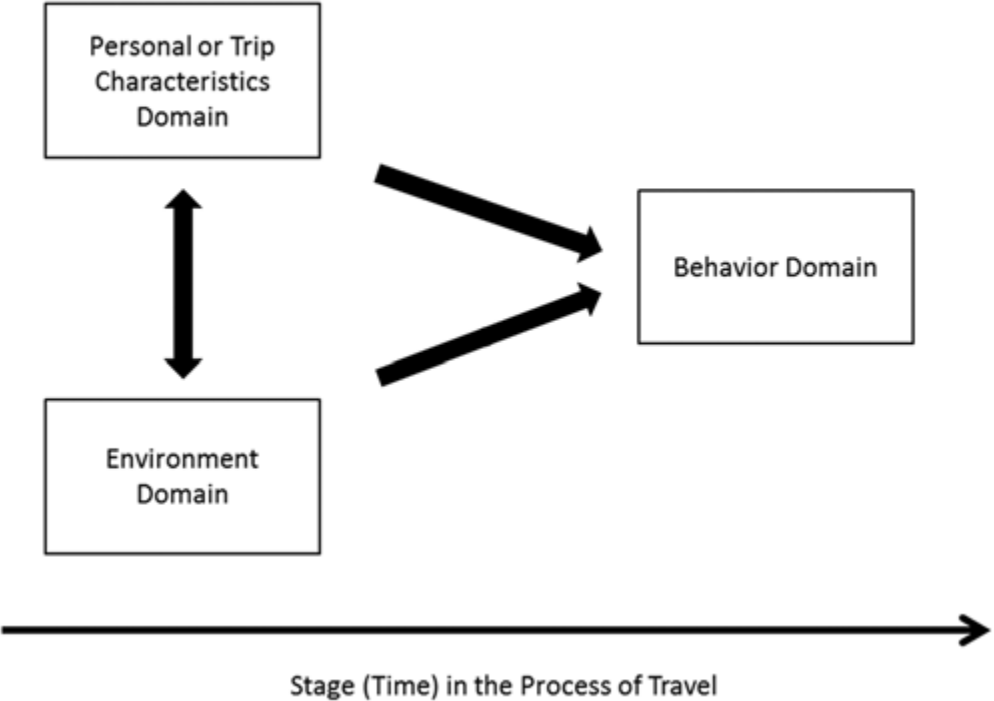
To facilitate the discussion, a conceptual framework is used to describe the components of the travel context and their relationship with travel behavior. As can be seen in Figure 1, travel behavior takes place in a context that consists of various aspects of two distinct domains, that is, the personal and trip-related characteristics domain and the environments domain, in a specific stage (time) of the travel process.
A general framework of context and travel behavior.
The first domain, that is, “personal or trip characteristics,” refers to characteristics pertaining to the individual or trip-related situations that are largely given and brought into travel by the tourist. Among these factors, individual characteristics may include sociodemographics, knowledge, personality, involvement, values, attitudes, cognitive style, decision-making style, and vacation style. Trip-related situations include travel purpose, time available, length of travel, distance between origin and destination, travel group composition, as well as travel mobility (Gretzel, Hwang, and Fesenmaier 2012). For example, travel purpose, which is closely connected to activities (Fodness and Murray 1999), can be generally defined as one’s stated needs or motives for travel. Time available for a trip constrains the geographical range of the trip (McKercher 1998). Whether a destination will be considered as an alternative is also a function of the distance from the traveler’s current location to a destination, a factor that has been included as a key variable in aggregated destination choice models (Kim and Fesenmaier 1990). The characteristics of the travel party also impact the geographical range of alternative destinations in respect to the mobility of the travel group (Fodness and Murray 1999; McKercher 1998). These factors are important determinants for the types of destinations considered, source of information used, types of information needed, extent of information search, travel activities, range of the trip, and potentially many other trip-related decisions (Fesenmaier and Lieber 1985; Gitelson and Crompton 1983; Lue, Crompton, and Fesenmaier 1993; Vogt and Fesenmaier 1998).
The second domain refers to the environment the traveler interacts with. In the HCI literature, environment usually includes factors such as location, weather, and temperature that can be directly used to infer a specific information need. In the tourism context, environment is a much broader and more complex concept which encompasses both physical and social entities of contact, leading to a rich stream of cognitions, feelings, emotions, and, ultimately, a sense of place (Cary 2004; Williams et al. 1992; Williams and Stewart 1998). Physical environments the traveler interacts with, among which the tourism attractions have been viewed by many as central to the tourism process, and they are often the reason for visiting a particular destination, providing activities and experiences and a means of collecting the signs of consumption (Leiper 1990; Richards 2002). While the “nuclei” of the tourism attractions are physical, there are also “markers” that make them visible and prominent, and tourists interact with both the physical attractions and their markers (Leiper 1990). On the other hand, these interactions, over time, also generate important impact on the social and physical environments (Jurowski, Uysal, and Williams 1997; King, Pizam, and Milman 1993).
While travel behavior may encompass anything related to what a tourist does, feel, perceive and think, the behavior domain in this framework refers to behavioral aspects pertaining to a specific time or stage in the travel process specifically related to the needs for information, decision making, communication, transaction, and even entertainment. For example, within the sequential framework of travel behavior, existing research has extensively examined travel decision making during the pretrip stage, particularly in relation to the traveler’s information search and destination choice (Crompton 1992; Fesenmaier and Jeng 2000; Mansfeld 1992; Woodside and Lysonski 1989). Specifically, destination-related decisions are generally high-level ones and are typically made when most other aspects of the trip are still undefined (Jeng and Fesenmaier 2002). At this stage, travelers usually make decisions regarding when they would like to travel, how long they would like to stay, who they would like to take along, what the purpose of the trip is, what main activity they will engage in, what the main mode of transportation will be, and from which point of origin the trip will start. Within the technology setting, Gretzel, Fesenmaier, and O’Leary (2006) suggested that travelers have different information needs in different stages of travel. They argued that during the consumption stage, that is, en route and on-site, travelers use information for connection, navigation, short-term decision making, and on-site transactions. Generally speaking, factors in the personal/trip-related characteristics domain and the environment domain influence and provide the contexts for decision making (Hwang et al. 2006).
While the two domains of the travel context have been extensively studied in tourism research, it is argued that, because of today’s mobile technology, context becomes particularly salient. First, the travel environment is increasingly digitized, which suggests that the travel context is becoming virtually oriented and connected. As suggested by Gretzel (2010), today’s travelers are literally traveling in IT-supported networks, both physical and virtual. Thus, mobile technology offers new affordances for the on-the-go traveler and has the potential to “reconfigure” the perceptions of (and interactions with) time, space, and the physical and virtual worlds (Leonardi 2011; Germann Molz 2010; Gretzel 2010; White and White 2007). Also, travelers are increasingly immersed in virtual augmented realities (ARs) (Gutiérrez, Vexo, and Thalmann 2008; Guttentag 2010; Mackay 1998), or being in two places at one time as suggested by the notion of “doubling” of places and a pluralization of social relations (Moore 2004; Sheller and Urry 2006). Second, mobile technology enables travelers to travel both on the Internet and with the Internet, allowing for ubiquitous connection with searchable information and greater flexibility, offering new opportunities for trip planning and coordination, and perhaps providing more chances for engagement with others (Germann Molz 2010; Gretzel 2011; Hwang and Fesenmaier 2011; Sorenson 2003). As such, it is argued that the travel context, especially the decision making environment, is becoming more open, fluid, and dynamic (Xiang et al., forthcoming). Lastly, the tourism experience is an extremely complex process, during which the traveler moves through infinite instances of space and time, and what happens previously conditions what happens next. Particularly in mobile tourism, the on-the-go stage should not be treated as a closed system or merely an instance because the traveler “carries over” many aspects from the pretrip stage and even everyday life into the state of mobility (MacKay and Vogt 2012; Tan et al. 2009; Turkle 2011; Wang, Xiang, and Fesenmaier, forthcoming). For example, a tourist carries his/her digital identity from everyday life into the mobile context (e.g., in the instance of logging into a social media website like Yelp). Thus, the notion of travel context reflects the interconnected nature of different stages (time) of travel as well as the interconnectedness of different consumer technologies.
Context as the Foundation for Mobile Tourism Systems
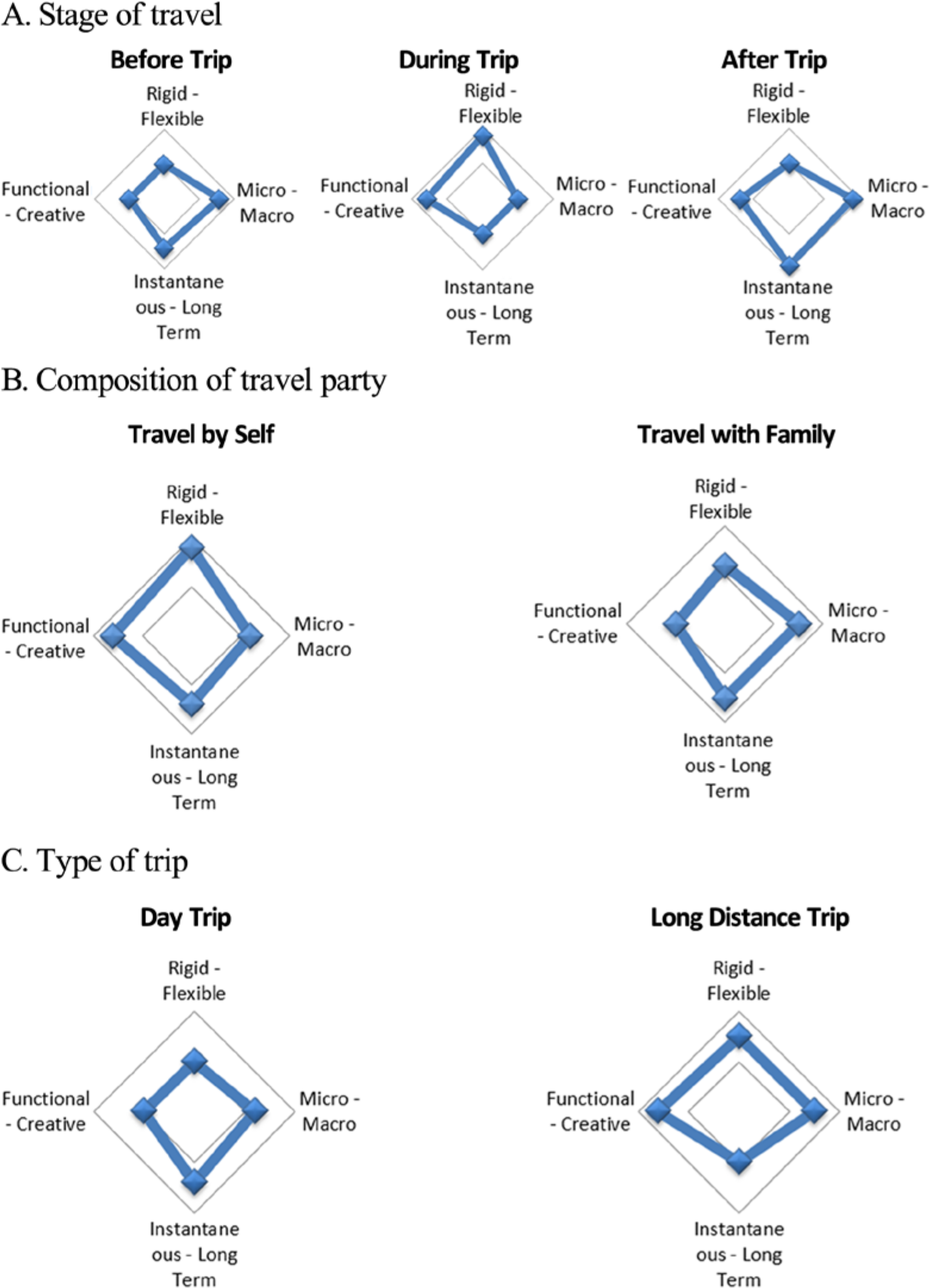
It is posited that these new properties of the travel context will substantially impact the nature of travel. To illustrate the nature of impact, Figure 2 uses four behavioral dimensions within three different travel contexts (situations), that is, stage of travel, composition of travel party, and type of trip, respectively. The behavioral dimensions and their measures are specifically related to travel decision making and use of information, including (1) decision-making flexibility (i.e., rigid vs. flexible); (2) decision specificity (i.e., micro vs. macro); (3) decision-making time frame (i.e., instantaneous vs. long term); and (4) information needs (i.e., functional—creative). While it is generally well established that travel behavior will change under different conditions such as stage of travel, composition of travel party, and nature of the trip, etc., it is argued that mobile technology, in combination with these contextual factors, will shift these decision-making behaviors to a certain direction.
Behavioral response to a specific context.
We use Scenario A, that is, stage of travel, for the purpose of discussion (also because it is pertinent to mobile tourism). As can be seen, decision making during the trip is likely to become more flexible because of mobile technology, since today’s travelers count on new sources of information that were not accessible to them this way until recently. Decision-making flexibility refers to the likelihood for the tourist to modify the trip plan in response to unfolding situations (Hwang 2010; Hwang and Fesenmaier 2011; March and Woodside 2005). Decision making in the en route phase is dynamic in that there are a series of interdependent decisions among which the contexts of later decisions are contingent upon results of earlier ones (Hwang 2010). Thus, the use of mobile devices such as smartphones changes the decision environment for en route and on-site decisions, especially when we consider the availability of search engines and social media (almost) anytime anywhere (Xiang and Gretzel 2010; Xiang, Wöber, and Fesenmaier 2008). Particularly, unplanned behavior occurs because of a change in the travel context such as various en route or on-site stimuli. Kramer et al. (2007 ) found that the use of smartphones could create spontaneous deviations from the original trip plan such as the changes of travel route, duration, and walking distance. For example, once a traveler checks in a Starbucks coffee shop using the FourSquare smartphone app, he/she is instantly connected with online friends who may offer product recommendations based upon their own personal experiences (Tussyadiah 2012b). As a result, it could significantly alter the context (because of an increased level of product knowledge and trustworthiness of information) and, consequently, the result of decisions taken. Therefore, the following proposition is formulated:
Proposition 1: The level of decision-making flexibility during the trip will become higher because of the use of mobile technology.
Travel decision making is usually conceptualized with a hierarchical structure involving numerous decision facets (Park and Lutz 1982; Moutinho 1987; Woodside and MacDonald 1994; Dellaert et al. 1998; Fesenmaier and Jeng 2000; Jeng and Fesenmaier 2002). As such, decision specificity refers to the levels of decision making in this hierarchical structure in that destination-level decisions can be considered core (macro) decision while others such as accommodation, restaurants, and many others (e.g., shopping) are secondary (micro), often en route decisions. Studies now indicate that, because of the use of mobile technologies, independent travelers (i.e., tourists not traveling in package tours) began to postpone the decisions at the secondary level (e.g., restaurants, attractions, and souvenir shops) from pretrip stage to the en route stage (Kramer et al. 2007). Further, the use of mobile devices enables travelers to obtain a better understanding of their geographic and social-cultural surroundings, leading to a more “refined” behavioral patterns (Tussyadiah and Zach 2012). As such, it is argued that the en route and on-site stage of travel is more likely to involve more micro decisions.
Proposition 2: The level of decision specificity during the trip will become higher, that is, the traveler makes more micro decisions, because of the use of mobile technology.
Third, decision-making timing is an important behavioral variable that reveals travel intention and consumption patterns (Perdue 1985; Iverson 1997). Because of the multifaceted nature of decision making, travelers allocate different time frames to decisions involving different kinds of products. Usually, it can take weeks, months, and even years for a traveler to make a decision regarding the destination to visit. More specific decisions presumably take less time. As opposed to the pretrip planning behavior, travelers on the move need to make decisions that are time-sensitive, immediate, unreflective, and spontaneous, and technologies such as smartphones are considered ideal in supporting these decision-making processes (Hwang 2010). Therefore,
Proposition 3: The decision-making time frame is likely to become shorter during the trip, resulting in more instantaneous decisions because of the use of mobile technology.
Last, in terms of information needs, mobile technology arguably leads toward more hedonic and creative use. Particularly, it has been argued that the development in location-based services (LBS) are making places more immersive and captivating for travelers (Hannam, Butler, and Paris 2014). Geo-based technologies have been suggested to help tourists have more meaningful and even more playful experiences (e.g., in the form of location-based social gaming) (Tussydiah and Zach 2011). Advances in mobile, social, communication, and location-based technologies have augmented and mediated tourists’ senses and experiences of place through emotional, aesthetical, informational, playful, and social engagement, allowing for tourists to be more creative and spontaneous (Gretzel and Jamal 2009; Richards 2011; Wang, Park, and Fesenmaier 2012). Therefore,
Proposition 4: Information needs during the trip will include more hedonic/creative needs because of the use of mobile technology.
Discussion and Conclusions
Understanding the context within which travel decisions are made has become vital as destination marketers seek more effective strategies for advertising and decision support. As such, a number of recent studies have been conducted in a number related including location-based social networking (Tussyadiah 2012b), decision-making processes on the go (Gretzel 2011), mobile search (Wang and Xiang 2012), mobile recommender systems (Ricci 2010), and on-site behavioral patterns (Zach and Gretzel 2012). Based on this research, this article contributes to the discussion on the impact of today’s information technology on travel and tourism in several ways.
First, recent discussion of mobile tourism (e.g., Featherstone, Thrift, and Urry 2004; Gretzel and Jamal 2009; Gretzel 2010; Hannam, Butler, and Paris 2014; Jansson 2002; Paris 2012) suggests that there is an emergence of a new “class” of tourists who heavily rely on information technology in general, and mobile/network technology in particular in constructing their personal and social experiences in travel. Context, as both what the travel brings into, and what he/she encounters in, the travel process, serves as the nexus that links together the traveler’s individual identity, the nature of the trip, the network technology, as well as the new affordances of the mobile device for the discussion on mobile tourism. Therefore, as suggested by Richards (2011), mobility nurtures creativity in tourism, and today’s mobile technology arguably creates opportunities and facilitates the development of creative tourism experiences by altering the conditions of travel.
Second, this article provides an alternative perspective for understanding the needs and wants of on-the-go travelers. In existing travel behavior literature, travelers’ individual characteristics, trip-related situations and, as a result, travelers’ needs for information are usually discussed in a static, isolated way (Gitelson and Crompton 1983; Lue, Crompton, and Fesenmaier 1993; McKercher 1998; Vogt and Fesenmaier 1998). In this article, it is argued that these factors become more meaningful when they interact with the environment which involves time/space and other physical and social entities. The proposed framework suggests that for on-the-go travelers, information search and decision making are becoming more open and more dynamic, which potentially leads to more unplanned solutions to their vacation needs (Hwang 2010; March and Woodside 2005). Travelers are constantly sending signals and generating new information, for example, the location and their information search history, when they engage with their social networks and to service providers in explicit or implicit ways. The emphasis on the dynamic and interdependent aspects of the decision context offers new insights into travel behavior as a holistic, inseparable experience (Greenberg 2001). As such, context can be seen as a domain of variables that provide powerful cues to make inference about travel behavior without relying on conventional variables such as demographics. Future research could focus on validating the proposed behavioral changes related to information seeking and decision making for on-the-go travelers.
Third, this study offers an important viewpoint to include context as part of the conditions for information technology adoption and use within travel and tourism. In the past decade, there is a plethora of studies applying the technology acceptance model (TAM) and its extended versions to study travelers’ perceptions, attitudes, and intentions in adopting the Internet or a special tool in travel shopping or information search experiences (e.g., Buhalis and Law 2008; Kim, Lee, and Law 2008). However, as argued by Benbasat and Barki (2007) and others, the use of technology can be shaped by many other factors including previous use experience and the attitudes and patterns of use developed in the postadoption stage. Indeed, TAM-based models treat the independent variables, that is, perceived usefulness and ease of use, as deterministic properties of adoption and use and fail to reflect the underlying processes that link these factors within an overall system-of-effects. More recently, considerations have been given to the value of context in theory development in information systems research by highlighting the importance of incorporating the specificity of technology characteristics, individual characteristics, and usage contexts into the domain of consumer technology adoption research (e.g., Hong et al., forthcoming; Orlikowski and Iacono 2001). As such, this article posits that understanding the travel context will help enrich the study of travelers’ adoption and use of information technologies.
Lastly from a practical standpoint, it is hoped that this study offers a strong conceptual foundation for designing mobile systems in travel and tourism. Context is something that gives meanings to what happens in the travel process. It can be seen as fragments of personal, situational, environmental, and technological data that can be organized and represented to create “stories” about the travel experience (Gretzel and Fesenmaier 2002). Following from the above discussion, it is argued that context modeling in mobile tourism system development must reflect the dynamic nature of context to support flexible, spontaneous travel decision making as well as to facilitate the creative use of technology. It is further posited that context modeling must take into consideration the spillover effect of travelers’ use of technology in the everyday life into the stage of travel (Wang, Xiang, and Fesenmaier, forthcoming), for example, through the ubiquitous connection with one’s social network and the interconnectedness of various technological platforms (e.g., Google+). Particularly, the networks that surround travelers in trip planning and their mobility encompass systems that capture and generate enormous amount of contextual information in the form of the so-called “Big Data,” offering opportunities to make inferences about the traveler’s online, en route, and on-site behaviors (Fesenmaier and Xiang 2014). The emergence of geo-based data enables businesses to identify movement patterns, preferences, and levels of loyalty within and beyond a destination. It is anticipated that the development of the “Internet of Things” (Atzori, Iera, and Morabito 2010) with the virtual representation of numerous uniquely identifiable objects will form a pervasive infrastructure that supports us in developing a more holistic understanding of travel behavior.
Footnotes
Acknowledgements
We would like to thank Professor Daniel Fesenmaier for his encouragement and guidance through this journey. We had many discussions and debates when writing this article, and we benefited a lot from his insights and critical comments.
Declaration of Conflicting Interests
The author(s) declared no potential conflicts of interest with respect to the research, authorship, and/or publication of this article.
Funding
The author(s) received no financial support for the research, authorship, and/or publication of this article.