



Abstract
This study examined satisfaction with life in the context of seasonal migrants who routinely live at a destination for an extended period of time each year. Findings from 1,257 seasonal migrants in the Rio Grande Valley of Texas indicate that in general the migrants are more active and more satisfied with life at the destination than at their hometowns and that specifically female migrants are more satisfied with life at the destination than male migrants. Importantly, the study also found that the migrants’ satisfaction with culture, health and safety, and financial life domains; their activities both at the destination and in comparison to their activities at home; and their satisfaction with life at home contribute to greater satisfaction with life at the destination. Finally, satisfaction with life at the destination significantly affects the likelihood that the seasonal migrants will return and recommend the destination to others.
Overall satisfaction with life (SWL) is defined as “a global assessment of a person’s quality of life according to his chosen criteria” (Shin and Johnson 1978, p. 478) and may be affected by a number of life domains, including leisure and travel experiences as noted in recent research. Travel-related factors, including vacations, holiday-taking, travel life, leisure and recreation life, trip experiences, and even social life, have each been linked to quality of life or overall life satisfaction (e.g., Dolnicar, Yanamandram, and Cliff 2012; McCabe and Johnson 2013; Oswald and Wu 2010; Sirgy et al. 2011), as has context, situation, and changes in life events (e.g., Diener, Inglehart, and Tay 2013; Michalos and Kahlke 2010). These findings suggest that, given the opportunity, people could permanently or temporarily relocate to a destination that represents their subjective ideal to enhance their overall satisfaction with life. Such may be the case with seasonal migrants—tourists who routinely spend a season at a destination each year—if indeed, “people tend to try to maximize net satisfaction” (Michalos 1985, p. 355) and if a place can contribute substantially to SWL.
Diener, Inglehart, and Tay (2013, p. 514) contend that “life satisfaction depends on comparing aspects of life to standards, which may depend on social comparison, aspirations and goals, one’s past circumstances, and one’s needs” in accordance with the comparison theory of happiness, as espoused by Veenhoven and Ehrhardt (1995). This comparison theory, which synthesizes social comparison theory (Festinger 1954) and lifetime comparison theory (e.g., Veenhoven 1984), focuses on the role of standards based on experiences and observations in making comparisons about the way life is and the way it should be. People may draw conclusions about their own life condition by comparing their own situation to others’ situations or by likening their current conditions and experiences to the past to determine the relative value of their existing state (Veenhoven and Ehrhardt 1995). Thus, a traveler’s level of satisfaction with life at a destination may be determined, at least in part, by comparing the overall satisfaction felt while at the destination with the satisfaction experienced when at home. If so, satisfaction levels with a hometown may provide the standard or reference point by which all travel destinations are compared, a point that may be especially salient for seasonal migrants who typically relocate to a destination for extended periods of time each year.
In a related vein of study, empirical findings have provided evidence for activity theory that proposes a link between engagement in activities of various types and life satisfaction (e.g., Havighurst 1961). That is, “the greater the frequency and intimacy of activity, the greater the life satisfaction” (Rodríguez, Látková, and Sun 2008, p. 164). Lyubomirsky (2008) suggested that happiness is influenced primarily by three factors, one of which is personal activities such as physical exercise, spiritual activities, socializing, eating, and leisure activities. Thus, the availability of physical, social, and leisure activities may also strongly encourage seasonal migrants to travel to specific destinations where they can participate in a plethora of such activities and engage in lifestyles that differ from those at the permanent home (Longino, Perzynski, and Stoller 2002; Mings and McHugh 1995). In one example of a seasonal migrant conclave, the abundance of social and recreational activities at Arizona winter RV/mobile home parks prompted Sullivan and Stevens (1982) to refer to parks as “adult camps,” where residents spent much time outside socializing and engaging in activities. Based on activity theory and comparison theory, then, these seasonal migrants should experience higher levels of SWL in their seasonal destinations than in their hometowns, a conjecture that leads to a number of important research questions:
Does satisfaction with various life domains contribute to SWL at a destination?
Does participation in activities at a seasonal destination contribute to greater SWL at the destination?
In comparison to activity participation while in permanent hometowns, do higher levels of activity participation at a seasonal destination lead to greater SWL at the destination?
Does SWL at permanent hometowns affect SWL at the seasonal destination?
Does SWL vary by permanent home or seasonal destination?
Does participation in activities vary by permanent home or seasonal destination?
Does greater SWL at a seasonal destination lead to greater intention to return and likelihood of promoting the destination to others?
This study addresses these research questions and is significant for a number of reasons. First, the global relevance of seasonal migrants and their economic impact makes this research especially important. Seasonal migrants have been the subject of some study worldwide, including, among other countries or regions, Australia (Hillman 2013), Europe (Gustafson 2002), North Africa (Viallon 2012), and the United States (Bjelde and Sanders 2012). Moreover, seasonal migrants have been found to have a substantial economic impact on the areas where they congregate (Serow 2003; Simpson and Nasif 2012; Smith and House 2006). The number of seasonal migrants is expected to increase as baby boomers reach their retirement years, adding to their economic force (Bjelde and Sanders 2012; Smith and House 2006).
Second, this research investigates the impact of satisfaction with various life domains and provides insights into which life domains are important in affecting SWL for winter migrants. Third, the research is the first known work in an emerging stream of travel and SWL research to examine the direct effects of activity participation on SWL in a travel context and with a mostly elderly population, although many studies have found positive relationships between social and recreational activities and SWL in other populations and contexts (e.g., Blace 2012; Simone and Haas 2013). Fourth, this work compares SWL and activity levels of respondents at two different, but valued, locations: the permanent home and the seasonal destination. The results found here not only add to existing findings about effects of travel on SWL but will also assist communities in understanding which factors should be improved to enhance tourists’ SWL, which should help in targeting tourists with appropriate marketing and retention tactics. Finally, this study is the first known study to examine the outcomes of SWL in terms of intention to return to a destination and likelihood of recommending a destination to others.
Satisfaction with Life and Seasonal Migrants
A vast record about SWL and its closely related counterparts—subjective well-being (SWB) and quality of life (QOL)—appears in the academic literature. SWL is a subjective judgment residing within the experiences of the individual (Campbell 1981; Diener et al. 1985; Sirgy 2012), includes both positive and negative factors (Gilbert and Abdullah 2004), and is a global assessment rather than an assessment of a particular life domain (Diener 1984). The integration of life domains in satisfaction with life studies are frequently based on three theoretical approaches. The first is the bottom–up approach or “bottom–up spillover,” which proposes that overall satisfaction results from satisfaction with specific domains (e.g., Diener 1984; Sirgy 2000, 2001, 2002). The top–down approach, by contrast, proposes that overall satisfaction results in satisfaction with specific life domains (e.g., Diener and Lucas 1992). The third approach used Michalos’s (1985) multiple discrepancies theory to propose a bidirectional model between global and domain satisfaction, arguing that bottom–up and top–down influences occur simultaneously (Mallard, Lance, and Michalos 1997). No one approach has proven superior over the others (Uysal, Perdue, and Sirgy 2012).
SWL has only been recently examined in the context of tourism. The limited research in the tourism literature has focused on understanding the leisure and travel life domains and their effects on SWL. Much of this work has been grounded in the bottom–up theory or “spillover approach.” For example, Sirgy et al. (2011) examined the effects of satisfaction with each of 13 life domains of travelers on overall SWL. Dolnicar, Yanamandram, and Cliff (2012) found that most of eight domains of QOL, including vacations, people (not family), and leisure, each contributed to QOL. Similarly, McCabe and Johnson (2013) found effects of holiday travel on ten of 27 dimensions of well-being including satisfaction with social life, amount of leisure time, and “way spend leisure time” for “social” or disadvantaged tourists. Págan (2014) examined the impact of satisfaction in six life domains—health, job, housework, income, dwelling, and leisure—on overall life satisfaction for tourists with disabilities, finding health and income satisfaction to be most critical. Additionally, work by Mactavish et al. (2007) found family vacations important in affecting QOL for caregivers of disabled individuals, and Neal, Uysal, and Sirgy (2007) and Neal, Sirgy, and Uysal (1999) found that four QOL domains—leisure, work, health, and family life—affected satisfaction with travel services and experiences, which in turn affected SWL. Finally, Andereck and Nyaupane (2011) investigated the role of tourism on residents’ QOL and found that, overall, residents perceived that tourism positively affected lives.
These prior findings of a relationship between social and recreational life domains and SWL are especially relevant to studies of seasonal migrants. A limited number of studies have examined seasonal migrants, especially their reasons for routinely traveling during certain periods of the year to familiar destinations, their personal characteristics, and their activities in their seasonal destinations, all of which may correlate with global SWL. Specifically, Sullivan and Stevens (1982) examined the socioeconomic and demographic characteristics and lifestyles of retirees who seasonally migrate to RV/mobile home parks and identified the importance of social and physical activities to the seasonal migrants.
Past research has also found that destination amenities and negative characteristics of the origin or home place affect the migration decision, as explained by Haas and Serow’s (1993) amenity retirement migration process model (see Walters 2002 for an excellent review). The model posits that desired amenities at a location are considered pull factors that influence the decision to migrate to the location while push factors are negatively perceived characteristics of the current home that encourage migration away from the home. Examples of destination pull factors include beautiful scenery, good weather, recreational activities, and cost of living, while examples of area push factors are cold weather, a high cost of living, and few desired activities. Empirical tests of the model support the importance of the destination pull and origin push factors on the migration decision (e.g., Carlson et al. 1998; Longino, Perzynski, and Stoller 2002). This stream of research suggests the importance of considering SWL and lifestyle at both a permanent residence and at a winter destination to SWL, especially to better understand the allure of seasonal migration.
In summary, prior research on seasonal migrants has focused on characteristics, motivation to migrate, and activities at the destination with little attention to differences in activities or SWL at home versus seasonal destination (with the exception of Mings and McHugh’s (1995) interviews with 12 snowbird couples). Yet, recent SWL and travel studies that incorporated recreational or social activities of a general population (McCabe and Johnson 2013; Sirgy et al. 2011) offer evidence suggesting that the travel of seasonal migrants and their activities, both at home and at the destination, may correlate with the global measure of SWL.
The proposed relationships of antecedents and outcomes of the SWL of seasonal migrants as derived from the literature and grounded in the bottom–up spillover effect, comparison theory and activity theory are shown in Figure 1. While there is no agreement about which domains make up SWL (Uysal, Perdue, and Sirgy 2012), life domains used in this research were derived from past research as noted previously and from a pilot study that surfaced factors important to winter migrants while at the destination. These life domains are social, health and safety, leisure and recreation, culture, spiritual, and financial; these domains are hypothesized to affect overall SWL at the destination. In addition, participation in activities at a seasonal destination, comparisons of levels of activity participation at the seasonal destination versus at home, and seasonal migrants’ SWL at home are posited to affect SWL at the destination, which then likely affects intentions to return to the destination and likelihood of recommending the destination to others.
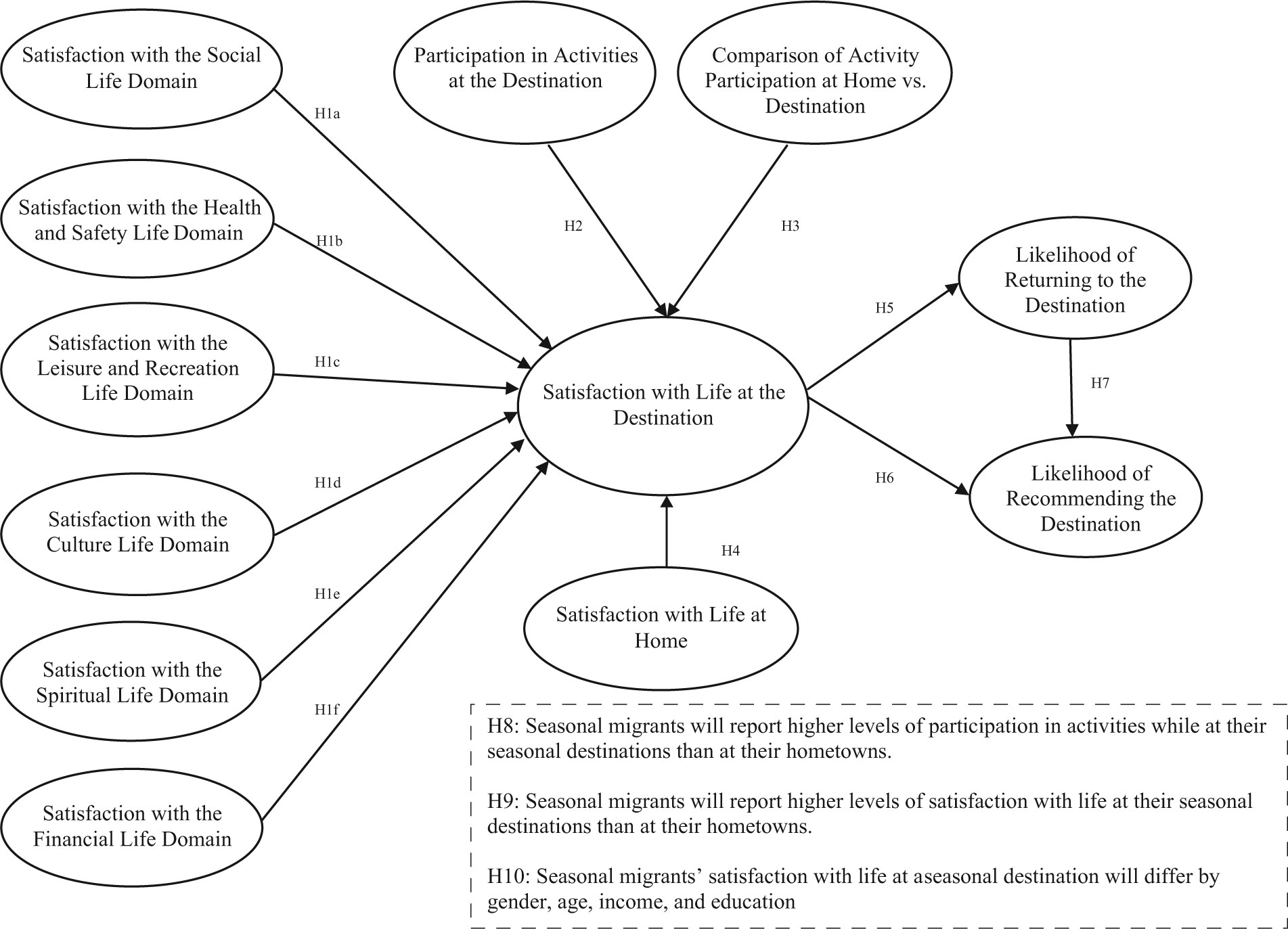
Research model.
Hypotheses
Life Domains and SWL
Social relationships contribute significantly to SWL for all populations (e.g., Diener and Seligman 2002; Helliwell et al. 2010). The relationship between a social life and happiness may be explained by attachment theory, which suggests that intimate attachments to others are the nucleus around which life revolves (e.g., Bowlby 1980).
Research has repeatedly demonstrated a correlation between the health and safety life domain and SWL, likely because health is such a critical component of enjoying one’s life (e.g., Campbell, Converse, and Rodgers 1976; Diener 1984). For the elderly, the importance of health as it relates to life satisfaction is very pronounced. As Sirgy (2012, p. 388) states, “the majority of the elderly have health issues rendering the health domain to be regarded as very important.”
As mentioned previously, the leisure domain has been found to affect SWL. Sirgy (2012) suggests that the relationship may be explained by genetics and physiological reactions where engaging in leisure and recreation activities stimulate endorphins and produce innate positive physiological responses. He also suggests social motivation theory as an explanation when the leisure and recreation activities involve social interactions that meet social needs, including affiliation, belongingness, cooperation, and social recognition.
Researchers have not noted a linkage between the cultural life domain and SWL. Nonetheless, bottom–up spillover theory would suggest that satisfaction in all life domains will improve overall SWL (e.g., Diener 1984; Sirgy et al. 2011). A positive relationship between spirituality and SWL across various populations has been well documented in the literature (e.g., Ellison and Fan 2008; Holder, Coleman, and Wallace 2010).
A number of studies have shown that satisfaction with the financial life domain has resulted in greater SWL (e.g., Campbell, Converse, and Rodgers 1976; Deaton 2008; Hayo and Seifert 2003; Veenhoven 1991), including for the elderly (Hsu 2010; Meadow and Sirgy 2008). The tie between an individual’s financial situation and happiness can be explained by self-determination theory. For example, Lane (1991) suggested that those who feel they have control over their financial situation are likely to express a stronger sense of well-being. In accordance with the bottom–up spillover theory, we propose that:
Hypothesis 1a–f: Satisfaction with the life domains of social, health and safety, leisure and recreation, culture, spiritual, and financial while at a seasonal destination will positively affect SWL at the destination.
Activities and SWL
Participation in activities of all types including hobbies, exercising, socializing, or playing cards, both at home and at a seasonal destination will likely be correlated with SWL at the destination as suggested by several theories and research as discussed previously. First, Diener, Inglehart, and Tay (2013) cited research findings that people consider numerous circumstances, events, and activities when evaluating life satisfaction. Second, research supports the activity theory link between frequency of activity, including physical, leisure, social, and place-centered activities, and SWL (e.g., Biddle and Ekkekakis 2005; Diener et al. 1999; Leung and Lee 2005; Menec 2003; Rodríguez, Látková, and Sun 2008). Importantly, activity has been identified as the most critical psychosocial factor related to SWL for seniors (Fernández-Ballesteros, Dolores Zamarrón, and Angel Ruíz 2001). Therefore, based on activity theory, we propose:
Hypothesis 2: Higher levels of participation in activities at a seasonal destination will lead to greater SWL at the destination.
Moreover, following the logic of comparison theory, if seasonal migrants are more active at their seasonal destinations than while in residence at their hometowns, and if migrants consider a broad range of experiences, events, and contexts on which to base the comparison of their lifestyle at home with their lifestyle at a destination, then
Hypothesis 3: Higher levels of activity participation at a seasonal destination as compared to activity participation levels while at the hometowns will lead to greater SWL at the destination.
Hypothesis 4: Seasonal migrants’ SWL while at the hometowns will positively affect their SWL at the destination.
No known studies have examined the effects of SWL on travel return intentions; however, the positive impact of customer satisfaction on behavioral outcomes such as positive word of mouth and repeat purchase intentions has been substantiated by extensive empirical evidence from consumer research and services marketing research (see Szymanski and Henard 2001). Within the travel context, studies have shown effects of satisfaction with travel, a domain of SWL (Dolnicar, Yanamandram, and Cliff 2012; Sirgy et al. 2011), on return intention. For example, Alegre and Cladera (2009) found that overall satisfaction was the predominant determinant of return intention and that number of repeat visits significantly affected return intention. Thus,
Hypothesis 5: Seasonal migrants’ SWL at a seasonal destination will positively affect their likelihood of returning to the destination.
Growth in visitor numbers is an important concept for tourism officials, and Reichheld (2003) advocates assessing the likelihood of customers to recommend a business through word of mouth as a pathway to such growth. In his quality-of-life theory of leisure travel satisfaction, Sirgy (2010) suggests that a destination-generated satisfaction with life should lead to positive word-of-mouth communications. In related research in the past few years, travel researchers have examined and found a positive relationship between destination satisfaction and word of mouth or likelihood of recommending a destination (Simpson and Siguaw 2008). Accordingly, we propose:
Hypothesis 6: Seasonal migrants’ SWL at a seasonal destination will positively affect their likelihood of recommending the destination to others.
Seasonal migrants have a history of returning to the same winter destination (Gustafson 2002; Martin et al. 1987; Simpson and Nasif 2012). The findings of investigations regarding repeat purchases and the impact on word-of-mouth endorsements, however, is equivocal. In the hospitality field, repeat visitors, also known as stayers, have been found to be less likely to provide positive word of mouth or referrals than those who have recently become customers (East, Lomax, and Narain 2001; Wangenheim and Bayón 2004). On the other hand, several service industries studies have noted that repeat purchasers are more likely to spread positive word of mouth (Murray and Howat 2002; Tomas, Scott, and Crompton 2002). We adopt the latter perspective to hypothesize:
Hypothesis 7: Seasonal migrants’ likelihood of returning to a seasonal destination will positively affect their likelihood of recommending the destination to others.
Research suggests that seasonal migrants are quite active while at their seasonal destination, perhaps more so than while in residence at their hometown. For example, Mings and McHugh’s (1995) qualitative study of 12 Arizona snowbird couples revealed that the couples participated in activities far more at their winter destinations than at home. Other seasonal migration research, beginning with Hoyt (1954), details the life of seasonal migrants as filled with numerous social and recreational activities, but does not compare activities at home with activities at the destination. Based on this limited research, we propose:
Hypothesis 8: Seasonal migrants will report higher levels of activity participation while at their seasonal destinations than at their hometowns.
Research comparing seasonal migrants’ lives at home versus the seasonal destination is scant; however, seasonal migrants will likely report greater SWL at their seasonal destinations than at their hometowns for several reasons. First, as a global construct, SWL assesses perceptions of life in general and is composed of events and circumstances, including travel, vacations, and holidays (e.g., Dolnicar, Yanamandram, and Cliff 2012; McCabe and Johnson 2013; Sirgy et al. 2011).
Second, some research suggests an emotional and behavioral affinity of seasonal migrants for their seasonal destinations. For example, Stedman (2006) and Simpson and Siguaw (2008) found that seasonal migrants reported higher levels of place attachment to their seasonal destination than did the destinations’ permanent residents. Considering that numerous factors, such as amount of sunshine (Oswald and Wu 2010), travel, and activities (Dolnicar, Yanamandram, and Cliff 2012; McCabe and Johnson 2013; Sirgy et al. 2011), are related to SWL and that seasonal migrants elect to travel to the same destination repeatedly (Viallon 2012; Walters 2002), then seasonal migrants likely enjoy higher levels of SWL at their seasonal destinations than at their hometowns. Although not previously tested, the following hypothesis seems likely:
Hypothesis 9: Seasonal migrants will report greater SWL at their seasonal destinations than at their hometowns.
Finally, some studies have shown that demographic factors such as gender, age, income, and education affect SWL (e.g., Daig et al. 2009; Levin et al. 2011); however, a considerable body of literature too lengthy to report here has found mixed results with each of the demographic variables. Thus, while not the key focus of this study, we examine these demographic effects to add to the body of research especially with regards to seasonal migrants and propose:
Hypothesis 10: Seasonal migrants’ SWL at a seasonal destination will differ by (a) gender, (b) age, (c) income, and (d) education.
Methodology
Approximately 70,000 retired/semi-retired households, mostly from the northern parts of the United States and Canada, migrate to the Rio Grande Valley (the Valley) in South Texas each winter for a period of one to six months to enjoy the area’s tropical warm weather, low cost of living, and cultural diversity (Simpson and Nasif 2012). This group, fondly called Winter Texans, served as the sampling frame for this study. During their stay in the Valley, the vast majority (91.0%) of these seasonal migrants reside in recreational vehicles or mobile homes housed within trailer park communities (Simpson and Nasif 2012).
To acquire the data for this study, a pilot survey of mostly open-ended questions about area attributes and activities while in the Valley was developed and distributed at a local trade show that targeted winter migrants and took place during the first week of January, 2012. The most often mentioned Valley characteristics and popular activities listed by the 1,603 winter migrants in the pilot study were then used in the final survey conducted during the months of late January and February of 2013. Winter migrants were made aware of the English and French versions of the online survey via survey links on the home pages of seven mobile home/RV parks; flyers and emails distributed to park managers to resend to residents; stories in regional newspapers; Facebook promotions; and an online advertisement. Hard copies of the survey were distributed to RV parks that requested them. Respondents who provided contact information were eligible to win a Kindle Fire tablet. A total of 1,193 responses were received online and 236 hardcopies were mailed in; 172 respondents indicated that they were not Winter Texans and their data were eliminated from the analysis.
Sample Characteristics
The respondents averaged 68 years of age and 49.4% were female and 50.6% male. While 62.1% of the sample had some college education or degree, 14.4% had a master’s, doctoral, or professional degree. Most respondents reported a combined annual household income of $30,000 to $69,000 (62.4%), while 31.9% had an income greater than $69,999. This demographic profile is consistent with prior research finding that retired seasonal migrants are among the well-educated “young old” with middle to upper-middle incomes (Hogan and Steinnes 1994; McHugh and Mings 1991).
Measures
As shown in Table 1, global SWL at a seasonal destination (SWL_Destination) and global SWL at hometowns (SWL_Home) were respectively measured by a set of six statements utilizing a 5-point Likert scale with endpoints 1, “strongly disagree,” and 5, “strongly agree.” Two items, “In most ways my life is close to ideal,” and “I am satisfied with my life,” were adapted from Diener et al.’s (1985) SWL scale, whereas the other four items were newly developed for this study. Satisfaction with each life domain (i.e., Sat_Social, Sat_Health, Sat_Leisure, Sat_Culture, Sat_Financial, and Sat_Spiritual) was measured by asking study participants to indicate how satisfied they were in response to a set of items on a 5-point scale with endpoints 1, “very dissatisfied,” and 5, “very satisfied.”
Attributes for Constructs with Reflective Measurement Model Specifications.

Note: Sat_Spiritual is a single-item measure and not included in the table. CR = composite reliability; α = Cronbach’s α.
Diagonal elements are the average variance extracted (AVE) and off-diagonal elements are squared interconstruct correlations.
α not reported because the construct has two measurement items.
Table 2 lists all 13 activity items for measuring study participants’ activity participation at the seasonal destination (ActivityParti_Destination). Respondents indicated how often they engaged in each activity on a 5-point scale with endpoints 1, “never,” and 5, “a lot.” ActivityParti_Destination was modeled as a formative construct because each activity item is unique and conceptually taps a distinct aspect of the construct. Dropping any activity item will result in a change in the construct’s conceptual domain. These considerations are in line with the decision rules for determining whether a construct is formative or reflective as suggested by Jarvis, Mackenzie, and Podsakoff (2003). For the same reasons, comparison of participation in activities in hometown versus the destination (ActivityParti_Comparison) was also modeled as a formative construct and was composed of 13 difference scores calculated by subtracting the participation level of each activity at the hometown from those at the destination.
Attributes for Constructs with Formative Measurement Model Specifications.
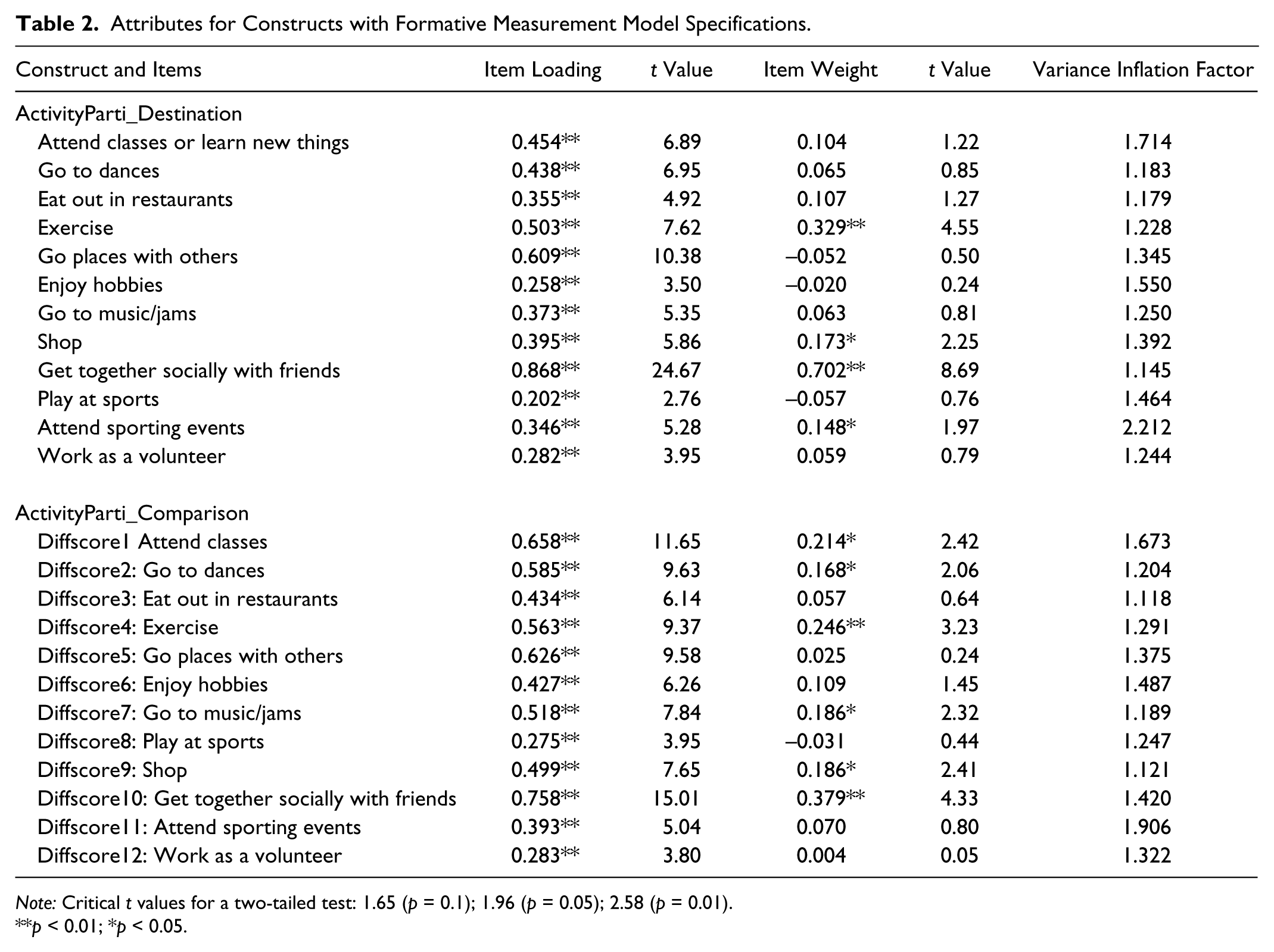
Note: Critical t values for a two-tailed test: 1.65 (p = 0.1); 1.96 (p = 0.05); 2.58 (p = 0.01).
p < 0.01; *p < 0.05.
A 10-point scale with endpoints 1, “not at all likely,” and 10, “extremely likely,” was used to measure likelihood of returning (Likely_Return) and likelihood of recommending (Likely_Recommend) by asking study participants, “How likely are you to return next winter?” and “How likely are you to recommend the Valley?” respectively.
Data Analysis
The partial least squares approach to structural equation modeling (PLS-SEM) was used to test hypotheses 1a–f to 7. PLS-SEM is a causal modeling approach that is aimed at maximizing the explained variance in the dependent latent constructs (Hair, Ringle, and Sarstedt 2011) and has been increasingly applied in a variety of research areas such as marketing (e.g., Rose et al. 2012), tourism and travel research (e.g., Ayeh, Au, and Law 2013), and management information systems (e.g., Ringle, Sarstedt, and Straub 2012).
PLS-SEM was used as the testing method for two main reasons. First, PLS-SEM’s prediction orientation makes it a more preferred method for achieving this research’s primary objective of identifying the predicting factors of seasonal migrants’ SWL at a seasonal destination and assessing the collective as well as individual impact of these predicting factors. Second, as noted by Hair, Ringle, and Sarstedt (2011, p. 143), PLS-SEM is “more robust with fewer identification issues, works with much smaller as well as much larger samples, and readily incorporates formative as well as reflective constructs.” Given that our data set is fairly large with 1,257 valid observations and that the proposed research model is complex and consists of 12 constructs with some being modeled as reflective constructs and others as formative constructs, PLS-SEM is a more preferred approach.
Paired and individual samples t-tests were used to test hypotheses 8–10 because these hypotheses involved comparing whether migrants’ activity participation and SWL vary by location (destination versus hometown) and by demographics.
Results
Testing Hypotheses 1–7 Using PLS-SEM
Evaluation of the measurement model
Reliability and validity of the latent constructs with reflective measurement model specifications were evaluated using SmartPLS 2.0 (beta) (Ringle, Wende, and Will 2005). As shown in Table 1, item loadings ranged from 0.70 to 0.92, all of which were above the recommended value of 0.70, thus supporting the reliability of each measurement item. Composite reliability values were between 0.77 and 0.94, supporting the measures’ internal consistency reliability. Cronbach’s α values ranged from 0.66 to 0.93, providing additional support for the reliability of the measures. AVE values were between 0.59 and 0.73, supporting the measures’ convergent validity. Moreover, each construct’s AVE value was higher than the construct’s highest squared correlation with any other construct, supporting the discriminant validity of constructs based on Fornell and Larcker’s (1981) criterion.
ActivityParti_Destination and ActivityParti_Comparison were modeled as having formative measurement items, and therefore, assessing internal consistency reliability and convergent validity was irrelevant. Instead, we examined each item’s weight and loading and used bootstrapping to assess their significance, following Hair, Ringle, and Sarstedt’s (2011) recommendation. An item’s loading indicates the item’s absolute importance to the latent construct and the weight indicates the item’s relative importance and contribution to the construct. When performing bootstrapping, we set the minimum number of bootstrap samples at 5,000 and the number of cases at 1,257 which was the number of observations in the original sample. “No Sign Changes” option was selected.
As shown in Table 2, all loadings for the ActivityParti_Destination items were significant at p <0.01 except one item: visit nature preserves. All loadings for the ActivityParti_Comparison items were significant at p <0.01. An examination of the significance of each item’s weight reveals a somewhat different picture. For ActivityParti_Destination, exercise (t = 4.55, p < 0.01), shopping (t = 2.25, p < 0.05), get together socially with friends (t = 8.69, p < 0.01), and attend sporting events (t = 1.97, p < 0.05) were the four items with significant weights. For ActivityParti_Comparison, items with significant weights were attending classes or learning new things (t = 2.42, p < 0.05), going to dances (t = 2.06, p < 0.05), exercising (t = 3.23, p < 0.01), going to music/jams (t = 2.32, p < 0.05), shopping (t = 2.41, p < 0.05), and getting together socially with friends (t = 4.33, p < 0.01).
“Visit nature preserves,” an item for ActivityParti_Destination, was removed from further analysis because neither its loading nor weight were significant, indicating a lack of support for the item’s relevance in providing content to the construct. All other items were retained even though several items had nonsignificant weights. This decision was made based on the following considerations. First, all activity items were developed based on the results generated from prior years’ Winter Texan studies and a pilot survey, supporting face validity of the activity items used. Second, from a content perspective, each activity was distinct and represented a unique aspect of winter migrants’ activity participation. Moreover, because all items’ loadings except one were significant, the absolute importance of these items to both constructs, ActivityParti_Destination and ActivityParti_Comparison, was demonstrated. Deleting items with nonsignificant weights might change the theoretical underpinnings and lead to adverse consequences for the derived measure’s content validity as pointed out by several researchers (e.g., Diamantopoulos and Siguaw 2006). Third, researchers argued that high levels of multicollinearity in a formative measurement model can cause items to be nonsignificant and that the degree of multicollinearity should be examined by means such as calculating the variance inflation factor (VIF) (e.g., Diamantopoulos and Winklhofer 2001; Grewal, Cote, and Baumgartner 2004). As shown in Table 2, VIF values were between 1.118 and 2.212, with none greater than 5, suggesting that multicollinearity was not a concern.
Evaluation of the structural model
The primary evaluation criteria in PLS path models for assessing the structural model are the R2 measures (i.e., the coefficient of determination of the endogenous latent variables) and the level and significance of the path coefficients (Hair, Ringle, and Sarstedt 2011; Henseler, Ringle, and Sinkovics 2009). The R2 value was 0.43 for SWL_Destination, 0.57 for Likely_Recommend, and 0.08 for Likely_Return. Different research disciplines have different recommendations as to what R2 value is considered high. For example, R2 values of 0.19, 0.33, and 0.67 are considered as weak, moderate, and high by Chin (1998). Hair, Ringle, and Sarstedt (2011) write that as a rule of thumb R2 values of 0.25, 0.50, and 0.75 can be described as weak, moderate, and high in marketing research studies.
Bootstrapping procedure was performed to assess each path coefficient’s significance. The results, as summarized in Table 3, show that SWL_Destination was positively affected by satisfaction with three life domains: Sat_Social (β = 0.22, t = 6.28, p < 0.01), Sat_Health (β = 0.14, t = 4.88, p < 0.01), and Sat_Financial (β = 0.13, t = 4.36, p < 0.01). The proposed positive effects of Sat_Leisure, Sat_Culture, and Sat_Spiritual on SWL_Destination were not supported. Overall, these findings provide general support for our hypothesis that seasonal migrants’ satisfaction with various life domains while at a seasonal destination positively contributes to their overall satisfaction with life at the destination.
Results Summary of Hypothesis Testing.
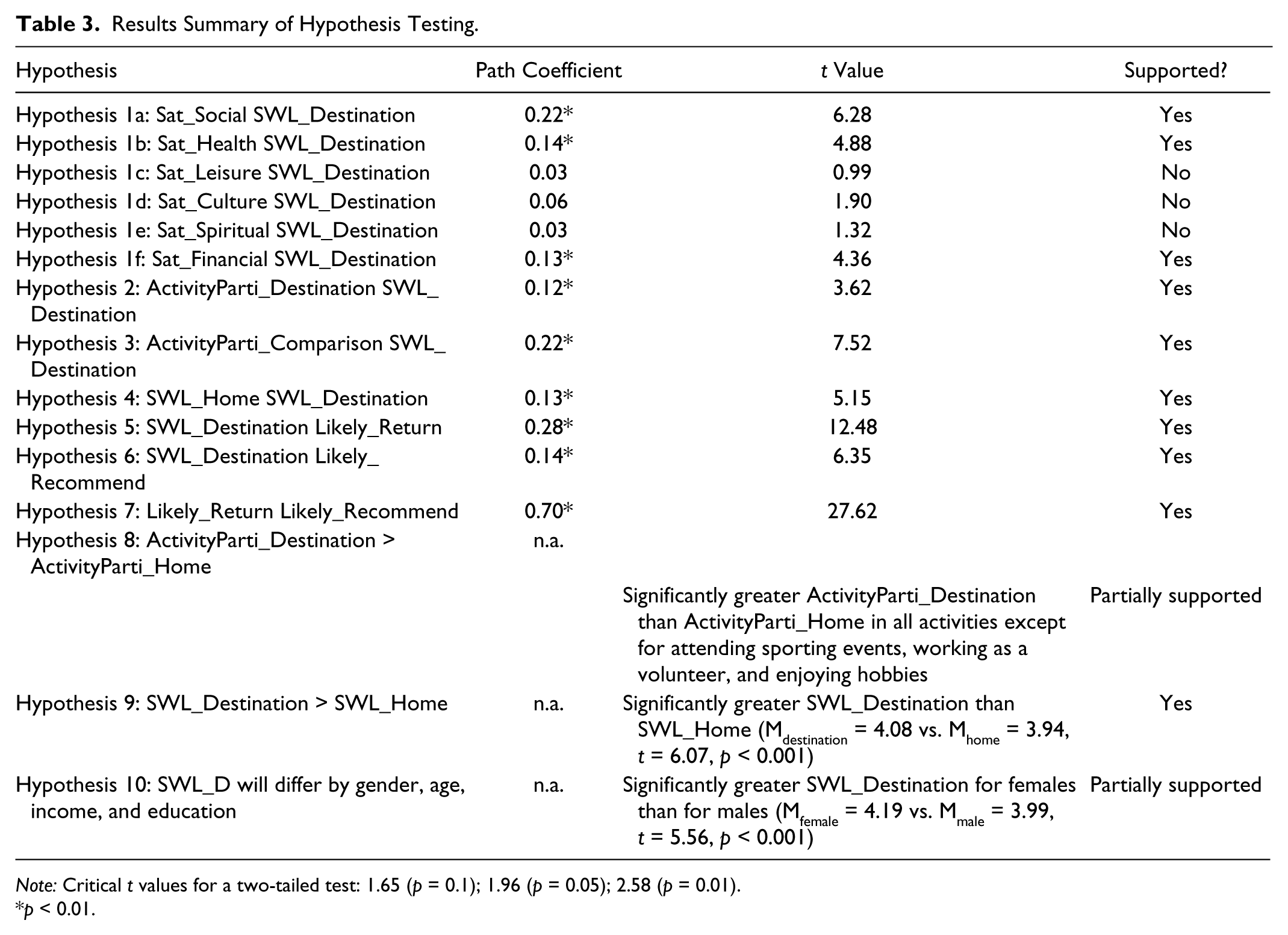
Note: Critical t values for a two-tailed test: 1.65 (p = 0.1); 1.96 (p = 0.05); 2.58 (p = 0.01).
p < 0.01.
As predicted, SWL_Destination was positively affected by ActivityParti_Destination (β = 0.12, t = 3.62, p<0.01), ActivityParti_Comparison (β = 0.22, t = 7.52, p < 0.01), and SWL_Home, supporting hypotheses 2, 3, and 4. SWL_Destination had a positive impact on Likely_Return (β = 0.28, t = 12.48, p < 0.01) and on Likely_Recommend (β = 0.14, t = 6.35, p < 0.01), supporting hypotheses 5 and 6. Finally, Likely_Return positively affected Likely_Recommend, (β = 0.70, t = 27.62, p < 0.01), providing strong support for hypothesis 7.
Predictive Relevance
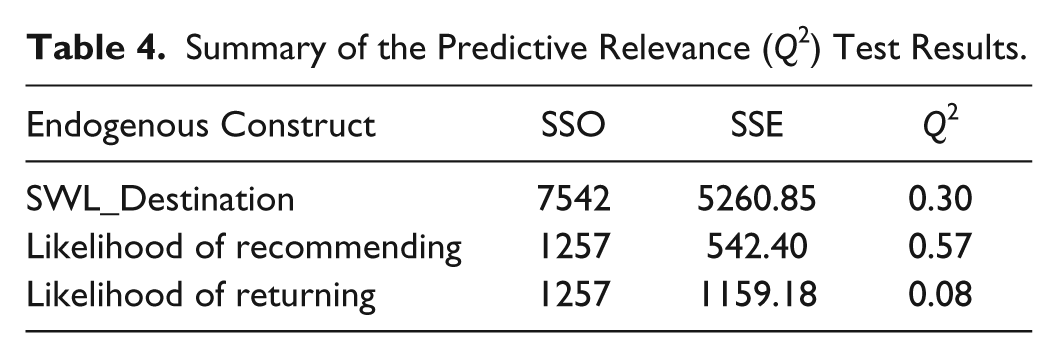
In addition to reporting R2 values and the level and significance of path coefficients, researchers use the Stone-Geisser’s Q2 (Geisser 1974; Stone 1974) as a measure for the predictive relevance of a structural model (e.g., Ayeh, Au, and Law 2013; Rose et al. 2012). The Q2 value is obtained by performing a blindfolding procedure. Hair, Ringle, and Sarstedt (2011) noted that the blindfolding procedure is only applicable to endogenous latent constructs with a reflective measurement model specification and recommend that the d value be set between 5 and 10. For an endogenous latent construct, a Q2 value greater than zero means that the construct’s exogenous constructs have predictive relevance. The number of valid observations in our original sample is 1,257 and the d value was set at 7 in running the blindfolding procedure. The results, as presented in Table 4, show that the Q2 values for SWL_Destination, Likely_Return, and Likely_Recommend were all larger than zero, providing evidence of the structural model’s predictive relevance.
Summary of the Predictive Relevance (Q2) Test Results.
Testing Hypotheses 8–10
Hypotheses 8 and 9 predicted that seasonal migrants will participate more in activities and have greater SWL while at the destination than at their permanent hometowns. Paired-samples t-tests were run to test both hypotheses in SPSS. The results, as summarized in Table 5, show that study respondents engaged in significantly higher levels of all activities at the destination except for attending sporting events, working as a volunteer, and enjoying hobbies. Study respondents attended more sporting events at their hometowns (Mhome = 2.37 vs. Mdestination = 2.12, t = 8.28, p < 0.001). Although respondents participated slightly more in working as volunteers at the winter destination, the difference was not significant (Mdestination = 2.66 vs. Mhome = 2.60, t = 1.41, p = 0.158). Likewise, respondents enjoyed more hobbies while at the destination, but the difference was not significant (Mdestination = 2.92 vs. Mhome = 2.89, t = 1.16, p = 0.247). These findings provide overall support for hypothesis 8. Hypothesis 9 was supported by the result that respondents reported significantly greater SWL_Destination than SWL_Home (Mdestination = 4.08 vs. Mhome = 3.94, t = 6.07, p < 0.001).
Summary of t-Test Results.
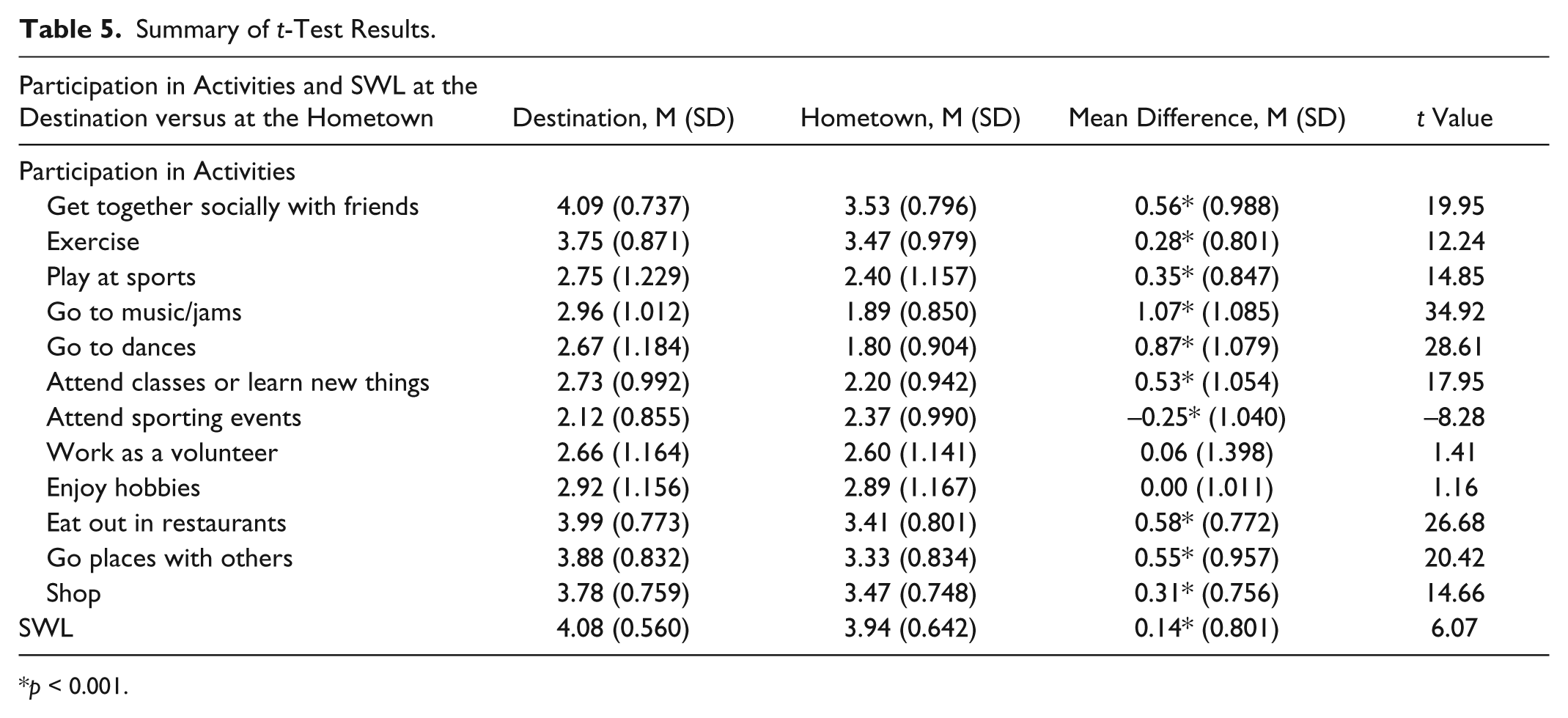
p < 0.001.
To test hypothesis 10, age, income, and education were first recoded into categorical variables. Independent-samples t-tests were then performed to assess the mean difference in SWL_Destination across age groups, income levels, and education levels, and between female and male participants. Female participants reported significantly greater SWL_Destination than male participants (Mfemale = 4.19 vs. Mmale = 3.99, t = 5.56, p < 0.001). However, SWL_Destination did not vary by age group, income level, or education level. Therefore, hypothesis 10 was only partially supported.
Conclusions
This study is one of just a very few that has examined satisfaction with life in a tourism context. Grounded in comparison theory, activity theory, and bottom–up spillover theory, this study identifies specific life domains that impact satisfaction with life at a winter destination and, uniquely, compares SWL and activities at a tourism destination with activities and life satisfaction at home to find significant effects. The study’s findings have several significant implications, beginning with the contribution of the research to theory.
The finding that SWL at a seasonal destination is positively affected by satisfaction with the life domains of social, health and safety, and financial is consistent with the findings from previous studies (e.g., Diener and Seligman 2002; Págan 2014) and provides further support for the bottom–up spillover approach to understanding the relationship between life domain satisfaction and overall SWL. This finding also points out the importance of satisfaction with the social, health and safety, and financial life domains to winter migrants’ successful winter stay experience and supports Págan’s (2014) findings of the importance of health and income domains in affecting SWL.
Activity participation at a seasonal destination and comparisons of activity participation at the destination versus at the hometown was found to contribute to greater SWL at the destination. This finding suggests that SWL at a seasonal destination is formed not solely by experiences at the destination but rather by comparing life factors at the destination with those at hometowns, which lends further empirical support to predictions based on comparison theory and activity theory in a tourism context.
Also adding to theory is the finding that SWL at hometowns positively affected SWL at the destination, which may provide some evidence that SWL is indeed a function of personal traits (e.g., Veenhoven 1994), giving some credence to the top–down approach of SWL discussed by Diener (1984) and Diener, Inglehart, and Tay (2013). For example, Diener (1984, p. 565) notes that some research “findings suggest that satisfaction with the domains may result from rather than cause global life satisfaction.”
This study also found that seasonal migrants were significantly more active at their winter destination than at their hometowns for almost all of the activities listed in the survey, including socializing with friends, exercising, playing at sports, going to music/jams and dances, attending classes, dining out in restaurants, visiting places with others, and shopping. This finding adds support to prior inferences of an increased level of activity at winter destinations over those in hometowns, although not specifically examined in previous works (e.g., Gustafson 2008; King, Warnes, and Williams 2000). A practical implication from this finding in light of the result that activity participation contributed to greater SWL at the destination is that local tourism officials should create more leisure events such as tours, shows, and festivals to encourage greater activity participation from winter migrants. Furthermore, following the advice of Neal and Gursoy (2008), the managers of leisure events at the destination should coordinate among one another to develop appropriate strategies to maximize satisfaction among the seasonal travelers.
The finding that female respondents were more satisfied with life at the winter destination than male respondents supports prior research that finds women to be more satisfied with life than men (Dittmann and Goebel 2010), but runs counter to the work of Plagnol and Easterlin (2008) that found women to be happier in early adult life, but men to be happier in later life. Given this finding, tourism officials at a seasonal destination should focus on improving seasonal migrants’ life satisfaction, especially for males, through enhancing all the positive contributors to SWL found in the current research.
This research is the first known study to examine the outcomes of SWL in terms of intention to return to a destination and likelihood of recommending a destination to others to find significant effects. These results strongly suggest that tourism officials should focus on improving seasonal migrants’ SWL at the winter destination to increase likelihood of returning and of providing positive word of mouth endorsements about the area. Although the results found here may not be generalizable to seasonal migrants in other regions of the nation or the world, they should help communities understand which factors could be improved to add to tourists’ SWL, which should also help in targeting tourists with appropriate marketing and retention efforts.
Suggestions for Future Research
This study is subject to the usual limitations of survey research, especially research among a self-selected sample, so it should be replicated by other methods and in other regions and with other types of seasonal migrants. Nevertheless, the study findings suggest that SWL at a seasonal destination is a function of not only what is experienced at the destination, but also hometown activities and hometown SWL. This unique finding bears further study and replication as it certainly has much bearing on the SWL and happiness literature.
The investigation of winter destination SWL’s influence on likelihood of returning and positive word of mouth may provide some answers for the contradictory results found in prior studies attempting to link satisfaction and repurchase (e.g., Agustin and Singh 2005; McKercher and Tse 2013; Seiders et al. 2005; Voss, Godfrey, and Seiders 2010). Previously studies have hypothesized the right level of attribute satisfaction is critical to repurchase (Dolnicar, Coltman, and Sharma 2013; Jones and Sasser 1995), but perhaps SWL is the missing link. In this regard, future studies should examine the role of both attribute satisfaction and SWL in influencing intention to return.
Other research questions arise from this study as well. The study’s respondents were much more engaged in activities at the seasonal destination than at home, but why? Does residing in trailer parks very near others at the destination encourage greater socializing and activity with neighbors? Or is living in a destination neighborhood with many others of about the same age a factor, whereas the hometown neighborhood may be composed of a diverse age group? Or does the increased happiness from being on “holiday” encourage more participation in activities? The answer to these questions could assist in keeping the seasonal migrants, especially the elderly, more active, less isolated, and thus more mentally and physically healthy. This study empirically tested and found support for SWL’s impact on likelihood of returning to and recommending the destination. Replication of these results is also needed to better understand and confirm how global SWL influences these important marketing constructs.
Finally, the lack of support for the proposed effects of satisfaction with the leisure and recreational, cultural, and spiritual life domains on SWL might suggest a need to improve the measures for these three satisfaction variables. For example, satisfaction with the spiritual life domain was a single-item measure in this study and, therefore, future research could include more items for this measure and test whether the effect will be supported.
Footnotes
Acknowledgements
The authors wish to thank The University of Texas-Pan American, the Business and Tourism Research Center, and the Rio Grande Valley Tourism Cooperative officials for assistance in this research.
Declaration of Conflicting Interests
The author(s) declared no potential conflicts of interest with respect to the research, authorship, and/or publication of this article.
Funding
The author(s) received no financial support for the research, authorship, and/or publication of this article.