




Abstract
This study examined the relationships among materialism, ecotourism attitude, ecotourism interest, ecotourism intention, and willingness to pay a premium for ecotourism utilizing a model that was developed based on the literature. Data for this study were collected from 2,352 Italian travelers and proposed hypotheses were tested using a structural equation modeling approach. Findings indicated that individuals’ materialistic value has negative relationships with their ecotourism attitude, ecotourism interest, ecotourism intention, and willingness to pay a premium for ecotourism products and services. Findings also suggested that individuals’ ecotourism attitude would positively influence ecotourism intention, ecotourism interest, and willingness to pay a premium for ecotourism products and services.
Keywords
Introduction
Ecotourism is a particular kind of alternative tourism closely associated with areas that are environmentally and culturally sensitive. It was developed in an endeavor to prevent the problems and repercussions resulting from traditional mass tourism (Pipinos and Fokiali 2009). Since ecotourism contributes to both environmental conservation and the economy (Ross and Wall 1999), it has become a significant topic in the tourism field (Weaver and Lawton 2007). Several studies have examined the factors that could influence tourists’ visitation intention and willingness to pay more for ecotourism products, such as tourists’ ecotourism attitude and interest (e.g., Lai and Nepal 2006; Singh, Slotkin, and Vamosi 2007). While the evaluation of tourists’ ecotourism attitude and interest is no doubt a basic prerequisite for successful implementation of ecotourism ventures, an investigation of the antecedents of individuals’ ecotourism attitude and interest could even be more meaningful for ecotourism operators. This investigation may enable operators to gain a better insight for determining strategies that could be adopted or developed to improve consumers’ positive attitude and interest toward ecotourism.
According to McCarty and Shrum (2001), individuals’ fundamental beliefs (e.g., value orientations) would affect their both pro-environmental attitudes and behaviors. Values represent learned beliefs about preferred ways of being, which serve as “guiding principles in the life of a person or other social entities” (Schwartz 1994, p. 21). Rokeach (1973) claimed that values can be distinguished from attitudes in that values represent abstract ideals that are not attached to any specific object, while attitudes focus on specific objects and situations. From this perspective, an attitude can be defined as a mental state induced by an application of a value to a certain object or situation. These definitions are consistent with a number of researchers’ (e.g., Kim, Borges, and Chon 2006) conclusions that values are the determinants of attitudes and behavior. In line with this rationale, it is critical for ecotourism operators to identify values that might influence individuals’ attitudes and behaviors toward ecotourism. With this aim, this study chose materialism, an individual value of Western society (Kilbourne and Pickett 2008), to see if it has any significant influences on one’s attitude, interest toward ecotourism, and willingness to pay a premium for ecotourism.
Materialism is a lifestyle that has been part of the Western society for decades (Kilbourne and Pickett 2008). In recent decades, this lifestyle has become a global phenomenon, and the number of people pursuing such a lifestyle has increased exponentially (Kilbourne and Pickett 2008). Materialistic individuals place a great emphasis on the satisfaction in life and happiness derived by the possession of material goods (Belk 1996). This lifestyle, to a certain extent, conflicts with one of the primarily goals of ecotourism: environmental protection. Environmental protection requires drastic decreases in overconsumption and is consequently affected by consumers’ bond to material goods and pleasures (Moisander and Pesonen 2002). Consumers who acquire satisfaction and happiness by material possessions are more likely to be self-centered and are less likely to be fulfilled by engaging in pro-environmental activities compared to individuals who do not value material possessions that much (Tilikidou and Delistavrou 2004). A person’s materialistic value, which has been examined as the root cause of many social problems and environmental degradation (Bredemeier and Toby 1960; Kilbourne and Pickett 2008), might be an important individual-based variable that reduces one’s favorable attitude, interest, and intention toward ecotourism. Therefore, this study aims to examine the influence of materialistic value on one’s attitude and interest toward ecotourism by specifically examining its influence on a tourist’s attitude, interest, intention toward ecotourism, and his/her willingness to pay a premium for it.
Literature Review
Impact of Materialism on Ecotourism Attitude and Interest
Materialism has been conceptualized as an economic consumer value (Inglehart 1981; Richins and Dawson 1992) emphasizing the type and quantity of goods consumed. A number of different, though similar, definitions of materialism have evolved over time. Belk (1985) viewed materialism as “the importance a consumer attaches to worldly possessions” (p. 291). Rassuli and Hollander (1986) referred to it as “a mindset . . . an interest in getting and spending” (p. 10). In a more psychological approach, Micken and Roberts (1999) argued that materialistic behaviors reflect “a preference for certainty, with materialists relying on objects not just as identity markers, but identity fixers” (p. 513). Furthermore, Browne and Kaldenberg (1997) characterized materialism as a cluster of values and traits that focus on possessions. While each of these definitions describes materialism in slightly different ways, they share a common base. They all suggest that people seek more in the consumption process than just the utility or instrumental value products offer and that the context of consumption is important.
Reviewing the construct and measurement of materialism in the literature, Richins and Dawson (1992) developed a values-oriented materialism scale that characterizes materialistic value as having three major realms: acquisition centrality, acquisition as the pursuit of happiness, and possession-defined success. Acquisition centrality refers to the central role possessions and their acquisition play in materialists’ lives. This dimension suggests that for those people who score high on this dimension, materialistic possessions are the focus of their lives. Acquisition as the pursuit of happiness refers to materialists’ belief that possessions are essential to their happiness. This factor suggests that possessions are vital for a materialistic consumer’s well-being and satisfaction in life. Finally, possession-defined success denotes materialists’ perception and assessment that success is determined by the type of things one owns. This factor relates to the role that possessions play as the evidence of success. Obviously, consumers who share materialistic value obtain happiness and fulfillment through possessions, and they tend to buy more to maintain and increase feelings of happiness and success. As such, materialists are easily motivated to overconsume (Tilikidou and Delistavrou 2004), yet overconsumption is given as one of the reasons for environmental degradation (Peattie 1995). As a number of social scientists argued (e.g., Clapp 2002; Conca 2001), the level of material goods produced and consumed determines the level of natural resources extracted and the level of pollution created. Arguably, production and consumption of material goods in an excessive level would facilitate environmental degradation as reported by Jorgenson’s (2003) study, which examined the relationship between consumption and environmental degradation through a cross-national comparison.
On the other hand, environmental values are highly emphasized by eco tourists and have been suggested to be highly influential in the development of ecotourism behavior (Wood 2002; Kasim et al. 2014). Environmental values are those values held by individuals regarding the association between individuals and their natural environment, typically viewed as a continuum ranging from pure anthropocentric to pure biocentric and ecocentric (e.g., Dunlap et al. 2000; Edwards, Davies, and Hussain 2009; Lück 2003). Anthropocentric environmental value is mainly concerned with continually improving human life and society, while biocentric and ecocentric values stress the importance of respecting all life forms and natural systems and granting them equal rights as humans have (Edwards, Davies, and Hussain 2009). However, since acquisition and consumption are considered as central values by materialists, they would not consider environmental protection as a core value. Preoccupation with material goods might thus preclude any major influence of environmental values, which make materialists to find little reason for altering their consumption behaviors to be more accommodating to the environment (Kilbourne and Pickett 2008). Therefore, those materialistic individuals might be less likely to show favorable attitudes and interest toward ecotourism. This might also lead materialists to be less willing to pay a premium for ecotourism products and services. Based on the preceding discussion, the following hypotheses are developed for the proposed model:
Hypothesis 1a: Materialism will negatively influence consumers’ ecotourism attitude.
Hypothesis 1b: Materialism will negatively influence consumers’ ecotourism interest.
Hypothesis 1c: Materialism will negatively influence consumers’ willingness to pay a premium for ecotourism products and services.
Relationships among Ecotourism Attitude, Ecotourism Interest, Ecotourism Intention, and Willingness to Pay a Premium for Ecotourism
Previous studies have suggested that individuals who have positive attitude and interest toward ecotourism are attracted to destinations where natural environment and culture are conserved and opportunities for learning and experiencing are provided (Hall 1992; Jefferson 1995). Since individuals’ attitude toward ecotourism is considered to be one of the most important antecedent of their intention to visit ecotourism destinations or to participate in ecotourism activities (Lai and Nepal 2006), understanding their intention requires researchers to capture and categorize attitude within a complete and multidimensional system that reflects its structural diversity regarding expectations and experiences of those individuals (Gnoth 1997; Weaver 2014). A number of social psychologists such as Hollander (1967) and Lindgren (1969) suggested that attitudes can serve as sources of intentions for the way in which people interact with their environment. Katz (1960) also argued that attitudes have psychodynamic functions motivating people to behave in certain ways.
In addition, according to the theory of reasoned action (Ajzen and Fishbein 1980), attitude toward a behavior is a significant predictor of behavioral intention because attitude toward a behavior represents the extent to which a person has a favorable or unfavorable evaluation of that behavior (Ajzen and Fishbein 1980). A high correlation between attitude, behavioral intention, and the subsequent behavior has been identified (Gursoy, Boylu, and Avci 2011; Mason and Nassivera 2013) and presented in tourism literature (Lai and Nepal 2006; Nunkoo, Gursoy, and Ramkissoon 2013). Attitude in particular has been one of the most widely investigated constructs in the social sciences and has been used to explain observed consistencies in behavior (Singh, Slotkin, and Vamosi 2007). A meta-analysis, conducted by Hines, Hungerford, and Tomera (1987) with an attempt to understand which variable(s) (attitude, knowledge of issue, knowledge of action strategies, locus of control, etc.) appear to be the most powerful predictor of consumers’ environmental behavior, found attitude to be the most influential predictor variable of consumers’ green consumption behavior intention (Millar, Mayer, and Baloglu 2012). Based on the preceding discussion, consumers’ ecotourism intention and interest should be the outcome variables that are positively predicted by consumers’ favorable attitudes toward ecotourism. Therefore, the following hypotheses are proposed:
Hypothesis 2a: Ecotourism attitude will positively influence ecotourism intention.
Hypothesis 2b: Ecotourism attitude will positively influence ecotourism interest.
A considerable amount of debate is found in the literature regarding the definition of ecotourism as well as the criteria used to conceptualize this construct (Pipinos and Fokiali 2009). A school of researchers used the level of enhancive sustainability to classify ecotourism into two types: those who actively provide net benefit to the environment and those who are protective of the environment but do nothing to benefit the environment (Valentine 1993). Similarly, a body of researchers made a distinction between “hard” and “soft” ecotourism (Lindberg and McKercher 1997). Hard ecotourism represents an active kind that visitors are knowledgeable, mostly travel in small groups, require the least amount of service, spend longer times traveling to specialized areas and interact with the natural environment with little assistance from an intermediary. By contrast, soft eco tourists are characterized by convenience and comfort. They generally take shorter trips, use the services of outside experts for interpretation, require a great deal of service from intermediaries, and travel in comfort (Singh, Slotkin, and Vamosi 2007). Researchers believe that soft eco tourists support steady-state sustainability, while hard eco tourists actively enhance sustainability through various approaches such as volunteer work, fund-raising to support environmental conservation, etc. Despite all these different conceptualizations, researchers agree that the core dimensions of ecotourism definitions are almost the same (Björk 2000). Fennell (2002) studied 85 definitions of ecotourism and found a small number of words that were encountered and recurred most often in those definitions. Those words in order of frequency were nature areas, conservation, culture, benefits to locals, education, and sustainability. Likewise, Diamantis (1998) contended that most of the widely used definitions of ecotourism contain three common elements, which are nature-based environment, environmental education, and sustainable management. Given that the purpose of the current study was not to profile any particular ecotourism segment’s attitudes and behaviors, but to examine the influence of materialism value on individuals’ attitude toward ecotourism, this study defined ecotourism in a general sense using the most common characteristics mentioned in the literature rather than narrowing it down to any specific ecotourism segment. Therefore, this study portrayed eco tourists as those individuals who are interested not only in culture and environmental conservation, but also in wilderness and nature experiences and learning (Juric, Cornwell, and Mather 2002). This portrayal clearly demonstrates that eco tourists intend to visit an ecotourism destination not merely because of their desire to relax and escape but also because of their interest in experiencing the nature and environmental conservation (Blamey 1997; Juric, Cornwell, and Mather 2002). Therefore, consumers’ ecotourism interest is likely to increase their intention to participate in ecotourism activities and services. Based on the preceding discussion, the following hypothesis is proposed:
Hypothesis 2c: Ecotourism interest will positively influence ecotourism intention.
Another important construct included in this study is consumers’ willingness to pay a premium for ecotourism. Since a number of researchers noted that companies usually need to charge a premium for environment-friendly products and services to recover additional costs incurred in the production and marketing (Manaktola and Jauhari 2007), consumers’ willingness to pay extra to engage in a pro-environmental behavior becomes critical for companies’ production, pricing, and marketing strategies (Xu and Gursoy, forthcoming). However, even though individuals hold high interest and favorable attitudes toward pro-environmental behaviors, many of them may not necessarily be willing to adopt them and pay relatively higher prices for pro-environmental activities and services (Holden and Sparrowhawk 2002). For example, consumers may be reluctant to be environmentally responsible when they still want to maintain their existing lifestyle (McDaniel and Rylander 1993) or when they are not prepared to sacrifice their convenience (Stern 1999). Ecotourism operators have to take this issue seriously, as the ecotourism industry is also an environment-oriented industry and the price of many ecotourism products and services are comparatively higher than that of mass tourism (Holden and Sparrowhawk 2002). Although researchers still have no consensus on whether consumers are willing to pay extra for ecotourism products and services, some of the prior empirical findings have revealed that consumers are willing to pay on average around 5% more for environment-friendly products (Kapelianis and Strachan 1996; Schwartz 1990; Speer 1997). There is also empirical evidence suggesting that a group of consumers are willing to pay significantly more than 5% (Reinhardt 1998), maybe as much as 20% or more (Worldwide 1997).
Ajzen and Peterson (1988) conceptualized “willingness to pay” as one’s intention to pay a certain amount of money for engaging in a leisure activity or attaining any other public goods. Ajzen and Driver (1992) also treated willingness to pay for public goods as a behavioral intention and they used the theory of planned behavior to explore the meaning of contingent valuation measures. In line with this logic, consumers’ willingness to pay a premium for ecotourism per se should also function similarly as a behavioral intention measure predicted by consumers’ ecotourism attitude. In addition, this variable should also be positively predicted by consumers’ ecotourism intention and interest, as only those who are interested in or motivated to engage in ecotourism activities are expected to be willing to pay more for it. The preceding discussion leads to the last three hypotheses of proposed framework:
Hypothesis 3a: Ecotourism attitude will positively influence consumers’ willingness to pay a premium for ecotourism.
Hypothesis 3b: Ecotourism intention will positively influence consumers’ willingness to pay a premium for ecotourism.
Hypothesis 3c: Ecotourism interest will positively influence consumers’ willingness to pay a premium for ecotourism.
Proposed Framework
Based on the literature review, nine hypotheses were developed and used to construct a model predicting ecotourism behavior. As presented in Figure 1, the model organizes determinants of ecotourism behavior into five categories: materialism, ecotourism attitude, ecotourism interest, ecotourism intention, and willingness to pay a premium for ecotourism. The model proposes that tourists’ willingness to pay a premium for ecotourism is influenced directly by materialism, ecotourism attitude, interest, and intention while tourists’ intention to visit an ecotourism destination is directly influenced by materialism, ecotourism attitude, and interest. Model also proposes that tourists’ ecotourism interest is likely to be influenced by materialism and ecotourism attitude while ecotourism attitude is likely to be influenced by materialism.
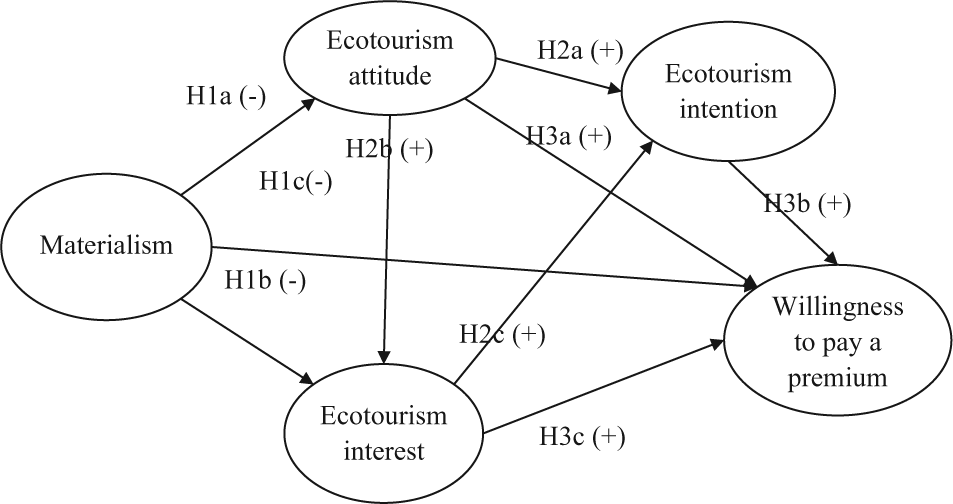
Conceptual framework.
Methodology
Sampling and Data Collection
Data for this study were collected from Italian travelers using an online self-administrated questionnaire utilizing a snowball sampling technique. Survey research is often used to assess subjects’ thoughts, opinions, and feelings, and it has several advantages such as cost-effectiveness and ability to gather data from a large sample in a relatively short period of time (Fowler 2013). Because of the financial limitations and the difficulty of reaching participants in remote areas through face-to-face structured interviews and to obtain data from a relatively large sample, this study utilized an online survey approach as an appropriate data collection method.
Snowball sampling technique is a frequently used sampling technique when the subjects are difficult to locate and access (Auerbach and Silverstein 2003). Through referral mechanisms, this technique provides researchers with an ever-expanding set of potential respondents in a very inexpensive and efficient way (Goldenberg et al. 2009). Even though snowball sampling technique is not considered a random sampling approach, it is considered as the best sampling approach for this study to obtain data from a large sample of consumers across different regions in Italy and to cope with the financial constraints of this project. Further, previous studies (Filieri and McLeay 2013; He and Li 2010) suggest snowball sampling is appropriate when the research purpose is to test hypothesized relationships among variables and constructs, which is the primary focus of this study.
Initial subjects were generated from the 3,000 contacts of an Italian Tourism Association. This approach is consistent with the data collection method used in other studies that examined Italian tourists’ perceptions, attitudes, and behaviors (e.g., Del Chiappa 2013). Specifically, the tourism association pools together consumers/tourists with a general interest in tourism and travelling. Individuals included in this contact list tend to be more engaged in tourism products compared to the rest of the population. Therefore, utilization of this contact list allowed us to reach individuals who are interested in tourism products. These 3,000 individuals, residing in different regions of Italy, received an e-mail inviting them to fill out an online questionnaire with a link provided in the e-mail. At the same time, they were asked to forward this online survey invitation to at least five of their friends, relatives, and contacts who are older than 18 years and, possibly, residing in different regions in Italy. Using a specific tracking program, the forwarding behavior of subjects in the original list was tracked. Tracking records indicated that 1,050 subjects in the original list forwarded the survey invitation. This process resulted in a total of 8,250 individuals receiving the survey invitation e-mail. After a three-week survey period, a total of 2,609 responses were collected and 2,352 were usable for statistical analysis, thus yielding a response rate of 28.59%.
Measurements
The online survey consisted of seven sections, with six measuring different constructs and the last section measuring respondents’ demographics. Because of the large number of constructs measured, the scales used for some constructs were reduced from their original form. As presented in Table 1, the materialism scale used in this study was a subset of items derived from the Richins and Dawson’s (1992) materialism scale. As mentioned in the literature review, original materialism scale is a three-factor solution with success, happiness, and centrality as the three independent dimensions of the construct. While the original scale consisted of 18 items, this study adopted eight items that had highest factor loadings for their factors in the original Richins and Dawson (1992) study. The use of such a short version of the sale has been justified by Richins (2004).
Standardized Path Coefficients of Confirmatory Factor Analysis.
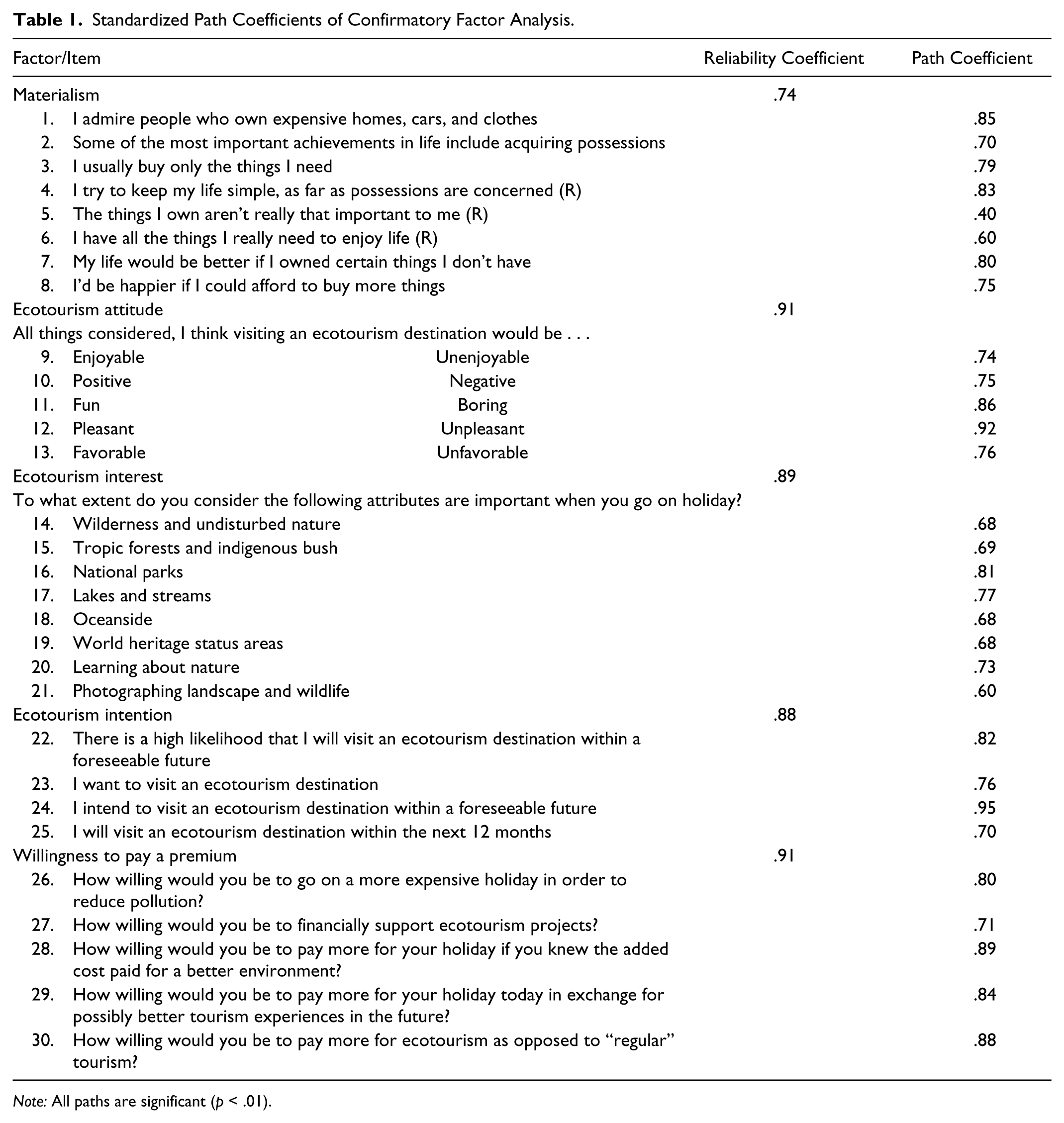
Note: All paths are significant (p < .01).
Before the sections that were designed to measure respondents’ ecotourism interest, attitude, intention, and willingness to pay a premium for ecotourism products, a definition of ecotourism operationalized in this study was presented to the participants as follows:
Ecotourism is defined as travelling to relatively undisturbed or uncontaminated areas with the specific objective of studying, admiring and enjoying the scenery and its wild plants and animals, as well as any existing cultural manifestations (both past and present) found in those areas. The person who practices ecotourism will eventually acquire an awareness and knowledge of the natural environment, together with its cultural aspects, that will convert him or her into somebody keenly involved in conservation issues. (Ceballos-Lascurain 1990, p. 25)
For measures of ecotourism interest, this study utilized eight items of Ecotourism Interest scale developed by Juric, Cornwell, and Mather (2002) as presented in Table 1. These eight items were measured on a seven-point Likert-type scale ranging from very important (7) to not at all important (1). As for the measurement of ecotourism attitude, five statements that were measured on the seven-point semantic differential scale were adopted from Lam and Hsu’s (2006) study. As presented in Table 1, the ecotourism intention was measured by four items adopted from Lam and Hsu’s (2006) study. These items were measured on a seven-point Likert-type scale ranging from strongly agree (7) to strongly disagree (1). Willingness to pay a premium was measured with five items that were adopted from Bang et al.’s (2000) study measuring consumers’ willingness to pay more for renewable energy (Table 1). These five statements were measured on a seven-point Likert-type scale ranging from strongly agree (7) to strongly disagree (1).
Data Analysis
The Statistical Package for Social Sciences (SPSS) was employed for descriptive and inferential analyses to provide respondents’ profiles, correlations, and Cronbach’s alpha reliability scores. A series of Cronbach’s α tests were performed to test the internal consistency and construct validity of constructs. Proposed hypotheses were tested utilizing a structural equation modeling (SEM) approach. The M-plus 6 computer program was used (Byrne 2011) to test the proposed hypotheses. SEM enables a number of constructs to be modeled, while also taking into account the unreliability of the indicators (Nunkoo, Ramkissoon, and Gursoy 2013). In addition, SEM considers unknown reliability of the measures and ranks the measures in terms of their importance (Bacon and Bacon 1997).
Results
As presented in Table 2, the sample consisted of 1,510 males (65%) and 825 females (35%). The majority of respondents were between the ages of 25 to 55 years old (90%) with a high educational background (76.2% have college degree or higher). While 19% of the respondents had an annual income less than $10,000, 43% of the respondents had an annual income between $10,000 and $40,000; 11% of the respondents earned at least $40,000 or higher, and 27% of the respondents were unwilling to report their annual income. It should be noted that this sample might not be representative of the Italian population because of the utilization of a convenience sample derived from a snowball sampling process. In 2011, according to ISTAT (the Italian national statistical office), the overall population of Italy was 59,433,744; 51.63% of them were female and 48.37% were male, and this may suggest a gender bias for the sample of this study. However, according to Dholakia, Dholakia, and Kshetri’s (2004) study, which examined the nature and sources of gender disparity in the adoption and usage of Internet across different nations, the male–female ratio in Internet use was 70:30 in Italy. This might explain why the sample of current study yielded a similar male–female ratio for Italian online users. In addition, since the purpose of this study was theory testing by assessing the magnitude and significance of hypothesized relationships among several constructs in the proposed theoretical model rather than generalizing the findings to an overall population, a representative sample may not be needed and a convenience sample may be adequate to fulfill the purpose of this study (Filieri and McLeay 2013; He and Li 2010). Since the application of structural equation modeling approach on convenience samples has been a frequently used practice (e.g., Ballantyne, Packer, and Falk 2011; Gallarza and Gil-Saura 2006; Ramkissoon, Graham Smith, and Weiler 2013), authors of this study believe that the data was appropriate to test the proposed relationships.
Demographic Profile of the Sample.

Measurement Model
According to Anderson and Gerbing’s (1988) two step approach, a confirmatory factor analysis (CFA) should be performed first to ensure confidence in the measurement model, which specifies the relations of observed indicators to their underlying constructs. As presented in Table 3, most of the goodness-of-fit indices for the measurement model were within an acceptable range except for the χ2 value. The χ2 value for the proposed model was found to be statistically significant (χ2 = 1901.39, df = 378, p = .00). As noted by Jöreskog (1993, p. 309), “since chi-square is N – 1 times the minimum value of the fit function, the chi-square test tends to be large in large samples.” Because of the large effect of sample size on the chi-square values (and associated p values), other fit indices were also selected to measure the fit of the tested models (Nunkoo, Ramkissoon, and Gursoy 2013). The fit between the measurement model and data was thus assessed by the following standard indices: comparative fit index (CFI) = .96; Tucker-Lewis index (TLI) = .96. Furthermore, the indicators of residuals, standardized root mean square residual (SRMR) = .03, and root mean square error of approximation (RMSEA) = .04. All of the above indicated that the measurement model fit the data well and the overall fit indices were appropriate.
Goodness-of-Fit Indices.

Note: CFI = comparative fit index; TLI = Tucker-Lewis index; SRMR = standardized root mean square residual; RMSEA = root mean square error of approximation.
Two types of validity measures, convergent and discriminant validity, were examined. Convergent validity was tested by examining t values of each item’s factor loading on its underlying construct (Anderson and Gerbing 1988). All t-values associated with each completely standardized factor loading for each indicator were found to be higher than 1.96, suggesting significance at the .05 significance level. This indicated that convergent validity of all the indictors was established. Discriminant validity was tested by comparing intercorrelations of factors with the square root of the average variance (i.e., variance extracted estimate) for each factor (Hatcher 1994). Since the estimate for variance extracted for each factor was at least .50 and exceeded any of the intercorrelations of the factors, discriminant validity of all the constructs was established (Fornell and Larcker 1981).
Structural Model and Hypothesis Testing
With measurement model demonstrating good fit, a structural model depicting each of nine hypotheses was then tested. Again, although the structural model had a significant χ2 value (χ2 = 2148.2, df = 388, p = .00), the other model fit indices were within an acceptable range: CFI = .96; TLI = .95; SRMR = .05; and RMSEA = .04 (Table 3). All these suggested that the structural model fit the data well.
The first three hypotheses (1a, 1b, and 1c) stated that materialism will negatively influence ecotourism attitude, ecotourism interest, and willingness to pay a premium for ecotourism. These three hypotheses were supported as the standardized path coefficients for hypotheses 1a, 1b, and 1c were –.34, –.15, and –.17, respectively, and parameter estimates for all three were significant at the .01 significance level (Table 4). Hypotheses 2a and 2b proposed that ecotourism attitude will positively influence both ecotourism intention and ecotourism interest. The path coefficients for these two hypotheses were .10 and .36, respectively, and were both statistically significant at the .01 significance level. This findings provided support for hypotheses 2a and 2b. Hypothesis 2c proposed a positive relationship between ecotourism interest and ecotourism intention, and this hypothesis was not supported as path coefficient was .05 and was not statistically significant (p = .06). Hypotheses 3a, 3b, and 3c proposed that ecotourism attitude, ecotourism intention, and ecotourism interest all will positively influence consumers’ willingness to pay a premium for ecotourism. The path coefficients for hypotheses 3a and 3b were .27 and .37, respectively, and were both statistically significant at the .01 significance level, whereas the path coefficient for hypothesis 3c was .03 and was not statistically significant (p = .17). Therefore, hypotheses 3a and 3b were supported while hypothesis 3c was not.
Standardized Path Coefficients of Variables for Hypotheses.
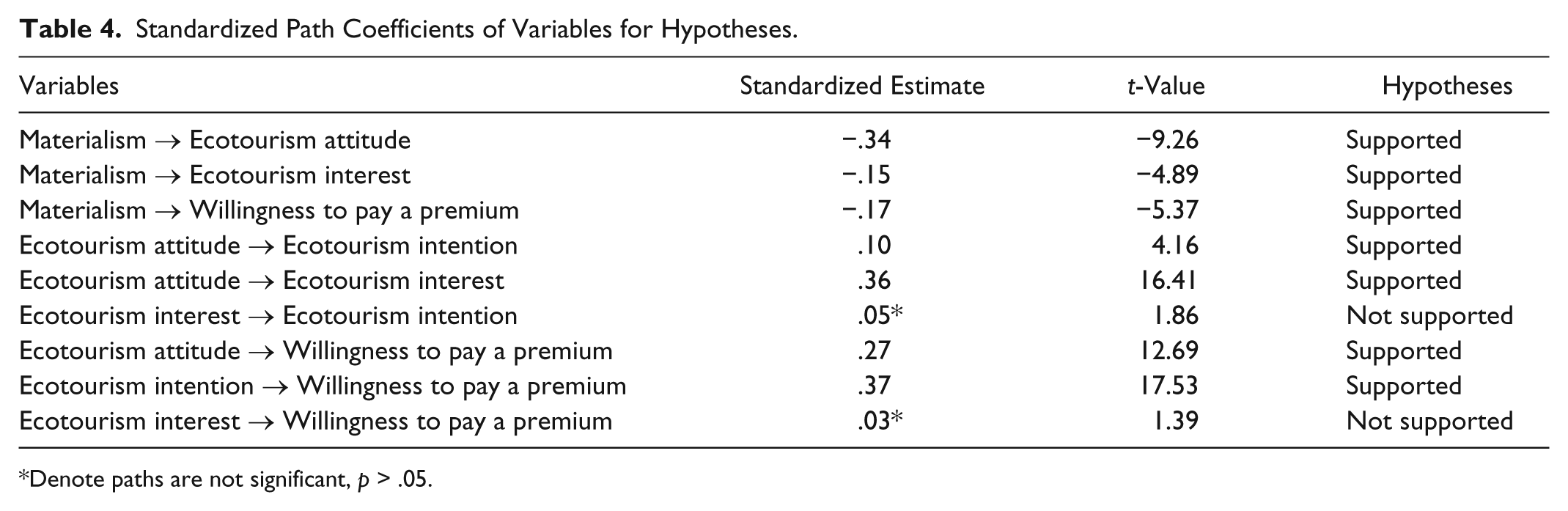
Denote paths are not significant, p > .05.
Discussions and Conclusions
As expected, the findings show that materialism value negatively influences ecotourism attitude, ecotourism interest, and willingness to pay a premium for eco-tourism products. Such result, to some extent, reflects previous researchers’ critiques of materialism as one of the root causes of environmental decline (Porritt 1984). In Kilbourne and Pickett’s (2008) study, which investigated how materialism affects environmental beliefs, concern, and environmentally responsible behavior, they contended that individuals’ cognitive dissonance (Festinger 1962) could occur when their desired consumption behavior is considered as negative to the environment. Therefore, cognitive dissonance in materialists is likely to increase once they realize that the increase of consumption could result in negative environmental consequences. The resolution for such dissonance relies on the circumstances relating to the relative attractiveness of the alternatives (Festinger and Carlsmith 1959). Given that materialism has been long rooted in Western industrial society while environmentalism is relatively new and less integrated into cognitive structures, the conflict between the two values would be resolved in favor of materialism. This suggests that an individual is likely to discard his or her environmental concerns conflicting with his or her materialistic value. Since environmental protection is one of the major objectives of ecotourism development, those with high materialistic value would thus find ecotourism as an unattractive type of leisure activity and, therefore, they would not want to pay a premium for ecotourism products. All these could explain why one’s materialism would negatively influence his or her ecotourism attitude, interest, and willingness to pay more for ecotourism as reported in this study.
The results also reveal that consumers’ ecotourism attitude would positively influence ecotourism intention, ecotourism interest, and willingness to pay a premium for ecotourism. Such findings are consistent with the rationale of the theory of reasoned action (Ajzen and Fishbein 1980). The model of TRA demonstrates that behaviors are determined by a person’s intention to perform a specific behavior and that behavioral intention is derived from two factors: (1) attitude toward the behavior and (2) subjective norms. In the present study, ecotourism intention, ecotourism interest, and willingness to pay a premium for ecotourism are three distinct variables that function similarly in nature as individuals’ behavioral intention, which has been justified in the literature review. It is thus reasonable to find that these three constructs are positively influenced by consumers’ ecotourism attitude. On the other hand, the result also indicates that consumers’ ecotourism intention will positively predict their willingness to pay more for ecotourism. Researchers (Howarth and Norgaard 1995) have noted that the reason why consumers are interested in the environment is mainly because they are concerned about their own health or their children’s future. According to Zaichkowsky (1985), when an issue is related to personal importance or values such as health or children’s future, it would enhance involvement. In addition, Bang et al. (2000) suggested that consumers who are concerned about the environment would prefer environmentally friendly products and would reward environmentally conscious businesses whom they perceive as socially responsible. In line with the above argument, consumers’ intention toward ecotourism, which aims to enhance nature-based environment, environmental education and sustainable management, should logically lead to their willingness to pay more for it as reported in this study.
Nevertheless, it is surprising that the present study did not find consumers ecotourism interest positively predict their ecotourism intention and willingness to pay a premium for ecotourism. Possible explanations for such findings might be the nature of Ecotourism Interest (EI) Scale itself. According to Juric, Cornwell, and Mather (2002), a notable limitation of EI scale is that it was tested only for selected activities available in New Zealand, so that whether the scale can be applied to different types of tourism activities and destinations is unknown. As those eight selected activities in New Zealand could not define all ecotourism activities across different destinations, the Italian public, who were the major sample of this study, might perceive some other activities in addition to those ones as their typical ecotourism activities. Therefore, the validity of EI scale in reflecting Italian participants’ ecotourism interest might be questionable, and this possibly inaccurate reflection might be the critical cause of insignificant predicting power of ecotourism interest on two other ecotourism-related constructs (i.e., ecotourism intention and willingness to pay a premium).
In conclusion, this study provides important theoretical contributions to the current literature on ecotourism and sustainable tourism development. Contrary to most prior ecotourism research that emphasized the positive relationship between individuals’ environmental values/attitudes and their ecotourism motivations and behaviors (e.g., Dolnicar and Leisch 2008; Luo and Deng 2008; Perkins and Brown 2012; Wurzinger and Johansson 2006), this study empirically illustrates that individuals’ materialistic value would significantly reduce their attitude and interest toward ecotourism and their willingness to pay a premium for ecotourism. Furthermore, the model proposed in this study also provides empirical support for Value-Attitude-Behavior cognitive hierarchy (Homer and Kahle 1988) that a person’s value orientations could be important influential factors of his/her attitudes. In addition, building on the theory of reasoned action literature, this study enriches the body of tourism literature by identifying significant positive effects of consumers’ favorable attitude of ecotourism on their ecotourism interest, ecotourism intention, and willingness to pay more for ecotourism. This also provides empirical support for using the theory of reasoned action when attempting to understand and explain individuals’ responses to ecotourism attitudes and behaviors.
Managerial Implications
The findings of this study provide some practical implications for ecotourism operators and marketers. Findings clearly indicate that an individual’s attitude is likely to influence his/her intention to purchase ecotourism products and his/her willingness to pay a premium for them. This suggests that development and implementation of communication strategies to create or increase consumers’ positive attitudes toward ecotourism is vital for the success and survival of ecotourism operations. To this end, ecotourism operators, tour operators, travel agents, and guides can cooperatively develop communication strategies and materials that emphasize the importance and benefits of ecotourism for preservation of environment and culture while generating positive benefits for local residents and tourists. For example, ecotourism service providers could cooperate with tourism community leaders to develop programs involving local residents to provide learning opportunities for them about the nature, environmental and cultural-heritage preservation efforts and initiatives, and how ecotourism can further those preservation efforts and initiatives. Studies suggest that the majority of ecotourists tend to travel with their friends or as a couple (Weaver and Lawton 2007). In order to increase participation in ecotourism and to target different segments, operators can provide facilities and activities that are family oriented around nature and wildlife. Operators can also offer special discounts to local residents to motivate them to try ecotourism products located within their communities. This may improve residents’ positive perceptions and support for ecotourism operations within their community. In addition, the promotion and recognition of potential economic benefits from ecotourism to an area is equally important. Tourism decision makers should communicate the importance of ecotourism in job creation and recreational opportunities with local residents through various media outlets such as Internet, TV, newspaper, magazine, printed material, etc. Ecotourism planners can also hold a series of special ecotourism events and festivals to achieve greater visibility and promotion. Increases in consumers’ knowledge and awareness of ecotourism’s importance and benefits are likely to result in favorable attitude toward ecotourism. This would, in turn, help increase consumers ecotourism interest, intention, as well as their willingness to pay more for ecotourism products and services, as reported in this study.
Nevertheless, it should be noted that the success of the above efforts will vary according to the level of materialistic value held by individuals targeted in those efforts. Since individuals’ materialistic value is likely to negatively influence their attitude, interest, and willingness to pay a premium for ecotourism products, ecotourism operators should spend a great amount of time and effort on communication and education strategies for those who are high in materialism. This, of course, requires a long-term commitment since materialism has been long embedded in Western industrial society (Kilbourne and Pickett 2008). Perhaps an effective and efficient approach is that local and central authorities can develop consumer and production programs and policies aimed at changing consumers’ behaviors about environmental and sociocultural issues. Such programs and policies should emphasize the importance of environmental protection as well as advocate making small lifestyle changes to help further conservation of natural and sociocultural resources while increasing individuals’ happiness in life and improving quality of life overall.
Limitations and Future Research Directions
As with any other studies, the current study has several limitations. Data for this study were collected only from one nation (i.e., Italy) utilizing an online data collection process, so whether the proposed model can be applied to different samples from Italy or other countries is questionable. Furthermore, since the data were collected utilizing an online survey, individuals without Internet access may have been excluded from the sample. In addition, this study utilized a convenience sample derived from a snowball sampling approach. Findings indicated that the sample included more male respondents than female respondents, which suggests that the sample may not be representative. When interpreting the results, readers should consider the possibility of gender bias in responses. It is strongly recommended that future studies utilize a random sampling approach for generalizability purposes. Future studies should preferably be conducted on a randomly acquired cross-national sample to address this generalizability concern.
Common method bias is also a limitation that should be noted. Data utilized were self-reported and all independent and dependent variables were obtained from the same raters (Podsakoff et al. 2003). This study did not separate the source of independent and dependent variables because of great difficulties in linking the data together. It is strongly recommended that future studies should set stricter research procedures to minimize this issue, preferably obtaining measures of independent and dependent variables from different raters.
Cross-sectional design is another limitation of this study, which could limit the ability to observe the changing patterns of subjects across time. It might also cause misidentification of the causal relationship between independent and dependent variables. Future research should address such issues by using longitudinal research approaches to detect and monitor variations and trends among subjects. Moreover, as mentioned in the discussion section, the EI scale used in this study may not be applicable to the sample of this study since the scale was developed for individuals who are located on another continent. The nature of EI scale might be the cause of insignificant findings. Future studies could address this issue by developing another measure of ecotourism interest that can be practically applied to a wider range of ecotourism experiences and eco tourist profiles.
The current study also provides a number of research directions for future research. Since this study utilized data from only one Western nation, Italy, it may be necessary to replicate this study in other Western nations to validate the results reported here. It may also be necessary to conduct cross-cultural studies to examine the influences of materialism on individuals’ attitude, interest, and willingness to pay more for ecotourism products from Eastern and Western cultures. Given research (Clark 2009) has identified Eastern and Western societies are ontologically differ in values they hold (i.e., Eastern society values spiritualism while Western society values materialism), replication of this study in Eastern cultures by integrating Eastern values into the model might generate critical findings and implications for Eastern ecotourism operators and marketers.
Future research can also identify factors that might moderate the relationship between materialism and individuals’ attitude, interest, and willingness to pay more for ecotourism products. For example, generational difference (i.e., Boomers vs. Generation X vs. Millennials) might be a possible moderator of this kind. Researchers have argued that each generation has a unique cultural perspective. The level of materialism value among different generations might also be different (e.g., Kilbourne and Pickett 2008). Therefore, including generational difference or other variables (e.g., demographic variables) as possible moderators in the proposed framework of this study might provide more practical implications for ecotourism practitioners to develop more customized marketing and communications strategies for different market segments.
Moreover, in addition to materialism value, future research should also try to identify other values that could influence people’s attitude and interest toward ecotourism; utilitarian and hedonic values might be two possible values of this kind (Gursoy, Spangenberg, and Rutherford 2006; Miao, Lehto, and Wei 2014). Since utilitarian and hedonic values have been widely recognized as two important determinants of consumers’ consumption choices (Dhar and Wertenbroch 2000), it would be interesting to examine whether these two values also have any significant influences on how people think of ecotourism products.
Last but not least, all of the endogenous variables utilized in this study are measures of respondents’ behavioral intentions, not actual behaviors. Given some empirical studies (e.g., Holden and Sparrowhawk 2002; McDaniel and Rylander 1993) have shown that individuals’ behavioral intentions to engage in pro-environmental behaviors do not guarantee that they will actually engage in pro-environmental behaviors. Future research effort in this regard should measure both respondents’ behavioral intentions and their actual behaviors in order to enhance the understanding of the relationship between the two as well as generate more useful practical implications for ecotourism operators.
Footnotes
Declaration of Conflicting Interests
The author(s) declared no potential conflicts of interest with respect to the research, authorship, and/or publication of this article.
Funding
The author(s) received no financial support for the research, authorship, and/or publication of this article.