




Abstract
Customer engagement has recently emerged in both academic literature and practitioner discussions as a brand loyalty predictor that may be superior to other traditional loyalty antecedents. However, empirical inquiry on customer engagement is relatively scarce. As tourism and hospitality firms have widely adopted customer engagement strategies for managing customer–brand relationships, further understanding of this concept is essential. Using structural equation modeling, this study investigates the linkages of customer engagement with traditional antecedents of brand loyalty. Results based on 496 hotel and airline customers suggest that customer engagement enhances customers’ service brand evaluation, brand trust, and brand loyalty. The results show that service brand loyalty can be strengthened not only through the service consumption experience but also through customer engagement beyond the service encounter. This study contributes to the literature by providing an empirical evaluation of the relationships between customer engagement and key brand loyalty development factors.
For many years, brand loyalty has been considered a significant indicator of marketing success of firms in many industries, including tourism and hospitality (Yoo and Bai 2012). Previous brand loyalty studies have mainly examined key marketing concepts such as service quality (e.g., Bloemer, de Ruyter, and Wetzels 1999; Hsu, Oh, and Assaf 2012; Nam, Ekinci, and Whyatt 2011), perceived value (e.g., Sirdeshmukh, Singh, and Sabol 2002; Ryu, Han, and Kim 2008; Petrick 2004), customer satisfaction (e.g., Back and Parks 2003; Li and Petrick 2008; Back and Lee 2009), and trust (e.g., Chaudhuri and Holbrook 2001; Han and Jeong 2013) as loyalty antecedents. Such determinants are often described as evaluative judgment variables (Butcher, Sparks, and O’Callaghan 2001) or service evaluation factors (Lai, Griffin, and Babin 2009) determined primarily through consumers’ evaluation of the actual service experience. While trust is considered as a relational variable (Sirdeshmukh, Singh, and Sabol 2002), the trust image of a brand is based mainly on past experiences with that brand (Delgado-Ballester and Munuera-Alemán 2001; Ravald and Gronroos 1996; Rempel, Holmes, and Zanna 1985). Thus, from a customer’s perspective, brand loyalty depends largely on the consumer’s assessment of the consumption experience with a particular brand.
The significant role of the service consumption experience in establishing brand loyalty remains indisputable. However, the rise of new media channels and the growing popularity of the Internet (Xiang et al., forthcoming) have provided tourism and hospitality firms with new opportunities to connect with their customers through interactions other than the service experience (e.g., reading newsletters, writing reviews, joining a Facebook community, or blogging). The increasing usage of smartphones (Wang, Xiang, and Fesenmaier, forthcoming) and the emergence of online social media also enable customers to interact easily with other consumers outside of actual service consumption (Verhoef, Reinartz, and Krafft 2010), thus allowing firms to encourage their customers to become effective advocates for the brand (Malthouse et al. 2013). Such beyond-purchase interactions are the behavioral manifestation of customer engagement (CE) (van Doorn et al. 2010; Verhoef, Reinartz, and Krafft 2010).
The tourism and hospitality literature widely supports the potential benefits of CE. For example, online user-generated reviews influence the number of online bookings (Ye, Law, and Gu 2009), the intentions to book and perceptions of trust in the hotel (Sparks and Browning 2011), as well as consumers’ attributions of service quality (Browning, So, and Sparks 2013). In addition, leveraging CE behaviors may allow tourism organizations to attract and retain more customers, convert browsers to buyers, and gain additional insight into their business (Wang and Fesenmaier 2004). Recent research suggests that engaging tourists posttrip could facilitate visitors become advocates and ambassadors for the destination by talking to other users and asking their opinions (Mistilis, Buhalis, and Gretzel, forthcoming). Practitioners also increasingly recognize the importance of CE. For example, Econsultancy (2011) surveyed more than 1,000 companies and agencies across various industries worldwide, including the travel sector, and found that 50% of the companies regard CE as “essential” for their organizations, and 33% consider CE as “important.”
Recognizing the benefits of building CE, global tourism brands such as the Marriott and Cathay Pacific have established their company page on major social network sites (e.g., Facebook and Twitter) and have begun engaging with their customers through interactions beyond purchase. According to the Marketing Science Institute (MSI) (2010), firms increasingly see nontransactional activities, such as word of mouth, recommendations, customer-to-customer interactions, blogging, and writing reviews, as a route for creating, building, and enhancing customer–firm relationships. Recent research reinforced the relevance of engagement in brand management (Keller 2003) by demonstrating that CE, incorporating both psychological and behavioral customer–brand connections outside of the purchase situation, significantly predicts customers’ behavioral intention of loyalty toward tourism brands (So, King, and Sparks, forthcoming).
Despite the growing interest in fostering CE, empirical research is relatively limited (Bolton 2011; Gummerus et al. 2012), and very little is known about the role CE plays in brand loyalty development and how it interacts with established loyalty determinants. More specifically, previous academic efforts focus mainly on the conceptualized relationships between CE and consumer–brand relationship factors such as trust and loyalty (Vivek, Beatty, and Morgan 2012; van Doorn et al. 2010; Hollebeek 2011a). This investigation, building on prior conceptual work (Hollebeek 2011a; Vivek, Beatty, and Morgan 2012), empirically examines CE’s associations with several critical factors underpinning the development of loyal customer–brand relationships in the context of tourism, where CE behaviors are considered to be prevalent (Wang and Fesenmaier 2004). This study places CE in a wider nomological framework (Hollebeek 2011a). In doing so, this research advances current understanding of beyond-purchase psychological and behavioral connections with a brand (i.e., CE) and the effects these connections have on the development of loyalty.
Literature Review
Customer Engagement
Customer engagement has emerged in the marketing literature as an important concept defined with a strong behavioral focus. For example, the MSI (2010) identifies CE as a priority topic and describes the concept as “customers’ behavioral manifestation toward a brand or firm beyond purchase, which results from motivational drivers including: word-of-mouth activity, recommendations, customer-to-customer interactions, blogging, writing reviews, and other similar activities” (p. 4). The academic (e.g., van Doorn et al. 2010; Bijmolt et al. 2010; Verhoef, Reinartz, and Krafft 2010) and practitioner (e.g., Shevlin 2007) literature also demonstrate a behavioral orientation.
However, several scholars argue that the conceptualization of CE needs to go beyond a pure action focus to incorporate both psychological and behavioral dimensions (e.g., Patterson, Yu, and de Ruyter 2006; Hollebeek 2009, 2011a; Vivek 2009; Brodie et al. 2011). In particular, support for broadening the conceptual domain of CE is grounded in the thinking that pure behavioral participation in CE activities does not necessarily mean true CE with a brand. A customer may engage in a brand discussion forum to acquire product information or reduce perceived risks (Brodie et al. 2013), rather than to be connected to the brand. As the truly engaged customer must have an enduring psychological connection with the brand in addition to behavioral participation (So, King, and Sparks, forthcoming; Hollebeek 2011b), a multidimensional approach captures the full conceptual domain of the CE concept.
While several multidimensional conceptualizations of CE have been proposed (e.g., Brodie et al. 2013; Hollebeek 2011b, van Doorn et al. 2010, So, King, and Sparks, forthcoming), which provide a significant conceptual foundation for CE, this study adopts the conceptualization proposed by So, King, and Sparks (forthcoming) because it focuses specifically on tourism services and offers a validated measurement scale to operationalize the concept. Following a multidimensional approach, So, King, and Sparks (forthcoming) define CE as a customer’s personal connection to a brand as manifested in cognitive, affective, and behavioral responses outside of the purchase and conceptualize CE as a higher-order construct comprising five first-order factors, including enthusiasm (or vigor), attention, absorption, interaction, and identification. Enthusiasm represents an individual’s strong level of excitement and interest regarding the focus of engagement, such as a brand, whereas attention describes a consumer’s attentiveness to the brand. Absorption is a pleasant state in which the customer is fully concentrated, happy, and deeply engrossed while playing the role as a consumer of the brand, and interaction refers to a customer’s online and offline participation with the brand, or other customers, outside of the purchase transaction. Identification is an individual’s perceived oneness with, or belongingness to, the brand. The five underlying dimensions collectively reflect the psychological and behavioral aspects of CE.
Customer Engagement and Service Brand Loyalty Development
Scholarly efforts have identified several key consumer–brand relationship concepts that are potentially related to CE (Patterson, Yu, and de Ruyter 2006; Hollebeek 2009, 2011a; Brodie et al. 2011; van Doorn et al. 2010; So, King, and Sparks, forthcoming; Bowden 2009; Vivek, Beatty, and Morgan 2012). These factors include customer satisfaction, brand trust, perceived value, and service quality, which are fundamental to development of brand loyal relationships (Harris and Goode 2004; Cronin, Brady, and Hult 2000). However, limited empirical evidence exists to establish a clear understanding of the connection between CE and factors underlying the development of loyal customer–brand relationships. Such knowledge is important to both marketing practitioners and academics owing to organizations’ increasing adoption of CE strategies and because of the significant amount of academic attention afforded to this emerging concept as a superior predictor of brand loyalty. Therefore, an effort to enhance understanding of the role CE plays in the brand loyalty development process requires a systematic approach to conceptualizing the linkages between the key components in service brand loyalty development.
Service brand evaluation
Prior research indicates that the development of brand loyalty rests largely on consumer evaluation of the key aspects of services, including the perceived level of service quality (Bloemer, de Ruyter, and Wetzels 1999; Lee and Cunningham 2001; Zeithaml, Berry, and Parasuraman 1996; Aydin and Ozer 2005; Rauyruen and Miller 2007), the perceptions of value for money (e.g., Chen and Hu 2010; Sirdeshmukh, Singh, and Sabol 2002), and customer satisfaction with the purchase (Butcher, Sparks, and O’Callaghan 2001; Li and Petrick 2008; Harris and Goode 2004; Rauyruen and Miller 2007; Bridson, Evans, and Hickman 2008). Consumers assess these factors primarily by evaluating the service encounter during their service consumption experience (So et al. 2013). Although early studies examined these concepts as distinct constructs, the marketing literature suggests that these closely related concepts could be combined to form a higher level of abstraction, given that they all represent higher-order mental constructs summarizing consumers’ knowledge of, and experiences with, a particular firm (Garbarino and Johnson 1999). Research shows that these global evaluation factors often have a strong statistical relationship, described as a halo effect (Crosby and Stephens 1987) or multicollinearity (Rust, Zahorik, and Keiningham 1995). This results from cognitive and memory processes where global evaluations synthesize many experiences and perceptions (Garbarino and Johnson 1999). Furthermore, scholars have combined different types of cumulative evaluations (e.g., trust and satisfaction) to form a single global construct, such as relationship quality (Crosby, Evans, and Cowles 1990). On this basis, the combination of perceived service quality, perceived value, and customer satisfaction to form a higher-order construct of service brand evaluation appears to be conceptually appropriate.
The effect of customer engagement on service brand evaluation
Although empirical research on the conceptual relationship between CE and service brand evaluation is currently lacking, the employee engagement literature provides some insight into the potential relationship between the two theoretical constructs. Specifically, research on engagement from an employee’s perspective has found that job satisfaction is a significant consequence of job and organization engagement (Saks 2006). Similarly, scholars have reported a positive relationship between employee engagement and employee satisfaction (Harter, Schmidt, and Hayes 2002). Given that employee engagement and CE are both characterized by feelings of passion, energy, enthusiasm, and activation (Hollebeek 2009, 2011a; Patterson, Yu, and de Ruyter 2006; Macey and Schneider 2008; So, King, and Sparks, forthcoming), the nature of these relationships may be transferable to a consumer context.
In the emerging CE literature, however, scholars appear to support two opposite predictions concerning the relationship between service brand evaluation and CE. On the one hand, customer-based evaluative factors, such as satisfaction, trust, perceived costs/benefits (i.e., value), and brand performance perceptions, have been described as influencing CE behavior (Verhoef, Reinartz, and Krafft 2010). Therefore, enhanced service brand evaluation may induce CE. However, this directional relationship is unlikely to be linear. While superior service brand evaluation is vital to the success of service brands, to assume that all customers who evaluate the service experience positively will become engaged with the brand is unreasonable. Thus, superior service brand evaluation is necessary but insufficient to establish strong CE.
On the other hand, scholars contend that CE affects customers’ evaluations of a product or service. For example, the potential effect of CE on service brand evaluation is apparent in Hollebeek’s (2009) conceptual model, which proposes that CE exerts a direct influence on satisfaction and an indirect effect on customer value. In addition, other marketing investigators argue that CE leads to favorable attitudes toward a product, company, or brand (Vivek, Beatty, and Morgan 2012). Furthermore, researchers in the social psychology literature suggest that the more strongly an individual is engaged, the more intensely the individual experiences the motivational force (Higgins and Scholer 2009). Therefore, an individual who is more strongly engaged in pursuit of a goal will evaluate a positive target more positively and a negative target more negatively. On this basis, we hypothesize that
Hypothesis 1: Customer engagement is positively related to service brand evaluation.
The effect of service brand evaluation and customer engagement on brand loyalty
Despite limited empirical evidence directly supporting the association between service brand evaluation, CE, and loyalty, research suggests that in evaluating the product or service offerings of a brand, consumers develop attitudes or satisfaction judgments about the purchase that justify their loyal relationship with the brand (Fullerton 2005; Yuksel, Yuksel, and Bilim 2010; Nam, Ekinci, and Whyatt 2011), resulting in favorable behavioral intentions such as loyalty to the company (Zeithaml, Berry, and Parasuraman 1996). Similarly, previous studies show that enhanced evaluation of service quality leads to positive outcomes such as repurchase intention (Rauyruen and Miller 2007), willingness to recommend (de Ruyter, Wetzels, and Bloemer 1998), and customer loyalty (e.g., Zeithaml, Berry, and Parasuraman 1996; Aydin and Ozer 2005).
Brand loyalty represents a customer’s deeply held commitment to rebuy or repatronize a preferred brand consistently (Oliver 1999). In contrast, CE summarizes customers’ beyond-purchase connections with the brand (Vivek, Beatty, and Morgan 2012; So, King, and Sparks, forthcoming). Marketing scholars argue that CE may enhance loyalty and purchase decisions (e.g., Hollebeek 2009; Patterson, Yu, and de Ruyter 2006) through a strong, enduring psychological connection accompanied by interactive brand experiences beyond purchase (Brodie et al. 2011). CE with a brand influences consumer outcomes such as brand perceptions and brand attitudes, and therefore influences brand loyalty (Sprott, Czellar, and Spangenberg 2009). Furthermore, an engaged individual is likely to develop more favorable attitudes toward a product, company, or brand, leading to loyalty toward the entity (Vivek, Beatty, and Morgan 2012; So, King, and Sparks, forthcoming). Therefore, we hypothesize
Hypothesis 2: Service brand evaluation is positively related to brand loyalty.
Hypothesis 3: Customer engagement is positively related to brand loyalty.
The mediating role of brand trust
In addition to having a direct effect on brand loyalty, service brand evaluation and CE contribute significantly to the development of consumers’ trust in a service brand. While trust can result from indirect contact with the firm (e.g., advertising or publicity), the most critical factor is evaluation of the consumption experience (Delgado-Ballester, Munuera-Alemán, and Yague-Guillen 2003; Delgado-Ballester and Munuera-Alemán 2001; Rempel, Holmes, and Zanna 1985; Ravald and Gronroos 1996). In the context of brand management, trust includes an inference that the organization will act benevolently in the best interests of the customer based on shared goals and values (Doney and Cannon 1997; Chaudhuri and Holbrook 2001). Therefore, prior experience with the service brand provides an important basis for establishing and reinforcing the customer’s perception of benevolence.
Although trust can be a potential antecedent of CE (Brodie et al. 2011), trust is more likely to be an outcome of CE (Hollebeek 2011a). According to social exchange theory, trusting relationships evolve over time as both parties experience the continuation of favorable reciprocal exchange (Cropanzano and Mitchell 2005; Saks 2006). Thus, individuals who are more engaged are likely to be in more trusting, high-quality relationships with an organization. The marketing literature also suggests that positive interactions in extra-exchange relationship interactions enhance trust levels (Ganesan 1994; Lambe, Spekman, and Hunt 2000; Sashi 2012). Therefore, higher engagement is expected to produce more trust in the relationship.
Enhanced by a positive evaluation of the brand, brand trust engenders brand loyalty as a result of creating highly valued exchange relationships with the firm or brand (Morgan and Hunt 1994). Furthermore, trust enhances a customer’s commitment to a relationship by reducing the level of perceived risk associated with the exchange partner’s opportunistic behaviors. In doing so, trust increases the confidence of the customer that short-term inequities will be resolved over a long period, thereby reducing the transaction costs in an exchange relationship (Ganesan and Hess 1997). Based on the previous discussion, we hypothesize:
Hypothesis 4: Service brand evaluation is positively related to brand trust.
Hypothesis 5: Customer engagement is positively related to brand trust.
Hypothesis 6: Brand trust is positively related to brand loyalty.
In summary, the preceding section presents the research hypotheses developed for this study. The proposed integrative model of service brand loyalty formation is presented in Figure 1.
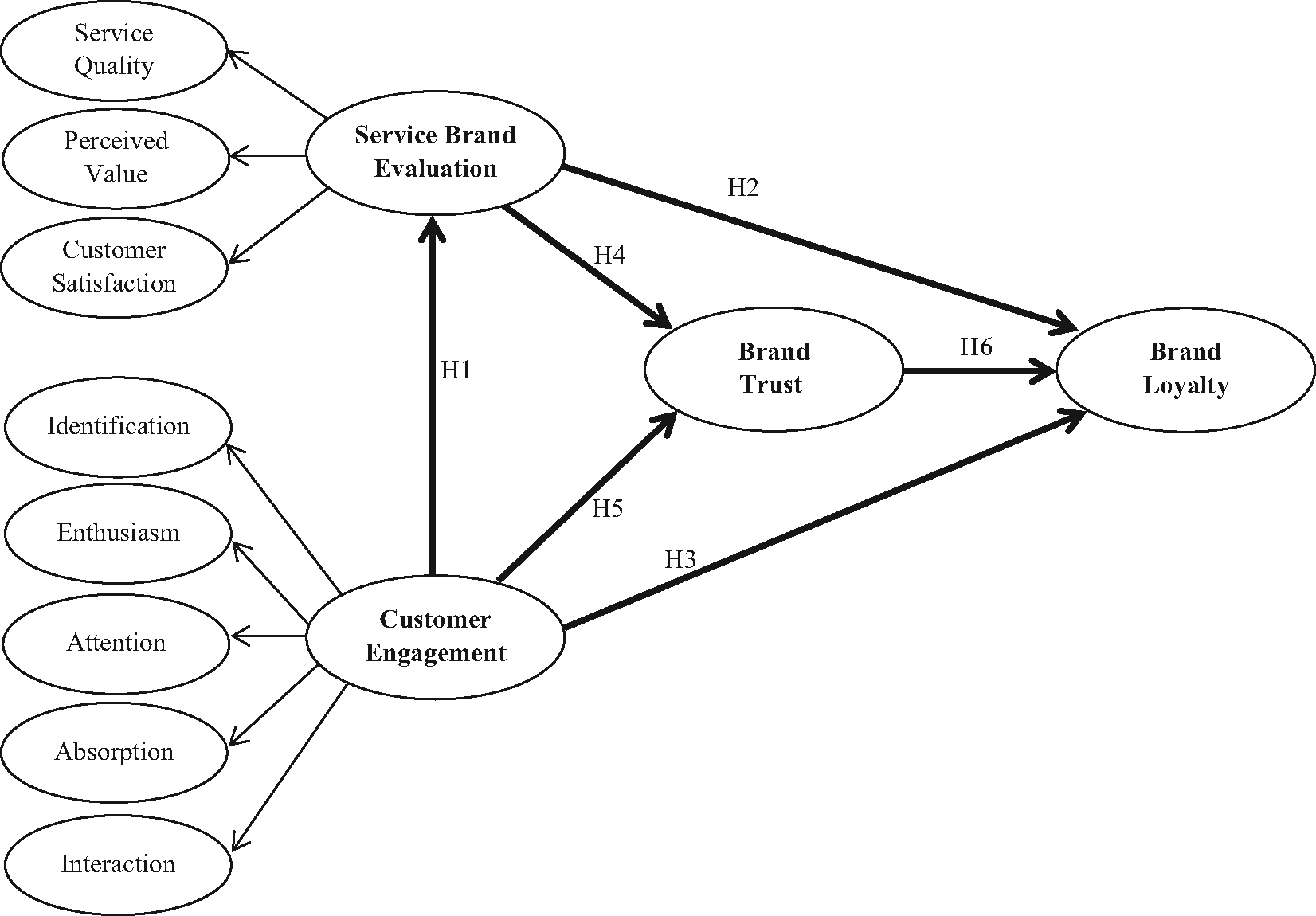
Proposed integrative model of service brand loyalty formation.
Method
Data Collection
To test the research hypotheses, we used a quantitative method that included a survey questionnaire to measure customers’ perceptions with respect to the constructs of interest.
Procedure
This study was conducted in Australia. To access potential respondents, we drew a sample from a privacy law–compliant online consumer panel consisting of more than 500,000 members, thus providing a reasonable representation of the population of this study, which includes general Australian consumers of travel services. Given the plethora of CE initiatives employed by tourism and hospitality organizations, the sampling frame of this study consisted of only individuals who had traveled domestically or internationally in the past 12 months.
We then used systematic random sampling to obtain a list of 5,000 potential respondents, with equal representation of males and females. We selected hotels and airlines as the sample brand categories because they represent two major components of the travel experience and have traditionally adopted brand strategies. Each respondent received an invitational e-mail with a click-through survey link.
In a two-week data collection period, 556 respondents completed the survey, yielding a response rate of approximately 11.12%. As the relatively low response rate could potentially introduce nonresponse bias into the research data, a nonresponse bias analysis was conducted in the results section. After inspecting the data, we eliminated 76 cases owing to incomplete responses, leaving 496 usable cases. The sample size was in line with the level recommended in the literature for structural equation models with similar complexity (Fabrigar, Porter, and Norris 2010; Bagozzi and Yi 2012; Hair et al. 2006) and was therefore considered appropriate.
Survey Instrument
The survey instrument was compiled using measurement items generated from the literature. The use of existing scales ensured the reliability and validity of the survey instrument.
We asked respondents to indicate a hotel or airline brand that they had most recently used and then to indicate their responses to brand trust and brand loyalty items on a 7-point Likert-type scale (1 = strongly disagree, 7 = strongly agree) and their responses to service quality, perceived value, and customer satisfaction on a 7-point semantic differential scale. Item wording was slightly modified to reflect the context of this study.
To measure CE, we used 25 items from So, King, and Sparks (forthcoming) to measure the five underlying dimensions of CE. To assess customers’ perceived quality of services provided by the brand, we adapted three overall service quality items from Cronin, Brady, and Hult (2000). We used four items from Sirdeshmukh, Singh, and Sabol (2002) to measure customers’ value perceptions and adapted four affective items from Spreng, MacKenzie, and Olshavsky (1996) to capture customers’ overall satisfaction with the brand. Finally, from Chaudhuri and Holbrook (2001), we adapted four items measuring brand trust, along with four items capturing both attitudinal and behavioral loyalty.
Results
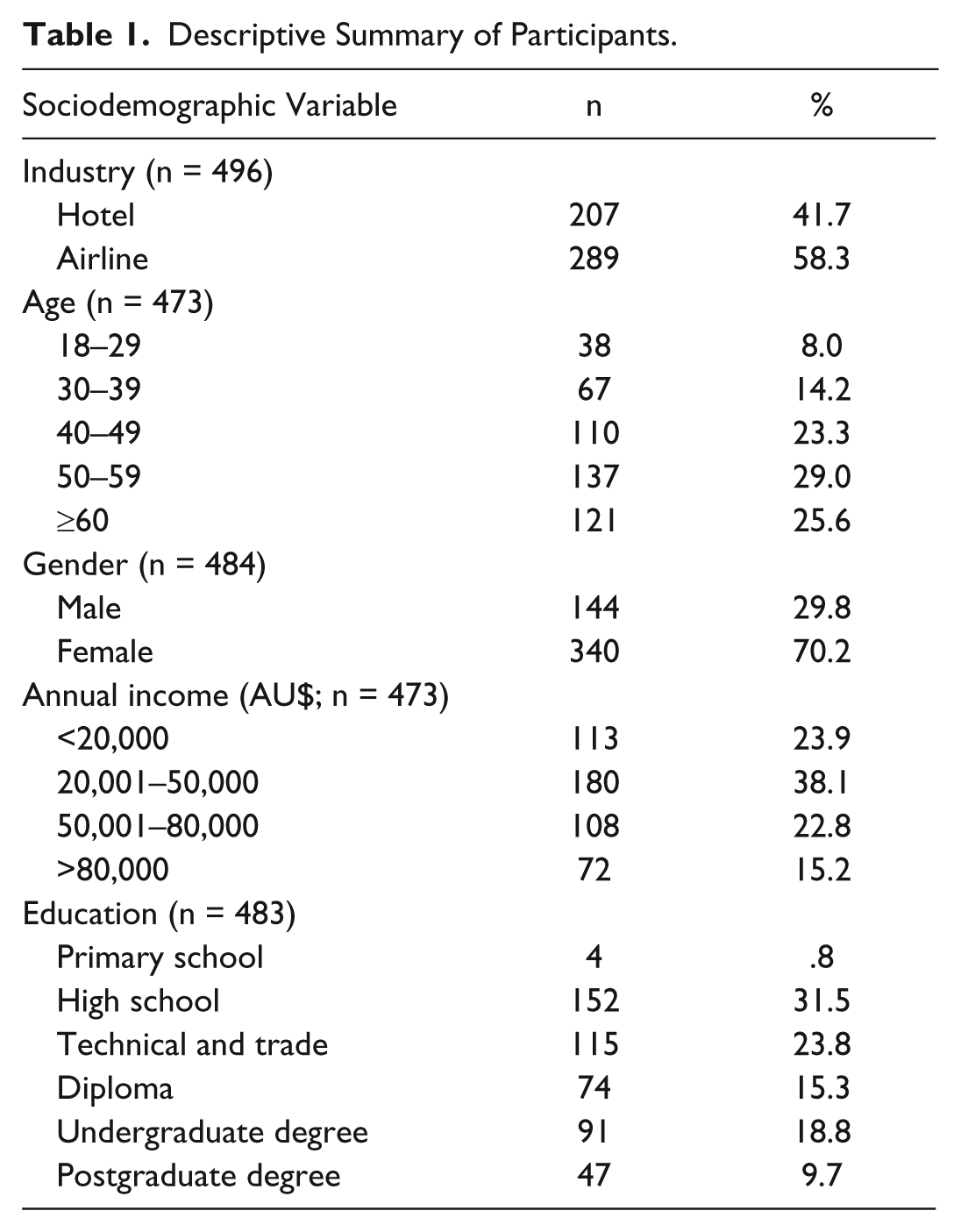
As Table 1 indicates, within the sample 70.2% of the respondents were female and 66.5% were between ages 30 and 60, with 25.6% older than age 60, and 8% younger than age 30 years. Annual income levels varied, with 23.9% of the sample earning under AU$20,000, 38.1% earning between AU$20,000 and AU$50,000, and 38% earning over AU$50,000. In terms of the highest education level achieved, 28.5% of the respondents had university degrees, 39.1% held other types of tertiary qualifications, 31.5% were high school qualified, and 0.8% had completed primary school.
Descriptive Summary of Participants.
In accordance with Armstrong and Overton (1977), we evaluated nonresponse bias by comparing early and late respondents on demographic variables and scale measures. The chi-square tests indicate no significant differences between early (top 10%) and late (bottom 10%) respondents in terms of respondent characteristics. In addition, the t-tests results show that all measured items were not significantly different (α = .01) between early and late respondents. These analyses indicate no serious nonresponse bias in this study.
The research data were analyzed through structural equation modeling (SEM) according to Anderson and Gerbing (1988), with an initial examination of the measurement model via confirmatory factor analysis (CFA) followed by testing of the hypothesized structural relationships among the four constructs contained in the conceptual model.
Measurement Model: First-Order CFA
As the literature review suggests, service brand evaluation and CE are second-order constructs, implying that the two multidimensional concepts consist of more concrete (or first-order) subdimensions or components. Analysis of the measurement model with higher-order factor structures requires the use of hierarchical (or higher-order) CFA, for which a well-defined first-order factor measurement model is a prerequisite (Marsh 1991). Therefore, we estimated a first-order measurement model on all scales used in this study, followed by a second-order CFA to assess the proposed second-order factor structure of service brand evaluation and CE.
To assess the measurement model, we first conducted a CFA on the overall sample data (n = 496) using AMOS 19.0 with all first-order constructs modeled simultaneously as correlated factors with the maximum likelihood estimation method. As the analysis suggests that the data were multivariate nonnormal, we used bootstrapping to generate parameter estimates for subsequent model analysis. In specifying the model, we included an error covariance for items BL1 (“If available, I will fly/stay with this brand the next time I travel”) and BL2 (“I intend to keep flying/staying with this brand”) given that they both measure consumers’ behavioral aspects of brand loyalty. The results of the analysis indicated a good fit for the sample data, with χ2 = 2234.97, df = 856, χ2/df = 2.61, p < .05; comparative fit index (CFI) = .95, normed fit index (NFI) = .92, Tucker–Lewis Index (TLI) = .94, root mean square error of approximation (RMSEA) = .057, and standardized root mean residual SRMR = .0508, as Table 2 shows.
Results of the Measurement Model.
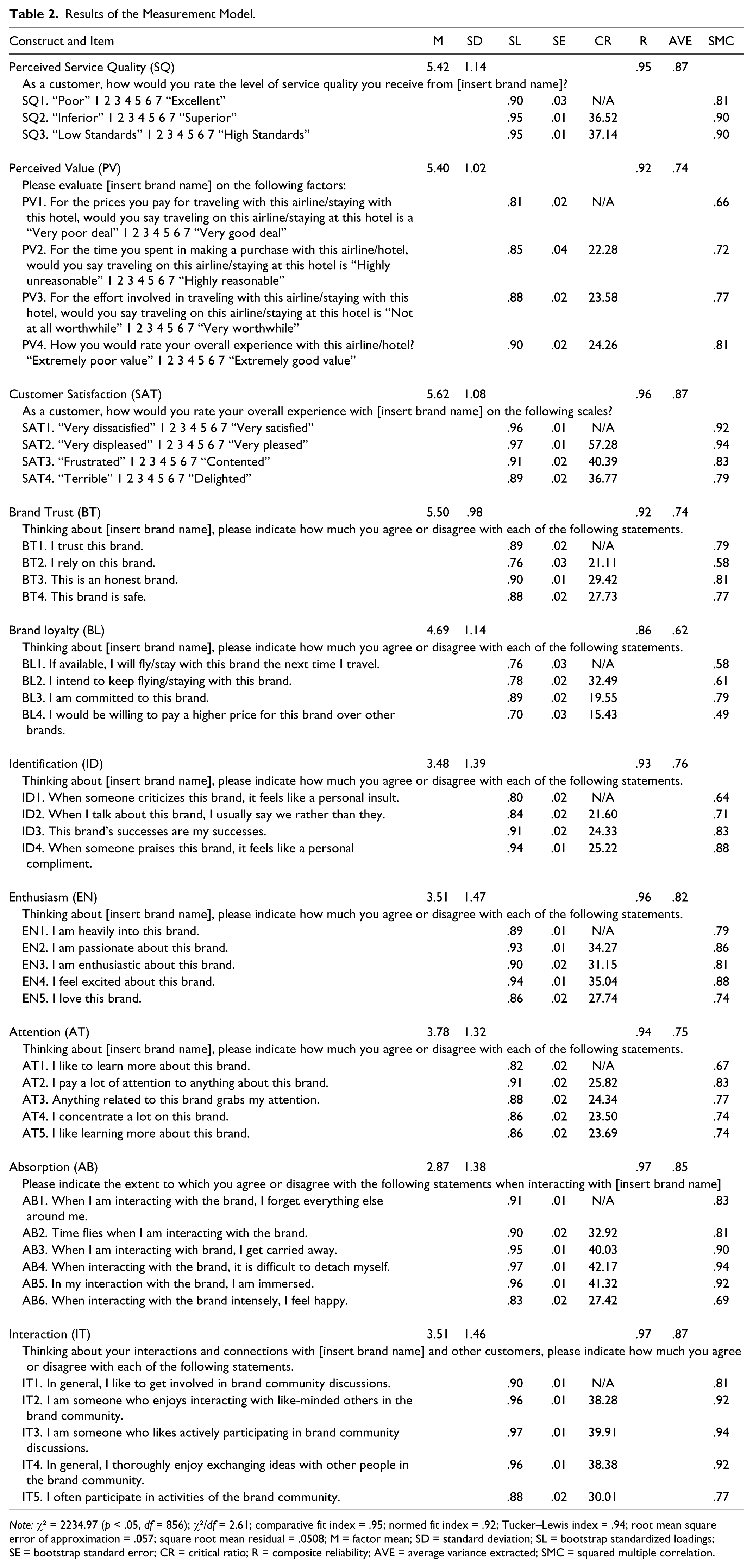
Note: χ2 = 2234.97 (p < .05, df = 856); χ2/df = 2.61; comparative fit index = .95; normed fit index = .92; Tucker–Lewis index = .94; root mean square error of approximation = .057; square root mean residual = .0508; M = factor mean; SD = standard deviation; SL = bootstrap standardized loadings; SE = bootstrap standard error; CR = critical ratio; R = composite reliability; AVE = average variance extracted; SMC = squared multiple correlation.
Construct validity was evaluated through convergent validity and discriminant validity. Convergent validity was supported with statistically significant (p < .01) item factor loadings (Anderson and Gerbing 1988). Standardized factor loadings for all 44 items achieved the suggested threshold of .70 (Hair et al. 2006), and the critical ratios for all standardized factor loadings were well above 2.57 (Netemeyer, Bearden, and Sharma 2003), providing strong support for convergent validity.
As suggested by Fornell and Larcker (1981), we assessed the discriminant validity of the measured constructs. The results presented in Table 3 show that the square root of the average variance extracted (AVE) for each factor was greater than its correlations with other factors except for perceived value, which had a square root of AVE equal to its correlation with customer satisfaction. Therefore, we furthered tested whether the correlation between constructs is significantly less than one (Bagozzi and Heatherton 1994; Anderson and Gerbing 1988). Discriminant validity is evidenced if the value of one is not contained within 2 standard errors of the correlation. As Table 3 shows, the highest correlation between constructs was .86 (between SAT and PV). The associated confidence interval was .84 to .88. Therefore, on the basis of the two analysis tests, discriminant validity was supported for all pairs of constructs.
Discriminant Validity Analysis from First-Order Confirmatory Factor Analysis.
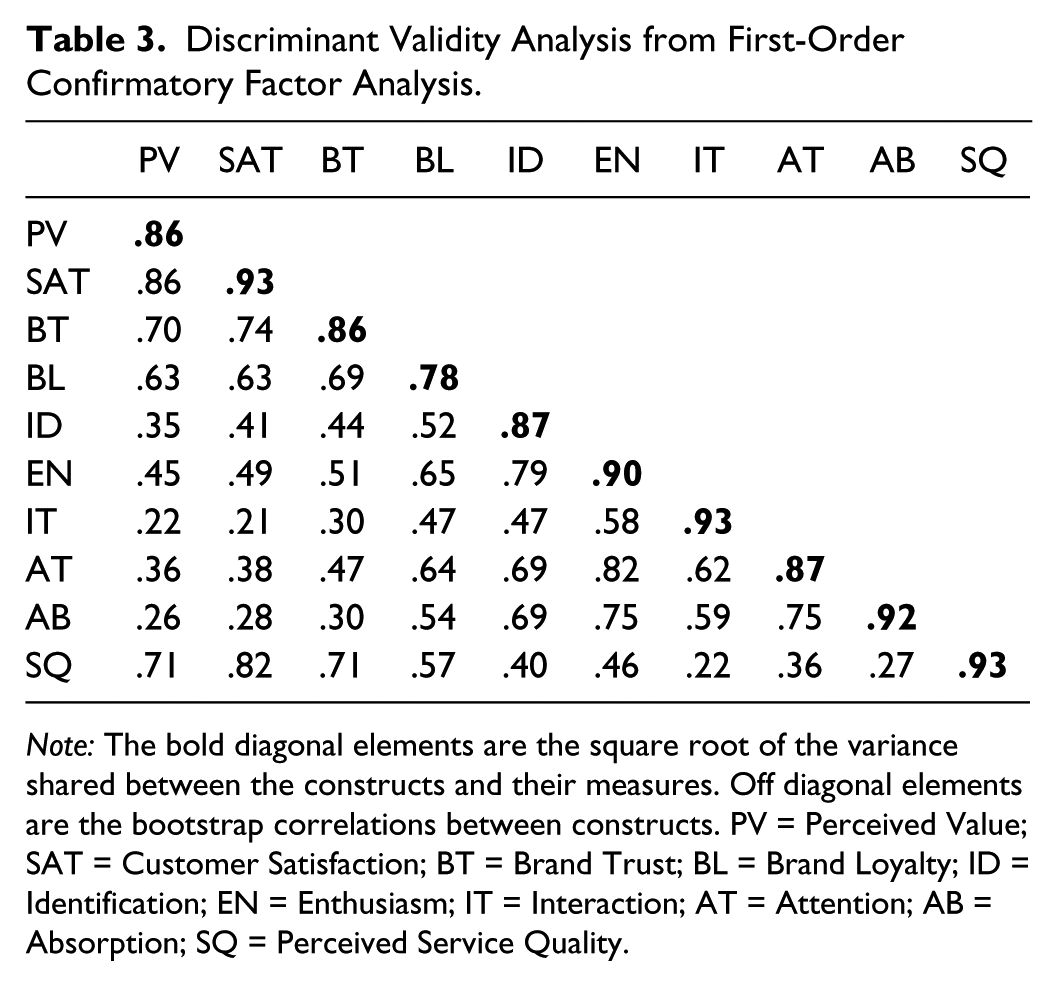
Note: The bold diagonal elements are the square root of the variance shared between the constructs and their measures. Off diagonal elements are the bootstrap correlations between constructs. PV = Perceived Value; SAT = Customer Satisfaction; BT = Brand Trust; BL = Brand Loyalty; ID = Identification; EN = Enthusiasm; IT = Interaction; AT = Attention; AB = Absorption; SQ = Perceived Service Quality.
Assessment of construct reliability was via AVE and composite reliability (Netemeyer, Bearden, and Sharma 2003). All composite reliability estimates exceeded the recommended level of .70 (Hair et al. 2006), and the AVEs of all constructs were well above the .50 threshold (Fornell and Larcker 1981), providing support for construct reliability of the measurement scales.
Measurement Model: Second-Order CFA
In the second-order measurement model, we tested a hierarchical CFA with service brand evaluation, CE, brand trust, and brand loyalty being modeled as correlated constructs. The measurement model achieved a good fit for the sample data, with χ2 = 2376.29, df = 887, χ2/df = 2.679, p < .05, CFI = .95, NFI = .92, TLI = .94, RMSEA = .058, and SRMR = .0629. As the construct validity and reliability of brand trust and brand loyalty were assessed in the first-order CFA, this analysis focused primarily on the evaluation of the two second-order factors, namely, service brand evaluation and CE.
As Table 4 shows, the standardized loadings of three dimensions of service brand evaluation were all significant at the α = .01 level. Similar results were also produced for the five dimensions of CE. The large critical ratios indicate that these first-order factors were significant and strong indicators of their respective second-order constructs (p < .01). Furthermore, the AVEs of both service brand evaluation and CE well exceeded .50 (Hair et al. 2006), supporting convergent validity.
Second-Order Measurement Model for Service Brand Evaluation and Customer Engagement.
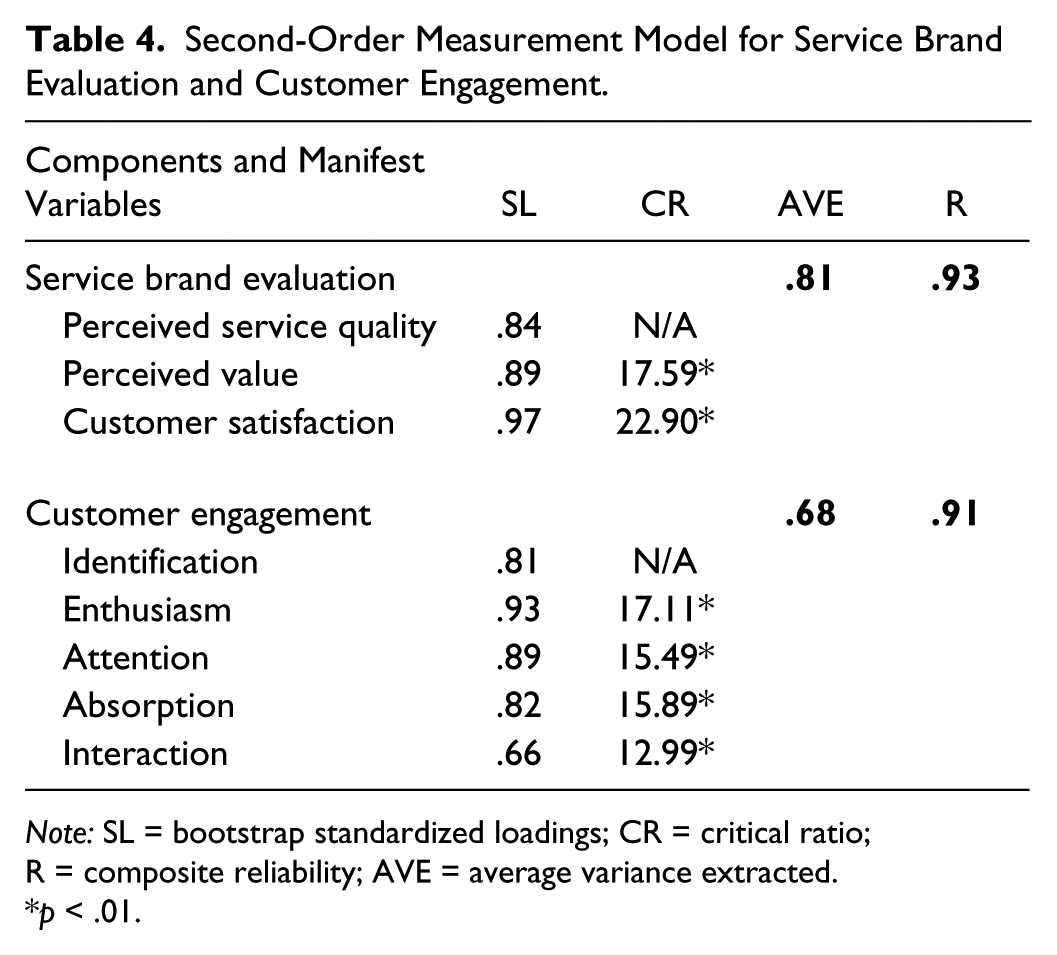
Note: SL = bootstrap standardized loadings; CR = critical ratio; R = composite reliability; AVE = average variance extracted.
p < .01.
Discriminant validity of the two second-order factors and two other first-order factors (i.e., brand trust and brand loyalty) was supported, as the square root of the AVE for each factor was greater than its correlations with other factors (Fornell and Larcker 1981). Furthermore, the composite reliability values for service brand evaluation and CE exceeded .70 (Hair et al. 2006) and their AVEs were also well above the .50 threshold (Fornell and Larcker 1981).
Structural Model
Results of the test of the overall structural model, presented in Table 5, indicate a good model fit with χ2 = 2376.29, df = 887, χ2/df = 2.679, p < .05, CFI = .95, NFI = .92, TLI = .94, RMSEA = .058, and SRMR = .0629. Further examination of the structural path coefficients suggests that all seven paths are supported. The results indicate that CE is a significant predictor of service brand evaluation with moderate effect size (β = .48, t = 9.65, p < .001), explaining 22.9% of its variance. In addition, both CE (β = .18, t = 4.43, p < .001) and service brand evaluation (β = .69, t = 14.61, p < .001) significantly predict brand trust, accounting for 63.2% of the variance in brand trust. Furthermore, CE (β = .43, t = 8.87, p < .001), service brand evaluation (β = .23, t = 3.83, p < .001), and brand trust (β = .29, t = 4.50, p < .001) are significant predictors of service brand loyalty, collectively explaining 65.4% of its variance. Figure 2 graphically depicts the results of hypotheses testing.
Results for Structural Model Analysis.
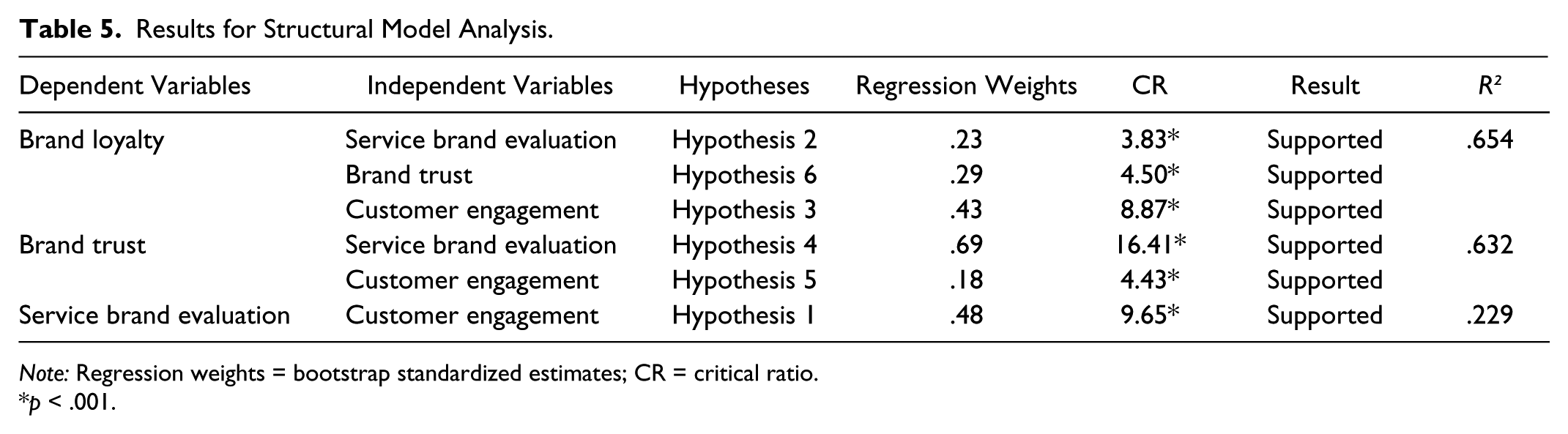
Note: Regression weights = bootstrap standardized estimates; CR = critical ratio.
p < .001.

Graphical depiction of the structural relationships.
To assess the incremental predictive power of CE, we also examined whether the inclusion of CE in the model would improve the variance explained in brand loyalty. Given the impossibility of conducting a direct test in SEM for the improvement in R2, we performed a hierarchical regression analysis after creating composite scores for service brand evaluation, brand trust, CE, and brand loyalty. Service brand evaluation and brand trust were entered as the first block of predictor variables for brand loyalty, followed by CE as the second block. Results of the analysis revealed a significant increase in model predictive power (R2 change = .088. F = 97.95, p < .001), which confirms that the addition of CE significantly improved model prediction. Tests for multicollinearity indicate that variance inflation factor (VIF) values ranged from 1.31 to 2.26, well below the conservative threshold of 5.3 (Hair et al. 2006), suggesting that the findings of the regression models are not substantially influenced by any multicollinearity effect.
Discussion and Implications
The literature has recognized the emerging importance of CE as a strategic imperative for building customer–brand relationships (Wang and Fesenmaier 2004; MSI 2010). In testing the role of CE in developing service brand loyalty, this study has addressed calls for more research on CE to further the understanding of this emerging construct (Bolton 2011; MSI 2010). Findings provide insight into the relationships between the focal constructs that underlie the process of service brand loyalty formation and afford a greater appreciation of how CE interacts with existing key drivers of loyalty in generating truly committed and loyal customers. The overall model results support the conceptualized model.
The results of the model also support the argument that CE affects customers’ evaluations of a product or service (Hollebeek 2009; Vivek, Beatty, and Morgan 2012; Higgins and Scholer 2009), demonstrating that CE contributes to the creation of favorable attitudes toward a brand. In addition, results show the linkage between CE and brand trust to be statistically significant, supporting prior conceptual research proposing that trust is a likely outcome of CE for both new and existing customers (Hollebeek 2011a).
The positive effect of CE on brand trust is unsurprising, since positive extra-exchange interactions have been described as enhancing trust levels in the exchange relationship between partners (Ganesan 1994; Lambe, Spekman, and Hunt 2000), such as those between the brand and a customer. Results also revealed that customers’ beyond-purchase connections with the brand significantly influence the formation of service brand loyalty, supporting the argument that CE enhances customers’ loyal relationship with a brand (e.g., Hollebeek 2009; Patterson, Yu, and de Ruyter 2006).
Of the three direct predictors of service brand loyalty (i.e., service brand evaluation, brand trust, and CE), CE, with the highest standardized regression weight, was found to be the strongest predictor of customers’ level of loyalty to the brand. This finding supports the thinking that CE may represent a superior explanatory factor for service brand loyalty. Although superior service brand evaluation and enhanced brand trust are vitally important for building loyalty, in a highly competitive business environment positive service brand evaluation and brand trust are the expected standard, rather than the driving factors, for service brand success. In contrast, CE represents a strong customer–brand relationship beyond purchase (Brodie et al. 2011), making it a stronger contributor to establishing truly committed loyal customers. The conceptualization and empirical validation of a more comprehensive brand loyalty model results in a number of theoretical and practical implications that warrant further discussion.
Theoretical Implications
An emerging notion in the marketing literature is to initiate marketing programs that connect with customers and foster CE beyond purchase (MSI 2010). However, empirical research on CE remains sparse. From a theoretical perspective, this empirical investigation of the linkages between CE and key loyalty development factors serves as an important step toward building further knowledge of CE in the context of customer–brand relationship development, thus contributing to the existing literature.
CE has been suggested to play a central role in a nomological network governing service relationships in which other relational concepts (e.g., trust and loyalty) are antecedents and/or consequences in iterative CE processes (Brodie et al. 2011). However, the literature is predominantly conceptually based and offers no empirical indication of how CE is situated within such a nomological network. Therefore, the conceptualization and formal testing of the linkages between CE and other components included in the model provide nomological validity for the CE concept, and more importantly illustrate its position in the wider nomological network at least in the airline and hotel environment.
While some relationships hypothesized within the proposed model have been previously investigated, this study contributes insights into how service consumption–related variables and beyond-purchase connections collectively perform to enhance service brand loyalty. Hotels and airlines are increasingly adopting new media channels for managing customer relationships beyond purchase, making integration of these variables into one model necessary for a comprehensive understanding of how customer loyalty develops. The resulting knowledge of this integration advances existing theory and provides support for the emerging literature on CE that emphasizes the importance of cultivating such a consumer response. Additionally, the results of the present study contribute to the understanding of the evolving dynamics of service brand loyalty formation.
Investigators have traditionally studied customer–brand relationships in terms of purchase-specific actions. However, the upsurge of new media channels and virtual platforms for customer-to-customer and customer-to-brand interactions has enabled tourism firms to connect with their customers beyond the service encounter, providing multiple ways to enhance customer relationships. Thus, the purchase-specific approach to customer–brand relationships may not be sufficient to understand a consumer’s various connections with the brand. CE addresses this limitation by encapsulating behavioral manifestations with a less direct impact on brand performance (Bijmolt et al. 2010). Therefore, the results of this study not only advance understanding of the customer–brand relationship but also incorporate CE into the brand loyalty discussion, expanding existing theory.
In testing the proposed integrative model of service brand loyalty formation, this study provides both theoretical justification and empirical evidence supporting the linkages between CE and the traditional components of service brand loyalty development. The findings of this study contribute to the knowledge of brand management by empirically demonstrating that CE beyond purchase has a strong influence on consumer loyalty to airline and hotel brands. In addition, CE significantly influences service brand evaluation and brand trust, which in turn lead to brand loyalty. These results, as well as the incremental explanatory power of CE in predicting service brand loyalty, generate strong support for the important role of CE in loyalty formation.
Although investigators believe that CE may engender brand loyalty (e.g., Hollebeek 2009; Patterson, Yu, and de Ruyter 2006), no known studies have examined this relationship. The results of this empirical research suggest that service brand loyalty can be strengthened not only through a superior experience in the actual service encounter but also through CE. This research therefore provides a meaningful synthesis of the service brand loyalty literature as well as the emerging CE literature, yielding a framework that encapsulates customer–brand experiences both within and outside of the service encounter.
Practical Implications
This research also has several practical implications for brand management. The knowledge generated from this study reinforces the importance of managing the customer’s experience with the brand. However, service brand evaluation may reach a point where incremental improvement is not practically feasible. Therefore, the strong influence of CE on service brand loyalty provides a sound reason for airline and hotel brands to also focus on marketing strategies and actions that are likely to engage customers in dialogues and other forms of communication, influencing not only their evaluation of the service but also their loyalty to the brand.
While previous research demonstrates the importance of purchase-related loyalty antecedents such as service quality and satisfaction (Clemes, Gan, and Ren 2010), this study suggests that CE beyond purchase can also enhance brand loyalty. Therefore, the results of this study expand managerial understanding of CE by substantiating the value of developing strong engagement with their brand. Hotel and airline brand managers should establish or maintain the presence of their brand on various social media platforms and connect with their customers regularly via newsletters, customer interactions, and product or offer information. Given the significant impact and potential reach of social media, marketers should also encourage sharing and recommendations on social media platforms to complement traditional forms of engagement, such as word of mouth, because some engaged customers would enjoy the opportunity to have personal social interaction to share their experience with others and to express the sense of pride derived from the brand (e.g., Engel, Blackwell, and Miniard 1995; Sundaram, Mitra, and Webster 1998).
Limitations, Future Research, and Concluding Thoughts
This study contributes to the tourism literature by conceptualizing and examining the relationships of CE with key constructs underlying brand loyalty development. However, the research findings are subject to several limitations. First, as this research collected cross-sectional data, the results can only show associations between the constructs under investigation rather than a causal relationship. Second, the sample of this study comprised only customers who had experience with the indicated brands. Therefore, caution is warranted when generalizing the results to potential customers who have no experience with a service brand. Third, the relatively low response rate may affect the validity of the study’s findings. Furthermore, while the reliability and validity of the measured constructs indicated sound psychometric properties of the measurement scales, the use of surveys may introduce measurement error into the research data. Finally, as 70% of the 496 respondents were female, the sample may not be completely representative of the population of the study.
This investigation suggests several possible areas for future research. First, as the study was limited to the hotel and airline sectors of the tourism industry, further testing of the conceptual model in other tourism settings (e.g., the cruise sector) may afford greater generalizability of the findings. Second, future research can extend the research model by including additional factors that might represent antecedents and outcomes of CE. For example, conceptual work suggests that involvement is a driver of CE (Hollebeek 2011a). This factor can be incorporated into the research model and tested in subsequent research to determine the relationships with CE. Similarly, the literature suggests that CE may affect aspects such as customer equity, long-term reputation of the firm, brand recognition, and financial outcomes (van Doorn et al. 2010). To further advance brand management knowledge, future research could investigate the effects of CE on these factors. Given the globalization of the tourism industry, further examination of the model with samples from America, Asia, or Europe might advance the generalizability of the model in illustrating the loyalty formation process. Finally, as this study did not collect data on the sample’s consumption behavior or frequency, it is not clear whether the same findings would emerge if survey respondents were to be differentiated according to frequency of purchase or use.
In conclusion, this study has theoretically conceptualized and empirically investigated the role of CE in building loyal customers. The results advance customer relationship management knowledge by expanding the current understanding of service brand loyalty, which suggests that loyalty is developed primarily through enhancement of the service consumption experience. From a practical point of view, the findings suggest that, in addition to managing the service consumption experience, hotels and airlines must allocate resources to effectively foster CE to further enhance customer loyalty with their brand. In developing the integrative model of service brand loyalty, this investigation provides noteworthy insight into the process of building a successful service brand.
Footnotes
Declaration of Conflicting Interests
The author(s) declared no potential conflicts of interest with respect to the research, authorship, and/or publication of this article.
Funding
The author(s) disclosed receipt of the following financial support for the research, authorship, and/or publication of this article: The authors acknowledge the Griffith Institute for Tourism for the financial support of this project.