




Abstract
While there exists an abundant literature on the way religious sites deal with tourists, little has been written specifically on how Buddhist monasteries visited by large numbers of believers and nonbelievers strive to preserve their physical fabric and atmosphere of sanctity. This article describes and analyzes how the resident monastic orders of Pu-Tuo-Shan, China, protect their monasteries and nunneries and maintain their lifestyle of prayer and meditation while hosting nearly six million visitors a year. The findings, based on observation and grounded research methods, reveal the use of “soft” visitor management techniques inspired by the spirit of Buddhism. It is also found that the visitors are classified by the monks and nuns into three categories, one of which—not the tourists—is more problematic, namely the Xianke, or “incense burners.” It is concluded that currently these methods are effective, although growing numbers pose an increasing challenge.
Introduction
The management of tourists at a destination and the manner in which flows of such visitors are controlled has attracted considerable interest in the tourism literature. Many studies have addressed issues of visitor management at theme parks (Alexander et al. 2012), areas of environmental fragility (Dobbie 2013), and places of cultural and religious importance (Digance 2003). This research has, over time, come to examine detailed specifics, such as the role of sounds in signifying importance in urban landscapes (Wissmann 2014). The study of tourist impact management thus represents a significant stream within tourism research but arguably has been centered on locations in the Western world. Today the growth of tourism in Asia and the Islamic world has meant that researchers need to consider tourist management within a wider cultural context. This is particularly true when considering sites of religious and cultural significance.
Consequently an emergent literature is beginning to challenge conventional modes of thinking about the ways in which tourists are—or should be—managed as they wend their way through sites of religion and pilgrimage. For example, Stephenson (2014) examines the use of public and private space within the Islamic world and discusses implications for the design of tourism locations and modes of handling the flows of visitors. In the context of Hindi pilgrimage and tourism, Singh (2002) notes problems due to a failure to distinguish between tourists and pilgrims. Similarly attention is beginning to be devoted to the means of handling tourists and other visitors in a Buddhist context in a way that sustains the sanctity of religious sites while affording satisfactory experiences for all visitors. This last facet is the subject of this paper.
Certainly a rich literature exists on the linkages between travel and religion, the nature of tourism as a secular pilgrimage, and more recently the challenges facing religious sites as they cope with increasing numbers of tourists. At the same time, religious sites have come to be seen as expressions of history and culture and constitute a source of national identity in addition to being sites of faith (Bremer 2006, p. 35; Cohen 2006; Digance 2003; Din 1989; Eade 1992; Jackowski and Smith 1992; Vukonic 1992). This article reports the results of a study of how a Chinese sacred Buddhist site attracting nearly six million visitors a year is managed in an efficient way that also remains true to the spirit of Buddhism. Hitherto, little has been written on visitor management techniques in a Buddhist context (Shackley 2001; Zhang et al. 2007).
Buddhism is a religion characterized by its spirit of tolerance, compassion, and respect of individual free will (Shackley 2001). The conventional principles of visitor management to the contrary suggest control over visitors (Joseph and Kavoori 2001; Nolan and Nolan 1992; Olsen and Timothy 2006). Visitors are often a priori suspected of having a negative impact on the sites they visit and “containing measures” are often put in place in advance to control them (Hall and McArthur 1996). Crick explains that bereft of social obligations, commitment, and responsibility at the destination, tourists in particular may engage in “ludicrous behavior” in which they would not dare to engage in their hometown (Crick 2002, p. 37). McKercher (1993) comments that tourists perceive themselves as consumers, not anthropologists, at a destination, and thus their sense of responsibility ultimately depends on their self-discipline and on voluntary implementation. This article, set in the context of a major traditional Buddhist pilgrimage site in China, namely Pu-Tuo-Shan, studies how Buddhist monks and nuns manage visitors in ways consistent with their faith and which exhibits few overt signs of control over visitor activities.
Conventionally, visitor management at sacred sites is thought necessary because they attract large numbers of nonbelievers motivated by reasons other than faith (Rinschede 1992), and hence there exists actual or potential “conflicts of interest” between believers and nonbelievers at those sites (Pfaffenberger 1983; Shackley 2001, 2002). Equally conventionally, believers are presumed to be dignified visitors who behave respectfully while at “their” religious sites while tourists who seek a cultural and pleasurable experience may sometimes behave otherwise. Rinschede (1992) gives a general presentation of religious tourism, and Nolan and Nolan (1992) provide a classic discussion of the distinction pilgrim-tourist. Nowadays, at many religious sites, tourists considerably outnumber religiously motivated visitors. Gutic, Caie, and Clegg (2010), for example, report that very few of the visitors to Chichester Cathedral are religiously motivated. Woodward (2004) documents that a Buddhist pilgrimage site in Sri Lanka now routinely included in the generic bus tours of the country is losing its religious character. Joseph and Kavoori (2001) describe a similar phenomenon at a Hindu site in India. In extreme cases, such as the Sistine Chapel, a religious site has for any practical purpose become a tourist attraction (Anon 2012).
As a norm, a number of management techniques are put in place to protect the physical fabric and the sanctity of those sacred sites that receive many visitors. Among religious sites, monasteries are particularly vulnerable to unwelcome intrusions because they are not merely often ancient sacred sites that need to be protected and where their dignified use by worshipers needs to be upheld; they are also communities where monks and/or nuns reside permanently. Shackley’s (1999) analysis of the situation at St. Katherine’s monastery in the Sinai and della Dora’s (2012) analysis of one of the monasteries at Meteora in Greece suggest that monastic life at those sites has in effect become all but impossible. In many cases, religious sites that are tourist attractions typically use a combination of proactive and reactive measures to control the behavior of visitors (Mason 2005; Shackley 1999, 2001, 2002, 2006). Those measures can include the imposition of an entrance fee, combined possibly with the use of pay perimeters, the interdiction of some activities, a dress code, CCTV cameras, uniformed guards, the physical protection of the site’s physical assets, the control of the visitors’ flow, with possibly the imposition of a prescribed route, and the use of queue control.
Some English cathedrals have resorted to imposing entrance fees (Shackley 2002, 2006). The purpose of such fees is twofold: to generate revenue and, if sufficiently high, have a deterrent effect on visitation. In 2013, visiting Westminster Abbey costs £18 to an individual and £44 to a family of four. Clearly, such fees can also constitute a nonnegligible source of income for the site. They also of course raise several issues of principle and pragmatism. An example is that even if locals are exempted, nonlocals who are nonetheless members of the site’s faith may be required to pay a fee to enter and pray. Differential fees for different parts of the site, pay perimeters for the more touristic attractions, and mandatory visitor flows can mitigate this problem and to an extent separate worshipers from tourists. The strategy used at the monasteries of Mount Athos is to allow only a small number of visitors at any time (della Dora 2012). Many sacred sites need the constant presence of staff that keeps an eye on the crowds to avoid vandalism, theft, physical damage, and inappropriate behavior. Woodward (2004) provides an account of the army of paid and volunteer stewards who guard St. Paul’s Cathedral in London.
Religious sites open to the public often have a dress code and a set of rules of visitation that the nonworshipers are the most likely to violate because of their ignorance and lack of focus. Shackley (2001, 2002) mentions that visitor management measures have been adopted in some Catholic churches, such as having restricted zones reserved for pilgrims to separate and “protect” them from tourists. In short, the literature suggests that tourists tend to misbehave in pilgrimage sites or simply overcrowd them and that, as a result, some of the space or resources of religious sites are often reserved to pilgrims. At the same time, rules and codes of conduct are imposed on tourists to prevent them from indulging in destructive or unbecoming behavior. The common notions of these scholarly works are that tourists can be a burden for a sacred site if they are too numerous or if they do not behave respectfully, and that all too often they fail to do so.
Shackley (2001) analyzes the possible negative impacts generated in situ, by not only the tourists but by all visitors, including pilgrims. She lists eight categories of negative consequences for religious/sacred sites, including theft of artifacts, vandalism/graffiti, accidental damage, physical pollution, noise pollution, littering, microclimate change, as well as overcrowding. She also gives examples of the challenges being created by the actions of the very devout pilgrims, namely touching, taking a sacred relic/fabric home, or kissing a holy object, acts that typically would not be performed by tourists but rather by pilgrims who, driven by religious fervor, have an urge to have physical contact with religious artifacts (Shackley 2001, pp. 37-38). Whether or not the tourists are actually solely or mostly responsible for compromising the gravitas of sacred sites and damaging them, the literature tends to concentrate on them. Consequently much discussion centers on how to preserve the sanctity of these places by minimizing the negative impact of tourism development (Joseph and Kavoori 2001; Shackley 2001, 2002, 2006; Shinde 2007; Singh 2005; Wilson 1997). The literature further reports that many visitor management measures adopted to cope with the tourists’ presence at religious sites are proactive in nature, including charging admission fees, implementing queuing controls, controlling the visitors’ flow, and having restricted zones reserved for pilgrims (Garrod, Fyall, and Leask 2006; Nolan and Nolan 1992; Shackley 2001). Those studies about visitor management are all about the sites of religions other than Buddhism.
The purpose of this article is to reveal whether the way of managing Buddhist sites is the same as that employed at other religious sites. It uses Pu-Tuo-Shan, a Buddhist pilgrimage site in China with more than a thousand years of history which today attracts many religious and nonreligious visitors, as a case to illustrate how a Buddhist sacred site can be managed in a way that remains true to the spirit of Buddhism. It also documents that at Pu-Tuo, according to the testimony of the monks and nuns, it is actually not the tourists who are the worst threat to the preservation and sanctity of the site.
Pu-Tuo-Shan, China
Pu-Tuo is a small island (12.5 square kilometers) located in the Zhejiang Province of China. It has been for centuries a Buddhist sacred site and a traditional pilgrimage destination exclusively dedicated to Bodhisattva Avalokitesvara. With Jiu-Wa, E-Mei, and Wu-Tai, Pu-Tuo is one of the Four Buddhist Sacred Mountains of China. Because of its proximity to large cities and year-round moderate weather, it attracts a particularly large number of visitors; in 2013 it recorded nearly six million visits, much more than the other Sacred Mountains. Of these visitors, a majority can be categorized as tourists, in that they require overnight accommodation on the island (Wong 2011).
From a religious perspective, Pu-Tuo is particularly renowned as an important Buddhist pilgrimage destination because it is found in Buddhist scriptures that Pu-Tuo is Potalaka, the home in samsara (the existing world) of Bodhisattva Avalokitevsara, where the Great Being preached the Dharma of Buddhism. Apparitions of the Great Being at Pu-Tuo were recorded many times (Bao and Bai 2008; Fang and Wang 2005; Wang 1999). As a result, many Chinese Buddhists go to Pu-Tuo—often repeatedly—for devotions, in a quest for favors, to fulfill a vow, or to give thanks. In addition to its religious significance, Pu-Tuo is visited because of its historical and cultural value; its large assortment of ancient religious structures appeals to cultural tourists. In addition, its natural scenic beauty and beaches offer visitors the possibility of leisure activities.
All these characteristics make Pu-Tuo an interesting object of study in itself and as a proxy for other sacred sites in China that have similar features. Pu-Tuo was accordingly selected as the investigation site, with the research aim of understanding how its resident monks and nuns, numbering more than a thousand, cope with the rapid tourism development that is taking place on the island and yet manage to preserve the sacredness of their sites and homes. There are 28 monasteries, nunneries, and shrines on Pu-Tuo. They receive daily thousands of visitors, and large crowds at the occasion of religious festivals. The larger monasteries that attract the most visitors consist of a number of halls, other monastic buildings, courtyards, and park areas. Unless used for a puja (a Buddhist “mass” during which scriptures are recited and mantras chanted), the halls are open to the public. The grounds of the monasteries, nunneries, and shrines are enclosed, and thus access can be controlled at their gates. They are closed outside of the visiting hours. The grounds of those sites are free of any commercial or other profane activities, nonreligious structure, or “museumification” that would compromise their sanctity.
An approximate idea of the composition of the population of visitors who go to Pu-Tuo can be gathered from the survey of a large number of visitors reported in Wong, Ryan, and McIntosh (2013). About 53% of the surveyed visitors describe their visit as having the purpose of “hsu yan and huan yuan,” meaning respectively to make wishes to the divinities and to thank them for granted wishes. The monks and nuns call those visitors Xiankes, meaning literally “incense burners,” as their worshiping involves a great deal of incense burning (Wong 2011; Wong, McIntosh, and Ryan 2013, p. 224). While the Xiankes are religiously motivated, the monks and nuns do not consider them real Buddhists, but rather people ignorant of the tenets of the religion and who actually come to a Buddhist site to perform religious but folkloric rites. Wong, Ryan, and McIntosh (2013) note that only 10.5% of the surveyed visitors reported that they came “to learn Buddhism and unearth their innate Buddha-hood.” These visitors are called Jushis by the monks and nuns who regard them as true Buddhists. The group that can be considered as tourists, those who said that they came “primarily for relaxation and sightseeing” represented 31.4% of the sample. The remainder (5.3%) described their motivation as being partly religious and partly touristic. It is thus not the case at Pu-Tuo that the tourists outnumber the religiously motivated visitors (Xiankes plus Jushis), but it is worth noting that Xiankes and Jushis constitute two differently driven religious groups as regards their motivation and, as discussed below, with regard to the way they behave on site and how they are regarded by the monks and nuns. Less than 3% of the sample consisted of visitors from abroad; Pu-Tuo is thus visited almost exclusively by Chinese people living in China, as is typical of the Chinese Sacred Mountains (Shepherd, Yu, and Huimin 2012).
Methodology
It is the norm in the West that the clergy does not get involved in the mundane task of enforcing the visiting rules of religious sites open to the public; this function is delegated to lay people, volunteers, or professional security guards (Shackley 2001). Things are different at Pu-Tuo, where it is the Buddhist monks and nuns themselves who guard the monasteries/nunneries, and this is common practice at Buddhist sites in China. Junior monks and nuns spend several hours a day in charge of visitor control on the grounds of their monasteries/nunneries. These monastic members therefore represent expert informants who can provide reliable testimony about how visitors are controlled on the basis of their extensive hands-on experience. As a result, it is by interviewing them that one can understand how the Pu-Tuo model of visitor management operates in practice, and this is what was done here.
The corpus of data was derived from the fieldwork undertaken by the first author (henceforth “the researcher”); on-site observations and thematic interviews with monks and nuns involved in visitor management were the main sources of data. The researcher had the opportunity to make many observations about visitor behavior at the sites and about how the monasteries are safeguarded by the monastic members. Those observations were useful to suggest to the researcher topics to be discussed in the course of the interviews. Nineteen monks and six nuns participated in the research; they were invited to do so through convenience sampling when the fieldwork was conducted in Pu-Tuo during May 2009 and February 2010. Monks and nuns attached to large, small, central, or remotely located monasteries and nunneries were all included to obtain a representative sample of sites. Interviews were used as the research tool because they allow rich contextual data to be revealed through interactions and conversations between the researched and the researcher (Creswell 2003; Patton 2002). An open-ended question, “Could you share with me some experiences you had in dealing with visitors?” was used to initiate the interviews. Responses were then further probed as the conversations proceeded to obtain clarification of some specific statements or to elicit a deeper understanding (Silverman 2005). Follow-up questions included “What are the visitor behaviors that you consider inappropriate?” and “How do you react when you witness such behavior?” The interviews, which lasted for an hour on average, were individually conducted and audio-recorded. All names attributed to informants in what follows are pseudonyms. In all cases, the many on-site observations of the researcher were consistent with the responses of the interviewed monks and nuns.
It should be noted that these interviews were conducted after repeated preliminary visits to Pu-Tuo by the researcher and many conversations that she had with the monastic members before the fieldwork per se took place. This allowed her to identify potential informants on an opportunistic basis, as well as to make many preliminary observations. By the time the fieldwork started, she was thus well known to the informants, and recognized by them as a fellow Buddhist. The Buddhist identity of the researcher most certainly contributed to facilitating rapport, creating trust and avoiding misunderstandings. She was lucky enough to be welcomed by a number of senior monks and nuns who oversee the monasteries and nunneries, which opened doors and allowed her to deepen her fieldwork and data collection at Pu-Tuo. As she is fluent in both Mandarin and English, no translation issues arose in the interviews.
Thematic analysis was used as the evaluation method, supported by the use of Atlas software for cross-checking the data. The basic unit of analysis was the individual contribution of each informant, including quotes from the interviews and the researcher’s handwritten notes of nonverbal responses of the informants (Coffey and Atkinson 1996, p. 112). The research was hence based on reiterative patterns of exploration, evolution, conclusion, and re-confirmation of views. Individual quotes were carefully studied and the analytical procedures of handling the qualitative data followed the suggestions of Marshall and Rossman (2006). Statements of a similar nature across cases were identified and assigned to existing or newly created categories. Categories of the same nature were then assigned to the same theme; the themes were inductively derived (Ryan and Bernard 2003) and then cross-checked between the authors.
Findings
The Framework of Visitor Management at Pu-Tuo
Since 1994, all places of worship in China must by law register with the government’s Religious Affairs Bureau and obtain a license (Ryan 2010). Locally, the island’s religious sites’ management is in the hands of the Pu-Tuo Buddhist Association, which provides guidance and gives instructions to all the local monasteries and nunneries. The Association is run by their abbots and senior members. They meet once a month and hold an annual meeting in December. As a result of the Association’s coordinating role, the system of visitor management is the same in all the monasteries and nunneries.
The first finding to report is that no imposed, exogenous control of the visitor flow is found in any of the monasteries, nunneries, and shrines contrary to the situation at Christian sites with high levels of visitation as described by Shackley (2001). Consequently, there is no limit to how many visitors can enter the grounds of a monastery/nunnery or stay in a hall at any time during the opening hours. There is no one assigned to control their number nor are there uniformed guards. Such an “open-door” policy was explained by several monks and nuns by the philosophy that “the monastery is for everybody,” “the Buddhist door is open to everyone,” “we do not care who those visitors are, or how many of them come as long as they do not destroy anything.”
The large monasteries of Pu-Tuo, the ones receiving the most visitors, charge an admission fee for access to their grounds, while the smaller ones do not. This fee is 5 yuans (US$0.75) per visitor; Buddhist clergy visiting from elsewhere and locals are exempted. The responses of visitors who were interviewed during the fieldwork suggest that this modest entrance fee constitutes little deterrence. The admission charge is not interpreted by the interviewed monks and nuns as being meant to discourage visitors; it is rather seen as providing needed income to sustain the running of the monastery. Once inside the grounds of a monastery or nunnery, the visitors are free to wander around all the outside areas and enter the buildings that are open to the public. There is no attempt at enforcing a predetermined route, nor is there any queuing procedure to be followed. None of the monasteries or nunneries were found to have restricted zones that are only accessible to a particular kind of visitor or on payment of an extra fee. This was confirmed during the interviews with the monks and nuns. If some particular areas are not accessible to the public, for example, the sleeping quarters of the monks and nuns, it is because they are closed to any lay person.
Findings relating to the framework of visitor management reveal only three explicit proactive measures implemented in every monastery and nunnery. First, the use of portable loudspeakers by tour guides is not allowed on their grounds. This measure is clearly directed to the group tourists. The second proactive measure is meant to prevent decay and damage to the statues of Divinities. All the monasteries and nunneries adopt the same manner of displaying their precious statues of Buddhas and Bodhisattvas. The statues are either protected by glass panes or displayed in such a way that they cannot easily be touched. When not protected by a glass enclosure, the statues are placed on top of platforms in front of which a number of vases containing flowers and plants are placed on the floor, thereby creating a buffer zone in an aesthetically pleasant way. Such a design in displaying the statues deters the visitors from having close physical contact with them. At the same time, such an arrangement does not inhibit the performance of devotions.
The third explicit proactive measure is the absolute prohibition of bringing paper offerings and lit incense sticks into the halls themselves and the related control exercised over the quantity of incense sticks allowed to be brought into the grounds of the monasteries and nunneries (three incense sticks per person). Conspicuous signs spelling out this rule are placed at the entrances and cannot be missed when one enters the grounds of a monastery or nunnery (see Figure 1). The researcher observed that at the entrance of the large monasteries, some visitors were approached and sometimes asked to leave their extra incense sticks at the gate. From the observations of the researcher, as well as the comments of the monks and nuns, it is apparent that there are many visitors who do not respect the rule and sneak in many more than three sticks. It is easy to do so because the control is rather perfunctory; the entering visitors are not searched and declaring extra incense is basically voluntary.

This signboard placed at the entrance of a large monastery reads: “As of today, all monasteries and nunneries allow each visitor to bring in 3 incense sticks only. Thank you for your cooperation. Issued by the Pu-Tuo Buddhist Association.”
The Pu-Tuo Method of Visitor Management
From the analysis of the interview data, it appears that the challenges created by the visitors include noise, incense smoke, inappropriate conduct, and antagonistic attitudes toward monks and nuns when they try to enforce proper behavior. This was also confirmed in the observations of the researcher. Some of those challenges are taken care of by enforcing in a flexible way the few proactive measures described above, but most of them are dealt with through flexible reactive interventions in the many cases where no explicit rule applies. Proactive measures in a sense imply that all visitors are presumed guilty of creating negative impacts, or at least suspected as such, and that regulations must be put in place in advance to control them (Hall and McArthur 1996). At Pu-Tuo, the visitors are instead presumed innocent, until evidence to the contrary is apparent. This concurs with Shackley’s (2001, p. 42) suggestion that the management of Buddhist monasteries usually avoids any rigorous regulation of visitor activities. The interviewed monks and nuns emphasized the Buddhist spirit of respecting the free will of all under the condition that the exercise of this free will causes no harm to others.
As a result, no monastery or nunnery at Pu-Tuo has visitor capacity control. Buddhist monks and nuns were found not to be concerned with how many people come into their sacred grounds or with who they are. Rather, they placed their emphasis on what people do when they are there. This policy is in line with the findings of Garrod, Fyall, and Leask (2006, p. 144), who suggest that visitor impacts are in fact not strongly related to visitor numbers but rather to what the visitors do. The fact that it is the monks and nuns themselves who safeguard the monasteries and nunneries and that they act on a case-by-case and need-to-intervene basis is thus the distinguishing feature of visitor management at Pu-Tuo and raises important conceptual questions that will be addressed later in the article about the distinguishing spirit of a religion. The monks and nuns in charge of visitor control at Pu-Tuo walk around the grounds or position themselves in or nearby the halls. In effect, many visitors may at first not be aware of their role as guards, a role captured by the informants’ term wu-yuan meaning protecting the monastery.
When the monks and nuns commented on their understanding of their role when on guard duty, the majority appeared to be very conscious of their dual nature, as both monastic clergy and guards. Monk Jing Xuan stated: “I am here safeguarding the hall to protect it from getting burned down as well as to prevent anyone from stealing things.” The interviews revealed that the fundamental principle according to which the visitors are managed is very simple: if the behavior of a visitor is hazardous to the physical fabric of the site, in particular the halls, or detrimental to the experience of other visitors, then it is immediately and firmly stopped. Otherwise, a minimum of intervention is used. In addition to performing their role as guards, the monks and nuns on guard duty also answer visitors’ inquiries and play their Buddhist role of preaching and explaining the religion to visitors who might approach them to ask questions. They admit though that it does not happen often.
Monks and nuns on guard do not appear at all concerned about issues such as photo-taking or how the visitors are dressed. Rather they concentrate almost exclusively on preventing behavior that could damage the monasteries/nunneries, particularly their wooden halls, such as bringing burning objects inside them, as well as behavior that is disrespectful, such as “bringing in lit cigarettes, wine,” “littering,” “spitting,” and “shouting inside the halls.” Monk Xin Xia, a Vice Abbot of a large monastery said, “The way to handle crises is flexible; there is no fixed formula telling us what to do, but no matter what we do, whether we present ourselves in a gentle or in a stern way, our intentions and the methods we use are for the good sake of all sentient beings.” He further elaborated on the methods used: If you do something wrong, most of the time it is because you don’t know the rules and proper rites. For this kind of situation, we just need to advise people nicely about what are the correct things to do; they usually obey and there is no problem. But if you intentionally destroy something and do not listen to our advice, then we will show an angry face and ask you to stop; we can explain to you the reasons after you have stopped and cooled down.
From Monk Xin Xia’s comments, one can see that when monks and nuns prohibit hazardous or obnoxious behavior, their attitude is tough and determined. Nun Jing Yung testified that she is not shy when having to argue about bringing lit incense sticks into her small nunnery: Even though we have talked to them nicely and told them what the rules are, they simply ignore you. So I tell them to go back home to use their own ways to worship their own statues.
The interviews suggest that the decision by monks and nuns to either take a lenient and compassionate attitude or to follow a firm and possibly confrontational course of action in protecting the sacred venues is affected by three factors: (1) their initial perception of the nature of a visitor’s behavior: whether they perceive that a misconduct is deliberate or simply the result of ignorance or carelessness; (2) the type of act performed by visitors; a decisive factor is here whether the action of a visitor is harmless or hazardous to the buildings or other visitors; and (3) the situated identity adopted by the monks and nuns: the explicit front-stage image of a monk or nun versus his or her “covert” role as a guard. These three factors are evidenced in the interviews and each emerging theme is now discussed in turn.
The Monks’ or Nuns’ Initial Perception of the Nature of a Visitor’s Behavior
The monks’ or nuns’ initial perception of a visitor’s behavior is critical in determining what attitude they adopt and what action they take. Driven by the spirit of Buddhism, the monks and nuns presume that the reason a visitor’s behavior can be inappropriate is carelessness. Monk Mun Zhao commented: “Some people are just too used to what they usually do, so sometimes they forget that they should not bring in lit cigarettes; then you have to remind them.” Driven by such a forgiving mentality, the Buddhist monks and nuns first offer kind advice. They believe visitors will change their behavior once they are reminded that it is inappropriate. As Monk Xin Xia says, “We usually just need to advise people nicely; they will usually obey and there will be no problem.” If, on the other hand, the monks and nuns perceive that visitors misbehave on purpose, or if they ignore the advice they are given, then they will adopt a more assertive approach.
The Types of Breaches: The Harmless versus the Hazardous
From the responses of the monks and nuns, it is clear that they adopt a more aggressive attitude toward any action perceived as hazardous, such as bringing in lit incense sticks and paper offerings inside the halls. On the other hand, they tend not to interfere if visitors have obviously brought in more than three incense sticks into the grounds of the monasteries or nunneries and openly but safely burn them in the courtyards, even though it is a transgression of a posted regulation. The informants expressed the view that as long as visitors are not at risk of destroying something or do not behave disrespectfully inside the monasteries or nunneries, they will simply not interfere. Monk Fa Miao said: Those Xiankes who burn a lot of incense are praying for good fortune, same as for throwing coins. Those are not really Buddhist rites. Those people worship in a way that they think pays reverence to the Buddha such as bringing in and burning a lot of incense in the courtyard. If they insist in doing it, we just leave them alone; we won’t argue with them because it is not good to argue, also not good for the image of the monastery.
Monk Mun Zhao made similar comments: “If what they do is destructive or if they behave disrespectfully inside the monastery then of course I have to tell them to stop.” From the above quotes, one can see that in the monks’ and nuns’ eyes, there are some acts that can cause damage to the sacred venues and thus must be stopped, while there are other acts that are alien to Buddhism, such as burning paper offerings (in dedicated containers placed in the courtyards), but are meant as acts of supplication or gratitude. As long as it is safe to indulge in them, they do not call for a reaction.
The Situated Identity Pursued by Monks and Nuns Facing Misbehavior
The fact that monks and nuns do not interfere with harmless inappropriate behavior appears to be associated with their identity as Buddhists (Shackley 2001); if the visitors’ behavior does not compromise the safety of monasteries/nunneries or bother others, they tend to simply ignore it and forgive their ignorance or carelessness. Such an attitude is in line with the Buddhist spirit of being tolerant and compassionate, according to which Buddhist monks and nuns should be calm and kind. Importantly for them, it also preserves the detachment that otherwise pervades the monastic life they have chosen to live (Wong 2011). Many informants, when answering the question of why they do not argue about improper but harmless conduct, justified it by saying that “it [arguing] is not good for the image of the monastery,” “Buddhism emphasizes kindness,” and “It [arguing] induces bad karmas.” The above quote of Monk Fa Miao is typical in illustrating the fact that monks and nuns do care about their Buddhist image. A similar response was given by Monk Jing Xuan: “We are monks; our identity is different [from the one of visitors]. We do not argue with them and will not fight them. If we did, it would not be good for our image.” In other words, in addition to the nature of the visitors’ actions, the public role and image that monks and nuns perceive of themselves also appear to have a significant influence on their attitude. When the monastery/nunnery is not at risk, the monks’ and nuns’ mentality is governed by their front-stage identity, that is, they are Buddhist and thus should be lenient, forgiving, and remain detached from some visitors’ “ignorant behavior.”
On the surface, to have the double role of being both a Buddhist monk or nun and a guardian implies a certain degree of contradiction as the function carried out by a custodian is not always, at least to an external observer, in line with the Buddhism faith that stresses emptiness to dispel the false appearance of the world and respect of free will. Yet, the analysis of the interviews shows that the monks and nuns have a philosophical solution to the apparent dilemma. Not only do they not see their two roles as clashing with each other but they hold a distinctively Buddhist way of rationalizing the fact that in certain circumstances they must be very strict and interfere with the free will of others. Nun Ying Yi explained, One person’s actions should not interfere with and disturb others. If some people make noise or cause inconvenience that affects a lot of other people, their behavior must be controlled and so we have to tell them explicitly, for example, that they should not talk loudly when we are praying. When something can affect the majority, it is necessary to regulate and correct. Such intervention is made out of mercy, in order not to let people create bad karma.
A very clear message is found in this quote, to the effect that if a monk or nun adopts a determined stance to handle visitor misbehavior, somewhat at variance with his/her usual image of a gentle and compassionate person, it is actually out of compassion and for the good sake of the transgressing visitors, to prevent them from bringing bad karmas upon themselves. Abbot Zhang Wu referred to the concept of “rightful use of force” and related it to situations that arise in visitor management at Pu-Tuo. His explanation was very articulate in conveying why, in their Buddhist understanding, monks and nuns do not see any inconsistency in being both a monastic member and a guard who might need to exercise authority: This rightful use of force has a place in the management and protection of the monastery. We have to protect this place because it is where all sentient beings come to pay reverence to the Bodhisattva and to learn Buddhism. If one person’s misconduct can destroy the monastery, which can harm the well-being of other sentient beings, then it must be stopped. This is to help him, in order to prevent him from accumulating bad karmas. When we tell people not to do something, we may show a fierce or angry face, but our heart remain calm and merciful.
The Transgressions and the Transgressors
Some acts of worship performed by visitors are recognized by the informants as real Buddhist acts, such as “to do penance” or “to attend pujas and Buddhist lectures.” On the other hand, the unanimous opinion of the interviewed monks and nuns is that many of the worshiping activities performed by many visitors are not really Buddhist but, rather, superstitious in nature. Those visitors are the ones they call Xiankes. The incongruity, according to the monastic members, is due to those people misunderstanding Buddhism per se. As monks and nuns, they know that the Xiankes’ worshiping acts are not proper Buddhist rituals and, as custodians, they also know that they can cause inconvenience to other people in addition to being sometimes against the rules. Yet, for the most part those acts constitute at worst a very limited threat to the physical fabric of the site or to its serenity, and the monks and nuns tend not to intervene. The observations of the researcher and findings of the interviews identified four kinds of acts that were clearly not Buddhist in spirit but were widely practiced by visitors on the grounds of the monasteries. They are discussed in turn below.
Conquering the Offering Table
In Buddhism, the offering table of any hall is sacred and should be touched only by monks and nuns. It is intended to be where the monastic community itself offers water, mantras, flowers, incense, fragrances, oil burners, candles, dolmas, fruits, etc. to the Buddha and the Bodhisattva as a form of respect. Yet, as the researcher observed, the offering tables in the halls have instead been “invaded” by visitors’ offering bags (see Figure 2). Monks and nuns explained that Xiankes are in the habit of bringing tributes and offering bags from home. Many of them are eager to leave them on the offering tables of the halls. Monk Zhan Miao said: “We let them do so because Buddhism emphasizes kindness and if we can help those people, we will do it. In any case, this behavior is not too obnoxious or detrimental to the monastery. We now leave the offering table bare and let them put their offerings on it.” Nun Che Jiang made a similar comment.
Xiankes want to show to the Bodhisattva what they have brought from their hometown as offerings to the Great Being. The table was originally not for this purpose. But they don’t listen to us. Instead, they always try to clear space and push aside the nunnery’s offerings to make room for their own bags on the table. Sometimes the nunnery’s offerings end up on the floor! Therefore we decided to remove our own offerings.

An offering table being “conquered” by visitors’ offering bags.
From the conciliatory strategy adopted by the monks and nuns, as apparent from the above quotes, it is clear that they apply tolerance and compassion and are willing to offer as much convenience as they can to the visitors to avoid repeated confrontations. In such matters, the monks and nuns tend to give in. As a result, all the offering tables have in effect been “conquered” by visitors the monks and nuns describe as devout Xiankes.
Throwing Coins at the Pagodas
Some visitors are fond of throwing coins at the Six Layers Incense Pagodas that are found in the courtyards of monasteries and nunneries, facing the entrance of the main halls (see Figure 3). They were originally placed there merely as a symbol identifying the venue as a Buddhist site; the visitors can place their lit incense sticks at the bottom layer, where they can be planted in a large bowl filled with sand. Yet, there is a common belief that those pagodas are sacred objects that it is auspicious to touch or throw coins at. There is a popular notion that it is auspicious if the coins do not bounce off and fall to the ground and that the higher a coin lands on the pagoda the better. The explanation given by one of the visitors, with whom the researcher chatted, and who had just finished throwing coins, is that “if the coin can be thrown up high enough and stay on the highest layer of the incense pagoda one will be blessed with good luck. To touch the dragon figure [cast on the base of the pagoda] is to absorb auspiciousness from the dragon.” He added that he was told that “you must touch and caress the dragon from its head to its tail three times; then you will get good qi (good fortune, blessings).”

Visitors throwing coins at a Six Layers Pagoda.
When asked about his understanding of the practice, Monk Yuan Guang immediately pointed out that “this is not a Buddhist rite; it is merely folklore.” When asked why such kind of superstitious acts were not prohibited or discouraged by the monastery, he explained, As long as they are not throwing coins at the Buddha’s or Bodhisattva’s statues, it is okay for them to do the things that they want to do as long as it is not harmful to others or damages the monastery. If they want to learn, they will approach us and ask about Buddhist knowledge. As their time to learn Buddhism has not yet come, they do not feel the need to talk to us. Not only will they not approach us, they will also not listen to us.
Touching Sacred Objects
The researcher repeatedly observed that touching Buddhist objects that are kept within the halls was also very popular. Some visitors insist on touching the drums, chimes, and muyus (musical instruments used in certain ceremonies) on display. The researcher witnessed a scene involving a woman and a young child and overheard the woman telling her child to quickly pat the muyu “to get good qi” (see Figure 4), which she did. Monk Zhan Miao explained why people like to touch the Buddhist objects on display, even if there are conspicuous signs asking the visitors not to do so: “They want to have some physical contact in order to bring good luck back home.” Taking no action toward these transgressions was explained by him as a manifestation of Buddhist compassion. At the same time, it may also have to do with the fact that objects such as drums or muyus can easily and cheaply be replaced, unlike the ancient statues in the halls.
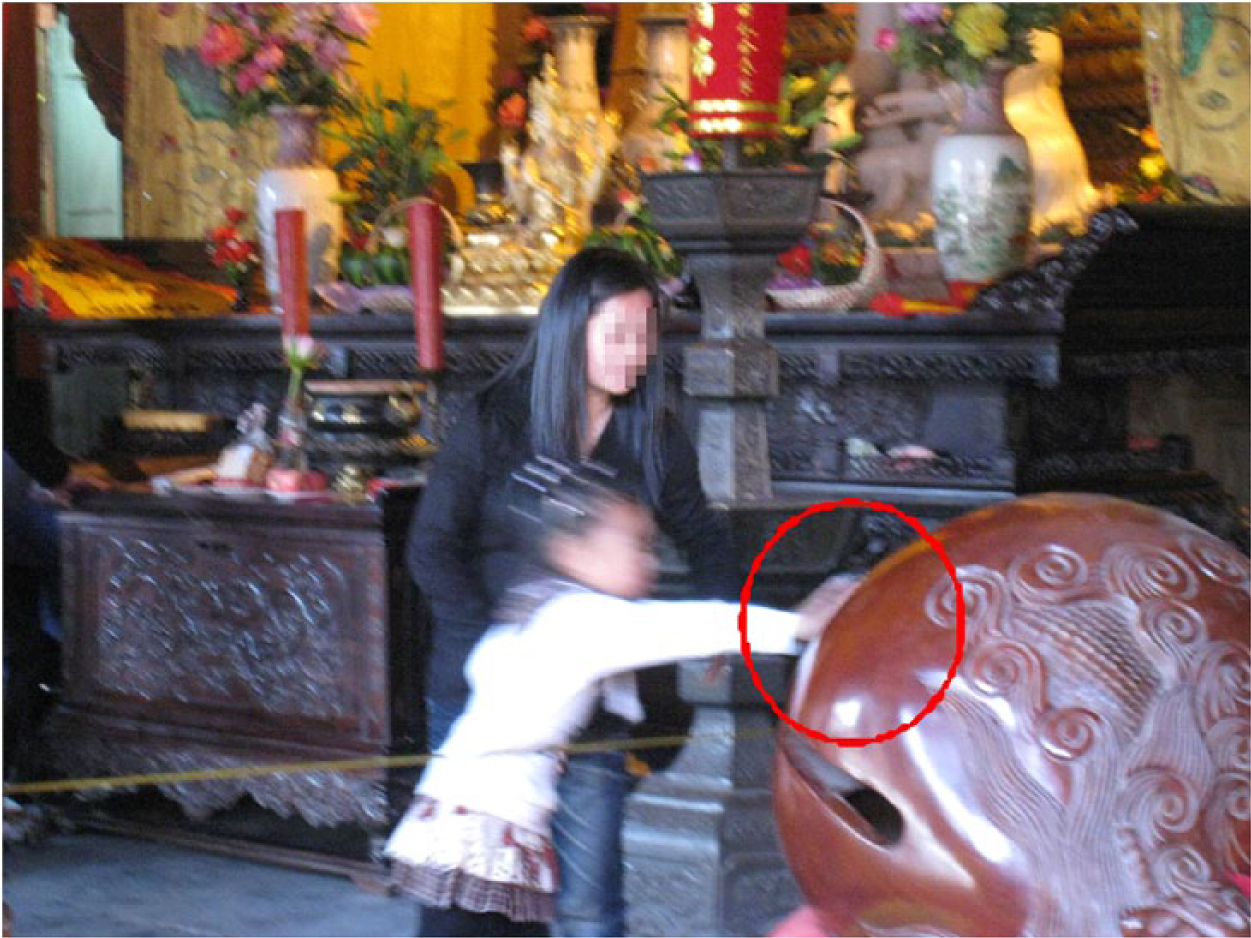
A little girl is told by her mother to pat a muyu.
In addition, in order to take care of the wish of some visitors who would like to bring back home some concrete symbol of auspiciousness or a memento of their visit and prevent physical harm to the monasteries, a “soft” strategy was implemented (Kuo 2002; Mason 2005). It is to offer visitors the opportunity to have a logo stamped on their clothes, bags, or any piece of fabric or paper, which they can take back home. Each stamping costs a symbolic one yuan (US$ 0.15) and the researcher could witness that they are very popular. The size of the stamp is 20 cm × 20 cm; it prints the name of the monastery and the symbol of Buddhism (see Figure 5). Monk Zhan Miao explained: “This is for the convenience of the people who want to bring some good qi back home; it also helps reduce their interest in touching or even taking away Buddhist objects.”
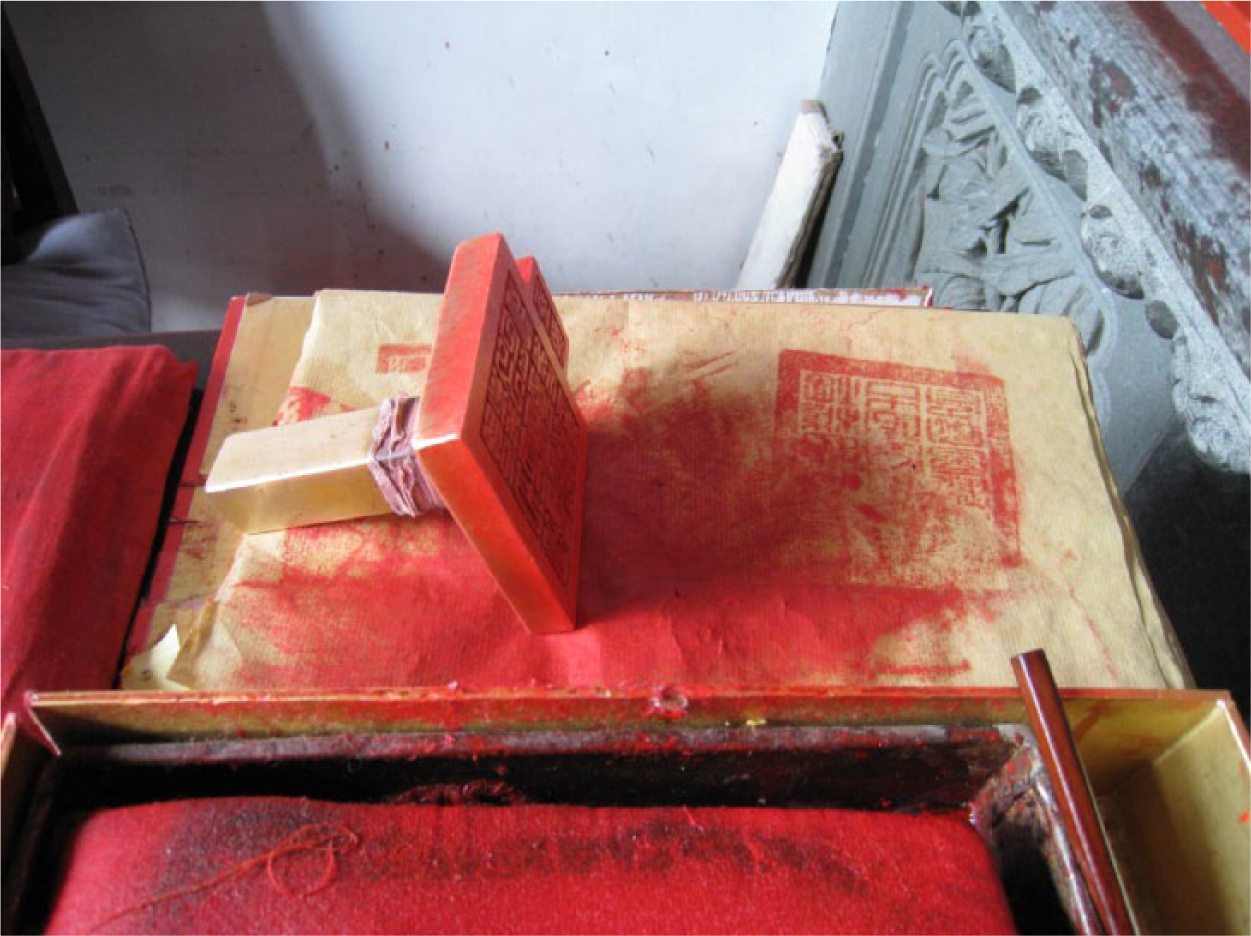
The stamp of a monastery.
Burning Incense and Paper Offerings in the Courtyards
The researcher noticed another common visitor behavior, namely, to burn their tributes, which typically are paper money or objects, candles, and incense sticks. Since visitors are forbidden to burn anything inside the halls, and since this prohibition is strictly enforced, visitors conduct the burning in a container placed for this purpose in the courtyards of the monasteries and nunneries. Though monks and nuns take a dim view of such rites, they do not intervene, even when obvious that much more incense is being burned than was allowed in. The monks and nuns interviewed explained that the reason they find these practices objectionable is twofold. First, there is a health issue as today many “incense” sticks contain more than incense and their smoke can be toxic. A second reservation is that the monks and nuns feel that it is not done in the right spirit. The informants explained that, while burning incense sticks is a traditional and proper Buddhist ritual, it is merely meant to show respect and should be done in moderation. They commented that burning many incense sticks is a folkloric ritual, a “reflection of not really understanding Buddhism” and furthermore a “waste of money.” Nun Yun Jing offered a clear articulation of the attitude that a devout Buddhist should take toward burning of incense: A real Jushi who understands Buddhism knows that offering incense is just a form of showing respect. . . . To burn incense has nothing to do with getting blessings. Those Xiankes who do not understand this are in fact not real Buddhists. One will not get blessings from the Buddha by offering incense, but rather by doing good things for others. This is the real way of obtaining blessings.
In spite of their view that “compulsive” incense burning has no place at a sacred Buddhist site, the monastic community does nothing about it. The token regulation about the quantity of incense one can bring into the grounds of the monasteries is obviously futile and no serious attempt is made at enforcing it. To compromise and provide convenience to all worshipers, whether or not they are seen as Buddhists by the local clergy, illustrates very well the Buddhist’s philosophy of compassion, tolerance, and respect of other peoples’ beliefs that underlies the way visitor management is conducted at Pu-Tuo. Of interest is that, in the interviews, the monks and nuns always spontaneously identified the problematic visitors as being Xiankes, not tourists.
Discussion and Conclusion
As discussed in the introduction, the literature on visitor management at sacred sites tends to emphasize the distinction between the pilgrims and worshipers on the one hand and the tourists on the other. The tourists, that is, visitors in search of leisure and cultural enlightenment, are typically seen as the being the more problematic group for whom visitor control measures need to be put into place. Furthermore, the situation being described in this literature—which is not about sacred Buddhist sites—is one where the number of tourists has today become quite larger than the one of pilgrims, to the extent that the religiosity of the site is compromised. For sacred sites built as homes for monastic communities, the tourists have even sometimes crowded out these communities (Shackley 1999; della Dora 2012).
The first thing to note about Pu-Tuo is that, as reported in a previous section, prior research indicates that the proportion of visitors who described themselves as pure tourists or as being partly religiously motivated and partly tourists is 36.7%. The proportion of visitors who described themselves as being Xiankes is 52.8%, leaving only 10.5% for the “true” Buddhist pilgrims, the visitors whom the monks and nuns call Jushis. The traditional pilgrim/tourist distinction would leave the Xiankes in a limbo as they are clearly not tourist, being in fact very religiously motivated. Yet they are not recognized as Buddhists by the monastic community. In effect, Pu-Tuo is a sacred site where the majority of visitors are, in effect, neither tourists nor regarded as pilgrims by the resident monastic members. Indeed it may be said that there is a certain awkwardness in the situation where the majority of visitors to a Buddhist sacred site have come to worship, but in a manner alien to Buddhism. Hence the situation at Pu-Tuo is more complex than at many Western counterparts, as at Pu-Tuo there are “approved pilgrims,” “nonsanctioned believers” against whose practices there is little action, and “tourists” motivated by sightseeing or cultural motives, all at the same site. In addition, from a Buddhist perspective, all are on a spiritual journey or dharma, but at different levels of achievement (Wong 2011). There is no corresponding situation reported in the literature on non-Buddhist religious sites. The similarity between the two situations is that the “approved” pilgrims at Pu-Tuo, the Jushis, are a minority, but it is not because of the abundance of tourists.
From the point of view of visitor control it is quite clear from the problems that the monks and nuns report in the interviews that the culprits are primarily Xianke worshipers, not tourists. In fact, the informants had remarkably little to say about the visiting tourists. None of the interviewees described them as a nuisance but rather as part of the landscape, as evidenced in the informants’ quotes. They commonly describe tourists’ main motivations to visit Pu-Tuo as those of “leisure and sightseeing,” “they do not pray . . . but are only curious, look around, take pictures and walk slowly.” Most importantly, the informants all comment that “tourists do not bring along incense sticks and paper offerings” and therefore tourists are seen as constituting no threat to the physical fabric or the atmosphere of Pu-Tuo.
In contrast to what is found in the West, the visitor control of the sacred grounds of Pu-Tuo is done by the monastic members themselves, who are therefore in daily close contact with the visitors. As a result of this, those stewards of the sites operate in a religious spirit of which a professional security guard would be bereft. It is found that the monasteries and nunneries are managed in way that remains true to the spirit of Buddhism. In Pu-Tuo, there is no carrying capacity control, no CCTV security systems or uniformed guards, and only minimal proactive measures can be found. Visitor control is largely performed on a reactive basis. On the one hand, monks and nuns take the view that prohibiting hazardous or disruptive behavior is imperative, a form of compassion so that all sentient beings can continue to use the religious sites as venues to contemplate, to pay reverence, and to learn Buddhism. On the other hand, they tolerate incongruous behavior on the part of visitors if harmless, without imposing, or even encouraging, adherence to proper Buddhist conduct.
In a religion that stresses self-discipline rather than external governance, it is fitting that many conventional visitor management strategies are not adopted in the Buddhist monasteries/nunneries. Observation of other Buddhist sites by the authors indicates that these attitudes are not unique to Pu-Tuo. In this respect, the article by Choe et al. (2013) on visitation to Chua Ba Thien Hau Buddhist temple in Chinatown, Los Angeles, is of interest as the same modes of visitor management are also seemingly applied and additionally are equally successful in this non-Chinese context, as they are also at the Fo Guang Shen Temples in Auckland, New Zealand, and Kaohsiung, Taiwan. It should be noted however that Choe et al. (2013) observe that visitation is motivated by a desire to contemplate meanings of personal lives, and hence a congruency between management philosophies and visitor motivation exists in this American example.
Buddhist monasteries and nunneries are built for the monks and nuns, but also for letting lay people have a chance to learn Buddhism. To have a serene environment that allows people to freely immerse themselves into the site’s atmosphere to absorb what Buddhism is about may also in itself lead visitors to behave in a more responsible way. Those non-Buddhist visitors may become Buddhists in the future. The alternative of a more proactive visitor control policy may result in creating more problems between the hosts and guests than there are now. As Shackley (2001, p. 35) points out, “the proper treatment of a sacred place is a matter of respect, not always enforceable by management.” Only the future will tell whether the visitor management philosophy of Pu-Tuo is sustainable, as the number of visitors is likely to continue to increase in the years to come.
Footnotes
Declaration of Conflicting Interests
The author(s) declared no potential conflicts of interest with respect to the research, authorship, and/or publication of this article.
Funding
The author(s) received no financial support for the research, authorship, and/or publication of this article.