



Abstract
This study utilized generational cohort theory to enhance understanding of the motivation and destination image of Mainland Chinese tourists visiting Taiwan (i.e., cross-strait tourism). With 350 Chinese tourists traveling to Taiwan, unique characteristics of four generations were identified (e.g., the Republican generation was more highly motivated to visit friends and relatives than the other generations, the Social Reform generation had greater hedonic motivation for visiting Taiwan than either the Consolidation or the Republican generations). The inconsistent characteristics between cohorts could be attributed to generational differences in past historical experiences. Thus, findings suggest that an individual’s life experience could play an important role in forming an image of the destination where the experience is related to, and also suggest that cross-strait tourism, one of the unique contexts of quasi-states tourism between politically divided countries, has a strong generational component, and tourism policies between such countries must take this into account.
Keywords
Introduction
Previous studies have shown that chronological age affects the motivation and destination image of tourists traveling between politically divided countries (e.g., China–Taiwan, South Korea–North Korea, and North Cyprus–South Cyprus) (Liu, Lee, Kan, and Huan 2011; Kim and Prideaux 2006; Kim, Prideaux, and Prideaux 2007). This should not be surprising, as someone in their twenties will be looking for different experiences and have different perceptions than someone, for example, in their sixties. However, a reasonable question is whether, in countries where there are political divisions, these differences are not simply a matter of chronological age but also the result of generational differences. In other words, do generations who live through different historical events involving two countries have different perceptions of the corresponding country, and do these perceptions affect the motivations and destination images when people travel from one country to the other? Obviously chronological age is one aspect of generation differences, but as Egri and Ralston (2004) point out, not all characteristics of generations follow an age-related pattern.
This study addressed this question by using generational cohort theory to examine the motivations and destination images of the unique quasi-states tourists in cross-strait tourism. The unique characteristics and attitudes of four specific generations of Chinese Mainlanders (the Republican, Consolidation, Cultural Revolution, and Social Reform generations) visiting Taiwan were identified and compared to each other. While the most prevalent characteristics were consistent across the generations, several other factors were shown to have generational differences. It could be argued that different types of motivations and destination images in the various generational cohorts are due to life experiences that are associated with historical events and the destination.
Literature Review
Cross-Strait Tourism
Cross-strait tourism refers to the inbound and outbound tourism between Taiwan and mainland China, which are separated by the Taiwan Strait in the west Pacific Ocean. Tourism between Taiwan and mainland China is one of the quasi-states tourism types along with those of the Republic of Ireland and Northern Ireland, the former West and East Germany before reunification, Greek and Turkish Cyprus, and North and South Korea (Butler and Mao 1995). Butler and Mao (1995) defined a quasi-state as “a currently separate political unit, once part of a larger unit, subdivided by internal (religion, ethnic origin, etc.) or external (colonization/decolonization, occupation, war, etc.) forces” (p. 94). In many cases, quasi-states indicate partitioned states or countries due to the historical event such as the Chinese Civil War between China and Taiwan. Chen, Lin, and Petrick (2013) argued that the political and/or ideological distance between two countries may hinder tourists from visiting each other.
Taiwan is located about 100 miles off the southeast coast of Mainland China. For over four centuries, mainland Chinese immigrants have relocated to the island (Lin 1999). The most noted and most recent major influx occurred in the late 1940s following the Chinese Civil War. From 1895 to 1945, Taiwan was occupied by Japan, but was returned to the Chinese Nationalist Party or Kuomintang (KMT) after World War II. Soon afterwards, however, the civil war between the Chinese Communist Party and the KMT resulted in the KMT retreating from the mainland to Taiwan (Zhang, Xu, and Zhang 2003). As a result, the KMT government and a total of one and half million followers fled to Taiwan in late 1949 (Copper 1999).
From 1949 well into the 1980s, relations between the Mainland and Taiwan were dominated by military confrontation. Since the early 1980s, both the Chinese Communist Party and KMT shifted their focus to economic development, which resulted in the initiation of cross-strait conciliations (Copper 1999; Guo et al. 2006; Yu 1997). As a part of cross-strait conciliations, the KMT government lifted the ban on travel to China in 1987 (Guo et al. 2006), and the number of Taiwanese tourists to China increased from a half million in 1988 to 5.1 million in 2010 (China Tourism Administration 2012). However, the number of tourists from the Mainland to Taiwan remained low, largely because of the political changes that were occurring in Taiwan. Yu (1997) argued that the flow of Taiwanese visiting Mainland China went through the initial stage of the veterans who moved to Taiwan in the 1940s and were separated from their families, and it gradually reached the middle stage—leisure and business tourism.
Rapid economic growth and gradual political liberation in Taiwan fostered a political transformation from single party authoritarian rule to a more democratic multiparty process (Hsieh and Niou 2005). The biggest impact of this democratic trend was the emergence of the Democratic Progressive Party formed in 1986 (Copper 1999). The influence of the Democratic Progressive Party reached its highest point in 2000, when Chen Shui-ben was elected president of the Republic of China and became the first non-KMT member ever to hold the office. Chen and the Democratic Progressive Party not only challenged the legitimacy of the KMT government but also its Chinese ideology (Chu and Lin 2001; Hsieh and Niou 2005). During his entire presidency, Chen strived to rebuild a Taiwanese, as opposed to a Chinese, national identity (Copper 2008). Chen’s party identified themselves as Taiwanese, rather than Chinese. Chen’s anti-China stance and policies strained the already tense relations between Beijing and Taipei, resulting in the cessation of official contacts and negotiations across the Taiwan Strait (Guo et al. 2006).
All during Chen’s presidency, however, the opposing KMT held its Chinese ideology and asserted that Taiwan and China needed to cooperate with each other, at least in economic matters (Gold 2009). Therefore, when the KMT regained the presidency in 2008, negotiations between Taiwan and China immediately took place—and one quick result was direct flights between China and Taiwan, the first to be allowed since 1949 (McDonald 2008). With the easing of tensions since 2008, the number of Mainland Chinese tourists to Taiwan rapidly increased. In 2010, Taiwan received a total of 1.8 million tourists from the Mainland (Tourism Bureau of Taiwan 2011), and Mainland China has become the largest inbound market to Taiwan.
Generational Cohort Theory
Generational cohort theory proposes that a generation of individuals share a distinctive set of values, beliefs, attitudes, and behavior that are formed by significant social, political, and economic events that occurred during the early stage of their life cycle (i.e., childhood, adolescence, and/or early adulthood) (Inglehart 1977). Generational cohort is “one type of national subculture that reflects the value priorities emphasized during a country’s particular historical period” (Egri and Ralston 2004, p. 210). Inglehart (1977, 1997) argued that it is important to understand generation subcultures because when one generation becomes the majority in society, their values would be prevalent in a national culture.
Generational cohort theory differs from a life-stage theory, which posits that people’s values and beliefs change throughout their life cycle. Life-stage theory suggests that all people within a culture pass through similar phases as they age (e.g., as people become old, they also become more conservative, collectivistic, and less individualistic), and there is consistency generation to generation (Erikson 1997). Conversely, generational cohort theory acknowledges the long-term impacts of unique historical events in the life of a particular generation, and these impacts produce shared values and attitudes that remain stable throughout life. Inglehart (1997), for example, proposed that individuals’ basic values reflect the socioeconomic conditions of their childhood.
Generational cohorts in China
Egri and Ralston (2004) identified four different generations in Mainland China with distinct personal values influenced by historical events during their childhood and adolescence. The four are the Republican, Consolidation, Cultural Revolution, and Social Reform generations. The Republican generation (born 1930–1950) experienced extreme poverty, natural disaster, war, and the political instability from 1927 to 1949 (Civil War). The Consolidation generation (born 1951–1960) was influenced by political consolidation initiated by the Chinese Communist Party, which led to greater economic and political stability. The Cultural Revolution generation, born between 1961 and 1970, substantially experienced the Great Cultural Revolution (1966–1976), and the Social Reform generation (born after 1970) experienced modern policies that encouraged personal intellectual growth, personal economic efficiency and entrepreneurship, and a form of materialism in line with the beliefs of Deng Xiaoping (Tian 1998).
Meglino and Ravlin (1998) stated that “values specify an individual’s personal beliefs about how he or she ‘should’ or ‘ought’ to behave” (p. 354). Egri and Ralston (2004) empirically tested the generational effect on personal values in China and found some differences between generational cohorts significant. They argued that most characteristics of generations follow a general age-related pattern, but not all values followed this pattern. For instance, the Republican generation had the highest self-transcendence value score in comparison to other generations, and the Social Reform generation had a higher openness to change than other generations. Also, the Consolidation generation was more conservative than the Cultural Revolution and Social Reform generations. However, the Cultural Revolution generation had higher self-enhancement values than the more recent Social Reform generation. Egri and Ralston (2004) suggested that the Cultural Revolution generation places high importance on power and achievement because these values were needed to survive the extreme societal instability of that particular era. They argued that generational differences explain better than mere age the unique aspects of these various groups.
Motivation and Destination Image
Klenosky (2002) demonstrated that personal values (e.g., excitement, accomplishment, self-esteem, and fun and enjoyment) correspond to pull motivations. He proposed a hierarchical value map showing that the value of self-esteem leads to the pull factors of “look good/healthy” and “get sun/tan” along with attributes of warm climate and beaches, whereas the value of a sense of accomplishment is related to the motivations of “know more,” “be more productive,” “learn more,” and “new/novel experience” (Klenosky 2002, p. 393). A means–end model refers to a knowledge structure that connects knowledge about product or service attributes to consumers’ self-knowledge about benefits and values that they are looking for (Gutman 1982; Reynolds and Gutman 1988). This theory argues that an individual develops the knowledge structure through four steps: product or service attributes, functional consequences (benefits), psychological consequences (benefits), and perceived values (Peter, Olson, and Grunert 1999). This approach assumes that when people purchase products or services, they always consider the self-relevant consequences and values derived from that product or service. In other words, consumers see product and service attributes as a means to reach end (e.g., benefits or personal values).
Recently, Li and Cai (2012) also argued that personal values affect travel motivation and behavioral intention. With Kahle’s List of Values (1983), Li and Cai (2012) found that strong internal values are associated with novelty and self-development motivations, and external values with motivation for prestigious and luxurious experience, self-development, exciting experience, and escape. Internal values indicate that the locus of control of values rests with the self, thus including self-respect, being well respected, sense of self-fulfillment, and sense of accomplishment. Conversely, external values include sense of security and sense of belonging, as those who are externally oriented may not want to be exposed to unfamiliar environments (Li and Cai 2012).
Tourism scholars have paid considerable attention to motivations and behavioral intentions of specific tourism services (Li and Petrick 2008; Huang and Hsu 2009; Hsu, Cai, and Li 2010; Dolnicar and Grün 2013; Hallmann, Zehrer, and Müller 2013). Examples include cruise lines (Hung and Petrick 2011; Qu and Ping 1999), rural tourism (Devesa, Laguna, and Palacios 2010; Park and Yoon 2009), volunteer tourism (Grimm and Needham 2012), and festival tourism (Crompton and McKay 1997; Lee, Lee, and Wicks 2004). In the context of destination marketing, it has been found that travel motivation and destination image are two important factors influencing tourists’ intentions to visit or revisit a destination (Baloglu and McCleary 1999; Beerli and Martín 2004). According to Iso-Ahola (1980), motivation is defined as an internal factor that directs and arouses an individual’s behavior. In the context of tourism, it has been shown that motivation is a multidimensional construct (Crompton and McKay 1997). In other words, an individual might seek to satisfy different needs within a single trip (e.g., sightseeing, relaxing, and family interaction all within a single vacation).
Destination image is defined as “the sum of beliefs, ideas and impressions that a person has of a destination” (Crompton 1979, p. 18). Previous studies about destination image have been mostly based on the assumptions of attitude theory that suggests people follow a process of awareness, interest, desire, and action (Fishbein 1967). Therefore, tourism researchers frequently have conceptualized destination image as two constructs, one being cognitive image (an individual’s beliefs and knowledge about a destination) and the other affective image (his or her feelings toward the destination) (Baloglu and McCleary 1999; Beerli and Martín 2004; Pike and Ryan 2004). Tourism researchers, not surprisingly, are interested in measuring the destination images of targeted customers, as understanding these destination images can reveal perceived strengths and weaknesses of a destination in the eyes of potential tourists (Echtner and Ritchie 1993; Hu and Ritchie 1993; Jenkins 1999). Accordingly, based on destination images of potential tourists, destination marketers can decide how to promote their destinations (Echtner and Ritchie 1993; Tasci and Gartner 2007).
Contextually specific motivation: quasi-states tourism
Motivation and destination image have been popular topics in the literature regarding tourism between politically divided countries. Butler and Mao (1996) postulated that “economic necessity, religious obligations, family ties, political requirements, and pleasure are all reasons for the cross-border travel of people in such situations” (p. 26). Given the nature of the special relationship between the two countries or units, tourism between quasi-states is unique and significant in terms of motivations for travel and destination image of each other. Social relationships (e.g., kinship) especially play an important role in driving tourism development between partitioned states or countries. Family and/or friend relationships that have developed before partition or separation are more likely to affect an individual’s desire to visit the other country, as, for example, between residents of North Korea and South Korea (Kim and Prideaux 2006).
Hanqin and Lam (1999) found that Mainland Chinese tourists have several push and pull motivations. For instance, while knowledge, prestige, enhancement of human relationship, relaxation, and novelty are push motivation factors, hi-tech image, expenditure, accessibility, service attitude and quality, sightseeing variety, and cultural links indicate pull factors. Further, they argued that there is a significant relationship between travel motivations and sociodemographic profiles; that is, some groups of people (e.g., annual income with RMB 20,000–39,999, 36–45 years old) are more likely to perceive accessibility as more important than other groups. Also, first-timers to Hong Kong tend to value prestige and the desire to experience something different from their everyday lifestyles in comparison to the frequent tourists.
More recently, Liu et al. (2011) replicated Hanqin and Lam’s (1999) study and argued that only three factors of push motivation (i.e., knowledge, prestige, and enhancement of human relationship) apply to Mainland Chinese tourists to Taiwan. Of the three main factors, knowledge (e.g., seeing something different, increasing knowledge about a destination, and experiencing a different lifestyle) is the most influential motivational factor affecting travel behavior. They also found that age, income level, and education level significantly affect these push motivations. Lin and Lin (2006) conducted a survey of Mainland Chinese tourists in Taiwan to identify main activities they participated in during their visits. Cultural exchange was one of the main reasons for visiting (55.7%), followed by business meetings (28.1%) and conferences (10.3%).
In addition, Guo et al. (2006) argued that cultural resources draw the attention of tourists in China and Taiwan, as both countries share many similarities in culture and language. For example, the beliefs in “Mother Ancestor” (the indigenous goddess of the sea who is said to protect fishermen and sailors) would be an important cross-strait cultural tourism resource. In fact, the Mother Ancestor has had a significant impact on Taiwanese traveling to Mainland China (Guo et al. 2006).
Chen and Lin (2012) developed items to measure the cognitive and affective image that Mainland Chinese have of Taiwan. They found that while cognitive image is multidimensional, affective image is unidimensional. Specifically, cognitive image is composed of four dimensions of quality, sentiment, negative (i.e., negative perceptions such as crime, political instability), and culture. Younger Mainland Chinese were found to have relatively more positive destination image of Taiwan than older people, but they have, because of their low income level, lower intentions to actually visit Taiwan than middle-aged Chinese. Furthermore, it was found that destination familiarity significantly affects destination images and revisit intentions; that is, Mainland Chinese tourists who are very familiar with Taiwan are more likely to have more positive destination image and higher visiting intention than those who are not familiar with the destination.
The effect of age on tourists’ motivation and behavior has been frequently studied in the literature. Liu et al. (2011) found that the older Chinese tourists (age 61 and older) are more likely to visit Taiwan in order to learn something, feel prestige, enhance social relations, or relax than the younger groups, and suggested that tourism enterprises need to target middle-aged and senior Chinese tourists as they are more motivated to visit tourism destinations in Taiwan than younger groups. Hanqin and Lam (1999) also argued that tourists 36–45 years old are more likely to want to feel prestige when they travel to Hong Kong than their younger counterparts (age 35 or younger). Conversely, young groups tend to place the highest importance on adventure and excitement. However, Liu and Ko (2011) argued that no differences exist between five different age groups of Chinese tourists in preferred tourism attractions.
In another politically divided country relationship, Kim and Prideaux (2006) found that there are some differences between different age groups in their perception of the Mt. Gumgang project, the tourism development project designed to have South Korean tourists visit a resort in North Korea to increase cross-cultural understanding. South Korean tourists over 60 were inclined to expect positive political and economic impacts, whereas individuals under 30 in South Korea were relatively skeptical of those impacts. In addition, Kim and Prideaux (2006) argued that gender and marital status significantly affect support of the Mt. Gumgang tour project. Men were more positive toward the economic and political impacts of the tourism project in North Korea than women. Regarding motivations for visiting Mt. Gumgang resort in the future, “seeing the beautiful scenery” was most popular, followed by “experiencing something different,” “understanding North Korea,” “experiencing the empathy of North Korean countrymen and the reality of a divided country,” and “escaping from everyday routine life” (Kim and Prideaux 2006, p. 132).
Inconsistent with previous study, Kim, Prideaux, and Prideaux (2007) found that older age groups of South Koreans are more likely than younger age groups to view North Korea as the enemy even if they visited Mt. Gumgang and think there is a big gap in the ways of life between the two countries. In other words, young South Koreans tend to see North Korea friendlier and closer after taking the Mt. Gumgang tour. Accordingly, Kim, Prideaux, and Prideaux (2007) argued that tourism could play an important role in promoting peace between politically hostile nations as time goes by. Three main motivational factors of visiting the Mt. Gumgang resort were also identified as enjoyment of tourism resources, escape from everyday routine, and interest in North Korea. While the first two motivations relate to general travel motivation, the last one is a context-specific motivation (i.e., visiting and understanding a politically divided country).
In spite of some significant findings of age and gender effects, little study has attempted to examine generational effects between politically divided countries in the literature. The generational effects on destination image would make it possible to understand the destination image literature from a different angle. In addition to individuals’ internal factors such as attitude, past travel experience and cultural values (e.g., Baloglu and McCleary 1999; Moura, Gnoth, and Deans 20014; Pike and Ryan 2004), destination personality (e.g., Papadimitriou, Apostolopoulou, and Kaplanidou 2013), and external information sources such as news media and marketing materials (e.g., Stepchenkova and Eales 2011; Sun, Ryan, and Pan2014), an individual’s life experience could play an important role in forming an image of the destination the experience is related to. As examined earlier, each generation is distinct from the other because of the shared experience from social and historical events.
Thus, this study sought answers to the following research questions: (1) Is there any difference between generational cohorts of Chinese tourists visiting Taiwan in motivations, destination images, and revisit intentions? (2) Does gender moderate the generational effect on motivation, destination images, and revisit intentions? (3) Overall, what are the unique characteristics of each generation in Mainland China?
Method
Data Collection and Measurement
In this study, the target population was Mainland Chinese tourists who have visited Taiwan for pleasure. However, because it was not possible to obtain a cross-strait tourist list, a nonprobability convenience sampling was utilized as an alternative sampling frame. Since most Mainland Chinese tourists arrive and depart Taiwan via the Taiwan Taoyuan International Airport, data were collected either in the lobby of the Taoyuan Airport while they were waiting for departure or in hotels near the airport on the last night of the trip (from April to August 2007). A total of 350 questionnaires (excluding 29 invalid responses) were obtained. Scales of Mainland Chinese tourists’ travel motivation were derived from previous studies (e.g., Hanqin and Lam 1999; Liu et al. 2011). Hanqin and Lam (1999) developed 20 scales to measure five dimensions of Mainland Chinese tourists’ push-factor motivations to visit Hong Kong, and Liu et al. (2011) confirmed that their 20 scales can be applied to Chinese tourists visiting Taiwan.
As it has been stated that determining attributes measuring destination image might differ from destination to destination (Jenkins 1999; Pike 2003), scales of destination image were developed following the procedure as suggested by Churchill (1979). That is, a list of common attributes was initially collected from the literature (Baloglu and McCleary 1999; Beerli and Martín 2004; Echtner and Ritchie 1993; Gallarza, Saura, and Garcia 2002; Pike and Ryan 2004). These common attributes are believed to represent the characteristics that have universal importance for all tourist destinations. They include accommodation quality, general infrastructure, and beautiful scenery. However, each tourist destination also has its unique attractions or atmospheres, which might be determining factors in the process of destination choice (Hu and Ritchie 1993; Pike 2003). Accordingly, as suggested in previous studies (e.g., Echtner and Ritchie 1993), three open-ended questions were asked to elicit unique attributes of Taiwan as perceived by Mainland Chinese tourists.
Results
Demographic Information
The vast majority of the respondents in this study (95.6%) were first-time tourists to Taiwan, but more than half of them had traveled to other international destinations: 36.8% had traveled internationally twice and 32.9% had done so three or more times (Table 1). In terms of generation cohorts, almost half of the respondents were from the Cultural Revolution generation (44.1%). Close to one-fourth (24.7%) were of the Consolidation generation, 22.5% were from the Social Reform generation, and 8.8% were from the Republican generation. A majority were male (68.5%), and nearly half were middle-aged between 40 and 49 years old (44.1%), which is consistent with previous studies (e.g., Lin and Lin 2006; Liu and Ko 2011). The first wave of Mainland Chinese outbound tourists to all countries had been middle-aged professionals, and likewise, it was assumed that the current wave of Mainland Chinese tourists to Taiwan would be dominated by middle-aged individuals (Guo, Kim, and Timothy 2007; Lin and Lin 2006). However, it has been also observed that the number of younger Chinese tourists is recently growing (Agrusa, Kim, and Wang 2011; Chen and Lin 2012; Guo, Kim, and Timothy 2007).
Description of the Respondents.

There were more male respondents (68.5%) than female (31.5%) respondents, and this was fairly consistent across generational cohorts: Social Reform (male: 61.8% vs. female: 38.2%), Cultural Revolution (69.3% vs. 30.7%), Consolidation (75.0% vs. 25.0%), and Republican (64.3% vs. 35.7%).
Factor Analysis
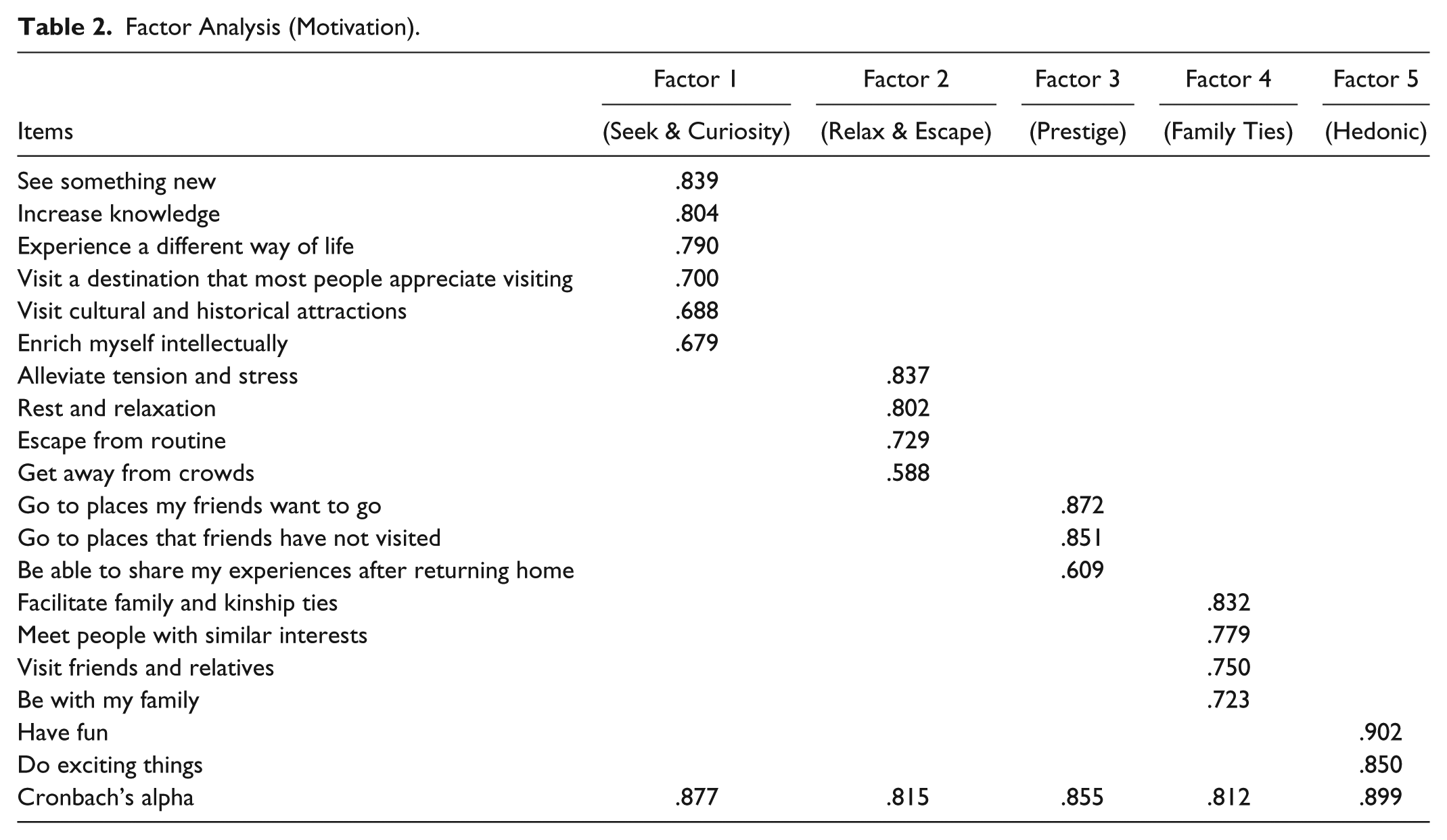
Factor analysis with varimax rotation (Table 2) was conducted to explore the dimensions of motivation and cognitive destination image. The Kaiser-Meyer-Olkin (KMO) value was .856, and the Bartlett’s test was significant (p < .001); thus, factor analysis was appropriate (Hair et al. 2006; Pallant 2005). Motivation was found to encompass five dimensions with factor loadings and communalities of 0.50 or above, which explained 69.0% variance: Seek & Curiosity (six items), Relax & Escape (four items), Prestige (three items), Family ties (four items), and Hedonic (two items). All four dimensions showed reliability with high internal consistencies (Cronbach’s alpha: Seek & Curiosity = .877; Relax & Escape = .815; Prestige = .855; Family ties = .812; Hedonic = .899). Some items with low factor loading or cross-loading were deleted (e.g., “looking for potential business opportunities” and “being entertained”).
Factor Analysis (Motivation).
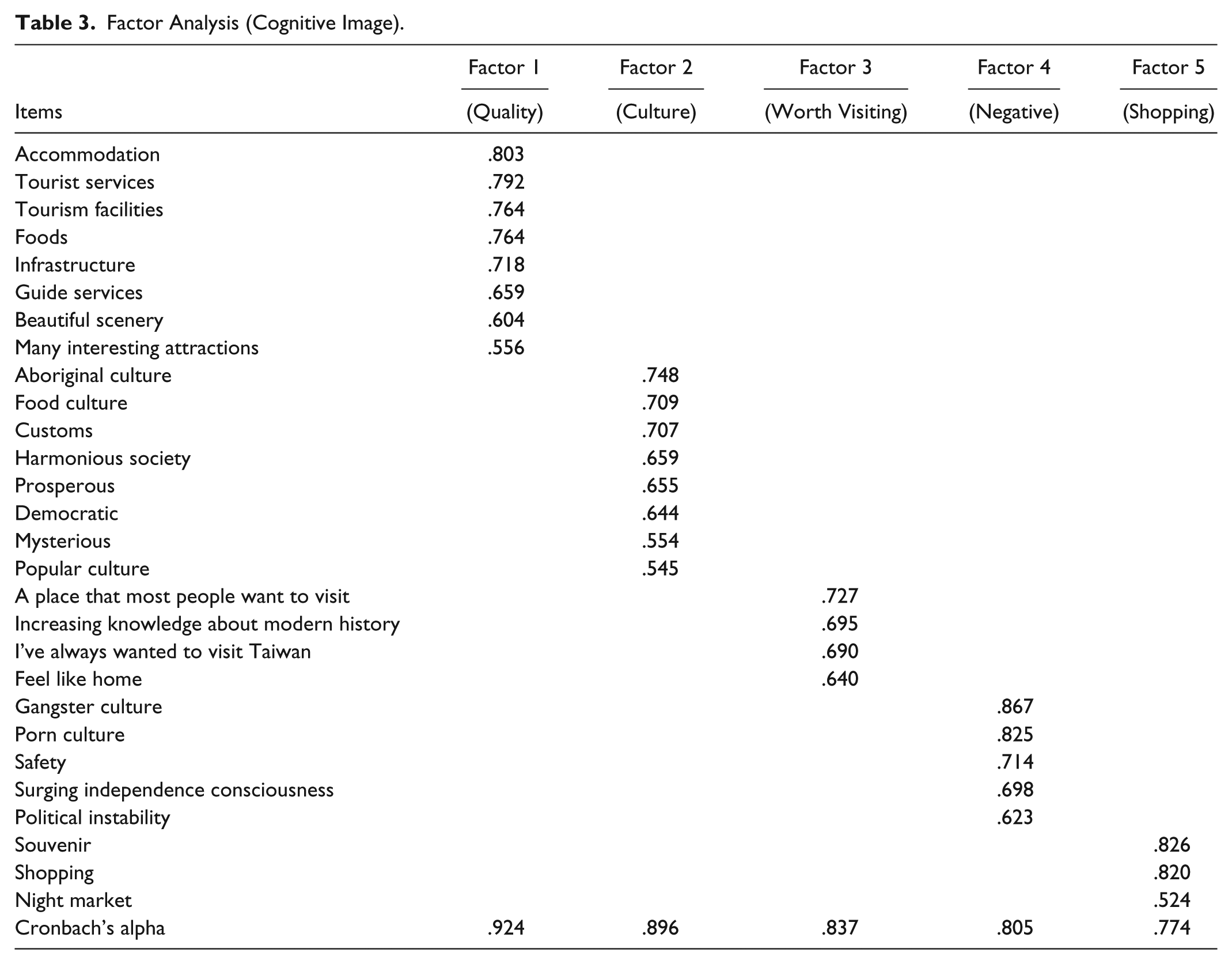
Another factor analysis with varimax rotation extracted five dimensions of cognitive image: Quality (eight items, Cronbach’s alpha = .924), Culture (eight items, Cronbach’s alpha = .896), Worth visiting (four items, Cronbach’s alpha = .837), Negative (five items, Cronbach’s alpha = .805), and Shopping (three items, Cronbach’s alpha = .774). The KMO value was .919, and the Bartlett’s test was significant (p < .001) (Table 3). Some items were deleted because of the low factor loadings (0.50 or below) or cross-loadings. These included “weather,” “available tourism information,” “friendly people,” “adventurous,” “visa permission,” and “nightlife.” Except for the shopping-related items, these results are consistent with a previous study (Chen and Lin 2012). Chen and Lin (2012) argued that Mainland Chinese tourists’ cognitive image of Taiwan is composed of four dimensions of quality, sentiment, negative, and culture.
Factor Analysis (Cognitive Image).
Additionally, it was found that affective image is unidimensional, which is consistent with previous study (Chen and Lin 2012). Factor analysis of affective image is appropriate as the KMO value was .807, and the Bartlett’s test was significant (p < .001). The Cronbach’s alpha was .903, showing internal consistency of a concept of affective image.
Confirmatory Factor Analysis
Confirmatory factor analysis with maximum likelihood estimation was conducted to further refine the scales and to confirm the dimensionality of motivation (Netemeyer, Bearden, and Sharma 2003). The model of motivation with five factors indicated acceptable model fit (χ2[df = 142] = 448.216, p < .001; root mean square error of approximation = .08; comparative fit index = .90) (Hu and Bentler 1999). Although the chi-square statistic for model fit was significant, this usually happens to large sample sizes as this index is highly sensitive to sample size (Hair et al. 2006; Reisinger and Mavondo 2006). All factor loadings fell within a reasonable range between .60 and .90 (Bagozzi and Yi 1988), and all five motivation factors (Seek, Escape, Prestige, Family ties, and Hedonic) were moderately correlated with one another (between .29 and .56), which is an evidence of the discriminant validity of this construct (Netemeyer, Bearden, and Sharma 2003). Consequently, it was determined that no items need to be further deleted, and the extracted factors of motivation in EFA were confirmed.
Two-Way Analysis of Variance
A two-way analysis of variance (ANOVA) was conducted to examine the effect of generation and gender on motivation, destination image, and revisit intention. This analysis would be most appropriate because it enables to test the impact of two independent variables (i.e., generation and gender) on one dependent variable (i.e., motivation, destination image, and revisit intention, respectively) (Pallant 2005). This test has been frequently used in the literature. For example, Moura, Gnoth, and Deans (2014) used a two-way ANOVA to examine the significant differences in New Zealand, India, and China destination website users’ destination image and willingness to travel on each dimension of multiple cultural values (e.g., collectivism, individualism, power distance, uncertainty avoidance, high context, and low context). Further, the ability of testing for an interaction effect—the effect of one independent variable that is influenced by another independent variable—is one of the advantages of a two-way ANOVA. Multiple separate two-way ANOVAs were conducted for each dependent variable because no evidence of moderate or strong correlations among dependent variables was found in the preceding factor analysis (Pallant 2005).
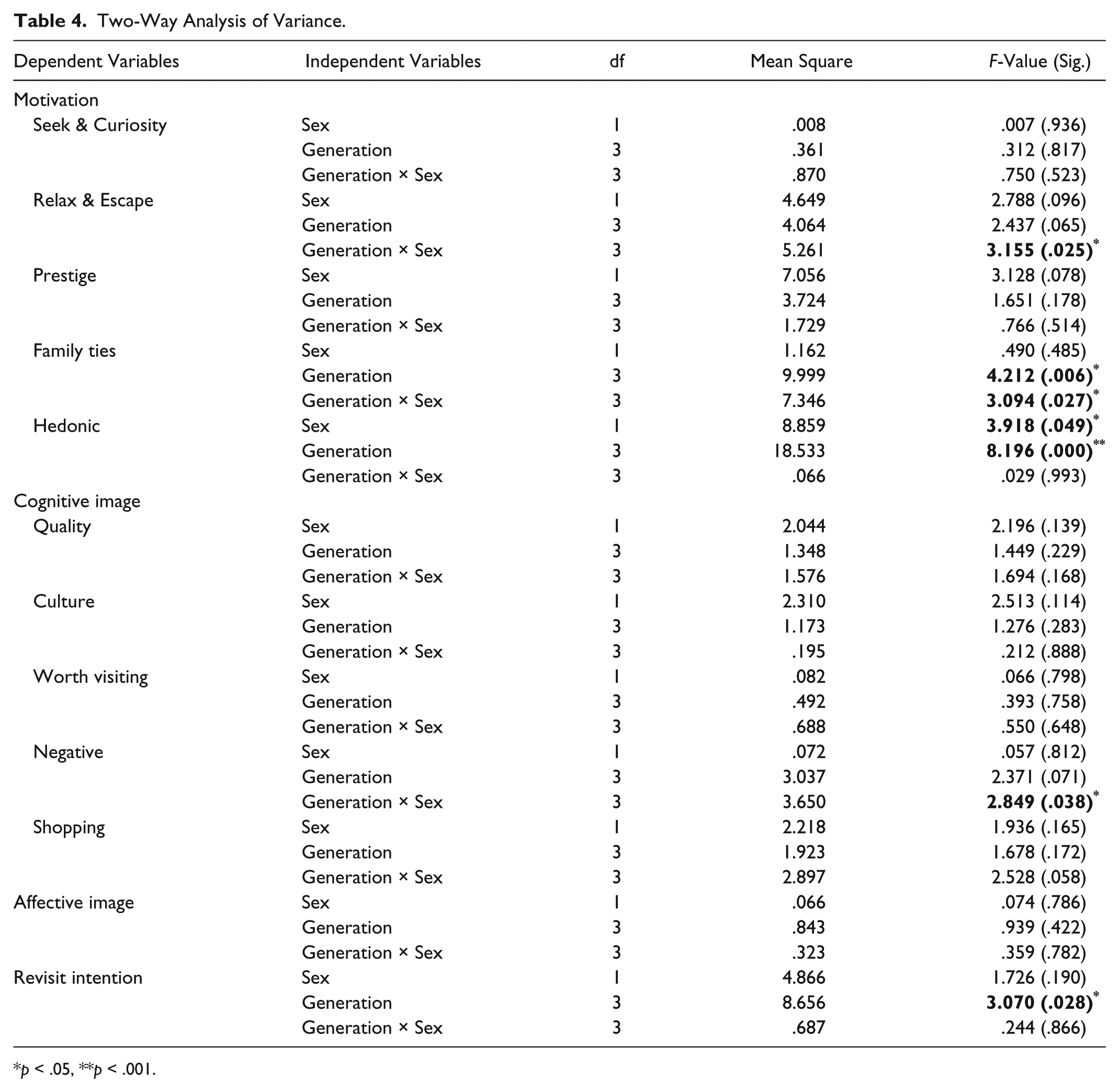
Results showed that there are some statistically significant differences in motivation (Table 4). While no significant differences exist in seek & curiosity and prestige motivations (both main and interaction effects), statistically significant differences were found in other motivations.
Two-Way Analysis of Variance.
p < .05, **p < .001.
Specifically, there were significant main effects of generation on family ties (F = 4.212, p = .006) and hedonic motivations (F = 8.196, p < .001), respectively. The main effect of gender on hedonic motivation was also significant (F = 3.918, p = .049), which was not the case in other motivations. However, significant interaction effects of gender and generation on relax & escape (F = 3.155, p = .025) and family ties (F = 3.094, p = .027) showed that gender plays a moderating role in generation effects on relax & escape and family ties motivations. In other words, while regarding hedonic motivation, there were differences between gender groups and generational cohorts, respectively; generational differences in relax & escape and family ties motivation were observed only in a certain gender group.
Likewise, there was a significant interaction effect of gender and generation on negative cognitive image (F = 2.849, p = .038). Also, a main effect of generation on revisit intention within three years was significant (F = 3.070, p = .028). However, no main and interaction effects of gender and generational cohorts on other cognitive images (quality, culture, worth visiting, and shopping) and affective image were significant.
Post hoc tests (Scheffe) showed that the most recent generation (Social Reform) has greater hedonic motivation to visit Taiwan (e.g., having fun and doing some exciting things) than the Consolidation and the Republican generations (p < .001) (Table 5). The Social Reform generation also has more willingness to revisit Taiwan in the near future than the Consolidation group (p = .028).
Post hoc Test.
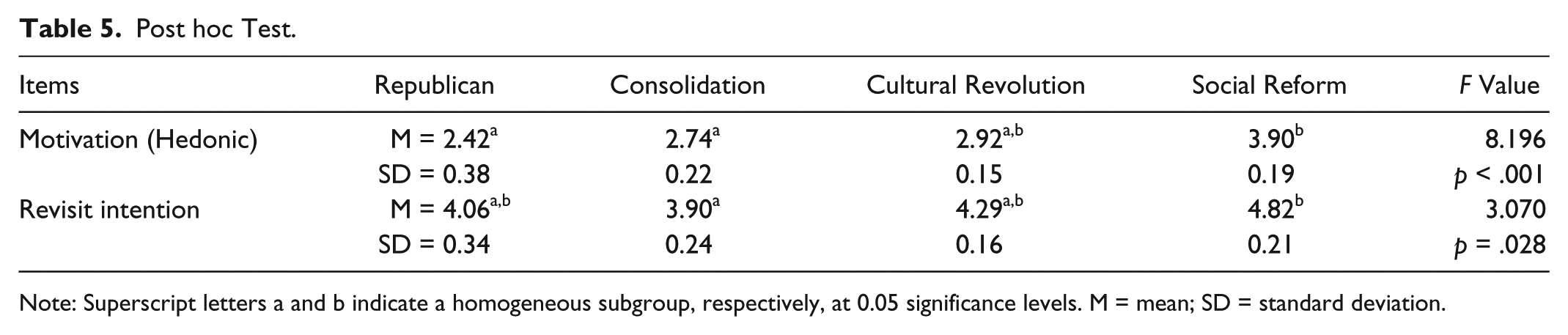
Note: Superscript letters a and b indicate a homogeneous subgroup, respectively, at 0.05 significance levels. M = mean; SD = standard deviation.
Furthermore, Table 6 shows that the female Republican group was the least motivated to visit Taiwan for the fun and entertaining purposes (M = 2.17 on a scale of 1 (least motivated) to 7 (most motivated)). Instead, they were more highly motivated to visit friends and relatives (M = 4.88) and to relax (M = 4.91) than other groups. Also, the female Republican and the male/female Social Reform generations have relatively stronger negative images of Taiwan than the female Consolidation group.
Means in Generational Cohorts and Gender.
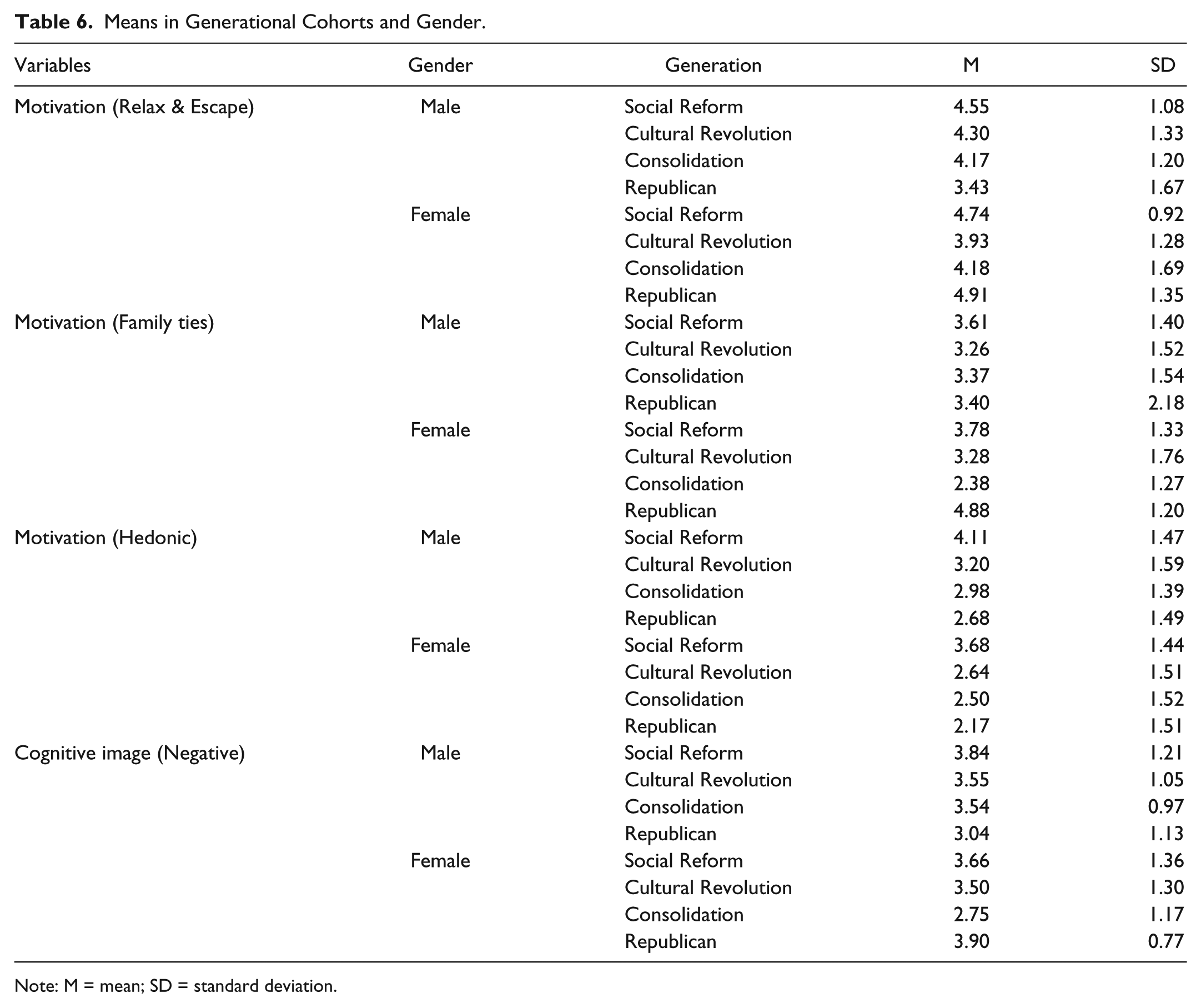
Note: M = mean; SD = standard deviation.
Regression Analysis
Regression analysis was conducted to see whether each variable is significant in predicting revisit intention. Three multiple regression models with revisit intention as the dependent variable and motivation and cognitive image as the independent variables were built for the Consolidation, Cultural Revolution, and Social Reform generations (as only 28 respondents belong to the Republican, they were excluded from the regression analysis). Results showed that all motivation factors were not significant in all three models, and three cognitive image factors (quality, worth visiting, and shopping) were significant (p < .05) in at least one model.
Table 7 shows that an image of worth visiting has significant regression weights in two models (Cultural Revolution model: β = .247, p < .01; Social Reform model: β = .496, p < .001), and a shopping image also has significant regression weights in these two models (Cultural Revolution model: β = .420, p < .001; Social Reform model: β = .381, p < .001). Quality had a statistically significant effect on revisit intention in Consolidation model (β = .356, p < .01).
Regression Analysis ( Dependent Variable: Revisit Intention).
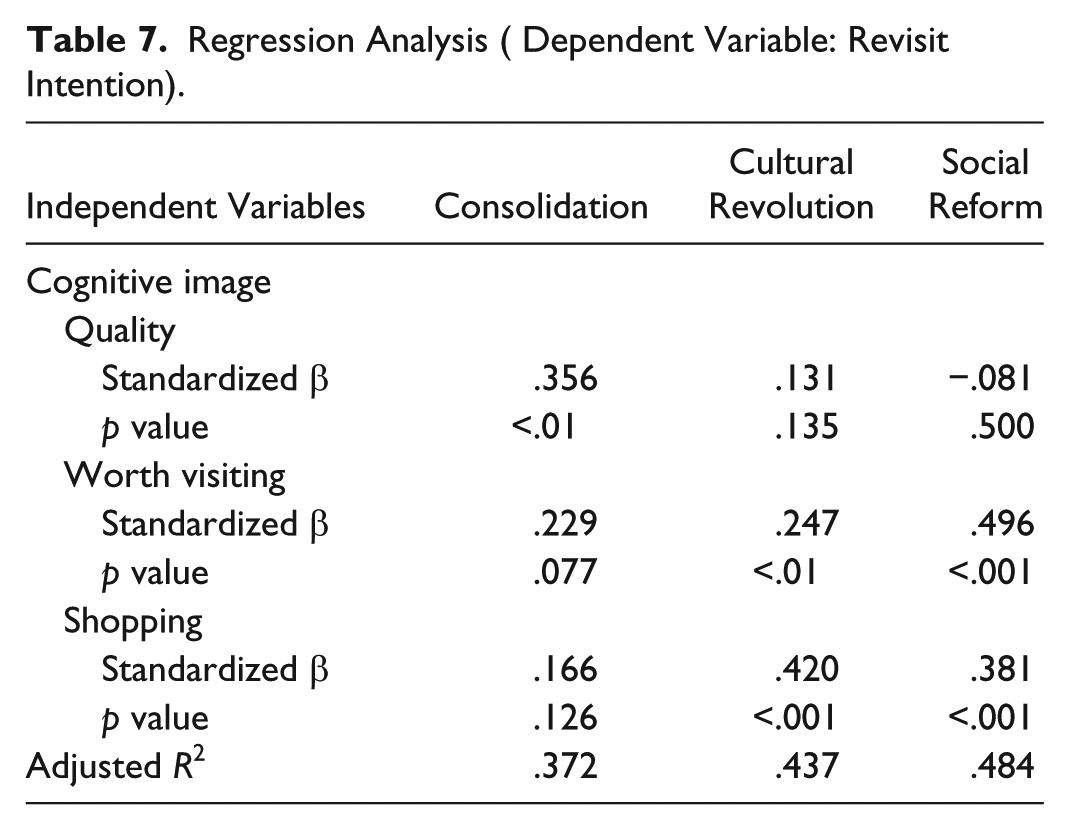
Subsequently, the regression weights of worth visiting and shopping in Social Reform and Cultural Revolution models were compared. When two models (e.g., Social Reform model and Cultural Revolution model) have the same independent and dependent variables, the regression weights of an independent variable in two different models can be compared by adding a dummy variable (e.g., Social Reform model = 0 and Cultural Revolution model = 1) and an interaction variable (the product of the dummy variable and the independent variable) in the regression model. In this way, the t statistic and p value associated with the interaction variable in the regression model reveals whether the magnitude of two regression weights are statistically different. Therefore, a regression model for comparison of regression weights was built (i.e., Social Reform model vs. Cultural Revolution model). The results indicated that the two models were homogenous in terms of the relative importance of worth visiting (t = −1.055, p = .293) and shopping (t = 0.054, p = .957) in predicting revisit intention.
Discussion and Conclusion
This study examined Mainland Chinese tourists’ motivations and destination images of Taiwan. To this end, generational cohort theory was employed to better understand the unique context of quasi-states tourism between politically divided countries. Dimensionalities of motivation and destination image were first examined and the unique characteristics of the Chinese tourists were identified by comparing four different generations. Consequently, this study revealed that Mainland Chinese tourists travel to Taiwan for the following purposes: seek & curiosity (mean [M] = 5.2, standard deviation [SD] = 1.06, on a seven-point scale), relax & escape (M = 4.2, SD = 1.34), prestige (M = 4.8, SD = 1.50), family ties (M = 3.38, SD = 1.59), and/or hedonic (M = 3.18, SD = 1.56). This multidimensionality of motivation is consistent with previous empirical studies (e.g., Crompton and McKay 1997; Hanqin and Lam 1999; Kim, Prideaux, and Prideaux 2007; Liu et al. 2011).
What is particularly interesting is that seeking something new and curiosity was the main motivation regardless of gender and generational cohorts. It has been traditionally believed that people tend to travel the other country to obtain the information from their friends and relatives residing in that destination, and the kinship ties and sense of belonging considerably motivate people to visit the other partitioned destination in quasi-states tourism (Butler and Mao 1996).
Guo et al. (2006) also argued that the primary reasons for Taiwanese to visit China has recently changed from visiting friends and relatives to a variety of reasons including general leisure tourism, business tourism, and cultural exchanges. Kim, Prideaux, and Prideaux (2007) also found that South Korean tourists are more likely motivated to visit a tourism resort in North Korea for simply enjoying recreation activities and seeing beautiful natural resources than for learning more about the unique dynamics of the Korean situation (e.g., meeting North Korean residents, seeing the North Korean way of life, understanding inter-Korean relations). Social or political motivations are not so important as other push and pull motivation factors, even in the context of tourism between partitioned states. Therefore, findings of this study suggest that tourism development policy and programs in politically divided countries consider redirecting and focusing on generational motivation along with context-specific motivation for some generational cohorts.
Mainland Chinese tourists also have a multidimensional cognitive image of Taiwan, consisting of quality (M = 5.44, SD = .96, on a seven-point scale), culture (M = 5.16, SD = .95), worth visiting (M = 5.19, SD = 1.10), negative (M = 3.53, SD = 1.14), and shopping (M = 4.74, SD = 1.06), as well as a unidimensional affective image (M = 5.19, SD = .95, on a seven-point scale). This is consistent with previous studies (Chen and Lin 2012).
A second finding suggests that each generational cohort has unique characteristics of motivation and cognitive image of Taiwan; however, no significant difference in affective image between cohorts existed. The Social Reform generation is greatly motivated to travel to Taiwan for fun and entertainment in comparison to other generational cohorts. This is consistent with Hanqin and Lam’s (1999) findings: the youngest group (the Social Reform generation in this study) is significantly different from other age groups as they are largely looking for thrills and excitement and also want to be daring and adventuresome. This generational cohort also exhibits some other unique features. For example, they tend to visit Taiwan to facilitate family ties, meet people with similar interests, or alleviate tension and stress. However, it showed that males in this generational cohort have relatively strong safety concerns and, therefore, a highly negative image of Taiwan (e.g., gang culture, political instability) in comparison to other groups. Nonetheless, the Social Reform generation is more likely to revisit Taiwan in the near future than the Consolidation.
Also, images of places worth visiting and shopping destination were found to affect the Social Reform and the Cultural Revolution generations’ intentions to revisit. This seems plausible as younger generations, like the Social Reform and Cultural Revolution generations, tend to perceive shopping as leisure activity (Hung, Gu, and Yim 2007). On the other hand, for the Consolidation generation, the shopping image was not associated with their revisit intentions; instead, the quality image was the only significant predictor of intention to revisit Taiwan. Hung, Gu, and Yim (2007) found that the Consolidation generation tended to regard purchasing as burden. Seek & curiosity was the main reason the Consolidation group visited for Taiwan. Contrary to the Social Reform group and the females in the Republican group, females in the Consolidation generation reported fewer concerns with safety and had less of a negative image of Taiwan.
In the Republican generation, females showed unique characteristics. For example, in comparison to the Cultural Revolution group, they were highly motivated to rest and relax and alleviate tension, and they had a strong desire to visit friends and relatives and to be with family. However, females in the Republican group showed very little motivation to visit Taiwan for hedonic purposes, which was a very strong motivation for the Social Reform generation.
It could be argued that the variations in motivation are attributed to differences in the past experiences of each generation. The Republican generation actually experienced the Civil War (1927–1949), which is not the case with other generations (Yu 1997). Therefore, it has been shown that the Republican generation tends to be collective and nonmaterialistic in comparison to other groups (Hung, Gu, and Yim 2007). Also the Republican, Consolidation, and Cultural Revolution generational cohorts have experienced military confrontation (1949–1978), which is much less prevalent with the Social Reform generation. Previous research has found that the Social Reform generation is individualistic, materialistic, and hedonistic (Hung, Gu, and Yim 2007; Rosen 1990).
In addition, diverse personal value orientations across generational cohorts are believed to lead to different motivation. In line with a means–end model, previous studies empirically showed that there is a significant relationship between personal values and motivation (e.g., Klenosky 2002; McIntosh and Thyne 2005). On the basis of the means–end knowledge structure, it may be argued that tourists or recreationists’ motivations and psychological benefits (i.e., to relax, to enjoy, or to be comfortable) are influenced by personal values (i.e., self-esteem, hedonism, freedom, or social status), which in turn affect their behavioral intention or actual behavior. For instance, individuals who place the highest importance on freedom are most likely interested in an individual backpacking travel rather than a grouped package tour. Tourists who regard sense of security (e.g., family safety) as the most important value are presumed to choose more costly but safe places, rather than remote and isolated destinations. Likewise, in this study, it could be argued that while the Social Reform generation tends to have strong hedonic motivation to visit Taiwan as they primarily value openness to change, the Republican generation is little motivated to travel Taiwan for fun as self-enhancement and openness to change are the least values that they seek.
In the context of Mainland Chinese outbound tourism, Li and Cai (2012) also proposed a structural model depicting the significant relationship between both internally and externally directed personal values and travel motivation, including novelty (e.g., experiencing something different), prestige (e.g., going places friends have not been), self-development (e.g., feeling inner harmony/peace), excitement (e.g., having adventuresome experience), and escape (being away from daily routine). Conceptually, a linkage between personal values and motivation also seems plausible because a value is defined as “an enduring belief that a specific mode of conduct or end-state of existence is personally or socially preferable to an opposite or converse mode of conduct or end-state of existence” (Rokeach 1973, p. 5). That is, values are a kind of preferences that stimulate motivation for certain types of behavior (Gutman 1982).
Of five motivation factors, seek & curiosity (e.g., seeing something new, experiencing different way of life, enriching myself intellectually) was a universal motivation that applies to all four generations, that is, all groups of Chinese tourists wanted to visit to see something new or experience different ways of life. Difference in prestige (e.g., going to places that others have not visited or being able to share my experiences after returning home) between generational cohorts also was not significant. This was not consistent with Hanqin and Lam’s (1999) findings. They argued that middle-age tourists visiting Hong Kong felt higher levels of prestige than the younger groups of 20s and 30s. However, they found that no significant difference between genders existed in prestige motivation, which is consistent with the results of this study.
Theoretically, this study demonstrated that generational effects exist in the context of tourism between politically divided countries, which could contribute to the advancement of the existing theories (e.g., Kim and Crompton’s (1990) two-track diplomacy system and Butler and Mao’s (1996) model of tourism between partitioned states). Specifically, this study suggests that cross-strait tourism does have a strong generational component; that is, understanding unique characteristics of each generation is critical as each generation would have different attitudes and perceptions toward the other side because of the differences in past experiences. Employing the generational cohort rather than age could be justified also because previous studies and this study consistently showed that not all characteristics of generations follow an age-related pattern. Thus, applying the generational cohort concept and testing generational effects to theoretical discourse in tourism and peace could make it possible to better understand tourists in that context, and furthermore, the study findings can provide insights to other politically divided country-to-country relationships (e.g., South–North Korea, South–North Cyprus).
This study also could contribute to establishing the generation-oriented tourism policy regarding cross-strait relations, that is, tourism policy and marketing should be developed to satisfy the unique needs of each generation. Studies have suggested that market segmentation by “coming-of-age” would provide richer information than when approached by “birth age” (e.g., Schewe and Meredith 2004). Schewe and Meredith (2004) argued that from a marketing perspective, generational cohort analysis can provide a sense of familiarity and personal appeal to target markets and help companies or organizations to create values of products or services in line with a given cohort’s desires. For example, popular music, favorite movie stars, or well-known icons that each cohort has shared with others from their coming-of-age years can be an effective means of designing promotion and conveying communication messages. In addition, cohort analysis can help destination marketers identify valid market segmentation. As there is already previously defined market segmentation, an a priori segmentation method can be used. While a priori (or forward) segmentation predetermines the segmentation bases, a posteriori (or backward) market segmentation determines the type of number of market segments based on the results of data analyses (Mill and Morrison 2009; Wedel and Kamakura 2000).
Limitations and Future Research
Although this study focuses on unchanging generational cohorts, that the data were a little bit outdated could be a limitation. Thus, a replication study with newly collected data can be suggested to identify changes in each Chinese generation’s attitude and perception toward Taiwan and to allow for comparisons between two studies in different time periods. In addition, although this study aimed to examine the generational effects, it could still remain unclear whether the unique characteristics are attributed to generational or age differences due to the methodological limitations. Although two possible factors (i.e., past experiences and personal value orientations) were identified earlier, what directly lead to the differences between each generational cohort was not empirically determined yet. A longitudinal study based on panel can be therefore considered for future research to confirm the generational effects.
Footnotes
Acknowledgements
The authors gratefully acknowledge the helpful suggestions of Dr. Steven Simpson on an earlier version of this article.
Declaration of Conflicting Interests
The author(s) declared no potential conflicts of interest with respect to the research, authorship, and/or publication of this article.
Funding
The author(s) disclosed receipt of the following financial support for the research, authorship, and/or publication of this article: The authors received the financial support for the research, authorship, and/or publication of this article from the National Science Council of the ROC (grant no. NSC95-2415-H-259-007-SSS).