



Abstract
This study developed a behavioral model of intentions to purchase aviation carbon offsets, and tested the model through structural equation models. The model draws on the established hierarchical models of human behavior to hypothesize relationships between general and specific attitudes as predictors of offsetting intentions. The New Ecological Paradigm scale, the theory of planned behavior and variables from past literature were employed to measure general environmental attitudes, intermediate beliefs, and behavior-specific attitudes and norms. The current research represents a first attempt to build a theoretical model that helps to understand the relationships between factors that determine whether people will purchase aviation carbon offsets. The results show that a more positive orientation toward the environment could be an important predictor of environmental intentions operating both directly on intentions as well as guiding beliefs that relate to intentions. Policy implications of the findings are discussed, encouraging greater voluntary climate action.
Keywords
Introduction
Carbon emissions from aviation represent a substantial portion of the overall tourism-related carbon footprint. They accounted for 40% of total tourism carbon emissions in 2005, which is expected to rise to 52% by 2035 (UNWTO/UNEP/WMO 2008). This intensifying trend is mainly due to the increasing number of airline users (BITRE 2009; Macintosh and Wallace 2009). One strategy that airlines have implemented to address aviation-related carbon emissions is voluntary carbon offset schemes. However, there has been a low level of participation in these schemes (approximately 1% to 2% per flight) and a lack of awareness among international airline customers about the existence of such schemes (Chang, Shon, and Lin 2010; Gössling et al. 2009; McKercher et al. 2010). In Australia, the uptake rate for carbon offset schemes ranges from 5% to 10% of all domestic flights (Commonwealth of Australia 2009; Qantas 2011).
Voluntary carbon offsetting schemes have been subject to various critiques. One of the two main criticisms is about the fact that tourists can easily purchase cheap “environmental pardons” (Kollmuss and Bowell 2007), without engaging a direct reduction in their carbon footprint by changing their behavior (Gössling et al. 2007). The other criticism is related to the quality of carbon offset projects, which is described to have a low level of credibility and transparency (Broderick 2008; Gössling et al. 2007; Polonsky, Grau, and Garma 2010), sometimes bringing no additionality (i.e., causing additional carbon reductions to the business-as-usual case) (Haya 2007). However, some critiques are based on a misunderstanding of how the global problem works. Climate change requires a global solution no matter where the reduction of carbon emissions is put in place, because what counts here is the global amount of greenhouse gases. Therefore, offset schemes have appeal not only because travelers can achieve the same effect at a much lower cost (i.e., cost-effectiveness) but also because they can contribute to a more sustainable growth path of developing countries where many offset projects are hosted (Kollmuss, Zink, and Polycarp 2008; Peters-Stanley and Gonzalez 2014). Furthermore, the effectiveness of most voluntary offsets (i.e., the project quality and additionality) can be assured with various offset standards, requiring third-party verification, such as the Gold Standard and the Verified Carbon Standard (Peters-Stanley and Gonzalez 2014).
Australia is a major long-haul tourism destination, and its airlines have been active in developing voluntary carbon offset programs, known as Fly Carbon Neutral, since 2007. In addition to airline-initiated voluntary mechanisms, the Australian government has also introduced a mandatory mechanism for reducing carbon emissions by putting a price on carbon of US$23 (AU$23 equivalent 1 ) per ton of CO2 as of July 1, 2012. Consequently, there are both voluntary and mandatory mechanisms for reducing carbon emissions operating side by side. This national context provides an interesting opportunity to examine the relationship between attitudes to mandatory policies and how they are related to the voluntary offsetting behavior of airline customers.
From the perspective of the airline companies, the carbon price (i.e., a tax) seems to be viewed as an additional operation cost or a threat to the voluntary offset programs, and they have downplayed the policy in order to encourage airline customers’ offsetting behavior (Qantas 2012; Virgin Australia 2012; Wroe 2012). Research has not addressed how mandatory carbon pricing mechanisms may be related to willingness to offset aviation carbon emissions voluntarily. The current research therefore addresses this specific question, as well as the broader question of what motivates airline customers to purchase carbon offsets.
These research questions are related to previous research that has explored factors that motivate the purchase of aviation carbon offsets. The literature identifies a list of factors, such as the perceived effectiveness of carbon offsets in reducing carbon emissions (Lu and Shon 2012), perception of flight contribution to climate change (Brouwer, Brander, and Beukering 2008; Gössling et al. 2009; Hooper et al. 2008), stated intention to offset their flights (Gössling et al. 2009; Hooper et al. 2008), and general support for a carbon tax (BBC 2007; Brouwer, Brander, and Beukering 2008). However, the literature contains little about the relationships among these factors, and past research has not developed or empirically tested a behavioral model to explain consumers’ purchase of aviation carbon offsets. Furthermore, there has been little systematic measurement of psychological factors, with the exception of Mair (2011), who employed the New Ecological Paradigm (NEP) scale (Dunlap et al. 2000) in relation to purchasing carbon offsets.
Addressing this research gap, this article has three aims. The first is to develop a behavioral model that theorizes the relationship among psychological factors relating to carbon offsetting behavior. The second is to empirically test the theoretical model in the context of intentions to purchase voluntary aviation carbon offsets and in a context where mandatory carbon policies are in place. The model was tested through structural equation modeling. The research provides an improved understanding of the complex issue of consumer demand for aviation carbon mitigation. The final aim is to offer meaningful policy recommendations to the airline industry and policymakers more generally, based on sound and theoretically driven behavioral evidence.
The remainder of the article is structured as follows: the next section provides theoretical foundations by establishing the conceptual model that is capable of incorporating various motivational factors at multiple levels, and suggests some research hypotheses. The methodology section describes how motivational factors are measured and how the data are collected and analyzed. Analytical results for structural models and hypothesis tests are explained in the results section. The final section discusses research implications and offers suggestions for future research.
Theoretical Foundations
The first aim of the research is to develop a theoretical model that identifies factors that motivate airline customers’ carbon offsetting behavior. The environmental psychology literature offers established theoretical understanding of human environmentally related behavior (Ajzen 1991; Ajzen and Fishbein 1977; Bamberg 2003; de Groot and Steg 2010; Stern 2000). As explained below, established psychological theories propose a hierarchical relationship from more general to more specific attitudes as predictors of behavior.
The Conceptual Model
Drawing on the theorizing of Fulton, Manfredo, and Lipscomb (1996), we propose a hierarchical relationship between factors that motivate behavior. Fulton, Manfredo, and Lipscomb (1996) employed a pyramid shape to illustrate how value orientations and basic beliefs transform into specific attitudes. As shown in Figure 1, the most abstract forms of motivation are fundamental values and value orientations that yield more context-specific attitudes and behaviors (Vaske and Donnelly 1999). The context-specific attitudes and norms subsequently influence behavioral intentions and actual behaviors. When this hierarchy is applied to attitudinal constructs (Ajzen 1991; Eagly and Chaiken 1993; Fulton, Manfredo, and Lipscomb 1996; Stern 2000), the major components of the pyramid above intentions in Figure 1 can be conceptualized as general attitudes (at the top of the hierarchy), followed by behavior-specific attitudes and norms (Choi 2011; Choi, Papandrea, and Bennett 2007). This generalization is consistent with other well-established behavioral models such as the attitude–behavior model of Eagly and Chaiken (1993), the value-belief-norm (VBN) theory of Stern (2000), and the theory of planned behavior (TPB) of Ajzen (1991). Compared to behavior-specific measures of psychological dispositions, general attitudes are relatively stable (so take more time to change), are limited in number, and less directly related to specific situations.
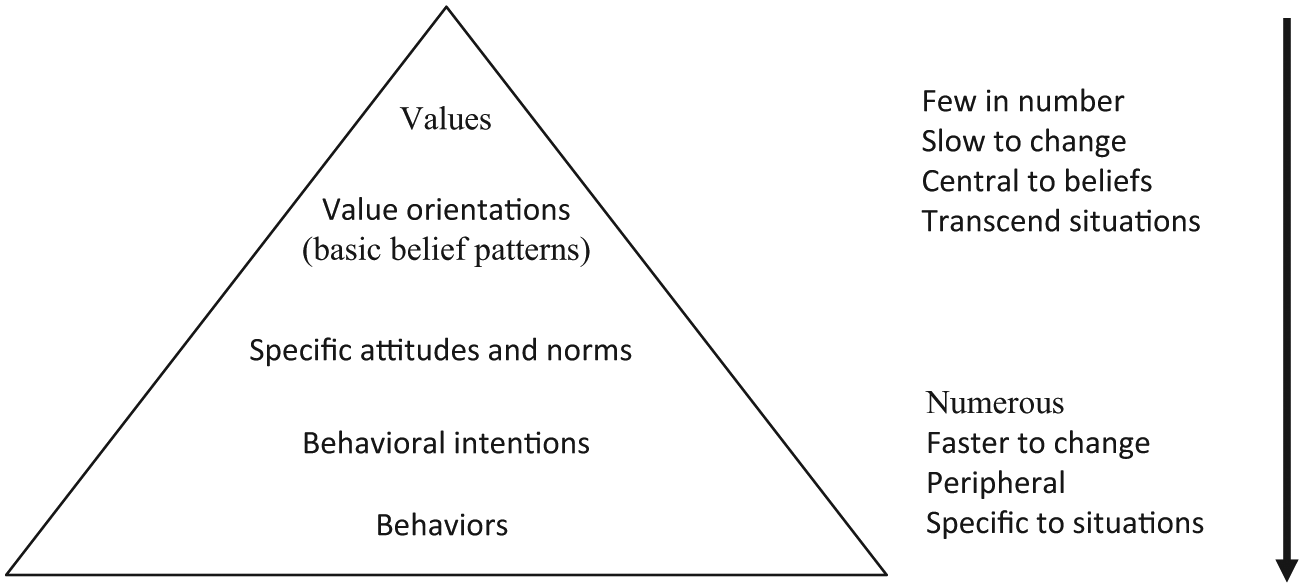
The cognitive hierarchy model of human behavior.
Attitudes as multidimensional and hierarchical measures (Ajzen 2005; Ajzen and Fishbein 1980; Eagly and Chaiken 1993; Stern 2000) can be also measured at an intermediate level in between general attitudes/beliefs and specific attitudes/norms (Stern 2000), such as attitudes toward targets (e.g., climate policies and institutions) and belief-based evaluation of behavioral consequences (e.g., negative impacts and effectiveness of action). The intermediate measures reflect neither fundamental/general values, as described by Fulton, Manfredo, and Lipscomb (1996), nor attitudes specific to the behaviors of concern. According to Ajzen and Fishbein (1980), these measures are in turn in a hierarchical relationship; beliefs/attitudes about the targets predispose beliefs about behavioral consequences. Nonetheless, it might be useful to keep them as a single group of intermediate measures of cognitive beliefs/attitudes so as to make the overall conceptual model simple and easily understood (see Figure 2).

The conceptual model with mediation effects.
The conceptual differentiation between general and specific measures of psychological characteristics helps researchers understand why there are sometimes weak relationships between general attitudes and behavioral intentions (or actual behaviors) (Ajzen 1989; Bamberg 2003; Dunlap et al. 2000). Although past research has shown that general environmental attitudes are related to specific pro-environmental intentions and behaviors (Choi and Fielding 2013; Kang et al. 2012; Kotchen and Reiling 2000), the principle of compatibility also highlights that specific attitudes are better predictors of specific behaviors (Ajzen and Fishbein 1977). Most impacts from general attitudes on specific behaviors are indirectly formulated through the dynamic process of defining the situation, interpreting alternatives and comparing consequences (Ajzen 1989; Bamberg 2003). The literature suggests, therefore, that the effects of general attitudes will be mediated, at least in part, through more context-specific beliefs and attitudes (Stern 2000). Because the current study operationalizes attitudes and related constructs (e.g., beliefs) at varying levels of specificity, it can test both the direct relationship between general attitudes and intentions and whether it is mediated through more context-specific measures.
Research Hypotheses
Based on past theorizing and empirical evidence, we propose that general environmental attitudes will be both directly and indirectly associated with intentions to purchase aviation carbon offsets. We hypothesize a direct relationship between general attitudes and intentions, consistent with past empirical studies (Choi and Fielding 2013; Kang et al. 2012; Kotchen and Reiling 2000). We first hypothesize the following:
Hypothesis 1: General environmental attitudes have a direct effect on intention to pay for aviation carbon offsets.
As noted above, we also hypothesize an indirect relationship between general attitudes and intentions. This hypothesis accords with behavioral models that theorize a hierarchical relationship among attitudes and behavior, with the effect of general attitudes on behavior mediated through more specific attitudes and cognitive beliefs (Ajzen 2005; Eagly and Chaiken 1993; Fulton, Manfredo, and Lipscomb 1996; Raymond, Brown, and Robinson 2011; Stern 2000). We also place intermediate factors in the model that are broadly related to carbon offsets, but are neither specific to the offsetting behavior nor general enough to be considered basic beliefs (e.g., about human–environment relations). These cognitive beliefs have been identified in prior research as related to carbon offsetting behavior. The intermediate beliefs relate to the background policies (e.g., a carbon price/tax) as well as beliefs about whether flights impact on climate and the perceived effectiveness of voluntary carbon offsets in mitigating carbon emissions.
Insofar as general attitudes reflect a broad predisposition toward the object (in this case, the environment), they should be related to judgments and beliefs that relate to that object (i.e., the environment). This reasoning is consistent with the VBN model (Stern 2000) that proposes a causal sequence of variables from values and general environmental attitudes (as measured by the NEP) to behavior via beliefs about adverse consequences to the environment and ability to deal with the environmental threat, and personal norms. Past empirical research provides further evidence of the relationship between general attitudes and beliefs, with positive significant relationships found between the NEP and beliefs about environmental and climate change risks (Bostrom et al. 2006; Milfont 2012), awareness of the impacts of specific behaviors on the environment (e.g., air pollution from private car use in Eriksson, Garvill, and Nordlund 2006), and prioritization of environmental issues (Hunter and Rinner 2004).
In the same vein, we reason that the more people are concerned about the environment the more aware they should be of the impacts of various behaviors on the environment (e.g., impacts of flying on climate change), the more likely they may be to think that environmental actions will be effective at addressing environmental issues (i.e., perceive greater effectiveness of carbon offsetting), and the more they should be in favor of actions that help to protect the environment (e.g., carbon pricing). Hence, we would expect that general environmental attitudes would be related to these intermediate beliefs. In the current study, we assess beliefs relating to mandatory policies (i.e., support for a carbon tax) as well as beliefs relating to the impact of specific behavior on climate change (i.e., flights) and perceived effectiveness of a voluntary carbon offset approach. We do not make any firm predictions about the relationships among these variables, although it is possible that support for a carbon tax is a more abstract concept that may in turn predict the more specific variables related to flight-related carbon emissions. We hypothesize:
Hypothesis 2: General environmental attitudes will be positively related to intermediate beliefs.
Both the VBN model and the TPB posit beliefs as precursors to more behavior-specific predictors such as attitudes, norms, and perceived behavioral control. As noted above, the VBN posits that beliefs about awareness of consequences and effectiveness feed into personal norms, and according to the TPB, beliefs about a specific behavior, such as the costs and benefits of engaging in that behavior, feed into attitudes toward the behavior, which in turn influence behavioral intentions. It makes both intuitive and theoretical sense, then, that intermediate beliefs relating to carbon reduction (both voluntary and mandatory) would be related to more specific attitudes to a scheme that aims to reduce carbon emissions from flying.
We measured specific attitudes and norms by drawing on the constructs of the TPB: attitudes, subjective norms, and perceived behavioral control. This theory is the expanded and upgraded version of the theory of reasoned action of Fishbein and Ajzen (1975), and is known as the most widely researched model of the attitude–behavior relationship (Armitage and Conner 2001). The underlying idea of this model is that people’s behavioral intention (INT) is determined jointly by specific attitudes toward the behavior (ATT), subjective norms (SN), and perceived behavioral control (PBC). These variables present a level of attitudinal inclination toward a specific behavior, the perceived social pressure in performing the behavior and the perceived difficulty in performing the behavior, respectively (Ajzen 1991). There is strong evidence for the TPB in relation to environmental choices (Nocella et al. 2012; Pouta and Rekola 2001; Spash et al. 2009) and in relation to tourism-related behavior specifically (Han, Hsu, and Sheu 2010; Hsu and Huang 2012; Wang and Ritchie 2012). Hence we further hypothesize:
Hypothesis 3: Intermediate beliefs have a direct effect on behavior-specific measures of psychological dispositions such as attitudes and subjective norms.
Hypothesis 4: Behavior-specific measures of psychological dispositions such as specific attitudes and subjective norms have a direct effect on intentions.
Consistent with our proposal that general environmental attitudes may be mediated through intermediate beliefs and behavior-specific attitudes and norms, we propose one additional hypothesis:
Hypothesis 5: Intermediate beliefs, specific attitudes, and norms for aviation carbon offsets mediate the effect of general attitudes on offsetting intention.
The proposed theoretical model is shown in Figure 2. To summarize, we propose that the effects of general attitudes may have a direct effect on intentions to purchase flight-related carbon offsets, but its effect may also be mediated through intermediate beliefs and specific attitudes (i.e., attitudes, norms, perceived behavioral control). We also propose that the effects of intermediate beliefs will be mediated through specific attitudes and norms, which are directly related to intentions. This is the first research to examine hierarchical attitude–behavior relationships specifically constructed for voluntary carbon mitigation, involving the full scale of analysis as recommended by Fulton, Manfredo, and Lipscomb (1996) and Stern (2000). This multilevel analysis not only allows identification of the key factors for voluntary climate action but also offers deeper insights into the complex relationships among these psychological constructs
Methodology
Sample and Procedures
The questionnaire, which was pretested with 200 online respondents, was distributed to an online panel in Australia by a social research company. This company hosted more than 300,000 online panelists who agreed to take part in research in exchange for a small compensation. A sample of 2,000 respondents who were nationally representative based on gender, age, and residential location (ABS 2012) was sought. The survey was open for several weeks in late March and April 2013, which was approximately nine months after the mandatory carbon price was introduced. In order to achieve this, a total of about 16,500 invitations were sent out and 3,323 individuals visited the survey site. As the survey involved several quotas, 926 visitors could not join the survey because of quota restrictions and 256 visitors dropped out in the middle the survey without completion. Further, 141 respondents who made flat-lining responses (i.e., selecting the same answer) across the 15 NEP items were taken as disqualified, followed by new invitations according to their location, gender, and age. As shown in Table 1, approximately 52% of the respondents had a tertiary degree or postsecondary qualification, and approximately 53% had a household income (before tax) that was less than AU$78,000. These figures are similar to the census data (ABS 2011). As to their experiences in flight and carbon offsets in the past three years, 1,489 respondents (74.5%) had taken at least one domestic or international flight, and 228 respondents (15.3% 2 of those with flight experience) indicated that they paid for voluntary carbon offsets at least once in the past three years.
Demographic Compositions of the Sample Respondents.

The questionnaire comprised three major sections. The first section asked about sociodemographic characteristics, past number of flights, and carbon offsetting experience. The second section explained the key issues of aviation carbon offsets, including basic characteristics of offset projects and the carbon price policy. The goal was to clarify the situation where all domestic air passengers pay the mandatory carbon tax and where both the tax and carbon offsets were linked to actual flight distances. Using simple information tables and figures, offset projects were described either as domestic or overseas, and either as renewable energy or forest management. The final section assessed the focal variables, as detailed below.
General Attitudes
The NEP scale of Dunlap et al. (2000), an extended version of the New Environmental Paradigm (Dunlap and Van Liere 1978), was used to measure general environmental attitudes. The NEP scale is the most widely used measurement tool to assess general beliefs about the human–nature relationship (Hawcroft and Milfont 2010). Following Dunlap et al. (2000), responses to the 15 items of the scale were on a five-point scale ranging from “strongly disagree” (1) to “strongly agree” (5). The even-numbered items were reversed during the coding process so that higher scores indicate stronger pro-environmental attitudes. The 15 items were aggregated to create an NEP index ranging from 15 to 75. Similar to the findings of previous studies (Choi and Fielding 2013; Dunlap et al. 2000; Hunter and Rinner 2004; Kotchen and Reiling 2000), these items show general support for pro-environmental attitudes. The mean NEP score in the current study is 52.5 (SD = 9.56), which is slightly lower than in the other recent studies, whose scores are between 54 and 58.
Intermediate Beliefs
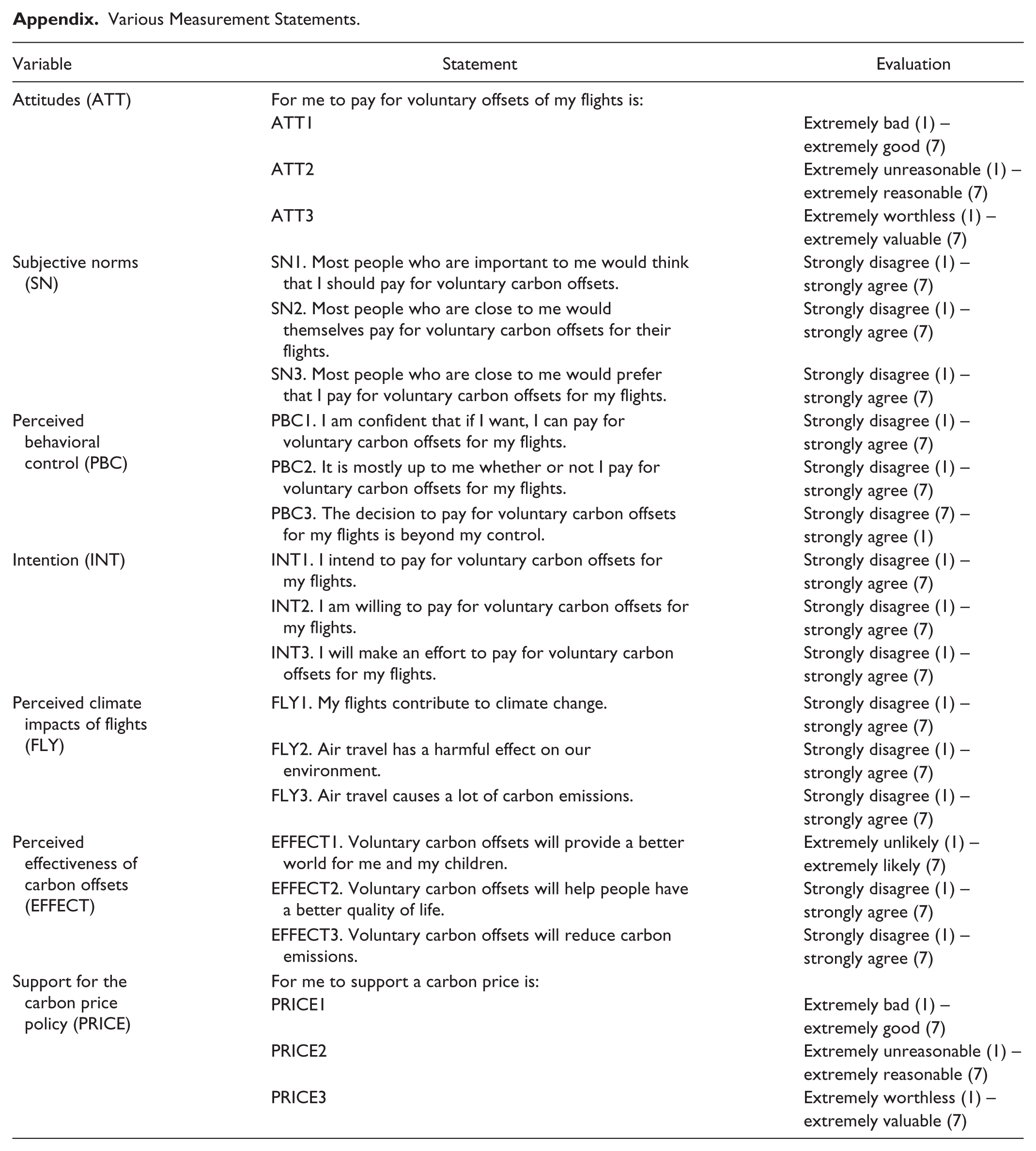
The appendix contains manifest variables that were devised for three latent variables, measuring the major intermediate beliefs that were suggested as significant determinants of the voluntary offsetting behavior in the literature. The first latent variable was designed to measure beliefs about a carbon price (PRICE) as one of the major objects that might be relevant to the voluntary offsetting behavior. Because PRICE was about attitudes toward the target (i.e., a climate policy in this study), a measurement format of the TPB (Ajzen 1991) was adopted. It was measured using the statement “For me to support a carbon price is:” followed by three different seven-point semantic scale choices (e.g., from “extremely unreasonable” [1] to “extremely reasonable” [7]). The second variable was the perceived impact of flights on climate change (FLY). This variable was related to the extent to which aviation customers recognize a negative impact on the environment, carbon emissions, and climate change. It was measured using three items (e.g., “My flights contribute to climate change”). The final latent variable was the perceived effectiveness of voluntary carbon offsets in mitigating carbon emissions (EFFECT). It was about the awareness of consequences as results of voluntary action, and measurement items that were commonly available in the literature were adapted for the current study, covering egoistic, altruistic, and biospheric items (Ryan and Spash 2011). Three items were used to measure this construct (e.g., “Voluntary carbon offsets will reduce carbon emissions”). Responses to these latter items were offered on seven-point scales ranging from “strongly disagree” (1) to “strongly agree” (7).
Behavior-Specific Measures
The behavior-specific factors were based on the constructs of the TPB (Ajzen 1991).
The variables were measured in accordance with the guidelines of Ajzen (2002) and questions were evaluated on seven-point scales, as shown in the appendix. ATT was measured using three items: participants were provided with the statement “For me to pay for voluntary offsets of my flights is:” followed by three different semantic scale choices (e.g., from “extremely bad” [1] to “extremely good” [7]). SN was measured using three items (e.g., “Most people who are important to me would think that I should pay for voluntary carbon offsets”). PBC was measured using three items (e.g., “I am confident that if I want, I can pay for voluntary carbon offsets for my flights”), and INT was measured using three items (e.g., “I intend to pay for voluntary offsets of my flights”). With the exception of specific attitudes, responses to the questions were offered on scales ranging from “strongly disagree” (1) to “strongly agree” (7).
Data Analysis
This article follows the two-stage approach recommended by Anderson and Gerbing (1988). The first stage involved confirmatory measurement models, while the second stage dealt with structural models that were used to test the hypotheses. The data analysis was carried out using SPSS and AMOS (version 20.0). Prior to the formal tests of models, the fundamental assumption of multivariate normality was examined. Among 2,000 cases, 139 extreme multivariate outliers were identified based on the Mahalanobis distance, with a critical value of 48.27 (22 degrees of freedom) (Mardia 1975). Nonetheless, when the skewness and kurtosis of individual measurement items were examined for normal distribution, none of them showed an absolute value larger than 3 for skewness or 10 for kurtosis (Kline 2011). This indicated that there was no significant violation of normal distribution for individual data items.
When observed variables are significantly skewed, maximum likelihood estimation can lead to inflated model fits and underestimated standard errors. Thus, if the multivariate normality assumption is not satisfied, researchers usually delete extreme outliers (Han, Hsu, and Sheu 2010) or employ a post hoc adjustment process, such as the Bollen-Stine bootstrapping method (Raymond, Brown, and Robinson 2011; Song and Chon 2012). However, the estimation results were not significantly changed when the extreme multivariate outliers were excluded from the analysis of the current study. Considering the loss in terms of sample compositions by excluding outliers (Gao et al. 2008), this article employed bootstrapped standard errors with 5,000 bootstraps (Nevitt and Hancock 2001). This method provides new adjusted standard errors for regression coefficients. Further, mediation effects were examined for significant indirect effects using bias-corrected confidence intervals (Hayes 2009).
Results
The proposed latent constructs for general, intermediate, and specific attitudes were assessed for reliability and convergent validity. As shown in Table 2, most latent constructs show alpha values between 0.84 and 0.96, except for PBC. These are larger than the recommended threshold value of 0.70 (Hair et al. 2005; Hinkin 1995). The standardized factor loadings for the factors show loadings mostly larger than 0.80, demonstrating their construct validity. As for convergent validity (i.e., examining the variance due to the construct) and discriminant validity (i.e., examining statistical difference between two constructs), the average variance extracted (AVE) for each construct was calculated (Fornell and Larcker 1981). The AVE values are expected to exceed the recommended threshold value of 0.50, but several constructs failed to satisfy convergent validity such as FLY, EFFECT, PBC, and NEP, FLY and EFFECT also failed the discriminant validity for which their AVE values are expected to be larger than the squared regression weights from the preceding factors (Fornell and Larcker 1981).
Correlations, Mean, Standard Deviation, Reliability, and AVE.
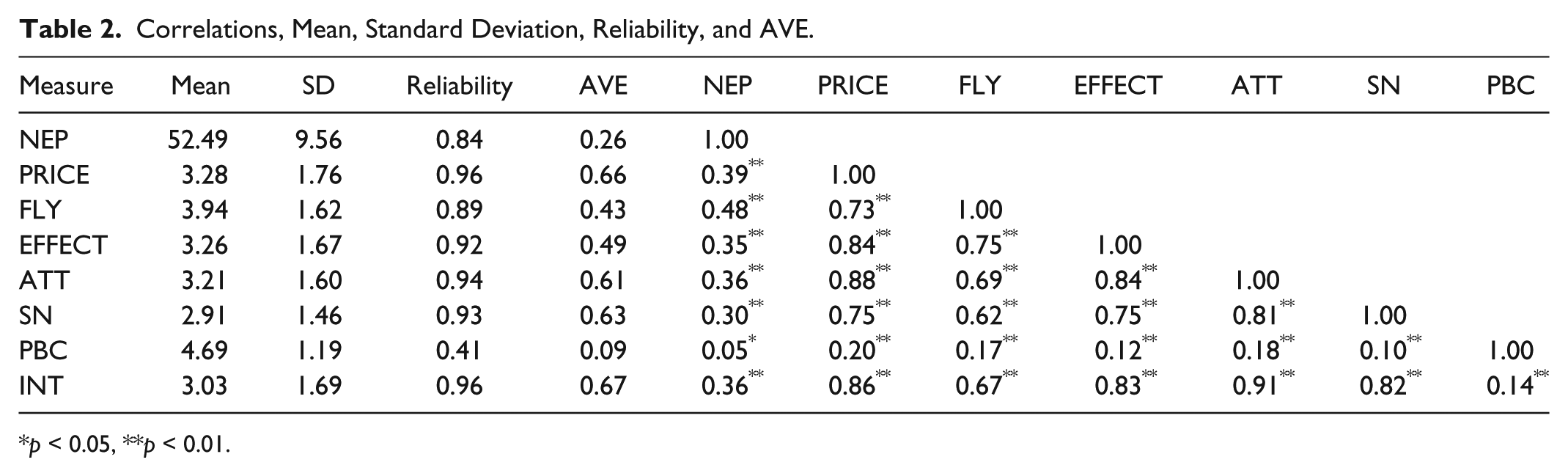
p < 0.05, **p < 0.01.
In particular, when the TPB constructs are examined with specified paths from ATT, SN, and PBC to INT (Ajzen 1991), the first two constructs display a significant regression weight as expected, whereas PBC is not significant at the 0.05 level. A similar finding has also been shown in previous tourism research (Wang and Ritchie 2012). This might reflect measurement errors from a complex situation where air travelers face differing degrees of behavioral control depending on some unknown factors such as the ticketing process (i.e., inability to opt in carbon offsets) or on how they define the context of behavioral control. In fact, many travelers could not exercise any control over the option of carbon offsets simply because the booking was made through travel agencies or the trip involved multiple airlines. Thus, the three measurement items for PBC might be inappropriate to represent the true perception of air travelers’ behavioral control. Consequently, the PBC variable was subsequently excluded from further analysis of the structural models. On the other hand, FLY, EFFECT, and NEP were kept in the models because their relationships with other constructs deserved further analysis. As to the dimensionality of the NEP scale, it was treated as a single measurement scale, following the recommendations emerging from a meta-analysis of the scale (Dunlap 2008; Hawcroft and Milfont 2010).
After the assessment of reliability and convergent validity were tested, mean and standard deviation values were examined, as shown in Table 2. Respondents on average show a neutral or slight disagreement with the statements of PRICE (support for a carbon price), FLY (perceptions that flying contributes to climate change), and EFFECT (perceptions that voluntary carbon offsets will reduce carbon emissions). For example, approximately 69% of respondents held an unfavorable attitude toward a carbon price (i.e., the average score is ≤4.00). As for the behavior-specific variables, respondents on average held a slightly negative position for the ATT (attitudes to carbon offsets) and INT (intentions to purchase carbon offsets) variables. A weak disagreement on the SN (perceptions of support from important others to purchase carbon offsets) variable indicates that people who are important or close to the respondents might work as a normative barrier to participating voluntary carbon offset programs. Further, the average score for the PBC (perceived behavioral control) variable is the highest among the three TPB constructs, with a relatively small variance, displaying a level of confidence in the behavioral control. This might indicate that voluntary offsetting behavior is relatively easy to implement in general.
Structural Model
A structural model was formed after all latent constructs were transformed into single-indicator variables in order to reduce the complexity involving various measure items (Bollen 1989). A total score was recalculated by summing up all measurement item scores for each latent construct and its error variance was also fixed to be (1 – alpha value) × (standard deviation [SD]) 2 . After removing 5 individual paths whose regression weights were not significant at the 0.05 level, the final structural model included 14 paths with significant regression weights, as shown in Table 3. The model fits are normally assessed using multiple indices: chi square (χ2), normed chi square (the chi square to degrees of freedom ratio; χ2/df), the root mean square error of approximation (RMSEA) (Browne and Cudeck 1992), the comparative fit index (CFI) (Bentler 1990), the Tucker–Lewis index (TLI), and the standardized root mean square residual (SRMR). Among these indices, the χ2 index has been disputed in the literature because it penalizes a large sample size and tends to move away from a good fit (Arbuckle 2011; Bentler and Bonett 1980). Although this study used a large sample size, the single-indicator model seemed to overcome this limitation. A model is considered to have a good fit to the data when the χ2 statistic is not significant (e.g., p > 0.05), 1.0 < χ2/df < 2.0, CFI > 0.95, TLI > 0.95, RMSEA < 0.06, and SRMR < 0.08 (Hu and Bentler 1999; Kline 2011). According to these criteria, the final model demonstrated a good fit (χ2 = 5.8718, the Bollen-Stine p = 0.5467, χ2/df(5) = 1.17, CFI = 0.9999, TLI = 0.9997, RMSEA = 0.0093, and SRMR = 0.0036).
Significant Structural Paths and Hypothesis Test Results.
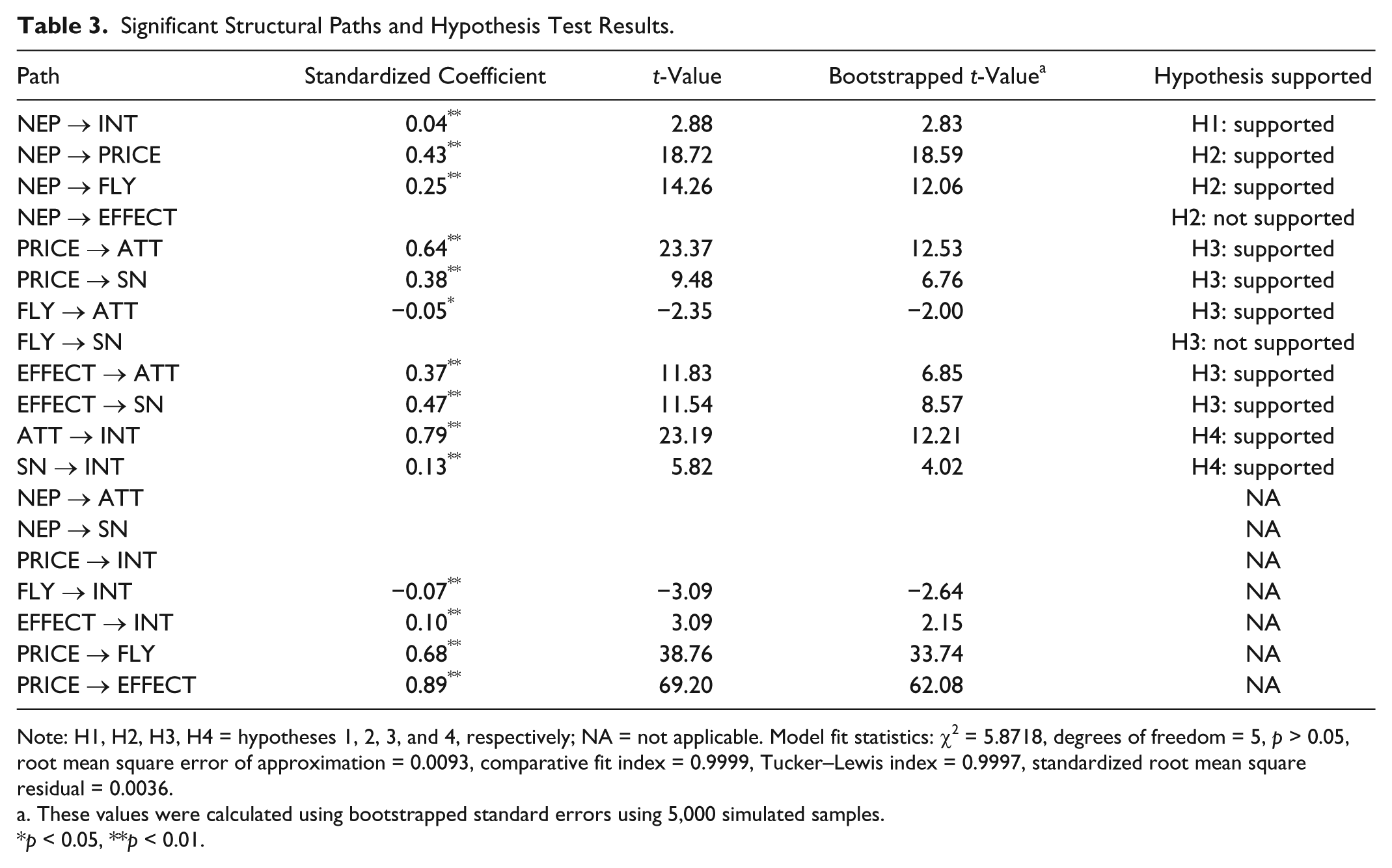
Note: H1, H2, H3, H4 = hypotheses 1, 2, 3, and 4, respectively; NA = not applicable. Model fit statistics: χ2 = 5.8718, degrees of freedom = 5, p > 0.05, root mean square error of approximation = 0.0093, comparative fit index = 0.9999, Tucker–Lewis index = 0.9997, standardized root mean square residual = 0.0036.
These values were calculated using bootstrapped standard errors using 5,000 simulated samples.
p < 0.05, **p < 0.01.
Hypothesis Testing
According to the conceptual model with a hierarchical structure of multiple levels, parameter estimates, and the test results for major hypotheses are reported in Table 3 and Figure 3. Based on the standardized coefficient estimates, the links are positively significant at the 0.05 level between NEP and INT (β = 0.04; t = 2.83, p < 0.01), between ATT and INT (β = 0.79; t = 12.21, p < 0.01) and between SN and INT (β = 0.13; t = 4.02, p < 0.01). These results indicate a significant direct effect from both general and behavior-specific attitudes on intention to pay for voluntary carbon offsets. Consequently, hypotheses 1 and 4 are supported.
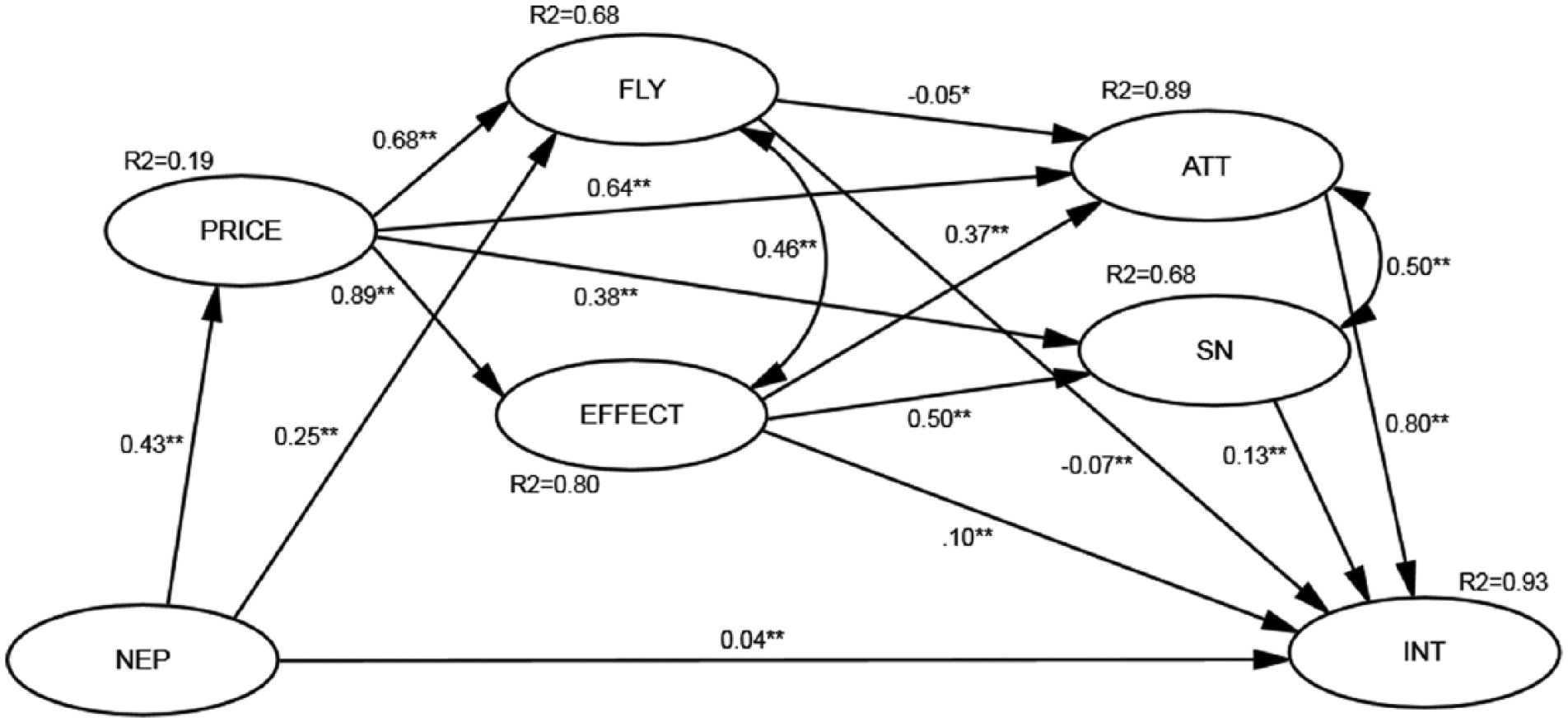
The final structural equation model.
Other hypothesized direct impacts were also tested, which involved intermediate beliefs. Two latent variables for intermediate beliefs (i.e., FLY and EFFECT) are shown to have a direct relationship with INT. Most links between NEP and intermediate beliefs (i.e., PRICE, FLY, and EFFECT), and between intermediate beliefs and behavior-specific factors (i.e., ATT and SN), show a significant direct effect, except for between NEP and EFFECT, and between FLY and SN. According to these results, respondents with a strong pro-environmental attitude are more likely to hold a favorable attitude toward a carbon price (β = 0.43; t = 18.59, p < 0.01) and to recognize flight-caused climate change (β = 0.25; t = 12.06, p < 0.01). Further, favorable attitudes toward a carbon price and positively perceived effectiveness of voluntary carbon offset programs are shown to lead to favorable attitudes toward voluntary carbon offsets and to positive social support to pay for voluntary carbon offsets.
Unexpectedly, FLY shows a negatively significant effect on ATT (β = −0.05; t = 2.00, p < 0.05) and INT (β = −0.07; t = 2.64, p < 0.01). This indicates that the more respondents believe their flights contribute to climate change, the weaker their attitudes are toward the voluntary payment for carbon offsets and the weaker their intention is to pay for voluntary offsets. This negative relationship might arise because those respondents with a strong belief in flight-caused climate change generally think that it is the responsibility of airline companies to address the emission issue (Gössling et al. 2009; Lu and Shon 2012), or that they can nullify their climate liability as travelers based on what has been practiced in reality (i.e., descriptive norms) (Cialdini, Reno, and Kallgren 1990). It may also be that those participants who have stronger beliefs in the negative environmental effects of flying do not really believe that carbon offsetting is the appropriate way to address these effects. Rather, they may believe that the carbon tax policy relieves their moral responsibility by internalizing the climate cost of air travel. According to these results, a direct relationship between general and intermediate beliefs and between intermediate beliefs and behavior-specific factors provides partial support for hypotheses 2 and 3.
Above all, results supporting hypotheses 3 and 4, which confirm relationships between intermediate beliefs and specific factors and between specific factors and intentions, provide evidence for the mediated relationship. In the section below, we describe how the mediated relationship proposed in hypothesis 5 was analyzed.
Mediation Analysis
Mediation effects were analyzed jointly and individually within the conceptual framework as constructed above. They were examined using bias-corrected confidence intervals (Hayes 2009; MacKinnon et al. 2002). Table 4 shows 95% bias-corrected confidence intervals that were estimated using 5,000 bootstrap samples. For each mediation analysis to be significant, a zero value should not be included within the interval. All of the mediation effects are significant at the 0.05 level. However, different impacts of the mediators appear to exist. Some mediators have a full-mediation effect, so that the direct effect is insignificant between NEP and the two behavior-specific factors (i.e., ATT and SN), and between PRICE and INT, as can be seen in Figure 3. The absence of these mediators from the structural model makes the relevant direct links significant at the 0.01 level. On the other hand, latent variables for intermediate beliefs and specific factors as a whole work as partial mediators of the relationship between NEP and INT. Thus, hypothesis 5 is supported.
Standardized Mediation Effects and Their Bias-Corrected Confidence Intervals.
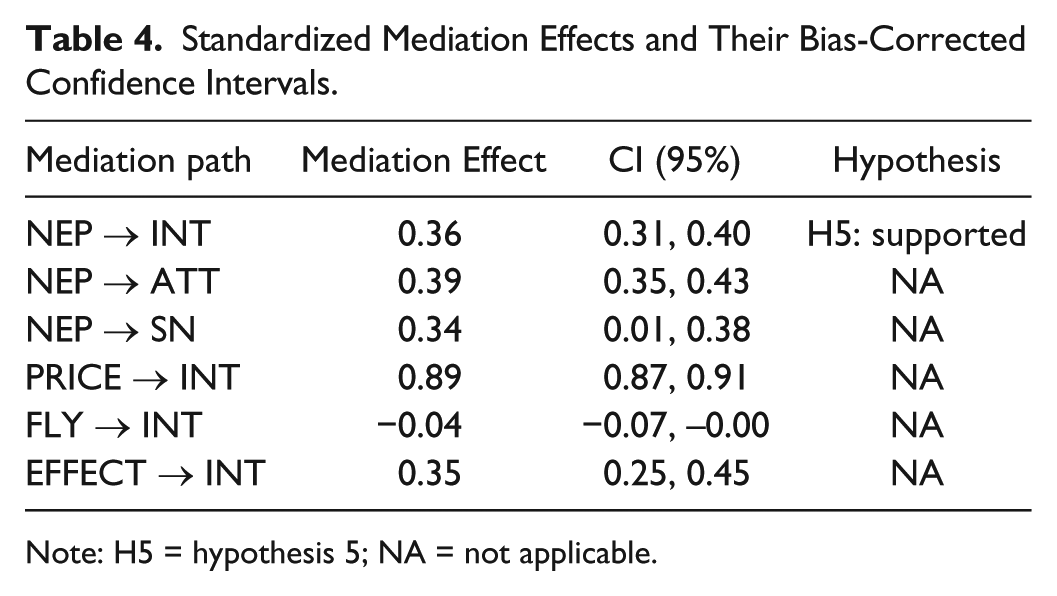
Note: H5 = hypothesis 5; NA = not applicable.
Discussion and Conclusions
The aviation sector is a crucial element of the tourism carbon footprint, and presently, voluntary carbon offsets are a key way that customers can help to neutralize their flight-related carbon emissions. The current research was conducted in a context in which the Australian government had introduced a mandatory price on carbon. This allowed us to examine how attitudes toward a broader carbon reduction scheme may be related to more specific voluntary actions to reduce carbon emissions. One of the major aims of the research was to build a model of carbon offsetting behavior with a capacity to incorporate variables drawn from the theoretical and empirical literature. Based on established hierarchical models of human behavior, the
conceptual model in this article proposes relationships between factors at three levels: general, intermediate, and specific. The final structural equation model shows how factors at these different levels of specificity are related to people’s offsetting intentions. The current research represents a first attempt to build a theoretical model that helps to understand the relationships between factors that determine whether people will purchase aviation carbon offsets.
Although the literature has suggested a range of discrete determinants of offsetting intention, most of their interconstruct relationships have not been explored. In our proposed model, general environmental attitudes (as measured by the NEP) show both direct and indirect effects on intentions to purchase voluntary carbon offsets. In addition to the direct relationship, our results show, consistent with theory, a partially mediated relationship between general attitudes and intentions via intermediate beliefs and behavior-specific factors (as measured by the theory of planned behavior constructs). Our findings also demonstrate a direct relationship between general environmental attitudes and specific intentions to purchase flight-related carbon offsets after intermediate beliefs and specific determinants of behavioral intention are controlled for. This finding suggests that a more positive orientation toward the environment could be an important predictor of environmental intentions operating both directly on intentions as well as guiding beliefs that relate to intentions. One question that is raised by this finding is whether the same pattern would emerge on actual behavior. Some researchers (Corral-Verdugo 1997; McGuire 1984) have argued that self-report surveys assess underlying attitudes, ideas, and beliefs about behavior, and based on this notion, there might be a closer association between attitudes and intentions than attitudes and behavior. Future research should seek to clarify this possibility by also including measures of actual carbon offsetting behavior.
The current study measured specific attitudes and norms for aviation carbon offsets using the three constructs of the theory of planned behavior: attitudes toward the offsetting behavior (ATT), subjective norms (SN), and perceived behavioral control (PBC). ATT and SN show a significant path to people’s offsetting intentions (INT), whereas PBC does not. Further, three latent variables that were included as intermediate beliefs were beliefs about a mandatory carbon price, beliefs about climate impacts of flights, and beliefs about the effectiveness of carbon offsets in mitigating carbon emissions. The intermediate motivational factors not only show a positive and significant effect on the specific attitudes and norms, but their effects on intentions are partially mediated by the latter. On the other hand, the three intermediate variables fully mediate the path between NEP and the two specific factors (i.e., ATT and SN).
Finally, a central role of people’s attitudes toward the carbon price policy is evidenced in the proposed hierarchical model. The price-related beliefs have significant direct effects on the other two intermediate factors (i.e., beliefs about flight-caused climate change and beliefs about the effectiveness of the voluntary schemes) and the two specific factors (i.e., ATT and SN). The standardized coefficients for the paths involving the carbon price–related attitudes are substantially larger than those for the other paths in general. Although their impact on intentions is fully meditated by the other factors, people’s beliefs about the carbon price policy work as a centerpiece in explaining how various motivational factors are related to each other and how they determine travelers’ intention to pay for voluntary carbon offsets. One reason for the importance of this construct may be that it reflects broader beliefs about the importance of taking action to ameliorate carbon emissions. These broader beliefs may underpin individual perceptions about negative consequences of their flights, perceptions of whether specific carbon-reducing actions will be effective and positive or negative attitudes to specific carbon-reducing actions. In contrast, the expected internalizing effect of the carbon price policy in terms of the climate costs might lead those who hold stronger beliefs about flight-caused climate impacts to have weaker intentions to pay for aviation carbon offsets.
Our findings provide suggestions for how policy may help to promote travelers’ offsetting behavior. The most feasible approach may be to target intermediate beliefs, because these may be the easiest to change. It may be difficult (if not impossible) to have direct impacts on general attitudes. According to the cognitive hierarchical model of human behavior (Eagly and Chaiken 1993; Fulton, Manfredo, and Lipscomb 1996; Stern 2000; Vaske and Donnelly 1999), general attitudes are relatively stable and slow to evolve, and specific attitudes are relatively too close to the actual implementation of the behavior. Intermediate beliefs might work as an appropriate and approachable arena for the policy intervention to formulate offsetting triggers. Based on our results, the focus should be shifted to the effectiveness issue of voluntary offset programs, rather than the issue of how much air travel contributes to carbon emissions, particularly when a carbon tax is in place. Although it is important for people first to understand the contribution of their flights to climate change, the carbon tax policy or descriptive norms (Cialdini, Reno, and Kallgren 1990) might lead to a negative relationship between air travelers’ climate awareness and their attitudes toward voluntary carbon offsets. Thus, airline customers in general may be more likely to build stronger offsetting intentions when they become aware of the fact that there are effective ways to offset these emissions. For instance, improved knowledge about governmental certification programs such as the National Carbon Offset Standard of Australia, which assure the effectiveness of the voluntary offset programs, is an important aspect of promoting greater offsetting behavior.
Although our results suggest that positive beliefs about the current carbon pricing policy are associated with a greater likelihood of offsetting flights, the political nature of carbon pricing may make it difficult for airlines to use this as an avenue to promote offsetting. Moreover, the airline industry in Australia holds a negative position on carbon pricing (Qantas 2012; Virgin Australia 2012). However, environmental groups that are seeking to encourage greater offsetting behaviors may want to emphasize the complementary nature of mandatory carbon price policies and the voluntary offset programs.
This study has some limitations. First, it only considers three intermediate belief variables. Although these variables were derived from the literature review of aviation carbon offsets, other studies offer different latent constructs, such as knowledge (Hsu, Cai, and Li 2010), perceived risk (Quintal, Lee, and Soutar 2010), and emotions (León and Araña 2014). Future research may consider expanding the list of intermediate variables for a better understanding of voluntary offsetting behavior, and measurement items need to be improved. Second, the research context was limited to Australia. Australia provides a leading example with the introduction of a new carbon price policy; thus, the lessons learned here could be applied to other countries that are yet to introduce a similar policy. On the other hand, motivational constructs and paths might work differently in other countries, because consumer preferences for carbon offsets are expected to be heterogeneous across different parts of the world (Brouwer, Brander, and Beukering 2008). Further research is required to address these complex questions. Finally, the article has focused on the relationship between attitudinal constructs and behavioral intentions, and some have challenged this approach as placing too much emphasis on individual choices as a mechanism to achieve change (León and Araña 2014). Consistent with this critique, future research may also consider the role of government and contextual influences on travelers’ climate action.
Future studies should consider undertaking confirmatory research using the proposed structural model in other regional contexts such as Europe, Asia, and North America. Other exciting research implications are also expected through the investigation of impacts of the intermediate factors on the offsetting intention of air travelers, as a part of future intervention programs to increase the uptake rate. For this purpose, it might be possible to set up an experiment that involves treatment groups (Ferguson, Branscombe, and Reynolds 2011). Finally, it is important to monitor and track changes in consumer motivations and attitudes over time to observe the influence that the carbon pricing policy may have on voluntary aviation carbon offsetting behavior. The behavioral model in this study also indicates a potentially negative impact on the voluntary climate action from the removal of the policy, which should be carefully observed in the real world.
Footnotes
Appendix
Various Measurement Statements.
| Variable | Statement | Evaluation |
|---|---|---|
| Attitudes (ATT) | For me to pay for voluntary offsets of my flights is: | |
| ATT1 | Extremely bad (1) – | |
| extremely good (7) | ||
| ATT2 | Extremely unreasonable (1) – | |
| extremely reasonable (7) | ||
| ATT3 | Extremely worthless (1) – | |
| extremely valuable (7) | ||
| Subjective norms (SN) | SN1. Most people who are important to me would think that I should pay for voluntary carbon offsets. | Strongly disagree (1) – |
| strongly agree (7) | ||
| SN2. Most people who are close to me would themselves pay for voluntary carbon offsets for their flights. | Strongly disagree (1) – | |
| strongly agree (7) | ||
| SN3. Most people who are close to me would prefer that I pay for voluntary carbon offsets for my flights. | Strongly disagree (1) – | |
| strongly agree (7) | ||
| Perceived behavioral control (PBC) | PBC1. I am confident that if I want, I can pay for voluntary carbon offsets for my flights. | Strongly disagree (1) – |
| strongly agree (7) | ||
| PBC2. It is mostly up to me whether or not I pay for voluntary carbon offsets for my flights. | Strongly disagree (1) – | |
| strongly agree (7) | ||
| PBC3. The decision to pay for voluntary carbon offsets for my flights is beyond my control. | Strongly disagree (7) – | |
| strongly agree (1) | ||
| Intention (INT) | INT1. I intend to pay for voluntary carbon offsets for my flights. | Strongly disagree (1) – |
| strongly agree (7) | ||
| INT2. I am willing to pay for voluntary carbon offsets for my flights. | Strongly disagree (1) – | |
| strongly agree (7) | ||
| INT3. I will make an effort to pay for voluntary carbon offsets for my flights. | Strongly disagree (1) – | |
| strongly agree (7) | ||
| Perceived climate impacts of flights (FLY) | FLY1. My flights contribute to climate change. | Strongly disagree (1) – |
| strongly agree (7) | ||
| FLY2. Air travel has a harmful effect on our environment. | Strongly disagree (1) – | |
| strongly agree (7) | ||
| FLY3. Air travel causes a lot of carbon emissions. | Strongly disagree (1) – | |
| strongly agree (7) | ||
| Perceived effectiveness of carbon offsets (EFFECT) | EFFECT1. Voluntary carbon offsets will provide a better world for me and my children. | Extremely unlikely (1) – |
| extremely likely (7) | ||
| EFFECT2. Voluntary carbon offsets will help people have a better quality of life. | Strongly disagree (1) – | |
| strongly agree (7) | ||
| EFFECT3. Voluntary carbon offsets will reduce carbon emissions. | Strongly disagree (1) – | |
| strongly agree (7) | ||
| Support for the carbon price policy (PRICE) | For me to support a carbon price is: | |
| PRICE1 | Extremely bad (1) – | |
| extremely good (7) | ||
| PRICE2 | Extremely unreasonable (1) – | |
| extremely reasonable (7) | ||
| PRICE3 | Extremely worthless (1) – | |
| extremely valuable (7) |
Declaration of Conflicting Interests
The author(s) declared no potential conflicts of interest with respect to the research, authorship, and/or publication of this article.
Funding
The author(s) received no financial support for the research, authorship, and/or publication of this article.