




Abstract
Social exchange theory (SET) has made significant contributions to research on residents’ support for tourism. Nevertheless, studies are based on an incomplete set of variables and are characterized by alternative, yet contradictory, and theoretically sound research propositions. Using key constructs of SET, this study develops a baseline model of residents’ support and compares it with four competing models. Each model contains the terms of the baseline model and additional relationships reflecting alternative theoretical possibilities. The models were tested using data collected from residents of Niagara Region, Canada. Results indicated that in the best fitted model, residents’ support for tourism was influenced by their perceptions of positive impacts. Residents’ power and their trust in government significantly predicted their life satisfaction and their perceptions of positive impacts. Personal benefits from tourism significantly influenced residents’ perceptions of the positive and negative impacts of tourism. The study provides valuable and clearer insights on relationships among SET variables.
Keywords
Introduction
The diffusion of sustainability principles in tourism has led researchers to emphasize on the requirements for sustainable tourism. Residents’ support for tourism development is seen as a prerequisite for sustainability (Gursoy, Chi, and Dyer 2010; Sharpley 2014). This is based on the premise that sustainable tourism should address the fundamental needs and concerns of local communities in development. Consequently, research in this area has attracted significant attention from scholars. Nunkoo, Smith, and Ramkissoon (2013) retrieved 140 articles published on this topic between 1984 and 2010 from three major tourism journals alone. They noted that while early studies on residents’ attitudes were of an atheoretical nature, research has “evolved from being low on methodological sophistication and theoretical awareness to being high on both aspects” and has “reached a stage of active scholarship in theory development followed by empirical testing” (2013, 5).
Social exchange theory (SET) has been the most widely used theory to investigate residents’ support for tourism (Nunkoo et al. 2013; Sharpley 2014). Ap (1992, 668) defined SET as “a general sociological theory concerned with understanding the exchange of resources between individuals and groups in an interaction situation.” Exchanges take place between and among actors embedded in the groups, networks, organizations, and institutions that exist in society (Cook, Cheshire, Rice, and Nakagawa 2013). In tourism, researchers have mostly utilized SET in the context of an exchange relationship between local communities and the tourism industry in an attempt to understand how such relationships shape residents’ reactions to tourism development. SET “outlines the processes by which residents become involved in tourism exchanges, continue these exchanges, and become disengaged from the exchanges” (Ap 1992, 669).
While virtually all contemporary tourism researchers believe that a healthy relationship between residents and the tourism industry is important for mutually beneficial exchanges, studies conceptualize social exchanges in various ways by using different variables, reflecting one or more dimensions of SET. The majority of researchers measure the outcome of an exchange relationship as residents’ level of support for tourism development which indicates their willingness to enter an exchange relationship with the industry (e.g., Boley, McGehee, Perdue, and Long 2014; Gursoy and Rutherford 2004; Stylidis and Terzidou 2014). The value attributed to the elements of the exchange, often conceptualized as residents’ perceptions of the positive and negative impacts of tourism in several studies, influence the ways in which they react to tourism development (Andriotis and Vaughan 2003). Drawing from other conceptualizations of social exchanges, some other studies demonstrate that a mutually beneficial exchange relationship depends on the level of trust between social exchange actors (e.g., Nunkoo, Ramkissoon, and Gursoy 2012; Nunkoo and Smith 2013), distribution of power between actors and their knowledge (Andereck, Valentine, Knopf, and Vogt 2005 ; Látková and Vogt 2012; Nunkoo and Ramkissoon, 2012), and personal benefits an actor derives from the exchange (e.g., Andereck and Nyaupane 2011; Ko and Stewart 2002).
While there is much to learn from existing research on residents’ support for tourism, two major problems can be identified. First, studies are “fragmented theoretically” because they fail to integrate together the various perspectives of SET to study residents’ support for tourism. For example, trust, power, and knowledge, which are core variables of SET and should therefore be studied jointly in any research that deals with the world of social relations (Cook et al. 2013), have yet to be considered simultaneously for a more accurate prediction of residents’ support for tourism. Second, existing studies informed by SET are based on conflicting, yet theoretically sound, research propositions, leading to confusion among tourism scholars. For example, Nunkoo and Ramkissoon (2011) predicted residents’ perceptions of tourism impacts from their trust in government actors, while in other studies, the contrary was found to be true (Nunkoo and Ramkissoon 2012, 2013. Likewise, while some studies found tourism impacts to predict personal benefits (e.g., Andereck and Nyaupane 2011), the opposite was confirmed in other research (e.g., Ko and Stewart 2002).
The different ways in which SET has been conceptualized and the conflicting theoretical propositions which exist in existing literature on residents’ support for tourism stem from the multitude of approaches on which SET is built. Social exchange does not involve a single conceptual model, but it is developed upon a family of related theoretical frameworks. While all social exchange theorists agree on the reciprocal nature of social exchanges, each model has its own approach to and contextualization of social exchange (Mitchell, Cropanzano, and Quisenberry 2012). For example, Thibaut and Kelley (1959) discussed how actors in an exchange relationship weigh the benefits of the exchange relation against the costs; Emerson’s (1962) work related to the concept of power between actors involved in an exchange relationship; Blau (1964) emphasized social interaction as an exchange process, distinguishing between economic exchange relationships and social exchange relationships. Blau’s (1964) research also highlighted the importance of trust between social actors, an idea further elaborated by Deutsch (1973).
The diverse approaches used to understand social exchanges explain the different ways in which researchers have operationalized SET to understand residents’ support for tourism, sometimes leading to conflicting theoretical propositions among studies. As Emerson (1976, 335) himself admitted, SET contains “sparks of controversy.” However, Mitchell, Cropanzano, and Quisenberry (2012, 114) argued that the different social exchange paradigms “can reinforce one another by being combined into specific theoretical positions.” Therefore, there is a need for research that recognizes the different theoretically plausible relationships and includes the core variables derived from the various approaches to social exchanges. This will ensure that the full potential of the theory in explaining residents’ support for tourism is achieved.
This article attempts to fill these literature gaps by bringing together the ideas underlying social exchanges in a single study and empirically testing the different theoretical possibilities offered by SET. A technique particularly useful in situations where various theoretically possible approaches exist to study a given phenomenon is the alternative a priori model approach. Comparing multiple a priori models is based on the scientific principle that the data “do not confirm a model, they only fail to disconfirm it, together with the corollary that when the data do not disconfirm a model, there are many other models that are not disconfirmed either (Cliff 1983, 116–17). To this end, we develop a baseline model (BM) of residents’ support for tourism and compare it with four competing nested models (CM1–CM4) using structural equation modeling (see Figure 1). Nested models contain all the terms of a BM and at least one additional term (Anderson and Gerbing 1988). Each nested model presented in Figure 1 has a legitimate status in the literature as it reflects alternative theoretically plausible relationships. Such a practice uncovers the model that is the best fit to the data (MacCallum and Austin 2000) and leads to a theoretically and methodologically robust study because such practices “increase the alignment of modeling results with existing knowledge and theories” (Shah and Goldstein 2006, 162) and lend “protection against a confirmation bias,” which happens when researchers favor information that confirms their hypotheses (MacCallum and Austin 2000, 217). Testing alternative models in a single study also enables researchers to uncover new relationships among variables and is useful for development of theory (Nunkoo, Ramkissoon, and Gursoy 2013).
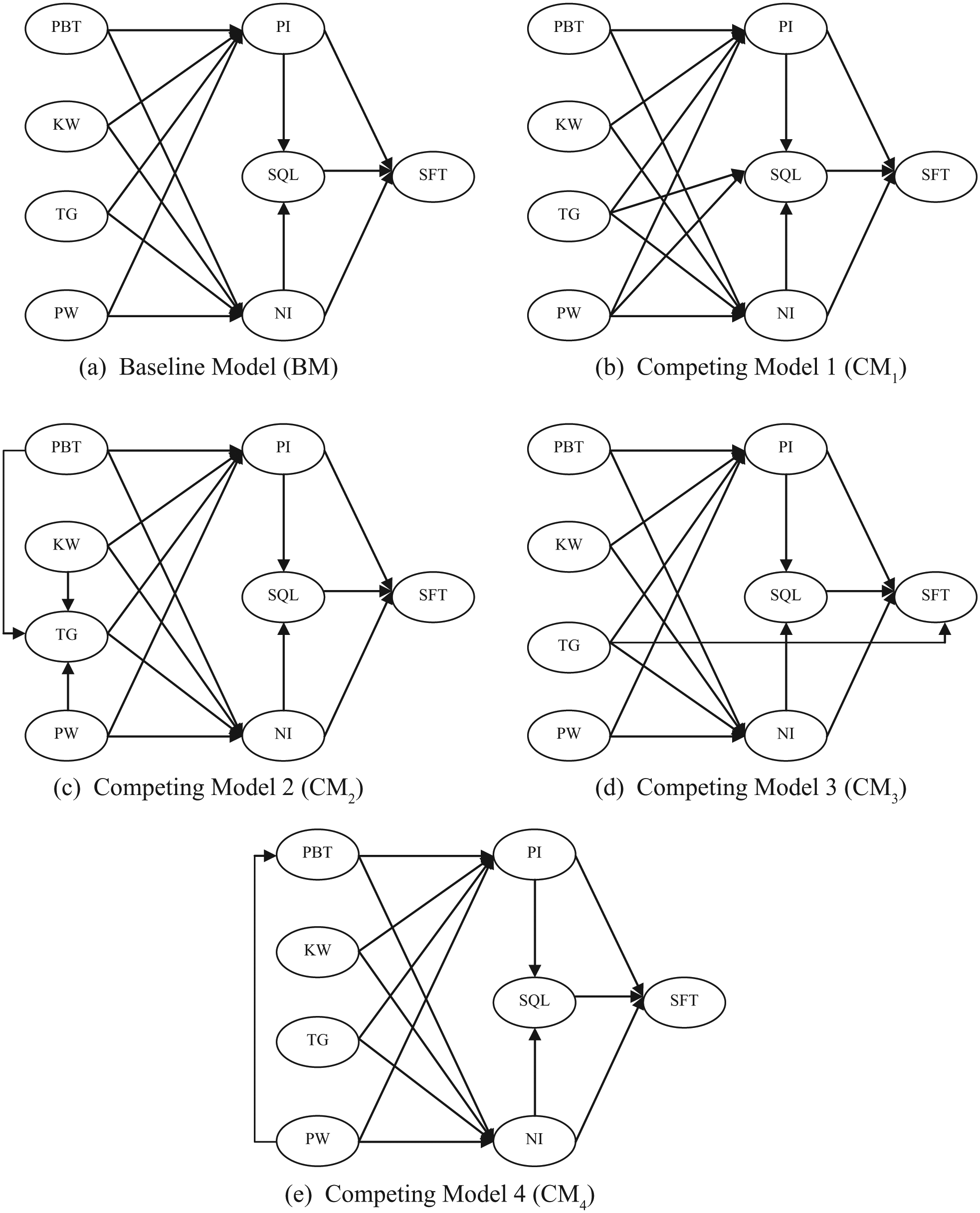
Baseline model and competing structural models of residents’ support.
Literature Review
Residents’ Support for Tourism
Existing studies suggest that locals perceive several positive and negative impacts from tourism development (Nawijn and Mitas 2012; Nunkoo and Ramkissoon 2010). The industry provides economic benefits such as employment for local people, development of small businesses, and investment opportunities (Kim, Uysal, and Sirgy 2013; Nunkoo and Smith 2013). Tourism also leads to preservation of environmental resources, promotion of environmental awareness among local residents, and revival of local arts and culture (Kim et al. 2013). On the negative side, tourism is a source of environmental pollution, traffic congestion, and litter problems (Nunkoo and Smith 2013; Nunkoo and Ramkissoon 2012). In other cases, the industry has been found to modify traditional culture and create inflationary pressures on local economies (Gursoy et al. 2010; Nunkoo and Ramkissoon 2007; Nunkoo and Smith 2013). In support of SET, a number of studies empirically demonstrate that residents’ support for tourism (SFT) is positively related to their perceptions of the positive impacts of tourism (PI) but inversely related to perceived negative impacts (NI) (e.g., Gursoy and Rutherford 2004; Gursoy et al. 2010; Nunkoo and Gursoy 2012; Nunkoo and Ramkissoon 2011 2012; Nunkoo and Smith 2013). These paths are proposed in the BM and CM1–CM4 (PI → SFT; NI → SFT).
Satisfaction with Quality of Life
Use of SET in residents’ attitudes studies appears to shed light mainly on economic value domains conditioning an exchange relationship (Wang and Pfister 2008). However, less tangible resources also influence social exchanges considerably (Cook, Hardin, and Levi 2005; Woo, Kim, and Uysal 2015). Of particular interest here, is residents’ satisfaction with their quality of life (SQL). The definition of quality of life remains contentious in the literature. For example, Andereck and Nyaupane (2011) contend that there are more than a hundred definitions of the concept. This research defines quality of life as “one’s satisfaction with life and feelings of contentment or fulfillment with one’s experience in the world” (Andereck and Nyaupane 2011, 248). The premise quality of life studies is that while it is important to study how well a community is doing from an objective perspective (i.e., the actual circumstances related to residents’ economic, social, environmental, and health well-being), understanding it from a subjective human response perspective (i.e., residents’ satisfaction with quality of life) is also of value (Uysal, Sirgy, and Perdue 2012).
Research on quality of life has been driven by the need to study the impacts of tourism development on local communities (Uysal et al. 2012; Uysal, Woo, and Singal 2012). Positive economic, sociocultural, and environmental impacts of tourism development improve residents’ SQL while the adverse consequences of tourism decrease SQL (Kim et al. 2013; Moscardo 2009; Woo et al. 2015). Although such assumptions have been made, to date, the majority of research on SQL has focused on the tourists at the neglect of local communities (Nawijn and Mitas 2012). Few studies explicitly investigate the theoretical relationships between residents’ perceptions of tourism impacts and their satisfaction with quality of life (Kim et al. 2013; Nawijn and Mitas 2012). Kaplanidou et al.’s (2013) study reported a positive relationship between positive impacts of tourism and residents’ satisfaction with quality of life. However, the researchers were unable to establish a statistically significant relationship between negative impacts of tourism and satisfaction with quality of life. Similar conclusions can be derived from other studies (e.g., Kim, Uysal, and Sirgy 2013; Nawijn and Mitas 2012). Our BM and CM1–CM4 propose similar relationships (PI → SQL; NI → SQL).
While the majority of research treats residents’ satisfaction with quality of life as a dependent variable influenced by the impacts of tourism (e.g., Andereck and Nyaupane 2011; Chancellor, Yu, and Cole 2011), it is only recently that quality of life has been considered as an antecedent of residents’ support for tourism development (e.g., Woo et al. 2015). If impacts of tourism improve residents’ quality of life, they will be more likely to enter an exchange with the industry and support the industry’s development or one can also expect residents to be less supportive of tourism if it disrupts their quality of life—a premise based on SET. Thus, improved quality of life through tourism development can be regarded as a resource positively valued by local communities. The relationship between quality of life and support for tourism development has been validated by a few recent studies (e.g., Kaplanidou et al. 2013; Woo et al. 2015). We therefore propose similar paths in the BM and CM1–CM4 (SQL → SFT).
Personal Benefits from Tourism
Benefits are value domains that help actors make decisions about the subjective worth of a social exchange relationship (Emerson 1987). In tourism, personal benefits (PBT) are value domains (i.e., various economic, social, and cultural benefits) that residents personally derive from an exchange relationship with the tourism industry (Wang and Pfister 2008). According to SET, personal benefits residents derived from tourism condition their perceptions of the impacts of tourism development because actors react according to the subjective expected personal utility they derive from an exchange relationship (Emerson 1987). Ko and Stewart (2002) found personal benefits to be a strong determinant of residents’ perceived positive impacts of tourism but an insignificant predictor of their perceived negative impacts, contradicting the results of Perdue, Long, and Allen (1990), who found personal benefits to significantly predict negative impacts. Perdue et al. (1990) also reported that after controlling for personal benefits, residents’ perceptions of tourism were unrelated to their demographic characteristics. More recently, Látková and Vogt’s (2012) study found personal benefits to significantly predict both positive and negative impacts of tourism. The BM and CM1–CM4 propose similar paths (PBT → PI; PBT→ NI).
Knowledge of Tourism
Residents’ knowledge of tourism (KW) is central to the sustainability and good governance of the sector (Moscardo 2005). Here, knowledge refers to residents’ understanding of tourism development issues and of the role of local government in the industry. Knowledge is an important resource for an actor and determines its position in a social exchange network, making it an important construct of SET (Cook et al. 2013). Some studies investigate the influence of residents’ knowledge of tourism on their attitudes to the perceived impacts of the industry. Residents who are knowledgeable about tourism are most likely to recognize the benefits and costs of development (Andereck et al. 2005). However, results are far from conclusive. Davis, Allen, and Cosenza (1988) found that “haters” of tourism included residents who generally had poor knowledge of tourism. Andereck et al.’s (2005) study indicated that residents who were knowledgeable about tourism were more likely to report positive impacts while Nunkoo (2015) reported a significant relationship between knowledge and perceived negative impacts only. Contrary to these findings, Látková and Vogt (2012) found knowledge to be an insignificant predictor of positive and negative impacts of tourism. Based on these results, our BM and CM1–CM4 include similar relationships (KW → PI; KW→ NI).
Power in Tourism
Central to SET is the concept of power (PW) that exists in a set of specific relationships, where actors are positioned within this network of power relations (Emerson 1962). In social exchanges, power is defined as the ability of one actor to influence the behavior of another actor (Wrong 1979). In tourism, power provides a basis for understanding residents’ reactions to the impacts of development. Power is usually asymmetrically distributed among tourism actors and, in particular, local communities are often the least powerful in tourism development compared to other stakeholder groups (Moscardo 2011a; Saufi, O’Brien, and Wilkins 2014). This, according to Ap (1992), adversely influences residents’ perceptions of tourism development, while he argues that positive reactions from residents are associated with a high level of power. This is confirmed by some studies (e.g., Nunkoo and Ramkissoon 2011, 2012), although empirical findings are inconclusive to date (see, e.g., Látková and Vogt 2012; Nunkoo and Smith 2013). Based on the preceding discussion, our BM and CM1–CM4 attempt to test such relationships (PW → PI; PW→ NI). Power also influences the ability of an actor to benefit from an exchange because as Ap (1992, 679) argues, “power is usually viewed as the capacity to attain ends.” Power brokers have considerable influence on the benefits of tourism development (Smith 1996). Empowerment allows communities to benefits more from and to take advantages of the opportunities of tourism development (e.g.,Moscardo 2011a; Saufi et al. 2014; Scheyvens 1999). CM4 proposes an additional relationship between residents’ power and personal benefits residents derived from tourism (PW → PBT).
The concept of perceived power is highly akin to the general psychological notion of locus of control (Rotter 1966), which is considered as one of the most important psychological variables contributing to improved quality of life among residents (Diener 1984). Research conducted across various contexts and situations consistently shows that perceived power to influence or perceived personal control over events in one’s environment leads to improved life satisfaction (e.g., de Quadros-Wander, McGillivray, and Broadbent 2014; Hofmann, Luhmann, Fisher, Vohs, and Baumeister 2014). Likewise, Grzeskowiak, Sirgy, and Widgery (2003) study demonstrated that individuals’ power to influence local institutions was positively correlated with their satisfaction with their life and the community. Analogously, one could argue that residents’ power to influence tourism development should be positively related to their satisfaction with quality of life. However, tourism researchers have remained insensitive to a potential causal association between power and quality of life. Thus, CM1 proposes to investigate such a relationship (PW → SQL).
Trust in Government Actors
Trust is one of the most important variables of SET (Blau 1964). It is defined as “a psychological state comprising the intention to accept vulnerability based upon positive expectations of the intentions or behavior of another” (Rousseau, Sitkin, Burt, and Camerer 1998, 395). Trust is important in social exchanges because exchange of benefits is neither contractual nor happens on a quid pro quo basis, but on a voluntary basis. The persistence of a social exchange relationship depends on implicit trust between actors (Konovsky and Pugh 1994). In tourism, while government cannot oblige local communities to display positive attitudes toward the industry, it requires favorable reactions from them to ensure sustainable development. Residents’ trust in government actors (TG) involved in tourism planning conditions the ways in which they react to the impacts of tourism. This is because trust affects public attitudes to government policies and outputs (Easton 1965; Hetherington and Husser 2012). Empirical research suggests that public trust positively influences benefits but is inversely related to risks associated with an activity (e.g., Bronfman, Vázquez, and Dorantes 2009). Corroborating these results, Nunkoo and Ramkissoon (2011) found that residents’ trust in tourism institutions significantly predicted their perceptions of the positive and negative impacts of tourism. Similar paths are proposed in the BM and CM1–CM4 (TG → PI; TG→NI).
SET also posits that trust influences a partner’s commitment to an exchange relationship (Blau 1964). In tourism, residents demonstrate such commitment by supporting development. Government needs local support for its policies to flourish (Caldeira and Gibson 1992). Some few studies found residents’ trust in government actors to be a strong predictor of their support for tourism (e.g., Nunkoo, Ramkissoon, and Gursoy 2012; Nunkoo and Ramkissoon 2012; Nunkoo and Smith 2013). CM3 therefore proposes this additional relationship (TG → SFT). Trust in other social actors is also essential to a successful life. A culture of mistrust is related to the belief that others are dishonest, self-seeking, and looking out for their own good, victimizing others in pursuit of their own goals (Mirowsky and Ross 1983). Research in psychology and sociology suggests that trust is positively related to an individual’s quality of life (Di Tella, MacCulloch, and Oswald 2003; Helliwell 2003; Ross 2003). However, existing research in tourism has so far failed to consider the influence of residents’ trust in government actors on their quality of life. CM1 proposes this additional relationship (TG → SQL).
Interestingly, some other studies treat trust as an outcome rather than an independent variable (e.g., Nunkoo 2015). According to SET, trust between actors develops through reliable performance, that is, by reciprocating for benefits received from others, where such benefits comprise of economic and noneconomic value domains (Blau 1964; Whitener, Brodt, Korsgaard, and Werner 1998). However, the influence of personal benefits residents derive from tourism on their level of trust has rarely been studied in tourism. Based on this, CM2 proposes such an additional relationship (PBT→ TG). Familiarity is another important preconditioned for development of trust (Luhmann 1979). Although a government meets the attributes of trustworthiness, it does not necessarily mean that citizens will possess sufficient knowledge to believe that it would act in their interests. This, according to Hardin (1998) and Levi and Stoker (2000), hinders residents’ trust in government, lending support to Simmel’s (1978) argument that trust involves a degree of cognitive similarity with the object of trust that is somewhere between total knowledge and total ignorance. Recent studies (e.g., Grimmelikhuijsen 2012) validate a positive relationship between citizens’ knowledge of government processes and political trust. However, such evidence is largely lacking in tourism studies. CM2 proposes such an additional relationship (KW→ TG).
In social exchanges, trust and power complement one another to inform social actors’ behaviors (Blau 1964; Emerson 1962). They should therefore be studied jointly in any research on social relations and institutions (Cook et al. 2005; Oberg and Svensson 2010). Although the relationship between these constructs remains to be well understood, power is usually considered a precondition for development of trust because it influences an exchange partner’s evaluation of the relative worth of a relationship (Bachmann, Knights, and Sydow 2001; Farrell 2004). Power asymmetries among social actors create grounds for distrust and block the possibility of trust (Cook et al. 2005; Farrell 2004). Institutions face lack of trust from citizens if their political processes marginalize community members, rendering them powerless in influencing policy decisions (Gabriel et al. 2002). Some studies in political science (e.g., Oberg and Svensson 2010; Oskarsson, Svensson, and Oberg 2009) and in tourism (e.g., Nunkoo et al. 2012; Nunkoo and Ramkissoon 2012) validate a significant positive relationship between power and trust, although results are contradictory (see, e.g., Nunkoo and Smith 2013). CM2 hypothesizes an additional relationship between power and trust (PW→ TG).
Research Methodology
Research Context
The Niagara Region, Canada, was chosen as the research site. Tourism is one of the most important industries of the region, providing various socioeconomic benefits to residents. Despite its positive contributions, tourism has adversely affected local neighborhoods and has altered the sociocultural fabrics of the region. Development of tourism has also led to a number of environmental problems, including the overuse of natural resources (Nunkoo and Smith 2013). Authorities have been criticized for their top–down and corporatist approach to tourism planning, for marginalizing local communities in the development process, and for providing inadequate leadership of the tourism sector (Graveline 2011; Nunkoo and Smith 2013). However, local government has expressed its commitment to sustainability through greater involvement of local communities in tourism development.
Survey Method and Sample Size
Data were collected from local residents of Niagara Region using an online panel provided by TNS Global Marketing Research, Canada. An online panel “consists of people who have registered to occasionally take part in web surveys” (Goritz 2004, 411). Although online panels have some limitations, they produce reliable data and do not suffer from higher sample bias than traditional methods (Callegaro et al. 2014). Consequently, their increasing use in tourism research is not surprising (see, e.g., Chung and Petrick 2013; Dolnicar, Yanamandram, and Cliff 2012; Nunkoo, 2015; Nunkoo and Smith 2013). The requirements in terms of sample frame and size were provided to TNS. The online survey was open to residents who were at least 18 years of age. Four hundred and eight responses were obtained. Seventeen questionnaires were eliminated as a result of missing data, resulting in a usable sample of 391 respondents, satisfying the minimum sample requirement of 200 respondents for effective use of structural equation modeling (Anderson and Gerbing 1988).
Measurement of Constructs
Items used to measure the various constructs are presented in Table 1 and were derived from existing literature. SFT, PI, NI, and PBT were operationalized using items borrowed from Nunkoo and Ramkissoon (2011), Látková and Vogt (2012), and Wang and Pfister (2008). TG was measured using scales derived from Lühiste (2006) and Shi (2001). Items to measure PW were borrowed from Hung, Sirakaya-Turk, and Ingram (2011) and Madrigal (1993). Scale to measure KW was derived from Hung et al. (2011) and Grimmelikhuijsen (2012). SQL was operationalized using items borrowed from Andrew and Withey (1976)and Sirgy and Cornwell (2001). A recent study by Kim et al. (2013) also made use of the same scale items to measure SQL. Where necessary, items were slightly modified to suit the particular context of tourism development in Niagara Region. Such modifications were contextual rather than conceptual.
Results of Measurement Model.
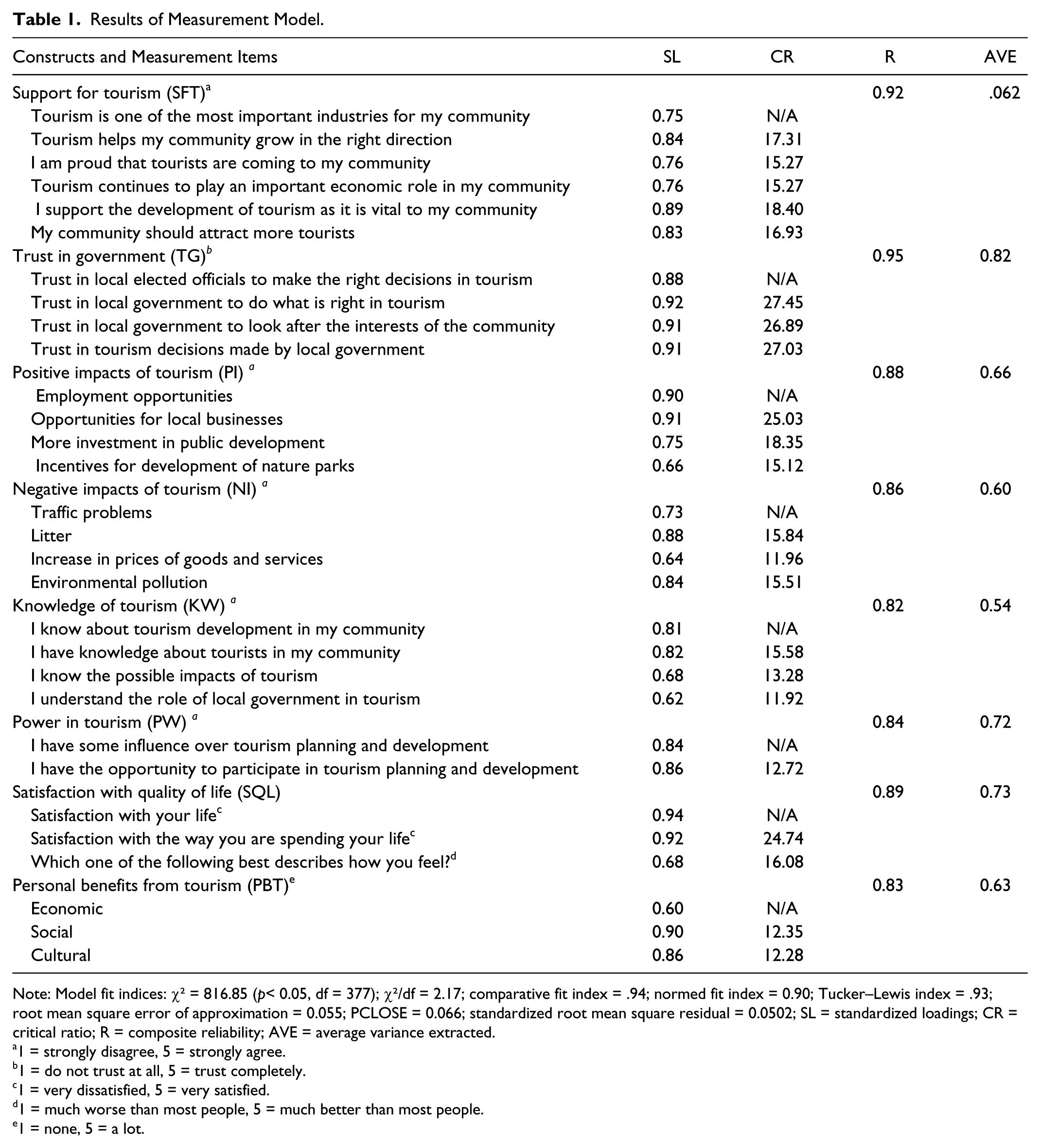
Note: Model fit indices: χ² = 816.85 (p< 0.05, df = 377); χ²/df = 2.17; comparative fit index = .94; normed fit index = 0.90; Tucker–Lewis index = .93; root mean square error of approximation = 0.055; PCLOSE = 0.066; standardized root mean square residual = 0.0502; SL = standardized loadings; CR = critical ratio; R = composite reliability; AVE = average variance extracted.
1 = strongly disagree, 5 = strongly agree.
1 = do not trust at all, 5 = trust completely.
1 = very dissatisfied, 5 = very satisfied.
1 = much worse than most people, 5 = much better than most people.
1 = none, 5 = a lot.
Results
Sample Profile and Nonresponse Bias
Of the 391 respondents, 65.7% were female and 12.5% were between 18 and 35 years old, with 68.5% between 35 and 65 years old, and 18.9% over age 65 years. In terms of annual household income, 34.4% of the sample earned under $35,000, 41.5% earned between $35,000 and $80,000, and 24% earned more than $80,000. With respect to the highest education level completed, 18.4% of the respondents had university degrees, 33% had attended college, and 6.6% had apprenticeship or trade certificates. To assess nonresponse bias, we adopted the Armstrong and Overton’s method (1977) to compare early respondents (top 5%) with late respondents (bottom 5%) on their demographic variables (e.g., gender, marital status, education, and income) and the measurement items. The chi-square tests indicated no significance differences (α = .05) between early and late respondents in terms of respondent characteristics. In addition, the t test results showed that responses to the measurement scales were not significantly different (α = .05) between early and late respondents. Therefore, nonresponse bias was not evident in this study.
Common Method Variance
Given that this study collected information via the same method (self-administered online surveys), common method variance may introduce bias to the relationships among the constructs. We therefore conducted a confirmatory factor analysis (CFA) test to examine whether a single factor can account for all of the variance in the data (Baldauf, Cravens, Diamantopoulos, Zeugner-Roth 2009). A CFA with all 30 items loading onto a single common factor was estimated. A chi-square difference test was then performed to compare the results of the common factor model with the CFA results of the proposed measurement model, which included the eight latent factors. The results show that the proposed measurement model fits significantly better than the common factor model (Δχ2 = 4935.91, df = 30, p< .001), suggesting that common method variance was not a major issue in this study.
Structural Equation Modeling
Data were analyzed with structural equation modeling (SEM) using the two-step approach (Anderson and Gerbing 1988). To evaluate the performance of the measurement model, we conducted a CFA on the sample data (N = 391) using AMOS 21, with the eight constructs modeled simultaneously as correlated first-order factors with maximum likelihood estimation. As this estimation method relies on data normality, the distribution of the collected data was examined. Normality is attributed to both skewness and kurtosis. While skewness affects analysis of means, kurtosis severely influences tests of variances and covariances which underlie SEM. Therefore, the kurtosis of all items was evaluated. According to West, Finch, and Curran (1995), a rescaled value of greater than 7 is indicative of early departure from normality. An inspection of the kurtosis values produced by AMOS suggested that no item was substantially kurtotic, therefore satisfying the assumption underlying maximum likelihood estimation of SEM.
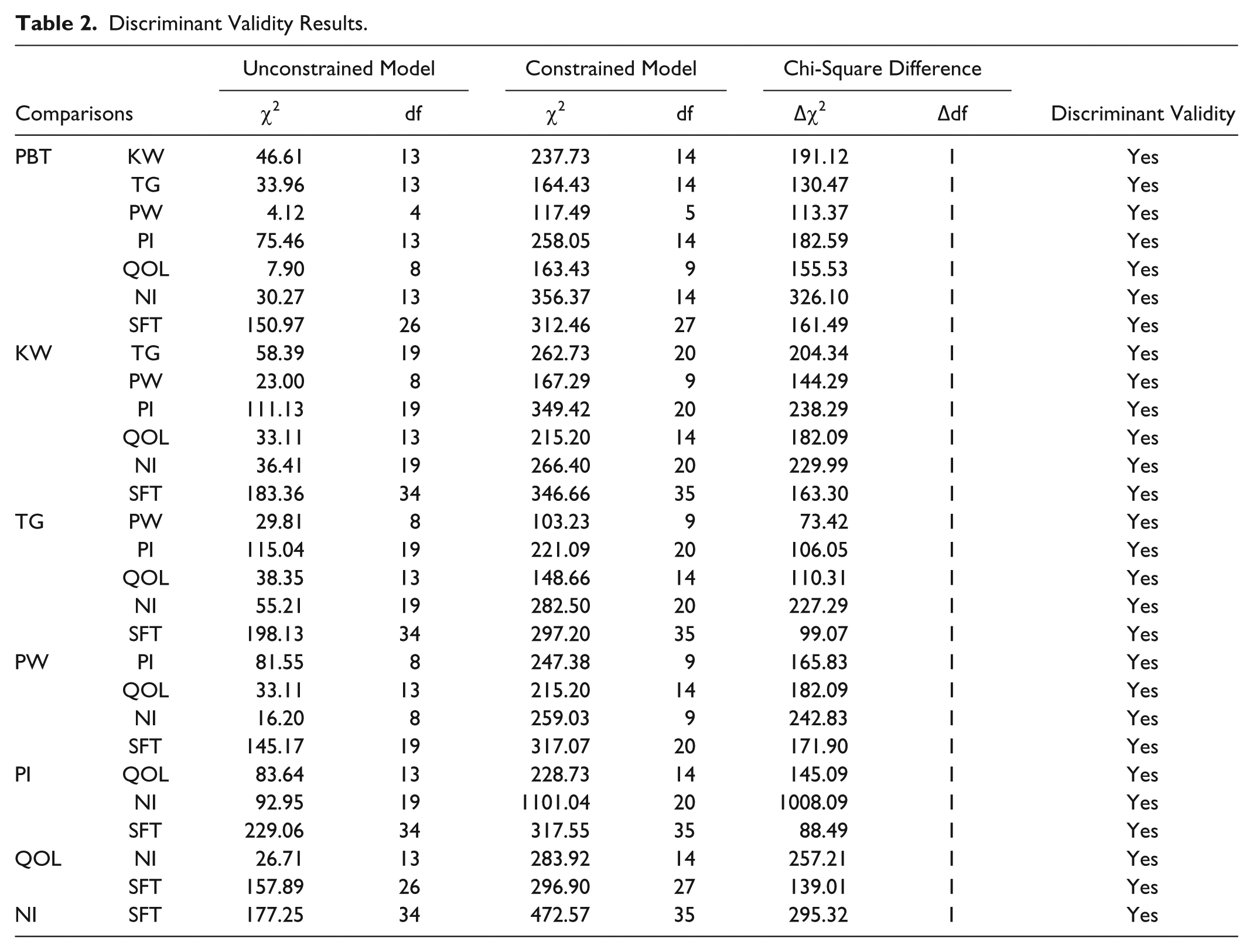
The measurement model resulted in a significant chi-square value of 816.85 (df = 377, p < .001), which is known to be highly sensitive to sample size. However, the ratio of the chi-square to degrees of freedom (χ2/df = 2.17) is below the recommended cutoff point of 3 (Bagozzi and Yi 1988). Overall, the measurement model achieved a good fit to the data, with comparative fit index (CFI) = .94, Tucker–Lewis index (TLI) = .93, standardized root mean square residual (SRMR) = .0502, and root mean square error of approximation (RMSEA) = .055 (Table 1). Convergent validity was evidenced with statistically significant (p < .01) item factor loadings (Anderson and Gerbing 1988) as shown in Table 1. Discriminant validity was tested by comparing all pairs of constructs in two-factor CFA models (Anderson and Gerbing 1988), where each model was estimated twice, with one constraining the correlation between the constructs to be one and the other allowing free estimation of the parameter. According to Bagozzi and Phillips (1982), discriminant validity is achieved if a significantly lower chi-square value is obtained for the model in which the correlation is not constrained to unity. The analysis shows that all combinations resulted in a significantly higher value (χ2> 3.84 at α = 5%) for the constrained model, indicating discriminant validity (Jöreskog 1971; see Table 2). Scale reliability was achieved because the composite reliability and average variance extracted values exceeded .70 and .50, respectively (Hair, Black, Babin, Anderson, and Tatham 2006).
Discriminant Validity Results.
Baseline Model versus Alternative Models
Once the above steps were performed, the hypothesized BM was tested using AMOS 21 with the maximum likelihood estimation method. Results indicated a good model fit with χ² = 889.24, df = 386, χ²/df = 2.79, p< .05, CFI = .934, TLI = .926, SRMR = .071, and RMSEA = .058. The structural path coefficients of the BM suggested that of the 13 hypothesized paths tested, 8 were found to be significant. Following this, each competing model was estimated individually, with all the exogenous variables being assumed to be correlated. The comparison first involved the assessment of the overall model fit of the models. As Table 3 shows, all four competing models exhibited good model fit. If all competing models exhibit a reasonable fit to the data and explain similar outcome variables, the researcher must apply other criteria to identify the most appropriate model (Rust, Lee, and Valente 1995). Specifically, when comparing nested models, such as those tested in this study, a chi-square difference test is considered appropriate to determine the best model (Anderson and Gerbing 1988; Rust et al. 1995). Results suggested that both CM1 (Δχ2 = 11.70, df = 2, p< .01) and CM3 (Δχ2 = 4.41, df = 1, p< .05) were significantly better fitted models than the BM, whereas CM4 (Δχ2 = 23.92, df = 2, p< .001) was shown to be significantly worse than the BM.After including the covariance terms among exogeneous variables in CM2, the BM and CM2 were equivalent models, which produced the same predicted correlations or covariances, but with a different configuration of paths among the same observed variables (Kline 2011).
Results for Model Comparison.
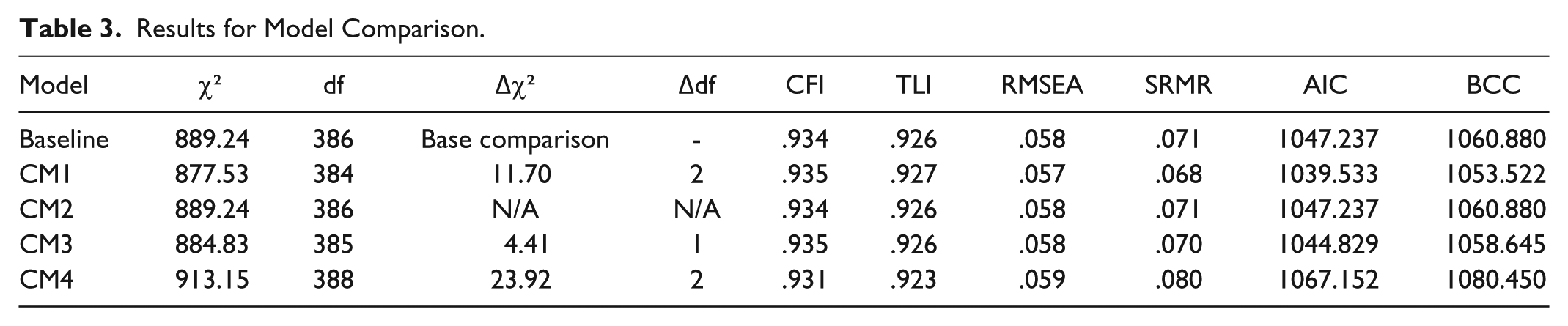
According to Kline (2011), equivalent models have equal values of fit statistics. As such, comparison of the two models through a chi-square difference test or fit statistics was not possible. Selecting the best model from equivalent models should be based on both theoretical grounds (Kline 2011) as well as quantitative criteria (Hershberger 2006). As the literature review offers theoretical support for the three additional paths contained in CM2, (PBT → TG, KW → TG, PW → TG), these were tested and found to be statistically significant, collectively accounting for 17% of the variance in TG. On this basis, we concluded that CM2 was superior to the BM. Further comparison of CM1, CM2, and CM3 suggested that CM1 was the best fitted model. Furthermore, goodness-of-fit measures that take parsimony as well as fit into account such as the Akaike information criterion (AIC) (Akaike 1987) and the Browne–Cudeck criterion (BCC) (Browne and Cudeck 1989) can also be used regardless of whether models can be ordered in a nested sequence or not. On the basis of the AIC and BCC values, we again concluded that CM1 was the best fitted and parsimonious model.
Discussion
Results of the best fitted model (i.e., CM1) are presented in Figure 2. Nine of the 15 path relationships proposed in the model were supported. Residents’ perceptions of the positive impacts of tourism were found to predict their support, corroborating results of existing studies (e.g., Lee 2013; Nunkoo and Ramkissoon 2011; Nunkoo and Smith 2013). Perceived negative impacts were not found to exert a significant influence on support. This is similar to some previous research (e.g., Gursoy and Kendall 2006; Gursoy, Jurowski, and Uysal 2002; Nunkoo and Ramkissoon 2012). Residents’ satisfaction with quality of life did not influence their support for tourism. This result contradicts Kaplanidou et al.’s (2013) study on residents’ quality of life and their support for a mega event. Such contradiction may be due to the different types of development studied. Mega events are obtrusive types of tourism and are more likely to impact on community life and to cause emotional and cognitive reactions among residents than other types of development (Prayag, Hosany, Nunkoo, and Alders 2013). Residents’ experiences with mega events are more conspicuous, making them more reactive to such developments (Gursoy and Kendall 2006). Thus, it is not surprising that Kaplanidou et al. (2013) found residents’ quality of life as impacted by a mega event to significantly influence their support, contrary to our findings. Our results demonstrate that while positive impacts of tourism significantly influenced satisfaction with life, negative impacts did not. Kaplanidou et al. (2013) and Kim et al. (2013) also found similar evidence. Our results imply that when it comes to their quality of life, residents place more emphasis on the positive consequences of tourism than on the negative ones. This is not surprising given that tourism is usually viewed as an industry that significantly improves quality of life of communities (Andereck and Nyaupane 2011; Kim et al. 2013).
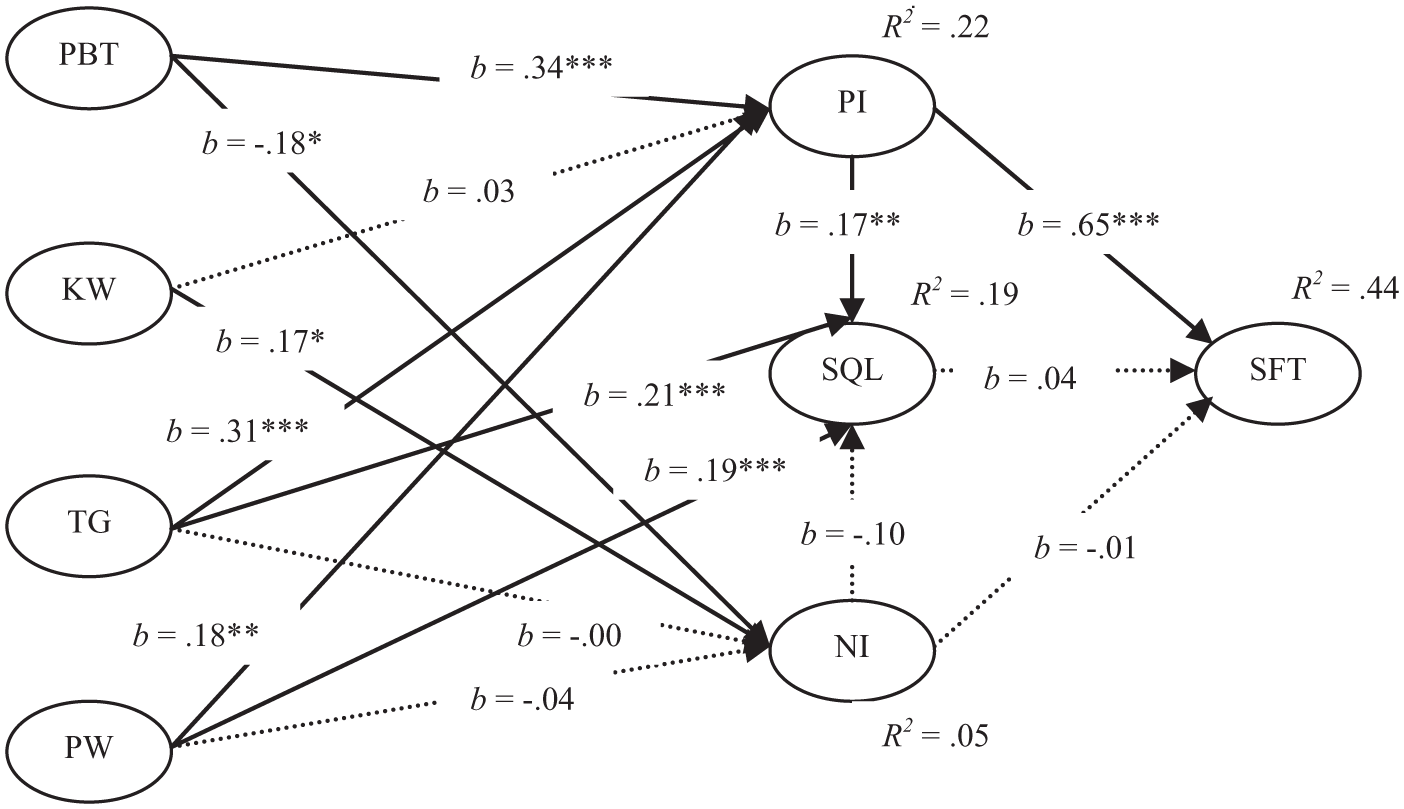
Best fitted model (CM1) of residents’ support tested.
Personal benefits from tourism positively influenced perceptions of positive impacts but were inversely related to perceived negative impacts. These findings lend support to other empirical studies, suggesting that residents’ attitudes to tourism impacts are conditioned by the extent to which they personally benefit from development (e.g., Látková and Vogt 2012; Perdue et al. 1990; Wang and Pfister 2008). Support for this relationship aligns with SET which suggests that residents’ attitudes toward tourism are based on an exchange for something of value attributed by tourism. Here, such value domains include the economic, social, and cultural benefits residents personally derive from tourism development. Residents’ knowledge of tourism was found not to predict their perceptions of the positive impacts. These results support that of Látková and Vogt (2012), who did not find a significant relationship between knowledge and perceptions of positive impacts, but contradict the findings of Davis et al. (1988), who found knowledgeable respondents to be more appreciative of tourism. Our results also indicated that higher knowledge of tourism among residents were associated with stronger perceptions of the negative impacts. This is because knowledge gives rise to “critical citizens” and produces more critical attitudes toward development (Christensen and Laegreid 2005).
Corroborating the results of Nunkoo and Ramkissoon (2011), our study suggests that residents who are more trusting of government actors involved in tourism development are more likely to view the impacts of the industry positively. The theoretical rationale of such a finding is that trust is a cognitive habit that allows the trustee to interpret the behavior of the trustor as honest, supportive, and benevolent (Cook et al. 2013). Here, the physiological consequence of residents’ trust in local government is that it allows them to view the impacts of tourism positively. Contrary to our theoretical expectations and existing research (e.g., Nunkoo and Ramkissoon 2011), trust was not found to be significantly related to perceptions of the negative impacts of tourism. This finding suggests that the adverse consequences of tourism development are felt by everyone, irrespective of their level of trust in local government.
Interestingly, residents who were more trusting of local government in tourism reported better quality of life. In fact, among the various determinants of quality of life incorporated in the model, residents’ trust exerted the strongest influence. This result confirms the centrality of trust in society, where humans are social beings and trust is seen as a core element in the social setting (Helliwell and Wang 2011). Trust is therefore seen as a “central ingredient in the healthy personality” (Rotter 1967, 651). Thus, it is not unexpected that like ours, several other studies suggest that positive psychological factors such as trust lead to a better life (Ashleigh, Higgs, and Dulewicz 2012; Helliwell 2011; Helliwell and Wang 2011; Ward and Meyer 2009). Carried out in a context similar to ours, Widgery’s (1982) and Grzeskowiak et al.’s (2003) study reported a significant positive relationship between residents’ trust in government and their life satisfaction.
Residents’ power in tourism was found to significantly predict perceptions of positive impacts of tourism, lending support to SET and to some empirical studies (e.g., Madrigal 1993; Nunkoo and Smith 2013). However, power did not predict perceptions of negative impacts, corroborating results of Nunkoo and Smith (2013) and Látková and Vogt (2012). The latter findings suggest that the negative consequences of tourism are borne by everyone, irrespective of their level of power in tourism. Like trust, residents who perceived they had the power to influence tourism were most likely to report better quality of life. Such result confirms long-standing evidence in psychology suggesting that individuals capable of influencing their environment to suit their needs and desires are able to maintain a positive and stable life (de Quadros-Wander et al. 2014). This is why some studies found that individuals who are able to influence their local institutions experience higher life satisfaction (Diener 1984; Grzeskowiak et al. 2003). Thus, it expected that residents who have the power to influence tourism development outcomes experience improved life satisfaction.
Conclusion
Residents’ support for tourism is one of the most systematically documented areas in tourism. Research has reached a stage of active scholarship in theory development followed by empirical testing. While SET has largely influenced such studies, several of them are based on an incomplete use of the theory. In addition, although each study contributes in its own way to researchers’ understanding of residents’ support, the combined knowledge-base is characterized by conflicting, yet theoretically plausible relationships among variables, potentially creating confusion and hindering future theoretical developments. This study addresses these gaps by comparing four competing models of residents’ support for tourism against a baseline model, where each model is developed following an in-depth review of existing literature. The premise is that as other unexamined models reflecting other approaches to social exchanges may fit the data as well or better, an examination of theoretically rival or competing models is recommended to rule out equivalent or even better fitted models (MacCallum and Austin 2000). Indeed, relationships uncovered in the best fitted model make some important theoretical contributions to literature.
So far, existing literature suggests that residents’ satisfaction with their quality of life in a destination is influenced primarily by the impacts of tourism development (Kaplanidou et al. 2013; Kim et al. 2013). While our study reconfirms such evidence, unlike previous research, it also provides some new theoretical evidence on other determinants of quality of life. Interestingly, residents’ trust in government and their level of power in tourism development were the two strongest determinants of quality if life (even stronger than perceived positive impacts of tourism). While most existing studies adopt a “self-help approach,” focusing on what individuals can do to improve their quality of life, our results suggest that “others,” in particular, tourism institutions, can also influence quality of life of residents. It is probably for these reasons that Helliwell (2011, 255) considers institutions as “enablers of wellbeing”. Thus, residents’ power in tourism and their trust in government are not only institutional variables impacting on the formulation of tourism policies, but they also have health consequences on communities. Trust and power in tourism development underpin a social system that plays a role in the development and maintenance of a healthy society.
Previous research proposes various antecedents of residents’ perceptions of tourism impacts (see, e.g., Sharpley 2014). Within such literature, residents’ trust in government actors involved in tourism development has rarely been considered as a determinant of impact perceptions. On the contrary, some few studies consider residents’ trust as an outcome variable influenced by perceptions of tourism impacts (e.g., Nunkoo and Smith 2013). While this remains plausible, our study found the opposite to be equally possible theoretically, confirming the existence of a bi-directional relationship between trust and perceptions of tourism impacts. Therefore, the study makes a contribution to this domain as well. Overall, we found residents’ trust and their level of power to be intimately connected to their quality of life and their perceptions of tourism impacts. Therefore, there are benefits for theory development by including power and trust concurrently in a single theoretical model predicting residents’ support for tourism. Indeed, Cook et al. (2005, 40) note that these two constructs “cannot be assumed away in any theory that deals with the world of social relations and social institutions.”
Results also have implications for tourism planning and management in Niagara Region. Planners should note that residents would be willing to enter an exchange process by supporting tourism development if they perceive that the industry results in positive impacts. Such benefits may be of an economic (e.g., business opportunities in tourism for local residents), sociocultural (e.g., cultural exchange), and environmental (e.g., local environmental improvement) nature. It is also important for planners to ensure that tourism benefits are shared across individuals from all social spectrums and communities. While tourism development should have positive consequences for the whole community, policy makers should also ensure that residents derive direct and personal benefits from tourism (Hung et al. 2011). As our findings suggest, higher personal benefits are associated with more tolerant attitudes to tourism. Results indicate that residents’ trust is also closely associated with positive perceptions of tourism as well as higher satisfaction with quality of life. Thus, it is important that residents trust local government institutions involved in tourism.
Local authorities can build trust by ensuring that tourism policies are fair and transparent. Tourism planning should be driven by community needs rather than by self-interests of politicians and commercial interests. Trust can also be built if government authorities provide accurate and reliable information about tourism development to local residents. Empowering local residents in tourism is another effective strategy for fostering positive attitudes and improving quality of life. Local government should adopt a participatory approach, with the aim of making residents central to tourism development by encouraging beneficiary involvement interventions that affect them and over which they had limited influence. Planners should implement a comprehensive strategy of social integration and participation where people from different social groups/backgrounds are involved in tourism development. Authorities should consider democratizing the tourism sector in Niagara Region, which at present seems to be controlled by society elites. Education and training of local residents to work in the tourism sector are other important sources of local empowerment.
Regardless of the implications of the research, it has certain theoretical and methodological limitations. The study used an overall measure of quality of life. Research suggests that residents’ quality of life comprises various domains such as material, community, emotional, and health and safety, personal relationships, and community connectedness (de Quadros-Wander et al. 2014; Kim et al. 2013). Likewise, power was also considered as a unidimensional construct. Boley et al. (2014) provide evidence that power is a multidimensional construct comprising of psychological, social, and political empowerment. Thus, future studies should consider the multidimensional nature of these variables to further clarify the theoretical relationships tested in this study. From a methodological standpoint, use of an online panel for data collection may introduce an element of bias in the results. Respondents of online panels are usually politically more active than those of traditional survey methods (Duffy, Smith, Terhanian, and Bremer 2005). Thus, readers should interpret the findings taking this into account. Despite these limitations, insights revealed by the study have made relationships among SET constructs clearer for researchers and provide a basis for further theoretical developments in future studies.
Footnotes
Declaration of Conflicting Interests
The author(s) declared no potential conflicts of interest with respect to the research, authorship, and/or publication of this article.
Funding
The author(s) received no financial support for the research, authorship, and/or publication of this article.