



Abstract
This article aims to measure the influence of two environmental strategies: “concerned citizen” and “proactive” strategies on firms’ performance. A two-step data envelopment analysis (DEA) procedure is therefore used on a sample of 38 French ski resorts. First, the DEA method is used to evaluate ski resorts’ operational performance. Second, the impact of environmental strategies on their performance is analyzed via a bootstrapped truncated regression model. Contrary to findings of current studies, these results show that a “proactive” environmental strategy is not more positively correlated with firms’ performance than a “concerned citizen” strategy. The research highlights an inflection point on the correlation between environmental strategy and organization’s performance. By clarifying which green initiatives lead to performance improvements, this study helps managers defining their most advantageous environmental investments.
Introduction
Several governments place tourism policies at the heart of their countries’ development strategies. France is among the world’s top tourist destinations in terms of number of arrivals but generates less revenue than other countries (Randriamboarison 2003) because of what is known as “the French tourism paradox” (Barros et al. 2011). This situation questions the performance and competitiveness of French tourism destinations—including ski resorts. In fact, while in 2007 France was the world’s top “white” tourism destination, the United States pushed France into second place in 2009 (59.7 million against 56.1 million visits; Domaines Skiables de France Report 2011).
Ski resort managers face three main difficulties trying to improve their destinations’ performance. First, a multiplicity of stakeholders—firms, associations, and local authorities—are involved in their governance (Kelly et al. 2007). This heterogeneity is a factor of complexity in the strategy definition and decision processes. Second, ski resort managers need benchmarking tools to improve their performance (Kotler, Bowen, and Makens 2009; Aragón-Correa and Rubio-Lopez 2007), but if they are to evaluate improvements and measure the best performing units (Donthu et al. 2005), such tools must be able to take account of the significant disparities between the size and contexts of different resorts, and the competition they face. Third, like many other organizations but maybe with a higher accuracy, as their offer is mainly related to natural surroundings and outdoor activities, ski resorts also face environmental challenges.
Studies on the environmental challenges facing the tourism sector—and particular ski resorts—can be split in three groups. The first analyses how ski resorts impact on their environments (e.g., Tsuyuzaki 1994; Wood 1987; Thompson and Hutchinson 1986). The second group considers how the environmental context might impact on ski resorts (e.g., Falk 2009; Beyazi and Koc 2010), given that the ski industry has been identified as being particularly vulnerable to environmental evolutions—such as climate change (Scott and McBoyle 2007)—because of its dependence on natural snow (Scott et al. 2003; Abegg et al. 2007). The third group identifies the impact of environmental strategies on ski resorts’ performance, which is the focus of this article.
Environmental strategies have become a major issue (Hoffmann et al. 2009), and while some operators adopt only superficial and occasional environmental behavior, others engage in more costly approaches requiring structural, organizational, and managerial changes (Prakash and Kollman 2004). Consequently, they have launched heterogeneous green strategies (Clemens and Douglas 2006). Does “going green” pay off? Which types of green actions impact performance? Are all these impacts necessarily positive? Can green actions have negative influences?
Various authors (e.g., Williams and Todd 1997; Flagestad and Hope 2001; Ritchie, Brent, and Crouch 2003; Spector et al. 2012) have highlighted the benefits of environmental strategies for ski resorts, but the literature review underlines lack of quantitative studies measuring these benefits. The impact of environmental strategies on corporate financial performance have been largely analyzed and debated. However, this literature mostly focuses on two extreme strategies: “reactive” and “proactive” (e.g., Albertini 2012). Can this assertion be applied to an intermediary strategy such as “concerned citizen” (Hunt and Auster 1990)? Does a proactive strategy generate more benefits than a “concerned citizen” one? Consequently, this study tests the following hypothesis: A proactive environmental strategy is more positively correlated with firm performance than a “concerned citizen” strategy.
This study aims to measure the impact of two different types of green strategies, “concerned citizen” and “proactive,” described by the voluntary green initiatives (VGIs) adopted by firms. To do this, we use a two-stage DEA procedure taken from the research of Simar and Wilson (2007). The first stage measures firm operational performance through DEA efficiency scores to identify the best-performing firm practices, and the second consists of a bootstrap procedure to determine if French ski resorts’ performance is driven by environmental strategies (concerned citizen or proactive strategies). In this perspective, environmental strategies are determined through VGIs considered as contextual variables, and all these elements contribute to the setting of benchmark goals.
The article is structured as follows: the next section surveys the literature on the topic; the third section describes the methodology framework using a two-step data envelopment analysis procedure; the fourth section presents the French ski resorts’ data; the fifth section discusses the results; and the final section concludes.
Literature Review
Which Environmental Strategy for What Purpose?
Green issues can be seen as a collective societal concern, which should be integrated into productive activities. The strategic implications of making environmental investments, and their political (Green et al. 2009) and ecological consequences, have been considered through different perspectives since the 1930s (Carroll 1999). Different external and internal pressures drive firms to adopt heterogeneous environmental strategies (Clemens and Douglas 2006). The former may be understood as legal (government), economic (investor, customer, competitor), and social (community and nongovernmental organization) pressures, and the latter as being represented by managers and employees (Albertini 2011, 2012; Doonan et al. 2005).
Considering external pressures, in a classical economic view, green policies can be seen as negative externalities, expenditures that may jeopardize an organization’s productivity (Friedman 1970). A second perspective—known as eco-efficiency management, or “Porter’s Hypothesis”—establishes a positive link between environmental actions and economic interests (Porter 1991; Porter and Van Der Linde 1995). Indeed, efforts to reduce the amounts of raw material and energy used and pollution generated tend to stimulate organizational innovation and thus increase productivity, as well as developing competitive positioning, modernizing production processes, raising corporate image, and promoting the exploitation of new markets (e.g., Chien and Peng 2012).
Social welfare as well as private benefits can be increased in this win–win situation. The literature offers no consensus about these two contrasting concepts (Boiral 2006): while some studies (e.g., Russo and Fouts 1997) validate the Porter hypothesis, others (e.g., Boyd and McCelland 1999) confirm the key assumptions of the classical model. Even if Porter suggests a link between environmental regulation and firm performance, environmental initiatives can constitute significant costs for firms. Some authors (e.g., Delmas and Toffel 2003; Tutore 2010) question the key drivers of corporate green strategy and take into consideration internal pressures.
The resource-based view theory (Barney 1991; Wernerfelt 1984) emphasizes that it is the internal pressures of access to resources that drive firms’ environmental decisions (Aragón-Correa 1998; Hart 1995; Russo and Fouts 1997; Sharma and Vredenburg 1998) and that firms drive competitive advantage from continuous improvement (e.g., by eliminating waste and saving costs), stakeholder integration, continuous innovation, organizational learning, shared vision, and strategic proactivity (Miles et al. 1978; Hart 1995; Russo and Fouts 1997; Marcus and Geffen 1998; Sharma and Vredenburg 1998; Sharma 2000; Christmann 2000). Hart (1995), who promotes the natural resource–based view, argues that implementing proactive environmental strategies leads to competitive advantage, economic opportunity, and efficiency improvement (Hart 1995; Klassen and Whybark 1999; Aragón-Correa and Sharma 2003) through the acquisition of new organizational capabilities (Russo and Fouts 1997; Sharma and Vredenburg 1998) and cost savings (Russo and Fouts 1997; Judge and Douglas 1998).
These external and internal pressures generate two different environmental strategies (see Figure 1): reactive and proactive (e.g., Aragón-Correa 1998). The reactive strategy is the minimum level of environmental involvement that a firm can develop in order to avoid penalties or to lose market position. For example, reporting air, water, and land pollution resulting from the production process (King and Lenox 2001). For Albertini (2012, p. 5), the goal of this “compliance” strategy is to measure the emission level and to control it by the “end of pipe” techniques. While these companies view environmental issues as constraints, others consider implementing environmental management as an opportunity to improve productivity. These proactive firms develop environmental management system such as eco-lifecycle process through new product design or certifications like ISO 14001 (Hart 1995) in order to secure business advantages. If we consider a continuum from “reactive” to “proactive” to develop environmental strategies, an intermediary approach exists (see Figure 1) through the “concerned citizen” strategy (Hunt and Auster 1990) or “accommodative” strategy (Christmann and Taylor 2002). In the “concerned citizen” strategy, firms go further than government and stakeholder’s requirements by developing VGIs (Hart and Ahuja 1996; Aragón-Correa 1998; Hart 1995; Clemens and Douglas 2006). Most of these actions deal with prevention, such as reducing toxic emissions, waste-conserving energy, and natural resources. Many firms that adopt these initiatives expect that they will improve their performance (Hamilton 1995; White 1995; Klassen and McLaughlin 1996; Chien and Peng 2012). The aim of the “concerned citizen” strategy is to strengthen the company’s legitimacy in the market.
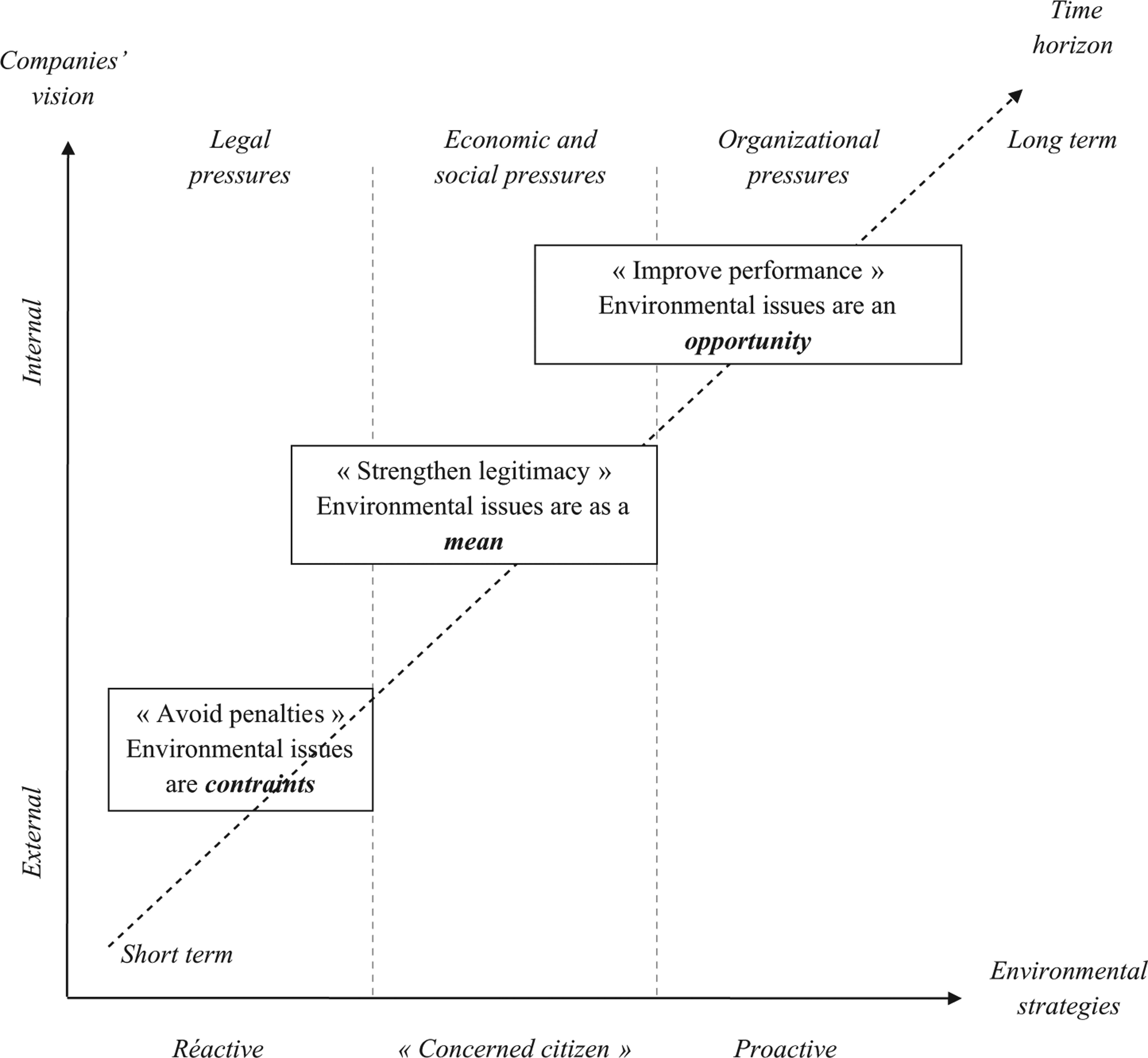
What environmental strategy for what purpose?
Environmental Strategies and Firms’ Performance
Regarding the previous literature, it is difficult to generalize the conclusions as the link between environmental strategies and firms’ performance remain conflicting. Several authors undertook meta-analysis with the aim of reaching theoretical and methodological consensus. Through the analysis of 52 studies, Orlitzky et al. (2003) highlighted the positive relationship between corporate social performance, in which environmental concern is a component, and organizations’ performance. In this case, firm reputational effects moderate the relationship. However, these authors focus on the corporate social performance, which evaluates altogether the implemented services, different environmental programs, and corporate philanthropy together. This approach does not allow a specific analysis of the influence of environmental actions. These authors call for psychometric refinements regarding social and environmental performance outcomes as environmental initiatives. In the same perspective, Allouche and Laroche (2005) confirm Orlitzky et al. (2003) results through the meta-analysis of 82 studies. These authors emphasize that the corporate social performance concept embodies many meanings and is measured by a variety of criteria in different studies. Even so, their meta-analysis also establishes a positive link between corporate social performance and financial performance. However it considers the corporate social performance concept through the direct use of social or environmental ratings without a real conceptual framework. Albertini (2012) focuses on the impact of environmental strategies on financial performance by extending these previous results through the meta-analysis of 52 empirical studies. She details two opposite pro-environmental strategies: proactive environmental strategies and compliance strategies. The author underlines a stronger relationship between proactive environmental strategies and financial performance. However, Albertini (2012) calls for studies that focus on different strategies and for a consideration of the institutional context to clarify the causal structure of the relationship between environmental strategies and an organization’s performance. Accordingly, since no studies have measured the impact of an intermediary strategy such as “concerned citizen” on firm performance (Hunt and Auster 1990; Hamilton 1995; White 1995; Klassen and McLaughlin 1996; Chien and Peng 2012), this article focuses on this intermediate strategy.
Methodological Framework
The Two-Stage DEA Methodology
Analyzing business performance is a central issue in the management literature, yet distinguishing the performance concepts of efficiency, effectiveness, and productivity remains difficult. From a managerial point of view, effectiveness is the relationship between a firm’s objectives and its results, thus measuring its ability to achieve its goals. Efficiency is the relationship between resources used and results obtained, and is represented as a productivity ratio, so productivity can be seen as an indicator of efficiency. Performance measurements are often limited to economic and financial productivity ratios (Conant et al. 1990; Jennings and Seaman 1994; Donthu et al. 2005), but this view suffers from constraints, particularly with respect to evaluating and comparing results. So, the financial approach has to be completed by an operational one (Ilinitch et al. 1998; Molina-Azorin et al. 2009). Where there are only single inputs and outputs, productivity ratios are easy to calculate, but companies generally use multiple inputs, and produce one or more outputs, which means they can be limited when fixed systems set a priori weightings for each input and output (Parsons 1994), and such choices may bias the results and affect efficiency scores. To avoid this problem, performance can be measured in terms of technical efficiency, which refers to the technological relationship between the inputs and outputs in the relevant production technology. Each decision unit is compared with each of the others to determine best practice: if several methods suffer from restrictions, the nonparametric DEA method can measure business unit performance via benchmarking analyses, which can identify how best managerial practices can yield performance improvements (Assaf and Josiassen 2011).
The selected research instrument follows two steps. First, a DEA model is used to estimate ski resorts’ operational performance through technical efficiency scores (see the first stage in Figure 2). Second, in order to identify the determinants of efficiency, we follow the approach of Simar and Wilson (2007) and Zelenyuk and Zheka’s (2006) seminal illustration. Simar and Wilson (2007) define a procedure that consists of bootstrapping DEA scores with a truncated regression, thus allowing consistent estimates and models that explain efficiency scores (see the second stage in Figure 2), by estimating the bias-corrected estimator of the efficiency score, a method they first introduced in the DEA context in 1998.
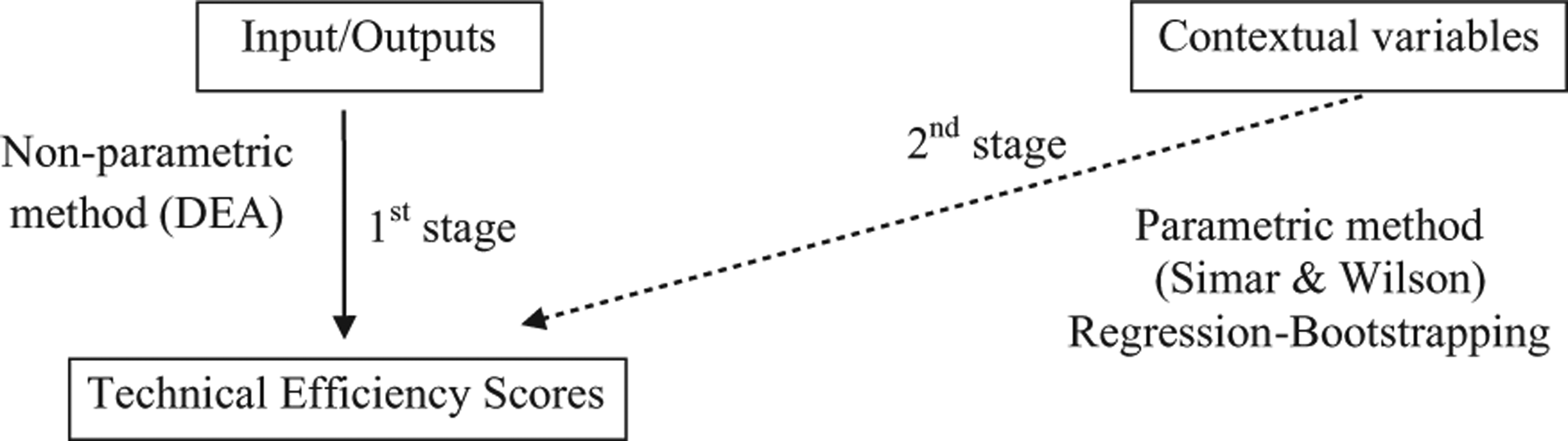
The two-stage data envelopment analysis method.
Estimation of Efficiency Scores (First Stage)
DEA is a nonparametric method based on linear programming which measures technical efficiency, on the basis of the same inputs and outputs, by constructing efficient frontiers for decision making units (DMUs)—in this case the ski resorts—thus identifying best practices (benchmarks) and measuring the comparative efficiency levels for specific ski resorts relative to the best.
DEA is a well-established method in the literature and aims to delineate technical efficiency by defining a frontier envelopment surface for all sample observations. Two DEA models are commonly used: the first—the CCR model, introduced by Charnes, Cooper, and Rhodes (1978)—assumes constant returns to scale (CRS), while the second—the BCC model (Banker et al. 1984)—assumes variable returns to scale (VRS). Figure 3 illustrates the CCR and BCC models in a case with a single input and a single output. Ski resorts are considered as fully efficient if they lie on the frontier, and inefficient otherwise. So the frontier line designates the performance of the best DMUs. In the case of the CCR model, DMUs B and C are efficient at 100%. Thus, the efficiency of the other DMUs—in this case the DMUs A, E, and D—are measured by deviation from the frontier. For example, DMU E is inefficient and can be improved in two ways. One is achieved by reducing the input to E* (input orientation) on the efficient frontier. Another is achieved by raised the output up to E** (output orientation). In the BCC case, DMUs A, B, and C are on the frontier and serve as benchmarks. The distance between the two frontiers (CCR and BCC) permits to take into consideration the scale efficiency and investigate if the DMUs considered operate efficiently according to their scale size.

The CCR and BCC frontiers.
As Figure 3 shows, the DEA model allows for both input and output-oriented methodologies—this study uses the latter, assuming that ski resorts aim to maximize the outputs resulting from their activities. The output-oriented DEA efficiency estimator

where
In the first stage, a comparison between the CCR and the BCC model is proposed in order to take into consideration inefficiency due to the ski resorts scale. In the second stage, the regressed score is the CCR score as proposed in the literature.
Regression Analysis of Determinants of Efficiency (Second Stage)
In analyzing the determinants of efficiency, we follow the approach of Simar and Wilson (2007) and the seminal exposition of Zelenyuk and Zheka (2006). It is recognized in the DEA literature that the efficiency scores obtained in the first stage are correlated with the explanatory variables used in the second term, and this often results in inconsistent and biased second stage estimates (Simar and Wilson 1998, 2000). A bootstrap procedure is needed to overcome this problem (Efron 1979; Efron and Tibshirani 1993). To this end, as explained earlier, we adopt the approach of Simar and Wilson (2007). This new procedure offers some improvement in both efficiency of estimation and inference in the second stage. Specifically, the procedure allows consistent estimates with models explaining efficiency scores, through estimating a bias-corrected estimator of the efficiency score.
The DEA model had been criticized for being a nonstatistical technique (Assaf and Josiassen 2012), and the basic idea of bootstrapping is to transform it into a statistical technique by approximating the distribution of the estimator via resampling and recalculating the DEA efficiency scores. Simar and Wilson (2007) extend the bootstrap procedure to account for the impact of contextual variables on efficiency (see (2) the second stage in Figure 1). The basic idea of bootstrapping is to approximate the distribution of the estimator via re-sampling and recalculation of the parameter of interest, which in our case is the DEA efficiency score. The bootstrap procedure was also later extended by Simar and Wilson (2007) to account for the impact of environmental variables on efficiency. For example, if we take the following model:

where
Here, we assume and test the following specification:

which can be understood as the first-order approximation of the unknown true relationship. In equation (2), a is the constant term,

where

(4) is estimated by the maximum likelihood method, with respect to
A number of studies have considered measuring efficiency in the tourism industry using two-stage procedures. In the transport sector, Barros and Dieke (2008a) estimate the efficiency determinants of airports using Simar and Wilson’s (2007) two-stage procedure, and Assaf (2009) introduces the bootstrapping methodology to analyze and test the scale efficiency of UK airports, while in accommodation, the two-stage method has been used in studies by Barros and Dieke (2008b) and by Assaf, Barros, and Josiassen (2010). In a recent article, Huang et al. (2012) analyzed the influence of macro contextual factors on Chinese hotels’ efficiency with a totally dynamic two-stage model, while Barros et al. (2009) and Barros et al. (2011) have also used the Simar and Wilson (2007) method to analyze the efficiency determinants of Portuguese hotels and the impact of tourism attractions on French destinations’ performance respectively. But to our knowledge, there have been no studies of ski resorts’ efficiency using the two-stage procedure—in fact, Falk (2009) suggests that the lack of technical efficiency studies on ski resorts can largely be explained by the lack of available data.
Sampling and Data Collection
Data to Estimate the Ski Resorts’ Operational Performance (First Stage)
Skiing is by far the major component of winter tourism, which includes all sports (alpine skiing, snowboarding) requiring infrastructure such as ski-lifts. The ski area is considered to be the main physical resource supporting winter tourism destinations and consists of physical spaces (such as ski slopes) and mechanisms (such as ski-lifts) to manage tourist flows in the resorts. Our choice of inputs and outputs followed the practice of previous literature (Coelli et al. 2005) and data availability, and our data collection was concluded with an expert interview in October 2010 with the General Secretary of France Montagnes (en.france-montagnes.com), a federated organization of all the stakeholders of the France ski resort industry (ski lift operators, ski area managers, ski schools, local elected representatives) that provides precise and exhaustive information on all French ski resorts.
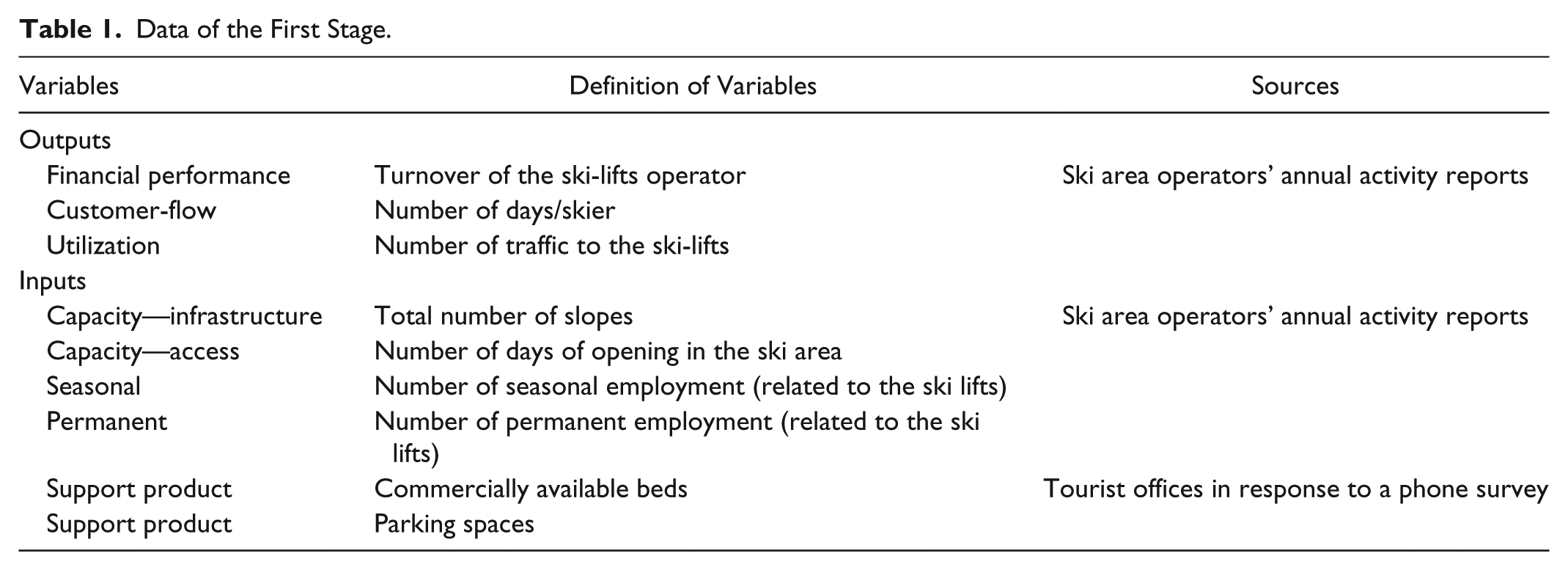
According to the literature review and data availability, three outputs representing the attractiveness of the ski resort destination are selected: ski-lift operators’ turnover figures, total number of ski-passes sold during the ski season and intensity of ski-lifts traffic. Six inputs are considered. Four of them represent functional investments: total number of slopes, number of a ski area’s opening days, and number of permanent and seasonal employees working on the ski-lifts. These data were gathered through ski area operators’ annual activity reports. Two other inputs were provided by tourist offices in response to a phone survey (numbers of commercially available beds and parking spaces) which can be seen as goods and services supporting visitors’ consumption of ski-resorts’ products. Table 1 shows the characteristics of the outputs and inputs considered.
Data of the First Stage.
The combination of the measured indicators ensures adherence to the DEA convention that the minimum number of firms analyzed (here 38 ski resorts) should be greater than three times the number of inputs plus outputs [38 > 3(6+3)] (Cooper, Seiford, and Tone 2006, p. 106).
Data to Regression Analysis of Determinants of Efficiency (Second Stage)
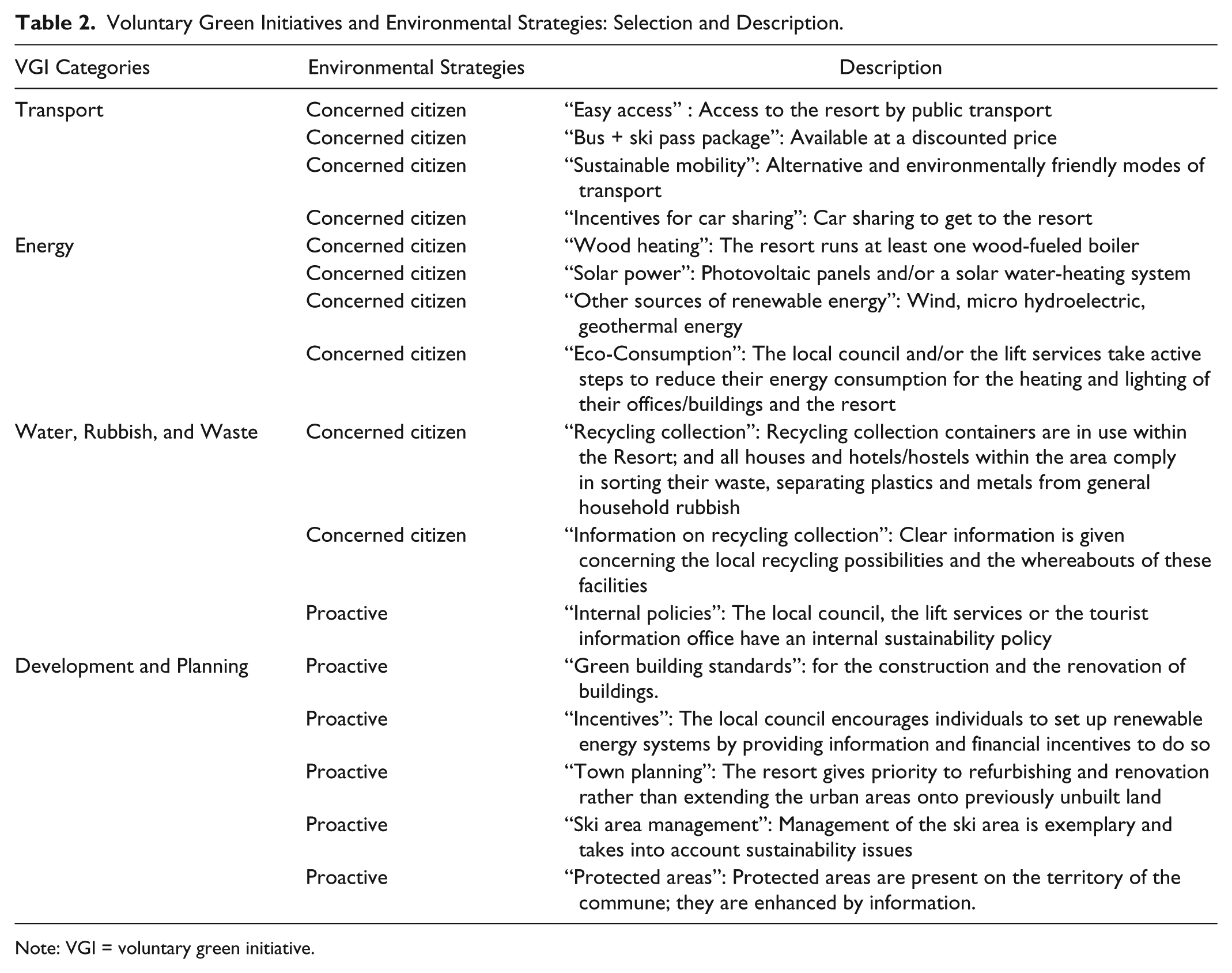
The environmental strategies expressed through VGIs were determined according to a green ski resorts’ guide produced by Mountain Riders, a nonprofit organization created in 2000. This organization works to inform and raise awareness about environmental issues in all the actors involved in mountain pursuits and to promote sustainable development in the mountains by publishing an annual eco-guide to ski resorts (www.mountain-riders.org) . It addresses four separate areas—transport, energy, development/planning, water, rubbish and waste—and represents 16 different VGIs. These VGIs were classified according to two strategies: “concerned citizen” or “proactive” strategy. These two environmental strategies are driven by firms that want to participate voluntarily in environmental programs by going further than government and stakeholder requirements. Table 2 shows the different VGIs assigned to each environmental strategy, that is, “concerned citizen” or “proactive” strategy.
Voluntary Green Initiatives and Environmental Strategies: Selection and Description.
Note: VGI = voluntary green initiative.
Albertini (2012) explains that “concerned citizen” strategies deal with prevention and control measures such as (1) reducing toxic emissions and waste, (2) waste recycling, (3) conserving energy and natural resources, or (4) reducing the impact of the business on ecosystem. Following this author, we consider the four voluntary green transport initiatives (easy access, bus + ski pass package, sustainable mobility, and incentive for car sharing) as actions to reduce toxic emissions. The four voluntary green energy initiatives (wood heating, solar power, other sources of renewable energy, and eco-consumption) permit the conservation of energy and reduce the impact on the ecosystem. The “recycling collection” and “information on recycling collection” actions permit to the reduction and recycling waste. Then, according to the literature, we consider these 10 VGIs as part of “concerned citizen” strategies.
Firms adopting a “proactive” strategy have implemented an internal long-term process of environmental performance improvement such as the Environmental Management Systems (e.g., ISO 14001 certification). These organizational and managerial systems are sustainable production processes (Hart 1995) that help firms to gain a competitive advantage. Thus, we consider the “internal sustainable policy” and “green building standards” (HQE) initiatives as proactive voluntary green initiatives. Moreover, several researchers consider organizational factors as part of a proactive strategy. For example, Albertini (2012) integrates environmental best practices such as environmental investments (Mahapatra 1984) that correspond to the “incentive” variable, less polluting production processes like the “town planning strategy” or “ski area management” selected in this study. “Protected area” initiatives can then be considered as green product stewardship (Hart 1995), which allows a differentiation advantage. In fact, “proactive” strategy is adopted by firms that are “aware of the potential for business advantages offered by the environment” (Albertini 2012, p. 6). Finally, following the literature, we consider these six voluntary green initiatives as part of a “proactive” strategy.
Of the 216 ski resorts in the French Alps, only 38 are analyzed in the eco-guide, and so our sample is composed of these 38 ski resorts and was based on the available environmental data, which was collected between March 2010 and July 2010.
Results and Discussion
Results are presented in two subsections: first, DEA scores are described and, second, the impact of green strategies on ski resorts’ performance is assessed.
Operational Performance Results (First Stage)
This study estimates output-oriented technical efficiency scores, assuming that ski resorts aim to maximize outputs levels. The CCR efficient score model is probably the best known and most widely used DEA model, and assumes CRS (constant returns to scale) relationships between inputs and outputs. The CCR model measures each unit’s overall efficiency by aggregating pure technical efficiency and scale efficiency into one value. The BCC model assumes VRS (variable returns to scale) between inputs and outputs, and just measures pure technical efficiency. The BCC efficiency score is at least equal to the CCR score, and the scale efficiency score is obtained by dividing the aggregate CCR score by the technically efficient BCC score. A unit is scale efficient when the size of its operation is optimal—its scale efficiency score will drop if its size is either reduced or increased relative to optimal size.
Assuming that pure technical efficiency can be attributed to managerial skills, BCC scores are interpreted as a proxy for managerial skills. The DEA scores used in this article are all ratio models, which define efficiency as the ratio of weighted outputs divided by weighted inputs. Radial or proportionate measures are used to determine a unit’s technical efficiency, which is defined by the ratio of the distance from the origin to the inefficient unit, divided by the distance from the origin to composite units on the efficient frontier. Table 3 presents the relative efficiency scores of our sample ski resorts, using the “DEA Solver” proposed in Cooper et al. (2006). A unit with a score of more than 1 (or more than 100%) is relatively inefficient compared to others.
Technical Efficiency Scores for Ski Resorts with CCR and BCC Data Envelopment Analysis Models.
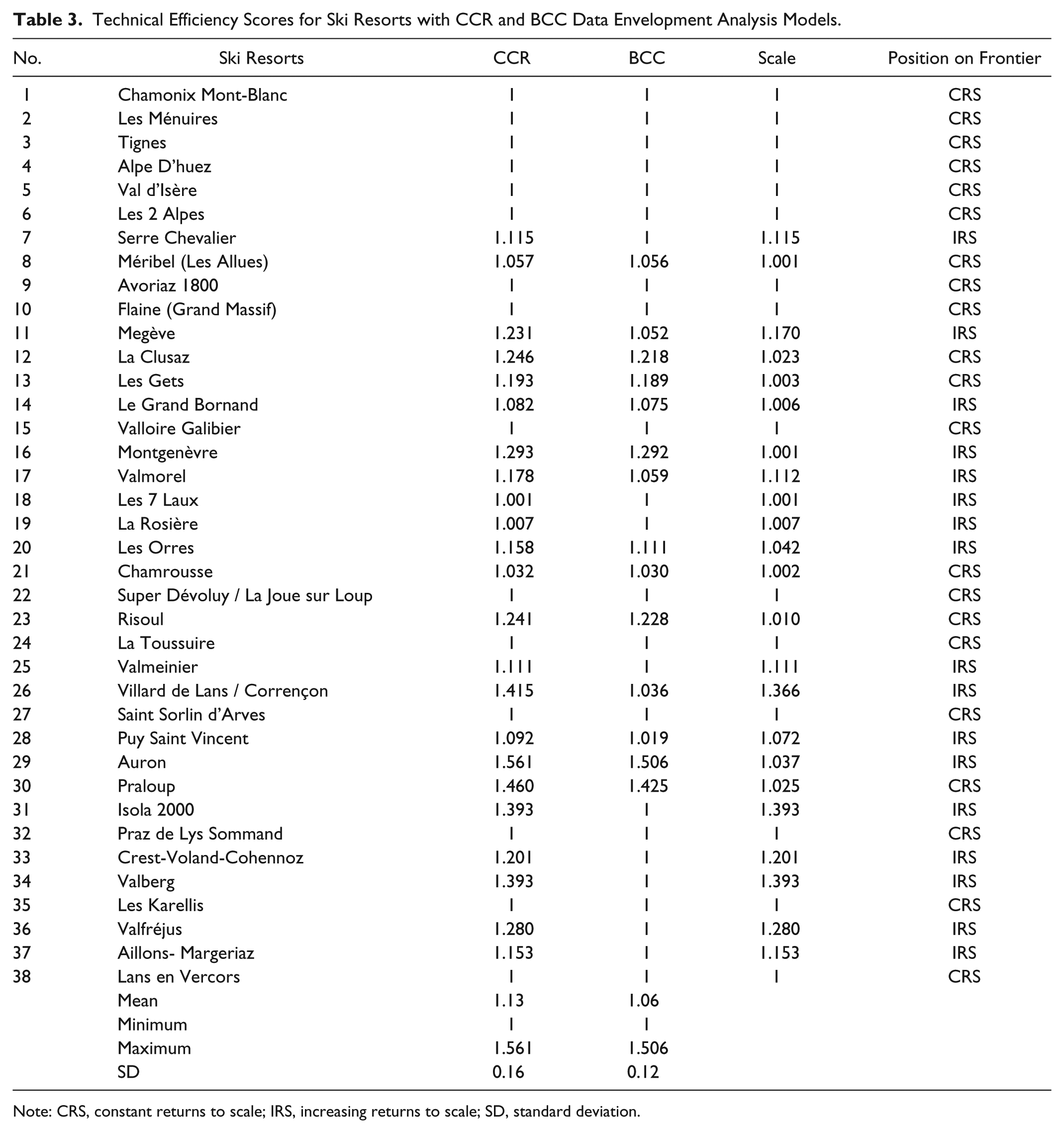
Note: CRS, constant returns to scale; IRS, increasing returns to scale; SD, standard deviation.
A number of points emerge from this study. Our analyses show that 15 ski resorts are measured as efficient by the CCR DEA model and 24 by the BCC DEA model, meaning that the resource levels used by these DMUs allow them to reach optimal production levels. Concerning underperforming ski resorts, the CCR model finds 23 ski resorts inefficient, whereas the BCC DEA model shows 14 that fail to reach optimum efficiency. For example, the Praloup resort’s efficiency score of 1.46 means it needs to increase its output level by 46% to achieve technical efficiency. (Units’ efficiency scores are not absolute, but are relative to those of other units.)
All ski resorts measured as technically efficient in CRS terms (i.e., by the CCR model) are also technically efficient in VRS terms, indicating that scale is the dominant source of efficiency. CRS is assumed if an increase in a unit’s input leads to a proportionate increase in its outputs so that, whatever the unit’s operational scale, its efficiency will remain unchanged assuming it continues its current operating practices. Variable returns to scale mean there are increasing or decreasing returns to scale: increasing returns to scale exist when increasing a unit’s inputs yields a greater than proportionate increase in its outputs, and decreasing returns to scale mean that an increase in a unit’s inputs yields a lower than proportionate increase in output. Variable returns to scale characterize the technical efficiency of ski resorts better—in this study, none displayed decreasing returns to scale, signifying that the French ski resorts are characterized by IRS (or increasing returns to scale), perhaps implying that they are smaller than they optimally should be, and that increasing their dimensions would yield increasing returns. Those resorts exhibiting CRS (constant returns to scale) can be seen as being about the right size.
Environmental Determinants of Firms’ Operational Efficiency
The results show that seven VGIs had positive influences, six had nonsignificant influences and three negative influences, which corroborate the general debate in the literature: some VGIs validate Porter’s hypothesis (e.g., Russo and Fouts 1997), others confirm the key assumptions of the classical model (e.g., Boyd and McCelland 1999). The results obtained with the Stata solver help to distinguish between three types of VGIs according to their impacts on ski resorts’ operational efficiency (Table 4).
Environmental Variables Results.
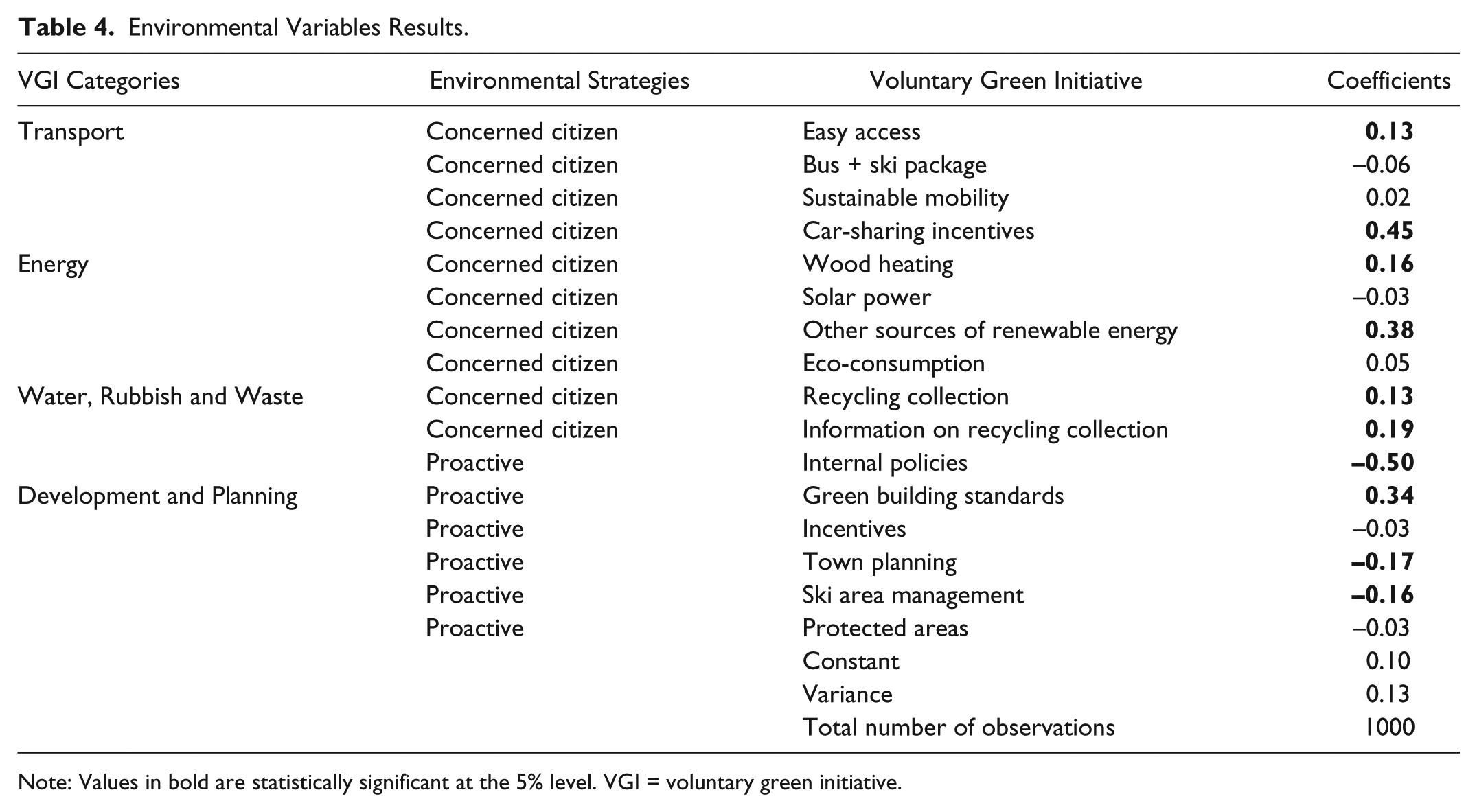
Note: Values in bold are statistically significant at the 5% level. VGI = voluntary green initiative.
Type 1: VGIs (seven in this study) which had positive impacts on efficiency: easy access to the resort by public transport, incentives for car sharing, use of wood for heating, other sources of renewable energy, green building standards, provision of recycling collection, and information on that collection. This corroborates the eco-efficiency management theory (Porter’s hypothesis) by establishing a statistical link between these environmental actions and the resorts’ economic interests (Porter 1991; Porter and Van Der Linde 1995), and shows that such assets can be valuable in terms of supporting viable and high-performing strategies (Russo and Fouts 1997). These assets can be categorized in two ways: tangibles (like using wood for heating) and intangibles (e.g., incentives for car sharing). The first relates to specific services or products delivered by the resort, whereas the second refers to a range of different possible actions, such as communications, that firms can utilize thanks to their flexibility in managing their internal organization process (Hart 1995; Sharma and Vredenburg 1998; Sharma et al. 2007; Aragón-Correa et al. 2008). Indeed, there is a strong support for the notion that being a good environmental “steward” creates a reputational advantage that leads to enhanced performance (Miles and Covin 2000; Hudson and Miller 2005). So ski resort managers investing in these VGIs are likely to improve their businesses’ competitiveness. Regarding the two environmental strategies, six VGIs are related to “concerned citizen” and only one (green building standards) initiative is linked to the “proactive” strategy.
Type 2: VGIs (six in this study) which had no or nonsignificant impacts on performance: bus and ski packages, sustainable mobility, solar power, eco-consumption, incentives, and protected areas. This finding underlines a gap in those studies that focus on short-term analyses. Chien and Peng (2012) demonstrate that, even if investments seem inefficient in the short term, going green can pay off in the long run; for example, Hart and Ahuja (1996) have shown that a company will have to wait two years before it can hope to see improvements in its financial performance as a result of implementing environmental policies. This suggests the need for further investigation via a longitudinal study, but also that ski resort managers should not give up on these VGIs, as they can yield competitive advantages in the future. Concerning nonsignificant VGIs, four of these (bus and ski packages, sustainable mobility, solar power, eco-consumption) refer to the “concerned citizen” strategy and two (incentives and protected areas) to the “proactive” strategy.
Type 3: VGIs (three in this study) which yield negative performance impacts: town planning, ski area management, and resorts’ internal policies. These results seem to corroborate the “traditional view of the corporation” (Pava and Krausz 1996) and thus imply that decision makers need to be strongly committed to environmental management systems (EMS) (Sroufe 2003), as they are not superficial actions but require important managerial, organizational, and methodological changes. Depending on the nature of the specific firm, this negative effect can be associated with a short-term view, and so (again) suggests that researchers need to integrate longitudinal studies to understand the long-term effects of such VGIs (Chien and Peng 2012). This result might also be linked to the organization’s size (Clemens 2006); although no consensus has been achieved in the literature, we can suggest that firms of different sizes are likely to experience different outcomes. Larger firms, with more significant resource levels, will be better able to adapt more quickly and more efficiently to environmental regulations (Fineman and Clarke 1996) and also to implement environmental initiatives not aligned with government constraints. But at the same time, smaller firms characterized by strong managerial vision, flexibility in managing their external relationship, and entrepreneurial orientations may adopt proactive practices and still generate significant positive financial performance (Aragón-Correa et al. 2008). Clearly, managers may give up on these VGIs, which seem to influence organizational performance negatively, and which raises the question of regulation. Two possible strategies, coercion and incentives, emerge for public authorities willing to support the implementation of green actions. Alternatively, government, consumers’ associations, or insurance firms can offer incentives—usually economic—to encourage firms to take environmentally friendly decisions that can have positive impacts, for example, in terms of energy consumption (Heberlein and Warriner 1983; Nwaeze and Mereba 1997) or waste management (Pearce and Turner 1993), although often at the cost of short-term benefits or profitability. These three negative VGIs are all implemented through the “proactive” strategy.
Finally, all positive VGIs except one are related to the “concerned citizen” strategy while all negative VGIs refer to the “proactive” one. Contrary to the current studies, these results reject the hypothesis that a “proactive” environmental strategy is more positively correlated with corporate financial performance than a “concerned citizen” strategy. The goal of a “concerned citizen” strategy is to strengthen corporate social responsibility. This environmental strategy is often considered a communication tool to maintain legitimacy in the market in a short term view. Accordingly, the majority of “concerned citizen” VGIs adopted by ski resorts have a positive impact on performance. By contrast, the “proactive strategy” considers environment actions as an opportunity to improve performance and gain competitive advantage. Therefore, the long-term view of this strategy might explain the nonsignificant and negative impact of VGIs. As Chien and Peng (2012) wrote: “going green can pay off in the long run.” Furthermore, Hart and Ahuja (1996) highlight that it is only after two years that companies can hope to improve their performance. In this perspective, the ski resorts’ environmental strategies have to be conducted in continuous-improvement efforts in an attempt to gain a comparative advantage (Hart 1995).
Conclusion
This study develops an innovative methodological framework to evaluate the influence of environmental strategies on firms’ performance. To do this, we analyzed the effects of implementing two different environmental strategies, through 16 VGIs, on a representative sample of 38 French ski resorts. A two-stage DEA model is used: the first stage integrates multiple inputs and outputs to measure French ski resorts’ operational performance, and the second step uses bootstrapping methodology to investigate the determinants of technical efficiency. Three types of VGIs are identified: positive, nonsignificant, and negative. While a majority of “concerned citizen” initiatives have a positive impact on ski resorts’ performance, all the “proactive” VGIs have negative impact. Contrary to the current studies, these results show that a “proactive” environmental strategy is less positively correlated with organizations’ performance than a “concerned citizen” strategy.
How does this article compare with previous research? This article is not directly comparable with previous research for several reasons.
From a methodological perspective, first of all this study investigated the use of a benchmark quantitative method to assess environmental issues. Most researchers who have analyzed the impact of green strategies on ski resorts’ performance have used qualitative or declarative data, whereas this study uses factual data on an exhaustive sample. Second, this two-step DEA method offers a specific quantitative tool to measure technical efficiency and VGIs’ impact. This research is also the first to use Simar and Wilson’s approach to analyze VGIs’ impact on French ski resorts’ performance.
From an empirical point of view, this study is not comparable with alternative research because it focuses on French ski resorts. Moreover, this study contributes to a better understanding of ski resorts’ strategies, a context that has been little studied because of low data availability (Falk 2009). In fact, the analysis of ski resort efficiency is restricted to a very small number of articles, and to our knowledge, only one contribution can be found in the literature. Falk (2009) compared the conglomerate and independent ski resorts with data on four countries (Canada, France, United States, Switzerland) using the stochastic frontier production approach. Falk explained that the lack of contributions in this field is due to a lack of available data.
From the managerial perspective, this research first clarifies which green strategies and initiatives lead to firms’ financial performance improvement. It helps managers to decide the most appropriate environmental investment to enhance competitive advantage. Second, this research also highlights key roles for public authorities in promoting VGIs that do not offer firms immediate financial efficiency. Two main levers can enhance long-term green strategies: forcing firms through specific regulations or offering them financial incentives.
From the theoretical perspective, this study uses the concept of technical efficiency to analyze the relationship between corporate environmental strategies and corporate financial performance. It contributes to the literature on corporate social responsibility and performance measurement through a classification of three types of VGIs based on their performance impacts and through a comparison on two environmental strategies. Moreover, while previous literature considers that “proactive” strategies are more efficient than “concerned citizen” and “compliance” strategies, these results suggest a new perspective where “concerned citizen” are more efficient than “proactive” strategies. This highlights an inflection point on the correlation between environmental strategy and organization’s performance. The results corroborate Wood and Jones’ (1995) and Russo and Fouts’ (1997) points of view by underlining that the relationship between environmental actions and firm performance is more complex than a simple calculation equating higher cost with lower profit. Which key drivers lead then to environmental performance? Regarding the literature, the inflection point can be interpreted through different lenses: governance (Berman et al. 2000), firm size (Fineman and Clarke 1996), and firm age (Majumdar 1997). However, a Kruskal-Wallis test on these different criteria has failed to verify these relationships. This study therefore calls for further investigation on environmental performance’s key drivers.
One main limitation of this study is due to data constraints, and it would be interesting to analyze data over a more extended period to take into account different environmental situations. So, future studies should investigate the time effect through a longitudinal analysis. Moreover, further research and a potential extension of this approach could be achieved by testing the governance hypothesis (private or public) or the use of categorical variables, such as altitude, to provide a more precise explanation of the links between efficiency and environmental strategies.
Footnotes
Declaration of Conflicting Interests
The author(s) declared no potential conflicts of interest with respect to the research, authorship, and/or publication of this article.
Funding
The author(s) received no financial support for the research, authorship, and/or publication of this article.
Author Biographies
 .
.