




Abstract
Although tourism destination image (TDI) has been extensively studied, the nature and scope of TDI remain vague. This study aims to address this conceptual problem from a modernist perspective. Forty-five representative TDI definitions are analyzed, and a new definition is proposed by adopting a “seven-step” procedure derived from definition theory in logic studies. Results show that (1) currently TDI is defined mainly as the mental/total impressions/perceptions held by tourists pertaining to a destination, (2) such definitions are quasi-theoretical in type and created by roughly following the connotative definition technique, (3) the quality of these definitions is generally low, and (4) the new definition proposed in this study better captures the essence of TDI and considerably reduces TDI’s internal and external vagueness. In defining a key tourism concept, this study has notable implications for advancing TDI research and defining tourism concepts more rigorously.
Introduction
Approximately one year ago, a graduate student approached one of us with two papers. In one study, the authors analyzed a number of destination brochures and attempted to make a case on how destination image was projected. In the other, the authors investigated tourist reviews on social media pertaining to one destination and suggested that these comments were important but not well-understood destination image information. Both studies were competently executed and well written, but the student seemed confused. “I know the communication materials, the online comments, or anything we hear, know, or think of a destination are things related to the image,” she said. “But at what point shall I say that they are destination images?” The student’s question is deceptively simple, but a concrete answer is hard to find despite, since Boulding’s (1956) seminal work, the admirable successes accomplished on the meaning, structure, formation, and measurement of perceived tourism destination image (TDI) (e.g., Gallarza, Saura, and Garcia 2002; Pike 2007).
In fact, the line of research on TDI remains challenged by various problems (Gallarza, Saura, and Garcia 2002; Josiassen et al. 2015; Ko and Park 2000; Lai and Li 2012; Tasci, Gartner, and Cavusgil 2007; White 2004). Among the most fundamental problems is the vagueness of TDI as a concept, as illustrated by the student’s confusion. This conceptual vagueness, that is, a concept having unclear meaning(s) (Hurley 2008), is manifested mainly by the uncertain nature of TDI itself (internal vagueness), TDI being confused with other mental concepts (external vagueness), and the ambiguity of the mental image or even the human mind where TDI can be found (foundational vagueness, to be explained later). Although past studies have proposed several conceptual frameworks and definitions, their contribution to reducing the conceptual vagueness of TDI has been limited (see later). Therefore, the internal/external/foundational vagueness of TDI remains to date, and this vagueness has resulted in doubts regarding the actual usefulness of this construct (White 2004), potential miscommunication among academics (Tasci, Gartner, and Cavusgil 2007), and limited progress toward the truth of TDI.
Based on the broad premise that sound research should be built on well-defined concepts, the conceptual vagueness of TDI should be reduced or eliminated. Therefore, this study aims to address the conceptual problem of TDI better from a definition perspective (e.g., Gerring 1997; Kimiecik and Harris 1996). Note that this study only deals with perceived or mental TDI (rather than projected or physical TDI). This project was guided by definition theory based on definition research from logic study (e.g., Copi and Cohen 2005; Hurley 2008). The specific objectives of this study are twofold: (1) to objectively assess existing TDI definitions and (2) to look for a “better” TDI definition based on these definitions. Sound definitions can be a solution for conceptual problems because they possess “a therapeutic function, as a means of clearing up or avoiding ambiguous, vague, and obscure language” (Abelson 2006, 669).
This study may advance TDI research, one of the most salient topics in tourism research (e.g., Gallarza, Saura, and Garcia 2002; Pike 2007; Xiao et al. 2013), by alleviating the vagueness surrounding TDI. The results may help identify the essence of TDI and promote academic research and management practices informed by such study. This study also recommends an important but less noticed approach for tourism researchers to define tourism concepts. The quality of definitions can be enhanced under the guidance of definition theory, as will be demonstrated by this study.
Such an informed definition approach is particularly necessary to tourism research, which has recorded some other ambiguous concepts, such as tourism (Smith 2007b), tourist (McCabe 2009), heritage tourism (Poria, Butler, and Airey 2001), tourism industry (Leiper 2008), and sustainable tourism ( McCool, Moisey, and Nickerson 2001. For many (e.g., Leiper 2008; Smith 2007a), the fragmented and inadequate understanding of basic tourism concepts is problematic and should be avoided. The definitional solution proposed by this study, not a panacea by any means, may decrease their ambiguity and thus enhance the rigor of tourism research. In fact, miscommunication and even “academic battles” among different users (e.g., researchers, practitioners, and policymakers) of the same concepts can be decreased when these concepts are provided with logically clarified meanings.
Literature Review
Conceptual Problems of TDI and Its Extant Solutions
The conceptual problem of TDI has at least three major manifestations, namely, internal, external, and foundational vagueness. Internal vagueness refers to the poor understanding of the nature of TDI. “What constitutes TDI? What are the attributes of TDI? How are these attributes organized? Are some of them more fundamental?” These questions remain largely open because past research has resulted in a group of conceptual approximations (Lai and Li 2012; Tasci, Gartner, and Cavusgil 2007) and “there are almost as many definitions of image as scholars devoted to its conceptualization” (Gallarza, Saura, and Garcia 2002, 59). External vagueness denotes the difficulty in drawing a dividing line between TDI and other close mental concepts (see also Josiassen et al. 2015). As Tasci, Gartner, and Cavusgil (2007, 195) observed, “There are a number of studies of subjects that are actually similar, seemingly similar, or closely related to the destination image construct.” For example, how TDI “differs from other commonly used tourism research constructs, such as perceptions or attitudes and for that matter dreams, hallucinations and imagination” (White 2004, 309) remains unclear.
Foundational vagueness refers to the inherent ambiguity of a mental image (or imagery) and the human mind where TDI can be found. Despite the available literature on mental image, the concept remains uncertain on what it is, whether it exists, and whether it really matters (Thomas 2010). Even if a mental image actually exists, debates are common on whether an image is a mental experience or a mental representation, whether it is picture-like or otherwise, and how it is related to perception (Thomas 2010). However, the problem of mental image is only secondary to the challenge of conducting a scientific study of the human mind where both TDI and mental image can be found. The philosophy of mind, where the nature of mind is most seriously discussed, offers an imprecise picture in which competing theories about the human mind (e.g., materialism, idealism, dualism, and pluralism) coexist, each with its own strengths and weaknesses (Heil 2013; Kim 2011). In fact, this field remains “one of the most imaginative, fertile, and hotly contested areas of research . . . still just as far from a solution to its central problem as we ever were” (Burwood 2003, 234). Without clarifying these fundamental concepts first, TDI is perhaps doomed to vagueness.
Various solutions have been offered to address the conceptual problem of TDI. Before presenting these solutions, three views on conceptual problems should be mentioned to avoid logical confusion. These views are (1) modernism, which indicates that concepts should have clear meanings that reflect the essence these concepts represent (Carnap 1967; Frankfurt 2005), (2) postmodernism, which indicates that concepts have different meanings in different situations (Guba 1990), and (3) nihilism, which indicates that concepts themselves have no meanings at all (Quine 1992). The postmodernist stance appears to be increasingly influential among tourism researchers because this view fits the inter-/intra-/postdisciplinary status of tourism as a research field. Concepts seldom have unified meanings in this field. Therefore, determining which of the three epistemologies is reasonable is itself a philosophical question (Lycan 2000) and is beyond the scope of this study. In recognizing the vagueness of TDI as a problem, this study takes the modernist stance.
After introducing and justifying the conceptual problem, we now show how it has been addressed. Among the solutions offered by TDI researchers, two are noteworthy. First, several conceptual models of TDI have been proposed. For instance, Gallarza, Saura, and Garcia (2002) conducted a comprehensive review of the literature and proposed a framework in which TDI is considered complex, relative, multiple, and dynamic. The three-continuum model (Echtner and Ritchie 1991), the dimensional model (Baloglu and McCleary 1999; Gartner 1993), the long tail distribution model (Pan and Li 2011; Stepchenkova and Li 2012), and the core–peripheral model (Lai and Li 2012) are among the other important works exerted to understand the internal structure of TDI. A spate of TDI definitions has also been developed (e.g., Gartner and Hunt 1987; Hunt 1975; Kim and Richardson 2003; MacKay and Fesenmaier 1997). According to Copi and Cohen (2005), a definition should carry the meanings of the concept defined. Therefore, TDI definitions can be considered as attempts to identify the semantic dimensions of TDI.
How good are these existing solutions? This question is crucial because if the solutions had been good enough, this study would have no more work to do and thus must stop here. However, a critical evaluation of the solutions shows that this is probably not the case. Specifically, the model of Gallarza, Saura, and Garcia (2002) does not necessarily distinguish TDI from other concepts, as many concepts (e.g., attitude, perception, and memory) bear all such attributes (i.e., being complex, relative, multiple, and dynamic). However, these concepts should not be treated as mere synonyms of a mental image and should not be equated with TDI. That said, if examined against a postmodern perspective, this critique would be invalid. Regarding the structural models, they are challenged by debates on whether TDI is structured or unstructured (Pan and Li 2011) and on the different structural models recommended (Lai and Li 2012).
Besides, when examined together, TDI definitions indicate divergence among TDI researchers about whether TDI is holistic or atomistic, subjective or objective, and affective or cognitive. Most definitions do not appear to appreciate the difference between TDI and its neighboring concepts, such as attitude, perception, and prejudice (to be explained later). The mainstream literature on the philosophy of mind (Heil 2013; Kim 2011) and psychology (Myers 2004; Richards 2009; Zimbardo, Johnson, and McCann 2009) indicates that mental image (including TDI) and such concepts are overlapping yet distinctive concepts.
Finally, the conceptual problem of mental image and mind remains. In general, TDI research appears to be reluctant to connect TDI with those fundamental constructs. Admittedly, several studies (e.g., Tasci, Gartner, and Cavusgil 2007; White 2004) do return to “mental image” and even “mind” to conceptualize TDI better. However, less attention has been drawn to the fundamental debates on the nature of these basic concepts recognized by researchers in psychology and philosophy, not to mention resolving these debates. In view of extant solutions, TDI as a key tourism concept is still challenged by conceptual ambiguity, a problem that should be addressed further. This study intends to do so by conducting a “definition analysis” on existing TDI definitions and subsequently creating a new definition. The following section provides a brief introduction of definition theory.
Definition Theory
Definition theory refers to a systematic body of knowledge on definitions that touches on the nature, typology, function, technique, evaluation, and limitation of definitions. “Theory” in this study is used in a loose sense (cf. Smith et al. 2013). Although the issue of structuring and analyzing definitions has been addressed across various disciplines, logicians and philosophers continue to discuss this issue (e.g., Abelson 2006; Copi and Cohen 2005; Gupta 2008; Hurley 2008; Robinson 1954). This study mainly relies on recent works in logic study to introduce definition theory (Copi and Cohen 2005; Hurley 2008).
According to Abelson (2006), the four different understandings of the nature of a definition are essentialistic, prescriptive, linguistic, and pragmatic. For essentialistic, to define is to identify the essence of object(s) to which a word refers. For prescriptive, to define is to designate how a word should be used in a given context. For linguistic, to define is to report the usage of a word in history. For pragmatic, to define is to perform what the essentialistic/prescriptive/linguistic notion of the definition claims based on the actual/contextual need for a definition. Regardless of the perspective adopted, a definition usually consists of two parts, namely, a word to be defined (definiendum) and words that do the defining (definiens) (Copi and Cohen 2005; Hurley 2008). Therefore, creating a definition requires providing the definiens to the definiendum. More importantly, for a definition to be possible, the definiens must have identical meanings to yet possess clearer meanings than the definiendum.
Definitions can be divided into stipulative, lexical, précising, theoretical, and persuasive categories (Copi and Cohen 2005; Hurley 2008). Briefly, a stipulative definition assigns meanings to a word (usually a neologism or technical term) freely and cannot be true or false. A lexical definition only reports the extant meanings of a word and can be right or wrong. A précising definition adds sharpness to a word with vague meanings. A theoretical definition provides a word its theoretically sound or scientifically useful meanings. A persuasive definition assigns meanings to a word through expressive rather than informative languages. These definitions are not mutually exclusive, and an alternative categorization of definitions exists (Deslauriers 1990; Gupta 2008). Table 1 provides examples of the five types of definitions. According to definition theory, different types of definitions have different functions (Abelson 2006; Gupta 2008). Stipulative and lexical definitions aim to reduce ambiguity, précising definition focuses on diminishing vagueness, theoretical definition promotes theoretical understanding, and persuasive definition aims to change the attitude or behavior of the audience involved (Copi and Cohen 2005; Hurley 2008).
Five Major Types of Definitions.

Definitions can be built through denotative and connotative techniques. The denotative technique assigns meanings to a word by indicating the members of the class that the definiendum denotes, and this technique leads to three types of denotative definitions: ostensive, enumerative, and subclass. For instance, an ostensive definition of “tourist attraction” can be theme parks, resorts, cultural heritages, scenic spots, and museums, among others. In this case, tourist attraction serves as the “class,” and the specific attractions enumerated act as “members.” By contrast, the connotative technique assigns meanings to a word by indicating the qualities or attributes of object(s) to which a word refers. The four types of connotative definitions are synonymous, etymological, operational, and genus-and-differentia. For example, a genus-and-differentia definition of “tent” can be “a collapsible shelter made of canvas or other material that is stretched” (Hurley 2008, 102). In this case, “shelter” is the genus, and “collapsible” and “made of canvas . . .” are the differentia. Detailed accounts and examples of the two techniques can be found in Copi and Cohen (2005) and Hurley (2008).
The connotative technique, especially the genus-and-differentia technique, is generally considered more important and useful than its denotative counterpart (Copi and Cohen 2005; Hurley 2008). Two steps are usually followed in building a genus-and-differentia definition. The first step is to find a proper genus to which an entity that is represented by a word belongs. The second step is to find for this entity the differentiating attributes that separate it from other entities within the same genus. In evaluating a genus-and-differentia definition, five criteria are required: the definition should (1) convey the essential meaning of the word being defined; (2) avoid circularity; (3) be neither too broad nor too narrow; (4) avoid figurative, obscure, vague, or ambiguous language; and (5) not be negative when it can be affirmative (Copi and Cohen 2005). In fact, such criteria can be applied to all connotative definitions (Copi and Cohen 2005). In terms of actual effects, an acceptable genus-and-differentia definition must be able to separate a word from nuanced others that belong to the same genus.
Notably, the definitions discussed here are mainly nominal definitions rather than operational definitions commonly used in research practices or everyday language. Philosophers have argued that fully formalized theories require a formal language system, which is inherently different from natural language systems. A formal language system requires nominal definitions that “have to do with relationships among terms alone (syntactic considerations)”; by contrast, operational definitions “have to do with relationships between terms and the real world (semantic considerations)” (Hunt 2010, 177). To sum up, definition theory from logic study captures the nature of definitions and offers useful guidelines for scientific creation/usage of definitions. Definitions have been widely used to clarify key concepts because of their proven benefits (e.g., Gerring 1997; Kimiecik and Harris 1996; Smith 1991), albeit these definitions also have certain limitations, such as circularity and lack of direct empirical support (e.g., Abelson 2006; Gratton 1994).
Research Questions
The foregoing review suggests that TDI’s conceptual problems still exist, and definition theory may provide valuable clues to address this issue. Therefore, this study addresses the conceptual problem from the perspective of definition theory. Four research questions are introduced to guide this project: What are the shared characteristics of the various proposed definitions? What are the types of the definitions, and how are they provided? How good are they? If the existing ones are judged by key definition theory principles to be somewhat flawed, is giving a better TDI definition possible? Answering the first three questions is logically necessary for the last one to be answered, as only when we understand the common features, types, and methods of extant definitions can we find a proper way to evaluate them. Further, only when these definitions are soundly evaluated can we start discussing whether a new definition for TDI is necessary as well as the process of building it.
Study Methods
Analytical Procedure
This study addresses the above-mentioned questions by first selecting a group of representative TDI definitions. Definition theory is then applied to detect their shared features (stage 1), type (stage 2), and definition technique (stage 3) and to evaluate the quality of the selected definitions (stage 4). Based on these analyses, the research explores whether and how better TDI definitions can be created (stage 5). In developing a TDI definition, a “seven-step approach” is adapted from definition theory (Copi and Cohen 2005; Hurley 2008). These steps intend to (1) identify concepts similar to TDI; (2) identify a proper genus that incorporates these concepts; (3) identify common attributes that these concepts represent; (4) determine the attributes that can separate TDI from other concepts in the same genus; (5) express the definition clearly; (6) test the quality of the definition and if necessary restart steps 1 to 6; and (7) revise the definition when more nuanced concepts of the same genus appear. Stages 1 to 4 aim to assess the targeted TDI definitions and serve as the logical basis for the analysis at stage 5. Figure 1 visualizes the above-mentioned analytical procedure.

Inherent logic of the analytical procedure.
Selection of TDI Definitions for Analysis
The success of this study depends on the crucial selection of TDI definitions that reflect tourism researchers’ understanding of this concept. The research team searched the mainstream tourism literature (i.e., journal articles, books, thesis, and dissertations) for such definitions. The criteria are tourism-specific (i.e., the definition is provided by tourism researchers), original (i.e., the definition is not a paraphrased version of other definitions), and normative (i.e., the definition meets the basic requirement of definitions). The scope and criteria were set by the present authors on the basis of the nature of this study and tenets from definition theory. Initially, 71 entries were sought. The authors examined each entry separately and kept only those that met all three criteria. This process led to a list of 45 valid entries, which consisted of TDI definitions based on sound conceptualization (e.g., Son and Pearce 2005; Tasci, Gartner, and Cavusgil 2007), classic TDI research (e.g., Crompton 1979; Echtner and Ritchie 1991; Hunt 1975), oft-cited studies (e.g., Baloglu and McCleary 1999; Gallarza, Saura, and Garcia 2002), and some less known for now yet with decent academic quality. In cases of divergent opinions, the two authors discussed and reasoned together until a consensus was reached. In other words, the finalized entries had full support from both authors. This final list was a reasonably representative sample of TDI definitions.
Research Findings
Stage 1
An overview is necessary before the type, technique, and quality of the selected TDI definitions can be discussed. A useful way is to identify, for each definition, the core word(s) defining the nature of TDI and the restrictive term(s) used to restrict the core words. This internal structure is common for academic definitions. The analysis shows 33 core words used to describe the nature of TDI (Table 2) and 47 determinants used to delimit the core words (Table 3). A closer look shows that “impression” (45.45%) is the most adopted core word, followed by “perception” (27.27%), “belief” (18.18%), and “idea” (18.18%). The first two major TDI determinants are “about certain objects” (70%) and “held by certain subjects” (45%) and are followed by TDI being “holistic” (19%) and “mental” (15%). These terms are the most common features of the analyzed TDI definitions. The results indicate that researchers tend to believe that TDI denotes holistic/mental impressions/perceptions held by tourists about a destination. However, apart from this tendency, the analysis failed to locate a univocal definition for TDI.
Core Words Used to Define the Nature of TDI.

Names of the authors are as follows: 1: Hunt (1971); 2: Hunt (1975); 3: Crompton (1977); 4: Lawson and Bond-Bovy (1977); 5: Crompton (1979); 6: Gartner (1986); 7: Phelps (1986); 8: Fridgen (1987); 9: Gartner and Hunt (1987); 10: Calantone et al. (1989); 11: Embacher and Buttle (1989); 12: Gartner (1989); 13: Chon (1990); 14: Reilly (1990); 15: Um and Crompton (1990); 16: Echtner and Ritchie (1991); 17: Fakeye and Crompton (1991); 18: Dadgostar and Isotalo (1992); 19: Santos Arrebo (1994); 20: Milman and Pizam (1995); 21: Parenteau (1995); 22: Alhemoud and Armstrong (1996); 23: Bramwell and Rawding (1996); 24: Dann (1996); 25: Jenkins and McArthur (1996); 26: MacKay and Fesenmaier (1997); 27: Pritchard (1998); 28: Walmsley and Young (1998); 29: Baloglu and McCleary (1999); 30: Choi, Chan, and Wu (1999); 31: Sussmann and Unel (1999); 32: Coshall (2000); 33: MacKay and Fesenmaier (2000); 34: Murphy, Pritchard, and Smith (2000); 35: Tapachai and Waryszak (2000); 36: Bigne, Sanchez, and Sanchez (2001); 37: Day, Skidmore, and Koller (2002); 38: Gallarza, Saura, and Garcia (2002); 39: Sönmez and Sirakaya (2002); 40: Beerli and Martin (2004); 41: Kim and Richardson (2003); 42: O’Leary and Deegan (2003); 43: Son and Pearce (2005); 44: Tasci, Gartner, and Cavusgil (2007); 45: San Martin and Bosque (2008).
Restrictions on the Core Words.

The authors are the same as those in Table 2.
This is a composite phrase designated by the present authors, with the original terms being as follows: state, area, object, place, destination; attribute, brand, event, product, entity, benefit, attraction, and reality.
The original terms are as follows: person, potential visitor, group, tourist, seller, other, audience, distributor, general public, and members of a group.
The original terms are as follows: sum, total, overall, holistic, and gestalt.
Stage 2
A careful analysis of the extant TDI definitions suggests that strictly speaking they may not belong to any of the five definition types, namely, stipulative, lexical, précising, theoretical, and persuasive (Copi and Cohen 2005; Hurley 2008). Specifically, TDI is not a neologism that has meanings that can be casually assigned, and thus the existing definitions cannot be stipulative. Most of the definitions are not borrowed from dictionaries and do not intend to report TDI’s possible meanings in use. Therefore, the TDI definitions should not be treated as lexical. They cannot be called précising definitions as well because, quite the opposite, many of them are imprecise. For example, “impression” and “idea,” which are commonly used core words, are not established psychological concepts and have vague meanings themselves. Given that many TDI definitions lack theoretical robustness and/or scientific utility (see later), they fall short of being theoretical definitions. Neither are they likely to be persuasive definitions because not much indicates that TDI researchers have attempted to persuade others to agree with them in conceptualizing or operationalizing TDI. In addition, they have not used seditious expressions in defining TDI. The above-mentioned analysis fails to determine the types of TDI definitions. However, among the five definition types, the existing definitions tend to be theoretical: TDI researchers may intend to propose definitions with both theoretical and scientific rigor but are somehow unable to actualize their attempt. In this sense, we can state that existing TDI definitions are quasi-theoretical in type.
Stage 3
Concerning the denotative and connotative techniques, TDI researchers have not adopted the former. No proof exists that researchers, when providing their definitions for TDI, use examples of TDI to explain this concept. Therefore, the definitions tend to be based on the connotative method. Further analyzing the structure of the TDI definitions indicates that among the four submethods of the connotative definition method, namely, synonym, etymological, operationalized, and genus-and-differentia, the fourth may have been followed. In fact, most extant definitions offer both genera (i.e., core words) and differentiae (i.e., restrictive terms). An example is Hunt’s (1975, 15) definition: “the perceptions held by potential visitors about an area.” Clearly, this definition contains one genus (i.e., “perceptions”) and two differentiae (i.e., “held by potential visitors” and “about an area”). Similar assessments can be made of most, if not all, of the remaining definitions. That said, examining the actual defining process indicates that previous studies did not strictly adopt the genus-and-differentia approach. Rather, most researchers (e.g., Gallarza, Saura, and Garcia 2002; Son and Pearce 2005; Tasci, Gartner, and Cavusgil 2007) developed their TDI definitions by synthesizing previous works.
Stage 4
Most TDI definitions appear to be theoretical in type and roughly follow the genus-and-differentia technique. Therefore, we can assess their quality by testing the extent to which they meet the five criteria of genus-and-differentia definitions. The assessment first reveals that the definitions did not use circular expressions, were all affirmative in tone, and met criteria 2 and 5. However, the remaining criteria were not well observed. One, the definitions may not adequately convey the essential meaning of TDI (violating criterion 1). According to definition theory, a definition captures the essence of a concept only when it provides a set of conventional attributes with good discriminating power. In the 45 definitions analyzed, the obviously conventional attributes are “about certain objects,” “held by certain subjects,” “holistic,” and “mental” (cf. Table 3). However, these attributes may be incapable of differentiating TDI from related concepts, such as attitude and perception. In fact, most mental concepts in the minds of tourists bear all these attributes. Even if some of the less conventional attributes (e.g., multisensory) in Table 3 have stronger discriminating power, TDI researchers did not indicate how such attributes should be determined.
Two, some definitions are too broad or narrow in scope (violating criterion 3). This criterion applies to both the genera (core words) and the differentiae (restrictive terms). Defining TDI as “feeling” or “prejudice,” for instance, will lead to narrow definitions because TDI does not have to be biased and can include components other than feelings. By contrast, defining TDI as “interpretation,” “combination,” “association,” “idea,” “conception,” or “strategy” results in TDI definitions being too broad in scope because these concepts are vague in meaning. The restrictive terms in Table 3 reveal that several terms (e.g., “by certain subjects,” “about certain objects,” and “mental”) impose loose restrictions on TDI, whereas others (e.g., “unique,” “visual,” and “total”) produce restrictions that could be too strict or even contentious among TDI researchers. Therefore, extant definitions do not demonstrate the proper genera and differentiae of TDI, and even if they do, such genera and differentiae are at best implicit and elusive.
Three, some of the definitions contain problematic expressions (violating criterion 4). Words such as “impression,” “picture,” “net-result,” “phenomenon,” “interpretation,” “reflection,” and “variable of analysis” (Table 2) appear to be figurative terms with unclear meanings. Several core and restrictive words also exhibit divergent opinions, such as “feeling” and “belief” in Table 2; “subjective” and “objective,” “unique” and “common,” and “emotional” and “in an individual’s cognitive system” (Table 3). Taken together, the evaluation indicates that despite all strengths, extant TDI definitions still have much room for improvement.
Stage 5
The above-mentioned analyses suggest the necessity of seeking better TDI definitions. The standard of better definitions does vary on the basis of the different definition types and techniques. Considering the dominance of theoretical definitions and the genus-and-differentia definitional technique (Copi and Cohen 2005; Hurley 2008), this study attempts to seek a better theoretical TDI definition by following the genus-and-differentia approach. This task is guided by the seven-step approach (cf. Analytical Procedure) based on the tenets of the genus-and-differentia technique.
Step 1 identifies a nomological network of concepts that overlaps with (i.e. being both similar to and different from) TDI, and this network includes sensation, perception, mental representation, cognitive map, consciousness, memory, and attitude. This decision is based on synthesizing the core words in the TDI definitions (cf. Table 2), the suggestions of TDI researchers (Tasci, Gartner, and Cavusgil 2007; White 2004), the authoritative and state-of-the-art arguments of psychological researchers on such concepts (Myers 2004; Richards 2009; Zimbardo, Johnson, and McCann 2009) (see Table 4 for detailed information), and the judgment of the authors. These concepts represent, rather than equate with, the concepts that have similar meanings with TDI. Moreover, all of these concepts are established psychological concepts rather than concepts that are used in daily conversations to ensure that the new TDI definition has greater scientific rigidity.
Key Differentiae of Mental Image.
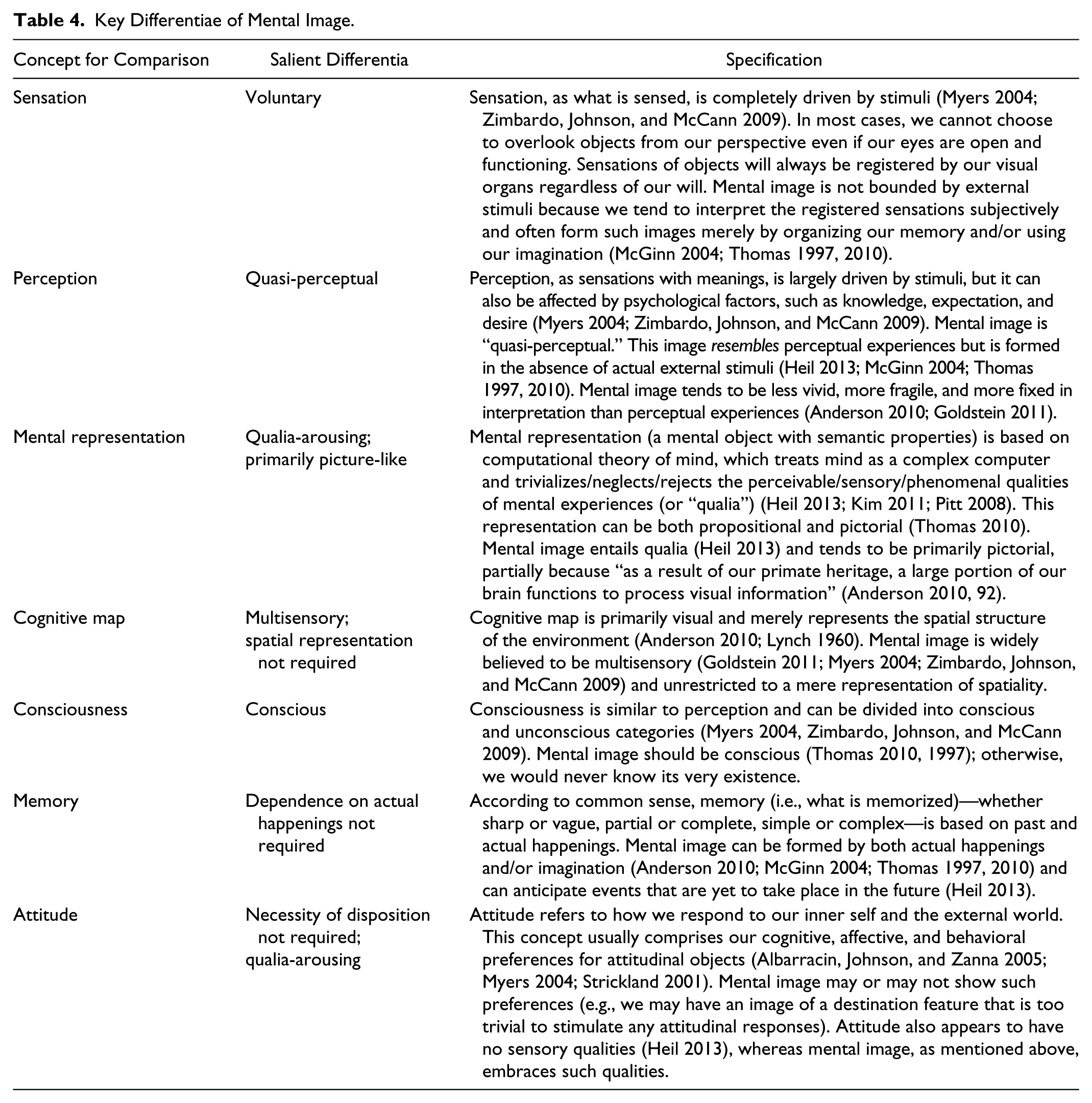
Step 2 determines the genus that can embrace TDI and the concepts that are proposed in step 1. A key question is to which genus these concepts belong. Similar to the pluralist nature of the concepts in step 1, the genus is also inherently multiple. The genus can vary in accordance with the basic requirement that a genus must be more encompassing in logic than its members (i.e., the concepts that belong to a specific genus). Being, mind, mental phenomenon, idea, and experience are some of the options that may be considered. Experience is eventually selected as the most desirable genus to consider the general readership of TDI research and to avoid using genera that are too broad (e.g., being and mind). Similar to all mental concepts, experience can be discussed at both physical and psychological levels (Heil 2013). The former deals with the neurophysiologic basis of experience, whereas the latter refers to its mental properties, namely, the events, states, and processes that occur in mind when something is experienced. This study limits the discussion of experience (the genus) and its internal concepts at the psychological level.
Step 3 identifies the common attributes of the included concepts. Overall, “mental” can be selected as the primary attribute. In accordance with the philosophy of mind, being mental may indicate (1) personal awareness, such that mental experience is direct, private, and self-intimate for the subjects who possess such experience; (2) nonspatiality, such that mental experience does not have spatial properties; and (3) intentionality, such that mental entities always refer to something (Kim 2011, 17–27). Moreover, (4) “held by tourists” and (5) “towards a destination” must be included as common attributes. We treat “destination” only as a modifier, although other research indicates that tourism destination, as a concept, has multiple meanings (e.g., Pearce 2014; Reinhold, Laesser, and Beritelli 2015). Given the word limit and the purpose of this study, we emphasize the attributes of “image” which is modified by “tourism destination.” This decision, Jenkins (1999, 1) advises, is made because “[a]t the heart of the definitional dilemma [of TDI] is the understanding of the term ‘image.’”
Step 4 determines the differentiating attributes of TDI by comparing TDI with each of its overlapping concepts. TDI is a context-specific definition (largely in the tourism context). For comparison, we investigate the concept in its most basic form. Given that mental image is the core of TDI (Jenkins 1999), we replace TDI with “mental image” in the comparison, and we eventually identify nine initial differentiae (Table 4). For scientific simplicity, “spatial representation not required,” “dependence on actual happenings not required,” and “necessity of disposition not required” are excluded because they are atypical of mental image. We eventually keep six differentiae for TDI: (1) voluntary, (2) multisensory, (3) primarily picture-like, (4) qualia-arousing, (5) conscious, and (6) quasi-perceptual.
Step 5 defines TDI in a clear language. Based on the above analysis, TDI can be defined as follows:
a voluntary, multisensory, primarily picture-like, qualia-arousing, conscious, and quasi-perceptual mental (i.e., private, nonspatial, and intentional) experience held by tourists about a destination. This experience overlaps and/or parallels the other mental experiences of tourists, including their sensation, perception, mental representation, cognitive map, consciousness, memory, and attitude of the destination.
This definition comprises three integrated components, namely, genera, common and differentiating attributes, and differentiated concepts.
Step 6 tests the quality of the above definition using the criteria of genus-and-differentia definitions. Overall, this new TDI definition has an acceptable quality. The new definition (1) better conveys the essential meaning of TDI by identifying nine attributes (i.e., three common and six differentiating attributes), (2) avoids circularity, (3) is neither too broad nor too narrow, (4) avoids figurative, obscure, vague, or ambiguous language, and (5) utilizes affirmative tones. More importantly, this new definition can distinguish TDI from the concepts within the realm of mental experience and mention these concepts overtly. Step 7 revises and improves the proposed definition over time. Whether the current definition can stand the test of time may be of interest for future research.
Discussion and Conclusion
This study attempted to address the conceptual problem of TDI, a major concept in tourism research. Guided by definition theory, this study examined the shared attributes of the existing TDI definitions, types, manner of creation, and qualities. This analysis stimulated the development of a new TDI definition that could meet the basic criteria for genus-and-differentia (or connotative) definitions. The following sections speculate on the reasons behind the findings and discuss their theoretical implications.
Explaining Key Findings
This study has four major research findings. First, our analysis finds that previous studies tend to define TDI as “mental/total impressions/perceptions held by tourists about a destination.” Presumably, this definition is widely used out of a practical concern. For instance, impression is more of a colloquial term. It is more natural to ask tourists “What is your impression of Destination A?” rather than “What is your image of Destination A?” Alternatively, this preference may mirror the hidden power structure (Leiper 2008) in this line of research. That is, researchers usually need to cite influential definitions to pass the peer-review process and develop similar attitudes toward TDI. Second, existing definitions tend to be theoretical and follow the genus-and-differentia technique. The characteristics of extant TDI definitions and our adopted definition theory jointly explain the reason behind this result.
Third, the less than optimal quality of the existing definitions may have both subjective and objective causes. Subjectively, the low quality may be caused by the emphasis on using rather than on theorizing this concept. For instance, the interest in operationalizing TDI may have outweighed that in delineating and exploring what the concept actually means. Although most of the existing TDI definitions adopt the genus-and-differentia technique as evidenced in their structure, none of these definitions were constructed by strictly following such technique. Objectively, the difficulties in defining TDI illustrate the vague nature of the mental image (e.g., Thomas 2010) and of the human mind (Heil 2013; Kim 2011). When such fundamental concepts are still being debated (e.g., whether the mental image is a visual or propositional representation), TDI can hardly be defined scientifically. Finally, regarding our last finding, namely, the new TDI definition proposed, it results from many factors (i.e., the logic of definition theory, knowledge of TDI and its neighboring concepts, and development of research on mental image and mind) and our interpretation of them.
Revisiting the Conceptual Problem of TDI
Our main goal is to address the conceptual problem of TDI as manifested by its internal/external/foundational vagueness. This section evaluates the extent to which this goal has been achieved and discusses the contributions of this study compared with those of previous studies that aim to understand and define TDI. The internal vagueness of TDI can be attributed to the unclear essence of such a concept, that is, its conventional and differentiating attributes (Copi and Cohen 2005; Hurley 2008). This study has considerably reduced the internal vagueness of TDI by proposing a new TDI definition with a proper genus and nine attributes. The identified attributes are reasonably conventional: the common attributes are in accordance with the TDI research, whereas the differentiating attributes are derived from mainstream psychological/philosophical understandings.
More importantly, these attributes can distinguish TDI from its major cognates. Previous studies (e.g., Baloglu and McCleary 1999; Echtner and Ritchie 1991; Gallarza, Saura, and Garcia 2002; Son and Pearce 2005; Tasci, Gartner, and Cavusgil 2007) have also recognized several conventional attributes (e.g., “complex,” “dynamic,” “held by tourists,” and “about a destination”). However, these attributes have fairly weak discriminating capacity because they actually fall into the common rather than the differentiating attributes of TDI (Table 5). In fact, only two differentiating attributes (i.e., “quasi-perceptual” and “multisensory”) were recognized before (Gartner 1986; Gartner and Hunt 1987; Hunt 1971; Son and Pearce 2005).
Finalized Genus/Attributes of TDI Represented by Previous Studies.
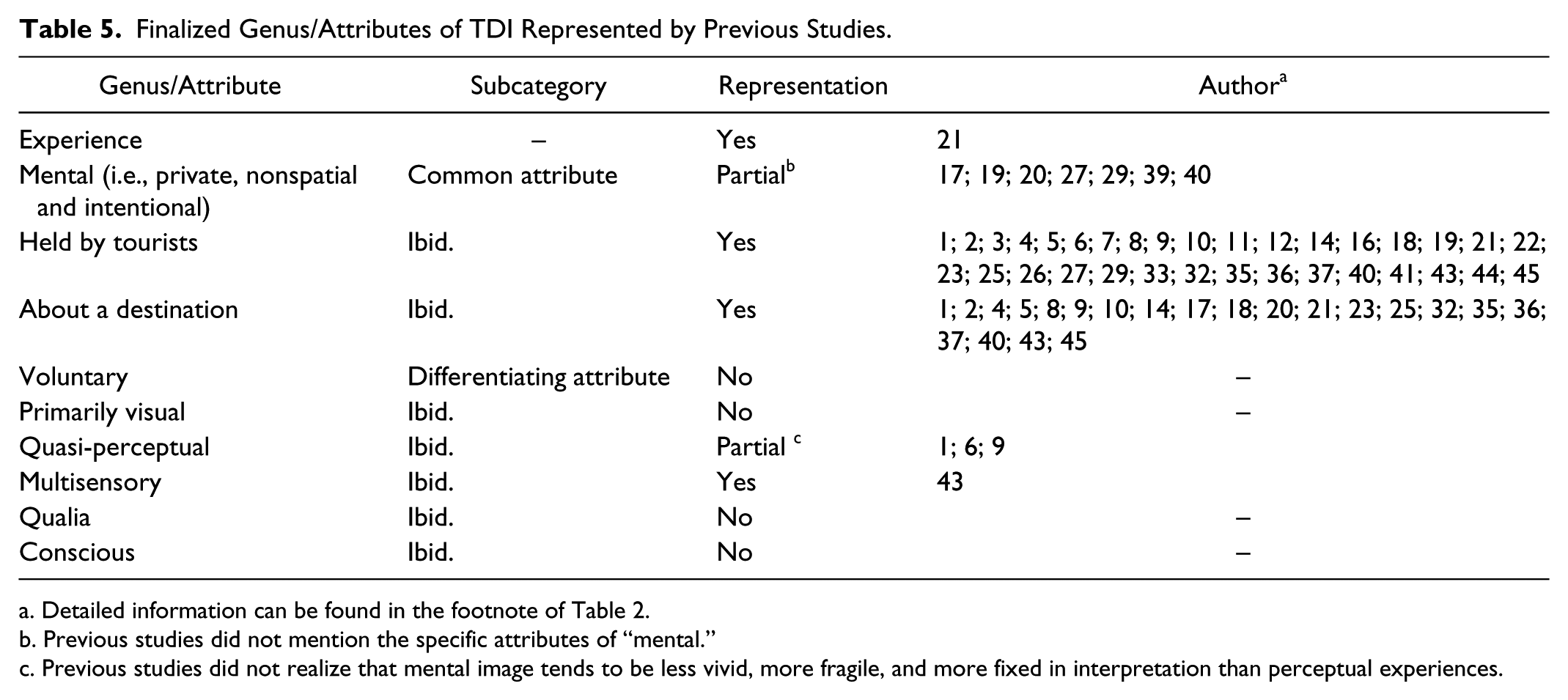
Detailed information can be found in the footnote of Table 2.
Previous studies did not mention the specific attributes of “mental.”
Previous studies did not realize that mental image tends to be less vivid, more fragile, and more fixed in interpretation than perceptual experiences.
The external vagueness of TDI arises from situations in which TDI is confused with other mental concepts. Previous studies did not directly address this issue, although some (e.g., Tasci, Gartner, and Cavusgil 2007; White 2004) have recognized this vagueness. In sum, previous studies have not adequately captured the essential characteristics of TDI. When the essence of TDI is not clearly understood, TDI is assumed to have a similar meaning as that of other mental concepts. This issue can be partially manifested when researchers equate TDI with perception (e.g., Hunt 1975), presentation (e.g., Gartner 1986), and memory (e.g., Jenkins and McArthur 1996). Comparably, this study identifies a set of attributes with higher discriminating power. Seven (but not all) specific concepts that are close to yet distinctive from TDI under the realm of mental experience have been overtly identified. Therefore, this study at least distinguishes TDI from seven of its neighboring concepts. Hence, to some extent, this study has decreased the external vagueness of TDI.
Nevertheless, this study has only offered a partial solution for the third manifestation of TDI’s conceptual problem, namely, its foundational vagueness. Although the nature of mental image has been clarified to some extent by the difference between TDI and the seven contrasting concepts (cf. Table 4), the debates on the nature of mental image (Thomas 2010) and mind (Burwood 2003) are not yet resolved. Admittedly, these time-honored debates are unlikely to be resolved in this study. In sum, this study contributes to the literature by reducing the internal and external vagueness of TDI and identifying its conceptual domain and boundary.
Implication for TDI Research
Although this study is unlikely to bring immediate change to the way how TDI research is conducted, it has some suggestions for those who want to explore the truth behind TDI. Despite the vast amount of literature on TDI, this concept remains vague and must be clarified further (Gallarza, Saura, and Garcia 2002; Josiassen et al. 2015; Ko and Park 2000; Lai and Li 2012; Tasci, Gartner, and Cavusgil 2007; White 2004). To better understand TDI, the differentiating attributes of TDI (cf. Table 5) captured by this study must be empirically tested, as definition theory only guarantees their logic validity but scientific knowledge entails both logic and empirical validity (Audi 2011). A recent research note tested and implied, using small samples though, that TDI is multisensory and primarily visual (Xiong, Hashim, and Murphy 2015). Needless to say, more research efforts along this line are needed. Moreover, the attributes of TDI can be explored further by creating new definitions. A new definition that comprises different genera and cognates for TDI may be compared with our proposed definition to identify a different attribute set of TDI. Creating multiple new TDI definitions can therefore produce a hierarchical set of TDI attributes that can approximate the nature of this concept (Figure 2).
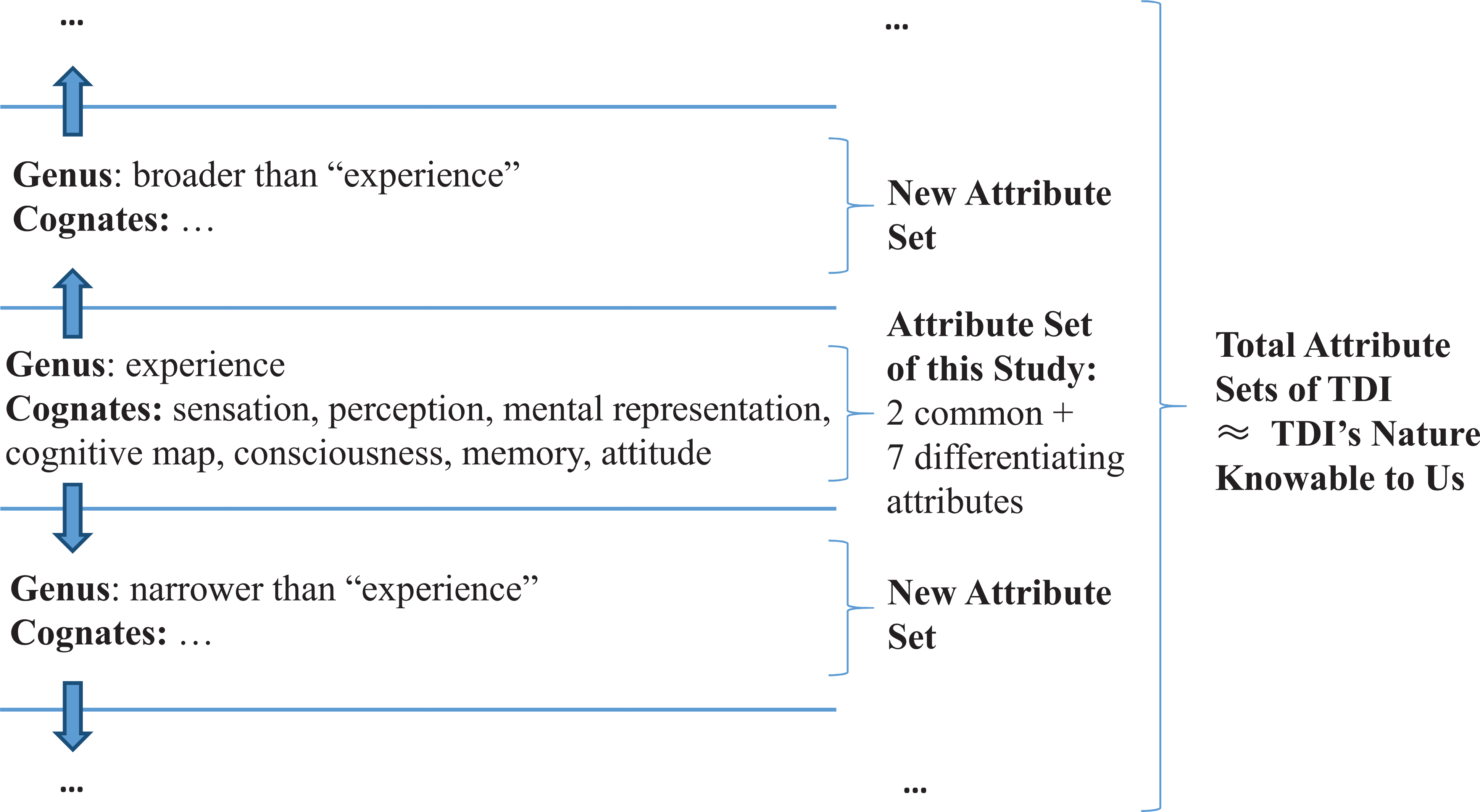
Process of creating hierarchical attribute sets of TDI.
A third implication worth mentioning is methodological, because how we understand TDI affects, if not determines, how we study it. TDI, as shown by this study, pertains to a kind of mental experience with various nebulous attributes (cf. Table 4). This finding has two notable implications for TDI research that is featured in being primarily quantitative and empirical (e.g., Gallarza, Saura, and Garcia 2002; Pike 2007). More qualitative (e.g., phenomenological, visual, and autobiographical) research is needed, because qualitative research enables us to collect and analyze information on TDI more comprehensively, especially when our purpose is to understand TDI in greater detail. Furtuermore, additional conceptual research—academic endeavors that aim to clarify concepts—similar to ours should be encouraged. If empirical research has several limitations (e.g., neglecting philosophical/logic issues, relying on old approaches, and not challenging/enriching/renewing existing concepts) and if such limitations can be largely offset by conceptual research (Xin, Tribe, and Chambers 2013), then additional conceptual research on TDI should be conducted to promote this line of research in the future.
Implication for Defining Tourism Concepts
As indicated, tourism research contains some vague concepts, among which is the typical case of TDI. Tourism researchers generally agree that these concepts should be clarified (e.g., Leiper 2008; McCabe 2009; Poria, Butler, and Airey 2001; Smith 2007b). This study has several pertinent implications for this practice. First, a systematic knowledge of definition theory is required to offer an ultimate rationality for creating/using definitions. However, a broad reading of tourism literature indicates that although tourism researchers have created/used various definitions, they have not focused on definition theory. It should be pointed that an adequate exposure to definition theory, particularly classic literature (e.g., Copi and Cohen 2005; Hurley 2008), can facilitate the development and circulation of better definitions.
Second, the theoretical definitions based on the genus-and-differentia method are highly useful in reducing conceptual vagueness. Clearly, definitions vary widely in terms of their theoretical approaches, types, functions, and techniques (Abelson 2006; Copi and Cohen 2005; Hurley 2008). We must capture the essence of a concept (i.e., conventional and discriminating attributes) before it can be clarified. This task is a major function of genus-and-differentia definitions. By using this definition to address the conceptual problem of TDI, this study has demonstrated its utility in conceptual clarification. Notably, for a given concept its genus-and-differentia definitions could be multiple, because the genera, cognates, and differentiae of the concept—factors that actually determine a definition—may vary. In other words, had we chosen different genera/cognates/differentiae for TDI, we could have identified a definition different from the one reported here. As such, to maximally clarify the essence that this concept represents may entail creating multiple definitions, each of which captures a certain layer of the essence (cf. Figure 2).
Third, a wide knowledge base is necessary to define a concept effectively. In attempting to define TDI, we have resorted to studies on TDI, mental image, mind, and the seven cognates of TDI to find a workable genus-and-differentia TDI definition. Substantial efforts were made to search for the appropriate literature and obtain key information (e.g., the differentiating attributes in Table 4) from these studies. We suggest to understand the nature of TDI by studying it both from the inside and the outside. In this sense, conceptualizing TDI only within the TDI literature may fail to identify TDI’s differentiating attributes and be unable to create an acceptable genus-and-differentia definition for TDI. Presumably, TDI shall be viewed from the perspective of mental image and even mind (e.g., Tasci, Gartner, and Cavusgil 2007; White 2004) to obtain an in-depth understanding.
Fourth, existing definitions of TDI have their respective limitations (e.g., Abelson 2006; Gratton 1994). In strict terms, all definitions are more or less circular (i.e., to define a word is always to replace it with another set of words), and even the definitions that are based on the genus-and-differentia method may lack empirical validity (i.e., definition theory—a subtopic in logic studies—does not overtly require definitions to be supported by empirical evidence). A proper attitude toward definitions (cf. Garrod and Fyall 2001) must neither exaggerate nor underestimate the role of definitions in tourism research.
Fifth, although basic research like the present one appears to lack practicality, we would argue that definitions are relevant and important for research practice. From a research method perspective, the quality of a definition has a profound effect on the validity of research instruments, and “the heuristic value of a construct is partially dependent on the precision of its definition” (Kimiecik and Harris 1996, 251–52). Without the guidance of a fair definition, we could be unknowingly measuring the “wrong” things (things we do not intend to measure). From a communication perspective, fair definitions serve as the basis of effective communication among scholars within the same field and across different areas and disciplines. Therefore, the role of definitions in an era when knowledge inquiry becomes increasingly multidisciplinary, interdisciplinary, or postdisciplinary must be emphasized and appreciated further. Accurate, nonambiguous definitions are also vital for the communication between academics and practitioners. And practitioners generally rely on academics to define, distinguish, and delimit important concepts and ideas.
Limitation and Future Research
The major limitation of this study lies in the proposed new TDI definition. Given its nominal nature, the proposed definition is not as straightforward as are most existing definitions. The differentiating attributes of TDI may also be incomplete because their purpose is not for immediate operationalization. Moreover, some differences between TDI and attitude may not have been identified. The proposed definition is also based on debates (on mental image and mind) that are not yet resolved and have not been considered in this study. The definition is yet to be subject to empirical tests, and therefore this definition may only have conceptual validity. As another limitation, this study does not address the issues concerning the deep meanings of TDI. Given that all definitions convey meanings (Copi and Cohen 2005; Hurley 2008) and that many different theories discuss meanings (i.e., traditional theory, “use” theory, Grice’s program, verificationism, and truth-condition) (Lycan 2000; Morris 2007), a deeper understanding of TDI may have been achieved by directly considering the underlying issue of meanings.
Therefore, future research is warranted to address such issues. These studies should test the proposed definition empirically by studying real tourists, researchers, and practitioners, exploring the nature of TDI by applying theory of meanings to analyzing the possible meanings of this concept, and revealing the parental concepts of TDI, such as mental image and mind, by infusing the knowledge advancements from the philosophy, cognitive science, and tourism research fields. Furthermore, if tourism destinations vary in terms of their resource, geography, scale, and conceptualization (e.g., Pearce 2014; Reinhold, Laesser, and Beritelli 2015), and if genuine distinction exists among different types of destinations, future studies may verify whether different subtypes of TDI exist and entail tailor-made definitions. Finally, given that this study adopts a modernist approach for solving conceptual problems, the insights from postmodernist and nihilist studies may be compared with the findings of this research. Examining TDI from different theoretical stances may result in a more rounded and deeper understanding of TDI.
Smith et al. (2013, 876) observed that “hospitality, tourism and leisure scholars often use words that mean different things to different people in different contexts.” Although this definitional analysis will unlikely end the debate on TDI definition and conceptualization, it calls for the commencement of a more informed and rigorous way of defining constructs. For an emerging field such as tourism, employing well-defined concepts is crucial to produce high-quality research that enables effective cross-discipline communications and serves as a good indicator of the maturity of a field (Altman and Low 1992). Ultimately, the process of defining a concept has a direct effect on the entire research process and outcome. Therefore, we hope that this study will stimulate productive and in-depth discussions on the development and use of definitions in tourism academic research. Searching for scientific tourism definitions takes time, and such search could be more productive with the guide of definition theory.
Footnotes
Acknowledgements
We thank Ms. Yingsha Zhang and Ms. Jing Gong for their assistances in collecting the definitions analyzed in this study, and reviewers and colleagues who shared valuable suggestions and feedback during the manuscript preparation.
Author’s Note
An earlier draft of this paper was presented at the 2014 Travel and Tourism Research Association Annual Conference, Brugge, Belgium.
Declaration of Conflicting Interests
The author(s) declared no potential conflicts of interest with respect to the research, authorship, and/or publication of this article.
Funding
The author(s) disclosed receipt of the following financial support for the research, authorship, and/or publication of this article: National Natural Science Foundation of China [grant number: 71202094].