



Abstract
This study examines the influence of residents’ trust in government and organizing committee on their impact perceptions and support for a mega-event, namely, 2014 FIFA World Cup. Findings suggest significant relationships between impact perceptions and support. While trust in government is found to be a significant determinant of impact perceptions, findings indicate no significant relationship between trust in government and support, which suggest that the relationship is mediated by impact perceptions. While a positive relationship between trust in the organizing committee and positive impact perceptions is found, findings suggest no significant relationship between trust in the organizing committee and negative impact perceptions. Trust in the organizing committee is also found to have significant positive impact on support.
Keywords
Introduction
Mega sporting events such as summer and winter Olympics, FIFA World Cup, and the Commonwealth Games are single and short-term obtrusive events that can have lasting effects on tourism development in host communities (Gursoy and Kendall 2006). They can enhance awareness of a region as a domestic and/or international destination, create new opportunities for potential investors, and increase commercial activity within host communities. However, several studies argue that hosting these mega-events is not likely to generate much economic benefits for host communities (Giesecke and Madden 2007). In fact, some local residents view the idea of hosting an international mega-event as an expensive proposition because of the financial resources needed to build the required infrastructure and superstructure to host a single event (Giesecke and Madden 2007). Furthermore, some residents believe that hosting a mega-event may result in significant negative impacts on a host community, such as direct expenditures and tax burdens, and shifting of public funds to private interests (Gursoy et al. 2011).
However, cities and countries still continue to compete assiduously to be selected as the host of an international mega sporting event (Gursoy and Kendall 2006) mainly because of the opportunities the event can provide for increased international publicity and recognition, enhanced branding, new or renewed sporting venues, urban development, and community pride (Prayag et al. 2013). Positive impacts a successfully executed international mega-event can bring to the international image of a community are seen as the most critical benefits of hosting a mega-event. Some studies even suggest that positive social impacts such as community pride and international recognition are just as, if not more, important than positive economic impacts (Gursoy et al. 2011; Prayag et al. 2013). Furthermore, hosting these mega-events is also likely to help build social cohesion by reinforcing ties within a community (Gursoy, Kim, and Uysal 2004).
Studies also suggest that submitting a bid for hosting a mega-event tends to be a politically driven process with little input from local residents apart from the initial election of political representatives (Gursoy and Kendall 2006). However, like any other form of tourism development, success of hosting a sporting mega-event largely depends on the support of local residents (Sharma et al. 2008). While residents’ support can transform a sporting mega-event into an urban festival, lack of support and cohesion within the host community can have devastating effects on the host community by turning it into a highly charged political and social exercise. Therefore, it is critical to gain local residents’ support and understand the antecedents of support for hosting a mega sporting event.
Most of the previous studies that have examined the antecedents of locals’ support for mega-events utilized the social exchange theory (SET) framework (Gursoy and Kendall 2006; Li, Hsu, and Lawton 2015; Lorde, Greenidge, and Devonish 2011; Prayag et al. 2013). These studies identified a number of factors that may determine the level of residents’ support such as perceptions of both positive and negative impacts, community concerns, community attachments, environmental values, etc. However, an important component of the SET, trust, was omitted in those studies (Nunkoo and Ramkissoon 2011, 2012; Nunkoo and Smith 2013). Considering the fact that the bidding and planning process tends to be a politically charged process with minimal local residents’ involvement, residents’ trust in the government and the organizing committee may have significant impact on their perceptions of mega-event impacts and their support. Furthermore, hosting a mega-event can lead to several negative consequences, very often with little direct benefits for local communities; therefore, community support for such events depends a lot on how much residents support and trust the government.
Although public trust and trust in government actors in tourism development have received some attention from tourism scholars (Nunkoo, Ramkissoon, and Gursoy 2012; Nunkoo and Smith 2013), impact of trust on residents’ support for a single and short-term obtrusive event such as the World Cup Games has not received much attention. Therefore, this study has two objectives. The first is to examine the influence of residents’ trust in the government and organizing committee of a mega sporting event on their perceptions of impacts and their support for a specific mega sporting event, namely, 2014 FIFA World Cup, Brazil. The second objective is to advance the theoretical understanding of local residents’ support for mega-events by developing a theoretical mega-event support model that contributes to the existing models. A comprehensive review of the event and tourism literature on impacts of mega-events, residents’ trust in the government and organizing committee and their support for mega-events is provided in the next section. Methodology utilized in this study is described in the following section. Thereafter, findings of the study are presented. Finally, discussions and managerial implications for destination managers and marketers as well as limitations of the study and recommendations for future research are presented.
Factors Effecting Residents’ Support for Mega-Events
Growth in sport and event tourism has led to a significant increase in research on the impacts of sporting events (Gursoy and Kendall 2006). Several researchers have examined the factors that influence residents’ support for mega-events (Prayag et al. 2013; Zhou and Ap 2009). While some studies have concluded that “economic benefits are the prime motive” for hosting these events (Malfas, Theodoraki, and Houlihan 2004, 218), others argued that positive social impacts such as community pride and international recognition are viewed as more important by residents of host communities (Gursoy et al. 2011; Prayag et al. 2013).
Studies have concluded that perceptions of positive and negative impacts a mega-event is expected to generate are two of the main determinants of residents’ support/opposition for hosting mega-events in their community (Gursoy et al. 2011). Previous literature provides strong evidence that positive impact perceptions significantly and positively affect residents’ support whereas perceived negative impacts significantly and negatively influence support for mega-events (Zhou and Ap 2009). For example, a longitudinal study by Getz (1994) shows that resident support for tourism is linked to perceived positive impacts outweighing the perceived negative impacts. However, several factors, including, but not limited to, expected personal benefits, community attachment, level of involvement in community issues, distance from the event, sociodemographic variables, etc. can influence the level of support (Jurowski and Gursoy 2004). For example, studies suggest that residents who expect to receive personal benefits from a mega-event are more likely to favor and support hosting the event compared to those who expect to receive little or no benefits (Zhou and Ap 2009). As suggested by the SET, residents who believe that hosting a mega-event can have positive impacts on their community and/or their well-beings will consequently support the idea of hosting a mega-event in their community.
However, Kim and Petrick (2005) argue that all residents are not likely to fully support mega-events. Some residents may oppose the idea of hosting a mega-event because of their belief that the cost of hosting these events can significantly be higher than the economic benefits they are supposed to generate (Giesecke and Madden 2007). Furthermore, hosting these events can also result in social, cultural, and environmental problems (Lorde, Greenidge, and Devonish 2011).
Positive Impacts of Mega-Events
Most studies that have examined the impacts of mega-events mainly focus on the economic benefits such as tax revenues for government, business opportunities, increased employment, improved quality of life for local residents, improved public services, and regeneration of urban areas and infrastructure (Gursoy et al. 2011). Studies have also examined impacts of hosting a mega-event on the economy; while some report positive impacts (Kasimati and Dawson 2009), others report negative impacts on the overall economy (Madden 2006).
Mega-events can also help a destination develop its tourism industry with an increase in the inflow of tourists, length of stay, and expenditures (Prayag et al. 2013). In addition, mega-events may enhance the awareness of the host country as a tourism destination, enhance its international reputation, improve the destination’s image, and create new opportunities for potential investors, which can result in an increase of commercial activity within the host community. Hosting mega-events also results in sociocultural impacts on local communities (Cornelissen and Swart 2006). Hosting mega-events can provide local residents opportunities to meet people from different cultures, enhance their community pride and cohesion, strengthen cultural values and traditions, and provide entertainment and relaxation opportunities for local residents (Gursoy et al. 2011). Furthermore, studies suggest interactions among residents and spectators impact perceptions (Gursoy, Chi, and Dyer 2010). For example, residents tend to view their interactions with spectators more positively if they believe that the event brings positive benefits to their community (Kim et al. 2015). Overall, as residents’ perceptions of positive impacts increases, so does their support for hosting these mega-events (Gursoy and Kendall 2006). Accordingly, the following hypothesis is proposed:
Hypothesis 1: There is a direct positive relationship between residents’ positive impact perceptions and their support for hosting mega-events.
Negative Impacts of Mega-Events
Aforementioned positive impacts may be offset by negative impacts mega-events can bring to host communities, which may result in opposition from local residents. These events may generate a number of negative economic consequences such as increases in tax burdens, and mismanagement of public funds by organizer (Gursoy et al. 2011). Further, high construction costs of sport venues can be perceived as a waste of taxpayers’ money (Lorde, Greenidge, and Devonish 2011). Moreover, funds allocated to mega-events may be benefited by privileged elites, while further marginalizing already disadvantaged groups (O’Bonsawin 2010). For example, some areas in Sydney experienced a significant increase in housing prices and rents during the preparation for the Olympic Games, leading to displacement of disadvantaged populations (Lenskyj 2002). Similarly, residents may also face expropriation and relocation because of their property being in the area of facility development, as in the case of the Olympic Games in Beijing (Wang 2006).
Mega-events can also generate negative environmental and social impacts on host communities. Several studies have shown that mega-events result in traffic congestion and crowding, noise, pollution, damages to the natural and physical environment, and deterioration of cultural and/or historical resources (Kim, Gursoy, and Lee 2006; Prayag et al. 2013). Furthermore, mega-events can generate social problems such as disruption of quality of life and decrease in the ability of law enforcement to police, prostitution and increased crime (Lorde, Greenidge, and Devonish 2011; Ritchie, Shipway, and Cleeve 2009). Conflicts can also arise between residents and visitors because of differences in cultural backgrounds, economic welfare, and purchasing power gaps (Le, Polonsky, and Arambewela 2015).
Overall, previous studies suggest a negative relationship between negative impact perception and residents’ support (Gursoy, Chi, and Dyer 2009). Moreover, as suggested by the SET, if residents believe that an exchange is likely to generate more negative outcomes than positive ones, they are likely to exhibit less supportive behaviors or even oppose the event. Thus, the following hypothesis is proposed:
Hypothesis 2: There is a direct negative relationship between residents’ negative impact perceptions and their support for hosting mega-events.
While residents’ support is heavily influenced by their perceptions of those impacts, studies suggest that tourism impact perceptions are correlated (Gursoy and Rutherford 2004). Studies report an inverse relationship between positive impacts perceptions and negative impacts perceptions. Thus, this study proposes the following hypothesis:
Hypothesis 3: There is a direct negative relationship between residents’ positive impact perceptions and their negative impact perceptions.
Trust
As suggested by the SET, community support is critical for successful hosting of a mega sporting event. However, in most cases, communities are not consulted before submitting bids and excluded from most decisions that are related to hosting a mega sporting event. Bidding and hosting decisions are often made by a small group of politicians, often with anarchic decision-making processes without any transparency, and more often in the interests of global flows rather than local communities. In this vein, for example, concerns about mismanagement of funds and increased taxes prior to 2014 FIFA World Cup led to numerous protests in Brazil, several including violent clashes between protestors and security officials (Butler and Aicher 2015).
Since most decisions related to hosting a mega sporting event are made by a small group of individuals (Minnaert 2012), local residents’ trust in those individuals can influence their perceptions of impacts and their support. As suggested by the SET, trust is a precondition for locals’ participation in future exchanges that seems risky with uncertain expected outcomes. Since local residents are expected to show their support for mega-event hosting decisions long before the actual event takes place, which potentially leads to vulnerability and risk as the event may not deliver the expected outcomes, locals’ trust level in decision makers can have significant impact on locals’ perceptions of expected impacts and their willingness to support the event.
The concept of trust has been examined in various fields, including economics, politics, psychology, sociology, management, marketing, and tourism (Nunkoo, Gursoy, and Ramkissoon 2013). Despite the prevalence and generally accepted importance of this construct, a succinct and universally acceptable definition appears unattainable. Fukuyama (1995, 27) defines trust as “the expectation that arises within a community of regular, honest, and cooperative behavior, based on commonly shared norms, on the part of other members of the community.” Trust is also defined through consistent and predictable acts of different parties over an extended period and characterizes an element in the relationship between a trustor and a trustee to cope with risks or uncertainties in these exchange relationships (So and Sculli 2002). Furthermore, trust is a “psychological state comprising the intention to accept vulnerability based upon positive expectations of the intentions or behavior of another” (Rousseau et al. 1988, 395). More recently, trust is defined as a psychological state and confidence that the exchange partner will perform (Nguyen and Rose 2009).
Trust can be seen as a subjective belief or expected qualities from politicians and organizers to further local communities’ benefits in an exchange situation. These qualities act as cues to evaluate the trustworthiness of those individuals. Such qualities include perceived credibility and benevolence of individuals who are involved in the decision-making process on behalf of the local communities, with the former referring to “local communities’ belief in those individuals’ expertise to perform the job effectively” while the latter meaning “local residents’ belief in the positive intentions of those individuals.” Local residents’ trust signifies their attitudinal and behavioral intentions to rely on politicians and the organizing committee in a vulnerable and risky situation.
Residents’ Trust in the Government
Trust plays a critical role in understanding the world, functioning of institutions, decision-making processes, and social, political, and community relations (Stein and Harper 2003). Fukuyama (1995) argues that trust plays an important role in societal functioning and it is considered as an important source of social capital within social systems. As noted by Freitag and Bühlmann (2009), trust is considered to be one of the key resources in development of modern societies. Therefore, trust in the government and state is vital for good governance, sustainability of the political system, and democratic regime stability (Nunkoo, Ramkissoon, and Gursoy 2012). Previous studies confirm the positive relationship between citizens’ trust in institutions and political support for development and governmental policies (Nunkoo, Ramkissoon, and Gursoy 2012). However, none of those studies has examined the trust and support for development and governmental policies in the context of hosting mega sporting events.
Since most decisions regarding hosting of a mega sporting event are made by politicians, political trust plays a critical role in legitimatizing the mega-event decisions and, thus, gaining residents’ acceptance and support (Nunkoo 2015). This is also in line with the conception of trust in SET. Since social exchange relationships are based on power and trust, parties’ trust in each other is crucial in setting up anticipated cooperation (Nunkoo and Gursoy 2015). Behaviors signaling a partner’s trustworthiness have greater impact on trust in reciprocal exchange (Molm, Takahashi, and Peterson 2000).
Government is the principal actor in the political process of tourism development (Bramwell 2011) and controls the industry through formal ministries and other institutions (Elliot 1997). Studies suggest that trust in key tourism institutions can influence the perceived benefits and costs as well as overall satisfaction with tourism development (Nunkoo and Ramkissoon 2011). Therefore, the existence of a reasonable level of trust in those key tourism players is likely to have significant impact on residents’ perceptions of the nature and magnitude of tourism impacts (Nunkoo and Smith 2015). Relatively high levels of trust can make residents believe that those key players will develop strategies to minimize negative consequences while maximizing the positive outcomes. As a result, residents may be more willing to support the idea of hosting a mega-event. On the basis of the preceding discussion, following hypotheses are proposed:
Hypothesis 4: A direct positive relationship exists between residents’ level of trust in government and their perceptions of positive impacts of mega-events.
Hypothesis 5: A direct positive relationship exists between residents’ level of trust in government and their perceptions of negative impacts of mega-events
Hypothesis 6: A direct positive relationship exists between residents’ trust in government and their level of support for mega-events.
Residents’ Trust in the Organizing Committee
Sport and recreation facilities and events held in them are typically owned and managed by public authorities (Anderson and Getz 2009). However, hosting a mega sporting event requires a collective approach that necessitates participation of several ministries at the governmental level, local authorities, and private and public institutions for the success of the event. Although many stakeholders are involved in hosting a mega-event, organization and day-to-day operations of the event are mostly run by an organizing committee, members of which are usually appointed by the government.
When the organizing committee is involved in bidding, organizing, or hosting a mega sporting event, there might be implicit legitimacy but also inherent distrust among some of those affected by the project. In a situation where there is no or little trust in the organizing committee, the host community may not exhibit much enthusiasm and support toward the event (Lühiste 2006). There can be tensions and conflicts between various stakeholders for particular event activities (Anderson and Getz 2009). The organizing committee may need to identify ways to minimize conflict and manage competing interests in order to gain the trust of all stakeholders involved. This is particularly evident when policies and actions that are taken by authorities for crowd control, traffic congestion, noise pollution, litter, and access to natural amenities are challenged by local residents (Derrett 2003). Since the success of any special event heavily relies on the support of local communities, organizers may need to place more importance on the benefits that mega sporting events can bring to the local community (Gursoy et al. 2004).
Trust is a big part of organizers’ appeal (Anderson and Getz 2009) in gaining and maintaining residents’ support for mega-events. Trust in organizers is likely to promote positive attitudes of residents toward hosting a mega sporting event in their community and increase their level of support (Nunkoo and Ramkissoon 2011). Studies suggest that the level of trust in the organizing committee heavily depends on the level of opportunities created by the committee for general public involvement (Davenport et al. 2007). Moreover, it should be noted that host communities are not likely to be composed of a very homogenous group of individuals. Individuals that compose the community may have differing interests, perceptions, and involvement in events, which may present significant challenges in gaining the trust of each group. Therefore, it is critical for the organizing committee to seek opportunities to incorporate local community values and knowledge into the organization and management policies of the event within the guiding framework of the event’s mission focusing on the individual differences in the community. It is also critical to focus on informal relationship-building strategies that can provide opportunities for repeated interactions (Davenport et al. 2007). As such, trust helps event organizers to have reasonably smooth relationships with various stakeholders, overcome possible oppositions in the community, maintain support for the event, and develop partnerships among institutions and businesses that can contribute to the success of the event. However, despite the importance of trust in event organizers, another lacunae existing in the literature about residents’ perceptions of the impacts of and support for mega-events is the absence of trust as a key component of the SET (Nunkoo and Smith 2013). On the basis of the above discussion and the lack of research on the relations between trust in the organizing committee and locals’ perceptions of event impacts and their support, the following hypotheses are proposed:
Hypothesis 7: A direct positive relationship exists between residents’ trust in the organizing committee and their perceptions of positive impacts of mega-events.
Hypothesis 8: A direct positive relationship exists between residents’ level of trust in the organizing committee and their perceptions of negative impacts of mega-events.
Hypothesis 9: A direct positive relationship exists between residents’ level of trust in the organizing committee and their level of support for mega-events.
Proposed Model
Figure 1 presents the theoretical model developed on the basis of the preceding discussion. As presented in the model, this study proposes that both positive and negative impact perceptions of local residents are likely to be significant determinants of their support or opposition for hosting a mega-event in their community. The model also suggests that the level of trust residents have in politicians and the organizing committee is likely to be a significant determinant of both their negative and positive impact perceptions

Proposed model.
Research Methodology
2014 FIFA World Cup
The FIFA World Cup is the world’s largest sporting competition in the World. Brazil has proved to be a powerhouse in the international soccer industry, with a strong sense of national pride by winning a record five World Cups. After organizing the World Cup in 1950, Brazil qualified as the host on October 30, 2007, for the second time, and hosted the 20th edition of the FIFA World Cup 2014. The games were held between June 12 and the July 13, 2014. A total of 12 host cities and 12 stadiums were used during the cup (Brasília, Cuiabá, Manaus, Recife, Fortaleza, Natal, Salvador, Curitiba, Porto Alegre, Belo Horizonte, Rio de Janeiro, and São Paulo). Among these stadiums, five were newly built, and the one in the capital Brasília was demolished and rebuilt, with the remaining six being extensively renovated for the games. The games attracted a total of 3,429,873 attendees in 64 matches and were broadcasted by more than 500 television stations worldwide (FIFA 2015).
Sample
The sample population consisted of individuals who reside in the 12 cities that hosted at least one game during the 2014 FIFA World Cup in Brazil. A two-step process was used to determine the study sample in each target city. First, a stratified random sampling approach was utilized to determine the sample size for each city. The number of usable responses needed from each city was determined based on the margin of error estimations. Researchers aimed to collect at least 250 usable responses from each city. The number of targeted usable responses was higher in cities with larger populations. Afterwards, gender, age, and location of principal residents were used to determine the number of responses from each population strata utilizing a quota sampling approach in the second stage.
Questionnaire Design
The survey instrument used in this study was developed following the procedures recommended by Churchill (1979) and DeVellis (1991) for developing a standardized survey instrument. A number of items to measure each construct was identified from the literature. Using a back-translation approach recommended by Brislin (1970), items were translated into Portuguese. Afterwards, a group of tourism experts (three professors and three state tourism officers) assessed the content validity of these items. They were asked to provide comments on the content and understandability of those items. They were then asked to edit and improve those items to enhance their clarity and readability. They were also asked to identify any redundant items and offer suggestions for improving the proposed scale. After making sure that the survey instrument had content validity, two pretests were conducted on local residents in São Paulo, Brazil. Based on the results of those pretests, the survey instrument was finalized.
The survey instrument consisted of eight sections. However, this study used data from three sections that focused on trust, perceptions of mega-events, and support for mega-events. A total of five items were used to measure trust in government and four items in the organizing committee. These items were adopted from Nunkoo, Ramkissoon, and Gursoy (2012), Nunkoo and Ramkissoon (2012), and Nunkoo and Smith (2013). These items were measured on a five-point Likert-type scale with “do not trust them at all” at the low end and “trust them completely” at the high end. A total of 11 items was used to measure local residents’ perceptions of mega-event impacts and 3 items were used to measure support for mega-events. Items that were used to measure perceptions of mega-event impacts and support for mega-events were adopted from Prayag et al. (2013), Gursoy and Kendall (2006), and Kim, Gursoy, and Lee (2006). These items were also measured on a five-point Likert-type scale with “strongly disagree” at the low end and “strongly agree” at the high end.
Survey Method
Data were collected using personal interviews utilizing an intercept approach six months prior to the 2014 World Cup Games. A professional data collection company was contracted to collect data from each of the selected cities. A number of trained interviewers were instructed to intercept residents at the most frequented locations geographically distributed in the survey areas. The interviewers were properly identified with a badge of the company, and tablets were used for data collection. Interviewers were asked to approach every 10th person passing through using the gender, age, and location of the principal residents’ quota that was predetermined based on the population demographics in each study area. They were instructed to ask the person if she or he was interested in participating in a survey that measures local residents’ perceptions of the 2014 FIFA World Cup. If the answer was a no, interviewers were instructed to intercept the next person and ask the same questions until they identified an individual who agreed to participate in the survey. After the individual agreed, the purpose of the study was explained in detail by the interviewer and a personal interview using a structured survey instrument was conducted. Each question was asked by the interviewer and responses were recorded on a tablet. Around 20% of respondents from each city were called back to confirm the validity of the responses after each interviewer submitted the data she or he collected. A total of 3,770 valid questionnaires were obtained from the residents of 12 cities that hosted at least one 2014 FIFA World Cup game. A total of 520 responses were received from residents of Sao Paulo, 406 responses from residents of Rio de Janeiro, 306 responses from residents of Belo Horizonte, 304 responses from residents of Porto Alegre, 302 responses from residents of Curitiba, 308 responses from residents of Salvador, 304 responses from residents of Recife, 309 responses from residents of Fortaleza, 251 responses from residents of Brasilia, 252 responses from residents of Cuiaba, 252 responses from residents of Natal, and 256 responses from residents of Manaus.
Data Analysis
The fit of the measurement model and the fit of the structural model were tested using the LISREL 8.7 structural equation analysis package. The maximum likelihood method of estimation in combination with the two-stage process was utilized to analyze the data (Nunkoo, Ramkissoon, and Gursoy 2013). As fit indices, the chi-square statistics (and associated p-values) were examined first. However, because of the large effect of sample size on the chi-square values (and associated p-values), other fit indices were also selected to assess the fit of the models (Nunkoo et al. 2013). These fit indices were the goodness-of-fit index (GFI), adjusted goodness-of-fit index (AGFI), the normed fit index (NFI), the non-normed fit index (NNFI), the comparative fit index (CFI), the incremental fit index (IFI), and the relative fit index (RFI). Two indices that are proposed to measure the parsimony of the model were also reported: parsimony goodness-of-fit index (PGFI) and parsimony normed fit index (PNFI).
Results
Demographic Profile
Table 1 presents the descriptive profile of respondents. As presented in Table 1, female respondents slightly outnumbered male respondents (53.80% vs. 46.20%). The majority of participants were in the age group of 20 and 50. As for the level of education, 47.9% of the participants had completed secondary school while 16.3% had undergraduate degrees. A large portion of them considered themselves brown (42.40). A slightly larger portion of the respondents were single (38.50) compared to married respondents (36.70%). A large portion of them (40.10%) had a monthly income of less than US$645.
Sociodemographic Profile of Respondents.
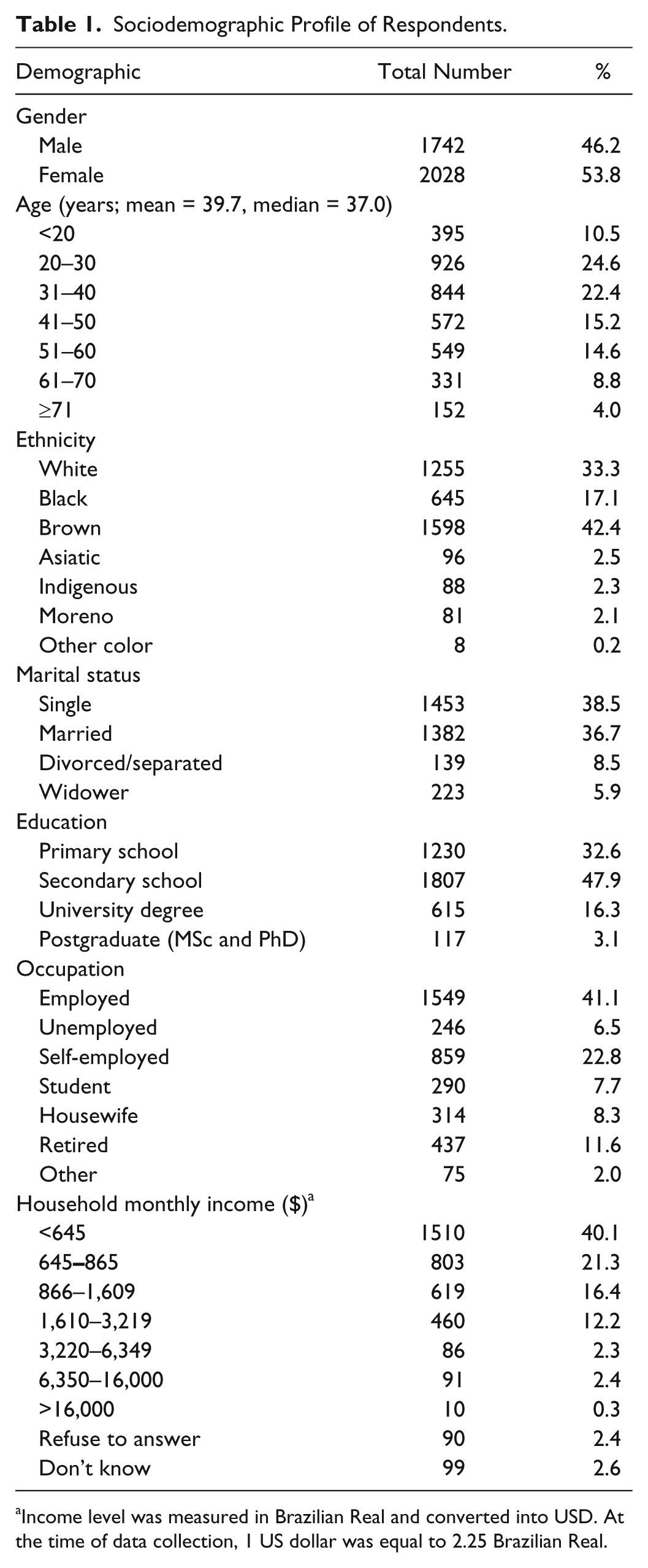
Income level was measured in Brazilian Real and converted into USD. At the time of data collection, 1 US dollar was equal to 2.25 Brazilian Real.
Measurement Model
Details on the properties of the measurements are provided in Table 2. As shown in Table 2, all of the composite reliabilities were above 0.70, indicating that each construct had acceptable reliability. The overall fit indices of the measurement model were as follows: χ2(216) = 1,238.82 (p = 0.00); goodness-of-fit index = 0.97; adjusted goodness-of-fit index = 0.96; the normed fit index = 0.99; the non-normed fit index = 0.99; the comparative fit index = 0.99; the incremental fit index = 0.99; the relative fit index = 0.99; the parsimonious goodness-of-fit index = 0.84; and the parsimonious normed fit index = 0.76. Further, the indicators of two residuals, root mean square residual (RMR), standardized root mean square residual (standardized RMR), and root mean square error of approximation (RMSEA) were 0.052, 0.029, 0.035 respectively.
Measurement Scale Properties.

Composite reliability score.
Two types of validity measures, convergent and discriminant validity, were examined. Convergent validity was tested by examining t values of each item’s factor loading on its underlying construct (Anderson and Gerbing 1988). All t values associated with each completely standardized factor loading for each indicator were found to be higher than 1.96, suggesting significance at the 0.05 significance level, which indicated that convergent validity of all the indicators were established. Discriminant validity was assessed for every possible pair of constructs by constraining the estimated correlation parameter between them to 1.0 and then performing a chi-square difference test on the values obtained for the constrained and unconstrained models (Anderson and Gerbing 1988). A significantly lower chi-square value in an unconstrained model indicated that discriminant validity was achieved.
Structural Model
Most of the goodness-of-fit statistics of the proposed theoretical model were found to be above the recommended threshold values. The χ2 value with 217 degrees of freedom was 1,655.82 (p = 0.00), which was lower than the acceptable level. However, all other fit indices indicated that the hypothesized structural model fits well to the data: goodness-of-fit index = 0.96; adjusted goodness-of-fit index = 0.95; the normed fit index = 0.98; the non-normed fit index = 0.98; the comparative fit index = 0.99; the incremental fit index = 0.99; the relative fit index = 0.98; the parsimony goodness-of-fit index = 0.76; and the parsimony normed fit index = 0.84. Further, the indicators of two residuals, RMR, standardized RMR, and RMSEA, were 0.053, 0.031, and 0.042, respectively.
Both the direct and indirect estimated standardized path coefficients for the proposed model are presented in Table 3. As expected, a direct significant relationship was identified between positive impact perceptions and support for mega-events (direct effect = 0.67, t value = 25.47, p < 0.05) and between negative perceptions and support for mega-events (direct effect = −0.10, t value = −5.85, p < 0.05). A direct negative relationship between positive impact perceptions and negative impact perceptions was also identified (direct effect = −0.16, t value = −5.12, p < 0.05). These findings provided support for hypotheses 1, 2, and 3.
Estimated Standardized Coefficients for the Hypothesized Model.
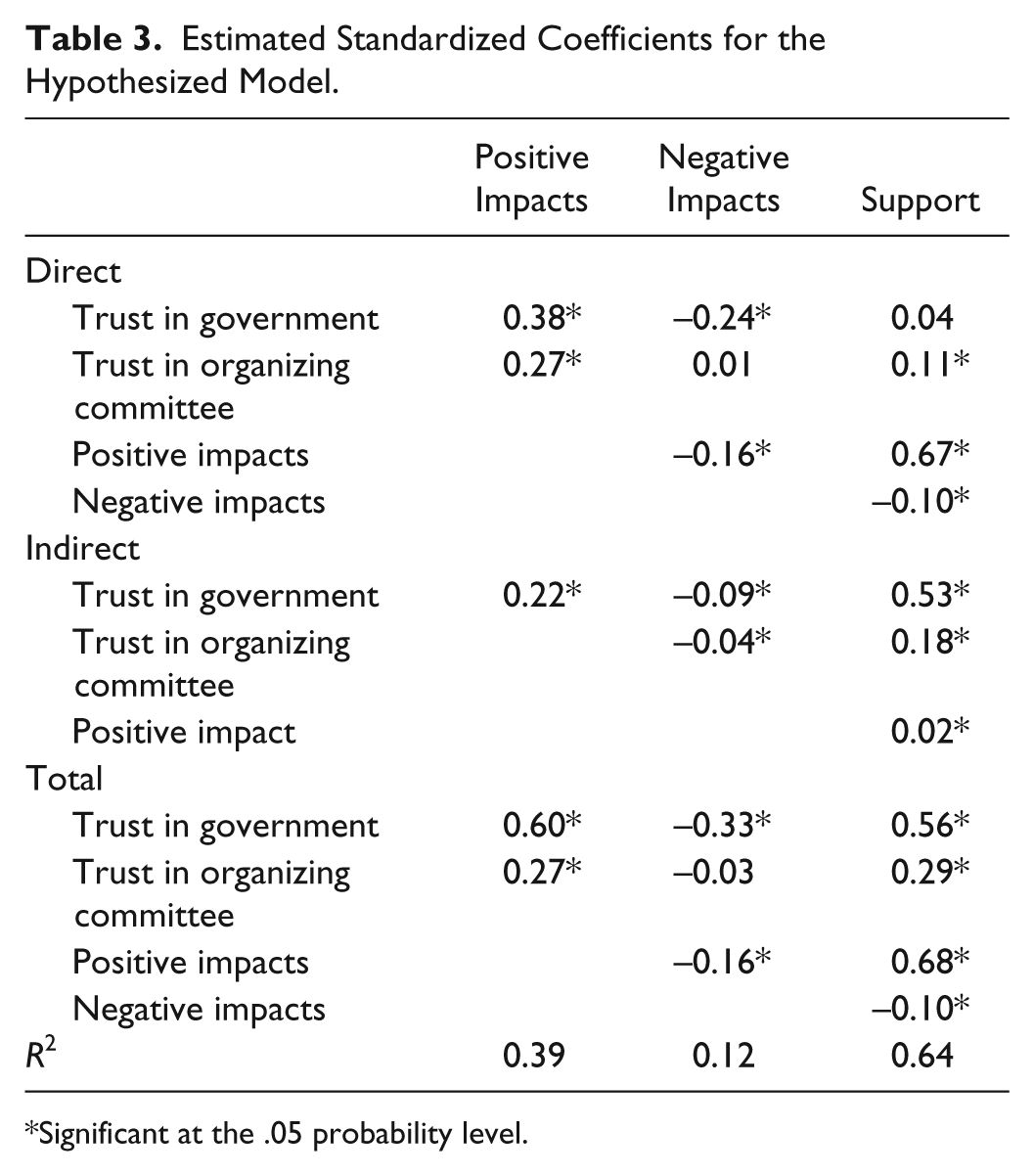
Significant at the .05 probability level.
Findings indicated direct relationships between trust in government and perceptions of positive impacts (direct effect = 0.38, t value = 9.07, p < 0.05) and between trust in government and perceptions of negative impacts (direct effect = −0.24, t value = −4.84, p < 0.05), which provided support for hypotheses 4 and 5. The direct impact of trust in government on support for mega-events was not found to be significant (direct effect = 0.04, t value = 1.36, p > 0.05). Therefore, hypothesis 6 was rejected. However, the indirect and total impacts of trust in government on support were found to be significant (indirect effect = 0.53, t value = 15.77, p < 0.05; total effect = 0.56, t value = 31.98, p < 0.05, respectively). These findings suggest that both the positive and negative impact perceptions are likely to mediate the relationship between trust in government and support.
Findings indicated positive direct relationships between trust in organizing committee and perceptions of positive impacts (direct effect = 0.27, t value = 6.31, p < 0.05) and trust in organizing committee and support (direct effect = 0.11, t value = 3.14, p < 0.05), which provided support for hypotheses 7 and 9. However, no significant direct relationship was found between trust in organizing committee and negative impact perceptions (direct effect = 0.01, t value = 0.24, p > 0.05). Therefore, hypothesis 8 was rejected. Total effect of trust in organizing committee on negative impact perceptions was not significant either (total effect = 0.03, t value = 0.75, p > 0.05).
Discussions
Hosting mega-events such as the FIFA World Cup requires governments to make significant infrastructure and superstructure investments. These investments are usually funded utilizing scarce public resources; sometimes resulting in additional significant tax burdens for local residents (Gursoy et al. 2011). Furthermore, most of the financial and nonfinancial decisions related to hosting a mega-event are usually made by a small group of individuals even though studies argue that participatory planning processes are essential for large-scale tourism projects as in the case of sporting mega-events (Gursoy and Kendall 2006). Since these large-scale projects can cost a significant amount of money, result in tax increases, change in the structure and meaning of a place, and residents’ relationships with their community, it is important for government and organizing committee to gain residents’ trust and their support for hosting mega-events to ensure the success of the event. Lack of trust, coordination, and involvement of residents in various phases of the process can result in a high charge process for the government and organizing committee.
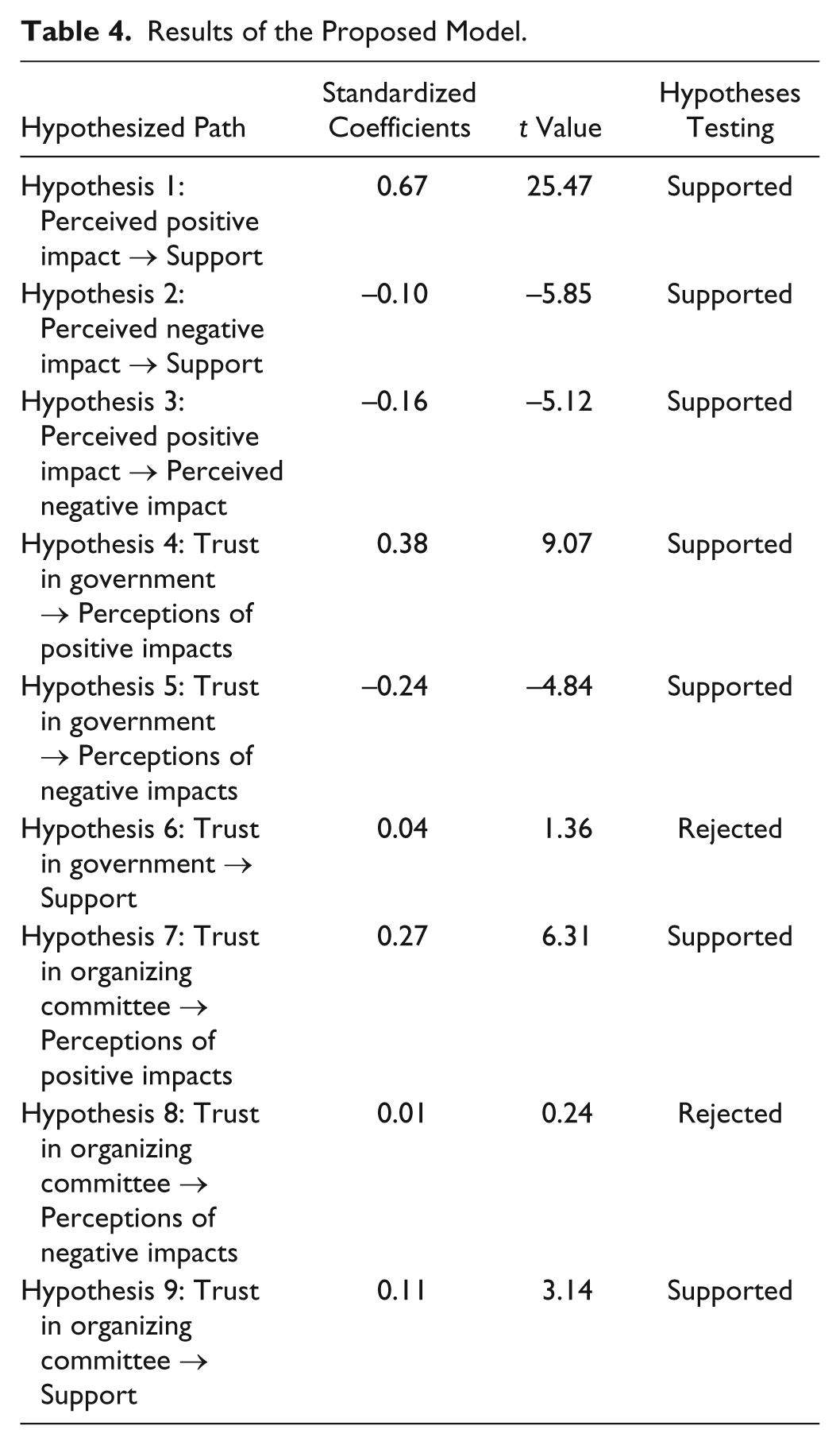
Results summarized in Table 4 indicate that seven of the nine proposed hypotheses are supported. Findings clearly indicate that both the positive and negative impact perceptions are significant determinants of residents’ support for mega-events. These findings are consistent with the conclusions of many earlier studies, which suggest that the perceived negative impacts negatively relates to support, and expected positive impacts are likely to increase support (Poudel, Nyaupane, and Budruk 2015). However, the significant relationship found between the negative impact perceptions and support contradicts the findings of a few studies (Gursoy and Kendall 2006; Kim et al. 2005). These studies suggest that communities that host mega-events often ignore negative impacts prior to hosting the mega-event, while glorifying the expected positive impacts (Gursoy and Kendall 2006). However, as suggested by the SET, residents are likely to support large-scale tourism projects as long as they believe that negative outcomes do not exceed the positive outcomes or rewards. According to this theory, perceptions of potential impacts depend on how people evaluate the exchanges in which they are involved. Individuals who consider it beneficial are likely to evaluate the potential impacts differently from someone who evaluates the exchange as detrimental. In the context of mega-event tourism, SET suggests that expressed support involves a willingness to enter into an exchange (Gursoy and Kendall 2006).
Results of the Proposed Model.
Evidence suggests that political trust is a critical determinant of local residents’ impact perceptions of and their support for any form of development (Nunkoo and Gursoy 2015). However, even though residents’ level of trust is also recognized as an important factor that influences residents’ perceptions of tourism impacts and their support (Nunkoo 2015), impacts of residents’ trust on their impact perceptions and support for a single and short-term obtrusive event such as mega sporting events have not received much attention. This study clearly fills this gap. Furthermore, this study integrates one of the most important components of the SET, trust, into a mega-event support model, which has been omitted in previous mega-event studies (Nunkoo and Ramkissoon 2011, 2012; Nunkoo and Smith 2013).
Most studies that have examined the relationship between impact perceptions and support did not include trust as one of the constructs even though trust is considered to be one of the most important components of the SET. The ones that have included trust (e.g. Nunkoo and Smith 2013; Nunkoo 2015; Nunkoo and Ramkissoon 2011, 2012; Nunkoo and So 2015) have examined it as a unidimensional construct, conceptualized generally as “trust in government” “or political trust.” This study conceptualizes trust as a two-dimensional construct: (1) “trust in government” and (2) “trust in organizing committee.” Therefore, one of the most important theoretical contributions of this study is that it introduces a two-dimensional trust construct, namely, trust in government and trust in organizing committee, as antecedents of perceived positive and negative impacts of mega-events, and residents’ support. Conceptualization of trust as a two-dimensional construct further advances our theoretical understanding of trust and its role in tourism development.
Since the bidding and planning steps of mega-events are handled by a small group of individuals with minimal local residents’ involvement, residents’ trust level with those individuals plays a significant role in the formation of their impact perceptions and support. As suggested by the SET, trust shapes an individual’s belief and attitudes toward other individuals in an exchange and, therefore, trust determines whether an individual is willing to participate or engage in an exchange relationship (Hewett and Bearden 2001). If residents trust the government and the organizing committee, they are likely to believe that the event will generate relatively more positive outcomes than negative ones.
Findings indicate that residents’ trust in government is a significant determinant of locals’ perceptions of a mega-event’s impacts. This finding is consistent with the findings of studies that suggest trust in government acts as a decision rule for supporting or opposing government activities (Nunkoo and Ramkissoon 2012). Considering the fact that government is the principal decision maker in mega-event hosting process (Bramwell 2011) and controls the industry through formal ministries and other institutions (Elliot 1997), trust in government is critical for policy decisions that require large investment for facilities that are likely to be used for a short period of time as in the case of obtrusive, mega-event type of tourism venues (Gursoy and Kendall 2006). As findings suggest, higher level of trust in government will result in higher positive impact perceptions and, therefore, higher level of support while lowering the negative impact perceptions. However, this study finds no significant direct relationship between trust in government and support for mega-events. This finding might be explained by the fact that this relationship is mediated by both the positive and negative impact perceptions as indicated by the significant indirect and total impacts of trust in government on support for hosting mega-events (indirect effect = 0.53, t value = 15.77, p < 0.05, total effect = 0.56, t value = 31.98, p < 0.05, respectively).
While findings suggest that trust in organizing committee is likely to result in higher positive impact perceptions and higher level of support, it is not likely to have any significant impact on negative impact perceptions. This insignificant relationship may be explained by the fact that residents may believe it is the responsibility of the government, not the organizing committee, to make sure that the host community does not incur unacceptable costs because sport and recreation facilities and the events held in them are typically owned and managed by public authorities (Anderson and Getz 2009). Therefore, residents may expect the government to develop strategies using formal ministries and other institutions to minimize negative consequences while maximizing positive outcomes.
Residents may view successful hosting of an event as the main responsibility of an organizing committee. Assigning responsibility for minimizing the negative impacts these mega-events may generate to the government may be the main cause of this insignificant relationship. Furthermore, since these are hallmark events viewed by audiences worldwide, residents may be more willing to use their existing resources on the event and sacrifice their quality of life during the event in order to support the efforts of the organizing committee to make their community appear more attractive. As a result, residents with increased pride and self-esteem, perhaps associated with attention the community receives, may accommodate negative outcomes of such developments. The insignificant relationship might also be explained by the fact that in the case of obtrusive, mega-event-type tourism venues, perceived negative impacts may not have the same implications as it might from less obtrusive tourism venues. As argued by Gursoy and Kendall (2006, 618), “this mitigation may be explained by the fact that these events are world class, single and unique events. As a consequence, residents may perceive that the benefits received outweigh the costs of hosting a mega-event.”
The insignificant finding might also be explained by the fact that host community members are likely to have far lower awareness of the membership of the organizing committee than the awareness of government leaders. Members of organizing committee are usually less visible than members of government. For example, community members might not be able to name the members of an organizing committee but are likely to be able to name several members of government. This variation in community members’ awareness level can influence their ability to make associative linkages between problems and their sources, a pattern suggested by Sniderman, Brody, and Tetlock (1993). In cases where individuals foresee possible negative consequences of an action (i.e., hosting a mega sporting event), they are likely to associate those negative consequences with more visible entities (i.e., government leaders) that are physically and/or conceptually proximate to the issue at hand rather than less visible ones such as the organizing committee. This tendency can make community members blame the government for possible negative impacts rather than the organizing committee (Gomez and Wilson 2001) as suggested by the findings of this study.
Implications
Findings clearly suggest that a successful hosting of a mega sporting event requires that all stakeholders trust the government and the organizing committee because lack of trust within the community hosting a mega-event may have significant negative consequences for the planning process and may turn the process into a highly charged political and social exercise. However, since community members are less likely to be familiar with the organizing committee compared with government officials, community members are likely to associate the mega-event with the government, which can undermine the efforts of the organizing committee. Therefore, it is critical for the success of an event to develop and implement strategies to improve local community members’ awareness level of and their trust in the organizing committee. Considering the fact that hosting mega-events such as the Word Cup requires a considerable investment of human, financial, and physical resources from communities that host them, underestimating the power of trust may have significant impact on residents’ support for hosting the event, which may result in large demonstrations against hosting of the event.
One strategy organizers and politicians can utilize to gain and improve the level of local residents’ trust is to get them involved in the process. Studies clearly indicate that inputs from residents should be solicited and opportunities for residents’ involvement should be provided for the sake of transparency even before submitting a bid for hosting a mega-event (Gursoy and Kendall 2006). A widespread community involvement and public discussions on expected benefits and costs are likely to make the process more transparent (Seetanah and Sannassee 2015) and ease the concerns residents may have about hosting a mega-event and result in development of strategies to reduce negative impacts while increasing the positive outcomes. However, this process requires the organizing committee and government officials to pay close attention to the concerns of residents and work with community members to develop action plans to ease those concerns. If used effectively, collaboration can be a great tool in resolving conflicts and/or advancing shared visions (Tresidder 2015). However, accomplishing these strategies require the abandonment of traditional political planning approach and adoption of a more democratic planning approach, which may significantly increase residents’ trust in the organizing committee and government, and result in higher support for the event.
Planning for mega-events is often carried out over a very long time period; the time between bidding, winning, organizing, and staging the event is often close to 10 years, if not more. This time frame is likely to include major changes to political leadership and socioeconomic landscape that may impact residents’ levels of trust. Therefore, it is important to monitor residents’ concerns about the event over time and address those concerns periodically. It may also be beneficial for the government and organizing committee to employ a major sport star or celebrity to act as a spokesperson for the event in the public arena. It may also be useful to form a committee from a group of celebrities to promote the event and to develop public relations campaigns to improve support for the event.
Furthermore, organizers should also periodically conduct studies to identify residents’ expectations from the event and develop performance measures to assess how well the event meets residents’ expectations. Since trust is a subjective construct with cognitive, emotional, and behavioral dimensions, identifying residents’ perceptions and expectations and then developing measures to evaluate how the event can meet those perceptions and expectations can have significant impact on residents’ trust level because trust requires evidence to justify. Performance measurement can provide such evidence (Yang and Holzer 2006). However, it is critical that the development process of the performance measures serve as a deliberative and collaborative process involving the government, organizing committee, and local residents. Otherwise, it could degenerate into a purely managerial mechanism for damage control purposes rather than a tool to encourage locals’ participation in the mega-event hosting process and their support for the event. It is also critical that the evaluation results are accessible by host community members because if they are not accessible to all, community members can end up relying on anecdotal sources for information and speculations, which may not generate the most desirable outcome. There is no question that if the measurement instruments are developed through community-driven initiatives and local community members are part of assessment process, their trust level in the process and in the results are likely to be significantly higher than if the measurement was developed and implemented only by government officials and organizing committee members.
Limitations
Like other studies, this study is not free of limitations. Hypotheses and the proposed theoretical model are tested using data collected from residents of 12 cities in Brazil that hosted at least one 2014 FIFA World Cup game. Since data were collected only in one country for one event, findings may not be generalizable to individuals who live in other countries. Furthermore, responses may represent the specific situation in Brazil, reflecting Brazilians’ motivations for supporting or opposing the event, and their values and culture, which may further limit the generalizability of the findings. Similarly, since trust is very much dependent on the political and institutional structure of a specific country, Brazil in our case, findings from this study may not be applicable to other economies.
Another limitation is that data were collected from residents using an intercept approach at most frequently visited locations in all study sites. This approach may not guarantee that all local residents have the possibility of being included in the sample. Therefore, results may not be applicable beyond the sample. Replication of this study in other countries on different events may be needed to confirm the validity of the findings reported in this study.
The relationship between trust in the organizing committee and negative impacts is not found to be significant, nor is the relationship between trust in the government and support. Furthermore, some of the R2 values are found to be quite low, suggesting that while trust is an important variable, there might be other unmeasured variables or mediators that should be included in subsequent models such as perceived competence, levels of community engagement, community concerns, state of the local economy, etc. Findings of this study suggest that trust is likely to be one of many variables influencing perceptions of impacts and support. However, future studies should examine the impact of other variables, in addition to trust, on impact perceptions and support.
This study used data that were collected before the event. However, studies suggest that residents’ perceptions are likely to change over time. As suggested by previous studies, while residents’ support is likely to remain strong over time, they tend to become increasingly more concerned about the negative impacts (perceived liabilities) over time (Gursoy et al. 2011; Kim et al. 2005). This study did not examine the temporal effects. The impact of temporal effect on the proposed constructs and on the hypothesized relationships is certainly the subject of future research.
Footnotes
Declaration of Conflicting Interests
The author(s) declared no potential conflicts of interest with respect to the research, authorship, and/or publication of this article.
Funding
The author(s) disclosed receipt of the following financial support for the research, authorship, and/or publication of this article: This project was funded by the “CNPq—Conselho Nacional de Desenvolvimento Científico e Tecnológico,” Brasil (National Council for Scientific and Technological Development,” Brazil).