



Abstract
This study develops a model based on the developmental theory of place attachment. The model considers the influence of tourists’ emotions on place attachment and the mediating effects of satisfaction and place attachment on the relationship between tourists’ emotions and intention to recommend. The model was tested using data collected from 464 international tourists at the end of their trip to Thailand. Results show that positive emotions, negative emotions and satisfaction are significant determinants of place attachment. In particular, negative emotions display a positive relationship with place attachment. In addition, only satisfaction mediates the relationship between tourists’ emotions and intention to recommend. Findings highlight the need for researchers to incorporate emotions in modeling place attachment and offer implications for marketers promoting Thailand as a tourist destination.
Introduction
Existing studies on affective consumer relationships investigates concepts of interest such as brand attachment (Thomson, MacInnis, and Park 2005), possession attachment (Ahuvia 2005), destination attachment (Yüksel, Yüksel, and Bilim 2010), and place attachment (Vlachos et al. 2010). This rich body of research recognizes that consumers develop attachment to different situations, objects, and entities. Prior research in tourism investigates attachment to festivals (Lee, Kyle, and Scott 2012), hot spring resorts (Su, Cheng, and Huang 2011), destinations (Prayag and Ryan 2012; Yüksel, Yüksel, and Bilim 2010), heritage sites (Poria, Reichel, and Biran 2006), and other natural areas (Tonge et al. 2015). Antecedents of place attachment include motivation to visit (Kyle, Mowen, and Tarrant 2004), destination image (Chen and Phou 2013; Prayag and Ryan 2012), destination attractiveness (Cheng, Wu, and Huang 2013; Hou, Lin, and Morais 2005), service quality (Su, Cheng, and Huang 2011), destination personality and trust (Chen and Phou 2013), and personal involvement (Gross and Brown 2008; Hou, Lin, and Morais 2005; Prayag and Ryan 2012).
A significant lacuna in tourism research remains the influence of emotions on place attachment. The literature on environmental psychology recognizes an overlap between emotions felt toward a place and place attachment (Halpenny 2010; Low and Altman 1992; Manzo 2003). Morgan (2010, 11) notes that “most authors recognize an emotional or affective component in the concept of place attachment but the word emotion, like place, has an easy-to-understand, hard-to-define quality, making place attachment if anything, more conceptually elusive than place itself.” Place–people relationship consists of an array of positive emotions such as love, pride, and contentment (Scannell and Gifford 2010), but attachment to the environment is not always positive (Manzo 2005). Unhappy experiences can lead to place aversion (Scannell and Gifford 2010). The environmental psychology literature uses the term place affect to describe both positive and negative emotions that visitors feel toward a place (Halpenny 2010). In fact, several studies have modeled place affect (Halpenny 2010; Ramkissoon and Mavondo 2015; Ramkissoon, Smith, and Weiler 2013) as a subdimension of place attachment.
Yet, previous research recognizes that emotions and place attachment are related but distinct constructs (e.g., Altman and Low 1992; Hernández et al. 2007; Morgan 2010). Accordingly, based on Morgan’s (2010) developmental theory of place attachment, this study models felt emotions as antecedents of place attachment. Morgan (2010) suggests that a pattern of emotional experiences toward a place develops, with time, into a bond known as place attachment. Consumer research supports the idea that emotions felt during the consumption process are retrieved to evaluate postconsumption behaviors and these emotions influence product/brand attachment (Mugge, Schifferstein, and Schoormans 2010; Orth et al. 2012). Furthermore, in a recent study, Hosany et al. (2015) provide strong evidence that in tourism, emotions achieve discriminant validity with the place attachment construct. However, Hosany et al. (2015) did not explicitly investigate the structural relationships between emotional responses and place attachment.
The purpose of this study is to test a conceptual model linking tourists’ emotions, place attachment, satisfaction, and intention to recommend. The current research focuses on tourists’ holistic and hedonic experiences at a popular destination, Thailand. Vacations are primarily consumed for hedonic purposes (Otto and Ritchie 1996). The emphasis on hedonic tourist experiences remains popular among tourism researchers (Knobloch, Robertson, and Aitken 2016) The proposed framework (Figure 1) draws on existing theorizations cutting across various disciplines such as environmental psychology (e.g., Halpenny 2010; Morgan 2010; Manzo 2005), marketing (Orth, Limon, and Rose 2010; Su, Cheng, and Huang 2011; Vlachos et al. 2010), and tourism (Prayag and Ryan 2012; Ramkissoon, Smith, and Weiler 2013; Yüksel, Yüksel, and Bilim 2010). The model shows that tourists’ emotions (positive and negative) are antecedents of satisfaction and intention to recommend. Place attachment and satisfaction mediates the relationship between tourists’ emotions (positive and negative) and intention to recommend. Finally, satisfaction influences intention to recommend. From a practical perspective, the model posits that an understanding of the emotions that drive place attachment will enable destination marketers to formulate effective advertising and communication strategies.

The structural model.
The contribution of this study is fourfold. First, this research responds to recent calls for tourism researchers (e.g., Hosany et al. 2015) to examine the relationship between tourists’ emotional responses (positive and negative) and place attachment. Existing studies can be classified into two main categories; the first group focuses on emotions and satisfaction in predicting future intentions or loyalty (Grappi and Montanari 2011; Prayag, Hosany, and Odeh 2013; Yüksel and Yüksel 2007). The second research stream includes satisfaction and place attachment along with other variables (Chen and Phou 2013; Prayag and Ryan 2012; Su, Cheng, and Huang 2011) to predict future intentions or loyalty. There is currently no study that examines the relationships between emotions, satisfaction, and place attachment in the context of a tourist destination. Second, in the environmental psychology literature, “place affect” (Halpenny 2010; Low and Altman 1992) is used to describe the emotions of an individual toward a particular place and is not considered as a distinct concept from place attachment. Similarly, in the marketing literature, brand attachment, a concept related to place attachment, has been originally conceptualized using emotional dimensions such as affection and passion (Thomson, MacInnis, and Park 2005) and/or mostly positive emotions (Park et al. 2010). However, Hosany et al. (2015) show that emotions and place attachment are related but distinct constructs. In this study, we extend existing research (e.g., Chen and Phou 2013; Prayag and Ryan 2012; Veasna, Wu, and Huang 2013; Yüksel, Yüksel, and Bilim 2010) and hypothesize emotions as determinants of place attachment.
Third, the study contributes to the debate on the relationship between place attachment and satisfaction. Satisfaction is conceptualized as either an antecedent (Chen and Phou 2013; Lee, Kyle, and Scott 2012; Su, Cheng, and Huang 2011; Zenker and Rütter 2014) or outcome of place attachment (Hwang, Lee, and Chen 2005; Prayag and Ryan 2012; Ramkissoon, Smith, and Weiler 2013; Veasna, Wu, and Huang 2013; Yüksel, Yüksel, and Bilim 2010). In this study, based on the developmental theory of place attachment (Morgan 2010), we confirm that satisfaction is an antecedent of place attachment. Fourth, we propose that satisfaction and place attachment mediates the relationship between tourists’ emotions and intention to recommend. Prior studies in tourism (e.g., Prayag and Ryan 2012; Veasna, Wu, and Huang 2013; Yüksel, Yüksel, and Bilim 2010) fail to consider the mediating effects of place attachment. To benefit theory development, mediators provide useful information on “how” or “why” an independent variable predicts the outcome variable (Bennett 2000; Wu and Zumbo 2008).
Conceptual Background and Hypotheses Development
The Concept of Place Attachment
No single accepted definition or systematic theory of place attachment exists (Low and Altman 1992; Lewicka 2011; Scannell and Gifford 2010). In this study, drawing on Morgan’s (2010, 12) developmental theory, place attachment is defined as “an affective bond to a particular geographical area and the meaning attributed to that bond.” The developmental theory of place attachment attempts to bring together attachment theories in psychology (e.g., Bowlby 1982) and theories of place. According to this theory, place attachment emerges from social interactions and one’s evaluation of the environment. Place attachment is seen as a developmental process in which experiences in a place are internalized at the unconscious level and subjectively manifests into an attachment to the place (Morgan 2010). Given the “developmental” nature of place attachment and the meanings attributed to a place based on an individual’s interactions with the place, it is important to specify a time, place and context when operationalizing place attachment. Place attachment is a meaningful construct at the end of a tourist trip, when all tourism experiences are complete. From the perspective of people–environment interactions, place attachment would thus represent an overall connection or bond between a person and a location (Tuan 1980).
Place attachment has been studied extensively in tourism (e.g., Hou, Lin, and Morais 2005; Gross and Brown 2008; Lee, Kyle, and Scott 2012; Prayag and Ryan 2012; Ramkissoon, Smith, and Weiler 2013; Yüksel, Yüksel, and Bilim 2010; Veasna, Wu, and Huang 2013). Studying visitors’ attachment to national parks and recreational areas to predict pro-environmental behavior dominate existing research tradition (e.g., Hwang, Lee, and Chen 2005; Ramkissoon, Weiler, and Smith 2013; Tonge et al. 2015). However, the emotional aspects of the tourism experience have been ignored in predicting place attachment (Orth et al. 2012). In addition, existing studies focus on the influence of place attachment on postconsumption behaviors such as loyalty (e.g., Chen and Phou 2013; Prayag and Ryan 2012) but overlook the mediating role place attachment plays on the relationship between on-site tourism experiences (such as emotions) and postconsumption behaviors.
Many studies recognize two dimensions of place attachment: place identity and place dependence. Place identity refers to the symbolic importance of a place as a repository for emotions and relationships that give meaning and purpose to life (Williams and Vaske 2003). Place identity is described as a component of self-identity that increases one’s sense of belonging to a place (Relph 1976; Tuan 1980) and enables individuals to express and affirm their identity (Kyle, Mowen, and Tarrant 2004). Place dependence reflects on “how well a setting serves goal achievement given an existing range of alternatives” (Jorgensen and Stedman 2001, 234). Place dependence is a form of functional attachment, providing features and conditions that support the achievement of specific goals or desired activities (Williams and Vaske 2003). The functional attachment “is embodied in the area’s physical characteristics and related to specific activity needs” (Su, Cheng, and Huang 2011, 2724). Repeat visitation contributes to place attachment (Moore and Graefe 1994) but recent studies (e.g., Cheng and Kuo 2015) confirm that individuals form bonds to places not visited previously.
Tourists’ Emotions
Emotions are distinct from moods (Russell 1980). Moods are mild affective states that are easily induced, transient and not attributable to a specific stimuli or object (Gardner 1985). Emotions are affective states characterized by episodes of intense feelings associated with a specific referent (such as a person, an object, or an event) and instigate specific response behaviors (Cohen and Areni 1991). The psychology literature offers two major theoretical approaches to study emotions: categorical (emotion specificity) and dimensional (valence based). Categorical approaches theorize emotions as a set of idiosyncratic affective states (e.g., joy, disappointment, surprise) (see Izard 1977; Plutchik 1980). Dimensional approaches conceptualize emotions using few dimensions such as positive and negative (Watson, Clark, and Tellegen 1988), or pleasure and arousal (Russell 1980). Measurement of emotions in tourism has favored the valence-based approach. Summary dimensions, positive and negative (e.g., del Bosque and San Martin 2008; Grappi and Montanari 2011) or pleasure and arousal (e.g., Bigné, Andreu, and Gnoth 2005; Yüksel and Yüksel 2007) are common. The dimensional approach gives a more parsimonious account of emotional experiences (Lazarus 1991) and usually influences satisfaction and behavioral intentions (del Bosque and San Martin 2008; Grappi and Montanari 2011).
Researchers often adapt scales from psychology to measure emotions in tourism. Commonly adapted valence-based scales include Mehrabian and Russell’s (1974) Pleasure, Arousal, and Dominance (PAD) and Watson, Clark, and Tellegen’s (1988) Positive Affect and Negative Affect Scales (PANAS). However, some scholars have questioned the applicability, reliability, and validity of psychological emotion scales in consumer studies (see Laros and Steenkamp 2005; Schoefer and Diamantopoulos 2008). Hosany and Gilbert (2010) further note that existing emotion scales from psychology fail to take into account tourism and destination-specific characteristics. Recognizing the need to measure the diversity and intensity of tourists’ emotional responses, Hosany and Gilbert (2010) developed the Destination Emotion Scale (DES). The DES consists of 15 items representing the three emotional dimensions of joy, love, and positive surprise. Lee and Kyle’s (2013) Festival Consumption Emotions (FCE) scale also identified joy, love and positive surprise as key emotions, together with a negative dimension. Studies have also shown that emotions vary throughout the tourism experience (Lin et al. 2014; Nawijn 2011; Nawijn et al. 2013).
The Relationship between Tourists’ Emotions and Place Attachment
Positive Emotions and Place Attachment
Relationship theory supports a direct link between consumer affective experiences and brand attachment (Grisaffe and Nguyen 2011; Orth, Limon and Rose 2010). Strong attachment is associated with a sense of affection, love, and passion (Mugge, Schifferstein, and Schoormans 2010). Orth, Limon, and Rose (2010) confirm that pleasure and arousal are positively related to brand attachment. In a destination context, place represents the attachment figure, and consistent with Morgan’s (2010) developmental theory, positive emotions toward a place will reinforce a sense attachment through person–place interactions. Emotions related to the destination experience contribute to the formation of place attachment. Accordingly, the following hypothesis is formulated:
Hypothesis 1: Positive emotions have a positive effect on place attachment.
Negative Emotions and Place Attachment
Tourism experiences are not devoid of negative emotions (Hosany and Prayag 2013). However, there is a lack of negative emotions in tourists’ recalled experiences. For example, Nawijn (2011) and Nawijn et al. (2013) report that tourists rated their holiday experiences low in terms of negative emotions. Findings are consistent with the “rosy view” effect (Mitchell et al. 1997) where negative occurrences in people’s retrospective assessments of events are mitigated and positive experiences magnified (Lee and Kyle 2012). However, relationships people associate to places are not always positive, and people can develop aversion to certain places (Relph 1985). Some places are oppressive, and as a result people feel less connected to them (Relph 1976). The place attachment literature overemphasizes positive emotions toward places (Trentelman 2009), and how negative emotions contribute to place attachment is underresearched (Manzo 2005). Hence, the study proposes the following hypothesis:
Hypothesis 2: Negative emotions have a negative effect on place attachment.
The Relationship between Tourists’ Emotions and Satisfaction
Positive Emotions and Satisfaction
Satisfaction is a positive reaction resulting from favorable appraisals of consumption experiences (Oliver 1997). Some research in tourism follow a cognitive approach and conceptualize satisfaction as an evaluation of whether expectations are met (e.g., Eusébio and Vieira 2013). Other studies operationalize satisfaction as an affective reaction to the consumption experience (e.g., Huang, Weiler, and Assaker 2015). Some studies (e.g., del Bosque and San Martin 2008; Žabkar, Brenčič, and Dmitrović 2010) adopt a cognitive-affective perspective when modeling tourist satisfaction. Irrespective of how satisfaction is conceptualized, a rich body of tourism research confirms a relationship between positive emotions and satisfaction (e.g., Bigné, Andreu, and Gnoth 2005; del Bosque and San Martin 2008; Yüksel and Yüksel 2007). Positive emotions such as joy (Faullant, Matzler, and Mooradian 2011), happiness, excitement, and pleasure (Grappi and Montanari 2011) have a favorable influence on satisfaction. On the basis of the above discussion, the following hypothesis is formulated:
Hypothesis 3: Positive emotions have a positive effect on satisfaction.
Negative Emotions and Satisfaction
Mixed evidence exists on the relationship between negative emotions and satisfaction. Previous research in marketing found a significant influence of negative emotions on satisfaction (e.g., Phillips and Baumgartner 2002; Westbrook 1987). Other studies establish that negative emotions have no effect on satisfaction (e.g., Westbrook and Oliver 1991). However, research in tourism confirms a negative relationship between negative emotions and satisfaction (del Bosque and San Martin 2008; Faullant, Matzler, and Mooradian 2011; Grappi and Montanari 2011; Lee et al. 2008). Hence, these findings lead to the following hypothesis:
Hypothesis 4: Negative emotions have a negative effect on satisfaction.
The Relationship between Satisfaction and Place Attachment
Consistent with the developmental theory of place attachment (Morgan 2010), this study hypothesizes satisfaction as an antecedent of place attachment. Several studies support the satisfaction–place attachment link. For example, Su, Cheng, and Huang (2011) reveal that tourist satisfaction affects both place identity and place dependence. Zenker and Rütter (2014) show that residents’ overall satisfaction with a city significantly predicts attachment to the city. Lee, Kyle, and Scott (2012), in the context of festivals, further establish a positive influence of satisfaction on both place identity and place dependence. In addition, some research in marketing models consumer satisfaction as an antecedent of brand attachment (Orth, Limon, and Rose 2010). As such, it is logical to hypothesize:
Hypothesis 5: Satisfaction has a positive effect on place attachment.
The Relationship between Place Attachment and Intention to Recommend
Prior research shows empirical support for the effect of place attachment on various behavioral responses (Kil et al. 2012). In nature-based recreation settings, for example, several studies (Halpenny 2010; Kil et al. 2012; Ramkissoon, Smith, and Weiler 2013; Tonge et al. 2015) identify a positive effect of place attachment on pro-environmental behaviors. In the context of festivals, Lee, Kyle, and Scott (2012) show that place dependence predicts word of mouth. Attachment is also a significant determinant of willingness to promote a brand (Park et al. 2010). At the destination level, Prayag and Ryan (2012) establish that place identity and place dependence predict intention to recommend. Prayag and Ryan (2012) call for further research examining the relationship between place attachment and intention to recommend. Hence, the study proposes the following hypothesis:
Hypothesis 6: Place attachment has a positive effect on intention to recommend.
The Relationship between Satisfaction and Intention to Recommend
Recommendation intentions are indicators of positive behavioral outcome from satisfactory tourist experiences (Bigné, Sanchez, and Sanchez 2001; Grappi and Montanari 2011; Lee et al. 2008; Prayag and Ryan 2012). Satisfied tourists are more likely to recommend the destination to others (Bigné, Sanchez, and Sanchez 2001; Chen and Tsai 2007). Dissatisfied tourists will engage in negative word of mouth (Prayag and Ryan 2012). Prior place attachment studies show that satisfaction has a positive influence on word of mouth (Su, Cheng, and Huang 2011). Hence, these findings lead to the following hypothesis:
Hypothesis 7: Satisfaction has a positive effect on intention to recommend.
Mediating Effects of Satisfaction and Place Attachment
In investigating the relationship between emotions and intention to recommend, satisfaction is often operationalized as a key intervening construct (e.g., Bigné, Andreu, and Gnoth 2005; Nyer 1997; Soscia 2007; Walsh et al. 2011). Nyer (1997) argues that word of mouth is best explained using both satisfaction and consumption emotions. Prior studies (e.g., Lee et al. 2008; Su and Hsu 2013; Yüksel and Yüksel 2007) support a direct effect of positive emotions on loyalty (including intention to recommend). Other research supports the role of satisfaction as a mediator between emotions and intention to recommend. For example, in the context of retailing, Walsh et al. (2011) found that satisfaction partially mediates the relationship between emotions and intention to recommend. Grappi and Montanari (2011) establish an indirect relationship between emotions (positive and negative) and re-patronizing intentions via satisfaction. Based on the above discussions, the following hypothesis is formulated:
Hypothesis 8a: Satisfaction mediates the relationship between emotions (positive and negative) and intention to recommend.
Existing research on place attachment tend to prioritize the direct effects of attachment on satisfaction (e.g., Lee, Kyle, and Scott 2012; Prayag and Ryan 2012; Yüksel, Yüksel, and Bilim 2010). Other studies examine either the indirect effects of attachment on behavioral intentions via satisfaction (Ramkissoon, Smith, and Weiler 2013) or the mediating effects of behavioral intentions on the relationship between satisfaction and place attachment (Ramkissoon and Mavondo 2015). However, these studies examine the relationship between place attachment, satisfaction, and behavioral intentions in the context of national parks and not tourist destinations. More specifically, prior research fails to test the mediating effect of place attachment on the relationship between tourists’ emotions and intention to recommend. Related studies (e.g., Orth, Limon, and Rose 2010) on brand attachment show that satisfaction partially mediates the relationship between emotion and brand attachment. Hence, the study proposes:
Hypothesis 8b: Place attachment mediates the relationship between emotions (positive and negative) and intention to recommend.
Methods
Measurement Scales
The study’s main constructs were measured using multiitem scales. Positive emotions were captured using six items (α=0.88) adapted from Hosany and Gilbert’s (2010) Destination Emotion Scale. Two items capture each of the DES’s three dimensions: joy, love, and positive surprise. The six items were aggregated into the latent variable “positive emotions.” Three items (α=0.85), disappointment, displeasure, and unhappiness, adapted from Hosany and Prayag (2013), measure negative emotions. Respondents had to rate the intensity of their emotional experience toward Thailand (e.g., “I felt a sense of pleasure”; “I felt a sense of disappointment”) on a 7-point scale ranging from 1 = not at all and 7 = very much.
Place attachment was operationalized using eight items adapted from Williams and Vaske’s (2003) scale. Several studies have confirmed the reliability and validity the scale in tourism (e.g., Gross and Brown 2008; Prayag and Ryan 2012; Yüksel, Yüksel, and Bilim 2010). Place identity (α = 0.89) and place dependence (α = 0.88) were each measured using four statements. Respondents had to rate their level of agreement or disagreement with the statements on a 7-point scale (1 = strongly disagree and 7 = strongly agree). Satisfaction was operationalized as a summative overall construct (α = 0.90) using the following statements (adapted from Faullant, Matzler, and Mooradian 2011; Lee et al. 2008): “Please indicate your overall satisfaction with the destination experience” (1 = very dissatisfied and 7 = very satisfied; and 1 = terrible and 7 = delighted). Intention to recommend was measured using 3 statements (α = 0.92) on a 7-point scale (1 = strongly disagree and 7 = strongly agree). The statements were adapted from previous studies (e.g., Lee et al. 2008; Žabkar, Brenčič, and Dmitrović 2010).
To minimize any potential common method variance (CMV) bias, the survey design and administration follow Podsakoff et al.’s (2003) guidelines. In addition, Harman’s single-factor test was employed to assess CMV (Podsakoff and Organ 1986). The test requires loading all the constructs in an exploratory factor analysis (EFA) procedure. CMV is present if either a single factor emerges from the data, or one general factor explains majority of the variance (Podsakoff et al. 2003). EFA results reveal the existence of a multifactor structure (five factors with eigenvalues greater than 1), with the first factor accounting for only 26% of the total variance (out of 73.10%). EFA results suggest common method variance is not a pervasive issue in the data.
Sampling and Data Collection
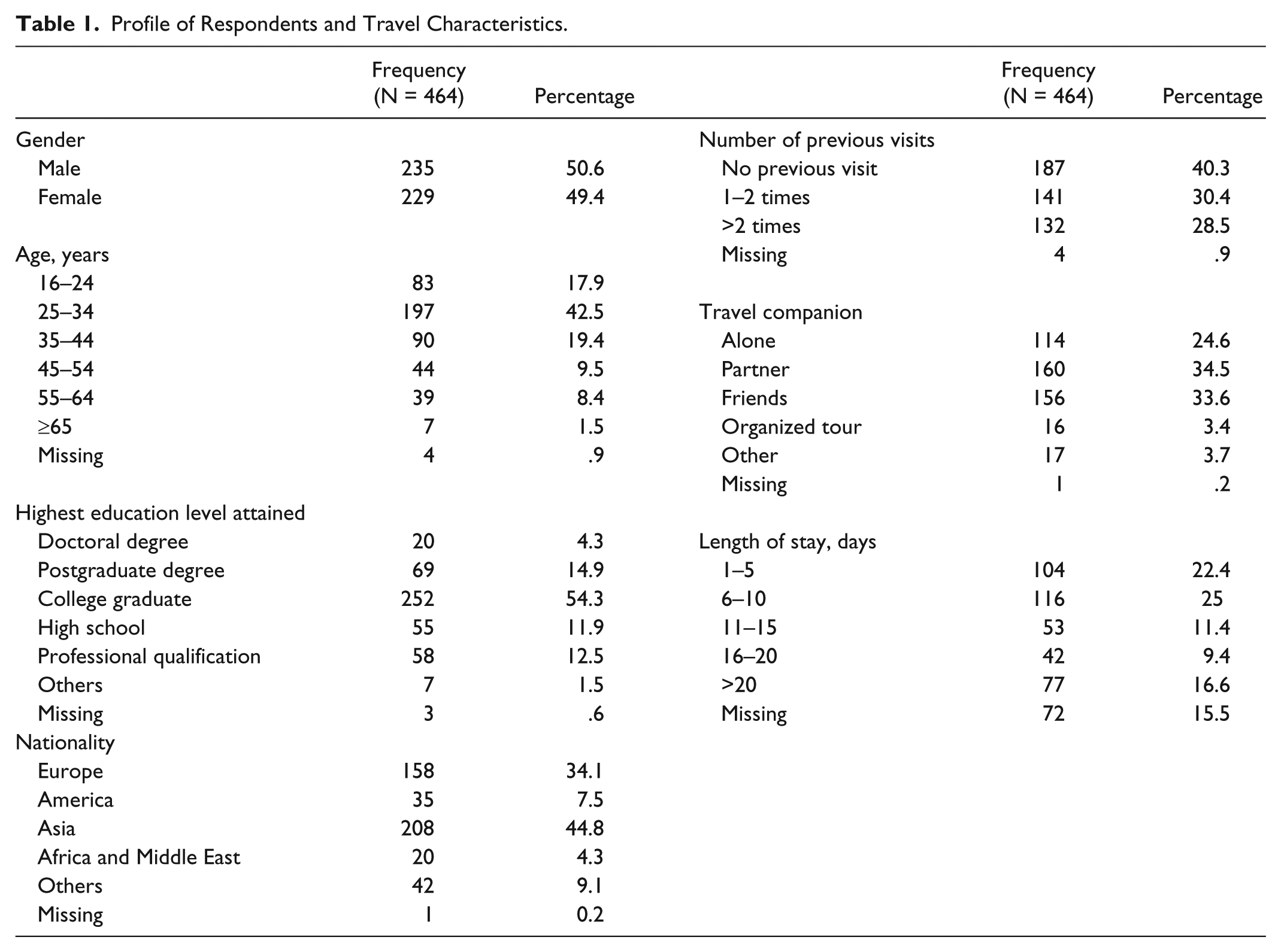
Thailand is Southeast Asia’s top tourist destination (World Tourism Organization 2016). Around 30 million international tourists visited Thailand in 2015 (Thailand Department of Tourism 2016). A team of five trained research assistants collected data face-to-face with international tourists at the departure hall of the Suvarnabhumi International Airport in Bangkok. The airport was the most cost-effective location to obtain a sample of international tourists. A purposive sampling procedure identified potential respondents. Only international tourists at the end of their stay in Thailand were invited to participate in the study. Potential respondents were approached at the departure hall’s entrance. Similar to previous studies (e.g., Hui, Wan, and Ho 2007) and to minimize selection bias, departing international tourists were targeted at different times throughout the day (e.g., morning, afternoon, and evening). If subjects did not qualify as international tourists, were in transit, or were not willing to participate in the study, the research assistants intercepted the next available person. In total, 600 questionnaires were distributed and 570 respondents completed the survey. Fifty-three cases were removed because of excessive missing data and a further 53 cases were identified as multivariate outliers (Mahalanobis D2 values with P values ≤.001). A final total of 464 valid cases were retained for subsequent analyses. The sample was almost equally split between males and females (Table 1). The majority of respondents (42.5%) were in the age category 25–34 years and held a college degree (54.6%). In terms of nationalities, two main groups were identified: Asia (44.8%) and Europe (34.1%). The sample had a high proportion of first-time visitors to Thailand (40.3%), and respondents traveled with a partner (34.5%), friends (33.6%), or alone (24.6%).
Profile of Respondents and Travel Characteristics.
Results
Measurement Model
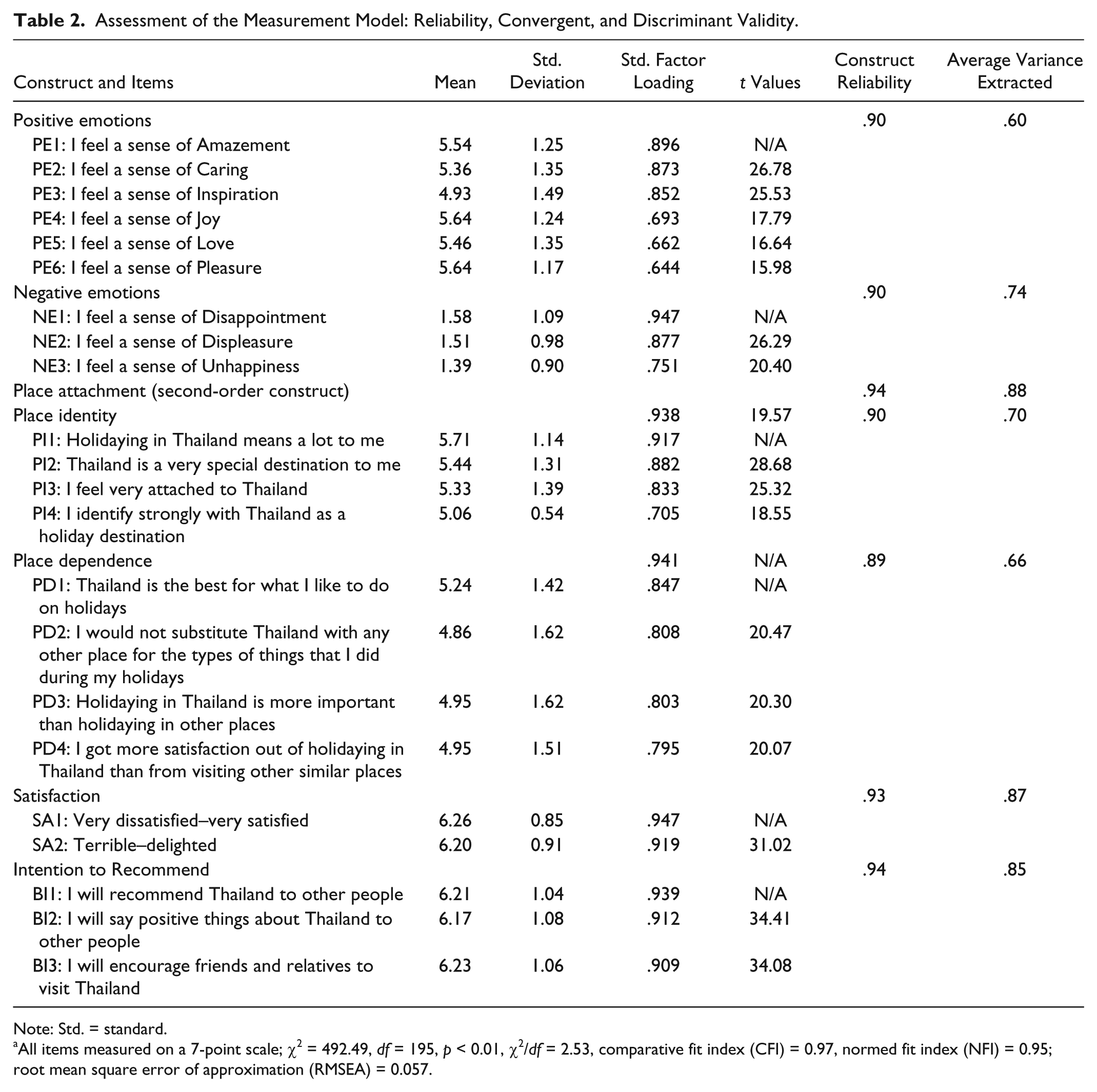
In terms of data distribution, skewness and kurtosis for the scale items were within the recommended absolute values, indicating no violation of the normality assumption (Kline 2005). To assess the psychometric properties of the scales, a five-factor measurement model was estimated using AMOS. The model displayed satisfactory fit (χ2 = 492.49, χ2/df = 2.53, comparative fit index [CFI] = 0.97, normed fit index [NFI] = 0.95; root mean square error of approximation [RMSEA] = 0.057). From Table 2, all factor loadings were greater than 0.644 and significant (p < 0.001), with t values exceeding the critical value of 3.29 (Kline 2005). Place attachment was specified as a second-order construct, consisting of place identity (Std. β = 0.938, p < 0.001) and place dependence (Std. β = 0.941, p < 0.001). Composite reliabilities estimates were ≥0.90, indicating that all the measures are reliable (Bagozzi and Yi 1988). Average variance extracted (AVE) for each construct was above 50%, establishing the scale’s convergent validity (Fornell and Larcker 1981). Discriminant validity was examined by comparing the square root of AVE for each construct with the correlations between pairs of latent variables. For adequate discriminant validity, the diagonal elements in Table 3 should be greater than the off-diagonal elements (Fornell and Larcker 1981). Comparing all correlation coefficients with square roots of AVEs in Table 3, results suggest strong evidence of discriminant validity.
Assessment of the Measurement Model: Reliability, Convergent, and Discriminant Validity.
Note: Std. = standard.
All items measured on a 7-point scale; χ2 = 492.49, df = 195, p < 0.01, χ2/df = 2.53, comparative fit index (CFI) = 0.97, normed fit index (NFI) = 0.95; root mean square error of approximation (RMSEA) = 0.057.
Interconstruct Correlations.
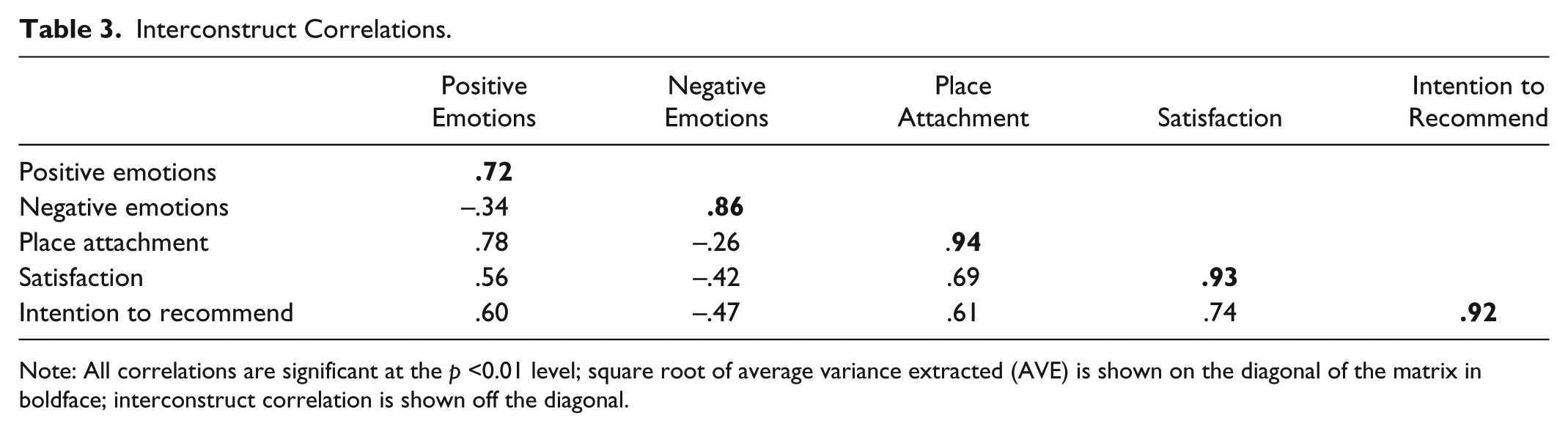
Note: All correlations are significant at the p <0.01 level; square root of average variance extracted (AVE) is shown on the diagonal of the matrix in boldface; interconstruct correlation is shown off the diagonal.
Structural Model and Hypothesis Testing
The hypothesized relationships were tested using structural equation modeling (SEM) and results are presented in Figure 1. Overall, the structural model achieves acceptable fit (χ2 = 534.446, df = 197, p < 0.01, χ2/df = 2.713, CFI = 0.96, NFI = 0.94, RMSEA = 0.061). Standardized estimates path coefficients establish a significant relationship between positive emotions and place attachment (β = 0.59, t value = 12.26). Contrary to theoretical predictions, negative emotions display a positive relationship with place attachment (β = 0.10, t value = 2.76). The relationship between satisfaction and place attachment (hypothesis 5) is established (β = 0.41, t value = 8.86). Together, tourists’ emotions (positive and negative) and satisfaction explain a high proportion of variance in place attachment (R2 = 0.713). Results also confirm the positive emotions → satisfaction (β = 0.48, t value = 10.39) and negative emotions → satisfaction (β = −0.28, t value = −6.28) relationships. Positive and negative emotions explain more than 38% of variance in satisfaction (R2 = 0.389). Hypothesis 6, hypothesizing a relationship between place attachment and intention to recommend (β = 0.21, t value = 3.89), is also supported. Finally, as theorized, the relationship satisfaction and intention to recommend is positive and significant (β = 0.60, t value=11.27). Satisfaction and place attachment explains 58.1% of variance in intention to recommend.
Testing for Mediating Effects of Satisfaction and Place Attachment
Mediation analyses establish whether the relationship between the independent variables (predictors) and the dependent variable is direct or indirect (Iacobucci, Saldanha, and Deng 2007). Positive and negative emotions are modeled as predictors, with satisfaction and place attachment serving as mediating variables between emotions and intention to recommend. To test the mediating effect of place attachment and satisfaction, we first followed Baron and Kenny’s (1986) general guidelines and test the significance of the indirect effects using Preacher and Hayes’s (2008) bootstrap procedure. Four conditions are necessary to establish the mediation effect (Baron and Kenny 1986). First, a direct link must be established between the independent and dependent variable. Second, the independent variable must be related to the mediating variable. Third, the mediator must be correlated with the dependent variable. Fourth, the relationship between the independent variable and dependent variable must be reduced when controlling for the mediating variable. Complete mediation is established when the path coefficients for the independent variable in condition 1 are significant and the same coefficients are not in condition 4. Otherwise, assuming all the four conditions hold, partial mediation is supported (Baron and Kenny 1986).
Results provide support for the conditions necessary for mediation. The direct effects without the mediators show that positive emotions (β = .495, p < .001) and negative emotions (β = –.304, p < .001) were related to intention to recommend. Once the mediators are included in the model, findings indicate that (1) satisfaction (β = .196, p < .001) and place attachment (β = .263, p < .001) partially mediates the relationship between positive emotions and intention to recommend (β = .195, p < .001); (2) satisfaction (β = –.169, p < .001) and place attachment (β = –.176, p < .001) partially mediates the relationship between negative emotions and intention to recommend.
To assess whether the mediating effects are statistically significant, we follow Zhao, Lynch, and Chen’s (2010) guidelines. Preacher and Hayes’s (2008) bootstrapping method with bias-corrected, 95% confidence intervals and 5,000 iterations were used to test the significance of the indirect effects. If the indirect effect is significant and the confidence interval does not include zero, mediation is supported (Zhao, Lynch, and Chen 2010). The bootstrap results (see Table 4) indicate that satisfaction significantly mediates the path of positive emotions (β = .287, p < .001; CI = .226 to .362) and negative emotions (β = –.139, p < .001; CI = –.201 to –.088) on intention to recommend. However, the indirect effect of positive emotions (β = .011, p = .821; CI = –.076 to .098) and negative emotions (β = .002, p = .770; CI = –.013 to .018) on intention to recommend via place attachment is not significant. In summary, only satisfaction mediates the relationship between emotions and intention to recommend.
Mediation Analysis.

p < .001; bootstrap confidence in parentheses, CI = confidence interval.
Discussions and Implications
The main objective of this study was to test a conceptual framework examining the relationships between emotions (positive and negative), satisfaction, place attachment, and intention to recommend. Findings offer several theoretical and managerial implications. The proposed model builds on the developmental theory of place attachment (Morgan 2010). The theory suggests that place attachment develops as a result of multiple interactions with the environment, generating an individual bond with a place, informed by emotional associations such as pleasure, love, and grief. Although Morgan’s (2010) theory was developed in the context of childhood experiences with place, our study found support for this theory in explaining tourists’ attachment to destinations. According to our model, both positive and negative emotions are central to tourists’ attachment to Thailand. From this perspective, tourists’ onsite experiences create memories that evoke powerful emotions, which in turn influence behavior, consistent with Morgan’s (2010) theory. Love and pleasure are emotions that imbue meaningful place–person interactions as recalled by participants in Morgan’s (2010) study. Findings of this study show that the emotions of love and pleasure, along with joy, amazement, caring, and inspiration, are central to meaningful tourism experiences. Such emotions contribute to place identity and place dependence consolidation, in line with the developmental theory of place attachment. Morgan’s (2010) study suggests that the attachment figure can be a place or a person, which includes experiences in the natural environment as well as experiences that have occurred at “home.” In the context of tourist destinations, the objects of attachment are multiple experiences that are evaluated holistically.
Findings are consistent with the brand attachment literature, suggesting that high levels of felt positive emotions can lead to strong attachment (Park et al. 2010; Thomson, MacInnis, and Park 2005). However, positive emotions that generate attachment for tourist destinations (e.g., amazement, love, and caring) are not necessarily similar to brand attachment studies in marketing (Thomson, MacInnis, and Park 2005). Yet, some emotions such as love and pleasure seem central to all positive consumption experiences (Scannell and Gifford 2010). Beyond research in marketing, the study also contributes to the environmental psychology and geography literatures (Halpenny 2010) by explicitly showing that emotions are antecedents of place identity and place dependence rather than a subdimension of place attachment. Positive and negative emotions arousing from on-site experiences influence the extent to which a tourist identifies with a place. Our findings, unlike prior studies only considering the effects of satisfaction on place attachment (e.g., Chen and Phou 2013; Su, Cheng, and Huang 2011; Zenker and Rütter 2014), show the merits of including both emotions and satisfaction to explain place attachment.
Contrary to predictions, negative emotions make a positive contribution to place attachment. Tourists’ negative emotional experiences do not mitigate their levels of attachment to the destination. A number of plausible reasons exist to explain these divergent results. First, consumer research indicates negative emotions can result from events that are relevant to but incongruent with consumption goals. Hence, consumers mitigate the importance of negative emotions in their evaluations of experiences (Lerner and Keltner 2001; Menon and Dubé 2007). Second, when negative emotions occur, tourists evaluate how the destination contributes to self-identity and the provision of features and conditions that support the achievement of specific goals or desired activities (Williams and Vaske 2003). Hence, low levels of negative emotions and high levels of place dependence or place identity can still lead to strong place attachment. It is worth mentioning that low levels of negative emotions in tourists recalled experiences reflect a positive bias, also known as the “rosy view” phenomenon (Mitchell et al. 1997). The rosy view effect mitigates negative emotions in people’s assessments of events and magnifies positive experiences (Gilbert et al. 1998; Lee and Kyle 2012). Although negative experiences reduce the enjoyment of the moment, these disappointments are fleeting (Mitchell et al. 1997), and people reinterpret their experiences in ways consistent with their original expectations (Klaaren, Hodges, and Wilson 1994).
In line with prior studies (e.g., Faullant, Matzler, and Mooradian 2011; Grappi and Montanari 2011), the results show that positive emotions have a favorable influence on satisfaction. Findings also align with previous research in marketing (Phillips and Baumgartner 2002; Westbrook 1987) and tourism (del Bosque and San Martin 2008; Lee et al. 2008), suggesting that negative emotions attenuate satisfaction levels. In addition, results confirm satisfaction as an antecedent of place attachment, consistent with research in environmental psychology (Hernández et al. 2007; Zenker and Rütter 2014), tourism (Chen and Phou 2013; Lee, Kyle, and Scott 2012; Su, Cheng, and Huang 2011), and marketing (Orth, Limon, and Rose 2010).
Emotional experiences can potentially modify behavior by creating or strengthening brand attachment (Orth et al. 2012). This study confirms that emotions have an indirect influence on intention to recommend via both satisfaction and place attachment. In addition, results establish that satisfaction has a positive effect on intention to recommend as identified in previous tourism studies (Bigné, Andreu, and Gnoth 2005; Grappi and Montanari 2011; Su, Cheng, and Huang 2011). Satisfied tourists are more likely to recommend the destination to others. Similarly, in line with previous studies (e.g., Prayag and Ryan 2012), place attachment has a positive effect on intention to recommend. The more tourists feel attached, the higher their propensity to recommend a destination.
The mediating effects of satisfaction on both the relationship between positive and negative emotions and intention to recommend confirm prior studies identifying an indirect relationship between emotions and behavioral intentions via satisfaction (Grappi and Montanari 2011; Lee et al. 2008; Yüksel and Yüksel 2007). More specifically, the results highlight the need to incorporate both emotions (positive and negative) and satisfaction in modeling tourists’ intention to recommend. Contrary to expectations, results fail to support the mediating effects of place attachment on the relationship between tourists’ emotions (positive and negative) and intention to recommend. A plausible explanation relates to the fact that tourists have higher propensity to recommend the destination, irrespective of the level of attachment. Table 2 confirms higher mean scores for the intention to recommend construct compared with place identity and place dependence. Overall, the mediation results suggest that satisfaction plays a more significant role in explaining intention to recommend and serves as a stronger transient factor than place attachment.
Managerial Implications
From a practical point of view, the results offer several implications for destination marketers. Findings show that positive emotions such as amazement, caring, inspiration joy, love, and pleasure determine both satisfaction and place attachment. Destination marketing organizations (DMOs) can develop advertising and communication campaigns about Thailand using these emotions as anchors. Thailand already utilizes “Amazing Thailand” as tagline for the destination’s brand. Results highlight opportunities to supplement this tag line with other emotive words such as “inspiration” and “love.” For example, “Inspiring Food” can be used to market the distinctive cuisine of Thailand. Agapito, Mendes, and Valle (2013) argue the need for destinations to design and market “tastescapes,” “smellscapes,” and “soundscapes” for new product development and differentiation purposes. Thailand’s DMOs can design and market tastescapes and smellscapes based on the country’s rich culture and cuisine (e.g., floating flower and food markets), tapping into the sensorial elements of the tourist experience in order to generate positive emotions. In addition, the distinctive notes in Thai music through cultural shows can be used to enhance soundscapes to elicit emotions.
Furthermore, results indicate emotions (positive and negative) influence satisfaction. For Thailand, managing tourism experiences is critical if marketers want tourists to recommend the destination to others. Tourists’ positive and negative emotions emerge from service encounters. For example, negative emotions arising from failures with service providers such as hotels, tour operators and restaurants can be minimized through employee training and emotional labor management. In addition, tourists’ interactions with residents during their holidays are a source of both positive and negative emotions. DMOs should put in place campaigns to educate residents and emphasize the importance of displaying desirable behaviors (e.g., friendliness, courtesy, and respect) in order to create positive place experiences among tourists.
Strengthening place attachment should be a priority for destination marketers. Findings of this study reveal that the antecedents of place attachment are emotions and satisfaction. As suggested in previous studies (e.g., Prayag and Ryan 2012; Su, Cheng, and Huang 2011), strategies to develop place attachment include enhancing tourists’ interactions with the physical settings (for example, improving interpretation of cultural activities at heritage sites and immersing tourists in the destination experience through cooking classes at hotels) and encouraging social interactions between tourists and residents. Such experiences create memories that reinforce emotions associated with a place (Grisaffe and Nguyen 2011). Moreover, strategies to increase place identity and place dependence include on-site marketing of activities (Ramkissoon, Smith, and Weiler 2013) and the availability of apps allowing tourists to customize their experiences. For example, on-site marketing activities such as sign-ups for loyalty programs, exclusive discounts on tours and activities, and upgrades on hotels and flights are ways to create place dependence.
There are limited tourism experiences that are devoid of negative emotions (Hosany and Prayag 2013). However, negative emotions, though common, do not necessarily adversely impact evaluations of a holiday experience (Nawijn et al. 2013). While DMOs should aim to arouse positive emotions, negative emotions should be managed to prevent dissatisfaction without comprising place attachment. In addition, both positive and negative emotions influence overall satisfaction. Traditional strategies such as targeting, developing niche products for specific segments, and coordinating service providers are necessary to improve tourist satisfaction levels. However, improving tourist satisfaction cannot be isolated from strategies to enhance destination attachment given that both influence intention to recommend.
Limitations and Directions for Future Research
The results of this study should be interpreted with caution for a number of reasons. First, only conscious emotions were captured using self-reports. Retrospective evaluations of emotional responses can be problematic (Cutler, Larsen, and Bruce 1996), given that they are vulnerable to memory reconstruction (Kahneman, Diener, and Schwarz 1999). Future studies should attempt to capture unconscious or implicit emotional responses that can provide unbiased portrayal of individuals’ initial emotional reactions when exposed to a stimulus (Li, Scott, and Walters 2015). Second, satisfaction was operationalized at the global level and future studies could adopt an attribute-level conceptualization of satisfaction (e.g., Chi and Qu 2008; Eusébio and Vieira 2013). Third, based on the developmental theory of place attachment, this study hypothesizes satisfaction as antecedent of place attachment. Other studies (e.g., Prayag and Ryan 2012; Ramkissoon, Smith, and Weiler 2013; Yüksel, Yüksel, and Bilim 2010) conceptualize satisfaction as an outcome of place attachment. Additional research should test for competing models to further understand the place attachment–satisfaction relationship.
Fourth, researchers (e.g., Robinson 2012) challenge the notion that tourists merely seek pleasure or a state of joy. Future studies should test the model in the context of other tourist experiences such as dark tourism or travel to war sites. For example, in dark tourism experiences, negative emotions are consciously sought-after experiences. Such negative emotions promote positive future intentions (Nawijn and Fricke 2015). Furthermore, place attachment was conceptualized in terms of two common dimensions: place identity and place dependence (e.g., Gross and Brown 2008; Prayag and Ryan 2012; Williams and Vaske 2003). Future studies should incorporate other dimensions such as social bonding (Ramkissoon, Smith, and Weiler 2013) and place memory (Chen, Dwyer, and Firth 2014) in the measurement of place attachment. In addition, consistent with the dominant approach in tourism research (e.g., Tonge et al. 2015), in this study place attachment was measured postvisit. However, an individual might have developed an attachment to a place prior to travel (Kyle, Mowen, and Tarrant 2004). An area for future research would be to capture pre- and postvisit levels of place attachment using a longitudinal research design.
Tourists to a destination comprise both first-timers and repeaters (Um, Chon, and Ro 2006). Previous research have established that first-timers and repeaters differ in terms of sociodemographics, travel characteristics, destination perceptions, travel motivations, perceived value, and posttrip evaluation (e.g., Fakeye and Crompton 1991; Petrick 2004; Li et al. 2008; Choo and Petrick 2016). Additional research should test the proposed model using multigroup analysis to compare first-timers versus repeaters. However, a recent study by Cheng and Kuo (2015) suggest individuals can develop bonds to places never visited before. Hence, a distinction between first-time and repeat visitors, though useful, may be futile in understanding place attachment. Finally, collecting data at a large international airport is an ideal spot to survey tourists but such a high-security location places certain restrictions on fieldwork. The convenience sampling approach and cross-sectional data used in this study restrict generalization. Future studies should perhaps consider a more sophisticated sampling procedure (e.g., stratified or quota).
Footnotes
Declaration of Conflicting Interests
The author(s) declared no potential conflicts of interest with respect to the research, authorship, and/or publication of this article.
Funding
The author(s) received no financial support for the research, authorship, and/or publication of this article.