



Abstract
Appeals to people’s pro-environmental values have been shown to trigger pro-environmental behavior across a range of contexts. The present study tests the potential of such interventions in a hedonic context where behavioral change does not generate utilitarian benefits (tourism). Results from a field experiment in a four-star hotel in Slovenia indicate that appeals to people’s pro-environmental values fail to significantly increase tourists’ hotel towel reuse and decrease room electricity consumption, suggesting that interventions in hedonic contexts—such as tourism—may require the use of more tangible benefits in order to change behavior.
Introduction
Environmental psychology acknowledges two dominant causes of pro-environmental behavior: self-interest and self-concept (Bolderdijk et al. 2013; Evans et al. 2013; Lindenberg and Steg 2007). Self-interest goals aim at maximizing personal utility; people are willing to change their behavior in exchange for personal benefits. A positive self-concept relates to individual moral norms and to feeling good about oneself when doing good (Khan and Dhar 2006; Sachdeva, Iliev, and Medin 2009). Acting green can be more appealing than acting greedy (Bolderdijk et al. 2013) because it makes people feel good.
Early research into pro-environmental behavior aimed at persuading people to act in their own interest (Ackerman 1997; Thøgersen 1994; Vining and Ebreo 1990). Most of those studies have shown that self-interest appeals are effective because they target individual economic interests. Recently, however, studies have been increasingly emphasizing that leveraging a positive self-concept can trigger pro-environmental behavior (Bolderdijk et al. 2013; Evans et al. 2013; Van der Linden 2015). These studies fail to account for context, especially contexts that are hedonic in nature, such as tourism. As Barr et al. (2010) state, “whilst individuals are relatively comfortable with participating in a range of environmental behaviors in and around the home, the transference of these practices to tourism contexts can be problematic” (p. 474).
The question driving the present study is whether findings about the effectiveness of pro-environmental appeals generalize to the tourism context given its inherently hedonic nature. A number of reasons suggest that this may not be the case: first, the level of environmentally sustainable behavior of most people is known to be lower in the vacation context than in the home context (Dolnicar and Grün 2009). Second, even people who volunteer for environmental organizations at their usual place of residence do not behave particularly environmentally friendly when on vacation. Instead, they tend to offer justifications for the mismatch between their beliefs and behaviors (Juvan and Dolnicar 2014). Third, studies conducted in the home contexts (Ackerman 1997; Thøgersen 1994; Vining and Ebreo 1990) have successfully used self-interest appeals. In those studies, behavioral change has utilitarian benefits, such as cost savings, for the people who change their behavior. This is not the case in hedonic contexts. In tourism, for example, reusing a towel does not save the tourists cost, rather it reduces the hedonic value of the accommodation they are paying for because they cannot use a fresh, dry towel, but instead use one that has been used before and might still be a bit damp.
For the above reasons, approaches proven to be successful in triggering environmentally friendly behavior in the everyday context may not be effective in hedonic contexts such as tourism (Barr, Gilg, and Shaw 2011; Franz-Vasdeki 2011).
The present study makes four contributions: (1) it assesses the potential of interventions shown to be effective in inducing more pro-environmental behavior in the home context to be used in a hedonic context (tourism); (2) it extends the body of work on environmentally sustainable tourism by using objectively measured dependent variables that are not prone to social desirability bias; (3) it extends prior experimental work in tourism by using towel reuse and electricity use as dependent variables; and (4) it investigates whether a theoretical approach rarely used in tourism—Cognitive Dissonance Theory—may serve as a useful theoretical basis of developing interventions.
Literature Review
Triggering Behavioral Change
The body of work directly relevant to this study is literature on interventions aimed at increasing the level of pro-environmental behaviors in hedonic contexts generally and the tourism context in particular. Only a very small number of studies have been conducted to date investigating this question.
In the hedonic context more generally, a few studies explored retailing. Hanss and Böhm (2013) increased demand for sustainable groceries by using persuasive communication informing consumers how they can reduce their environmental and social footprint. Rubens et al. (2015) induced buying of recycled instead of plastic shopping bags by leveraging commitment and cognitive dissonance. Geller, Witmer and Tuso (1997) reduced littering during shopping by 30% by providing specific disposal instructions at the bottom of the bill. All those studies were based on stimulating a positive self-concept and were in the domain of activating moral norms.
In the tourism context, actual behavior was investigated only in a small number of studies: Goldstein, Cialdini, and Griskevicius (2008) show that using social and descriptive norms by telling people about how many other hotel guests reused towels led to a 14% increase in towel reuse. Mair and Bergin-Seers (2010)—using a combination of information, norms and incentives—achieved a 4% increase in reuse using persuasive communication. Baca-Motes et al. (2013) used social identity theory (Tafjel 1979) to develop a number of alternative interventions. The most successful intervention, which consisted of a publicly visible commitment by hotel guests specifically to the reuse of towels, increased towel reuse by more than 40%. The focus in tourism was not only on positive self-concept but also on social pressure to change behavior.
Looking beyond the hedonic context, a number of recent studies have concluded that appealing at pro-environmental values of people is a successful way to trigger pro-environmental behavior in them:
Bolderdijk et al. (2013) conducted laboratory and field experiments to test the effectiveness of economic and biospheric appeals. The term “biospheric” refers to the human motivation to protect the environment. The field experiment was conducted at petrol stations in the USA. Visitors were exposed to biospheric (“Care about the environment? Get a free tire check.”), economic (“Do you care about your finances? Get a free tire check.”), and safety appeals (“Do you care about your safety? Get a free tire check.”). Participants were offered free coupons for checking their car tire pressure. Of the 23 coupons taken, 11 were used while the biospheric sign was posted, seven while the control sign, five while the safety sign, and none while the economic sign was posted.
Evans et al. (2013) report that making the reason to protect the environment for one behavior, car sharing, more salient can have spillover effects to another behavior with environmental consequences, recycling. In a field experiment, participants were informed about either the environmental benefits or the economic benefits of car sharing and their garbage recycling behavior was measured. Participants who received environmental information about car sharing displayed increased recycling rates. This spillover effect did not occur when financial information about car sharing was provided.
Van der Linden (2015) argues that intrinsic rewards to act in a pro-environmental way are more powerful than extrinsic rewards, such as monetary incentives, because they lead to sustained, long-term behavior change. Van der Linden collected data on campus energy consumption before, during and after an energy conservation campaign. This campaign was designed as a competition between U.S. university campuses. Energy consumption decreased significantly during the campaign. But after the competition was over, consumption bounced back to the initial consumption level. The competition was extrinsic in nature and was effective in modifying behavior only as long as the reward was in place.
Measuring Behavioral Change
A rich body of work has developed on environmentally sustainable tourism over the past decades. Because of the difficulties of conducting field experiments, most of this work was descriptive in nature and relied on survey data–measuring constructs such as stated intentions to stay with eco-friendly accommodation providers (Dalton, Lockington, and Baldock 2008; Fairweather, Maslin, and Simmons 2005; Firth and Hing 1999; Lee et al. 2010), stated intentions to book an eco-friendly tour (Bergin-Seers and Mair 2009; Dolnicar 2010; Edwards and Griffin 2013; Lee 2011; Tierney, Hunt, and Latkova 2011; Wearing et al. 2002), or stated intentions to choose environmentally friendly transportation (Dawson et al. 2010; Hergesell and Dickinger 2013; Prillwitz and Barr 2011). This body of work led to the conclusion that tourists wish to keep the negative environmental effects of their vacations to a minimum (Ballantyne, Packer, and Hughes 2009; Goodwin and Francis 2003; Hughes 2013; Lee and Moscardo 2005). But, as Miller (2003) correctly identifies, “a weakness of much of this research is the distinction between what survey respondents say and what they actually ask for or do” (p. 19). Other experts share Miller’s concerns. Fisher (1993) argues that social desirability bias is to blame, defining it as “systematic error in self-report measures resulting from the desire of respondents to avoid embarrassment and project a favorable image to others” (p. 303). Social desirability bias causes a gap between self-reported attitudes or behaviors and observed behavior (Juvan and Dolnicar 2016; Karlsson and Dolnicar 2016; Kollmuss and Agyeman 2002), implying that stated behavior and stated behavioral intentions overestimate actual pro-environmental behavior.
Understanding Behavioral Change
A number of theories have been used to try to understand what causes behavioral change in humans in the context of pro-environmental behavior. Norm-Activation Theory (Schwartz 1977; Schwartz and Howard 1981) postulates that moral concerns play a major role in evaluating what is right and what is wrong and eliciting environmentally friendly behavior. In contrast, Stern (2000), in his Value-Belief-Norm Theory of Environmentalism, argues that environmental behavior can be triggered by various reasons including moral norms, money saving, or desire for comfort or freedom. The importance of satisfying self-interest goals in eliciting pro-environmental behavior was highlighted by Equity Theory (Adams 1963). This economic theory emphasizes fairness of relationships as the driver of behavior. Another popular theory of human behavior, the Theory of the Planned Behavior (Ajzen 1985), states that social norms, attitudes, and perceived behavioral control drive behavioral intentions that, in turn, lead to actual behavior. The importance of social norms and peer pressure in triggering pro-environmental behavior was emphasized also by Social Identity Theory (Tajfel and Turner 1979) which postulates that (non)membership of certain social groups guides behavior. Cognitive Dissonance Theory (Festinger 1957) postulates that people feel a tension when their behavior does not reflect their cognitions. To relieve this tension, people can either adjust their beliefs or modify their behavior.
Those theories have not been widely applied in tourism. Rather, theories from social psychology are used in tourism and hospitality in the areas of marketing, research and development, human resources and administration. Even social psychological theories have not been widely adopted to the study of issues relating to environmental sustainability in tourism (Tang 2014). Cognitive dissonance has been observed (Hares, Dickinson, and Wilkes 2010; Juvan and Dolnicar 2014; Miller et al. 2010; Tanford and Montgomery 2014), but not actively used in an attempt to increase the level of pro-environmental behavior among tourists. Social Identity Theory was used in the successful intervention studies by Baca-Motes et al. (2013) and Goldstein, Cialdini, and Griskevicius (2008). Self-report-based studies of pro-environmental behavioral intentions rely heavily on the Theory of Planned Behavior (Chen and Tung 2014; Halpenny 2010; Hares, Dickinson, and Wilkes 2010; Lee and Moscardo 2005).
Methodology
Study Site
A field experiment was conducted at Bohinj Eco Hotel in Slovenia. Bohinj Eco Hotel has 96 rooms and hosted 10,461 tourists in 2015. The major markets for this hotel are three European countries: Croatia, Italy, and Slovenia. According to the Eurobarometer (European Commission 2008) Croatia, Italy, and Slovenia display moderate to high levels of environmental awareness. Although Bohinj Eco Hotel aims to reduce the environmental impact of its operation, it does not attract particularly environmentally friendly tourists. This was confirmed by the hotel manager and by employees working in the cleaning department of the hotel. Based on their observations, hotel guests coming to the hotel are not more environmentally friendly than guests of any other conventional hotel. Rather, tourists choose Bohinj Eco Hotel because there are only two hotels in the area and—compared to the second hotel—Bohinj Eco Hotel is more modern and offers a wider range of recreational facilities, including a bowling alley, a small movie theatre, seminar and conference facilities, and an extensive water park. It is this unique offer that attracts guests. It can therefore be expected that findings from this study will generalize to other similar hotels. Findings may not generalize to accommodations that are specifically chosen because of their environmentally friendly operations.
Field experiments have the disadvantage of being extremely labor intensive and prone to bias by unexpected events occurring during the experimental period that are not under the control of the researchers. The main advantage of field experiments is that they have high external validity, meaning that conclusions drawn from rigorously implemented field experiments will predict real human behavior better than findings derived from any other research design.
Details of the Experiment
The primary purpose of the experiment is to test the effectiveness of pro-environmental appeals in reducing electricity use and increasing towel reuse. For this purpose, three types of stickers (shown in Figure 1) containing different pro-environmental appeals were developed.
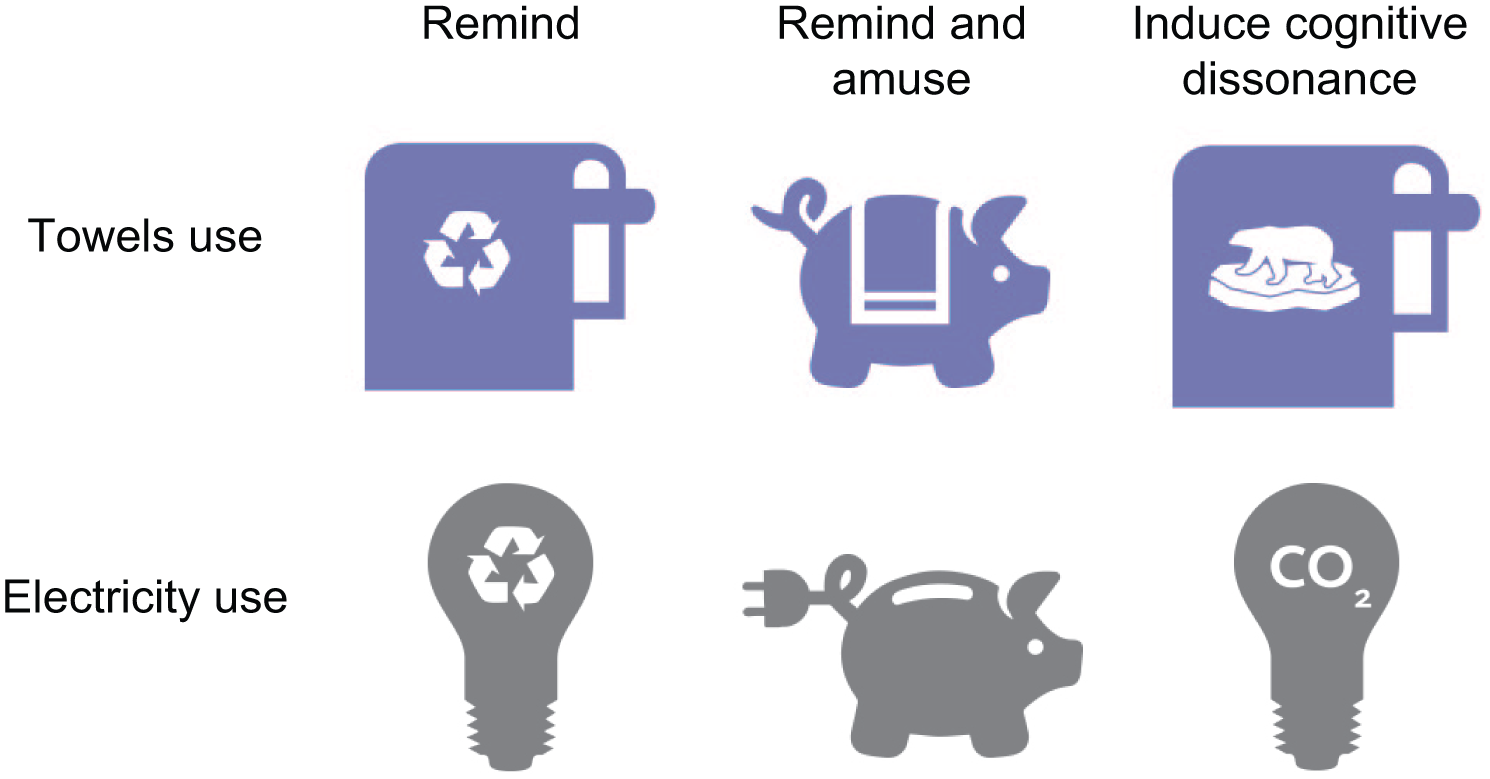
Stickers designed to remind, to remind and amuse and to induce cognitive dissonance for the towel reuse experiment (top row) and the electricity use experiment (bottom row).
Because of the wide range of linguistic backgrounds of hotel guests in Bohinj Eco Hotel, nonverbal stickers were required. Professional designers created the stickers following a detailed brief provided by the researchers. Four experimental conditions were implemented: a control condition without stickers, an experimental condition with stickers serving as reminders only, an experimental condition with stickers serving as amusing reminders, and an experimental condition where stickers elicited cognitive dissonance. To prevent results from being biased by the type of hotel room, rooms were assigned to the experimental conditions such that specific room types were represented equally across conditions. This means that all experimental conditions had the same number of rooms at each level, with the same views, of the same size, etc.
The three types of stickers developed had the following characteristics. The first type of sticker only reminded and informed hotel guests to use fewer towels and less electricity. This approach mirrors that of Evans et al. (2013), Hanss and Böhm (2013), and Bolderdijk et al. (2013). These studies—in the non-hedonic context (car sharing, recycling, retailing, and tire replacing)—used informative pro-environmental appeals to induce environmentally friendly behavior. The only study using informative pro-environmental appeals to trigger environmentally friendly behavior in tourism was that by Mair and Bergin-Seers (2010).
The second type of sticker aimed to achieve the same effect in a more amusing and engaging way. Its development was guided by Cooke and Fielding’s (2010) conceptual paper. The authors discuss the contribution of supportive psychology in eliciting pro-environmental behavior hypothesizing that individuals engage in environmentally friendly behavior if the motivators are “satisfying, interesting and fun” (p. 162).
The third type of sticker was specifically developed to induce cognitive dissonance and make people feel guilty about their environmentally unfriendly behavior. Cognitive Dissonance Theory has proven useful in reducing the shower duration at university campuses (Dickerson et al. 1992), in reducing household energy consumption (Kantola, Syme, and Campbell 1984) and in reducing household water consumption (Aitken et al. 1994). Cognitive dissonance has not been used in this way in the tourism context yet.
Stickers were placed in hotel rooms where the behaviors of interest occur: for example, electricity stickers were positioned next to the light switches and the TV and towel stickers next to the towels. Note that this represents a much more targeted approach in terms of the intended behavior change than commonly used notes and signs in hotel rooms. Also, as opposed to notes and signs, stickers cannot be removed out of sight by the guest and, because stickers were placed in all spots where the behavior occurs, guests were exposed to multiple reminders, as opposed to typically only one. The pro-environmental appeals were not designed to only increase awareness but specifically to trigger a change in behavior, for example, switching the lights off and reusing towels. Standard hotel signs reminding hotel guests to think about the environment were removed from the rooms during the experiment.
Data was collected for 81 days (December 20, 2014 to March 11, 2015) on 1,836 room nights from 784 guest parties. Each one of the hotel rooms was fitted, specifically for this study, with an electricity meter. Electricity consumption per room was measured every day at 11:00
Descriptive Statistics of Guest Parties Staying at the Hotel during the Experiment (n = 784).
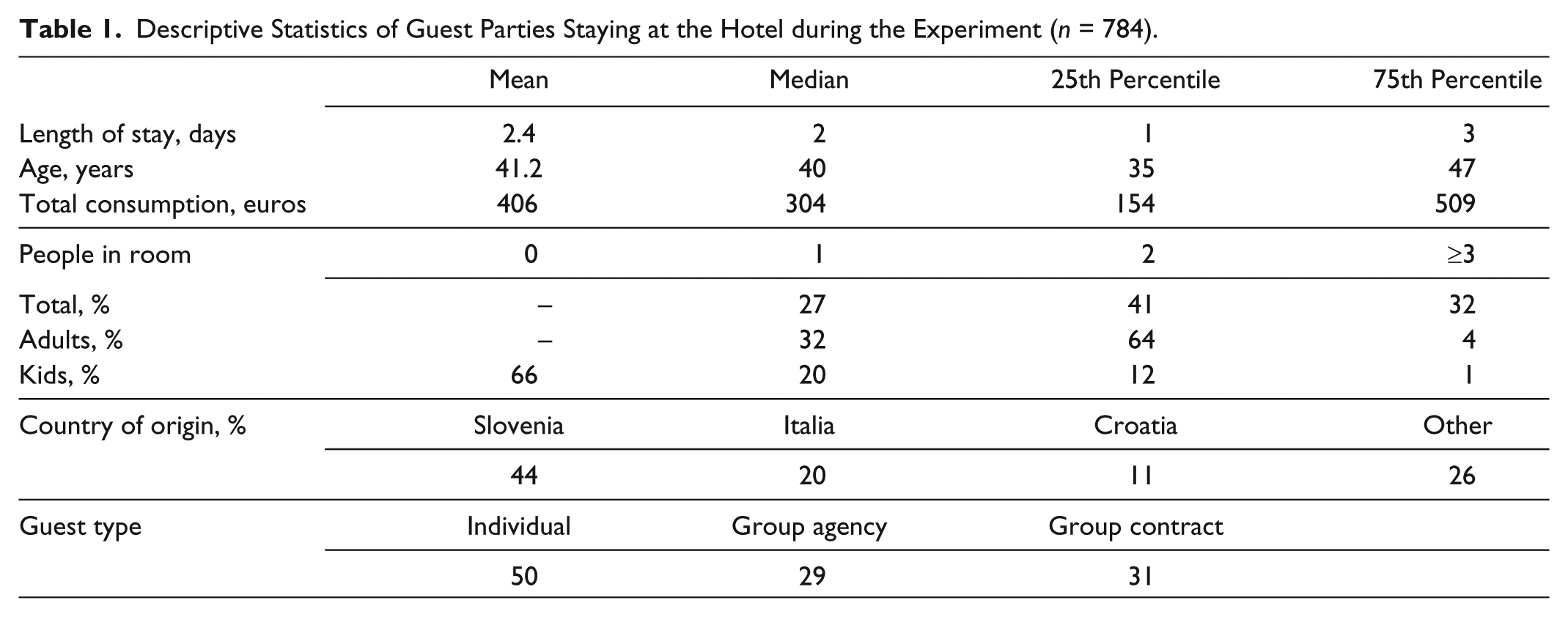
It was not possible for the researchers to reconstruct the identity of hotel guests from these data. The study was approved by the University of Queensland human ethics committee. Guests were aware that a study involving monitoring towel and electricity use was being conducted during their stay. Guests were not provided with details of the experimental conditions. This awareness could affect behavior. However, guests were randomly assigned to experimental conditions. Therefore, any changes in behavior due to the information provided to them would occur across all conditions.
Manipulation Check
A manipulation check was conducted to ensure that the stickers triggered the intended reactions in hotel guests. For this purpose, interviewers intercepted 180 tourists (30 tourists per sticker). Interviewers were unaware of the purpose of the study to avoid interviewer bias. Interviewers asked respondents to imagine they are in the hotel and they see the sticker. Then using an open-ended question, they were asked how the sticker made them feel and to express their feelings using opposite adjective pairs presented in a semantic differential with five scale points. When presented with the cognitive dissonance inducing stickers, the following words were used: “sad,” “uncomfortable,” “makes me think about environmental issues,” or “global warming problem.” When presented with the stickers aimed at reminding and amusing, most respondents smiled and related them with “fun,” “amusement,” “saving the money,” and “unclean behavior.” For the reminder stickers (light bulb and towel with recycling symbol), reported emotions included being aware and recycle.
Ratings on the semantic differential confirm differences in reactions to the stickers, as shown in Table 2. Respondents were asked to evaluate their feelings towards the sticker using a semantic differential scale including the following opposites: bad–good, guilty–not guilty, amused–not amused, happy–sad, aware–unaware of environmental issues, and annoyed–not annoyed. The percentages in Table 2 indicate how many respondents agreed that the stickers made them feel bad, guilty, amused, happy, aware of environmental issues or annoyed, that is, chose one of the categories in that half of the scale.
Manipulation Check Results (Percentage of People Ticking Answer Option in the Left Half of the Semantic Differential When Asked How the Stickers Made Them Feel).

Only the attribute “aware of environmental issues” did not lead to significant differences (Electricity: chi-square 9.954; p = 0.268; Towels: chi-square 10.980; p = 0.203), indicating that all stickers achieved this aim to the same extent. The observed rating differences confirm the intended functioning of the stimuli: the cognitive dissonance–inducing stickers were significantly more frequently making people feel bad (Electricity: chi-square = 17.806; p = 0.023; Towels: chi-square 26.824; p < 0.001) and guilty (Electricity: chi-square = 18.179; p = 0.020; Towels: chi-square 30.699; p < 0.001). The sticker designed to remind and amuse was significantly more frequently making people feel happy (Electricity: chi-square = 19.460; p = 0.013; Towels: chi-square = 19.290; p = 0.037) and amused (Electricity: chi-square = 25.445; p < 0.001; Towels: chi-square = 24.197; p = 0.002). Overall, the manipulation check confirmed the suitability of the stickers for the study.
Results
Results of the experiment are provided in Figure 2, where the top section shows the results for electricity use in the hotel room and the bottom section shows the results for towel reuse. In the top plot, relating to electricity consumption, experimental conditions are aligned from left to right. The y axis shows the electricity use per room per day in kilowatt-hours and the x axis shows the time of the measurement. To avoid bias, the experimental conditions were implemented simultaneously. In the bottom plot, relating to hotel towels, the experimental conditions are aligned in the same way. The y axis shows the number of towels used per room per day and the x axis shows the number of people in the room.
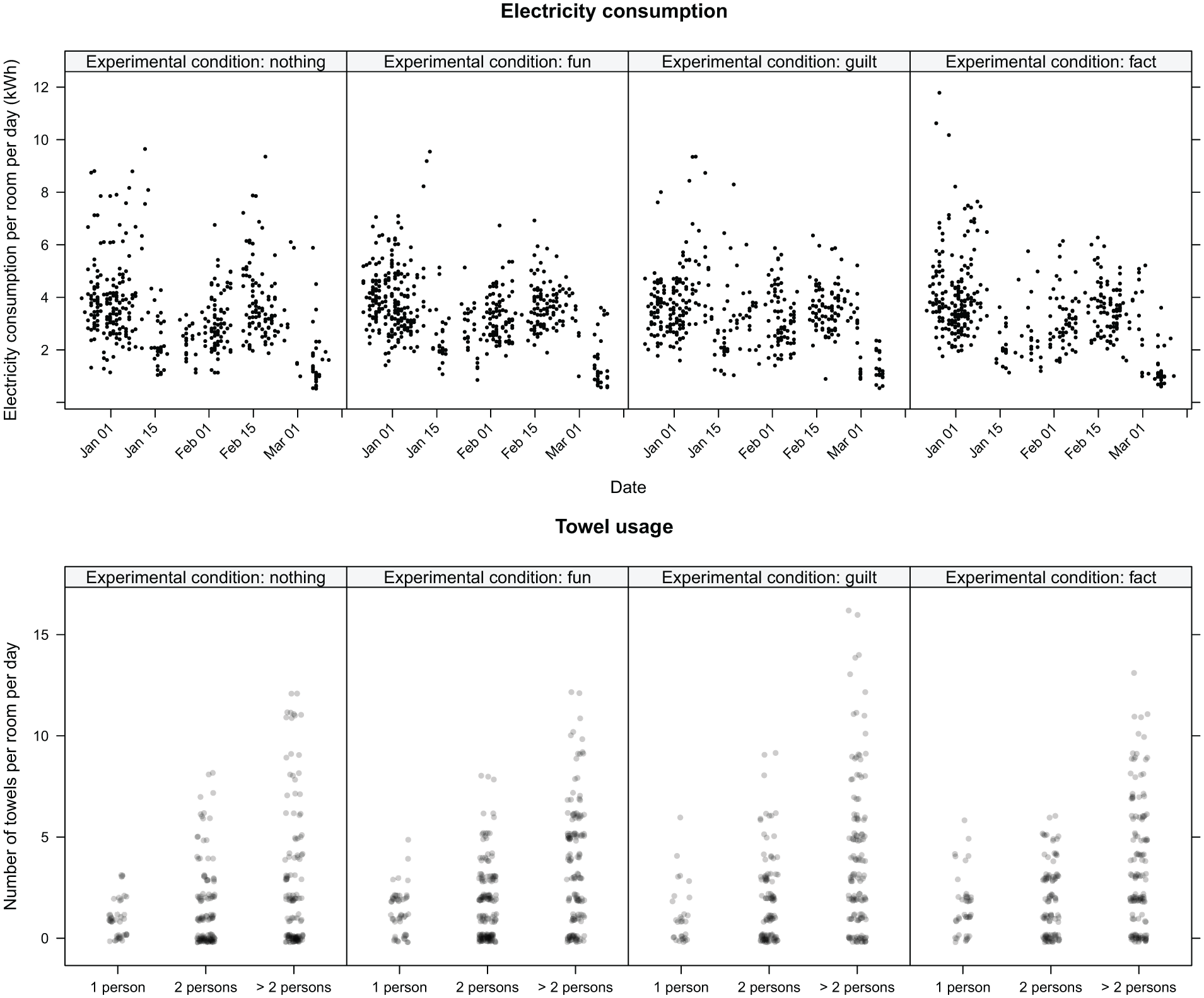
Effect of experimental interventions on electricity use (top) and towel reuse (bottom).
As can be seen, the distributions of both electricity and towel reuse values are very similar across the four experimental conditions. Differences in dependence of the experimental conditions cannot be visually detected in either electricity use or towel reuse.
This observation based on the plots in Figure 2 is confirmed by the results when fitting statistical models. For both dependent variables generalized linear mixed effects models were fitted using maximum likelihood estimation (Bates et al. 2015). For towel usage per room per day, observations from their last day of stay were excluded, resulting in 1,063 observations from 559 guest parties. In these models, the experimental condition was included as independent variable, number of adults and kids in the room as control variables, and a random intercept to account for repeated measurement by guest party. The experimental design of the study ensured that the distribution over experimental conditions is the same over time, that is, the month of stay (chi-square = 6.758, p = 0.66), which implies that time does not need to be included as a control variable in the analysis. Similar results hold for the guest party being Slovenian or not (chi-square = 2.029, p = 0.57). However, despite the efforts made to have a comparable room distribution over experimental conditions, the number of adults and kids in the rooms varied considerably (Adults: chi-square = 13.527, p = 0.04; Kids: chi-square = 20.806, p = 0.002), implying that these need to be included as control variables in the analysis.
Including a random intercept for guest parties is important because the length of stay was on average 2.4 days per guest party, and the length differed between guest parties. Not accounting for this when using daily data would lead to biased estimates and would understimate the uncertainty of the estimates. In addition, comparing the model with and without random intercept using the Akaike information criterion (AIC) clearly indicates the better fit of the mixed effects models (Electricity consumption: AIC without random intercept = 6,222, AIC with random intercept = 5,461; towels use: AIC without random intercept = 5,104, AIC with random intercept = 4,405). The estimated coefficients with their standard errors for the mixed-effects models are given in Table 3. The results clearly indicate that electricity consumption and towels use increase significantly with the number of adults as well as the number of kids in the room.
Estimated Coefficients and Standard Errors for the Mixed Effects Models with the Intercept Including the Control Group (No Stickers) as Baseline and the Coefficients for the Experimental Conditions Indicating the Difference to the Control Group.

Note: SE = standard error.
To assess if the experimental conditions had an effect, Wald chi-square tests were employed to compare the models containing the experimental condition with the models where the independent variable was dropped. For electricity consumption per room per day as dependent variable, no significant differences between experimental conditions were detected (chi-square = 2.73, p = 0.44). The fitted Poisson mixed-effect model also indicated no significant differences across experimental conditions in the towel reuse data (chi-square = 5.29, p = 0.15). These results indicate that the calls for action to reuse towels and reduce electricity consumption using nothing else but biospheric appeals positioned at the exact location of where the behavior occurs were not effective.
Conclusions, Limitations, and Future Work
This study set out to assess the potential of interventions proven to be effective in nonhedonic contexts in the hedonic context of tourism. It further investigates whether inducing cognitive dissonance—which has frequently been observed in tourists who do not behave in an environmentally friendly way—could serve as a promising basis for intervention development.
Prior studies, published in highly reputable journals, including Nature Climate Change, make strong statements about the effectiveness of pro-environmental (biospheric) appeals in triggering pro-environmental behavior. Results from our field experiment in a four-star hotel show, however, that pro-environmental appeals do not significantly improve towel reuse or electricity use of hotel guests. This does not mean that prior studies were wrong; rather, it leads to the conclusion that the findings obtained from studies set in people’s home context cannot be assumed to automatically generalize to the tourism context. A possible explanation for this finding is that the tourism context is inherently hedonic. Tourism is about pleasure, not chores. Tourism is about letting go, not acting responsibly. This finding is in contradiction to much of the work on sustainable tourism which studied tourist attitudes and stated behavioral intentions relating to environmental sustainability, but aligns well with the more recent body of work, which provides substantial empirical evidence that tourists like the idea of environmentally sustainable tourism, but they do not like it enough to actually adjust their behavior to be more environmentally friendly (e.g. Buckley 2011; Dolnicar and Grün 2009; Gössling et al. 2009; Juvan and Dolnicar 2014; Karlsson and Dolnicar 2016; Miller et al. 2010).
The key theoretical implication from these findings is that the effectiveness of pro-environmental appeals in triggering pro-environmental behavior is context dependent. As a consequence, successful approaches to triggering pro-environmental behavior in the home context (where self-interest plays a role as motivator) cannot be automatically assumed to work in tourism, which is inherently hedonic in nature. It is important, therefore, to proactively work on developing and testing new, different approaches to triggering environmentally sustainable behavior in tourists. One possibility is to develop interventions that offer some kind of benefit and, in so doing, also trigger the self-interest motive.
The present study is limited in a number of ways. First of all, it was conducted only in one hotel and in one country. Although there is no obvious reason to believe that this context biases results, it would be desirable to replicate this study in other contexts to ensure generalizability of the finding that pro-environmental appeals are ineffective in hedonic contexts. Specifically, the study should be replicated in hotels that differ substantially from the nature of the hotel used in the present study, either in terms of star rating or location. The larger context may also play a role, for example, the guest composition in terms of the strength of environmental values held by guests or the location of the hotel in regions with very high or low environmental awareness. Second, the study is limited by measuring only two behaviors. Even in a hotel there are many more behaviors that, if modified successfully, have the potential of reducing the environmental footprint of hotel operations. Future work should extend the investigation to other behaviors, especially given that it is possible that different interventions have different levels of success for different behaviors.
These findings also have major implications for practice: pro-environmental appeals targeted at tourists are unlikely to represent effective ways of reducing the negative environmental impacts of the tourism industry on the environment. This is an unfortunate finding because interventions focusing merely on the communication of pro-environmental appeals are very simple and cheap to develop. In future, it will be necessary to explore and experimentally test a range of other possible theory-based interventions. Promising theoretical backgrounds include attribution theory (originally Heider 1958), which could be implemented by trying to proactively counterargue excuses tourists have for not behaving in an environmentally friendly way and, in so doing, forcing them into internal attribution patterns; and Stern’s (2000) Value–Belief–Norm theory of environmentalism, which could be implemented by spelling out very clearly both the consequences of tourists’ behavior as well as the specific behaviors that they could engage in to avoid those consequences. These two theories still require pro-environmental values or beliefs as a foundation to some extent. Two theories that do not and could be used in future work include Equity Theory (originally Adams 1963) which could be implemented by offering adequate rewards for the tourists when they display desirable behavior; and Social Identity Theory (originally Tafjel 1979), which could be implemented by creating peer pressure through feedback on the high level of environmentally friendly behavior by similar tourists. Future work should also use actual behavior as dependent variable. This is the only way to avoid biases when testing any intervention.
Footnotes
Acknowledgements
We thank Nazila Babakhani and Homa Hajibaba for feedback on previous versions of this manuscript. Most of all, we thank Anze Cokl, the General Manager of Bohinj Eco Hotel, for his active involvement in the implementation of this project.
Declaration of Conflicting Interests
The author(s) declared no potential conflicts of interest with respect to the research, authorship, and/or publication of this article.
Funding
The author(s) disclosed receipt of the following financial support for the research, authorship, and/or publication of this article: We are grateful to the Australian Research Council (ARC) for supporting this research through salary funding under the Discovery Scheme project DP110101347 and the University of Queensland for support under the Vice-Chancellor’s Research Focused Fellowship Program and under the Jim Whyte Fellowship Program.