



Abstract
Given that online travel media enable multilateral communication patterns in destination marketing, this study investigates technical attributes presenting the number and type of source-related visual cues. From a technological perspective, the sources of online travel information can be conceptualized in terms of specialization, endorsement, and other users’ star rating to reflect technological functions and psychological effects. An experiment with a 2 (specialization: a generalist website vs. a specialist website) × 2 (endorsement: absence vs. presence) × 3 (star rating: low vs. medium vs. high) factorial between-subjects design was conducted to test the relationships between source-related visual cues, cue-induced perceptions, information credibility, and destination images. This study found that each source-related visual cue produced distinctive psychological effects on a tourist’s perceptions. Furthermore, these cue-induced perceptions were influential to tourists’ judgment of information credibility, which was positively related to destination images and behavioral intention.
Introduction
The communication pattern in traditional media, such as magazines, brochures, and television, is based on the unilateral flow of travel information from senders (tourism providers) to receivers (tourists; Govers, Go, and Kumar 2007). With the development of media technology (e.g., web-based interface, mobile application, and newly emerged virtual reality and augmented reality technology), however, the traditional roles of sender, medium, and receiver have become indistinguishable because various agents (e.g., tourism providers, travel websites, and other tourists) participate in the creation and distribution of online travel information. As a result, there exist different types of visual cues (symbol, mark, or label implying the source of information). For instance, in a situation where an individual is exposed to a video clip portraying the landscape of a tourist destination on YouTube, there can be a complex set of source-related visual cues, for example, a tourism provider who originally uploaded the video clip, the website where presented, a user himself/herself who chose to watch, or other users who recommended watching.
Online media enable multilateral communication patterns involving multiple agents, channels, and directions (Sundar and Nass 2000, 2001). Online travel information, originally created by a tourism provider, can be easily modified, recreated, and distributed by tourists and/or other tourism providers (Tussyadiah and Fesenmaier 2009). By using Web 2.0 technology, tourists’ feedback, comments, and ratings become more accessible and important forms of information for both tourism providers and other tourists (Bronner and Hoog 2011; Sparks, Perkins, and Buckley 2013). Also, tourists can search and share travel information through various online platforms such as search engines, virtual communities, travel websites, and social media (Illum, Ivanov, and Liang 2010; Pan et al. 2010; Xiang and Gretzel 2010).
Using diverse online platforms that produce, distribute, and share information, tourists can search for an enormous volume of online travel information, which possibly contradicts the destination images established and promoted by destination marketing organizations (DMOs). Hence, to successfully promote positive destination images, it is necessary for DMOs to provide credible and plausible travel information.
Source of information has been considered a key determinant to enhance information credibility (Gotlieb, Schlacter, and Louis 1992; Kerstetter and Cho 2004; Sundar 2008). With the influence of media technology, however, it is important to reconsider sources of information from a technological perspective for three reasons. First, online travel information contains different types of compound source-related visual cues due to technology functions enabling multilateral communication patterns. Second, many technology attributes of online travel media present multiple visual cues of different sources. Third, visual cues of different sources can elicit substantial psychological effects on tourists’ judgment on information credibility and their formation of destination images.
Given that tourists are exposed to multiple visual cues of sources, it is important to differentiate and diversify the sources of online travel information to understand their technological functions and psychological effects. Recently, researchers have addressed the emergence of virtual communities and social media (Wang, Yu, and Fesenmaier 2002; Xiang and Gretzel 2010); technology innovations (Guttentag 2010); and online travel information search (Ho, Lin, and Chen 2012; Pan and Fesenmaier 2006). But how psychological effects of source-related visual cues influence the formation of destination images has received less attention. Although the concept of source has been developed to capture technological functions of online media in literature on communications and media effect studies (Koh and Sundar 2010; Reeves and Nass 1996; Sundar and Nass 2000), there has been no attempt in tourism context to conceptualize source from a technological perspective. Moreover, recent studies have found that not only the content of message but also source-related visual cues can produce distinctive psychological effects (Koh and Sundar 2010; Sundar and Nass 2001). For online travel information, there is a lack of understanding of how and to what extent source-related visual cues influence destination image and behavioral intention.
Considering the potential psychological effects elicited by different source-related visual cues, what are the psychological effects of the sources of online travel information on the formation of tourist destination image? To answer this question, we conducted an experiment to test the relationships between source-related visual cues of online travel information, cue-induced perceptions, information credibility, and destination images. The purpose of this experiment was threefold: (a) to conceptualize the sources of online travel information from a technological perspective, (b) to articulate the psychological effects of source-related visual cues on information credibility, and (c) to examine the relationship between information credibility and the formation of destination images.
Literature Review
Sources of Online Travel Information
Referring to the origin of information, source has been considered an important concept in the literature on persuasive communication and information search (Sundar and Nass 2001). With traditional media, where the roles of sender, channel, and receiver have been perceived as distinctive, source was treated as either (a) a singular agent that originally supplies and disseminates the given information or (b) a two-sided concept of internal or external sources in the information search process (Gartner 1993; Gunn 1972). As online media have developed and increasingly involved multiple agents, diverse channels, and a multidirectional flow of information, however, source has become more difficult to define (Sundar and Nass 2001). For instance, online information can have diverse types of sources, originating from not only senders but also channels (e.g., computer); gatekeepers (e.g., editor of newspapers or magazines and website); labels attached to the information; bloggers; and social media and/or website users (Morris and Ogan 1996; Sundar and Nass 2000).
Online information also has a complex structure with multiple layers and hyperlinks (Sundar 2008). There is a hierarchical layout of web pages within a website (e.g., a travel news article under the travel menu bar of a portal website) and some online information can be linked to other websites (e.g., YouTube video clips available on Facebook). In this regard, the sources of information can be mixed and each source-related visual cue may produce distinctive psychological effects (Sundar and Nass 2001). Hence, researchers have suggested reconsidering the concept of source to apply to a broader range of media, including newly emerged online media (Nass and Moon 2000; Sundar and Nass 2001; Koh and Sundar 2010).
In their seminal work on the conceptualization of information source in online media, Sundar and Nass (2001) established a typology of information sources based on the distinctive orientations in the communication chain of sender, medium, and receiver. In this regard, there exist at least four types of information sources: visible sources, technological sources, self as source, and audience as source (Sundar and Nass 2001). By conducting an experiment on individuals’ perceptions of online news, they found that different information sources (e.g., news editors, computer, other users, and self) produce different psychological effects on individuals’ perceptions about the given information (e.g., credibility, liking, quality, and representativeness). In addition, online information can contain multiple source layers, such as medium, website, and web agent, which potentially elicit substantial psychological effects on individuals’ information processing (Koh and Sundar 2010). Sundar (2008) introduced the term agency to represent technology attributes providing sources of information when classifying technology affordances (action possibilities of a web interface). As a foundational building block for a particular medium or web interface, agency determines the number and type of source-related visual cues. He also argued that online information sources can be specified with the influx of new technical functions.
Tourism researchers have also suggested that information source must be accounted for when studying the role of online travel media in destination marketing (Akehurst 2009; Sparks, Perkins, and Buckley 2013). As online travel media have increasingly adopted Web 2.0 applications, tourists have been exposed to diverse sources of online travel information. Because of the distinctive orientations of sources in multilateral communication patterns, online travel information has presented multiple layers of visual cues of sources.
More importantly, diverse sources of online travel information can influence how tourists assess information credibility. According to Sundar (2008), because of multiple layers of sources media users consider source credibility as well as information credibility. Information credibility is user’s judgment on information in terms of credibility, trustworthiness, and reliability. Dual process models, such as the elaboration likelihood model (Petty and Cacioppo 1981) and the heuristic-systematic model (Chaiken 1980), consider media users “cognitive misers” who tend to use heuristics (mental shortcuts) when making decisions. In a similar fashion, Sundar (2008) indicated that agency is related to an individual’s credibility judgment. The recognition of source-related visual cues produces certain types of heuristics (e.g., bandwagon and authority) that influence an individual’s perceptions about the given information (Sundar 2008). Moreover, perceptions about information can change an individual’s attitude and behavior (Sundar, Xu, and Dou 2012). Other researchers have provided empirical evidence to support the profound psychological effects of source-related visual cues on the perceptions about information and credibility judgment (Reeves and Nass 1996; Sundar and Nass 2000; Koh and Sundar 2010).
Not only the content of the message but also source-related visual cues can influence credibility judgment. In other words, when the information of a destination is identical, it is possible that tourists’ judgment on information credibility can be changed by source-related visual cues, such as where the information is presented (e.g., specialization), who represents the information (e.g., endorsement), and how other people think about the information (e.g., star rating). Their judgment on information credibility can also be affected by travel websites with visual cues presenting different sources of information that ultimately elicit different perceptions (e.g., perceived usefulness, perceived bandwagon, and perceived authority). However, it is important to note that different types of technical functions (e.g., comment function, self-filtering, search engine algorithm, and chat-room) introduce unique aspects of online information sources. Hence, to conceptualize the sources of online travel information, this study considers different types of technical functions, leading to very different fundamental characteristics of sources.
The number of technical functions related to sources has been rapidly increasing so that it seems impossible to examine all technical functions in one study. To maintain the manageable experimental design, this study focuses on three common technical functions deriving from medium, visible, and user sources, respectively: specialization, endorsement, and other users’ star rating. The following explain the distinctive psychological effects of each source of online travel information on information credibility and destination images.
Specialization
The domain of online tourism consists of “technological elements and information entities related to travel” (Xiang, Wober, and Fesenmaier 2008, 138). Although there is a broad range of websites and web pages containing tourism-related information, certain online tourism domains are more specialized in travel/tourism than others (e.g., Travelocity.com vs. Amazon.com). In this study, specialization is conceptualized as a source of online travel information representing the centrality of an online tourism domain on travel and tourism.
Recent studies have shown that people tend to consider the information in a specialized medium more informative and useful than identical information in a generalized medium. In their experimental study showing news and entertainment TV programs, Nass, Reeves, and Leshner (1996) found that participants more positively evaluated information from a TV labeled “specialist” than one labeled “generalist,” although the information in these two TV sets was identical. Similarly, Koh and Sundar (2010) proposed that a specialist website produces greater affective and cognitive trust than a generalist website. Thus, we hypothesize that specialization of the online tourism domain (website) is positively associated with individuals’ perception of how useful and informative the travel information is.
Hypothesis 1a: A specialist website is perceived to produce more useful information than a generalist website.
In the MAIN (Modality, Agency, Interactivity, and Navigability) model, Sundar (2008) postulates the psychological mechanism explaining how visual cues of technical functions induce heuristics or mental short cut, which influence media users’ credibility judgment on information or web interface. Considering this sequential process, information credibility is considered to be the outcome from the assessment of cue-induced perceptions. In a sense that perceived usefulness is a cue-induced perception by the visual cue of specialization, a positive relation between perceived usefulness and information credibility is proposed.
Hypothesis 1b: Perceived usefulness is positively related to information credibility.
Endorsement
Researchers have suggested that professional entities and experts produce an authority effect in the decision-making process (Nolan 1976; Manfredo and Bright 1991; Rieh 2002). As a source of online travel information, endorsement is defined as the advocacy or recognition from an official agent. Endorsement can include those from identifiable people, corporations or organizations, and inanimate figures (Stout and Moon 1990).
In tourism, there are internationally renowned organizations and institutes that are used to promote the preservation of natural and cultural heritages. For instance, researchers have argued that being recognized by professional organizations such as the United Nations Educational, Scientific and Cultural Organization (UNESCO) is a powerful tool in international destination marketing (Buckley 2004; Kim, Wong, and Cho 2007; Li, Wu, and Cai 2008). As a third-party organization, the role of UNESCO is to encourage the identification, protection, and preservation of cultural and natural heritage. By acknowledging partnership with and/or sponsorship by UNESCO, online travel media can increase tourists’ perception of authority. Thus, we hypothesize that the perception of authority can vary depending on the presence or absence of visual cues of the endorsement from professional organizations (i.e., UNESCO).
Hypothesis 2a: The presence of endorsement produces a greater authority than the absence of endorsement.
Perceived authority is a distinctive psychological perception, mainly induced by the presence of endorsement. Considering the sequential process of source-related visual cues, cue-induced perceptions, and credibility judgment (Sundar 2008), perceived authority is considered to be an antecedent of information credibility. The effect of perceived authority on information credibility is hypothesized as follows:
Hypothesis 2b: Perceived authority is positively related to information credibility.
Star rating
People tend to follow other people’s opinions, attitudes, and choices (Bass 1969; Fu and Sim 2011). In the context of eCommerce and social media, the opinion of the majority of other users can have a significant effect on an individual’s perception, attitude, and behavior. In their experimental study on online marketing, Sundar, Oeldorf-Hirsch, and Xu (2008) documented that the visual cues of collaborative filtering features (e.g., star rating, number of reviews, and sales rank) produced the perception of bandwagon that positively links to the increase of purchase intention. Bandwagon effect refers to “the tendency for social constituents to emulate the consensus among a critical mass of peers as their focal choice” (Fu and Sim 2011, 2383).
In a tourism context, researchers have argued that tourists evaluate other tourists’ information more credibly than that of tourism providers or DMOs (Sparks, Perkins, and Buckley 2013). Among many collaborative filtering features, the star rating is a widely applied technical function in travel websites. By providing the average of other tourists’ evaluations, a star rating can represent a condensed index for determining the quality of information.
Hypothesis 3a: Higher star ratings from other users will produce a greater bandwagon effect than lower star ratings from other users.
Similar to perceived usefulness and perceived authority, perceived bandwagon is a cue-induced perception by star ratings. Based on the sequential relationship proposed by Sundar (2008), it is expected that perceived bandwagon is a foundation for the assessment of information credibility.
Hypothesis 3b: Perception of bandwagon is positively related to information credibility.
Effects of Information Credibility on Destination Image
Information credibility is considered to be a central factor that affects the information search process (Kerstetter and Cho 2004; Xie et al. 2011; Lee, Lee, and Kwon 2015) and tourists’ attitude and behavioral intention (Manfredo and Bright 1991; Kim, Chung, and Lee 2011). Particularly in destination marketing, researchers have proposed that information credibility mediates the effects of information source on the formation of destination image (Baloglu 1999; Gartner 1993; Kim and Richardson 2003). For instance, Tasci and Gartner (2007) argued that certain types of sources (e.g., tourists vs. tourism providers) are more influential on destination image because they are perceived to have higher credibility. Mercille (2005), in a study of destination images of Tibet, found this to be true; perceived credibility increased the effects of media representations (i.e., movies, guidebooks, and magazine) on destination image.
Destination image refers to the various visual or mental representations of a place and, as a result, is complex and hierarchical (Baloglu and McCleary 1999; Ryan and Cave 2005). In the early 1970s, Gunn (1972) indicated that image can be organic (formed by noncommercial media) or induced (formed by commercial media), depending on the source of information. Today, this simplistic interpretation of image no longer holds true. Online travel media often present multiple visual cues of information sources from both commercial and noncommercial media and it becomes difficult to distinguish between organic and induced image. For example, Li et al. (2009) attempted to differentiate between baseline (formed by passive media exposure) and enhanced image (formed by active information searching). This proved problematic because the formation of baseline image for many not-so-popular destinations is negligible for tourists. In response, Baloglu and McCleary (1999) and Kim and Richardson (2003) conceptualized destination image as multidimensional. They argued that destination image is composed of affective (positive or negative emotions), cognitive (beliefs or assessments), and conative images (behavioral intention). We hypothesize that information credibility is positively associated with affective, cognitive, and conative dimensions of destination image.
Hypothesis 4a: Information credibility is positively related to affective image.
Hypothesis 4b: Information credibility is positively related to cognitive image.
Hypothesis 4c: Information credibility is positively related to behavioral intention.
When investigating the interrelationships among the three dimensions of destination image, researchers found that there is a sequential process of building destination images, and that affective and cognitive images precede behavioral intention. For example, Tasci and Gartner (2007) postulated a positive relationship between destination image and trip behavior. Baloglu (1999) and Sönmez and Sirakaya (2002), similarly, argued that both affective and cognitive destination images are the primary determinants of a tourists’ intention to visit. Hence, we hypothesize sequential relationships between affective image, cognitive image, and behavioral intention.
Hypothesis 5a: Affective image is positively related to cognitive image.
Hypothesis 5b: Affective image is positively related to behavioral intention.
Hypothesis 5c: Cognitive image is positively related to behavioral intention.
The hypotheses are presented in the following research model (see Figure 1).
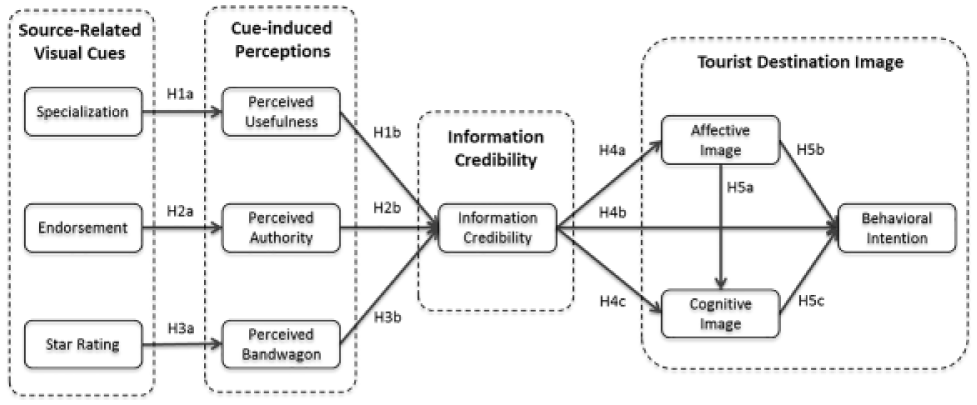
Proposed relationships between source-related visual cues, cue-induced perceptions, information credibility, and tourist destination image.
Method
Research Design
To test the hypotheses, we conducted an online experiment with a 2 (specialization: a generalist website vs. a specialist website) × 2 (endorsement: absence vs. presence) × 3 (star rating: low vs. medium vs. high) factorial between-subjects design.
Independent Variables
Twelve different websites were created to examine the psychological effects of different sources of specialization, endorsement, and star rating. Every website played the same two-minute video clip that presented travel information about a tourist destination in South Korea (Haeinsa Temple Janggyeong Panjeon). The travel information focused on the natural environment, which included mountains and cultural properties (e.g., a Buddhist temple and a collection of Buddhist scriptures carved on wooden plates).
Additional manipulations to the websites were made for specialization, endorsement, and star rating. For specialization, websites were divided into two categories (specialist: eTour.com vs. generalist: eVideo.com). Before the video clip, individuals were exposed to a specialist condition (or a generalist condition): “You are planning to visit South Korea in the next three months. You are using eTour.com (or eVideo.com) to search for tourist attractions in South Korea. Here is the recommendation of eTourguide (or eVideoguide).” In addition, the background of the specialist website focused more on travel/tourism-related content (e.g., menu bars on the top and other linked information at the bottom) than the generalist website (see Figure 2). Endorsement was indicated by the absence or presence of UNESCO support. The participants in the presence condition were exposed to the UNESCO logo as a sponsor of the given website. There was no UNESCO logo in the absence condition. Star rating was represented by three levels: one and one-half (low condition), three (medium condition), and four and one-half stars (high condition).
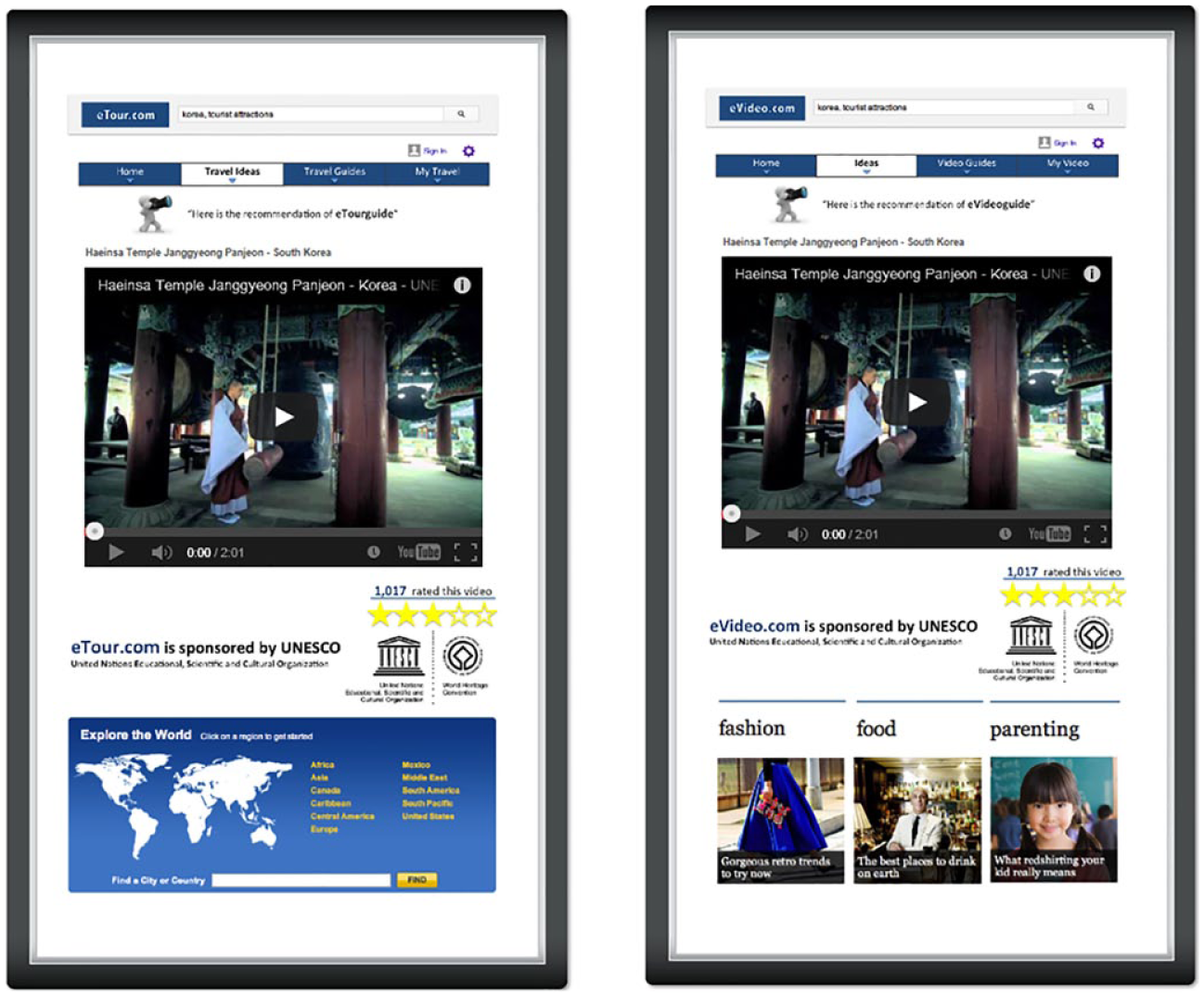
Snapshots of a specialist website (left) and a generalist website (right).
Because of the study research design (i.e., 2 × 2 × 3 factorial between-subjects design), participants were randomly assigned to one of 12 conditions (see Table 1).
Twelve Experimental Conditions by Specialization, Endorsement, and Star Rating.
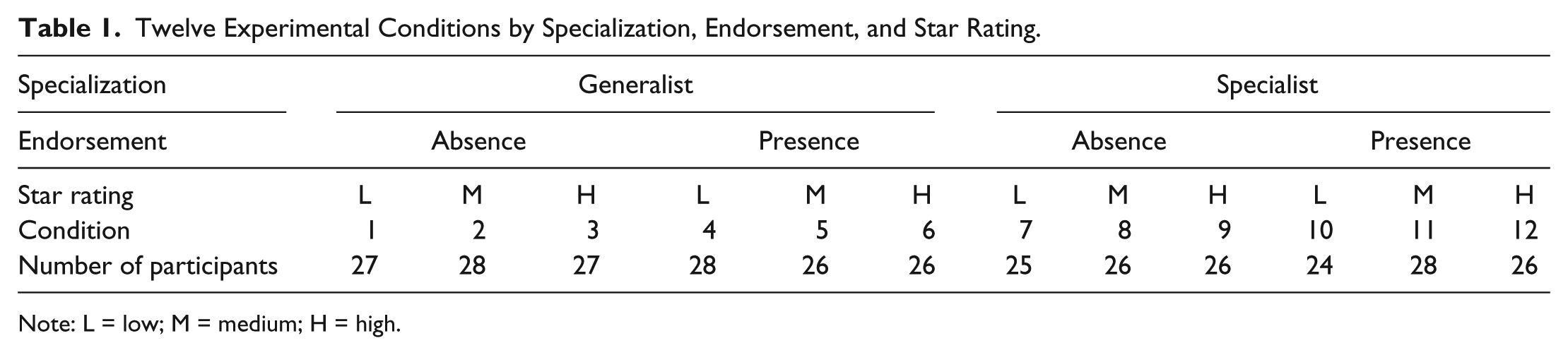
Note: L = low; M = medium; H = high.
Measures
In addition to viewing the video clip and being assigned to one of the 12 experimental conditions, participants were asked to respond to a series of statements regarding their perceptions of usefulness, authority, and bandwagon; information credibility; and the affective and cognitive dimensions of destination image. They were also asked to address their behavioral intention. In all cases participants indicated their response using a 7-point scale, ranging from 1 (strongly disagree) to 7 (strongly agree), except with the measure for affective image using an 8-point scale (1 = extremely inaccurate, 8 = extremely accurate).
With respect to usefulness, individuals indicated the degree to which they agreed with three statements (i.e., “The website provides useful information,” “The website provides up-to-date travel information,” “The website provides a variety of travel information”) originally presented by Kim and Fesenmaier (2008). To capture perceived authority, individuals responded to an additional three statements (i.e., “I think this travel information is professional,” “I think this travel information is official,” and “I think this travel information is authoritative”) conceived by Rieh (2002). And, to measure bandwagon, individuals responded to three statements adopted and modified from the work of Sundar, Oeldorf-Hirsch, and Xu (2008) (“How likely are other people to like this video?” “How likely are other people to enjoy this video?” “How likely are other people to recommend this video?”).
Information credibility was measured by asking individuals to respond to the following three statements adopted and modified from Kim et al. (2011): “I think this travel information is trustworthy,” “I think this travel information is credible,” and “I think travel information is reliable.”
The affective component of destination image was measured with 10 positive and 10 negative adjectives that captured four dimensions of image (i.e., pleasant, unpleasant, relaxing, and distressing). The 20 adjectives were rated on an 8-point scale, anchored from 1, extremely inaccurate, to 8, extremely accurate. Then, the scores of the bipolar dimensions (pleasant-unpleasant and relaxing-distressing) were calculated based on Russell and Pratt’s (1980) instructions. For example, the pleasant-unpleasant score was calculated by subtracting the sum of the five negative items (i.e., dissatisfying, displeasing, repulsive, unpleasant, and uncomfortable) from the sum of the five positive items (i.e., pleasant, nice, pleasing, pretty, and beautiful). In addition, the cognitive dimension of image was measured using four statements adopted from Baloglu and McCleary (1999) (i.e., I think this destination has . . . “beautiful scenery/natural attractions,” “interesting cultural attractions,” “interesting historical attractions,” and “an unpolluted and unspoiled environment”). Behavioral intention was measured with four statements (e.g., “I would visit the tourist destination I viewed on the video clip”) obtained from Zeithaml, Berry, and Parasuraman (1996) (Table 2).
Results of Measurement Model of Source-Related Visual Cues, Cue-Induced Perceptions, Information Credibility, and Destination Images.
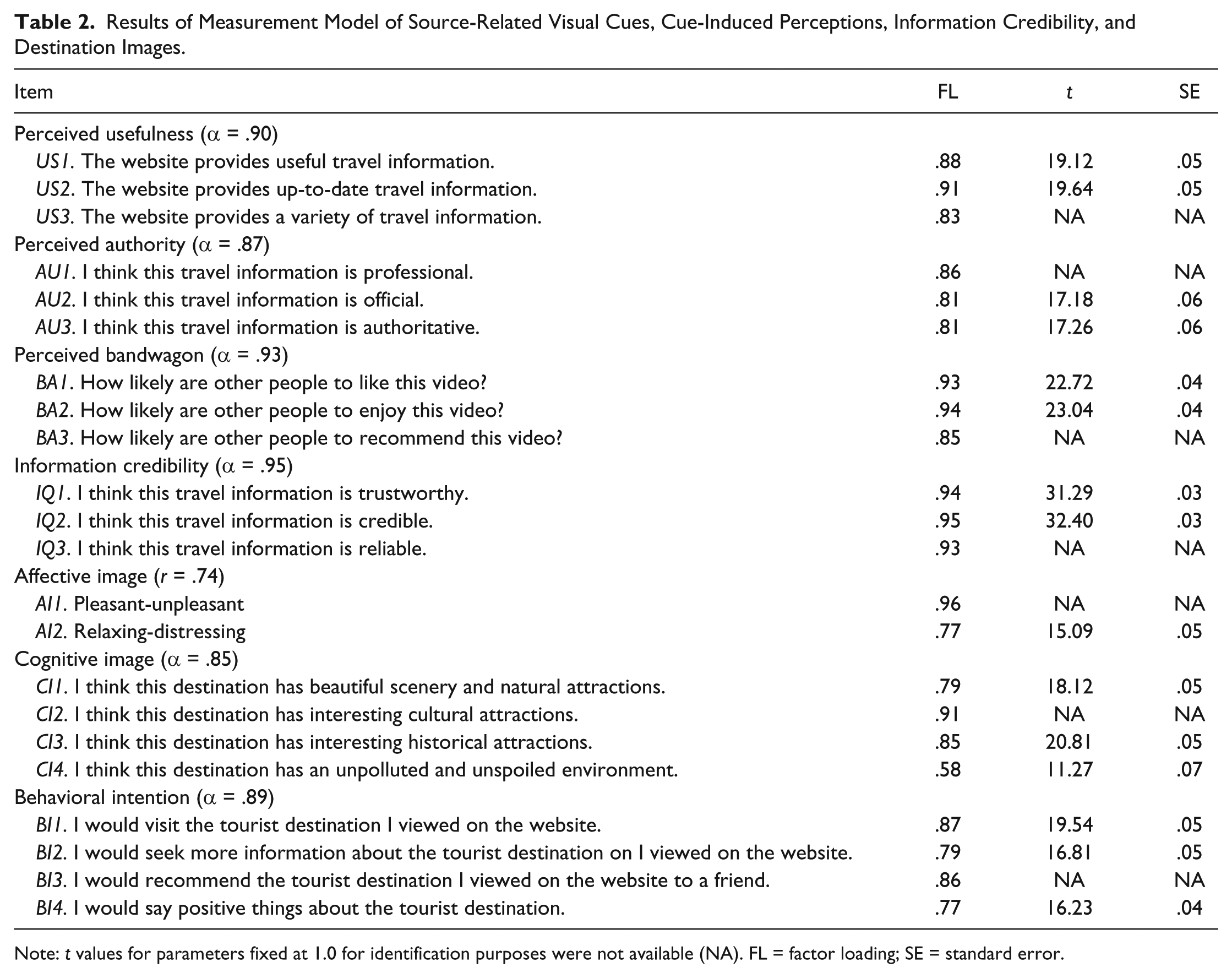
Note: t values for parameters fixed at 1.0 for identification purposes were not available (NA). FL = factor loading; SE = standard error.
Pilot Test and Data Collection
A pilot test was conducted with 10 graduate students to confirm the random assignment of source-related cues, the flow of the experiment, and participants’ comprehension of the instructions. Based on the pilot test, three questions (i.e., “Did you watch the entire video?,” “In this video, where is the heritage located?,” “Which of the following is not presented in the video?”) were included to ensure that participants watched the entire video.
Individuals 18 years of age or older and residing in the United States were recruited from Amazon’s Mechanical Turk (MTurk). Recent studies have supported the validity and reliability of MTurk in obtaining high-quality data inexpensively and rapidly (Buhrmester, Kwang, and Gosling 2011; Paolacci, Chandler, and Ipeirotis 2010). A total of 500 individuals accessed the experiment. However, the 14 who used mobile phones or tablets, the 119 who used web browsers that did not support the video (i.e., Mozilla Firefox and Microsoft Internet Explorer), the 49 who did not watch the entire video, and the 2 that submitted incomplete surveys were excluded from the study. A total of 317 cases were used in the analysis.
Analytic Plan
Using JMP 11.0, SPSS 21.0, and AMOS 21.0, several statistical analyses were conducted to test the hypotheses. First, the frequency and distribution of the data were analyzed. Second, the main effects of independent variables were examined by using three-way analyses of variance (ANOVAs). Third, confirmatory factor analysis was used to examine the reliability and validity of the measures. Then, a structural equation model was used to test the relationships between sources, cue-induced perceptions, information credibility, and the affective, cognitive, and conative dimensions of destination image.
Results
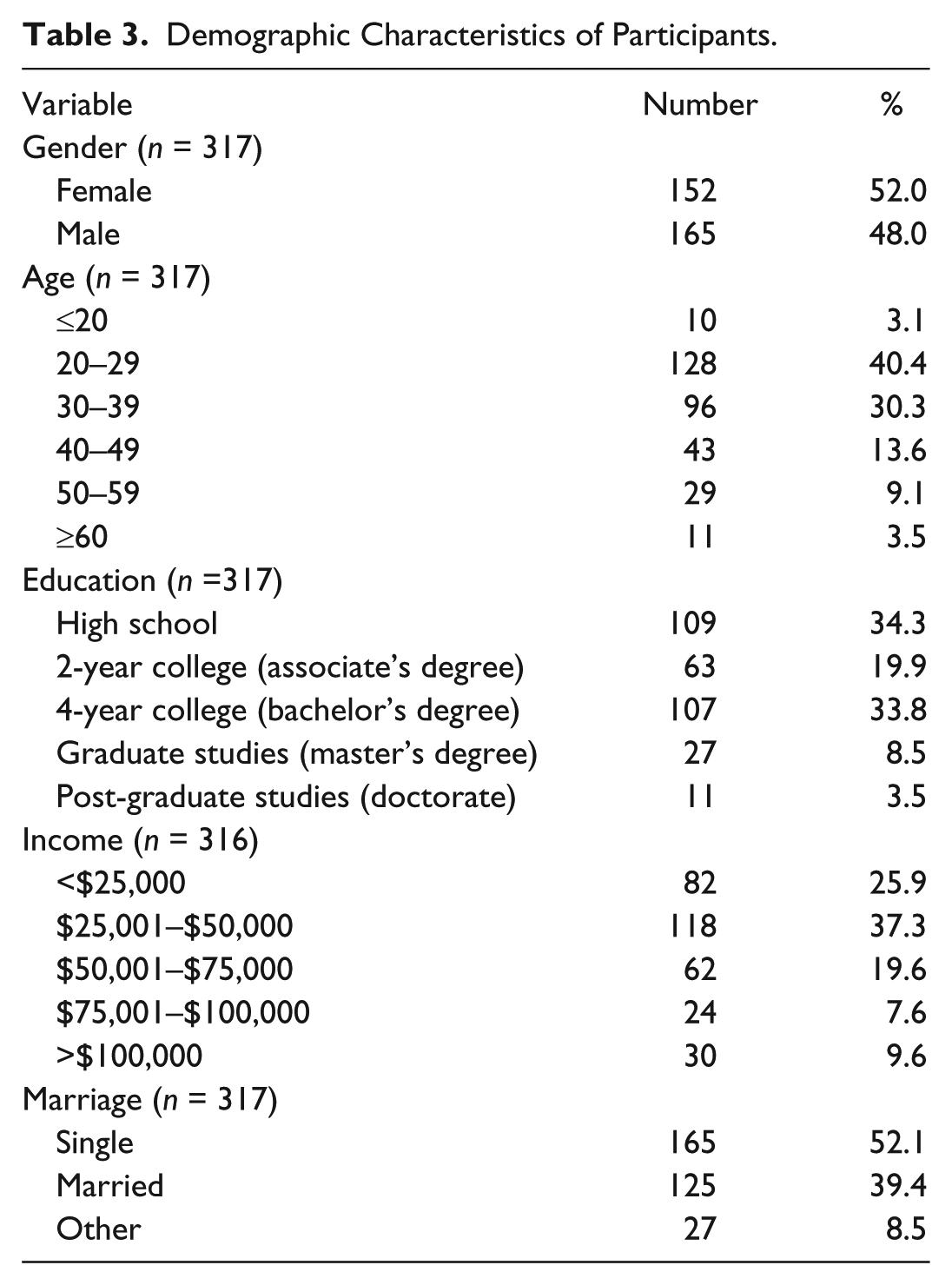
Table 3 presents respondents’ demographic characteristics. There were more male (52.0%) than female (48.0%) participants. A considerable portion was in the age group of 20–29 (40.4%) or 30–39 years (30.3%), and most had either high school (34.3%) or 4-year college education (33.8%). The most prevalent household income was $25,001–$50,000 (37.3%), followed by under $25,000 (25.9%) and $50,001–$75,000 (19.6%). In terms of marital status, more participants were single (52.1%) than married (39.4%) or other (8.5%).
Demographic Characteristics of Participants.
To begin the analysis, the data were screened for missing values and normal distribution of observable variables for perceived usefulness, perceived authority, perceived bandwagon, information credibility, affective image, cognitive image, and behavioral intention. Because of a small portion of missing values (0.0%–1.5%) and the results of Little’s MCAR test (p > .05), missing values for all observable variables were determined not to significantly influence other variables (Tabachnick and Fidell 2007). Hence, prior to further analysis, missing values were substituted with an expectation-maximization procedure. Based on the assessment of histograms and the acceptable levels of kurtosis (|<| 10) and skewness (|<| 3), all observable variables were considered to follow a normal distribution (Kline 2011).
Main Effects of Visual Cues
Because manipulations are technologically embedded in the given website conditions, the main effects of source-related visual cues on cue-induced perceptions can reveal if the manipulations worked properly. Three-way ANOVAs were conducted on perceived usefulness, perceived authority, and perceived bandwagon. For perceived usefulness, the results revealed that the main effect of specialization was significant (F = 13.91, p < .01). Perceived usefulness was significantly higher for a specialist website (M = 4.93, SD = 1.32) than a generalist website (M = 4.36, SD = 1.32). Unexpectedly, this study also showed a main effect of endorsement on perceived usefulness (F = 5.16, p < .05). The result showed higher perceived usefulness in the presence of endorsement condition (M = 4.82, SD = 1.34) than the absence condition (M = 4.47, SD = 1.34).
The results on perceived authority indicated a significant main effect of endorsement (F = 10.85, p < .01); that is, participants in the presence condition (M = 5.25, SD = 1.15) had a higher perceived authority than those in the absence condition (M = 4.84, SD = 1.15). Although the effect of star rating on perceived authority was significant, a post hoc test (Student’s t test and Tukey’s honestly significant difference [HSD] test) revealed no difference between low, medium, and high conditions.
In regard to perceived bandwagon, only star rating showed a significant main effect (F = 10.70, p < .01). A post hoc test (Student’s t test and Tukey’s HSD test) found a significant difference between low (M = 4.93, SD = 1.40) and medium conditions (M = 5.41, SD = 1.07), but the difference between medium and high conditions (M = 5.71, SD = 1.11) was not significant. This result is consistent with previous studies showing negative ratings or comments that are more salient and influential than neutral or positive ones (Standifird 2001; Liu 2006). Thus, the conditions of medium and high levels were combined (N = 213) in further analyses. In addition, there were no significant interaction effects of the three independent variables across perceived usefulness, perceived authority, and perceived bandwagon.
Measurement and Structural Models
To test the proposed research model, a two-step approach was adopted. First, a confirmatory factor analysis was conducted to examine the measurement model with seven latent variables. Table 4 shows the results of the measurement model. Based on goodness-of-fit indices (χ2 = 539.66, df = 188, p < .01; root mean square error of approximation [RMSEA] = .067, 90% CI = .060–.074; comparative fit index [CFI] = .94, nonnormed fit index [NNFI] = .93), the measurement model had an acceptable model fit (Hu and Bentler 1999). All standardized factor loadings (λ = .58–.96) were statistically significant at a .05 level. Seven endogenous variables had good reliability above .70 (Nunnally 1978). As shown in Table 4, each latent variable had good construct validity based on a composite reliability above .70 and average variance extracted (AVE) greater than .51. The results supported good discriminant validity by showing that each latent variable had a higher value of AVE than the square of the correlation between corresponding interconstructs (Fornell and Larcker 1981).
Correlations, Composite Reliability, AVE, Mean, and SD.

Note: US = perceived usefulness; AU = perceived authority; BA = perceived bandwagon; IC = information credibility; AI = affective image; CI = cognitive image; BI = behavioral intention; CR = composite reliability; AVE = average variance extracted; SD = standard deviation.
Second, the relationships among the latent variables were tested in the structural model, which also had an acceptable model fit (χ2 = 624.77, df = 259, p < .01; RMSEA = .070, 90% CI = .063-.077; CFI = .93, NNFI = .92). For cue-induced perceptions, the explained variance of perceived usefulness, perceived authority, and perceived bandwagon was 3.8%, 2.5%, and 4.5%, respectively. This model also explained 76.3% of variance for information credibility, 9.0% for affective image, 59.5% for cognitive image, and 32.8% for behavioral intention.
Hypothesis Testing
The hypotheses were tested by examining direct and indirect effects among the latent variables (see Figure 3). There was a significant direct effect of specialization on perceived usefulness (γ11 = .19, t = 4.10), which also significantly influenced information credibility (β41 = .17, t = 3.30). Thus, hypotheses 1a and 1b were supported. Endorsement had a significant positive effect on perceived authority (γ22 = .16, t = 2.89), which led to the increase of information credibility (β42 = .67, t = 11.23). Thus, hypotheses 2a and 2b were supported. Star rating had a significant effect on perceived bandwagon (γ33 = .19, t = 3.75) only when it increased from low to medium, not medium to high, providing partial support for hypothesis 3a. And the significant effect of perceived bandwagon on information credibility (β43 = .16, t = 3.92) supported hypothesis 3b. The effects of information credibility were consistently significant for affective image (β54 = .30, t = 5.11), cognitive image (β64 = .09, t = 2.05), and behavioral intention (β74 = .21, t = 3.93). So, hypotheses 4a, 4b, and 4c were all supported. In terms of image, affective image had significant effects on both cognitive image (β65 = .74, t = 12.67) and behavioral intention (β75 = .19, t = 2.05). And cognitive image had a significant effect on behavioral intention (β76 = .34, t = 3.73). The results of interrelations between affective, cognitive, and behavioral intention supported hypotheses 5a, 5b, and 5c.

Structural relationships between source-related visual cues, cue-induced perceptions, information credibility, and destination images.
In addition, to test the indirect effects of cue-induced perceptions on destination image via information credibility, a bootstrapping procedure was performed using 2,000 bootstrap samples with a bias-corrected confidence interval level of 95%. All of the indirect effects were significant at p < .05, supporting the mediating role of information credibility.
Discussion
Many online travel media have been increasingly adopting diverse Web 2.0 applications (Akehurst 2009; Sparks, Perkins, and Buckley 2013), which present multiple visual cues of different information sources. Although tourism researchers have found online travel media to be a powerful tool for promoting positive destination images (Li et al. 2009; Lepp, Gibson, and Lane 2011; Jeong et al. 2012), few have addressed the role of information sources in tourists’ judgment on information credibility and the formation of destination images. To better understand the effect of online media, researchers have argued that it is important to dissect pieces of technical attributes and examine corresponding psychological effects (Reeves and Nass 1996; Sundar 2008). In this regard, this study aimed to articulate different sources of online travel information and to understand the psychological effects of source-related visual cues in destination marketing.
One important theoretical contribution of this study is to conceptualize the sources of online travel information from a technological perspective. Online travel media contain technical features that determine the nature and number of different sources available on a certain web interface (Sundar and Nass 2001). Considering the dynamics of communication patterns in online travel media, researchers’ focus on the orientation of information source should be shifted from information providers to technology attributes. Because of recent technology attributes showing collaborative scoring system (e.g., star ratings) and simultaneously presenting multiple layers of different information providers, tourists are no longer affected by one particular type of information provider. Hence, the technological orientation of sources can expand the scope of research beyond differentiating internal and external sources in the information search process (Fodness and Murray 1999) or identifying and comparing the effect of discrete information providers, such as travel agency, newspaper/magazine, and TV/radio (Chen and Gursoy 2000).
In this regard, this study identified three different sources (specialization, endorsement, and star rating) that are technologically distinctive. The findings support the notion that different sources produce distinctive psychological effects on a tourist’s perceptions. Study participants’ perceptions were changed by source-related visual cues, such as where to view (e.g., specialization of online tourism domain), who represents (e.g., endorsement), and how other people rate the information (e.g., other users’ rating). Further, a specialist website (eTour.com) was more effective in producing a higher perceived usefulness than a generalist website (eVideo.com). Also, the presence of endorsement was beneficial in enhancing perceived authority and perceived usefulness. For star rating, perceived bandwagon was higher in the conditions of medium and high than the low condition. Furthermore, these cue-induced perceptions (perceived usefulness, perceived authority, and perceived bandwagon) were influential on tourists’ judgment of information credibility, which is positively related to affective and cognitive destination images and behavioral intention.
The findings show that the orientation of sources can be recognized by source-related visual cues. Examining the role of visual cues is an important contribution to the literature on information processing. According to dual process models (Chaiken 1980; Petty and Cacioppo 1981), tourists’ evaluation about the given information is not solely based on the content of information through a central route or systematic process. Source-related visual cues can lead to a peripheral route or heuristic process when evaluating the information. By showing that participants’ judgment on information credibility is influenced by not only the content of travel information but also visual cues attached to that information, this study highlights how diverse sources of online travel information relate to information credibility and the formation of destination image. Likewise, the results support that technology affordances have potential to elicit certain heuristics and perceptions, which influence an individual’s perception, attitude, and behavior (Sundar 2008; Sundar, Xu, and Dou 2012).
The experiment accounts for the role of agency in destination marketing by showing that source is a crucial determinant for information credibility, which eventually lead to destination image. In line with previous studies (Gartner 1993; Baloglu 1999; Kim and Richardson 2003; Xie et al. 2011), information credibility is considered a key factor in destination marketing. This study found that information credibility mediates the effects of cue-induced perceptions on the formation of destination image. In terms of the dimensionality of destination images, this study supports a tripartite approach by showing information credibility is positively related to affective and cognitive images and behavioral intention (Baloglu 1999; Kim and Richardson 2003; Li et al. 2009). From an online marketing perspective, this study provides empirical evidence about the relationship between the virtual experience of viewing a destination and actual travel attitude/behavior, such as intention to visit a physical destination.
In addition, the results can be applicable to the design of online travel media and destination marketing campaigns. With the rapidly increasing population of online media users, it is important for tourism providers and DMOs to understand the substantial effects of online travel information sources on destination images. The results are useful to understand how tourists differently respond to online travel information presented in a specialized or a generalized website. By designing the layout and atmosphere focusing on travel and tourism contents, websites are expected to enhance perceived usefulness. For example, this study provides supporting evidence for portal sites creating a separate web platform specializing in travel and tourism (e.g., Yahoo! Travel). Also, travel websites can produce authority effects by showing their relations with third-party organizations or groups who support the values of natural and cultural heritages and sustainability. For successful destination marketing, partnership is a fundamental element of visitor-oriented innovation (Zach 2012). Travel websites can be designed to show particular types of logos and links to their sponsorship or partnership, depending on the content of information. The partnership between commercial travel websites and not-for-profit associations will become more important to increase information credibility.
The results of this study support the notion that tourists tend to perceive information generated or recommended by other tourist(s) to be more plausible and trustworthy than information presented by DMOs (Sparks, Perkins, and Buckley 2013). Thus, for tourism providers, it is important to deliver excellent service and a memorable experience, which should result in positive feedback online, but they should also effectively manage tourists’ complaints to maintain star ratings above the midpoint. For tourists, on the other hand, they need to understand that the use of media technology to create, distribute, and share travel information will eventually improve the quality of overall touristic experience.
This experiment can provide a theoretical lens to broaden future research directions. As shown in the case of endorsement affecting both perceived usefulness and authority, it is important to note that one source-related visual cue can affect more than one dimension of users’ perception. For endorsement, this study used the presence of UNESCO’s sponsorship. However, UNESCO only represents one type of endorsement and it may have unique meanings in a tourism context. For future study, it would be interesting to examine the psychological effects of different endorsing agents in terms of type (e.g., celebrities, corporates, or not-for-profit organizations) and prestige level. Delving into a particular type of source, researchers will be able to document a set of corresponding psychological effects. For star rating, this study found that there is a starting point where user’s perception is significantly changed. Future research should focus on identifying a threshold of the effect of collaborative filtering feedbacks. This study is limited to three types of travel information sources (specialization, endorsement, and star ratings). Responding to the rapid development and application of media technology, future studies investigating other types of information and sources would be beneficial to the tourism literature. The experiment focused on a particular type of information (i.e., video clip). For future studies, the present findings of this study can be applied to other forms of online information (e.g., text, audio, 3D virtual reality). This experiment was designed to test with one particular destination. Given that the sources of online travel information may produce different psychological effects for different types of destinations, it would be meaningful to examine a variety of destinations and hedonic and experiential products in the tourism and hospitality industries.
Footnotes
Declaration of Conflicting Interests
The author(s) declared no potential conflicts of interest with respect to the research, authorship, and/or publication of this article.
Funding
The author(s) disclosed receipt of the following financial support for the research, authorship, and/or publication of this article: This study is selected and supported by Tourism Cares: ASTA Holland America Graduate Research Scholarship.