



Abstract
The objective of this research was to examine airline passengers’ service recovery assessments. In addition, the impact of loyalty was examined with relation to postrecovery satisfaction, word-of-mouth communication, and purchase intent. Rawls’s justice theory guided the study. Data were collected via self-reported measure from Mturk and revealed that air travelers’ level of satisfaction of service recovery was impacted by all three justice dimensions. It was further found that the most effective recovery strategy for airline management would likely be to focus on providing compensation beyond expectations. Theoretical and practical implications were discussed.
Introduction
With a push of a button or a swipe of a mobile device, today’s consumers have access to an impressive array of service options. With access to customized service alternatives and credible online service reviews and recommendations, today’s consumers no longer need to quietly accept service dissatisfaction. This highly competitive service environment has made it tougher to secure additional chances with disgruntled customers and has left service providers with a need to develop effective strategies that offset service missteps when they occur. For this reason, it is becoming more important for more service providers to develop sound strategies for providing effective service recovery.
When a service goes wrong and leaves customers feeling less than positive about the experience, a service failure has occurred (Gelbrich and Roschk 2011). To counteract service failure, service providers typically engage in problem-solving actions intended to rectify these perceived service and/or product defections (Nguyen, McColl-Kennedy, and Dagger 2012; Maxham and Netemeyer 2002) with the hopes of dissolving negative customer attitudes (Kuo et al. 2013a). These actions, collectively referred to as service recovery, are enacted to restore the confidence and trust bestowed upon them by consumers following a service failure experience (McCollough, Berry, and Yadav 2000; Wen and Chi 2013). In short, service recovery is the process of acknowledging a wrong and making it right (Grönroos 2009).
Tourists engaged in travel develop attitudes and form memories that can be positive or negative, and many tourists have strong recall of travel incidents that have gone wrong (Lee and Park 2010). This is important, considering that the manner in which we arrive and depart from a travel destination is the only phase of the travel process that tourists typically must endure not once but twice (San Martin, Collado, and Rodriguez del Bosque 2013). The short- and long-term impacts of service failures associated with this phase of the travel experience should not be minimized. Examining the relationship between cognitive evaluations and consumer satisfaction, Kim et al. (2016, 1214) describes an airline lounge as an “exceptionally experiential service environment” that engages a traveler’s senses and emotions with the potential to “enhance their travel well-being” (Kim et al. 2016, 1229). However, few tourism research articles have focused on the impact that the mode of travel can have on tourists’ overall trip satisfaction (Reisinger and Mavondo 2005; Chung and Petrick 2013). Although air travel is one of the most common modes of travel for tourists and provides for several service opportunities, few studies have examined service recovery with relation to air travel (Nikbin and Hyun 2015).
Justification
The fact that air travel is a common and sometimes necessary mode of travel for millions of travelers compounds the potential for service failures, and thus the heightened need for sound service recovery strategies. Although nearly 850 million passengers traveled on U.S. and foreign airlines serving the United States in 2014 (US DOT 2015), profitability within the airline industry remains extremely precarious. Several factors can be attributed to this, including “volatile fuel prices, economic downturns, impacts of terrorism and natural disasters, pandemics and government austerity measures” (Tretheway and Markhvida 2014, 3). Far from being recognized for “error-free service,” airline passengers regularly report negative experiences that include overbooking, delayed flights, canceled flights, and lost luggage (Nikbin and Hyun 2015; Chang and Chang 2010). Delivering superior service recovery may serve to distinguish airlines from competition and increase the likelihood of obtaining a loyal customer base (Ding, Ho, and Lii 2015; Al-Refaie, Bata, Eteiwi, and Jalham, 2014).
Because of the many potential impacts of service recovery on the sustainability of airlines, additional research is needed for the following reasons. Although service recovery has been a prominent focus in tourism literature for decades (Graham and Sparks 2009), few studies have focused on the airline industry (Park and Park 2016; Bamford and Xystouri 2005) and fewer still have examined recovery strategies using justice theory (Ding, Ho, and Lii 2015). Of the articles examining airline service recovery that are grounded in justice theory, the findings have been contradictory (see Table 1). Finally, while research focused on service recovery and airlines has been limited to on-site surveys (airports) and customer recall, the current study utilized a scenario-based experimental design.
Service Recovery Literature Review.

Based on the need for research in this area as well as the limited methodology and “mixed results” of previous research, the purposes of this study are to
Investigate the effect of the three dimensions of justice theory (interactive justice, procedural justice, and distributive justice) of service recovery on customer satisfaction, word-of-mouth advertising, and repurchase intent;
Examine service recovery evaluations of consumers identified as loyal to one service provider; and
Investigate the current state of service recovery in the airline industry utilizing critical incident technique.
Literature Review
Service Recovery
Bell and Zemke (1987, 32) defined service failures as “situations in which customers are dissatisfied because their perception of the service they have received is worse than their expectation.” Service recovery has subsequently been described as the actions of a firm “designed to resolve problems, alter negative attitudes of dissatisfied customers and to ultimately retain these customers” (Miller, Craighead, and Karwan 2000, 388). Because of the criticality of service quality and customer satisfaction, service recovery has held a prominent role in the services marketing literature and the tourism service literature in particular. Service environments that have been previously examined include hotels (Zehrer and Raich 2016), restaurants (Siu, Zhang, and Yau 2013), transportation (Nikbin and Hyun 2015), and retail (Kuo and Wu 2012).
Why is service recovery so important? One reason is that service recovery may be a firm’s “last defense” against customer defections. Previous research has found that service recovery, depending on the perceived quality of the attempt, can have a powerful impact on the relationship between customers and service providers (Kim, Yoo, and Lee 2012), as postrecovery customer satisfaction has been found to be a critical antecedent of positive word-of-mouth advertising and customer loyalty (Bitner, Booms, and Tetreault 1990; Chang and Hung 2013; Wen and Chi 2013). These findings have been extended to air travel service providers (Al-Refaie et al. 2014; Bamford and Xystouri 2005).
It has also been suggested that service failures are not only inevitable, they are a common occurrence in air travel (Kuo et al. 2013a; Park and Park 2016). Researchers attribute the frequency of service errors to the intangible nature of services and the often unpredictable “human interaction” necessary in service experiences (Siu, Zhang, and Yau 2013). Thus, the potentially critical impact of service recovery among airlines is likely due in part to the high frequency and diverse interaction between customers and airline service representatives (Swanson and Hsu 2011; Ghalandari, Babaeinia, and Jogh 2012). Additionally, technical or computer “glitches” can have a significant and negative impact on air travel (Mantin and Wang 2012). Other factors that could contribute to the high incidence of air travel service failures include maintenance problems, air traffic congestion, security issues, and extreme weather (Nikbin and Hyun 2015).
In addition, aspects of service recovery attempts are magnified because customers who have experienced a service failure generally become more “aware” and emotionally involved in the service experience (McCollough 2009). For example, once an air traveler has been notified that his or her luggage has been lost, that traveler is likely to be more mindful of the service steps to follow. These service steps could include the speed (or lack of) in which the issue is resolved, or the disposition of the airline representative handling the recovery. It has been reported that customers who have been “wronged” (not once, but twice) have gone to great lengths to exact revenge against the firm (and its employees) they hold culpable. For these reasons, it has been suggested that failed service recoveries can significantly and negatively impact operating costs, employee morale, and the overall image of a firm (Swanson and Hsu 2011).
Alternatively, “making things right” can impact a firm in fortuitous ways. Successful service recoveries have been found to increase profits (Swanson and Hsu 2011), customer satisfaction (Chang and Hung 2013), retention or loyalty (Miller, Craighead, and Karwan 2000), and promulgation of positive word-of-mouth advertising (Kim, Ok, and Canter 2012). It has been further suggested that exceptionally strong recovery attempts can lead to customer evaluations higher than transactions with no perceived service failure whatsoever, resulting in a phenomenon Etzel and Silverman (1981) identified as the service recovery paradox (Ding, Ho and Lii 2015).
Justice Theory
Several theories have been used to examine service recovery evaluations, including attribution theory (Swanson and Hsu 2011), mental accounting theory (Chuang et al. 2012), equity theory (Wen and Chi 2013), and the disconfirmation paradigm (McCollough, Berry, and Yadav 2000). Based on the recommendations of Tax, Brown, and Chandrashekaran (1998), the present study applies the most prevalent theory used in service recovery research: Rawls’s (1971) justice theory. A political philosophy derived from Festinger’s (1962) theory of cognitive dissonance and Adams’s (1963) equity theory, Rawls’s justice theory (1971) is based on the assumption that consumers evaluate a service recovery based on a perception of justice or fairness.
According to justice theory, the economic and social interactions inherent in service failures result in customer evaluations of procedural justice, distributive justice, and interactional justice. Previous research has found that this three dimensional concept of justice accounts for over 60% of service recovery evaluations (Siu, Zhang, and Yau 2013). Over the past 20 years, justice theory has been used to uncover several important findings and has been suggested to be an “effective evaluative tool and a powerful predictor of service recovery satisfaction among consumers” (Kim, Yoo, and Lee 2012, 4).
Procedural Justice has been described as the customers’ evaluations of the policies, procedures, and decision making of firms used to resolve a conflict (Maxham and Netemeyer 2002). According to Wen and Chi (2013), procedural justice is evaluated by the manner in which firms or firm representatives bear the responsibility of the service failure, the speed in which complaints are addressed, and the speed in which the service problem is resolved. The elements of procedural justice provided by Tax, Brown, and Chandrashekaran (1998) include flexibility, timing/speed, accessibility, process control, and decision control.
With regard to airline service recovery, previous research has focused on the promptness of fielding complaints (Karatepe and Vatankhah 2014) as well as the flexibility and promptness of solving the problem (Nikbin and Hyun 2015). Earlier studies provided only anecdotal evidence to the potential impact of procedural justice on customer evaluations of service recovery (Blodgett, Granbois, and Walters 1993; Bitner, Booms, and Mohr 1994). More recently, researchers have found procedural justice to be less impactful on service recovery evaluations than either distributive justice or interactional justice (McCollough 2009).
Distributive justice is related to the outcome of the recovery effort. Described as efforts of provider atonement, distributive justice is characterized by tangible compensatory rewards in the form of discounts, refunds, replacements, and coupons. Maxham and Netemeyer (2002, 241) defined distributive justice as the “extent to which customers feel they have been treated fairly with respect to the final recovery outcome.” Previous studies have measured distributive justice by measuring the “justice” and “reward” of outcomes (Gelbrich and Roschk 2011).
Several studies suggest that customer perceptions of perceived justice of tangible outcomes have a positive and significant effect on recovery evaluations (see Table 1). For example, Tax, Brown, and Chandrashekaran (1998) examined the complaint-handling strategies of four firms (a health care insurer, a bank, a telecommunications firm, and an ambulatory service). They used a cross-sectional survey to evaluate the service recovery experience, as respondents were asked to recall a complaint that was lodged in the past six months. Based on their findings, it was suggested that higher levels of compensation can result in higher distributive justice evaluations.
Interactional justice is associated with the interactional aspects, as opposed to the formal procedures/policies or the outcomes associated with the service recovery (Swanson and Hsu 2011). Put simply, interactional justice is the customers’ perception of the sincerity and appropriateness of the interaction provided by the staff during the recovery. The operationalization of interactional justice has not been consistent. Clemmer (1993) found that customers use the following six principles in evaluating interactional justice during service recovery: honesty, friendliness, politeness, bias, sensitivity, and interest. In contrast, Wen and Chi (2013) examined the service recovery of airline customers by operationalizing interactional justice with the following: politeness, patience, effort, honesty, respectfulness, and fair treatment. Although justice theory remains the predominant theory used to evaluate service recovery assessments, a consensus of the justice dimension or dimensions most responsible for satisfaction, WOM, and repurchase intent have yet to be identified.
Justice theory in service recovery and loyalty
Customer loyalty is one of the most widely studied areas of interest among service marketing researchers (Parasuraman and Berry 1991; Kumar and Shah 2004) and has become a particular area of interest among tourism and hospitality researchers (Kim, Lee, and Mattila 2014). Many researchers agree that customer loyalty is critical to a firm’s success (La and Choi 2012; Swanson and Hsu 2011) and suggest that customer loyalty has a positive and direct relationship with customer satisfaction (Kim 2011), repurchase intent (Kim, Yoo, and Lee 2012), and WOM (Gelbrich and Roschk 2011).
However, results concerning the impact of customer loyalty on service recovery evaluations have been mixed (Kim, Kim, and Kim 2009). This could be partly attributed to the manner in which customer loyalty has been conceptualized. Some studies previously examining service recovery failed to measure the attitudinal aspect of customer loyalty, and focused only on behavioral commitment (Li and Petrick 2008). These previous studies erroneously measured customer loyalty by adapting scales intended to measure repurchase intent (Kim, Yoo, and Lee 2012). To avoid this confusion, loyalty is conceptualized in this study as the behavioral consistency and level of psychological attachment that a traveler exhibits toward the selection of an airline (Li, Petrick, and Zhou 2008), and the following hypotheses are proposed:
Hypothesis 1a: Loyal airline passengers will have a higher postrecovery satisfaction than nonloyal airline passengers.
Hypothesis 1b: Loyal airline passengers will be more likely to spread positive WOM after a service recovery than nonloyal airline passengers.
Hypothesis 1c: Loyal airline passengers will be less likely to spread negative WOM after a service recovery than nonloyal airline passengers.
Hypothesis 1d: Loyal airline passengers will have a higher repurchase intent after a service recovery than nonloyal airline passengers.
Justice theory in service recovery and satisfaction
Originating with customer complaint behavior, previous studies suggest that justice perceptions are a strong predictor of consumer satisfaction (Siu, Zhang, and Yau 2013; Wen and Chi 2013; Ding, Ho, and Lii 2015) and effective service recovery attempts have been found to repair customer dissatisfaction (McCollough, Berry, and Yadav 2000; Kuo et al. 2013a). This is important as it suggests that service providers, when given the opportunity to right a perceived wrong, have an opportunity to sustain a strong service provider–customer relationship.
However, the impact of each justice dimension on customer satisfaction remains unclear. For example, Tax and Brown (1998) found distributive justice to be the most important aspect of service recovery with regard to recovery satisfaction. While several additional studies have found distributive justice to be the most important determinant of postrecovery satisfaction (Smith, Bolton, and Wagner 1999; Cranage and Mattila 2006), others have suggested distributive justice is the least important (Ok, Back, and Shanklin 2005). Although procedural justice was found to be the most significant indicator of consumer satisfaction by Karatepe (2006), the majority of previous researchers have found procedural justice to be the least impactful (Kim, Kim, and Kim 2009).
In the context of air travel, Chang and Chang (2010) examined the relationships between service recovery, recovery satisfaction, overall customer satisfaction, and customer loyalty. They found interactional justice and procedural justice to influence recovery satisfaction, yet found distributive justice to have no significant influence. Also focusing on airline passengers, both Ding, Ho, and Lii (2015) and Nikbin et al. (2015) found that distributive justice had the strongest influences on postrecovery evaluation of air travelers, which is contradictory to the findings of Chang and Chang (2010). While prior studies have had somewhat confounding results, this study proposes the following hypotheses:
Hypothesis 2: In the context of air travel, a breakdown of distributive justice will have the strongest negative effect on postrecovery satisfaction, followed by a breakdown of procedural justice, and a breakdown of interactional justice will have the least negative effect.
Justice theory in service recovery and word of mouth
As a result of advances in technology, the potential impact of WOM has significantly increased. The advent of emails, texts, instant messaging, blogs, and online reviews has led to an increase in both the number and types of informal communication channels (Goyette et al. 2010). It has been estimated that social media generates more than 3.3 billion brand impressions daily. According to Berger and Schwartz (2011), customers who are highly “delighted” with a service recovery attempt are more likely to tell others about their experience than those who report to be simply satisfied.
However, negative WOM communication can have a far more detrimental impact on a firm. According to Richins (1987), satisfied customers tell an average of three people, yet unsatisfied customers spread negative WOM communication to an average of 11 people. Early research examining restaurant customers found that while 38% of satisfied customers shared their experience with others, unsatisfied customers shared their experience 75% of the time (Hoffman and Chung 1999). It is for this reason that managing/minimizing negative WOM communication is likely imperative for all service-intensive industries, including the airline industry.
To date, empirical findings of which justice dimension(s) have the most impact on both positive and negative WOM communication have been contradictory. For instance, Wen and Chi (2013) examined the impact of emotion on postrecovery behaviors among delayed airline passengers, and found interactional justice to be a significant contributor to positive WOM. Examining service recovery strategies for online retailers, Lin, Wang, and Chang (2011) found interactional justice to be the only justice dimension to have a negative influence on negative WOM. However, other studies (e.g., Kim, Kim, and Kim 2009; Nikbin et al. 2012) suggest that distributive justice has the largest effect on negative WOM via customer satisfaction. Based on the majority of findings, the following hypotheses are proposed:
Hypothesis 3: In the context of air travel, a breakdown of distributive justice will have the strongest negative effect on the intention to spread positive WOM, followed by a breakdown of procedural justice, and a breakdown of interactional justice will have the least negative effect.
Hypothesis 4: In the context of air travel, a breakdown of distributive justice will have the strongest positive effect on the intention to spread negative WOM, followed by a breakdown of procedural justice, and a breakdown of interactional justice will have the least positive effect.
Justice theory in service recovery and repurchase intent
Several researchers have previously suggested customer satisfaction and future repurchase intent to be influenced by the perceived justice of the service recovery following a service failure (Chang and Chang 2010; Lin, Wang, and Chang 2011; Ha and Jang 2009). Similarly, previous findings regarding service recovery and repurchase intent incorporating justice theory have been mixed. For example, several researchers have found that higher levels of distributive justice result in a significant positive influence on repurchase intent (Blodgett, Hill, and Tax 1997; Clemmer 1993; Lin, Wang, and Chang 2011), while Kuo and Wu (2012) found the only justice dimension to have a significant and positive effect on online retail purchases was distributive justice. Ghalandari, Babaeinia, and Jogh (2012) reported distributive justice, interactional justice, and procedural justice all have a positive influence on postrecovery revisit intention. However, examining satisfaction and customer loyalty of air travelers, Chang and Chang (2010) found that distributive justice had no influence on recovery satisfaction or repurchase intent. Although there is no consensus, the majority of previous research suggests that distributive justice has a significant effect on purchase intent. Thus, the following hypothesis is proposed:
Hypothesis 5: In the context of air travel, a breakdown of distributive justice will have the strongest negative effect on repurchase intent, followed by a breakdown of procedural justice, and a breakdown of interactional justice will have the least negative effect.
Methods
This study employed a hypothetical scenario-based experiment in which respondents evaluated one of four service recovery scenarios in an airline context and reported their subsequent satisfaction, positive and negative WOM, and future intentions. This scenario-based experiment approach has been widely used in service recovery studies (McCollough, Berry, and Yadav 2000; Blodgett, Hill, and Tax 1997) as it can eliminate the difficulties associated with observing service recovery incidents in the field, such as the amount of time and cost involved, and it can avoid ethical considerations associated with enactment of actual service failures (Bitner, Booms, and Tetreault 1990). Furthermore, the use of scenarios has the advantages of reducing recall biases (Smith and Bolton 2002), controlling the impact of irrelevant variables (Blodgett, Hill, and Tax 1997), and ensuring higher internal reliability (Wen and Chi 2013).
Research Design
A total of four scenarios (baseline condition with an error-free recovery, procedural injustice condition with a recovery error associated with procedural justice, interactional injustice condition with a recovery error associated with interactional justice, and distributive injustice condition with a recovery error associated with distributive justice) were developed by manipulating three components: the speed in which the problem was resolved (procedural justice), the amount of monetary compensation (distributive justice), and the appropriateness of the interaction provided by the airline representative (interactional justice). The scenarios were constructed based on previous studies (Bitner, Booms, and Tetreault 1990; Ha and Jang 2009) and were reviewed by a panel of experts to ensure scenarios were realistic. Table 2 displays the scripts of the four scenarios.
The Four Scenario Scripts.
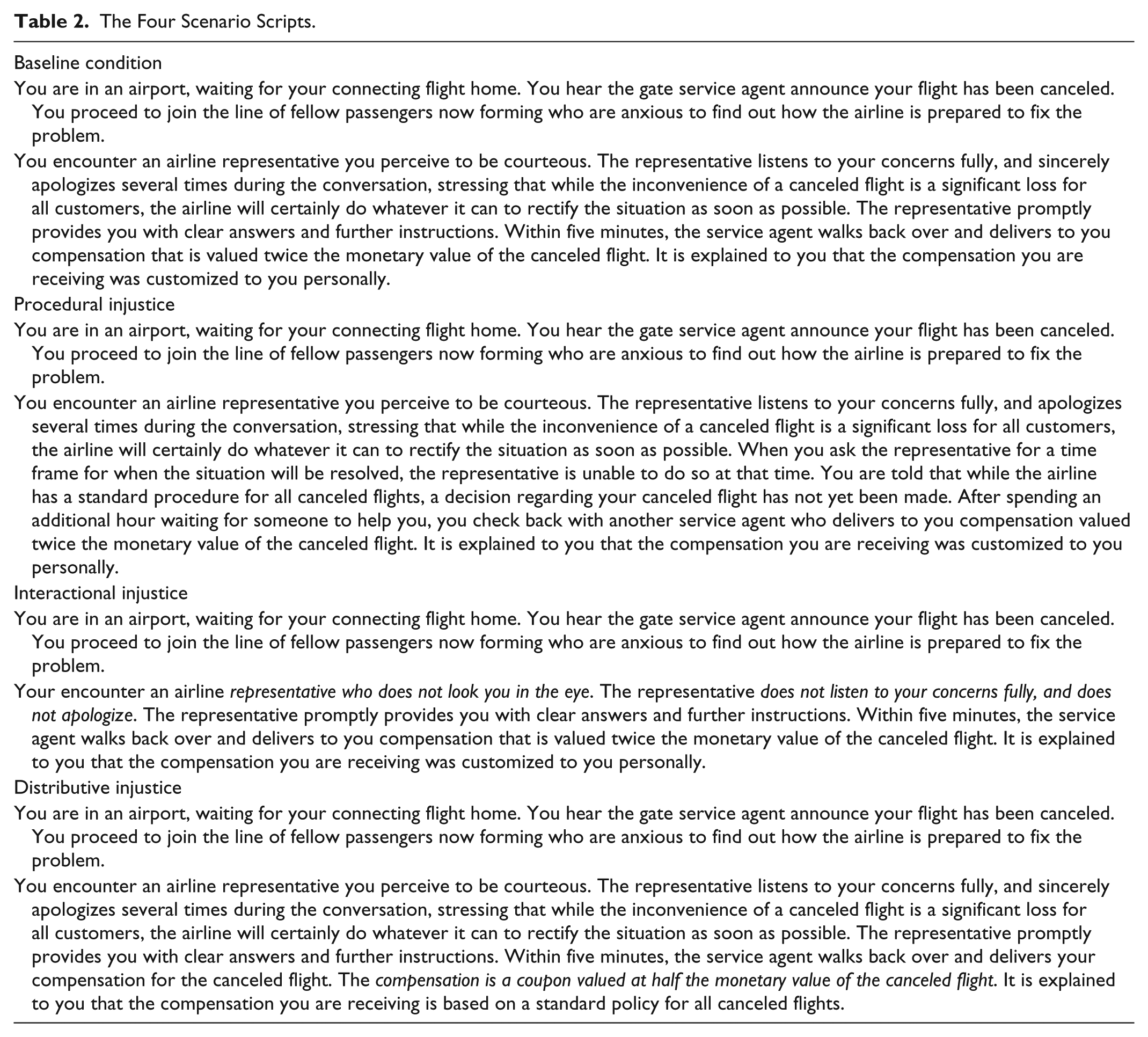
In the procedural injustice condition, the airline representative was depicted to make a weak attempt at providing clear answers and further instructions regarding the flight cancelation in a timely manner. In this condition, the representative was courteous and the compensation had a monetary value twice the canceled flight value. In the interactional injustice condition, the airline representative was portrayed as rude during the interaction with customers as the representative did not look customers in the eyes, did not listen patiently, and did not apologize. In this condition, the representative provided quick, clear instructions and the compensation had a monetary value twice the canceled flight value. In the distributive injustice condition, customers were offered only half of the monetary value of the canceled flight as compensation but the representative was depicted as courteous and responsive.
The survey started by asking participants their previous experience with airline service recovery utilizing Critical Incident Technique (CIT) as well as the airlines that they were loyal to. Then, the scenario scripts instructed respondents to imagine that they were waiting for a connecting flight home in an airport and were informed that the flight got canceled. Each respondent was randomly assigned to one of the four conditions. After reading the scenario script, respondents were asked three manipulation check questions and a series of questions related to satisfaction, positive and negative word of mouth, and future purchase intentions. Finally, the survey finished with demographic questions.
Participants and Data Collection
Participants were recruited through the Internet using Amazon’s Mechanical Turk (MTurk). MTurk is an Internet-based human intelligence marketplace with about 500,000 individuals, referred to as “workers,” who voluntarily complete tasks in return for a monetary payment (Amazon Mechanical Turk 2014). There are at least three advantages of using MTurk for sampling purposes: first, the size of the sample pool is mostly larger than university’s sample pools; second, the demographic background of participants is more diverse than college and online samples; third, previous studies using MTurk have found that the quality of the data obtained from MTurk had the same, if not better, reliability as that from conventional sampling methods (Byun and Jang 2015; Mason and Suri 2012).
To ensure the quality of the data, workers who participated in this survey needed to have a “master” qualification granted by MTurk. “Masters” are elite groups of “Workers” who have demonstrated accuracy on specific types of human intelligence tasks (HITs) on MTurk. “Workers” achieve a “Masters” distinction by consistently completing HITs of a certain type with a high degree of accuracy across a variety of requesters, and “Masters” must continue to pass MTurk’s statistical monitoring to remain qualified (Amazon Mechanical Turk 2014).
A total of 171 workers were randomly assigned to one of the four scenarios and responded to the survey between August 15 and August 28, 2015, in exchange for a small payment. Fifteen did not complete the survey and were excluded from data analysis. Out of the 156 participants, 37 were in the procedural injustice condition, 41 in the interactional injustice condition, 39 in the distributive injustice condition, and another 39 in the baseline condition.
Measurements
The survey questionnaire was composed of four sections. In the first section, participants were asked whether they had experienced a flight cancelation (yes or no), and if so, whether they were offered service recovery (yes or no). For those who were offered service recovery, they were asked two CIT open-ended questions about their previous experiences with airline service recovery: “In your own words, regarding the most recent time your flight got canceled, please briefly describe what the airline customer service representative did best” (i.e., positive incidents) and “In your own words, regarding the most recent time your flight got canceled, please briefly describe the worst mistake made by the airline customer service representative” (e.g. negative incidents). Then, participants were asked whether they were loyal to an airline (yes or no), and if so, which airline they were loyal to.
The second section included three questions for the manipulation of the four conditions. To assess procedural justice manipulation, participants were asked a multiple-choice question: “Based on the story you have just read, how long did you have to wait to have your problem resolved?” Four options were offered: (1) five minutes, (2) 30 minutes, (3) 60 minutes, and (4) over 60 minutes. In the procedural injustice conditions, participants should have chosen “60 minutes” or “over 60 minutes” to pass manipulation check, and participants in the other three conditions should have chosen “five minutes.” Then, participants were asked whether they felt the airline representative in the script was courteous. To pass the manipulation check, participants in the interactional injustice condition should have chosen “no” while participants in the other three conditions should have answered “yes.” Finally, to check manipulation of distributive justice, participants were asked whether the compensation awarded was customized or not. Participants in the distributive injustice condition should have answered “no” whereas participants in the other three conditions should have chosen “yes.”
The third section assessed participants’ satisfaction, positive and negative WOM and repurchase intentions. Participants were asked to indicate the degree to which they were delighted with the service recovery using a one-item, 11-point Likert-type question: “I am delighted with the service recovery provided by the airline.” In order to capture above-average expectancy-disconfirmation, the term “delighted” replaced the term “satisfaction” (Souca 2014). Positive word of mouth was accessed with the scale adopted from Wen and Chi (2013): “I will recommend this airline to my friends and relatives,” “I will provide positive comments about this airline on social media websites,” and “I will encourage my friends and relatives to choose this airline for their next trip.”
Negative word of mouth was measured with Lin, Wang, and Chang’s (2011) three-item scale: “I will criticize this airline on social media websites,” “I will encourage my friends and relatives not to choose this airline for their next trip,” and “I will negatively criticize this airline to my friends and relatives.” Repurchase intentions were operationalized with a 3-item scale modified from Wen and Chi (2013). Participants were asked to indicate the extent to which they agree with the following three statements: “It will be my first choice to fly with this airline for my next trip,” “I plan to fly with the same airline next time,” and “I am more likely to choose this airline from now on.” All items in section three used 11-point Likert-type scales anchored by 0 = strongly disagree and 10 = strongly agree. The final section included questions about demographic information such as gender, age, zip code, education, and income.
Results
Manipulation Checks and Respondent Profiles
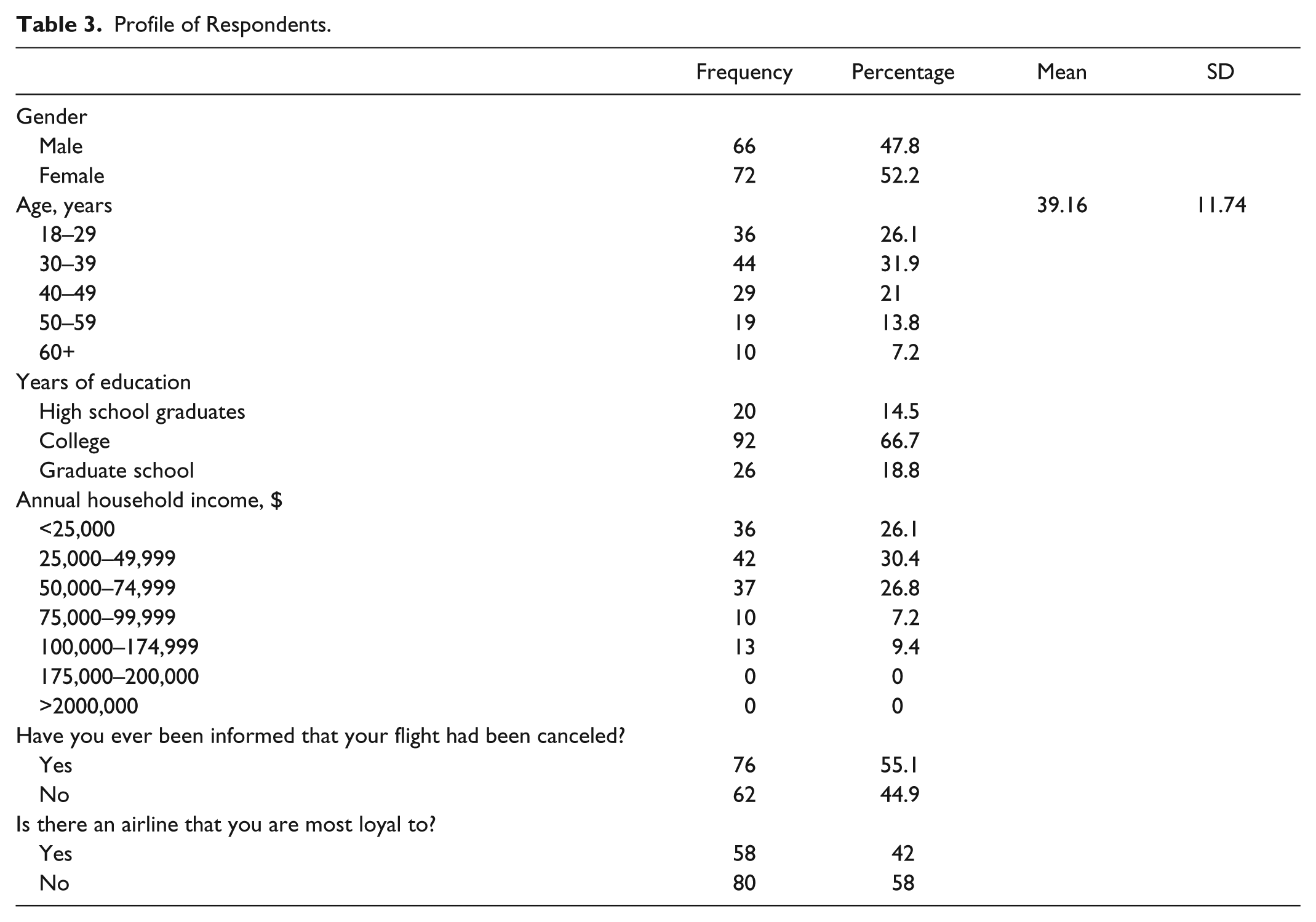
To ensure that the three types of justice (procedural, interactional, and distributive) were successfully manipulated as intended, respondents with at least one wrong answer to any of the three manipulation questions were deleted. As a result, a total of 32 respondents were deleted (3 in procedural injustice, 17 in interactional injustice, 8 in distributive injustice, and 4 in the baseline condition). Because of the substantial number of participants in the interactional injustice condition who failed the manipulation check, a second recruitment was conducted between October 15 and October 19, 2015. In this recruitment, 20 responses in the interactional injustice condition were collected, and 9 participants were excluded because they failed the manipulation checks. Thus, a total of 138 participants were included in the final data analysis (34 in procedural injustice, 38 in interactional injustice, 31 in distributive injustice, and 35 in the baseline condition). Table 3 displays the profile of the respondents.
Profile of Respondents.
The Effect of Airline Loyalty on Service Recovery
A series of multivariate analysis of variance (MANOVA) and follow-up t-tests were conducted to examine whether being loyal to an airline brand would have an effect on satisfaction, positive and negative WOM, and future intentions after a service recovery regardless of whether it was successful or unsuccessful (Table 4). The results revealed that participants’ loyalty made a difference on positive WOM and future intentions. Specifically, those who were loyal to an airline were significantly (p <.05) more likely to spread positive WOM and had a higher level of future repurchase intentions than those who were not. Thus, hypotheses 1b and 1d are supported. However, no significant differences (p >.05) were found for satisfaction or negative WOM, and hypotheses 1a and 1c are not supported.
The Effects of Airline Loyalty on Satisfaction, Word of Mouth, and Future Intent.

p < .05, **p < .01, ***p < .001.
To further investigate the nature of the airline loyalty, a series of t-tests were broken down into four conditions (Table 5). Significant differences (p<.05) in repurchase intentions were found in both procedural injustice condition and interactional injustice conditions: loyal participants had a higher level of repurchase intentions than disloyal participants even though the airline representative was not courteous or responsive to them during a service recovery. Additionally, in the procedural injustice condition, loyal participants were found to be more likely to spread positive WOM than those who were not loyal to any airlines. However, the t-tests yielded no significant results (p > .05) in the baseline conditions or the distributive condition.
The Effects of Airline Loyalty on Satisfaction, Word of Mouth, and Future Intent in Treatments.

p < .05, **p < .01, ***p < .001.
Themes Classification of Critical Incident Technique
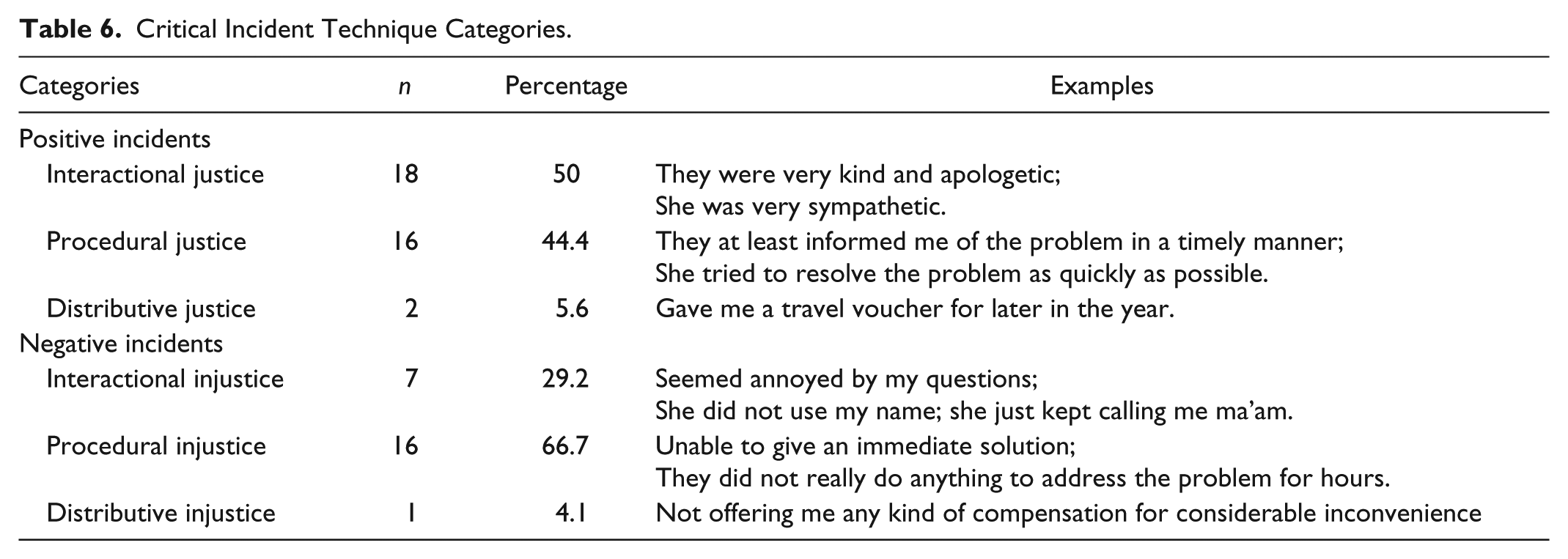
Among the 76 participants (55.1%) who had a flight cancelation before, only 38 (50%) observed a service recovery attempt from the airline. These 38 participants were asked both positive and negative critical incidents in their previous service recovery experience. After data cleaning, 2 positive incidents and 12 negative incidents were not valid, and as a result, 36 positive incidents and 24 negative incidents were found usable. All incidents were classified into one of the three themes, Procedural (In)justice, Interactional (In)justice, and Distributive (In)justice. Table 6 displays examples of responses in each theme. Among the 36 positive incidents, Interactional Justice (50%) and Procedural Justice (44.4%) were most often mentioned by participants. And among the 24 negative incidents, Procedural Injustice (66.7%) and Interactional Injustice (29.2%) were mentioned most often.
Critical Incident Technique Categories.
Satisfaction, Positive WOM, Negative WOM, and Future Intent
The items for each construct (i.e., positive WOM, negative WOM, future intentions) were averaged. Since loyalty has been found to have an effect on positive WOM and future intention, it was deemed appropriate to perform analysis of covariance (ANCOVA) to test hypotheses related to positive WOM and future intentions. One-way ANOVA and follow-up Tukey’s honestly significant difference (HSD) tests were employed to test the various hypotheses related to satisfaction and negative WOM. Table 7 presents the results indicating the differences in satisfaction, positive word of mouth, negative word of mouth, and future purchase intentions among the four conditions.
Differences of Treatments in Satisfaction, Word of Mouth, and Future Intent.
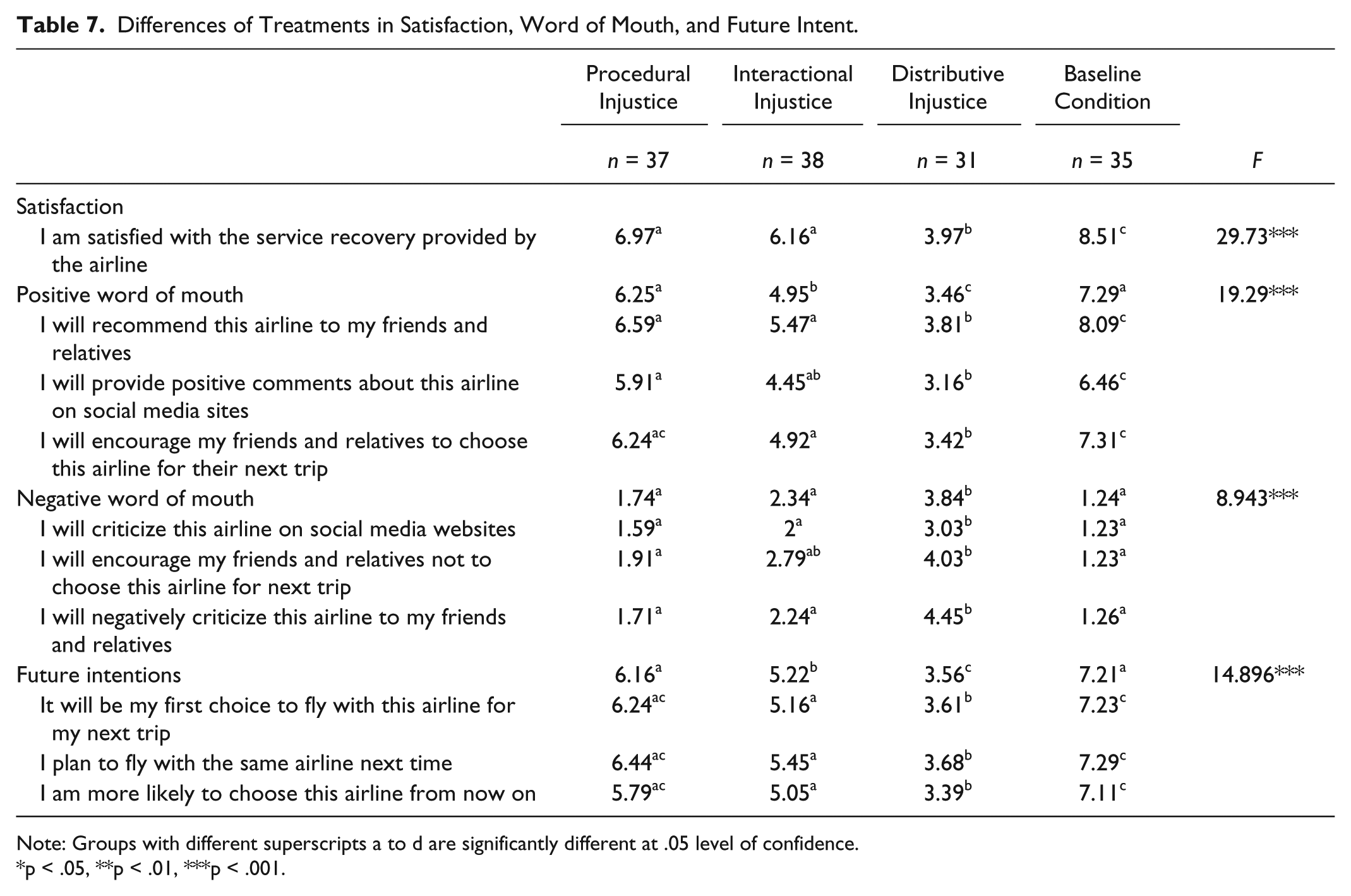
Note: Groups with different superscripts a to d are significantly different at .05 level of confidence.
p < .05, **p < .01, ***p < .001.
Satisfaction
A one-way ANOVA with a post hoc Tukey’s HSD test was used to examine the differences in satisfaction among the four conditions. The ANOVA results showed that the four conditions were significantly different (F = 29.73, p < .001) in their satisfaction with the service recovery they received. Specifically, post hoc analysis showed that participants in the baseline condition (mean = 8.51) were significantly (p > .05) more satisfied than those in both procedural injustice condition (mean = 6.97) and interactional injustice condition (mean = 6.16). Participants in the distributive injustice condition (mean = 3.97) were more likely to be dissatisfied than those in the other three conditions. However, no significant difference (p < .5) was found between procedural and interactional conditions. Thus, hypothesis 2 was partially supported.
Positive word of mouth
Levene’s test of equality of error variances for the ANCOVA analysis was met (F = 0.681, p = .565), which indicates the assumption of homogeneity was not violated. The interaction effect between loyalty and the four scenario groups was not significant (p > .05). The ANCOVA exploring differences in positive WOM found significant differences (F = 19.29, p < .001) among the four conditions. Post hoc analysis revealed that participants in the distributive injustice condition (mean = 3.46, SD = 2.35) had significantly (p < .05) lower intentions to spread positive WOM than those in the other three conditions. In addition, significant differences (p < .05) were found between participants in the procedural injustice condition and those in the interactional injustice condition. However, no difference (p >. 05) was found between procedural injustice condition and the baseline condition (mean = 7.29, SD = 2.01). Therefore, hypothesis 3 was partially supported by the data as the results revealed that distributive injustice had the strongest effect followed by interactional injustice, and procedural injustice was found to have no effect on intention to spread positive WOM.
Negative word of mouth
The negative WOM ANOVA revealed that the four conditions were statistically different (F = 8.94, p < .05). Post hoc Tukey’s HSD analysis showed that participants in the distributive injustice condition (mean = 3.84, SD = 2.71) were significantly (p < .05) more likely to spread negative WOM than those in the other three conditions. However, no differences in negative WOM were found among the other three conditions (i.e., procedural injustice condition, interactional injustice condition, and the baseline condition). Therefore, hypothesis 4 was partially supported. Moreover, respondents’ intentions to spread negative WOM were generally low regardless of the conditions they were in since no means were larger than 4.45 on the 11-point Likert-type scale.
Future purchase intention
Levene’s test of equality of error variances for the ANCOVA analysis were met (F = 2.72, p = .05), which indicates the assumption of homogeneity was not violated. The interaction effect between loyalty and the four scenario groups was not significant (p > .05). Results of the future purchase intentions ANCOVA showed that the four conditions were statistically different (F = 14.9, p < .001). The post hoc test further showed that participants in the distributive injustice condition (mean = 3.56, SD = 2.64) had significantly (p < .05) lower future intentions than those in the other three conditions. Moreover, participants in the interactional injustice condition had a lower repurchase intent than those in the procedural injustice and baseline conditions. However, no differences (p > .05) were found between participants in the procedural injustice condition and those in the baseline condition (mean = 7.21, SD = 2.38). Thus, hypothesis 5 was also partially supported by the data.
Discussion and Implications
Although service recovery is a critical issue for all service providers, the airline industry presents specific challenges in providing successful service recovery, including (1) the impact that certain service failures (such as flight delays or canceled flights) can have on large groups of customers at one time; (2) service failures can result in significant loss (of time and/or money) in proportion to other services; and (3) flying can induce feelings of having little or no control, thereby increasing passengers’ feelings of vulnerability and hopelessness, and thus requiring more of a recovery effort.
Based on the results, the baseline condition (i.e., error-free condition) resulted in higher satisfaction. This is an important theoretical finding as it provides further support of the three-dimensional conceptualization of recovery justice originally proposed by Tax, Brown, and Chandrashekaran (1998). This finding also provides a valuable lesson for service managers: service recoveries are more likely to be perceived as just or fair when service providers “satisfy” all three justice dimensions. Subsequently, the most logical managerial recommendation, based solely on this finding, would be for airlines to take all three dimensions of justice into consideration when designing service recovery policies/procedures, and strike for an error free service recovery.
Results of the effect of airline loyalty on service recovery also supports previous findings that customers who identify themselves as being loyal to one service provider are significantly more likely to spread positive WOM and repurchase than those customers not loyal to one service provider (Parasuraman, Zeithaml, and Berry 1994; Lee, Lee, and Feick 2006). The saliency of this finding is due to the importance placed on loyalty among service firms. In addition to the benefits stated above, previous researchers have suggested that loyal customers can provide free advertising (Petrick 2004), a decrease in price sensitivity (Gummesson 2004), lower production costs (Tadajewski 2009), and critical insight into product/service enhancements (Berry and Seiders 2008). A concerted effort should thus be made to provide exceptional service recovery (in the form of compensation) to “loyal” passengers. However, no significant differences were found between “loyal” airline passengers and those not loyal in regard to satisfaction or negative WOM. According to Li and Petrick (2010, 203) and based on the Investment Model (IM), one’s commitment to a relationship is strengthened by satisfaction gained from the relationship, weakened by the quality of alternatives, and “fueled by the investments in the relationship.” As Chen and Hu (2013) found that service quality affects customer loyalty among airline passengers, future service recovery research should examine the relationship between loyalty, service quality, and the investments provided by the firm.
The CIT results revealed that among the 24 negative incidents reported by respondents who had experienced a flight cancelation, 16 of them (66.7%) were related to procedural injustice. Of these 16 critical incidents, the most heavily cited were a perceived lack of speed or frustration with the airline representative’s inability to provide clear instructions on the best course of action (following the flight cancelation). Because timeliness is a pressing procedural issue for airline passengers, recovery speed should be prioritized as an integral part of both front-house training and ongoing staff evaluation: frontline staff members need to recognize service failures as immediate concerns. It is also suggested that the anxiety stemming from a lack of procedural justice could be minimized by providing travelers with detailed flight status updates, helpful suggestions, and options pertaining to service failure solutions.
Comparing the CIT results with the experiment results, several discrepancies were found. Among the positive service recovery incidents reported by respondents who had experienced a flight cancelation, incidents related to interactional and procedural justice together accounted for 94.4%; while only 5.6% of the positive critical incidents were related to distributive justice. Our experiment results, however, showed that distributive justice had the most impact on air travelers’ satisfaction, WOM, and future intentions. It is possible that the respondents did not associate distributive justice as part of the duties of the frontline airline representative, as they were asked to simply describe the “worst mistake made by the airline representative.” Compensation may be a component of service recovery that airline passengers perceive to be a company matter, unrelated to the quality of the recovery attempt provided explicitly by the airline service representative. Or, perhaps the omission of critical incidents associated with distributive justice could be an indication that current airlines’ recovery practices focus largely on interactional and procedural justice, and lack a “memorable” distributive component.
As previously stated, results of the experiment suggest that different dimensions of justice in service recovery had significant effects on satisfaction, WOM, and future intentions. Specifically, a lack of distributive justice (compensation for a canceled flight was described as half the value of the original flight) had the most negative impact on both satisfaction and future intentions. This finding contradicts the results of some previous studies of service recovery among airline passengers (Chang and Chang 2010), hotel guests (Karatepe 2006), and restaurant patrons (Ok, Back, and Shanklin 2005) in which interactional justice was found to have the strongest effects. With the exception of Chang and Chang (2010), such discrepancies may be partly explained by the nature of different services. It is assumed that the services in hotels and restaurants involve a perception of high-level interaction between service providers and customers that is far more intensive than airline services (Swanson and Hsu 2011). Moreover, it has been suggested in previous studies that some customers are more price sensitive about the cost of purchasing flight tickets than the cost of an overnight stay at a hotel or a full-service meal (Garrow, Jones, and Parker 2007). Subsequently, it is recommended that both price elasticity and the level of perceived service required in specific service contexts be considered for future service recovery research.
Other than safety, the most influential determinant of choosing an airline has been suggested to be price (Kumar and Shah 2004), indicating the saliency of cost and value among potential air travelers. Thus, combined with the current findings on the significant impact of distributive justice on satisfaction and repurchase intent, it is recommended that airlines consider service recovery to be largely a matter of distributive justice. Distributive justice, or compensation, should be the capital concern for airline service recovery providers. In addition to positively and significantly impacting satisfaction and repurchase intentions, distributive justice had a similar effect on positive WOM. This finding supports previous research suggesting that successful motivators of positive WOM include offers of discounts, rewards or points, and coupons (Li and Zhan 2011). Therefore, for service recovery to provide a cure for service failure rather than simply a remedy, airline managers and frontline employees should present a compensation package that significantly impacts satisfaction, positive WOM, and repurchase intent by exceeding traveler expectations in that regard.
The current study has limitations that provide directions for future research. First, the study relied on a scenario-based experiment, which may weaken respondents’ emotional reactions to the service failures and recoveries in comparison to “real” consumption situations. Future studies should focus on empirical validation of this study. Second, the cause of a flight cancelation was not specified in the scenario script. Thus, it is possible that airline passengers’ reactions to a flight cancelation due to severe weather may be different from the reactions to a flight cancelation due to an insufficient number of passengers. Future studies should consider examining the effects of different causes of service failure on service recovery evaluations.
Third, the issue of service failure severity and corresponding service recovery was not fully addressed in this study. The authors acknowledge a significant relationship between service failure severity and service recovery perceptions, as it has been well documented in service recovery research. A concerted effort was made in the research methodology procedures to account for the potential impact of service failure on service recovery: a baseline scenario was implemented in conjunction with the three additional scenarios used to examine distributive, interactional, and procedural justice. Future studies should consider extending the current research by incorporating service failure severity as an additional independent variable. Furthermore, the conclusions drawn from this study are based on the findings from one travel industry. It is possible that customers may respond differently to service failures and recoveries in different contexts. For instance, airline customers tend to have a lower level of involvement and interaction with service providers than those in a dining experience or an overnight stay at a hotel. Therefore, air travelers may pay less attention to interactional aspects of a service recovery than restaurant patrons or hotel guests. Thus, future research is needed to verify the results of this study in different hospitality/travel industries.
In conclusion, results of the present study suggest that while all dimensions of justice affect consumer evaluations, airlines should consider a service recovery strategy focused on providing superior distributive justice. In addition, the findings support the applicability of relationship marketing with respect to customer loyalty. While the recommendations provided are based on a specific industry, this study demonstrates that other tourism-based service entities could generate their strategic focus with the use Rawls’s (1971) justice theory. Therefore, it is presumed that the present study’s results not only can provide airline management with direction on how best to allocate limited resources but also support a previous theoretical conceptualization of service recovery.
Footnotes
Declaration of Conflicting Interests
The author(s) declared no potential conflicts of interest with respect to the research, authorship, and/or publication of this article.
Funding
The author(s) received no financial support for the research, authorship, and/or publication of this article.