




Abstract
This study examines the relationships between motivations, modes of participation and loyalty intentions of consumers of tourism brand pages on Facebook (TBPF). The study introduces an integrative theoretical and exploratory model that describes the impact of motivation on online consumer behavior (extent of participation and degree of active contribution) and attitudes toward particular brands (repurchase and recommendation intention). A digital survey posted on TBPF elicited 903 responses. Four factors of motives for participation were identified—functional, social-psychological, hedonistic, and incentive motives—with varying levels of importance. Social-psychological motives were the main predictors for “active-participation” in TBPF. There was a positive significant correlation between all the modes of participation and consumers’ loyalty intentions. The findings were significantly different from previous studies of online tourism communities with regard to the impact of social-psychological motives on consumer’s electronic word-of-mouth participation and loyalty intentions. The implications for the theory and marketing management are discussed, as is the study’s contribution to effective marketing management of TBPF.
Introduction
Online social networks (OSNs) have become important social platforms for computer-mediated communications, in general (Ellison et al. 2014; Majchrzak et al. 2013), and within the travel industry, in particular (L. S. Huang, Chou, and Lan 2007; Law, Buhalis, and Cobanoglu 2014; Litvin, Goldsmith, and Pan 2008; Morosan, Bowen, and Atwood 2014). The importance of OSNs in tourism derives from the information-intensive nature of the industry, driven by information search processes and information flow (Poon 1993; Sheldon 1997). OSNs have thus become a significant arena in which “collective knowledge” is created, gathered, and shared among consumers (Ayeh, Au, and Law 2013; Bilgihan, Peng, and Kandampully 2014; Bronner and de Hoog 2011). In general, it is widely agreed that OSNs play a vital role in the decision-making processes of travelers, who seek to obtain travel-related information and to share their personal experiences, reviews, comments, and opinions (Inversini and Masiero 2014; Law et al. 2015).
OSNs such as Facebook, Twitter, Myspace, YouTube, Instagram, and Microblog are platforms with dynamic, multimodal features that enable users to post, share, and discuss issues with other users with similar interests (Jansen et al. 2009), and engage in peer-to-peer product recommendations and electronic word of mouth (eWOM) (S. Chu and Kim 2011). In defining eWOM, Bronner and de Hoog (2011) suggest that the concept of WOM refers to traditional offline interpersonal information sources, whereas eWOM involves consumers’ comments about products and services posted on reviewer sites on the Internet. Accordingly, interpersonal consumer-oriented communication that flows in OSNs is a new type of WOM, whose analysis may benefit from the accumulated knowledge on traditional WOM processes. For example, some researchers have focused on the motivations of consumers to seek information or to consume information through eWOM (e.g., Goldsmith and Horowitz 2006; Schindler and Bickart 2005), while others have focused on understanding consumers’ motives for creating and sharing eWOM information (e.g., Bronner and de Hoog 2011; Hennig-Thurau et al. 2004; H.H. Lee, Fiore, and Kim 2006). In both cases, namely, “eWOM creators” versus “eWOM seekers,” there appears to be a range of consumer needs that extend beyond the sheer satisfaction related to functional information. For example, Hennig-Thurau, Walsh, and Walsh (2003) identify five main dimensions of motivation to participate in eWOM: obtaining buying-related information, social orientation through information consumption, community membership, remuneration, and learning how to consume a product. Moreover, Bronner and Hoog (2011) summarize findings from numerous studies and identify motives such as helping other vacationers, social benefits, consumer empowerment, and helping companies.
User characteristics and motives for participation in eWOM are also related to the platform or to the nature of the network (Bronner and de Hoog 2011; Gretzel and Yoo 2008; Sung et al. 2010; Schindler and Bickart 2005). Similarly, Bronner and de Hoog (2011) conclude that there is a relationship between the motive for making a contribution and the choice of a Website. Indeed, site type is associated with the nature of the information uploaded, the consumer’s participation characteristics, and the way in which the two factors interact (Litvin, Goldsmith, and Pan 2008). In conclusion, different OSN platforms are used to satisfy different needs; they constitute different communication patterns between consumers and have their own dynamics, and therefore a dedicated examination of consumer behavior for each platform in its own right is necessary.
The current study focuses on consumer participation in commercial tourism sites on the world’s largest social network, Facebook. Like other social networks, Facebook offers commercial firms a number of options with which to communicate with their potential customers through “Facebook brand pages” (also called: “Business Pages” or “Fan Pages”), which have become important online service for brand communication (Dholakia, Bagozzi, and Pearo 2004). The resulting virtual brand communities do not only provide marketers with additional communication channels but also allow them to establish links with current and future consumers (Andersen 2005), to induce productive feedback from consumers, and to establish and strengthen long-term relationships with consumers (Dysart 2008; Sung et al. 2010). From the consumers’ perspective, Facebook brand pages constitute a relatively new arena for eWOM communication. Given the transparent social nature of Facebook, we consider in this research all forms of consumer’s participation (comment, liking, or sharing) on the brand page “wall” (which is visible to all) as eWOM or eWOM arouses, which affect the evaluation of the marketing message posted by the organization.
However, despite the popularity and global significance of Facebook, only limited empirical research has been conducted on Facebook brand pages and their role in the customer–brand duo (Jhane and Kunz 2012; Ross et al. 2009). Facebook, in general, and eWOM patterns within tourism brand pages, in particular, remain relatively unexplored in terms of consumer behavior related to WOM, despite their unprecedented significance for marketing practice (Verma, Jahn, and Kunz 2012). Recent studies on tourism-related Facebook brand pages explore issues such as users’ trust, strength of relationships, and perceived enjoyment. These issues significantly affect users’ acceptance of Facebook and their intentions to attend a promoted event (W. Lee and Paris 2013). Conversely, Gretzel and Dinhopl (2014) explored why travelers unlike Travel-Related Facebook brand pages. Finally, Gretzel and Fesenmaier (2012) found only a small proportion of online Americans actively engaged with travel companies through their Facebook pages. However, they predict that with social media use growing and younger consumers being more accustomed to this mode of operation, one can expect that these numbers will change in the near future.
Therefore, the aim of the current exploratory study is to fill the gap in our understanding of consumer behavior in relation to Facebook tourism brand pages by providing insights on the following three behavioral aspects: first, identifying the specific motivations that affect consumer participation (eWOM) in the tourism corporate brand pages of Facebook; second, examining the nature and patterns of use of participating consumers; and third, exploring the relationship between participation patterns and consumer loyalty intention with regard to a particular tourism brand. To this end, a theoretical model based on accumulated literature and exploratory conceptualizations was introduced with the aim to facilitate a better understanding of the connections between motivations, modes of participation, and loyalty intentions of consumers participating in the tourism brand pages of Facebook.
Consumer Motives for Participating in Tourism OSNs’ eWOM
Virtual communities are a source of advantages and opportunities for both marketers and consumers. Much of their success depends on the ability of marketers to understand the needs of the community and fulfill these needs in the best possible way (W.G. Kim, Lee, and Hiemstra 2004; Wang and Fesenmaier 2004). Indeed, understanding the motivations and needs of the consumer is one of the tenets of modern marketing (Hawkins, Best, and Coney 2004). Recent studies in the service industry illustrate the multitude of motives for consumer participation in OSNs. In particular, Jhan and Kunz (2012) investigated the motives of participation in Facebook brand pages and identified both social and functional motives. Hence, this study will further elaborate on their conceptualization by adding specific tourism-related dimensions.
As outlined below, the tourism literature proposes several motivating factors for participation in virtual communities that can be grouped into four major concepts—functional, sociopsychological, hedonistic, and identification (Armstrong and Hagel 1996; Chung and Buhalis 2008; Wang and Fesenmaier 2004). The following section discusses each one of the four motivating factors as seen in the literature on tourism.
Functional Needs
Functional needs lie at the core of the motivation to participate in tourism OSNs. Community members provide functional utility in terms of buying or selling tourist services and/or to searching for and collecting information simply for the sake of knowledge or for future consumerism decisions (Chung and Buhalis 2008). Virtual communities offer easy availability of tourist-related information, regardless of time or geographic constraints (Armstrong and Hagel 1996; D’Ambra and Wilson 2004; Wang and Fesenmaier 2004). Consumers are able to easily obtain ample information about destinations, service offerings, and service quality. In the specific case of backpackers, OSNs have almost completely eradicated the use of commercial guidebooks and communal books of recommendations located at guesthouses and similar venues where backpackers congregate (Reichel, Fuchs, and Uriely 2007).
Social and Psychological Motives
Social and psychological motivations for virtual community participation are akin to those pertaining to “real life” (vs. virtual) social networks. These include emotional support, maintaining ties with current friends, and making new acquaintances. In essence, tourism OSNs offer informal support and a platform for the exchange of ideas and for creating and maintaining contacts with other members (Preece 2000; Wang, Yu, and Fesenmaier 2002). According to Wang and Fesenmaier (2004), in such communities there is also an element of trust that facilitates openness and sharing of experiences. As such, the network helps participants to express their inner thoughts and opinions. Indeed, some scholars consider psychological needs as a necessary reason for joining communities (Bressler and Grantham 2000). As noted before, joining a virtual community provides its members with a sense of belonging to a group. This, in turn, enables participants to express their individualism and contribute to eWOM communication (Walther 1996; Wang and Fesenmaier 2004). The aforementioned recent study in service industry Facebook brand pages (Jhane and Kunz 2012) distinguished between two main kinds of relationships where an interaction could be of value for a user: the interaction with other users, and the interaction with the brand or company. Clearly, the role of the social motives in Facebook in general, and in Facebook brand page in particular, cannot be overlooked. In addition to the above-mentioned socially related benefits, psychological motives include self-expression, self-empowerment, an expression of status, power or prestige, as well as expressions of negative emotions and even revenge. It should be noted, however, that not all of these benefits or motives have been empirically investigated in the tourism realm. Moreover, an empirical study of Chung and Buhalis (2008) did not find psychological motives as an independent dimension related to tourism virtual communities.
Hedonism
Consumers join virtual communities not only for functional benefits but also for entertainment and pleasure (Bagozzi and Dholakia 2002; Wang and Fesenmaier 2004). Hedonistic benefits related to the search and consumption of knowledge were identified long before the advent of the Internet (Hirschman and Holbrook 1982). Yet, in the current platform of Facebook and social networks, a great number of network members can virtually congregate and discover a new world of imagination and entertainment, a world where they can try out new roles and connections—new almost limitless possibilities. Consequently, hedonistic consumption through the Internet creates a unique emotional stimulus associated with positive emotions, excitement, enjoyment and satisfaction (Wang and Fesenmaier 2004). The hedonistic dimensions of participation in a tourism social virtual network are probably especially powerful, given the constant supply of numerous stimuli directed toward new positive experiences and emotional responses (Chung and Buhalis 2008). In addition, as noted by Litvin, Goldsmith, and Pan (2008), sharing one’s travel experiences with other participants enables one to enjoy the trip again simply by writing it up on a travel site.
Consumers’ Identification with Corporations and Brands
Consumer identification with a particular firm may be associated with a need to support the firm and help it grow and prosper. This motive, designated brand interaction value (BIV), has been found to affect the level of consumer participation in virtual communities in fields other than tourism (Gremler, Gwinner, and Brown 2001). For example, Bhattacharya and Sen (2003) found that the psychological process of consumer–company identification determines the nature of the relationships between the firm and the individual, including the level of commitment of the consumer to a particular brand name. While Bhattacharya and Sen (2003) do not focus on virtual communities, they clearly illustrate the strong link between consumer identification with a particular firm and willingness to repurchase the firm’s products and recommend the firm to others in preference to its competitors.
Research in organizational behavior indicates that consumers’ commitment to an organization and their willingness to contribute to its success are positively related to the adoption of a firm’s products and services (Dutton, Dukerich, and Harquail 1994). It seems plausible that such a positive attitude will be also manifested in a willingness to be part of the firm’s OSN virtual community (Bronner and de Hoog 2016). Hence, the current study regards the motive of identification with a corporation as a separate motivational dimension from the above-mentioned three factors. This idea is supported by two recent studies. In the first, Gretzel and Yoo (2008) showed that the need to contribute to the firm has an impact on the willingness of consumers to post positive comments in review sites. In the second, Bronner and de Hoog (2011) identified the motive of “helping companies” as one of the main motives for engaging in eWOM. These findings further highlight the possible significant role of corporate identification in the tourism realm. Thus, our first hypothesis states:
Hypothesis 1: Consumer participation in brand pages of tourism companies in OSN virtual communities is associated with functional, sociopsychological, hedonistic and customer company’s identification motives.
Nature and Measurement of Consumer Participation in Tourism OSNs
It should be noted from the outset that exact and precise measures of the nature of consumer participation (sometimes referred to as “engagement” or “interaction”) in Facebook have yet to be developed. This is partly due to constraints inherent in the nature of the site and the technological platform it offers (Hargittai 2007; Litvin, Goldsmith, and Pan 2008). The current study attempts to fill this gap by focusing on two dimensions of participation: First, the “extent of participation,” measured by the frequency and duration of page visits, presents the quantitative aspect of participation. The second, the “degree of active contribution,” measured by the perceived level of consumer active generation of eWOMs in the brand community of Facebook (the tendency to contribute information and to be active in communication with other members), conveys a qualitative characteristic of participation not in terms of quantity but rather the nature of the participation and contribution behavior.
The literature offers various measures of the degree of eWOM participation in OSNs, including total amount of time spent in an OSN within a given period of visits (Hargittai 2007; Pelling and White 2009), the average time spent on each visit (J. Kim, Kim, and Nam 2010; Raacke and Bonds-Raacke 2008), and the frequency of visits (Chung and Buhalis 2008). In the tourism domain, the most common measures of participation in OSNs are quantitative, for example, time spent on the site, frequency of visits, and duration of visits (Chung and Buhalis 2008; Wang and Fesenmaier 2004). Additional contextualization includes the extent of involvement and activism, such as content “creators” versus “seekers” (Hennig-Thurau, Walsh, and Walsh 2003; Wang and Fesenmaier 2003), the type of information posted (Peluchette and Karl 2008; Ross et al. 2009), and the issue of positive valence eWOM or negative valence eWOM (Goyette et al. 2010). In parallel, Harrison-Walker (2001) made a distinction between eWOM activity and eWOM praise.
In addition, the aforementioned research indicates the participation dimension of active contribution to the content and activities of companies’ sites. Active participation determinants include consumer personal participation drives, expected benefits, group allure, and the ease of interacting with others on a site (Bagozzi and Dholakia 2002; Wang and Fesenmaier 2004; Yoo and Gretzel 2008). Wang and Fesenmaier (2004) found an association between the extent of participation and the degree of active contribution in the OSN. Assessing the consumer’s degree of active contribution is measured by her or his perceptions about the nature of participation in the community. For example, examining the following four perceptual measures: motivation to communicate with other members, willingness to invest effort to further activities in the community; motivation to contribute to the community in terms of content and information that would be helpful for other members; and enthusiasm for sharing information and posts with other members (Casaló, Flavián, and Guinalíu 2010b; Koh and Kim 2004). According to the above-described studies, these four measures are reliable indicators of the strength of consumer involvement with a company’s brand and its community as well as of the degree of the consumer’s active contribution to the community.
Consumer’s Motives and Participation Modes in Tourism OSNs
As noted earlier, the basic premise of this study is that consumer needs are the main motivating factors that determine the different modes of participation (extent of participation and active contribution) in firm-hosted online travel communities. Given the significant role of travel and tourism in today’s world, and the experiential, intangible, and processual nature of the tourism product, customer participation and long-run relationship with the site and brand are basic requirements for success (see Grönroos 2007).
Functional Motives and Participation Modes
Tourism consumers fulfill significant functional needs when they browse in cyberspace. These needs include information collection regarding matters of personal interest to them, information about services offered, and acquisition options (Armstrong and Hagel 1996; Pan and Fesenmaier 2006). It is thus not surprising that the information search motive has a considerable impact on the extent of participation in OSNs. Clearly, this functional motive is the most noteworthy factor in terms of participation (Chung and Buhalis 2008; Gretzel and Fesenmaier 2012; Wang and Fesenmaier 2004). It should be noted, however, that there are some conflicting findings about the relationships between functional needs and participation in corporate pages. For example, Wang and Fesenmaier (2004) found inverse relationships between functional motives and the extent of participation. The information search is target oriented, and therefore after acquiring the desired information, the consumer has no need to extend the visit. In contrast, Chung and Buhalis (2008) found positive relationships between functional motives and the duration of visits. The contradictory findings seem to be the result of defining “participation” differently.
Active contribution may be defined as the willingness of the consumer to contribute information and be an active, contributing partner in the community. Specifically, highly functionally motivated tourism consumers tend to participate in the community more often and for a longer time and to be more active and involved than less functionally motivated consumers. This assessment is supported by some non-tourism studies (see Dholakia et al. 2009). Hence, two hypotheses are presented below:
Hypothesis 2: There is a positive relation between functional motives and the extent of consumer participation (as measured by frequency and duration of visits) in Facebook tourism brand pages.
Hypothesis 3: There is a positive relationship between functional motives and the degree of active consumer contribution (as measured by the level of consumer active generation of eWOMs) to Facebook tourism brand pages.
Sociopsychological Motives and Participation Modes
Cyber-tourist communities are social entities, offering social and psychological benefits to their members (Preece 2000; Walther 1996; Wang, Yu, and Fesenmaier 2002). As noted above, sociopsychological motives may be attributed to social benefits derived from participation, to caring for other people, and to personality factors (Ross et al. 2009; Wang and Fesenmaier 2004). Indeed, psychological motives can act as prerequisites for joining a community (Bressler and Grantham 2000). These processes affect the extent of participation of the consumers in various virtual community activities (Algesheimer, Dholakia, and Herrmann 2005; Bagozzi and Dholakia 2006; Casaló, Flavián, and Guinalíu 2010b) and the willingness to produce and share knowledge (Neelamegham and Jain 1999; Nyer 1997).
Wang and Fesenmaier (2004) and Chung and Buhalis (2008) indicated clear positive relations between social needs and the extent of participation in terms of frequency and duration of firm-page visits. Social motives are highly correlated with the role of “knowledge producer,” actively contributing knowledge to the virtual community (Brown, Broderick, and Lee 2007; Hennig-Thurau et al. 2004). In contrast, the impact of psychological motives on the participation in tourist corporate homepages was statistically significant (Chung and Buhalis 2008; Wang and Fesenmaier 2004). Consequently, Chung and Buhalis (2008) suggest that psychological motives are an aspect in a hybrid of sociopsychological motives. Consequently, consumers who are highly motivated by social needs are also expected to show a high level of psychological involvement. In light of the approach of Chung and Buhalis (2008), the following two hypotheses are presented below:
Hypothesis 4: There is a positive relationship between sociopsychological motives and the extent of consumer participation (as measured by frequency and duration of visits) in Facebook tourism brand pages.
Hypothesis 5: There is a positive relationship between sociopsychological motives and the degree of active contribution (as measured by the level of consumer active generation of eWOMs) to Facebook tourism brand pages.
Hedonistic Motives and Participation Modes
Consumers may also join tourism virtual communities and corporate homepages for satisfying the hedonistic needs of fun and pleasure (Bagozzi and Dholakia 2002; Litvin, Goldsmith, and Pan 2008; Wang and Fesenmaier 2004). These needs were found to be positively correlated with longer durations of Facebook brand page visits (J. Kim, Kim, and Nam 2010). Tourism studies on consumer behavior also found hedonistic motives to be positively correlated with the extent of participation in virtual communities, whether on an ongoing basis (W. Lee and Paris 2013; Wang and Fesenmaier 2004) or specifically before taking a vacation (Chung and Buhalis 2008). Yoo and Gretzel (2008) also identified the hedonistic need for enjoyment as characterizing active “content producing” consumers, who contribute significantly to a firm’s homepage. These suggested patterns are congruent with pre–cyber era studies on WOM that showed that feelings of satisfaction and enjoyment motivated consumers to share their experiences with other people (Dichter 1966). Based on the above findings, the following two hypotheses are presented:
Hypothesis 6: There is a positive relationship between hedonistic motives and the extent of consumer participation (as measured by frequency and duration of visits) in Facebook tourism brand pages.
Hypothesis 7: There is a positive relationship between hedonistic motives and the degree of active contribution (as measured by the level of consumer active generation of eWOMs) to Facebook tourism brand pages.
Consumer Identification with a Corporation and Participation Modes
The significance of consumer appreciation and willingness to support a firm was highlighted in the seminal study of Bhattacharya and Sen (2003). Amicable relations between customers and firm’s staff contribute to the commitment of the former to the latter (Grönroos 2007; Shani et al. 2014). Indeed, Hong and Yang (2009) found consumer-company identification to be an intervening factor between the firm’s reputation and the customer’s willingness to distribute positive eWOM. Other studies indicated that the more consumers expressed identification with a particular firm, the more they tended to be committed to the brand and the more often to participate in creating positive WOM (K. Chu and Li 2012; Tuškej, Golob, and Podnar 2011). Similarly, in tourism research, Yoo and Gretzel (2008) found that the willingness to contribute to a firm is associated with positive eWOMs. While the mass media usually deals with corporations that damage consumer trust, apparently below the surface there is a dynamic process of some emotional, almost surprising, relationships of consumer–firm taking place in OSNs. Hence, it is assumed that the motives of corporate identification are related to both the quantitative measure of participation and the qualitative measure of degree of active contribution:
Hypothesis 8: There is a positive relation between the corporate identification motive and the extent of consumer participation (as measured by frequency and duration of visits) in Facebook tourism brand pages.
Hypothesis 9: There is a positive relationship between the corporate identification motive and the degree of active contribution (as measured by the level of consumer active generation of eWOMs) to Facebook tourism brand pages.
Consumer Participation in Tourism OSNs and Loyalty Intention
Numerous studies indicate that exposure to eWOM communication in virtual communities has a significant impact on consumer attitudes and behavior (Hennig-Thurau et al. 2004). Studies in this realm found that eWOM affects brand awareness (Vermeulen and Seegers 2009), brand preference and purchasing intention (Cho and Fiorito 2008; M.K.O. Lee et al. 2006), and actual purchases (Dholakia and Durham 2010; Trusov, Bucklin, and Pauwels 2009). Note that although the common approach in consumer behavior states that intentions are prior to actions (Ajzen and Fishbein 1980), in the current study we propose that there might be a dual direction of effects in the sense that behavior may have an effect on intentions. This is in line with Keller’s (1993) seminal conceptualization of brand equity as being associated with the breadth of consumer knowledge about the brand. Participation in tourism brand pages on Facebook clearly expands consumers’ knowledge of the brand, thus affecting their attitudes and intentions toward the brand. The premise is that the more consumers engage in OSN brand-related activities, the more their attitudes are crystalized. This premise is also supported by the classic theory of Bem (1972) that stipulates that a person’s perceptions and attitudes are often self-revealed through one’s activities and behavior. The current study focuses on the impact of eWOM on two dimensions of brand loyalty: reuse (repurchase) intention toward the brand or its Facebook page, and willingness to recommend the brand (or its Facebook page) to other community members, that is, recommendation intention.
Bagozzi and Dholakia (2006) demonstrated that a positive experience and exposure to brands in firm-hosted OSNs led to a high degree of loyalty, support, and willingness to purchase, especially among highly active community participants. These participation processes are expected to materialize in brand purchase (e.g., Casaló, Flavián, and Guinalíu 2010b; Karahanna, Straub, and Chervany 1999; Venkatesh 1999). Esch et al. (2006) asserted that brand knowledge affects future purchases via “a brand relationship path that includes brand satisfaction, brand trust, and attachment to the brand. Clearly, active participation might supply all these pre-purchase and loyalty requisites” (p. 98). Similar patterns were found in the tourism literature. For example, it was shown that exposure to eWOM affects consumer purchase intention (Vermeulen and Seegers 2009). Moreover, exposure to consumer-generated reviews (in this case, of hotels) increased consumer willingness to consider purchasing the product, probably as a result of developing a brand awareness (Vermeulen and Seegers 2009). Clearly, consumer intentions were stronger in cases of positive evaluations than in negative ones. In the latter case, the attitudes toward the brand had negative effects, yet they were mitigated or neutralized by brand awareness. Similar to the broader context (Asur and Huberman 2010; Chevalier and Mayzlin 2006; Dhar and Chang 2009), researchers in the tourism domain (Ye, Law, and Gu 2009) found that positive online reviews significantly increased the number of bookings. Variance or polarity of WOM of the reviews of a particular hotel had a negative impact on online sales.
The above-described literature indicates that past research supports the premise that exposure to eWOM has an impact on purchase decisions. Yet, there is a dearth of studies on the impact on such decisions of corporate brand pages on Facebook. Among the few studies that were conducted, that of Dholakia and Durham (2010) found that consumers who had become “fans” of Facebook brand pages visited those brand stores (cafés) 20% more frequently and generated more eWOM than those consumers who did not like the website.
A “referral,” or a willingness to recommend a particular brand to other consumers, is often considered as a dimension of loyalty (Algesheimer, Dholakia, and Herrmann 2005; Casaló, Flavián, and Guinalíu 2010a; Trusov, Bucklin, and Pauwels (2009). Referrals are viewed as simple, yet effective, measure for ensuring firms’ profitability and long-term survival (Reichheld 2003). As noted by Casaló, Flavián, and Guinalíu (2010a, 2010b), participation in a virtual community is related to consumer willingness to promote the community and recommend it to nonmembers. Algesheimer, Dholakia, and Herrmann (2005) reported similar findings. However, there is a gap in our knowledge about the relations between participation in Facebook tourism brand pages and the willingness to recommend a particular tourism brand or firm. Indeed, the nature of community participation and tourist willingness to recommend the brand still requires in in-depth investigation. Given the above findings, we predict that intensive participation is related to high involvement that will also be reflected in loyalty intentions. Consequently, the following two hypotheses are presented:
Hypothesis 10: There is a positive relationship between the extent of consumers’ participation and the degree of active contribution to Facebook tourism brand pages eWOM and loyalty expressions as measured by willingness to recommend a brand/brand page.
Hypothesis 11: There is a positive relationship between the extent of consumers’ participation and the degree of active contribution in Facebook tourism brand pages eWOM and loyalty expressions as measured by reuse intention toward a brand/brand page.
Research Model
The proposed model for the current study is presented in Figure 1. The model incorporates the above-mentioned four main motives (functional, sociopsychological, hedonistic, and corporate identification), two consumer participation characteristics (the extent of participation and the degree of active contribution) in the context of tourism brand pages on Facebook, and two expressions of brand loyalty (brand reuse intention and recommendation intention). The study’s 11 hypotheses are also depicted in the Figure.
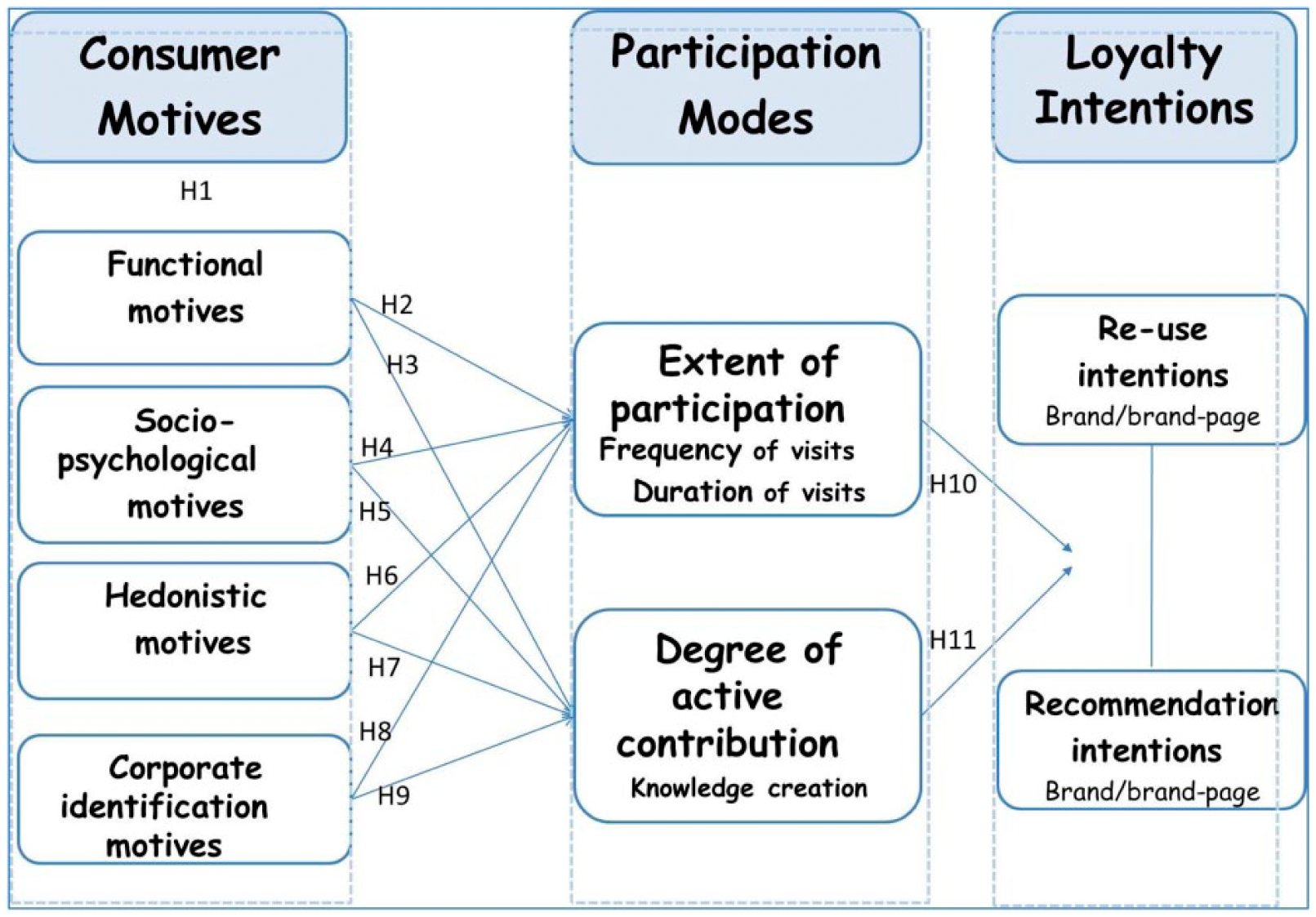
Proposed research model.
Method
Measurements
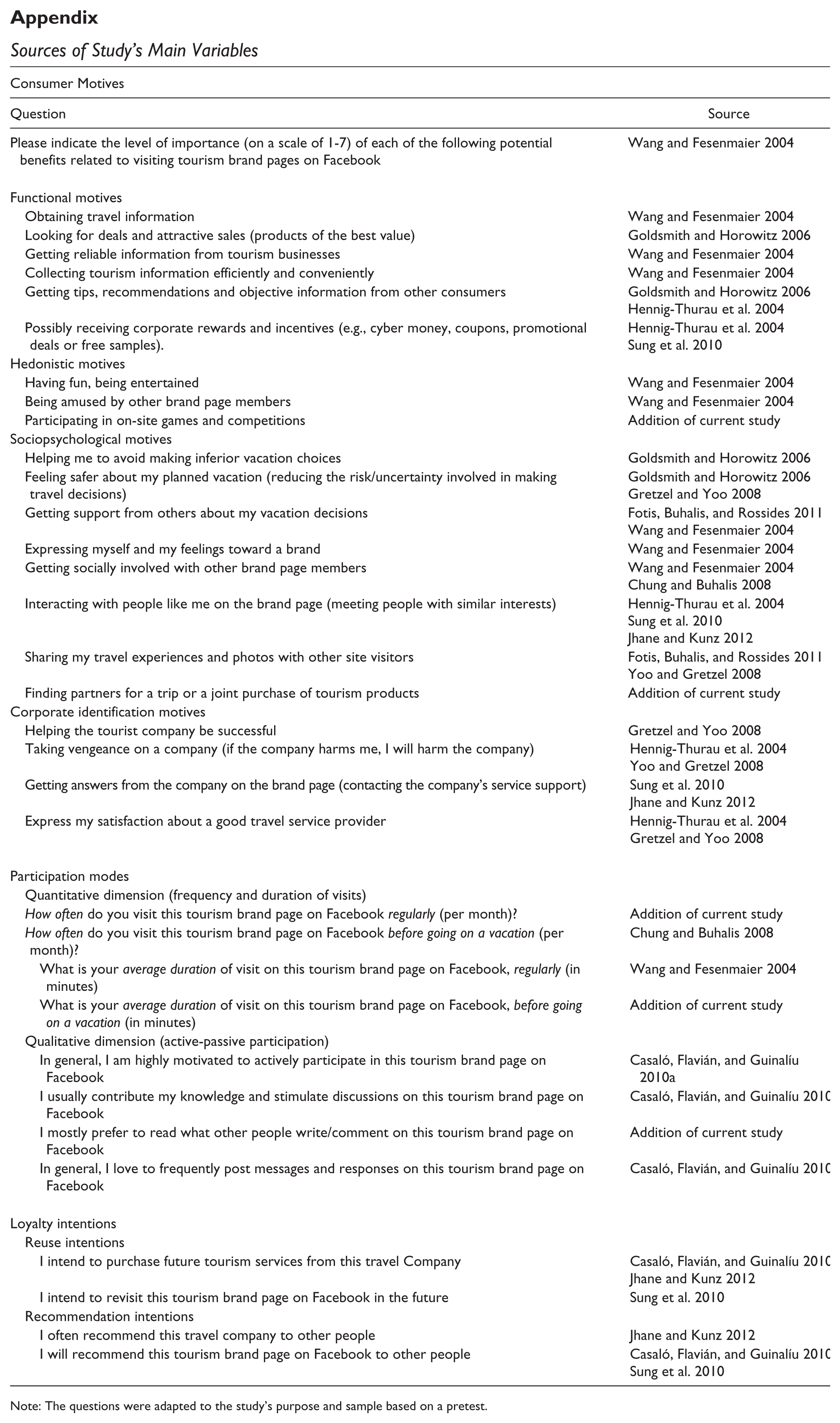
An online questionnaire utilizing multiple-item scales was designed with the aim to assess Facebook users’ perceptions in accordance with the study constructs. The questionnaire was made up of four sections: (1) consumer motives, (2) consumer participation modes, (3) loyalty intentions, and (4) personal and demographic information. Most scales were adjusted from existing research measures for which high reliability had been reported (see appendix), with the minor modifications detailed below.
The questionnaire was pretested on 60 respondents whose characteristics resembled those of the target population of this study, that is, older than 18, all holding a Facebook account and being registered as a member of at least one tourism Facebook brand page. The questionnaire was translated professionally into Hebrew and modified to fit our context of Facebook brand pages. The qualifier question was “How many Facebook tourism brand pages are you subscribed to? (i.e., for which you have pressed the “like-button” of the brand page).” In addition, a brief definition of a tourist company was included in the questionnaire for clarifying to the respondents the meaning of the concept for purposes of this study. The respondents were then asked to name one of their tourism brand pages and were instructed that the rest of the questionnaire would refer to that particular Facebook page. All the study’s constructs were measured on a Likert scale of 1 to 7, where a value of 7 represented “extremely important” and 1 represented “not at all important.”
The construct of consumer motives was based largely on the research instrument of Wang and Fesenmaier (2004), with some recently introduced adjustments (Chung and Buhalis 2008; Fotis, Buhalis, and Rossides 2011; Goldsmith and Horowitz 2006; Gretzel and Yoo 2008). Consumer participation modes was divided into two dimensions, extent of participation (a quantitative dimension) and degree of active contribution (a qualitative dimension). The measurement of the extent of participation was based on Chung and Buhalis (2008). Consumer degree of active contribution was adopted from Casaló, Flavián, and Guinalíu (2010b) and from Koh and Kim (2004). The construct of loyalty intention was also divided into two dimensions, reuse intention and recommendation intention, based on four questions from Casaló, Flavián, and Guinalíu (2010b). The pretest was followed by minor language revisions to the questionnaire to better fit the questions to the relevant population sample.
Data Collection
The study participants were Facebook users in Israel who subscribed to at least one hospitality company, airline, or major travel agency brand page on Facebook. We note that Israeli consumers are relatively very active on the Internet in general and on social networks in particular (http://www.ynetnews.com/articles/0,7340,L-4383797,00.html). The data were collected electronically through a questionnaire designed by Qualtrics Survey Software (Survey Platform). As noted earlier, after the pilot survey of 60 respondents, some questions were rephrased more clearly. Then, the main study’s online questionnaire was posted on the “wall” of 18 aforementioned leading tourism brand pages on Facebook, from 29 August 2012 to 20 September 2012. Posting a link to the questionnaire on tourism brand pages assured that we targeted users who had already chosen to take part in a tourism and hospitality brand community on Facebook. That, along with the qualifier question, was designed to enhance the external validity of the research. The study’s brand pages were selected according to the intensity of their activity on Facebook, based on the statistics provided by Facebook, namely, “Total Page Likes” (the number of fans on the brand page) and “People Talking about This” (the actual number of people who were “engaged” and interacting with that Facebook Page within the last week). In coordination with the brand pages operators, we submitted a “status” with a brief description of research objectives and definition of the required kind of tourism businesses (“A tourism business is defined as any company that arranges or provides tourism and hospitality services, such as hotels, travel agencies or airlines”). Next, we invited consumers to participate by clicking the link to the questionnaire. It was explicitly stated that participation was voluntary and anonymous.
Results
Through the survey, we obtained a sample of 903 fully completed questionnaires of brand page members. The number of female respondents (n = 644) was larger than the number of male (n = 259). In terms of age, participants were divided into four categories. The vast majority of travel brand page users fell within the categories of 21–39 (59.1%) and 40–60 (31.5%). Fifty-one respondents (5.7 %) were younger than 18, and 34 (3.8 %) were over 60. In terms of respondent activity on Facebook, average personal-page friends was 344. All respondents reported some experience with tourism brand pages on Facebook: 492 reported they pressed the “like-button” of one to two tourism brand pages (54.5%), 268 stated they “liked” three to five tourism brand pages (29.7%), and 143 reported that they “liked” more than five. In terms of product-category use, most respondents stated that they had used travel services within the past six months (n = 532, 58.9%). Only 16.4% said they had used travel services 6–12 months ago, and the rest (24.7%) had done so more than a year ago.
Analysis of Consumer Motives to Participate in eWOM
To identify underlying motives of consumers of tourism brand communities on Facebook, factor analysis was conducted. Principal components analysis with varimax rotation yielded four main factors (see Tables 1 and 2), the first relating to functional motives (α = .9), the second including sociopsychological variables (α = .89), the third relating to hedonic motives (α = .71), and the fourth consisting of two incentive variables (α = .73). Three variables were excluded from the model because of a lack of exclusivity in factor loadings. Together, the four factors accounted for 67.54% of the variance. Hypothesis 1 predicts that the main motives for consumer participation in brand pages of tourism companies in virtual communities are functional, sociopsychological, hedonistic, and customer identification with a company. However, the last of these four motives did not emerge as an independent factor, but instead became an integral part of the sociopsychological factor. A new fourth factor, “incentive motives,” was revealed. This factor consisted of “participating in games and competitions” and “receiving gifts, bonuses, or preferred treatment” from the tourism company. It seems that these items reflect expected benefits from the Facebook interaction.
Consumer Motives Factor Analysis Results (n = 903) a .
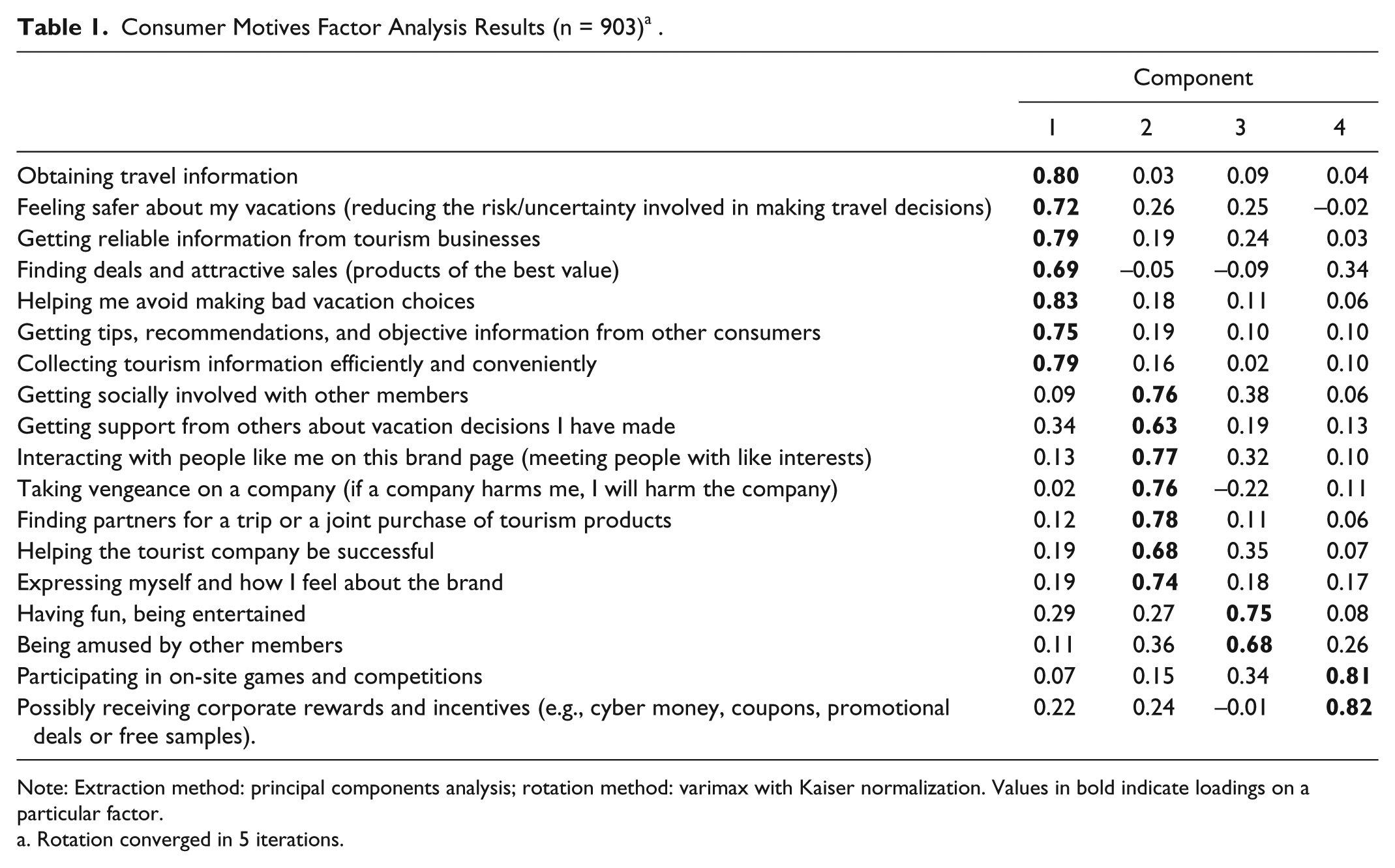
Note: Extraction method: principal components analysis; rotation method: varimax with Kaiser normalization. Values in bold indicate loadings on a particular factor.
Rotation converged in 5 iterations.
Rotation Sums of Squared Loadings.
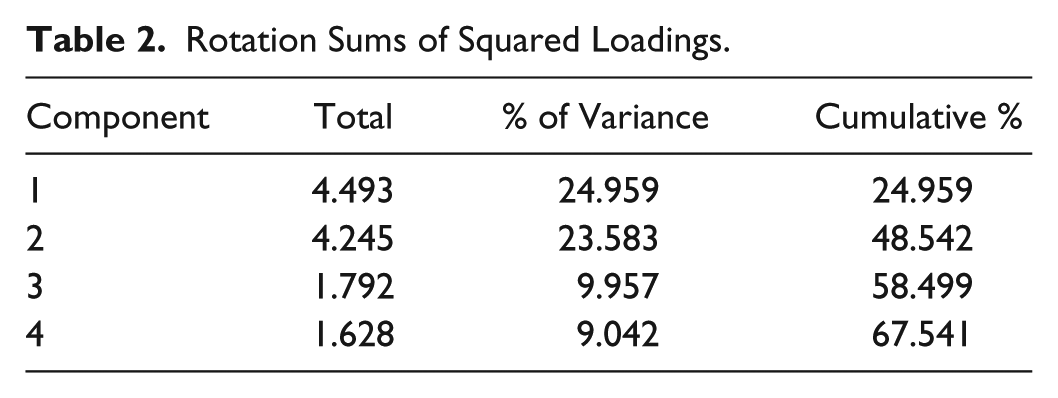
With regard to the contribution of each factor, the “functional” factor explained 25% of the variance, followed by sociopsychological (23.6%), hedonistic (10%), and incentive (9%). Means and standard deviations of the four motives factors are presented in Table 3.
Means and Standard Deviations for the Four Motive Factors.

Note: minimum = 1, maximum = 7.
Relationship between Motives and eWOM Participation Modes
Participation in Facebook tourism corporate pages was measured by both quantitative and qualitative variables. The quantitative measures included frequency and duration of participation. Two quantitative measures, namely, duration of visit on this tourism brand page before going on a vacation and frequency of visits on this tourism brand page before going on a vacation, were deleted because of their high colinearity with regular visit duration and frequency of regular visit (.64 and .63, respectively).
Analyzing the qualitative aspect of participation indicated high Pearson correlations (.6, .71, and .72) between the following three measures of active participation: “I am highly motivated to actively participate,” “I tend to share with others much information,” and “I supply very useful information to other members.” In contrast, these three variables were relatively less correlated with the fourth measure (“I mainly prefer to read what others write”), namely, .24, .20, and .15, respectively. Hence, we suggested two separate variables: active participation, which is the mean of the three above-mentioned variables (Cronbach’s α = .86), and passive participation. We assumed that each consumer might exhibit different patterns, as measured by these separate dimensions. Hence, altogether, we recognized four separate dimensions of consumer participation modes: frequency of visit, duration of sessions, active participation, and passive participation. Hypotheses 2 to 9 examined the relationship between each one of the main motives (factors) and the four dimensions of participation. Table 4 presents a summary of four regression analyses. In each analysis, the four motive factors are the assumed predictors of one of the participation aspects.
Regression Analysis Results for Motives as Determinants of Participation Modes.
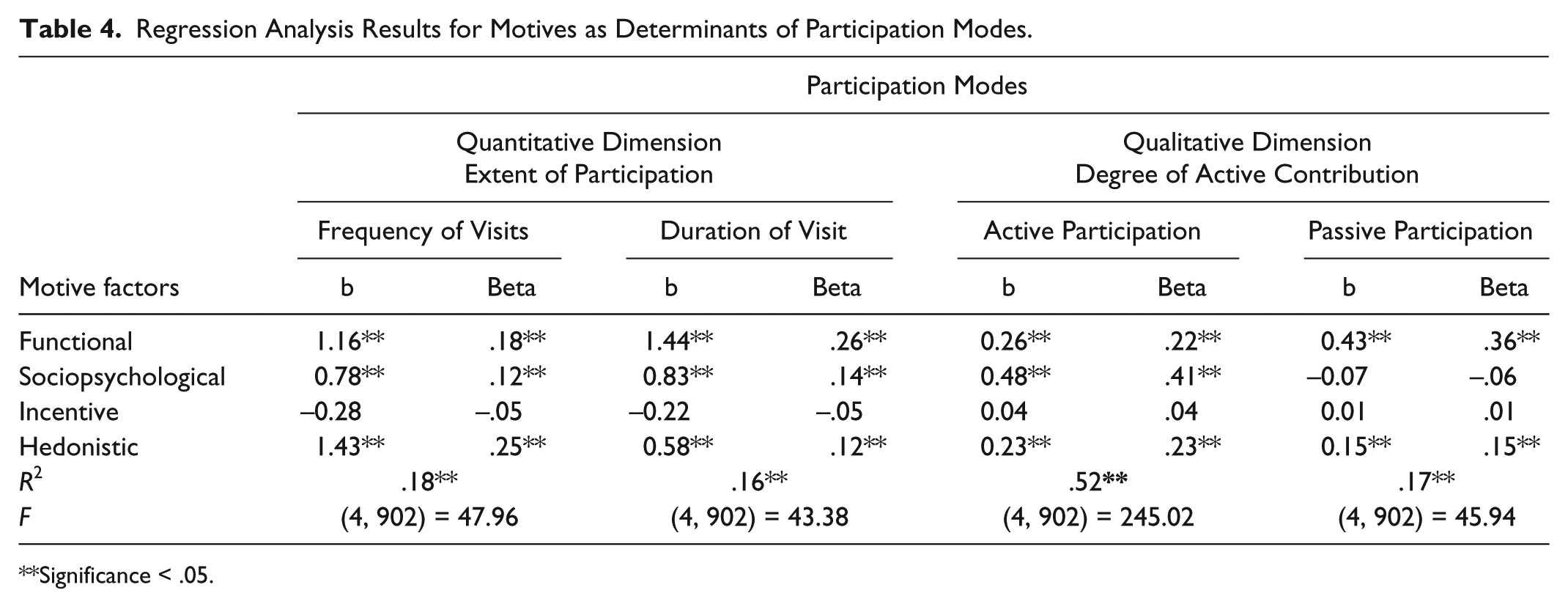
Significance < .05.
Hypothesis 2 predicts that there is a positive relationship between the functional motive and the extent of consumer participation (eWOM) in Facebook tourism corporate brand pages. In general, the stronger the functional motive, the more frequent and the longer the duration of the visit to the site (beta = .18**, beta = .26**, respectively, where ** indicate level of significance below 0.01). Although these results were statistically significant, the impact of functional motives was stronger for the duration of the visits than for the frequency of the visits. With regard to the nature of participation, hypothesis 3 predicts positive a relationship between the functional motive and the degree of active contribution to Facebook tourism corporate brand pages. Functional motives were positively related to the active participation pattern (beta = .22**) and to the passive pattern (beta = .36**). The statistical power of the two separate patterns of participation gives credibility to the above-mentioned decision to consider them as two separate dimensions. In summary, the stronger the functional motive, the greater were all the various aspects of participation—frequency of visits, duration of visits, exposure to others’ eWOM, and contribution to knowledge.
A different pattern was revealed in the examination of hypotheses 4 and 5. As noted in Table 4, the regression analysis yielded a beta coefficient of .12** for the frequency of visits, and a beta coefficient of .14** for the duration of visits. These are relatively low scores, but they clearly indicate a positive direction. In the case of participation mode, the effect of sociopsychological dimensions was clear: a positive and relatively strong beta = .41** for the active mode versus the negligible beta coefficient of –.06 for the passive participation mode.
Hypothesis 6 predicts a positive relationship between hedonistic motives and the extent of consumer participation in Facebook tourism corporate brand pages. We validated this hypothesis for both dimensions of participation: frequency of visits (beta = .25**) and duration of visits (beta = .12**). The latter was relatively low, but contributed to a positive direction of the results in terms of the study model’s hedonistic motives. Moreover, hypothesis 7, which focuses on hedonistic motives and the degree of active-contribution to Facebook tourism brand pages, was fully validated for the active participation mode (beta = 0.23**). However, the beta coefficient for hedonism and passive participation mode was relatively weak (beta = .15**).
Hypotheses 8 and 9 address the relationship between consumers’ identification with a corporation, and the extent and mode of participation in tourism corporate Facebook brand pages eWOM. Clearly, both hypotheses could not be tested, given that no corporate identification factor was identified (as shown in Tables 1 and 2). The factor that was considered as a possible substitute, “incentives of corporation,” also did not yield any significant and meaningful results.
In summary, considering the quantitative dimension of participation, the most meaningful motives for predicting the frequency of entering corporate brand pages were hedonism, followed by functionality and sociopsychological variables. With regard to the duration of site visit, the functional motives were the most prevalent, followed by sociopsychological and hedonism motives. Incentive motives did not predict the degree of participation, neither frequency nor duration. Examining the qualitative dimension of active-contribution participation, the strongest predictors were sociopsychological motives, followed by hedonistic and functional motives. Although the study participants presumably did not consider sociopsychological motives as very important (Table 3), the contribution of these motives to the explanation of the degree of active contribution was highly meaningful, as shown in Table 4. This finding was of particular importance in light of our result that the highest R-square value (.52) was obtained for the prediction of the effect of consumer motives on the consumer’s active participation pattern in Facebook pages. In contrast, the relatively weak explanatory power for all four motives for passive participation (R-square of .17) derived mainly from functional needs (beta = .36) and to a lesser degree from hedonistic motives (beta = .15). Clearly, these results support the idea of different types of behavior associated with each mode of participation. A summary of the validated hypotheses related to the impact of consumer motives (hypotheses 2 to 9) is presented in Figure 2.
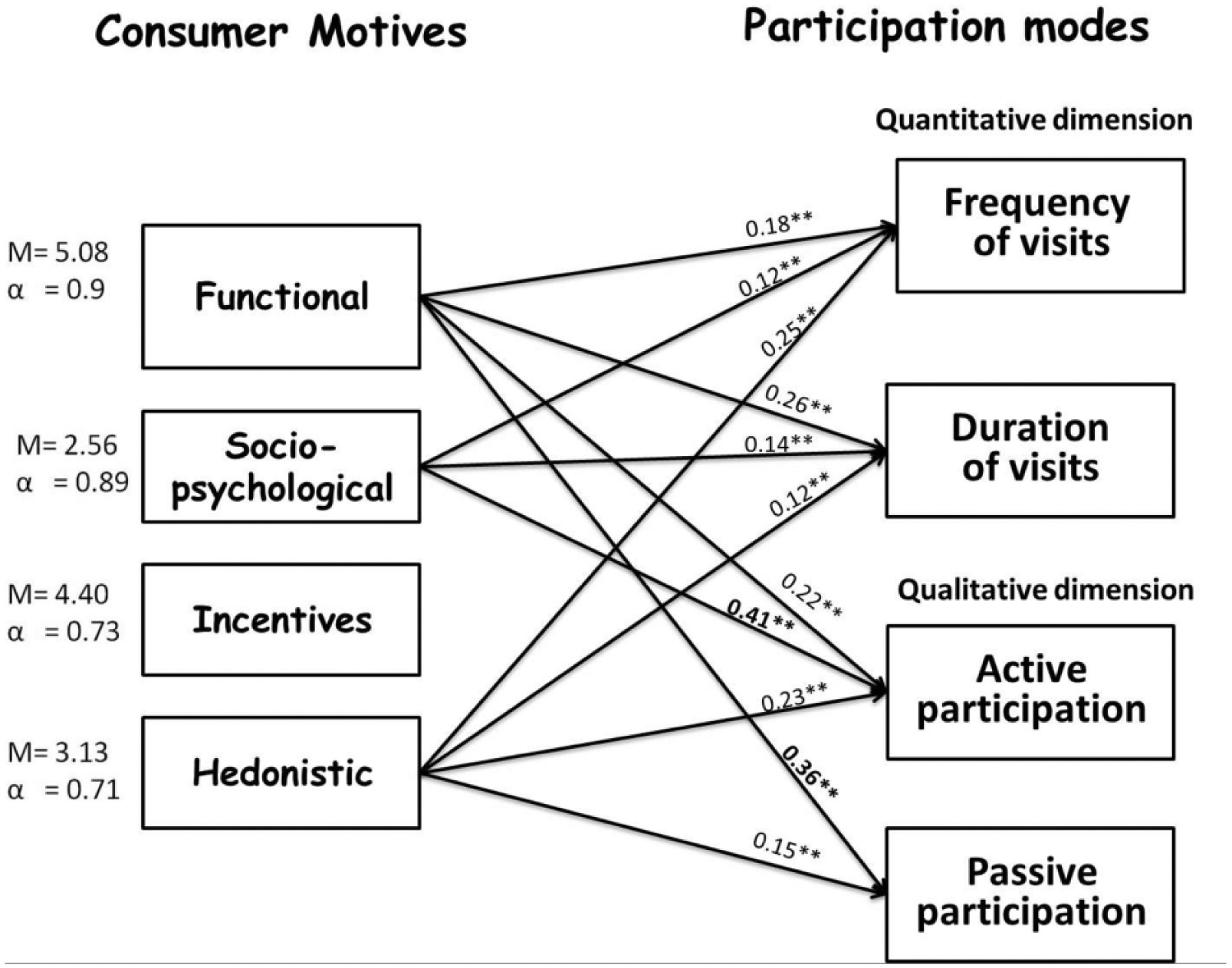
Motives as determinants of facebook consumer participation modes.
Relationship between Participation Modes and Loyalty Intention
Hypotheses 10 and 11 predicted a positive relationship between the extent of consumer participation and activeness in a firm’s Facebook page and expressions of loyalty in terms of willingness to recommend a brand / brand page and to reuse that brand / brand page. Given the high correlation (r = .75) between readiness to recommend a brand/product and recommending its Facebook corporate brand page, we decided to converge the two variables into one mean index (Cronbach’s α = .86). Similarly, given the high correlation (r = .776) between intention to reuse a brand’s site in the ONS and intention of repeat purchase, the two were combined into one mean index (Cronbach’s α = .87). For such statistical consideration, see Eisinga, Grotenhuis, and Pelzer (2013).
Next, hypotheses 10 and 11 were examined by regression analysis (see Table 5). These two hypothesis were validated, albeit with relatively low correlation coefficients. Our findings showed that both frequency and duration of visits and active participation in brand page eWOM do predict loyalty patterns of consumers, in terms of both recommendation and reuse intentions (Table 5). Apparently, frequency and duration of visits explained a relatively small part of the variance of loyalty to a brand and a brand page. In comparison, as indicated in Figure 3, the active pattern of participation was a much stronger predictor of expression of loyalty: recommendation intention (beta = .58) and reuse intention (beta = .32). In general, all participation measures were statistically significant predictors of loyalty expressions, explaining 50% of the variance in willingness to recommend a brand and 29% of the variance in reuse intention. The most meaningful dimension was the active pattern of participatory behavior association with a high likelihood of intensive involvement in positive eWOM toward a particular tourism organization on Facebook.
Regression Analysis Results for Participation Modes and Consumer Loyalty Intentions.

Significance < .05.
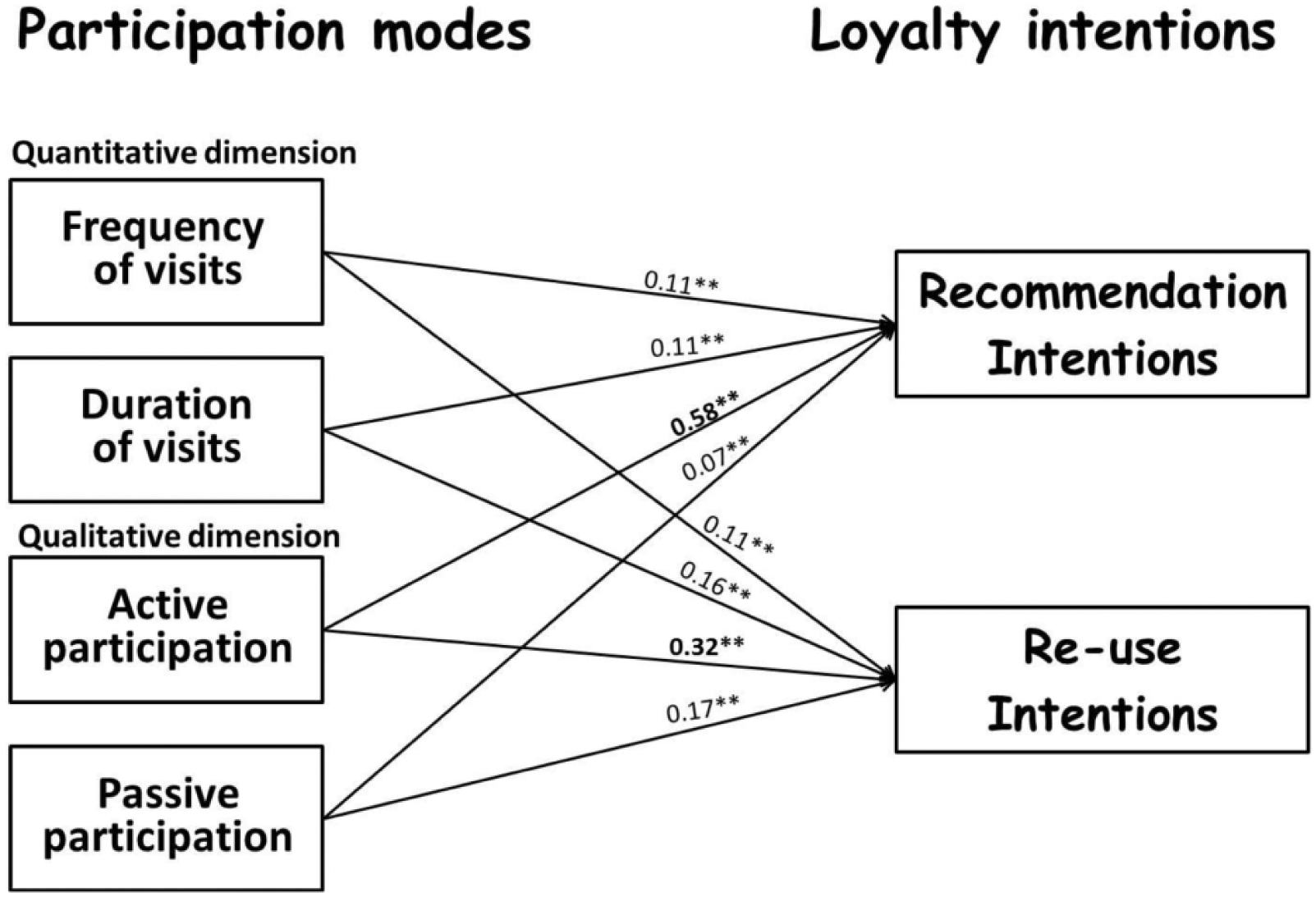
Participation modes as determinants of loyalty intentions (beta coefficients).
Discussion and Conclusions
This study focuses on the relationships between the motives of consumers of tourism brand pages, their behavioral eWOM participation patterns, and their loyalty to a particular firm or brand. Our first objective was the identification of the needs that prompted consumers’ eWOM for a tourism brand community in a social network, specifically Facebook. Previous research suggested four main motives of eWOM participation: functional, social, psychological, and hedonistic (Armstrong and Hagel 1996; Chung and Buhalis 2008; Wang and Fesenmaier 2004). This study revealed an additional motive that relates to consumer identification with a corporation or brand, namely, incentive.
The results of this study concerning functional motives were consistent with those of previous studies in the sense that online tourism communities were shown to fulfill a functional role, by enabling cooperation and sharing of updated and reliable knowledge (see Armstrong and Hagel 1996; Pan and Fesenmaier 2006; Wang and Fesenmaier 2004). However, the findings related to social and psychological motives differed from those previously reported. Unlike Wang and Fesenmaier (2004), who distinguished between social and psychological motives, the current study did not find a well-defined factor for psychological motives. Our results were akin to the pattern described by Chung and Buhalis (2008), who view psychological motives as extensions of ongoing social activities. Moreover, as opposed to some of the above-mentioned studies (e.g., Wang and Fesenmaier 2004), the current study revealed a unique and rather complex role of sociopsychological motives for eWOM activities and involvement. On the one hand, the sociopsychological factor received the lowest Likert rating (2.4 out of 7) in comparison with the other motives. Consequently, it can be argued that consumers do not consider Facebook brand pages as a means to develop and maintain social relations or as an outlet for self-expression, but rather as a source for satisfying functional needs. On the other hand, the sociopsychological factor was found to play a key role in predicting consumer participation and loyalty expression, as is discussed below. This unique finding seems to support the study basic premise that Facebook tourism virtual community is not like other previously measured virtual communities, and hence requires a particular, painstaking attention.
With regard to the hedonistic motives, the findings of the present study concur with those of the relevant previous studies (Bagozzi and Dholakia 2002; Chung and Buhalis 2008; Wang and Fesenmaier 2004) showing that the motives of consumers for joining tourism corporate pages include enjoyment, leisure, and entertainment. However, in comparison to previous studies (Chung and Buhalis 2008) the ranking of this motive was relatively low (m = 3.13). A novel finding was the identification of a new motivational dimension, namely, incentive. This factor consists of “participating in games and competitions” and “receiving gifts, bonuses, or preferred treatment” from the tourism company. Note that earlier studies incorporated some aspects of the “incentive” motive within the functional or hedonistic motives (Chung and Buhalis 2008; Wang and Fesenmaier 2004). Clearly, the role of the incentive motive requires further examination, given its rank of 4.4 on a seven-point scale. This motive can be related to instrumental incentives or economic incentives that characterize knowledge producers in virtual communities (Hennig-Thurau et al. 2004; Portes 1998).
The suggested motive of identification with a corporation was not supported by our findings. However, two of the items hypothesized to be included in this factor were actually bundled with the sociopsychological factor: “help the tourism corporation to succeed” and “punish the corporation for bad service.” It is possible to consider these two attitudes as a means of expressing some negative experiences, since they are clearly measures of self-expression. These forms of expression have previously been associated with a psychological-emotional factor (Hennig-Thurau et al. 2004). If this is indeed the case, then “identification with a corporation” is not a distinct factor but rather one of the expressions of sociopsychological needs, even though consumer–company identification serves as an important indicator of commitment to a brand (Bhattacharya and Sen 2003).
The second objective of the study was to explore the relationships between consumers’ motives and their eWOM behavior (participation modes) on tourism brand pages on Facebook. As noted earlier, consumers’ motivation is the basis of their behavior and it is likely to shape the patterns of participation in virtual communities (Hawkins, Best, and Coney 2004). Wang and Fesenmaier (2004) found that consumers’ motives have an effect on the degree of participation in virtual communities and on their willingness to contribute to that community. The analysis in the current study supports the above findings and clearly demonstrates a positive and significant association between consumers’ motives and their participation patterns on Facebook. Specifically, a positive and significant association was found between functional, hedonistic, and sociopsychological factors and the frequency and duration of visits to Facebook corporate tourism sites. It appears that the more important the motives are from the consumers’ perspective, the higher is their level of participation.
Among the different motives, functionality was ranked the highest. This finding is congruent with that of Jhane and Kunz (2012) and with other studies in the realm of tourism virtual communities (e.g., Chung and Buhalis 2008; Wang and Fesenmaier 2004). It is, however, interesting that Wang and Fesenmaier (2004) found a negative impact of the functional motive on the duration of participation in a community. This finding was explained by the possibility that consumers with a high functional motivation are target oriented and therefore their visit ends as soon as they obtain the required information. Another factor that was shown in this study to serve as a predictor for the duration of the site visit is the sociopsychological factor. This finding is in line with numerous studies on consumer behavior in virtual communities. The stronger the relationship of users with the virtual community, the stronger is their identification with the community, and hence the more intense the extent of participation in community issues (Algesheimer, Dholakia, and Herrmann 2005; Bagozzi and Dholakia 2006; Casaló, Flavián, and Guinalíu 2010b; Chung and Buhalis 2008). The final factor that affected participation was the hedonistic factor, as was also found in previous studies (Jhane and Kunz 2012; J. Kim, Kim, and Nam 2010).
With regard to the frequency of entry into the corporate page, the best predictors were hedonistic motives, followed by functional motives, and finally sociopsychological motives. Such relationships were previously identified by other researchers (Chung and Buhalis 2008; Wang and Fesenmaier 2004), but not necessarily in that order of impact. Contrary to expectations, the current study found no significant association between the incentive motive and the frequency of entry or the duration of the visit. The same pattern was found regarding the quantitative dimension of participation. Again, the limited impact of the incentive motive was contrary to that reported in the mainstream literature (e.g., Hennig-Thurau et al. 2004; Portes 1998). It may be speculated that while the consumer places high value on the financial incentive, the scarce use of such tactics by tourism firms lowers consumers’ expectations concerning the incentive offerings on Facebook. Another possible explanation is related to the initial hypotheses of the current study that did not relate to an incentive motive. Clearly, this issue is worthy of future investigation.
This study found that the most meaningful predictors to the degree of active contribution to eWOM were sociopsychological motives, followed by hedonistic and functional motives. As noted earlier, the study’s participants did not rank the importance of sociopsychological motives highly. Yet, these motives’ contribution to an active pattern of consumer behavior is noted. This is congruent with previous studies on eWOM that indicated that social needs are highly correlated with the motivation to be a “knowledge producer” who initiates and actively contributes knowledge to the community (Brown, Broderick, and Lee 2007; Hennig-Thurau et al. 2004). Indeed, Jhane and Kunz (2012), who focused on Facebook brand pages, showed that the social motive is the main force for activating the participation of consumers. The current study also identified functional and hedonistic motives, albeit with a lower explanatory value. An examination of other studies on motives provides some supporting evidence for our findings. For example, Dholakia et al. (2009) demonstrated that functional motives have a positive effect on the degree of consumer active patterns of participation on Facebook pages. Goldsmith and Horowitz (2006), Schindler and Bickart (2005), and Shang, Chen, and Liao (2006) presented additional evidence for the significant role of the functional needs of eWOM consumers. In addition, Yoo and Gretzel (2008) considered the role of hedonistic motives.
It is important to note that the current study gives credence to the assertion that the motives underlying a passive pattern of participation on Facebook corporate page tourism differ from those promoting the active pattern. The active pattern is explained here mainly in terms of functional needs as well as some hedonistic motives, similar to Jhane and Kunz’s (2012) findings. In summary, this study revealed that functional and hedonistic motives were associated mainly with the extent of participation (frequency and duration) on the brand pages. On the other hand, the sociopsychological motives were mainly associated with the contribution of the degree of activity to eWOM within ONS communities.
The third objective of the current study was to examine the association between the modes of participation in tourism brand page eWOM and consumer loyalty as expressed in terms of willingness to recommend a brand (or its Facebook site) and in site reuse or brand repurchase intention. It is generally held that “return to the site” is negligible in terms of marketing effect in comparison with “repurchase intention.” However, in our study both these factors were found to be an integral part of reuse intentions. Previous studies mentioned above (particularly that of Chung and Buhalis 2008) indicated that participation in consumption-related eWOM affects consumer attitudes toward the brand in question. The findings of the current study confirm these observations by clearly showing a positive association between various participation patterns in tourism brand pages and a loyal attitude toward the site or the brand. Our analysis showed that the most meaningful predictor of readiness to recommend either a site or a brand was the degree of consumer activity on the Facebook tourism brand page. The greater the extent to which consumers perceived themselves as active participants, the higher was the probability that they would recommend the site or the brand to others. The extent of participation as measured in terms of the frequency and duration of visits indicated a similar but weaker predictive power. The study’s findings on the impact of participation was congruent with those of Jhane and Kunz (2012) in a study of Facebook in general and of those of Casaló, Flavián, and Guinalíu (2010b) in a study on tourism corporate sites. Likewise, Algesheimer, Dholakia, and Herrmann (2005) found activity in virtual communities to be a predictor of recommendation intention. Consequently, it can be concluded that consumer activities in Facebook tourism corporate sites are associated with willingness to recommend and support the particular corporate brand.
The significant role of the degree of consumer activity in Facebook tourism brand pages is also demonstrated in the intention to reuse the product (or its Facebook site). This is clearly a significant dimension of active eWOM. The greater the extent to which consumers perceive themselves as “active participants,” the stronger their propensity to return to the brand site and to repurchase the product. Moreover, the frequency and duration of page visits have also been associated with reuse intentions, but to a lesser degree. The impact of these visit characteristics parallels Vermeulen and Seegers’s (2009) findings that mere exposure to online reviews of other tourism consumers (eWOM) was associated with the intention to consider purchasing the product. This seemingly paradoxical effect may be attributed to increased exposure to the brand in question (e.g., Esch et al. 2006). In conclusion, the results of this study demonstrate a positive and significant association between all four modes of eWOM participation and expressions of consumer loyalty to a brand and its Facebook page. The most meaningful measure of eWOM behavior as predictor of loyalty was the active participation pattern.
The results of the current study also indicate that Facebook tourism brand pages are a means not only for a corporation to communicate with its customers but also for developing loyalty patterns of consumers toward the brand. Therefore, marketers have to respond effectively to needs that are of significance to consumers, namely, their functional, hedonistic, incentive, and sociopsychological needs. For example, the marketer has to supply information that is accessible and easy to retrieve, information that is valuable in terms of sales and special opportunities, and/or incentives in terms of sales and tourism experiences. Similar to P. Huang, Lurie, and Mitra (2009), it is suggested here that firms should encourage eWOM related to consumers’ travel reports, reviews, and recommendations. It is not recommended, however, to invest heavily in sociopsychological dimensions in corporate tourism pages, given the minor effect of these factors. It is clear that the participants of this study were not interested in developing personal contacts with others or in using brand pages as a space for emotional expression.
As noted earlier, the advantages of participants to engage in active and highly frequent eWOM are related to brand loyally. This pattern is further encouraged by the specific algorithm of Facebook. Each interaction of a participant with a given page raises the probability that messages from that page will appear on the “wall” of the private page of the participant and encourage a revisit to the corporate page. Finally, there is another practical application, albeit an ethically challenging one: mapping out the characteristics of the consumers’ participation patterns as a means to gauge the effectiveness of a corporate page in terms of loyalty intentions. Again, the extent of participants’ activities and frequency of visits would serve as efficient predictors of loyalty.
Limitations and Future Research
Despite the application of a methodology that has been tested for content validity in previous studies, there are some inherent weaknesses in this study. First, the questionnaire was originally written in English for American participants; it may thus have a local bias. In addition, the triple translation process (English to Hebrew to English) is itself not immune from possible biases. Second, we assumed that questions phrased for various tourism-related virtual communities are also applicable to Facebook. It is possible that in addition to the quantitative pilot used in this study, a qualitative pilot study of Facebook participants could have revealed the need to elaborate on some issues, such as incentives. Third, the study is based on self-reporting. Like any study of this nature, there could be gaps between actual behavior and participants’ perceptions of their behaviors. Fourth, the results should be generalized cautiously, paying attention to possible intercultural differences. Similarly, the analysis of the surveys in the current study did not distinguish between various subsectors within the tourism industry that may attract different types of participants. Finally, it would be interesting to design a study that examines attitudes versus actual behavior in virtual communities.
Footnotes
Appendix
Sources of Study’s Main Variables
| Consumer Motives | |
|---|---|
| Question | Source |
| Please indicate the level of importance (on a scale of 1-7) of each of the following potential benefits related to visiting tourism brand pages on Facebook | Wang and Fesenmaier 2004 |
| Functional motives | |
| Obtaining travel information | Wang and Fesenmaier 2004 |
| Looking for deals and attractive sales (products of the best value) | Goldsmith and Horowitz 2006 |
| Getting reliable information from tourism businesses | Wang and Fesenmaier 2004 |
| Collecting tourism information efficiently and conveniently | Wang and Fesenmaier 2004 |
| Getting tips, recommendations and objective information from other consumers |
Goldsmith and Horowitz 2006
Hennig-Thurau et al. 2004 |
| Possibly receiving corporate rewards and incentives (e.g., cyber money, coupons, promotional deals or free samples). |
Hennig-Thurau et al. 2004
Sung et al. 2010 |
| Hedonistic motives | |
| Having fun, being entertained | Wang and Fesenmaier 2004 |
| Being amused by other brand page members | Wang and Fesenmaier 2004 |
| Participating in on-site games and competitions | Addition of current study |
| Sociopsychological motives | |
| Helping me to avoid making inferior vacation choices | Goldsmith and Horowitz 2006 |
| Feeling safer about my planned vacation (reducing the risk/uncertainty involved in making travel decisions) |
Goldsmith and Horowitz 2006
Gretzel and Yoo 2008 |
| Getting support from others about my vacation decisions |
Fotis, Buhalis, and Rossides 2011
Wang and Fesenmaier 2004 |
| Expressing myself and my feelings toward a brand | Wang and Fesenmaier 2004 |
| Getting socially involved with other brand page members |
Wang and Fesenmaier 2004
Chung and Buhalis 2008 |
| Interacting with people like me on the brand page (meeting people with similar interests) |
Hennig-Thurau et al. 2004
Sung et al. 2010 Jhane and Kunz 2012 |
| Sharing my travel experiences and photos with other site visitors |
Fotis, Buhalis, and Rossides 2011
Yoo and Gretzel 2008 |
| Finding partners for a trip or a joint purchase of tourism products | Addition of current study |
| Corporate identification motives | |
| Helping the tourist company be successful | Gretzel and Yoo 2008 |
| Taking vengeance on a company (if the company harms me, I will harm the company) |
Hennig-Thurau et al. 2004
Yoo and Gretzel 2008 |
| Getting answers from the company on the brand page (contacting the company’s service support) |
Sung et al. 2010
Jhane and Kunz 2012 |
| Express my satisfaction about a good travel service provider |
Hennig-Thurau et al. 2004
Gretzel and Yoo 2008 |
| Participation modes | |
| Quantitative dimension (frequency and duration of visits) | |
| How often do you visit this tourism brand page on Facebook regularly (per month)? | Addition of current study |
| How often do you visit this tourism brand page on Facebook before going on a vacation (per month)? | Chung and Buhalis 2008 |
| What is your average duration of visit on this tourism brand page on Facebook, regularly (in minutes) | Wang and Fesenmaier 2004 |
| What is your average duration of visit on this tourism brand page on Facebook, before going on a vacation (in minutes) | Addition of current study |
| Qualitative dimension (active-passive participation) | |
| In general, I am highly motivated to actively participate in this tourism brand page on Facebook | Casaló, Flavián, and Guinalíu 2010a |
| I usually contribute my knowledge and stimulate discussions on this tourism brand page on Facebook | Casaló, Flavián, and Guinalíu 2010 |
| I mostly prefer to read what other people write/comment on this tourism brand page on Facebook | Addition of current study |
| In general, I love to frequently post messages and responses on this tourism brand page on Facebook | Casaló, Flavián, and Guinalíu 2010 |
| Loyalty intentions | |
| Reuse intentions | |
| I intend to purchase future tourism services from this travel Company |
Casaló, Flavián, and Guinalíu 2010
Jhane and Kunz 2012 |
| I intend to revisit this tourism brand page on Facebook in the future | Sung et al. 2010 |
| Recommendation intentions | |
| I often recommend this travel company to other people | Jhane and Kunz 2012 |
| I will recommend this tourism brand page on Facebook to other people |
Casaló, Flavián, and Guinalíu 2010
Sung et al. 2010 |
Note: The questions were adapted to the study’s purpose and sample based on a pretest.
Declaration of Conflicting Interests
The author(s) declared no potential conflicts of interest with respect to the research, authorship, and/or publication of this article.
Funding
The author(s) received no financial support for the research, authorship, and/or publication of this article.