




Abstract
The purpose of this study is to explore the effect of detailed contracts and partner irreplaceability on interfirm conflict in cross-border package tour operations. The study is based on an analysis of relations between 129 inbound tour operators and their overseas outbound tour operator partners. Data were collected using a standard questionnaire containing questions that capture constructs of interest. Hypotheses were tested with partial least squares structural equation modeling using SmartPLS 3. The results show that more detailed contracts significantly reduce conflict. The direct effect of partner irreplaceability on conflict is not significant. However, partner irreplaceability significantly weakens the efficacy of detailed contracts to reduce conflict.
Keywords
Considering the wide range of services that are typically combined for tourism production, a firm can hardly create value single-handedly (Zhang, Song, and Huang 2009). Efficient and effective coordination with other firms is therefore a critical source of competitive advantage for firms in the tourism industry. However, adverse interfirm relations are quite common in tourism value chains (Buhalis 2000; Sinclair and Stabler 1997; Zhang, Song, and Huang 2009), and there are various preconditions and triggers of conflict (Mwesiumo and Halpern 2016). Preconditions include exogenous events, asymmetrical power distribution, antagonism of goals and differences in perceptions of reality, which serve as a breeding ground for triggers such as opportunistic behaviors, coercive demands, perceptions of unfairness or dissatisfaction with partner performance. Although interfirm conflict may result in constructive outcomes (Alter 1990; Assael 1969), it is often destructive and should therefore be prevented (Menon, Bharadwaj, and Howell 1996; Rose and Shoham 2004).
Despite the prevalence of conflict in tourism value chains, the subject has received little scholarly attention, being explored by just a handful of studies (e.g., Buhalis 2000; Douglas and Lubbe 2006; Ivanov, Stoilova, and Illum 2015). Noting the existing research gap on conflict in tourism value chains and the contingent nature of the outcomes of interfirm conflict, Mwesiumo and Halpern (2016) call for further research to assess the efficacy of various preventative approaches. This study partly responds to that call by examining the role of detailed contracts and partner irreplaceability in alleviating interfirm conflict in cross-border package tour operations. The insights provided by this study are particularly relevant given the steady growth of international tourism (World Tourism Organization 2017) and the role of interfirm relations in international travel trade (Crotts, Aziz, and Raschid 1998). In addition, this study has a more general contribution to the field because it responds to a call by Lumineau, Eckerd, and Handley (2015) for analysis of the role of contracts in the prevention and management of interorganizational conflict. Furthermore, as conflict management is an aspect of interfirm relationship governance, approaches to preventing tourism interfirm conflict constitute the foundation for developing appropriate governance models for tourism value chains—an area that Song, Liu, and Chen (2013) highlight as requiring further research.
In the following sections, this article provides brief context to the research including the unit of analysis and the potential for conflict between inbound and outbound tour operators. The theoretical framework is then presented along with the hypotheses to be tested. The methodology section describes how data was collected and how measures of constructs and control variables were developed. The analysis and findings section outlines the approach taken to analyze the data, assesses the measurement model that is used, and presents the structural model and findings of the analysis, which includes testing the hypotheses. The discussion section places the findings into a wider context and considers key management implications. The conclusion then highlights the main findings of the study, provides recommendations for future research, and identifies several limitations of the study.
Research Context
The unit of analysis in this study is the dyadic relationship between inbound tour operators and their overseas counterparts, namely outbound tour operators (Figure 1). Tour operators, along with travel wholesalers and travel agents, are tourism value chain members whose activities are almost exclusively tourism-related (Weaver and Lawton 2012), and those that specialize in packages create value by bundling the core tourist product with additional services and offering them under a single price, providing convenience and cost-effectiveness (Buhalis and Laws 2001). Inbound tour operators create and sell travel products mainly to overseas clients whereas outbound tour operators create and sell travel products mainly to clients that seek specific experiences in destinations abroad.

Cross-border package tour operations.
Inbound tour operators tend to have an in-depth knowledge of their local environment and have contact with various service providers, which gives them a competitive edge against outbound tour operators that create tour packages for the same destination (Saffery, Morgan, and Tulga 2007). Outbound tour operators tend to be more knowledgeable of the needs of the clients in their countries. As such, it is common for inbound tour operators to sell their packages through outbound tour operators (or via travel wholesalers or agents). Likewise, outbound operators may develop and operate their own packages through collaboration with partners in destinations or they may simply sell packages that are already designed by inbound operators that they chose to partner with. It is important to note that the tourism industry has experienced disintermediation of its distribution channels, which increasingly allows inbound tour operators and other service providers in destinations to reach clients directly (Berne, Garcia-Gonzalez, and Mugica 2012; Buhalis and Licata 2002; Tse 2003).
Tour operators face various challenges that affect their relationship with exchange partners. First, tour operators usually represent and describe their products in printed or visual forms and since such representations cannot accurately provide the impression of how clients will experience the product, meeting client expectations can be challenging (Reimer 1990). Second, tour operators deal with discretionary products rather than necessities (Weaver and Lawton 2012), which implies that customers buy tour products after meeting their basic needs such as for food, clothing, and housing. In addition, the demand for tourism products is highly sensitive to external events such as terrorism attacks, extreme weather conditions, and natural disasters (Evans 2016). Combined, these factors make the demand for services of tour operators uncertain. Third, tour packages are perishable because they are only sold up to the date when the tour begins, which implies that any unsold slot is a lost sale. Taken together, these challenges have a direct effect on the profit margins of tour operators, which in turn may affect their relationship and the potential for conflict with suppliers such as accommodation providers and intermediaries such as other tour operators, travel wholesalers and travel agents.
Conflicts can range from minor tensions to major disagreements that may result in litigations or even relationship terminations. According to Buhalis (2000), conflicts between tour operators and their exchange partners can be distinguished according to whether they are profit-related or operations-related. Profit-related conflicts result from a failure of the exchange partners to maximize profits collectively due to actions motivated by individual benefits. In other words, such conflicts arise from misaligned incentives in an exchange relationship (Gulati, Lawrence, and Puranam 2005; Malhotra and Lumineau 2011). Operational conflicts are the disagreements that arise from failure of an exchange partner to execute agreed duties.
Given the intensity of competition and the nature of demand for tourism products, actors in tourism value chains may opt to engage in zero-sum game tendencies, that is, maximizing their profit margins by squeezing those of their exchange partners. Such tendencies often lead to dissatisfaction of the targeted partner(s) and may eventually trigger conflict (Mwesiumo and Halpern 2016). In the case of inbound-outbound tour operator relations, this can be, for example, failure of the inbound tour operator to provide the agreed standard of accommodation services, the use of incompetent tour guides, or failure to keep the agreed tour schedules. Such operational failures of the inbound tour operator may lead to client dissatisfaction, which in turn hurts the business of the outbound operator who sold the package in the first place. This happens not only by discouraging repeat purchases but also in the form of negative word of mouth and bad online reviews.
Theoretical Framework
Conflict in Interfirm Exchanges
Interfirm conflict has been one of the important research topics in marketing, organization science and management fields. As mentioned previously, it is associated with tensions that may develop between two or more firms. This can be due to actual or perceived differences, and the tensions can be viewed in terms of the frequency and intensity of disagreements between the firms involved (Palmatier, Stern, and El-Ansary 2015). Due to a scarcity of resources and the functional interdependencies between firms, such disagreements are often inevitable (Assael 1969). Extant literature provides both empirical and conceptual analyses on the nature and consequences of interfirm conflict. Regarding the nature of interfirm conflict, literature largely embraces the dynamic perspective offered by Pondy (1967), which classifies conflict into five stages: latent, perceived (cognitive), felt (affective), manifest (behavior), and conflict aftermath (conditions) (e.g., Brown and Day 1981; Gaski 1984; Lusch 1976). This dynamic perspective views conflict as a series of episodes whereby each episode is shaped by the previous one and in turn lays the foundation for subsequent episodes. Besides the dynamic perspective, conflict can also be classified based on other dimensions such as structural versus operating conflict (Molnar and Rogers 1979), major versus minor conflict (Ganesan 1993), and task versus emotional conflict (Rose and Shoham 2004). Regarding the consequences, literature recognizes the potential for both dysfunctional (negative) and functional (positive) outcomes. Negative outcomes include reduction in quality of products (Rose and Shoham 2004), poor relationship performance (Menon, Bharadwaj, and Howell 1996), and financial costs when partners resort to litigation (Lumineau and Malhotra 2011). Positive outcomes include the potential for inducing partners to reexamine and improve their communications and power allocation (Assael 1969), which in turn leads to relationship maturity (Alter 1990). Despite the potential for positive outcomes, the dysfunctional view of interfirm conflict has been predominant.
Governing Interfirm Exchanges
Governance of interfirm exchange refers to the mode of organizing transactions that occur between firms (Heide 1994). Implementation of an appropriate governance mechanism is vital for effective and efficient interfirm exchanges because it allows firms to overcome various problems associated with conducting transactions with other firms. Such problems include difficulties involved in verifying partner performance (behavioral uncertainty), environmental uncertainty (Rindfleisch and Heide 1997), and challenges of coordination (Jones, Hesterly, and Borgatti 1997). Formal contracts address these problems through the creation of a shared set of rules, responsibilities, procedures, and expectations between exchange partners. For example, formal contracts can include terms that prescribe performance criteria, an approach to handling conflict or how to handle unforeseen circumstances. If fairly negotiated, such terms provide protection to both parties. Furthermore, contracts provide a mechanism for aligning incentives between exchange parties. That is, formal contracts can potentially help to distribute fairly the risks, costs, and rewards of engaging in the exchange. As Hill and King (2004) note, since incentives of exchanging parties often tend to be misaligned, contracts help to enlarge transactional value by coordinating information sharing, specifying rights, duties and procedures, as well as the allocation of risk.
Although the popular and legal notion of contracts is that of hard, explicit, formal, and written agreements between parties (Williamson 1985), there is widespread consensus about the prevalence of relational contracts (Macneil 1978; Macneil 1980). That is, rather than dwelling strictly on the original agreement as the reference point for handling transactions, relational contracts consider the historical and social context of the transactions and view enforcement of obligations as arising from the mutuality of interest between parties to the exchange (Dwyer, Schurr, and Oh 1987; Gundlach, Achrol, and Mentzer 1995; Kaufmann and Stern 1988). At the core of relational exchange are the expectations about exchange behavior shared by the exchange partners, the so-called relational social norms (Macneil 1980). The relational norms serve to guide, control, or regulate proper and acceptable behavior among exchange partners (Macneil 1983) and they are often manifested by the prevalence of relational behaviors in interfirm exchanges (Stephen and Coote 2007). The relational behaviors are the various supportive and constructive actions that promote the development of cooperative relationships between exchange partners. They include such behaviors as acquiescence and cooperation (Hewett and Bearden 2001); solidarity, information exchange, and flexibility (Lusch and Brown 1996); specialized investments; and bilateral communication. Overall, previous studies suggest that relational behaviors can potentially enhance the wellbeing of interfirm exchanges and thus facilitate smooth attainment of the goals of exchange (e.g., Bercovitz, Jap, and Nickerson 2006; Zhang, Cavusgil, and Roath 2003). The positive outcomes of relational behaviors have been observed in the context of hospitality and tourism interfirm exchanges (e.g., Kim, Oh, and Gregoire 2006; Tsaur, Yung, and Lin 2006).
Detailed Contracts and Conflict between Inbound and Outbound Tour Operators
Formal contracts are commonly used in governing exchange relationships between inbound and outbound tour operators, and signing a contract is often one of the tasks performed early in the formation of a relationship between them (Saffery, Morgan, and Tulga 2007). The signed contract typically stipulates terms and conditions governing the exchange relationship, which among other things, is likely to specify duties and benefits of engaging in the exchange. In practice, however, contracts governing interfirm exchanges tend to be incomplete (Macaulay 1963). That is, often contracts fail to capture fully and in an enforceable manner all matters related to the exchange relationship. Klein (1980) notes that there are two reasons that lead to incomplete contracts. First, is the prevalence of environmental uncertainty, that is, it is difficult to identify and specify in advance appropriate responses to the various exogenous disturbances that firms may encounter while doing business. Second, high costs may be involved in verifying the performance of an exchange partner on certain activities. Although contracts cannot be complete, exchange partners can exercise a great deal of care in contemplating numerous contingencies (Williamson 1985). In such cases, the exchange partners would consider in advance all imaginable events and the appropriate responses. This calls for detailed contracts that explicitly stipulate roles and responsibilities to be performed, define outcomes to be delivered, and state adaptive processes for handling unforeseeable events (Kashyap, Antia, and Frazier 2012; Wuyts and Geyskens 2005). Thus, detailed contracts can be achieved through the inclusion of contingency planning clauses, which can be defined as the parts of a contract that are designed to provide an adaptation mechanism within the contract, and by including a more comprehensive specification of the tasks to be completed.
The tourism industry is known for being particularly exposed to unforeseeable external shocks that are beyond a manager’s control (Evans 2016). As such, it is often difficult for firms in tourism value chains to draft contracts that exhaustively stipulate appropriate responses for such events. Incomplete contracts may lead to role ambiguity and can provide loopholes for exchange partners to engage in noncompliant behavior (Williamson 1985). As argued by Mwesiumo and Halpern (2016), such noncompliant behavior is one of the triggers of interfirm conflict in tourism values chains. For example, the feud in 2010 between Thomas Cook, a renowned UK tour operator, and hoteliers in Spain, Portugal, and Greece was due to Thomas Cook’s unilateral decision to cut hotel bills by 5 percent, contrary to the agreed terms (Bowers 2010). However, Thomas Cook did so as a measure against multiple exogenous events that had not been foreseen, namely, a recession in the United Kingdom, the weak pound, relatively high fuel prices, an increase in Air Passenger Duty, and the volcanic eruption in Iceland that resulted in large parts of European airspace being closed.
Accordingly, it is argued that by aligning incentives, specifying roles, and closing loopholes for noncompliant behavior, detailed contracts play a significant role in reducing conflict between exchange partners. Thus, the following hypothesis is proposed:
Hypothesis 1: Detailed contracts significantly reduce conflict between inbound and outbound tour operators.
Partner Irreplaceability and Conflict between Inbound and Outbound Tour Operators
Partner irreplaceability is the extent to which a firm finds it difficult to find a substitute exchange partner and often results in imbalanced dependence in interfirm exchanges (Heide and John 1988). Imbalanced dependence is quite common in tourism interfirm exchanges and is a key cause of bargaining power asymmetry. As Buhalis (2000) notes, the explosion of tourism supply in many destinations across the world increases the bargaining power of both consumers and intermediaries over suppliers. The resulting bargaining power asymmetry is the relative capacity of one partner to negotiate and secure agreements on its own terms (Choi and Triantis 2012). In light of the transaction cost theory, Gundlach and Cadotte (1994) note that such asymmetry can lead to the onset of opportunistic behavior by the more powerful partner. According to Mwesiumo and Halpern (2016), such behavior can subsequently trigger interfirm conflict in tourism value chains. For example, due to Thomas Cook’s scale of operations, brand equity and long experience, many overseas suppliers consider them as key to accessing the British market. As such, in the previously mentioned conflict involving Thomas Cook, the hoteliers accused it of using its market dominance to threaten and pressure them into accepting a reduction in contracted prices (Bowers 2010).
While an irreplaceable partner can capitalize on its power and engage in active opportunism or exploitative tendencies (Gundlach and Cadotte 1994), power asymmetry can also induce the less powerful party to engage in hidden actions to protect its own interests (Liu et al. 2017). For an inbound tour operator, such actions include misrepresenting information about the suppliers used, adding ghost charges/hidden fees on services, not doing exactly as promised, and failing to provide proper notification. These actions constitute passive opportunism. Although passive opportunism produces immediate benefits to the perpetrator, Wathne and Heide (2000) note that its incidence in the service industry can result in customer dissatisfaction, which according to Mwesiumo and Halpern (2016) can also be a trigger of interfirm conflict.
Consistent with the above reasoning, this article argues that increased partner’s irreplaceability leads to increased bargaining power asymmetry, which in turn encourages opportunistic or exploitative tendencies by the more powerful party and hidden action or passive opportunism by the weaker party. The incidence of these tendencies will subsequently result in increased interfirm conflict. Accordingly, the following hypothesis is proposed:
Hypothesis 2: Increased partner irreplaceability significantly leads to increased conflict between inbound and outbound tour operators.
Interaction Effect of Detailed Contracts and Partner Irreplaceability
Despite the potential of detailed contracts to reduce conflict, Hill and King (2004) note that to protect both parties from exchange problems contracts need to be fairly negotiated. However, bargaining power asymmetry between exchange partners often prevents the fair negotiation of contracts (Helveston and Jacobs 2014). For instance, according to Choi and Triantis (2012), bargaining power asymmetry can affect both price and nonprice terms of the contract. This is because a party that enjoys bargaining power has the opportunity to dictate terms to the weaker party, and thereby take advantage of them. Even in situations where both parties can cheat, tough contractual restraints are often placed on the weaker party (Klein 1980). Usually firms in tourism value chains tend to have antagonistic goals, different strategic interests, as well as different operational procedures (Zhang, Song, and Huang 2009), which often results in them being more concerned with their own short-run interests (Kotler et al. 2017). This implies that tourism firms with a stronger bargaining position will often use it to their advantage.
Thus, this article argues that partner irreplaceability increases bargaining power, which allows a more powerful party to negotiate contract terms and conditions to its advantage. That way, the effect of detailed contracts on aligning incentives is weakened and therefore leads to increased conflict. Based on this reasoning, the following hypothesis is proposed:
Hypothesis 3: Increased partner irreplaceability significantly weakens the efficacy of detailed contracts to reduce conflict between inbound and outbound tour operators.
Methodology
Data Collection
Data for this study were collected on the dyadic relationships between inbound tour operators in Tanzania and outbound tour operators in foreign markets. Through a self-administered questionnaire, an inbound tour operator provided information about their relationship with an outbound tour operator that they deal with. The sampling frame consisted of 266 active inbound tour operators registered with two major associations of tour operators in Tanzania: Zanzibar Association of Tour Operators (43 operators as of 2016) and Tanzania Association of Tour Operators (223 operators as of 2016). The two associations are the only government-recognized representatives for tour operators in Tanzania, and were deemed appropriate for this study because membership to them is often a key criteria that overseas outbound tour operators consider when selecting partners in Tanzania. The survey was conducted using a drop-off and pick-up method whereby questionnaires were physically delivered to the tour operators’ premises and collected afterward. This method was used to confirm eligibility of tour operators and to reduce the potential for nonresponse bias (Allred and Ross-Davis 2011). Respondents were asked to consider one overseas tour operator that their company has been working with and to respond to all questions with respect to the same operator. The questionnaire was to be completed by a manager that is most knowledgeable about the relationship with the considered partner. After repeat visits, usable questionnaires were received from a total of 129 inbound tour operators (49 percent of operators in the sampling frame). Relations were reported with outbound tour operators located in 21 different countries, the majority being in the United States (21) and United Kingdom (15). Among the 137 nonresponders, 46 (17 percent) declined to participate due to confidentiality reasons or a lack of interest in the study, while 91 (34 percent) accepted the questionnaire but did not complete it due to a busy schedule.
Measures
Measures of constructs and control variables used in this study are listed in Table 1. The constructs were measured using scales that are well-established in literature. Based on insights from tourism management literature, the items of the scales were modified to suit the focal context. An initial draft of the questionnaire was then given to six managers from inbound tour operators in the sampling frame, followed by in-depth interviews with them. Their feedback was used to improve the clarity and relevance of the items in the questionnaire. All measures of the constructs were anchored on a 7-point Likert-type scale (ranging from 1 = strongly disagree to 7 = strongly agree) and measured on a reflexive model.
Measures of Constructs and Control Variables.

Reversed item.
Conflict Level
This construct was measured based on an inbound tour operator’s perception of disagreements that exist in their relationship with the partner regarding various aspects. Items for this construct were based on Brown and Day (1981), Johnson, Sakano, and Onzo (1990), and Frazier, Gill, and Kale (1989). However, insights from Buhalis (2000), Ivanov, Stoilova, and Illum (2015), and Douglas and Lubbe (2006) were used to capture aspects of conflict relevant for tour operators. The construct was measured by six items. The resulting scale is labeled CONFL.
Detailed Contracting
This construct was measured by items that describe the level of detail with which the contract between an inbound tour operator and their overseas partner prescribes various aspects of their exchange relationship such as pricing, quality, payment terms, and handling of unplanned events. Items of the scale for this construct were borrowed from Wuyts and Geyskens (2005). To capture contractual terms relevant to tour operator interfirm exchange, the items were modified based on Gurcaylilar-Yenidogan, Yenidogan, and Windsperger (2011), Pan, Sparks, and Fulop (2007), and Gjerald and Lyngstad (2015). Ten items were used to measure detailed contracting. The resulting scale is labeled DECO.
Partner Irreplaceability
This was measured by the perception of the inbound tour operator on how difficult it is to substitute the overseas partner. Following a conventional approach (see Heide and John 1988; Kumar, Scheer, and Steenkamp 1998; Yilmaz and Kabadayi 2006), partner irreplaceability (PIRR) was measured by reversing a scale for measurement of partner replaceability. Four items, based on Celly and Frazier (1996), were used to measure partner replaceability. To adapt to the focal context, the items were modified based on insights from literature on tourism distribution channels (e.g., Buhalis and Laws 2001; Pearce 2005; Pearce and Taniguchi 2008).
Control Variables
To ensure robustness of the results, four control variables were included, inbound tour operator’s flexibility (OPFLEX), overseas partner’s flexibility (PFLEX), inbound tour operator’s size (OPSIZE), and cultural distance (CDIST).
Flexibility was included as a control variable because as a relational behavior it plays a key role in preventing problems in interfirm exchanges that are caused by unforeseeable adjustments (Han, Sung, and Shim 2014), especially in the coordination of logistical services (Lusch and Brown 1996). Considering that tourism is a coordination-intensive industry (Zhang, Song, and Huang 2009) and tour operators essentially play a logistics management role, flexibility of either the inbound tour operator or their partner would conceivably reduce conflict. Flexibility of the inbound operator and that of the partner were measured using a scale of three items each based on Lusch and Brown (1996), and modified accordingly for this study.
Size was included as a control variable because Buhalis (2000) and Ivanov, Stoilova, and Illum (2015) found that size of a firm has a significant effect on tourism interfirm conflicts. Interestingly, while Ivanov, Stoilova, and Illum (2015) find that larger establishments are more likely to have conflict with travel agencies than smaller establishments, Buhalis (2000) finds that often smaller establishments are not able to achieve adequate price increases from tour operators thus leading to conflict. Therefore, in this study direction of the effect of size was not specified a priori. Following Hoppner and Griffith (2011), number of employees was used as a proxy for the size of inbound tour operators.
Cultural distance was included as a control variable because according to previous studies (e.g., Sousa and Bradley 2006) it is one of the main drivers of psychic distance, which is often associated with distorted communications and amplified misunderstandings (Terpstra and David 1991). A cultural distance index was measured by aggregating cultural differences between countries based on Hofstede’s six cultural dimensions: power distance, individualism, uncertainty avoidance, masculinity, long-term orientation, and indulgence (Hofstede, Hofstede, and Minkov 2010). The index was computed using the model by Morosini, Shane, and Singh (1998) as follows:

CDISTTj: Cultural distance between Tanzania and jth country.
Iij: Hofstede’s ith cultural dimension score for jth country.
IiT: Hofstede’s ith cultural dimension score for Tanzania.
Marker Variable
Survey-based data are prone to the problem of common method variance, especially when both the dependent and explanatory variables are perceptual measures derived from the same respondent at the same time (Podsakoff and Organ 1986). This study applied a marker variable approach to the diagnosis of common method variance whereby two items that are theoretically unrelated to the substantive variables but semantically similar were included as a marker variable (Lindell and Whitney 2001).
Analysis and Findings
Data Analysis Approach
The analysis in this study was conducted through partial least squares (PLS) path modeling, a composite-based form of structural equation modeling (SEM) that in recent years has been increasingly used in tourism research (Oom do Valle and Assaker 2016). Data analysis was conducted using SmartPLS 3 (see Ringle, Wende, and Becker 2015). Given the composite nature of the effect indicators in this study, PLS-SEM is an appropriate choice (see Richter et al. 2016; Sarstedt et al. 2016). In addition, the sample size of 129 meets both the recommended threshold of 100 observations (see Assaker, Huang, and Hallak 2012) and the recommended PLS-SEM sample size for a statistical power of 80 percent (Hair et al. 2017).
Assessment of the Measurement Model
Assessment of the measurement model is necessary to substantiate the validity of the results and any conclusions that are drawn from the study (Hair, Ringle, and Sarstedt 2011). Assessment of the reflective measurement model in PLS-SEM involves an evaluation of the internal consistency reliability, convergent validity and discriminant validity (Henseler, Hubona, and Ray 2016). This involves assessing the relationship between latent variables and their corresponding indicators. Internal consistency reliability is assessed by Cronbach’s alpha (α) whereby the recommended threshold is Cronbach’s α > 0.7. Convergent validity is assessed by the value of the average variance extracted (AVE) with the recommended threshold of AVE > 0.5. Hair, Ringle, and Sarstedt (2011) recommends that the loading of each indicator on its associated latent variable must be computed and for indicator reliability to be considered acceptable its loading should be higher than 0.7. Items loaded between 0.4 and 0.7, might be considered for removal if doing so increases the reliability or the AVE above the suggested threshold without compromising content validity of the latent variable.
Table 2 presents descriptive statistics of the indicators for the latent variables with their loadings and values of Cronbach’s α and AVE. As shown in Table 2, values of Cronbach’s α and AVE for all latent variables in the PLS path model were higher than 0.7 and 0.5, respectively. Most of the item loadings were higher than 0.7 except DECO1, DECO3 and PIRR1 whose loadings were 0.597, 0.602, and 0.650, respectively. However, since these loadings are greater than 0.4, and the values of Cronbach’s α and AVE are well above the threshold, the items are retained to maintain the content validity of the latent variables (Hair et al. 2017).
Descriptive Statistics and Results of the Measurement Model Assessment.

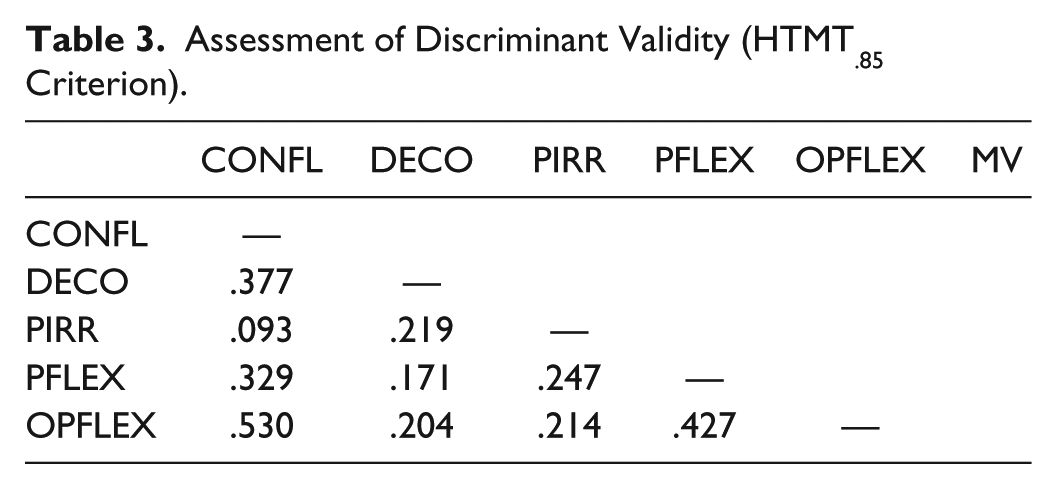
Discriminant validity is the extent to which each latent variable is distinct from other latent variables in the model (Hair et al. 2017). The conventional approach to assessment of discriminant validity is the use of the Fornell–Larcker criterion and cross-loadings (Hair, Ringle, and Sarstedt 2011) whereby discriminant validity is established when the square root of each construct’s AVE is greater than its highest correlation with any other construct and the loadings exceed cross-loadings. However, Henseler, Ringle, and Sarstedt (2015) developed a superior approach for assessing discriminant validity using the heterotrait-monotrait (HTMT) ratio whereby discriminant validity is established when the HTMT ratio is significantly smaller than 1. Voorhees et al. (2016) demonstrated that a HTMT ratio with a 0.85 cutoff (HTMT.85) provides the best assessment of discriminant validity. Discriminant validity in this study has been established as all values of the HTMT ratio are well below the critical value of 0.85 (Table 3).
Assessment of Discriminant Validity (HTMT.85 Criterion).
Assessment of Common Method Bias Analysis
First, the marker variable approach was implemented by correlating the marker variable with the focal latent variables whereby the presence of common method bias would be detected by high values of correlations (Lindell and Whitney 2001). As shown in Table 4, none of the correlation values between the marker variable and focal variables is significant suggesting an absence of common method bias. These results were corroborated with Harman’s single-factor test to assess whether one single factor emerges or whether one general factor accounts for a majority of the covariance between the measures (Podsakoff and Organ 1986). To perform Harman’s single-factor test, factor analysis was conducted whereby all 28 items were loaded onto a single factor. The unrotated factor solution showed that a single factor accounted for only 26.198 percent of the variance, which is less than 50 percent and thus suggesting the absence of common method bias.
Assessment for Common Method Bias.
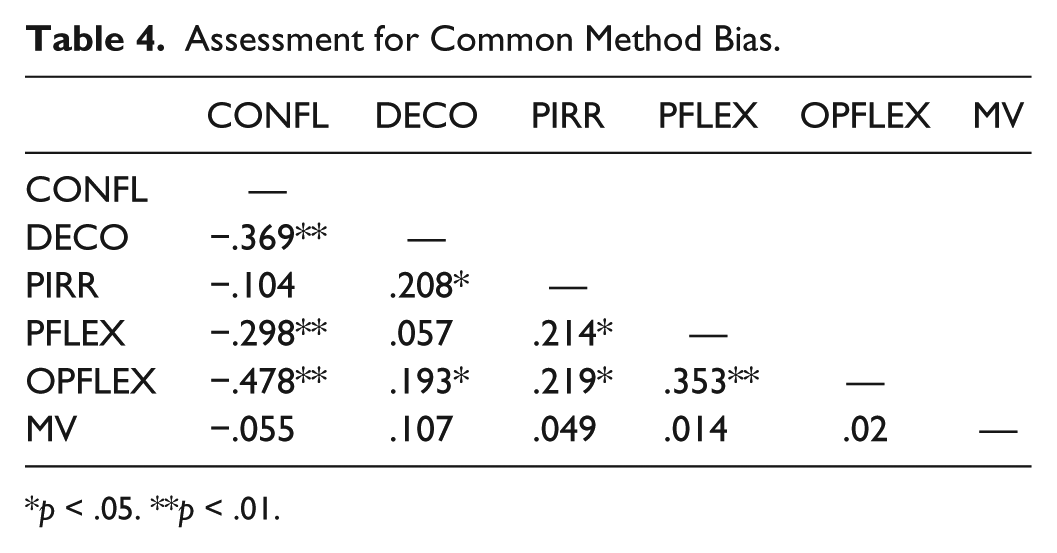
p < .05. **p < .01.
Structural Model and Hypothesis Testing
Figure 2 presents the structural model estimated in this study, including the focal constructs and control variables. As the goal of this study is to achieve as precise a prediction as possible, and given that the exogenous constructs are measured on a reflective model, then following Henseler and Chin (2010) and Henseler and Fassott (2010) the product indicator approach was used to create the interaction term.
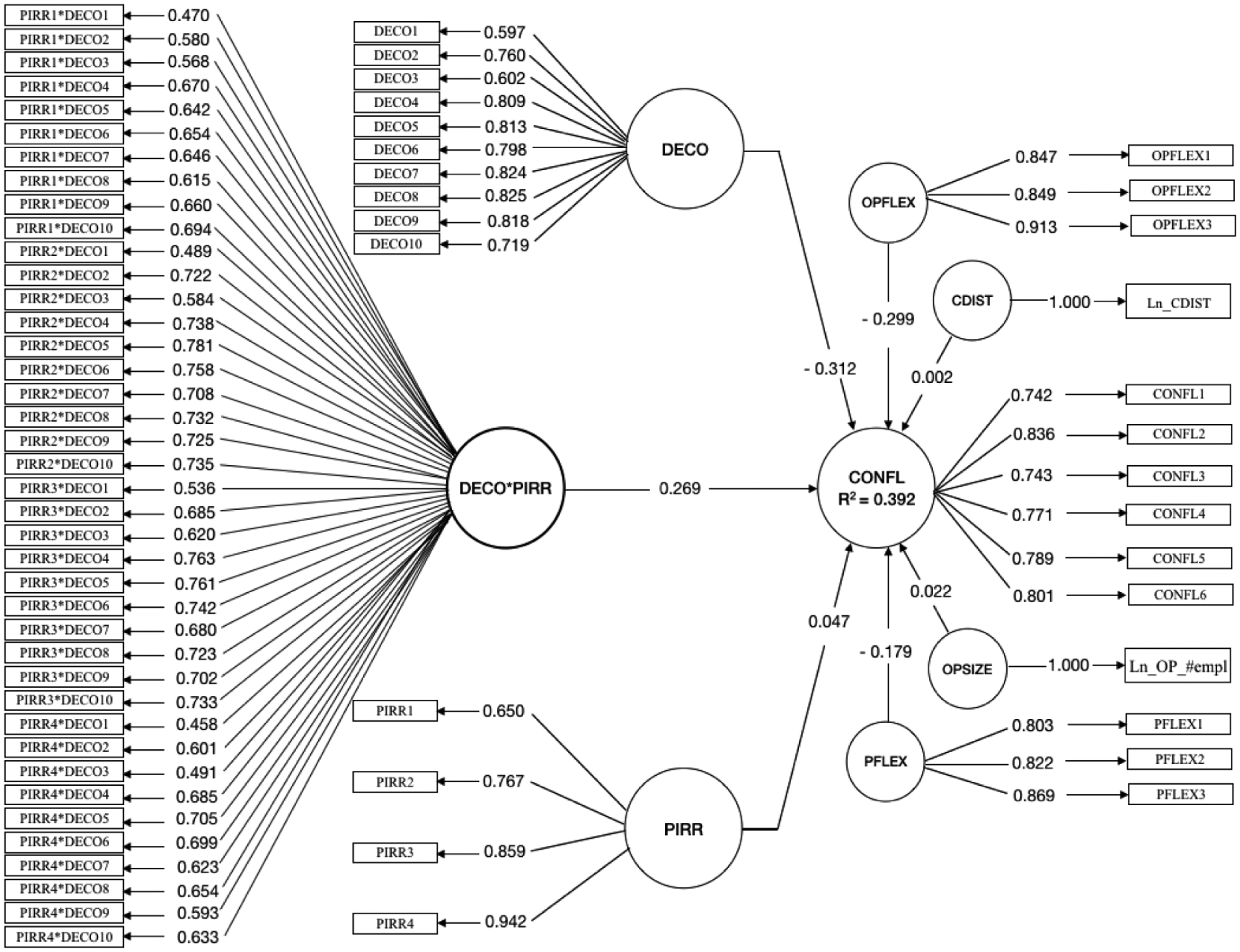
Structural model.
The estimated model was evaluated by checking path coefficients, R2 values, effect size (f2), and approximate model fit. In addition, the model was checked for its predictive relevance by assessing the value of Stone-Gaisser’s Q2, which is a measure for the model’s out-of-sample predictive power. Predictive relevance is established when Q2 values are larger than zero, suggesting that the model accurately predicts data not used in the model. Approximate model fit was assessed using the standardized root mean residual (SRMR) with the recommended criterion being SRMR < 0.08 (Henseler, Hubona, and Ray 2016). To test the hypotheses, the model was run using 5,000 bootstrap resamples. Table 5 reports results of the assessment of the structural model and hypotheses test.
Results of the Assessment of the Structural Model and Test of Hypotheses.
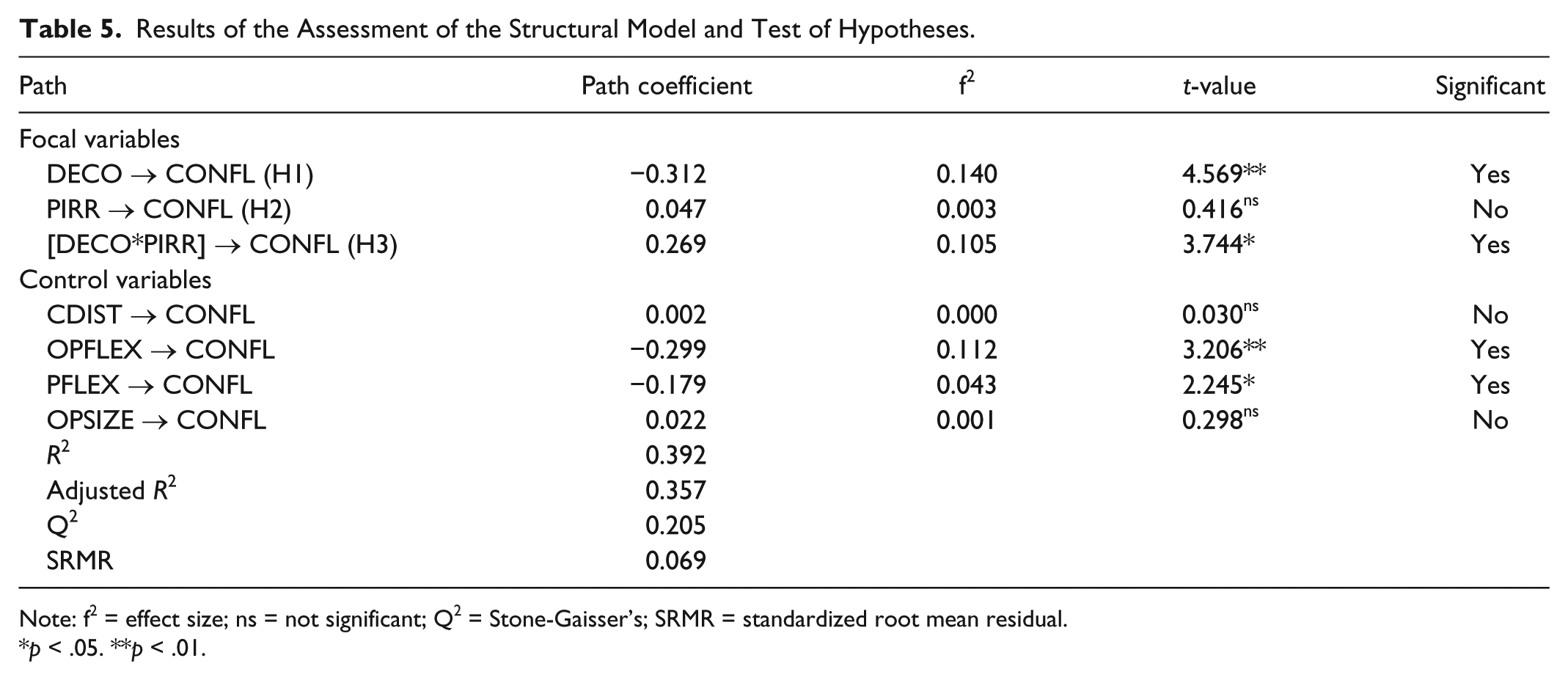
Note: f2 = effect size; ns = not significant; Q2 = Stone-Gaisser’s; SRMR = standardized root mean residual.
p < .05. **p < .01.
As shown in Table 5, path coefficients ranged from 0.002 to 0.312 in absolute terms with effect size ranging from 0 to 0.140. Based on Cohen (1988), these effect sizes range from none to almost medium. With a SRMR value of 0.069 and the adjusted R2 of 0.357, the approximate model fit is acceptable and provides an adequate description of the data. Stone-Gaisser’s Q2 value is above zero, indicating predictive relevance of the model.
Hypotheses are tested by evaluating the significance of path coefficients. The first hypothesis (H1) proposed that detailed contracts significantly reduce conflict in the relationship between inbound and outbound tour operators. This hypothesis is supported as the path coefficient for detailed contracting is negative (–0.312) and significant (p ≤ .01). The second hypothesis (H2) proposed that increased partner irreplaceability significantly leads to increased conflict between inbound and outbound tour operators. This hypothesis is not supported as the path coefficient for partner irreplaceability is positive (0.047) but not significant. The third hypothesis (H3) proposed that increased partner irreplaceability significantly weakens the efficacy of detailed contracts to reduce conflict between inbound and outbound tour operators. This hypothesis is supported as the path coefficient for the interaction effect between detailed contracting and partner irreplaceability is positive (0.269) and significant (p ≤ .01). This means that if the level of partner irreplaceability is increased by one standard deviation unit, the effect of detailed contracting on conflict level decreases to 0.043 (–0.312 + 0.269) (Figure 3).
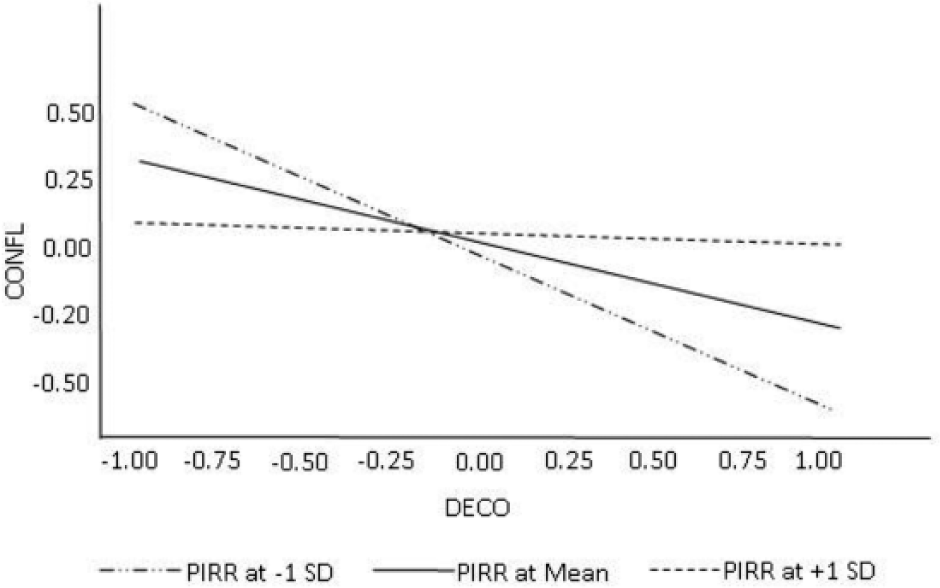
Detailed contracting at different levels of partner irreplaceability.
As for the control variables, inbound tour operator’s number of employees and cultural distance were both positively associated with conflict level but not significantly, suggesting that inbound tour operator’s size and psychic distance do not have a substantial effect on the conflict level between inbound and outbound tour operators. However, inbound tour operator’s flexibility (OPFLEX) and overseas partner’s flexibility (PFLEX) have a significant negative association with conflict level of –0.299 (p ≤ .01) and –0.179 (p ≤ .05), respectively. As the study’s predictor variables maintained their explanatory power even after inclusion of control variables, the model estimated in this study can be regarded as satisfactorily robust.
Discussion
The role of formal contracting in interfirm exchange relationships has drawn significant scholarly attention across disciplines. Previous studies in marketing and management disciplines have examined implications of various aspects of formal contracts such as contract specificity on performance (Mooi and Ghosh 2010), contractual completeness on ex post behavior monitoring and enforcement efforts (Kashyap, Antia, and Frazier 2012), and contract structure on interfirm dispute resolution processes and outcomes (Lumineau and Malhotra 2011). In the context of the tourism industry, previous studies have examined aspects such as drivers of contractual completeness (Gurcaylilar-Yenidogan, Yenidogan, and Windsperger 2011) and important elements of a contract (Fenich, Chacko, and Taylor 2009). This study attempts to advance literature on formal contracting by examining the impact of detailed contracts on conflict in interfirm exchanges. Furthermore, the study examines the impact of partner irreplaceability on conflict and on the efficacy of detailed contracts to reduce conflict. The hypotheses are argued based on insights from tourism, transaction economics, law, marketing, and management literature.
Results of this study show that detailed contracts significantly reduce the level of conflict in the relationship between inbound and outbound tour operators. To the best of our knowledge, this is the first study to examine the role of detailed contracting in alleviating conflict in interfirm exchanges. Partly, this study responds to a call for analysis of the role of contracts in the prevention and management of interorganizational conflict. Thus, the findings of this study contribute not only to literature on governance of interorganizational relations in tourism but also push the envelope of the broader field of interorganizational conflict (which is reviewed by Lumineau, Eckerd, and Handley 2015). Furthermore, the study found that both inbound tour operator’s flexibility and overseas partner’s flexibility significantly reduce conflict level, which suggests that regardless of how detailed or explicit contracts might be, there will always be gaps that need to be addressed by flexibility. As flexibility is one of the norms reflecting relational contracting (Macneil 1985), the results of this study suggest complementarity of formal and relational contracts in the context of tourism interfirm exchange. Although this study was not designed to compare relative efficacy of the governance mechanisms, these findings cast some light on the question of appropriate governance mechanisms for tourism value chains (Song, Liu, and Chen 2013).
Furthermore, this study argued that partner irreplaceability would lead to increased conflict due to malicious behavior of the more powerful party. The results show that partner irreplaceability increases conflict but not significantly as hypothesized. However, partner irreplaceability significantly moderated the effect of detailed contracts on conflict. Taken together this shows that partner irreplaceability does not necessarily lead to conflict itself but rather compromises the efficacy of detailed contracts to reduce conflict. As extant literature unanimously emphasizes the role of contracts in aligning incentives of exchange partners, results of this study contribute to literature on formal contracting by demonstrating that the role of detailed contracts is contingent upon imbalanced dependence. Most likely, as argued earlier, the problem occurs when the party with greater bargaining power explicitly determines terms and conditions of exchange which may turn out, ex post, to be unfavorable to the other partner.
Besides flexibility, two other control variables, namely cultural distance and inbound operator’s number of employees, were included in the structural model of this study. Cultural distance was included because of its suggested causal link to psychic distance, which is often associated with conflict while number of employees was used as a proxy for the size of inbound tour operators, which previous tourism studies suggest has an impact on conflict. Contrary to the expectation, the analysis in this study finds that cultural distance and number of employees have no significant effect on conflict level. One possible explanation for the nonsignificant effect is that, being proxies, the two variables may not have been effective in capturing the target variables, namely psychic distance and operator’s size. This is conceivable considering that extant literature points to the limited predictive ability of using these proxies. For instance, although cultural distance is the most commonly used proxy for psychic distance, its predictive ability tends to be weak when used in isolation (Dow and Karunaratna 2006). Regarding the use of number of employees as a proxy for firm size, this study followed previous studies and considered only the number of permanent employees, however, Hart and Oulton (1996) noted that the use of permanent employees to measure the size of companies can be problematic especially for the smallest size classes. This is because increasingly such companies use part-time workers whose full-time equivalents are not taken into account in the analysis, and thus reduce the accuracy of the number of permanent employees as a proxy for firm size. Therefore, while the findings of this study suggest that firm size and psychic distance do not have a significant effect on conflict level, this should be verified by further research because the proxies implemented in this study may not have been effective in capturing the expected effects.
Nevertheless, the results of this study have several implications to managers of tourism businesses, in particular tour operating businesses. First, the results suggest that exchange partners should make an effort to detail terms and conditions of their exchange relationship. By specifying roles, responsibilities, outcomes to be delivered, and adaptive processes for handling contingencies, more detailed contracts guide behavior and expectations of exchange partners thereby reducing potential disagreements. Second, the results suggest that although managers whose firms have greater bargaining power might be tempted to capitalize on their power, and secure more advantageous terms and conditions, this behavior may lead only to short-term profits as the weaker party may stick to the relationship due to a lack of alternatives. As the competitiveness of any tourism firm largely depends on the competitiveness of the value chain to which they belong (Song, Liu, and Chen 2013; Zhang, Song, and Huang 2009), it is critical that managers of tourism firms consider other firms in their value chains as extensions of their organizations and thus avoid hostile tendencies and promote mutual interests. Third, managers of tourism businesses need to recognize that contracts can hardly be complete and for that matter they should be willing to make good-faith modifications as circumstances change. To promote flexibility in the relationship, flexibility clauses may be considered. That is, detailed contracts should include clauses that can change the effect of certain terms and conditions by providing alternative arrangements that suit the needs of unfolding circumstances. Fourthly, managers of tourism businesses should consider various power balancing mechanisms such as through the creation of a strong bond with end customers and through the provision of unique value (Mwesiumo and Halpern 2016).
Conclusion
Previous studies have noted that adverse relationships in tourism value chains are quite common. While interfirm conflicts may lead to maturity of exchange relationships (Alter 1990) and improved communications and a more equitable allocation of power and resources between partners (Assael 1969), often they have negative consequences such as poor relationship performance (Menon, Bharadwaj, and Howell 1996) and financial costs, especially when partners resort to litigation (Lumineau and Malhotra 2011). This study investigated the effect of detailed contracts and partner irreplaceability on conflict in the exchange relationship between inbound and outbound tour operators. Consistent with insights from extant literature, the results show that detailed contracting significantly reduces conflict. The effect of partner irreplaceability on conflict was not significant as hypothesized, however, partner irreplaceability was found to significantly moderate the effect of detailed contracts on conflict.
Several avenues for further research are highlighted as a result of the findings from this study. First, this study assumed that a tourism firm with greater bargaining power will always engage in active opportunism, which conceivably would lead to conflict. Prevalence of opportunism, which is self-interest seeking with guile, is one of the assumptions of the transaction cost framework. This assumption views opportunism as part of human behavior and therefore managers would project it whenever circumstances allow such as when an exchange partner lacks alternatives. However, the nonsignificant effect of partner irreplaceability on conflict suggests that this assumption is not always true. Future research may investigate the conditions under which tourism firms engage in opportunism against their exchange partners. Second, this study investigated only the effect of detailed contracts and partner irreplaceability on conflict. Future studies may investigate other aspects of interfirm conflict such as effective approaches to resolving it. Finally, although this study did not set out to examine the interplay of formal contracting and relational governance, the significant effect of both detailed contracting and flexibility suggests that there may be some complementarity between the two governance mechanisms. However, as flexibility is just one element reflecting relational governance, further research is required to properly examine the efficacy of various governance mechanisms in tourism interfirm exchanges.
Despite the insights provided by this study, some limitations also open avenues for further research. First, this study relied on data collected on one side of the dyad—inbound tour operator. As the measures used in the study are mainly perceptual, obtaining data from both sides of the relationship is recommended for future research. Second, this study was confined only to the relationship between inbound and outbound tour operators. As the tourism industry is comprised of a multitude of actors, operating in various contexts, replicating this study in other empirical contexts is desirable. Third, although the results suggest that cultural distance and operator’s number of employees have no significant effect on conflict levels, these were used as proxies that may not have been effective in capturing the desired variables. Future studies may consider applying perceptual measures of psychic distance (e.g., Sousa and Bradley 2005) and alternative proxies for firm size such as sales revenue and total assets (Al-Khazali and Zoubi 2005).
Footnotes
Declaration of Conflicting Interests
The author(s) declared no potential conflicts of interest with respect to the research, authorship, and/or publication of this article.
Funding
The author(s) received no financial support for the research, authorship, and/or publication of this article.