



Abstract
Tourism represents one of the most important industries in the world and one of the sectors of fastest growth. An understanding of the relation between tourism and poverty is key for poverty reduction in developing countries. The impact of tourism on the reduction of both poverty and inequality in income distribution is analyzed in this paper in the Dominican Republic (within the Caribbean Community of Small Island Developing States). The Ng and Perron test for analyzing time series stationarity and the AutoRegressive Distributed Lag bounds test were used to determine the existence of long-term relationships. The short-run dynamic models represented by the Error Correction Models were also estimated. The results showed that income from tourism has not alleviated poverty and has clearly failed to reduce inequality in the distribution of wealth. Finally, management implications are also provided for public and private bodies wishing to achieve sustainable tourism.
Keywords
Introduction
The continual expansion of the tourism industry over the past 70 years places it firmly among the fastest-growing global economic sectors. According to data from the United Nations World Tourism Organization (2016), the number of international tourist arrivals increased by 4.6% in 2015, year on year, reaching a total of 1.186 billion international arrivals. Likewise, international income from tourism was estimated at $1.26 trillion in 2015. At present, and according to the same source, international tourism represents 7% of global exports of goods and services.
It is generally argued in mainstream research that international tourism prompts economic growth (Balaguer and Cantavella-Jordá 2002; Brida, Cortes-Jimenez, Pulina 2016; Croes 2014a). The expansion of tourism has also been especially linked to poverty alleviation in developing countries (Scheyvens 2007; Winters, Corral, and Mora 2013). From this standpoint, tourism is seen as an economic sector with a potential role to play in the active reduction of poverty, assuming that its capacity to stimulate economic growth can be oriented in that direction (Medina-Muñoz, Medina-Muñoz, and Gutiérrez-Pérez 2016). It is therefore seen as a crucial element in achieving the first United Nations Millennium Development Goal: the eradication of extreme poverty and hunger.
The potential of tourism to act as a motor for growth and an instrument for poverty reduction is hardly ignored in public policies (Croes and Vanegas 2008). Moreover, developing countries have expressed their commitment to expanding their tourism sectors and related industries, seeing them as a source of important economic benefits in terms of income, employment, and gross domestic product (Medina-Muñoz, Medina-Muñoz, and Gutiérrez-Pérez 2016).
With the passage of time, different perspectives have emerged regarding the relation between tourism and development (Scheyvens 2007). Critical of the role that tourism can play in the economic development of host countries, one approach cites the leakage of profits and minimal participation among local populations: high capital requirements prevent poorer individuals from participating in touristic activities (Yang and Hung 2014). Besides, the tourist sector is labor intensive, often involving workers in precarious conditions, with low wages, long working days, stress, little education, and few opportunities for promotion (Beddoe 2004). The benefits arising from tourism are, on the other hand, minimized in sectors dominated by foreign companies that repatriate their profits (Scheyvens 2007). Hence, operational, structural, and cultural barriers exclude the less well off from the benefits that tourism can yield (Tosun 2006; Yang and Hung 2014).
From a more positive perspective, there is the argument that tourism benefits local economies through the consumption of local products and services. “It is this direct tie to consumers that is often highlighted in considering the poverty-reduction potential of tourism, since it raises the possibility of linking the poor directly to consumers” (Winters, Corral, and Mora 2013, p. 179). Likewise, no less important is the fact that tourism can create employment, in particular among the most vulnerable groups (women, youth, and ethnic minorities). In doing so, they can participate in the production of goods and services for the tourist market through a diversified supply chain (Ashley, Goodwin, and Roe 2000; Ndivo and Cantoni 2016).
In general, economic growth has been the priority objective of touristic development while poverty reduction has been understood as a welcome consequence or a second-level target (Medina-Muñoz, Medina-Muñoz, and Gutiérrez-Pérez 2016). Hence, considerable attention has traditionally been lent to the expansion of the tourist sector, but much less to the study of just how much tourist development contributes to poverty alleviation (Zhao and Ritchie 2007). Yet economic growth, while a necessary condition, is by no means a sufficient one for the reduction of poverty (Winters, Corral, and Mora 2013).
Thus, the subject must be approached from an empirical standpoint, given the lack of evidence relating to the intensity of the relation between tourist development and poverty reduction (Croes 2014b; Mitchell and Ashley 2010; Winters, Corral, and Mora 2013), the limitations affecting the analysis of “poverty alleviation via tourism studies,” and the gaps existing in poverty studies (Yang and Hung 2014, 884). Such an approach may help to achieve a better understanding of the circumstances in which tourism can help to reduce poverty (Winters, Corral, and Mora 2013). It must be borne in mind that the equation between tourism and poverty is determined by contextual aspects (i.e., the macro-environment) and by the institutions and the specific assets of the destination, without overlooking the type of tourism.
Each type of destination (cultural, sun and sea, ecotourism, etc.) will attract a certain kind of tourist. It is likely that international tourists with high purchasing power will engage less in activities that locally owned organizations manage. Likewise, sun-and-sea tourism will often bring people to a certain destination, but once there will keep them isolated from the local community. So, the segment with the highest purchasing power will not necessarily generate the greatest benefits for local communities. The impact on the local economy will also depend on the quantity of goods and services that are consumed and the sorts of goods that are preferred. For example, internal tourism might well be more favorable to the purchase of locally produced goods (Dwyer 2005). Be that as it may, empirical research into the relation between the type of tourism and links with the local economy has yielded varying and inconclusive results (Mitchell and Ashley 2010).
A review of the literature published between 1999 and 2017 on the relation between tourism and poverty reduction shows that most empirical research has centered on tourism in general. There has been little or no differentiation between different types of tourism products. Typical studies have been descriptive analyses that examine tourism content and frequency of visits at one location in a specific geographical context (Medina-Muñoz, Medina-Muñoz, and Gutiérrez-Pérez 2016).
In view of the above, it is of fundamental importance to understand the relation between tourism and poverty (Winters, Corral, and Mora 2013), because existing empirical analysis is clearly insufficient (Goodwin 2007; Jamieson, Goodwin, and Edmunds 2004; Winters, Corral, and Mora 2013). Mitchell and Ashley (2010, 135) called for studies to examine the connection between tourism and poverty. The mixed results mentioned above “suggest that the link is not automatic,” so “a closer examination of the conditions or types of policies that may be effectively replicated (or avoided) elsewhere” is fully warranted (Croes 2014b, 295, on similar lines to Winters, Corral, and Mora 2013). Any such inquiry will require the use of sophisticated econometric models (Jamieson, Goodwin, and Edmunds 2004) involving time-series data in developing countries, in order to shed light on “the role tourism plays in economic growth, development and poverty alleviation” (Winters, Corral, and Mora 2013, p. 184).
Given these antecedents, the purpose of the present work is to conduct an empirical assessment of the relation between tourism, poverty reduction, and income distribution inequalities in the framework of a Small Island Developing State in the Caribbean, the Dominican Republic. The intention is to obtain empirical evidence on the magnitude of such links, so that the results may shed light on how to guide the implementation of public policy measures.
The following paragraphs review the relevant literature that addresses the connection between tourism and poverty reduction and between tourism and the reduction of inequality. The research hypotheses is then expressed and the economic situation and that of the tourism industry in the Dominican Republic is briefly described. The sections that follow consider the methodological aspects and the results. Finally, the conclusions and their implications for tourism management are presented as well as some guidelines for future research.
Literature Review
Poverty
Poverty is defined as “the inability to consume a minimum bundle of goods [as] measured by a minimum monetary income” (Croes 2014b, p. 293). “Poverty is an inherently dynamic and complex phenomenon that varies in space, time, gender, age, culture and season” (Yang and Hung 2014, p. 879). Its causes are both economic and sociological (Yang and Hung 2014), and not only are the poor denied income and resources but also opportunities (Bowden 2005). Situations of poverty may perpetuate themselves because of the “poverty trap,” scarce access to resources, and the impossibility of changing such conditions (Sachs 2005).
The conceptual difficulty of studying poverty lies in its multidimensional nature. Economic indicators, such as income or consumption, stand alongside non-economic measurements such as the standard of living, social exclusion, and access to education and the health services, among others (Medina-Muñoz, Medina-Muñoz, and Gutiérrez-Pérez 2016; Sen 1999; Spenceley and Goodwin 2007; Sultana 2002; Yang and Hung 2014; Zhao and Ritchie 2007). Poverty is therefore not only determined by low income, but other factors, such as premature death, poor health, and lack of access to education and participation in community life must also be taken into consideration in an analysis of poverty (Grusky, Kanbur, and Sen 2006). “Poverty encompasses all deprivations of well-being . . . including lacking means of empowerment, such as networks, knowledge and skills” (Adiyia, Vanneste, and Van Rompaey 2017, 34).
A variety of poverty measures have been used in the literature. Medina-Muñoz, Medina-Muñoz, and Gutiérrez-Pérez (2016) reviewed papers on poverty alleviation and tourism between 1999 and 2014 and identified four approaches for gauging poverty: (a) the number of residents, employees or households with incomes inferior to a specified income level (poverty threshold); (b) distinction of different categories of poor residents or households in terms of income, type of employment, occupation, etc.; (c) indicators of human development; and, finally, (d) the personal perceptions of residents, employees, tourists, or any other key informant. Poverty is therefore measured through the subjective perceptions of relevant stakeholders. This approach needs to be complemented with economic approaches and/or human development indicators, as poverty has multidimensional aspects (Medina-Muñoz, Medina-Muñoz, and Gutiérrez-Pérez 2016).
The direct effects, indirect effects, and dynamic effects of tourism are what may influence the reduction of poverty (Mitchell and Ashley 2010). The direct impact of tourism will be dependent on the behavior of tourists who buy goods and services. In this way, the proprietors of tourist businesses obtain nonlabor income and their employees earn wages (Winters, Corral, and Mora 2013). The direct economic impact of tourism will therefore depend on the owners, the employees, and the business organization. The indirect economic effects of touristic activity will proceed from expenditure incurred through direct effects, such as the purchase of inputs from other companies to develop tourist activity and/or the acquisition of goods and services from outside the sector by proprietors and employees of tourism firms (Dwyer et al. 2004). Aside from the private sector, the influence of tourist activity on the local economy will depend on reinvestment of the income generated by tourism in the same area and will be conditioned by public policies (Blake et al. 2008). The dynamic effects of tourism on the local economy will depend on the long-term impact of tourism-related investments, in that sector and in others, such as infrastructure, staff training, etc. Investments that generate a more dynamic economy in the long term and a greater degree of development can contribute to poverty reduction.
Alleviation of Poverty
Efforts to reduce poverty are a continuous challenge for developing countries (Yang and Hung 2014). Since the 1990s, tourism has been regarded as an instrument for furthering the objective of poverty reduction (Scheyvens 2007).
The connection between tourism and poverty reduction is related to trade and economic growth (Croes and Vanegas 2008); that is, a positive and significant relation exists between tourism and economic growth. This relation is potentially more important in developing countries, since tourism is one of the economic sectors of greatest weight (or increasing importance) in most countries that suffer high levels of poverty (Scheyvens 2007). If we accept that economic growth reduces poverty and that tourist activity generates growth, through job creation, a positive balance of payments, and the development of tourism-related businesses (Croes 2014b), then it follows that touristic activity will contribute to the alleviation of poverty (Croes and Vanegas 2008). Eugenio-Martin, Martín Morales, and Scarpa (2004) pointed out that the expansion of tourism is suitable for the economic growth of countries with low-to-medium income levels. Other works suggested that a specialization in tourism fosters rapid growth in small countries; however, the key element in those studies was a specialization in tourism and not the dimensions of the country (Croes and Vanegas 2008).
Compared with other sectors—as pointed out by Medina-Muñoz, Medina-Muñoz, and Gutiérrez-Pérez (2016)—tourism has a greater potential for reducing poverty in developing and less developed countries because (1) it is a suitable activity for poor rural and coastal areas with few other options for growth; (2) it is a labor-intensive activity; (3) it generally employs a large number of women, young people, and underqualified people (a high percentage from poorer levels of society); and (4) an influx of tourists creates a wide range of business opportunities at the place of destination.
Nonetheless, the undesired consequences of tourism are also undeniable: inflation, inequality, threats to natural and cultural resources, negative effects on the quality of life, pollution, etc. (Ashley and Roe 2002; Bowden 2005).
The connection between tourism, economic growth, and poverty reduction has been called “the democratization of the dollar” (Croes and Vanegas 2008; Vanegas and Croes 2003): the transference of wealth and income from developed countries to less developed ones. It is done through the generation of employment opportunities for all economic sectors, fostering conditions in which the poor can participate, increasing their incomes and their standards of living. In this sense, the tourism industry is regarded as the most important voluntary transference of resources from rich to poor (Yang and Hung 2014).
Nonetheless, the above-mentioned causal equation is hardly as simple as it sounds. Blake (2008) argued that the poor will only benefit from tourism, in so far as their earnings depend on direct involvement in tourism, without proceeding from other export industries. The poor whose incomes depend on other export industries will not benefit from the development of tourism, because the growing numbers of arrivals from international tourism could lead to an increase in exchange rates, resulting in an appreciation of the local currency and, consequently, price rises that would doubtless affect those other export industries.
The above reasoning will perhaps explain the empirical evidence on the potential that tourism has to reduce poverty and the inconclusiveness of the results. According to the results of Deller (2010) in the framework of a developed country, the United States, the expansion of certain recreational activities (golf, tennis, swimming facilities) exercises a downward pressure on the incidence of rural poverty. Nevertheless, the effects of other tourist activities such as skiing and commercial recreation are less clear, because of their variation in relation to the geographical area in question. Moving to a very different geographical and economic context, in Africa, one study pointed to an incipient relation between tourism and poverty reduction in Zimbabwe (Mutana, Chipfuva, and Muchenjeet 2013). Another study observed that cultural tourism has contributed to reducing the level of poverty in communities in rural areas around Kilimanjaro (Anderson 2015). A further two studies in Tanzania determined that households dedicated to tourist activities were less likely to be classified as poor in comparison with households dedicated to other activities (Duygan and Bump 2007; Slocum and Backman 2011). In particular, local communities in rural Kilimanjaro perceived improvements in social progress and access to education and to health facilities, thanks to the introduction of cultural tourism in the area (Anderson 2015). Within the same area in Africa, Njoya and Seetaram (2018) showed how tourism has positively influenced the poverty gap and acute poverty in Kenya, although its impact has been higher in urban rather than in rural areas. Along the same lines, the effect of tourism development on extreme poverty reduction in Costa Rica and Nicaragua was positive and higher than agricultural development (Vanegas, Gartner, and Senauer 2015).
In contrast, a study in Botswana, Namibia, and South Africa (Muchapondwa and Stage 2013) showed that in comparison with other industries, tourism generated no significant benefits for the poor. Likewise, in Ghana, the contribution of tourism to the reduction of poverty appeared to be limited (Holden, Sonne, and Novelli 2011). Recently, Rakotondramaro and Andriamasy (2016) concluded that economic growth and the development of tourism have not mitigated poverty in the framework of a less developed country (Madagascar). Although tourism may well favor economic growth, they found that it merely increased the pool of workers on low wages. Gartner and Cukier (2012) analyzed whether employment in tourism in Malawi was sufficient for poverty reduction. From their qualitative and quantitative analyses, they concluded that there was little evidence to support the argument that those employed in tourist activities would see improvements in their impoverished living conditions.
In the context of developing countries in Central America, protected areas of Costa Rica (Ferraro and Hanauer 2014) have seen a positive relation established between tourist development and the reduction of poverty. In Nicaragua, Croes and Vanegas (2008) identified a link between tourism and poverty reduction in the sale of craft products and souvenirs, the provision of transport services, as well as other direct and indirect tourism-related services. More recently, Croes (2014a) reported contrary results on tourism development and absolute poverty, whereas in Costa Rica the poor benefited from tourism development unlike in Nicaragua. Tourism has had substantial multiplier effects on the economy of Ecuador where “tourism development does help the poor increase their earnings, including those with the highest incidence of poverty” and “benefits the poor more than non-poor” (Croes and Rivera 2017).
Truong, Hall, and Garry (2014) suggested that the main beneficiaries of local tourist activities in Vietnam were the nonpoor and the tour operators rather than the poor. Jiang et al. (2011) analyzed the particular case of 29 Small Island Developing States in 2005 and found significant correlations between the intensity of tourism and a higher standard of living, a higher Human Development Index, and a lower rate of infant mortality. However, Sharpley and Naidoo (2010), in their evaluation of both the short- and the long-term consequences of tourism in Mauritius, concluded that tourism was hardly likely to reduce poverty in the long term, even though it may promote short-term economic benefits for the poor.
Additionally, the economic level of a country may play a moderating role in the relationship between tourism and poverty ratio reduction. N. Kim, Song, and Pyun (2016) reported mixed results in relation to the effect of tourism on the poverty ratio (measured as country per capita income) in 69 developing countries for the period 1995–2012: the initial positive effect of tourism on poverty alleviation turned negative when the per capita Gross Domestic Product of the developing countries in their study exceeded $3400.
Thus, as summed up by Medina-Muñoz, Medina-Muñoz, and Gutiérrez-Pérez (2016) in an extensive review of the published literature on tourism and poverty alleviation (1999–2014), the empirical results are contradictory—both when tourism is compared to other industries and when the effects of tourism are evaluated in the reduction of poverty at the regional level—which highlights the need for more empirical studies on this issue. The present work, in response to that need, sets out the following hypotheses:
Hypothesis 1: Earnings derived from tourist activity will impact on the percentage of the population living below the poverty threshold.
Hypothesis 2: Earnings from tourist activities will impact on the intensity of poverty among the population living below the poverty threshold.
In this study, two simple poverty indicators are used: “incidence of poverty or poverty head-count ratio (H)” and “intensity of poverty” (Sen 1992). The poverty incidence indicator responds to the question, “how many poor people are there?” The H indicator represents the percentage of individuals or households whose income falls below the poverty line that is under consideration. The poverty head-count ratio is one of the most frequently used measurements, because it is simple to calculate and to interpret. However, one of its most significant flaws is that it omits the adverse circumstances of the poor and their severity, regardless of the income distance from the poverty line. The World Bank’s head-count measure, for example, relies heavily on the level at which the poverty line is set, ignoring those who die prematurely from deprivation. Moreover, because of its use of a common currency (US dollars), a double conversion of the consumption expenditures of poor households is required, using the consumer price index and international purchasing power parities. This procedure disregards the fact that the consumption patterns of the poor would hardly resemble international, and even national, ones (Pogge 2017).
Hence, together with the above-mentioned indicator (H), the poverty intensity indicator (I) and poverty gap ratio (Gap) have to be taken into consideration.
Income Inequality
If we are ever to understand the effects of tourism development in a specific community in greater depth, we will need to analyze how the economic gains of tourism are distributed between the different income groups of the community. Despite its importance, this question has yet to receive the attention it deserves in the literature (Alam and Paramati 2016; Incera and Fernández 2015). So, while tourism may have a positive impact on employment, income, and tax revenue, the effects of tourist expenditure may vary considerably as regards their distribution among the different social groups (Copeland 1991); hence, tourism-induced economic growth will not necessarily imply an improvement in poverty levels, because not all the wealth that is generated is redistributed equitably throughout the community (Donaldson 2007).
Inequality in the redistribution of the wealth generated by tourism may, potentially, deepen existing class and gender inequalities and divide ethnic groups, prejudicing previously marginalized groups (David 2002). Nevertheless, with adequate planning, proper management, the involvement of local communities, and cost and benefit redistribution, it may act to foster equality, justice, and equity (Duffy et al. 2015). Therefore, addressing local community participation in tourism development, with an appropriate approach toward community empowerment, plays a crucial role in poverty alleviation (Ndivo and Cantoni 2016). Llorca-Rodríguez, Casas-Jurado, and García-Fernández (2017) researched tourism impact on total and extreme monetary poverty and found that low levels of community involvement in Peru prevented “tourism potential from being fully exploited” (p. 8).
One of the first pieces of research to address the impact of tourism on income inequality was that of Wen and Tisdell (1997). The authors concluded that tourism generates inequalities among the different Chinese provinces. Studying cases in Turkey, Tosun, Timothy, and Öztürk (2003) observed an increased rate of economic growth at the expense of greater inequality among various income groups in coastal and rural regions. Similar conclusions were drawn in the US Great Lakes states (Marcouiller, Kim, and Deller 2004), Kenya (Manyara and Jones 2007), Brazil (Blake et al. 2008), and Small Island Developing States (Scheyvens and Momsen 2008). Along the same lines, Lee and O’Leary (2008) concluded that tourism contributed to income inequality. The work of Kinyondo and Pelizzo (2015) in Tanzania suggested that while tourist development may stimulate economic growth and employment, the impact induced by such growth on the reduction of income inequality is less pronounced.
On the contrary, the recent study of Hengyun et al. (2015) in China held that tourism can be seen as an instrument that contributes to reducing regional economic disparities. Their reasons were that (1) less-developed zones tend to be rural areas with natural resources that can be converted into tourist attractions; (2) activities connected with tourism generate transference of expenditure between regions; (3) expenditure on tourism produces multiplier effects; and (4) tourism favors employment. These conclusions are endorsed by the work of Li et al. (2016) in the same geographical sphere. Applying the conditional convergence model and dynamic panel-data estimation techniques, empirical evidence is provided on the effects and the importance of tourism for the reduction of regional inequalities, while also shedding light on the type of tourism of greatest efficacy. The results of the study also show that domestic tourism can accelerate regional economic convergence faster than international tourism.
In more global terms, the empirical analysis of Alam and Paramati (2016) covers 49 developing economies, including the Dominican Republic, in all five continents over the period 1991–2012. It showed that, at that end of that period, the tourist industry increased income inequality in terms of the long-run equilibrium between the selected variables. In contrast, Blake et al. (2008) showed that tourism has the potential to reduce income equality, insofar as it benefited the lowest income sections of the Brazilian population. However, the main beneficiaries of tourism were not the lowest-income households. They also demonstrated that alternative distribution of government revenue could double the benefits of the poorest households, allocating around one-third of all the benefits from tourism.
On the basis of what has been outlined above, the following hypothesis is proposed:
Hypothesis 3: Income from tourist activities will impact on the inequality of existing income distribution patterns in the population.
Economic Growth, Tourism, and Poverty in the Dominican Republic
According to data from the Central Bank of the Dominican Republic (BCRD 2017a), the economy has enjoyed one of the fastest growth rates in the region over the past two decades. The average growth rate in real GDP between 1992 and 2013 (reference year 1991) stood at 5.7%, and the average quarterly growth of real GDP was 7.3% over the period 2014–2015. This strong growth has been driven by building, manufacturing, and tourism (World Bank 2016).
Following the Second World War, improvements in air transport led to a reduction of journey times to geographically distant destinations. This new mobility saw the growth of mass tourism to many destinations during the 1960s and the 1970s, among them Small Island Developing States (Mgonja, Sirima, and Mkumbo 2015).
The Dominican Republic, a Small Island Developing State in the Caribbean region, has been characterized by rapid tourism-sector growth over recent years. As in other Caribbean countries, its growth is linked to its natural assets: sea-sun-sand for mass tourism in the framework of all-inclusive packages (López-Guzmán et al. 2016; Padilla and McElroy 2005; Tenor Peña et al. 2017; Villareal and van der Horst 2008).
Tourism development in the Dominican Republic began in the 1960s and was based on foreign investments, given the lack of infrastructure, appropriate safety and health structures, and complementary services for tourism (Fawcett 2016; Mejía-Urbánez 2013). Significant governmental incentives were therefore made available to attract foreign investment in tourism, such as tax breaks and long-term rentals of frontline beach properties (Fawcett 2016). As a consequence, the tourism sector of the Dominican Republic has followed an “all-inclusive” tourism development scheme (Pérez 2011; Real-Aquino 2014). The following data show its continued dependence upon that scheme (BCRD 2017b; Fawcett 2016; Mejía-Urbánez 2013): (a) 95% of hotel beds of an international category are foreign owned, of which 80% belong to hotel chains; (b) La Altagracia (Bávaro-Punta Cana) and Puerto Plata concentrate 62% of all hotel beds in the country; (c) 83.8% of tourists arriving at airports in the Dominican republic in 2016 were foreigners; (d) 94.1% of tourists visited the country for leisure and 90% chose to stay in hotels; (e) foreign tourists amounted to 66.9% of all arrivals at the international airport of Punta Cana, surrounded by all-inclusive hotels, and 7.9% of arrivals at Puerto Plata airport; and, f) the offer of hotel beds is for the most part (62%) concentrated on the east coast and to the north of the country.
The growth rate in total arrivals of air passengers to the Dominican Republic between 2004 and 2016 has been in the order of 73.35% (BCRD 2017a). In 2015, the percentage variation over the previous year was 8.9%. The Central Bank of the Dominican Republic also provides interesting data on tourist expenditure and average stays. Tourist spending varies according to the visitor profiles: foreigner or Dominican, resident or nonresident. Foreigners spend on average $129.56 (USD) per day; resident Dominicans average $879.32 (USD) per visit and nonresident Dominicans, $825.20 per visit. The average stay for foreigners is 8.32 nights, for resident Dominicans, 1.68 nights, and 14.96 nights for nonresident Dominicans.
Despite the above figures, the poverty indicators are not encouraging: the percentage of the population living in conditions of poverty fell from 32% in 2000 to 30.5% in 2016 (The Ministry of Economics, Planning and Development of the Dominican Republic 2016). Over the last few years, although the country has adopted measures aimed at alleviating poverty, access to public services is regarded as unequal and of deficient quality, in particular for the poorest people. Table 1 shows the Human Development Index (HDI) in the Dominican Republic and its neighboring countries, Haiti and Cuba, during the period under study (2000–2013), for comparative purposes. Devised by the United Nations Development Program (UNDP), the HDI is a summary measure of three crucial dimensions of human development: long and healthy life, knowledge, and a decent standard of living, operationalized as the geometric mean of normalized indices of those three dimensions (UNDP 2015). The situation of poverty in the Dominican Republic is confirmed by the HDI figures. Poverty in the Dominican Republic is less acute than poverty in Haiti and only slightly worse than poverty in Cuba.
Human Development Indicators: Cuba, Haiti, and the Dominican Republic.

Source: UNDP data.
Employment figures on the hospitality sector -Hotels, Restaurants and Bars- provided by the Central Bank of the Dominican Republic database are not encouraging over the period 2000-2013, as shown in Table 2. Employment generated in the hospitality sector represents a low percentage of total employment in the country. Furthermore, the participation of women in the hospitality sector is slightly higher than that of men, but even so it is very low, as can be seen in Table 2.
Employment Data: Gender Balance of Employment in the Tourism Sector.

Source: Data calculated from Dominican Republic Central Bank.
The first of the Millennium Development Goals (MDGs) is to eradicate extreme poverty and hunger, taking monetary indigence as an indicator. Its specific aim is to reduce by 50% the percentage of people with incomes less than $1.25 a day between 1990 and 2015. The percentage of monetary indigence in the Dominican Republic stood at 2.1% in 2000 and 1.2% for 2014 (SISDOM 2014), and the monetary poverty gap passed from 11.7% to 12.5% between 2000 and 2014. The percentage of the working population in conditions of poverty and indigence is striking: respectively, at 32% and 9.6%, for 2002, and at 22.5% and 7.4% twelve years later (ECLAC 2017). Looking at the distribution of the population by income groups (UNDP 2016), in 2014, 27.4% of the population were living on less than 4 dollars a day, lower than the figures registered in 1996 (34.4%) and 2003 (41.7%).
Data, Methods, and Results
In the first place, the absence of any consensus must be stressed with regard to the method for gauging the impact of tourism on poverty (Mitchell 2012; Mitchell and Ashley 2010), the sources of information, and the best analytic techniques (Medina-Muñoz, Medina-Muñoz, and Gutiérrez-Pérez 2016). Historically, the analysis of the relation between tourism and poverty has been approached using different methodological procedures: (a) simulation models ranging from input–output models to multiregional equilibrium models that take into account all income and all expenditures by the tourism industry (Mahadevan, Amir, and Nugroho 2017; Njoya and Seetaram 2018) and (b) econometric analyses that contemplate temporal series of macroeconomic variables (Balaguer and Cantavella-Jordá 2002; Cárdenas-García, Sánchez-Rivero, and Pulido-Fernández 2015; Lin, Yang, and Li 2018).
Among the methodological limitations of simulation models is the fact that prices and wages are not taken into account. The capacity of these models for evaluating changes in tourist demand and their impacts is limited and they disregard the fact that tourists will respond to changes in pricing and that companies will respond to changes in material costs (Blake et al. 2001). Econometric analyses, on the other hand, focus on the role of tourism for inducing economic growth, which is a necessary (although not a sufficient) condition for inducing the reduction of poverty (Winters, Corral, and Mora 2013). The present work is framed within the second analysis focusing on time series approach unlike other research performed using a structural equation modeling approach (Cárdenas-García, Sánchez-Rivero, and Pulido-Fernández 2015). Furthermore, there are few works that directly analyze the long-term relation between tourism and poverty (Croes and Vanegas 2008; Kumar et al. 2016). While Croes and Vanegas (2008) analyze the impact of tourism on poverty over a period of 25 years (1980–2004), this research, considering a shorter time period (2000–2013), selected the autoregressive distributed lag (ARDL) approach as a tool for investigating the existence of a long-run relationship between tourism and poverty. The ARDL bounds testing approach to cointegration is consistent and relatively more efficient in small or finite sample data sizes, as in our study, than the Johansen and Juselius technique (Pesaran and Shin 1999) used by Croes and Vanegas (2008). Additionally, our article analyzes the impact of tourism not only on the incidence of poverty (head-count ratio) but also on intensity of poverty (poverty gap ratio) and on the income inequality of the Dominican population (Gini coefficient).
Data and Description of Variables
Data
According to the literature, the impacts of tourist activity on poverty can be classified as four types (Medina-Muñoz, Medina-Muñoz, and Gutiérrez-Pérez 2016): (a) net impact on poverty, (b) economic impact, (c) impact on socio-cultural livelihood, and (d) impact on environmental livelihood. The focal points of this study are the impact of tourism on two poverty-related indicators and income inequality in the Dominican population.
The data used in the empirical analysis refer to the period 2000 to 2013, because of the availability of the variables needed for the analysis. The selected period includes years of unprecedented crisis (2000–2004) for the Dominican economy, in which the most vulnerable social strata were considerably impoverished, followed by a period of economic recovery, beginning in 2004, in which the building, tourism, and telecommunications sectors appeared as the key sectors in the country’s economic growth.
Description of variables
The World Development Indicators used in this article were taken from the annual reports of the World Bank. The poverty indicators in use refer to the incidence and the intensity of poverty (Grusky, Kanbur, and Sen 2006; Jenkins and Lambert 1997). The head-count ratio (H) at $3.10 a day (2011PPP) provided by the World Bank database is used in the analysis to measure the incidence of poverty. The poverty gap ratio (Gap) at $3.10 a day was used to measure the intensity of poverty, as the poverty gap ratio at national poverty lines is not available on the World Bank database. The Gini index obtained from the World Bank database was taken as an indicator of income inequality in the Dominican population.
TouRism Income (TRI) was chosen as an indicator of tourist activity, reported on a yearly basis by the Central Bank of the Dominican Republic. The base period for obtaining income from tourism in constant US dollars is 2010. Gross Domestic Product (GDP) per capita in constant 2010 US dollars obtained from World Bank database was also used to monitor economic growth over the time span of the study.
TRI, being a component of GDP, can lead to multicollinearity problems in the regression models that explain the incidence and intensity of poverty and income inequality as a function of the predictor variables, TRI and GDP. Thus, the regression models of equations (1) to (3) were estimated by ordinary least squares (OLS) to detect possible multicollinearity problems.


where Ln is the napierian logarithm of the variables H, Gap, Gini, TRI, and GDP.
The variance inflated factors (VIFs) that were obtained for the three regression models (1)-(3) were greater than 3, so we can affirm the existence of multicollinearity between the variables ITR and GDP. The presence of a correlation between the variables is due to the fact that the GDP variable includes TRI as one of its components in its definition. Hence, the procedure to be followed is to residualize the variable GDP and substitute this residualized version of GDP (GDPc) for the original variable in subsequent models (Jorgenson 2006; Jorgenson and Burns 2007; Kentor and Kick 2008). To do this, we estimated the regression model given by equation (4).

As a consequence, the residuals of the OLS regression represent the part of the GDP that is not explained by TRI (GDPc) given by equation (5).

Stationary and Cointegration Analysis
In time series analysis, before estimating the regression models, the variables must be tested for stationarity and cointegration (Kim and Chen 2006; Croes and Venegas 2008; Lelwala and Gumaratne 2008; Kreishan 2010; Jayathilake 2013). First, it is necessary to test whether the time-series are stationary or integrated of order I(0). In fact, the nonstationary character of the variables can have important consequences when we use them in the regression analysis, in the sense that if the time series are not stationary, the hypotheses tests, the confidence intervals, and habitual predictions may turn out not to be trustworthy. A second analysis is to assess the existence of the long-term relationship between the dependent variables (H, Gap, Gini) and the predictors (ITR, GDPc) by using a cointegration testing approach.
Unit roots tests
The Ng and Perron (2001) modified unit root test (Ng-Perron) was used to test the variables for stationarity and therefore to identify the order of integration of the variables. The Ng-Perron test is more powerful and reliable for small data sets than the augmented Dickey-Fuller (ADF) unit root test. In fact, the Ng-Perron test provides information about four different tests (Adnan and Khan 2013; Mérida and Golpe 2016; Ertuğrul, Yıldırım, and Ayhan 2017): the MZa and MZt which are the modified versions of the Phillips’s (1987) test and Phillips and Perron’s (1988) test; the MSB test, which is based on the R1 test (Bhargava 1986); and the MPT, which is a modification of the point optimal test (Elliot, Rothenberg, and Stock 1996).
Table 3 presents the Ng-Perron unit root tests for variables at levels. Unit root tests are conducted with a constant and a deterministic trend in the regression as the series appears to possess a deterministic time trend. Table 3, in relation to all of the variables, shows that the null hypothesis of nonstationary variables in levels is not rejected at any significance level (1%, 5%, and 10%) in any of the Ng-Perron tests.
Ng-Perron Unit Root Tests on Log Levels of Variables: Period 2000-2013.

Critical values are from Ng and Perron (2001).
Table 4 presents the Ng-Perron unit root tests for variables at first differences. The four tests provide evidence that at a 5% significance level, the first differences of the variables are stationary. Hence, we conclude that the variables used in the study are an integrated order of one, I(1).
Ng-Perron Unit Root Tests on First Differences of Log Levels of Variables: Period 2000–2013.

Critical values are from Ng and Perron (2001).
ARDL bounds tests for cointegration
To empirically analyze the existence of the long-run relationship between the dependent variables (H, Gap, Gini) and the predictors (TIR and GDPc), the autoregressive distributed lag (ARDL) cointegration technique (Pesaran and Pesaran 1997; Pesaran, Shin, and Smith 2001) has been used (Narayan 2004; Srinivasan, Kumar, and Ganesh 2012; Hor 2015; Kumar et al. 2016). The ARDL bounds testing approach was used as it has three advantages in comparison with other traditional cointegration methods: ARDL does not need all the variables of the study to be integrated of the same order; it is consistent and relatively more efficient with finite samples and small-sized data sets (as is the case with our data) than the Johansen and the Jeselius tests (Pesaran and Shin 1999); the third advantage is that by applying the ARDL technique, unbiased estimates of the long-run models (Harris and Sollis 2003) are obtained. The null hypothesis of no cointegration is rejected when the value of the F statistic exceeds the upper critical bounds value, while it is accepted if the F-statistic is lower than the lower bounds value. Otherwise, the cointegration test is inconclusive. The upper and the lower bounds values at a given significance level were determined by Pesaran, Shin, and Smith (2001).
Based on AIC-Akaike information criterion and SC-Schwartz information criterion, the optimum lag-length of 2 is selected (Table 5). The calculated F statistics are reported in Table 5, and the following findings are achieved: it is clear that there is a long-run relationship among the variables when Gini coefficient is the dependent variable because its F statistic (11.96) is higher than the upper-bound critical values at all conventional significance levels (10%, 5%; 2.5% and 1%); a long-run relationship was also observed among the variables when the head-count ratio (H) was the dependent variable, with an F statistic (7.479) higher than the upper-bound critical values at all significance levels; and finally a long-run relationship is also observed when the intensity of poverty (Gap) is the dependent variable as its F statistic (7.097) is also higher than the upper-bound critical values at all significance levels. These results imply that the null hypotheses of no-cointegration among the variables are rejected.
ARDLbound Tests for Cointegration: Period 2000-2013.

Summarizing, based on the cointegration results from the AutoRegressive Distributed Lag (ARDL) bounds test, long-run linear relations between the dependent variables (H, Gap, and Gini) and the explanatory variables (TRI and GDPc) are observed. Once cointegration is confirmed, we move to the second stage and estimate the long-run coefficients in equations (6)-(8) and the short-run dynamic coefficients via the error corrections models (ECM) in equations (9)-(11).
Short-run and long-run causality tests
A two-step modeling procedure based on Pesaran, Shin, and Smith (2001), commonly used in the modeling of tourism series (Lim and McAleer 2001; Dritsakis 2004; Bonham, Gangnes, and Zhou 2009; Mishra, Rout, and Mohapatra 2011; Gautam 2014; Khoshnevis, Homa Salehi, and Soheilzad 2017), was also applied, in order to validate the long-run impact of the TRI variable on the dependent variables.
The specifications of the long-term relationships among the variables are defined by the equations (6)-(8):


And the short-run dynamic relationships amongst the variables are represented by the Vector Error Correction Model (VECM) in equations (9)-(11):


where ωt are the disturbance terms and the variable ECT is the error correction term defined as it appears in equations (12)-(14):


The model specifications in the short-term incorporate dummy variables to detect any structural break in the period 2000–2013. The dummy variable D0002 captures the influence of the period 2000–2002. It is included with the intercepts of the regression equations. The dummy variables D0304 and D0513 respectively capture the influence of the periods 2003–2004 and 2005–2013. The dummy variables D0002 and D0304 capture the period of crisis in the Dominican economy. The inclusion of these two dummy variables is due to the confirmation of the structural breaks observed in the period 2000–2004, as deduced by the Chow test for structural change (Gujarati 1970; Wooldridge 2015). The dummy variable D0513 is an indicator of the period of expansion of the Dominican economy, and its inclusion is also confirmed by the Chow test.
The results of the long-run estimations of the models (6)-(8) are presented in Table 6. The regression analysis shows that income from tourism (ITR) has a significant influence on the poverty head-count index (H), the poverty gap ratio (Gap), and inequality (Gini). Besides, all three indicators, the poverty head-count ratio, the poverty gap ratio, and income inequality are seen to increase as income from tourism increases. In the long term, a 1% increase in the TRI would lead to an estimated significant increase of 0.72% and 0.44% in the incidence of poverty (H) and in the intensity of poverty (Gap) respectively, ceteris paribus. Hypothesis 1 and 2 are therefore confirmed. Thus, the TRI contributes to increase poverty when the incidence and intensity aspect of poverty are analyzed. An increase in the sustained growth of TRI would lead to an estimated significant increase of 0.10% in income inequality, in the long run, ceteris paribus. Hypothesis 3 is therefore confirmed. TRI increases the income inequality of the population measured with the Gini coefficient. It should be highlighted that a 1% increase in income from tourism activity led to a slight increase lower than 1% in poverty (for both H and Gap indices) whereas an increase of 1% of income from tourism led to a very low increase in inequality. The results suggest that TRI influences the poverty dimensions, the incidence and the intensity of poverty, more than income inequality.
Estimated Long-Run Coefficients: Period 2000–2013.

p < 0.01; **p < 0.05; *p < 0.1.
Table 7 reports the estimates of the Vector Error Correction (VEC) models. The VEC model forces the long-term patterns of the endogenous variables, the head-count ratio (H), the poverty gap (Gap), and income inequality (Gini) to converge toward their cointegrating relation. In the short term, deviations may occur with respect to the long-term relationship, but if there is cointegration they have to be corrected within a reasonable time. Thus, the error correction term measures the speed with which that correction occurs. Its value must therefore be negative and significantly different from zero (Granger, Huang, and Yang 2000). A negative sign means that the discrepancy between the present value of the endogenous variable and the long-term or equilibrium value is corrected each year. From Table 7, the estimations have the appropriate signs and are statistically significant and the values of the error correction terms (ECT) are negative in all the short-run regression models. The short-run dynamic models equations (9)-(11) are globally significant at the 5% level.
Estimated Short-Term Coefficients, VECM Models: Period 2000–2013.

Note: “y” stands for LnGap, LnH, and LnGini in the ECM models.
To ascertain the goodness of fit of the ECM models, diagnostic and stability tests are conducted. The models in equations (9)-(11) (Table 7) pass all diagnostic tests against serial correlation (Breusch–Godfrey test), heteroskedasticity (Breusch–Pagan–Godfrey test), and normality of errors (Jarque–Bera test). The Ramsey’s RESET test was applied to test for the specification of the functional form of the models. Table 7 displays the statistics when the squared terms were included in the models indicating the correctness of the linear specifications. The tests were extended to the third and fourth power and they confirmed the appropriateness specification of linear functions.
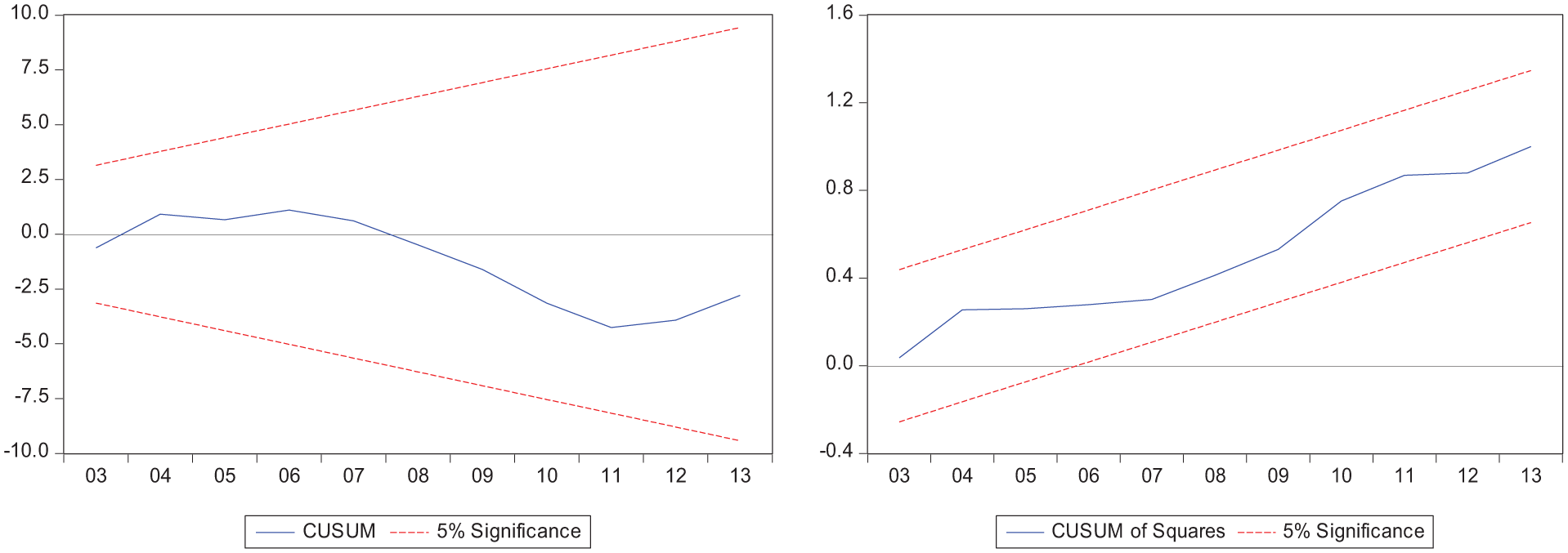
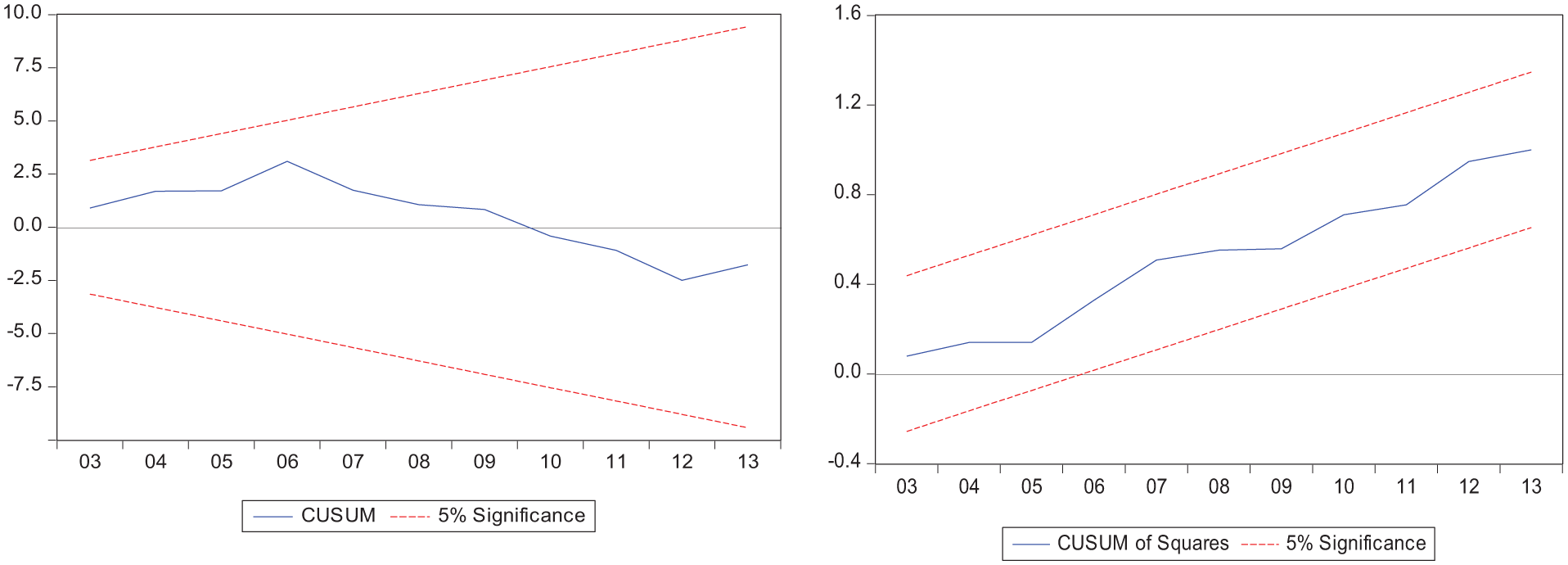
The stability of the long-run coefficients is tested by the short-run dynamics models. Once the ECM models in equations (9)-(11), have been estimated, the cumulative sum of recursive residuals (CUSUM) and the CUSUM square (CUSUMSQ) tests are applied to assess parameter stability since unstable parameters can result in model misspecification (Narayan and Smith 2006). Figures 1 to 3 indicate the absence of any instability of the coefficients because the plots of the CUSUM and CUSUMQ statistics fall between the critical bands of the 5% confidence interval of parameter stability.

Plots of CUSUM and CUSUMSQ statistics for coefficient stability for the relationship between head-count ratio (H) and predictors (ITR, GDPc): Period 2000–2013.
Plots of CUSUM and CUSUMSQ statistics for coefficient stability for the relationship between poverty gap ratio (Gap) and predictors (ITR, GDPc): Period 2000–2013.
Plots of CUSUM and CUSUMSQ statistics for coefficient stability for the relationship between Gini coefficient (G) and predictors (ITR, GDPc): Period 2000–2013.
Discussion
Tourism has played an important role in the Dominican economy over the past 20 years. It is one of the sectors that has contributed most income to the economy (World Bank 2016), generating employment, underpinning other sectors (building, transport, and commerce), and stimulating infrastructural improvements.
Extraordinary growth has characterized the Dominican Republic from 2000 to 2013 in terms of the number of arrivals, the creation of large hotel complexes along the coast, and, consequently, the expansion of the supply of sun-and-sea tourism opting for the “all-inclusive” modality (Guzmán 2015). Its most obvious disadvantages are unregulated construction work along the coastline, encroachment on the natural environment, and weak territorial planning with no consideration for the local community and culture (UNDP 2005). There is no doubt that the proliferation of the “all-inclusive” model has been an obstacle to the interaction of tourists with the local community and has contributed to the exclusion of the local population from tourist activity. In 2006, Christie and Luna-Kesler argued that tourism development based on all-inclusive packages limits the in-country spending of tourists and the “tourism sector contribution to overall economic growth” (p. 11).
Thus, the model of tourism to which the Dominican Republic has committed itself, rather than fostering a sustainable and an inclusive form of tourism, has had quite the opposite effect. The results have shown that the percentage of poor people increased in terms of the incidence of poverty, measured as the proportion of poor people below the poverty threshold of $3.10 a day (H). In fact, a 1% increase in tourism income saw a 0.72% increase in poverty. Thus, people experiencing transitory poverty, close to the poverty line, can slide back into poverty, despite TRI-funded economic growth. One explanation is the scant collateral effect that tourist activity can have on society through the generation of tourism-related jobs, most of such a precarious nature that the transitory poor move below the poverty line.
It would be interesting to analyze the group of people who cross the poverty threshold as a consequence of tourism activity, to see how close they are to the threshold in terms of income. In all likelihood, most of them would continue to survive in a precarious situation. The poverty gap is a significant indicator, more so than the head-count ratio, for evaluating how the increase in income from tourism has influenced the reduction of poverty, since while it is true that individuals may experience periods of nonpoverty as measured against a specific poverty threshold, what is truly significant is the extent to which they succeed in diminishing the intensity of the poverty they experience. According to our results, the intensity of poverty has also increased as a result of tourist activity, as an increase of 1% in income from tourism actually results in a 0.40% increase in the poverty gap. This result indicates that the local community has not become less impoverished with the model of tourism implemented in the Dominican Republic.
As in other studies, our own findings suggest that tourism development will not necessarily reduce poverty (Blake et al. 2008), but that poor people are excluded from or disadvantaged by what tourism can offer (Scheyvens 2007). Blake (2008) pointed out that the influence of tourism development on poverty depends not only on the extent to which the poor are economically involved in tourism activity, but also on other export activities. International tourism development could quite feasibly provoke an appreciation of the real exchange rate with a negative collateral effect on other export industries (Blake 2008).
According to our results, the intensity of poverty has also increased as a result of tourist activity, as an increase of 1% in income from tourism actually results in a 0.40% increase in the poverty gap. This result indicates that the local community has not become less impoverished with the model of tourism implemented in the Dominican Republic.
It would suggest that the development of tourist activity has taken place behind the back of Dominican society, perhaps because of the absence of job-training policies aimed at the least well-off and the exclusion of the communities living close to the large hotel complexes or devoted to cultural tourism or tourism of a very different nature from the “hotel-resort” type of activity. So much so, that the period under consideration has been characterized not only by the growth of tourism, but also by the proliferation of marginal settlements (UNDP 2008). The all-inclusive sun-and-sea tourism model in the Dominican Republic has been developed, rather than other alternatives such as community-based tourism (CBT) where local people can involve themselves in tourism development and benefit from tourism-generated wealth. Therefore, the all-inclusive sun-and-sea tourism model fails to adopt pro-poor strategies to alleviate poverty.
It is equally assumed that tourism development like other types of development can be disadvantageous for the poor and cause greater inequality (Medina-Muñoz, Medina-Muñoz, and Gutiérrez-Pérez 2016) as happens in our study. From the empirical analysis, TRI also increased inequality in income distribution measured by the Gini index (0.10%). This result could be explained because tourism activity, far from improving equity in terms of redistribution of wealth, concentrates wealth in the businesses managing the large hotel complexes situated above all on the coast and, in consequence, leads to a redistribution of poverty. Everything appears to indicate that the Dominican tourist model has achieved no improvements in income redistribution.
Definitively, the present model of tourist exploitation in the Dominican Republic is not sustainable. Sustainable tourist activity must not ignore the improvement of the local community. In this sense, sustainability implies the inclusion of citizens in tourist activity as agents of cultural production and knowledge exchange, which will in turn dynamize the participation of other sectors (restaurants and commerce). A model of sustainable tourism for the Dominican Republic has little option but to wave goodbye to the present model of the all-inclusive three S’s (sun, sand, and sea). It must commit itself to a model designed to benefit the local communities in which tourist activity takes place, underpinning a structure that enables the needs of the tourists to be met, while respecting the environment and the needs of the host communities in terms of future economic, social, and environmental impacts.
Conclusion and Implications
Tourism represents 10% of the GDP; 1 of every 11 jobs is generated by this activity that accounts for 7% of the country’s total exports. It is also estimated that the number of international tourists worldwide will have risen to $1.8 billion by 2030 (World Tourism Organization 2016). These figures reflect the importance of tourism at the global level. The study of the relation between tourism and poverty, of growing interest for academic research, needs further empirical evidence to determine the effect of one upon the other (Croes 2014b; Mitchell and Ashley 2010; Winters, Corral, and Mora 2013). The present work has contributed along those lines, through its quantitative assessment of the extent to which tourism development can contribute to poverty reduction in countries where poverty is especially prevalent. An assessment that has analyzed TRI, its relation with poverty reduction, and the impact of income inequalities on the population, in the concrete case of the Dominican Republic, a Small Island Developing Country.
This research has provided empirical evidence on how tourism development, in this case based mainly on the all-inclusive sun-and-sea model in the Dominican Republic, has contributed to increased poverty when measured by the percentage of poor people who cross the poverty threshold. Furthermore, it has not been possible to confirm that income derived from tourist activity largely improves the intensity of poverty for those situated below the poverty threshold. To the extent that income from tourism arises, the incidence of poverty (number of poor individuals) and the intensity of poverty increase. These two conclusions precisely characterize the link between tourism and poverty in the Dominican Republic. The numbers of poor people not only increase, but those who remain poor become poorer as a consequence of tourist activity.
As observed in the literature review, the results of studies on tourism and the impact of tourist expenditure on poverty are not conclusive. Our findings show that tourism development will not necessarily alleviate poverty in less developed countries, contrary to some previous works (Blake 2008; Rakotondramaro and Andriamasy 2016), even though tourism development contributes to economic growth. They also support the previous findings of Croes (2014a) and N. Kim, Song, and Pyun (2016), who suggested that less-developed countries with higher per capita GDP (above $3,400 for N. Kim, Song, and Pyun 2016), among them the Dominican Republic, will not reap the benefits of poverty alleviation due to tourism development.
Our results have likewise allowed us to confirm that income from tourism increases income distribution inequality in the population of the Dominican Republic. Planning in the area of tourism must be instrumental in the development of much-needed structures, so as to help reduce the gap between rich and poor (Gregory 2007). The government must develop effective redistribution policies designed to improve the living standards of residents (Duffy et al. 2015). As Alam and Paramati (2016) pointed out, inequalities may be conditioned by the oligopolistic structure of the markets, since the providers of tourism services tend to be concentrated in a small number of multinational corporations. Local, small, and medium enterprises cannot compete fairly between each other, and market acquisitions will force some proprietors out of business, which will in turn lead to inequalities in income distribution. Besides, the benefits of tourism development favor the owners of tourist firms, but as long as employees of local communities are receiving low wages, income inequalities will increase (UNDP 2005, 2008).
The implications of the present research are inextricably connected to each agent participating in tourist activity and its role. The behavior of tourists, private companies, local communities, and government influence the potential benefits of tourism (Ashley 2006), one example of which would be “tourism-specific institutional structure conducive to poverty alleviation” (Winters, Corral, and Mora 2013, p. 178).
A key aspect is the need to involve the local economy in tourist activity, with the aim of increasing the multiplier effects of tourism in the immediate sphere, so that it may contribute to the reduction of poverty and income distribution inequalities. Local communities stand to benefit not only from the direct employment generated by tourism but also from the multiplier effect of the entire value chain (Job and Paesler 2013). From this perspective, the participation of the local community in tourism is of key importance for benefiting the local community through the redistribution of income from tourism (Aref, Ma’rof, and Zahid 2009; Medina-Muñoz, Medina-Muñoz, and Gutiérrez-Pérez 2016).
The sun-and-sea model of tourism and its limited involvement of local communities has not been instrumental in either reducing poverty or inequalities. It is now time to give earnest consideration to a community participative approach to tourism, because local community involvement is key to the beneficial effects of tourism as a means of poverty reduction through economic development (Ndivo and Cantoni 2016). It is also worth thinking along such lines as cultural or community tourism and wilderness tourism (Croes 2014b; Ndivo and Cantoni 2016). As Croes and Vanegas (2008, p. 96) stated, “tourism expansion and development both need to receive support from and give support to the local communities, because tourism activities affect an entire community. This means that the new growth and development strategy should focus on increased economic participation, social equity, and thus poverty reduction.” Hugo and Nyaupane (2016, p. 9) suggested “setting up clearly visible tour guide offices and increasing the number of organized activities” as well as community programs sponsored by hotels or hotels donations, to foster local community involvement in the tourism sector. Manwa and Manwa (2014) supported the idea of opening forest reserves to ecotourism in Botswana, as a means of reducing poverty among local communities through the direct, secondary, and dynamic effects of this sort of tourism.
Truong, Hall, and Garry (2014) recommended the perspective of poor people on poverty, underlining significant differences with the academic definition, among poor people in Sapa, Vietnam, where tourism was used as a means of poverty alleviation.
The way in which governments involve those with interests in the sector influences the model of tourist development. In this sense, another fundamental question is the ownership of assets. If properties are entirely owned by large foreign hotel chains, for example, it will complicate the creation of links between tourism and the local economy (Lacher 2008). In this sense, the role played by government policy is fundamental, as likewise in aspects related to employment policy, including conditions of hiring, wages, etc. Hence, tourism’s potential for reducing poverty is conditioned by the intervention of governments, which perform a coordinating role in the sharing of tourism experiences (Croes 2014b). More specifically, for three types of actions to implement governmental policy, Croes (2014a) advocates (1) stimulating investment in the tourism sector through economic incentives aligned with social costs and benefits; (2) attracting demand by means of an intensive promotion of the country; and (3) improving the country infrastructures thanks to the increase in tax revenues derived from tourism growth.
In short, the tourism–poverty link depends on the relations established between all actors involved in the activity: tourists, local communities, and public and private sectors. There is a need to explore new models of tourist systems, given that the traditional model prevailing in the Dominican Republic fails to reach the desired aim of reducing poverty. Similarly, Islam and Carlsen (2016) called for a coordinated effort of all committed stakeholders, from government organizations to private tourism organizations including nongovernmental organizations, national tourism organizations, international aid agencies, and indigenous communities themselves, to work together to alleviate extreme poverty in rural Bangladesh.
One of the limitations of the present work relates to the indicators used to contrast the hypotheses set forth in the research. The use of income derived from tourist activity as an explanatory variable of the reduction of poverty and inequality cannot contemplate aspects of the environment in which such income is generated (demographic variables, employment level, infrastructures, etc.). The choice of acceptable variables for measuring tourist activity or poverty is not an easy task, and so no totally satisfactory solution appears; on many occasions the researcher is simply limited to the use of available data (Croes and Vanegas 2008). Poverty is a multidimensional phenomenon (Alcock 2008; Sen 1992) rather than a unidimensional phenomenon based on the economic deprivation dimension. The concept of poverty used in this paper is linked to the concept of economic deprivation experienced by the population located below the poverty threshold. Hence, it would be interesting to use the FGT index (Foster, Greer, and Thorbecke 1984) for different values for the poverty aversion parameter (alpha parameter in its formulae) when analyzing the impact of tourism activities on poverty alleviation in future researches by applying the bounds testing ARDL approach to cointegration as suggested in this article. Thus, as recognized by Njoya and Seetaram (2018), taking into account not only head-count ratio (for alpha = 0) and gap ratio (alpha = 1) but also poverty severity indices (alpha > 1) a more complete picture about the effect of tourism activities on poor population would be obtained.
Doubtless it would be also interesting to use indicators that take in the multidimensional character of the phenomenon such as the Human Development Index (HDI; UNDP 2015) and the Social Progress Index (Social Progress Imperative 2016). However, the limitations presented by these indicators as regards their availability for the period analyzed, 2002–2013, and even the methodological change in the definition of HDI in that period make it necessary to revert the concept of monetary poverty. The present study could therefore be repeated in the future using multidimensional poverty indicators once longer time series become available for such indices. When this becomes possible, a better and clearer picture of the influence of tourist activity on poverty may be obtained. Furthermore, future research will complete the results and enrich them with enhanced data series from relevant economic variables, so far unavailable, on the economy of the Dominican Republic (e.g., gender balance in employment and in the tourism sector). Econometric case study design in the present case may not “provide external validity but can discern valuable data patterns, thus facilitating inferential analysis” (Croes 2014a, p. 209).
Finally, data of a quantitative nature formed the basis of the study. Following the recommendations of Spenceley and Meyer (2012), future work would ideally combine both quantitative and qualitative data for measuring poverty and the impacts of tourism.
Footnotes
Declaration of Conflicting Interests
The author(s) declared no potential conflicts of interest with respect to the research, authorship, and/or publication of this article.
Funding
The author(s) received no financial support for the research, authorship, and/or publication of this article.
