




Abstract
Using online customer reviews for airline services, this study examines the impacts of various attributes of airline service failures and subsequent recovery actions on customer consumption emotions, satisfaction, and recommendation likelihood through text mining, sentiment analysis, and path analysis. Findings suggest that causes, magnitude, and consequences of service failures influence customers’ positive and negative emotions. Providing compensation for the current trip, either monetary or nonmonetary, can alleviate customers’ negative emotions, while providing compensation for future travel does not have any impact on emotions. Findings further suggest that positive employee attitudes, behaviors, and prompt service recovery actions generate more positive emotions while alleviating negative emotions compared to compensations provided. Service failures and timely, reliable, and satisfactory recovery actions have greater influences on travelers who fly with full-service airlines and in business class compared with travelers who fly with low-cost airlines and in economy class. Customers’ emotions influence their satisfaction and recommendation likelihood.
Keywords
Introduction
Airline service failures and failed recovery attempts have been receiving significant media attention in recent years. In fact, those service failures and failed recovery attempts have prompted a public relations crisis for the airline industry (Shen 2017), which is feared to take a significant toll on airlines financial performance due to loss of customer trust and loyalty. For example, in April 2017, United Airlines shares dropped $1.4 billion (4%) during the second day after a public relations crisis caused by overbooking that resulted in a passenger being forcibly dragged off that overbooked flight (Shen 2017).
It is true that even the best service providers cannot completely avoid service failures. Thus, planning for service recovery is one of the most important operational steps. Examining and understanding customer perceptions of service failures and subsequent recovery actions are the first few steps in designing a reliable service failure recovery process (Gu and Ye 2014). Several studies have examined negative impacts of service failures and positive impacts of subsequent service recovery actions on customer satisfaction (e.g., S. W. Anderson, Baggett, and Widener 2009; Dickinger and Bauernfeind 2009). However, most of those studies did not examine the differences among various attributes of service failures and recovery processes (e.g., Nguyen and McColl-Kennedy 2003). Therefore, a systematic review that incorporates attributes of service failures and impacts of subsequent recovery actions on customer attitudes and behaviors is still needed. Furthermore, while a few studies have examined the role of customer emotions in the context of service failure and recovery (e.g., Del Río-Lanza, Vázquez-Casielles, and Díaz-Martín 2009), the coexistence of positive and negative emotions has not received much attention (Williams and Aaker 2002). Examining the role of customer emotions during service failures and recovery processes can help us better understand customers’ expectations and those expectations’ impacts on customer satisfaction with the recovery. To address these research gaps, this study aims to examine (a) the influence of service failure attributes, which include causes, magnitudes, and consequences of a service failure, on positive and negative emotions, satisfaction, and recommendation behaviors and (b) the influence of recovery actions, which include monetary and nonmonetary compensation, speed of recovery actions, and employee empathy and apology, on customer perceptions.
Most previous studies that examined airline service failures and recovery actions did not consider the impacts airline type and cabin class can have on customer evaluations of service failures and recovery actions. Full-service airlines and low-cost airlines provide different level and types of services, charge different fares (Fourie and Lubbe 2006), and target different groups of customers with different expectations and needs (O’Connell and Williams 2005). Thus, customers of each airline type are likely to utilize different criteria to evaluate service failures and recovery actions. In addition, business class and economy class travelers have different service expectations, which can influence their evaluations of service failures and recovery actions. For example, compensation expectations are likely to vary significantly between business class and economy class customers, and even between customers of full-service and low-cost airlines. Understanding the impacts of those differences on service failure and recovery evaluations can help airlines better address customer expectations during service failures and recovery steps. Thus, the third purpose of this study is to (c) examine the role of airline type (i.e., full-service vs. low-cost) and cabin type (i.e., business class vs. economy class) on customers’ evaluations of service failures and recovery actions.
Contributions of this study mainly lie in the following aspects: First, this study examines influences of service failures and recovery actions on both positive and negative emotions and their role in influencing satisfaction and recommendation likelihood. Second, this study identifies influences of compensation for the current / future travel, and monetary / nonmonetary compensation on emotions. Third, moderating the role of airline type (i.e., full-service vs. low-cost) and cabin type (i.e., business class vs. economy class) on the impacts of service failures and recovery actions on customers’ positive and negative emotions are investigated. Lastly, this study examines online electronic word of mouth (eWOM) behaviors utilizing online reviews from social media sites. Findings provide further evidence on the importance of closely monitoring and managing online customer reviews as well as their value as critical business intelligence inputs in the social commerce and e-commerce era.
Theoretical Background and Literature Review
Theoretical Background
This study examines airline customers’ behavioral responses to airline service failures and recovery actions drawing on the perceived justice theory and the cognitive appraisal theory. As suggested by the cognitive appraisal theory, customers treat service failures as conflict situations (Del Río-Lanza, Vázquez-Casielles, and Díaz-Martín 2009). In their evaluation of the conflict, their perception of justice plays an important role in determining the fairness of service failures and recovery actions (Gustafsson 2009). The perceived justice theory provides a comprehensive framework for understanding consumers’ perception of fairness of service recovery actions and complaint processes (Tax, Brown, and Chandrashekaran 1998). The perceived justice theory suggests that justice has three dimensions: distributive (Deutsch 1985), procedural (Lind and Tyler 1988), and interactional (Bies and Shapiro 1987). Distributive justice is defined as customers’ perceptions of the fairness of actual outcomes or consequences of a decision (Deutsch 1985). In this study, perceived distributive justice refers to customers’ perceptions of fairness of a service failure and fairness of the compensation provided during recovery process. Distributive justice perceptions are formed based on customers’ evaluations of the possible consequences of service failures and the appropriateness of recovery actions such as the monetary / nonmonetary compensation for the current / future trips. Procedural justice is customers’ perceptions of the fairness of procedures used in making decisions (Lind and Tyler 1988). In this study, perceived procedural justice refers to customers’ perceptions of fairness of the magnitude of the service failures, for example, the length of the flight delay, and the speed of recovery actions, that is, whether employees implemented recovery actions promptly and rapidly. Interactional justice refers to customers’ perceptions of the fairness of interpersonal behaviors in the enactment of procedures and delivery of outcomes (Bies and Shapiro 1987). In this study, interactional justice refers to customers’ perceptions of fairness of the cause of the service failures (i.e., internal reasons related to human factors vs. external reasons such as weather), and fairness of interactions between employees and customers such as communication about causes and magnitude of the delay, empathy and apologies received from employees, as well as service attitudes and behavior of employees during service recovery process.
When service failures occur and service recovery actions are implemented, the way customers evaluate these generates emotions, not the service failures or service recovery actions themselves (Del Río-Lanza, Vázquez-Casielles, and Díaz-Martín 2009). According to the cognitive appraisal theory, customers’ emotional responses are the results of their appraisal of a situation (Bagozzi, Gopinath, and Nyer 1999). In this cognitive appraisal process, perceived justice plays a critical role, and the resulting emotions reflect the way customers perceive the justness of the event or situation (Chebat and Slusarczyk 2005), which in turn affect customers’ evaluation of service recovery actions (Del Río-Lanza, Vázquez-Casielles, and Díaz-Martín 2009). Even though the cognitive–affective sequence can significantly influence customer satisfaction (Mattila and Wirtz 2000), especially in a service failure situation, only few researchers have included emotions in studies that examined perceived justice in service failure and recovery contexts (Chebat and Slusarczyk 2005; Del Río-Lanza, Vázquez-Casielles, and Díaz-Martín 2009). This article attempts to fill this gap by examining the impacts of various service failures and recovery actions on both positive and negative emotions.
According to the utility theory (Lancaster 1971), customers purchase bundles of airline products and services with a certain level of quality expectations at a certain price to obtain utility. Customers’ expectation of service quality is formed based on a number of implicit service promises such as price, tangibles and intangibles (Zeithaml, Betty, and Parasuraman 1993). Customers of full-service airlines and business-class cabin, compared to customers of low-cost airlines and economy class cabin, usually pay higher prices, which raise their expectations for higher utility products and services (Liu et al. 2013). Thus, emotional reactions of those customers to a service failure are likely to be different.
Airlines Service Failures and Recovery Actions
Previous studies about airline service failures and recovery can be categorized into two groups. The first group of studies focuses on causes of airline service failures and their consequences. External causes such as bad weather (S. W. Anderson, Baggett, and Widener 2009) and internal causes such as overbooking (McCollough 2000) have been discussed. Negative consequences of service failures on customer satisfaction, trust, loyalty, customer-switching behavior, and supplier-buyer relationships (S. W. Anderson, Baggett, and Widener 2009) have also been studied. The second category of studies focuses on airline service recovery actions and their consequences. Those who examined service recovery actions and their consequences have concluded that effective recovery actions can enhance customer satisfaction and prevent switching behavior compared to no or ineffective recovery actions (Cai and Qu 2018).
Customer Consumption Emotion
Customer consumption emotion refers to a set of emotional responses elicited specifically during consumption experiences (Westbrook and Oliver 1991). Appraisal theory suggests that when individuals are exposed to an environmental stimulus (Lazarus 1991), they go through an evaluation process. This evaluative process begins with a primary appraisal whereby customers assess goal congruence and goal relevance of the service provided. If the service provided is seen as out of the ordinary and incongruent with their expectations, a secondary appraisal elicits cognitions and emotions. Both positive and negative emotions can be evoked as a result of customers’ evaluation of a product and/or service performance compared to their expectations (Phillips and Baumgartner 2002). If expectations of service quality are much higher than the quality of service received, negative emotions are likely to be generated. On the other hand, if service quality expectations are much lower than the service quality received, positive emotions are likely to be generated. Customers’ expectation of service quality is influenced by a number of factors such as past experiences, implicit service promises, situational factors, etc. (Zeithaml, Betty, and Parasuraman 1993). Furthermore, quality of interactions with employees, physical environment such as ambience and design, and outcome quality expectations are also likely to have significant impact on customers’ perception of the service quality (Brady and Cronin 2001) and, thus, on their emotions.
Although many studies have only focused on either positive or negative emotions (Williams and Asker 2002), this has been challenged by other studies in psychology (Larsen, Mcgraw, and Cacioppo 2001) and consumer behavior (Lau-Gesk 2005). Larsen, Mcgraw, and Cacioppo (2001) used Cacioppo and Berntson’s (1994) evaluative space model showing that positive and negative emotions can coexist under certain circumstances. Babin, Darden, and Babin (1998) argued that having a negative emotion does not preclude the feeling of a positive emotion. Jang and Namkung (2009) found that customers can feel happiness and unhappiness at the same time. From a psychological perspective, the coexistence of positive and negative emotions generates mixed emotions (Williams and Aaker 2002). Two independent dimensions represent the emotional valence, and thus people can experience conflicting emotions simultaneously, and this joint experience can be natural and occurs frequently (Cacioppo, Gardner, and Berntson 1997; Larsen, Mcgraw, and Cacioppo 2001). For example, a news story reported about the Sichuan Airlines in May 2018 stated that passengers felt both afraid and joyful when they heard that the cockpit window was broken during flight. Their fear was accompanied by joy and excitement after the reassurances from the crew that the flight could land safely even with a broken cockpit window (Wilkinson and Wang 2018). Another example is that an airline passenger can feel both joy and gratitude for a meal served on a plane because he or she is hungry; however, he or she may feel sad and even hate the food because of the taste and flavor of the food (Fensterstock 2017). Coexistence of both positive and negative emotions also frequently appear in advertisements. For example, the Diet Coke advertisement on Rolling Stone magazine utilizes both emotions in the ad script: “She can make me laugh even when I am mad at her. That Certain Something, Diet Coke” (Williams and Aaker 2002, p. 636). Other examples include while watching a movie or a commencement ceremony, the emotion of happiness and sadness can be experienced at the same time (Andrade and Cohen 2007).
Omission of positive emotion when customers experience negative emotion is problematic, as when the service provider implements good recovery actions, customers’ negative emotion can be reduced, while positive emotion can be enhanced simultaneously. However, poor recovery actions can exacerbate negative emotions and reduce positive emotions simultaneously (DeWitt, Nguyen, and Marshall 2008). Since a service experience can include both high- and low-quality experiences during the same service delivery process, positive and negative emotions can also coexist. This study examines both positive and negative emotions resulting from service failures and recovery actions because they both influence customers’ perception of service performance significantly, and the desired and actual emotion can change over the course of a travel experience (Le Bel 2005).
Previous studies have examined both the service quality (e.g., Augustyn and Ho 1998; Weber 2005) and customer online reviews on travel and tourism businesses (e.g., Shin et al. 2019; Stamolampros et al. 2019). This study bridges these two streams of research through examining customer emotion and satisfaction toward airline service quality, particularly service failures and recovery actions, using online customer reviews.
Hypotheses Development
Service Failures
Influence of severity of service failures on customer emotions
Cognitive evaluations of service failure consequences determine customer emotions (Smith and Bolton 2002). Service failures that cause serious consequences reduce customers’ positive emotions of joy and happiness, and stimulate sentimental evaluation of service quality (Wen and Chi 2013). Serious service failures result in large resource losses, and, thus, customers view the exchange as inequitable, which arouses their negative emotions (Richins 1987). Based on the above discussion, the following hypotheses are proposed:
Hypothesis 1a: There is a significant negative relationship between the severity of service failures and customers’ positive emotions.
Hypothesis 1b: There is a significant positive relationship between the severity of service failures and customers’ negative emotions.
Influence of magnitude of service failures on customer emotions
Magnitude of service failure is one of the most critical determinants of customers’ emotions, especially for airline service failures (Lin and Liang 2011). Some of the airline service failures, especially delays, force customers to stay longer in unfavorable physical environments, which reduces their positive emotions (Lin and Liang 2011). Punctuality of service refers to an evaluation adherence to a particular time, which shows the promptness (Taylor 1994). Punctuality heavily influences customers’ perception of service reliability, which is considered as one of the critical determinants of perceived service quality and whole experience quality (Parasuraman, Zeithaml, and Berry 1985). As the magnitude of service failures increase (e.g., longer delays), negative emotions such as frustration and worries are likely to increase as well (McCollough 2000). Based on the above discussion, the following hypotheses are proposed:
Hypothesis 1c: Higher-magnitude service failures weaken customers’ positive emotions.
Hypothesis 1d: Higher-magnitude service failures strengthen customers’ negative emotions.
Influence of Causes of Service Failures on Customer Emotions
A service failure typically results in customer utility loss as a result of the service provider’s failure to provide a basic service or perform the core service (Smith, Bolton, and Wagner 1999). According to the attribution theory (Weiner 1985), customers usually attempt to identify the causes of a service failure before evaluating its consequences. If customers believe that the service failure was caused by internal reasons such as delays caused by mechanical reasons, incorrect scheduling, etc., then they will blame the service provider for the failure. This will negatively influence customers’ evaluations of the service provider’s ability to provide a reliable, good-quality service (Rafaeli and Sutton 1990), which may result in the belief that the service provider has cheated them by failing to provide the promised service efficiently and effectively. This process is likely to result in a perception of injustice and negative emotions (Chebat and Slusarczyk 2005; Lin and Liang 2011). Based on the above discussion, the following hypotheses are proposed:
Hypothesis 1e: Service failures caused by internal factors weaken customers’ positive emotions.
Hypothesis 1f: Service failures caused by internal factors strengthen customers’ negative emotions.
Service Recovery
Influence of monetary and nonmonetary compensation on customer emotions
In this study, influences of two forms of travel compensation on customer emotions are examined: travel compensation for the current trip and travel compensation for future trips. The travel compensation for the current trip is operationalized as monetary compensation such as meal vouchers, or nonmonetary compensation such as hotel accommodations, seat upgrades, and so on. Providing compensation for the current trip can result in fewer complaints by restoring customers’ perception of distributive justice (Wirtz and Mattila 2004) and by enhancing both utilitarian and hedonic values (Mano and Oliver 1993). Hotel rooms and meals that are compensated by the service provider can make consequences of a service failure more manageable, which can enhance customers’ positive emotions (Sirgy et al. 2011). Furthermore, compensated products and services can provide additional utility for customers by inducing the perception that they receive additional services for the same price, which can enhance their positive emotions (Naylor and Frank 2001). It can also diminish customers’ feelings of injustice, uncertainty, and frustration about a service failure, which can alleviate their negative emotions (Wen and Chi 2013). Based on the above discussion, following hypotheses are proposed:
Hypothesis 2a: Providing monetary travel compensation for the current trip strengthens customers’ positive emotions.
Hypothesis 2b: Providing monetary travel compensation for the current trip weakens customers’ negative emotions.
Hypothesis 2c: Providing nonmonetary travel compensation for the current trip strengthens customers’ positive emotions.
Hypothesis 2d: Providing nonmonetary travel compensation for the current trip weakens customers’ negative emotions.
Compensation for future trips refers to compensations that can be applied to future travel, which is often in the form of flight ticket vouchers and coupons. It can create a value-adding effect, which can enhance customers’ positive emotions (Babin and Attaway 2000). It also provides a strong incentive to use the same airline for future travels (Karande, Magnini, and Tam 2007). Furthermore, it can alleviate the perception of inequality and dissipate consumer anger and frustration after a service failure (McCollough, Berry, and Yadav 2000). It is considered to be an effective remedy for fixing the imbalanced relationship between a service provider and a buyer in the event of service failures (Chebat and Slusarczyk 2005). Based on the above discussion, following hypotheses are proposed:
Hypothesis 2e: Providing future travel compensation strengthens customers’ positive emotions.
Hypothesis 2f: Providing future travel compensation weakens customers’ negative emotions.
Influence of speed of recovery actions on customer emotions
Procedural justice is a critical determinant of customer perceptions of fairness of complaint handling process (Karatepe 2006). The speed by which service failures are corrected is one of the most important determinants of customers’ perception of procedural fairness (Tax, Brown, and Chandrashekaran 1998). The immediate response to a service failure can provide assurances to customers that the service provider is reliable and service failures happen rarely (Wirtz and Mattila 2004). Speedy responses also alleviate customers’ worries about future service failures (Blodgett, Wakefield, and Barnes 1995). Based on the above discussion, the following hypotheses are proposed:
Hypothesis 2g: Quicker recovery actions strengthen customers’ positive emotions.
Hypothesis 2h: Quicker recovery actions weaken customers’ negative emotions.
Influence of empathy and apologies, and service attitudes and behaviors on customer emotions
Showing empathy for the service failure that a customer has just experienced and sincerely apologizing for it can enhance customers’ perception of sincerity of employees’ regret about service failures and thus enhance the seller–buyer relationship (Grégoire, Tripp, and Legoux 2009). Furthermore, a sincere apology can have positive impacts on customers’ evaluation of the recovery process and, thus, enhance their positive emotions (Hart, Heskett, and Sasser 1990). Empathy and sincere apology can compensate for the damage to customers’ ego-identity and self-esteem and help reduce customers’ anger over a service failure (Nguyen and McColl-Kennedy 2003). Based on the above discussion, this study proposes the following hypotheses:
Hypothesis 2i: Empathy and apologies strengthen customers’ positive emotions.
Hypothesis 2j: Empathy and apologies weaken customers’ negative emotions.
Employee service attitudes and behaviors play major roles in customer perception of quality in service-intensive industries such as the travel and tourism industry (S. W. Anderson, Baggett, and Widener 2009). Positive service attitudes and behaviors strengthen the relationship between customers and employees (S. W. Anderson, Baggett, and Widener 2009). Positive service attitudes and behaviors can induce the perception that employees are doing everything within their power to resolve the issue, which can mitigate customers’ negative emotions (Clemmer and Schneider 1996). Based on the above discussion, this study proposes the following hypotheses:
Hypothesis 2k: Employees’ positive service attitudes and behaviors strengthen customers’ positive emotions.
Hypothesis 2l: Employees’ positive service attitudes and behaviors weaken customers’ negative emotions.
Airline Type
Moderating role of airline type on the influence of service failures on customer emotion
The business model and the type of services provided by full-service airlines and low-cost airlines can be different (Akamavi et al. 2015). Low-cost airlines often focus on core services and do not provide most auxiliary services such as in-flight entertainment and food service. They often offer lower air fares than full-service airlines (Grigolon, Kemperman, and Timmermans 2012). Customers’ service expectations from full-service airlines are usually higher than that from low-cost airlines (E. W. Anderson, Fornell, and Lehmann 1994). Thus, when a service failure happens, the gap between the expectations and the perceived quality is higher for full-service airlines, which largely reduces customers’ positive emotions. Based on the above discussion, this study proposes the following hypothesis:
Hypotheses 3a, 3c, 3e: The impact of service failure attributes: severity (3a), magnitude (3c), and cause (i.e., by internal reasons due to human factors or by external reasons due to natural factors) (3e) on customers’ positive emotions is higher for full-service airlines compared to low-cost airlines.
Customers’ sense of perceived fairness in service failure situations can vary depending on the price they paid for the service, and this can influence their consumption emotions (Xia, Monroe, and Cox 2004). According to the social exchange theory (Emerson 1976), customers view an exchange as more inequitable if they experience a service failure for a service they paid a relatively high price compared to relatively less expensive services. When full-service airlines (compared to low-cost airlines) suffer service failures, customers feel the lost utilities more acutely because of the higher price paid for the service. Thus, full service airline service failures are likely to result in more negative emotions compared to low cost airline service failures (Smith, Bolton, and Wagner 1999). Since low-cost airline customers focus more on value-for-money attributes instead of service quality (Cravens et al. 1988), they are likely to have fewer negative emotions when service failures occur because of their low service expectations. Based on the above discussion, this study proposes the following hypothesis:
Hypotheses 3b, 3d, 3f: The impact of service failure attributes: severity (3b), magnitude (3d), and cause (i.e., by internal reasons due to human factors or by external reasons due to natural factors) (3f) on customers’ negative emotions is higher for full-service airlines compared to low-cost airlines.
Moderating role of airline type on the influence of service recovery actions on customer emotions
When customers pay a higher price, they expect to receive higher-quality products and services (E. W. Anderson, Fornell, and Lehmann 1994) because they view the monetary value as a proxy for quality (Liu et al. 2013). Thus, price is a critical determinant of customers’ quality expectations (E. W. Anderson, Fornell, and Lehmann 1994). Customers form their overall perception of airline quality based on their evaluation of seven dimensions, including reliability, assurance, facilities, employees, flight patterns, customization, and responsiveness (Gilbert and Wong 2003). Among these dimensions, reliability has repeatedly been rated as the most important dimension (Parasuraman, Zeithaml, and Malhotra 2005). Flight delays and cancellations are viewed as the most critical determinants of airline service reliability perceptions (Gilbert and Wong 2003).
As discussed earlier, customers of full-service airlines have higher expectations than those of low-cost airlines. Because of those higher expectations, customers expect full-service airlines to implement timely, reliable and satisfactory service recovery actions in the event of a service failure (McCollough, Berry, and Yadav 2000). Those timely, reliable and satisfactory service recovery actions also result in the generation of an emotional value in customer mind (Deng et al. 2010). Thus, when full-service airlines implement recovery actions that meet or exceed customer expectations, they generate more positive emotions compared to recovery actions implemented by low-cost airlines. Based on the above discussion, this study proposes the following hypothesis:
Hypotheses 4a, 4c, 4e, 4g, 4i, 4k: Monetary travel compensation for the current trip (4a), nonmonetary travel compensation for the current trip (4c), monetary travel compensation for the future trips (4e), speed (4g), apologies (4i), and positive employee service attitudes and behaviors (4k) have significantly more impact on customers’ positive emotions for full-service airlines compared with customers’ positive emotions for low-cost airlines.
Customers of full-service airlines have a higher tolerance for price but a lower tolerance for delays than customers of low-cost airlines (O’Connell and Williams 2005). However, service recovery actions can alleviate negative emotions resulting from service failures (Fourie and Lubbe 2006). Timely, reliable, and satisfactory recovery can also increase the perceived utility and benefits, especially for higher-priced products and services compared to lower priced ones (Lichtenstein, Netemeyer, and Burton 1990), which can result in alleviation of negative emotions. Thus, this study proposes that:
Hypothesis 4b, 4d, 4f, 4h, 4j, 4l: Monetary travel compensation for the current trip (4b), nonmonetary travel compensation for the current trip (4d), monetary travel compensation for the future trips (4f), speed (4h), empathy and apologies (4j), and positive employee service attitudes and behaviors (4l) have significantly more impact on customers’ negative emotions for full-service airlines compared to customers’ negative emotions for low-cost airlines.
Airline Classes
Moderating role of airline class on the influence of service failures on customer emotion
Higher price of business-class tickets raises business-class travelers’ expectations for obtaining higher utility through higher-quality products and services (Liu et al. 2013). Because business-class travelers have higher expectations of service quality, in the event of a service failure, the gap between their expectations of service and perceived service is higher than economy-class travelers. Thus, service failures can have significantly more negative impact on business-class travelers’ emotions compared to economy-class travelers. Based on the above discussion, this study proposes that:
Hypotheses 5a, 5c, 5e: Service failure severity (5a), magnitude (5c), and cause (i.e., by internal reasons due to human factors or by external reasons due to natural factors) (5e) have significantly more negative impacts on business-class travelers’ positive emotions compared to economy-class travelers’ emotions.
Travelers in business class are often business travelers with different expectations than leisure travelers. Business travelers are more time-sensitive, travel more frequently, and take longer trips than other travelers (e.g., leisure travelers, Gilbert and Morris 1995). Thus, service failures generate more negative emotions in business travelers compared to leisure travelers because of possible serious consequences of failures such as being late to or missing a business meeting (Khattak, Schofer, and Koppelman 1993). Thus, this study proposes that:
Hypotheses 5b, 5d, 5f: Service failure severity (5b), magnitude (5d), and cause (i.e., by internal reasons due to human factors or by external reasons due to natural factors) (5f) generate significantly more negative emotions in business-class travelers compared to economy-class travelers.
Moderating role of airline class on the influence of service recovery actions on customer emotions
As discussed earlier, in the event of a service failure, dissatisfaction is likely to be higher for customers who pay higher prices compared to customers who pay lower prices for air travel. However, a timely, reliable and satisfactory recovery service is likely to have a higher effect on customers’ emotions who pay higher prices because of their expectations of speedy and satisfactory recovery as opposed to customers who pay lower prices (Miller, Craighead, and Karwan 2000). Thus, a speedy, reliable and satisfactory recovery service is likely to evoke more positive emotions and low negative emotions in business-class travelers compared to economy-class travelers. Based on the above discussion, this study proposes that:
Hypotheses 6a, 6c, 6e, 6g, 6i, 6k: Monetary travel compensation for the current trip (6a), nonmonetary travel compensation for the current trip (6c), monetary travel compensation for the future trips (6e), speed (6g), empathy and apologies (6i), and employees’ positive service attitude and behavior (6k) evoke more positive emotions in business-class travelers compared to economy-class travelers.
Hypotheses 6b, 6d, 6f, 6h, 6j, 6l: Monetary travel compensation for the current trip (6b), nonmonetary travel compensation for the current trip (6d), monetary travel compensation for the future trips (6f), speed (6h), empathy and apologies (6j), and employees’ positive service attitude and behavior (6l) result in significantly lower negative emotions in business-class travelers compared to economy-class travelers.
Customer Emotions, Satisfaction, and Recommendation Behaviors
Customers tend to evaluate products more positively when they are in a positive emotional state than when they are in a negative emotional state (Isen 1987). Thus, customers who experience more positive emotions during service failure recovery process usually express more satisfaction (Yalch and Spangenberg 2000) compared to customers who experience more negative emotions. Furthermore, customers become more critical in their assessment of service quality when they are in a negative emotional state (McColl-Kennedy and Sparks 2003). They tend to be more detail oriented, systematic, and use complex judgmental processes to evaluate the service failure recovery process (Forgas 1994). Thus, this study proposes that:
Hypothesis 7a: Customers’ positive consumption emotions positively affect satisfaction.
Hypothesis 7b: Customers’ negative consumption emotions negatively affect satisfaction.
The behavioral model (Fishbein and Ajzen 1975) provides insights into understanding the causal relationship between affect (satisfaction) and conation (recommendation). As indicated by a large number of studies, satisfaction is one of the critical antecedents of recommendation likelihood (Šerić and Praničević 2018). Thus, this study proposes that:
Hypothesis 8: Customer satisfaction positively affects recommendation likelihood.
Based on the above discussion, this study proposes the conceptual framework presented in Figure 1.
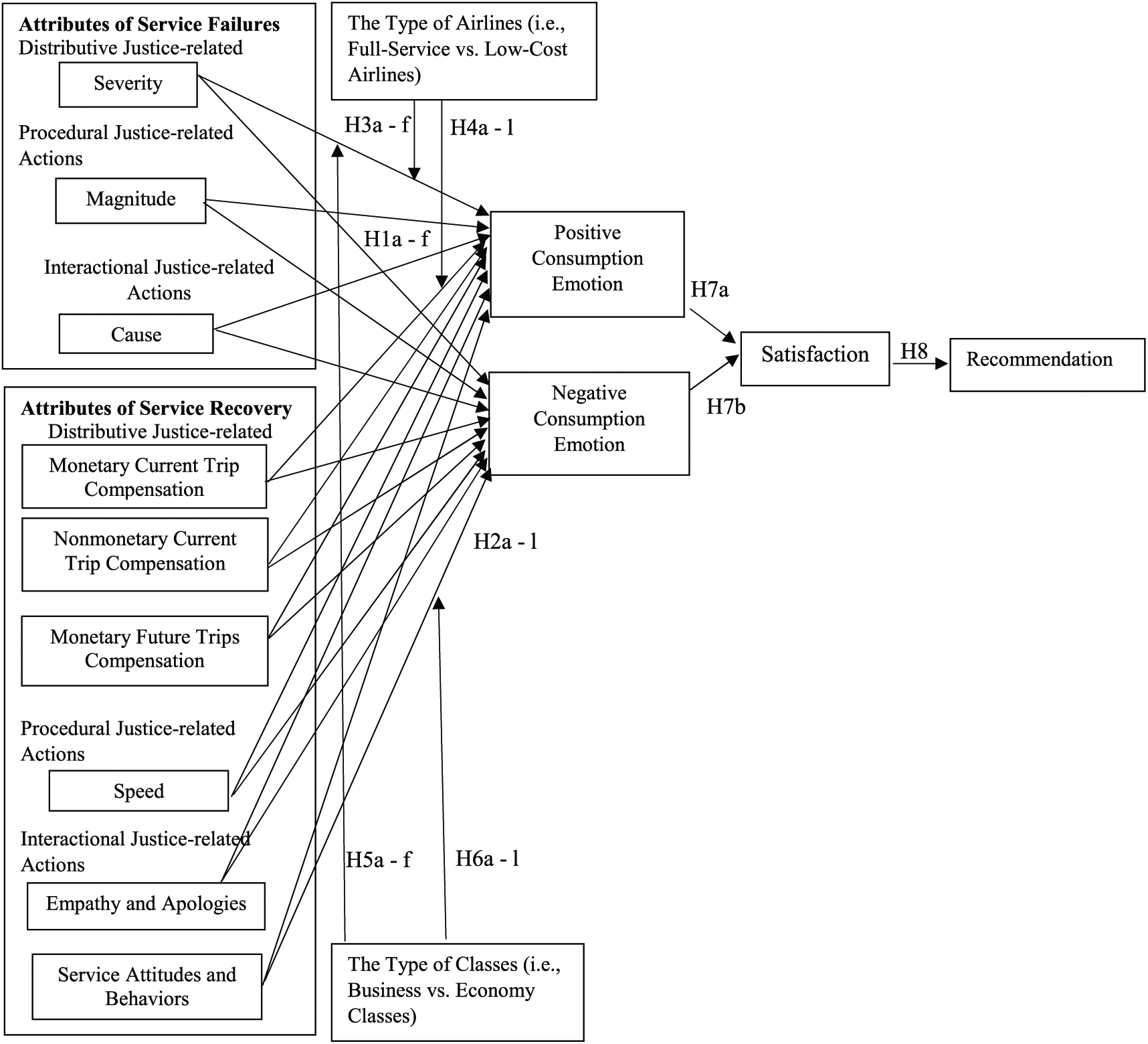
The conceptual framework of this study.
Methodology
Data Collection
Even though airline customers can encounter a number of service failures such as long check-in lines and ticketing process, uncomfortable seats, unsatisfactory in-flight food and entertainment services, lost luggage, unfriendly service, and so on (Xu and Li 2016), this study only focuses on core airline service failures impact on customers’ attitudes and behaviors because core service failures are the ones that can result in serious consequences for customers (S. W. Anderson, Baggett, and Widener 2009). Previous studies suggest that the core airline service failures are flight delays and cancellations (e.g., S. W. Anderson, Baggett, and Widener 2009) because airlines’ core business is to transport customers from point A to point B. Thus, both flight delays and cancellations are considered as core service failures in this study, which is consistent with the operationalization of core service failures in other studies (e.g., S. W. Anderson, Baggett, and Widener 2009).
Data were collected from Skytrax (http://www.airlinequality.com/), a popular airline service rating website (Xu and Li 2016). Skytrax presents reviews of airlines from various countries. In this study, only US-based airline reviews were used. Based on the previous studies (e.g., Lapré and Tsikriktsis 2006; Tsikriktsis and Heineke 2004; Xu and Li 2016), Alaska, American, Delta, Hawaiian, United, and Virgin America were considered as the full-service airlines and Allegiant Air, Frontier, JetBlue, Spirit, Southwest, and Sun Country were considered as low-cost airlines. Data included online customer textual reviews, customer ratings of their flight experiences, demographic information about customers, and basic information about the flight (e.g., airplane, route, and seat). A screenshot of online customer reviews can be found in Figure 2. Using WebHarvy, a visual web-scraping tool, verified online customer reviews of full-service/low-cost airlines and business-/economy-class trips posted between January 2014 and December 2016 were collected. The online reviews are verified by the Skytrax editorial team by confirming the online review writers’ e-ticket, booking details, or boarding pass with the customer name and the airline route noted in the review. Only those verified reviews that mentioned flight delays or cancellations were used in this study.
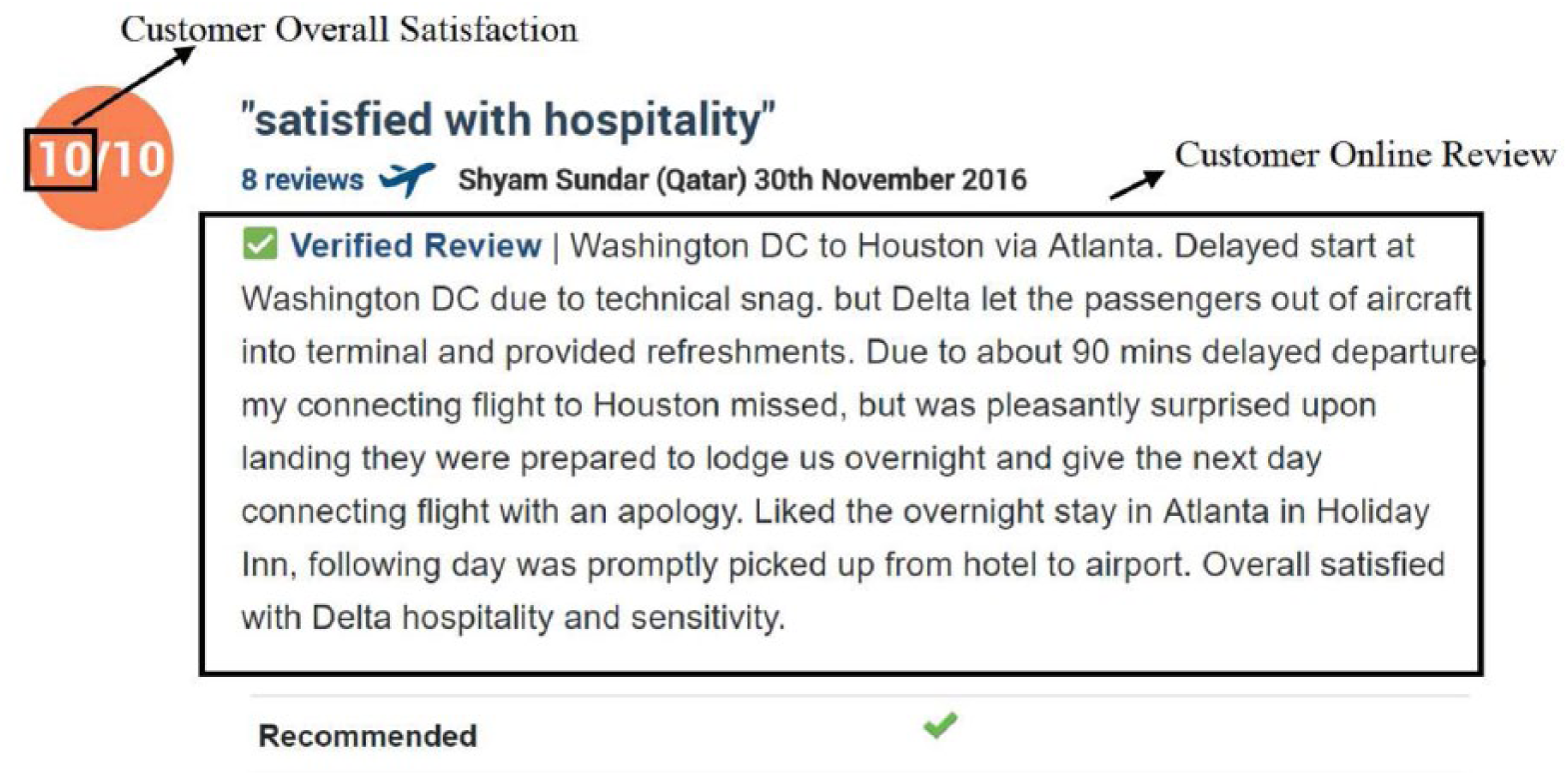
Screenshot of online customer review on Skytrax.
For the content analysis, two members of the research team independently coded the data using procedures recommended by Krippendorff (2004). Krippendorff’s alpha was then estimated to assess the extent of intercoder reliability. Krippendorff’s alpha value measures the agreement for nominal, ordinal, interval, and ratio data, which is fully comparable to the reliabilities reported for metric data (Hayes and Krippendorff 2007). In this study, to calculate the Krippendorff’s alpha value, we used a two-dimensional matrix corresponding to each review, where two is the number of members in the research team independently coding the data; and the length of each dimension in the array is nine, which is the number of variables that need to be coded. In this study, each review is treated as a subject, and each variable to be coded is treated as a unit. The purpose of calculating intercoder reliability is to estimate the level of agreement among different coders on the subject (Hayes 2005; Krippendorff and Bock 2009). In the case of low intercoder reliability (i.e., Krippendorff’s alpha < 0.80), suggesting disagreement among coders on a review, a number of approaches can be used to address the issue, such as having another expert serve as a tie-breaker, discussing and resolving the disagreement, and randomly selecting or selecting the majority decision from the different coders (Lombard, Snyder-Duch, and Bracken 2010). In this study, based on the recommendation in Abelson (1997) study and the example presented in Block, Roberson, and Neuger’s (1995) study, we discarded the reviews that yielded a low intercoder reliability (i.e., Krippendorff’s alpha < 0.80), which resulted in elimination of 18 reviews (less than 1%). The similar process of discarding samples is also used in many other studies in order to avoid sample bias and allow for better statistical generalization and accuracy (e.g., Larsson 1993). This process yielded a sample of 2,439 reviews for path analysis.
Measurements
As suggested by previous service failure and recovery studies (Smith, Bolton, and Wagner 1999), binary variables were used to categorize the attributes of service failures and recovery actions. The advantage of using binary variables is that it enables clear categorization of the data, which makes data analysis and interpretation easier. Internal reasons for service failures such as maintenance and employee scheduling were coded as 1, and external reasons for service failures such as weather were coed as 0. Magnitude of the failure was measured by the extent of the delay in minutes, and the consequences of failure as high (e.g., vacation is interrupted, business meeting is cancelled, as mentioned by customers) or low (if no consequences were mentioned). High consequences were coded as 1, and low consequences were coded as 0.
For attributes of service recovery actions, monetary compensation for the current trip or future travel was measured in US dollar values (e.g., cash, credit, coupon, or voucher). Nonmonetary compensation such as seat upgrades, priority boarding, lodging services, and checked luggage for the current trip was coded as 1; and if nothing was mentioned, it was coded as 0. Speed of recovery was coded as 1 if customers mentioned that the airline provided speedy and prompt recovery. If nothing was mentioned, it was coded as 0. Empathy and apologies were coded as 1 if customers mentioned receiving apologies from the airline and/or its employees. If nothing was mentioned, it was coded as 0. Positive employee service attitudes and behaviors such as friendliness of staff, providing satisfactory explanation for the delay or cancellation, and providing satisfactory recovery actions and excellent service were coded as 1. If nothing was mentioned, it was coded as 0.
Note that although some of the above variables appear to be similar, they are in fact distinctly different. For example, variables of magnitude and speed are in two different categories. Magnitude is one of the service failure attributes measuring the extent of the delay. Speed is one of the recovery action attributes measuring the speed of the recovery process. Magnitude is also different from severity. Magnitude measures the extent of the delay while severity measures the consequences of the delay for travelers. For example, a long delay (high magnitude) does not necessarily cause high severity of consequences if the layover time of the connecting flight is long.
Sentiment analysis was utilized to capture positive and negative customer emotions from online customer textual reviews (Salehan and Kim 2016). Capturing and measuring customer emotions from customers’ verbal protocols and textual reviews is a technique that has been successfully used in previous studies (e.g., Smith and Bolton 2002). As suggested by previous studies (Salehan and Kim 2016), SentiStrength software was used in capturing the emotion (sentiment) from online customer textual reviews. SentiStrength is capable of analyzing emotions and booster words from text, correcting spelling, and using negative words (e.g., not) to flip emotions (Salehan and Kim 2016). It reports two separate numbers for positive emotions (with numbers ranging from 1 [not positive] to 5 [extremely positive, such as delight, happiness]) and negative emotions (with numbers ranging from −1 [not negative] to −5 [extremely negative, such as frustration and anger]). Both positive and negative values are considered in two dimensions to capture both positive and negative customer emotions (Salehan and Kim 2016).
Customer satisfaction was measured through customer ratings (between 0 and 10) reported in the online review, 10 represented extremely high customer satisfaction and 0 extremely low customer satisfaction. Furthermore, recommendation likelihood was coded as 1 if customers would recommend the airline and 0 otherwise. Airline type was coded as 1 if the flight was operated by a full-service airline and 0 if the flight was operated by a low-cost airline. The class type was coded as 1 for business class, and 0 for economy class. The research design is presented in Figure 3.

Research design framework.
Data Analysis
First, the mean differences between positive and negative consumption emotions, satisfaction, and recommendation likelihood between customers who encountered service failures and those who did not were compared. Findings indicated that positive emotions, satisfaction, and recommendation likelihood of customers who encountered service failures were significantly lower, and their negative emotions were significantly higher than those who did not encounter service failures. Customers who experienced flight delays and cancelations were very dissatisfied as indicated by their overall satisfaction rating of only 2.59. Results in Table 1 show significant negative influences of core service failures on customer perceptions.
Mean Difference of Variables With/Without Service Failures.
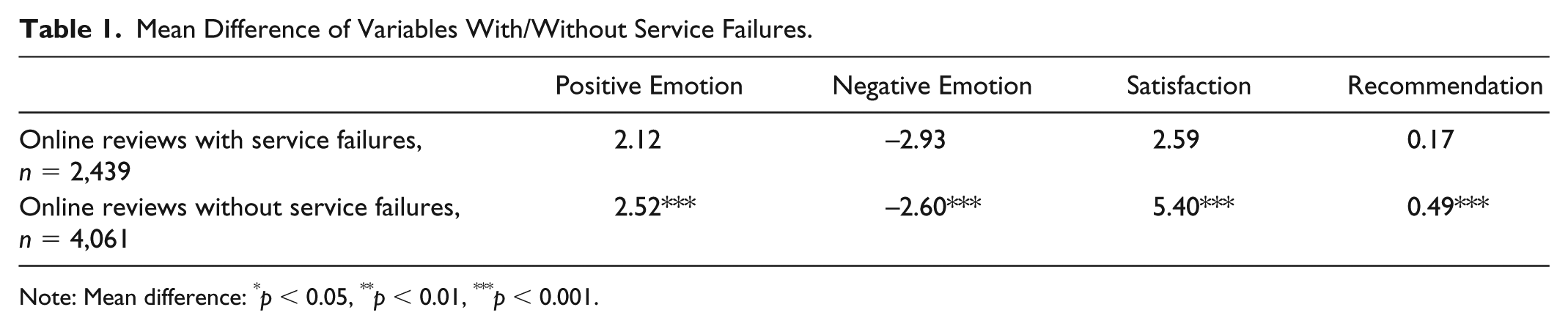
Note: Mean difference: *p < 0.05, **p < 0.01, ***p < 0.001.
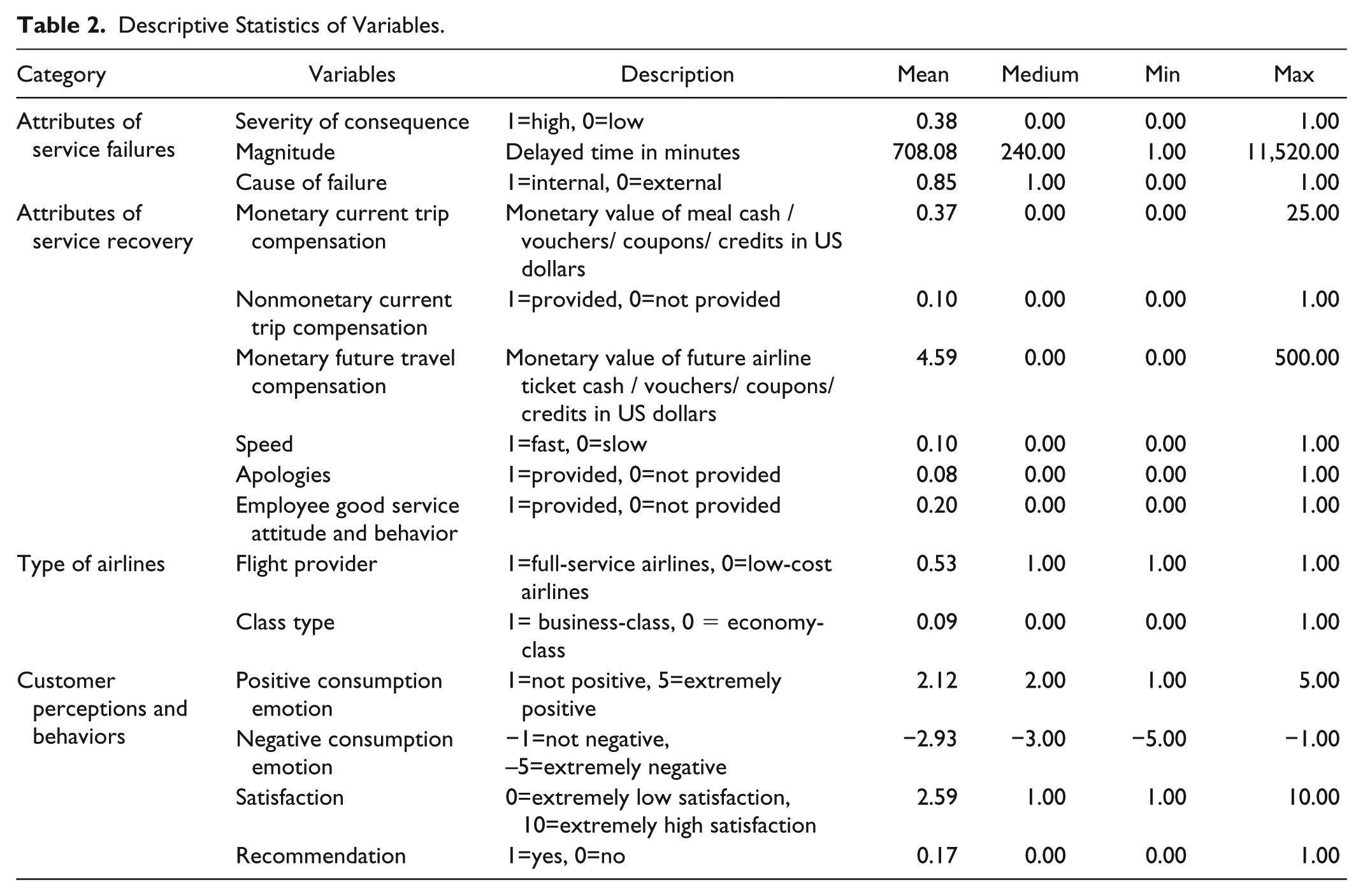
A path analysis was used to analyze the data because of its strengths in addressing problems that involve the decomposition of dependent variables (i.e., positive and negative emotion, satisfaction, and recommendation in this study) (Duncan 1996). The descriptive statistics of the variables used in the path analysis are shown in Table 2. Fifteen variables were included in the path analysis; three categorical variables (positive and negative emotions, satisfaction), three continuous variables (magnitude and current / future trip monetary compensations), and nine binary variables. Path analysis was conducted using LISREL 9.2. Fit indices indicated that the model had a good fit. The goodness of fit index (GFI), the normed fit index (NFI), the comparative fit index (CFI), the incremental fit index (IFI), and the adjusted goodness of fit index (AGFI) were greater than 0.90, the relative chi-square (chi-square/degree of freedom) was less than 3:1, and the upper confidence interval of the RMSEA was less than 0.08 (Hu and Bentler 1995).
Descriptive Statistics of Variables.
To test the moderating effects of airline type, first, as suggested by previous studies (e.g., Mittal and Kamakura 2001), 18 interaction terms were generated: 6 interaction terms between service failure attributes and airline (class) type: Consequences of the Failure
Hypotheses Test Results.
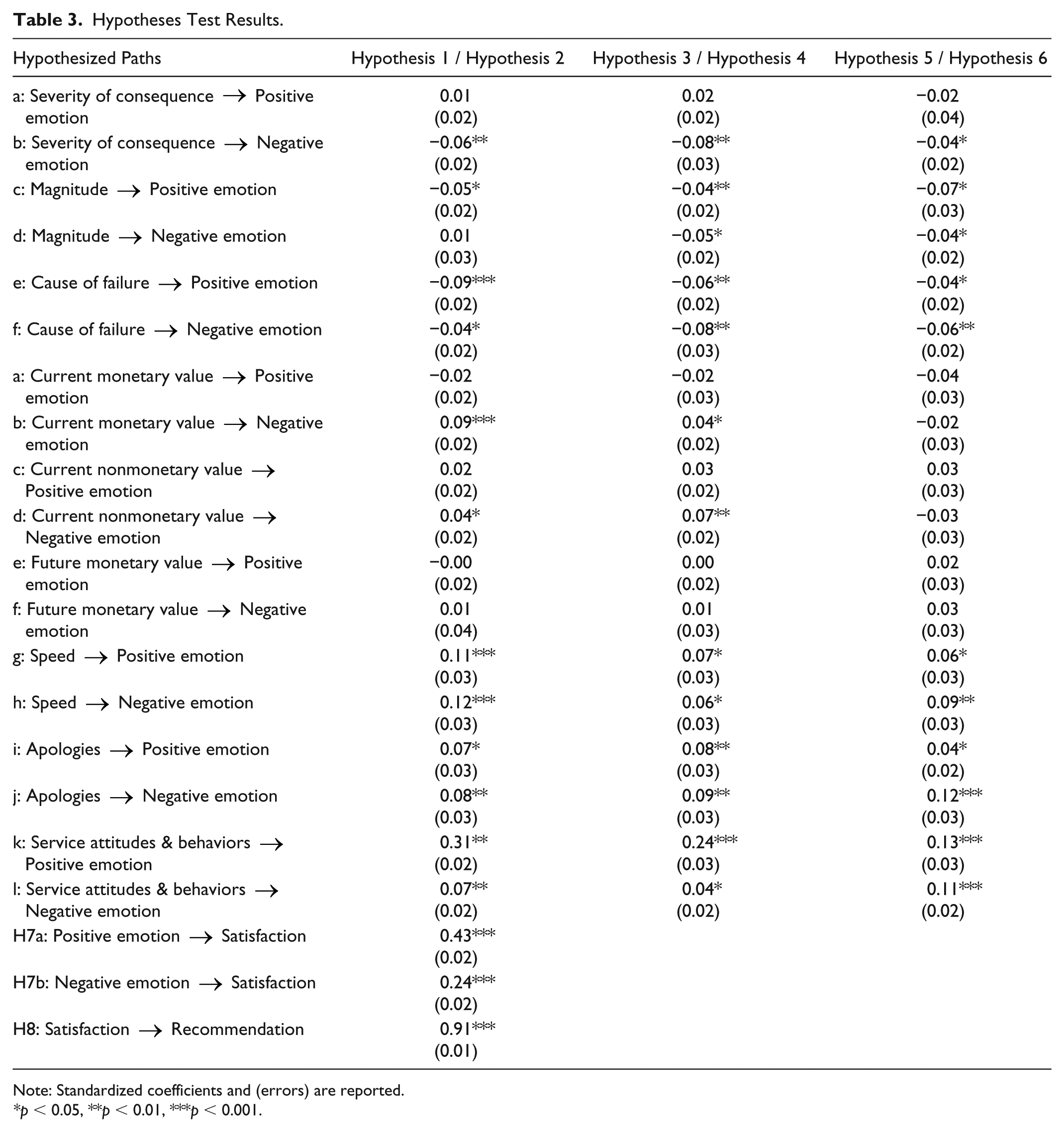
Note: Standardized coefficients and (errors) are reported.
*p < 0.05, **p < 0.01, ***p < 0.001.
Results and Discussions
Influences of Service Failure and Recovery Attributes on Customer Emotion
Findings provide partial support for hypotheses 1 and 2. Except for future-trips compensation, all other attributes of service failure and recovery are found to influence customer emotions. Even though providing compensation is one of the typical recovery actions that is assumed to enhance customer perceptions about distributive justice in the event of a service failure, findings indicate that providing monetary compensation for future trips neither significantly enhances positive emotions nor alleviates negative emotions. This finding might be explained by the fact that customers might have lost their trust in those service providers’ ability to provide reliable and satisfactory air travel experiences. As a result, customers may not be willing to travel with those airlines in the future even if they receive free or deeply discounted airfares by using the coupon or voucher provided as a compensation for the current service failure as mentioned in many online reviews. Findings strongly suggest that rather than providing monetary compensation for future trips, airlines should provide compensation, either monetary or nonmonetary, for the current trip to alleviate customers’ frustration and anger about the flight delay/cancelation. Complementary meals and upgrades such as priority boarding and seat upgrades enhance air travel experience by providing additional functional and hedonic benefits. The standardized coefficients presented in Table 3 show the relative importance of each attribute of service failure and recovery actions, compared to other attributes, on influencing customer emotions. Utilizing the attributes of service failure and recovery actions that have significant impacts on customer emotions, airlines can prioritize the attributes based on the impact they have on customer emotions (i.e., coefficients) (e.g., cause of failure, speed of service recovery, and service attitude and behavior) and allocate more resources to those attributes that produce better results compared to ones that have low impact on customer emotions. For example, airlines can offer more training to their employees on how to address dissatisfied and complaining customers in the case of flight delays and cancellations with excellent service attitudes and behaviors to alleviate those customers’ frustration (Lee et al. 2018). Airlines can also explore the possibility of developing new and creative services to generate positive emotion such as surprise and excitement (Law and Leung 2000).
Moderating Effects of Airline Type
Findings partially support hypotheses 3 and 4. A moderating effect of the airline type on the influence of most of the service failure attributes and recovery actions on customer emotions is observed. Except for monetary compensation for future trips, service failure attributes and recovery actions are found to have significantly more impacts on full-service airline customers’ positive or negative emotions compared to low-cost airline consumers. This finding might be explained by the fact that the higher price commanded by full-service airlines increases customers’ service quality expectations (E. W. Anderson, Fornell, and Lehmann 1994). According to the expectation–disconfirmation model (Oliver 1980), customer perceptions are determined by the comparison between expectations and perceived quality. With higher expectations, customers are more sensitive to service failures and recovery actions. In the event of a service failure, they are likely to see the business transaction between the airline and themselves as inequitable since the airline failed to provide the promised service. This inequity perception is likely to be higher for customers who paid higher prices compared to customers who paid lower prices for the same basic services, that is, transporting passengers from point A to point B. However, findings suggest that the airline type does not moderate the effect of monetary compensation for future trips on customer emotions. This can be due to customers losing their trust in the airline’s ability to provide reliable and satisfactory travel experience in the future. Because of this reason, they may not want to travel on the same airline in the future.
Moderating Effects of Airline Class
Results provide partial support for hypotheses 5 and 6. Findings suggest that the cabin class (i.e., business vs. economy) type moderates the influence of most service failure attributes and recovery actions on customer emotions. Except for compensation, influences of service failure attributes and recovery actions on positive and negative emotions are higher for business-class travelers. This finding might be due to three main reasons. First, according to the utility theory (Liu et al. 2013), higher-priced flight tickets for business class increase travelers’ service quality expectations, and thus, the gap between expected and perceived service quality can be larger compared to economy-class travelers. Since the gap is larger for business-class travelers than for economy-class travelers, both service failure and recovery actions can have higher impact on business travelers’ emotions. Second, as stated earlier, more business travelers travel in the business class than leisure travelers. Since consequences of flight delays or cancellations might be severe for business travelers, service failures and corresponding recovery actions can have higher impact on their emotions compared with leisure travelers. Third, because of the financial value of travelers who travel in business class, travelers in business class usually receive priority treatment from airlines in the event of a service failure. Furthermore, since they travel more frequently, they are more familiar with service recovery procedures of airlines compared to economy-class travelers. Thus, timely, reliable, and satisfactory service recovery is likely to have a more positive impact on their emotions. However, findings indicate that the class type does not moderate the effect of compensation on customer emotions. One of the main reasons can be that consequences of delays or cancellations are relatively more severe for business-class travelers compared to economy-class travelers. Thus, they may focus on solutions that can minimize or eliminate the consequences. As a result, compensation may not have any significantly different impact on their emotions compared to economy-class travelers.
Influences of Customer Emotions on Customer Satisfaction and Recommendations
Findings provide support for hypotheses 7a and 7b, suggesting that positive emotions increase satisfaction whereas negative emotions decrease satisfaction. Alleviating customers’ frustration and anger and enhancing their pleasure and delight through improving their utility and hedonic evaluations can enhance their overall satisfaction (Mano and Oliver 1993). Results also provide support for hypothesis 8. This finding is consistent with the findings of previous studies that reported satisfaction to evoke positive behavioral intentions such as re-patronizing, recommending the service, and spreading positive WOM (Šerić and Praničević 2018).
Theoretical and Managerial Implications
Theoretical Implications
This study used the three dimensions of justice framework to examine the effects of service failures and recovery actions on customer emotions. Results demonstrated that procedural justice dimension (e.g., magnitude of the service failure, speed of recovery) and interactional justice dimension (e.g., causes of the service failures, apologies and positive employee service attitudes and behaviors) have higher influences on customer emotions than distributive dimension (e.g., severity of the failure and compensation). Findings further confirmed the coexistence of positive and negative customer emotions in the event of a service failure and recovery process, which has been largely ignored by previous studies (Williams and Aaker 2002). Furthermore, both positive and negative emotions are found to significantly influence customer satisfaction. This supports the argument that customer satisfaction and consumption emotions are distinguishable theoretical constructs (Westbrook and Oliver 1991). In addition, this study finds a moderating role of airline type and cabin class on the influence of various service failure attributes and recovery actions on customer emotions.
Managerial Implications
Having service failures is part of doing business for service companies. Even the best service providers cannot completely avoid service failures. Identifying the most critical service failures and then developing strategies to reduce the magnitude and severity of the consequences of those service failures through reliable, timely, and satisfactory service failure recovery process can significantly enhance customer attitudes and behaviors. Findings suggest that service failures caused by internal factors such as aircraft maintenance and overbooking have larger negative influence on customer perceptions than service failures caused by external factors. Thus, airlines should focus more on minimizing service failures caused by internal factors and, in the event of a service failure caused by internal factors, airlines service recovery actions should go above and beyond customer expectations. Airlines should also improve internal operations to minimize the occurrence of service failures due to internal factors. In addition, it is critical to keep customers informed about the cause and magnitude of the service failure and what they are doing to resolve it, which can help ease customers’ concerns and create the perception that the airline is being honest and doing everything in their power to resolve the issue. This can enhance customers’ positive emotions and reduce their negative emotions (S. W. Anderson, Baggett, and Widener 2009).
In addition, given their limited resources, airlines need to set priorities regarding their implementation of various types of service recovery actions. Findings indicate that prompt recovery actions to reduce the magnitude and negative consequences of service failures have more positive impacts on customer emotions, which amplifies the importance of timely, reliable, and satisfactory recovery procedures on customer attitudes and behaviors. Providing compensation for the current trip, both monetary and nonmonetary can reduce customer anger and frustration. Genuine empathy and apologies from employees as well as positive service attitudes and behaviors are especially helpful for alleviating negative customer emotions and enhancing positive emotions. Positive employee attitudes and behaviors have a critical effect on a company’s reputation, and many customers mentioned “employees saved the company” in their online reviews when they evaluated their service failure recovery experiences.
Travelers who fly on full-service airlines and/or in business-class cabin view frequency and magnitude of service failures and satisfactory service failure recovery actions as the most critical factors that affect their attitudes and behaviors. Thus, it is critical for full-service airlines and airlines that offer business-class cabin to develop operational strategies to reduce the frequency of service failures. In the event of a service failure, they should be ready to provide service recovery actions that can minimize the magnitude and negative consequences of the service failure. As suggested by previous studies (e.g., Parasuraman, Zeithaml, and Malhotra 2005), timely, reliable, and satisfactory service recovery actions, including quick response, constant communication, and satisfactory compensation, can have a significant impact on customers’ perceptions of service quality and their future consumption behaviors. Since business-class travelers expect high-quality services, airlines should pay special attention to business-class travelers during the service recovery process.
Because customers’ consumption emotions influence their satisfaction, enhancing the service environment, such as the physical surroundings, décor, and caring customer service representatives (Lin and Liang 2011), is helpful for enhancing customer consumption emotions. Airlines can also build emotion recognition programs to investigate what diagnostic cues typically influence customers’ positive and negative emotions during service failures and recovery action implementation processes, which can help service employees detect and guide customers’ emotional status.
Conclusions and Extensions
Conclusions
This study examined the impacts of various attributes of service failures and that of subsequent recovery actions on customer attitudes and behaviors. Findings indicated that causes, magnitude, and consequences of service failures influence customers’ positive and negative consumption emotions. Providing compensation for the current trip, either monetary or nonmonetary, can reduce customer negative emotions, while providing compensation for future travel is not likely to have any impact on their emotions. Findings also indicated that employees’ positive attitudes and behaviors and promptness of service recovery actions have greater influences on generating positive emotions, as well as alleviating negative emotions compared to providing compensation. Service failures are found to have more impact on full-service airline and business-class travelers’ emotions compared to low-cost airline and economy-class travelers’ emotions. On the other hand, timely, reliable, and satisfactory service failure recovery process generate more positive and less negative emotions in full-service airlines and business-class travelers compared to low-cost airlines and economy-class travelers. Furthermore, customers’ consumption emotions significantly influence their satisfaction and recommendation intentions.
Limitations and Extensions
The main limitation of this study is based on the fact that extremely satisfied and extremely dissatisfied customers are more likely to post online reviews to express their satisfaction or dissatisfaction compared to customers with more moderate satisfaction and experiences (E. W. Anderson 1998; Chen, Fay, and Wang 2011). This may suggest that the online reviews may not represent a random cross section of customer experiences. However, customers who post online reviews are likely to be more involved, and thus may represent the most meaningful segments of the market (i.e., customers who are either extremely satisfied or extremely dissatisfied). Results obtained from this study using online reviews can serve as a base for future studies to examine the perceptions of service failure and recovery actions of customers who are less involved or do not have the desire to post review comments about their experiences. Future studies can utilize consumer surveys and compare their results to the findings reported in this or similar studies to identify similarities and differences in perceptions of service quality, benefits, and performance (Weber 2005). Furthermore, future studies can also examine the role of customer reactions to a variety of service failures and how they evaluate the severity of service failure and merit of recovery actions. For example, future studies can examine what causes some customers to get upset over what might seem like a very minor service failure while the same failure may not have any effect on other customers.
In addition, although using binary variables can help facilitate the analysis, the binary classifications for some variables in this study such as severity of consequences, nonmonetary compensation for the current trip, apologies, and employee attitudes and behaviors have some limitations. In this study, we assumed that when a certain attribute of service failure or recovery action occurs, customers are likely to mention it in their online reviews. If they did not mention it in their online reviews, the impact of that certain attribute of service failure or recovery action was not included in the analysis. However, not all opinions expressed in the online reviews reflects all recovery actions taken by companies (Chen, Fay, and Wang 2011). In addition, customers’ not mentioning a certain attribute of service failure or recovery action may not necessarily mean that it did not happen. Instead, that attribute may not be meaningful and/or important to the customer. Future studies can remedy this limitation by including face-to-face interviews with customers in their research design in order to explore the impacts of specific attributes of service failure or recovery actions.
Moreover, although the influence of some attributes of service failure and recovery actions on customer emotion is significant, the magnitude of the influence is found to be relatively small. The significance of the impact may be attributed to the relatively large sample utilized in this study. Future studies are needed to confirm the findings of this study and to further validate the influence of each service failure attribute and recovery action on customer emotions and satisfaction. Findings of these future studies can enable businesses to allocate their resources more appropriately to each of the actions to reduce each service failure attribute occurring frequency r magnitude and improve the effectiveness of recovery actions.
Footnotes
Declaration of Conflicting Interests
The author(s) declared no potential conflicts of interest with respect to the research, authorship, and/or publication of this article.
Funding
The author(s) received no financial support for the research, authorship, and/or publication of this article.