



Abstract
African-Americans in the United States have long since been confronted with harassment and discrimination while traveling because of segregated lodging, restaurants, and other leisure activities. However, African-Americans/Blacks are one of the fastest-growing tourist groups. This work builds on previous research on the Black travel experience analyzing over 300 tweets using the trending hashtag #TravelingWhileBlack through a critical race theory lens. By analyzing how Black tourists are traveling, this study reveals how experiential knowledge of Black travelers can contribute to the learning environment of the tourism industry. Three emergent themes were identified: (1) occurrences of racism, (2) awareness of being Black while traveling, and (3) meaningful experiences traveling while Black, suggesting that experiential knowledge of travelers of color brings different perspectives, which will, it is hoped, move toward eliminating all forms of subordination and create a more just society.
Introduction
Domestic and international exploration has long been an area of interest for academicians and industry professionals alike. However, these travel journeys have historically been plagued with significant barriers for African-Americans or Blacks in the United States. 1 “No Negros allowed. . . . We serve Whites only. . . . No coloreds allowed. . . . Coloreds must sit on the balcony.” These are just a sampling of some of the well-documented captions that Blacks in the United States had to endure during the racial segregation-era of Jim Crow. 2 During this time, Black people in the United States faced major roadblocks and continued threats of violence while traveling, which was induced by the deeply embedded history of racism in the country. In response to this, Victor Green (1936) wrote and published the very first edition of The Negro Motorist Green Book, meant to give Black travelers information about places that were safe to visit while on the road. With a spirit of hopefulness and optimism, Green wrote in one edition, “There will be a day sometime in the near future when this guide will not have to be published. That is when we as a race 3 will have equal opportunities and privileges in the U.S.” (1954, p. 1).
Fast-forward 30 years, the Civil Rights Act of 1964 ended the legal discrimination of Blacks in public spaces, including travel venues such as hotels, restaurants, recreation sites, and amusement parks. Currently, present-day United States is witnessing significant changes in demographics, with reports projecting that by 2050, 43% of the population will consist of people of color (Contrino and McGuckin 2009). Accompanying these changes, the African-American travel market has also continued to see sustained growth. According to Mandala Research Firm (2011), 17% of African-Americans take one or more international trips a year and account for $48 billion of the U.S. travel market. Although this market continues to experience upward growth, the relationships African-Americans have with travel are still complex and multifaceted. In fact, the current landscape of the industry is a testament to this.
Although other niche travel markets such as LGBTQ and women-only groups are being heavily promoted, many major hospitality and tourism companies continue to avoid specifically targeting Black people. In response to this, many Black travelers are taking the initiative to create their own pathways in the travel world. For example, numerous Black-owned startup companies and blogs such as “Back to Africa,” “Travel Noir,” “Outdoor Afro,” and “Innclusive” were created to fill this gap in traditional industry offerings. Further to this, social media trends such as the trending hashtag “traveling while Black” have brought to light some of the modern-day experiences of Black travelers, both positive and negative. 4 The presence and growing popularity of networks like these confirm the fact that Black travel experiences are uniquely rooted in the history of race in America, making them vastly different from White travel experiences.
Although the emergence of this trend is evident, research in this area consists of a small collection of work, leaving much room for expansion and improvement (Alderman 2013; Carter 2008). The goal of this study is to gain a deeper understanding of the Black travel experience through the lens of critical race theory (CRT), which suggests that race and racism are pervasive, and a significant factor in explaining the lived experience of an individual. This work extends previous research on Black tourism by adding depth and breadth to understanding the Black travel experience. It is our goal that the findings from this research will aid in probing stimulating discussion about this sensitive but critical travel and tourism issue.
Literature Review
History of African-American Travel
African-Americans confronted considerable amounts of harassment and humiliation when traveling because of restricted areas and desegregated beaches, hotels, restaurants, and other accommodations in the United States (Alderman 2013). However, during this Jim Crow era, there was a movement in the Black travel community to remain resilient against its oppressors. The most prominent work would be the Negro Motorists’ Green Book by Victor Hugo Green. The Green Book (1936-1966) was an annual guidebook for Black travelers and motorists to easily and safely navigate parts of the United States. The book included safe rest stops, hotels, stores, cities, and other resources of use. While the Green Book was a direct guide, there have been other publications that served as a great resource for African-American travelers and tourists. For instance, as early as 1911, the official magazine of the newly formed National Association for the Advancement of Colored People (NAACP), The Crisis, published an article by Virginia Wright titled “The Congo Express” (Foster 1999). In this article, Wright gave her perspective on traveling to Africa with the goal of finding her roots (Foster 1999). Today, “roots tourism” is one of the increased aspects of African-American travel (Alderman 2013).
Although Black people tend to display these cautious traveling characteristics, historical evidence indicates that despite discrimination and other challenges, they still felt a need to travel and participate in leisure activities. For instance, far more than White Americans, Black Americans traveling [abroad] had to be particularly sensitive to local customs and they had to learn how to talk themselves into decent accommodations and out of potential conflicts (Foster 1999). However, despite these negative experiences, Black people have shown resistance and resilience to the racism and discrimination by continuing to travel and create a space and community for themselves. They have shown their resilience by creating their own travel agencies, organizations, and publications.
African-American Travel Behavior
Among the small archive of research on African-American tourism, some important studies to note include that of Philipp (1994), Carter (2008), and most recently, Lee and Scott (2017). Both Philipp (1994) and Carter (2008) conducted studies highlighting the differences between Black and White travelers using household travel survey data. Both studies found that Black travelers continue to participate in many of the travel behaviors established during Jim Crow segregation. For example, both studies found that Black travelers are more likely (than White travelers) to visit destinations solely based on the recommendations from family and friends (Carter 2008; Philipp 1994).
Carter (2008) found that Blacks travel more frequently in large groups in comparison to Whites. Black travelers have also been considered to be less adventurous when it comes to trip itineraries, activities and accommodation choices (Philipp 1994). In 2015, Tucker conducted a qualitative study among 12 African-American tourists which provided information suggesting that marginality, ethnicity, and issues related to discrimination impact their travel attitudes and behaviors. Similarly, Lee and Scott (2017), through a vignette technique, identified five major themes: racial discrimination during travel, fear of racism, storytelling and safety instructions, social reproduction of the fear of racism, and race-related travel choices that affect African-Americans’ travel behaviors.
Existing studies have paid relatively little attention to the racism that today’s Black travelers experience in tourism contexts (Lee and Scott 2017). However, recently Willis (2015) explored how African-American female college students deal with macroaggressions and intersectionality of their study abroad experiences. From this qualitative study, Willis found that the women were the targets of macroaggressions, isolation, and other negative interactions from their host countries, providing an example from a study abroad trip to Italy: The White people would stay to themselves. . . . And the rest of the people that were not White, we would be in a group. . . . And so we would kind of discuss amongst ourselves as ethnicities, as the minority in a way . . . that “How come they just don’t hang out with us?” And we would invite them and they don’t come. (Willis 2015, p. 218)
Although the women felt like race affected their study abroad experiences, they also felt other factors, such as gender, language ability, and sexual orientation influenced their trips (Willis 2015). Willis posits that the idea of “intersectionality,” the interdependent and overlapping nature of social constructs such as race, class, and gender, is an important factor to consider when examining African-American students’ experiences. Furthermore, Willis argues for more research around African-American study abroad experiences in order to draw attention to the quality of these programs for marginalized students.
African-Americans showed their resilience through creating travel agencies and personal retreats (Foster 1999). Recently, Blacks showed their resistance through the preservation, promotion, and use of cultural heritage sites. For instance, Gotham (2011) explored the strategies that tourism organizations and influencers have used to revitalize and reconstruct New Orleans into a cultural heritage site for African-Americans. Gotham posited that creating a cultural site that emphasized racial heritage tourism can be a tactic of resistance against marginalization and provide a proactive strategy to affirm African-American culture (Gotham 2011).
Importance of Social Media in Black Tourism
The recent phenomenon of social media has served as an important venue where groups with common interests come together to share ideas and information (Anderson and Hitlin 2016). Social media is fueled by its ability to instantly connect people and ideas across any distance, helping to bring greater attention to issues voiced collectively (Anderson and Hitlin 2016) in addition to allowing its members to share documentary evidence, spread activist messages, and forge a collective meaning of heartrending news (McClain 2016). This instant connection can lead to ideas and movements becoming much more powerful and meaningful because of their wide and rapid spread. According to a study conducted by the Pew Research Center in 2012, 66% of social media users—or 39% of all American adults—have done at least one of eight civic or political activities through social media. People are using various social platforms for these movements, such as Facebook, Instagram, and Twitter, each having unique methods of sharing content. On these platforms, text, pictures, and short videos can be posted using a “hashtag” to link the content to a specific topic. Consequently, social media and online communities have played a role in the Black travel movement, acting as a modern form of resilience.
African-Americans use Twitter as a popular platform to resist against issues regarding Black travel, spread awareness, and build a community for Black travelers. The most popular hashtag specifically for Black travelers is #TravelingWhileBlack, which is used to share personal narratives, advice, and additional travel resources. Along with hashtags and social networking sites, African-Americans use travel forums, blogs, and other online communities as a form of resilience to empower the Black travel movement. Since the topic of Black travel is rarely studied and discussed, online travel communities have served as a primary asset for travelers outside conventional social media. They are carrying a long tradition of travel media created by and for Black consumers (Southall 2015). Within these communities and posts, users are looking for representation. The images uploaded by the Black travel networks run counter to the typical profile of the international traveler (many hosts and writers are middle-aged White men). Travel media and advertising campaigns often feature people of color only as the airport and airline staff or locals (Southall 2015). Because of underrepresentation in the media, Black travelers are looking for other travelers who have visited places they are interested in and are seeking like-minded individuals who have shared their experiences.
Unfortunately, many African-Americans have experienced or have a fear of experiencing negative encounters while traveling. However, sharing their lived narrative provides a pathway to strengthen and empower the Black travel movement. Positive experiences are shared and discussed as a way to uplift the community, whereas negative ones can help inform future travelers. These experiences can be isolating, and they are part of what draws Black travelers to the movement emerging on social media (Southall 2015). For some, shared hashtags and niche communities across Twitter helped Black users gain a sense of belonging and help relieve feelings of isolation (Guo 2015). This community built on shared narratives helps form a hub of resources for future Black travelers and like The Green Book, these online communities help Black travelers navigate a world outside of their comfort zone (Southall 2015).
Thanks to a new crop of emerging online communities, international travel is growing rapidly, particularly for social media–savvy African-Americans (Ferguson 2015). What makes it “more real” is that unlike [some] blogs and books, questions are answered in real time by likeminded Black travelers from around the world (Southall 2015). Information, users, and posts are visible and personal, which encourages African-Americans to travel more and explore different places. For instance, Talley (2017) posits that “African-Americans need their social media timelines to be flooded with pictures and videos of Black individuals who travel, so much to the point where it isn’t something we view as extraordinarily unimaginable” (p. 1). While Blacks may not be able to stop possible occurrences of racism, colorism, and other negative experiences, they can remain resilient and use their online communities to connect, inform, and uplift fellow travelers.
Facilitating change, including social media outlets, requires social commitment to activism. Peake and Kobyashi (2002, 50) posit the necessity for including specific approaches, for example, using CRT, informing academic narratives and research, to change “our racialized past.” Advocating what Derek Bell (1992) termed “racial realism,” early CRT focused specifically on the experiences of Black Americans and shifting paradigms from the goal of equality, to that of social justice through radical reform (Price 2010). Therefore, we argue that CRT informs our understanding of how marginalized groups are experiencing travel, and the obstacles they face are a product of institutionalized racism and injustice.
Theoretical Paradigm
Dominant culture shapes its own social reality in ways that promote self-interest through words, stories and silence. Consequently, CRT emerged out of Critical Legal Studies in the early 1980s in response to Harvard Law School student protests over the lack of faculty of color and absence of courses related to race (Zamudio et al. 2011). CRT is a uniquely American approach thanks to its historical roots within a nationally specific, economic, political, and legal system (Peters 2004).
The foundation of CRT begins with the idea that that race and racism are endemic and permanent rather than a marginal factor in defining and explaining the lived experiences of individuals, therefore, racism looks ordinary and natural to persons in the culture (Bell 1992; Russell 1992; Delgado and Stefancic 2017; Taylor, Gillborn, and Ladson-Billings 2009). Beyond this foundational pillar, CRT suggests the following propositions:
White supremacy and racial power are maintained over time. Sometimes referred to as interest convergence or material determinism, this tenet argues that racism improves the lives of both the White working class and the elite, materially and physically, leaving little room for interest in changing the political and societal structure to serve more minority groups (Delgado and Stefancic 2017).
Race is a social construction of society. CRT suggests that race and racism are not objective, but are products of the societal environment created by humans over time (Delgado and Stefancic 2017).
Different minority groups are racialized at different times. Dominant society places different stereotypes on different racial groups at different times, depending on the current state of society. For example, Delgado and Stefancic (2017) suggest “in one era, a group of color may be depicted as happy-go-lucky, simpleminded, and content to serve White folks. A little later, when conditions change, that very same group may appear in cartoons, movies and other cultural scripts as menacing, brutish, and out of control” (Delgado and Stefancic 2017, p. 10).
No one person has a single, unitary identity such as “Black” or “White.” Though society may want us to identify singularly as one race, our identities move much beyond the color of our skin. For example, an “African-American” woman may be the product of a Black father and a White mother, a lesbian, a Muslim, and a Democrat. Because of her mixed background, should she be considered Black or White? Everyone, no matter their race, has overlapping, and possibly diverging, identities (Delgado and Stefancic 2017).
The experiences of people of color are critical to understanding, analyzing, and teaching about race (Ikemoto 1991). CRT encourages minority races to voice their stories using nontraditional methods of storytelling, including sharing family history, biographies, real-life scenarios, parables, chronicles, and counternarratives (Taylor, Gillborn, and Ladson-Billings 2009). These stories, though divergent from mainstream cycles of thought, are important to the advancement of minority races in society (Delgado and Stefancic 2017).
CRT is a complex and ever-changing phenomenon. However, an underlying and steadfast truth of CRT is its commitment to social justice for all, with the challenge to expose racism in society, and the hope to liberate and transform marginalized groups.
The act of storytelling has provided CRT with a highly effective mode of framing “lived experience of racialization in America and the sharing of others” (Price 2010, p. 159). Counterstorytelling, on the other hand, invokes an oppositional narrative practice and is also part of CRT. Utilized by underrepresented voices, counterstorytelling narrative is used to “build up, as well as break down, community, shared understandings, and deeply held beliefs” (Price 2010, p. 160). The influential power of storytelling is strategically deployed by CRT to elicit empathy and to change opinions (Delgado and Stefancic 2000; Solorzano and Yosso 2002). Furthermore, CRT and CRT methodologies are now globally informing data collection and analysis within academic research across disciplines. For example, CRT was first applied to the field of education in 1995 by Gloria Ladson-Billings and William Tate.
Within the field of education, everyday practices, experiences, and interactions are infused with racial ideologies (Jay 2009). Critical race methodologies can be used to reveal how schools are institutions that reproduce social inequities, but racism is so normalized and deeply ingrained in our society that it is difficult to see (Vaught and Castagno 2008). CRT asks why White students are disproportionately represented in gifted and talented programs while students of color are tracked in remedial and special education classes (Bergerson 2003). Actively engaging White, middle-class preservice teachers in critical discourse can disrupt preconceived notions and facilitate the cognitive and emotional processes necessary for culturally responsive pedagogy.
Although ubiquitous within the discipline of education, to date, little has been done to apply CRT within the tourism industry. There is some mention of CRT within the geography of tourism in relation to how narratives are told at plantation sites, but it has not been used to critically analyze how race plays a role within tourism (Alderman 2010). However, critical race methodologies have the potential to expose how dominant narratives are used to manipulate history, silence and marginalize people of color, and perpetuate racial stereotypes within the tourism industry. Kivel, Johnson, and Scraton (2009) suggest using CRT postulating that race should be examined as a political, social, and cultural construct and that like gender, race is an identity construct; its meanings are infused by those individuals and collectives who create it. CRT can uncover ways in which hegemonic practices are perpetuated by well-meaning people whose altruistic motivation is embedded in a deficit perspective. Thus, in this study, we use CRT to help expose and explain, how the experiences of Black travelers are critical to understanding, analyzing and learning about race within the tourism sphere.
Analyzing over three hundred tweets using the trending hashtag #TravelingWhileBlack, a thematic analysis was used to answer the research question: In what ways do Black travelers use Twitter to express their travel experiences? It is important to note the similarity between #TravelingWhileBlack and #BlackLivesMatter, since the latter is one of the most notable social media movements to date. The two hashtags are similarly used as a way for those to express their feelings, experiences, and frustrations over the safety and well-being of Black people in the United States.
Though it began on Facebook, the phrase [“Black Lives Matter”] exploded on Twitter, electrifying digital avenues where Black users were already congregating to discuss the issues that are often absent from the national conversation (Wortham 2016). Protesters and their supporters were generally able to circulate their own narratives on Twitter without relying on mainstream news outlets (Freelon, McIlwain, and Clark, 2016). The influential presence of Black tweeters has been nicknamed “Black Twitter” which is a constellation of loosely formed multifaceted communities created spontaneously by and for Black Twitter users who follow or promote Black culture (Wortham 2016).
#BlackLivesMatter is not the first major movement on Twitter, yet has proven to be the most effective. The social networking site has always been a platform to share other national movements; while those early actions proved the social network’s ability to organize or rally protesters, they also revealed the difficulty of sustaining a movement after the crowds went away (Wortham 2016). The activism on Black Twitter is more continuous, creating a feedback loop of online actions and offline demonstrations. Most importantly, it has slowly led to ways of translating social awareness into real change (2016). While #TravelingWhileBlack may be used by a smaller population of Black users on Twitter, it still has the ability to build a community and spread awareness among the niche groups of Black travelers and vacationers.
Methodology
The design of this study is informed by a critical theory paradigm and critical race theory to explore the critique and transformation of the social, political, ethnic, and cultural structures that “constrain and exploit humankind” within the travelling while Black (TWB) phenomenon (Guba and Lincoln 1994, p. 113). Essentially, our goal as critical theorists studying the phenomenon of TWB is to begin a discussion about emancipating the oppressed through travel.
Criteria for the data set included publicly shared tweets only, tweets written in the English language, and tweets published within a one-year period from September 2015 to October 2016. These criteria were chosen to protect the privacy of those users who chose to tweet privately, the familiarity of the researchers with the English language in addition to sourcing tweets that covered a full 12-month time span. The data collected included 328 tweets, with 146 unique users and an average of two to three tweets per user, all including 140 characters or less that was inputted into the software NVivo. The number of tweets and unique users collected for data analysis were considered to be sufficient based on saturation of the data as determined through the process of familiarization (Braun and Clarke 2006). Additionally, analysis of the tweets revealed the formation of an online community of users, all utilizing the #TravelingWhileBlack hashtag to communicate back and forth, thus engaging in meaningful conversation. Furthermore, there is no set number of social media observations considered to be “adequate” for qualitative analysis. Previous studies used varying numbers ranging from 128 Instagram posts with an unknown amount of unique users (Laestadius and Wahl 2017) to 1,300 tweets, with only 44 unique users (Hull and Lee 2016).
Data Analysis
Exploration of the data collected for this study followed the steps of Braun and Clarke’s (2006) thematic analysis using an inductive approach. Utilizing an inductive approach allowed the data to drive the themes identified, rather than attempting to identify a priori themes within the data. Essentially, inductive thematic analysis allowed us to code without trying to fit the data into a predetermined framework of what the data “should” reveal (Saldaña 2015). Although CRT was used as a theoretical framework as a means of understanding the phenomenon at large, CRT does not prescribe specific a priori themes that could be used to “fit” the data. Instead, CRT provided a context that aided in the analytic process that first involved rich description of semantic themes followed by an attempt to speculate at the significance of latent meaning, patterns, and relationships among the data. Nevertheless, it is important to recognize that researchers cannot completely bracket themselves out from their theoretical and epistemological stances. Therefore, in order to strengthen the trustworthiness of the study, we utilized the criteria of credibility, transferability, dependability, and confirmability as defined by Lincoln and Guba (1985) within a six-step process to establish trustworthiness in each phase of the study (Braun and Clarke 2006; Nowell et al. 2017).
The process of analyzing the data included an audit trail of the following six phases of inductive thematic analysis adopted by Braun and Clarke (2006) and Nowell et al. (2017): (1) Familiarization—In order to establish a base level for credibility and dependability within our study, separately, we read and re-read through the original data set to familiarize ourselves with initial ideas and themes that were present in the data. All researchers documented their theoretical and reflexive thoughts prior to moving to the second phase of analysis. The raw data for the study was stored and saved separately before the generation of initial codes to provide a benchmark for evaluating transferability (Nowell et al. 2017).
(2) Generation of initial codes—Working separately within the same data set, we used NVivo 11 (a qualitative text mining software) to generate a preliminary list of codes across the entire data set. To begin establishing confirmability, the process involved the development of a coding framework in which each tweet was assigned a code or codes that matched with their semantic theme (Nowell et al. 2017). In order to further assess the trustworthiness of our coding process, a coding comparison query was tabulated using a tool provided by NVivo 11. The initial list included 38 codes. Across all 38 codes, the agreement percentage among all researchers ranged from 95.8% to 100%, which well exceeded the minimum percentage needed to determine intercoder reliability. (3) Search for themes—Utilizing researcher triangulation to establish credibility, we worked together to diagram tweets assigned across the 38 codes, further examining them to identify operational definitions that described each code assigned to the data set (Nowell et al. 2017). Subsequently, each code was assigned to an overarching theme. In line with recommendations from Lincoln and Guba (1985) in addition to Nowell et al. (2017), documentation of this process was continuous and detailed. (4) Reviewing themes—At this point, each separate code was reviewed for similarities with other codes. Among the 38 codes, 6 were renamed and combined with other codes of remarkable similarity, resulting in a final list of 30 codes along with their operational definitions. In order to continue to establish credibility and confirmability, together, we sifted through each code, identifying an overarching theme for groups of codes. For the first cycle of coding methods, each author individually analyzed and coded each raw tweet from Twitter users (Saldaña 2015) using In Vivo and Value Codes. We then reviewed each code category against their corresponding raw tweets as a method of understanding the participants’ perspectives and actions and confirming that our findings were clearly derived from the data and transferable within the data set. Codes were grouped together in themed categories based on similarities. Resultant from this process, 9 initial themes were developed to represent 30 thematic codes (Table 1).
Codes and Themes.

(5) Defining and naming themes—Based on the revised list of codes, and the nine initial themes, we reviewed the list of themes and worked together to refine the specifics of each theme, thus creating a synoptic theme chart representing the overall story of the analysis. This process was iterative, documented in detail and included all researchers to ensure the dependability of our final synoptic chart. The synoptic chart represented three overarching themes, with nine subthemes, as described by the codes in Table 1 (Figure 1). (6) Producing the report—Production of the final report included the selection of captivating and representative extracts from the original data set, including thick descriptions of context to ensure transferability within the data set (Nowell et al. 2017). We also conducted a final analysis of these extracts that included an iterative search for disconfirming evidence to ensure reasons for analytical choices were clear throughout the written report. Finally, linkages back to the original research questions and theoretical framework were described to demonstrate confirmability of the study findings.

The relationships between the lived travel experience of Black travelers.
Findings
The data gathered from this research revealed three major emergent themes: (1) occurrences of racism, (2) awareness of being Black while traveling, and (3) meaningful experiences traveling while Black. At first, we grouped these themes into two simple categories to identify the type of lived travel experience: positive or negative. Upon further investigation into the nuances of each theme, we were able to develop a synoptic chart revealing more meaning within the data along the positive/negative spectrum (Figure 1). Findings are described below linking themes and codes with raw tweets, thick description, and quasi-statistics (simple counts of codes and themes). The use of numerical quantitative data in qualitative research is no stranger to controversy. Some researchers argue that the inclusion of these quasi-statistics could lead to unintended inference, linear assumptions of correlation out of context, and/or the reduction of qualitative data to numerical evidence (Maxwell 2010; Patton 1990; Weiss 1994). Taking these risks into account, we chose to include some simple numerical statistics to critique the underlying power structures of travel as described by Black travelers (Guba and Lincoln 1994). More specifically, we argue that in this study, quasi-statistics serve as a way to represent the internal generalizability of the data, the diversity of experiences among Black travelers, the larger patterns within the lived experiences of Black travelers, and a means to transparently represent evidence for our interpretations of the data beyond the few selected tweets that are included in this write-up (Maxwell 1992, 2010).
Within this figure are intertwined relationships among the three themes. At the center, the theme “Awareness of Being Black while Traveling” exposed both positive and negative experiences among Black travelers. We discovered that this theme encompassed a deep-rooted fear of travel, embedded in the history of travel for Blacks in addition to the vulnerability, anxiety, and worry felt about traveling while Black. However, we found that this theme also encompassed positive experiences of cross-cultural exchange fueled by racial and ethnic differences. As a result, this awareness of deep-rooted fear and vulnerability was confirmed by occurrences of racism. Conversely, this awareness was also the catalyst for meaningful and transformational experiences among Black travelers.
Occurrences of Racism
The theme “Occurrences of Racism”
5
included a total of 173 coded instances including incidences of racism (n=131, 27.5%), incidences with racist destinations or companies (n=33, 6.9%), and instances around issues for populations of difference (n=9, 1.9%). Travelers expressed several instances of frustration and racial profiling that included issues with hospitality and tourism companies like Spirit Airlines and Airbnb: “7 passengers kicked off Spirit Airlines flight at LAX; Some claim racial discrimination #travelingwhileBlack.”—Twitter User 1 “Just got instantly denied on @Airbnb. I wonder why?! #TravelingWhileBlack.”—Twitter User 2
Recently, Airbnb has been under attack for accepting distinctly White names roughly 16% more than African-American names (Edelman, Luca, and Svirsky 2016). Consequently, a hashtag specifically outing discrimination that Black travelers faced while using Airbnb, "#AirbnbWhileBlack,” was created. Two start-up companies, Innclusive and Noirbnb, now offer similar services of Airbnb, but in a way that welcomes Black people and helps them feel “at home” without being denied access due to their race. However, even if Black people are allowed into rental homes and apartments, is the destination that they are traveling to truly hospitable to everyone?
In the U.S. south, Southern Hospitality is a major part of the region’s identity and culture. However, within the “politics of belonging,” African-Americans were extended a highly segregated and unequal form of southern hospitality that did not allow them access to various accommodations during Jim Crow era and beyond (Alderman and Modlin 2013). Thus, the legacy and memory of these injustices are still felt today at various travel destinations that evoke hostility and fear: “Vaca’s off to a pleasant start . . . but trying to unsee the confederate flag flying outside a home 5 min down the road #travelingwhileBlack.”—Twitter User 3 “I feel more threatened and afraid for my life back at home in the USA than ANY other place in the world. #travelingwhileBlack.”—Twitter User 4
Although the Civil Rights Act of 1964 helped to alleviate discrimination in public spaces, Black travelers still felt apprehensive to travel to these spaces (Alderman and Modlin 2013). Additionally, the history of U.S. racial brutality also caused international Black tourists to feel apprehensive to visit the United States. For instance, thanks to social media and camera-phone technology, current visibility of police brutality and shootings has affected international tourist visitation to the U.S: “Bahamas issues a #USTravelAdvisory Caution: beware of #TravelingWhileBlack in the U.S. This is a first: Bahamas warns travelers to U.S. about ‘shootings of young Black males by police officers.’”—Twitter User 5
The current climate of race-related issues in the United States is still a major factor with feelings of security, belongingness, and safety within the Black community. Furthermore, the intersectionality of gender, sexuality, and being able-bodied is another issue Black Twitter travelers expressed. There were several instances where Twitter users expressed concern for their safety because of sexual harassment, being in an interracial couple, being LGTBQ, or being disabled: “#travelingwhiletrans #travelingwhileBlack has been a problem for 400+ years.” “And unfortunately in some places my disability overshadows my race or even my gender. Other Black travelers get treated badly but I’m seen as this disabled fragile thing. I’ve noticed it outside of big cities. #TravelingWhileBlack.”—Twitter User 7
Although there were limited Tweets regarding accessibility, sexual harassment, and LGTBQ, the intersectionality of race and marginalized groups is still a major deterrent when traveling. Further research and exploration is suggested to understand the nuances of how these marginalized groups (women, disabled, and LGTBQ) experience traveling since these markets are expected to grow (Coon 2012; Lee, Agarwal, and Kim 2012).
Awareness of Being Black While Traveling
The theme “Awareness of Being Black while Traveling” included a total of 136 coded instances including reactions to traveling while Black (n=59, 12.4%), understanding Black travel history (n=33; 6.9%), cultural and racial awareness (n=22, 4.6%), and othering of Black travelers (n=22; 4.6%). Black Twitter users shared various stories detailing their awareness of how tourists, residents, and other people reacted to their traveling. The tweets extracted from the data exemplify the exasperation Black people felt when traveling and frustration faced with having to educate people around the history of being Black in America: “You’re American? You look African.” Duh. I’m sick of having to teach strangers in various countries about the trans-Atlantic slave trade. #travelingwhileBlack—Twitter User 8 Vacant stare. I’m going to find a corner to sit in cause I can’t today. I’m not the one. Not today. #travelingwhileBlack—Twitter User 9
CRT focuses on the centrality of experimental knowledge (Solorzano, Ceja, and Yosso 2000). Nevertheless, people of color are not obligated or responsible for teaching and educating people about issues around racism, nor should they feel obligated to have these discussions during their travel excursions. It is one thing to be aware of one’s race, and another to have to explain it. However, understanding the history of Black travel could be an essential step with elucidating what it was like, and still like, to travel while Black.
The Green Book was a major reference when referring to Black travel history. Most importantly, it was a point of interest for arguing for a revision and creation of a current edition for today’s travel climate: When #travelingwhileBlack the #greenbook was our source of safety . . . and its still needed in some states NOW—Twitter User 10 We need an update to this book with what’s going on right now!! #TravelingWhileBlack—Twitter User 11 #BlackOwned travel sites of today reflect Black guidebook of the past.—Twitter User 12 #TravelingWhileBlack #DiningWhileBlack both remain serious realities. Traveling While Black: Is it Time to Bring Back the Jim Crow-Era ‘Green Book’ for Black Travelers?—Twitter User 12
These perspectives and insights identify a major issue within the cultural travel landscape, and through a CRT lens, enables broader discussion of social and structural inequalities, power, ideology, and White hegemony within tourism (Arai and Kivel 2009). Moreover, the reality Black travelers are facing today echoes similar fears, frustrations, and racism that Black travelers faced during the Jim Crow era. These findings posit that there is a need for a new Green Book that will help Black travelers navigate through hostile environments and find communities that are welcoming.
Numerous twitter users reflected on their experiences of “othering” because of their skin color. “Othering of Black Travelers” was described through accounts of Twitter users who encountered strangers that asked to touch their hair and skin, to take a photo or video of them, some even experienced a level of “fandom” from onlookers of different racial and ethnic backgrounds. Reflections related to this theme were categorized as predominantly negative, and as having a direct relationship with being aware of traveling while Black. For instance, one tweet refers to a video of some Black tourists being bombarded in China for photographs, nearing the point of harassment. The original tweet reads: “Curiosity is fine, but I think this would really annoy me. #travelingwhileBlack”—Twitter User 13
Upon further analysis of the video itself, a whole host of instances where the group of Black male tourists are being bombarded because of their skin color are revealed. Directly from the transcript of the video, one of the Black male tourists narrated while filming: “Look at this (crowd of people in China taking unsolicited photos of a group of Black men) . . . so many people trying to take photos of us.”—Twitter User 13 (Figure 2) “And then we get White people considering whether or not we’re famous—‘wait, maybe, maybe, maybe they’re famous, maybe we haven’t been to England for that long, and we just don’t know who they are’ Look, look, look, look (refers to Chinese man physically touching his hand to show that he was with a Black person in the photograph being taken)”—Twitter User 13 (Figure 3)

Black travelers in China being photographed.
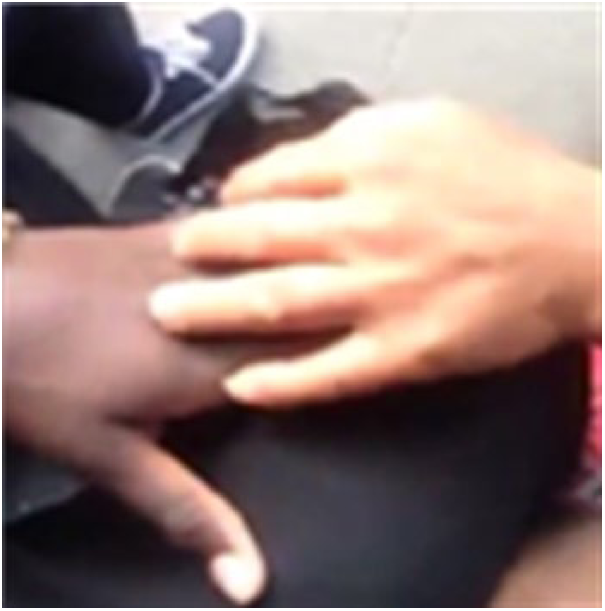
Chinese locals touching the hand of a Black traveler.
Further to this, a range of other tweets refer to strangers coming up to them, asking to touch their hair, staring from a distance or trying to get a photo: “Me inside right now as people at the airport try to get away with taking pictures of my hair. #TravelingWhileBlack #afro”—Twitter User 13
Many of the tweeters were culturally aware of their Blackness when traveling domestically and internationally: “Being aware of your Blackness means being one of the only Black women @ Salt Lake City airport with an Afro and blank stares.”—Twitter User 16 “Soooo today a girl asked me why my palms were White and a few people had me take pics with their kids.”—Twitter User 15
However, one tweeter reflects on a more positive note that awareness and cultural differences can actually lead to meeting new friends. The example given included a picture of two young children staring at each other, perhaps in awe of their differences, but, with the innocence of childhood.
“Meeting friends out on the street. #travelingwhileBlack #Blackgirltravel #chingu”—Twitter User 17
Urry argues that “tourism results from a basic binary division between the ordinary-everyday and the extraordinary” (1990, p. 11). Thus, within these instances, being Black was considered “exotic” and evoked suspicion or curiosity among other travelers or hosts: “Keeping your boarding pass tucked away so white passengers can stop trying to monitor where you belong.”—Twitter User 18
Feeling “othered” within these travel situations created another barrier for Black travelers. They did not feel a sense of belonging within traditionally White-dominated spaces (Johnston 2001). Moreover, these narratives helped to expose how racism is still embedded within the travel and tourism landscape, whether consciously or subconsciously.
These snippets of stories provide just a glimpse into the lived experiences of Black travelers all over the world. Although “Awareness of Black Travelers” cannot be directly attributed to racism, the idea that Black travelers have to deal with this kind of attention and intrusion from strangers presents an issue for the travel and tourism industry at large. The question becomes, how can destinations attract Black travelers while these types of experiences are being shared across social media? In summary, the number of different instances involving the exotic gaze from bystanders reveal that Black travelers across the globe share similar and consistent experiences of “othering,” ultimately inhibiting them from enjoying a vacation experience in the same way White people may be able to while traveling.
Meaningful Experiences Traveling While Black
Although many TWB twitter users offered their negative experiences involving racial discrimination, many of them also reflected on travel experiences that excited, transformed, and changed them. The theme “Meaningful Experiences” included two main categories, wanderlust despite being Black (n=70, 14.7%) and transformative experiences (n=98, 20.5%). These experiences encompassed a range of reflections shared regarding excitement and wanderlust for travel, cross-cultural exchange, the Black travel community, learning and education through study abroad, empowerment and transformation through travel. Reflections related to this theme were all categorized as positive experiences on the spectrum in addition to having a direct relationship with being aware of traveling while Black. In fact, the relationship between meaningful experiences and awareness of traveling while Black provides an important backdrop for understanding the complexity of the Black travel experience.
Black twitter users shared a range of reflections about the excitement of upcoming trips, specific destinations they had visited that sparked their wanderlust, and travel dreams they had for their future. Within the data, one tweet posed a question using the #Traveling While Black hashtag that asked other users to share travel experiences that changed them or influenced them in a positive way. Multiple Twitter users responded describing their positive travel experiences: “First time away was to Ethiopia and Nigeria while at Howard. Incredible experience that sparked my wanderlust #travelingwhileBlack.”—Twitter User 19 “Summer Plans on deck! Do you have any?! #expatlife #travelingwhileBlack #Blackgirlstraveltoo #wanderlust #QnA.”—Twitter User 20
Moving into more depth, the thematic analysis of tweets revealed that Black travelers were not only experiencing wanderlust and excitement, but were also reporting transformative and empowering experiences sparked by education, study abroad, and cross-cultural exchange. A plethora of comments related to these themes indicates that this was a widespread phenomenon among the sample. For example, the following tweets reflect on their experiences with cross-cultural exchange and how those have made a lasting impact on them: “Seeing other cultures, values (and) ideals, made me think a lot more critically about the life I want to live #travelingwhileBlack.”—Twitter User 21 “I learned I could go to a country where I didn’t speak the language and survive and experience life in a new way #TravelingWhileBlack.”—Twitter User 22 “I studied abroad in #Jordan and traveled around the #MiddleEast (This experience) gave me insight into a culture that’s often misunderstood #travelingwhileBlack.”—Twitter User 23 “Leaving the U.S. and seeing the world is critically important for perspective and you just can’t get it without #travelingwhileBlack.”—Twitter User 24
Further to this, one tweet reflects on the fact that their travel experience actually created a shift in their travel behavior, motivating them to now travel internationally multiple times per year: “(Travel) completely changed my life. Now I travel internationally at least 3 times a year.”—Twitter User 25 “(It) opened my eyes to all the world offers #travelingwhileBlack.”—Twitter User 26
One of the main tenets of CRT commits to transforming and liberating marginalized groups through social justice reform and non-traditional methods of storytelling (Atwood and López 2014). These findings lay important groundwork for understanding the rise of the Black travel movement itself, and its connection to CRT. Interestingly, the data showed that the awareness of negative issues for Black travelers that was spread across social media platforms, was actually the catalyst for the development and rapid growth of the Black travel community. In short, these issues of racism and prejudice experienced by Black travelers actually stimulated the growth of the BTM, creating a community in which Black travelers could feel welcomed. One user tweets about “why the Black travel movement has taken off,” linking their tweet to a longer blog post describing the need for a Black travel community, and the level of awareness Black people have to maintain while they are traveling:
Ironically, the lack of representation and negative issues that face Black travelers created a strong push for the development and growth of the BTM. This community provides a space for Black travelers to share their experiences, a counternarrative to the more normalized and Whitewashed picture of travel (Atwood and López 2014; Merriweather, Guy, and Mangliitz 2006). In fact, African-Americans are traveling now more than ever, but the awareness they must travel with is different from a White person, hence the need for this community. These snapshots and stories describing the meaning and transformation that can be garnered through traveling while Black provides a glimmer of hope for the advancement of race relations around the world. In summary, these accounts confirm that although Black travelers are still faced with racism and discrimination, travel is still an avenue for education, empowerment, peace, and greater understanding among cultures.
Discussion
The tourism industry, nationally and internationally, has traditionally adopted a White male gaze that shrouds experiences of marginalized groups and perpetuates racial stereotypes (Alderman 2013). Unfortunately, this study exemplifies the consistent touristic marginalization of Black and African-American travelers expressed and shared through Twitter. Hence, there is a strong movement, among the Black community, toward creating brave places where Black travelers can share their travel experiences and find support to navigate through precarious environments.
Although there were major themes extracted from the data that suggest issues around discrimination, racism, and othering, there were still discussions around meaningful transformational experiences. These counternarrative stories helped to paint a different picture around the Black travel experience. Twitter users expressed that, unfortunately, occurrences of racism while traveling are not a thing of the past, and in fact, still present a serious issue for many Black travelers. Accounts related to interrogation, racial profiling, microaggressions, and discriminatory remarks provide evidence to this claim. These findings support the notion argued by critical race theorists that racism is built into the fabric of our society, and maintained by officers of the law (immigration officers) who are trained to profile people of color as criminals, out of place, or suspicious (Delgado and Stefancic 2017). Further to this, these stereotypes are then passed down to other travelers and locals who are in the majority, promoting a cyclical experience of racism for Black travelers.
On a more positive note, a major theme emergent among Twitter users was liberation and transformation through travel. We found that many Twitter users expressed experiencing a perspective shift as a result of learning about new cultures and stepping outside their comfort zone. More specifically, a conversation around studying abroad revealed how educational travel can have a positive impact on individuals, resulting in empowerment and cross-cultural understanding. Emphasizing the transformative potential of tourism mirrors CRT’s commitment to social justice and freedom for all.
Lastly, the CRT counterstorytelling method adopted in this study helps to illustrate the process by which the travel and tourism atmosphere reinforces a White-male gaze. Stories create their own bonds, represent cohesion, shared understandings, and “the cohesiveness that stories bring is part of the strength of the outgroup”, which circulate within the group as a kind of “counterreality” (Delgado 2000, p. 45). By analyzing how Black tourists are traveling, we revealed how experiential knowledge of Black travelers contributed to the learning environment of the tourism industry and their shared counterreality. CRT suggests that experiential knowledge of travelers of color brings different perspectives, that will hopefully, move toward eliminating all forms of subordination and create a more just society (Delgado Bernal and Villalpando 2002). Within tourism, traveling has the power to be a transformative experience and contribute toward important social aims. Fostering cross-cultural understanding, facilitating learning, promoting peace and environmental protection, are all positive characteristics of tourism (Higgins-Desbiolles 2006). Thus, travel and tourism can become a vehicle for greater racial understanding, providing a glimmer of hope for race relations in the travel and tourism sphere (Delgado and Stefancic 2017).
Hopeful tourism, as explained by Pritchard, Morgan, and Ateljevic (2011), posits for tourism studies’ scholars to embrace co-transformative learning and action unfolding a vision for tourism research that is committed to social justice and the universality of human rights. Furthermore, Tribe (2008) argues for a critical assessment of the tourism industry in order for the survival of tourism; he posits that if we are to “make genuine and deep progress in sustainable tourism,” then management practices must be informed by the “current configurations of power and the operation of dominant ideological practices” (p. 253) that work through how marginalized groups navigate touristic spaces. Thus, awareness and accountability of how power, politics, and race help shape the tourism industry can contribute toward a more inclusive and inviting touristic experience for underrepresented groups (Benjamin et al. 2016).
Implications
The relationship between African-Americans and travel and tourism is a complicated and disputed one given the segregated and discriminatory history in the United States. However, the Black tourism market is growing fast yet still under-represented within academic research. Thus, it is our goal to explore how Black travelers are experiencing travel and tourism currently in order to become social justice advocates. The use of counternarrative storytelling, as a means of data collection, challenges dominant claims of meritocracy within the travel and tourism landscape. Using Twitter as our platform to collect data, along with the fairly new phenomenon of hashtags, we found that we were able to gain access to the “counternarrative” of a group that has not normally been heard in the past.
The development and rising popularity of social media platforms like Twitter has, unknowingly or knowingly, created a space for collective, counternarrative storytelling in a (mostly) nonthreatening environment. Collectively, these stories help academics to understand the voices of Black travelers in a way that was previously unattainable. These real-life snippets of Black travel experiences acted as a mechanism for connection and community building. Interestingly, the increase in these counternarrative stories of racism led to a new phenomenon in the tourism domain—The Black Travel Movement (BTM).
Almost as a replacement to the once popular Negro Travelers Green Book published between the 1930’s and 60’s, the Black Travel Movement provides a brave space for travelers of color to connect with each other. However, without platforms for these counternarrative stories, the movement may have never come about. Examples of this movement include popular Black travel bloggers such as Minority Nomad (
Continuing to share these narratives online will help strengthen the community and educate travelers about the world around them. Above all, Black travel narratives demonstrate that writing, particularly self-writing in transnational contexts, in many ways reflects commitment to self-possession through evolving definitions and shifting perceptions of the world (Evans 2014). Through narratives, tweets, forum posts, videos, blog posts, photos and other media, Black travelers can show each other, as well as the world, how important the Black travel movement is. Karia Talley, a contributor on Blavity, writes about using Black travel on social media as a form of resistance against doubts and oppressions, “It’s saying I can take on and explore the world without anyone controlling my body, my freedom of movement nor my freedom of choice to go wherever I please” (2017).
Destination marketing organizations and hospitality and tourism marketing/advertising firms can listen to the experiences and stories of people of color, and like CRT, help to teach other travelers about the issues marginalized groups face while traveling. Furthermore, professionals and policy makers need to make a conscious effort to include and integrate African-American/Black travelers by providing a welcoming and safe environment (Lee and Scott 2017). Implementing more marketing and advertising collateral (i.e., travel brochures, advertisements, and commercials) that physically show visible images of people of color actively participating and enjoying tourist activities and experiences can help improve marginalized representation within tourism marketing material showcasing the true value of these groups.
These images are not just about displaying products and attractions; they also include representations of social groups and societies (Pritchard and Morgan 2000) and rely on racial representations to attract tourists to specific locations. Consequently, if multiple studies (Alderman 2013; Burton and Klemm 2011) have found that marginalized populations are not well represented in travel brochures, how are tourism marketers planning to invite these fast-growing markets of tourists to their destinations? Whether or not the exclusion of underrepresented populations is purposeful, it alienates underrepresented populations and sends a message that they are not welcome.
Limitations and Future Research
This study, though it is novel in its approach, is not without limitations. It is limited to only those Black travelers who chose to post and share on Twitter using a specific hashtag. This method would have excluded people from generations that do not use Twitter as a platform, or that do not use hashtags to share their thoughts. Additionally, because of the nature of the data, we have no demographic information of the participants, nor do we have comprehensive information about the places that they traveled. Furthermore, this article is American-centric, in that we are framing the analysis within CRT and the history of Black/African-Americans in the United States.
Although the Black travel market continues to experience upward growth globally, the relationships that Black people have with travel remain multifaceted. Future research in this area should include a focus on the historical awareness of Black travel, and its effect on travel experiences of today’s Black traveler. For example, studies exploring visitors to the newly opened African-American Museum of History and Culture located in Washington, DC, would be warranted. Further to this, future studies in this area may include comparisons between the results from this study and data gathered from other niche social media outlets including Black Twitter, Reddit, and Instagram.
Another interesting direction would be to interview popular Black travel enthusiast companies including Outdoor Afro, Nomadness Travel Tribe, Travel Noire, and Black Adventuristas. From a marketing perspective, these companies have an interesting line to walk. For example, what affect will showing more Black and Brown faces have on the media presence of these travel companies? These interviews would expand on Carter’s (2008) work around Black travel agents and include the impact with social media efforts including blogs and websites. We would like to explore how counternarratives included in their websites and Instagram posts/stories could possibly cross cultures and help to educate on the issues around Black travel. By diving deeper into the niche social media outlets and Black travel enthusiast companies, findings could possibly contribute to a better understanding of how Black travelers are experiencing the tourism industry and how academics and industry professionals can change the narrative to be more inclusive.
Footnotes
Declaration of Conflicting Interests
The author(s) declared no potential conflicts of interest with respect to the research, authorship, and/or publication of this article.
Funding
The author(s) received no financial support for the research, authorship, and/or publication of this article.
Notes
Author Biographies
 ). Currently, much of her work revolves around studying the development of the Black Travel Movement where she is exploring African-American identity through roots tourism.