



Abstract
Beside the physical impacts of climate change, society’s perceptions of climate change and its reactions at different stages of decision-making levels have become critical issues. This study presents the perspective of tourists who have previously visited Florida, in a hypothetical scenario of changed climatic conditions. It is proposed that existing social representations about climate change, and therefore individuals’ attitudes, views, and beliefs about this phenomenon, need to be taken into account when examining tourists’ stated responses to climate change and subsequent potential shifts in tourism demand. The existence of a relationship between tourists’ visitation intentions toward a destination impacted by climate change and the social representations they hold with respect to climate change itself offers an alternative way to look at tourists’ stated responses. This study concludes that predicting shifts in tourism demand based on tourist visitation intentions requires caution when dealing with climate change.
Introduction
Moving beyond the natural sciences, the issue of climate change has today become a significant domain of the social sciences. Society’s perceptions of climate change and the responses to it at various decision-making levels have become urgent issues to deal with. However, with climate change being perceived as a gradual and complex phenomenon, society has been insufficiently prompt in its reactions. The effects of climate change on coastal areas generate particularly severe consequences for the tourism industry. The impacts of rising sea levels, especially when combined with changes in storm frequency and intensity, lead to damage of sea defenses, protective mangrove swamps and shoreline buildings, cause beach erosion, and create storm-surge damage to coral reefs (Mather, Viner, and Todd 2005).
This study analyzed the standpoint of tourists who visited a costal destination in the state of Florida, United States. The choice of Florida was twofold. First, Florida, one of the most visited tourist destinations in the world, holds one of the most “unenviable” positions in terms of its vulnerability to climate change (Stanton and Ackerman 2007; Harrington and Walton 2008; Florida Oceans and Coastal Council 2010; Noss 2011). The effects of rising sea levels and changing climatic conditions are already visible, particularly on its low-lying coastal areas (Kolbert 2015; Bagley 2016; Sutter 2016a, 2016b). Second, and even more concerning given its vulnerable position, is the lack of political will to address these issues at the state level (Dearen and Kay 2015; Korten 2015; Florida Majors 2016).
A favorable climate and appealing waterfront are main attractions that draw visitors to the coastal areas of Florida. The intensification of storms, hurricanes, and sea level rise has the power to cause long-term negative economic impacts to the state’s tourism industry and to its attractiveness as a tourism destination (Repetto 2012). In Florida, with nearly 10% of its land area lying at less than one meter above sea level, timing and effective adaptation is vital in determining the extent of climate change impacts (Borisova, Breuer, and Carriker 2008). Local communities across Florida are already developing adaptation measures, such as investing in storm water pumps, upgrading storm water and sewer systems, and revising building codes. However, no statewide climate change adaptation policy is currently in place (Dearen and Kay 2015).
In an attempt to address the urgency of dealing with climate change impacts and adaptation, this study presents the perspective of tourists who have previously visited Florida, in a hypothetical scenario of changed climatic conditions. The perspective of tourists, key stakeholders and Florida’s most precious resource, should not be overlooked. However, the fact that the climate change issue remains so controversial in the particular context of the United States, and which now has become a socially constructed issue, suggests that there is not a single way of looking at reality in this context. The problem of uncertainty associated to climate change’s extent and scope has created room for denial and skepticism about the existence of climate change itself (see Dunlap 2013; Hall et al. 2015). Also, although it is well established that climate change impacts will cause a shift in time and place of tourist visitation (Gössling and Hall 2006; Gössling et al. 2012), these shifts in tourism demand will occur as actual impacts increasingly become apparent. Subsequently, trying to predict tourists’ actual behavior for a future in which the effects of climate change will be fully evident can only be a tentative effort and is not necessarily accurate. In particular, tourists’ stated responses gathered through surveys and interviews might be influenced by their views and beliefs about climate change (Halfacree 1993). If this is the case, their stated intentions might not represent their actual future behavior. In this situation, a theoretical perspective is necessary in order to attempt gathering an understanding of tourists’ responses and visitation intentions to tourist destinations impacted by climate change. Climate change, as well as being a compelling and real problem for our society, has become an emotive social issue. For these particular reasons, this study chose to embrace the theoretical framework of social representations theory, an approach that focuses on the way people create their shared realities. The theory of social representations (Moscovici 1981) postulates that social groups develop shared meanings of a new, unfamiliar phenomenon, by aligning it with what is a familiar and comfortable interpretation of it. By taking into account tourists’ social representations in the context of climate change, this study aimed at understanding how projected climate change impacts and the existence of adaptation measures realized to cope with these impacts might influence the choice of Florida as a coastal tourism destination.
Literature Review
Climate Change and Potential Shifts in Tourism Demand
Climate is one of the main factors affecting travel motivations and destination choice (Scott, Gössling, and Hall 2012), and as such the implications of climate change for tourist behavior and demand patterns are significant. In this regard, Gössling et al. (2012) argue that “understanding tourist perceptions and reactions to the impacts of climate change is therefore essential to anticipating the potential geographic and seasonal shifts in tourism demand, changes in specific tourism markets, and the overall competitiveness of businesses and destinations” (p. 37). However, with the physical phenomenon of climate change having become a social phenomenon through the involvement of international institutions, influential personas, including religious and political leaders, and the delivery of images and messages by the media, anticipating potential shifts in tourism demand from prospective perceptions and reactions stated by tourists is not free from limitations.
As highlighted by Scott, Simpson, and Sim (2012), despite the high value of tourism properties and economic activities in coastal areas, there is a lack of tourism studies related to the impacts of climate change in coastal tourism destinations. Scott, Gössling, and Hall (2012) also emphasize the importance of understanding the implications of climate change for tourist demand patterns, and how this constitutes a research priority in the tourism field. Since people engage in tourism and recreational activities for personal satisfaction or pleasure as a free choice, participation in those activities for which climate is considered a key factor will only occur if the potential participants perceive the climate conditions to be appropriate. As pointed out by De Freitas (2005), the discretionary nature of tourism means that participation will decline as discomfort and dissatisfaction increase.
Uncertainty, Denial, and the “Construction” of Climate Change
The Intergovernmental Panel on Climate Change (IPCC 2013) defined warming of the climate system as “unequivocal” (4), with many of the observed changes since the 1950s being unprecedented over past decades and even millennia. “The atmosphere and ocean have warmed, the amounts of snow and ice have diminished, sea level has risen, and the concentrations of greenhouse gases have increased” (IPCC 2013, p. 4). However, uncertainties are intrinsic in the scientific method, in the development of models and hypotheses, in measurements, or in the interpretation of scientific assumptions (IPCC 2014). Because of the complexity of the climate system and the large variety of processes involved, climate science is not different, being characterized by different levels of uncertainty on its extent and scope (Cubasch et al. 2013). Any climate parameter, observed trend, or projected change that is based on statistical or modeling analysis, expert views, or other quantitative analyses, can be expressed in terms of probability (see Mastrandrea et al. 2010).
The uncertainty associated with climate change impacts and pace makes exact predictions difficult, offering climate change skeptics and deniers the chance to criticize scientists’ work and findings on the evolution of climate (see Dunlap 2013; Hall 2015). As highlighted by Scott, Hall, and Gössling (2012), “climate change knowledge is extremely contested and, at times, extremely controversial” (p. 347). There are several reasons for which a part of the population is skeptical and denies anthropogenic (influenced by human activities) climate change (Hall et al. 2015). The controversy that characterizes views and beliefs about climate change among the general public and policy makers is particularly emblematic in the United States (see McCright and Dunlap 2011; Dunlap 2013). As reported in a paper by Borisova, Breuer, and Carriker (2008), some climate change skeptics argue that the price of reducing emissions is too high, when compared to the uncertain benefits of our actions on the climate. However, “the failure to avert severe climate change would have even more severe consequences for Florida, in cold hard cash as well as human and ecological impacts” (Stanton and Ackerman 2007, p. ii).
Climate change has originally been a domain of the natural sciences. However, the fact that the issue is rooted in human behavior—and that is why it is referred to as “anthropogenic”—makes it also a domain of the social sciences. The fact that the climate change issue is so controversial suggests that there is not a single way of looking at reality in this context. Hulme (2009), in this regard, examines the complex reasons why society disagrees on climate change, and how this phenomenon goes beyond its origins in the natural sciences to take new meanings and serve new purposes. As the World Bank wrote about denial in decision making, “rather than an aberration, denial needs to be considered a coping strategy deployed by individuals and communities facing unmanageable and uncomfortable events. Resistance to change is never simply the result of ignorance—it derives from individual perceptions, needs, and wants based on material and cultural values” (The World Bank 2010, p. 226).
Since climate change seems to be a socially and culturally “constructed” issue (see, e.g., Demeritt 2001, 2006), the way it is framed and communicated is highly important to determine how individuals perceive it. In this regard, Lorenzoni, Nicholson-Cole, and Whitmarsh (2007) argue that the way issues are framed, including words, metaphors, stories, and images used to communicate information, determine individual actions. In reference to climate change, messages, individual assumptions, worldviews, and cultural models will influence the ways such messages are judged (Lorenzoni, Nicholson-Cole, and Whitmarsh 2007).
Scenarios are useful tools to ask tourists to imagine what their likely reactions would be in the event of climate change impacts on a visited destination’s environmental features that attract them the most, such as wide beaches and marine wildlife (e.g., Braun et al. 1999; Uyarra et al. 2005; Coombes and Jones 2010; Moreno 2010). However, in a situation of uncertainty in the extent and scope of climate change impacts, only a partial understanding of how tourists’ intentions will translate into actual behavior can be obtained, until the different climate change impacts progressively become evident.
Additionally, tourists’ answers in surveys and interviews might be influenced by their views and beliefs about climate change (Halfacree 1993). If this is the case, their intentions might not represent their actual future behavior. Although behavioral intentions can, in many cases, be a proxy of actual behavior, people tend to behave in ways that are not consistent with their perceptions and attitudes, and even less with their stated perceptions and attitudes (Dickinson and Dickinson 2006). In this situation, a theoretical perspective is necessary in order to attempt understanding tourists’ responses to climate change impacts in terms of visitation intentions.
The Theory of Social Representations in the Context of Climate Change
Psychological approaches such as the theory of reasoned action (Fishbein 1979; Sheppard, Hartwick, and Warshaw 1988) and the subsequent theory of planned behavior (Ajzen 1991) have often been used in the study of tourists’ behavioral intentions in the context of tourism and hospitality (e.g., Lam and Hsu 2006; Quintal, Lee, and Soutar 2010). These theories assume that attitudes are stable attributes that predispose a person to respond in a certain way. According to this assumption, individuals make rational decisions based on available information and their own attitudes, objectives, and values. However, especially when confronted by social issues and practices, people tend to have dilemmas about those issues, with their attitudes being contradictory rather than stable (Dickinson and Dickinson 2006). The existing empirical studies on tourists’ responses to climate change tend to assume, in a deterministic way, that people operate rationally and consistently (Dickinson and Dickinson 2006). However, this may not be the case. As emphasized by Dickinson and Dickinson (2006), while theories such as reasoned action and planned behavior do consider the social processes that influence individual decisions, they fail to account for what represents normative patterns of behavior or how and why they have developed. As a matter of fact, our worldviews are shaped by interactions with other people, as well as by institutional and cultural forces (Joffe 2003).
The theory of social representations postulates that people construct shared perceptions and theories that represent the social realities they live (Dickinson and Dickinson 2006). Social representations theory focuses on the way individuals develop their shared realities. It postulates that social groups create shared meanings of a new, unfamiliar phenomenon, by associating it with another that is considered a comfortable and familiar interpretation of it. Social representations derive from direct experience as well as from mass media and social interactions (Moscovici 1981).
Social representations help individuals define and organize reality, and connect them to their cultural and social world (Pearce, Moscardo, and Ross 1996). However, they are not to be considered as logical and coherent thought patterns, as they are full of contradictory thoughts and ideas. In this regard, it is suggested that not only social representations distort reality in order to preserve intact a created preconception (Fredline and Faulkner 2000) but also that societies can create a reality that fits that preconception (Hogg and Abrams 1988).
Social representations become particularly relevant in phenomena subject to debate, conflict and strong feelings that change collective thinking in society. Within the issue of climate change, we can observe how science, politics, mass media, and everyday knowledge meet, to create new social representations (Hoïjer 2011). While social representations theory has been applied to tourism studies that assess the resident population’s views of tourism (see Fredline and Faulkner 2000; Pearce, Moscardo, and Ross 1996) there are no social representations studies in the tourism and climate change literature. However, this theory is well suited for application to tourists’ views on climate change, as it has been used previously as a lens to look at how people make sense of climate change through a combined filter of science, politics, mass media, and everyday knowledge (Hoïjer 2011). By proposing an approach based on social representations theory (Moscovici 1981), this article introduces a theoretical approach that has so far been absent from empirical studies of tourist responses to climate change impacts on coastal tourism destinations.
Social representations theory (Moscovici 1981) postulates two main socio-cognitive communicative mechanisms that generate social representations: anchoring and objectification. The first mechanism, anchoring—differentiated between a number of mechanisms itself—is a kind of cultural assimilation that makes the unknown known by relating a new phenomenon to a well-known phenomenon or context. Anchoring mechanisms include naming, emotional anchoring, thematic anchoring, antinomies, and metaphors. Examples of anchoring in the context of climate change include giving this complex phenomenon a short and easier-to-understand label such as “the weather”—for example, the weather will become too hot (naming anchoring). Also, describing our planet as “sick” or “on its way to die” (metaphors) is a type of anchoring that societies created to make sense of a new, complex phenomenon such as climate change (Hoïjer 2011).
The second mechanism, objectification—differentiated between emotional objectification and personification—makes the unknown known by transforming it into something concrete that can be perceived with our senses. In the context of climate change, objectification occurs, for example, when concrete and frightening images such as people escaping severe floods or dramatic forest fires are recurrently used by the media and associated to climate change (emotional objectification). Objectification also occurs through personification, when an idea or phenomenon is linked to specific persons. For instance, this is the case of the former US vice president Al Gore, whose photographs were regularly accompanying news articles on climate change in the press (Hoïjer 2011). Table 1 summarizes the different mechanisms through which individuals within a society make sense of new phenomena, as it applies to the phenomenon of climate change.
Social Representations in the Context of Climate Change.
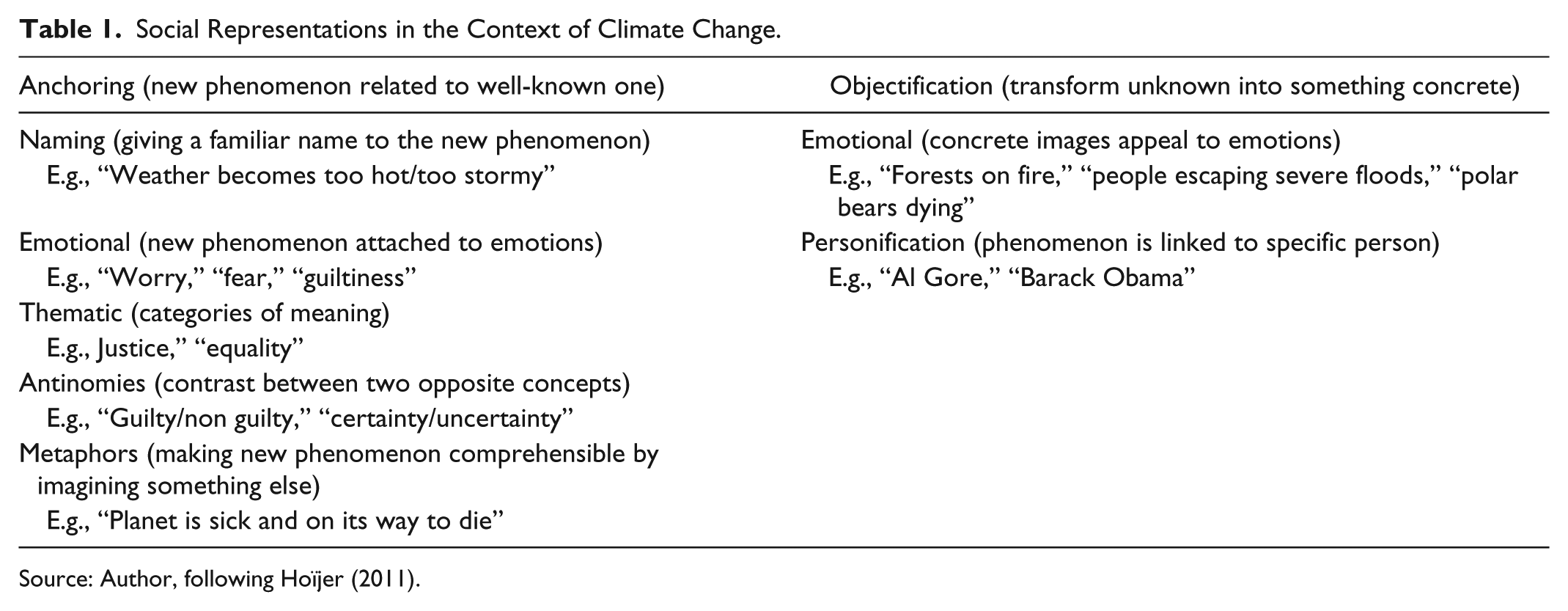
Source: Author, following Hoïjer (2011).
Using social representations theory as a theory of reference, the question that arises is: does the way tourists form their views about climate change have a role in both their responses to climate change impacts and their intention to visit a tourism destination? The theory of social representations suggests that views and opinions stated in surveys reflect social representations of reality that are commonly shared in the society we are part of (Halfacree 1993).
The Importance of Perceptions for Tourist Responses to Climate Change
Climate is a key factor considered by tourists, either consciously or subconsciously, during travel planning (Scott et al. 2008). It is recognized that tourism is influenced by weather and climate, with “sun, sand and sea” holiday decisions being predominantly based on perceptions of warm and sunny environments (Gössling and Hall 2006). Numerous coastal tourism destinations depend on favorable climatic conditions, such as abundant sunshine and absence of precipitation or wind (Scott et al. 2008). In general, a crucial element in leisure travel demand is the degree of comfort (or discomfort) experienced at the tourism destination (Mather, Viner, and Todd 2005). The comfort experienced by tourists is also influenced by other elements such as disease risk, prolonged rainfall, and changes in extremes. All these factors affect leisure travelers’ destination choice.
The impacts of climate change on islands, coasts, and beaches cause severe consequences for the tourism industry. Sea level rise, especially in combination with change in storm frequency, produces damage to sea defenses, protective mangrove swamps and shoreline buildings, in addition to beach erosion and storm-surge damage to coral reefs (Mather, Viner, and Todd 2005). If the features that attracted tourists to a destination in the first place are negatively affected by the impacts of climate change, tourists’ comfort and enjoyment will decrease (De Freitas 2005). Since people engage in tourism and recreation activities as a free choice, as a result, participation in those activities for which climate is considered an important factor will only occur if the potential participant perceives the climate conditions to be suitable. Subsequently, changes in the spatial and temporal features of climate resources will produce significant effects for tourism demand at different levels, both as a consequence of changing conditions at the destination level and climatic variables perceived as less or more comfortable by visitors (Gössling and Hall 2006; Gössling et al. 2012).
One branch of publications on climate change focuses on tourists and their responses to changing climatic conditions. Particularly, the effects of increasing temperatures and related variables on destination choice and time of departure have been the focus of research (Gössling and Hall 2006). Other studies, on the other hand, provide a bottom–up approach that gathers the perspective of tourists (see Braun et al. 1999; Uyarra et al. 2005; Gössling et al. 2006; Uyarra et al. 2005; Buzinde et al. 2010; Coombes and Jones 2010; Moreno 2010).
In spite of negative impacts of climate change on coastal destinations, adaptation measures can help mitigate the negative effects on the appearance and appeal of the destination (Becken and Hay 2007). Adaptation is defined by the Intergovernmental Panel on Climate Change as “the adjustment in natural or human systems in response to actual or expected climatic stimuli or their effects, which moderates harm or exploits beneficial opportunities” (IPCC 2007, p. 6). However, adaptation measures are not always sufficient to appeal to tourists in the occurrence of climate change impacts. For example, Braun et al. (1999) investigated the likelihood of choosing the North German coast as a vacation destination, given the effect of temperature and precipitation changes with sea level rise and beach loss. They found that in case of negative climate change impacts, the likelihood of visiting the destination was substantially lower, even in the scenario where adaptation measures were included. These findings support the point that, of all the stakeholders involved in the tourism system, it is the tourist that has the greatest capacity to adapt to the impacts of climate change (Scott et al. 2008; Jopp, DeLacy, and Mair 2010; Becken and Hay 2012). In fact, tourists have three resources—money, knowledge, and time—which give them relative ease and freedom to avoid unfavorable climatic conditions and destinations impacted by climate change, as well as the opportunity to change the timing of their trip to avoid unfavorable weather conditions (Becken and Hay 2012). Therefore, consulting tourists about their perceptions, not only regarding weather and climate conditions and relative changes, but also on which adaptation measures would make them still feel comfortable in spite of climate change impacts, will be fundamental for mitigating potential shifts in tourism demand. At the same time, since climate change’s most severe impacts are still to be felt, responses given by tourists today about their visitation intentions will be driven more by the representations they hold in relation to climate change than the actual predicted impacts.
In this context, the biggest uncertainty is characterized by tourists’ perceptions of change. Perceptions, defined as the “process of receiving and interpreting ‘information’ through all senses” (Gössling et al. 2006, p. 423), play a key part in tourist’s decision-making process. Perceptions represent an intermediate phase in processing information, thus constituting a very important “filter” in shaping the final result of the tourist’s reported or experienced change (Gössling et al. 2012).
Gössling et al. (2012) offered an extensive analysis of characteristics of tourist perceptions of and responses to climate change impacts. For instance, previous studies showed that tourist perceptions of climate change impacts vary with holiday type and role, as well as with age, culture, and other sociodemographic variables (e.g., Scott, Jones, and Konopek 2008; Buzinde et al. 2010; Denstadli, Jacobsen, and Lohmann 2011; Hewer and Scott 2011) and that tourist perceptions are heavily influenced by media (e.g., Hall and Higham 2005; Rutty and Scott 2010; Scott and Becken 2010; Scott 2011).
This study proposes that existing social representations about climate change, and therefore individuals’ attitudes, views, and beliefs concerning this phenomenon need to be taken into account when examining tourists’ stated visitation intentions and potential changes in future tourism demand. However, as destinations will appeal to tourists for other reasons that are unaffected by climate change, such as the cost and time of travel, perceived security and safety, available facilities service, accessibility, and host hospitality, as pointed out by Hall (2005), it is necessary to clarify that climate change is only one of the elements that will affect destination appeal in the eye of the tourist.
Hypotheses Development
Social representation mechanisms such as anchoring, emotional objectification and personification used by individuals to make sense of climate change may have an influence on tourists’ visitation intentions toward destinations impacted by climate change. To date, however, no research has empirically tested the relationship between tourists’ social representations in the context of climate change and their intention to visit a destination. If a relationship existed, the accuracy of respondents’ stated visitation intentions to a destination might be moderated by their social representations of the climate change issue. Tourists’ intentions on either choosing the same destination, visiting on different dates, or choosing a different destination, in the case of climate-induced impacts, may be influenced by the views of climate change they formed, consciously or unconsciously, in their minds. If this were the situation, predictions of potential shifts in tourism demand produced by climate change—when reported directly by tourists through their stated intentions—may be limited.
The following three hypotheses aimed to examine the relationship between tourists’ intention to visit a climate change–impacted destination and their level of anchoring, emotional objectification, and personification, respectively.
Hypothesis 1a: There is a relationship between tourists’ level of anchoring (low, medium, high) in the context of climate change and their intention to visit a destination.
Hypothesis 1b: There is a relationship between tourists’ level of emotional objectification (low, medium, high) in the context of climate change and their intention to visit a destination.
Hypothesis 1c: There is a relationship between tourists’ level of personification (low, medium, high) in the context of climate change and their intention to visit a destination.
Additionally, this study aimed to assess whether the existence of adaptation measures at the destination has an effect on tourists’ visitation intentions, taking into account their social representations mechanisms in the context of climate change. The following three hypotheses examined the relationship between tourists’ intention to visit a climate change–impacted destination in existence of adaptation measures and their level of anchoring, emotional objectification, and personification, respectively.
Hypothesis 2a: There is a relationship between tourists’ level of anchoring (low, medium, high) in the context of climate change and their intention to visit a destination in existence of adaptation measures at the destination.
Hypothesis 2b: There is a relationship between tourists’ level of emotional objectification (low, medium, high) in the context of climate change and their intention to visit a destination in existence of adaptation measures at the destination.
Hypothesis 2c: There is a relationship between tourists’ level of personification (low, medium, high) in the context of climate change and their intention to visit a destination in existence of adaptation measures at the destination.
Study Methods
This study followed a cross-sectional, in part descriptive and in part relational, research design. In order to avoid potential bias from existing weather conditions at the destination, an ex situ approach was employed. The data were collected through a self-administered online survey over the first week of July 2016. A self-administered survey refers to a questionnaire that has been designed expressly to be completed by a respondent without the intervention of the researcher collecting the data (Lavrakas 2008). The target population for the study was composed of a sample of tourists who had previously visited a beach/coastal destination in Florida, selected through a nonprobabilistic sampling technique. Respondents who agreed to participate in the study were granted $1 as a compensation to take and return the survey. The questionnaire was built through Qualtrics and distributed through Amazon Mechanical Turk (AMT).
The survey instrument was composed of five sections. The first section was intended to gather preliminary information about the last beach/coastal destination visited in Florida. Tourists were then presented with a scenario of changed climatic conditions. In order to assess their responses without mentioning the concept of climate change and thus trying avoiding any answer biased by their attitude toward the climate change debate, the question was worded as follows: “Keeping in mind the last beach/coastal destination you visited in Florida, please state your likely reaction assuming that the following changes in climatic and environmental conditions were to happen.” Hence, 10 items were listed, corresponding to 10 predicted impacts of climate change on Florida’s coastal destinations adapted by the work of Uyarra et al. (2005), Moreno (2010), Scott et al. (2008), and Rutty and Scott (2010) to reflect specific climate change in Florida’s coastal areas as projected by the IPCC (2007) and reflected in the work of Stanton and Ackerman (2007) and Repetto (2012). The items were as follows: “Temperature becomes unacceptably hot to me”; “Rainfall duration becomes unacceptable to me”; “Cloud cover becomes unacceptable to me”; “Wind strength becomes unacceptable to me”; “Beaches largely disappear”; “Corals severely bleach”; “Marine wildlife largely disappears”; “Tropical disease spread becomes more frequent”; “Storms intensify throughout the year”; and “Streets are frequently flooded in case of rain or tidal surge.” For each of the items, tourists were asked to indicate their likely responses in terms of visitation intentions on a categorical scale, adapted by the work of Moreno (2010) and ranging between “I would choose the same destination”; “I would choose the same destination but different dates”; and “I would choose a different destination.”
The next section of the questionnaire was aimed at assessing tourists’ responses, in terms of visitation intentions, in existence of adaptation measures realized at the destination to cope with climate change impacts. Tourists were asked the following question: “How would you react if, in spite of changed environmental and climatic conditions, the following adaptation options were to be implemented at the destination?” Fourteen possible adaptation measures were derived from a thorough review of the literature about adaptation measures applicable to coastal destinations (Braun et al. 1999; Becken 2005; Mather, Viner, and Todd 2005) and adapted to include some of the adaptation measures that are currently implemented by some Florida’s beach/coastal destinations to mitigate the negative impacts of climate change. The following adaptation measures were presented: “Free transportation to the beach with shuttle buses is provided to visitors”; “More indoor leisure-time activities are offered to visitors”; “Information about changes in climatic and environmental conditions is provided to visitors”; “Prices of lodging and other products and services are reduced”; “Fans and air conditioning are placed outdoor”; “Sea walls defenses and breakwaters are built to avoid beaches/coasts erosion”; “Beach nourishment is implemented to deal with beach shrinking”; “More built attractions are introduced to replace natural attractions”; “Street level is raised to cope with flooding”; “Pumps that draw floodwater from the flooded streets are installed”; “Tourism resorts and infrastructure are moved further back from eroding coasts”; “Marine protected areas (sanctuaries) for coastal habitat preservation are created”; “Preservation plans of wetlands flora and fauna are implemented”; and “Response plans for coral bleaching are implemented.” Based on the items presented, tourists were asked to indicate their likely responses in terms of visitation intentions, this time in existence of adaptation measures, on a categorical scale ranging from “I would choose the same destination”; “I would choose the same destination but different dates”; to “I would choose a different destination.”
Although the term “climate change” was not expressly mentioned up until this point in the survey, when faced with scenario-like statements about the impacts of climate change (e.g., beach disappearance, storm intensification, excessively hot temperature), and the wording “changed environmental and climatic conditions,” respondents may associate those impacts and words to the shared perceptions they have constructed about the phenomenon of climate change. Therefore, it is essential to understand how people view climate change and how they shaped those views in order to attempt making sense of their responses.
The subsequent section was aimed at investigating respondents’ beliefs and views about climate change by assessing the anchoring and objectification mechanisms they apply when trying to make sense of climate change. The majority of items in this section were adapted from Lorenzoni et al. (2006) and Leiserowitz et al. (2013), and the questions were reformulated by the authors to reflect the anchoring and objectification mechanism postulated by the social representations theory as reported by Hoïjer (2011) in the context of climate change publics’ sense-making. Respondents were asked to rate their level of agreement with various statements that reflect the general public’s views and feelings about climate change, thus constituting the anchoring mechanisms people use to make sense of climate change. The items were rated on a 7-point Likert-type scale ranging from 1 to 7 (1= strongly disagree, 2 = disagree, 3 = somewhat disagree, 4 = neither agree or disagree, 5 = somewhat agree, 6 = agree, 7 = strongly agree). Fourth, respondents were asked to rate a set of items on their perceived level of relation to climate change corresponding to the objectification mechanisms (both emotional objectification and personification) used to attach a meaning to climate change, on a continuous scale ranging from 1 to 7 (1= extremely unrelated, 7= extremely related). The final section of the survey was intended to gather information about demographic characteristics of tourists such as age, gender, family organization, education level, ethnicity, country of residence, income, political orientation, and religious orientation. The final version of the instrument was reviewed by the authors and peers in order to achieve face validity before being pilot-tested with a sample composed of 149 students enrolled at a university in Florida, and subsequently distributed to the target population.
Data Analysis
At the end of the data collection period, a total of 509 responses were collected. Data collected were analyzed with the aid of SPSS version 21.0. The data were subject to initial screening to detect any deviations from normality, and the existence of any missing data and outliers was checked. After data preparation and screening procedures were conducted, a total of 432 surveys were ultimately retained for the analysis. Before proceeding with the descriptive statistical analysis, continuous variables were inspected in order to assess the normality of each variable’s distribution. Both Kolmogorov-Smirnov statistic and the Shapiro-Wilk statistic were conducted. The significance value for all the variables resulted in a statistically significant value of .000 (P < .001) for both tests, indicating a violation of the assumption of normality. Although a violation of normality is very common in online samples, and although many parametric tests can tolerate non-normality because of the Central Limit Theorem, it was decided to utilize the correspondent nonparametric techniques for all the statistical analyses that required normally distributed data.
After data cleaning, a descriptive analysis was conducted to describe the demographic profile of the respondents, the characteristics of their last visit to a beach/coastal destination in Florida, and their attitudes toward climate change and social representation mechanisms. Following the descriptive analysis, the nonparametric inferential statistics technique chi-square test for independence was used to test the relationships hypothesized in this study.
Results
Respondent Demographic Profile and Characteristics of Destination Visit
The demographic profile of the study’s sample was quite balanced in terms of gender, with a little more than half being male respondents (54.9%) and the other half female (45.1%). Most age groups were represented, from 18 to 24 years old (16%) to the older generation of 65 to 74 (0.5%). The age distribution was skewed toward the younger end, with the median age being in the range of 25–34, only about 0.5% of respondents older than 55, and no respondents older than 74. All the respondents, except for one single case, had at least a high school degree. About 50% of the respondents had an associate or bachelor’s degree, and slightly over 15% of respondents had a graduate, professional, or doctorate degree. About half of respondents (53.3%) had an annual household income of less than $50,000, with the other half of the sample divided into 20.8% of respondents who had an annual household income between $50,000 and $75,999. The remaining 25.9% indicated an annual income of more than $75,000. With respect to their ethnicity, three quarters of respondents (75.2%) were white, with the remaining quarter divided into Asian or Pacific islanders (10%), Hispanic or Latinos (6%), Black or African American (5.1%), and other ethnicities who accounted for the residual 1.6%. The majority of the respondents (93.5%) reported to live in the United States, with the remaining 6.5% of respondents living in eight other countries around the world. Respondents indicated their political views were closer to Democrat (44%), Independent (34.7%), and Republican (18.8%), with a remaining 2.5% of other nonspecified political views. The spiritual beliefs of the majority of the respondents (82.9%) resulted to be closer to Christian (46.1%) or Atheist/Agnostic (36.8%). Another 8.3% did not belong to any particular spiritual belief, and the other spiritual beliefs accounted for the remaining 8.2%.
During their last visit, which in the majority of cases occurred over the last three years (54.7%), respondents visited the whole range of Florida coastal regions, although there was a greater concentration toward the Southeast (e.g., Miami Beach) and the Central East (e.g., Daytona Beach). The vast majority of respondents traveled mainly for leisure purposes and for visiting friends and relatives (92.6%), half being without children. The activities enjoyed by the majority of respondents included walking on the beach, relaxing and sunbathing on the beach and swimming, followed by activities entailing the observation of marine wildlife, fishing, and water sports.
Attitudes toward Climate Change and Social Representation Mechanisms
Respondents’ beliefs and views about climate change were investigated by assessing the anchoring and objectification mechanisms they apply when trying to make sense of climate change. The relative questions were formulated to reflect the anchoring and objectification mechanisms postulated by the social representations theory in the context of climate change publics’ sense-making.
In the first set of questions, respondents were asked to rate their level of agreement with various statements that reflect the general public’s views and feelings about climate change. Table 2 shows that the level of agreement is higher on the statements that reflect a thematic type on anchoring, such as the concept of taking action against climate change, whereas an emotional type of anchoring mechanism seems to be less prevalent among respondents.
Respondents’ Anchoring Mechanisms Used to Make Sense of Climate Change.
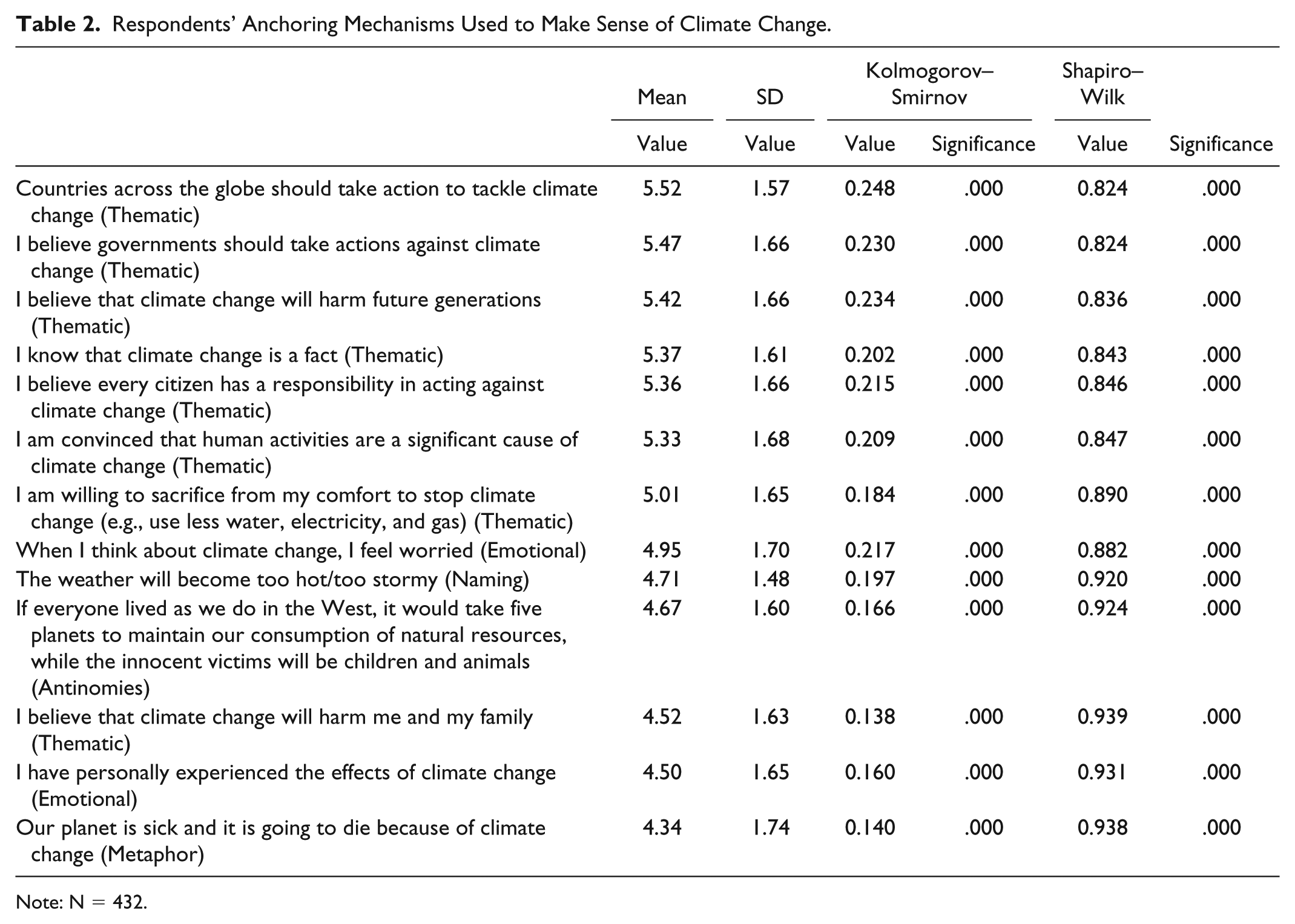
Note: N = 432.
In the subsequent set of questions concerning social representations in the context of climate change, respondents were asked to rate a set of items on their perceived level of relation to climate change (e.g., ice melting, people escaping severe floods, polar bears dying, cities disappearing under water) corresponding to the objectification mechanisms used to attach a meaning to climate change. The results depicted in Table 3 show high levels of emotional objectification mechanisms in relation to climate change perception, as for example given from images of ice melting (M = 5.17, SD = 1.93), rather than personification mechanisms provided by public figures such as Al Gore (M = 2.92, SD = 2.06) or politicians in general (M = 2.55, SD = 1.83).
Respondents’ Objectification Mechanisms Used to Make Sense of Climate Change.
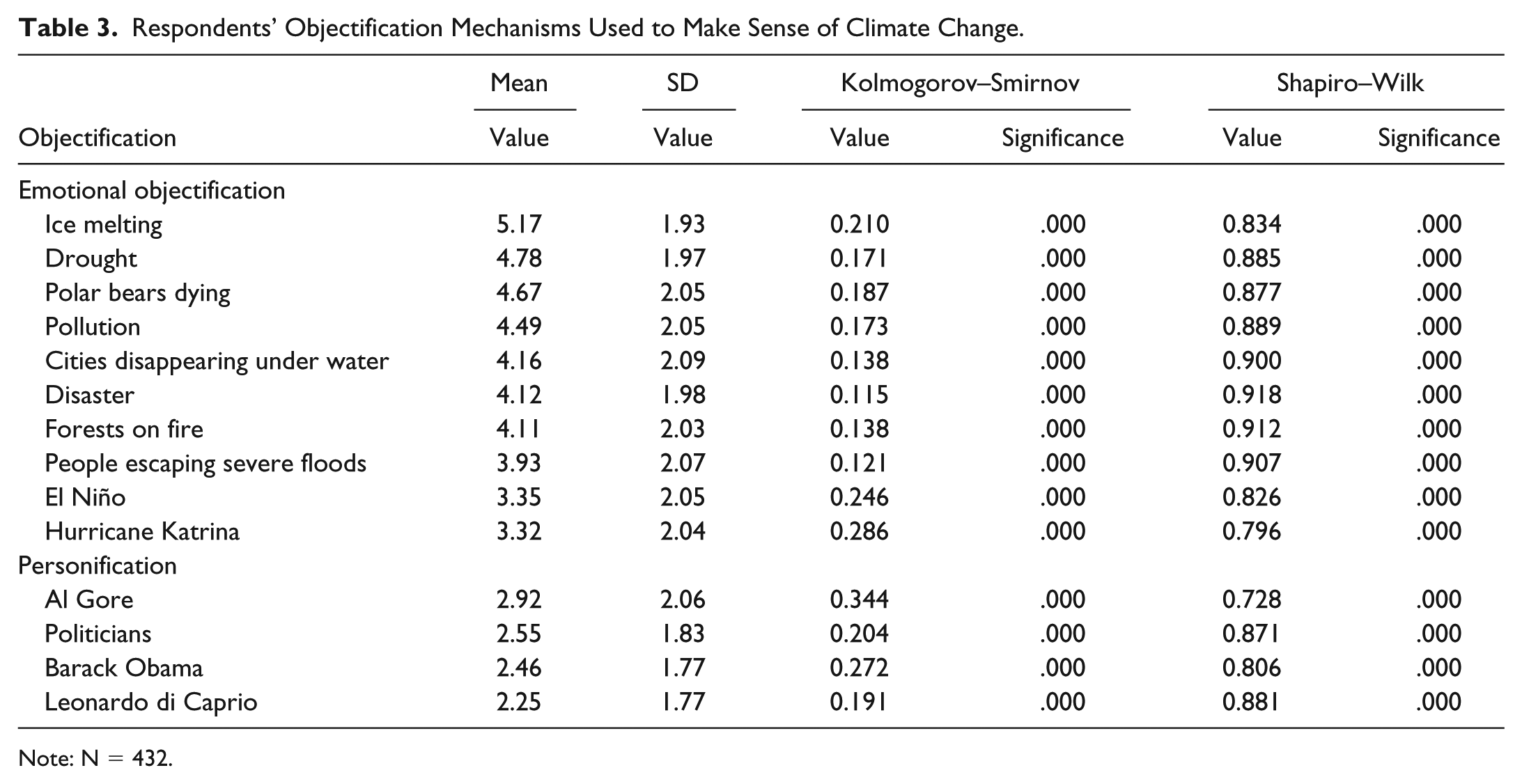
Note: N = 432.
Social Representations of Climate Change and Visitation Intentions toward Climate Change–Impacted Destinations
In an attempt to assess the relationship between tourists’ social representation mechanisms in the context of climate change and their intention to visit a destination, this study tested three hypotheses. The first hypothesis (1a) assessed the relationship between tourists’ level of anchoring (categorized into low, medium, high) in the context of climate change and their intention to visit a destination. A chi-square test for independence indicated a statistically significant association between levels of anchoring (low, medium, high) and tourist responses in terms of visitation intentions, χ²(4, n = 432) = 29.11, p = .000, phi, .260 (Table 4). The hypothesis was supported, suggesting the existence of a relationship between tourists’ level of anchoring (low, medium, high) in the context of climate change and their intention to visit a destination. As shown on Table 4, more than 40% (42.5%) of respondents who reported a low level of anchoring (e.g., do not feel worried about climate change, do not believe that countries, governments, and citizens should take action against climate change) would still choose the same destination in a scenario of climatic and environmental changes. This contrasts with the 10% who reported high levels of anchoring (e.g., feel very worried about climate change, strongly believe that countries, governments, and citizens should take actions against climate change).
Social Representations Mechanisms and Tourists’ Responses (Crosstabulation).
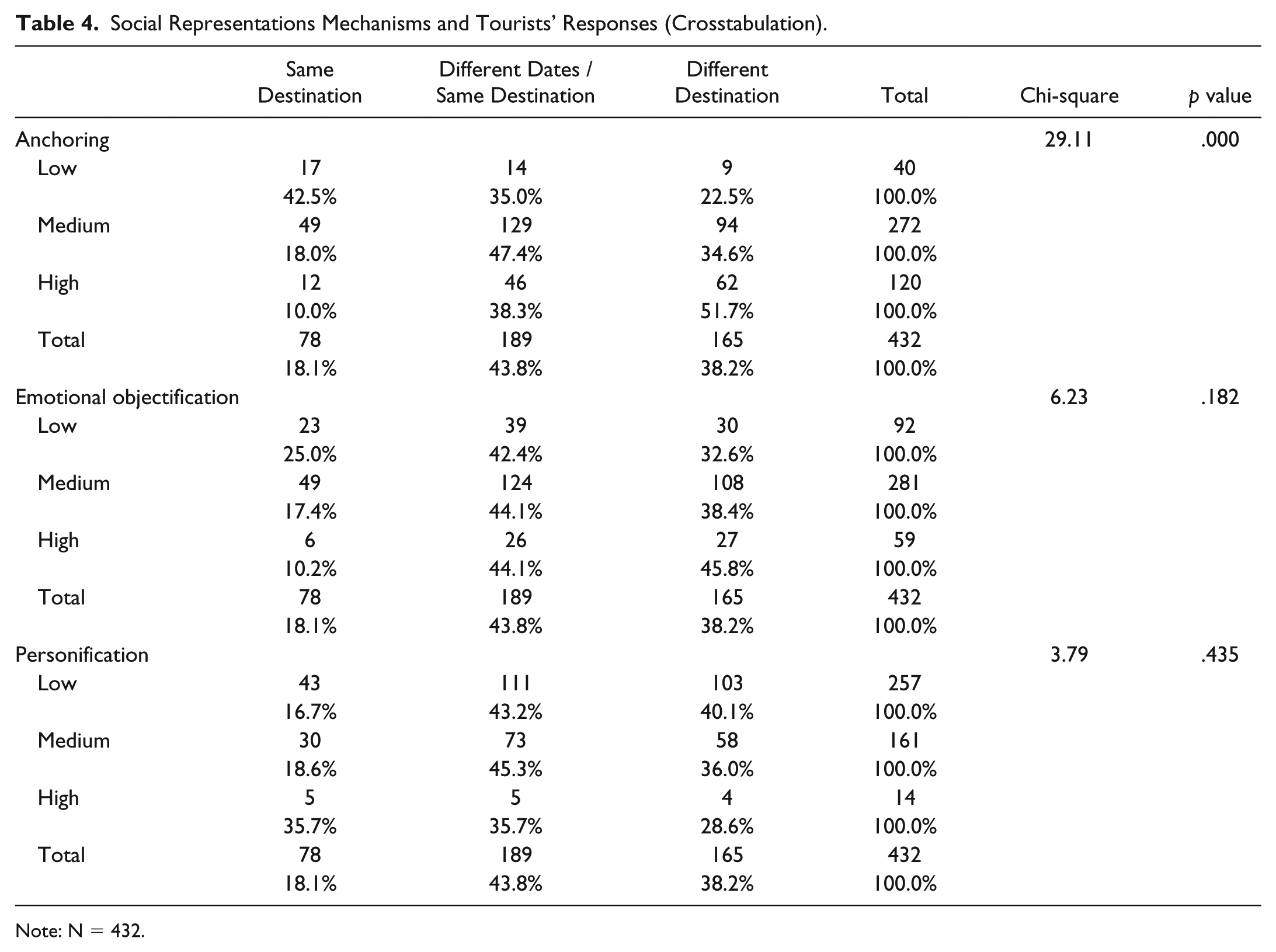
Note: N = 432.
In testing the second hypothesis (1b), the chi-square test for independence indicated no significant association between levels of emotional objectification (low, medium, high) and tourist responses in terms of visitation intentions, χ²(4, n = 432) = 6.23, p = .182, phi, .120 (Table 4). The hypothesis was not supported, indicating that no relationship exists between respondents’ level of emotional objectification in the context of climate change and their intention to visit a destination. These results suggest that reported levels of emotional objectification—which includes associating images of ice melting, people escaping severe floods, cities disappearing under water, etc. to the phenomenon of climate change—do not relate with tourists’ visitation intentions.
In the third hypothesis (1c), the chi-square test for independence indicated no significant association between levels of personification (low, medium, high) and tourist responses in terms of visitation intentions, χ²(4, n = 432) = 3.79, p = .435, phi, .094 (Table 4). The hypothesis was not supported, indicating that no relationship exists between respondents’ level of personification (low, medium, high) in the context of climate change and their intention to visit a destination. These results suggest that reported levels of personification—which includes associating images of politicians or other public personas who publicly addressed the urgency of fighting climate change to the phenomenon of climate change itself—do not relate with tourists’ visitation intentions.
Social Representations of Climate Change and Visitation Intentions in Existence of Adaptation Measures at the Destination
The purpose of the following analysis was to examine the relationship between tourists’ social representation mechanisms in the context of climate change and their intention to visit a climate change–impacted destination if adaptation measures existed at the destination.
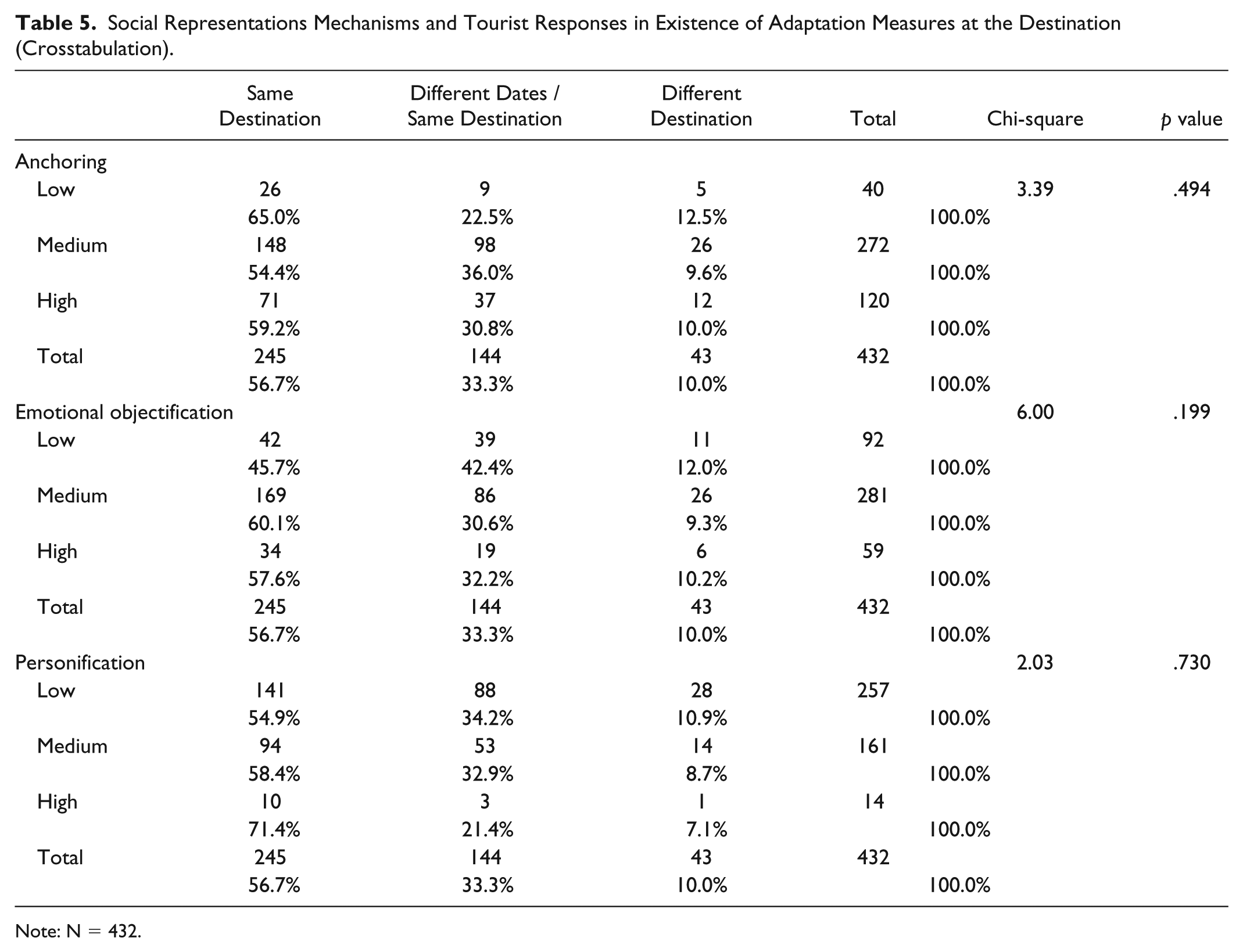
The first hypothesis (2a) assessed the relationship between tourists’ level of anchoring (categorized into low, medium, high) in the context of climate change and their intention to visit a destination in existence of adaptation measures at the destination. The chi-square test for independence indicated no significant association between levels of anchoring (low, medium, high) and tourist responses in terms of visitation intentions with the prospect of adaptation measures implemented at the destination, χ²(4, n = 432) = 3.39, p = .494, phi, .089 (Table 5). The hypothesis was not supported, indicating that reported levels of anchoring do not relate with tourists’ visitation intentions, in existence of adaptation measures at the destination.
Social Representations Mechanisms and Tourist Responses in Existence of Adaptation Measures at the Destination (Crosstabulation).
Note: N = 432.
In the second hypothesis (2b), the chi-square test for independence indicated no significant association between levels of emotional objectification (low, medium, high) and tourist responses in terms of visitation intentions in existence of adaptation measures implemented at the destination, χ²(4, n = 432) = 6.00, p = .199, phi, .118 (Table 5). The hypothesis was not supported, indicating that no relationship exists between respondents’ level of emotional objectification in the context of climate change and their intention to visit a destination, in existence of adaptation measures. These results suggest that similar to the scenario in which adaptation measures were not mentioned, reported levels of objectification do not relate with tourists’ visitation intentions.
In the third and last hypothesis of this study (hypothesis 2c), the chi-square test for independence indicated no significant association between levels of personification (low, medium, high) and tourist responses in terms of visitation intentions, with the prospect of adaptation measures implemented at the destination, χ²(4, n = 432) = 2.03, p = .730, phi, .069 (Table 5). The hypothesis was not supported, indicating that no relationship exists between respondents’ level of personification (low, medium, high) in the context of climate change and their intention to visit a destination in existence of adaptation measures. Analogously to the scenario in which adaptation measures were not mentioned, these findings suggest that reported levels of emotional objectification do not relate with tourists’ visitation intentions.
Discussion and Conclusions
The purpose of this study was to investigate how projected climate change impacts may influence the choice of Florida as a coastal tourism destination, taking into account tourists’ social representations of climate change. The effects of climate change have already started to be felt in Florida, especially in the particularly vulnerable and low-lying areas of South Florida and the Florida Keys (Kolbert 2015; Bagley 2016; Sutter 2016a, 2016b). The examination of the tourist perspective attempted to understand the negative effects that climate change impacts are expected to have on the appeal of Florida as a coastal destination, in an attempt to further our knowledge of how potential seasonal and geographic shifts in tourism demand could be mitigated by the implementation of adaptation measures.
The theory of social representations, especially with its anchoring mechanism, proved to be particularly well suited for explaining tourists’ visitation intentions in the complex and uncertain context of climate change. The role of social representations used as a system of explanation for different tourist responses introduced a theoretical perspective into the literature stream of stated response of tourists to climate change in the context of coastal tourism. Prior to this study, no research had theorized or empirically tested the relationship between tourists’ social representations and intentions to visit a destination impacted by climate change.
This study proposed and tested six hypotheses. The hypotheses examined the relationship between tourists’ intention to visit a destination impacted by climate change (both in existence of adaptation and with no adaptation considered) and their levels of anchoring, emotional objectification, and personification (Hoïjer 2011). The first hypothesis (1a) was supported, indicating the existence of a relationship between level of anchoring and tourists’ visitation intentions. A high percentage of tourists with low levels of anchoring (e.g., do not feel worried about climate change) reported that they would still visit the same destination in Florida in spite of climate change impacts. Conversely, only a very small percentage of tourists showing high levels of anchoring (e.g., feel very worried about climate change) indicated they would still visit in the same circumstances. These results indicate that tourists not particularly concerned about climate change are less prone to report negative visitation intentions to a destination hypothetically impacted by climate change. In fact, based on their social representations of climate change, they might not believe that the presented climatic and environmental changes are ever going to occur (Hogg and Abrams 1988). Conversely, tourists showing concern about climate change and its consequences might firmly believe that they would avoid visiting a destination if it was impacted by climate change.
Different results were obtained when the relationship between tourists’ levels of anchoring and their intention to visit a destination impacted by climate change, this time in existence of adaptation measures, was assessed (hypothesis 2a). The hypothesis was not supported, indicating that levels of anchoring do not relate with tourists’ visitation intentions, if adaptation measures to cope with climate change were to be in place at a destination. The explanation for the lack of support of this hypothesis can be easily understood by looking at the data (Table 4 and 5). When previously asked to indicate their visitation intentions to a climate change–impacted destination (hypothesis 1a), most tourists with high level of anchoring (and therefore worried about finding themselves in a situation of changed climate) reported negative visitation intentions (Table 4). When adaptation measures to cope with climate change impacts were mentioned in the survey (hypothesis 2a) and tourists were asked to indicate their visitation intentions in existence of those adaptation measures at the destination (Table 5), those concerned tourists might have felt reassured and their previously negative visitation intentions turned into positive ones (Halfacree 1993). In this situation, the difference in responses between tourists with high levels of anchoring and those with low levels of anchoring might have been leveled by the existence of adaptation measures. In other words, when the possibility of adaptation to deal with climate change impacts was introduced, the proportion of tourists who would still visit the destination increased, hence eliminating the statistically significant difference in visitation intentions between low anchoring and high anchoring related responses. What these findings suggest is that, if adaptation measures were implemented at a destination to mitigate climate change impacts, and such measures were made visible or communicated to the tourists, there would be no difference in visitation intentions between less concerned and more concerned respondents.
The four hypotheses that examined the relationships between tourists’ intention to visit a destination impacted by climate change—two in existence of adaptation measures (hypotheses 2b and 2c) and two with no adaptation considered (hypotheses 1b and 1c)—and respondents’ level of emotional objectification and personification, were not supported. The fact that these hypotheses were not supported indicates that respondents’ levels of both emotional objectification and personification do not have an influence on their visitation intentions. The extent to which a respondent associates a particular image, as for instance melting ice or other commonly portrayed images, to the complex phenomenon of climate change (emotional objectification), does not demonstrate a relationship to visitation intentions. This lack of a relationship can be explained by looking at how climate change is portrayed by the media (Hoïjer 2011). In fact, climate change is commonly associated to the iconic images presented to the tourists in the survey (e.g., drought, melting ice, polar bears dying). Those images have proved to be successful in creating social representations of climate change among the public (as shown by the high mean levels of association with climate change reported on Table 3). As emotional objectification levels were generally high among respondents, there was no difference among its levels and tourists’ visitation intentions (both in existence and in nonexistence of adaptation measures). The dynamics that might justify the lack of support of the hypotheses related to personification are similar, with the difference being that personification levels were generally low among respondents. This suggests that as politicians and other opinion leaders mentioned in the survey were generally unremarkably associated to climate change, levels of personification are not seen to influence visitation intentions among respondents.
Overall, the results suggested that the predictive accuracy of tourists’ responses, when faced with highly controversial and politicized issues such as climate change, needs to be subject to careful interpretation. Tourists’ intentions on either choosing the same destination, visiting on different dates, or choosing a different destination, in the case of climate-induced impacts, has shown to be influenced by the views of climate change surveyed tourists formed, consciously or unconsciously, in their minds. In this situation, potential geographic or seasonal shifts in tourism demand produced by climate change—when based on visitation intentions directly reported by tourists through their stated intentions—need to be interpreted with caution. Predicting shifts in tourism demand based on tourists’ stated intentions might, on the one hand, underestimate demand shifts. In fact, tourists who are not concerned about climate change or do not believe in its existence might state that they would still visit a destination even if the destination was impacted by climate change—simply because they might not believe that those impacts are ever likely to become a reality. When climate change impacts will show their full impacts on coastal destinations, those who are currently skeptical toward the existence and scope of climate change might not behave according to their presently stated intentions. On the other hand, tourists who are currently very worried about climate change and concerned about its impacts might produce an overestimation in terms of demand shifts. In fact, the negative stated visitation intentions provided when a scenario of climate change is hypothesized might reflect the concern created by their social representations rather than reflecting their actual behavior once climate change impacts are to be apparent at the destination.
Unlike other destinations, in which tourists enjoy man-made attractions, visitors are attracted to the coasts of Florida mainly for its environmental features. As the study findings showed, most tourists would not likely choose to visit the same destination again if the environmental attributes that made them choose that destination disappeared. Regardless of skeptical and denier individuals who have been challenging the existence of climate change (Hall et al. 2015), the environmental resources that attracted the tourist to the destination in the first place are going to be impacted, and are going to disappear at a faster rate, if no adaptation is implemented to cope with climate change. Corals are already bleaching and dying off across the entire world, shores are gradually being eroded by rising sea levels, and storms are intensifying in their strength and frequency (IPCC 2013). When a destination’s environmental resources will not be usable or enjoyable by tourists, tourism demand will experience a shift, either seasonally or geographically or both (Gössling and Hall 2006; Gössling et al. 2012). However, the findings also showed that those tourists who would switch destination in a scenario of climate change would reconsider their intention if their preferred adaptation measures were in place. These results support the findings of previous studies conducted in other coastal destinations (Uyarra et al. 2005; Gössling et al. 2006; Buzinde et al. 2010; Moreno 2010). Even if limited, knowledge of tourists’ stated responses to potential climate change impacts in a given destination is necessary. Understanding what adaptation measures would make tourists feel comfortable and still visit a destination even in a scenario of climate change is essential for a destination, in an attempt to understand where its efforts to cope with climate change should be concentrated and made visible to the tourists. This offers the opportunity to coastal destinations and hospitality businesses to take tourists’ perspective into consideration and use that to build their case to request state and federal government funding and support for the implementation of adaptation measures that could mitigate shifts in tourism demand.
Study limitations and future research suggestions
This study presents some limitations associated with the analysis of a complex and gradual phenomenon such as climate change. The analysis of tourists’ visitation intentions provides only a partial and limited understanding of what will constitute actual tourist behavior once climate change progressively continues impacting coastal destinations. People might get used to coexisting with climate change impacts and will accept the new conditions as a given reality. Therefore, it is difficult at this stage to predict precisely how intentions will translate into behavior once the different impacts of climate change will be fully developed. Other limitations need to be highlighted in consideration to the study’s design. The analysis of the sample’s demographics showed some potential limitations of the study’s external validity. The skewness of the respondents’ age toward the younger age and lower income, a very common situation in online samples, makes the results of this study limited in terms of representativeness of the typical tourists who patronize Florida’s coastal destinations. Also, this study utilized a nonprobability convenience sampling technique. This constitutes an additional reason to exercise great caution in generalizing the findings related to the specific sample to the larger population, since this technique does not permit much control over the representativeness of a sample.
A complex phenomenon such as climate change that has become subject to large debate and controversy needs to be examined with more profundity. Future research may use the same instrument to survey other samples and other demographics and attempt to obtain a more representative sample and increase the external validity of this study. For example, a targeted in situ study conducted at the destination on a stratified sample, rather than an online survey, might facilitate a more representative sample of the population in terms of age and income. However, a follow-up qualitative approach, in which tourists are interviewed in depth, is likely to generate deeper and more meaningful perspectives. In light of the findings of this research, future studies of different tourism destinations might consider using anchoring mechanisms, rather than the emotional objectification and personification mechanisms, to investigate whether visitation intentions are influenced by respondents’ social representations of climate change. At the same time, investigating whether other variables, such as political orientation and religious orientation, play a mediating role between anchoring mechanisms and visitation intentions, would facilitate an additional layer of complexity to the examination of tourist responses to climate change impacts through the filter of social representations. The theory of social representations postulates that people’s views about complex and controversial societal issues are shaped through the interaction of individuals with the groups they belong to. The connection between climate change views and political orientation has been previously examined both in the United States (see Dunlap and McCright 2008; McCright and Dunlap 2011) and the United Kingdom (Whitmarsh 2011), indicating that political affiliation was a strong determinant of views about climate change. Analogously, religious beliefs are connected to the societal groups individuals belong to. While climate change research has not yet focused particularly on the relationship between climate change views and religious beliefs, a survey study (Tonn, Hemrick, and Conrad 2006) suggested that Christians, as opposed to other religious groups, think and worry less about the future, are more optimistic about the future, and are much less likely to believe that humans will become extinct in the future.
The study’s results provide a further step toward understanding potential responses of tourists in a scenario in which a destination’s most appealing climatic and natural resources were impacted by climate change. The existence of a relationship between tourists’ visitation intentions and the social representations they hold with respect to climate change offers a different way to look at tourists’ stated responses. The findings of this study can encourage future researchers to pursue a more critical route for exploring the meaning behind tourists’ stated responses, which could in turn lead to an expansion of our current understanding as to how climate change will transform tourism demand across different destinations.
Footnotes
Declaration of Conflicting Interests
The author(s) declared no potential conflicts of interest with respect to the research, authorship, and/or publication of this article.
Funding
The author(s) received no financial support for the research, authorship, and/or publication of this article.