



Abstract
We propose a conceptual framework to investigate factors influencing the supply of Airbnb units in US urban communities. Based on a sample of Airbnb supply data from 1068 zip codes in 28 major US cities, we apply a mixed-effects negative binomial model to uncover supply determinants. The results confirm the significance of five supply determinant categories, namely, hotel market demand and supply, housing market demand and supply, and short-term rental regulation. We also highlight the respective impacts of supply determinants on three different Airbnb units: entire houses, private rooms, and shared rooms. Moreover, we examine the unique effects of different types of regulation policies. In general, regulations related to tailored legal framework and hostile enforcement significantly decrease Airbnb unit supply.
Keywords
Introduction
The sharing economy allows users, particularly nonprofessional individuals, to offer unused or underutilized goods and services to fellow consumers (Li, Moreno, and Zhang 2015). Although not new, this business model has exploded in the last few years, driven by advancements in information and communication technologies. Today’s Internet and smart devices allow individuals to exchange money, communicate with strangers, and establish trust in business transactions at significantly lower costs than previously possible (Guttentag 2015). Essentially, the sharing economy provides an alternative means of resource distribution and consumption (Frenken and Schor 2017). As one of the most compelling examples of this phenomenon, Airbnb is an online short-term home-sharing platform that connects people who have spaces to share with those looking for a place to stay.
Airbnb offers a host of tourism-related benefits, such as expanding destinations’ tourism activities (Interian 2016), augmenting lodging capacity during peak seasons (Hajibaba and Dolnicar 2017), reducing visitors’ accommodation costs (Guttentag 2015), enhancing visitors’ travel experiences (Guttentag 2015), improving host–guest interactions (Tussyadiah and Pesonen 2015), and helping hosts earn extra income and create new revenue from otherwise idle house properties (Karlsson and Dolnicar 2016). However, some scholars have contended that the negative effects of Airbnb may outweigh its benefits. By penetrating residential neighborhoods, Airbnb has led to tourism encroachment and local externalities’ reallocation of housing resources from locals (i.e., long-term residents) to nonlocals (i.e., tourists) (Barron, Kung, and Proserpio 2017). Airbnb may therefore reduce long-term rental supply, threaten housing affordability, and raise local renters’ and resident owners’ cost of living while benefiting a handful of nonresident owners and visitors (Lee 2016). Visitors can also compromise local residents’ quality of life: tourists may loiter, generate excessive noise, and overcrowd local neighborhoods (Jordan and Moore 2018), creating tension between community residents and visitors. Airbnb has also been the target of criticism from the hotel industry because of the platform’s loose regulatory and compliance practices and unfair competition to gain market advantage (Wachsmuth and Weisler 2017).
Research on Airbnb has become increasingly popular from a variety of perspectives: psychological (Mao and Lyu 2017), sociological (Karlsson and Dolnicar 2016), geographical (Gutiérrez et al. 2017), marketing (Liu and Mattila 2017), financial (Xie and Mao 2017), and economic (Wang and Nicolau 2017; Zervas, Proserpio, and Byers 2017), to name a few. Most economic studies have focused on Airbnb’s impact on traditional businesses such as hotels. Despite the growing body of literature, a critical issue—influences on Airbnb listing supply—remains underexplored. Even with scholarship on associated benefits and costs, the sharing economy’s growth and development (Airbnb included) warrants greater attention given its broad societal contributions (Heo 2016). It is also important to empirically identify and understand the driving forces behind Airbnb supply growth in the context of tourism development and policy implementation. Only by studying Airbnb’s supply can we uncover and evaluate the enablers and inhibitors of home-sharing economy. Consequently, the present study aims to explore potential factors and their nature, magnitude, and direction relative to Airbnb supply.
In this research, we empirically investigate the factors behind Airbnb supply in a single year using a unique data set across major US cities by zip code. To our knowledge, our study represents a pioneering effort in its focus on an econometric analysis of supply in home-sharing businesses. We attempt to contribute to nascent literature on the sharing economy as well as the current understanding of tourism’s accommodation sector. First, we propose a framework explaining the underlying factors that inform Airbnb supply. This framework reflects a three-pronged spatial equilibrium across home-sharing, housing and hotel markets, and lays a foundation in tourism economics to contextualize the proliferation of home-sharing businesses. Second, we empirically test a set of Airbnb supply determinants through competition analysis from hotel and residential housing. A demand–supply equilibrium shapes the landscape of the home-sharing industry as well as the hotel and housing sectors, and a comprehensive supply-side analysis is indispensable to thorough study. Based on the empirical results of this analysis, we provide practical guidelines and suggestions for Airbnb and local communities to develop accommodations. Third, we examine how Airbnb supply is affected by different regulations, such as legal restrictions and tax collection. A better understanding of these regulations’ effectiveness can assist local governments in overseeing the home-sharing industry and ensuring its sustained prosperity. Last but not least, our study presents an innovative approach to analyzing integrated data from various sources that exhibit potential for future tourism studies.
Literature Review
Scholars have recently begun to explore the distribution patterns of Airbnb (i.e., flexible lodging sellers) supply, mainly through comparisons to hotels (i.e., dedicated lodging sellers). Through a comparative analysis, Gutiérrez et al. (2017) found a close spatial correlation between hotels and Airbnb listings for the city of Barcelona, with Airbnb options generally clustered near tourist attractions. In addition, Quattrone et al. (2016) explored the geography of Airbnb and its relationship with the local housing market in London, discovering that Airbnb listings are tied to neighborhoods’ socioeconomic characteristics, with more listings in desirable areas that host young populations, employed residents, and visitors born outside the United Kingdom. A recent study analyzed and revealed some area-specific geographical patterns of Airbnb listing (e.g., centralization and a scarcity in low-income communities of color) in five US cities without providing further explanations (Wegmann and Jiao 2017). Despite emergent research on Airbnb supply, current literature has yet to establish a conceptual framework or probe potential moderating factors. Furthermore, extant work has only considered the impact of either hotels or housing—but not both—on Airbnb supply, resulting in potentially biased estimates. In addition, prior studies concentrated solely on one or two locations, limiting findings’ generalizability across different regions.
Airbnb hosts can convert residential spaces to home-sharing accommodations relatively easily. The platform also blurs traditional boundaries between resident- and tourist-specific products by merging residential and tourist markets (Gurran and Phibbs 2017). Given its transient yet permanent nature, Airbnb has effectively created a new category of short-term rental housing: a hybrid between traditional residential housing and travelers’ accommodations (Wachsmuth and Weisler 2017). Airbnb has also extended temporary accommodation supply in a smooth manner, and therefore, the capacity of a destination to cater to the visitor becomes dynamic in the short run. Airbnb strengthens destinations’ capacity to host visitors, leading to excessive supply for short-term stays. Furthermore, Airbnb’s use of residential housing will likely shrink local residence supply, fostering competition in geographically close markets with regard to residential housing, home-sharing (i.e., Airbnb), and hotel accommodations. These changes result in a three-pronged spatial equilibrium.
Based on this triadic relationship, this study applies the supply–demand equilibrium to guide conceptual development. By specifying the possible mechanisms, our work presents an explicit and holistic framework to examine the driving forces of demand and supply in the lodging market and associated equilibration process at the local level. Airbnb supply is a function of supply and demand for the short-term visitor accommodation market and long-term local residential housing market, plus environmental conditions such as regulatory policies for local Airbnb properties. The system approach (supply and demand paradigm) in tourism economics serves as the underpinning for our framework, to be explained in detail later in this section. Our conceptual approach provides a comprehensive yet practical method for analyzing Airbnb supply. Figure 1 depicts the model graphically.
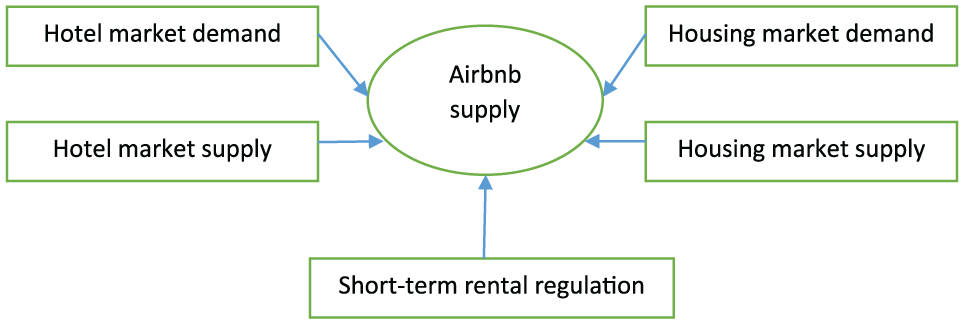
Factors contributing to Airbnb supply.
The tourism and hospitality literature indicates that accommodation demand stems from tourism demand, especially that of non–visiting friends and relatives overnight tourists (Chan, Lim, and McAleer 2005). Tourism demand is the source of temporary visitor stays. Markets with strong tourism demand also have high needs for accommodation providers such as Airbnb. The greater the tourism demand, the more opportunities and incentives for local residents to provide room rentals and earn supplemental income. In addition, tourism demand can fluctuate substantially based on seasonality and its relationship with weather, festivals, events, or even traveler characteristics (Farronato and Fradkin 2015). For instance, business travelers use hotels more often on weekdays, whereas leisure tourists tend to stay in hotels on weekends (Hoyt 2015). The wider the gap between peak and low tourism seasons, the more inefficient hotels’ fixed temporary room supply becomes (Farronato and Fradkin 2015); that is, a fixed hotel capacity with variable tourism demand implies either many periods of high prices and unmet demand (if the hotel supply is low) or many periods of low occupancy with weak demand (if the hotel supply is high) (Farronato and Fradkin 2015). As a result, tourism demand and seasonality may influence Airbnb supply.
Hotel room supply potentially competes against Airbnb supply for visitors’ overnight stays. During peak seasons, Airbnb can be an alternative to relieve local hotel supply shortages (Hajibaba and Dolnicar 2017). On the other hand, during low seasons, hotels are usually underutilized and thus lower their prices to induce demand. In the case of perfect competition, the greater a hotel’s supply in a particular area, the more visitors’ needs are likely to be met, leading to fewer opportunities and fiercer competition for Airbnb hosts. Airbnb and hotel rooms share common characteristics in catering to travelers’ accommodation needs; thus, hotel room supply will inevitably affect Airbnb supply through spatial competition in the same area. Current empirical research has only documented the effects of Airbnb listings on nearby hotels with no direct assessment of hotels’ impact on Airbnb supply (Zervas, Proserpio, and Byers 2017), even though scholars have acknowledged that Airbnb properties and hotels are mutually influential. In addition, Airbnb properties can be classified as “entire place,” “private room,” and “shared room” based on the room type; each category has its own characteristics and may react differently to market changes (Mao and Lyu 2017). This heterogeneity can lead to distinct Airbnb-hotel competition patterns.
Local residents’ socioeconomic factors shape demand for residential housing, which in turn affects Airbnb supply. Early research in housing studies found that socioeconomic factors such as population (De Leeuw and Ekanem 1971), age (Jud, Benjamin, and Sirmans 1996), income (De Leeuw and Ekanem 1971), employment rate (Gonzalez and Hoza 1978), family size and structure (Cunningham 1994), and others influence residential housing market demand. We suggest that residential housing market demand also affects Airbnb supply because it competes against home-sharing demand for the same resource of local housing units. In addition, research has found that residents of differing socioeconomic status vary in their propensity to share their residences (Farronato and Fradkin 2015), which may also influence Airbnb supply. Hence, local residents’ socioeconomic conditions could be another factor affecting Airbnb supply in a given area.
The assumption that residential housing market supply has an impact on Airbnb supply is relatively straightforward: unused space, whether a portion or the entirety of a primary or second residence, can either be rented through a long-term lease or listed on Airbnb for short-term rentals to provide an income stream. If the benefits of short-term rentals outweigh those of a long-term lease, hosts will likely be incentivized to monetize spare space by listing properties on Airbnb. Spare residences listed on Airbnb comprise merely a fraction of the total housing supply, which is reversible and transferable across short-term and long-term housing markets. Home-sharing businesses such as Airbnb provide more options for residential housing owners and renters; therefore, the local residential housing market, as the source for Airbnb listings, will affect Airbnb supply dynamically.
Finally, Airbnb supply may be heavily influenced by external environmental factors such as governmental and nongovernmental regulations. Indeed, housing supply is regulation-dependent (Saiz 2010). The use of residential housing to serve visitors’ needs rather than permanent residents encourages hotelization and the conversion of long-term rentals to home-sharing businesses (Lee 2016), creating potential problems for zoning and residential development (Gurran and Phibbs 2017). Moreover, regulations are often the most significant barrier to individuals’ participation in the sharing economy (Cannon and Summers 2014). Many US local government authorities have passed and implemented new rules and regulations to control Airbnb’s development. Home-sharing platforms will continue to evolve in legal gray areas (Interian 2016), where laws concerning zoning, taxes, insurance, health and public safety, and employment, all of which regulate commercial hotels, are not yet fully implemented and enforced across home-sharing businesses (Tussyadiah and Pesonen 2016). Some jurisdictions are relatively permissive while others are more restrictive, with some even banning home-sharing businesses like Airbnb outright. As such, regulatory policies have significant bearing on local Airbnb supply. For example, Zervas, Proserpio, and Byers (2017) noted that forbidding nonshared accommodation listings could effectively reduce Airbnb’s negative impact on the hotel industry.
In sum, our proposed model collectively and simultaneously includes constructs related to hotel room demand, hotel room supply, residential housing demand, residential housing supply, and regulatory policies on Airbnb as predictors of Airbnb supply. No individual hypotheses can be developed at the model level because each construct is represented by a set of underlying variables that could exert different effects on Airbnb supply.
Research Method
Research Areas
Based on the proposed framework, we aim to empirically uncover Airbnb supply determinants in major US cities by zip code. To determine which cities to sample, we referenced official statistics on the population of US cities and metropolitan statistical areas (MSAs). A typical MSA usually includes multiple cities, and some major US cities actually refer to the MSA in which a city is located. For example, Miami is ranked 44th in terms of city population in the United States; however, the Greater Miami area (Miami–Fort Lauderdale–West Palm Beach MSA) is the eighth most populated MSA. We selected major cities from the top 25 MSAs, resulting in a sample of 28 major cities consisting of 1,068 zip codes. Figure 2 presents their locations.
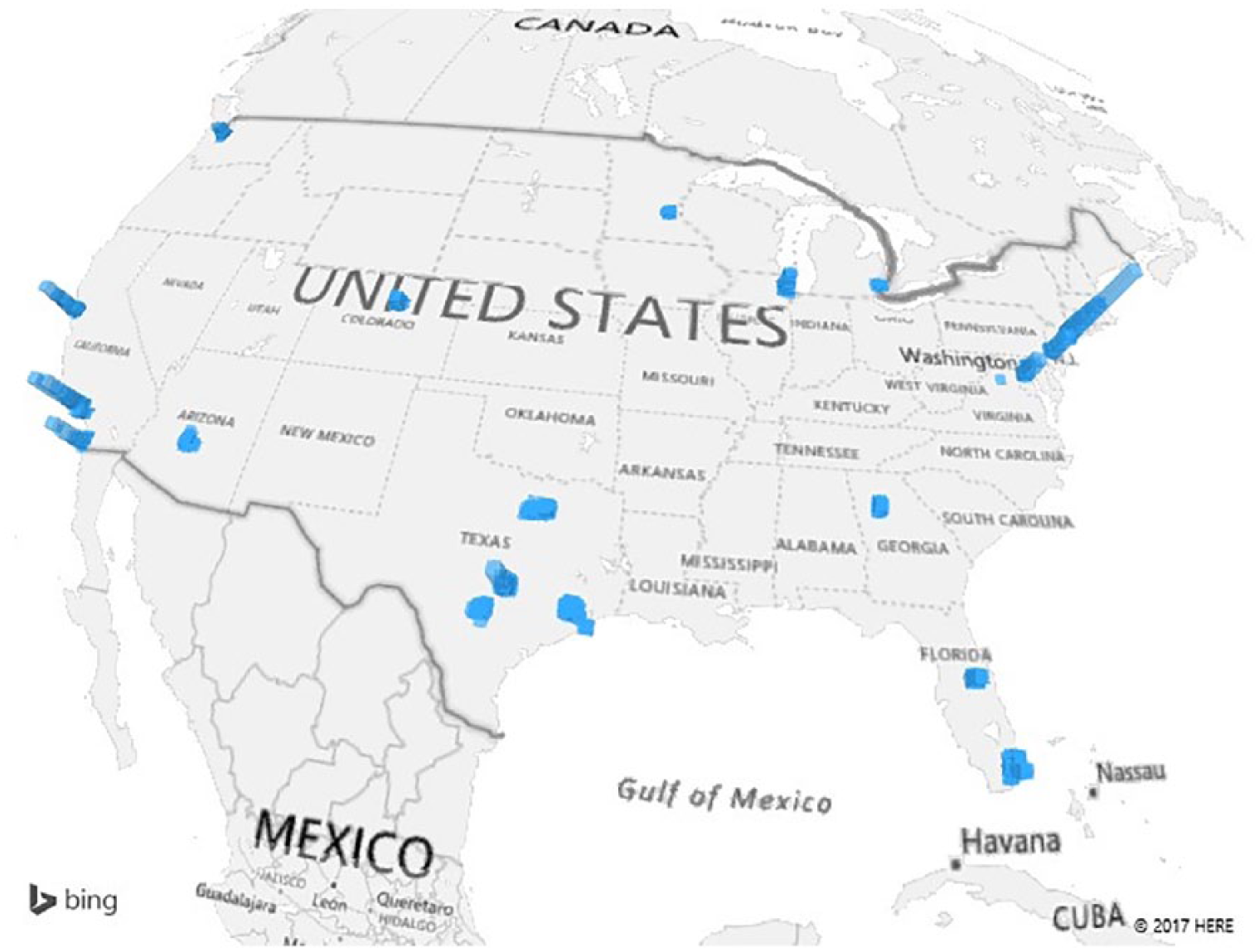
Geographic distribution of Airbnb supply in sampled US urban communities.
Data Collection
We collected research data from various sources. First, we obtained Airbnb supply data (the number of Airbnb units and total number of available days) from a third-party data vendor, AirDNA. AirDNA continuously crawls public information from the Airbnb website to obtain information such as the number of home-sharing units and their characteristics and prices. The number of available days was obtained by determining the blocked date of each unit’s Airbnb calendar using an advanced artificial intelligence and machine learning technology (https://www.airdna.co/methodology). Second, we turned to TripAdvisor, one of the most popular online third-party travel intermediaries (Fang et al. 2016), to construct tourism and hotel demand variables. For example, to capture the level of local tourism demand, we used TripAdvisor reviews of tourist attractions (“Things to Do”) that received at least 10 reviews (Yang, Mao, and Tang 2017) and to capture the level of local hotel demand, we used TripAdvisor hotel reviews. When evaluating hotel stays, each reviewer was required to report his or her check-in month and travel type, such as business travel (Banerjee and Chua 2016). From that, we calculated hotel demand seasonality and the proportion of business travelers. Third, we collected city-level hotel price data in 2015 from the hotel price index on Hotels.com (http://hpi.hotels.com/). Fourth, we collected data on the number of hotel rooms in each zip code based on data from Smith Travel Research Hotel Census Database (https://www.strglobal.com/products/census-database). The database includes 98% of hotel properties in the United States and is considered one of the leading data sources on hotel supply (Kosová and Sertsios 2016). Fifth, residential housing supply and demand data were obtained from the 2015 American Community Survey (ACS) database (https://www.census.gov/programs-surveys/acs/). Unlike US Census data, which are collected every 10 years, ACS data survey vital sociodemographic and economic information about the US population annually. Data were aggregated into different levels of geographic units, one of which was zip codes. Lastly, we collected city-level home-sharing regulation scores from the Roomscore project (http://www.roomscore.org/). The project measures US cities’ legal and regulatory climates in terms of their openness to home-sharing businesses, assigning individual scores in five categories and a cumulative room score from 0 to 100 (Moylan 2016). Researchers in this study exhaustively reviewed all legal and regulation-related documents at different levels to gauge the regulatory status of home-sharing in each city. This effort was further supplemented by conversations with lodging regulators. The higher the total score, the friendlier the city. Because we used data to capture the degree of regulation per city, we multiplied the original scores from each category by −1; as such, the higher the value, the more regulated the market. Likewise, we calculated the overall regulation as 100 minus the original score.
Econometric Model
In this study, we used either the total number of listed Airbnb units or the total number of available days of Airbnb units to capture the level of local Airbnb supply. Therefore, the dependent variable is a count number, and a count data model becomes a natural candidate. The count data model assumes a specific discrete distribution of the dependent variable as a count number (Winkelmann 2008). More specifically, we used a mixed-effects negative binomial model, as a type of count data model, for empirical analysis. First, this model captured the hierarchical structure of our data (York, Vedula, and Lenox 2017), in which zip code observations were nested in each city. The model also accounted for unobserved city-specific effects not incorporated in independent variables. A failure to incorporate these effects can lead to omitted variable biases. Second, the negative binomial model is superior to the Poisson model (another type of count data model) because the former does not suffer from overdispersion issues (MacDonald and Lattimore 2010). Note that we compared the goodness of fit of various types of count data models, and the mixed-effects negative binomial model outperformed its competitors. In the model, we assumed the conditional probability that observing

where i indexes zip code, and j indexes the city to which the zip code belongs.

In the model, the exposure variable enters on the right-hand side after a logarithmic transformation with a parameter estimate constrained to 1, and after moving this variable to the right-hand side of the equation, the right-hand side becomes a log rate between (expectation of)
Variables of Interest
In the empirical model, the dependent variable is the aggregate Airbnb supply in a 12-month period from July 2015 to June 2016, and the independent variables are measured in 2015. Therefore, the model is able to capture the lagged effect of independent variables on Airbnb supply. Table 1 presents the specifications of various variables incorporated in the econometric model. The model’s dependent variable captured the supply level of Airbnb units in a single zip code. Two types of supply indicators were used: the total number of Airbnb units, and the total number of available days for Airbnb units in each zip code. The latter is unique to the Airbnb market compared to hotels with fixed inventory because Airbnb hosts can de-list their units in a timely manner. Unlike hotels, the room capacity is not a reliable supply indicator because a single Airbnb unit listed cannot sell out multiple rooms simultaneously. As a wide variety of housing units exist in the home-sharing market, we also aimed to investigate the supply level of three different types of Airbnb units: entire houses (entire units for rent without space to share with others), private rooms (private rooms for sleeping plus shared common areas with others), and shared rooms (entire spaces shared with others). Therefore, the supply indicators for each unit type were used as dependent variables for subgroup analysis.
Descriptive Statistics of Variables.
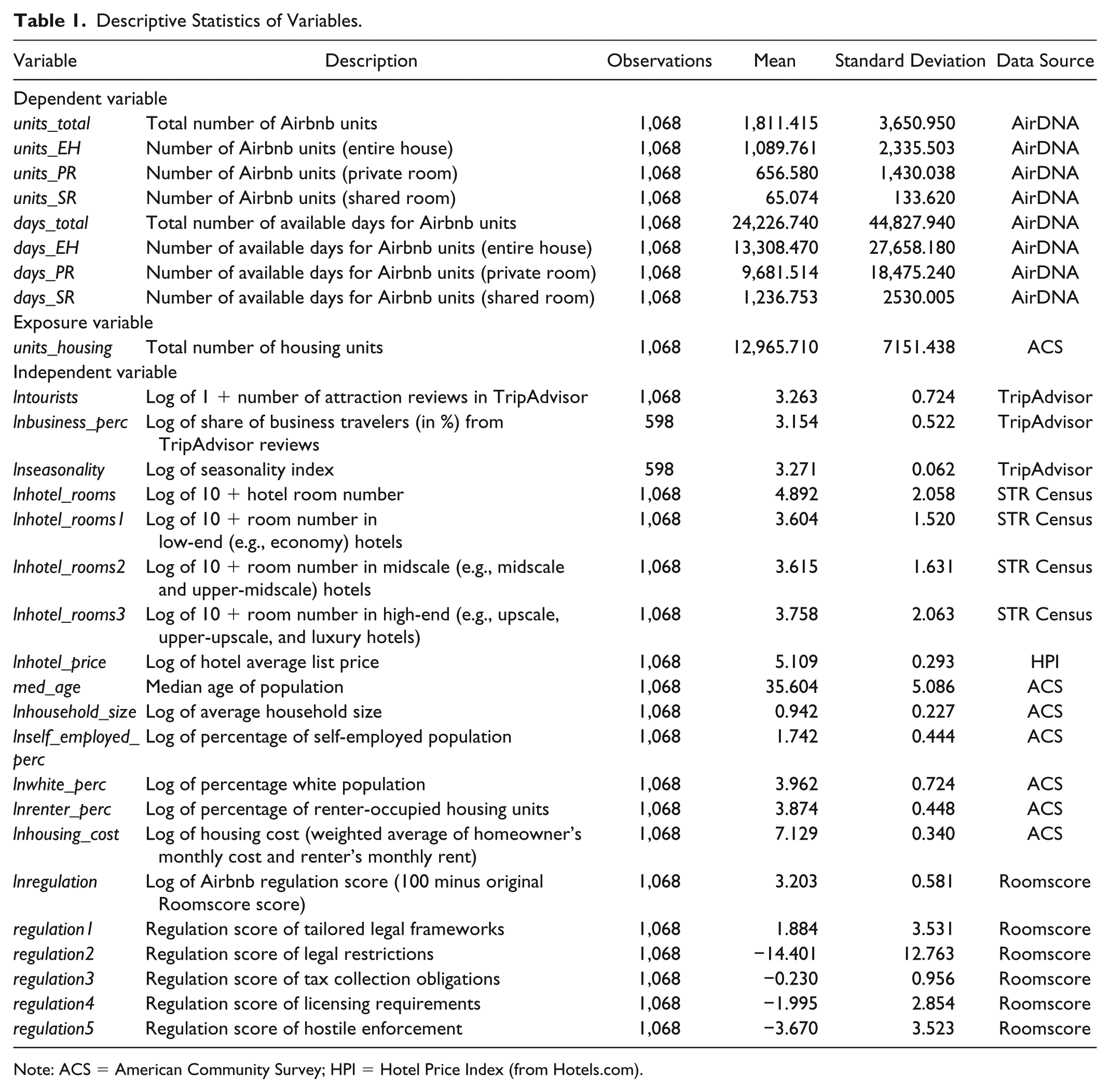
Note: ACS = American Community Survey; HPI = Hotel Price Index (from Hotels.com).
In our model, we chose the total number of housing units in each zip code (units_housing) as the exposure variable to capture heterogeneity across different zip codes. Therefore, if we move the log of units_housing to the left-hand side of equation 2, the dependent variable can be considered a log rate of Airbnb supply, defined as the count of Airbnb units divided by the total number of housing units. For the major independent variables, we specified five categories in line with the research framework described earlier (see Figure 1). We log-transformed most independent variables, and their estimated coefficients can be interpreted as elasticities, which are explained as the change in Airbnb supply as a result of a change in that independent variable.
For factors related to hotel room demand, we included three variables: lntourists, lnbusiness_perc, and lnseasonality. Although some tourism demand statistics are available at the city level, such as airport traffic, hotel demand, and estimated tourist number from various sources, we resorted to the number of TripAdvisor “things-to-do” reviews (lntourists) to proxy the number of tourist arrivals within the zip-code area. A prelimenary check on the aggregate reviews at city level and tourist arrival in major US cities confirms a high correlation between the two. Moreover, lnbusiness_perc measures the proportion of business travelers in the area, and business travelers are typically less likely to stay in Airbnb properties compared to hotels (Guttentag and Smith 2017). Furthermore, lnseasonality captures the seasonality of hotel demand after a logarithmic transformation using the following formula:

where
In terms of residential housing demand, we included four sociodemographic variables per area, namely, med_age, lnhousehold_size, lnself_employed_perc, and lnwhite_perc. According to previous housing studies, these sociodemographic variables largely shape various types of housing demand (De Leeuw and Ekanem 1971; Jud, Benjamin, and Sirmans 1996; Cunningham 1994). Moreover, we incorporated lnrenter_perc as a housing supply factor to reflect the share of renter-occupied housing units in an area because renters may demonstrate a different level of willingness to home-share because of their lower emontional attachment to the property. The other variable, lnhousing_cost, denotes the monthly housing cost for homeowners and tenants, which is shaped by housing market supply and demand factors and determine the decision of house owners/renters to list the property on Airbnb.
Lastly, we included variables capturing city-level legal and regulatory climates in terms of openness to home-sharing businesses and short-term rentals, which can be determined based on five categories (Moylan 2016). The first is a tailored legal framework (regulation1), wherein a city is considered to be more home-sharing-friendly if the regulatory structure explicitly acknowledges and creates a legal foundation for short-term or vacation rentals. The second category is legal restrictions (regulation2), which examines the restrictions placed on property owners’ home-sharing behavior. For example, some cities prohibit rentals briefer than a certain duration and allow home-sharing only when property owners are present during a guest’s stay. The third category, tax collection obligations (regulation3), reflects whether home-sharing platforms collect required taxes and whether short-term rentals carry disproportionate tax burdens compared to other forms of accommodation. Fourthly, licensing requirements (regulation4) evaluate the licensing burdens requiring home-sharing property owners to comply with all city- and state-imposed rules. The last category, hostile enforcement (regulation5), denotes rules fundamentally opposed to home-sharing services, such as restrictive inspection requirements, excessive insurance burdens, and occupancy limits. The overall regulations score (lnregulation) aggregates all five categories to capture the overall regulative environment of home-sharing in a single city.
Table 1 also presents variables’ descriptive statistics. For dependent variables, we found entire house units to account for more than half of Airbnb supply, measured by either the number of units or number of available days. A very small share of supply came from shared room units. Because of unavailable data for hotels in some zip codes, we could not obtain information on lnbusiness_perc and lnseasonality based on TripAdvisor reviews, resulting in 598 total observations for these two variables. When categorizing hotel rooms by class, we discovered more high-end (i.e., upscale, upper-upscale, and luxury) hotels in urban zip codes compared to midscale and low-end hotels. We observed high variability across regulation-related observations as indicated by a large standard deviation. The overall regulation score (before logarithmic transformation) ranged from 3 (Galveston, TX) to 50 (Atlanta, GA, and Denver, CO). Table 2 presents multicollinearity diagnostics, including a correlation matrix and variance inflation factor (VIF) values. All pairwise correlation coefficients were below 0.50, and most were well below 0.40; all VIF values were below 3.0. Thus, our sample demonstrated no severe multicollinearity problems (Gujarati and Porter 2010; Pearson 2010).
Multicollinearity Checks for Major Independent Variables.

Empirical Results
In this section, we first estimated a series of models with different specifications based on all types of Airbnb units. After that, we conducted a subgroup analysis by estimating the model based on three different types of Airbnb units.
Results for All Units
Table 3 presents the estimation results of the empirical models for all types of Airbnb units. The likelihood ratio tests from all models favored a mixed-effects model over a standard model to capture city-level specific effects. In Model 1, we estimated an Airbnb supply model of unit number using all 1068 zip codes. For hotel demand variables, lntourists was estimated to be significant and positive, revealing that a 1% increase in tourist number was associated with a 0.115% increase in Airbnb supply. Moreover, lnhotel_rooms, which measured hotel supply, was negative but not significant at the 0.05 level. The other hotel-related variable, lnhotel_price, was estimated to be positive and significant, with a 1% increase in the listed hotel room rate leading to a 1.397% increase in Airbnb supply. Therefore, a high hotel room rate appeared to motivate residents to list their units on Airbnb. Of housing demand variables, med_age was estimated to be insignificant while lnhousehold_size and lnself_employed_perc were significant. The estimated coefficients indicated that a 1% increase in average household size resulted in a 2.332% decrease in Airbnb supply, while a 1% increase in the percentage of self-employed residents was associated with a 0.388% increase in supply. For other housing market variables, supply appears to matter: lnrenter_perc and lnhousing_cost were positive and significant, suggesting that a higher level of Airbnb supply can be found in areas with higher monthly housing costs and a higher percentage of renter-occupied housing units. Lastly, lnregulation was found to be insignificant albeit negative.
Estimation Results on Total Units and Total Days Available.
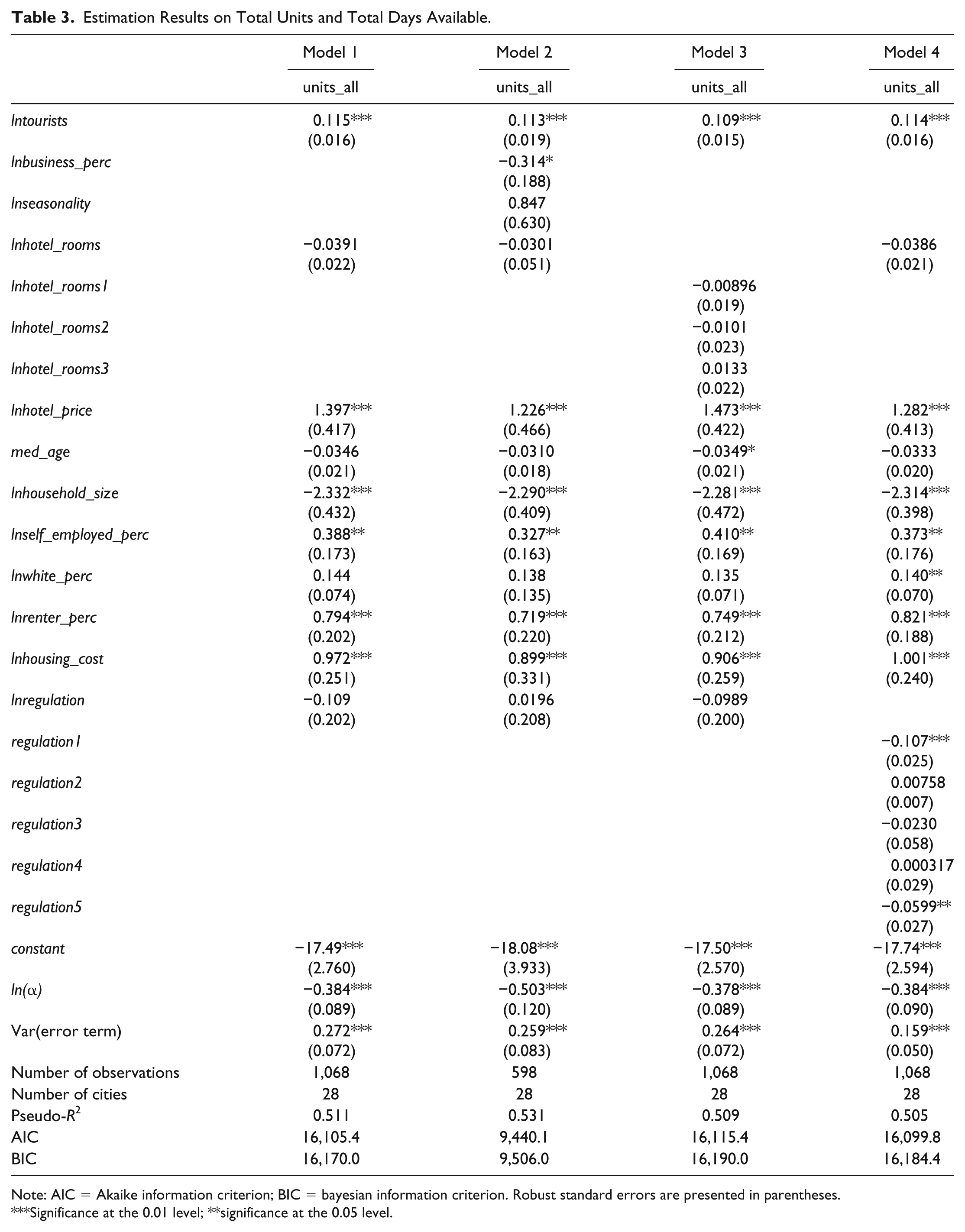
Note: AIC = Akaike information criterion; BIC = bayesian information criterion. Robust standard errors are presented in parentheses.
Significance at the 0.01 level; **significance at the 0.05 level.
In Model 2, we introduced two additional independent variables for hotel demand, lnbusiness_perc and lnseasonality, with a sample size of 598. Neither variable was found to be significant at the 0.05 level. Differences in the estimated magnitudes of other variables were negligible, and more importantly, the estimated signs and statistical significances remained largely unchanged. In Model 3, we broke down the total number of hotel rooms by hotel class. As suggested by the insignificant estimates of lnhotel_rooms1, lnhotel_rooms2, and lnhotel_rooms3, we did not find statistical evidence to support the impact of hotel supply on Airbnb supply based on all types of Airbnb units. In Model 4, we separated regulation scores into five categories. Because the category score could include nonpositive numbers, a logarithmic transformation was infeasible. Although lnregulation was estimated to be insignificant in Models 1–3, some regulation variables (regulation1 and regulation5) were statistically significant and negative in Model 4. This result suggests that regulations related to a tailored legal framework and hostile enforcement largely constrained the supply of Airbnb units in US urban communities; however, the effects of regulation were not significant in other regulation-related categories such as legal restrictions, tax collection obligations, and licensing requirements. The pseudo-R2 values are larger than 0.5 in Models 1 to 4, suggesting a reasonable level of explanatory power of our models.
We re-estimated the model using the same independent variables but an alternative supply measure, the number of days available for Airbnb units, as the dependent variable. The signs and statistical significances of the estimated coefficients changed little from the models’ counterparts using unit number as the supply measure. The detailed estimation results of these models can be found in the supplementary materials.
Results for Different Types of Units
Different types of Airbnb units cater to distinct lodging demands (Gutiérrez et al. 2017; Wang and Nicolau 2017); therefore, we estimated supply models for three types of Airbnb units: entire houses, private rooms, and shared rooms. Table 4 presents these results. Models 5 estimated the supply of entire houses. Compared to the results for all Airbnb units (Model 1), we found the estimate of lnwhite_perc to be statistically significant in Model 5 for the supply of entire house units. In Model 6, some notable differences for private room units included the significant and negative effects of median age (med_age) and hotel room supply (lnhotel_rooms). In Model 7 for shared room units, the results suggested that monthly housing cost was not a significant determinant of supply as indicated by the insignificant estimate of lnhousing_cost. Also, similar to entire house units (Models 1), median age and hotel room supply were not significant determinants of supply. By comparing the magnitudes of estimates across different models, we found that monthly housing cost (lnhousing_cost), average household size (lnhousehold_size), and tourist number (lntourists) exerted the largest impacts on the supply of entire house units, whereas the percentage of renter-occupied housing units (lnrenter_perc) and self-employed residents (lnself_employed_perc) had the strongest impacts on shared-room unit supply. Lastly, the larger values of psuedo-R2 in Models 5 (0.581) suggest that our specification is more powerful in explaining the supply of entire house Airbnb units than other types.
Estimation Results for Different Types of Airbnb Properties.

Note: EH = entire house; PR = private room; SR = shared room; AIC = Akaike information criterion; BIC = bayesian information criterion. Robust standard errors are presented in parentheses.
Significance at the 0.01 level; **significance at the 0.05 level.
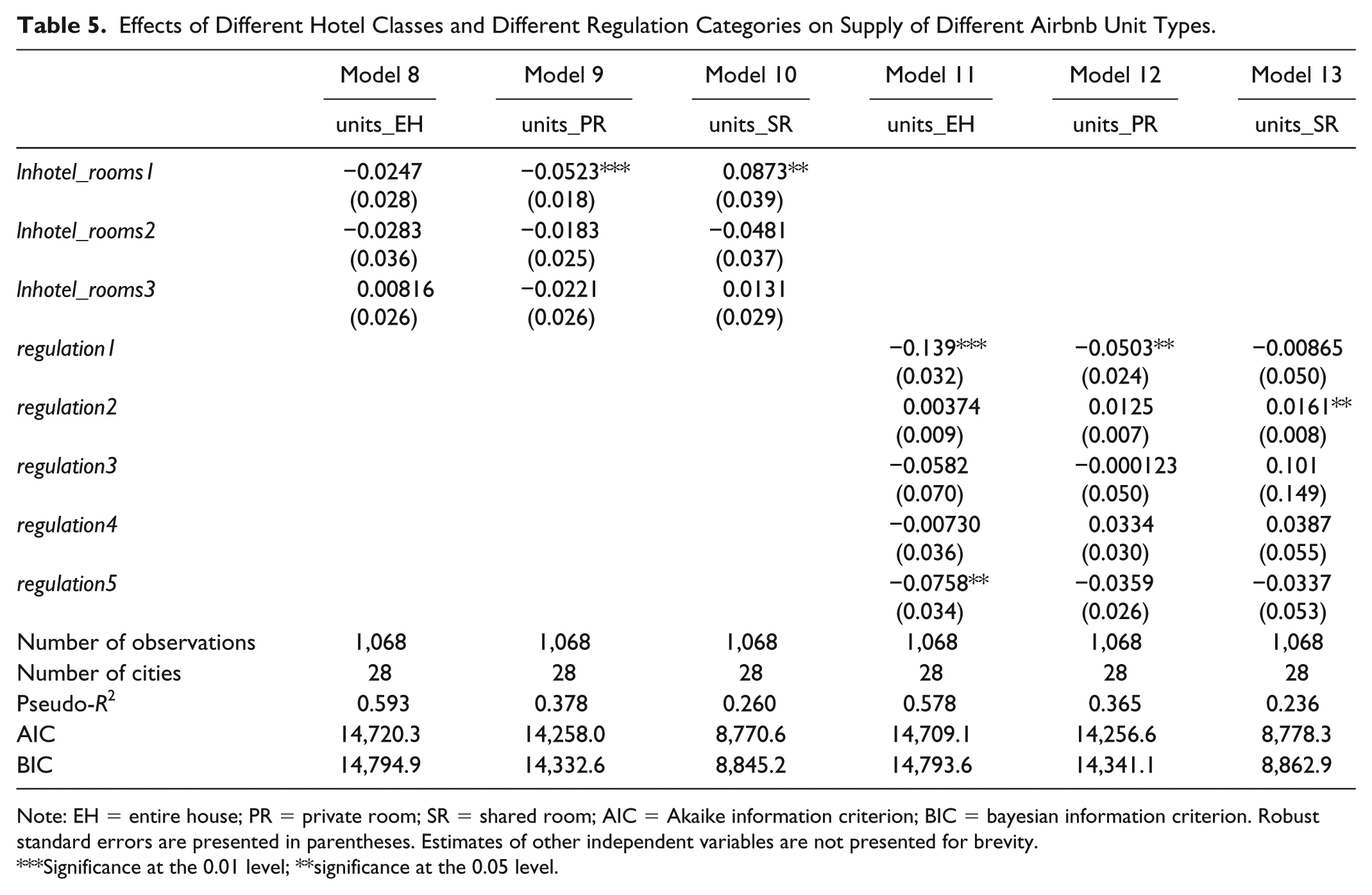
Table 5 presents the estimation results for the respective effects of room supply in different hotel classes: low-end (lnhotel_rooms1), midscale (lnhotel_rooms2), and high-end (lnhotel_rooms3). Although the three hotel room supply estimates were statistically insignificant for entire house units (Model 8), the estimated coefficients of lnhotel_rooms1 were statistically significant for private room units (Model 9) and shared room units (Model 10). The coefficients were negative for the former but positive for the latter, unveiling a competitive relationship between the supply of low-end hotel rooms and private room Airbnb units but a supplementary relationship between the supply of low-end hotel rooms and shared-room Airbnb units. Room supply at midscale and high-end hotels did not appear to influence the supply of any Airbnb unit types.
Effects of Different Hotel Classes and Different Regulation Categories on Supply of Different Airbnb Unit Types.
Note: EH = entire house; PR = private room; SR = shared room; AIC = Akaike information criterion; BIC = bayesian information criterion. Robust standard errors are presented in parentheses. Estimates of other independent variables are not presented for brevity.
Significance at the 0.01 level; **significance at the 0.05 level.
Table 5 also presents the estimation results for the respective effects of different regulation categories on the supply of different Airbnb unit types. The results indicated that while regulations pertaining to a tailored legal framework (regulation1) reduced the supply of entire house units (Model 11) and private room units (Model 12), those related to hostile enforcement (regulation5) only decreased the supply of entire house units (Model 13). Another type of regulation, legal restrictions (regulation2), was positively associated with the supply of shared room units (Model 13). Regulations related to tax collection obligations (regulation3) and licensing requirements (regulation4) did not influence the supply of any Airbnb unit types.
The estimation results using the number of days available for Airbnb units can be found in the supplementary material. The signs and statistical significances of the estimated coefficients remain similar.
Discussion and Conclusions
Discussion
As an alternative accommodation option for travelers, Airbnb is changing the lodging sector of the tourism industry. Despite its rapid growth and the early literature on the role of the sharing economy in hospitality and tourism, little is known about Airbnb supply and its determinants conceptually and empirically. In an effort to close this gap, we established a conceptual framework based on a system approach in tourism economics (i.e., supply and demand) to model the influential factors behind Airbnb supply and subsequently investigated the nature, magnitude, and direction of these relationships using data from various sources. The results of our overall models showed that the number of visitors, local hotel average daily rate, self-employed population percentage, monthly housing cost, and percentage of occupied renter housing units encourage more Airbnb participation, while average household size hinders Airbnb supply. These findings confirm that factors associated with hotel and residential housing jointly affect the supply of home-sharing businesses (Gutiérrez et al. 2017; Quattrone et al. 2016). In addition, certain regulation categories, such as a tailored legal framework and hostile enforcement, may complicate Airbnb hosting, although the holistic regulation measure did not appear to have an overall significant impact on Airbnb supply. For other regulations, such as legal restrictions, tax collection obligations, and licensing requirements, their effects on Airbnb supply were not significant. There are several reasons to explain the results. First, although legal restrictions can be greatly detrimental to Airbnb supply, the effectiveness of this regulation heavily depends on its enforcement of the local government. Second, for tax collection obligations, home-sharers can internalize the loss by using strategical pricing tools to alleviate potential negative effects of this regulation. Third, compared to the regulation category of hostile enforcement, licensing requirements just impose little additional burdens on home-sharers to obtain permits and licenses, which can be considered less harmful. Therefore, researchers and practitioners should evaluate regulation categories individually rather than relying on an overall measure when investigating regulatory influences on Airbnb as a whole.
When Airbnb supply was divided into room-sharing types, most results remained consistent with those of our initial models with a few notable exceptions: hotel room supply and the median age of the local population were negatively associated with Airbnb’s private room supply, and monthly housing cost was no longer significantly associated with shared room supply. This disparity reveals a fine difference between supply determinants for different Airbnb room-sharing types. Once local hotels were further categorized into low-end, midscale, and high-end properties, our results revealed that only economy hotels exerted significant and negative influences on Airbnb’s private and shared room supply. This finding supports the claim that Airbnb’s competitive effects are mainly concentrated on low-end hotels (Zervas, Proserpio, and Byers 2017). When we delineated regulation into five categories, we discovered that a legal framework hinders the supply of entire house and private room listings on Airbnb, whereas hostile enforcement only inhibits supply of entire houses. In contrast, legal restrictions significantly enhanced the supply of Airbnb shared rooms. One possible explanation of this result is that legal restrictions in some cities require hosts’ presence during the guest stay, which indirectly stimulate the supply of shared rooms as an alternative type to other Airbnb options. Also, our results show that neither tax collection obligations nor licensing requirements had any significant effect on any type of Airbnb supply. In sum, different regulation categories exerted different effects on different Airbnb supply types. These findings lay the groundwork for a systematic understanding of the factors that may influence Airbnb supply with corresponding theoretical and practical implications for researchers and policymakers.
Theoretical Implications
Our study made several theoretical contributions to the emergent home-sharing literature. First, we established a conceptual model of Airbnb supply using a systematic approach (i.e., supply and demand), reflecting a three-pronged spatial equilibrium across home-sharing, housing, and hotel markets. Unlike prior research that focused solely on hotels or housing, our study simultaneously examined the effects of hotel and housing markets on Airbnb. Therefore, we uncovered factors related to Airbnb supply comprehensively. Our conceptual model, serving as a foundation for supply analysis, can be easily applied to other sharing economy contexts such as labor, transportation, and financial services. Consequently, we advanced scholarly understanding of the nature of the sharing economy and home-sharing businesses like Airbnb.
Second, our research contributed to the sharing economy literature by revealing important factors (and their valences) that influence Airbnb supply. Our findings provided empirical supports for the utility of the research framework to explain relevant factors of Airbnb supply. By further classifying hotel type, Airbnb supply type, and regulation categories and testing their respective effects on supply, we managed to differentiate between the nuanced aspects of Airbnb supply to identify factors that may be overlooked without further delineation.
Third, the sharing economy is marked by evolving and often ambiguous regulations and policies, many of which have yet to be fully explored and quantified, unlike the regulations governing conventional businesses. We incorporated regulatory factors into our proposed model to account for the heterogeneity of these effects. Our empirical evidence revealed that regulation is important for Airbnb supply in terms of the regulation category and Airbnb room type. As such, we extended the current knowledge on the sharing economy. We also recommend that this approach include regulatory factors when applied to the sharing economy studies.
Practical Implications
Airbnb is here to stay. The findings of our study reflect the fluid nature of Airbnb supply and its interdependence with the hotel and housing markets while also highlighting several key practical insights for stakeholders. Airbnb growth could pose an increasing threat to the local hotel industry. Our results show that higher hotel prices, rather than hotel room inventory, may drive home-sharing businesses’ supply, at least in the short term. Therefore, hoteliers in urban areas should adopt pricing strategies, such as revenue management and real-time dynamic price tools with consideration and integration of local Airbnb supply, to mitigate the negative effects of Airbnb. Compared to individual Airbnb hosts, hotels typically have better financial resources, human talent, and technological expertise to realize their objectives. Besides pricing strategies, hotels have more to offer in terms of hospitality products and services. In contrast, low-end hotels, as direct rivals to Airbnb listings, must devise strategic means to thrive amid competition from home-sharing businesses. These hotels can either improve their service quality or enhance product offerings and variety to provide better value to price-sensitive travelers through operational advantages and economy of scale. In addition, low-end hotels can also compete for both short- and long-term rentals by offering attractive pricing packages and more family-friendly products such as kitchenware.
Our findings also encourage the development of policies related to individual communities, local authorities, and Airbnb. This study’s results advance the understanding of Airbnb supply from a residential housing perspective. Real estate price, room-sharing type, and a community’s socioeconomic demographics may significantly change a city’s propensity to host home-sharing businesses, all of which should be included in policy development. As more jurisdictions focus on the emergence of Airbnb, regulatory issues are likely to constrain Airbnb growth to some extent. In particular, a conflict is already brewing between new home-sharing businesses and the realities of existing regulations (Jefferson-Jones 2015). An institutional structure should be put in place to facilitate Airbnb’s stable growth and positive effects while preserving regulatory equity between residential housing and hotel accommodations. Our study appears to be the first to provide empirical evidence and to systematically quantify the effects of different regulation categories on Airbnb supply. Airbnb and its hosts, along with metropolitan areas’ local governments and communities, should collaborate to design and implement regulatory frameworks, legal restrictions, and enforcement of home-sharing businesses to support Airbnb’s sustainable development. These significant regulation categories are inherently ambiguous and subjective, reflecting the evolving nature of home-sharing regulations and policies. By comparison, licensing requirements and tax collection obligations are more straightforward and objective; hence, they do not seem to significantly affect Airbnb supply. Therefore, we advocate that policymakers, in consultation with the local community, hotel businesses, Airbnb, and Airbnb hosts, propose and establish clear, quantifiable, rule-based policies and procedures to regulate and guide home-sharing businesses.
Limitations
Despite this study’s contributions, some limitations may temper the generalizability of our results. First, we were unable to account for all factors that may influence Airbnb supply due to data unavailability and the complexity of supply determinants. Nevertheless, we constructed a comprehensive framework using a systematic and rigorous approach. Second, although we provided a sound theoretical rationale and constructed a typology outlining potential determinants of Airbnb supply, our cross-sectional data only tested the short-term effect of market equilibrium among the distribution of local accommodation supply; thus, we did not capture supply factors from a long-term perspective. Further exploring how various factors might shape Airbnb supply over time will be particularly helpful in drawing a holistic picture in a dynamic market environment to forecast Airbnb’s future. Third, some independent variables, such as the hotel price and the housing cost, may suffer from endogeneity problems. Further efforts can be applied to identify appropriate instrumental variables to correct for these problems. Fourth, our data were confined to 28 major metropolitan areas in the United States, and findings should be interpreted with caution for nonurban settings and non-US areas. Lastly, our study only examined factors that may affect Airbnb supply; we did not consider demand. Future studies should consider studying Airbnb demand and supply simultaneously.
Footnotes
Declaration of Conflicting Interests
The author(s) declared no potential conflicts of interest with respect to the research, authorship, and/or publication of this article.
Funding
The author(s) disclosed receipt of the following financial support for the research, authorship, and/or publication of this article: This study was partly funded by the Temple CIBER International Business Research Award “Sharing-economy and tourism competitiveness.
