



Abstract
Backpacker identity has attracted growing attention in backpacker tourism research. However, there still lacks a valid scale to measure backpacker identity. Guided by Social Identity Theory (SIT), this study aims to develop and validate a scale to measure backpacker identity in the Chinese context. The study used two Chinese backpacker samples in two stages (Study 1, n=190; Study 2, n=323) to establish the psychometric properties of a backpacker identity scale (BIS). Following the process of scale development, a three-dimension (i.e., self-categorization, group self-value, and group self-evaluation) backpacker identity measurement model was identified. The refined scale with 16 measurement items was finally identified with sufficient reliability and validity. Theoretical and practical implications were discussed.
Keywords
Introduction
As a reflective cognition construct that answers the question of “Who am I?” (e.g., Stryker and Serpe 1982; Tajfel 1982), identity has been recognized not only as a main motivational source of human behavior (e.g., Burke 2004; McCall and Simmons 1978; Stryker and Serpe 1982; Tajfel 1982), but also to be highly related to personal mental health. Identity is believed to influence an individual’s self-verification (e.g., Ellemers, Kortekaas, and Ouwerkerk 1999), self-consistency (e.g., Burke 2004), self-esteem and self-efficacy (e.g., Erez and Earley 1993; Hornsey 2008; Tajfel 1982), and emotions (e.g., Burke 2004). Recently, identity has gained increasing attention in travel and tourism research (e.g., Desforges 2000; Hibbert 2013; Milde 2010), particularly in backpacker studies (e.g., Anderskov 2002; S. A. Cohen 2011; Elsrud 2001; Kerry 2013; Noy 2004; Noy and Cohen 2005; O’Reilly 2005; Zhang et al. 2018; Zhang et al. 2017).
Specifically, recent research has questioned the usefulness of previously widely used objective criteria (i.e., length of trip, budget, itinerary, and activity preferences) in distinguishing backpackers from other types of tourists (e.g., Dayour, Kimbu, and Park 2017; Larsen, Øgaard, and Brun 2011; Sørensen 2003; Zhang et al. 2017; Zhang et al. 2018). Researchers have generally argued that objective characteristics should best be deemed as guidelines to understand backpackers, because many travelers who do not necessarily meet these criteria still label themselves as backpackers (e.g., Sørensen 2003). Furthermore, as social identity theory (SIT; Tajfel 1982; Tajfel and Turner 1979) posits, individuals have a fundamental need to belong to a specific, readily labeled, and self-selected group (i.e., self-categorization); therefore, their social identities are constructed through their identification with a particular social group and the evaluative (i.e., group self-esteem) and affective (i.e., commitment to a group) consequences of such a grouping (e.g., Hornsey 2008; Tajfel 1982). According to SIT, it is reasonable to argue that certain travelers identify themselves as backpackers not only because they meet some tangible criteria, but more importantly also because they accept and manifest the socially constructed meanings and values of backpacking and thus may have a sense of belonging and emotional commitment to backpacking and the backpacker group (e.g., Liu et al. 2018; Zhang et al. 2017; Zhang et al. 2018).
Nevertheless, a review of extant literature shows that tourism researchers have only sporadically studied the different aspects of backpacker identity. Pertinent important questions like “what are the dimensions of backpacker identity” and “how could backpacker identity be effectively measured?” still remain largely unanswered. As such, using SIT as a guiding theory, this study aims to (1) identify the dimensions of backpacker identity and (2) develop and validate a valid and reliable scale to measure backpacker identity.
The findings are believed to be able to advance our understanding of backpacker identity as a significant construct with the growing backpacker market (e.g., G. Chen and Huang 2017; Liu et al. 2018; Zhang et al. 2018) and thus provide practical implications for backpackers, educational and health institutions, tourism policy makers, tourism marketers, and tourism industry practitioners.
Theoretical Backgrounds
Understanding Backpackers: “Who Are They?” and “Who Am I?”
In his milestone work, E. Cohen (1972) categorized tourist roles into four types by familiarity and novelty (i.e., the microenvironment attributes that different types of tourists seek to experience at a destination): the organized mass tourist, the individual mass tourist, the explorer, and the drifter. The last two types have often been regarded as “non-institutionalized” tourists. Furthermore, the drifter has been referred as the prototype for the backpacker (E. Cohen 2003), which was subsequently characterized as independent travelers who prefer budget accommodation, longer holidays, itinerary flexibility, meeting other travelers, and social and participatory holiday activities (Loker-Murphy and Pearce 1995; Pearce 1990).
Since E. Cohen’s (1972) seminal work, tourism researchers have studied the characteristics of backpackers and subsequently classified them into distinctive groups (e.g., G. Chen, Bao, and Huang 2014a; Larsen, Øgaard, and Brun 2011; Liu et al. 2018; Loker-Murphy 1997; Pearce 1990; Riley 1988; Ryan and Mohsin 2001; Sørensen 2003; Uriely, Yonay, and Simchai 2002). Tourism researchers have tried to identify and use objective criteria to distinguish these travelers from the more “institutionalized” tourists (e.g., Loker-Murphy and Pearce 1995; Uriely, Yonay, and Simchai 2002; Riley 1988). In their influential work, Uriely, Yonay, and Simchai (2002) employed two concepts (i.e., “form” and “type”) to further classify backpackers. Form-related attributes refer to those “visible institutional arrangements and practices by which tourists organize their journey” (Uriely, Yonay, and Simchai 2002, p. 521), such as length of trip (e.g., Elsrud 2001; O’Reilly 2006), flexibility of the itinerary (e.g., Pearce 1990; Vogt 1976), means of transportation and accommodation (e.g., E. Cohen 1972; Pearce 1990; Riley 1988; Zhang et al. 2017; Zhang et al. 2018; Zhu 2007), interaction with locals and fellow travelers (e.g., Riley 1988), visited destinations and attractions (e.g., E. Cohen 1972; Riley 1988; Vogt 1976), and so forth. Type-related attributes refer to “less tangible psychological attributes” (Uriely, Yonay, and Simchai 2002, p. 521), such as tourists’ motivations for travel (e.g., G. Chen, Bao, and Huang 2014a; Loker-Murphy 1997; Ryan and Mohsin 2001), attitudes toward fundamental values of their own society and culture, and the meanings they assign to their experiences (e.g., E. Cohen 1972; S. A. Cohen 2011). Drawing on an empirical study on the “types” of Israeli backpackers based on travel motivations and the meanings assigned to backpacking experiences, Uriely, Yonay, and Simchai (2002) argued that backpacking should only be defined as a form of tourism, because of the heterogeneous nature of backpacking in terms of its type-related aspects.
Nonetheless, with the evolution of backpacking as a globalized travel style, some tourism scholars have questioned and challenged the use of objective criteria to distinguish backpackers from other types of tourists. For example, Sørensen (2003) argued that the above-mentioned form-related attributes (i.e., length of trip, budget, and itinerary) can only be used as a guideline to understand backpackers, because many travelers who do not meet the criteria still consider themselves as backpackers. On the contrary, in a recent study on Chinese backpackers, Zhang et al. (2018) found that among backpacker respondents who “were operationalized as independent travelers, who carry backpacks, and who stay in backpacker hostels during their trips” (p. 529), 66% (205 out of 310) did not identify themselves as backpackers in the question “Are you a backpacker?” Similarly, Larsen, Øgaard, and Brun (2011) found that there were very limited differences between backpackers (who were identified as travelers staying in Hostelling International hostels) and mainstream tourists in terms of some psychological variables, including motivations, subjective judgments of risk, total tourist worries, and tourist role preferences (i.e., drifter, explorer, individual mass tourist, and organized mass tourist). These studies have all presented a challenge in understanding “what makes a backpacker a backpacker” (e.g., Zhang et al. 2018) and “who is a backpacker” (e.g., Dayour, Kimbu, and Park 2017).
Backpacker Identity: A Social Identity Theory Perspective
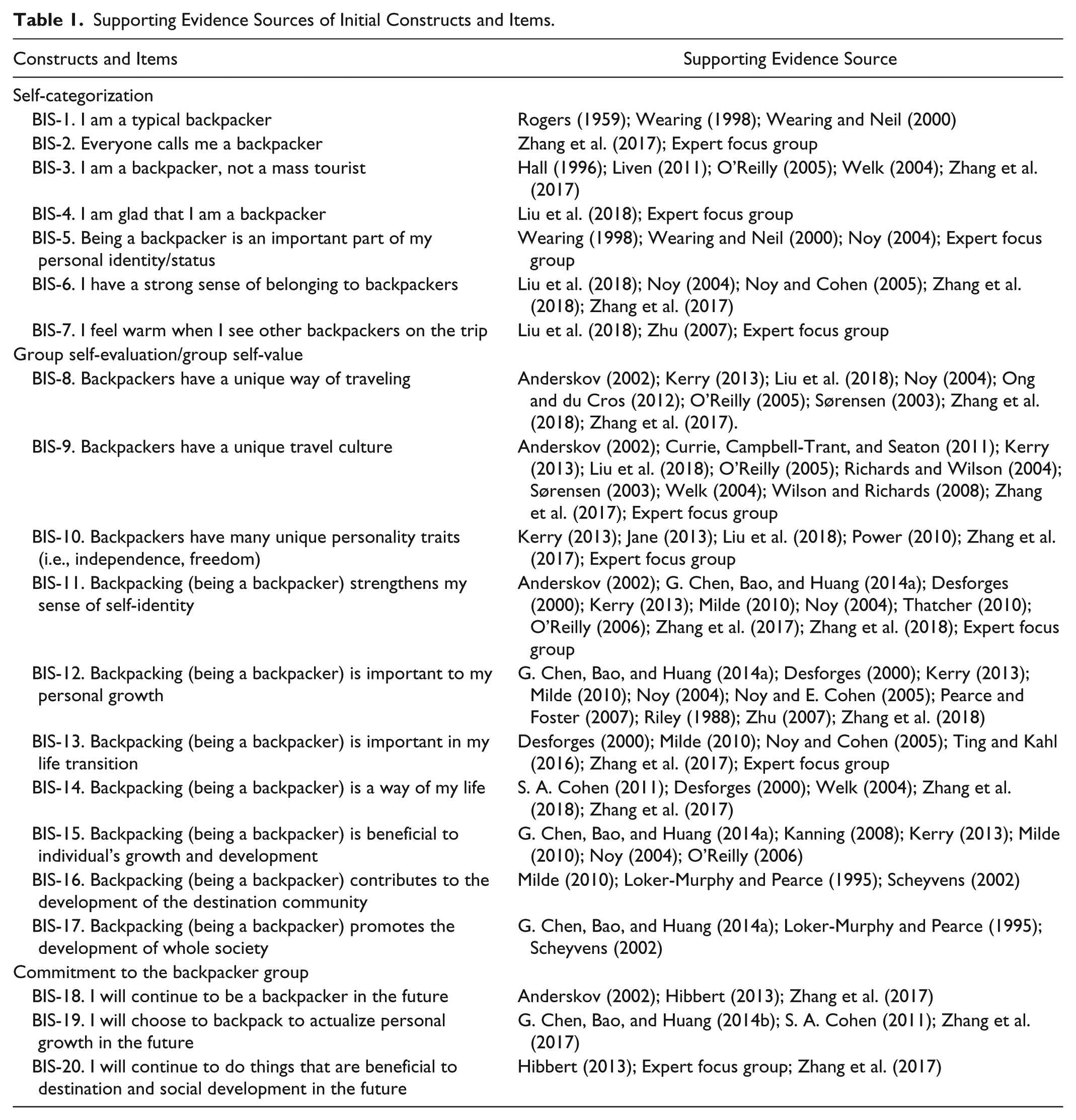
Social identity is “that part of an individual’s self-concept which derives from his knowledge of his membership of a social group (or groups) together with the value and emotional significance attached to that membership” (Tajfel 1978, p. 63). As one of the most influential identity theories (e.g., Ellemers, Kortekaas, and Ouwerkerk 1999; Hogg, Terry, and White 1995; Hornsey 2008), social identity theory (SIT) has provided an integrated theoretical framework to answer the above questions regarding backpacker identity (e.g., Hornsey 2008; Liu et al. 2018). According to SIT, individuals have a fundamental need to belong to a specific, readily labeled, and self-selected group or category (e.g., nationality, political affiliation, and sports team; e.g., Tajfel 1982; Tajfel and Turner 1979). Based on SIT, with its three interlinked components, cognitive component (self-categorization), evaluative component (self-esteem), and emotional component (commitment to a group) (e.g., Ellemers, Kortekaas, and Ouwerkerk 1999; Hogg, Terry, and White 1995; Hornsey 2008; Tajfel 1978, 1982), social identity can be used to synthesize past research on backpackers’ identities. Even though most of the existing studies have not explicitly used the term social identity in their inquiries, similar terms like collective identity (e.g., Noy 2004; Desforges 2000; Zhang et al. 2017) and group identity (e.g., Currie, Campbell-Trant, and Seaton 2011) have been widely applied in the backpacker literature. These previous studies are summarized in Table 1.
Supporting Evidence Sources of Initial Constructs and Items.
Backpacker Self-Categorization
As social psychologists posit, the cognitive component of social identity, in the sense of awareness of one’s membership in a specific social group, highlights the process of an individual’s self-categorization (e.g., Ellemers, Kortekaas, and Ouwerkerk 1999; Tajfel 1982). Self-categorization depends on a series of basic understanding of the fundamental characteristics defining ingroups (“us”) and outgroups (“them”) (Ellemers, Kortekaas, and Ouwerkerk 1999). Often, individuals identify themselves as part of a particular social category, in which their cognitive understanding of self or ideal self could be achieved (Tajfel 1982).
In correspondence to the cognitive component of social identity, tourism researchers have mentioned the self-categorization of backpackers sporadically. Specifically, prior studies (e.g., Elsrud 2001; Hibbert 2013; Liu et al. 2018; Muzaini 2006; O’Reilly 2005; Richards and Wilson 2004; Tucker 2003; Welk 2004; Zhang et al. 2017) show the most commonly used way for backpackers to establish their salient identity is social differentiation, that is, to label them as “travelers” or “backpackers,” rather than “tourists,” as the term tourist in their eyes has negative connotations. According to Noy (2004), when telling their transformative travel stories, Israeli backpackers usually emphasize the authenticity of their experiences to establish and strengthen their identities as backpackers. In addition, among the narratives, being a backpacker has become an important part of their personal identity/social status (Noy 2004). In another case, Zhang et al. (2017) recorded that, in becoming a backpacker, Chinese backpackers mostly reinforced their identity through social differentiation to distinguish themselves from mass tourists. In a following study, Zhang et al. (2018) adopted Mael and Ashforth’s (1992) six-item Organizational Identification Scale in the organizational behavior context to measure Chinese backpackers’ social identity (self-identification). It is found that external-oriented motivation, work alienation, and detachment from home centers are factors that mostly indicate social identities of Chinese backpackers (Zhang et al. 2018). However, according to Liu et al. (2018), this context-specific scale (Mael and Ashforth 1992) is only capable of measuring the group identity (group categorization) of backpackers, which according to SIT (e.g., Ellemers, Kortekaas, and Ouwerkerk 1999; Tajfel 1982), may not be able to comprehensively measure the social identity dimensions of backpackers.
Backpacker Group Self-Esteem
Self-esteem has been defined as an overall appraisal of one’s self-worth (Rosenberg 1965). The evaluative component of social identity associates group awareness (cognition) with selection of meanings and value bestowed to the group membership (e.g., Hornsey 2008; Ellemers, Kortekaas, and Ouwerkerk 1999; Tajfel 1978, 1982). As Hogg, Terry, and White (1995) claim, perceived group characteristics can coordinate an individual’s behavior based on normative values associated with a specific group membership. Social psychologists posit that members of a group are greatly motivated to adopt behavioral strategies to maintain a positive in-group identity compared to outgroups (e.g., Tajfel 1982). Through comparing, an individual often aims to establish an ingroup superiority. Consequently, an evaluatively positive self-esteem (self-evaluation and self-value) can be achieved (e.g., Hogg and Abrams 1993; Tajfel 1978, 1982).
In the backpacking setting, tourism researchers have occasionally mentioned the group self-esteem (i.e., self-evaluation and self-value) of backpackers. Many previous studies (e.g., Kerry 2013; Jane 2013; Liu et al. 2018; Power 2010; Zhang et al. 2017) have demonstrated that backpackers have, or perceive themselves to have, many unique personality traits (i.e., independence, freedom, responsibility, tolerance, and openness). Backpackers were believed to have unique ways of traveling and possess a unique travel culture (e.g., Anderskov 2002; Currie, Campbell-Trant, and Seaton 2011; Kerry 2013; Liu et al. 2018; Noy 2004; Ong and du Cros 2012; O’Reilly 2005; Sørensen 2003; Zhang et al. 2018; Zhang et al. 2017).
With regard to backpackers’ self-value perception, recent research has focused on personal growth and development as a consequence of backpacking travels. In this regard, Chen and colleagues (G. Chen, Bao, and Huang 2014b; G. Chen and Huang 2017) identified five backpacker personal development (BPD) domains, namely, capability, emotion, self-consciousness, skill, and worldview. Other important aspects of backpacking research include backpackers’ life transition (e.g., Desforges 2000; Milde 2010; Noy and Cohen 2005), meanings of backpacking as a lifestyle (e.g., S. A. Cohen 2011; Desforges 2000), and social impacts of backpacking on the local communities (e.g., Milde 2010; Loker-Murphy and Pearce 1995; Scheyvens 2002).
Commitment to the Backpacker Group
The third component in social identity consists of an emotional input based on the other two components: self-categorization and self-esteem (e.g., Hornsey 2008; Tajfel 1982). Specifically, as SIT posits, an individual’s cognitive understanding of both positive and negative meanings and value connotations of a group leads to affective commitment to a specific self-selected group (e.g., Ellemers, Kortekaas, and Ouwerkerk 1999; Hornsey 2008), as he or she searches for a distinctive self-concept (Hogg, Abrams, and Brewer 2017). As a result, if people are strongly committed to a group, they commit themselves emotionally to improving the status of the in-group and continuing their membership in the group (Ellemers, Kortekaas, and Ouwerkerk 1999).
However, in the context of backpacking, unlike the relatively rich literature documenting backpackers’ self-categorization and group self-esteem, very little research has been conducted on backpackers’ commitment to the backpacker group (Anderskov 2002; S. A. Cohen 2011; Zhang et al. 2017). Among the few empirical studies, Anderskov (2002) examined the different ways through which backpackers build backpacking or values of the backpacker culture into their narratives about their personal futures. While most of the informants (16 of 20) in the study expressed their likelihood and willingness to continue backpacking, some backpackers simply stated that they wanted to make the current trip the last one in their backpacking career, and find a job (or start their own businesses) or study abroad (Anderskov 2002). Similarly, in the context of Chinese backpacking, Zhang et al. (2017) found that Chinese backpackers facing an “identity crisis” either rejected the backpacker identity in the end or continued to struggle to (re)negotiate their backpacker identity.
As stated above, most of the extant literature has only sporadically and partially studied the different domains of backpacker identity (see Table 1). The only exception, to the knowledge of the authors, was a recent study by Liu et al. (2018), which used a self-developed questionnaire to classify Chinese backpackers by identity (i.e., “proficient Chinese backpackers” and “novice Chinese backpackers”) and correlate the two segments with their destination choices. Employing a questionnaire survey, Liu et al. (2018) used Mael and Ashforth’s (1992) Organizational Identification Scale in the context of organizational behavior to measure Chinese backpackers “group identity.” In addition, both “group involvement” and “group evaluation” dimensions in the study (Liu et al. 2018) were measured using items that had been extracted from qualitative studies engaging a backpacker’s emic perspective (i.e., interview and online content analysis). While Liu et al.’s (2018) study has laid a solid theoretical foundation for future studies of backpacker identity and has well justified the usefulness of SIT in understanding backpacker identity, it did not aim to identify the dimensions of backpacker identity, nor did it purport to develop and validate a measurement scale of this construct. More importantly, the psychometric properties of the preliminary measurement have not been established (Liu et al. 2018). Therefore, a dedicated backpacker identity scale (BIS) with sufficient validity and reliability is still much needed for a better understanding of the dimensions of backpacker identity and an effective measurement of this significant construct. As such, the objectives of this study are to identify the dimensions of backpacker identity and to develop and validate a measurement scale for backpacker identity.
Overview of the Scale Development and Validation
As commonly suggested by previous studies on scale development and validation in general (e.g., G. Chen, Gully, and Eden 2001; Churchill 1979; Nunnally 1978) and in travel and tourism settings in particular (e.g., G. Chen, Bao, and Huang 2014b; G. Chen and Huang 2017; G. Chen and Zhao 2017; Kim, Ritchie, and McCormick 2012; Lehto 2013), there are six basic steps in developing and validating a measurement scale with satisfactory psychometric properties. The steps and widely employed techniques are (1) specification of construct domains (literature search); (2) generation of scale items (i.e., literature search, panel of experts); (3) data collection (questionnaire survey); (4) purification of measures (exploratory factor analyses); (5) assessment of reliability (Cronbach’s alpha and composite reliability) and validity (i.e., content validity, construct validity, and criterion-related validity; confirmatory factor analyses and correlation analyses); and (6) development of norms (developing standards and norms for decision makers).
In line with these scale development steps, two successive studies were conducted independently using two different Chinese backpacker samples. Chinese backpackers were targeted for the following three reasons. First, backpacking in China has become increasingly popular in recent decades (e.g., G. Chen, Huang, and Hu 2018; Xu, Di, and Wu 2014; Zhu 2007). Second, correspondingly, an increasing number of studies have been conducted to investigate various issues on Chinese backpackers, such as travel motivations (e.g., G. Chen, Bao, and Huang 2014a), personal development (e.g., G. Chen, Huang, and Hu 2018; Xu, Di, and Wu 2014), and identities (e.g., Liu et al. 2018; Zhang et al. 2017; Zhang et al. 2018). Third, two authors are based in a mainland Chinese university, which gives the current study the accessibility for data collection.
Specifically, study 1 was performed to conduct scale development following the above-mentioned steps 1 to 4, and assessed the content validity of the scale. Study 2 was conducted to establish the reliability and validity (i.e., Cronbach’s alpha, composite reliability, content validity, construct validity, and criterion-related validity) of the measurement scale, following the above-mentioned step 5 and step 6.
Study 1: Scale Development
Specification of Construct Domains and Generation of Items
To specify the construct domains of the BIS and generate an initial pool of scale items, a thorough literature search was performed from March to May 2016 and a panel of six experts was consulted in June 2016. Specifically, as suggested by social identity studies (e.g., Ellemers, Kortekaas and Ouwerkerk 1999; Rogers 1959), three initial constructs of BIS, namely self-categorization, group self-evaluation/group self-value, and commitment to the backpacker group, were identified. Meanwhile, an initial item pool of 23 measurement items (Table 1) was developed. Subsequently, the constructs and measurement items were sent to six experts (all university scholars) in the areas of backpacker tourism and measurement development in Australia (one expert), the UK (two experts), and mainland China (three experts) for comments and suggestions. Finally, according to feedbacks from the six experts, 6 initial items were deleted and 3 items were added; and the statement of each of the final 20 items was modified and finalized (Table 1).
Data collection
To operationalize the research, backpackers in this study were technically defined as independent travelers mostly staying in hostels and using a backpack as their main travel luggage. This technical definition of backpackers is in line with the purposes of the current research.
A questionnaire survey was conducted during June 2016 to March 2017. The questionnaire consisted of two parts. The first part was designed with choice questions and open questions to screen qualified respondents and record their trip characteristics and sociodemographic information (see Table 2). The second part consisted of all 20 BIS items measuring backpacker identity, using a 7-point Likert-type scale, ranging from 1 for “I do not agree at all” to 7 for “I agree very much.”
Demographic profile of respondents and their trip characteristics.
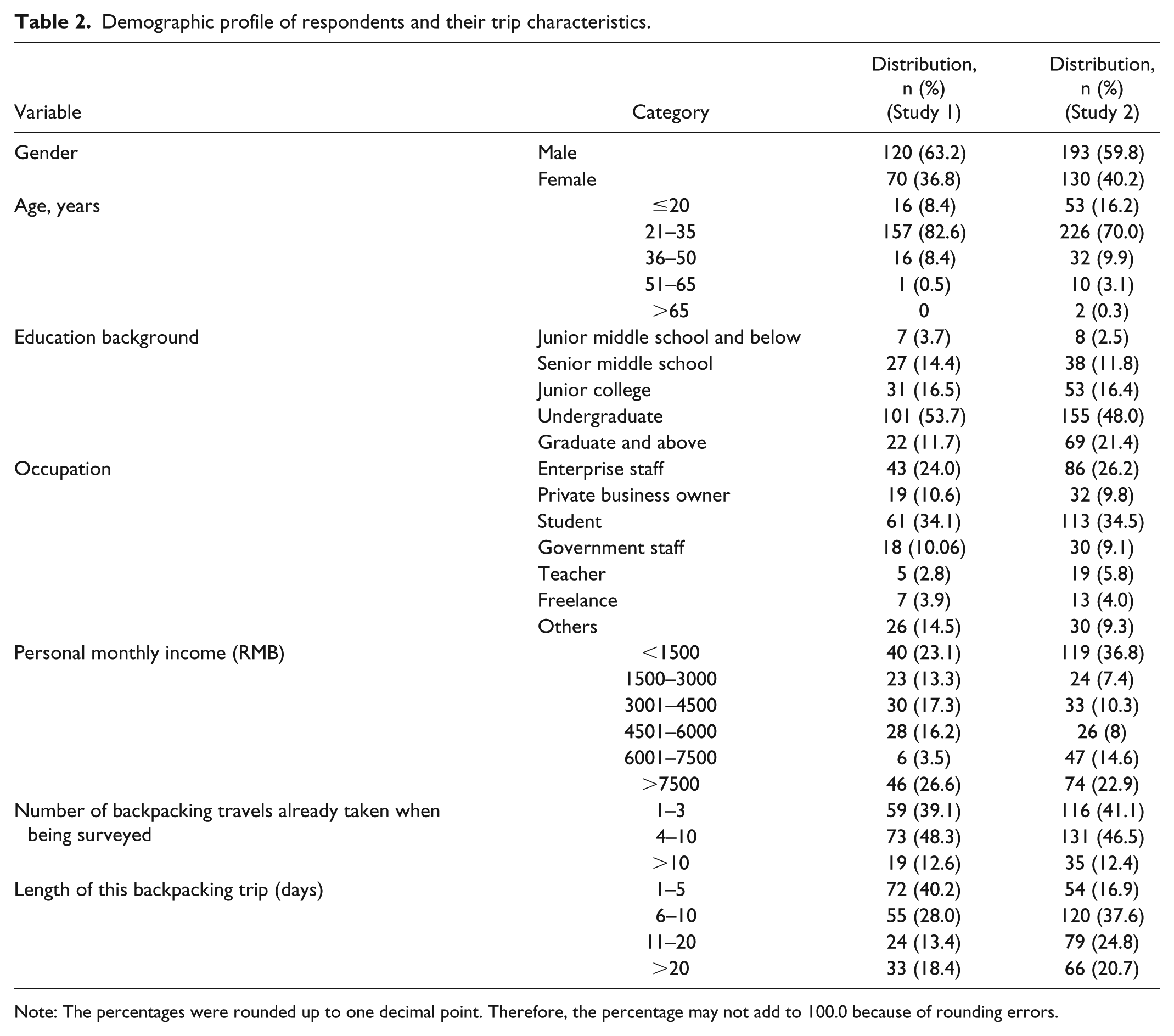
Note: The percentages were rounded up to one decimal point. Therefore, the percentage may not add to 100.0 because of rounding errors.
The questionnaire survey was administered with a total of 10 college students (8 undergraduate and 2 graduate students) as field interviewers (in three groups). Following previous studies on domestic Chinese backpackers (G. Chen, Bao, and Huang 2014a, 2014b; G. Chen and Huang 2017; G. Chen, Huang, and Hu 2018; Su and Ma 2009; Xu, Di, and Wu 2014; Zhu 2007), the field interviewers were allocated to eight international youth hostels (IYHs) in Guilin (June 2016, February 2017), Yangshuo (June 2016, February 2017), and Guangzhou (March 2017). Guilin and Yangshuo are both popular destinations in China for domestic Chinese backpackers (e.g., G. Chen, Bao, and Huang 2014a; Xu, Di, and Wu 2014; Zhu 2007), while Guangzhou is a gateway city for domestic Chinese backpackers (e.g., G. Chen, Huang, and Hu 2018; Su and Ma 2009; Zhu 2007).
Field interviewers approached potential eligible respondents in public areas of the IYHs and asked them to fill in the self-administered questionnaire. Afterwards, field interviewers stayed nearby for possible queries while respondents were filling in the questionnaires. Each questionnaire took an average of 10 minutes to complete. Eventually, of the 202 questionnaires distributed through convenience sampling, 190 copies were returned and deemed usable, representing an overall response rate of 94.06%.
Surveyed participants of this study did not report any problem of understanding the questionnaire items. Furthermore, an extensive review of extant literature and six expert consultations for developing measurement items (Table 1) provided sufficient evidence for content validity of the BIS.
Respondents’ sociodemographics are shown in Table 2. Male participants outnumbered their female counterparts (60.80% vs. 39.10%). The majority of respondents were in the age group of 21–35 (82.6%), followed by the age group of 18 and below (8.4%). Regarding educational background, 53.7% of the respondents reported an education level of undergraduate degree. As for occupation, about one third of the respondents (34.1%) were students, followed by enterprise staff (24.0%), and private business owner (10.6%) and government staff (10.6%). With regard to income, 26.6% of the respondents earned a monthly income of above 7,500 RMB (26.6%), followed by less than 1,500 RMB (23.1%) and 3,001–4,500 RMB (17.3%). Moreover, trip characteristics of the respondents are also shown in Table 2.
Purification of Measures
Before assessing the reliability and validity of the BIS, descriptive statistics of measurement items were examined in order to remove those items that exhibit inadequate psychometric properties. Among the 20 measurement items, 14 (70.0%) had a mean value over the midpoint (4.0), and another 3 items had a mean value very close to the midpoint (4.0), which indicates that respondents generally agreed with the statements. Item-to-total correlations showed that no item was poorly (r<0.40) correlated with the total score. In addition, no item should be deleted as judged by the change of Cronbach’s α value if an item was removed from the scale. Thus, all the 20 items were included in further analysis.
Exploratory factor analysis (EFA) was subsequently conducted on the retained 20 items using the principal axis factoring method with VARIMAX rotation to identify the dimensionality of the proposed BIS. The appropriateness of EFA was first determined by examining the Kaiser-Meyer-Olkin (KMO) measure of sampling adequacy and Bartlett’s test of sphericity. Later, items with a factor loading below 0.5 or a cross-loading above 0.5 (Nunnally 1978) were examined and removed. Furthermore, the number of dimensions was determined based on eigenvalue (>1.0; Tabachnick and Fidell 2007a). Following this procedure, in the first round of EFA (KMO=0.905; Bartlett’s test of sphericity=2693.889; df =190; p<0.001), the item of BIS-7 was removed because of low factor loading (0.327). In the subsequent rounds of EFA, the items of BIS-14 (FL: 0.367), BIS-4 (FL: 0.374), and BIS-18 (FL: 0.414) were removed in turn because of loadings lower than .50. Eventually, the fifth round of EFA (KMO=0.886; Bartlett’s test of sphericity=2044.905; df =120; p<0.001) identified three factors with 16 items, explaining 67.491% of the total variance (Table 3). The Cronbach’s α values of the three factors were all above 0.80, demonstrating adequate reliabilities.
Exploratory Factor Analysis Results.
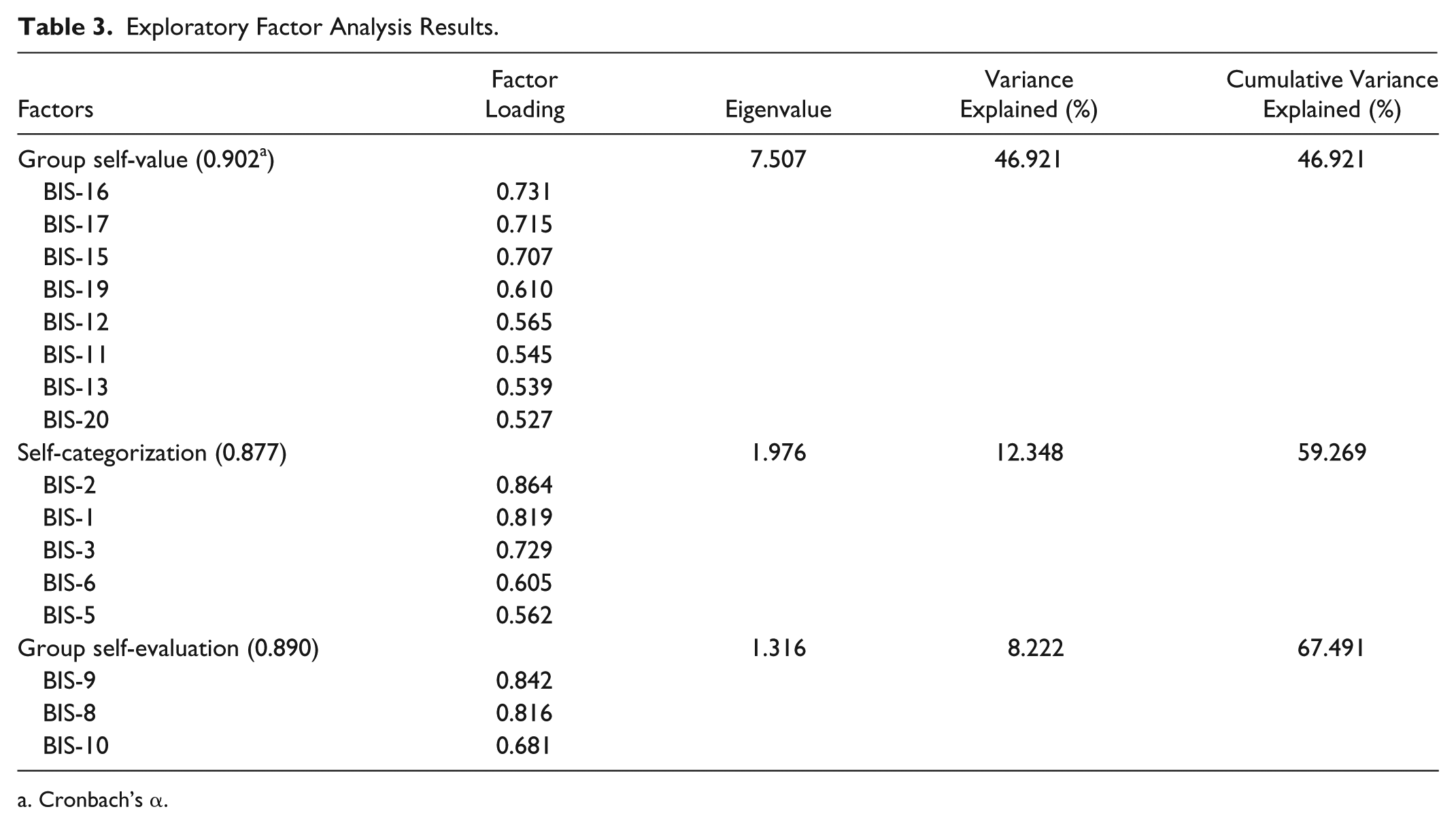
Cronbach’s α.
As shown in Table 3, the first factor (Factor 1; labeled as Group self-value) contained those items measuring group self-value (eight items). It is worth noting that two remaining items (BIS-19 and BIS-20) originally designed to measure backpackers’ commitment to the backpacker group was loaded on the group self-value factor. However, this is not difficult to understand, as these two items (i.e., “I will choose to backpack to actualize personal growth in the future” and “I will continue to do things that are beneficial to destination and social development in the future”) also denote the perceived benefits or social value of backpacking/being a backpacker. Factor 2, labeled as Self-categorization accordingly, included five items denoting backpackers’ self-categorization/self-identification with the backpacker group; while factor 3, labeled as group self-evaluation, contained three items measuring backpackers’ self-evaluations of having unique travel cultures, styles, and personality traits (Table 3).
Study 2: Scale Validation
Data collection
Following previous studies (e.g., G. Chen, Bao, and Huang 2014b; G. Chen and Huang 2017; Sirakaya-Turk, Ekinci, and Kaya 2008), a second study was further conducted to validate the BIS. Specifically, a new round of questionnaire survey was administrated. The questionnaire consisted of three parts. The first part used exactly the same choice questions and open questions as in Study 1, to screen qualified respondents and record their trip characteristics and sociodemographic information (see Table 2). The second part includes the retained 16 BIS items (using the same 7-point Likert-type scale as in Study 1) to collect data for the assessment of reliability, discriminant validity, and convergent validity. In the third part, in order to test the criterion-related validity of the BIS, based on previous studies on backpackers (e.g., G. Chen, Bao, and Huang 2014b; G. Chen and Huang 2017; G. Chen, Huang, and Hu 2018) and studies that have confirmed the significant correlations between individuals’ identity and personal development constructs (Erez and Earley 1993), four scales were included.
Specifically, the four scales were the Neuroticism subscale in the Eysenck Personality Questionnaire (EPQ; a scale measuring individuals’ emotional stability by using a “Yes/No” measurement with “Yes” scoring 1 and “No” scoring 0; see Eysenck and Eysenck 1975), the A subscale in the Texas Social Behavior Inventory (TSBI; a scale measuring individuals’ social self-esteem and social competence by using a 5-point Likert-type scale; see Helmreich and Stapp 1974), the Rosenberg Self-Esteem Scale (RSES; a scale measuring individuals’ self-value/self-worth by using a 5-point Likert-type scale; see Rosenberg 1965), and the New General Self-Efficacy Scale (NGSES; a scale measuring individuals’ perception of their ability to perform across a variety of different situations by using a 5-point Likert-type scale; see G. Chen, Gully, and Eden 2001). The Chinese editions of these four measurement scales were employed for their well-tested and recognized measurement qualities (G. Chen, Huang, and Hu 2018).
The questionnaire survey was conducted in two IYHs in Guangzhou and two IYHs in Chengdu, Sichuan province, from August 2017 to September 2017. Chengdu was additionally chosen as a data collection site as it has been confirmed to be a popular destination for Chinese backpackers (e.g., G. Chen and Huang 2017; Zhang et al. 2018; Zhu 2007). The same survey administration procedure as reported in Study 1 was applied in Study 2.
A total of 331 questionnaires were distributed and 323 copies were returned and deemed usable, presenting an overall response rate of 97.58%. As shown in Table 2, the profiles and trip characteristics of respondents were very similar to those of Study 1. Similarly, the chosen participants of Study 2 did not report any problem of understanding the questionnaire items.
Assessment of Reliability and Validity
The 323-case validation sample was used to validate the latent model identified in Study 1, through confirmatory factor analysis (CFA) by using AMOS21.0. The overall model fit was statistically evaluated by chi-square (χ2) test and a number of goodness-of-fit measures. The CFA results are reported in Table 4. The χ2/df value was 2.193(1 < χ2/df < 3) and other goodness-of-fit measures (i.e., root mean square error of approximation [RMSEA] = 0.061; goodness-of-fit index [GFI]=0.939; comparative fit index [CFI] = 0.979; incremental fit index [IFI] = 0.979; normed fit index [NFI] = 0.962; Tucker–Lewis index [TLI] = 0.968) also suggested a good fit of the three-factor model to the data.
CFA Results for the Backpackers’ Self-Identity Scale (N=323).
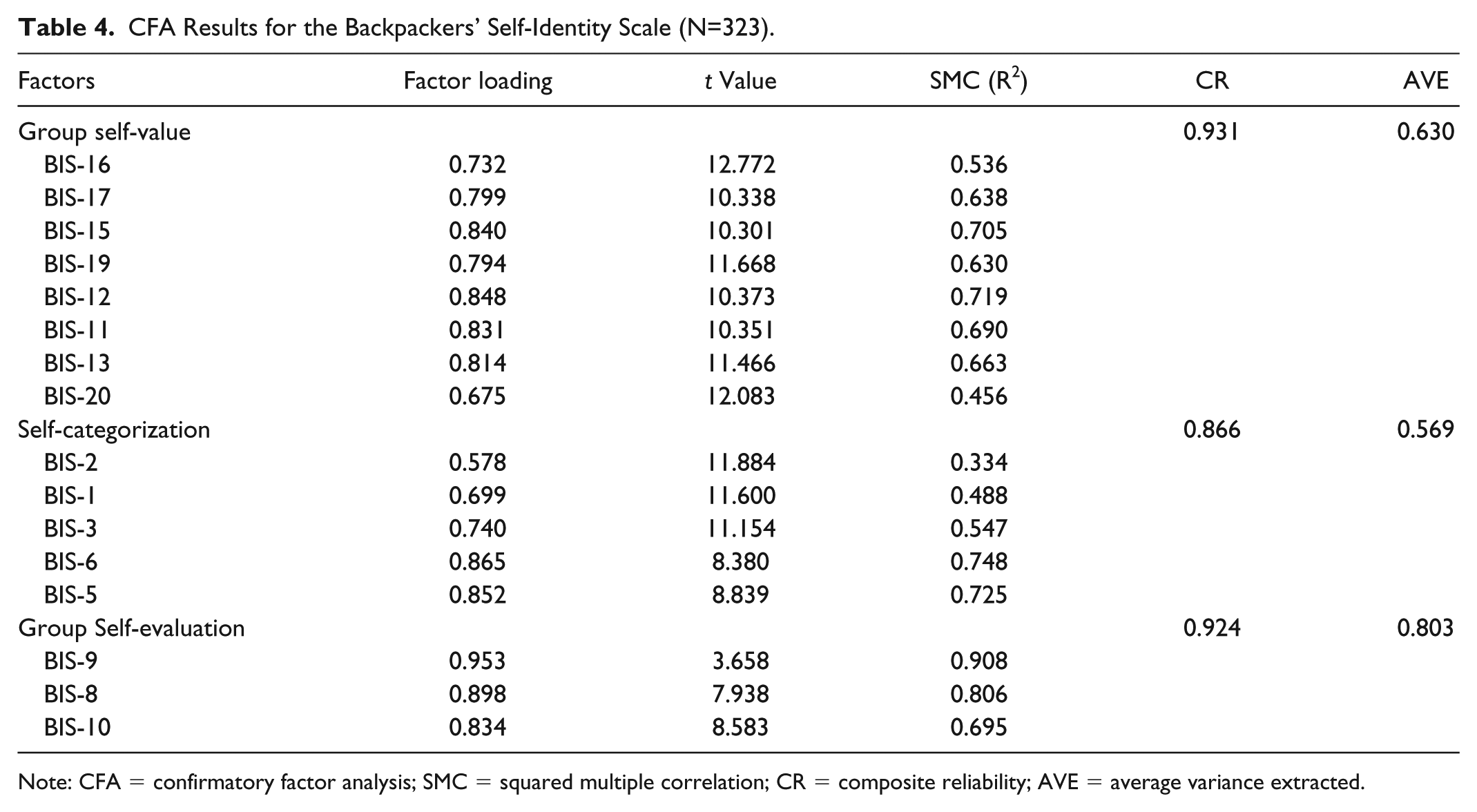
Note: CFA = confirmatory factor analysis; SMC = squared multiple correlation; CR = composite reliability; AVE = average variance extracted.
The next step is to assess the reliability and validity of BIS. As shown in Table 4, the factor loadings for the 16 items were between 0.578 and 0.898, R2 for all the items were between 0.334 and 0.908 (>0.30; Tabachnick and Fidell 2007b), and the composite reliability (CR) scores were between 0.866 and 0.931, all indicating sufficient reliability. Convergent validity was evaluated by checking all factor loadings (r >0.40) and the values of average variance extracted (AVE; >0.50). As shown in Table 4, the t values for 16 items were between 3.658 and 12.772 (p<0.001), and the AVE values were between 0.569 and 0.630, thereby confirming the convergent validity of the BIS. The discriminant validity of the scale was also examined. Following Fornell and Larcker’s (1981) suggestion, the square root of the AVE of each latent construct should be higher than the construct’s highest correlation with any other latent construct. As indicated in Table 5, the indicators for all the constructs met this requirement, suggesting sufficient discriminant validity. Therefore, it can be concluded that the assessment of the measurement model showed strong evidence of reliability, discriminant validity, and convergent validity of the latent constructs.
Construct Correlations (Pearson Correlation Coefficient).

Square root of average variance extracted (AVE).
As mentioned earlier, a test of criterion-related validity was conducted to further assess the validity of the BIS. As indicated by Table 6, the mean values of the BIS (including its subscales), NGSE, RSES, and TSBI scores were in the upper band (59.09%-80.54%) of the total score ranges, which indicated that respondents generally reported a high-level perception of identities, self-efficacy, self-esteem, and social self-esteem, respectively. In addition, the mean value of the EPQ (Neuroticism subscale) indicated that respondents generally reported a low level of emotional instability. Furthermore, the univariate skewness and kurtosis values showed that the data did not appear to have “extremely” deviated from normal distribution (Kline 1998). As shown in Table 7, three backpacker identity dimensions (i.e., self-categorization, group self-value, and group self-evaluation) and the overall BIS scale score were found to be significantly and negatively correlated with Neuroticism; on the other hand, they are all significantly and positively correlated with the RESE, GSES, and TSBI. These results provided sufficient support to criterion-related validity of the BIS.
Descriptive Statistics.
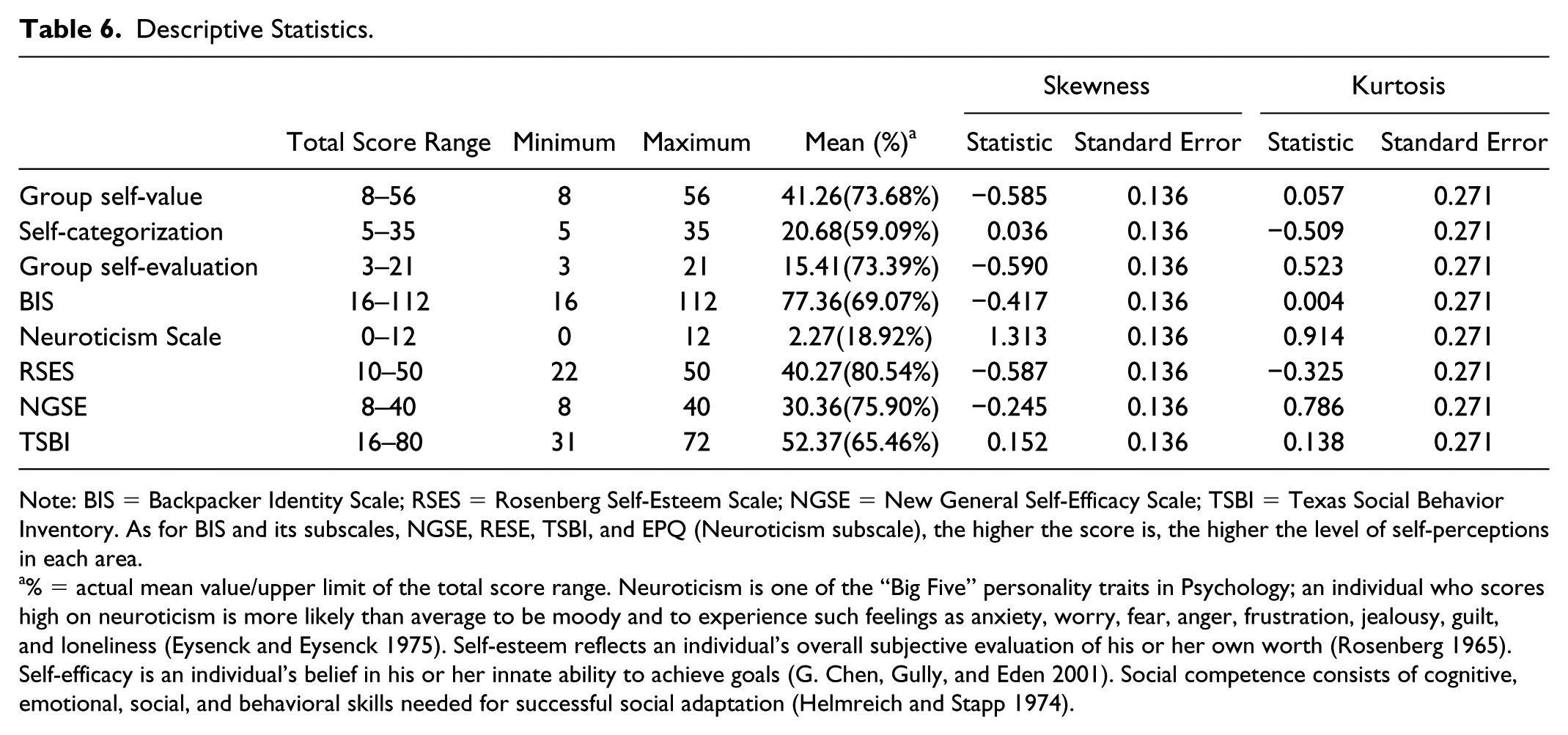
Note: BIS = Backpacker Identity Scale; RSES = Rosenberg Self-Esteem Scale; NGSE = New General Self-Efficacy Scale; TSBI = Texas Social Behavior Inventory. As for BIS and its subscales, NGSE, RESE, TSBI, and EPQ (Neuroticism subscale), the higher the score is, the higher the level of self-perceptions in each area.
% = actual mean value/upper limit of the total score range. Neuroticism is one of the “Big Five” personality traits in Psychology; an individual who scores high on neuroticism is more likely than average to be moody and to experience such feelings as anxiety, worry, fear, anger, frustration, jealousy, guilt, and loneliness (Eysenck and Eysenck 1975). Self-esteem reflects an individual’s overall subjective evaluation of his or her own worth (Rosenberg 1965). Self-efficacy is an individual’s belief in his or her innate ability to achieve goals (G. Chen, Gully, and Eden 2001). Social competence consists of cognitive, emotional, social, and behavioral skills needed for successful social adaptation (Helmreich and Stapp 1974).
Correlations (Pearson Correlation Coefficient).
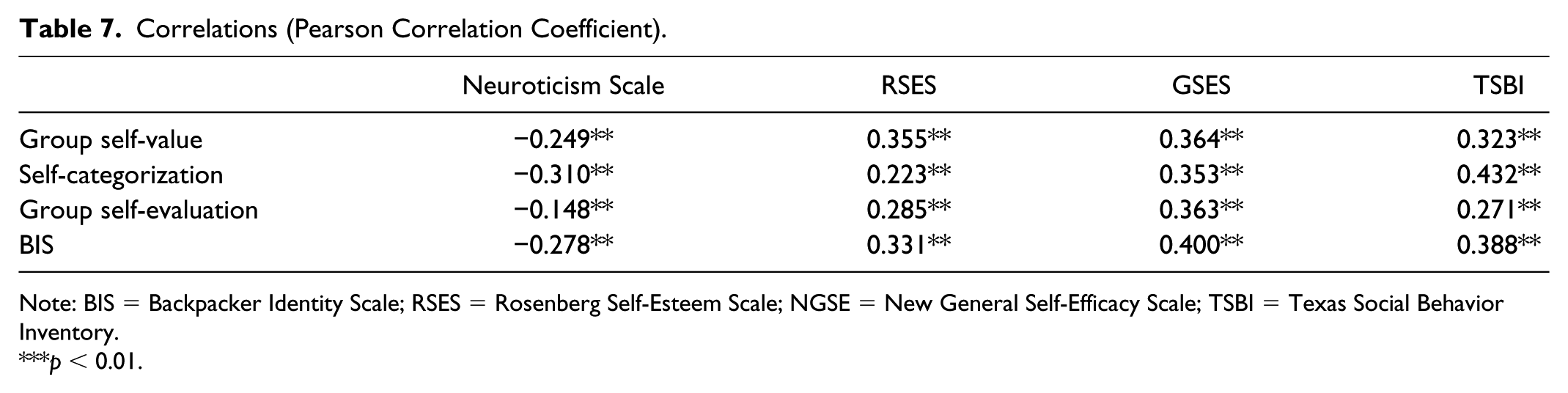
Note: BIS = Backpacker Identity Scale; RSES = Rosenberg Self-Esteem Scale; NGSE = New General Self-Efficacy Scale; TSBI = Texas Social Behavior Inventory.
**p < 0.01.
Finally, in order to confirm whether the three-factor model was the more appropriate conceptualization of backpacker identity, a dimensionality test was conducted. Specifically, a CFA with all items of the three BIS components loading on one factor was performed. As shown in Table 8, the one-factor model exhibited a significantly worse fit than the three-factor model (∆χ2(11)=174.12, p<0.001). Similarly, a two-factor model was estimated by combining the two most highly correlated components (i.e., group self-evaluation and group self-value) into one factor and leaving the other one factor (i.e., self-categorization) unchanged. As shown in Table 8, the two-factor model had a significantly worse fit than the three-factor model (∆χ2(9)=102.226, p<0.001). This dimensionality test provided sufficient evidence to support the three-factor model.
Model Comparisons for Dimensionality.
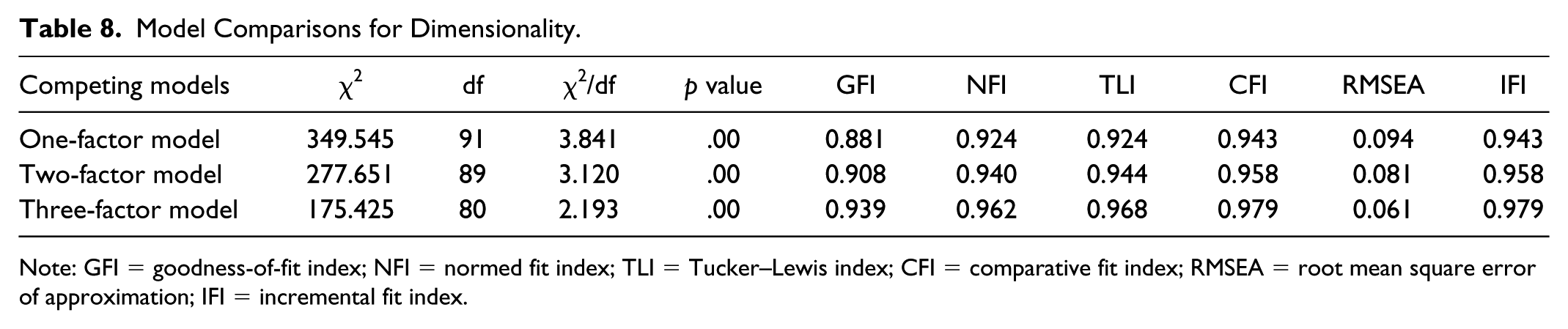
Note: GFI = goodness-of-fit index; NFI = normed fit index; TLI = Tucker–Lewis index; CFI = comparative fit index; RMSEA = root mean square error of approximation; IFI = incremental fit index.
Discussions and Conclusion
The purpose of this study was twofold. First, the study aimed to identify the dimensions to measure backpacker identity as a significant research construct with the rapidly growing backpacker market (e.g., Noy 2004; S. A. Cohen 2011; O’Reilly 2005). Guided by Social Identity Theory (SIT; Hornsey 2008; Tajfel 1982; Tajfel and Turner 1979), and with a prescribed theoretical framework consisting of three potential constructs (see Table 1), the study identified group self-value, self-categorization, and group self-evaluation as related but distinct aspects of backpacker social identity (e.g., Ellemers, Kortekaas, and Ouwerkerk 1999; Hornsey 2008; Tajfel 1982; see Tables 4 and 5).
Second and more importantly, the study was intended to develop and validate a measurement scale with sufficient reliability and validity. Following previous studies on scale development and validation, the current research established the validity and reliability of the backpacker identity scale (BIS), through two successive studies (Study 1 and Study 2). Specifically, through EFA, with the three backpacker identity dimensions, 16 items were finally retained in the refined scale. The dimension structure and measurement scale were then verified through CFA. In addition to the satisfactory convergent validity and discriminant validity, statistical findings also demonstrated sufficient criterion-related validity of the BIS.
Theoretical Implications
While tourism researchers have conducted a great number of studies on backpacker identity (e.g., Anderskov 2002; Liu et al. 2018; Noy 2004; S. A. Cohen 2011; O’Reilly 2005; Zhang et al. 2017; Zhang et al. 2018), very limited research has been dedicated to examining the dimensions of this construct. Especially, no empirical research has been conducted to develop and validate a measurement scale regarding backpacker identity. This study provides a better understanding of backpacker identity as a social psychological concept. The three backpacker identity dimensions (i.e., group self-value, self-categorization, and group self-evaluation) have been sporadically mentioned in the backpacker literature. However, it is believed that this study, by identifying and confirming significant dimensions of backpacker identity, has contributed to the growing body of knowledge of this specific and important topic. The three-dimension measurement scale could be further utilized as a research tool in future studies to evaluate how backpackers, and even broadly travelers, in different cultural backgrounds, reflect on the important question of “who am I.”
Unexpectedly, commitment to the backpacker group was not confirmed as an independent backpacker identity dimension in this study. Specifically, one initial item (i.e., “I will continue to be a backpacker in the future”) was removed due to low factor loading (0.414) in the process of EFA. Subsequently, in the final round of EFA, two other items (i.e., “I will choose to backpack to actualize personal growth in the future” and “I will continue to do things that are beneficial to destination and social development in the future”) within this prescribed dimension were instead loaded on the factor group self-value, suggesting that the originally assumed commitment to the backpacker group dimension has not been perceived to be a salient component of backpacker identity.
There are three possible explanations for the above circumstance. First, as Xie (2017) suggested, in contemporary China, backpacking as a travel style has been romanticized as a symbol of persuing freedom and independence, but backpacking as a lifestyle has been stigmatized as being irresponsible and regressive. Therefore, facing such pressure from their families and the society, Chinese young backpackers have often been confronted with a dilemma when they need to plan for their futures. Practically, there is a great number of options for their future lives (e.g., settling down, finding a job, further study, getting married and starting a family; see Xie 2017; Zhang et al. 2017). Second, as Zhang et al. (2017) found, some Chinese backpackers would detach themselves from the backpacker group after they have completed their backpacking trips, as they come to realize the gaps between the romanticized images and the experienced reality of backpacking. Third, backpacking has been commonly perceived as contributing to their personal development, such as capability, emotion, and skill (e.g., G. Chen, Bao, and Huang 2014b; G. Chen and Huang 2017), and further to their self-esteem and self-efficacy (G. Chen, Huang, and Hu 2018). Such social psychological develeopment has well enabled backpackers to adjust to their new life and work in the mainstream society, which in turn may have prompted them to abandon backpacking as a temporary travel or transient lifestyle. To sum up, a decisive and salient emotional commitment to the backpacker group/backpacking may not exisit ontologically.
As shown in Table 3, judged by the eigenvalue and variance explained, group self-value was identified as the most salient component of backpacker identity, followed by self-categorization and group self-evaluation. This indicated that the benefits of personal development, as well as perceived contributions to local communities, have been perceived to be the most important element in backpacker identity construction. This finding is in line with some previous narrative studies which confirmed that backpackers’ identity stories powerfully consisted of their experience of self-change and responsible travel behaviors (e.g., Noy 2004; O’Reilly 2005; Zhang et al. 2018; Zhu 2007).
It is noteworthy that self-categorization was identified as a second important component of backpacker identity (also judged by the eigenvalue and variance explained). It suggested that although backpackers generally recognize the benefits of personal development, they may not necessarily accept the label of backpackers (Zhang et al. 2018). As mentioned earlier, in the backpacking context, the term backpacker has not been a widely accepted label (e.g., Elsrud 2001; Muzaini 2006; O’Reilly 2005; Richards and Wilson 2004; Tucker 2003; Welk 2004; Zhang et al. 2018). Instead, most backpacking travelers would prefer to be called a traveler. Particularly, in Mainland China, backpacker (in Chinese Pinyin: “Beibaoke”) as a term translated from English, has not gained its dominant position in the discourse and communications among Chinese backpackers. Alternatively, the more culturally colloquial term Donkey Friends (“lvyou”), with its pronunciation in Chinese being very similar to that of travel, has been widely used (see H. Chen and Weiler 2014; Luo, Huang, and Brown 2014). This circumstance may have primarily caused self-categorization to be a relatively less recognized identity component (e.g., “I am a typical backpacker” and “Everyone calls me a backpacker”; see Table 1).
In addition, group self-evaluation (i.e., backpackers’ unique travel style, culture, and personality traits) was identified as the least contributive/important component to backpacker identity. Possibly due to the convergence of backpackers and mainstream tourists in terms of travel behaviors, especially in the context of China (e.g., Larsen, Øgaard, and Brun 2011; Zhang et al. 2018) and with the emerging “fake backpackers” (Zhang et al. 2018), the previously well-recognized ethos of backpackers may have been blurred and diluted in the Chinese context.
Finally, as shown in Table 7, the three backpacker identity components and BIS as a whole were all found to be significantly and positively related to self-esteem (SE), generalized self-efficacy (GSE) and social self-esteem, and negatively related to neuroticism. In other words, with a strong backpacker identity, a backpacker will have high levels of SE, GSE, and social self-esteem. These associations are consistant with findings in previous studies such as G. Chen, Bao, and Huang (2014a), G. Chen and Huang (2017), and G. Chen, Huang, and Hu (2018) that generally confirmed the positive correlations bettween backpacker personal development (BPD) and other human development constructs, such as SE, GSE, and social self-esteem.
Practical Implications
This study has some practical implications. Backpackers, educational and health institutions, tourism policy makers, tourism marketers, and practitioners could use the findings of this research to have a better understanding of the identity issues of backpackers. For instance, the present study has demonstrated that group self-value is the most contributive component to backpackers’ identity. In order to enhance a backpacker’s identity, efforts should be focused on strengthening the perceived psychological benefits of personal development (e.g., capability, skills, and self-consciousness) through backpacking as well as social and ecological contributions to local communities enabled by backpacking. To this end, tourism product and service providers (e.g., hostels) could use local resources to create customized programs (i.e., professional schools, outdoor expand training activities, and backpacking seminars). Similarly, destination marketing organizations (DMOs) could highlight the resources, attractions, activities, and atmosphere that could facilitate backpackers’ personal development (i.e., worldview, self-consiousness, skills, emotions, and capability) to attract potential backpackers, especially those who are in need of enhancing their backpacker identity.
Finally, as an important component to backpacker identity, self-evaluation of backpackers should be fully taken into account by tourism operators and DMOs. For instance, youth hostels could strengthen the local cultural atmosphere and symbolic representation in order to differentiate their services from mass tourism products to attract backpackers.
Limitation and Future research
Several limitations of the current research should be acknowledged. First, this study was based on two Chinese backpacker samples. It should be acknowledged that the findings may not be generalizable to backpackers from other cultures. The dimensional structure and the scale (including its items) may not be fully applicable to other national samples of backpackers, considering the cultural differences and heterogeneity of the global backpacker market. Fellow researchers are therefore encouraged to further verify this scale in different cultural contexts. Second, initial items of the BIS were based on a literature review and expert feedbacks. Fellow researchers can employ other qualitative methods (e.g., interviews with backpackers) to see if there are new measurement items to further verify and expand the BIS. Last, future research is encouraged to apply the BIS in examining the antecedents and consequences of backpacker identity.
Footnotes
Acknowledgements
The authors would like to thank all the research student investigators and backpackers who participated in the questionnaire surveys.
Declaration of Conflicting Interests
The author(s) declared no potential conflicts of interest with respect to the research, authorship, and/or publication of this article.
Funding
The author(s) disclosed receipt of the following financial support for the research, authorship, and/or publication of this article: This research was supported by grants from the National Natural Science Foundation of China (Grant No. 41501154) and Tourism Youth Expert Training Program of the former China National Tourism Administration (Grant No. TYETP201542).
