



Abstract
Based on impact range performance analysis and impact asymmetry analysis, this study aims to (1) examine the asymmetric effect of shopping tourism attributes on shopping destination satisfaction from the perspective of Chinese tourists and (2) prioritize attributes by identifying them as frustrators, dissatisfiers, hybrids, satisfiers, and delighters. The asymmetric relationships between shopping tourism attributes and shopping destination satisfaction offer an expanded view of the dynamic effects of attributes, while destination-specific attributes allow the researchers to examine the unexplored roles of government promotions and Korean pop culture/media in shopping tourism.
Introduction
Shopping tourism is critical to destinations that aim to create tremendous economic impact through a competitive tourism destination (Kattiyapornpong and Miller 2012; Tosun et al. 2007). For instance, Korea actively develops shopping tourism and emerges as the world’s 12th best shopping destination in 2013 (V. Kim 2014). Chinese tourists are key to the success of shopping tourism in Korea, given that they are a major source market for tourist arrivals to Korea and had spent US$22 billion in 2015 according to the Korea Tourism Organization (KTO 2017). Compared with tourists from other nations, Chinese tourists tend to feel more “happy or overjoyed” with their shopping experiences and are more engaged in learning about the products in which they are interested (Rovai 2016). Seventy percent of the Chinese tourists who visited Korea in 2016 for the purpose of shopping with their average spending of USD 2,200 per tourist (KTO 2017). Chinese tourists stay in Korea for 7.8 days on average, double the time spent by tourists from the second major source market, Japan (3.9 days on average). The top three shopping items bought by Chinese tourists are cosmetics/perfume, food, and clothes, and their overall satisfaction with shopping measures 95.2 out of 100 (KTO 2017).
The emergence of shopping tourism naturally translates into a diversity of shopping tourism literature. The previous literature largely covers shopping motivation (e.g., Alegre and Cladera 2012; Hsieh and Chang 2006; Moscardo 2004; Murphy et al. 2011), shopping tourist clusters (e.g., M. J. Choi, Heo, and Law 2016a; Han, Hwang, and Kim 2015), shopping behavior (e.g., Alegre and Cladera 2012; Kattiyapornpong and Miller 2012), and shopping satisfaction (e.g., Heung and Cheng 2000; Sirakaya-Turk, Ekinci, and Martin 2015; Vega-Vázquez, Castellanos-Verdugo, and Oviedo-García 2015; I. A. Wong and Wan 2013; Yeung, Wong, and Ko 2004). In examining shopping tourism attributes, the extant literature tends to overlook destination-related attributes (e.g., government promotion, tourism infrastructure, visa issue) while focusing more on shopping-related attributes (e.g., merchandise, staff service, facility). On the basis of the notion that tourism induces shopping and vice versa, the Globe Shopper Index, as cited by UNWTO (2014), is designed to assess the attributes of a shopping destination, including not only shopping-related attributes but also destination-related attributes, thereby implicitly emphasizing the role of destination attributes in shopping destination competitiveness.
Furthermore, the previous shopping tourism research overlooks asymmetric effect when assessing the relationships between shopping attributes and satisfaction. Asymmetric effect is defined as the differential effect of attributes on satisfaction according to three-factor theory (Füller and Matzler 2008; Füller, Matzler, and Faullant 2006; J. S. Lee, Choi, and Chiang 2017); the impact of attributes on satisfaction varies with the types of attributes (i.e., dissatisfiers, hybrids, and satisfiers). Although the linear, symmetric relationship is generally adopted in academic research, disregarding an asymmetric relationship limits the understanding of which attributes cause more satisfaction or more dissatisfaction. For example, agreeable store temperature may not make shopping tourists satisfied as they take it for granted. However, if air conditioning fails at a shop in hot summer, the shopping tourists are dissatisfied very much.
The above-mentioned example shows the asymmetric effect of shopping attributes on satisfaction; some attribute causes dissatisfaction if not provided, whereas it does not induce satisfaction even when supplied. The differential effect of attributes cannot be captured by linear and symmetric effect, as evidenced by the tourism literature (Füller, Matzler, and Faullant 2006; Füller and Matzler 2008). Disregarding asymmetric associations between attributes and satisfaction may result in model misspecification and poor predictive power (Streukens and Ruyter 2004). Also, an understanding of the asymmetric associations enables the prioritization of shopping tourism attributes for the strategic management of shopping tourism. Nevertheless, such asymmetric relationships have not been empirically explored in the shopping tourism literature.
The current study adopts a mixed-method design to qualitatively and quantitatively identify shopping tourism attributes (shopping- and destination-specific attributes) that remain unexplored in the extant shopping tourism literature. Through the identification of these attributes, this study aims to (1) examine the asymmetric effect of shopping tourism attributes on shopping destination satisfaction from the perspective of Chinese tourists, based on impact range performance analysis (IRPA) and impact asymmetry analysis (IAA), and (2) prioritize the attributes for the strategic management of shopping tourism by identifying them as frustrators, dissatisfiers, hybrids, satisfiers, and delighters.
Literature Review
Shopping Tourism Attributes
UNWTO (2014, p. 13) defines shopping tourism as “a contemporary form of tourism fostered by individuals for whom purchasing goods outside of their usual environment is a determining factor in their decision to travel.” This definition is consistent with the shopping tourism literature that shopping is a major travel motivation (M. J. Choi, Heo, and Law 2016b) and is treated as an irresistible attraction (Timothy 2014). This motivation leads tourists to allocate a high portion of the total travel expenditure to shopping activities (Albayrak, Caber, and Cömen 2016); thus, shopping tourism is recognized as a rapidly growing tourism sector (Sharma, Chen, and Luk 2018).
Shopping tourists show different shopping behavioral patterns when traveling than when staying in their home countries (I. A. Wong and Wan 2013). Tourists are likely to exhibit more impulse buying (Thomas and LeTourneur 2001) and thus spend more money on shopping than dining or accommodation because they can access merchandise that are either unique to a shopping destination only (Turner and Reisinger 2001) or cheaper than in their home country (Yeung, Wong, and Ko 2004). Henderson et al. (2011) stated that shopping tourism is facilitated or inhibited by critical attributes. The attributes are broken down into shopping-related (shopping opportunities, shop environments, products, service quality, and customer protection) and destination-related attributes (infrastructure, attractions, transportation, marketing campaign, government action). Shopping-related attributes are extensively reviewed in the extant literature (Albayrak, Caber, and Cömen 2016; Henderson et al. 2011; LeHew and Wesley 2007; Lloyd, Yip, and Luk 2011; Sharma, Chen, and Luk 2018). However, most studies have overlooked destination-specific attributes in examining shopping tourism phenomenon. This study reviews shopping- and destination-specific attributes to assess their asymmetric impact on shopping destination satisfaction.
Shopping-specific attributes
For shopping tourists, shopping is the purpose of their visit and their major activity. A number of researchers have agreed that product is the core factor in tourist shopping (Albayrak, Caber, and Cömen 2016; Henderson et al. 2011; Lloyd, Yip, and Luk 2011; Sharma, Chen, and Luk 2018). Product includes various attributes, such as product availability, variety, price, design, quality, value for money, reputation, and reliability (Albayrak, Caber, and Cömen 2016; LeHew and Wesley 2007; Lloyd, Yip, and Luk 2011; Sharma, Chen, and Luk 2018).
An underlying assumption in shopping tourism is a difference in product price between the home country and the shopping destination (Timothy 2005). Tourists want to gain financial benefit through a tax-free policy and discounted offers (M. J. Choi, Heo, and Law 2016a). A wide selection of products that are unavailable in the home country is another pull factor. For example, Hong Kong, which is known as a shopping paradise, welcomes approximately 56.7 million tourists per year (HKTB 2017). One of the distinctive features of Hong Kong is the guaranteed variety of luxury and high-street brands (M. J. Choi, Heo, and Law 2016a; M. Choi, Law, and Heo 2017). The ability to purchase unique products at reasonable prices contributes to the pleasant shopping experience of tourists by fulfilling their intended purpose (Yeung, Wong, and Ko 2004). The shopping enjoyment that they experience drives tourist satisfaction (Murphy et al. 2011), and satisfied shoppers tend to revisit the destination with an increased shopping budget (Huang and Hsu 2009). Therefore, product is considered a key shopping-specific attribute.
Studies have also emphasized the role of staff service in tourist shopping. Staff service comprises attributes, such as service attitude, product knowledge, language ability, service quality, and appearance (Albayrak, Caber, and Cömen 2016; LeHew and Wesley 2007; Lloyd, Yip, and Luk 2011; Sharma, Chen, and Luk 2018). Given that active promotion and service of store staff encourage tourists to purchase products that are not on their shopping list (Ottar-Olsen and Skallerud 2011; Tosun et al. 2007), tourist impulsive shopping is significantly affected by how store staff interact with tourists (I. A. Wong and Wan 2013). Tourists in retail shops tend to stop shopping when the attitude of the staff is unprofessional. Lack of product knowledge and poor service fail to build trust in staff members (M. Choi, Law, and Heo 2016), which leads to tourist dissatisfaction and eventually to an unpleasant shopping experience (I. A. Wong and Wan 2013). Foreign language proficiency is also critical to tourist shopping. Xu and McGehee (2012) examined shopping behavior of Chinese tourists in the US and found out that Chinese tourists prefer to communicate with Chinese-speaking staff to learn more about product details before purchase decision. Tosun et al. (2007) stated that “the tourist-shopping experience is the sum of tourist satisfaction or dissatisfaction gained from individual attributes of products and service purchased” (p. 88). Hence, staff service is a key shopping-specific attribute that should be managed well.
As evidenced by the positive effect of shop environment on perceived value of shopping tourists (Lloyd, Yip, and Luk 2011), tourists care more about shop environment, given that they expect it to be different from the one in their home countries (Sharma, Chen, and Luk 2018). Shopping experience is enhanced by shop environment (i.e., servicescape), such as ambient conditions, window display, lighting, layout, and interior/exterior design during the service encounter (Albayrak, Caber, and Cömen 2016; LeHew and Wesley 2007; Lloyd, Yip, and Luk 2011; Sharma, Chen, and Luk 2018; Singh and Sahay 2012).
Shopping environment is represented by the concept of servicescape in the retailing literature. For example, ambient conditions (e.g., temperature, lighting, noise, music, scent, wall color, neatness, and cleanliness) have been found to influence customer mood and behavior (Baker, Berry, and Parasuraman 1988; Baker et al. 2002; Bitner 1992). Hul, Dube, and Chebat (1997) found that background music influences customer reactions while waiting for service. In retail shops, high-tempo background music is typically used to improve traffic flow. Consumers move through space at a quick pace, and the music serves as a distraction to alleviate waiting time. Interior and exterior design includes window displays and decors, shop layout, location and accessibility, parking availability, and building architecture (Albayrak, Caber, and Cömen 2016; Turley and Milliman 2000). A shop layout that efficiently combines product and space encourages customers to traverse the entire store (W. T. Lin and Chen 2013; Murphy et al. 2011). Customers perceive high degrees of comfort and access when products are conveniently displayed in sections.
Store policy/service differentiation is also recognized as a shopping attribute. Unlike local shoppers, tourists have limited opportunities to shop during their trip. Thus, tourists consider opening hours, payment options (e.g., credit card and Alipay), and checkout speed to make the most of their shopping experience (Albayrak, Caber, and Cömen 2016; Y. H. Lin and Lin 2006; I. A. Wong and Wan 2013). Tourists are concerned with after-sales service for product malfunctions; thus, they frequently purchase products from well-known brand stores. Stores should clearly notify shoppers of their return/exchange policy, special deals/promotions (e.g., discounts, coupons), and overseas delivery service options for the convenience of tourists (T. M. Choi et al. 2008; Ismail El-Adly 2007; W. T. Lin and Chen 2013). LeHew and Wesley (2007) contended that such service differentiation alleviates anxiety and enhances confidence when shopping in a foreign country.
Finally, shopping information influences tourist response to shopping. Comprehensive shopping information about a destination and its retail shops can be a motivator when prospective tourists map out their shopping itinerary (T. M. Choi et al. 2008; Tosun et al. 2007). In particular, repeat tourists frequently pay attention to annual shopping festivals and periodic major sales when visiting a destination for shopping. Hence, shopping information is considered a salient attribute that influences shopping tourist satisfaction.
Destination-specific attributes
When selecting a destination, tourists consider destination attributes that can enrich their memorable experiences (V. Kim 2014), and shopping tourists are no exception. Although they allocate more time and budget to shopping than leisure tourists do (M. Choi, Law, and Heo 2017), shopping tourists still value destination attributes that make their trip pleasant (Chi and Qu 2009). Shopping tourists enjoy visiting landmarks and famous attractions, trying the local cuisine, and admiring landscapes and street scenes (Henderson et al. 2011). Thus, a destination should be positioned as attractive, affordable, safe, and accessible to tourists to fulfill their intended travel purpose. On the basis of shopping tourism research, this study reviews destination attributes in the following categories: culture and climate, affordability, safety, accessibility, and government promotion.
The aforementioned domains are fairly consistent with the dimensions in the destination competitiveness model developed by Crouch (2011), which includes (1) core resources and attractions, (2) supporting factors and resources, (3) destination management, (4) qualifying determinants, and (5) a competitive (macro/micro) environment. These dimensions are critical for maintaining a competitive edge in a highly competitive marketplace (V. Kim 2014). In addition to the dimensions provided in the shopping tourism literature, the dimension of destination competitiveness has been added to enhance this review of destination-level attributes.
Culture includes tourist attractions, UNESCO World Heritage Sites, and international cuisine (UNWTO 2014). Tourists seek authentic experiences by exploring the local culture (Funk and Bruun 2007). For example, female tourists have recently shown considerable interest in Korean cultural traditions, particularly clothing. They rent traditional clothes called hanbok and visit ancient palaces in Seoul. These activities are considered a “must do” among young tourists in Korea. Taking a traditional kimchi cooking class can be understood in the same context. Tourists perceive their travels as memorable when they interact with local people and visit historical tourist attractions (Richards 2002; Sharpley and Sundaram 2005). Such experiences provide tourists with a good understanding of the art, culture, and history of their destination. From heritage attractions to modern landmarks, local culture is undoubtedly an influential driver of destination choice and tourist satisfaction (Funk and Bruun 2007), which eventually leads to future behavior, such as revisits and positive word of mouth (Funk and Bruun 2007). Apart from culture, tourists also consider agreeable climate (e.g., temperature, humidity, and rainfall) when selecting a holiday destination or assessing alternative shopping destinations (UNWTO 2014).
Affordability is related to exchange rate stability and travel expenses, such as meals, accommodation, and transportation (UNWTO 2014). Exchange rates play an important role in determining the spending habits of tourists (Henderson et al. 2011), who tend to increase spending when the destination currency is devalued. In this regard, Southeast Asia has long been a favorite of Western tourists. High-quality tourism packages at affordable prices appeal to tourists worldwide, and affordability is a known determinant of destination competitiveness (Crouch 2011).
Recently, safety has become a major concern among tourists, regardless of the purpose of their travel (Crouch 2011). It comprises safety (e.g., crime rate and terrorist attacks) and political stability, that is, whether a nation is free of coups and strikes (UNWTO 2014). Terrorist attacks or natural/man-made disasters directly and indirectly influence tourism demand (Sönmez and Graefe 1998). Pizam and Smith (2000) noted that tourism demand takes up to 6 months to recover, with only 0.5% of the affected destinations recovering their business within 3 months. An incident that threatens safety results in a period of low tourism regardless of how attractive destinations are. In particular, Chinese tourists regard travel destination safety as a top priority (S. S. Kim, Guo, and Agrusa 2005). Moreover, Chinese tourists have emerged as big spenders in international tourism (UNWTO 2014).
Accessibility includes access between the home country and the destination (e.g., frequency of flight arrangement) and within the destination (e.g., dependable city transport) (Henderson et al. 2011). Inaccessibility makes tourists hesitant to visit destinations given that long travel time and high expenses are required (J. S. Lee and Min 2013; Wan 2011). Accessibility is related to physical and psychological distances. Even for long-haul travel, tourists perceive a destination as close when frequent (direct) flights and convenient transport to city centers are available (UNWTO 2014). Easy access influences tourist motivation (Oppermann 1998). Thus, governments frequently approve charter flights during government-sponsored shopping festivals to overcome inaccessibility issues (M. Choi, Law, and Heo 2016).
Finally, government promotion is listed as a destination attribute. It includes tourist visa regulations, tax-free systems (e.g., duty free or tax refunds), visitor information/service centers, and special promotional campaigns (UNWTO 2014). Visa regulations are partly related to accessibility. Certain destinations require tourists to obtain a visa before entry. Ease of visa application and a short processing time affect tourist visits. For some destinations, the required documents include an invitation letter, an employment certificate, and even bank statements for the past three to six months. These requirements can discourage prospective tourists because they may feel unwelcome. They may thus simply choose another destination as a substitute. Song, Gartner, and Tasci (2012) pointed out that visa regulation is a powerful tool that can be adjusted to tourism demand. Governments can relax visa regulations during national shopping festivals by allowing visa-free entry or visas on arrival (M. Choi, Law, and Heo 2016). Shopping tourists also express considerable interest in tax-free systems given that shopping is their major objective and activity. Tax-free systems, such as a maximum tax-free amount and a convenient tax refund process (e.g., availability of self-kiosk tax refund machines at the airport), have a major appeal, and therefore, should not be underestimated (Dimanche 2003; Hobson and Christensen 2001).
Underlying Theories of Asymmetric Effect of Attributes on Satisfaction
The performance of multi-attributes determines overall satisfaction (Back 2012; J. S. Lee, Choi, and Chiang 2017; J. S. Lee and Min 2013). The asymmetric effect of attributes on satisfaction occurs when a particular attribute does not induce customer satisfaction even after an investment in improving the attribute performance, whereas another attribute exhibits greater impact on customer satisfaction after an equivalent investment is made in this attribute.
The asymmetric effect of attributes on satisfaction is underlain by prospect theory (Kahneman and Tversky 1979), in which (1) gains and losses are evaluated by comparing them with a reference point, (2) losses are given more weight than gains in assessing value (loss aversion), and (3) the marginal value of gains or losses declines with their size (diminishing sensitivity). In particular, loss aversion explains that people are reluctant to realize losses because they consider losses more serious and larger than equivalent-sized gains (Einhorn and Hogarth 1981). This belief explains the phenomenon in which individuals tend to hold losers more than winners in stock investment. Loss aversion indicates that negative asymmetry exists given that the negative performance of a particular attribute is more sensitive to satisfaction than the corresponding size of its positive performance. Moreover, diminishing sensitivity implies that as an attribute approaches a high or low performance level, satisfaction is not as significantly affected as when the attribute’s performance is at an intermediate level. Loss aversion and diminishing sensitivity founded on prospect theory offer theoretical rationales for the asymmetric nature of attributes (Mittal, Ross, and Baldasare 1998).
The asymmetric effect of attributes on satisfaction is conceptualized by attractive quality theory (Kano 1984) composed of five quality dimensions. Kano (1984) asserted that five quality dimensions influence satisfaction differentially and are classified into “attractive,” “one-dimensional,” “must-be” “indifferent,” and “reverse” qualities.
Attractive qualities concern attributes that travelers do not generally expect. Hence, when tourists experience such qualities, they will likely be delighted and positively surprised, thereby ending up with high satisfaction. However, given that tourists do not expect attractive qualities, they will not be dissatisfied even if these qualities are not provided. That is, attractive qualities are positively asymmetric with satisfaction.
Must-be qualities are the opposite of attractive qualities; that is, they display a negative asymmetric relationship with satisfaction. These qualities are perceived by tourists as basic attributes. Thus, tourists feel disappointed when must-be qualities do not meet their expectations, but they are not satisfied even when these qualities are not provided as they take the qualities for granted.
One-dimensional qualities are defined as positively symmetric with satisfaction. Travelers are satisfied (dissatisfied) when these qualities are (are not) offered. Indifferent qualities literally do not have a relationship to satisfaction or dissatisfaction, regardless of whether they are provided or not. Reverse qualities trigger dissatisfaction if available and cause satisfaction if unavailable.
Attractive quality theory is further explored in the extant literature from the perspective of the three-factor theory, in which attributes are categorized as dissatisfiers, satisfiers, and hybrids (Anderson, Fornell, and Mazvancheryl 2004; Back 2012; Deng 2007; Füller, Matzler, and Faullant 2006; Mikulić and Prebežac 2008; Oliver 1997). For example, Oliver (1997) classified attributes into bivalent satisfiers, monovalent dissatisfiers, and monovalent satisfiers by advocating that attributes influence satisfaction differently. In particular, bivalent satisfiers (known as hybrids), which are contingent on the quality level of attributes, induce satisfaction or dissatisfaction. Monovalent dissatisfiers are regarded as must-be attributes (e.g., store temperature). Thus, individuals feel dissatisfied when these attributes are absent. However, even when these attributes are present, people are not necessarily satisfied because they take these attributes for granted. Unlike monovalent dissatisfiers, monovalent satisfiers are considered value-added and delightful attributes (e.g., staff foreign language proficiency) that cause a high satisfaction level and do not evoke dissatisfaction even if they are not provided because these attributes are generally unexpected.
In the tourism and hospitality literature, three-factor theory is adopted to examine the asymmetric effects of attributes on incentive traveler satisfaction (J. S. Lee, Choi, and Chiang 2017), convention attendee satisfaction (J. S. Lee and Min 2013), ski resort customer satisfaction (Füller, Matzler, and Faullant 2006), and restaurant customer satisfaction (Back 2012). In line with the above-mentioned research, the current study explores the asymmetric effects of attributes on shopping destination satisfaction, based on the following three factors (Back 2012; Füller, Matzler, and Faullant 2006; J. S. Lee, Choi, and Chiang 2017): Dissatisfiers and frustrators belong to negative asymmetrical attributes (Anderson and Mittal 2000). Dissatisfiers are considered must-be attributes that induce dissatisfaction when they are absent while frustrators are regarded as intense dissatisfiers (Füller and Matzler 2008). These attributes provoke frustration (a high level of dissatisfaction) if they are not supplied. Tourists take dissatisfiers and frustrators for granted; thus, these attributes do not trigger satisfaction even if they are provided (J. S. Lee, Choi, and Chiang 2017). Hybrids refer to symmetrical attributes (Anderson and Mittal 2000). When these attributes are implemented, travelers are satisfied. If they are not implemented, then travelers are dissatisfied (Back 2012; Füller, Matzler, and Faullant 2006; J. S. Lee, Choi, and Chiang 2017). Satisfiers and delighters are classified as positive asymmetrical attributes (Anderson and Mittal 2000). They exhibit the opposite nature of dissatisfiers and frustrators (Füller and Matzler 2008). That is, satisfiers are considered value-added attributes that cause satisfaction when they are fulfilled. Delighters are perceived as extreme satisfiers, such that tourists feel delighted when these attributes are provided. Travelers do not generally expect satisfiers and delighters. Thus, they are not likely to be dissatisfied when these attributes are unavailable (J. S. Lee, Choi, and Chiang 2017).
Methodology
Measurement Development and Data Collection
Measurement development
As suggested by Churchill (1979) and Gerbing and Anderson (1988), this study used a mixed-method design to generate measurement items and validation as follows: (1) a qualitative study (a literature review, in-depth interviews, and a panel of experts) and (2) a quantitative study (a survey). The mixed-methods design is instrumental in unveiling and validating new dimensions and attributes not identified in the previous literature but that may be salient in the current study (Delcourt et al. 2016).
First, an initial set of items was derived from the tourism and retail literature on shopping behavior. The latter is characterized by abundant research on consumer behavior, particularly the drivers of shopping mall and district choice. The extensive relevant literature was thoroughly reviewed to identify shopping tourism attributes considering the scope of this study. Shopping-specific items were derived in the following domains: product (Heung and Cheng 2000; W. T. Lin and Chen 2013; J. Wong and Law 2003), servicescape (Bitner 1992; Heung and Cheng 2000; Y. H. Lin and Lin 2006; Singh and Sahay 2012; Tosun et al. 2007; Turley and Milliman 2000), staff service (T. M. Choi et al. 2008; Heung and Cheng 2000; Tosun et al. 2007; I. A. Wong and Wan 2013), store policy/service differentiation (M. Choi, Law, and Heo 2016; T. M. Choi et al. 2008; Heung and Cheng 2000), and shopping information (M. Kim and Lennon 2008; Tosun et al. 2007). Meanwhile, destination-specific items focused on government promotion (Keown 1989; Li and Carr 2004), accessibility (Crouch 2011; Hsieh and Chang 2006), safety (S. S. Kim, Guo, and Agrusa 2005; Sönmez and Graefe 1998), affordability (Dwyer and Kim 2003; UNWTO 2014), culture, and climate (Chen, Chen, and Lee 2011; Jansen-Verbeke 1986; UNWTO 2014).
Second, using purposive sampling, three Chinese shopping tourists who had recently visited Korea were invited to take part in the study. The interviewees were two females in their 20s and one male in his 30s. A semi-structured in-depth interview with open-ended questions was conducted for an hour with each individual, and the interviewees were free to share the key determinants that affected their visit. Most of the identified attributes were consistent with those from the literature review, including affordability (e.g., exchange rate, dining, and hotels), accessibility (e.g., airports and flights), product (e.g., product selection and price), and promotional offers. The new attributes identified through in-depth interviews were pre-shopping information and government promotion (visitor service center, shopping festival). For example, the following statement indicates the attribute “government promotion.”
It was my first time visiting Seoul for the purpose of shopping. My sister and I are big fans of Korean cosmetic brands. One day, we happened to hear from YouTube promotional video that visa regulation was relaxed during the shopping festival, which is a strong motivation for foreigners like me. We thought that we could save on visa expenses and use the saving to shop for more cosmetics. [Interviewee 2]
A total of 59 items were consequently listed through the literature review and in-depth interviews. A panel of experts was then convened to help ensure the content validity of the measurement items. The panel members included 3 professors with specialized knowledge on shopping tourism, 4 senior government officials from the Ministry of Culture, Sports, and Tourism in Korea and the Korea Tourism Organization (KTO), and 11 managerial officers from the hospitality and tourism industry (e.g., duty-free shops, travel agencies, hotels). Government officials particularly involved in national shopping festival would be appropriate panel members. The experts were informed of the purpose of the study, the target sample (Chinese tourists), and the destination being studied (Korea). The panel members assessed the representativeness and applicability of the 59 items using a 5-point Likert scale, where 1 = highly inapplicable and 5 = highly applicable. The members were also encouraged to leave comments for further improvement and suggestions regarding the items. Consequently, 11 items with low ratings, such as music, scent, and parking availability under servicescape, were deleted.
In addition, the senior government officials and professors suggested including Korean pop (K-pop) culture, which had recently emerged as an influential reason to Chinese for visiting Korea. As stimulated by K-pop media (drama, music, and film), K-pop culture boosts the sale of Korean products (food, fashion, computer games, etc.) because tourists are inspired to purchase products promoted by celebrities and destinations featured in media (S. Kim 2012). Given that K-pop culture is one of the major boosters for Korea shopping tourism, four items of K-pop culture were added after referring to a study on K-pop culture (S. S. Kim et al. 2007). Finally, 52 items were generated for data collection.
Data collection
This study focused on Chinese tourists who had visited Korea. The Chinese people have considerable opportunities to accumulate disposable income and travel abroad due to the current spectacular economic growth of China (UNWTO 2014). Chinese citizens were ranked as top spenders on international tourism in 2013, with a total expenditure of US$129 billion (UNWTO 2014). Korea has recently become a popular shopping destination among the Chinese. KTO (2017) reported that China had become Korea’s top inbound market, accounting for 46.79% (n = 8,067,722) of its inbound tourists in 2016. These figures exhibit a sharp increase in ratio and number compared with the values in 2011 (i.e., 22.67%, n = 2,220,196); thus, Korea was deemed an appropriate study site.
To collect data, this study hired Sojump, a professional research software company managed by the Shanghai Information Technology Corporation. Since 2005, Sojump has been widely used by private companies and universities to collect online data and conduct market research in China. An online questionnaire about shopping tourism attributes was developed. The questionnaire asked the respondents to indicate their agreement with each item using a 7-point Likert-type scale, where 1 = strongly disagree and 7 = strongly agree. After data collection, 523 usable samples were obtained for data analysis. Table 1 shows the profiles of the respondents. Males accounted for 46.3% (n = 242) and females accounted for 53.7% (n = 281) of the sample. Approximately 79% (n = 413) of the respondents were in their 20s and 30s. Slightly more than half of the sample, that is, 53.9% (n = 282), were first-time visitors, whereas 46.1% (n = 241) were repeat visitors.
Profiles of Respondents (n = 523).
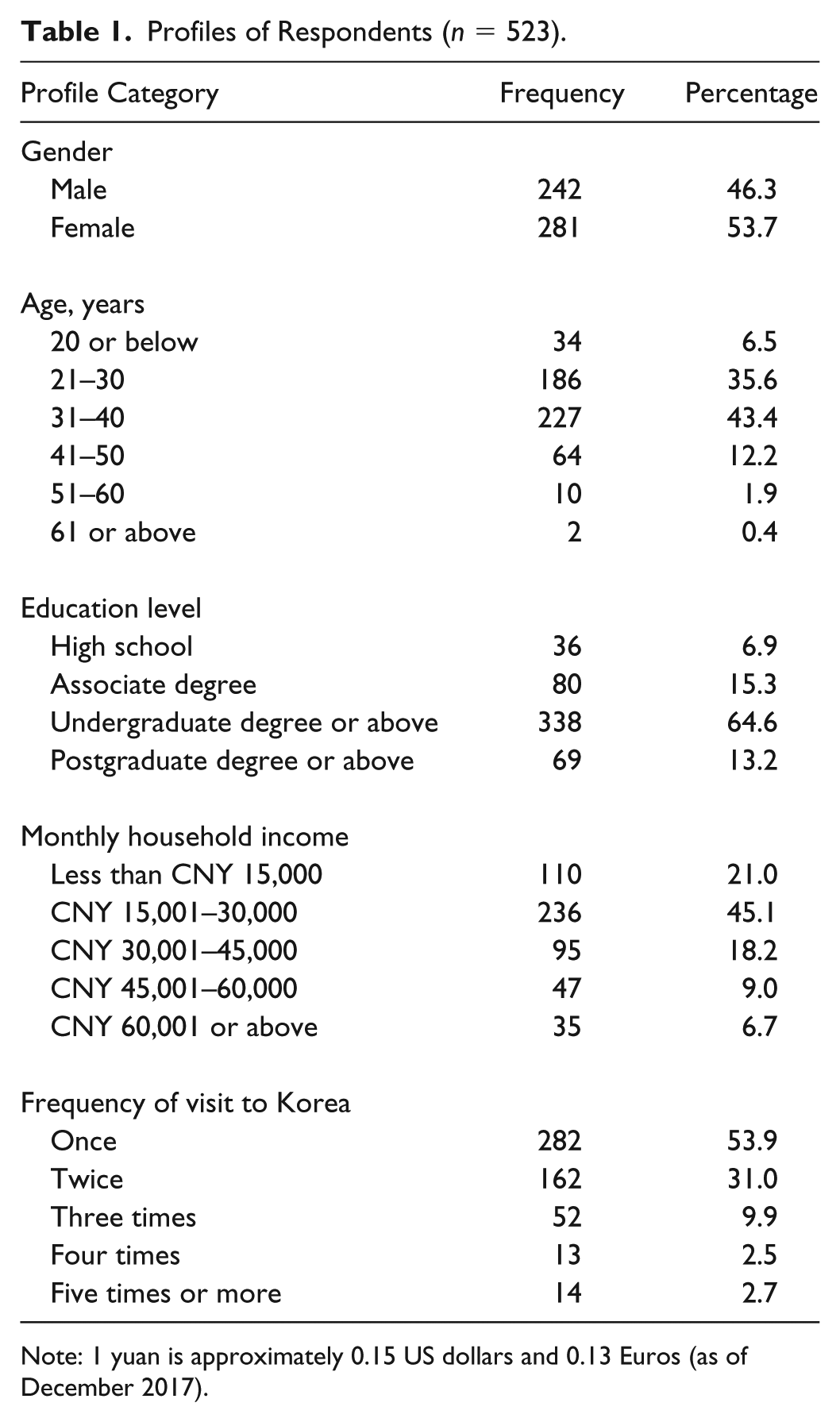
Note: 1 yuan is approximately 0.15 US dollars and 0.13 Euros (as of December 2017).
Factor Analysis
EFA was conducted using principal axis factoring with oblique rotation to identify the underlying dimensions of shopping tourism. Two distinct domains/concepts (shopping- and destination-specific attributes) exist over shopping tourism; thus, EFA was run separately for the two domains.
The EFA results show that 3 factors (shopping atmosphere, store service orientation, merchandise) underlay shopping-specific domains, with 66.78% of the variance (Table 2), whereas destination-specific domains comprised 6 dimensions, with 72.43% of the variance (Table 3). The destination-specific domains are affordability, K-pop culture/media (represented by drama, music, and film), safety, accessibility, government promotion, and attraction. Consequently, a nine-factor structure with 45 items underlay shopping tourism.
Results of Exploratory Factor Analysis for Shopping-Specific Attributes.

Note: Total variance explained = 66.78; Kaiser–Meyer–Olkin measure of sampling adequacy = .97; Bartlett’s test of sphericity, p < .001.
Results of Exploratory Factor Analysis for Destination-Specific Attributes.

Note: Total variance explained = 72.43; Kaiser–Meyer–Olkin measure of sampling adequacy = .96; Bartlett’s test of sphericity, p < .001.
Impact Range Performance Analysis (IRPA) and Impact Asymmetry Analysis (IAA)
The current study adopted IRPA and IAA to assess the asymmetric impact of an attribute on satisfaction (Mikulić and Prebežac 2008). Penalty–reward contrast analysis (PRCA) was undertaken using multiple regression analysis and dummy variables to conduct IRPA and IAA. The lowest “attribute performance score” (APS) was input as 1 to create the first set of dummy variables, that is, the penalty index (PI). That is, if an attribute performance is 1, then it will be coded as 1. When an attribute performance is rated as 2, 3, 4, 5, 6, or 7, then it will be coded as 0. The opposite procedure is used to generate the second set of dummy variables, that is, the reward index (RI). The highest APS (i.e., 7) was input as 1. Then, a low attribute performance (rated as 1, 2, 3, 4, 5, or 6) was input as 0. RI and PI were created through regression analysis using dummy variables. RI refers to attributes that are positively associated with satisfaction, whereas PI signifies attributes that are negatively associated with satisfaction (Table 4). RI and the absolute value of PI were summed to produce the value of an attribute’s “range of impact on satisfaction” (RIS), after which the equations below (Mikulić and Prebežac 2008) were adopted to generate the “satisfaction-generating potential” (SGP) and the “dissatisfaction-generating potential” (DGP). SGP and DGP were consequently used to determine “impact asymmetry” (IA).
(a) SGPi = RI/RISi,
(b) DGPi =│PI│/RISi,
(c) IAi index = SGPi − DGPi,
where RI = reward index for attribute i, PI = penalty index for attribute i, RISi =│PI│+ ri = range of impact on satisfaction, and SGPi + DGPi = 1.
Results of IRPA and IAA.
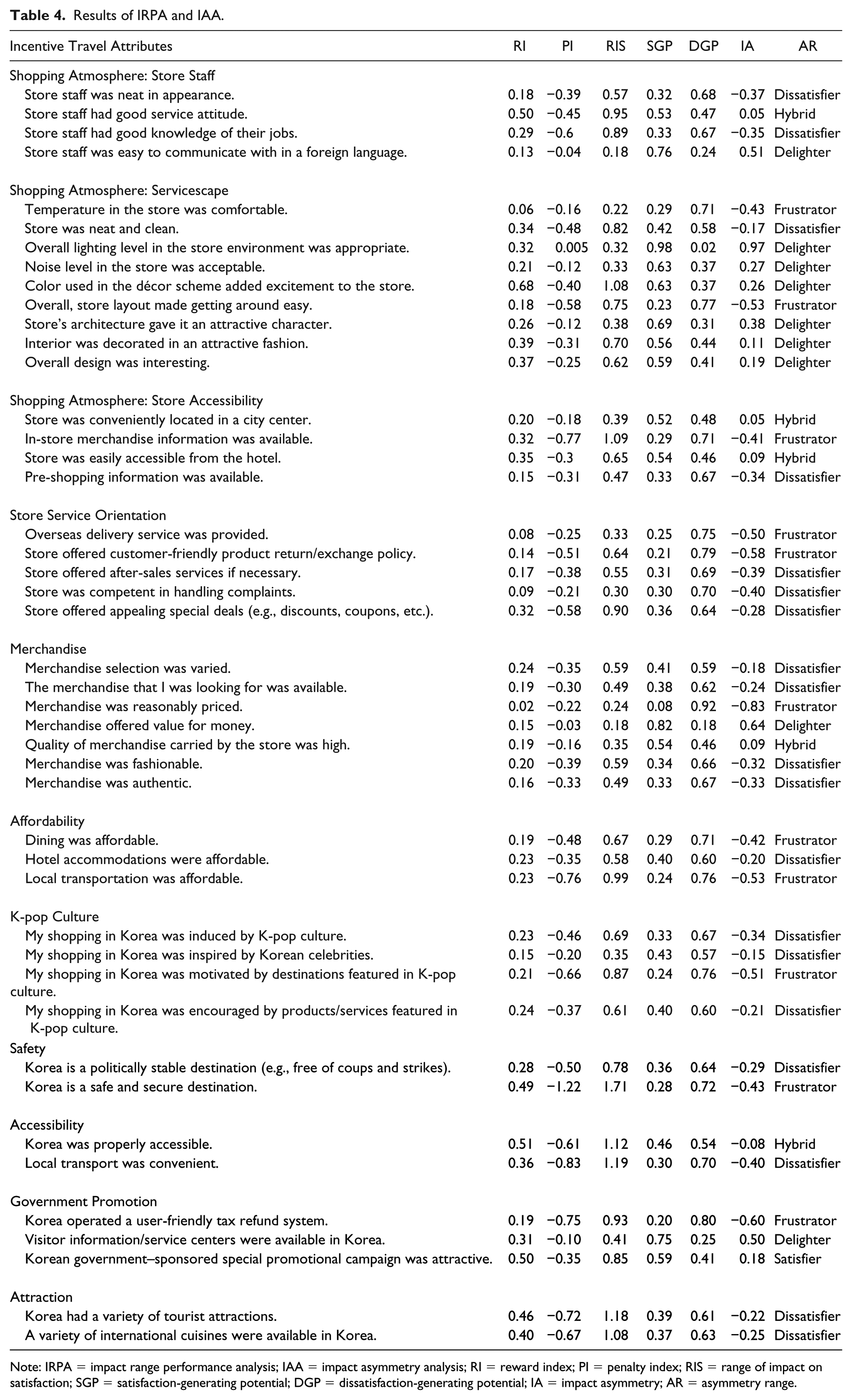
Note: IRPA = impact range performance analysis; IAA = impact asymmetry analysis; RI = reward index; PI = penalty index; RIS = range of impact on satisfaction; SGP = satisfaction-generating potential; DGP = dissatisfaction-generating potential; IA = impact asymmetry; AR = asymmetry range.
IA was used as a threshold to identify attributes as dissatisfiers, hybrids, or satisfiers (Mikulić and Prebežac 2008). That is, if SGP is greater than DGP, then an attribute is deemed to induce more satisfaction than dissatisfaction and is regarded as a satisfier. Conversely, if DGP is larger than SGP, then an attribute is considered to cause more dissatisfaction than satisfaction and is identified as a dissatisfier. If the difference between SGP and DGP is arithmetically slight, then an attribute is classified as a hybrid because of its equivalent impacts on satisfaction and dissatisfaction. The current study adopted the following cutoff point, as proposed by Mikulić and Prebežac (2008), to identify attributes as frustrators (extreme dissatisfiers, IA < −0.4), dissatisfiers (−0.4 ≤ IA < −0.1), hybrids (−0.1 ≤ IA ≤ 0.1), satisfiers (0.1 < IA ≤ 0.4), and delighters (extreme satisfiers, IA > 0.4).
This study assessed the asymmetric effects of shopping- and destination-specific attributes on shopping destination satisfaction based on the aforementioned mechanism (Table 4). Shopping atmosphere, store service orientation, and merchandise underlay shopping-specific domains, in which shopping atmosphere was dominant, with 17 attributes. Shopping atmosphere comprised many attributes that were clearly reflective of three subdimensions (store staff, servicescape, and store accessibility). The asymmetric effect of shopping atmosphere was presented using the three subdimensions to clarify its dynamics. Store staff-related attributes were shown to be dissatisfiers, hybrids, and delighters. Staff appearance and job knowledge were classified as dissatisfiers, whereas service attitude and foreign language communication were found to be a hybrid and a delighter, respectively. Servicescape attributes were either negative or positive asymmetric attributes. Store temperature and layout (frustrators) and cleanliness (a dissatisfier) fell into negative asymmetry, whereas delighters or positive asymmetry appeared in the remaining attributes (lighting, noise, décor color, architecture, interior, overall design). Store accessibility attributes indicate accessibility to physical location and store information. Physical location and accessibility (hybrids) were found to be symmetrically related to shopping satisfaction, whereas merchandise information and pre-shopping information were a frustrator and a dissatisfier, respectively. Store service orientation attributes were all characterized by negative asymmetry. Delivery service and return/exchange policy fell under frustrators. After-sales services, complaint handling, and special deals were classified under dissatisfiers. Merchandise attributes were also strongly related to negative asymmetry, except for merchandise quality (a hybrid) and value for money (a delighter). Merchandise variety, availability, fashionable style, and authenticity were found to be dissatisfiers, whereas merchandise price was a frustrator. Accessibility to Korea was considered a hybrid attribute, whereas the convenience of local transport turned out to be a dissatisfier attribute. In government promotion, the tax refund system was deemed as a frustrator, visitor information/service center as a delighter, and special promotional campaign as a satisfier.
On the basis of the IA and RIS values presented in Table 4, Figure 1 is designed to illustrate the relative position of attributes by simultaneously judging the asymmetric impact (IA, Y-axis) and the range of impact (RIS, X-axis) of attributes on shopping satisfaction. RIS was divided into low, medium, and high values using the RIS mean of attributes. A detailed picture of the asymmetric nature of attributes on shopping satisfaction was presented through the simultaneous interpretation of IA and RIS. For example, even if the RIS value of Attributes 5 and 7 in shopping atmosphere-servicescape slightly differed, the two attributes were found to exhibit an extremely opposite asymmetric nature (i.e., frustrator vs. delighter). The simultaneous illustration of the IA and RIS of attributes enables concerned government bodies or industry practitioners to identify which attributes should be prioritized over others in managing shopping destination satisfaction, which is discussed in the practical implication section.
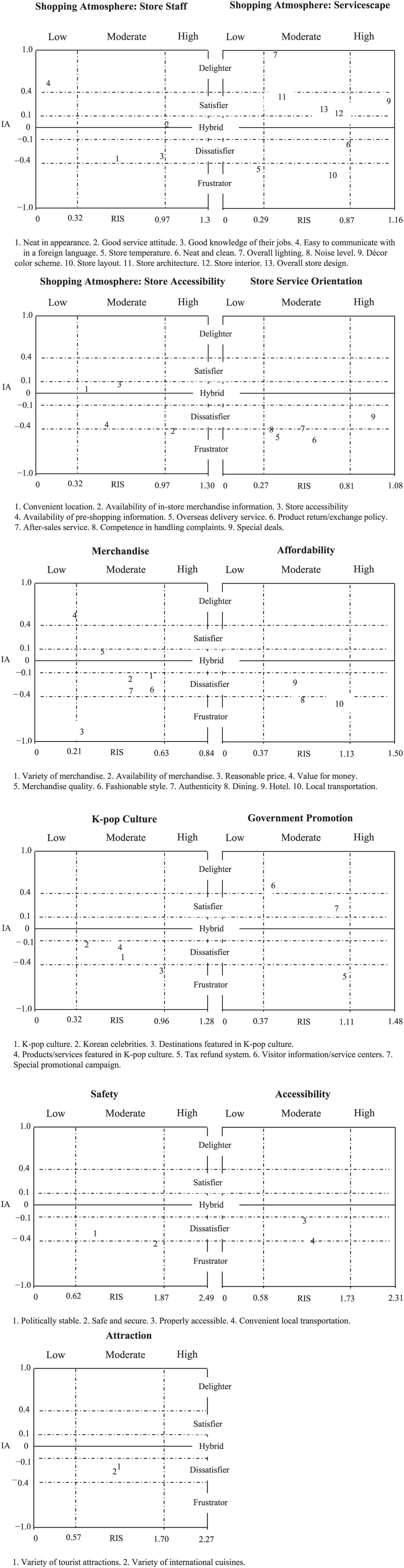
IRPA grid.
Discussions and Conclusions
Theoretical Implications
This study examines the asymmetric effect of shopping- and destination-specific attributes on shopping destination satisfaction from the perspective of Chinese tourists under the dimensions of shopping atmosphere, store service orientation, merchandise, affordability, K-pop culture, safety, accessibility, government promotion, and attraction. Jin, Moscardo, and Murphy (2017) encouraged further research on Chinese tourists in the shopping tourism literature given that they are considered the world’s biggest spenders in international tourism. The findings of this study contribute to the extant shopping tourism literature from the perspective of Chinese tourists in several ways.
First, the existing shopping literature measures shopping satisfaction in a limited manner that uses either a mean value of an attribute or overall satisfaction. For example, the perception and expectation of each attribute were compared with each other using a mean score (Heung and Cheng 2000; Yeung, Wong, and Ko 2004) to identify a satisfaction level. If the perception of an attribute is greater than its expectation, then the attribute is defined as satisfied. Otherwise, the attribute is considered dissatisfied. I. A. Wong and Wan (2013) operationalized shopping satisfaction as overall satisfaction and adopted a symmetric, linear relationship to identify the antecedents and consequences of shopping satisfaction. That is, the previous literature relies on the mean value of attributes and the linear relationship of overall satisfaction with shopping dimensions while not considering the asymmetric impact of shopping attributes on shopping satisfaction.
Asymmetric relationships afford researchers with a more detailed picture of the responses of attributes to satisfaction that symmetrical relationships cannot show when they assess the dynamic impact of attributes on satisfaction. Symmetric linear relationships enable researchers to test whether relationships are statistically significant either in a positive or negative manner. If relationships are statistically insignificant, then no relationship is interpreted over the hypothesized paths. By contrast, asymmetric relationships built on IRPA and IAA allow researchers to look into negative asymmetric (frustrators, dissatisfiers), positive asymmetric (satisfiers, delighters), or symmetric (hybrids) impacts of attributes on shopping destination satisfaction. The identification of the dynamic impacts of attributes assists concerned industry practitioners or government bodies in prioritizing attributes for the strategic management of shopping tourism, which is further discussed under practical implications.
Second, the previous shopping tourism literature (M. Choi, Law, and Heo 2016; Heung and Cheng 2000; I. A. Wong and Wan 2013; Yeung, Wong, and Ko 2004) has overlooked destination-related attributes in examining shopping tourism, although the Globe Shopper Index recognizes the critical role of destination attributes in shopping destination competitiveness. The current study identifies attributes of destination dimensions (affordability, K-pop culture, safety, accessibility, government promotion, and attraction) within shopping tourism and assesses the asymmetric impacts of these attributes on shopping satisfaction. Among the destination dimensions, K-pop culture and government promotion, which were developed from the qualitative research process, are considered unique to shopping tourism, whereas the remaining dimensions are deemed under basic tourism domains.
In addition to accessibility and government promotion, most destination attributes are found to be must-be attributes (frustrators or dissatisfiers). Among accessibility attributes, destination accessibility is found to be a hybrid, whereas local transport is considered a frustrator. Among government promotion attributes, the tax refund system falls under dissatisfiers, government-sponsored special promotional campaign under satisfiers, and visitor information/service center under delighters. Thus, active government promotion of shopping tourism enhances shopping satisfaction by offering value-added experience, whereas tourists recognize the tax refund system as a basic attribute.
Another noteworthy implication arises from K-pop culture because this dimension is neither discussed nor tested empirically in the extant shopping tourism literature. The current study operationalizes K-pop culture as K-pop celebrities (dissatisfier), products/services (dissatisfier), and destinations (frustrator) featured in K-pop media (frustrator) and K-pop-induced shopping (dissatisfier). All K-pop culture attributes are viewed as must-be attributes; K-pop culture is believed to be fundamental to Chinese shopping tourists as K-pop is very popular among the Chinese. The powerful role of K-pop in shopping tourism can be construed from film-induced tourism. Film tourism advocates that media affect tourist motivations and visit patterns, along with destination image (Croy 2010; Laing and Crouch 2009), in which individuals develop their personalized memory and associate symbolic meanings, emotions, and attitudes with celebrities and places featured in dramas or films (H. Kim and Richardson 2003; S. Lee, Scott, and Kim 2008). Media audience is motivated to purchase memorabilia and products related to figures featured in media (Ferguson 1992) given the strong emotional bond that develops from media. The theoretical underpinning of film tourism supports the asymmetric effect of K-pop culture on shopping tourism.
Third, the method used in this study offers advantages over qualitative and descriptive methods for assessing the asymmetric impact used in the previous literature. For example, Cadotte and Turgeon (1988) identified the attributes of triggering compliments and complaints from restaurants and hotels based on the critical incident technique (CIT). They examined the relative frequency of compliments- and complaints-causing attributes and typologized attributes into satisfiers (causing satisfaction/compliments), dissatisfiers (triggering dissatisfaction/complaints), criticals (leading to satisfaction and dissatisfaction), and neutrals (not significantly causing satisfaction nor dissatisfaction). Similarly, Johnston (1995) analyzed anecdotes incurred in bank services and identified service attributes as dissatisfiers, satisfiers, and criticals. Their studies (Cadotte and Turgeon 1988; Johnston 1995) shed light on the asymmetric effect of attributes on satisfaction in the service literature but still suffer from the limitations of CIT. For example, the analysis of complaints and compliments suggests that only extreme anecdotes of satisfaction and dissatisfaction experiences are considered. Only a few attributes are likely to fall under the categories of satisfiers and dissatisfiers given the possibility that particular attributes are always dominant in favorable anecdotes (compliments), whereas other attributes frequently appear in service failures (complaints). Therefore, researchers are not allowed to examine unobserved attributes in critical incidents. Consequently, only a handful of attributes with asymmetric impact are identified. This limitation explains why Johnston (1995) discovered only two attributes as satisfiers and two attributes as dissatisfiers among banking service attributes. Moreover, CIT asks survey participants to recall their perceptions of critical anecdotes that they experienced before. The time lapse can cause participants to interpret anecdotes differently from their original interpretation of the incidents because of other events that followed (Johnston 1995).
The current study examines how asymmetric shopping tourism attributes affect shopping destination satisfaction. Thus, this study identifies not only shopping-specific attributes but also destination-based attributes that the previous shopping literature has overlooked using IRPA and IAA. Asymmetric relationships between attributes and shopping satisfaction offer an expanded view of the dynamic effects of attributes, whereas destination-specific attributes allow researchers to examine the unexplored roles of government promotion and K-pop media in shopping tourism. The current findings present theoretical implications that have not been discussed and explored in the existing shopping tourism literature, thereby adding value to the extant literature.
Practical Implications
An insight into the asymmetric effects of shopping tourism attributes allows concerned retailers/government bodies to prioritize such attributes over others for the strategic management of shopping tourism for Chinese tourists. Attributes are prioritized as illustrated in Figures 2 and 3 based on the categorization of their asymmetric impact. This study recommends that an in-depth management of must-be attributes (frustrators, dissatisfiers) and hybrid attributes is fundamental to the success of shopping tourism given that these attributes result in dissatisfaction when they are not properly managed. If the quality of these attributes meets the expectation of shopping tourists, then tactical focus should be placed on value-added attributes (satisfiers, delighters) to make shopping tourists delighted.

Prioritizing shopping-specific attributes for shopping destination satisfaction.

Prioritizing destination-specific attributes for shopping destination satisfaction.
Figure 2 illustrates that the attributes of staff, merchandise, store accessibility, and store service orientation are strongly present across frustrators, dissatisfiers, or hybrids under shopping domains, whereas servicescape attributes are dominant among delighters. Retailers who target shopping tourists should regularly monitor whether must-be attributes (frustrators and dissatisfiers) cater to the expectations of shopping tourists. If these attributes fail to meet tourists’ anticipation, then their shopping experience is likely to be ruined (although high-quality servicescape attributes are provided) because these attributes are taken for granted.
In destination domains (Figure 3), frustrators, dissatisfiers, or hybrids are represented by affordability, K-pop culture, safety, accessibility, and attractions, whereas government promotion triggers delight and provides value-added experience to shopping tourists. Affordability, safety, accessibility, and attractions are well recognized as elementary attributes in the tourism literature, whereas pop culture is not known as a must-be attribute. In this study, K-pop media are found to be a fundamental attribute in shopping tourism for Chinese tourists. Korean government bodies that are concerned with shopping tourism should strategically utilize K-pop media and celebrities in promoting products/services and destinations to Chinese tourists. Simultaneously, government efforts are geared toward the design of shopping festivals/campaigns and tourist facilities to enhance the value-added experience of Chinese shopping tourists.
The asymmetric categorization and prioritization of shopping tourism attributes may vary with shopping destinations and the ethnicities of shopping tourists. Concerned retailers/government bodies are recommended to conduct individual surveys to identify the asymmetric classification and prioritization of shopping tourism attributes that are unique to a particular shopping destination or ethnic group. Such classification and prioritization allow practitioners to understand the relative importance and priority of attributes from the perspective of target shopping tourists, thereby leading to the strategic management of shopping tourism.
Another practical implication is derived from the simultaneous comparison of RIS and IA in Figure 1, wherein the asymmetric impact of each attribute is categorized with a corresponding RIS. The simultaneous observation of the RIS and IA of each attribute enables concerned practitioners to identify attributes that fall under dissatisfiers or frustrators with high RIS. Particular attention should be given to attributes that will have a tremendous impact on dissatisfaction (if not addressed adequately) because these attributes have a high RIS level, which indicates an attribute’s range of impact on satisfaction (Mikulić and Prebežac 2008). As shown in Figure 1, dissatisfiers or frustrators with high RIS at the shopping level are (1) staff knowledge of their job, (2) store cleanliness, (3) store layout, (4) availability of in-store merchandise information, (5) special deals, (6) merchandise variety, and (7) fashionable merchandise. Counterpart attributes at the destination level are (1) local transportation, (2) shopping induced by destinations featured in K-pop, (3) tax refund system, and (4) safety and security.
This study categorizes shopping tourism attributes as must-be, hybrid, and value-added ones and prioritizes them thereafter. The classification and prioritization of the attributes provide Korean Tourism Organization (KTO) in particular with an insight into the strategic management of shopping tourism for Chinese tourists, on whom Korea heavily depends. For example, to remain as an attractive shopping tourism destination to Chinese tourists, KTO can assess the performance of shopping tourism attributes identified in this study through periodic surveys. If the survey results indicate poor performance of value-added attributes when KTO aims to make shopping tourists delighted by offering extra value, KTO can make a strategic decision on more investment in value-added attributes to enhance their quality and thus shopping destination satisfaction. In case the low performance of must-be attributes is identified through the survey, KTO can consider an efficient investment to improve the quality of must-be attributes that just meets but does not significantly exceed shopping tourist expectation. The substantial investment in must-be attributes is not necessary because they do not induce satisfaction even if their quality is exceeding (as tourists take them for granted).
Furthermore, KTO could extend its “Korea Quality” certified tourism service scheme to retail shops (it is currently limited to accommodation and restaurants), based on the classification and prioritization of shopping-specific attributes identified in this study. Certification can be obtained after a document review and an on-site evaluation and is valid for three years once a retail shop is accredited. For an on-site evaluation, KTO can prioritize attributes by assigning a different weight to them and assess their performance accordingly. This certification would establish overall quality control over Korea Quality–accredited retail shops and ensure that tourists feel secure about their shopping experience. Shopping tourism attributes possess differing nature in responding to satisfaction. When DMOs identify the attributes and have a good understanding of their different sensitivity to satisfaction, the DMOs are better able to monitor and assess the performance of their destination, thereby ensuring shopping destination satisfaction in a strategic and effective manner.
Limitations and Future Research
This study has a number of limitations. The findings of this research may not be generalized to other ethnic shopping tourists given that this study is based on the perspective of Mainland Chinese shopping tourists. To minimize this limitation, a cross-cultural study will be conducted to identify the distinct perceptions of shopping tourism attributes. In addition, this study adopts cross-sectional data with self-report measures. Although carryover effects can be prevented with cross-sectional data, cross-sectional research can account for an event(s) only during a particular time slot. This limitation poses a bias, that is, a cross-sectional study will generate varying findings when a different time slot is selected (Bland 2001). Future research can explore the moderating role of K-pop in shopping tourism considering that all K-pop-related attributes are found to significantly impact shopping tourist satisfaction as must-be attributes.
Footnotes
Declaration of Conflicting Interests
The author(s) declared no potential conflicts of interest with respect to the research, authorship, and/or publication of this article.
Funding
The author(s) received no financial support for the research, authorship, and/or publication of this article.
