



Abstract
In this paper, we examine the mediating effect of experience value between experiential elements of employee–tourist encounters and the final experiential outcomes. The Tourism Encounter Mediated Experience Value (TEMEV) model is tested via a survey at 13 different locations (attractions, hotels, and retail) in Copenhagen (n=2,955). The findings illustrate how, for different types of tourism companies, experiential value plays varying roles as a mediator between employee–tourist encounter characteristics and tourists’ intentions to recommend an experience as well as their memory of the experience. The most complex relationship identified is for hotels, where experiential value is a significant mediator for the personalized, flexible, and emotional constructs of encounters. Surprisingly, experiential value plays no significant mediating role between cocreation or knowledge/learning in encounters and memory or recommendation intention in any of the sectors examined. The study concludes with implications for theory, practice, and study limitations.
Introduction
The role of experience as a core aspect of tourism has been highlighted in many studies (e.g., Cohen 1979; Pearce and Moscardo 1986; Ryan 2010; Tung and Ritchie 2011). Experience is a complex phenomenon, which is also obvious from more recent experience economy theory (Boswijk, Thijssen, and Peelen 2007; J. Sundbo and Sørensen 2013a). The management- and marketing-oriented experience economy literature has introduced new perspectives for analyzing experience creation in many types of firms, including tourism companies (Andersson 2007; Chang 2018; Oh, Fiore, and Jeoung 2007). This includes a focus on aspects such as cocreation, learning, and new employee roles (Prebensen and Foss 2011; Solnet and Baum 2015; Sørensen and Jensen 2015).
One aspect of particular interest that arises from experience-oriented literature concerns the role of encounters between employees and users (i.e., tourists in the case of tourism). In most types of tourism, such encounters play a fundamental role for the tourists’ experiences (Solnet and Baum 2015; Sørensen and Jensen 2015). However, though a few studies have examined the role of cocreation in tourism (Cabiddu, Lui, and Piccoli 2013; Zátori 2016), little is known about how these encounters shape experiential value and how this in turn affects tourism companies’ competitiveness. Traditionally, studies of such encounters are based on a service paradigm and not informed by experience economy theory (although see Keng et al. 2007; Wu and Liang 2009).
To shed light on this issue, in this article we discuss the mediating effect of experience value between experiential elements of employee–tourist encounters and the final experiential outcomes of memory and recommendation intention. This is knowledge that can inform tourism/experience research and provide guidance to tourism companies on how to plan and shape encounters in ways that increase tourists’ experience value and, in effect, tourist companies’ competitiveness.
To investigate the mediating effect of experiential value on tourist outcomes from encounter-based experiences, we develop a model that takes into account (1) experience-related dimensions of employee–tourist encounters; (2) an experiential value scale based on Formal Value Theory; and (3) memory and recommendation intentions of encounter-based experiences.
Further, we report the findings from a survey applying the proposed model. The survey was carried out at 13 different locations (attractions, hotels and stores) in Copenhagen in the summer of 2017. A total of 2,955 responses were received. The survey is one part of a larger practice-oriented research project resulting from collaboration between researchers, tourist organizations, and tourism companies.
The article is structured as follows. First, the theoretical basis of the research model is presented. This includes inputs from, first of all, the experience economy and formal value theory. We then present the details of the survey method. Subsequently, the findings are presented, followed by discussion and conclusions.
Theory and Research Model
In this section, we first discuss the role of employee–tourist encounters for experience value creation and the importance of different characteristics of such encounters. We then introduce an approach to measure experience value by applying formal value theory, before we build the theoretical model.
Tourism Encounters and Experiences
Research emphasizes the role of experiences for both people and businesses. In business-oriented literature, this has been the case in works relating to the Experience Economy (e.g., Boswijk, Thijssen, and Peelen 2007; Boswijk et al. 2012; Pine and Gilmore 1999; J. Sundbo and Sørensen 2013a). This branch of literature suggests how the production and consumption of experiences in contemporary, developed societies has a greater economic potential for businesses than the production of physical products and services. Since the tourism sector’s main aim is to create experiences for tourists, understanding consumption and production of experiences in this context is of central importance for tourism company survival and the creation of value.
Tourism research’s interest in tourism experiences is not new (e.g., Cohen 1979). However, sociological and psychological approaches to investigating tourism experiences have dominated this research topic (e.g., Tung and Ritchie 2011). Other authors (e.g., Andersson 2007; Chang 2018; Mossberg 2007; Oh, Fiore, and Jeoung 2007) have analyzed tourism experiences from a more business- and economy-oriented perspective, applying the experience economy approach pioneered by Pine and Gilmore (1999). Nevertheless, this approach has several shortcomings, not least in terms of understanding the creation of tourism experience value in relation to encounters between tourism employees and tourists, which is the focus of this article. In the original experience economy perspective, experiences were described as memorable events staged by companies and their employees for consumers. These experiences possessed characteristics of immersion and/or absorption and of active and/or passive participation of spectators. Different combinations of these elements would lead to different types of experiences: educational, escapist, aesthetic, and/or entertaining (Pine and Gilmore 1999).
While this original experience economy approach is relevant for some types of tourism experiences, it only partly helps to understand the potential role of encounters between employees and tourists for experience value creation. Recent research on experiences—including tourism experiences—departing from a traditional experience economy point of view offers a wider variety of perspectives on experiences (J. Sundbo and Sørensen 2013a). This includes for example perspectives on optimal, extraordinary, or flow experiences (Hansen and Mossberg 2013). In this literature, experiences, including tourism experiences, are often referred to as peak and intense moments of life, in contrast to everyday life (Larsen 2008). However, mundane tourism experiences involving relaxation and freedom from intense experiences have also been described as attractive tourism experiences, for example, for certain caravanning segments (Mikkelsen and Stilling Blichfeldt 2015). Thus, tourism experiences can have different shapes and widely varying values for different persons at different moments. Various types of holidays, for instance, have different experiential value for tourists in different stages of their life-cycle (Stilling Blichfeldt 2007). Personal perceptions of experiences are determined by, among other things, individual preferences, social relations, prior experiences, and future expectations (Helkkula, Kelleher, and Pihlström 2012). More recent experience definitions in experience economy–related literature recognizes this. J. Sundbo and Sørensen (2013b), for example, suggest that “Experience, in the context of the experience economy, could be defined as the mental impact felt and remembered by an individual caused by the personal perception of external stimuli” (p. 4).
The above has two major implications: (1) Different tourists have different perceptions of and desires for experiences depending on a multitude of personal and social factors; and (2) companies cannot produce and deliver finished experiences to tourists. Tourists themselves have a central role to play in the creation of such experiences. This implies that the production and consumption of experiences is a more complex phenomenon than suggested by the original experience economy theory. Consequently, recent experience economy literature argues how valuable consumer experiences are not simply staged for receivers of experiences, but are based on coproduction and cocreation in which users actively participate in creating their own experience. This resembles suggestions in tourism research that tourism experiences are coperformed (Crang 1997) or codesigned (Ek et al. 2008) by tourists and tourism employees. Compared with experiences that are staged for consumers, this leads to and requires, for example, active, personal, and flexible roles of both tourists and tourism employees (Sørensen and Jensen 2015, 2019).
Encounters between employees and tourists remain important for experience creation in tourism companies, but in these encounters employees are not simply actors on stages. Instead they are employees who must interact with, understand, and creatively assist tourists in creating their desired experience value from their visits. This resonates with Service Dominant Logic theory (e.g., Grönroos and Voima 2013; Lusch and Nambisan 2015; Shaw, Bailey, and Williams 2011) that argues how “real value” is created by and within individual users when products or services are used. While Service Dominant Logic has developed out of service theory, some of its arguments are particularly true for experience value that cannot be delivered, but arise within individuals as personal perceptions (cf. the above cited definition of experiences by J. Sundbo and Sørensen 2013b). In this way, recent experience economy and service value theory partly merges in an approach that today informs theoretical views on experience value formation (Harkison 2018; Helkkula, Kelleher, and Pihlström 2011; Shaw, Bailey, and Williams 2011; Scupola and Fuglsang 2018). From this view, in encounters between companies and users, companies do not deliver experiences but have the possibility to assist and influence consumers’ creation of “real” experience value. This perspective has been illustrated to be particularly relevant in the case of tourism experiences (Sørensen and Jensen 2015, 2019). In this line of thought, tourist experiences result from a number of interacting elements of destinations and tourism companies, for example, weather, sights, activities, smells, sounds, and interactions (with other tourists and the local population). Nevertheless, these elements do not themselves result in tourism experiences but can be perceived as elements of tourism companies’ and destinations’ experience value propositions. Tourism experience value arises only when tourists use and mentally absorb these elements. However, in the encounters with tourists the destination, its tourism companies, and their employees have a possibility to create, support, and influence the tourists’ experiences (Sørensen and Jensen 2015). Thus, these encounters are central to tourists’ experiential value creation, and therefore, in the end, also for destinations’ and destination companies’ competitive position.
Different characteristics of employee encounters can be assumed to be important for tourist experience value. However, the role of value creation in encounters in an experience value approach remains largely uninvestigated. Traditionally, research on encounters has taken a service focus (emphasizing mainly efficiency and appearances) rather than an experience perspective. A few quantitative studies have researched tourism experiences based on the experience economy perspective of Pine and Gilmore (1999), for example, Oh, Fiore, and Jeoung (2007), Wu and Liang (2009), and Mehmetoglu and Engen (2011). However, these studies do not take into account the more recent considerations on experience value creation described above; they do not have a specific focus on experiences in employee–tourist encounters and do not take into consideration the characteristics of such encounters and, thus, do not fully allow us to understand the experience value rising in these encounters.
Recently, a number of qualitative studies have investigated different aspects of experience value creation in encounters. These studies find that encounters sustaining experience value are characterized by employee and tourist personality, flexibility, cocreation, emotions, and learning. The importance of such encounters compared with traditional service encounters for experience value creation has, for example, been exemplified in studies of hotels and attractions (Sørensen and Jensen 2015, 2019). These qualitative studies indicate how transforming encounters from a service logic to an experience logic can lead to experiential value for tourists, better word of mouth, and more return visits (in addition to more satisfied employees).
Other studies that focus on individual elements of the abovementioned characteristics of experience value forming encounters support these findings. The importance of cocreation of encounters in tourism have been exemplified by Binkhorst and Den Dekker (2009) and Zátori (2016), who argue that cocreation can result in better experiences and more return visits. Cocreation in encounters sustains the idea that tourists’ individual and often unspoken needs and wishes help employees facilitate tourist value creation. Grissemann and Stokburger-Sauer (2012) have illustrated this in the case of travel agencies and Sørensen and Jensen (2019) in hotels and attractions. Further, Zátori (2016) has illustrated how cocreation on guided tours helped tourists to discover the visited destination, thus creating “added” experiential value.
The positive role of informative employees and learning in encounters have also been discussed and illustrated by Hansen and Mossberg (2013). In this case, learning about techniques in outdoor tourism (dog sledging) was part of the experience and also helped the tourists create better overall experiences by facilitating immersion in the environment. In addition, Boswijk, Thijssen, and Peelen (2007) have emphasized the importance for experience value of learning, but in more general terms, explaining how meaningful experiences entail both erfahrung (or experience understood as learning or knowledge) and erlebnis (i.e., experience understood as events, incidents, or adventures), and how the most valuable experiences are those involving learning.
Studies have illustrated how the support for unique and individualized experiences requires flexibility of the encounters (rather than standardization) and personalized behavior (Solnet and Baum 2015; Baum 2006). Employee–tourist encounters may aim at delivering standardized functional services to secure standard quality services and keep down costs (Baum 2006). This incites employees to not step outside standard procedures (D. Sundbo 2011). In this way, tourism companies can create a specific service quality, but the potential to create unique tourist experience value with tourists in encounters will remain unused without flexibility (Sørensen and Jensen 2015).
Moreover, personalized behavior in employee–tourist encounters has been argued to affect tourist experiences (Solnet and Baum 2015; Baum 2006). While scripts and standardization of employee behavior creates standard functionally focused service encounters, it limits employees in expressing unique personalities and inhibits the experiential value–creating potential of encounters. If employees can—and are allowed to—express personal traits, capabilities, and knowledge in encounters, employees seem authentic (rather than staged and scripted), sustaining authentic and unique experience value (Sørensen and Jensen 2015). Memorable customer experiences require such personalization (Solnet and Baum 2015).
The focus on emotions in tourist–employee encounters is also argued to be central to experience value creation, because experiences are essentially related to emotions. Encounters between employees and tourists can affect the emotions of both employees and users (Sørensen and Jensen 2019). This can lead to changes in emotional states that, according to Jantzen (2007), results in (good or bad) experiences. To act on such emotional possibilities for value creation requires, what Baum (2006) has termed, experiential intelligence of employees—a social capability allowing employees to identify and interact with tourists’ expectations and requirements, experientially and emotionally (Baum 2006). This helps employees to identify the essence of tourism experiences (Sfandla and Björk 2012) and to act on the emotional state and needs of tourists to influence it with the aim of creating unique experiences (Sørensen and Jensen 2019). In the same vein, Seymour (2000) suggested how tourism employees are “emotional workers,” and Bærenholdt (2008) notes how their emotional engagement is fundamental for creating experiential value in encounters.
From the above discussion, we therefore hypothesize that there are a number of critical underlying general dimensions of tourist encounters—being personalized, cocreated with emotions, flexible (from the behaviors of employees), and generating tourist intelligence—that form experience value for tourists in the encounters. The issue is now how, and to what extent, these dimensions form experiential value (from encounters), and the ultimate outcomes of such experience value.
Formal Value Theory
Different attempts have been made to measure aspects of experience and experiential value, for example, in the contexts of food tourism (Tsai and Wang 2017), Internet shopping (Mathwick, Malhotra, and Rigdon 2001), tourist shopping (Gallarza, Fayos Gardó, and Calderón García 2017), or tourism experiences in more general terms (Oh, Fiore, and Jeoung 2007). A few of these studies even focus in part on the role of the service encounter: for example, the study of Wu and Liang (2009) on restaurant experiences, and Keng et al.’s (2007) study on service encounters in retail. Notwithstanding, these studies mainly measure users’ evaluations of elements of the experience, such as entertainment and aesthetics, and relate these to measures of satisfaction, arousal, and memory. A more comprehensive value construct that captures the holistic value of experience as perceived by the customer has not been applied and related to elements of experiences (such as the dimensions of tourist encounters emphasized above), on the one hand, and to impact measures on the other.
To build such a holistic and thereby comprehensive conceptualization of experiential value, we opted to use formal value theory (Hartman 1967, 1973), because it is formal, multidimensional, and covers the entire human value realm. It was validated long ago (Lohman 1968; Elliot 1969) and successfully applied in business research (e.g., Lemmink and Mattsson 1996; Barnes and Mattsson 2011). Applying formal value theory to experience, we define it as experience value (EV).
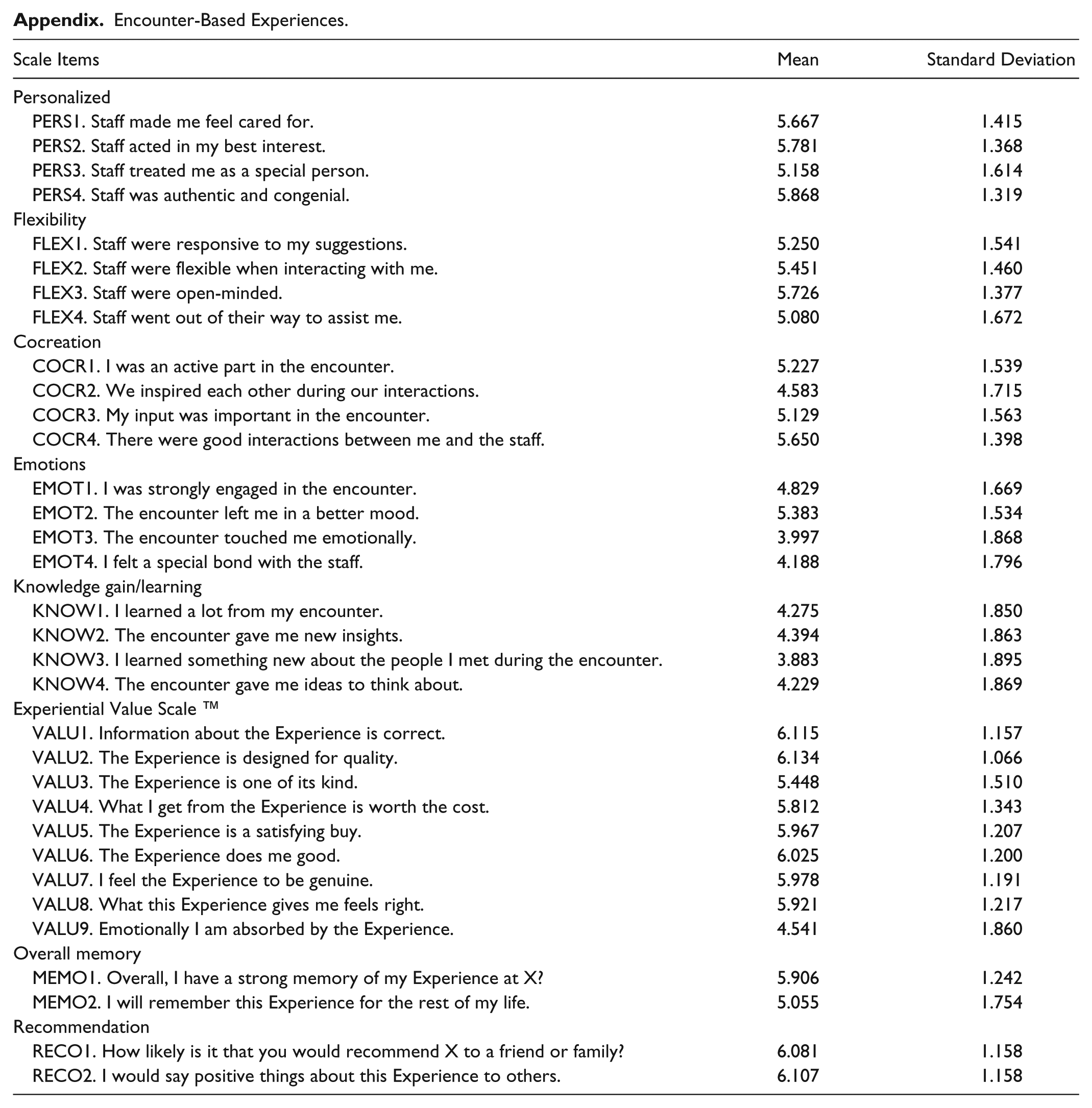
Built on a formal axiom of value (comparing two sets of properties of a thing), formal value theory defines and orders three basic value dimensions (i.e., intrinsic, extrinsic, and systemic) defined by their richness. Understood in common language, these have been termed emotional (E), practical (P), and logical (L) (Lemos 1994; Mattsson 1990). According to the formal definition of value, dimensions are combined pairwise (E and E, E and P, and so on) so that nine basic values can be formed, each one having a different value rank in a value order (Hartman 1973). The E dimension is defined to be far greater in richness than the P dimension, which in turn is greater than the L dimension. This is explained by the nature and number of the properties of the respective dimensions. In this way, we have an overarching and ordered measure of the value realm (see appendix: VALU1 to VALU9).
Items for each one of the nine values have to fit the underlying dimensions and the word experience. For example, expressing the combination of VALU6: “The experience does me good” includes the P (does) and E (me as a person), signaling a positive value with “good.” VALU1 (lowest rank) is expressed as “information” (L) about the experience being “correct” (L). Hence, this item combines two L-dimensions. In this way, all items have their own underlying value structure.
Theoretical Model: Tourism Encounters Mediated by Experiential Value (TEMEV)
We now build a conceptual model, in which EV is seen as a mediating construct, a crucial link between the tourist encounter (and its five input dimensions) and outcomes in terms of memory and recommendation (see Figure 1). Hence, the focus of this analysis is to estimate the role of EV in forming the encounter experience and forming long-term outcomes.
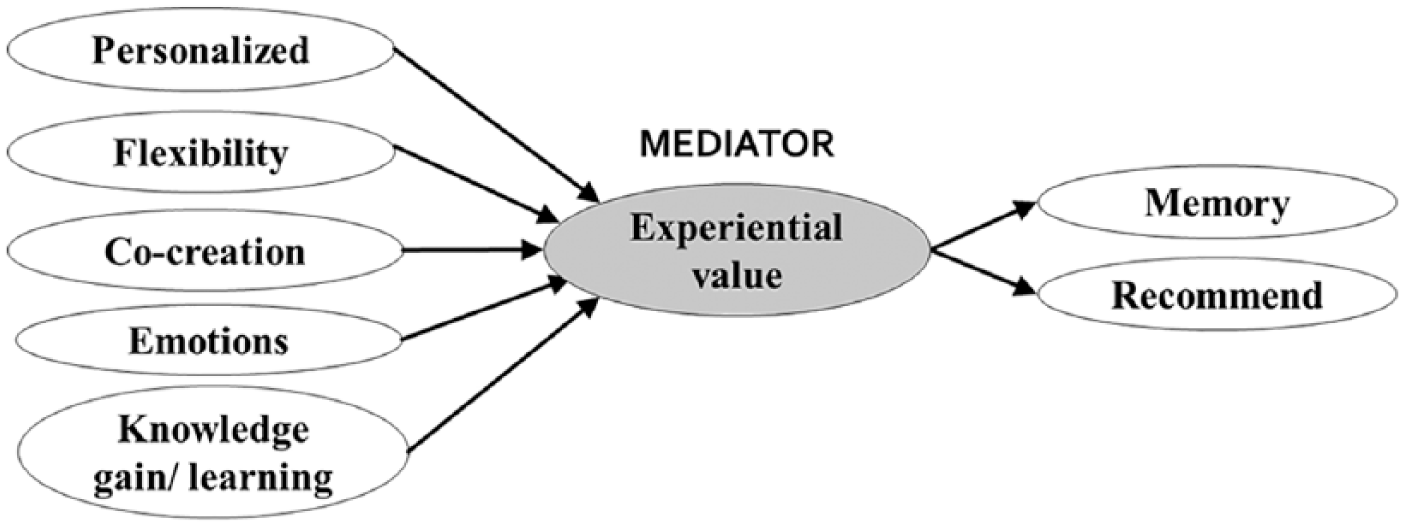
Tourism encounters mediated by experiential value (TEMEV) model.
The first measure of ultimate outcomes on the right-hand side of the model, memory, is included because memory is a key element of the definition of experience (cf. above) and this is also the case, of course, of tourism experiences (Barnes, Mattsson, and Sørensen 2016; Kim, Ritchie, and Tung 2010). Experiences create memories, which is all we have left after the ‘moment of experiencing’ and this memory affects how, how much, and for how long an experience gives value (Tung and Ritchie 2011). The second measure, recommendation, has become even more crucial than ever. Today customers have a much greater possibility to recommend satisfying products, services, or experiences than ever before given Web 2.0 technologies (Standing, Holzweber, and Mattsson 2016; Ye et al. 2011). It follows that consumers also have a far greater possibility to distribute castigating reviews or comments about companies. Thus, for companies it is crucial to achieve good recommendation intentions from the users. In our model, memory is an outcome based on the long-term effects of experience (the scale items refer to strong memory), whereas recommendation is considered more of a short-term effect (verbal communication in conjunction with the experience).
Thus, we posit that:
Hypothesis 1: The five dimensions of tourism encounters, (a) personalized, (b) flexibility, (c) cocreation, (d) emotions, and (e) knowledge gain/learning, have a direct relationship with experiential value.
Hypothesis 2: Experiential value has a direct relationship with (a) memory and (b) intention to recommend.
Hypothesis 3: Experiential value mediates the relationship between the five dimensions of tourism encounters and (a) memory and (b) intention to recommend.
Method
The research involved a survey to capture data from 2,955 respondents, interviewed by field researchers at a consultancy. Visitors were approached in situ and asked to participate in a study for a maximum of eight minutes. The stimulus was respondents’ recent experience and interactions with staff. The introductory phrase was “We would like to ask about your experience and the staff you encountered.” Interviews were carried out in four attractions, six hotels, and three retail stores in Copenhagen, Denmark, from the 7th of July to 25th of August 2017. These companies represent different but important companies in the tourist destination value chain, all of which will influence the tourists’ overall experience. However, the employee–tourist encounters in the companies may also be expected to influence experiential value and ultimate outcomes in different ways. Thus, the companies were chosen to create variance and to include companies serving different purposes in the destination value chain. Further, these sectors account for most of visitor spending and are generic in the sense that they represent basic needs in a new destination, namely, places to stay, eat, and enjoy.
The participants were real-time visitors, and as such, representative of normal customers. More than 200 randomly selected respondents completed the questionnaire in each of the 13 involved companies. The full questionnaire is included in the appendix, along with descriptive statistics. The mean age of the sample was 44.5 years, and the respondents were approximately split between genders (53.6% female). The dominant nationalities in the sample were Danish (23.1%), United States (13.2%), Swedish (10.0%), Norwegian (8.7%), United Kingdom (7.1%), and German (5.2%), with smaller proportions from France (2.4%), the Netherlands (2.3%), Italy (1.3%), and China (1.2%). A total of n = 1,331 respondents completed the survey for hotels, n = 964 for attractions, and n=660 for stores.
Four items were formulated for each one of the underlying five dimensions of tourism encounters (see appendix). These constructs are linked to the mediating construct, experiential value, and two output constructs—intention to recommend (two items) and memory (two items). Items (nine) for the mediating construct, Experiential Value, were formulated using axiological principles as discussed above (see Barnes, Mattsson, and Hartley 2015; Barnes and Mattsson 2011). For the underlying five dimensions of tourism encounters, Sørensen and Jensen’s (2015, p. 340) suggested items were developed and formulated by the authors using traditional item development procedures. A mixture of new and existing items measured intention to recommend and memory. Recommendation Intention items (see Reichheld 2003) were formulated as “How likely is it that you would recommend X to a friend or colleague?” and “I would say positive things about X to others?” that is, word of mouth (see Söderlund and Mattsson 2015). New memory items focused on the strength and length of memory (“Overall, I have a strong memory of my Experience at X?” and “I will remember this Experience for the rest of my life”) (e.g., Barnes, Mattsson, and Sørensen 2015). All items were rated on 7-point Likert-type scales from 1 = “I completely disagree” to 7 = “I completely agree,” where 4 = “I neither agree nor disagree,” except intention to recommend, which was measured on a Likert-type scale from 0 = not at all likely to 10 = extremely likely, based on a request from an industry partner who was conducting a simultaneous study using the Net Promoter Score (NPS). The items for intention to recommend were thus rescaled to 1- to 7-point scales using the formula (1/3)+(2/3)*value. We did not detect any substantial effects of using the different scale.
The structural model and mediation effects were analyzed using partial least squares (PLS) path modeling in Smart-PLS 3.2.7 (Ringle, Wende, and Becker 2015). PLS path modeling uses a variance maximization approach for structural equation modeling (SEM) that does not contain distributional assumptions for data sets. The technique is disposed to greater statistical power compared to traditional covariance-based SEM methods and is particularly robust when testing more complex models and indirect effects (Hair et al. 2014). Since our model is complex and includes many mediating paths, it is considered a suitable choice for analyzing the data.
Standard validity and reliability tests were conducted, as shown in Table 1. All measures of internal consistency were above the recommended 0.7 threshold (Nunnally 1978), with Cronbach’s alpha ranging from 0.779 to 0.923, composite reliability from 0.883 to 0.953 and rho_A from 0.794 to 0.923. In terms of convergent validity, the average variance extracted (AVE) ranged from 0.596 to 0.928. Further, all items loaded on their respective constructs at p<.001. Regarding discriminant validity, the variance inflation factor (VIF) method showed all values were well below the strict threshold of 5 (Hair et al. 2014), the highest at 3.882. Similarly, as shown in Table 2, all constructs passed the Fornell and Larcker (1981) test; in each case, the square root of AVE on the diagonal is greater than the intercorrelations off the diagonal—demonstrating discriminant validity. A power analysis in G*Power 3.1 (Faul et al. 2007) suggests that our sample size of n = 2,955 is able to detect extremely small effect sizes (f²) of 0.007 or less in our model (α = 0.05; 1 – β = 0.95).
Validity and Reliability Metrics.
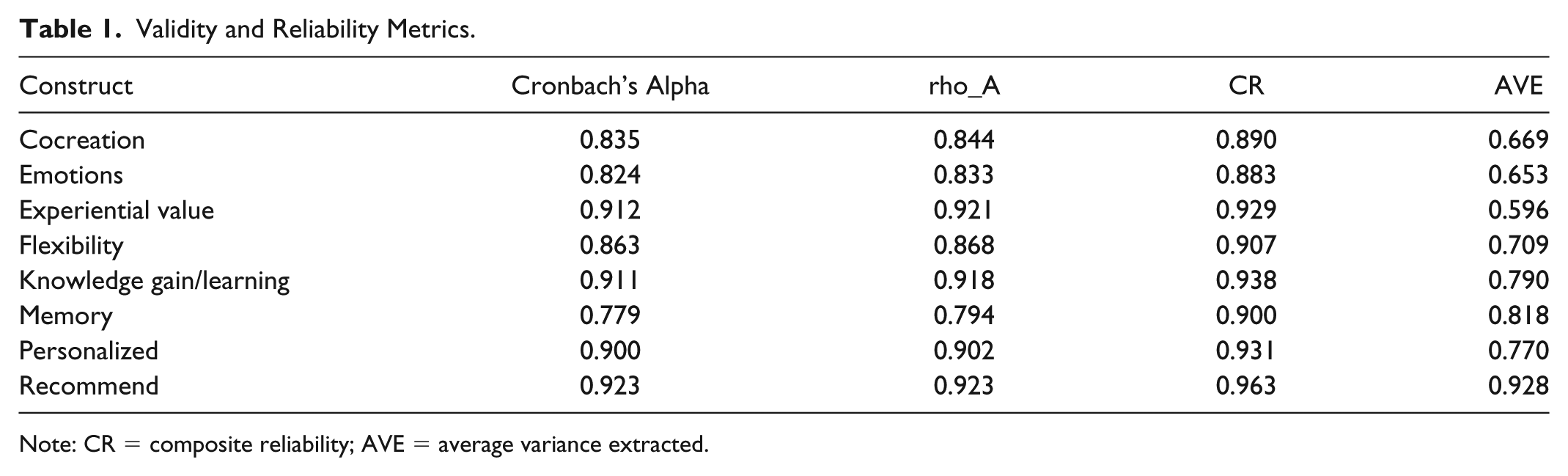
Note: CR = composite reliability; AVE = average variance extracted.
Fornell-Larcker Criterion
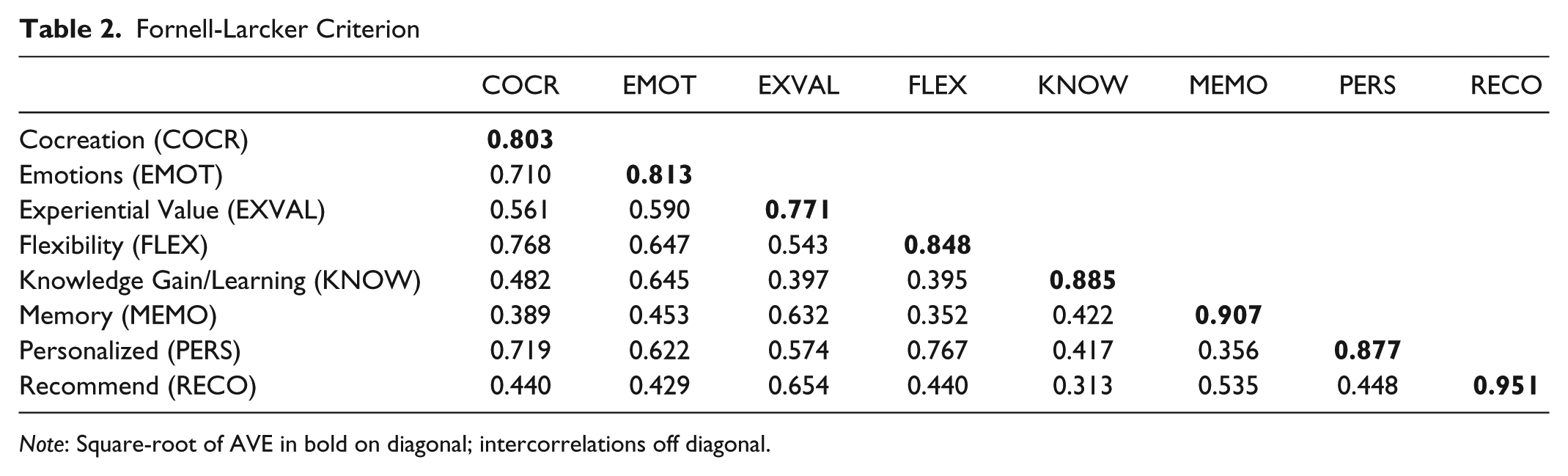
Note: Square-root of AVE in bold on diagonal; intercorrelations off diagonal.
The key objective of PLS path modeling is prediction; hence, the goodness of a model is typically not evaluated using traditional metrics such as goodness of fit in covariance-based SEM (although we provided some of these in our analysis below), but rather via assessing of the strength of the various structural paths in the model and the collective predictiveness (R²) of exogenous constructs (Chin 1998; Duarte and Raposo 2010). Falk and Miller (1992) suggest that an acceptable predictiveness level of for R² is 0.1. Applying this criterion to this study, all endogenous constructs in the research model exhibit acceptable levels of predictiveness, suggesting acceptable levels of nomological validity for the research model.
Analysis of the Complete Data Set
Table 3 shows the result of testing the TEMEV model on the complete data set. The fit of the model was acceptable. The standardized root mean square residual in the saturated model is 0.054, less than the conservative requirement of 0.08 (Hu and Bentler 1999). This absolute measure of fit suggests that the model has not been mis-specified (Henseler et al. 2014). The GOF (inner) was calculated as 0.966 and GOF (outer) as 0.999 using XLSTAT-PLSPM, suggesting a strong model (XLSTAT 2017). More importantly (Chin 1998; Duarte and Raposo 2010), endogenous constructs in the research model exhibit acceptable levels of predictiveness above 0.1 (Falk and Miller 1992), with the levels of R² ranging from 30.6% to 49.5% in the overall model.
Test of Mediating Effects of Experiential Value.
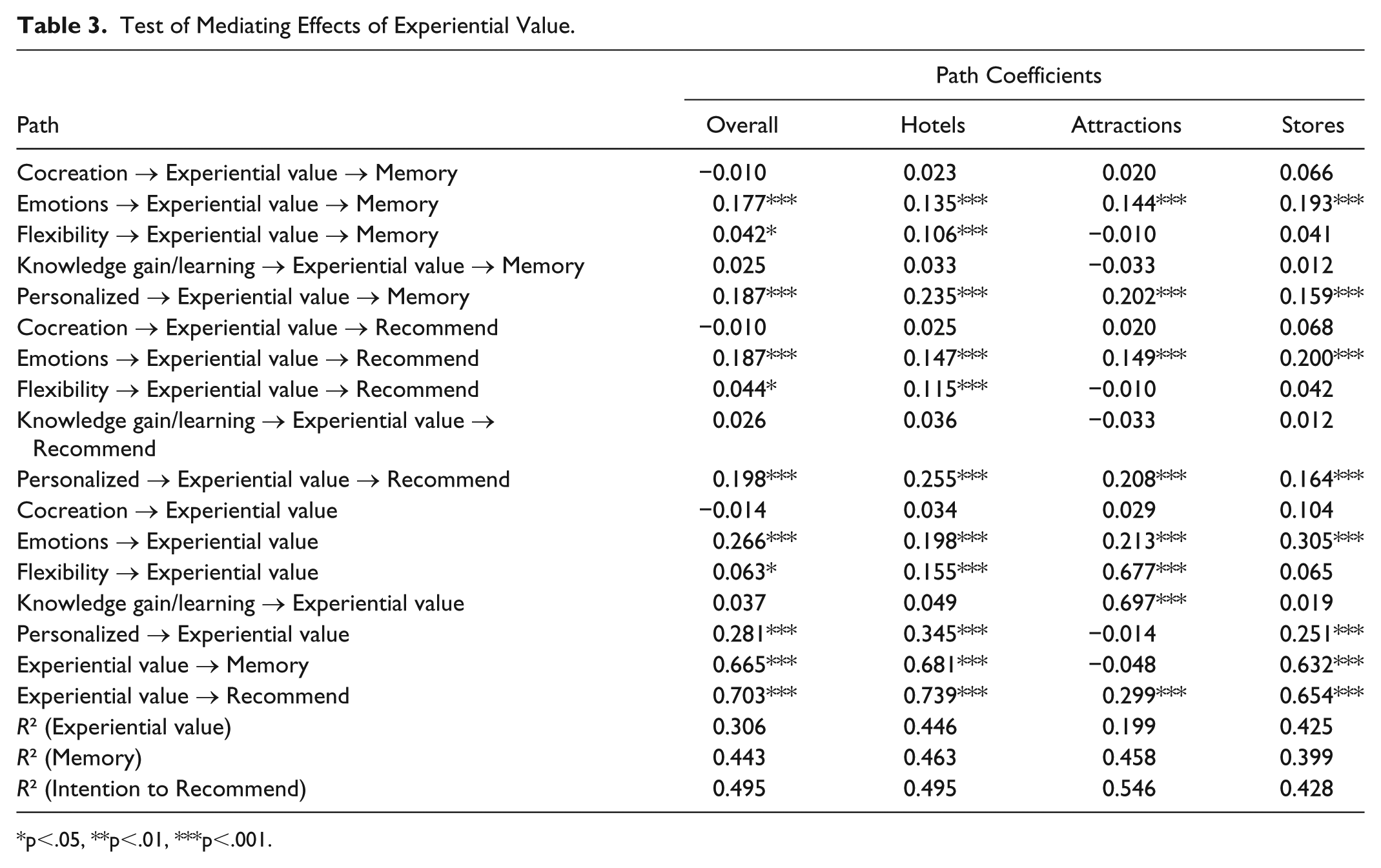
p<.05, **p<.01, ***p<.001.
Experiential Value is found to very significantly and positively mediate the relationship between Emotions and both Memory (coefficient=0.177, p<.001) and Intention to Recommend (coefficient=0.187, p<.001) and between Personalized and both Memory (coefficient=0.187, p<.001) and Intention to Recommend (coefficient=0.198, p<.001). There is also a weaker mediating relationship between Flexibility and both Memory (coefficient=0.042, p=.035) and Intention to Recommend (coefficient=0.063, p=.036). Experiential Value clearly plays a very important role in processing aspects of the employee–tourist encounter, increasing the ability of the tourist to remember the experience and accentuating their intention to recommend the experience to others (providing partial support for hypothesis 3). In terms of the general model, the links between Emotions, Personalized, and Flexibility and Experience Value are all significant (supporting hypothesis 1), as are the links between Experience Value and Memory and Intention to Recommend (supporting hypothesis 2). The model explains 30.6% of the variance in Experience Value, 44.3% of variance in Memory, and nearly 50% of variance in Intention to Recommend.
A lack of a mediating effect of experiential value between cocreation and final outcomes (here and for the individual sectors; see below) seems counterintuitive when considering the literature on experiences as well as recent service-dominant logic theory. The type of destination may provide one explanation for the lack of this mediating effect. Big city tourism, in this case based on an efficient tourism infrastructure, may require less experience cocreation than, for example, rural tourism– or nature-based tourism where the tourism infrastructure may not be as developed and institutionalized. Big city tourism in a sense becomes more self-service.
Similarly, the lack of a mediating effect between knowledge gain/learning and memory and recommendation (here and for the individual sectors) is surprising. It raises the question regarding whether tourists travel to learn. This finding may be explained by making a distinction between receiving information, for example about a place, and more cognitively demanding processes of knowledge development and learning. While tourists may value destination information, knowledge gain/learning may not play a central role for most people in the case of tourist experiences where the main reason for travel is pleasure (or business).
Sectoral Analyses
Hotels
Table 3 also examines the first of our sector analyses on the TEMEV model; the mediating effects of Experiential Value within the data set for hotels. Similar to the overall data set, Experiential Value is found to very significantly and positively mediate the relationship between Personalized and both Memory (coefficient=0.235, p<.001) and Intention to Recommend (coefficient=0.255, p<.001), between Emotions and both Memory (coefficient=0.135, p<.001) and Intention to Recommend (coefficient=0.145, p<.001), and between Flexibility and both Memory (coefficient=0.106, p<.001) and Intention to Recommend (coefficient=0.115, p<.001). Experiential Value appears to play an even stronger role in processing these three aspects of the employee–tourist encounter for hotels, increasing the ability of the tourist to remember the experience and accentuating their intention to recommend the experience to others (offering partial support for hypothesis 3). In terms of the general model, the links between Emotions, Personalized, and Flexibility and Experience Value are all significant at p<.001 (supporting hypothesis 1), as are the links between Experience Value and Memory and Intention to Recommend (supporting hypothesis 2). The model explains very good levels of explained variance in Experience Value (44.5%), Memory (46.3%), and Intention to Recommend (49.5%).
These findings, when compared with attractions and stores (see below) indicate how encounters are more complex and important for shaping experiential value in hotels resulting in memory and recommendation intentions. This may be related to tourists spending more time in one hotel and having more interactions with employees there than in the several attractions and retail/stores they visit. This means that not only do these encounters play a role for experience value, but also that this value has an impact on memory and recommendation. Additionally, while for example physical aspects, cleanliness, and other features of hotels are important for hotel experiences, the interactions play a relatively larger role for the experience than in, say, most attractions, and the employee–tourist relations become more intimate, interactive, and reciprocal.
Attractions
Table 3 examines the second of our sector analyses on the TEMEV model: the mediating effects of Experiential Value within the data set for attractions. In terms of the general model, the links between Emotions, Personalized, and Flexibility and Experience Value are all significant at p<.001 (offering partial support for hypothesis 1), as is the link between Experience Value and Intention to Recommend (offering partial support for hypothesis 2). The model explains lower levels of variance in Experience Value (19.9%), but good levels of Memory (45.8%) and Intention to Recommend (54.6%).
Only two antecedents are mediated in the model by Experience Value, but for both Memory and Intention to Recommend. Experience Value mediates between Personalized and both Memory (coefficient=0.202, p<.001) and Intention to Recommend (coefficient=0.208, p<.001), and between Emotions and both Memory (coefficient=0.144, p<.001) and Intention to Recommend (coefficient=0.149, p<.001). However, given the nonsignificant link from Experiential Value to Memory, we discount this relationship. Experiential Value is important in processing Emotions and Personalized experiences, boosting tourists’ intention to recommend the experience to others.
As indicated above, the findings may be explained by stays being shorter and interactions more superficial in attractions than in hotels. The major attractions in an amusement park are the rides and encounters may play a minor role. In other types of attractions, such as museums, zoos and the like, one could expect the learning element to be important. However, much of this learning is detached from employee–tourist encounters and is based instead on communication via information technologies, or other types of media such as information boards. The findings do show, however, that encounters can influence experience value and that this value can have a mediating role on outcomes. Thus, this should be a strategic concern also in attractions.
Stores
Table 3 examines the third of our sector analyses on the TEMEV model; the mediating effects of Experiential Value for the data from the set of stores. Here the set of significant mediating effects is more narrow: Experiential Value is only found to significantly and positively mediate the relationship between Emotions and both Memory (coefficient=0.193, p<.001) and Intention to Recommend (coefficient=0.200, p<.001) and between Personalized and both Memory (coefficient=0.159, p<.001) and Intention to Recommend (coefficient=0.164, p<.001). Similar to attractions, Experiential Value processes the tourism encounter experiences for just two elements for stores, but, notwithstanding, increasing the ability of the tourist to remember the experience and accentuating their intention to recommend the experience to others (providing partial support for hypothesis 3). In terms of the general model, the links between Emotions, Personalized and Experiential Value are all significant at p<.001 (providing partial support for hypothesis 1), as are the links between Experience Value and Memory and Intention to Recommend (supporting hypothesis 2). The model explains very good levels of variance in Experiential Value (42.5%), Memory (39.9%), and Intention to Recommend (42.8%).
As in the attractions case, the relatively brief encounters may influence the findings. However, there is also a strategic concern about whether the encounters’ importance for tourists’ experiential value is relevant.
Analyses by Gender and the Purpose of Visit
We were interested to see if there were any variations in the results according to respondent characteristics. Experiences are, as suggested in the theory section, personal, and different individuals may get different values from different elements of experiences (Helkkula, Kelleher, and Pihlström 2012). This counts for example for business versus leisure tourists (Sørensen and Jensen 2015) and may also be relevant for gender.
While the role of gender in tourism is an important research theme, most of this research has dealt with aspects relating to the role of women in the supply side of tourism, for example, in marketing and as employees, especially in the sex industry, and with the male orientation of signs, symbols, and fantasies within tourism marketing (see Pritchard and Morgan 2000). Notwithstanding, only a limited fraction of the literature is concerned with the consumption side in relation to how tourism experiences are valued by men and women, and rarely has gender been considered a basis for segmentation in tourism (Frew and Shaw 1999). In the experience economy–oriented literature, the role of gender in relation to experience value remains uninvestigated.
Nevertheless, a few studies focus on gendered differences in perceptions of tourism experiences. In these studies, it has been found, for example, that women often recollect more positive and unique events than men, and assign higher importance to their experiences (Tung and Ritchie 2011). Gender differences also exist in tourism activity preferences. For example, women participate in non-sport outdoor activities more often than men, while men participate in sports activities more often (Song 2017). For certain groups of women, elements of tourism experiences—such as weather, destination, cost, or accommodation and service quality—have been found to be less important than relationships with others and freedom from responsibility, especially for women in their forties (Small 1999). However, no literature has so far, it seems, investigated gendered differences in experience value related to employee–tourist encounters from a consumer point of view.
Examining the complete data set for gender, we found that for males (n=1,370) there was a significant mediating effect of Experiential Value between Personalized (p<.001), Flexibility (p<.05), and Emotions (p<.001) and both Memory and Intention to Recommend. Similarly, the links between Personalized (p<.001), Emotions (p<.001), and Flexibility (p<.05) and Experiential Value were significant, as were those between Experiential Value and both Memory (p<.001) and Intention to Recommend (p<.001). For the female group (n=1,585), Flexibility was not mediated by Experiential Value and the link to Experiential Value and on towards Memory and Intention to Recommend were nonsignificant. The other relationships in the model were significant to the same level as those of males. While these are not large differences between genders, they are not explained in the previous literature. However, these findings may perhaps be related to the more general tourism experience in which women, as described above, are found to pay more attention to relationship aspects, which in our model relates to Personalized and Emotions factors, thus perhaps downplaying other elements.
Further tests to examine the TEMEV model according to the purpose of the visit were conducted. This found dramatically different results according to whether the visit was for business/work purposes (n=209) or holiday/pleasure purposes (n=1,122). For business/work visitors, the only significant driver of Experiential Value was Personalized (p<.05), which in turn was a significant driver of both outcome constructs (p<.001). The only significant mediating effect for Experiential Value was that between Personalized and both outcome variables (p<.05). For holiday/pleasure visitors, there were three significant antecedents of Experiential Value, Personalized, Emotions and Flexibility at p<.001, which in turn was a significant driver of both Memory and Intention to Recommend at the same level. The relationships between these three drivers and the two outcome variables were all significantly mediated by Experiential Value at p<.001.
The differences can be explained by holiday visitors actively seeking and expecting experiences, whereas business tourists are primarily service- and efficiency-focused and value this more highly than experiences. Seeking familiarity and a “home away from home” may explain that personalized interactions are also relevant for the business tourist. The more important conclusion from this analysis is, however, that encounter strategies should include considerations about how experiential value plays different mediating roles for different visitor segments.
Conclusions
The findings illustrate how, for different tourism companies, experiential value plays varying roles as mediator between employee–tourist encounter characteristics and tourists’ intentions to recommend an experience as well as their memory of the experience. The most complex relationship identified is for hotels. Here experiential value plays a significant role as a mediator for the personalized, flexible, and emotional constructs of encounters. Surprisingly, experiential value plays no significant mediating role between cocreation in encounters and memory or recommendation intention in any of the sectors involved in the survey. The same was also true of the knowledge/learning construct. The findings also indicate how for business tourists, experiential value only plays a significant role as mediator for the personalized aspect of encounters. For leisure tourists this was true for both personalized, flexible, and emotional aspects of encounters.
Implications for Theory
Despite the central role of encounters in tourism, until now, only a few studies have examined the nature and role of employee–tourist encounters in experience value creation, and the resulting memory and intention to recommend. The findings in this article suggest that further theoretical developments within this area of research are needed; future research must seek to go further beyond the original experience economy approach of Pine and Gilmore (1999) and its applications in tourism research (e.g., Oh, Fiore, and Jeoung 2007; Mehmetoglu and Engen 2011). Novel investigations should elaborate on the role of encounters in developing users’ perceived value for tourism experiences, accepting the intrinsic and individual nature of this experiential value. Thus, research may benefit from further developing an experience economy perspective of encounters that is eclectic and inspired by more recent development in related theoretical fields, such as service-dominant logic (e.g., Grönroos and Voima 2013; Shaw, Bailey, and Williams 2011). Notwithstanding, theoretical development should take into consideration how contexts and segments affect the importance of different elements of employee tourist encounters; this article has shown how the prominence of elements varies with contexts and segments, but we have so far little theoretical explanation for these variations. Of particular interest is the nature and role of cocreation, which in this article is seen not to be as prominent as theories would suggest (e.g., Grönroos and Voima 2013; Zátori 2016; Harkison 2018). Additionally, in this article we have suggested a theoretical approach to investigate the role of encounters, but this does not take into consideration the surrounding (physical and narrative) design and other attributes of the experience. Tourism experience design theory (e.g., Tussyadiah 2014), combined with theory on employee tourism encounters, such as that presented in this article, could cast further light on the complex integration of encounters and designed elements that result in tourist experiences, providing tourism companies with further guidance on how to design valuable tourist experiences.
Implications for Practice
The general practical implications of the study include that tourism companies can improve their competitive situation by paying close attention to how encounters between employees and tourists influence tourists’ experiential value. Thus, a focus on experiential elements of encounters in addition to service elements is crucial. The findings also suggest that, at least for some companies, intensifying interactions may provide new possibilities for creating experiential value for tourists, improving recommendation intentions and tourists’ memory of the experience. On the other hand, companies should not focus blindly on building cocreation encounters or build too much cognition into the encounters. Another implication is that companies should have several approaches to employee–tourist encounters because the mediating effect of experiential value varies significantly between segments, which this study has exemplified with the comparison between business and holiday tourists.
The findings and implications are related, at least partly, to the context of the study: big city tourism based on a well-developed tourism infrastructure. This may be characterized as a type of self-service tourism not requiring much in terms of cocreation or learning in employee–tourist encounters. In other contexts, both learning and cocreation may play a more important role for the mediating effects of experiential value.
For managers, the findings indicate the need for creating work environments that allow employees more freedom to express their identity and in sustaining more creative flexibility in encounters. Furthermore, managers need to involve front-line employees in generating knowledge about visitors’ preferences and, thus, about suitable approaches to employee–tourist encounters in the specific company contexts. This implies managers must break down or loosen traditional hierarchical structures of control and one-way communication from management to frontline employees, in addition to strengthening horizontal communication among front-line employees to facilitate knowledge sharing. In order to facilitate emotional values in encounters, employees must learn experiential intelligence skills and employ these skills, rather than hyperprofessionalism, in encounters: employees must learn to understand the experiential needs of visitors and act on these, rather than relating professionalism to the capability to strictly follow standardized scripts (cf. Baum 2006; D. Sundbo 2011). Hence, managers (and educational establishments) need to educate employees in new approaches to employee–tourist encounters that put more emphasis on emotional and personal aspects of encounters. All in all, this results in new roles for managers and middle managers who must involve and inspire front-line employees rather than control and set up standardized encounter routines. Tourism company managers increasingly need to perceive front-line staff as knowledge-oriented employees, rather than merely manual workers.
Limitations and Future Research
The corollary of the above is that this study is limited by its context. Thus, future studies should examine other contexts to build a more complete picture of the mediating role of experiential value. Another limitation of the study is, despite the large sample, that the survey was conducted in only 13 tourism companies belonging to three tourism sectors. This does not allow for generalizing the results, neither within the destination nor to other destinations. However, for bringing exploratory knowledge and for validating the model and its usefulness, the study has served its purpose. Finally, our research analyzes just part of the tourist experience, the part that involves firm–customer interactions. Future research should consider tourist experiences that occur outside the firm–customer relationship.
We have several plans for future research. The next step in the research project is to create real impact by developing a practically applicable survey instrument that companies can apply and interpret themselves without intervention by researchers or consultants. We also intend to examine the impact of tourism–employee encounters on visitor outcomes using text analytics of online service reviews.
Footnotes
Appendix
Encounter-Based Experiences.
| Scale Items | Mean | Standard Deviation |
|---|---|---|
| Personalized | ||
| PERS1. Staff made me feel cared for. | 5.667 | 1.415 |
| PERS2. Staff acted in my best interest. | 5.781 | 1.368 |
| PERS3. Staff treated me as a special person. | 5.158 | 1.614 |
| PERS4. Staff was authentic and congenial. | 5.868 | 1.319 |
| Flexibility | ||
| FLEX1. Staff were responsive to my suggestions. | 5.250 | 1.541 |
| FLEX2. Staff were flexible when interacting with me. | 5.451 | 1.460 |
| FLEX3. Staff were open-minded. | 5.726 | 1.377 |
| FLEX4. Staff went out of their way to assist me. | 5.080 | 1.672 |
| Cocreation | ||
| COCR1. I was an active part in the encounter. | 5.227 | 1.539 |
| COCR2. We inspired each other during our interactions. | 4.583 | 1.715 |
| COCR3. My input was important in the encounter. | 5.129 | 1.563 |
| COCR4. There were good interactions between me and the staff. | 5.650 | 1.398 |
| Emotions | ||
| EMOT1. I was strongly engaged in the encounter. | 4.829 | 1.669 |
| EMOT2. The encounter left me in a better mood. | 5.383 | 1.534 |
| EMOT3. The encounter touched me emotionally. | 3.997 | 1.868 |
| EMOT4. I felt a special bond with the staff. | 4.188 | 1.796 |
| Knowledge gain/learning | ||
| KNOW1. I learned a lot from my encounter. | 4.275 | 1.850 |
| KNOW2. The encounter gave me new insights. | 4.394 | 1.863 |
| KNOW3. I learned something new about the people I met during the encounter. | 3.883 | 1.895 |
| KNOW4. The encounter gave me ideas to think about. | 4.229 | 1.869 |
| Experiential Value Scale ™ | ||
| VALU1. Information about the Experience is correct. | 6.115 | 1.157 |
| VALU2. The Experience is designed for quality. | 6.134 | 1.066 |
| VALU3. The Experience is one of its kind. | 5.448 | 1.510 |
| VALU4. What I get from the Experience is worth the cost. | 5.812 | 1.343 |
| VALU5. The Experience is a satisfying buy. | 5.967 | 1.207 |
| VALU6. The Experience does me good. | 6.025 | 1.200 |
| VALU7. I feel the Experience to be genuine. | 5.978 | 1.191 |
| VALU8. What this Experience gives me feels right. | 5.921 | 1.217 |
| VALU9. Emotionally I am absorbed by the Experience. | 4.541 | 1.860 |
| Overall memory | ||
| MEMO1. Overall, I have a strong memory of my Experience at X? | 5.906 | 1.242 |
| MEMO2. I will remember this Experience for the rest of my life. | 5.055 | 1.754 |
| Recommendation | ||
| RECO1. How likely is it that you would recommend X to a friend or family? | 6.081 | 1.158 |
| RECO2. I would say positive things about this Experience to others. | 6.107 | 1.158 |
Acknowledgements
We thank our partners in the NICE project Wonderful Copenhagen (WOCO) for funding and Wilke consultancy for their data collection work.
Declaration of Conflicting Interests
The author(s) declared no potential conflicts of interest with respect to the research, authorship, and/or publication of this article.
Funding
The author(s) disclosed receipt of the following financial support for the research, authorship and/or publication of this article: NICE has been financed by the Capital Region of Denmark and the “Education and Cooperation Funds” from the social partners HORESTA (Association for the Hotel, Restaurant, and Tourism Industry), Dansk Erhverv (Danish Chamber of Commerce, Trade, IT, Service, and Industry), 3F Private sector (United Federation of Danish Workers), and HK Private (Union for salaried workers).
