



Abstract
The article reports an overview of studies that have investigated the role of attitudes in understanding tourists’ sustainable choices. The literature is discussed in the light of theories and empirical research in social and environmental psychology. The aim is to show how past and present work in these disciplines can help tourism scholars to deal with the complex functioning of the attitude concept when this is applied to sustainability issues. Particular attention has been paid to the theoretical and methodological distinctions between the different types of attitudes as they relate to sustainability. Suggestions for improving the effective use of attitudes in sustainability related tourism studies are made together with a discussion of the possible research avenues directed to consolidate as well as to broaden the theoretical foundations of the use of the attitude concept in this field.
Keywords
Introduction
According to one of the most used definitions, attitudes are personal evaluative reactions (i.e., evaluations) to socially relevant issues concerning specific objects, events, people, contexts and/or behaviors (for recent discussions in social psychology see, e.g., Albarracin and Shavitt 2018; Fazio and Petty 2008; for discussions in the tourism domain, see, e.g., Iso-Ahola 1982; Pearce and Packer 2013). Studies conducted in the tourism and leisure domain have repeatedly and consistently shown attitudes to be associated with pro-environmental choices regarding both general and specific tourism-related issues (see Table 1). However, various authors have also highlighted the limitations affecting the application of the concept of attitude in tourism research. One of these is the weak (or alternate) relationship with behavior, which raises questions about its utility in the development of behavioral change interventions (e.g., Antimova, Nawijn, and Peeters 2012; Juvan and Dolnicar 2014a). Another limitation is that much research on attitudes neglects the social and cultural assumptions that underlie the reported attitudes (e.g., Dickinson and Dickinson 2006), as well as the role of social practices and of the structural and technological context (e.g., Verbeek and Mommaas 2008). While these limits actually exist, it should be acknowledged that attitude is a multifaceted construct, with a specific functioning, sometimes unexpectedly complex, that should be kept in mind by researchers (in all fields), if they want to avoid inconveniences and/or making biased interpretations of their results. The goal of this article is, therefore, to discuss the complex nature of attitudes and highlight both limitations and utilities of the concept in research into tourists’ sustainable choices. In particular, since the literature on attitudes and sustainable tourism has increased substantially in recent years, the aim is to provide an overview of it in the light of past and present work in the parallel fields of social and environmental psychology, where the construct has been extensively investigated. Suggestions for overcoming some of the most common problems arising from the use of attitudes in research will be proposed, and possible future research avenues will also be delineated. After a brief introduction to the relevance of studying attitudes for tourism sustainability and the historical conceptualization of attitudes, the discussion will focus on three crucial issues: (1) the different types of attitudes (relevant to sustainable tourism), (2) the attitude–behavior relationship (in the tourism domain), and (3) the theoretical models (including attitudes) that can be used to describe or explain tourists’ sustainable behaviors. The article concludes with a summary of the main suggestions derived from the review.
Examples of Studies That Have Considered the Role of Attitudes in Supporting General and Specific Sustainable Forms of Tourism.

Note: The references reported in this table were retrieved by searching Scopus and PsycINFO databases and by checking the literature cited in the references retrieved, according to a snowball technique. However, this literature is not exhaustive and many more studies might have been published on the topic. For example, the literature on the effects of tourism experience on attitudes were not considered in this table as these have been the subject of a dedicated article by Ardoin et al. (2015). Moreover, the classification of topics proposed takes into account what it appeared to be the main focus of the study reported in the reference and should not be interpreted rigidly. It does not preclude alternative interpretations and classifications of the articles according to other criteria. In addition, some studies could have been classified in more than one of the categories reported. NEP = New Environmental Paradigm scale.
Relevance of Studying Attitudes for Tourism Sustainability
The World Tourism Organization has defined sustainable tourism as “tourism that leads to management of all resources in such a way that economic, social and aesthetic needs can be fulfilled while maintaining cultural integrity, essential ecological processes, biological diversity and life support systems” (WTTC and UNWTO 1996; see also B. Bramwell and Lane 1993; Butler 1999; for a recent discussion, see, e.g., Higgins-Desbiolles 2018; Fennell 2019). However, because many doubts have been raised as to the possibility of achieving such high and abstract goals in tourism practice (e.g., Butler 2019; McCool et al. 2013; Wheeller 2007), more realistic or “adaptive” definitions have been proposed that see it as an “over-arching paradigm which incorporates a range of approaches to the tourism/environment system within destination areas” (Hunter 1997, p. 850; see also Clarke 1997). According to this view, tourism sustainability is a continuous quality, ranging from an undesirable minimum level of implementation to a more desirable maximum, and “a normative orientation that seeks to re-direct societal systems and behavior on a broad and integrated path toward sustainable development” (B. Bramwell et al. 2017, p. 1; see also Weaver 2017). According to Ko (2001), a tourist destination offering can be more or less sustainable depending on the extent to which it is able to fulfil the specific needs of its various stakeholders (i.e., local residents, tourists, and the natural environment; see also Hardy and Beeton 2009). Byrd (2007) has suggested four types of stakeholders potentially involved in the development of sustainable forms of tourism, including the present and future members of the local hosting community as well as present and future visitors (tourists). The process of stakeholder involvement can take many forms. According to Byrd (2007, p. 9), “they should be more informed and educated about the topics and issues; their values and opinions should be recorded as they can generate new ideas to be included in the decision process; trust between parties should be increased while conflicts should be reduced. In this way, quality and legitimacy of decisions will be enhanced and stakeholders will be more willing to share the responsibilities of the sustainability goals that have to be achieved” (Byrd 2007, p. 9). In particular, regarding visitors, according to the Davos Declaration (UNWTO 2007, p. 3) “tourists should be encouraged to consider the climate, economic, societal and environmental impacts of their options before making a decision and, where possible, to reduce their carbon footprint, or offset emissions that cannot be reduced directly” (UNWTO 2007, p. 3; see also UNESCO 2010). These recommendations have drawn researchers’ attention to the fact that tourists’ choices and actions can be seen as particular cases of ecological behavior and, as such, can be understood in light of the literature on the social-psychological determinants of these behaviors. In this literature, attitudes represent key factors to be taken into account (e.g., Steg and Vlek 2009).
Some Historical Issues in Attitude Definition and Conceptualization
According to Allport (1954), although the term attitude was first used in the sense closest to its present-day use by W. I. Thomas and F. Znaniecki, in 1918, the long history of attitudes actually started with an experiment conducted by L. Lange in 1888. Lange had noticed how participants who had been informed about the nature of a task they were about to carry out showed greater response readiness to the task than did those who had not been informed about it. According to the author, this was due to the fact that the information the former had received gave them time to create a mental representation of the task, thereby affecting their response readiness. For this reason, Allport (1935, p. 810) defined attitudes as “a mental and neural state of readiness, organized through experience, exerting a directive or dynamic influence upon an individual’s response to all objects and situations with which it is related.” Allport formulated this proposal as a unifying conceptualization after acknowledging the existence of 16 different definitions of attitude (as far back as then!). A discussion of these definitions and their evolution over time is beyond the scope (and ability) of the present article. However, overall, it can be said that the various interpretations proposed tended to differ in terms of depicting attitudes as either of biological or cultural in origin, individual or social in nature, unidimensional or multidimensional in structure, stored in memory or contextually constructed, directly or indirectly observable, and generally rather than specifically focused (for a synopsis of attitude definitions in social psychology, see Table 2). The existence of such a multiplicity of interpretations and conceptualizations is mentioned here only to give the reader an idea of the fact that in the social (and environmental) domain, the term attitude tends to identify more a “family” of closely connected constructs than a single, monadic instance (e.g., Albarracin and Shavitt 2018; Kaiser et al. 2013). This fact has a number of consequences for researchers in all fields, starting with the fact that, as already mentioned, despite its apparent simplicity, a certain competence about the concept is recommended before using it in any investigation studies. This is because each theoretical approach tends to be associated with specific methodological implications or different views (and explanations) of the relationships with antecedent and consequent factors. Because it is not possible to provide simple and synthetic suggestions about which conceptualizations are most appropriate for the tourism domain (this being a choice that varies from case to case), but given that the topic of attitudes has been addressed by a number of leading academics in social psychology, todays’ tourism researchers could resort to theoretical exploration of classic and recent literature in social psychology, starting with the key references provided in this paragraph. In addition, in the next section, I introduce and discuss a possible classification of attitudes that I deem particularly relevant for the environmental domain, which I hope will be of help to tourism researchers seeking to better identify and use the attitude construct when dealing specifically with sustainability issues.
Some Historical Dichotomies in the Conceptualization of Attitudes.

Note: This classification has been merely intended to give an idea of the high level of complexity and variety of the past and present discussion on attitudes. It should not be considered exhaustive, nor does it reflect the existence of actual boundaries between topics. Most of these dichotomies are intertwined among them, and many of the authors cited as examples for a dichotomy have also contributed to the discussion on others.
Types of Attitudes in the Environmental Domain and Their Relevance to Sustainable Tourism Research
Attitudes represent one of the first psychological factors taken into account by researchers interested in identifying the determinants of environmentally significant behaviors. The latter correspond to behaviors that can have a direct or indirect impact on the availability of materials or energy in the environment or alter the structure and dynamics of ecosystems or the biosphere itself (Stern 2000). In the environmental domain, such behaviors have been found to be associated with various types of attitudes in dozens of studies (e.g., Bamberg and Möser 2007), although, even here, this relationship has been revealed to be all but simple and straightforward. Below, I discuss some key aspects of attitudes that are peculiar to the environmental field and lead to differentiate them “vertically,” according to their level of specificity, and “horizontally,” according to the conceptual and ideological issues to which they refer (see also Figure 1).
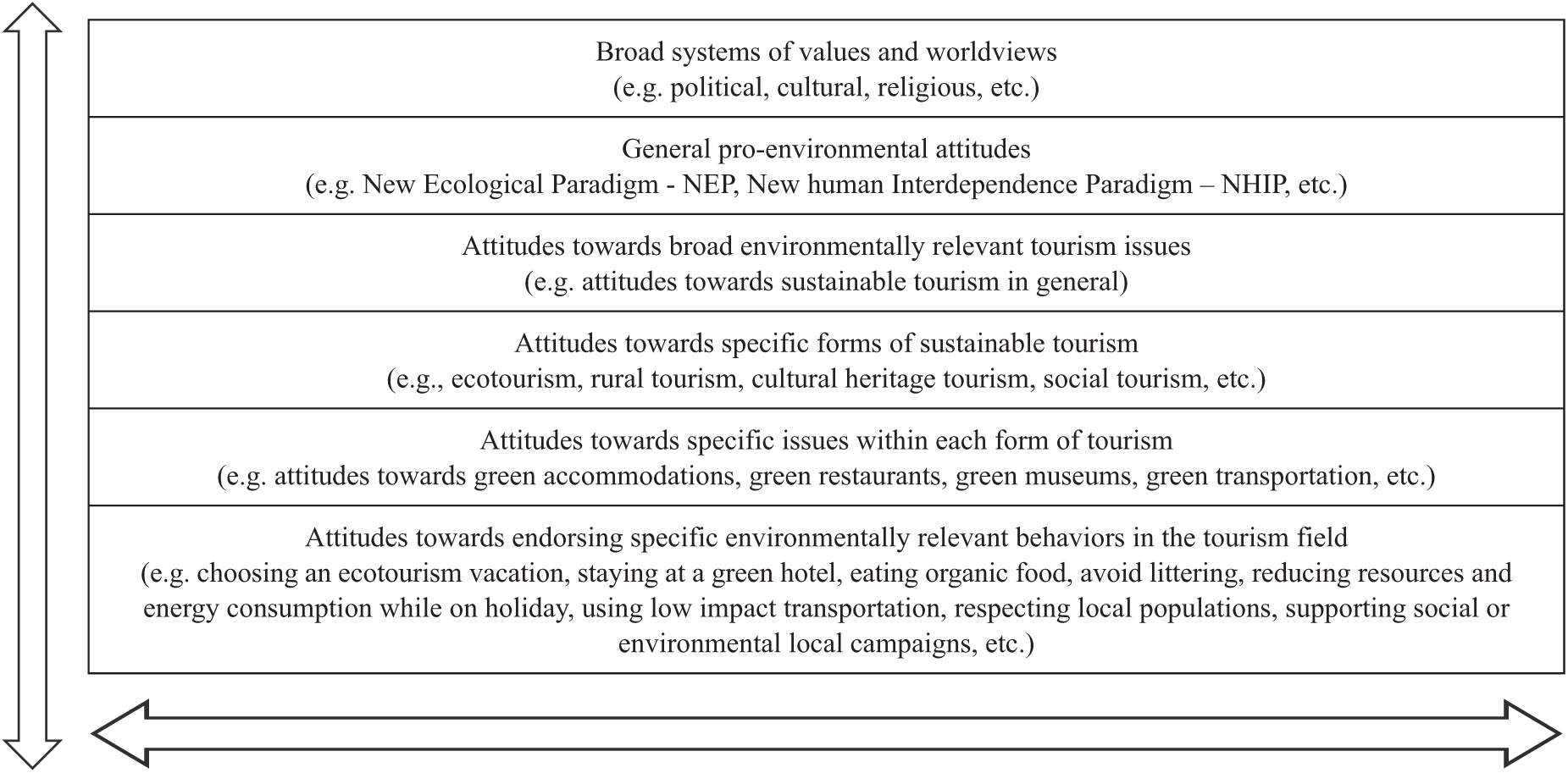
Proposed vertical and horizontal classification of environmental attitudes in tourism.
A vertical (hierarchical) classification of environmental attitudes
On a vertical (hierarchical) basis, attitudes that have been shown to be relevant to environmental issues can be distinguished according to the extent to which they refer to general (broad) themes (e.g., general attitudes and worldviews related to environmental protection and the social, cultural, and economic themes of sustainability, including sustainable tourism) rather than to specific environmental issues (e.g., attitudes toward ecotourism, cycle tourism, green hotels, and green restaurants). This distinction originates from Fishbein and Ajzen’s (e.g., Fishbein and Ajzen 1974; Ajzen and Fishbein 1977) postulate that attitudes can be differentiated on the basis of their level of abstraction and that such a distinction can affect their relationship to behavior (this aspect is discussed in more detail in the next section). Decades of studies conducted in the environmental domain have not only confirmed Fishbein and Ajzen’s postulate but have also uncovered important additional theoretical and methodological consequences (for a discussion in the environmental domain, see also Milfont, Duckitt, and Wagner 2010a). For example, many studies in this field have empirically demonstrated that the two kinds of attitudes (general and specific) are typically connected via a causal chain in which the general (and more abstract) ones tend to predict the more specific and concrete (e.g., Milfont, Duckitt, and Wagner 2010a, 2010b; Stern 2000; de Groot and Steg 2007). This has been confirmed by studies conducted in the tourism domain as well (e.g., M.-F. Chen and Tung 2014; Fairweather, Maslin, and Simmons 2005; Lu, Gursoy, and Del Chiappa 2016; Luo and Deng 2008) and leads to the notion that, although correlated, general and specific attitudes should be conceptualized as distinct constructs because they can have different antecedents and consequences. In fact, the most direct antecedents of specific environmental attitudes tend to be beliefs about the attitude target (see, e.g., Staats 2003; Han and Kim 2010; Nimri, Patiar, and Kensbock 2017), as well as broader attitudes and values, of which the most studied are general pro-environmental attitudes and worldviews (e.g., Stern 2000; de Groot and Steg 2007; for examples in the tourism domain, see M.-F. Chen and Tung 2014; Floyd, Jang, and Noe 1997; Luo and Deng 2008; Xu and Fox 2014). Moreover, specific environmental attitudes are more subject to the effects of factors uniquely related to a target issue or behavior. For example, in the tourism domain Han and Kim (2010) and Han (2015) established that perceived “service quality” and the “perceived consequences for valued objects” can be important antecedents of attitudes toward “green hotels,” in addition to the role played by classic “behavioral beliefs,” typically deemed to be relevant across contexts. Similarly, A. K. J. Kim, Airey, and Szivas (2011) found a direct effect of “interpretation” on tourists’ awareness and support for conservation management policies of a coastal area in England.
Conversely, general environmental attitudes and worldviews appear to be more directly affected by an individual’s broad system of values and beliefs (e.g., Hurst et al. 2013; Milfont, Duckitt, and Wagner 2010a; Schultz and Zelezny 1999; for an example in the tourism domain, see Lu, Gursoy, and Del Chiappa 2016), which include overall attitudes toward the “main moral foundations” (e.g., Baldner 2018). Moreover, general environmental attitudes have been found to be related to relatively stable individual traits, such as various forms of “connectedness to nature” (i.e., connectedness, relatedness, interdependence, implicit association, emotional affinity, dispositional empathy, etc.; e.g., Kaiser et al. 2014; Martin and Czellar 2017; Mayer and Frantz 2004; Davis and Green 2009; Tam 2013), “environmental” identity (e.g., Brügger, Kaiser, and Roczen 2011; Devine-Wright and Clayton 2010), and authoritarianism and social dominance (e.g., Stanley, Wilson, and Milfont 2017). Some authors have also argued that general pro-environmental attitudes are affected by a genetic/evolutionary predisposition termed “biophilia,” or “topophilia,” corresponding to a general “instinctive” inclination to appreciate natural environments (e.g., Kellert 1997; a study conducted in the tourism domain is reported in Perkins 2010). Furthermore, broad systems of general attitudes may be influenced by (or closely related to) a set of sociostructural and sociodemographic factors (e.g., Blake 2001; Dietz, Stern, and Guagnano 1998; Shen and Saijo 2008; for discussions in the sustainable tourism domain, see, e.g., McKercher, Pang, and Prideaux 2011; Han, Hsu, and Lee 2009; Dolnicar, Crouch, and Long 2008), that may include political ideology and party identification (e.g., Cruz 2017), religiousness (e.g., Felix et al. 2018; Guth et al. 1995), geographical/cultural origin (e.g., Eom et al. 2016), parenthood (G. O. Thomas et al. 2018), race (e.g., Deng, Walker, and Swinnerton 2006), gender (e.g., Bord and O’Connor 1997; Olsson and Gericke 2017), professional occupation (e.g., Sundblad, Biel, and Gärling 2009), and level (and type) of education (e.g., Hodgkinson and Innes 2001). It is worth noting here that these aspects have so far received little or no attention in the domain of sustainable tourism.
General and specific attitudes tend, then, to differ in their behavioral consequences, with specific attitudes exerting a stronger direct effect on intentions and behavior. This notion leads to the introduction of a further distinction between types of attitudes (within a hierarchical perspective)—one that captures the extent to which the attitude object is, or is not, a particular behavior. Only behavioral attitudes (attitudes toward performing a certain behavior) should be considered direct predictors of corresponding intentions and behaviors (e.g., Ajzen 2001; for a discussion in the environmental domain, see Staats 2003; for studies in the tourism domain, see, e.g., Y. Kim and Han 2010; Han and Hyun 2017a). However, general attitudes, and attitudes toward ecological issues in general, seem to be particularly relevant anyway, because they tend to correlate with behavior to some extent (e.g., Milfont, Duckitt, and Wagner 2010a), and because they can act as crucial moderators of other more direct determinants. For example, a study by Huang and Liu (2017) showed environmental concern (a particular general attitude) to moderate the relationship between motivation and revisit intention, in the ecotourism domain.
In many cases, general attitudes are able to affect crucial direct predictors of behavioral intentions, some of which are related to particular feelings and emotions. For example, in a study by Han and colleagues (Han, Hwang, and Lee 2017), environmental concern was shown to be able to directly affect personal norms (measured as a personal feeling of obligation to perform a certain behavior), a factor that, in turn, was revealed to be a strong predictor of intentions to practice green activities (e.g., saving electricity, and reducing waste) when attending a convention. Similar results were obtained by Han, Kim, and Kiatkawsin (2017) in a study of young travelers’ conservation intentions, while Han and Hyun (2017b) found environmental concern to be a predictor of anticipated positive affect, which, in turn, was able to predict (directly) intentions to enact environmentally responsible behaviors while visiting a museum.
Another strength of general attitudes is their relationship to policy support (e.g., Rauwald and Moore 2002). Probably because of their strong ideological basis, general attitudes appear to be particularly relevant in predicting and explaining people’s support for specific environmental policies—an important form of indirect pro-environmental action (e.g., Stern 2000). This aspect is acquiring increasing relevance in today’s societies, as surveys of support for specific policies often guide politicians’ and governments’ strategic choices.
Such an indirect role of general attitudes on behavior deserves greater attention in the domain of sustainable tourism, as do a number of other issues that have emerged in the social and environmental psychology literature, including:
The possible interaction between specific and general environmental attitudes—for example, some authors have noted that general environmental attitudes may act as internal motivators able to amplify and/or stabilize the effects of more specific attitudes on behavior (Huffman et al. 2014).
The role played by “particular” forms of general attitudes such as, for example, attitudes toward environmentalists (e.g., Ratliff, Howell, and Redford 2017)—some authors have suggested that these types of attitudes might predict pro-environmental behavior more effectively compared with general environmental concern (e.g., Ratliff, Howell, and Redford 2017). Indeed, according to the Prototype Willingness Model of behavior (PWM; e.g. Gerrard et al. 2008), evaluation of the characteristics of individuals who are prototypical of a social group or category is of crucial relevance for understanding other people’s willingness to act like them. These kinds of effects may be related to the implication for self-expression and self-presentation that some behaviors may have (e.g., Mannetti, Pierro, and Livi 2004), and it would be worthwhile ascertaining their relevance to tourism issues too.
The possibility that the effects of particular antecedents of attitudes (e.g., values) may be moderated by social cultural factors—for example, it has been shown that attitudes are more influenced by self-transcendent values in individualistic cultures and by conservation values in collectivistic ones (e.g., Boer and Fischer 2013).
The role of people’s past experience of the social physical environment in which they live (e.g., Miller 2005; Van den Berg, Vlek, and Coeterier 1998), or visit for leisure and tourism (e.g., Ardoin et al. 2015; Lee and Moscardo 2005; Packer and Ballantyne 2016), as well as in the context of educational intervention programs (e.g., De Dominicis et al. 2017; but see also Russell and Russell 2010; Ballantyne and Packer 2011; Ballantyne, Packer, and Hughes 2009; Ballantyne, Packer, and Sutherland 2011; K. Hughes, Packer, and Ballantyne 2011), in shaping both general and specific tourism attitudes—although this aspect has received some attention in the tourism domain, more systematic and theory-based investigations are still needed.
The effects on both general and specific attitudes of people’s traitlike tendencies to have positive versus negative views of life events (i.e., their dispositional attitude; Hepler and Albarracín 2013, 2014; see also Rocklage and Fazio 2014)—the role of traits in affecting responses to attitudes has been underestimated in the sustainable tourism field.
And finally, the effects of knowledge on attitudes formation and change—studies have shown that knowledge of specific and general environmental issues can affect attitudes and behaviors (e.g., Kaiser and Fuhrer 2003), and can play a role in their change over the life course (Otto and Kaiser 2014). However, knowledge is quite a composite construct; different forms of knowledge relevant to environmental issues exist that can have different types of impact on attitudes and behaviors (e.g., Liefländer et al. 2015). Unfortunately, although there is evidence that these differences are also relevant to the sustainable tourism domain (e.g., Alessa, Bennett, and Kliskey 2003; Juvan and Dolnicar 2014b), both the role of the learning experience and the influence of the various types of environmental knowledge on attitudes remain underinvestigated in this field (Falk et al. 2012; see also Coghlan and Kim 2012).
A “horizontal” classification of environmental attitudes
In addition to a vertical or hierarchical classification, attitudes relevant to sustainability issues can also be categorized on a “horizontal” basis. This means that within each level of abstraction/concreteness, environmental attitudes can still differ on the basis of the specific theme or topic addressed. Because the concept of sustainable development entails a number of domain-specific social and environmental issues (e.g., social inequality, loss of biodiversity, climate change, resources depletion, waste management, etc.) and these, in turn, reflect other more specific issues (e.g., attitudes toward reducing towels use at the hotels, attitudes toward using low-impact transportation means, attitudes toward buying organic food, etc.), it is reasonable to expect that distinct specific attitudes can be identified and studied for every issue. Again, this differentiation is justified by the fact that each attitude may have a specific set of antecedents and consequences in addition to those of a more general nature. This means, for instance, that the set of predictors of attitudes toward ecotourism might not always (or completely) overlap with those of attitudes toward sustainable cruise travel, cycle tourism, and/or heritage tourism, and that these, in turn, may show different patterns of relationship with corresponding behaviors. The use of the conditional form here reflects the fact that these issues have not yet been investigated extensively, although there is evidence in the environmental and tourism domains that congruence among different types of ecological behaviors is rather uncommon (e.g., Juvan and Dolnicar 2017; Thøgersen 1999; see also Lanzini and Thøgersen 2014), and should thus be ascertained on a case-by-case basis (e.g., Margetts and Kashima 2017).
Conversely, much more evidence, exists concerning the internal complexity and articulation of general environmental attitudes. Such complexity parallels that of environmental ideology and discourse in society (e.g., Bell 1994; Little 1999; Rappaport 1979; Redclift 1987). As a matter of fact, not only can different perspectives on people–nature relationship be identified by tracing them back to, for example, their historical (e.g., A. Bramwell 1989; Conway, Keniston, and Marx 1999), geographical (e.g., Sarigollu 2009; Uyeki and Holland 2000), socialcultural (e.g., Wang 1999; Williams and Cary 2002; Warren 1990; van den Berg, Vlek, and Coeterier 1998; Steg and Sievers 2000), and/or political (e.g., Eckersley 1989; Brondi et al. 2016; Carman 1998) origins (to name but a few), but these perspectives are continuously evolving as a result of the hectic social-cultural exchanges of today’s societies, enhanced by recent technical advances in mass media and social networks (e.g., Aiello and Bonaiuto 2003; Bell 1994; Buijs et al. 2012; Castro and Lima 2001; Curtin and Rhodenbaugh 2001; Hansen 1991; Holbert, Kwak, and Shah 2003; Sarrica et al. 2016). In other words, different dimensions of environmentalism exist at present, worldwide, which are likely to evolve via further differentiation in the future.
Researchers should be aware of this complexity when investigating factors thought to be expressions of these ideological dimensions, such as, for example, environmental concern. The latter has received substantial empirical attention, but little theoretical reflection in the environmental domain, and few authors seem to be aware of the different possible conceptual articulations of this construct across cultures, groups, and societies. For example, Milfont, Duckitt, and Wagner (2010b) suggested that, across cultures, environmental concern can be traced back to two main higher-order dimensions—that is, preservation and utilization—that reflect the way people think environmental resources should be used by human beings. Within the utilization dimension, some authors have seen the necessity of further distinguishing between exploitative and appreciative uses of nature (e.g., Kibbe, Bogner, and Kaiser 2014).
The existence of internal differentiations such as these should be taken into account by researchers, in order to select the measurement instrument that captures the dimensions most relevant to the particular case and context being investigated. In fact, most existing instruments are based on a rather partial view of the concept. This is the case, for example, with the most popular measure of environmental concern, the New Environmental Paradigm scale (NEP; Dunlap and Van Liere 1978; Dunlap et al. 2000; for studies in the tourism domain, see, e.g., Jurowski et al. 1995; Luo and Deng 2008; Uysal et al. 1994), which focuses on people’s endorsement of ecocentric (valuing nature per se) versus anthropocentric (valuing nature because of its importance for human beings) perspectives on the humans–nature relationship. Some authors have advised researchers to be well informed about both the potentialities and limits of this scale before using it (e.g., Van Liere and Dunlap 1981; Klineberg, McKeever, and Rothenbach 1998).
In particular, Milfont and Duckitt (2010) observed that samples with different socioeconomic backgrounds may respond differently to the NEP scale. For instance, environmentalists and white-collar samples tended to score significantly higher on this scale than did nationally or regionally representative samples, while blue-collar samples tended to score significantly lower. Differences in scores among respondents according to the type and number of the original items included were also reported, as a consequence of the fact that by including or excluding certain items, issues that may have different importance for different social groups may be included or excluded as a result. Consequently, the authors provide useful detailed suggestions on where and how to implement this renowned scale, and researchers are invited to follow them carefully when designing their studies.
In the meantime, over the years other measures of environmental concern have been proposed, as alternatives to the NEP, for tapping into important conceptual aspects not considered by this scale. For example, according to some authors, the NEP fails to capture indifference or apathy vis-à-vis environmental issues, and tends to treat ecocentrism and anthropocentrism as opposite poles of a single continuum (e.g., Thompson and Barton 1994). This renders the scale incapable of grasping the (often contradictory) views on environmental issues circulating in today’s societies. For these reasons, Thompson and Barton (1994) proposed a scale that treats ecocentrism, anthropocentrism, and environmental apathy as separate dimensions. This scale has been used in the environmental and tourism domain with interesting results (e.g., Bonnes, Passafaro, and Carrus 2011; Passafaro et al. 2015a), revealing it to be particularly effective for understanding the determinants of ambivalent and contradictory tourism choices.
Nevertheless, Tompson and Barton’s scale has also been criticized. According to some, this scale (as well as the NEP) does not incorporate the tenets of sustainable development (e.g., Corral-Verdugo et al. 2008). Indeed, the peculiarity of sustainable development is that it entails the need to reconcile the two perspectives (anthropocentric and ecocentric) in a trade-off view. Hence, measures more in line with this integrative nondichotomic view have been proposed. One of these is the New Human Interdependence Paradigm (NHIP; Corral-Verdugo et al. 2008), which has been used in a study of sustainable water consumption.
However, it should be noted that, in general, the number of different measures of environmental concern proposed by studies over time and in various disciplinary fields is rather impressive. Milfont and Duckitt (2010; see also Milfont, Duckitt, and Wagner 2010b) have tried to assemble some of them within a single new instrument: the Environmental Attitudes Inventory (EAI). The EAI scale is thus a comprehensive and hierarchically organized measure that taps into 12 crucial dimensions relating to ecological issues. Each dimension represents a scale that can be administered, if need be independently of the others, to assess a specific environmental issue. The instrument has been validated cross-culturally and shows high internal consistency, homogeneity and reliability, as well as low desirability bias. It would be worthwhile testing the utility of this instrument in cross-cultural studies focused on tourism-related issues.
The centrality of the issue of the way environmental concern and other attitudes are measured will become more evident in the section below, where the problem of the attitude–behavior relationship is addressed more thoroughly.
The Attitude–Behavior Relationship in Sustainable Tourism
One of the most challenging issues in attitude research is the controversial relationship with behavior (e.g., Ajzen and Fishbein 2005). Research on attitudes related to tourism is no exception (e.g., Antimova, Nawijn, and Peeters 2012; Bergin-Seers and Mair 2009; Budeanu 2007; Hibbert et al. 2013; Mehmetoglu 2010; Passafaro et al. 2015a, 2015b). For example, Juvan and Dolnicar (2014a) found that members of an environmentalist group (who were assumed to hold strong pro-environmental attitudes) admitted that they did not always act in an environmentally friendly way when they were on vacation, and similar results have been reported by Barr et al. (Barr and Prillwitz 2012; see also Barr, Shaw, and Coles 2011; Barr et al. 2009), Baker et al. (Baker, Davis, and Weaver 2014), Hares et al. (Hares, Dickinson, and Wilkes 2010), and by Passafaro et al. (2015a, 2015b). These and other results seem to confirm the validity of McDonald and colleagues’ “typology of green consumer” (e.g., McDonald et al. 2012), which was also empirically supported by a study in the tourism domain (Bergin-Seers and Mair 2009). These authors found evidences that being a “green traveler” is not an “all or nothing” matter, and that “shades of green” exist, so that, independently of their overt attitude orientation, some consumers can display a greater or lesser commitment to the green cause. Hence, now, the question is why this may happen.
Theoretical Explanations of the Attitude–Behavior Gap
Over the years, social psychologists have identified a number of general intervening factors that can contribute to the attitude–behavior gap (e.g., Ajzen 2001; Petty and Krosnick 1995; for a discussion in the environmental domain, see, e.g., Gifford 2011; Gifford and Nilsson 2014; for a discussion in the domain of sustainable tourism, see, e.g., Antimova, Nawijn, and Peeters 2012). For example, hundreds of studies in various behavioral fields (including tourism) have consistently shown that attitudes should be considered strong direct predictors of behavioral intentions, but not of behavior per se (e.g., Ajzen 1991, 2001). In addition, there are cases in which the attitude–intention relationship is mediated by desires (e.g., Perugini and Bagozzi 2001), including in sustainable tourism (e.g., Meng and Han 2016; Meng and Choi 2016a).
However, there may be other mediators as well. For example, according to some authors the various components of attitudes interact differently with social norms, leading to differences in their effects on intentions and behaviors (e.g., Huffman et al. 2014; Wan, Shen, and Choi 2017). In particular, it appears that strong subjective norms can (1) decrease the effects on intentions of attitudes measured according to their cognitive or deliberative component (corresponding to an evaluation of the pros and cons of an issue—also known as the functional component of attitude) and (2) increase the influence of those measured according to their emotional or affective/hedonic component (also known as experiential attitudes).
Moreover, according to the “theory of vested interest” (e.g., Sivacek and Crano 1982), attitudes tend to be more consistent with intentions if the attitude object is perceived as both important and hedonically relevant (i.e., relevant to oneself; see De Dominicis et al. 2014). Many studies have also highlighted the role played by people’s beliefs about their ability to induce a change in the environmental conditions (i.e., environmental self-efficacy) through performing or refraining from a particular behavior. This depends on a number of factors including individual’s perception of others’ willingness to act in the same way, and the extent to which he or she has an inner belief that any personal actions is a waste of time, if other people do not cooperate (for recent discussions, see Geiger, Swim, and Fraser 2017; Gifford 2011; Landry et al. 2018).
Furthermore, it is reasonable to assume that if people are unaware of the possible environmental impact of a certain behavior (e.g., Cheung, Chan, and Wong 1999), or if that behavior has become an ingrained habit (e.g., Verplanken et al. 1994), they may not act pro-environmentally, regardless of their attitude toward the environment. The empirical evidence, indeed, indicates that people tend to underestimate the potential environmental impact of tourism (Becken 2004), and that they tend to be very resistant to change their travel habits (e.g., Cohen, Higham, and Cavaliere 2011).
The attitude-intention relationship also vary in function of social-cultural characteristics, with greater consistency observed in developed and individualistic countries (e.g., Morren and Grinstein 2016).
Attitude–behavior inconsistencies may, then, be linked to the fact that the decision making about conservation behaviors can happen “in the context of an internal debate where contradictory ideas are weighed up and the possibility of ambivalence arises” (Castro et al. 2009, p. 24; see also Barata and Castro 2013). There is evidence that attitude ambivalence influences the attitude–behavior relationship in various ways (e.g., Costarelli and Colloca 2004) and that such ambivalence can be the result of the existence, within individuals and societies, of multiple views on an issue (e.g., Bonnes, Passafaro, and Carrus 2011; Song and Ewoldsen 2015). This makes the process of transition from one attitude to another anything but straightforward (e.g., Sarrica et al. 2016), as it is often hampered by denial processes at the individual and the societal level (e.g., Cohen, Higham, and Cavaliere 2011; Stoll-Kleemann, O’Riordan, and Jaeger 2001). There are, however, alternative theoretical accounts of attitude ambivalence, which relate it to an “internal” debate about how one wishes to be seen by others (i.e., “self-presentation”; e.g., Pillaud, Cavazza, and Butera 2013).
At an individual level, the attitude–behavior relationship may also be influenced by differences in the desire to be consistent, to be perceived as consistent and for others to be consistent (e.g., Guadagno and Cialdini 2010), as well as by the existence of “desired attitudes” that may conflict with one’s own actual ones (DeMarree et al. 2014). In addition, it seems that the mere perception that there is a moral basis to one’s own attitudes can moderate the correspondence between attitudes and behavioral intentions (Luttrell et al. 2016), recalling the importance of values in general as moderators of the attitude–behavior relationship.
Some authors have also observed that attitude–behavior incongruence may be caused by conflict among the various attitude components (i.e., cognitive, affective, and behavioral). Indeed, there are cases in which attitudes stem from emotional rather than cognitive instances and may be the result of “mere exposure effects” (e.g., Zajonc 1968; see also Montoya et al. 2017) or, within the environmental domain, the quality of experiences of nature, in which the emotional component prevails (e.g., Roczen et al. 2012). The possibility that the effect of attitudes on behavior and intentions may be moderated by the interplay between the affective and cognitive components has received some empirical confirmation in the tourism domain also (e.g., Kazeminia, Hultman, and Mostaghel 2016) and would thus deserve greater attention in this field.
A relatively recent and promising field of research on attitude formation and effect on behavior, is that regarding the so-called embodied cognition (e.g., Rosch, Thompson, and Varela 1992). Here, researchers are trying to establish how body states are related to states of mind. Given that tourists’ experiences are associated (almost by definition) with particular physical and mental states, it would not be surprising if “embodied cognition” proved a fruitful line of investigation for understanding the attitude–behavior gap in sustainable tourism as well (see, e.g., Oleksy and Wnuk 2016).
Methodological Issues
The attitude–behavior gap could also be due to bias introduced by the research design and the way attitudes and the related constructs are conceptualized and measured by researchers (e.g., Kaiser, Byrka, and Hartig 2010; Klineberg, McKeever, and Rothenbach 1998; Pienaar, Lew, and Wallmo 2015; Van Liere and Dunlap 1981; for discussions in the tourism domain see, e.g., S. Kim and Filimonau 2017; Oates and McDonald 2014). For example, Ajzen and colleagues (e.g., Ajzen 2001) suggested the importance to respect the “correspondence” principle (that there should be correspondence between the object, context, and time to which the measures of attitudes, intentions, and behavior refer). Some researchers in the environmental domain have also proposed that “evaluative correspondence” should be taken into account (e.g., Byrka and Kaiser 2015). These authors draw on Campbell’s (1963) notion that general attitudes may have implications for several specific behaviors and hence that people’s attitudes toward an issue may manifest in a variety of activities, which, in turn, may vary according to the level of difficulty for individuals. Hence, the likelihood that an attitude will be reflected in a specific behavior will vary according to how difficult the behavior is for the individuals in a given context (see also Kaiser and Schultz 2009). This means that the attitude behavior gap can vary according to the level of difficulty of the behavior in question. For this reason, according to Kaiser and colleagues, alternative ways to address the issue could be to use behavior based measures of attitudes (Kaiser, Oerke, and Bogner 2007) and/or to set up measures of attitudes and behaviors that refer to a broad range of behavioral domains (Kaiser, Schultz, and Scheuthle 2007). These proposals appear particularly relevant to the tourism domain, where individuals’ broad attitudes toward sustainability may manifest in a variety of different choices, ranging from choice of location to travel preferences, accommodation, and on-site tourist activities, for which different levels of “difficulty” could be defined.
Greater attention should also be paid to the wording used in the construction of attitude measures. It has been shown that measures of attitude that heavily depend on verbal forms (as most “explicit” measures of attitude do) might be influenced by the “linguistic relativity bias” (for a discussion in the marketing domain see, e.g., M. K. Chen 2013). Because the structure of a language influences the way speakers think and act, there may be differences between linguistic groups with respect to the attitude–behavior relationship. One such difference concerns time framing. S. Kim and Filimonau (2017) showed that people who speak strong Future-Time-Reference (FTR) languages tend to declare less favorable attitudes toward environmentally sustainable tourist activities. Drawing on earlier work by M. K. Chen (2013), the authors suggested that this could be because the grammar and syntax of strong FTR languages tend to stress the distinction between present and future tenses and thus between present and future events, making future events psychologically more distant and less threatening. Pro-environmental action often entail an immediate sacrifice in order to avoid future negative consequences and/or to obtain a pay-off in the future, so if the future is perceived as more distant, one would expect people to be less likely to act to protect the environment. However, studies in environmental psychology have shown that the situation could be even more complex than this. These studies suggest, first, that it is important to distinguish the “seriousness and magnitude” of a problem from its “relevance to the self.” The former amounts to objective or detached “evaluations” of the probability that an event could occur and the gravity of its consequences, whereas the latter refers to the probability and extent to which the consequences would affect the individual directly or indirectly (via impact on people or things of relevance to him or her). Second, the issue seems to relate as much to time as to space (e.g., Gifford et al. 2009; Spence, Poortinga, and Pidgeon 2012). People’s perception of the seriousness and self-relevance of environmental problems is influenced by when (present or future) and where (geographically proximate or distant locations) they are likely to occur. Third, the phenomenon appears to be due to multiple factors, of which linguistic bias is only one; the others include protection from anxiety, identity processes, and sociocultural origins (see, e.g., Craig and Douglas 2006; Bonaiuto, Breakwell, and Cano 1996; Gifford et al. 2009; Hatfield and Job 2001). However, Gifford et al.’s (2009) study also highlighted that there are national groups in which no such biases have been recorded. All these eventualities have not been investigated in the sustainable tourism domain and would deserve greater attention.
Overall, the extant research indicates that the framing of a problem (sometimes even more than its substance) can orient people’s responses to measures of attitudes (and of other constructs such as values, worldviews, behaviors, etc.; see also, Schuldt, Konrath, and Schwarz 2011). Orams’s (1997) argument that great caution should be exercised when measuring environmental attitudes in order to avoid “ceiling” and “acquiescence effects” as well as Dolnicar’s (2006, 2018) reiterated recommendations to avoid trivial measurement errors in tourism research (e.g., associated with the inappropriate format of items, cultural bias, and violations of the basic assumptions of analytical procedures that may hamper the validity and reliability of studies) appears particularly relevant to research on attitudes in the sustainable tourism domain too.
The use of implicit measures of attitudes and other constructs has sometimes been recommended to overcome these types of problems (e.g., Fazio and Olson 2003), and it would be worth assessing whether such an approach is useful when it comes to choices about sustainable tourism as well (e.g., D. Kim 2011; D. Kim and Chen 2011; Yang, He, and Gu 2012; for a recent discussion of the implications of the use of this method, see Yen, Durrheim, and Tafarodi 2018).
The use of photos and pictures to indirectly elicit unconscious beliefs, evaluations and ideas has also been suggested as an alternative approach to explicit measures of the determinants of tourist choices (e.g., Khoo-Lattimore and Prideaux 2013). These too could be applied to studies of sustainable tourism.
Social Psychological Models Including Attitudes and Their Relevance for the Sustainable Tourism Field
Another important point to keep in mind when studying attitudes is not to expect from these more than they can actually offer.
Toward the end of the 1960s, Martin Fishbein and Icek Ajzen (e.g., Ajzen and Fishbein 1969, 1977; Fishbein 1967; Fishbein and Ajzen 1974) showed how the best way to “get the most” out of the attitude construct was to insert it within a broader model of social behavior. Their Theory of Reasoned Action/Planned Behavior (TRA/TPB) introduced the “correspondence principle” as well as the postulate that attitude–behaviors relationship is mediated by behavioral intentions (both ideas have already been discussed in this article). They also proposed that attitudes can only predict volitional behaviors (i.e., behaviors that are under the complete control of an individual) and limited the scope of their model to describing and explaining the effects of a specific kind of attitudes: the attitudes toward a behavior. Furthermore they noted that attitudes are not the only determinants of behavior, as other possible determinants should be considered (i.e., social norms and perceived behavioral control), and acknowledged that the relative weight of such components could vary across behaviors and situations (Ajzen 1991), because of biases introduced by the measurement instruments (e.g., Ajzen 2015) and/or to the effects of important moderating factors (e.g., Kredentser et al. 2012; Trafimow and Finlay 1996). The TRA/TPB has been widely tested in many behavioral domains, including the environmental one (see, e.g., Staats 2003), and the domain of sustainable tourism (e.g., Brown 1999; A. Chen and Peng 2012).
However, researchers in sustainable tourism (and in many other fields) have suggested a number of extensions to the model that, according to their proponents, increase its predictive power and enhance the understanding of the behavior at issue, or have practical relevance in a specific domain (e.g., Han, Hsu, and Sheu 2010; Han, Meng, and Kim 2017; Meleddu and Pulina 2016). Some of the extensions involve adding constructs from other models (e.g., Stern and colleagues’ Values-Beliefs-Norms theory, VBN, and Schwartz’s Norm-Activation Model [NAM]; Stern et al. 1999; Schwartz 1977; Milfont, Duckitt, and Wagner 2010a) to produce ad hoc composite models (e.g., Han 2015; Han et al. 2019; Han and Hyun 2017a; Han, Yu, and Kim 2018; Lee and Jan 2018; Meng and Choi 2016b; Park et al. 2018; Shin et al. 2018; Teng, Wu, and Liu 2015; Verma and Chandra 2018; Ye et al. 2017). Some interesting cases have involved the inclusion of a measure of general environmental concern, which has been revealed to be an additional direct predictor of behavioral intentions in this field (e.g., Y. Kim and Han 2010; Meleddu and Pulina 2016).
Ajzen and colleagues have not excluded the possibility that extensions of the TPB may be valuable (the TPB is itself an extension of a previous model, the TRA), but they do emphasize additions to the model should be made with caution and based on a deep understanding of their theoretical and methodological implications (see, e.g., Ajzen 2011, 2015; Ajzen and Sheikh 2013; Bamberg, Ajzen, and Schmidt 2003; see also Kaiser, Hübner, and Bogner 2005).
That said, for the sake of completeness, it is worth briefly mentioning some other variants of the TPB proposed in the environmental field that may be of interest for researchers working in the field of sustainable tourism. One of these variants is the “general version” of the theory of planned behavior, which is intended to overcome some of the mentioned limitations of the TPB when it comes to the prediction of general pro-environmental behavior (i.e., the general tendency of a person to behave pro-environmentally in a variety of situational contexts; e.g., Kaiser 2006; Kaiser and Gutscher 2003; Kaiser, Schultz, and Scheuthle 2007; Kaiser and Wilson 2004).
Perugini and Bagozzi’s (2001, 2004) Model of Goal-directed Behavior (MGB), is another model intended to “broaden” and “deepen” the TPB (see also Leone, Perugini, and Ercolani 2004). This model is particularly suitable as a framework for studying the relationship between attitudes and “desires” (the willingness to endorse a behavior that has not yet translated into a behavioral intention). It has been used in both the environmental (e.g., Carrus, Passafaro, and Bonnes 2008; Passafaro et al. 2014) and tourism domain (e.g., Meng and Han 2016), also with some interesting variants (e.g., Han, Jae, and Hwang 2016; Meng and Choi 2016a; Meng and Han 2016; Park, Lee, and Peters 2017; Song et al. 2012; Song et al. 2014).
Finally, it is worth commenting briefly on Stern and colleagues’ VBN theory (Stern et al. 1999), a model that has been used several times in the environmental field and that has received some attention in the tourism domain as well (e.g., Kiatkawsin and Han 2017; Park et al. 2018). Unlike the original version of the TPB, the VBN has the merit of assigning general environmental concern a key role in the decision-making process regarding environmental issues, while it allows to take into account the relationship between attitudes and moral factors.
Discussion and Conclusions
Attitudes are rather complex constructs in their origins, conceptualization, relationships with other factors, and behavioral consequences, and many of their potentialities and limitations are directly due to this complexity. However, provided their complexity and articulation is taken into account by researchers, introducing the concept of attitudes can add to the understanding of people’s behavior in many fields (including sustainable tourism) and can play a crucial role in developing and monitoring intervention policies. For these reasons, theories and research results in social and environmental psychology (where the attitude construct originated) have been used to guide this review of literature on the role of attitudes in tourists’ sustainability. Below are some suggestions derived from this analysis.
Suggestions 1: Differentiate among the various types of attitudes
One hundred years have passed since the term attitude was first introduced and an impressive number of studies making use of the attitude construct have been carried out since then. As a result, the scope of the construct has grown enormously. This article has adopted a classification of environmental attitudes based on their “distance” from behavior (vertical-hierarchical distinction) and their possible internal conceptual articulations (horizontal-distinction). The former distinction is based on research showing that the extent to which attitudes directly predict behavior is determined largely by whether their content is abstract and general rather than concrete and specific. The latter distinction takes into account the huge variety of topics that can become the object of an attitude. This article makes no attempt to identify them all, simply indicating some possible broad categories to consider, and offering some suggestion about the topic areas that might be promising to explore in relation to sustainable tourism.
Suggestion 2: Identify attitude moderators and mediators relevant to specific contexts and behaviors
Attitudes should not be expected to be strong direct predictors of behaviors, and attitude–behavior incongruence is quite common. A number of moderators and mediators of the attitude–behavior relationship have been identified. Some of these, for example, behavioral intentions, have been shown to be relevant in many different contexts and behavioral domains, and can be reasonably considered universal, but others are more context dependent and should be assessed on a case-by-case basis. It seems that not many of the mediators and moderators specific to sustainable tourism have been identified, so this might be and interesting avenue for future research.
Suggestion 3: Choose appropriate measurement techniques and instruments
There are no measures of social psychological factors (attitudes included) that are valid across contexts and times, although some have been used successfully in a variety of contexts and situations. Over the years, various attitude measurement techniques have been developed to address different research needs and in different contexts. The potential utility and limitations of some techniques and instruments are well known (this article provides some references as a starting point for readers wishing to explore this issue further). If measures are not chosen carefully, there is the risk that a poor choice of measure will be mistaken for problems with the construct.
Suggestion 4: Select the appropriate theoretical framework
In other words, do not consider attitudes in isolation. Social psychology has long abandoned the idea that attitudes are the sole direct, strong predictors of social behavior, as the research data do not support this hypothesis. The attitude construct is best used within a broader model of human behavior. This article provides the references to the models used most frequently in the environment and sustainable tourism fields. In principle, there is no reason to think that new and better models of the relationship between attitudes and behavior cannot be designed, but the utility and information potential of studies conducted to validate these hypothetical new models would be vastly increased if they were to take into account existing models or compare the new models with existing ones.
Suggestion 5: Increase the interdisciplinary relevance of studies
Although academic interest in tourism publications has increased generally in recent years, thus paralleling growing interdisciplinary recognition (e.g., Buckley 2019), some authors (e.g., Wardle and Buckley 2014; Bauer 2015) have noted that the number of citations of tourism research in nontourism disciplines as opposed to tourism disciplines is relatively low. While in some fields (e.g., psychology) part of this neglect effect could be due to persisting prejudices concerning the relevance of tourism studies (e.g., Pearce 1987; see also Berno and Ward 2005), other barriers might be linked to the way in which studies are designed and reported in the tourism field. In general, it is the opinion of the author of this article that any attempt to include a psychosocial measure in studies of sustainable tourism has to be commended, and that authors in other fields have the right to use the construct in a way they deem more relevant to their field and context. It is, however, unfortunate that many studies on attitudes conducted in this field are difficult to translate into other disciplinary contexts (and into the psychological one in particular) because of poor alignment of the methods used and/or the way in which the studies are reported in articles. Regarding the former, authors interested in increasing the interdisciplinary relevance of their studies should avoid practices that are not recognized in some disciplinary contexts, such as, for example (for survey methods) the partial use of previously validated scales (i.e., the practice of arbitrarily picking items from existing scales) or the use of ad hoc created measures not previously tested for validity and reliability (for further recurring violations, see also Dolnicar 2006). It is also important to give an accurate and detailed description of the research design applied and the measures used to assess the constructs investigated (possibly including the exact item wording), because in certain academic contexts the scientific validity of a study also relies on its potential replicability.
Suggestion 6
Actively contribute to existing theoretical and methodological knowledge of attitude content, structure, and functioning.
Theoretically and methodologically accurate studies in the tourism domain will help to increase our knowledge of attitudes. For example, tourism appears to be a particularly appropriate context for studying issues relating to attitude stability over time and across situations, investigating on the role of contextual factors on the attitude–behavior relationship, and shedding further light on cross-cultural differences in attitude formation and change. Tourism studies have often focused on cross-cultural comparisons but their implications have tended to be limited to the tourism field. Researchers in this field could thus focus not only on what attitudes can do for tourism, but also on what tourism studies can do for increasing our understanding of attitudes that are relevant to sustainability and other behavioral domains.
Limits of this Overview
Given the impressive volume of the social-psychological literature on attitudes, this review has, inevitably, failed to address a number of important issues. A crucial one is attitude change. This topic has been the subject of considerable attention from social psychologists, because of its paramount importance for applicative purposes. It is strictly linked to the studies about attitude origins and formation and includes the structures and processes that guide their functioning. Some of these issues have been addressed in recent reviews in social psychology (e.g., Albarracín and Shavitt 2018; Bohner and Dickel 2011) as well as in the domain of sustainable tourism (e.g., Ardoin et al. 2015), but, clearly, the topic merits a more focused discussion in the latter field.
Another aspect missing from this article is a critical analysis of existing research on tourists’ attitudes combined with results obtained in the sustainable tourism field. The material retrieved and discussed here could be used to perform systematic reviews and meta-analyses of the literature that would better serve such an aim. Indeed, the goal of this article was to encourage colleagues in the tourism field to endorse a more proactive approach to the study of attitudes by keeping up with the latest achievements and possibly providing their own original contributions to the existing debate. The references reported here could serve as a starting point in this process, but can by no means be considered exhaustive of what is a vast research field. Those who chose to engage in this endeavor will soon learn that there is no standard way of conceptualizing and investigating attitudes. Thus, no easy suggestions can be offered here, as the ability to use this construct can improve only with practice. They will also learn that attitudes cannot explain all aspects of human behavior, nor particular behaviors in all circumstances (e.g., Gifford 2011; Gifford and Nilsson, 2014). Social psychologists have been working hard to disentangle the many possible determinants of individual and group behavior. These include factors such as values, worldviews, norms, identity, traits and others, all of which researchers should learn to distinguish. The literature on these is not included in this review either, although it should be highly familiar to those interested in understanding and/or influencing tourists’ behavior in relation to sustainability (for recent discussions of the psychological contribution to the tourism domain in general, see, e.g., Pearce and Packer 2013; Skavronskaya et al. 2017).
Footnotes
Declaration of Conflicting Interests
The author(s) declared no potential conflicts of interest with respect to the research, authorship, and/or publication of this article.
Funding
The author(s) received no financial support for the research, authorship, and/or publication of this article.
